Presented By:-
1. BHUSHAN JAYANT INGALE
2. PRAHARSH ABHAY PATIL
3. HITENDRA HEMRAJ YEOLE
4. PRATIKSH DHARMENDRA ROKADE
Table Of Content
 History of Iot
 Iot Definition
 How IoT works?
 What is an example of an Internet of Things device?
 IoT benefits to organizations
 Why Is Internet of Things (IoT) so important?
 Iot Applications
 Challenges of Internet of Things (IoT)
 Advantages
 Disadvantages
 References
History of IOT
•1999- The term "Internet of Things" was used by Kevin Ashton during his work at P&G
which became widely accepted
•2004 - The term was mentioned in famous publications like the Guardian, Boston Globe,
and Scientific American
•2005-UN's International Telecommunications Union (ITU) published its first report on this
topic.
•2008- The Internet of Things was born
•2011- Gartner, the market research company, include "The Internet of Things" technology
in their research
Iot Definition
 “The Internet of Things (IoT) is a system of interrelated computing
devices, mechanical and digital machines, objects, animals or
people that are provided with unique identifiers and the ability
to transfer data over a network without requiring human-to-
human or human-to-computer interaction.”
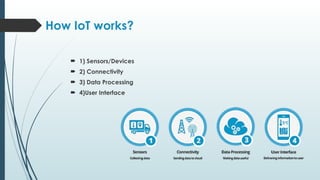
How IoT works?
 1) Sensors/Devices
 2) Connectivity
 3) Data Processing
 4)User Interface
1) Sensors/Devices
Sensors or devices are a key component that
helps you to collect live data from the
surrounding environment.
 All this data may have various levels of
complexities.
It could be a simple temperature monitoring
sensor, or it may be in the form of the video
feed.
2) Connectivity
All the collected data is sent to a cloud
infrastructure.
The sensors should be connected to the cloud
using various mediums of communications.
These communication mediums include mobile
or satellite networks, Bluetooth, WI-FI, WAN, etc.
3) Data Processing
 Once that data is collected, and it gets to the cloud,
the software performs processing on the gathered data.
 This process can be just checking the temperature,
reading on devices like AC or heaters.
 However, it can sometimes also be very complex like
identifying objects, using computer vision on video.
4)User Interface
• The information needs to be available to the end-user in some
way which can be achieved by triggering alarms on their
phones or sending them notification through email or text
message.
o The user sometimes might need an interface which actively
checks their IoT system.
• For example, the user has a camera installed in his home. He
wants to access video recording and all the feeds with the help
of a web server.
What is an example of an Internet of
Things device?
 A lightbulb that can be switched on using a smartphone
app is an IoT device, as is a motion sensor or a smart
thermostat in your office or a connected streetlight.
 An IoT device could be as fluffy as a child's toy or as
serious as a driverless truck.
 Some larger objects may themselves be filled with many
smaller IoT components, such as a jet engine that's now
filled with thousands of sensors collecting and transmitting
data back to make sure it is operating efficiently.
IoT benefits to organizations
monitor their overall business processes;
improve the customer experience (CX);
save time and money;
enhance employee productivity;
integrate and adapt business models;
make better business decisions; and
generate more revenue.
Why Is Internet of Things (IoT) so
important?
 Over the past few years, IoT has become one of the most
important technologies of the 21st century.
 Now that we can connect everyday objects—kitchen
appliances, cars, thermostats, baby monitors—to the
internet via embedded devices, seamless communication
is possible between people, processes, and things.
 By means of low-cost computing, the cloud, big data,
analytics, and mobile technologies, physical things can
share and collect data with minimal human intervention.
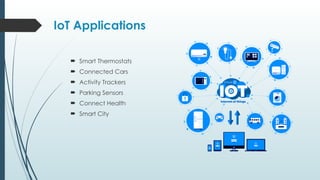
IoT Applications
 Smart Thermostats
 Connected Cars
 Activity Trackers
 Parking Sensors
 Connect Health
 Smart City
Challenges of Internet of Things (IoT)
 Insufficient testing and updating
 Concern regarding data security and privacy
 Software complexity
 Data volumes and interpretation
 Integration with AI and automation
 Devices require a constant power supply which is
difficult
 Interaction and short-range communication
Advantages of IoT
 Ability to access information from anywhere at any time
on any device;
 Improved communication between connected
electronic devices;
 Transferring data packets over a connected network
saving time and money; and
 Automating tasks helping to improve the quality of a
business's services and reducing the need for human
intervention.
Disadvantages IoT
 As the number of connected devices increases and more
information is shared between devices, the potential that a hacker
could steal confidential information also increases.
 Enterprises may eventually have to deal with massive numbers --
maybe even millions -- of IoT devices, and collecting and managing
the data from all those devices will be challenging.
 If there's a bug in the system, it's likely that every connected device
will become corrupted.
 Since there's no international standard of compatibility for IoT, it's
difficult for devices from different manufacturers to communicate
with each other.
References
Google.com
https://www.oracle.com
Studymafia.org
https://en.wikipedia.org/wiki/Internet_of_things
Thank You!!

IOT PPTbbdbfbfbfbfbfbfbfbfbfbfbffbb.pptx

  • 2.
    Presented By:- 1. BHUSHANJAYANT INGALE 2. PRAHARSH ABHAY PATIL 3. HITENDRA HEMRAJ YEOLE 4. PRATIKSH DHARMENDRA ROKADE
  • 3.
    Table Of Content History of Iot  Iot Definition  How IoT works?  What is an example of an Internet of Things device?  IoT benefits to organizations  Why Is Internet of Things (IoT) so important?  Iot Applications  Challenges of Internet of Things (IoT)  Advantages  Disadvantages  References
  • 4.
    History of IOT •1999-The term "Internet of Things" was used by Kevin Ashton during his work at P&G which became widely accepted •2004 - The term was mentioned in famous publications like the Guardian, Boston Globe, and Scientific American •2005-UN's International Telecommunications Union (ITU) published its first report on this topic. •2008- The Internet of Things was born •2011- Gartner, the market research company, include "The Internet of Things" technology in their research
  • 5.
    Iot Definition  “TheInternet of Things (IoT) is a system of interrelated computing devices, mechanical and digital machines, objects, animals or people that are provided with unique identifiers and the ability to transfer data over a network without requiring human-to- human or human-to-computer interaction.”
  • 6.
    How IoT works? 1) Sensors/Devices  2) Connectivity  3) Data Processing  4)User Interface
  • 7.
    1) Sensors/Devices Sensors ordevices are a key component that helps you to collect live data from the surrounding environment.  All this data may have various levels of complexities. It could be a simple temperature monitoring sensor, or it may be in the form of the video feed.
  • 8.
    2) Connectivity All thecollected data is sent to a cloud infrastructure. The sensors should be connected to the cloud using various mediums of communications. These communication mediums include mobile or satellite networks, Bluetooth, WI-FI, WAN, etc.
  • 9.
    3) Data Processing Once that data is collected, and it gets to the cloud, the software performs processing on the gathered data.  This process can be just checking the temperature, reading on devices like AC or heaters.  However, it can sometimes also be very complex like identifying objects, using computer vision on video.
  • 10.
    4)User Interface • Theinformation needs to be available to the end-user in some way which can be achieved by triggering alarms on their phones or sending them notification through email or text message. o The user sometimes might need an interface which actively checks their IoT system. • For example, the user has a camera installed in his home. He wants to access video recording and all the feeds with the help of a web server.
  • 11.
    What is anexample of an Internet of Things device?  A lightbulb that can be switched on using a smartphone app is an IoT device, as is a motion sensor or a smart thermostat in your office or a connected streetlight.  An IoT device could be as fluffy as a child's toy or as serious as a driverless truck.  Some larger objects may themselves be filled with many smaller IoT components, such as a jet engine that's now filled with thousands of sensors collecting and transmitting data back to make sure it is operating efficiently.
  • 12.
    IoT benefits toorganizations monitor their overall business processes; improve the customer experience (CX); save time and money; enhance employee productivity; integrate and adapt business models; make better business decisions; and generate more revenue.
  • 13.
    Why Is Internetof Things (IoT) so important?  Over the past few years, IoT has become one of the most important technologies of the 21st century.  Now that we can connect everyday objects—kitchen appliances, cars, thermostats, baby monitors—to the internet via embedded devices, seamless communication is possible between people, processes, and things.  By means of low-cost computing, the cloud, big data, analytics, and mobile technologies, physical things can share and collect data with minimal human intervention.
  • 14.
    IoT Applications  SmartThermostats  Connected Cars  Activity Trackers  Parking Sensors  Connect Health  Smart City
  • 15.
    Challenges of Internetof Things (IoT)  Insufficient testing and updating  Concern regarding data security and privacy  Software complexity  Data volumes and interpretation  Integration with AI and automation  Devices require a constant power supply which is difficult  Interaction and short-range communication
  • 16.
    Advantages of IoT Ability to access information from anywhere at any time on any device;  Improved communication between connected electronic devices;  Transferring data packets over a connected network saving time and money; and  Automating tasks helping to improve the quality of a business's services and reducing the need for human intervention.
  • 17.
    Disadvantages IoT  Asthe number of connected devices increases and more information is shared between devices, the potential that a hacker could steal confidential information also increases.  Enterprises may eventually have to deal with massive numbers -- maybe even millions -- of IoT devices, and collecting and managing the data from all those devices will be challenging.  If there's a bug in the system, it's likely that every connected device will become corrupted.  Since there's no international standard of compatibility for IoT, it's difficult for devices from different manufacturers to communicate with each other.
  • 18.
  • 19.