Submitted By:
Name : Rahul Kumar
Roll no : 20601
Section : A
BCA 2020-23
TABLE OF CONTENT
• History of Iot
• Iot Definition
• How IoT works?
• What is an example of an Internet of Things device?
• IoT benefits to organizations
• Why Is Internet of Things (IoT) so important?
• Iot Applications
• Challenges of Internet of Things (IoT)
• Advantages
• Disadvantages
• References
HISTORY OF IOT
•1999- The term "Internet of Things" was used by Kevin Ashton during his
work at P&G which became widely accepted
•2004 - The term was mentioned in famous publications like the Guardian,
Boston Globe, and Scientific American
•2005-UN's International Telecommunications Union (ITU) published its
first report on this topic.
•2008- The Internet of Things was born
•2011- Gartner, the market research company, include "The Internet of
Things" technology in their research
IOT DEFINITION
• “The Internet of Things (IoT) is a system of interrelated
computing devices, mechanical and digital machines, objects,
animals or people that are provided with unique identifiers and
the ability to transfer data over a network without requiring
human-to-human or human-to-computer interaction.”
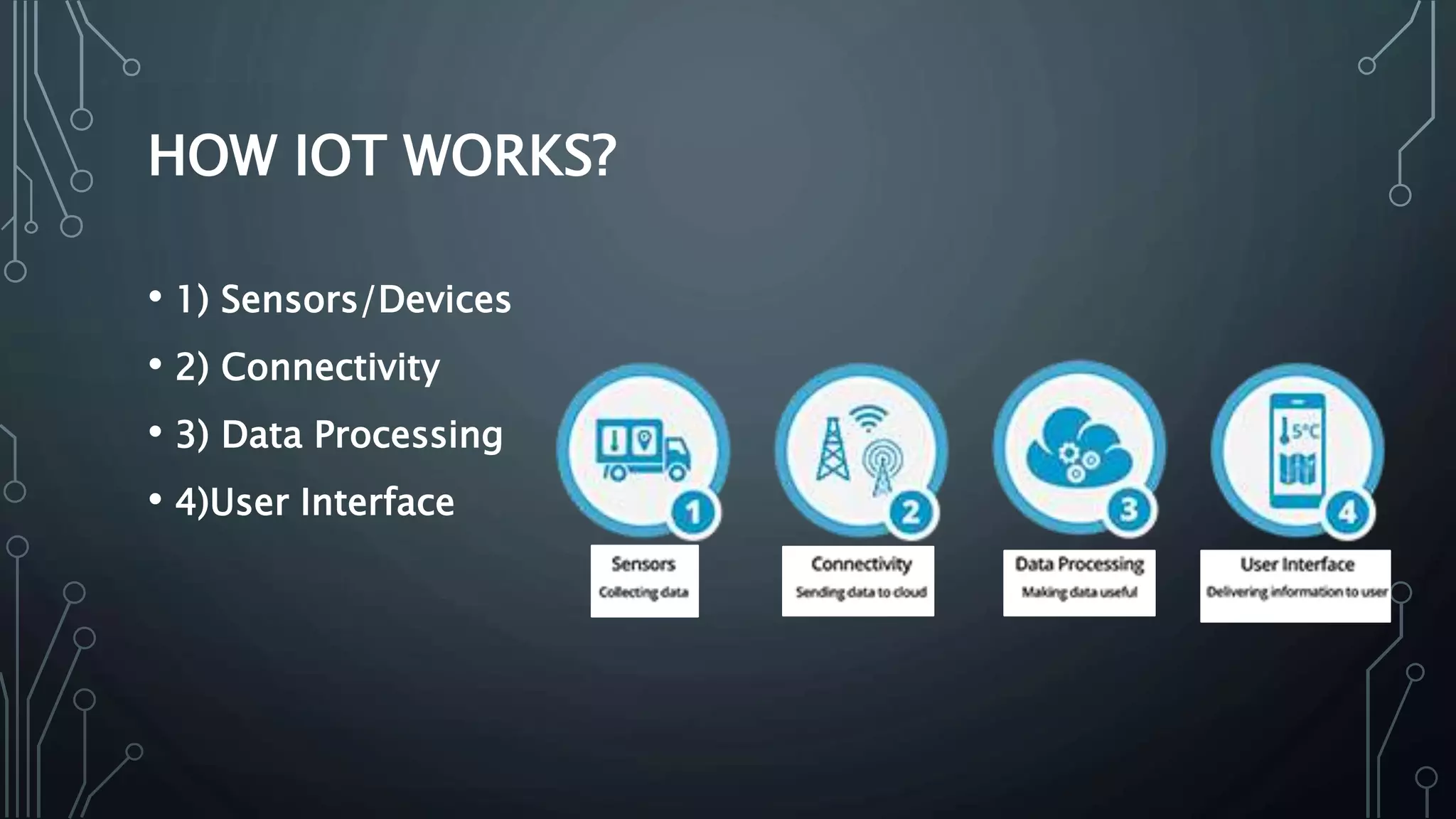
HOW IOT WORKS?
• 1) Sensors/Devices
• 2) Connectivity
• 3) Data Processing
• 4)User Interface
1) SENSORS/DEVICES
• Sensors or devices are a key component that helps you to
collect live data from the surrounding environment.
• All this data may have various levels of complexities.
• It could be a simple temperature monitoring sensor, or it may
be in the form of the video feed.
2) CONNECTIVITY
• All the collected data is sent to a cloud infrastructure.
• The sensors should be connected to the cloud using various
mediums of communications.
• These communication mediums include mobile or satellite
networks, Bluetooth, WI-FI, WAN, etc.
3) DATA PROCESSING
• Once that data is collected, and it gets to the cloud, the
software performs processing on the gathered data.
• This process can be just checking the temperature, reading on
devices like AC or heaters.
• However, it can sometimes also be very complex like
identifying objects, using computer vision on video.
4)USER INTERFACE
1. The information needs to be available to the end-user in some
way which can be achieved by triggering alarms on their
phones or sending them notification through email or text
message.
2. The user sometimes might need an interface which actively
checks their IoT system.
3. For example, the user has a camera installed in his home. He
wants to access video recording and all the feeds with the help
of a web server.
WHAT IS AN EXAMPLE OF AN INTERNET OF
THINGS DEVICE?
• A lightbulb that can be switched on using a smartphone app is an IoT
device, as is a motion sensor or a smart thermostat in your office or a
connected streetlight.
• An IoT device could be as fluffy as a child's toy or as serious as a
driverless truck.
• Some larger objects may themselves be filled with many smaller IoT
components, such as a jet engine that's now filled with thousands of
sensors collecting and transmitting data back to make sure it is
operating efficiently.
IOT BENEFITS TO ORGANIZATIONS
• monitor their overall business processes;
• improve the customer experience (CX);
• save time and money;
• enhance employee productivity;
• integrate and adapt business models;
• make better business decisions; and
• generate more revenue.
WHY IS INTERNET OF THINGS (IOT) SO
IMPORTANT?
• Over the past few years, IoT has become one of the most important
technologies of the 21st century.
• Now that we can connect everyday objects—kitchen appliances, cars,
thermostats, baby monitors—to the internet via embedded devices,
seamless communication is possible between people, processes, and
things.
• By means of low-cost computing, the cloud, big data, analytics, and
mobile technologies, physical things can share and collect data with
minimal human intervention.
IOT APPLICATIONS
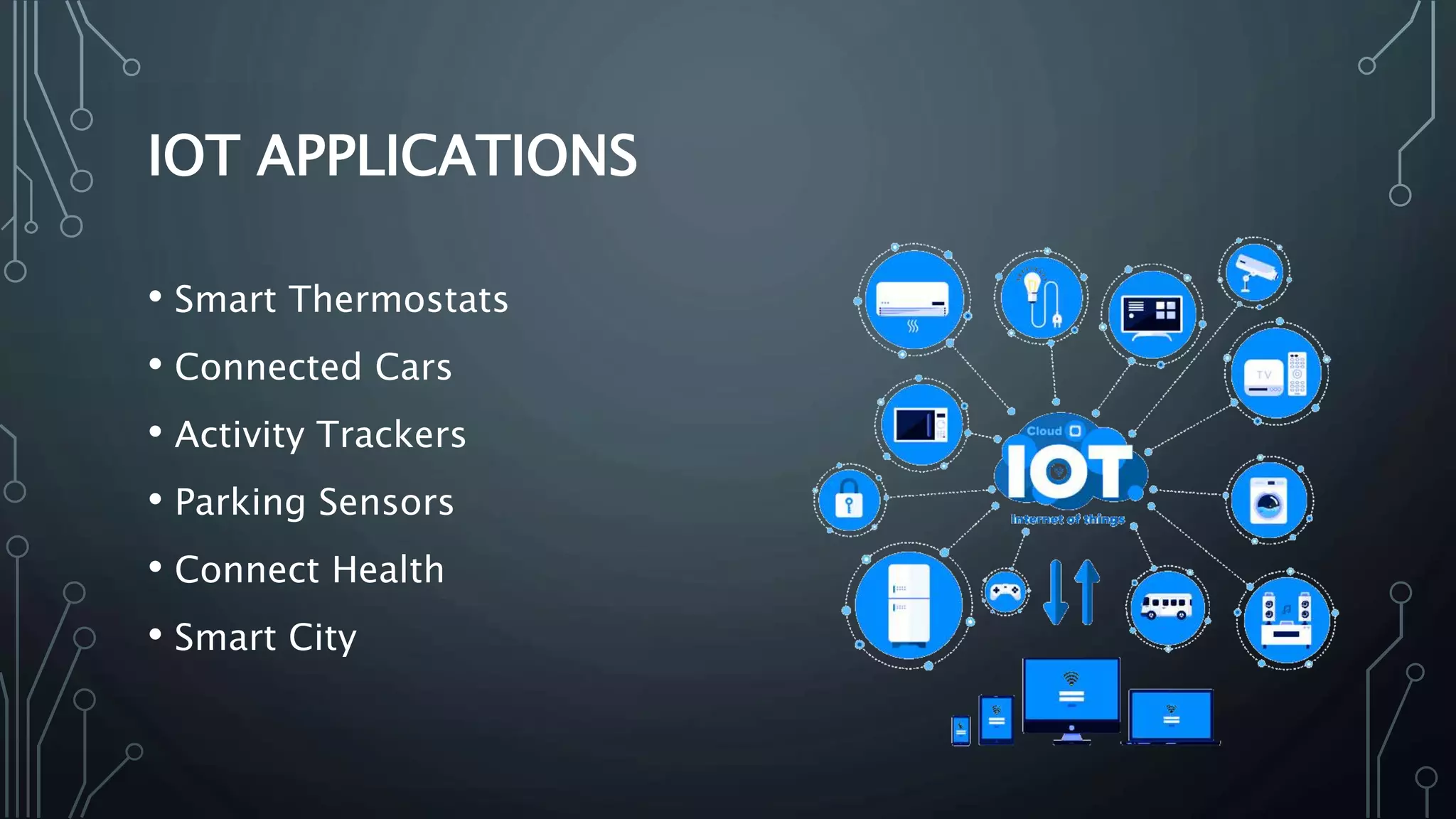
• Smart Thermostats
• Connected Cars
• Activity Trackers
• Parking Sensors
• Connect Health
• Smart City
CHALLENGES OF INTERNET OF THINGS (IOT)
• Insufficient testing and updating
• Concern regarding data security and privacy
• Software complexity
• Data volumes and interpretation
• Integration with AI and automation
• Devices require a constant power supply which is difficult
• Interaction and short-range communication
ADVANTAGES OF IOT
• Ability to access information from anywhere at any time on any
device;
• Improved communication between connected electronic
devices;
• Transferring data packets over a connected network saving
time and money; and
• Automating tasks helping to improve the quality of a business's
services and reducing the need for human intervention.
DISADVANTAGES IOT
• As the number of connected devices increases and more
information is shared between devices, the potential that a
hacker could steal confidential information also increases.
• Enterprises may eventually have to deal with massive numbers
-- maybe even millions -- of IoT devices, and collecting and
managing the data from all those devices will be challenging.
• If there's a bug in the system, it's likely that every connected
device will become corrupted.
• Since there's no international standard of compatibility for IoT,
it's difficult for devices from different manufacturers to
communicate with each other.
REFERENCES
• Google.com
• https://www.oracle.com
• https://en.wikipedia.org/wiki/Internet_of_things
THANK
YOU

Iot-Internet-of-Things-ppt.pptx

  • 1.
    Submitted By: Name :Rahul Kumar Roll no : 20601 Section : A BCA 2020-23
  • 2.
    TABLE OF CONTENT •History of Iot • Iot Definition • How IoT works? • What is an example of an Internet of Things device? • IoT benefits to organizations • Why Is Internet of Things (IoT) so important? • Iot Applications • Challenges of Internet of Things (IoT) • Advantages • Disadvantages • References
  • 3.
    HISTORY OF IOT •1999-The term "Internet of Things" was used by Kevin Ashton during his work at P&G which became widely accepted •2004 - The term was mentioned in famous publications like the Guardian, Boston Globe, and Scientific American •2005-UN's International Telecommunications Union (ITU) published its first report on this topic. •2008- The Internet of Things was born •2011- Gartner, the market research company, include "The Internet of Things" technology in their research
  • 4.
    IOT DEFINITION • “TheInternet of Things (IoT) is a system of interrelated computing devices, mechanical and digital machines, objects, animals or people that are provided with unique identifiers and the ability to transfer data over a network without requiring human-to-human or human-to-computer interaction.”
  • 5.
    HOW IOT WORKS? •1) Sensors/Devices • 2) Connectivity • 3) Data Processing • 4)User Interface
  • 6.
    1) SENSORS/DEVICES • Sensorsor devices are a key component that helps you to collect live data from the surrounding environment. • All this data may have various levels of complexities. • It could be a simple temperature monitoring sensor, or it may be in the form of the video feed.
  • 7.
    2) CONNECTIVITY • Allthe collected data is sent to a cloud infrastructure. • The sensors should be connected to the cloud using various mediums of communications. • These communication mediums include mobile or satellite networks, Bluetooth, WI-FI, WAN, etc.
  • 8.
    3) DATA PROCESSING •Once that data is collected, and it gets to the cloud, the software performs processing on the gathered data. • This process can be just checking the temperature, reading on devices like AC or heaters. • However, it can sometimes also be very complex like identifying objects, using computer vision on video.
  • 9.
    4)USER INTERFACE 1. Theinformation needs to be available to the end-user in some way which can be achieved by triggering alarms on their phones or sending them notification through email or text message. 2. The user sometimes might need an interface which actively checks their IoT system. 3. For example, the user has a camera installed in his home. He wants to access video recording and all the feeds with the help of a web server.
  • 10.
    WHAT IS ANEXAMPLE OF AN INTERNET OF THINGS DEVICE? • A lightbulb that can be switched on using a smartphone app is an IoT device, as is a motion sensor or a smart thermostat in your office or a connected streetlight. • An IoT device could be as fluffy as a child's toy or as serious as a driverless truck. • Some larger objects may themselves be filled with many smaller IoT components, such as a jet engine that's now filled with thousands of sensors collecting and transmitting data back to make sure it is operating efficiently.
  • 11.
    IOT BENEFITS TOORGANIZATIONS • monitor their overall business processes; • improve the customer experience (CX); • save time and money; • enhance employee productivity; • integrate and adapt business models; • make better business decisions; and • generate more revenue.
  • 12.
    WHY IS INTERNETOF THINGS (IOT) SO IMPORTANT? • Over the past few years, IoT has become one of the most important technologies of the 21st century. • Now that we can connect everyday objects—kitchen appliances, cars, thermostats, baby monitors—to the internet via embedded devices, seamless communication is possible between people, processes, and things. • By means of low-cost computing, the cloud, big data, analytics, and mobile technologies, physical things can share and collect data with minimal human intervention.
  • 13.
    IOT APPLICATIONS • SmartThermostats • Connected Cars • Activity Trackers • Parking Sensors • Connect Health • Smart City
  • 14.
    CHALLENGES OF INTERNETOF THINGS (IOT) • Insufficient testing and updating • Concern regarding data security and privacy • Software complexity • Data volumes and interpretation • Integration with AI and automation • Devices require a constant power supply which is difficult • Interaction and short-range communication
  • 15.
    ADVANTAGES OF IOT •Ability to access information from anywhere at any time on any device; • Improved communication between connected electronic devices; • Transferring data packets over a connected network saving time and money; and • Automating tasks helping to improve the quality of a business's services and reducing the need for human intervention.
  • 16.
    DISADVANTAGES IOT • Asthe number of connected devices increases and more information is shared between devices, the potential that a hacker could steal confidential information also increases. • Enterprises may eventually have to deal with massive numbers -- maybe even millions -- of IoT devices, and collecting and managing the data from all those devices will be challenging. • If there's a bug in the system, it's likely that every connected device will become corrupted. • Since there's no international standard of compatibility for IoT, it's difficult for devices from different manufacturers to communicate with each other.
  • 17.
    REFERENCES • Google.com • https://www.oracle.com •https://en.wikipedia.org/wiki/Internet_of_things
  • 18.