1
Computers Internet of Things(IoT)
and Cloud Computing
2
Internet of Things(IoT) :
IoT is a network of physical objects or people called "things" that are embedded
with software, electronics, network, and sensors that allows these objects to collect and
exchange data.
The goal of IoT is to extend to internet connectivity from standard devices like
computer, mobile, tablet to relatively dumb devices like a toaster.
IoT makes virtually everything "smart," by improving aspects of our life with the
power of data collection, AI algorithm, and networks. The thing in IoT can also be a person
with a diabetes monitor implant, an animal with tracking devices, etc.
Kevin Ashton, in a presentation of Procter & Gamble in 1999, coined the term
“Internet of Things“. Almost every area, device, sensor, software, etc are connected to
each other. The ability to access these devices through a smartphone or through a
computer is called IoT. These devices are accessed from a distance.
For example, an Air Conditioner’s sensor can gather the data regarding the
outside temperatures, and accordingly adjust its temperature to increase or decrease it
with respect to the outside climate. Similarly, your refrigerators can also adjust its
temperature accordingly. This is how devices can interact with a network.
3
History of IOT :
 1970- The actual idea of connected devices was proposed
 1990- John Romkey created a toaster which could be turned on/off over the
Internet
 1995- Siemens introduced the first cellular module built for M2M
 1999- The term "Internet of Things" was used by Kevin Ashton during his work
at P&G which became widely accepted
 2004 - The term was mentioned in famous publications like the Guardian,
Boston Globe, and Scientific American
 2005-UN's International Telecommunications Union (ITU) published its
first report on this topic.
 2008- The Internet of Things was born
 2011- Gartner, the market research company, include "The Internet of Things"
technology in their research
4
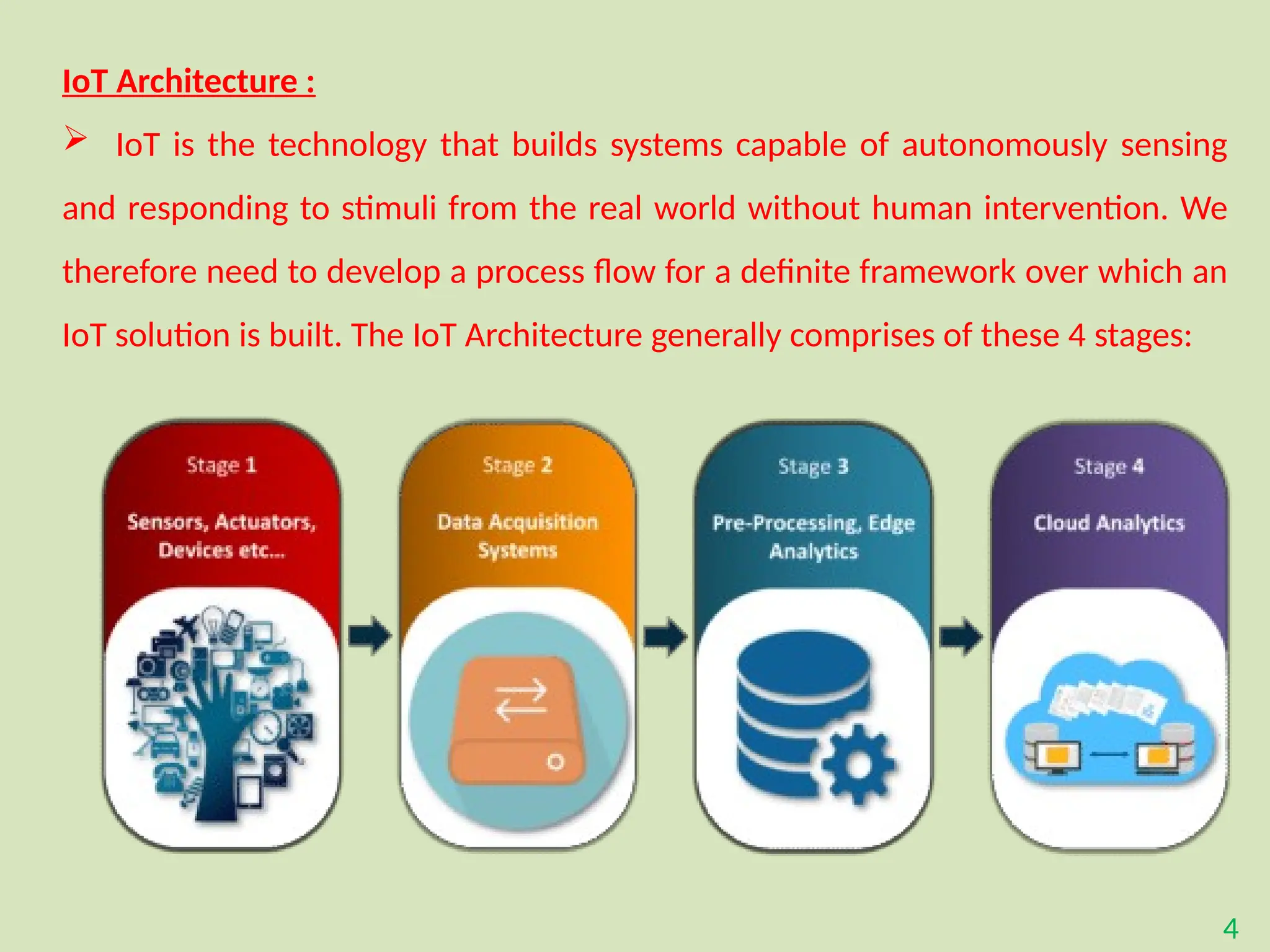
IoT Architecture :
 IoT is the technology that builds systems capable of autonomously sensing
and responding to stimuli from the real world without human intervention. We
therefore need to develop a process flow for a definite framework over which an
IoT solution is built. The IoT Architecture generally comprises of these 4 stages:
5
Stage 1 (Sensors/Actuators):
 A thing in the context of “Internet of Things”, should be equipped with sensors and
actuators thus giving the ability to emit, accept and process signals.
Stage 2 (Data Acquisition Systems):
 The data from the sensors starts in analogue form which needs to be aggregated and
converted into digital streams for further processing. Data acquisition systems perform
these data aggregation and conversion functions.
Stage 3 (Edge Analytics):
 Once IoT data has been digitized and aggregated, it may require further processing
before it enters the data center, this is where Edge Analytics comes in.
 Edge analytics is an approach to data collection and analysis in which an automated
analytical computation is performed on data at a sensor, network switch or other device
instead of waiting for the data to be sent back to a centralized data store.
Stage 4 (Cloud Analytics):
 Data that needs more in-depth processing gets forwarded to physical data centers or cloud-
based systems.
 Cloud analytics is the use of remote public or private computing resources— known as the
cloud—to analyze data on demand. Cloud computing analytics helps
streamline the business intelligence process of gathering, integrating, analyzing, and
presenting insights to enhance business decision making.
6
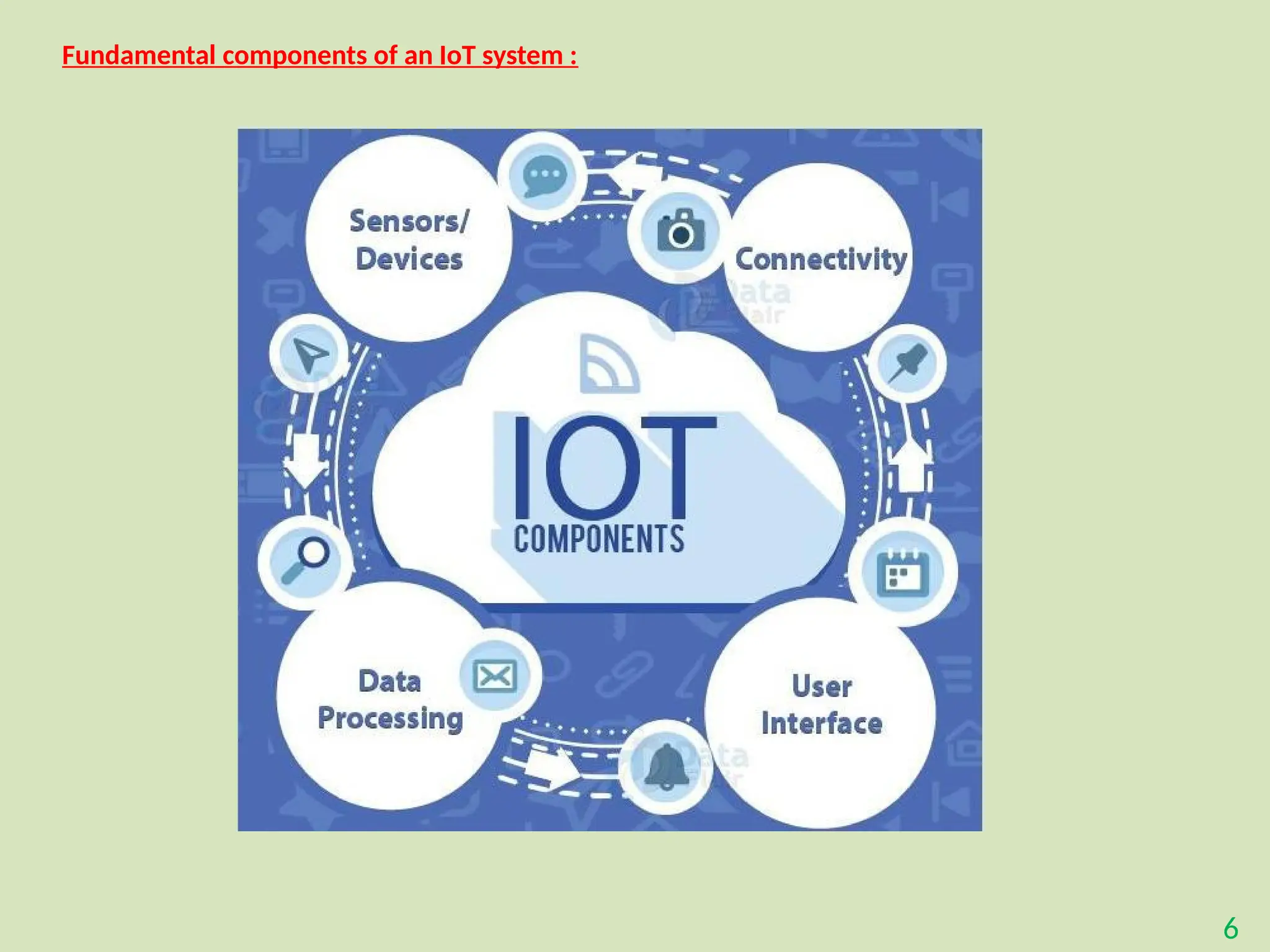
Fundamental components of an IoT system :
7
1) Sensors/Devices:
Sensors or devices are a key component that helps you to collect live data from
the surrounding environment. All this data may have various levels of complexities. It
could be a simple temperature monitoring sensor, or it may be in the form of the video
feed.
A device may have various types of sensors which performs multiple tasks apart
from sensing. Example, A mobile phone is a device which has multiple sensors like GPS,
camera but your smartphone is not able to sense these things.
2) Connectivity:
All the collected data is sent to a cloud infrastructure. The sensors should be
connected to the cloud using various mediums of communications. These communication
mediums include mobile or satellite networks, Bluetooth, WI-FI, WAN, etc.
3) Data Processing:
Once that data is collected, and it gets to the cloud, the software performs
processing on the gathered data. This process can be just checking the temperature,
reading on devices like AC or heaters. However, it can
sometimes also be very complex like identifying objects, using computer vision on video.
4) User Interface:
The information needs to be available to the end-user in some way which can be
achieved by triggering alarms on their phones or sending them notification through email
or text message. The user sometimes might need an interface which actively checks their
IOT system. For example, the user has a camera installed in his home. He wants to access
video recording and all the feeds with the help of a web server.
8
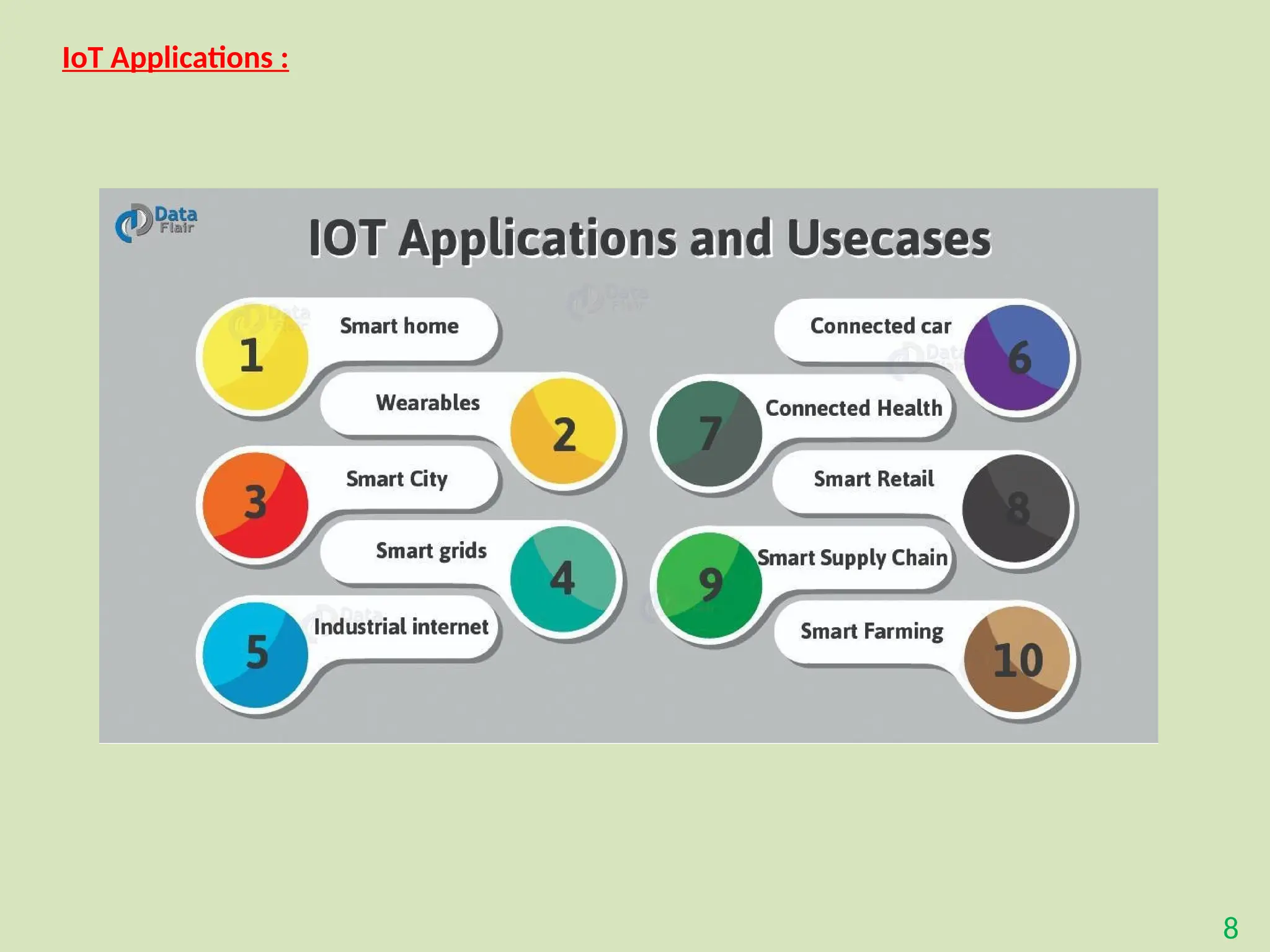
IoT Applications :
9
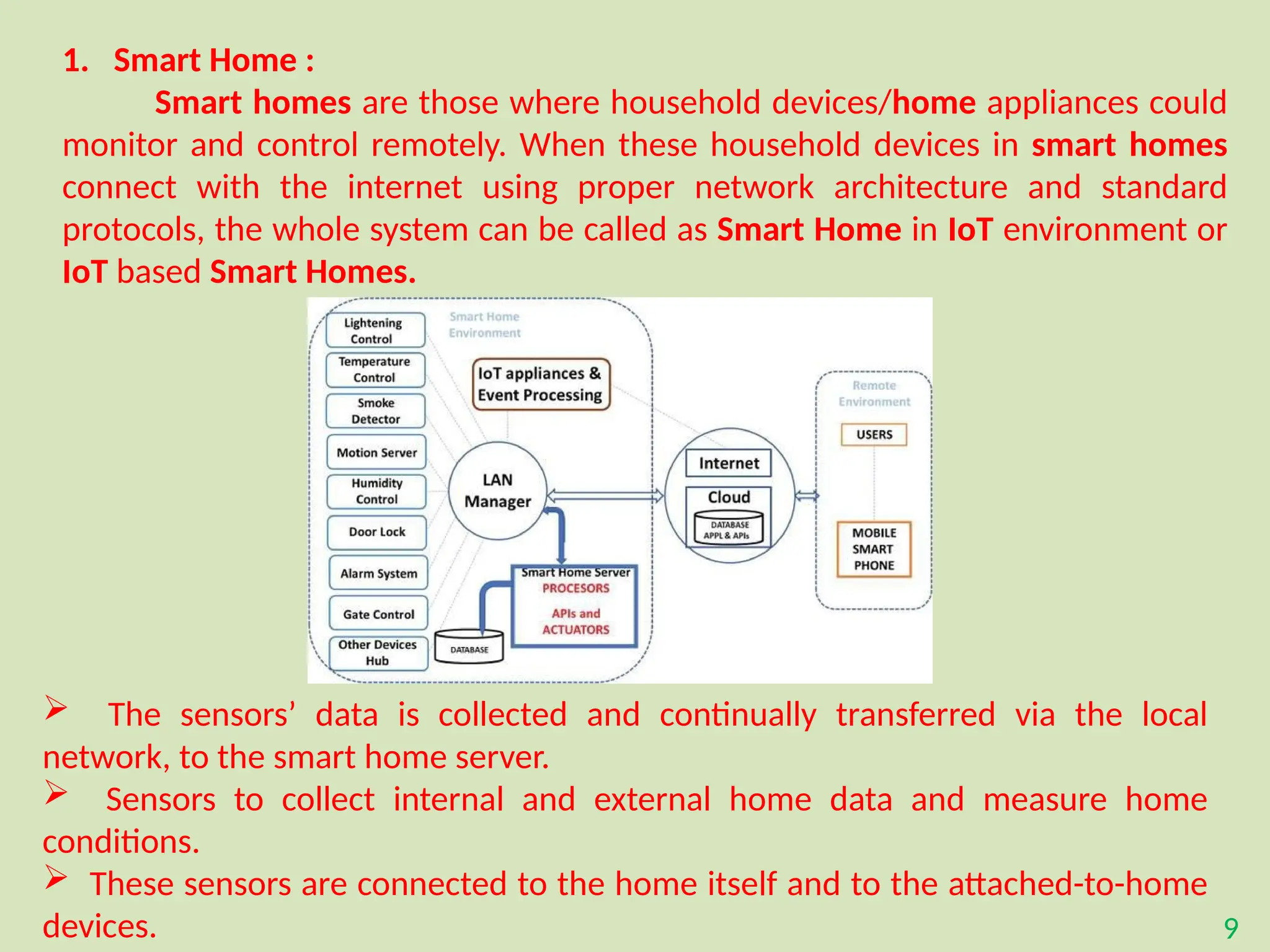
1. Smart Home :
Smart homes are those where household devices/home appliances could
monitor and control remotely. When these household devices in smart homes
connect with the internet using proper network architecture and standard
protocols, the whole system can be called as Smart Home in IoT environment or
IoT based Smart Homes.
 The sensors’ data is collected and continually transferred via the local
network, to the smart home server.
 Sensors to collect internal and external home data and measure home
conditions.
 These sensors are connected to the home itself and to the attached-to-home
devices.
10
Internet of things (IoT) :
The internet of things (IoT) paradigm refers to devices connected to the
internet.
 Devices are objects such as sensors and actuators, equipped with a
telecommunication interface, a processing unit, limited storage and software
applications.
 It enables the integration of objects into the internet, establishing the
interaction between people and devices among devices.
 The key technology of IoT includes radio frequency identification (RFID),
sensor technology and intelligence technology.
 RFID is the foundation and networking core of the construction of IoT.
 Its processing and communication capabilities along with unique
algorithms allows the integration of a variety of elements to operate as an
integrated unit but at the same time allow easy addition and removal of
components with minimum impact, making IoT robust but flexible to absorb
changes in the environment and user preferences
11
Cloud computing :
Cloud computing is a shared pool of computing resources ready to
provide a variety of computing services in different levels, from basic
infrastructure to most sophisticated application services, easily allocated and
released with minimal efforts or service provider interaction.
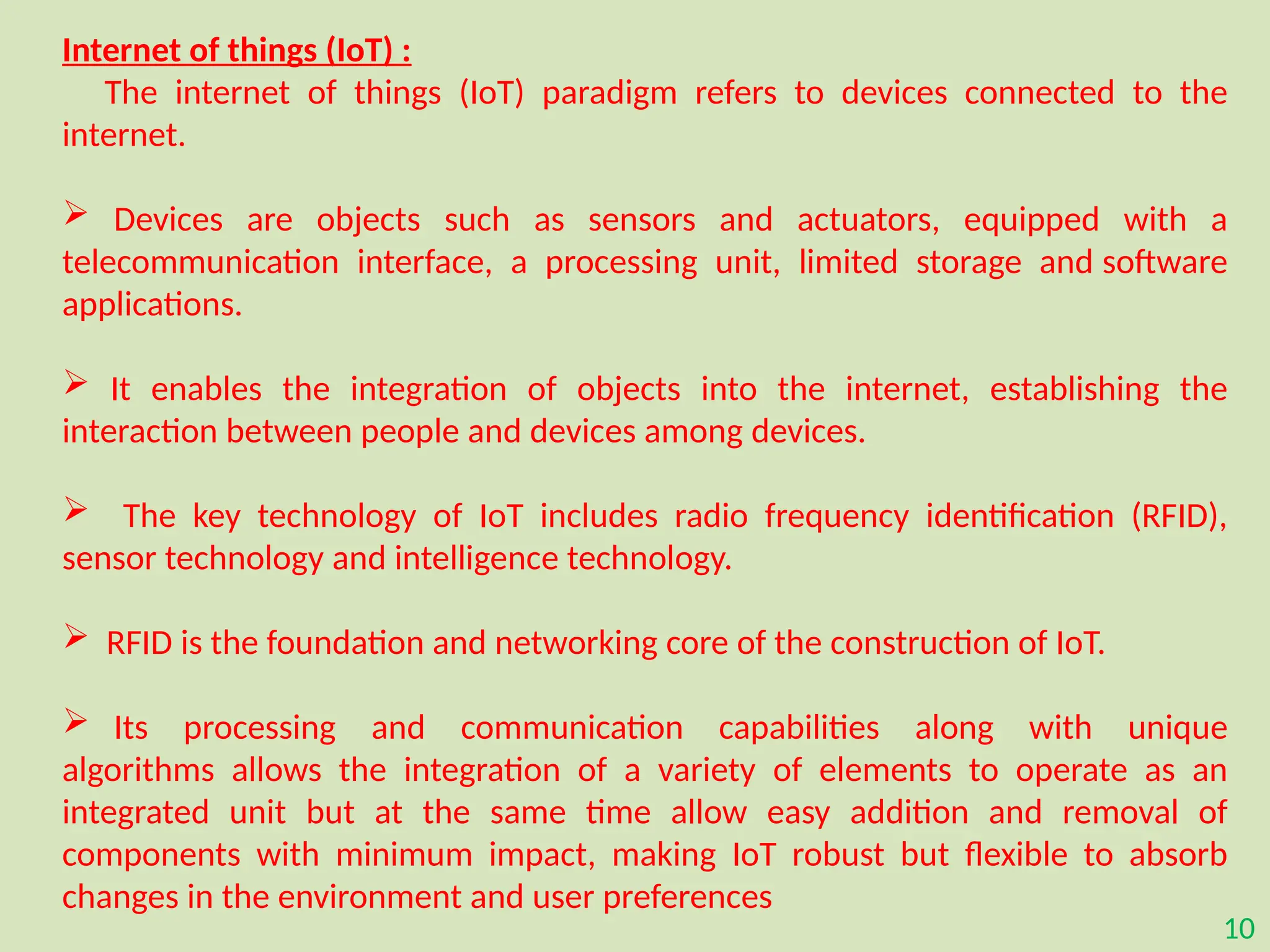
Internet of Things Applications – Smart Home
12
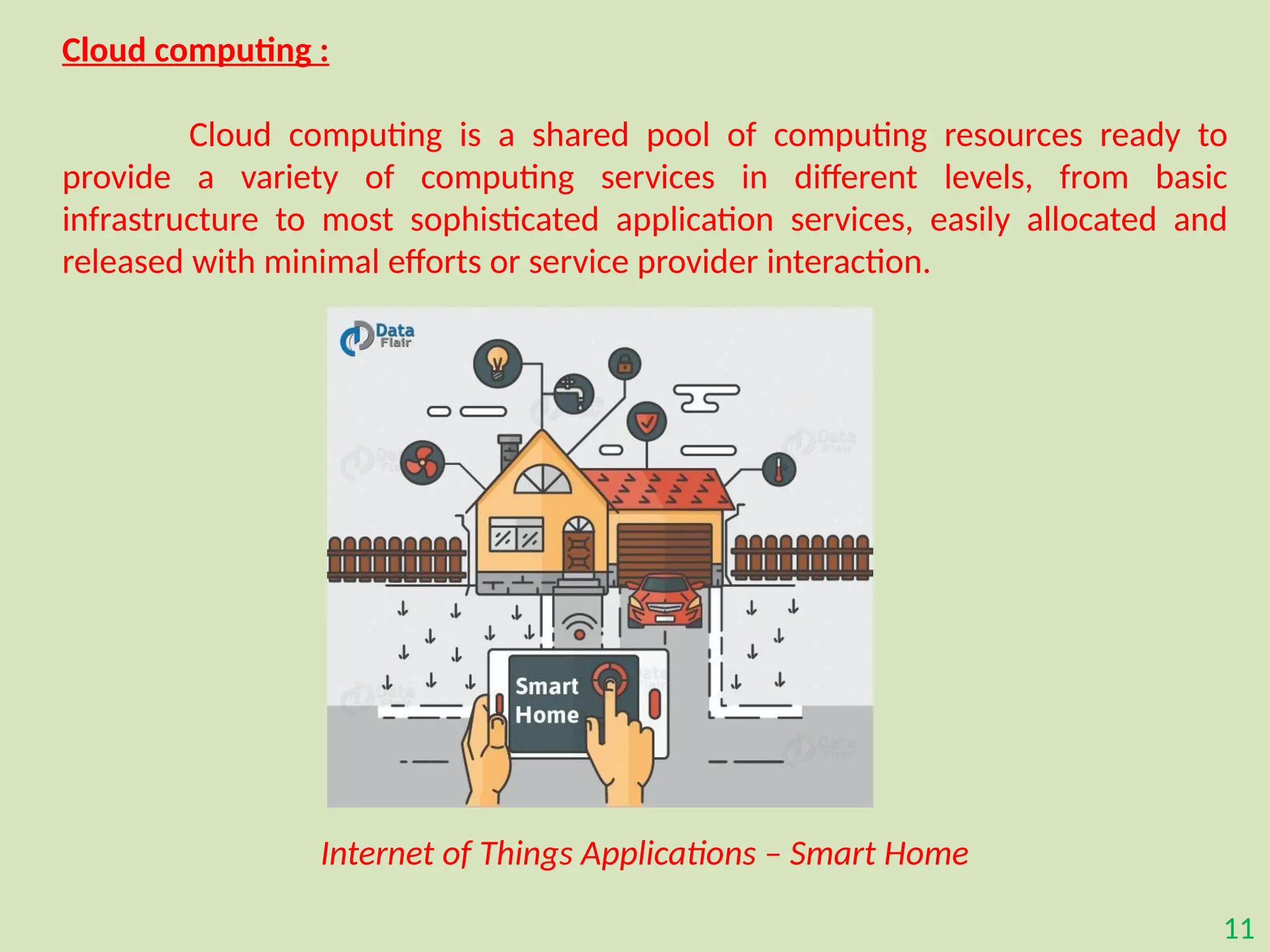
2. Smart City :
The smart city like the name suggests is a very big innovation and spans
a wide variety of use cases, from water distribution to traffic management to
waste management, environmental monitoring, and urban security. The reason
why it is so popular is that it tries to remove the discomfort and problems of
people who live in cities. IoT solutions offered in the Smart City area solve
various city-related problems comprising of traffic, reduce air and noise pollution
and help make cities safer.
IoT Applications – Smart City
13
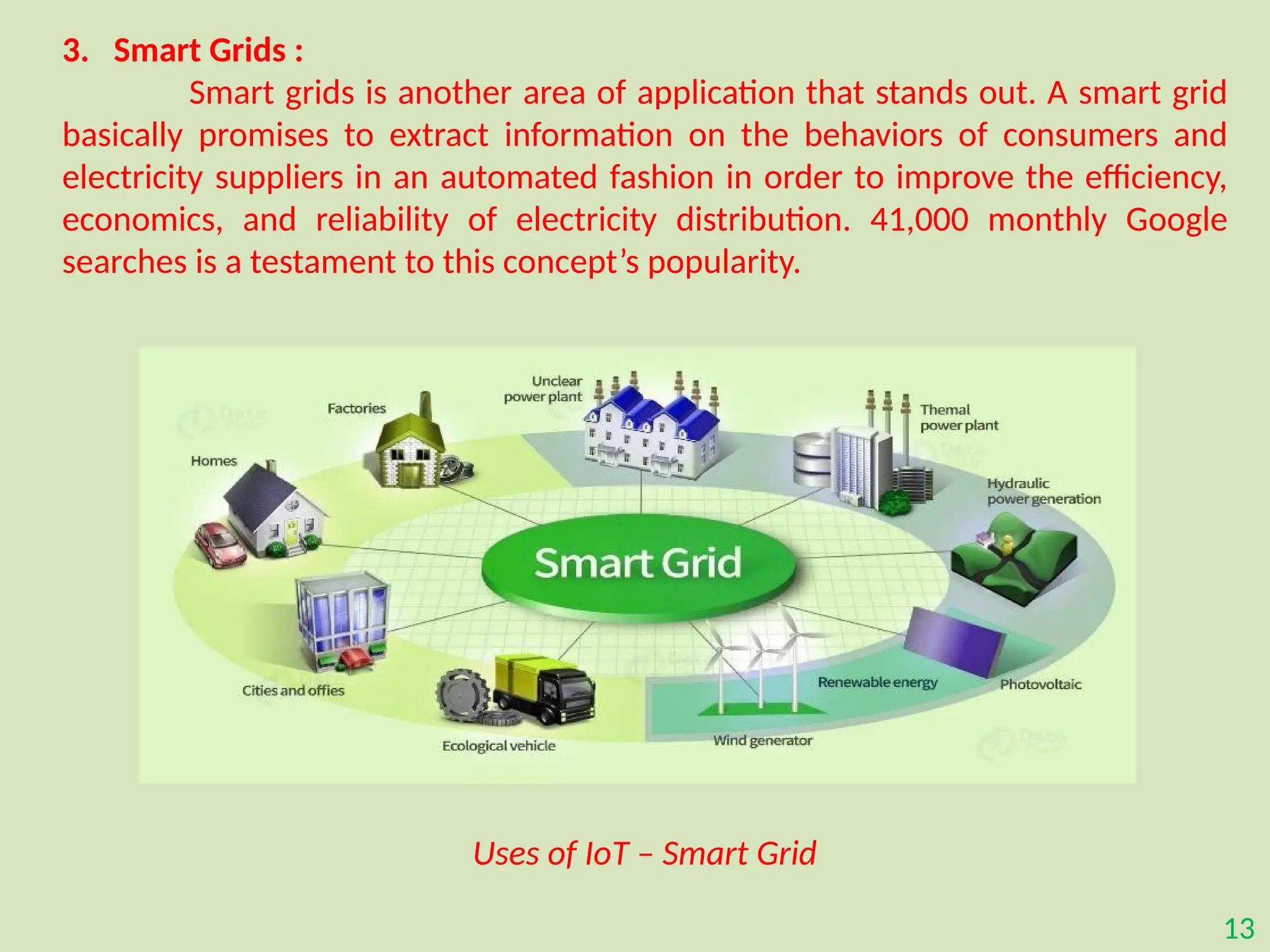
3. Smart Grids :
Smart grids is another area of application that stands out. A smart grid
basically promises to extract information on the behaviors of consumers and
electricity suppliers in an automated fashion in order to improve the efficiency,
economics, and reliability of electricity distribution. 41,000 monthly Google
searches is a testament to this concept’s popularity.
Uses of IoT – Smart Grid
14
4. Industrial Internet :
One way to think of the Industrial Internet is, as connecting machines
and devices in industries such as power generation, oil, gas, and healthcare. It is
also made use of in situations where unplanned downtime and system failures
can result in life-threatening situations. A system embedded with the IoT tends
to include devices such as fitness bands for heart monitoring or smart home
appliances. These systems are functional and can very well provide ease of use
but are not reliable because they do not typically create emergency situations if
a downtime was to occur.
15
5. Connected Car :
Connected car technology is a vast and an extensive network of multiple
sensors, antennas, embedded software, and technologies that assist in
communication to navigate in our complex world. It has the responsibility of
making decisions with consistency, accuracy, and speed. It also has to be reliable.
These requirements will become even more critical when humans give up
entirely the control of the steering wheel and brakes to the autonomous or
automated vehicles that are being successfully tested on our highways right now.
IoT Applications – Connected Car
16
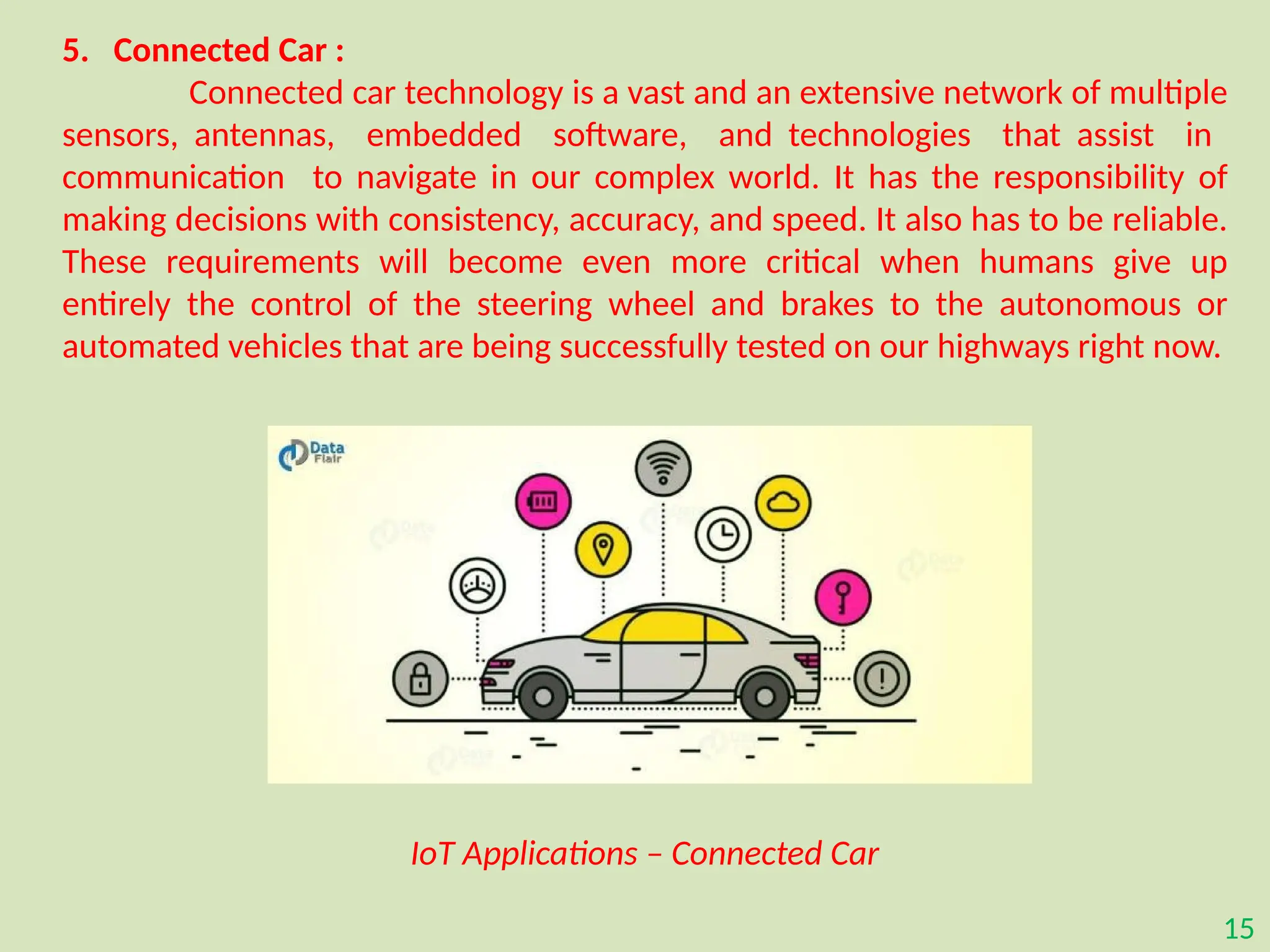
6. Connected Health (Digital Health/Telehealth/Telemedicine) :
IoT has various applications in healthcare, which are from remote
monitoring equipment to advance & smart sensors to equipment integration. It
has the potential to improve how physicians deliver care and also keep patients
safe and healthy. Healthcare IoT can allow patients to spend more time
interacting with their doctors by which it can boost patient engagement and
satisfaction. From personal fitness sensors to surgical robots, IoT in healthcare
brings new tools updated with the latest technology in the ecosystem that helps
in developing better healthcare. IoT helps in revolutionizing healthcare and
provides pocket-friendly solutions for the patient and healthcare professional.
Internet of Things Applications – Connected Health
17
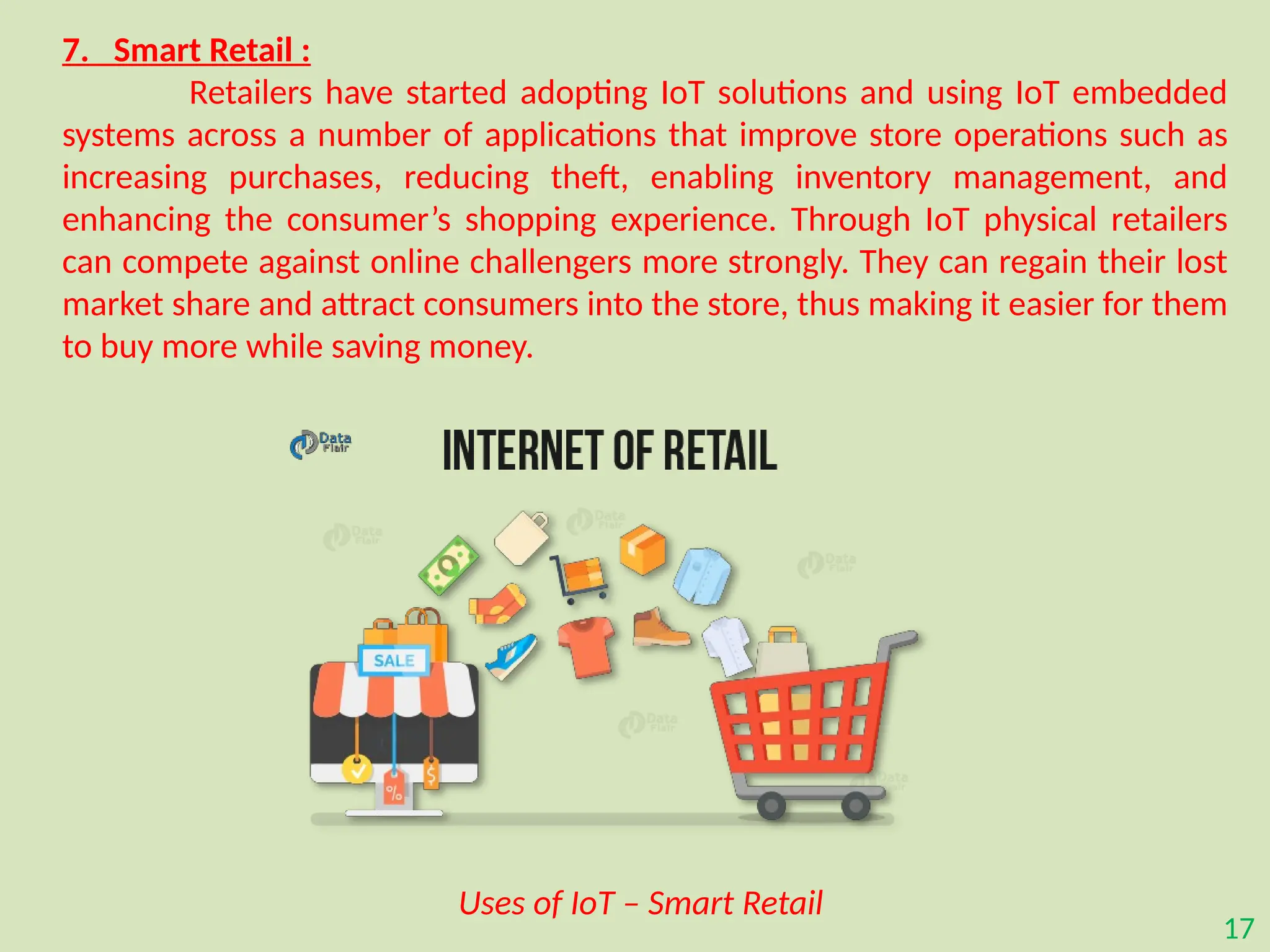
7. Smart Retail :
Retailers have started adopting IoT solutions and using IoT embedded
systems across a number of applications that improve store operations such as
increasing purchases, reducing theft, enabling inventory management, and
enhancing the consumer’s shopping experience. Through IoT physical retailers
can compete against online challengers more strongly. They can regain their lost
market share and attract consumers into the store, thus making it easier for them
to buy more while saving money.
Uses of IoT – Smart Retail
18
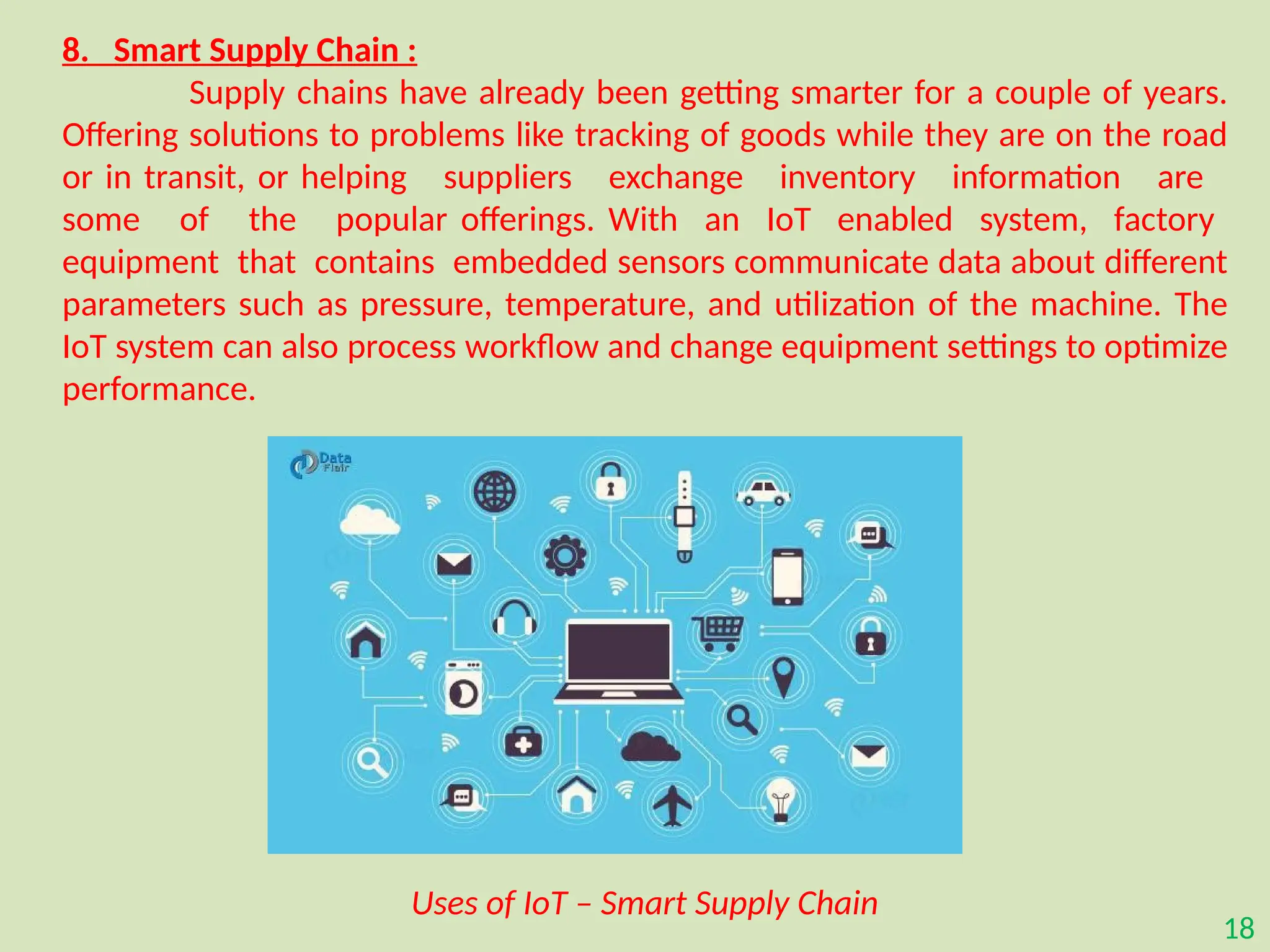
8. Smart Supply Chain :
Supply chains have already been getting smarter for a couple of years.
Offering solutions to problems like tracking of goods while they are on the road
or in transit, or helping suppliers exchange inventory information are
some of the popular offerings. With an IoT enabled system, factory
equipment that contains embedded sensors communicate data about different
parameters such as pressure, temperature, and utilization of the machine. The
IoT system can also process workflow and change equipment settings to optimize
performance.
Uses of IoT – Smart Supply Chain
19
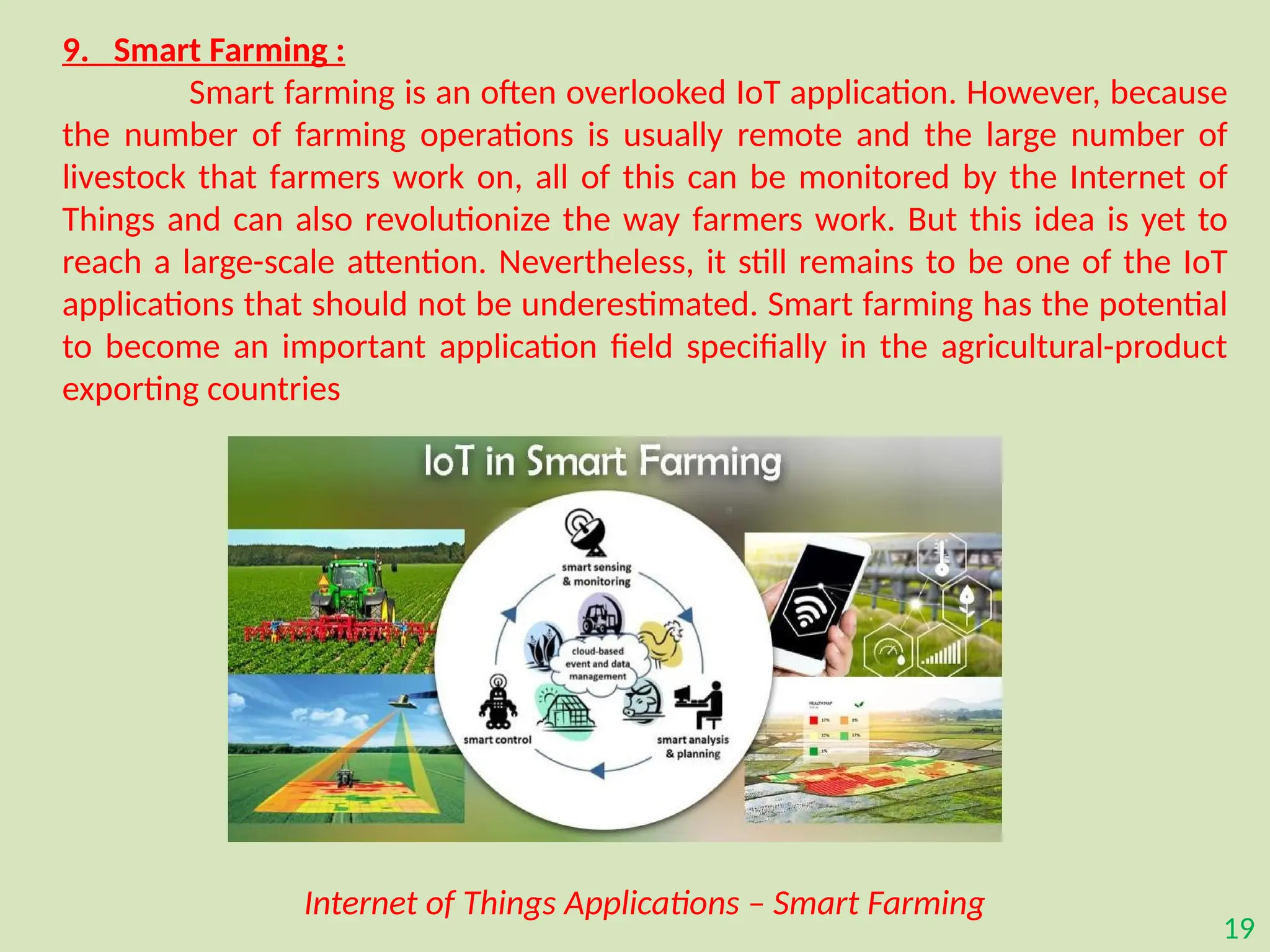
9. Smart Farming :
Smart farming is an often overlooked IoT application. However, because
the number of farming operations is usually remote and the large number of
livestock that farmers work on, all of this can be monitored by the Internet of
Things and can also revolutionize the way farmers work. But this idea is yet to
reach a large-scale attention. Nevertheless, it still remains to be one of the IoT
applications that should not be underestimated. Smart farming has the potential
to become an important application field specifially in the agricultural-product
exporting countries
Internet of Things Applications – Smart Farming
20
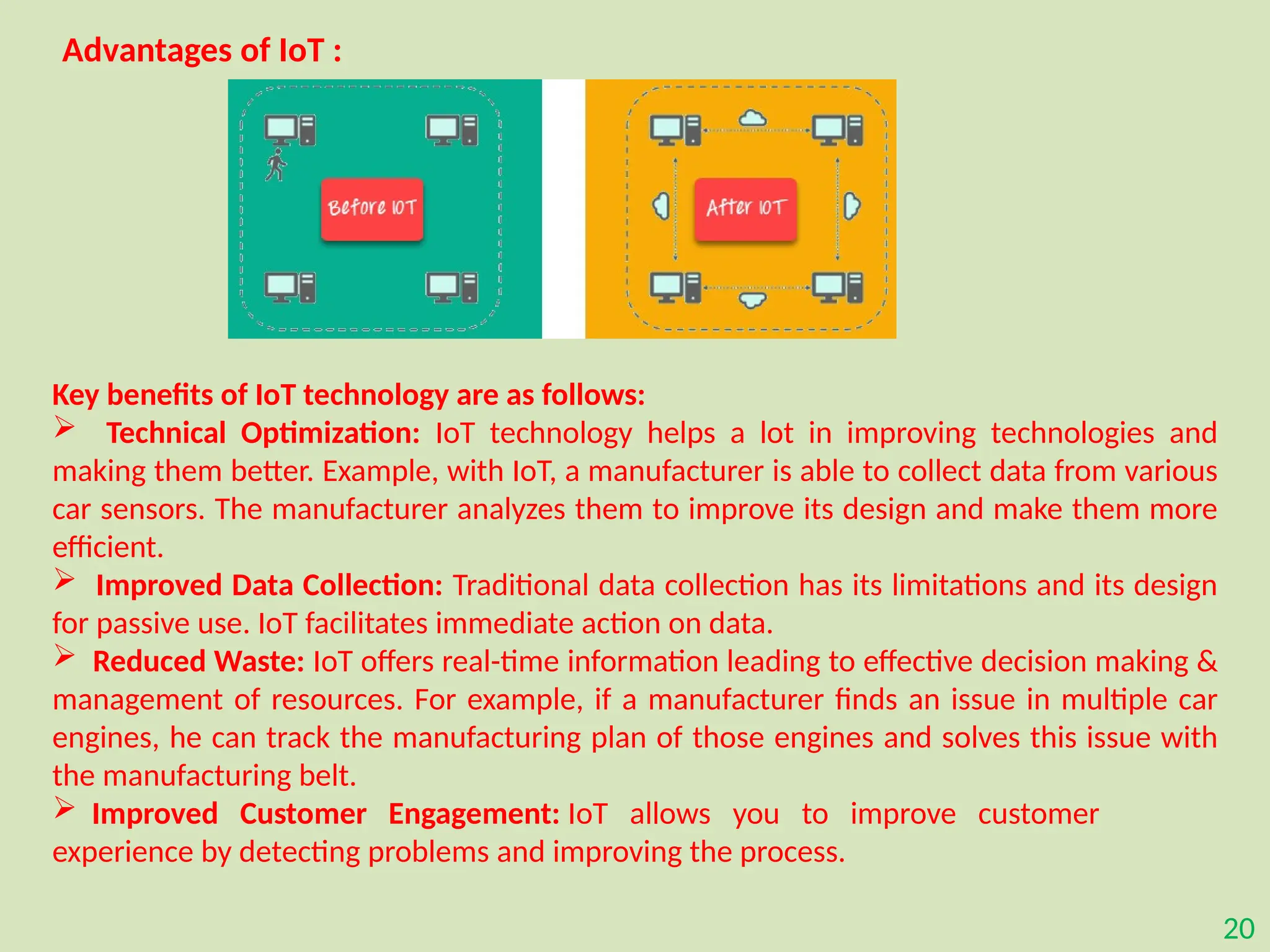
Advantages of IoT :
Key benefits of IoT technology are as follows:
 Technical Optimization: IoT technology helps a lot in improving technologies and
making them better. Example, with IoT, a manufacturer is able to collect data from various
car sensors. The manufacturer analyzes them to improve its design and make them more
efficient.
 Improved Data Collection: Traditional data collection has its limitations and its design
for passive use. IoT facilitates immediate action on data.
 Reduced Waste: IoT offers real-time information leading to effective decision making &
management of resources. For example, if a manufacturer finds an issue in multiple car
engines, he can track the manufacturing plan of those engines and solves this issue with
the manufacturing belt.
 Improved Customer Engagement: IoT allows you to improve customer
experience by detecting problems and improving the process.
21
Disadvantages IOT :
 Security: IoT technology creates an ecosystem of connected devices.
However, during this process, the system may offer little authentication control
despite sufficient security measures.
 Privacy: The use of IOT, exposes a substantial amount of personal data, in
extreme detail, without the user's active participation. This creates lots of privacy
issues.
 Flexibility: There is a huge concern regarding the flexibility of an IoT system. It
is mainly regarding integrating with another system as there are many diverse
systems involved in the process.
 Complexity: The design of the IOT system is also quite complicated. Moreover,
it's deployment and maintenance also not very easy.
 Compliance: IOT has its own set of rules and regulations. However, because of
its complexity, the task of compliance is quite challenging
22
Cloud Computing :
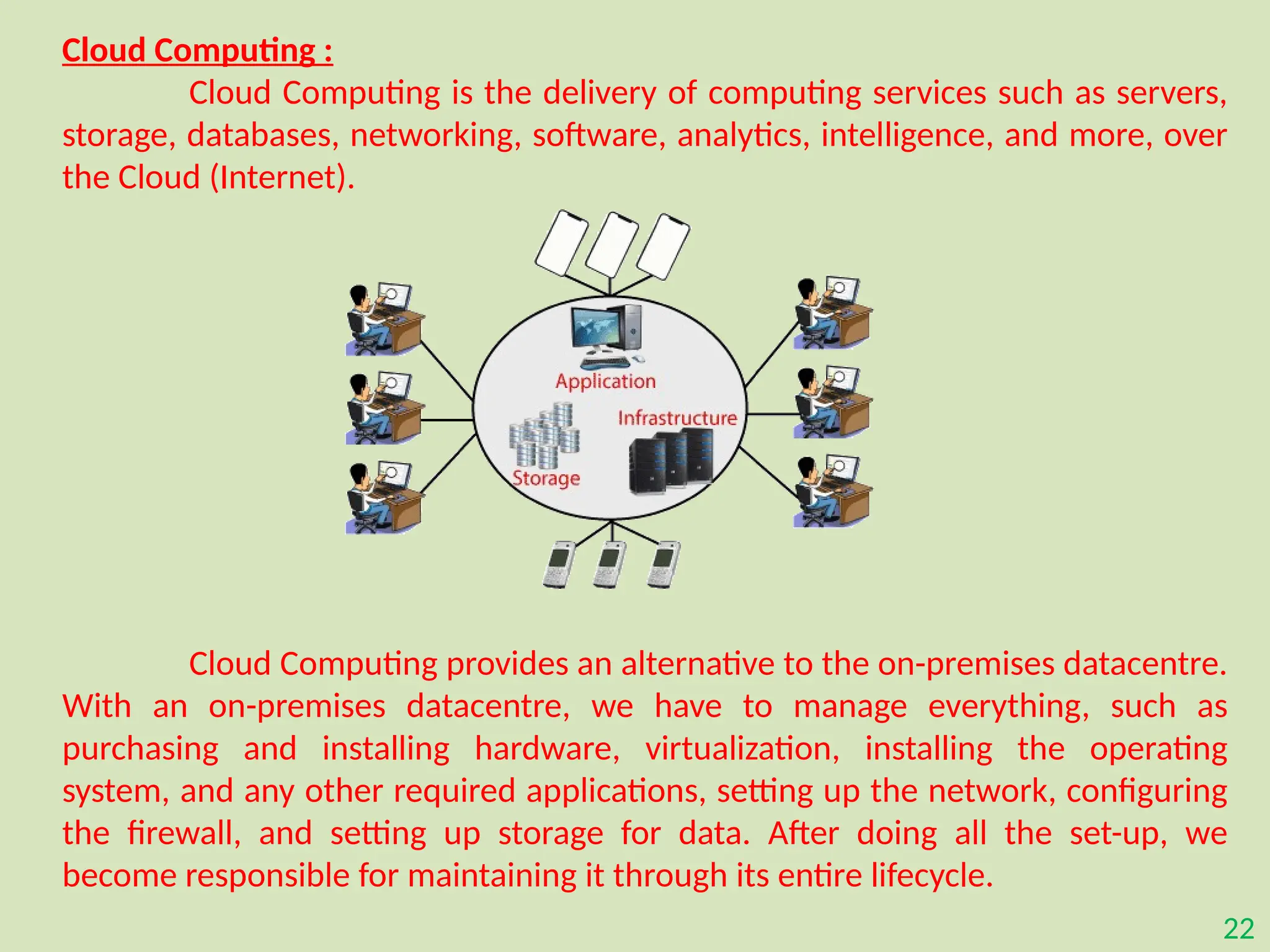
Cloud Computing is the delivery of computing services such as servers,
storage, databases, networking, software, analytics, intelligence, and more, over
the Cloud (Internet).
Cloud Computing provides an alternative to the on-premises datacentre.
With an on-premises datacentre, we have to manage everything, such as
purchasing and installing hardware, virtualization, installing the operating
system, and any other required applications, setting up the network, configuring
the firewall, and setting up storage for data. After doing all the set-up, we
become responsible for maintaining it through its entire lifecycle.
23
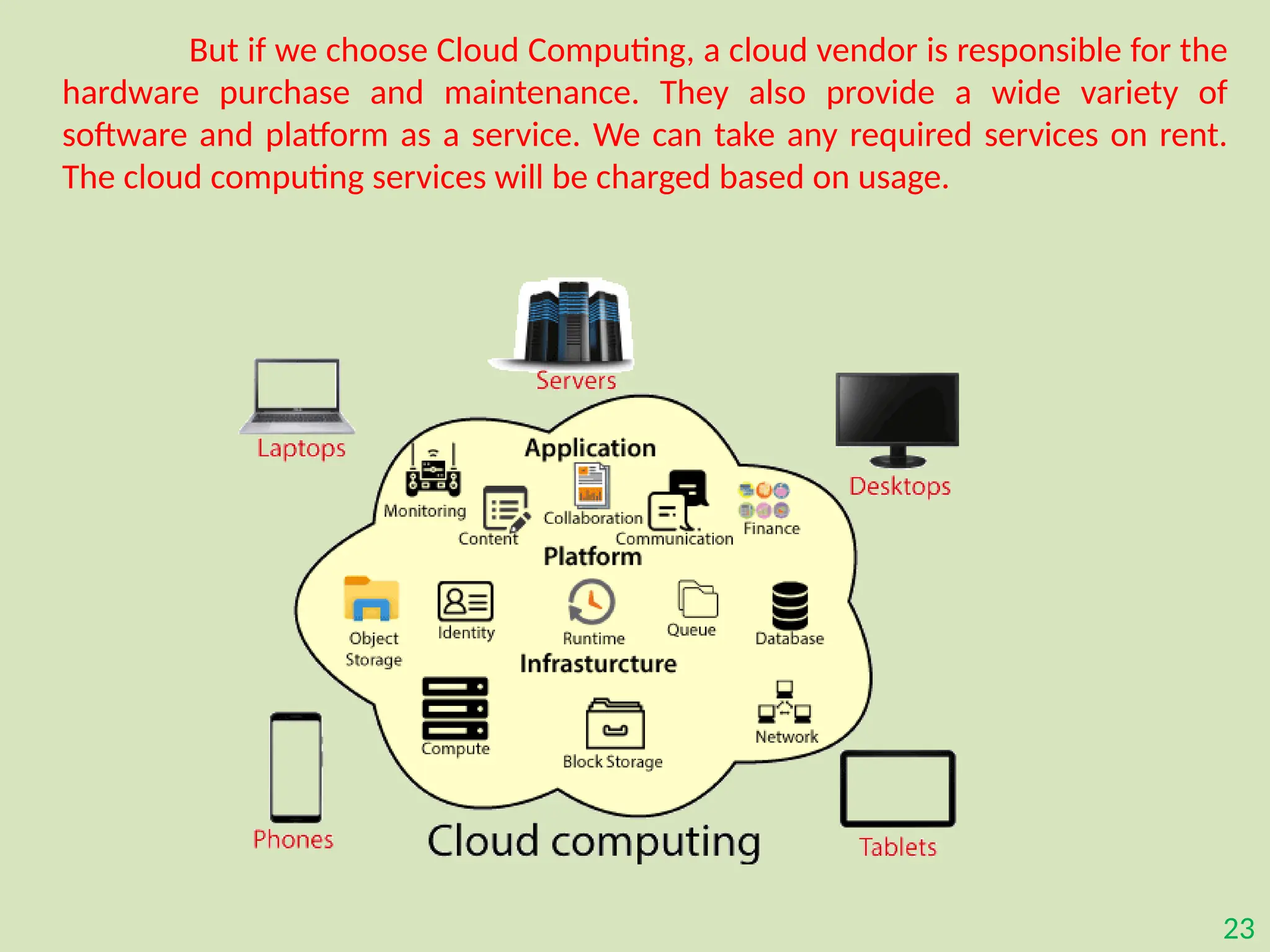
But if we choose Cloud Computing, a cloud vendor is responsible for the
hardware purchase and maintenance. They also provide a wide variety of
software and platform as a service. We can take any required services on rent.
The cloud computing services will be charged based on usage.
24
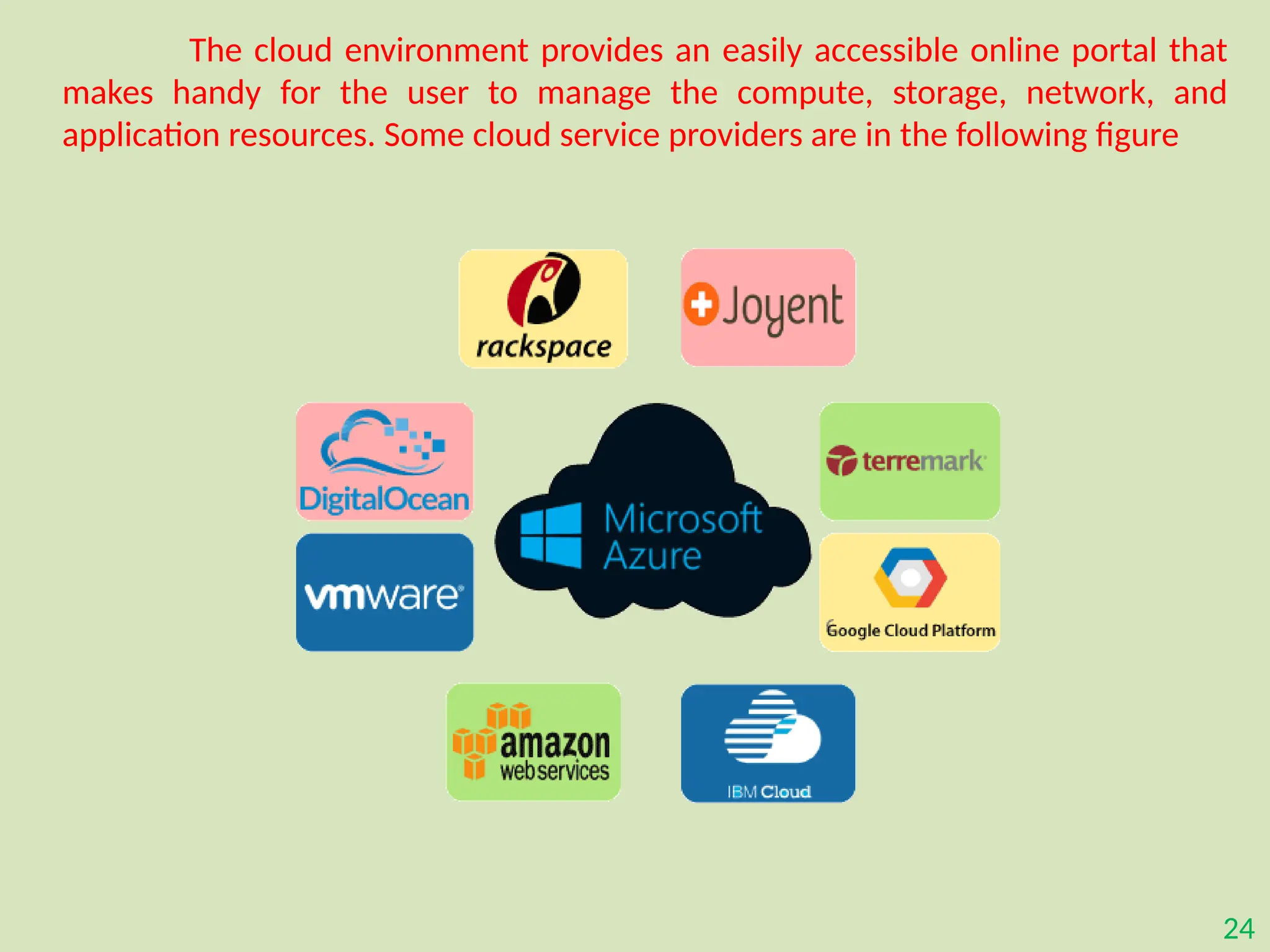
The cloud environment provides an easily accessible online portal that
makes handy for the user to manage the compute, storage, network, and
application resources. Some cloud service providers are in the following figure
25
Advantages of cloud computing :
 Cost: It reduces the huge capital costs of buying hardware and software.
 Speed: Resources can be accessed in minutes, typically within a few clicks.
 Scalability: We can increase or decrease the requirement of
resources according to the business requirements.
 Productivity: While using cloud computing, we put less operational effort.
We do not need to apply patching, as well as no need to maintain hardware
and software. So, in this way, the IT team can be more productive and focus
on achieving business goals.
 Reliability: Backup and recovery of data are less expensive and very fast
for business continuity.
 Security: Many cloud vendors offer a broad set of policies, technologies,
and controls that strengthen our data security.
26
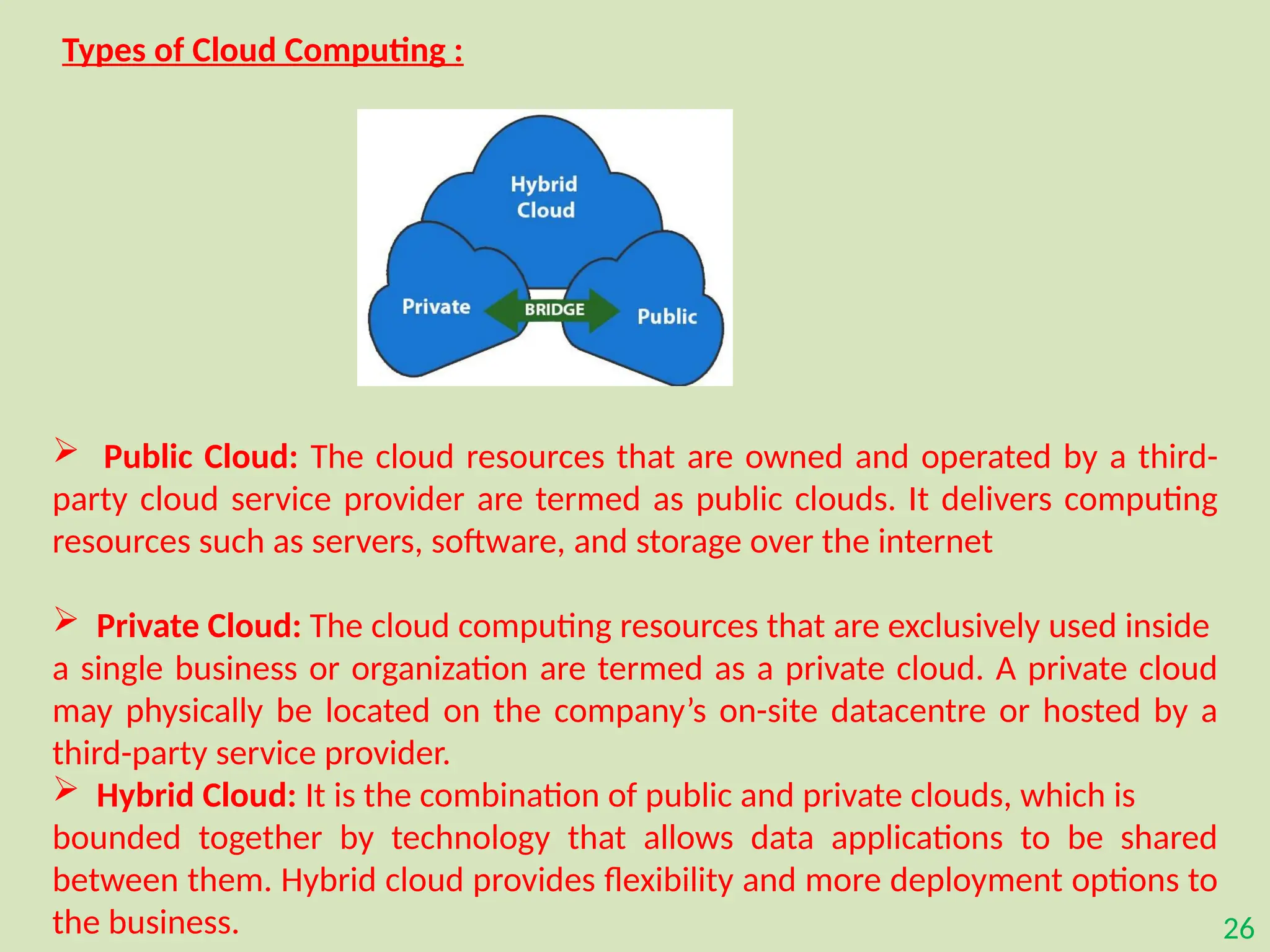
Types of Cloud Computing :
 Public Cloud: The cloud resources that are owned and operated by a third-
party cloud service provider are termed as public clouds. It delivers computing
resources such as servers, software, and storage over the internet
 Private Cloud: The cloud computing resources that are exclusively used inside
a single business or organization are termed as a private cloud. A private cloud
may physically be located on the company’s on-site datacentre or hosted by a
third-party service provider.
 Hybrid Cloud: It is the combination of public and private clouds, which is
bounded together by technology that allows data applications to be shared
between them. Hybrid cloud provides flexibility and more deployment options to
the business.
27
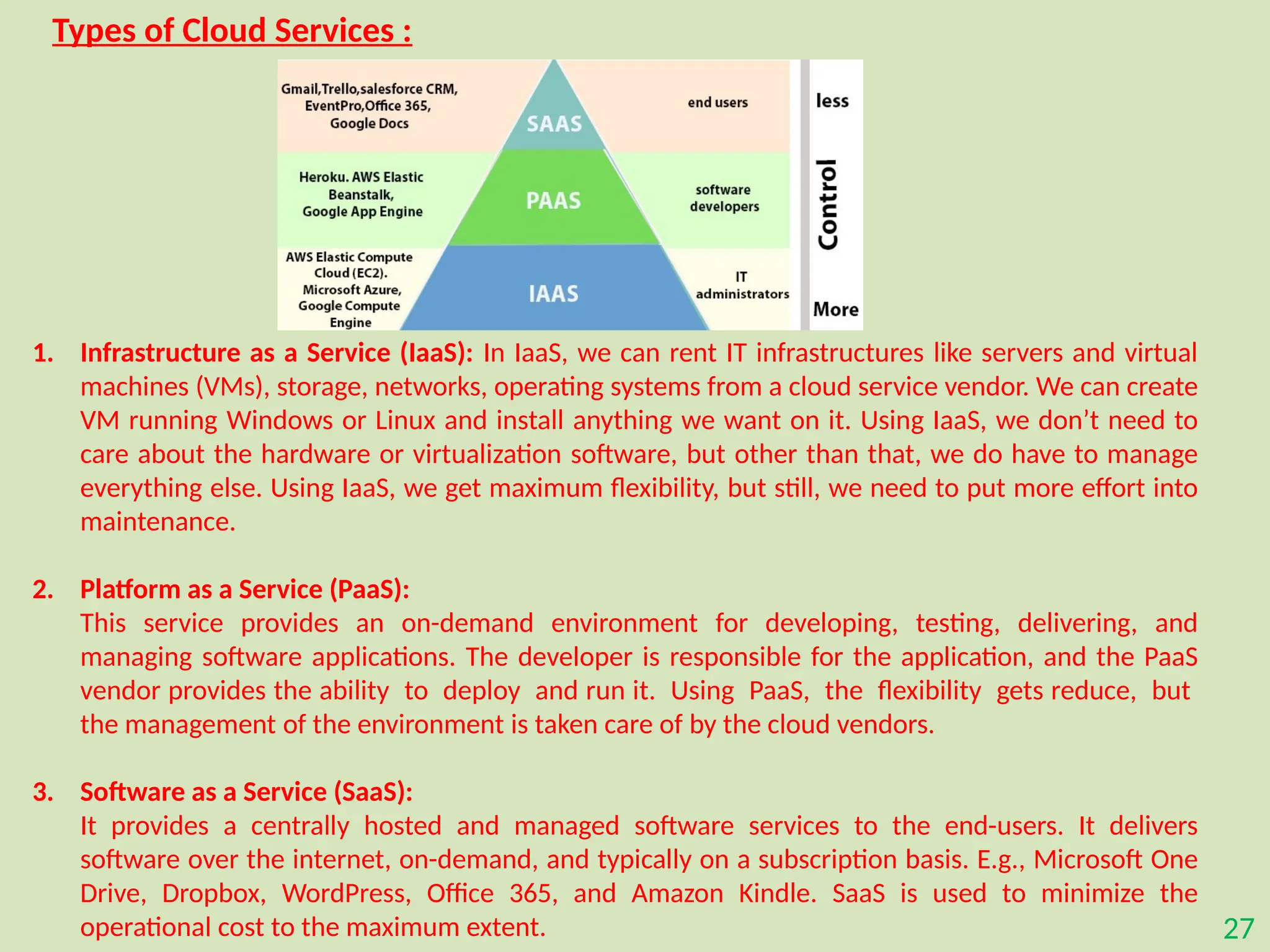
Types of Cloud Services :
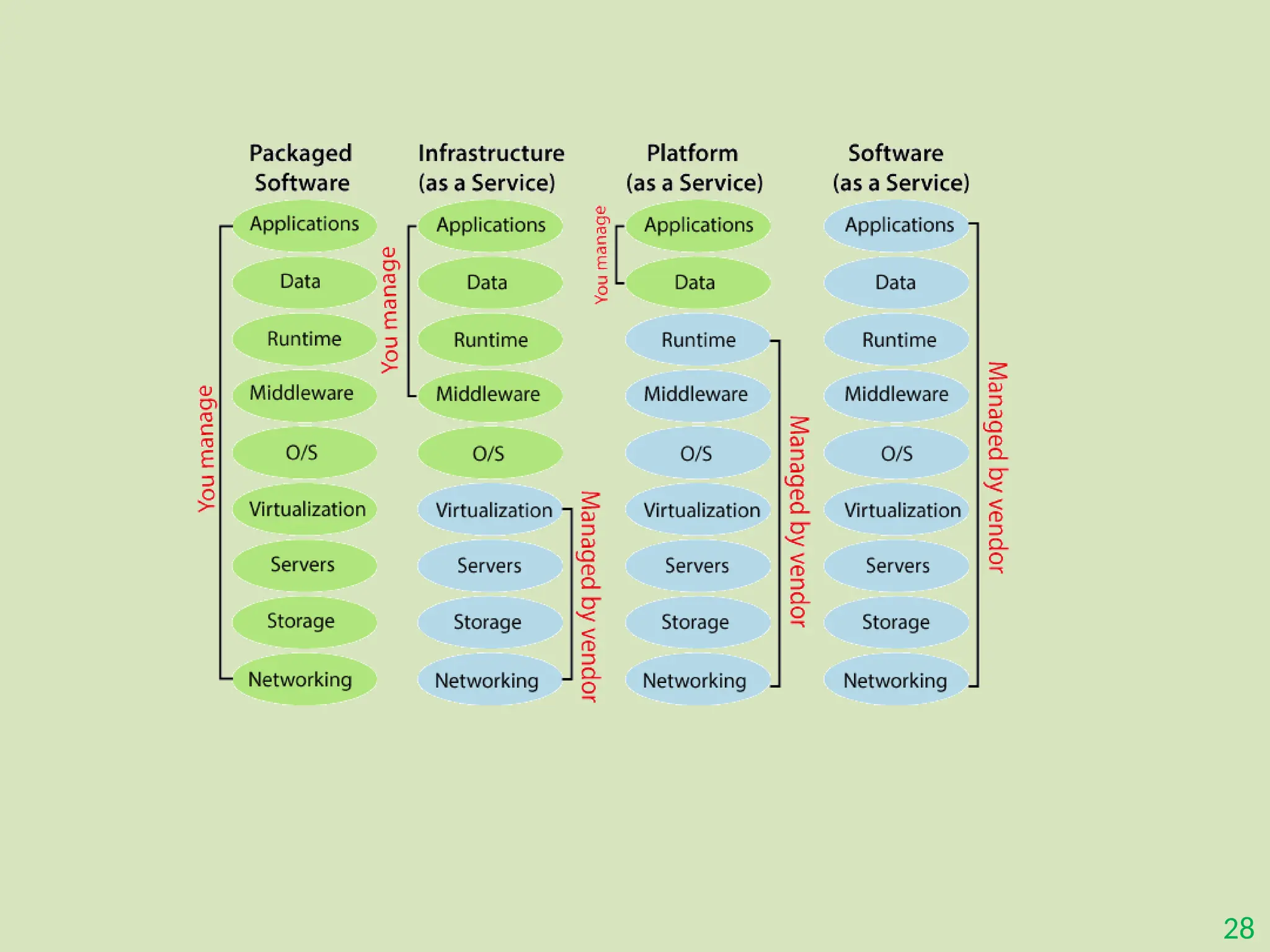
1. Infrastructure as a Service (IaaS): In IaaS, we can rent IT infrastructures like servers and virtual
machines (VMs), storage, networks, operating systems from a cloud service vendor. We can create
VM running Windows or Linux and install anything we want on it. Using IaaS, we don’t need to
care about the hardware or virtualization software, but other than that, we do have to manage
everything else. Using IaaS, we get maximum flexibility, but still, we need to put more effort into
maintenance.
2. Platform as a Service (PaaS):
This service provides an on-demand environment for developing, testing, delivering, and
managing software applications. The developer is responsible for the application, and the PaaS
vendor provides the ability to deploy and run it. Using PaaS, the flexibility gets reduce, but
the management of the environment is taken care of by the cloud vendors.
3. Software as a Service (SaaS):
It provides a centrally hosted and managed software services to the end-users. It delivers
software over the internet, on-demand, and typically on a subscription basis. E.g., Microsoft One
Drive, Dropbox, WordPress, Office 365, and Amazon Kindle. SaaS is used to minimize the
operational cost to the maximum extent.
28
29
Computers Internet of Things(IoT)
and Cloud Computing

17. Computers Internet of Things(IoT) and Cloud Computing.pptx

  • 1.
    1 Computers Internet ofThings(IoT) and Cloud Computing
  • 2.
    2 Internet of Things(IoT): IoT is a network of physical objects or people called "things" that are embedded with software, electronics, network, and sensors that allows these objects to collect and exchange data. The goal of IoT is to extend to internet connectivity from standard devices like computer, mobile, tablet to relatively dumb devices like a toaster. IoT makes virtually everything "smart," by improving aspects of our life with the power of data collection, AI algorithm, and networks. The thing in IoT can also be a person with a diabetes monitor implant, an animal with tracking devices, etc. Kevin Ashton, in a presentation of Procter & Gamble in 1999, coined the term “Internet of Things“. Almost every area, device, sensor, software, etc are connected to each other. The ability to access these devices through a smartphone or through a computer is called IoT. These devices are accessed from a distance. For example, an Air Conditioner’s sensor can gather the data regarding the outside temperatures, and accordingly adjust its temperature to increase or decrease it with respect to the outside climate. Similarly, your refrigerators can also adjust its temperature accordingly. This is how devices can interact with a network.
  • 3.
    3 History of IOT:  1970- The actual idea of connected devices was proposed  1990- John Romkey created a toaster which could be turned on/off over the Internet  1995- Siemens introduced the first cellular module built for M2M  1999- The term "Internet of Things" was used by Kevin Ashton during his work at P&G which became widely accepted  2004 - The term was mentioned in famous publications like the Guardian, Boston Globe, and Scientific American  2005-UN's International Telecommunications Union (ITU) published its first report on this topic.  2008- The Internet of Things was born  2011- Gartner, the market research company, include "The Internet of Things" technology in their research
  • 4.
    4 IoT Architecture : IoT is the technology that builds systems capable of autonomously sensing and responding to stimuli from the real world without human intervention. We therefore need to develop a process flow for a definite framework over which an IoT solution is built. The IoT Architecture generally comprises of these 4 stages:
  • 5.
    5 Stage 1 (Sensors/Actuators): A thing in the context of “Internet of Things”, should be equipped with sensors and actuators thus giving the ability to emit, accept and process signals. Stage 2 (Data Acquisition Systems):  The data from the sensors starts in analogue form which needs to be aggregated and converted into digital streams for further processing. Data acquisition systems perform these data aggregation and conversion functions. Stage 3 (Edge Analytics):  Once IoT data has been digitized and aggregated, it may require further processing before it enters the data center, this is where Edge Analytics comes in.  Edge analytics is an approach to data collection and analysis in which an automated analytical computation is performed on data at a sensor, network switch or other device instead of waiting for the data to be sent back to a centralized data store. Stage 4 (Cloud Analytics):  Data that needs more in-depth processing gets forwarded to physical data centers or cloud- based systems.  Cloud analytics is the use of remote public or private computing resources— known as the cloud—to analyze data on demand. Cloud computing analytics helps streamline the business intelligence process of gathering, integrating, analyzing, and presenting insights to enhance business decision making.
  • 6.
  • 7.
    7 1) Sensors/Devices: Sensors ordevices are a key component that helps you to collect live data from the surrounding environment. All this data may have various levels of complexities. It could be a simple temperature monitoring sensor, or it may be in the form of the video feed. A device may have various types of sensors which performs multiple tasks apart from sensing. Example, A mobile phone is a device which has multiple sensors like GPS, camera but your smartphone is not able to sense these things. 2) Connectivity: All the collected data is sent to a cloud infrastructure. The sensors should be connected to the cloud using various mediums of communications. These communication mediums include mobile or satellite networks, Bluetooth, WI-FI, WAN, etc. 3) Data Processing: Once that data is collected, and it gets to the cloud, the software performs processing on the gathered data. This process can be just checking the temperature, reading on devices like AC or heaters. However, it can sometimes also be very complex like identifying objects, using computer vision on video. 4) User Interface: The information needs to be available to the end-user in some way which can be achieved by triggering alarms on their phones or sending them notification through email or text message. The user sometimes might need an interface which actively checks their IOT system. For example, the user has a camera installed in his home. He wants to access video recording and all the feeds with the help of a web server.
  • 8.
  • 9.
    9 1. Smart Home: Smart homes are those where household devices/home appliances could monitor and control remotely. When these household devices in smart homes connect with the internet using proper network architecture and standard protocols, the whole system can be called as Smart Home in IoT environment or IoT based Smart Homes.  The sensors’ data is collected and continually transferred via the local network, to the smart home server.  Sensors to collect internal and external home data and measure home conditions.  These sensors are connected to the home itself and to the attached-to-home devices.
  • 10.
    10 Internet of things(IoT) : The internet of things (IoT) paradigm refers to devices connected to the internet.  Devices are objects such as sensors and actuators, equipped with a telecommunication interface, a processing unit, limited storage and software applications.  It enables the integration of objects into the internet, establishing the interaction between people and devices among devices.  The key technology of IoT includes radio frequency identification (RFID), sensor technology and intelligence technology.  RFID is the foundation and networking core of the construction of IoT.  Its processing and communication capabilities along with unique algorithms allows the integration of a variety of elements to operate as an integrated unit but at the same time allow easy addition and removal of components with minimum impact, making IoT robust but flexible to absorb changes in the environment and user preferences
  • 11.
    11 Cloud computing : Cloudcomputing is a shared pool of computing resources ready to provide a variety of computing services in different levels, from basic infrastructure to most sophisticated application services, easily allocated and released with minimal efforts or service provider interaction. Internet of Things Applications – Smart Home
  • 12.
    12 2. Smart City: The smart city like the name suggests is a very big innovation and spans a wide variety of use cases, from water distribution to traffic management to waste management, environmental monitoring, and urban security. The reason why it is so popular is that it tries to remove the discomfort and problems of people who live in cities. IoT solutions offered in the Smart City area solve various city-related problems comprising of traffic, reduce air and noise pollution and help make cities safer. IoT Applications – Smart City
  • 13.
    13 3. Smart Grids: Smart grids is another area of application that stands out. A smart grid basically promises to extract information on the behaviors of consumers and electricity suppliers in an automated fashion in order to improve the efficiency, economics, and reliability of electricity distribution. 41,000 monthly Google searches is a testament to this concept’s popularity. Uses of IoT – Smart Grid
  • 14.
    14 4. Industrial Internet: One way to think of the Industrial Internet is, as connecting machines and devices in industries such as power generation, oil, gas, and healthcare. It is also made use of in situations where unplanned downtime and system failures can result in life-threatening situations. A system embedded with the IoT tends to include devices such as fitness bands for heart monitoring or smart home appliances. These systems are functional and can very well provide ease of use but are not reliable because they do not typically create emergency situations if a downtime was to occur.
  • 15.
    15 5. Connected Car: Connected car technology is a vast and an extensive network of multiple sensors, antennas, embedded software, and technologies that assist in communication to navigate in our complex world. It has the responsibility of making decisions with consistency, accuracy, and speed. It also has to be reliable. These requirements will become even more critical when humans give up entirely the control of the steering wheel and brakes to the autonomous or automated vehicles that are being successfully tested on our highways right now. IoT Applications – Connected Car
  • 16.
    16 6. Connected Health(Digital Health/Telehealth/Telemedicine) : IoT has various applications in healthcare, which are from remote monitoring equipment to advance & smart sensors to equipment integration. It has the potential to improve how physicians deliver care and also keep patients safe and healthy. Healthcare IoT can allow patients to spend more time interacting with their doctors by which it can boost patient engagement and satisfaction. From personal fitness sensors to surgical robots, IoT in healthcare brings new tools updated with the latest technology in the ecosystem that helps in developing better healthcare. IoT helps in revolutionizing healthcare and provides pocket-friendly solutions for the patient and healthcare professional. Internet of Things Applications – Connected Health
  • 17.
    17 7. Smart Retail: Retailers have started adopting IoT solutions and using IoT embedded systems across a number of applications that improve store operations such as increasing purchases, reducing theft, enabling inventory management, and enhancing the consumer’s shopping experience. Through IoT physical retailers can compete against online challengers more strongly. They can regain their lost market share and attract consumers into the store, thus making it easier for them to buy more while saving money. Uses of IoT – Smart Retail
  • 18.
    18 8. Smart SupplyChain : Supply chains have already been getting smarter for a couple of years. Offering solutions to problems like tracking of goods while they are on the road or in transit, or helping suppliers exchange inventory information are some of the popular offerings. With an IoT enabled system, factory equipment that contains embedded sensors communicate data about different parameters such as pressure, temperature, and utilization of the machine. The IoT system can also process workflow and change equipment settings to optimize performance. Uses of IoT – Smart Supply Chain
  • 19.
    19 9. Smart Farming: Smart farming is an often overlooked IoT application. However, because the number of farming operations is usually remote and the large number of livestock that farmers work on, all of this can be monitored by the Internet of Things and can also revolutionize the way farmers work. But this idea is yet to reach a large-scale attention. Nevertheless, it still remains to be one of the IoT applications that should not be underestimated. Smart farming has the potential to become an important application field specifially in the agricultural-product exporting countries Internet of Things Applications – Smart Farming
  • 20.
    20 Advantages of IoT: Key benefits of IoT technology are as follows:  Technical Optimization: IoT technology helps a lot in improving technologies and making them better. Example, with IoT, a manufacturer is able to collect data from various car sensors. The manufacturer analyzes them to improve its design and make them more efficient.  Improved Data Collection: Traditional data collection has its limitations and its design for passive use. IoT facilitates immediate action on data.  Reduced Waste: IoT offers real-time information leading to effective decision making & management of resources. For example, if a manufacturer finds an issue in multiple car engines, he can track the manufacturing plan of those engines and solves this issue with the manufacturing belt.  Improved Customer Engagement: IoT allows you to improve customer experience by detecting problems and improving the process.
  • 21.
    21 Disadvantages IOT : Security: IoT technology creates an ecosystem of connected devices. However, during this process, the system may offer little authentication control despite sufficient security measures.  Privacy: The use of IOT, exposes a substantial amount of personal data, in extreme detail, without the user's active participation. This creates lots of privacy issues.  Flexibility: There is a huge concern regarding the flexibility of an IoT system. It is mainly regarding integrating with another system as there are many diverse systems involved in the process.  Complexity: The design of the IOT system is also quite complicated. Moreover, it's deployment and maintenance also not very easy.  Compliance: IOT has its own set of rules and regulations. However, because of its complexity, the task of compliance is quite challenging
  • 22.
    22 Cloud Computing : CloudComputing is the delivery of computing services such as servers, storage, databases, networking, software, analytics, intelligence, and more, over the Cloud (Internet). Cloud Computing provides an alternative to the on-premises datacentre. With an on-premises datacentre, we have to manage everything, such as purchasing and installing hardware, virtualization, installing the operating system, and any other required applications, setting up the network, configuring the firewall, and setting up storage for data. After doing all the set-up, we become responsible for maintaining it through its entire lifecycle.
  • 23.
    23 But if wechoose Cloud Computing, a cloud vendor is responsible for the hardware purchase and maintenance. They also provide a wide variety of software and platform as a service. We can take any required services on rent. The cloud computing services will be charged based on usage.
  • 24.
    24 The cloud environmentprovides an easily accessible online portal that makes handy for the user to manage the compute, storage, network, and application resources. Some cloud service providers are in the following figure
  • 25.
    25 Advantages of cloudcomputing :  Cost: It reduces the huge capital costs of buying hardware and software.  Speed: Resources can be accessed in minutes, typically within a few clicks.  Scalability: We can increase or decrease the requirement of resources according to the business requirements.  Productivity: While using cloud computing, we put less operational effort. We do not need to apply patching, as well as no need to maintain hardware and software. So, in this way, the IT team can be more productive and focus on achieving business goals.  Reliability: Backup and recovery of data are less expensive and very fast for business continuity.  Security: Many cloud vendors offer a broad set of policies, technologies, and controls that strengthen our data security.
  • 26.
    26 Types of CloudComputing :  Public Cloud: The cloud resources that are owned and operated by a third- party cloud service provider are termed as public clouds. It delivers computing resources such as servers, software, and storage over the internet  Private Cloud: The cloud computing resources that are exclusively used inside a single business or organization are termed as a private cloud. A private cloud may physically be located on the company’s on-site datacentre or hosted by a third-party service provider.  Hybrid Cloud: It is the combination of public and private clouds, which is bounded together by technology that allows data applications to be shared between them. Hybrid cloud provides flexibility and more deployment options to the business.
  • 27.
    27 Types of CloudServices : 1. Infrastructure as a Service (IaaS): In IaaS, we can rent IT infrastructures like servers and virtual machines (VMs), storage, networks, operating systems from a cloud service vendor. We can create VM running Windows or Linux and install anything we want on it. Using IaaS, we don’t need to care about the hardware or virtualization software, but other than that, we do have to manage everything else. Using IaaS, we get maximum flexibility, but still, we need to put more effort into maintenance. 2. Platform as a Service (PaaS): This service provides an on-demand environment for developing, testing, delivering, and managing software applications. The developer is responsible for the application, and the PaaS vendor provides the ability to deploy and run it. Using PaaS, the flexibility gets reduce, but the management of the environment is taken care of by the cloud vendors. 3. Software as a Service (SaaS): It provides a centrally hosted and managed software services to the end-users. It delivers software over the internet, on-demand, and typically on a subscription basis. E.g., Microsoft One Drive, Dropbox, WordPress, Office 365, and Amazon Kindle. SaaS is used to minimize the operational cost to the maximum extent.
  • 28.
  • 29.
    29 Computers Internet ofThings(IoT) and Cloud Computing