


Evaluating A Valuation 
Demetris C. Hadjisofocli
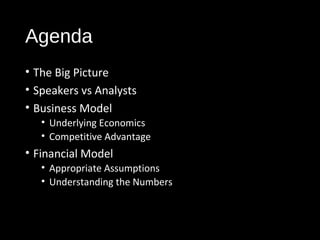
Agenda 
• The Big Picture 
• Speakers vs Analysts 
• Business Model 
• Underlying Economics 
• Competitive Advantage 
• Financial Model 
• Appropriate Assumptions 
• Understanding the Numbers
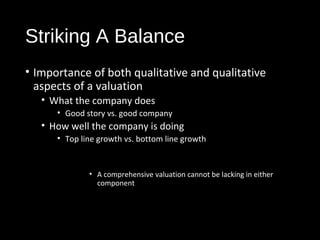
Striking A Balance 
• Importance of both qualitative and qualitative 
aspects of a valuation 
• What the company does 
• Good story vs. good company 
• How well the company is doing 
• Top line growth vs. bottom line growth 
• A comprehensive valuation cannot be lacking in either 
component
A good speaker does not make a 
good analyst 
• But a good analyst should be able to convey his/her 
ideas 
• Be confident 
• Know your material 
• Convey your points effectively-focus on important issues 
• A good pitch can have no meaningful content 
• What is being sold? 
• What is being left out? 
• What is really being said? 
• Buy the stock, not the pitch!
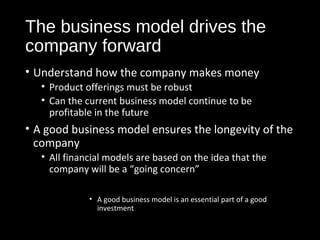
The business model drives the 
company forward 
• Understand how the company makes money 
• Product offerings must be robust 
• Can the current business model continue to be 
profitable in the future 
• A good business model ensures the longevity of the 
company 
• All financial models are based on the idea that the 
company will be a “going concern” 
• A good business model is an essential part of a good 
investment
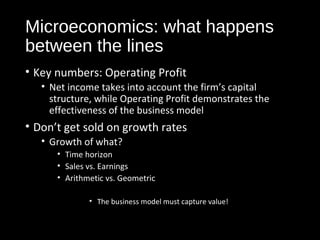
Microeconomics: what happens 
between the lines 
• Key numbers: Operating Profit 
• Net income takes into account the firm’s capital 
structure, while Operating Profit demonstrates the 
effectiveness of the business model 
• Don’t get sold on growth rates 
• Growth of what? 
• Time horizon 
• Sales vs. Earnings 
• Arithmetic vs. Geometric 
• The business model must capture value!
Good business models generate 
above-average returns 
• Sustainable competitive advantage is achieved 
when it is unique and not easily imitable 
• Creates excess returns for investors 
• Does the analyst explain the competitive dynamics 
of the industry? 
• Porter’s Five Forces 
• Competitive advantage cannot persist forever in a 
competitive market – did the analyst model this in 
the valuation 
• A good business model should create sustainable 
competitive advantage
No matter what valuation method 
you use, fundamentals matter 
• Discounted Cashflow Valuation (DCF) and Reliable 
Valuation are driven by the same components 
• Understand the drivers of the valuation 
• Cash Flows, Growth Rate, Discount Rate 
• Do not let reliable valuations throw you off 
• You should still understand the assumptions implied by 
the multiple 
• An undervalued company in an overvalued industry is 
not a good long term investment 
• Don’t be confused by fancy valuations – they all boil down 
to fundamentals
Garbage In, Garbage Out 
• The assumptions must reflect the business model 
• Does the discount rate reflect business and financial 
risk? 
• Are the growth rates too high? 
• Must be supported by fundamentals 
• Especially important in the stable growth phase 
• Are the cashflows realistic? 
• All valuations are biased 
• In most cases, valuations are overly optimistic 
• Buy the assumptions, not the value
Learn the intuition, not the 
method 
• Learn what is behind the numbers 
• There is no meaning in memorizing equations; they are 
in the books 
• Understand trends and anomalies 
• Understand the relationships between the 
numbers 
• What drives growth? 
• What numbers would make a company look cheap? 
• What are characteristics of a high/stable growth firm? 
• Understand the numbers, and sniff for signs that the analyst 
does not
Example: 4Kids Entertainment 
• What is the capital structure? 
• Are there country or currency risks? 
• Are the numbers coming out of a black box? 
• Don’t just show the results, show the process 
• Do YOU understand? 
• Why these assumptions?
Thanks! 
Questions

Valuation; How to Structure a Correct Valuation

  • 1.
    Evaluating A Valuation Demetris C. Hadjisofocli
  • 2.
    Agenda • TheBig Picture • Speakers vs Analysts • Business Model • Underlying Economics • Competitive Advantage • Financial Model • Appropriate Assumptions • Understanding the Numbers
  • 3.
    Striking A Balance • Importance of both qualitative and qualitative aspects of a valuation • What the company does • Good story vs. good company • How well the company is doing • Top line growth vs. bottom line growth • A comprehensive valuation cannot be lacking in either component
  • 4.
    A good speakerdoes not make a good analyst • But a good analyst should be able to convey his/her ideas • Be confident • Know your material • Convey your points effectively-focus on important issues • A good pitch can have no meaningful content • What is being sold? • What is being left out? • What is really being said? • Buy the stock, not the pitch!
  • 5.
    The business modeldrives the company forward • Understand how the company makes money • Product offerings must be robust • Can the current business model continue to be profitable in the future • A good business model ensures the longevity of the company • All financial models are based on the idea that the company will be a “going concern” • A good business model is an essential part of a good investment
  • 6.
    Microeconomics: what happens between the lines • Key numbers: Operating Profit • Net income takes into account the firm’s capital structure, while Operating Profit demonstrates the effectiveness of the business model • Don’t get sold on growth rates • Growth of what? • Time horizon • Sales vs. Earnings • Arithmetic vs. Geometric • The business model must capture value!
  • 7.
    Good business modelsgenerate above-average returns • Sustainable competitive advantage is achieved when it is unique and not easily imitable • Creates excess returns for investors • Does the analyst explain the competitive dynamics of the industry? • Porter’s Five Forces • Competitive advantage cannot persist forever in a competitive market – did the analyst model this in the valuation • A good business model should create sustainable competitive advantage
  • 8.
    No matter whatvaluation method you use, fundamentals matter • Discounted Cashflow Valuation (DCF) and Reliable Valuation are driven by the same components • Understand the drivers of the valuation • Cash Flows, Growth Rate, Discount Rate • Do not let reliable valuations throw you off • You should still understand the assumptions implied by the multiple • An undervalued company in an overvalued industry is not a good long term investment • Don’t be confused by fancy valuations – they all boil down to fundamentals
  • 9.
    Garbage In, GarbageOut • The assumptions must reflect the business model • Does the discount rate reflect business and financial risk? • Are the growth rates too high? • Must be supported by fundamentals • Especially important in the stable growth phase • Are the cashflows realistic? • All valuations are biased • In most cases, valuations are overly optimistic • Buy the assumptions, not the value
  • 10.
    Learn the intuition,not the method • Learn what is behind the numbers • There is no meaning in memorizing equations; they are in the books • Understand trends and anomalies • Understand the relationships between the numbers • What drives growth? • What numbers would make a company look cheap? • What are characteristics of a high/stable growth firm? • Understand the numbers, and sniff for signs that the analyst does not
  • 11.
    Example: 4Kids Entertainment • What is the capital structure? • Are there country or currency risks? • Are the numbers coming out of a black box? • Don’t just show the results, show the process • Do YOU understand? • Why these assumptions?
  • 12.