





UNI -100
Basics of Entrepreneurship
Demetris C. Hadjisofocli
Managing Director, Helix Business Incubator, Ltd.
Director, Liaison Office University of Nicosia
Coordinated Induction of Entrepreneurship Education in Schools
March 31, 2014
15:00 – 18:00
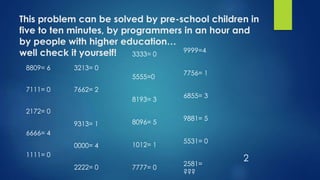
This problem can be solved by pre-school children in
five to ten minutes, by programmers in an hour and
by people with higher education…
well check it yourself!
8809= 6
7111= 0
2172= 0
6666= 4
1111= 0
2
3213= 0
7662= 2
9313= 1
0000= 4
2222= 0
3333= 0
5555=0
8193= 3
8096= 5
1012= 1
7777= 0
9999=4
7756= 1
6855= 3
9881= 5
5531= 0
2581=
???
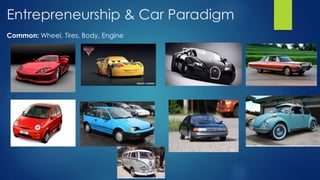
Entrepreneurship & Car Paradigm
Common: Wheel, Tires, Body, Engine
Definition - Systemic Entrepreneurship®
______________________________________
 Systemic Entrepreneurship® is a holistic approach to
entrepreneurship execution were the stakeholder
environment allows the user to use general frameworks and
principles in a modular way during the development of
business leaders, business models, monetization strategies and
while the corporate strategic objectives are met, to ensure
that the end target of Economic, Political, Social, Legal,
Environmental equality across the societal graph is reached.
Example of Systemic Entrepreneurship
 Developing agribusinesses in rural Africa, that strives to empower individuals and
communities
 It operates in several African countries. Researchers have introduced a system of vegetable
production that combines conventional farming with hydroponic technologies for healthy and
high value crop cultivation
 In partnership with the Sun International hotel group, a vegetable production
network has been established, allowing local groups of farmers to produce
vegetables for sale to top hotels serving the international tourism market
 This has led to the emergence of agri-entrepreneurs, and overall, the farmers benefiting earned
income of $1million annually since 2006. Beneficiaries include vulnerable groups like homeless,
the visually disabled, widows and orphans
 These are examples of the kind of systemic entrepreneurship that are needed. It
takes a social problem and utilizes knowledge transfer to come up with a solution
that is not about economic growth per se, but about human development
Definition - Social Entrepreneurship
__________________________________
 Social entrepreneurship is the process of pursuing suitable solutions to
social problems. More specifically, social entrepreneurs adopt a
mission to create and sustain social value. They pursue opportunities to
serve this mission, while continuously adapting and learning.
 Possible Social Problems
 Unemployment among youth
 Poverty
 Civil Unrest
 Recession
 Closure of large number of SMEs
 Productive Entrepreneurship
What is (Social) Entrepreneurship
 Social entrepreneurship is the process of pursuing suitable solutions to
social problems. More specifically, social entrepreneurs adopt a mission
to create and sustain social value. They pursue opportunities to serve
this mission, while continuously adapting and learning.
 Possible Social Problems
 Unemployment among youth
 Poverty
 Civil Unrest
 Recession
 Closure of large number of SMEs
 Unproductive Entrepreneurship
 Socially Productive Entrepreneurial Activities
Entrepreneurship
_______________________________
 Entrepreneurship is an agent of creative distraction
 Individuals NOT Corporations are the driving force
 Small agile companies as opposed to traditionally large
companies
 Knowledge intensive
 Needs Policy shifts
What is the contribution to
systemic societal development
_________________________________
 Entrepreneurship focuses Solely on economic growth
 Blind focus on straight forward monetization contributes to
scorch earth business models, business strategies, business
systems
 How does society as a whole contributes to the development of
responsible business leaders
 Education
 Culture
 Values discussion
 Ethics (not just business ethics but ethics in general)
What do we need Entrepreneurship to
address?
______________________________________
 How do we address the issue of social and financial equality?
 Society and quality of life should move forward in unison; not necessarily
at the same level but in unison
 The gap between social groups at worst should remain the same, but
we should strive to shrink it (capitalism needs free willing customers)
 Disparities, inequalities
 Entrepreneurship that brings economic justice, equality, environmental
sustenance
 Economic, Political, Social, Legal, Cultural, Technological, Environmental
Perspective social, economic, political, religious considerations
 Correlation between Entrepreneurship and Development
How is it to have an Idea and Start
a Business?
 What is the journey like?
 Brainstorming
 Perceptions
 Realities
Key Steps
 Why is a product/service necessary?
 What are the objectives for setting up a Company?
 Formulate a basic idea and organize a brainstorming session
 Research the needs/opportunities and set up a framework
 Map how the company will operate and how it will benefit the
stakeholders
 Define Business Model and Business Structure
Key Steps
 Get support (talk about the idea)
 Develop an executive summary and find
someone who can help with building initial
strategies/basic planning
 Identify the resources needed and the resources
available
 Think about both Operational and Tactical
Planning
Key Success Factors
 The Planning, Tactical, and Strategic Vision should be
globalized
 Learn from others’ experiences but…..
 There isn’t a One Model Fits All approach
 Don’t build a business just for the sake of building one
– Cost/Revenue Planning is Vital
– Don’t do it for non value added reasons
– Have sustainability planning (running out of money is
the biggest problem that kills even great ideas)
Key Success Factors
 Be honest when setting and communicating
expectations
 Continual internal evaluation with consideration
of external factors
 Continual communication with stakeholders
 Be willing to pivot
What is Entrepreneurship Drive
 The ability to identify new ideas
 Passion, determination and the drive to try them out
 Willingness to listen and learn
 Have the character to know when it is time to pivot
to a better version…
Characteristics of Entrepreneurship
 Innovation
 Creativity
 Scientific Curiosity
 Collaboration
 Forward Looking
 But Methodology to Success Can differ….
FOOTBALL
 One Ball  Tool
 Same Objective  Success
 Different Approaches 
What is a startup?
Usually it goes like…
Brother…. Whoa…. I have this idea that is
Kick Ass…. If we build it everyone is gonna
want it …. We made it!
And often seems to end like …..
GOOGLE, YAHOO, FACEBOOK…..
BUT, GUESS WHAT?
The reality is……
 Nothing works
 Run out of money
 Nobody wants to buy
 Someone else did it
 Don’t have more time to work on this
 So and so on the team doesn’t do his share of work
“
”
94 out of 100 die…
STARTUPS ARE REALLY HARD AND THERE IS NO SECRET INGREDIENT THAT WILL HELP
YOU TO SUCCEED
A good definition of startup
“A human institution designed to deliver a new
product or service under conditions of extreme
uncertainty”
Eric Ries
What are some of the Ingredients
 VISION
 MISSION
Vision
 What is it gonna be?
 So why we do our thing?
Vision
When Chester Carlson invented a way to
make copies of paper docs IBM laughed
at him
Then Xerox created copy machines and
today “to Xerox” is a verb
Characteristics of a good Vision
Short
Easy to understand
Implemented quite fast (< 2-3 yrs)
Long lasting (decades)
Mission
What we do?
For whom?
Mission
 Wang Laboratories
3 Billions in revenue in the 80s
Word processing computers
 Failed
 Didn’t foresee general purpose computers
Startups
Everything but an exact science
“Don’t worry about failure you only have to be
right once”
- Drew Houston
Most Successful entrepreneurs failed on
average 6 times before getting some traction
Startup Myths
 It Costs nothing to build
 Get funded with some nice slides and a lot of
passion
 It’s all about the idea
 Founders are all cool hippie college dropouts
Myth 1
Start Ups are cheap
Lean or not, building something meaningful
costs money and at some point savings run out
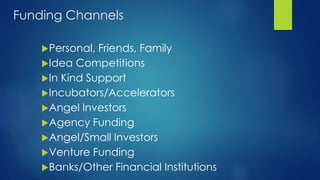
Funding Channels
Personal, Friends, Family
Idea Competitions
In Kind Support
Incubators/Accelerators
Angel Investors
Agency Funding
Angel/Small Investors
Venture Funding
Banks/Other Financial Institutions
Myth 2
“WOW them with your presentation and you’ll
get money”
You are already underestimating
the number of times you will be
rejected and how long it will take
you to raise some funds
Myth 3
“The idea makes the difference”
 Ideas are easy – Implementation is hard
 A great idea with:
a great execution
a great timing
a great team
great perseverance
 Maybe
Myth 4
“A startupper is a cool hippie college dropout”
 Profile of the average founder:
40yrs old
Married with Children
6-10 yrs work experience
Bachelors or higher
How to make it?
 Find your product/market fit before you
run out of money
 THAT’S IT
 Solve a Problem
Start Up is not a linear path
 Was everything you think you knew about
your product and market wrong?
 What if…
RJReynolds
Burned $450.000.000 to develop smokeless
cigarettes but...
………. Smokers didn’t give a f**k about
smoke … at that time
WebVan
 Grocery home delivery
 Within a 30-min window
 Time chosen by the customer but..
 Didn’t consider that many working
customers would like their groceries
delivered at home and at night
 They built the wrong capacity for the wrong
time
WebVan
 Burned $800.000.000
 CNET named it the largest dot-com flop in
history
Motorola
Burned $5.000.000.000 For satellite-
based phone system that nobody
wanted
Critical Point
 You don’t invent product/service
 You solve problems
Setup the right goals
 How good/thorough do you know customer’s needs?
 Does your product/service solve that need?
 How much are they willing to pay for your solution?
 How much is this problem a priority to the customer?
 Does it solve a significant problem?
Customer Discovery
 Who can be the customers?
Target
Profile
 Can they afford the product/service?
 Can they access it?
Location
Legal
Weather
Go through the process
 You’ll get plenty of doubt: Analyze data
 It’s all about speed and control
Customer Segments
 The People & Organizations targeted by the
company
For whom are we creating value?
Who are our most important customers?
Not all customers are created equal
Value proposition
 Services and products that provide value to customer
segments
 Product
Satisfies a new need/creates a need
Solves a problem
Offers better performance
Is more customized
Costs less
Has a better design
 KNOW Numbers
 KNOW Markets
 WHAT is the Monetization of the Solution
 Who is the TEAM
Channels
 How does company reach customers to tell them about
value proposition?
Through which Channels Customer Segments can/want
to be reached?
How are Channels integrated?
Which ones work best?
Which ones are most cost-efficient?
How are Channels integrated with customer
habits/routines?
Customer Relationships
 Types of relationships established between the
company and customer segments
What types of relationships does the company
have with customers?
Direct or relying on others
Customer facing
Loyalty Schemes
Revenue Streams
 Represents the income of the company for every
customer segment
For what value are customers willing to pay?
For what value do they currently pay? If they do!
How are they currently paying?
How would they prefer to pay?
How much does each stream contribute to overall
revenue?
Key Resources
 Strategic assets that the company need to maintain its
business model
 What Key Resources does the…
Value Propositions require to be delivered?
Distribution Channels?
Customer Relationships?
Revenue Streams?
 Resources type: Physical, Intellectual, Human, Financial
Key Activities
 Strategic activities to deliver the value proposition, reach customers
and nurture relationships
 What Key Activities does the
Value Propositions require?
Distribution Channels?
Customer Relationships?
Revenue streams?
 Types of Key Activities: Production, Problem Solving,
Platform/Network
Key Partners
 Define contractors and partners that are supporters/critics for
company’s business model
 Who are the Key Partners?
 Who are the key suppliers?
 Which Key Resources is the company acquiring from partners?
 Which Key Activities do partners perform?
Cost Structure
 What are all the costs required for the company in order to
have its business model up and running
What are the most important costs inherent in the
business model?
Which Key Resources are most expensive?
Which Key Activities are most expensive?
Cash Flow is King
Cost Rationalization? Why this/that Expense? How does
it Contribute?
Funding - Due Diligence
____________________________________
 The process through which investments are decided
 Detailed, Broad, Deep
 Has some fixed elements
 Has some local elements
 Need expertise to perform
 It is important and critical to the success of an investor
but it should not delay the process
 Ideas will fail for sure; better chances are 2 in 50
Team
____________________________________
 Not everyone can become an Entrepreneur but
ALMOST everyone can be Enterprising ………..Teams
that have GREAT
 Technologists
 Engineers
 Operations
 Legal
 Individuals who are Agile and Flexible
 If someone is not an Entrepreneur but has those
qualities, put a GREAT Entrepreneur on their team
 Know what the team does not know – No Ego!
Position for Success
____________________________________
 KNOW A PITCHING EAR ….
 Not all money is created (or given) equally
 Not all investment people have the same philosophy, psychology,
interests, knowhow..
 Not all cultures/ecosystems are the same
 A pitching angle  Tech, Business Model, Operations,
Monetization…. ADJUST IT
Value Proposition
_______________________________________
 KNOW Numbers
 KNOW Markets
 WHAT is the Problem to be Solved
 WHAT is the Monetization of the Solution
 HAVE a TEAM
Tool Box – Major Points
____________________________________
 To the point Business Plan; Executive Summary (short & sweet)
 Only the “justified & confirmed” Facts; no blah blah!!!
 Sustainable Competitive Advantage
 Know your business inside-out
 Know what you don’t know
 Avoid Tunnel Vision Syndrome
 Confirm the viability of your idea
 Know and Respect your competition
 Think & Plan 2 steps ahead (market trends)
 Team with Chemistry & Know-How; Build a balanced team-gene pool
 Assess & know your cost
 Sales pipeline
Tool Box – Use of Funds!
___________________________________
 Why do you need the money?
 How will the money be used?
 Legitimate reasons
 Grow Sales
 Product Development
 Marketing
 Recruiting
 Training
 Infrastructure
Tool Box – Transparency
___________________________________
 What are the controls which guarantee
legitimate use of funds?
 Established Audit processes
 Weekly/Monthly reports
 Knowledgeable/Functional Board of Directors
“
”
YOUR TURN
Ask yourself
 What are the emerging trends I notice?
 Am I willing to put the time and effort?
 Am I ready for sleepless nights and hardworking
days?
 Am I willing to Work hard, Learn, Listen, Kill ego?
 Do I have the support of people I care about?
What is your personality?
 Critical to understand personal traits because
certain characteristics fit certain jobs
Extrovert / Introvert
Fighter / Go getter / Quiet
Lerner/Listener/Know it all
 Know your strengths and weaknesses
Business Idea
Needs that will be satisfied
Problems to be solved
Who will buy? Customers? Target?
Competitive differentiation
Team
 Engineer
 Developer
 General Business/Finance
 Marketing
 Lawyer
 Leader (could be one of the above)
 Interact, Share, Listen, Respect, Embrace, Never Walk
Alone
Have a Network
 Family
 Supporters
 Knowledge Transfer
 Experience Couriers
 Market Experts
 Coaches/Mentors
 Failure Owners
 File contact information
Rationalization
 Think Logically and consider the facts
 No Feelings or Intuition or Someone told me
 Be Creative
 Look at the +’s
Ideation
 Identify a Group or Problem you want to solve
 How does your group behave? Where does it
frequent?
 Describe the activities of the group
 What kind of problems/difficulties could they
have?
 What are the possible solutions
How are Ideas born?
 Are they easy?
 Do they just come to us?
 Once we have the idea, is it easy to get to the market?
 Set the right expectations
 It’s about passion, planning, hard work, commitment,
the overall environment, the team, the resources,
perseverance
Tnx
4
UR Patience!
74

Uni100 basic entrepreneurship course

  • 1.
    UNI -100 Basics ofEntrepreneurship Demetris C. Hadjisofocli Managing Director, Helix Business Incubator, Ltd. Director, Liaison Office University of Nicosia Coordinated Induction of Entrepreneurship Education in Schools March 31, 2014 15:00 – 18:00
  • 2.
    This problem canbe solved by pre-school children in five to ten minutes, by programmers in an hour and by people with higher education… well check it yourself! 8809= 6 7111= 0 2172= 0 6666= 4 1111= 0 2 3213= 0 7662= 2 9313= 1 0000= 4 2222= 0 3333= 0 5555=0 8193= 3 8096= 5 1012= 1 7777= 0 9999=4 7756= 1 6855= 3 9881= 5 5531= 0 2581= ???
  • 3.
    Entrepreneurship & CarParadigm Common: Wheel, Tires, Body, Engine
  • 4.
    Definition - SystemicEntrepreneurship® ______________________________________  Systemic Entrepreneurship® is a holistic approach to entrepreneurship execution were the stakeholder environment allows the user to use general frameworks and principles in a modular way during the development of business leaders, business models, monetization strategies and while the corporate strategic objectives are met, to ensure that the end target of Economic, Political, Social, Legal, Environmental equality across the societal graph is reached.
  • 5.
    Example of SystemicEntrepreneurship  Developing agribusinesses in rural Africa, that strives to empower individuals and communities  It operates in several African countries. Researchers have introduced a system of vegetable production that combines conventional farming with hydroponic technologies for healthy and high value crop cultivation  In partnership with the Sun International hotel group, a vegetable production network has been established, allowing local groups of farmers to produce vegetables for sale to top hotels serving the international tourism market  This has led to the emergence of agri-entrepreneurs, and overall, the farmers benefiting earned income of $1million annually since 2006. Beneficiaries include vulnerable groups like homeless, the visually disabled, widows and orphans  These are examples of the kind of systemic entrepreneurship that are needed. It takes a social problem and utilizes knowledge transfer to come up with a solution that is not about economic growth per se, but about human development
  • 6.
    Definition - SocialEntrepreneurship __________________________________  Social entrepreneurship is the process of pursuing suitable solutions to social problems. More specifically, social entrepreneurs adopt a mission to create and sustain social value. They pursue opportunities to serve this mission, while continuously adapting and learning.  Possible Social Problems  Unemployment among youth  Poverty  Civil Unrest  Recession  Closure of large number of SMEs  Productive Entrepreneurship
  • 7.
    What is (Social)Entrepreneurship  Social entrepreneurship is the process of pursuing suitable solutions to social problems. More specifically, social entrepreneurs adopt a mission to create and sustain social value. They pursue opportunities to serve this mission, while continuously adapting and learning.  Possible Social Problems  Unemployment among youth  Poverty  Civil Unrest  Recession  Closure of large number of SMEs  Unproductive Entrepreneurship  Socially Productive Entrepreneurial Activities
  • 8.
    Entrepreneurship _______________________________  Entrepreneurship isan agent of creative distraction  Individuals NOT Corporations are the driving force  Small agile companies as opposed to traditionally large companies  Knowledge intensive  Needs Policy shifts
  • 9.
    What is thecontribution to systemic societal development _________________________________  Entrepreneurship focuses Solely on economic growth  Blind focus on straight forward monetization contributes to scorch earth business models, business strategies, business systems  How does society as a whole contributes to the development of responsible business leaders  Education  Culture  Values discussion  Ethics (not just business ethics but ethics in general)
  • 10.
    What do weneed Entrepreneurship to address? ______________________________________  How do we address the issue of social and financial equality?  Society and quality of life should move forward in unison; not necessarily at the same level but in unison  The gap between social groups at worst should remain the same, but we should strive to shrink it (capitalism needs free willing customers)  Disparities, inequalities  Entrepreneurship that brings economic justice, equality, environmental sustenance  Economic, Political, Social, Legal, Cultural, Technological, Environmental Perspective social, economic, political, religious considerations  Correlation between Entrepreneurship and Development
  • 11.
    How is itto have an Idea and Start a Business?  What is the journey like?  Brainstorming  Perceptions  Realities
  • 12.
    Key Steps  Whyis a product/service necessary?  What are the objectives for setting up a Company?  Formulate a basic idea and organize a brainstorming session  Research the needs/opportunities and set up a framework  Map how the company will operate and how it will benefit the stakeholders  Define Business Model and Business Structure
  • 13.
    Key Steps  Getsupport (talk about the idea)  Develop an executive summary and find someone who can help with building initial strategies/basic planning  Identify the resources needed and the resources available  Think about both Operational and Tactical Planning
  • 14.
    Key Success Factors The Planning, Tactical, and Strategic Vision should be globalized  Learn from others’ experiences but…..  There isn’t a One Model Fits All approach  Don’t build a business just for the sake of building one – Cost/Revenue Planning is Vital – Don’t do it for non value added reasons – Have sustainability planning (running out of money is the biggest problem that kills even great ideas)
  • 15.
    Key Success Factors Be honest when setting and communicating expectations  Continual internal evaluation with consideration of external factors  Continual communication with stakeholders  Be willing to pivot
  • 16.
    What is EntrepreneurshipDrive  The ability to identify new ideas  Passion, determination and the drive to try them out  Willingness to listen and learn  Have the character to know when it is time to pivot to a better version…
  • 17.
    Characteristics of Entrepreneurship Innovation  Creativity  Scientific Curiosity  Collaboration  Forward Looking  But Methodology to Success Can differ….
  • 18.
    FOOTBALL  One Ball Tool  Same Objective  Success  Different Approaches 
  • 19.
    What is astartup?
  • 20.
    Usually it goeslike… Brother…. Whoa…. I have this idea that is Kick Ass…. If we build it everyone is gonna want it …. We made it!
  • 21.
    And often seemsto end like ….. GOOGLE, YAHOO, FACEBOOK….. BUT, GUESS WHAT?
  • 22.
    The reality is…… Nothing works  Run out of money  Nobody wants to buy  Someone else did it  Don’t have more time to work on this  So and so on the team doesn’t do his share of work
  • 23.
    “ ” 94 out of100 die… STARTUPS ARE REALLY HARD AND THERE IS NO SECRET INGREDIENT THAT WILL HELP YOU TO SUCCEED
  • 24.
    A good definitionof startup “A human institution designed to deliver a new product or service under conditions of extreme uncertainty” Eric Ries
  • 25.
    What are someof the Ingredients  VISION  MISSION
  • 26.
    Vision  What isit gonna be?  So why we do our thing?
  • 27.
    Vision When Chester Carlsoninvented a way to make copies of paper docs IBM laughed at him Then Xerox created copy machines and today “to Xerox” is a verb
  • 28.
    Characteristics of agood Vision Short Easy to understand Implemented quite fast (< 2-3 yrs) Long lasting (decades)
  • 29.
  • 30.
    Mission  Wang Laboratories 3Billions in revenue in the 80s Word processing computers  Failed  Didn’t foresee general purpose computers
  • 31.
  • 32.
    “Don’t worry aboutfailure you only have to be right once” - Drew Houston Most Successful entrepreneurs failed on average 6 times before getting some traction
  • 33.
    Startup Myths  ItCosts nothing to build  Get funded with some nice slides and a lot of passion  It’s all about the idea  Founders are all cool hippie college dropouts
  • 34.
    Myth 1 Start Upsare cheap Lean or not, building something meaningful costs money and at some point savings run out
  • 35.
    Funding Channels Personal, Friends,Family Idea Competitions In Kind Support Incubators/Accelerators Angel Investors Agency Funding Angel/Small Investors Venture Funding Banks/Other Financial Institutions
  • 36.
    Myth 2 “WOW themwith your presentation and you’ll get money” You are already underestimating the number of times you will be rejected and how long it will take you to raise some funds
  • 37.
    Myth 3 “The ideamakes the difference”  Ideas are easy – Implementation is hard  A great idea with: a great execution a great timing a great team great perseverance  Maybe
  • 38.
    Myth 4 “A startupperis a cool hippie college dropout”  Profile of the average founder: 40yrs old Married with Children 6-10 yrs work experience Bachelors or higher
  • 39.
    How to makeit?  Find your product/market fit before you run out of money  THAT’S IT  Solve a Problem
  • 40.
    Start Up isnot a linear path  Was everything you think you knew about your product and market wrong?  What if…
  • 41.
    RJReynolds Burned $450.000.000 todevelop smokeless cigarettes but... ………. Smokers didn’t give a f**k about smoke … at that time
  • 42.
    WebVan  Grocery homedelivery  Within a 30-min window  Time chosen by the customer but..  Didn’t consider that many working customers would like their groceries delivered at home and at night  They built the wrong capacity for the wrong time
  • 43.
    WebVan  Burned $800.000.000 CNET named it the largest dot-com flop in history
  • 44.
    Motorola Burned $5.000.000.000 Forsatellite- based phone system that nobody wanted
  • 45.
    Critical Point  Youdon’t invent product/service  You solve problems
  • 46.
    Setup the rightgoals  How good/thorough do you know customer’s needs?  Does your product/service solve that need?  How much are they willing to pay for your solution?  How much is this problem a priority to the customer?  Does it solve a significant problem?
  • 47.
    Customer Discovery  Whocan be the customers? Target Profile  Can they afford the product/service?  Can they access it? Location Legal Weather
  • 48.
    Go through theprocess  You’ll get plenty of doubt: Analyze data  It’s all about speed and control
  • 49.
    Customer Segments  ThePeople & Organizations targeted by the company For whom are we creating value? Who are our most important customers? Not all customers are created equal
  • 50.
    Value proposition  Servicesand products that provide value to customer segments  Product Satisfies a new need/creates a need Solves a problem Offers better performance Is more customized Costs less Has a better design  KNOW Numbers  KNOW Markets  WHAT is the Monetization of the Solution  Who is the TEAM
  • 51.
    Channels  How doescompany reach customers to tell them about value proposition? Through which Channels Customer Segments can/want to be reached? How are Channels integrated? Which ones work best? Which ones are most cost-efficient? How are Channels integrated with customer habits/routines?
  • 52.
    Customer Relationships  Typesof relationships established between the company and customer segments What types of relationships does the company have with customers? Direct or relying on others Customer facing Loyalty Schemes
  • 53.
    Revenue Streams  Representsthe income of the company for every customer segment For what value are customers willing to pay? For what value do they currently pay? If they do! How are they currently paying? How would they prefer to pay? How much does each stream contribute to overall revenue?
  • 54.
    Key Resources  Strategicassets that the company need to maintain its business model  What Key Resources does the… Value Propositions require to be delivered? Distribution Channels? Customer Relationships? Revenue Streams?  Resources type: Physical, Intellectual, Human, Financial
  • 55.
    Key Activities  Strategicactivities to deliver the value proposition, reach customers and nurture relationships  What Key Activities does the Value Propositions require? Distribution Channels? Customer Relationships? Revenue streams?  Types of Key Activities: Production, Problem Solving, Platform/Network
  • 56.
    Key Partners  Definecontractors and partners that are supporters/critics for company’s business model  Who are the Key Partners?  Who are the key suppliers?  Which Key Resources is the company acquiring from partners?  Which Key Activities do partners perform?
  • 57.
    Cost Structure  Whatare all the costs required for the company in order to have its business model up and running What are the most important costs inherent in the business model? Which Key Resources are most expensive? Which Key Activities are most expensive? Cash Flow is King Cost Rationalization? Why this/that Expense? How does it Contribute?
  • 58.
    Funding - DueDiligence ____________________________________  The process through which investments are decided  Detailed, Broad, Deep  Has some fixed elements  Has some local elements  Need expertise to perform  It is important and critical to the success of an investor but it should not delay the process  Ideas will fail for sure; better chances are 2 in 50
  • 59.
    Team ____________________________________  Not everyonecan become an Entrepreneur but ALMOST everyone can be Enterprising ………..Teams that have GREAT  Technologists  Engineers  Operations  Legal  Individuals who are Agile and Flexible  If someone is not an Entrepreneur but has those qualities, put a GREAT Entrepreneur on their team  Know what the team does not know – No Ego!
  • 60.
    Position for Success ____________________________________ KNOW A PITCHING EAR ….  Not all money is created (or given) equally  Not all investment people have the same philosophy, psychology, interests, knowhow..  Not all cultures/ecosystems are the same  A pitching angle  Tech, Business Model, Operations, Monetization…. ADJUST IT
  • 61.
    Value Proposition _______________________________________  KNOWNumbers  KNOW Markets  WHAT is the Problem to be Solved  WHAT is the Monetization of the Solution  HAVE a TEAM
  • 62.
    Tool Box –Major Points ____________________________________  To the point Business Plan; Executive Summary (short & sweet)  Only the “justified & confirmed” Facts; no blah blah!!!  Sustainable Competitive Advantage  Know your business inside-out  Know what you don’t know  Avoid Tunnel Vision Syndrome  Confirm the viability of your idea  Know and Respect your competition  Think & Plan 2 steps ahead (market trends)  Team with Chemistry & Know-How; Build a balanced team-gene pool  Assess & know your cost  Sales pipeline
  • 63.
    Tool Box –Use of Funds! ___________________________________  Why do you need the money?  How will the money be used?  Legitimate reasons  Grow Sales  Product Development  Marketing  Recruiting  Training  Infrastructure
  • 64.
    Tool Box –Transparency ___________________________________  What are the controls which guarantee legitimate use of funds?  Established Audit processes  Weekly/Monthly reports  Knowledgeable/Functional Board of Directors
  • 65.
  • 66.
    Ask yourself  Whatare the emerging trends I notice?  Am I willing to put the time and effort?  Am I ready for sleepless nights and hardworking days?  Am I willing to Work hard, Learn, Listen, Kill ego?  Do I have the support of people I care about?
  • 67.
    What is yourpersonality?  Critical to understand personal traits because certain characteristics fit certain jobs Extrovert / Introvert Fighter / Go getter / Quiet Lerner/Listener/Know it all  Know your strengths and weaknesses
  • 68.
    Business Idea Needs thatwill be satisfied Problems to be solved Who will buy? Customers? Target? Competitive differentiation
  • 69.
    Team  Engineer  Developer General Business/Finance  Marketing  Lawyer  Leader (could be one of the above)  Interact, Share, Listen, Respect, Embrace, Never Walk Alone
  • 70.
    Have a Network Family  Supporters  Knowledge Transfer  Experience Couriers  Market Experts  Coaches/Mentors  Failure Owners  File contact information
  • 71.
    Rationalization  Think Logicallyand consider the facts  No Feelings or Intuition or Someone told me  Be Creative  Look at the +’s
  • 72.
    Ideation  Identify aGroup or Problem you want to solve  How does your group behave? Where does it frequent?  Describe the activities of the group  What kind of problems/difficulties could they have?  What are the possible solutions
  • 73.
    How are Ideasborn?  Are they easy?  Do they just come to us?  Once we have the idea, is it easy to get to the market?  Set the right expectations  It’s about passion, planning, hard work, commitment, the overall environment, the team, the resources, perseverance
  • 74.