

Intellectual Property Issues
for Consideration PLUS
Valuation Methods
Demetris C. Hadjisofocli
Executive Director, Entrepreneurship Frontier Network, Ltd.
Managing Director, Innovade, Ltd.
IP Precautions
 Perform patent search before beginning research
 Keep careful lab notebooks and write down every
possible notation and action from the very
beginning
 Avoid known/legal issues that will prohibit the
registration of a patent
 Protect against patent invalidity
IP Valuation Methods
 Basic Valuation Methods
 Cost method
 Market method
 Income method
 Selected IP Valuation Methods
 25% rule
 Industry standard royalty rates
 Real-Options method
 Competitive Advantage Valuation
Perform Patent
Search Before
Beginning
Research
Perform Patent Search
Before Doing Research
 Patent owner’s rights
 Exclusive right to make, use, sell and import
 Unauthorized use of patent subject matter in
research=patent infringement
 No general experimental use exemption to patent
infringement as in most other countries
 Limited experimental use exemption for drugs and
medical devices subject to FDA approval
Perform Patent Search
Before Doing Research
 Beyond avoiding infringement, patent searches can
also be helpful
 To learn from work of others
 To improve on successful approaches
 To avoid unsuccessful approaches
 To engineer around potential problems
Keep Careful Lab
Notebooks
Keep Careful Lab Notebooks
 Lab notebooks necessary to determine
 Who has priority to an invention
 Who is named as an inventor
Keep Careful Lab Notebooks
 Who has priority to an invention
 US patent law; priority goes to first to invent
 All other countries; priority goes to first to file
 Who is the first to invent
 First person to conceive of an invention and then
diligently proceed to reduce the invention to
practice
 First person who conceives of an invention (A) will
prevail over the first person to reduce the invention
to practice (B) if the first person who conceives of
the invention (A) is diligent from a date prior to the
other person’s (B’s) conception of the invention until
his/her (A’s) reduction to practice
Keep Careful Lab Notebooks
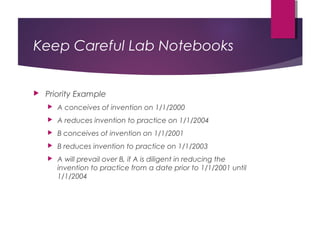
 Priority Example
 A conceives of invention on 1/1/2000
 A reduces invention to practice on 1/1/2004
 B conceives of invention on 1/1/2001
 B reduces invention to practice on 1/1/2003
 A will prevail over B, if A is diligent in reducing the
invention to practice from a date prior to 1/1/2001 until
1/1/2004
Keep Careful Lab Notebooks
 Definitions
 Conception
 Formation of a definite idea for the complete and
operative invention
 Reduction to practice
 Actual reduction to practice
 Building a working prototype of the invention
 Constructive reduction to practice
 Filing a patent application sufficient to enable one
skilled in the art to make and use invention
 Diligence
 Reasonable and continues effort directed toward actual
and/or constructive reduction to practice
 Fact sensitive determination in each case
Keep Careful Lab Notebooks
 Lab notebook are critical to establish
 Date of conception
 Date of reduction to practice
 Diligence during required period of time
 Lab notebooks should document all information
relevant to the invention (ideas, experiments,
instruments, procedures, formulas, calculations, etc.)
 Every page should be signed and dated by the
inventor
 Every page should be witnessed and dated by two
non-inventors who understand the work
 All entries should be in ink; errors should be crossed out
with a single line to remain readable
 Electronic lab notebooks (date/time stamp) can be
used
Keep Careful Lab Notebooks
 Who is an inventor
 An “inventor” is the person who conceives
of an idea that is included in the patent
claims
 A sole inventor must conceive of all the ideas
included in the patent claims
 A joint inventor must conceive of at least one
idea included in at least one patent claim
 A person who reduces an invention to
practice is not an inventor unless during the
reduction to practice he/she conceives of
an idea that is included in the patent claims
 Failure to properly name inventors in a
patent application can render the patent
invalid
Keep Careful Lab Notebooks
 Lab notebooks are critical to determine who is an
inventor and who should be named as an inventor
in the patent application
 Named inventors can be changed after patent
application is filed; unless there was a knowing and
wrongful omission or inclusion of inventors in the first
instance
Avoid known/legal
issues that will prohibit
the registration of a
patent
Avoid Statutory Bar To
Patent Issuance
 Patent cannot be obtained in the U.S. if
 Inventory known or used in U.S., or patented or
described in printed publication in U.S. or
foreign country, prior to the date of invention
claimed by applicant
 Invention patented or described in printed
publication in U.S. or foreign country, or in
public use or on sale in U.S., more than one
year prior to patent application date
 There is no statutory grace period in foreign
countries
 Strict novelty; any publication, public use or sale
prior to patent application date will bar foreign
patent issuance
Avoid Statutory Bar To
Patent Issuance
 Acts of patent application or third party
can bar patent issuance
 Acts that can bar patent issuance
 Public use
 Can be very negligible and still bar patent issuance
 Limited exception for “experimental use”
 Experimentation must be technical, not marketing
 Experimentation must be evidenced by written records
 On sale
 Offer of sale to single person can bar patent issuance
 Offer of sale can occur prior to reduction to practice
 License of technology is not an offer of sale
Avoid Statutory Bar To
Patent Issuance
 Acts that can bar patent issuance (cont.)
 Printed publication
 Any document available to public regardless of
location or form is a “printed publication”
 Doctoral theses are available to public at time they are
properly catalogued in library
 A document is not available ion public
 At time of thesis review and defense
 At time of submission for peer-review publication
 If recipient is under duty of confidentiality
 Public presentation
 Papers, slides, posters = printed publication
 Unless audience is under a duty of confidentiality
Avoid Statutory Bar To
Patent Issuance
 To constitute a statutory bar, the printed publication
must enable one skilled in the art to practice the
invention
 Reporting what an invention can do, but not how the
invention does what it does, is generally not an
enabling disclosure
Protect Against
Patent Invalidity
Protect Against Patent Invalidity
 A patent can be invalidated for inequitable
conduct during the patent application
process
 Two elements of inequitable conduct
 Patent applicant must misrepresent or fail to
disclose material information to PTO
 The misrepresentation or failure to disclose must be
intentional
 Most common misrepresentations
 Critical dates; Inventors
 Most common failures to disclose
 Prior art; offer of sale; printed publication
 Patent Act requires patent application to sign
an oath that applicant believes he/she is the
first inventor of the claimed invention
Protect Against Patent
Invalidity
 The Patent Act requires the patent
application to contain a written
description of the invention “in such full,
clear, concise and exact terms” as to
enable any person skilled in the art to
make and use the invention
 Every element of invention claims must be
enabled in the patent application
specification
 Failure to provide an enabling disclosure
will renter claim(s) invalid
Basic Valuation
Methods
Basic Valuation Methods
 Cost Method
 Value of an asset is the cost to replace the asset with
an identical or equivalent asset
 Can count for physical depreciation and functional
obsolescence
 BUT…. Cost does not equal value
 Nuclear powered aircraft
 Small percentage of patents have any value
Basic Valuation Methods
 Market method (real estate appraisals)
 Value of an asset is price paid for comparable assets
 Conditions necessary for market method
 Public exchange market
 Sufficient number of recent exchanges
 Standardized exchange terms
 Price of exchanges available to public
 None of these conditions exist for IP assets
Basic Valuation Methods
 Income Method
 Value of an asset is the net present value
(NPV) of the future income expected to be
received from the asset
 Discounted cash flow (DCF)
 Dollar today worth less than dollar tomorrow
 Income method useful for IP assets
associated with a revenue stream (Licensed
patents)
 Income method is not useful for IP assets
prior to licensing or commercial use
IP Valuation
Methods
IP Valuation Methods
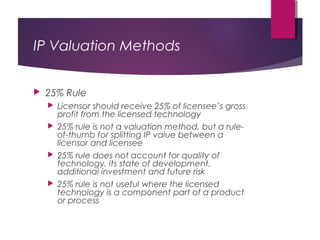
 25% Rule
 Licensor should receive 25% of licensee’s gross
profit from the licensed technology
 25% rule is not a valuation method, but a rule-
of-thumb for splitting IP value between a
licensor and licensee
 25% rule does not account for quality of
technology, its state of development,
additional investment and future risk
 25% rule is not useful where the licensed
technology is a component part of a product
or process
IP Valuation Methods
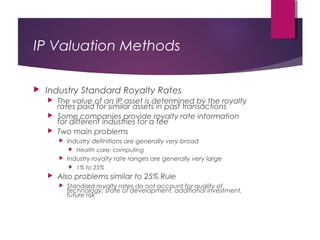
 Industry Standard Royalty Rates
 The value of an IP asset is determined by the royalty
rates paid for similar assets in past transactions
 Some companies provide royalty rate information
for different industries for a fee
 Two main problems
 Industry definitions are generally very broad
 Health care; computing
 Industry royalty rate ranges are generally very large
 1% to 25%
 Also problems similar to 25% Rule
 Standard royalty rates do not account for quality of
technology, state of development, additional investment,
future risk
IP Valuation Methods
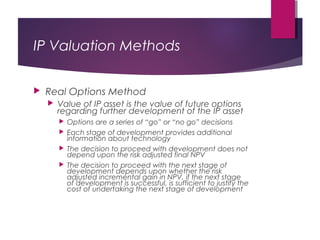
 Real Options Method
 Value of IP asset is the value of future options
regarding further development of the IP asset
 Options are a series of “go” or “no go” decisions
 Each stage of development provides additional
information about technology
 The decision to proceed with development does not
depend upon the risk adjusted final NPV
 The decision to proceed with the next stage of
development depends upon whether the risk
adjusted incremental gain in NPV, if the next stage
of development is successful, is sufficient to justify the
cost of undertaking the next stage of development
IP Valuation Methods
 Competitive Advantage Valuation (CAV)
 The value of an IP asset is determined from the IP asset’s
competitive advantage with respect to an average substitute IP
asset
 Seven basic steps
 Calculate NPV of total profits in technology’s intended market over time
 Disaggregate NPV into portion of profits attributable to technical intellectual
property assets
 Define price/performance parameters that determine success in the
intended market
 Calculate competitive advantage by comparing IP asset to an average
substitute IP asset on price/performance parameters
 Extrapolate from IP asset’s competitive advantage to predicted market
share in intended market
 Calculate value of IP asset from value of technical intellectual property
profits in intended market and predicted market share in intended market
 Adjust IP asset value for technical, market and intellectual property risks
IP Valuation Methods
 CAV (cont.)
 Benefits
 Links principal value drivers in intuitive way
 Easy to use and understand
 Can be used in multiple valuation contexts
 Scalable for simple and complex valuations
 Neutral as between licensors and licensees
 Limitations
 Default formulas and values are generalized for all industries
 Technical, market and intellectual property risk adjustments
can greatly alter valuation results
Thanks
QUESTIONS

Intellectual Property Issues for Consideration When Having a New Idea

  • 1.
    Intellectual Property Issues forConsideration PLUS Valuation Methods Demetris C. Hadjisofocli Executive Director, Entrepreneurship Frontier Network, Ltd. Managing Director, Innovade, Ltd.
  • 2.
    IP Precautions  Performpatent search before beginning research  Keep careful lab notebooks and write down every possible notation and action from the very beginning  Avoid known/legal issues that will prohibit the registration of a patent  Protect against patent invalidity
  • 3.
    IP Valuation Methods Basic Valuation Methods  Cost method  Market method  Income method  Selected IP Valuation Methods  25% rule  Industry standard royalty rates  Real-Options method  Competitive Advantage Valuation
  • 4.
  • 5.
    Perform Patent Search BeforeDoing Research  Patent owner’s rights  Exclusive right to make, use, sell and import  Unauthorized use of patent subject matter in research=patent infringement  No general experimental use exemption to patent infringement as in most other countries  Limited experimental use exemption for drugs and medical devices subject to FDA approval
  • 6.
    Perform Patent Search BeforeDoing Research  Beyond avoiding infringement, patent searches can also be helpful  To learn from work of others  To improve on successful approaches  To avoid unsuccessful approaches  To engineer around potential problems
  • 7.
  • 8.
    Keep Careful LabNotebooks  Lab notebooks necessary to determine  Who has priority to an invention  Who is named as an inventor
  • 9.
    Keep Careful LabNotebooks  Who has priority to an invention  US patent law; priority goes to first to invent  All other countries; priority goes to first to file  Who is the first to invent  First person to conceive of an invention and then diligently proceed to reduce the invention to practice  First person who conceives of an invention (A) will prevail over the first person to reduce the invention to practice (B) if the first person who conceives of the invention (A) is diligent from a date prior to the other person’s (B’s) conception of the invention until his/her (A’s) reduction to practice
  • 10.
    Keep Careful LabNotebooks  Priority Example  A conceives of invention on 1/1/2000  A reduces invention to practice on 1/1/2004  B conceives of invention on 1/1/2001  B reduces invention to practice on 1/1/2003  A will prevail over B, if A is diligent in reducing the invention to practice from a date prior to 1/1/2001 until 1/1/2004
  • 11.
    Keep Careful LabNotebooks  Definitions  Conception  Formation of a definite idea for the complete and operative invention  Reduction to practice  Actual reduction to practice  Building a working prototype of the invention  Constructive reduction to practice  Filing a patent application sufficient to enable one skilled in the art to make and use invention  Diligence  Reasonable and continues effort directed toward actual and/or constructive reduction to practice  Fact sensitive determination in each case
  • 12.
    Keep Careful LabNotebooks  Lab notebook are critical to establish  Date of conception  Date of reduction to practice  Diligence during required period of time  Lab notebooks should document all information relevant to the invention (ideas, experiments, instruments, procedures, formulas, calculations, etc.)  Every page should be signed and dated by the inventor  Every page should be witnessed and dated by two non-inventors who understand the work  All entries should be in ink; errors should be crossed out with a single line to remain readable  Electronic lab notebooks (date/time stamp) can be used
  • 13.
    Keep Careful LabNotebooks  Who is an inventor  An “inventor” is the person who conceives of an idea that is included in the patent claims  A sole inventor must conceive of all the ideas included in the patent claims  A joint inventor must conceive of at least one idea included in at least one patent claim  A person who reduces an invention to practice is not an inventor unless during the reduction to practice he/she conceives of an idea that is included in the patent claims  Failure to properly name inventors in a patent application can render the patent invalid
  • 14.
    Keep Careful LabNotebooks  Lab notebooks are critical to determine who is an inventor and who should be named as an inventor in the patent application  Named inventors can be changed after patent application is filed; unless there was a knowing and wrongful omission or inclusion of inventors in the first instance
  • 15.
    Avoid known/legal issues thatwill prohibit the registration of a patent
  • 16.
    Avoid Statutory BarTo Patent Issuance  Patent cannot be obtained in the U.S. if  Inventory known or used in U.S., or patented or described in printed publication in U.S. or foreign country, prior to the date of invention claimed by applicant  Invention patented or described in printed publication in U.S. or foreign country, or in public use or on sale in U.S., more than one year prior to patent application date  There is no statutory grace period in foreign countries  Strict novelty; any publication, public use or sale prior to patent application date will bar foreign patent issuance
  • 17.
    Avoid Statutory BarTo Patent Issuance  Acts of patent application or third party can bar patent issuance  Acts that can bar patent issuance  Public use  Can be very negligible and still bar patent issuance  Limited exception for “experimental use”  Experimentation must be technical, not marketing  Experimentation must be evidenced by written records  On sale  Offer of sale to single person can bar patent issuance  Offer of sale can occur prior to reduction to practice  License of technology is not an offer of sale
  • 18.
    Avoid Statutory BarTo Patent Issuance  Acts that can bar patent issuance (cont.)  Printed publication  Any document available to public regardless of location or form is a “printed publication”  Doctoral theses are available to public at time they are properly catalogued in library  A document is not available ion public  At time of thesis review and defense  At time of submission for peer-review publication  If recipient is under duty of confidentiality  Public presentation  Papers, slides, posters = printed publication  Unless audience is under a duty of confidentiality
  • 19.
    Avoid Statutory BarTo Patent Issuance  To constitute a statutory bar, the printed publication must enable one skilled in the art to practice the invention  Reporting what an invention can do, but not how the invention does what it does, is generally not an enabling disclosure
  • 20.
  • 21.
    Protect Against PatentInvalidity  A patent can be invalidated for inequitable conduct during the patent application process  Two elements of inequitable conduct  Patent applicant must misrepresent or fail to disclose material information to PTO  The misrepresentation or failure to disclose must be intentional  Most common misrepresentations  Critical dates; Inventors  Most common failures to disclose  Prior art; offer of sale; printed publication  Patent Act requires patent application to sign an oath that applicant believes he/she is the first inventor of the claimed invention
  • 22.
    Protect Against Patent Invalidity The Patent Act requires the patent application to contain a written description of the invention “in such full, clear, concise and exact terms” as to enable any person skilled in the art to make and use the invention  Every element of invention claims must be enabled in the patent application specification  Failure to provide an enabling disclosure will renter claim(s) invalid
  • 23.
  • 24.
    Basic Valuation Methods Cost Method  Value of an asset is the cost to replace the asset with an identical or equivalent asset  Can count for physical depreciation and functional obsolescence  BUT…. Cost does not equal value  Nuclear powered aircraft  Small percentage of patents have any value
  • 25.
    Basic Valuation Methods Market method (real estate appraisals)  Value of an asset is price paid for comparable assets  Conditions necessary for market method  Public exchange market  Sufficient number of recent exchanges  Standardized exchange terms  Price of exchanges available to public  None of these conditions exist for IP assets
  • 26.
    Basic Valuation Methods Income Method  Value of an asset is the net present value (NPV) of the future income expected to be received from the asset  Discounted cash flow (DCF)  Dollar today worth less than dollar tomorrow  Income method useful for IP assets associated with a revenue stream (Licensed patents)  Income method is not useful for IP assets prior to licensing or commercial use
  • 27.
  • 28.
    IP Valuation Methods 25% Rule  Licensor should receive 25% of licensee’s gross profit from the licensed technology  25% rule is not a valuation method, but a rule- of-thumb for splitting IP value between a licensor and licensee  25% rule does not account for quality of technology, its state of development, additional investment and future risk  25% rule is not useful where the licensed technology is a component part of a product or process
  • 29.
    IP Valuation Methods Industry Standard Royalty Rates  The value of an IP asset is determined by the royalty rates paid for similar assets in past transactions  Some companies provide royalty rate information for different industries for a fee  Two main problems  Industry definitions are generally very broad  Health care; computing  Industry royalty rate ranges are generally very large  1% to 25%  Also problems similar to 25% Rule  Standard royalty rates do not account for quality of technology, state of development, additional investment, future risk
  • 30.
    IP Valuation Methods Real Options Method  Value of IP asset is the value of future options regarding further development of the IP asset  Options are a series of “go” or “no go” decisions  Each stage of development provides additional information about technology  The decision to proceed with development does not depend upon the risk adjusted final NPV  The decision to proceed with the next stage of development depends upon whether the risk adjusted incremental gain in NPV, if the next stage of development is successful, is sufficient to justify the cost of undertaking the next stage of development
  • 31.
    IP Valuation Methods Competitive Advantage Valuation (CAV)  The value of an IP asset is determined from the IP asset’s competitive advantage with respect to an average substitute IP asset  Seven basic steps  Calculate NPV of total profits in technology’s intended market over time  Disaggregate NPV into portion of profits attributable to technical intellectual property assets  Define price/performance parameters that determine success in the intended market  Calculate competitive advantage by comparing IP asset to an average substitute IP asset on price/performance parameters  Extrapolate from IP asset’s competitive advantage to predicted market share in intended market  Calculate value of IP asset from value of technical intellectual property profits in intended market and predicted market share in intended market  Adjust IP asset value for technical, market and intellectual property risks
  • 32.
    IP Valuation Methods CAV (cont.)  Benefits  Links principal value drivers in intuitive way  Easy to use and understand  Can be used in multiple valuation contexts  Scalable for simple and complex valuations  Neutral as between licensors and licensees  Limitations  Default formulas and values are generalized for all industries  Technical, market and intellectual property risk adjustments can greatly alter valuation results
  • 33.