Innovation
Sorting out the plumbing, keeping it in check
and servicing it when it gets a bit blocked
Owen Valentine Pringle, Therein
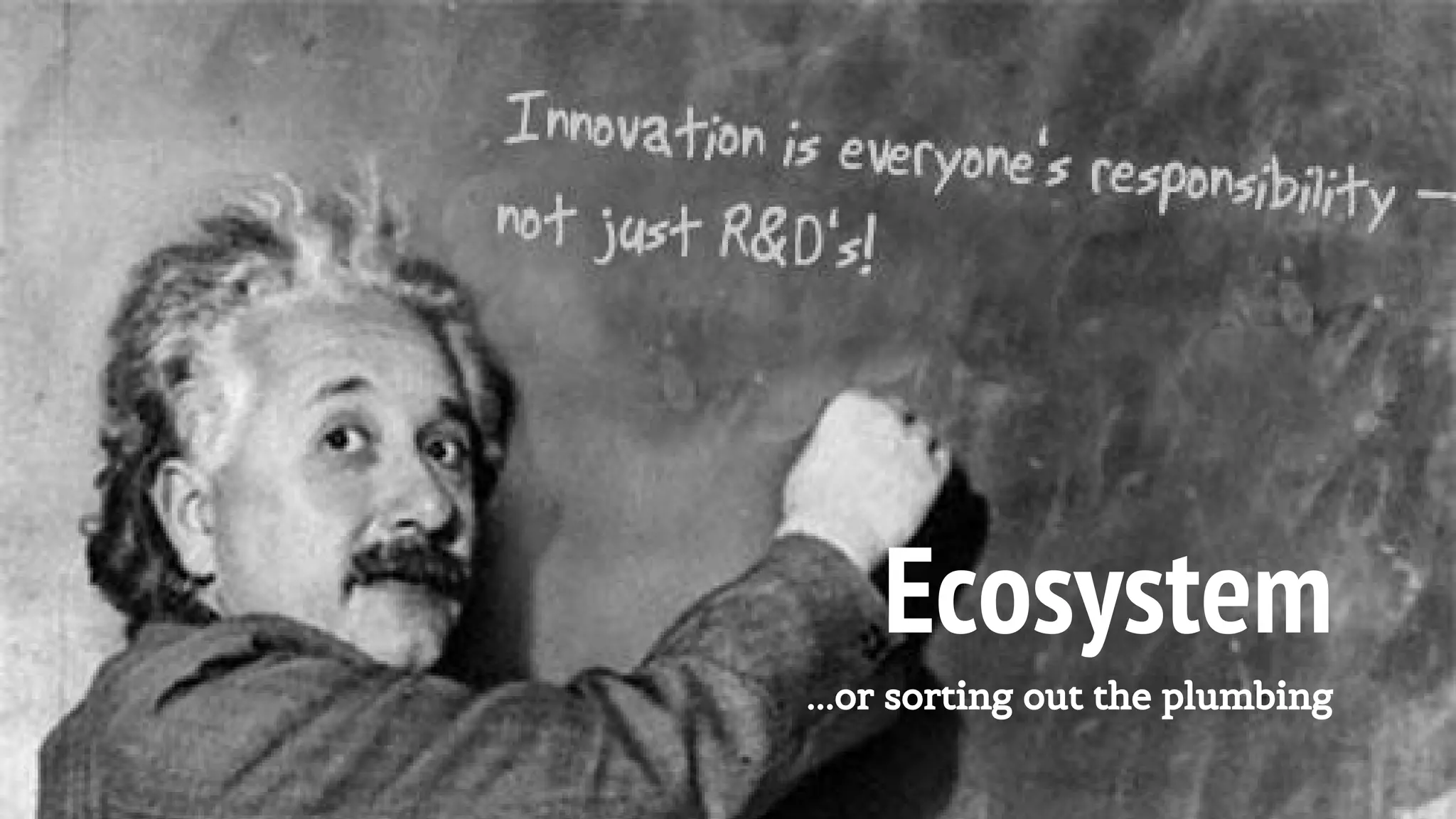
Ecosystem
...or sorting out the plumbing
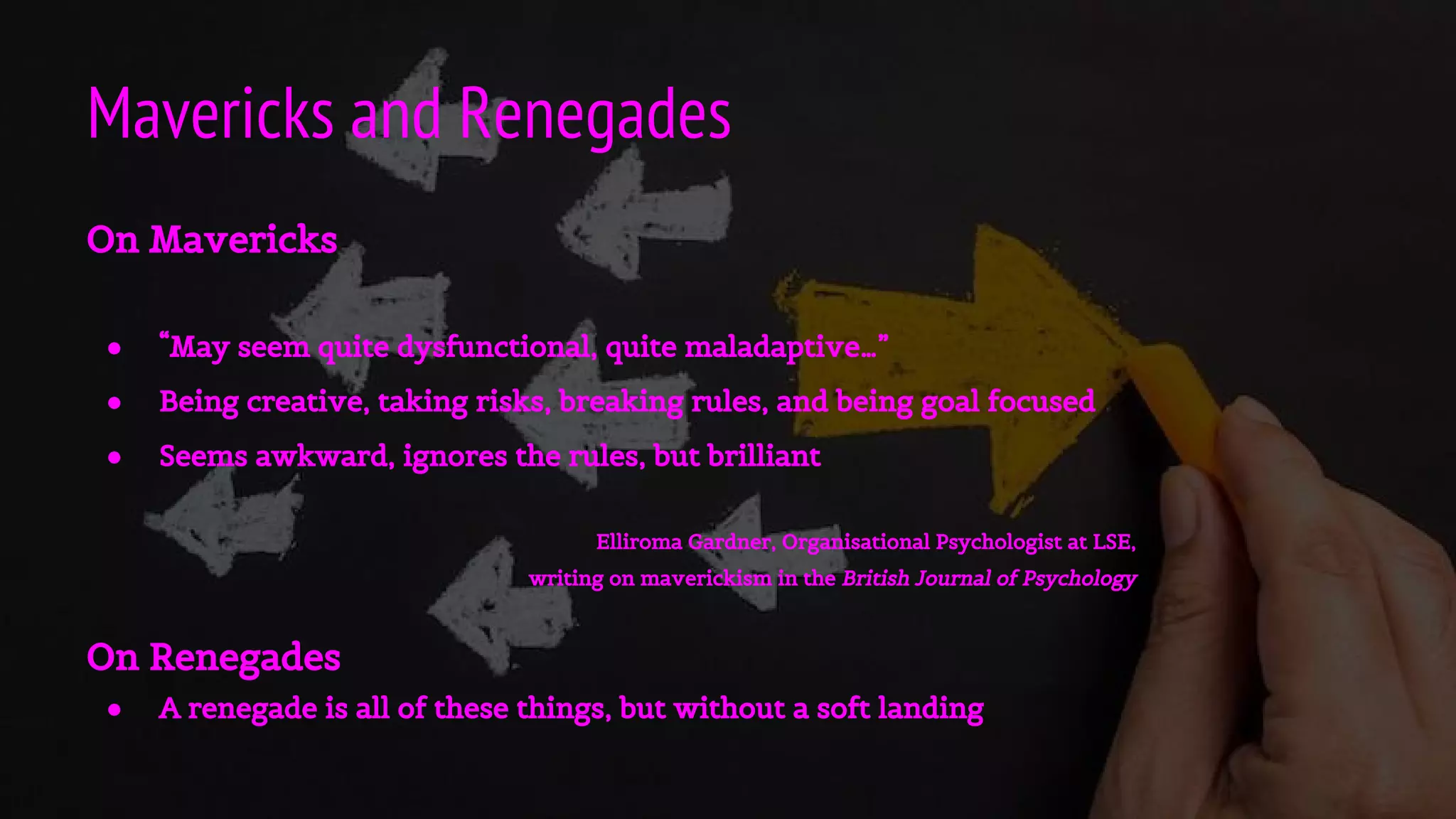
Mavericks and Renegades
On Mavericks
● “May seem quite dysfunctional, quite maladaptive…”
● Being creative, taking risks, breaking rules, and being goal focused
● Seems awkward, ignores the rules, but brilliant
Elliroma Gardner, Organisational Psychologist at LSE,
writing on maverickism in the British Journal of Psychology
On Renegades
● A renegade is all of these things, but without a soft landing
The Problem with ‘Innovation’
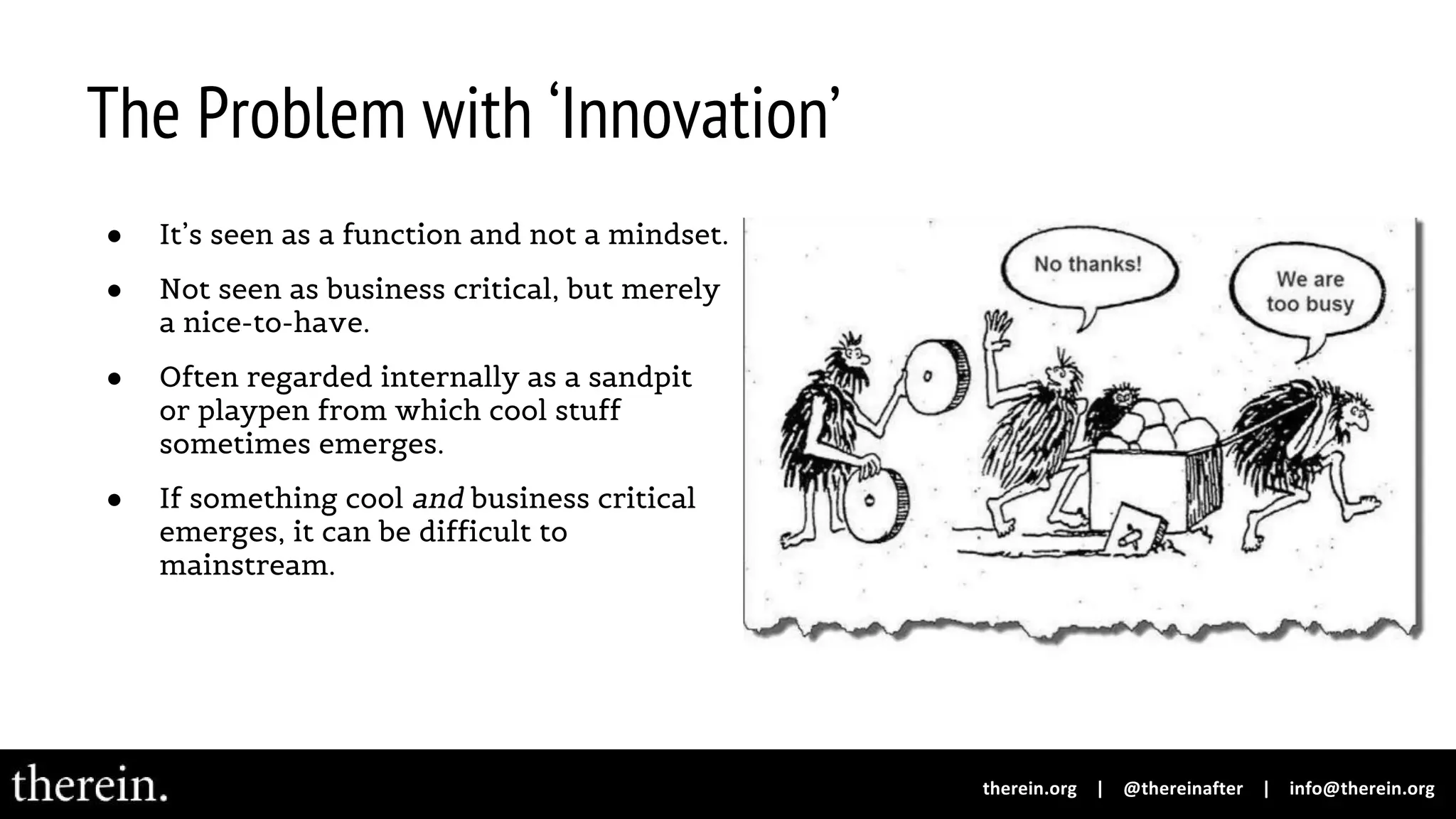
● It’s seen as a function and not a mindset.
● Not seen as business critical, but merely
a nice-to-have.
● Often regarded internally as a sandpit
or playpen from which cool stuff
sometimes emerges.
● If something cool and business critical
emerges, it can be difficult to
mainstream.
Sustainability
...or keeping it in check
Cardinal Rule
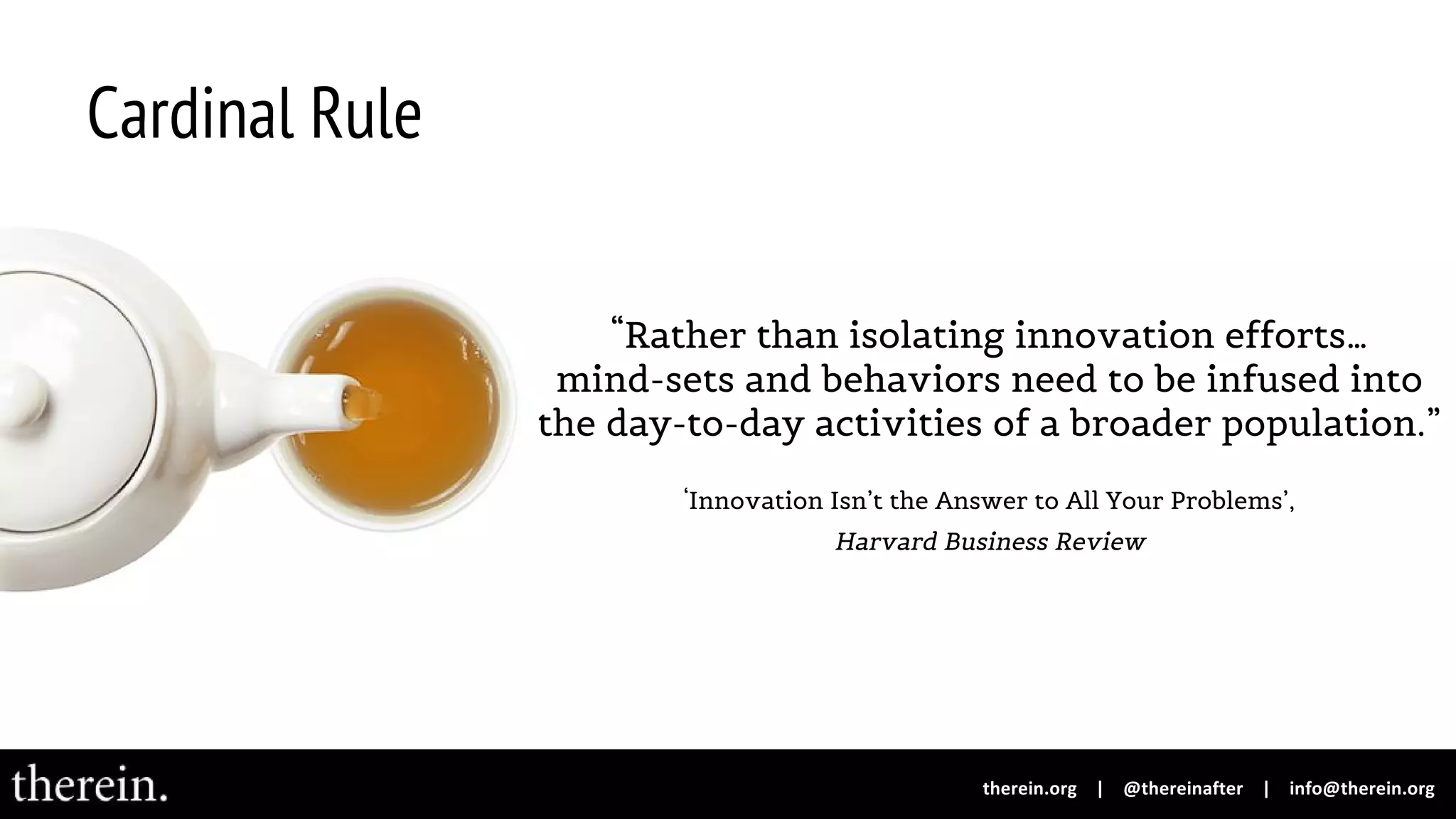
“Rather than isolating innovation efforts…
mind-sets and behaviors need to be infused into
the day-to-day activities of a broader population.”
‘Innovation Isn’t the Answer to All Your Problems’,
Harvard Business Review
Characteristics and Traits
● Means, not the end
● They implement
● Protected space
● Openness
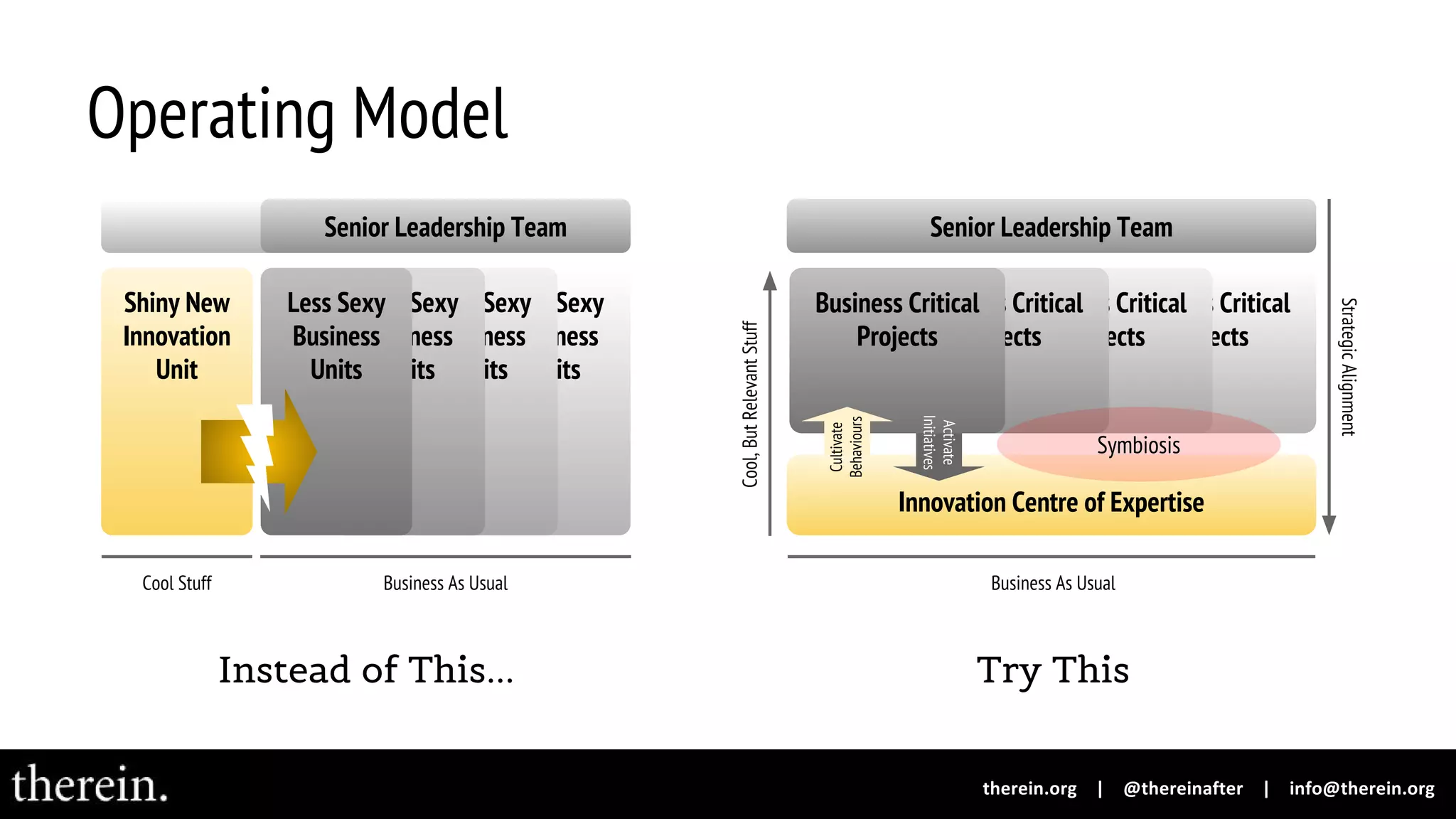
Operating Model
Senior Leadership Team
Shiny New
Innovation
Unit
Less Sexy
Business
Units
Less Sexy
Business
Units
Less Sexy
Business
Units
Less Sexy
Business
Units
Business As UsualCool Stuff
Senior Leadership Team
Business Critical
Projects
Business Critical
Projects
Business Critical
Projects
Business Critical
Projects
Business As Usual
Cool,ButRelevantStuff
Innovation Centre of Expertise
Cultivate
Behaviours
Activate
Initiatives
Instead of This... Try This
StrategicAlignment
Symbiosis
Unblocking
...or servicing it when it gets a bit blocked
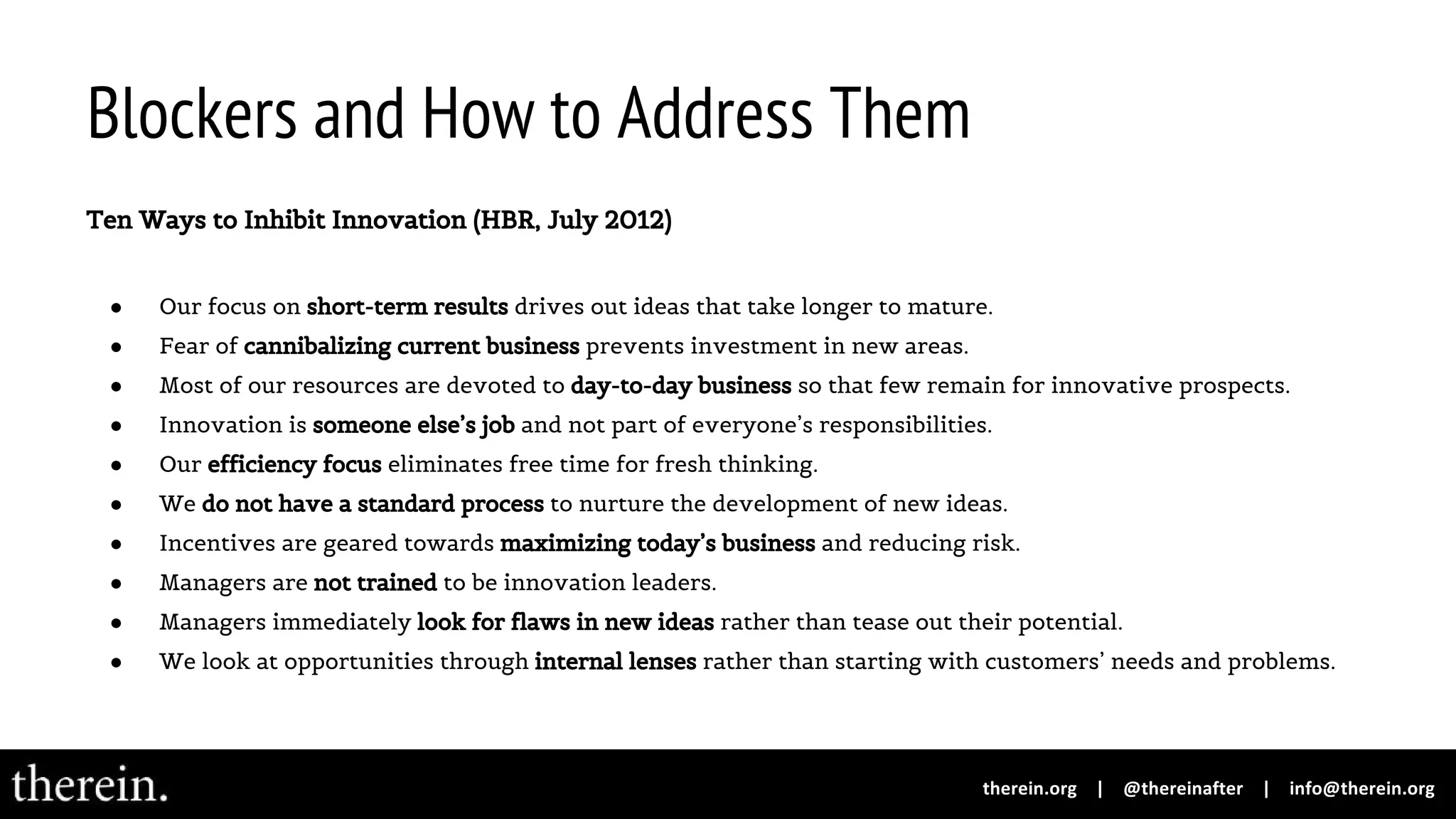
Blockers and How to Address Them
Ten Ways to Inhibit Innovation (HBR, July 2012)
● Our focus on short-term results drives out ideas that take longer to mature.
● Fear of cannibalizing current business prevents investment in new areas.
● Most of our resources are devoted to day-to-day business so that few remain for innovative prospects.
● Innovation is someone else’s job and not part of everyone’s responsibilities.
● Our efficiency focus eliminates free time for fresh thinking.
● We do not have a standard process to nurture the development of new ideas.
● Incentives are geared towards maximizing today’s business and reducing risk.
● Managers are not trained to be innovation leaders.
● Managers immediately look for flaws in new ideas rather than tease out their potential.
● We look at opportunities through internal lenses rather than starting with customers’ needs and problems.
Blockers and How to Address Them
1. “It’s not where our focus
should be”
- Identify a project with the greatest
reach across the organisation, limited
exposure in terms of cost, but can
demonstrate a quick win.
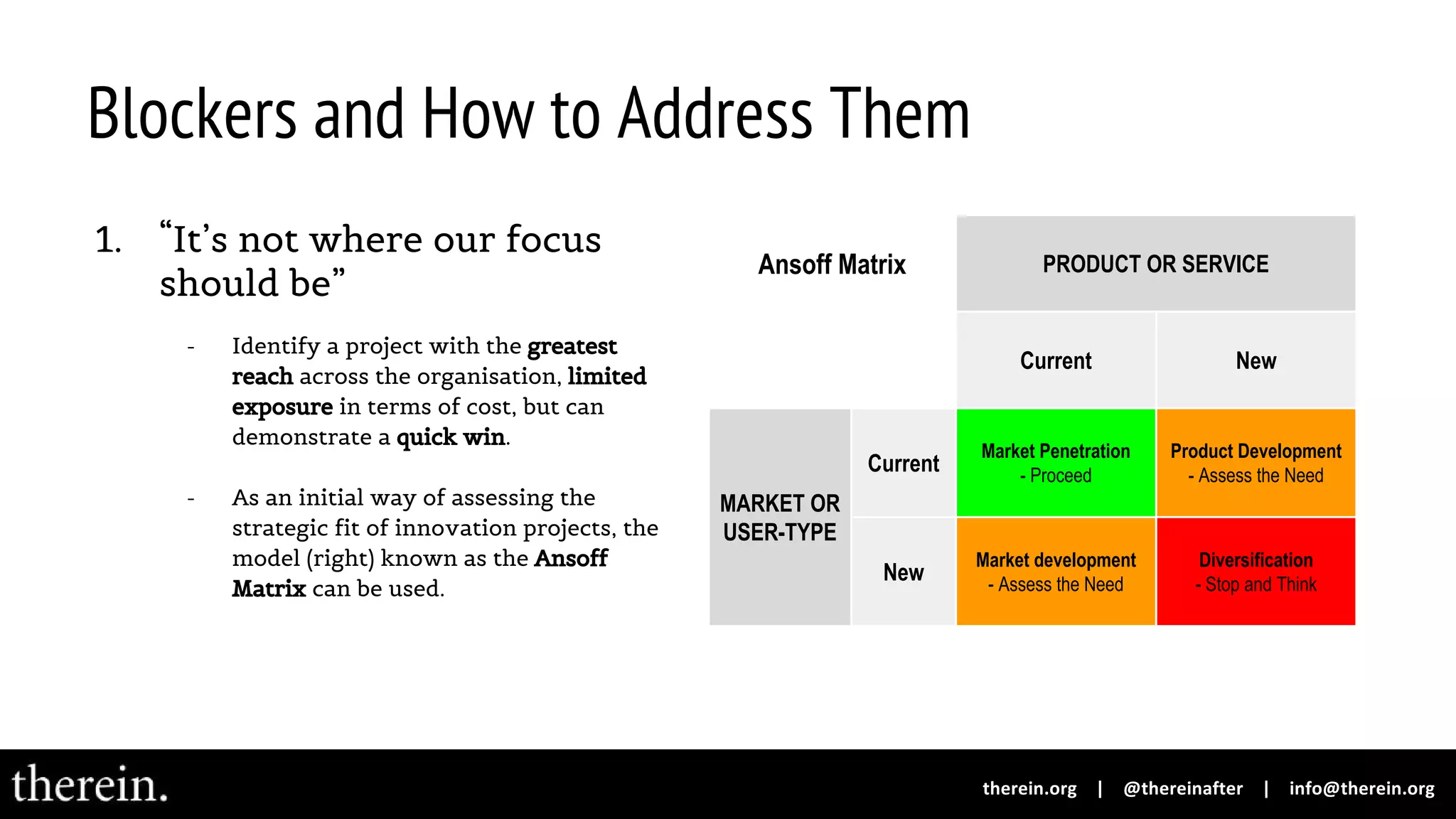
- As an initial way of assessing the
strategic fit of innovation projects, the
model (right) known as the Ansoff
Matrix can be used.
Ansoff Matrix PRODUCT OR SERVICE
Current New
MARKET OR
USER-TYPE
Current
Market Penetration
- Proceed
Product Development
- Assess the Need
New
Market development
- Assess the Need
Diversification
- Stop and Think
Blockers and How to Address Them
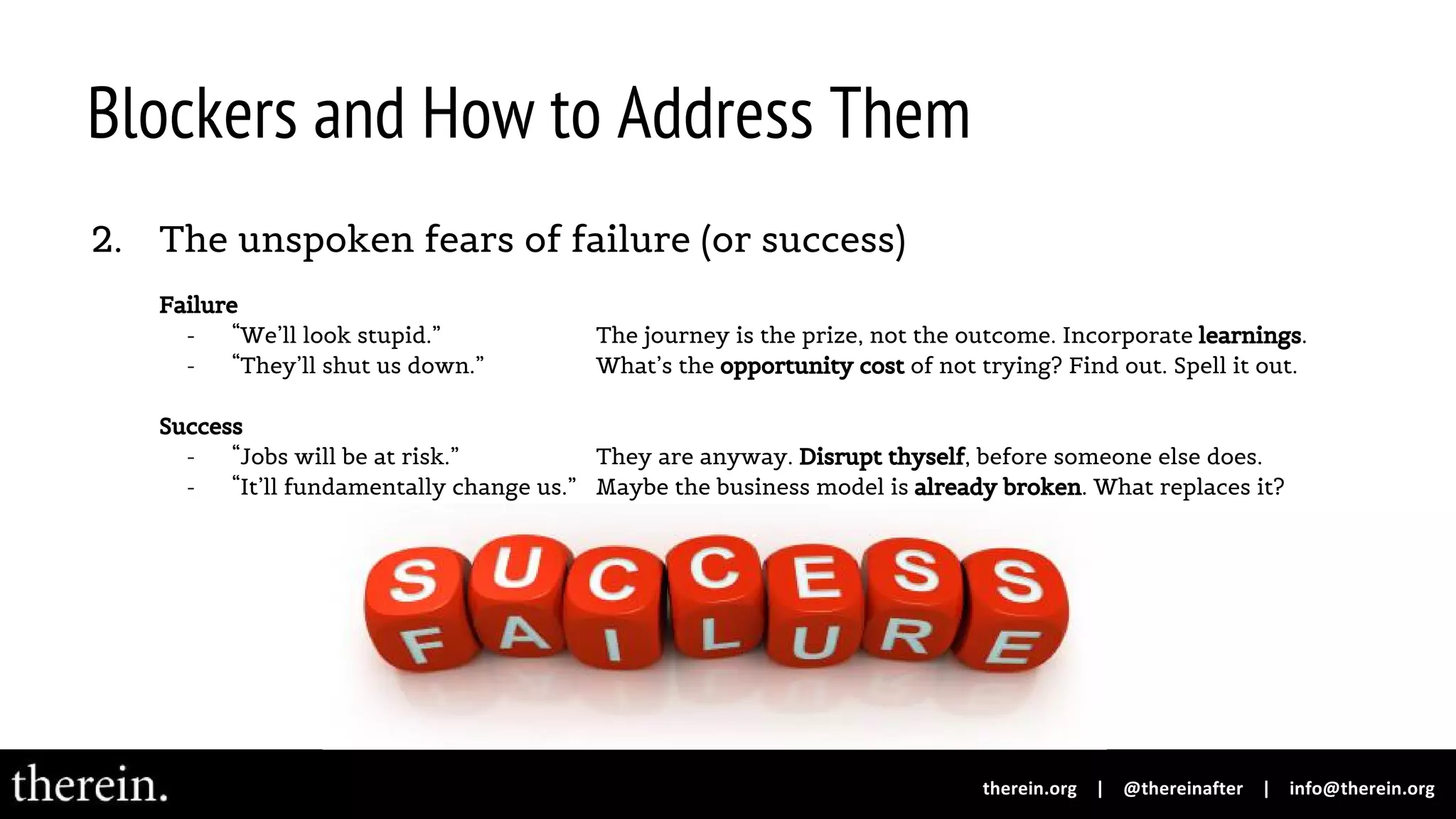
2. The unspoken fears of failure (or success)
Failure
- “We’ll look stupid.” The journey is the prize, not the outcome. Incorporate learnings.
- “They’ll shut us down.” What’s the opportunity cost of not trying? Find out. Spell it out.
Success
- “Jobs will be at risk.” They are anyway. Disrupt thyself, before someone else does.
- “It’ll fundamentally change us.” Maybe the business model is already broken. What replaces it?
Blockers and How to Address Them
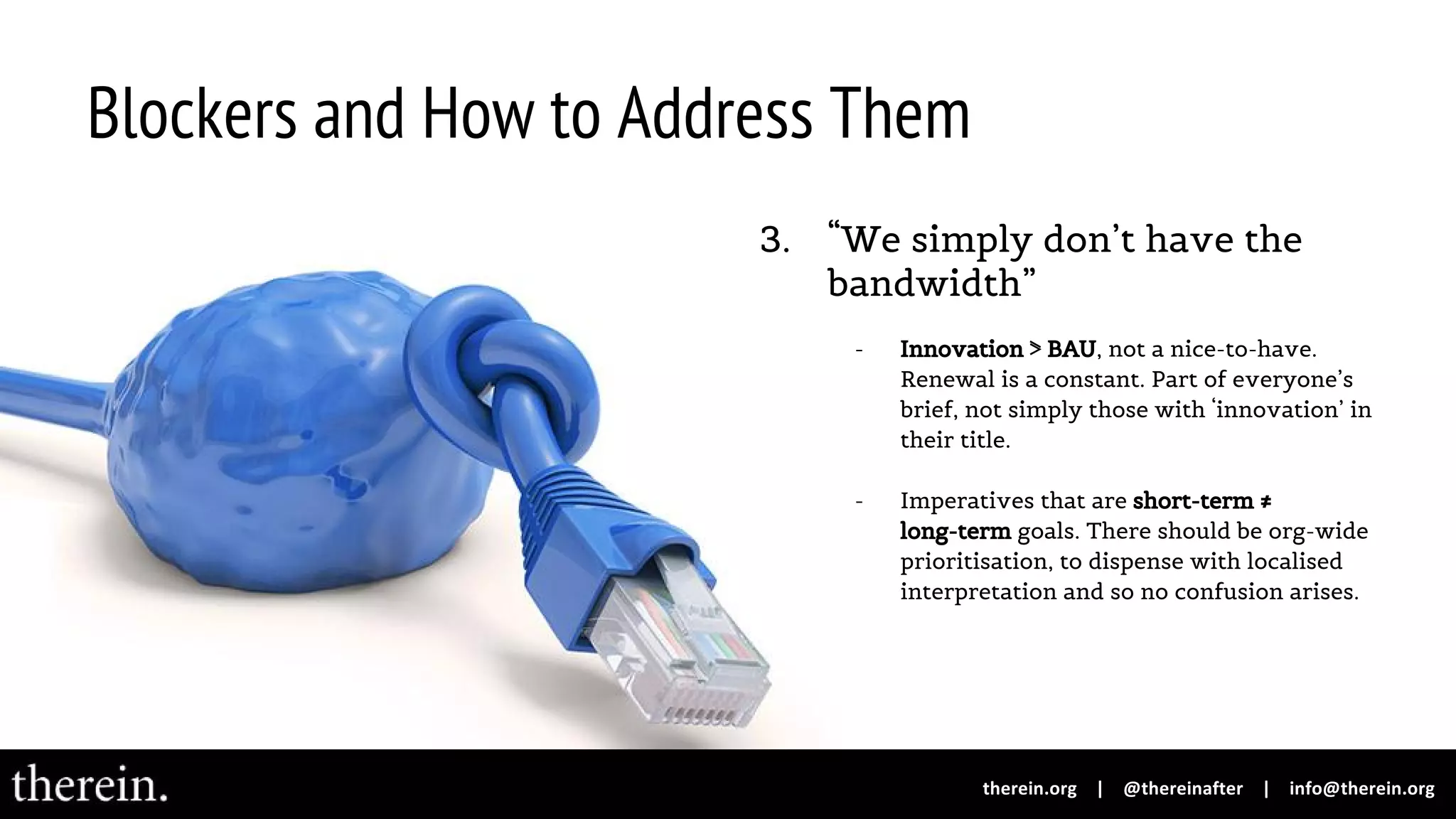
3. “We simply don’t have the
bandwidth”
- Innovation ⋝ BAU, not a nice-to-have.
Renewal is a constant. Part of everyone’s
brief, not simply those with ‘innovation’ in
their title.
- Imperatives that are short-term ≠
long-term goals. There should be org-wide
prioritisation, to dispense with localised
interpretation and so no confusion arises.
In Closing
Final Thoughts
● Start with the strategy. Does the innovation
have a line-of-sight back to your core
objectives?
● Test, learn and iterate. How can the journey
towards innovation help to foster new ways
of working?
● Create in a protected space, but not
protected from those who are expected to
operationalise or utilise your invention.

Developing and Maintaining Organisational Innovation

  • 1.
    Innovation Sorting out theplumbing, keeping it in check and servicing it when it gets a bit blocked Owen Valentine Pringle, Therein
  • 3.
  • 4.
    Mavericks and Renegades OnMavericks ● “May seem quite dysfunctional, quite maladaptive…” ● Being creative, taking risks, breaking rules, and being goal focused ● Seems awkward, ignores the rules, but brilliant Elliroma Gardner, Organisational Psychologist at LSE, writing on maverickism in the British Journal of Psychology On Renegades ● A renegade is all of these things, but without a soft landing
  • 5.
    The Problem with‘Innovation’ ● It’s seen as a function and not a mindset. ● Not seen as business critical, but merely a nice-to-have. ● Often regarded internally as a sandpit or playpen from which cool stuff sometimes emerges. ● If something cool and business critical emerges, it can be difficult to mainstream.
  • 6.
  • 7.
    Cardinal Rule “Rather thanisolating innovation efforts… mind-sets and behaviors need to be infused into the day-to-day activities of a broader population.” ‘Innovation Isn’t the Answer to All Your Problems’, Harvard Business Review
  • 8.
    Characteristics and Traits ●Means, not the end ● They implement ● Protected space ● Openness
  • 9.
    Operating Model Senior LeadershipTeam Shiny New Innovation Unit Less Sexy Business Units Less Sexy Business Units Less Sexy Business Units Less Sexy Business Units Business As UsualCool Stuff Senior Leadership Team Business Critical Projects Business Critical Projects Business Critical Projects Business Critical Projects Business As Usual Cool,ButRelevantStuff Innovation Centre of Expertise Cultivate Behaviours Activate Initiatives Instead of This... Try This StrategicAlignment Symbiosis
  • 10.
    Unblocking ...or servicing itwhen it gets a bit blocked
  • 11.
    Blockers and Howto Address Them Ten Ways to Inhibit Innovation (HBR, July 2012) ● Our focus on short-term results drives out ideas that take longer to mature. ● Fear of cannibalizing current business prevents investment in new areas. ● Most of our resources are devoted to day-to-day business so that few remain for innovative prospects. ● Innovation is someone else’s job and not part of everyone’s responsibilities. ● Our efficiency focus eliminates free time for fresh thinking. ● We do not have a standard process to nurture the development of new ideas. ● Incentives are geared towards maximizing today’s business and reducing risk. ● Managers are not trained to be innovation leaders. ● Managers immediately look for flaws in new ideas rather than tease out their potential. ● We look at opportunities through internal lenses rather than starting with customers’ needs and problems.
  • 12.
    Blockers and Howto Address Them 1. “It’s not where our focus should be” - Identify a project with the greatest reach across the organisation, limited exposure in terms of cost, but can demonstrate a quick win. - As an initial way of assessing the strategic fit of innovation projects, the model (right) known as the Ansoff Matrix can be used. Ansoff Matrix PRODUCT OR SERVICE Current New MARKET OR USER-TYPE Current Market Penetration - Proceed Product Development - Assess the Need New Market development - Assess the Need Diversification - Stop and Think
  • 13.
    Blockers and Howto Address Them 2. The unspoken fears of failure (or success) Failure - “We’ll look stupid.” The journey is the prize, not the outcome. Incorporate learnings. - “They’ll shut us down.” What’s the opportunity cost of not trying? Find out. Spell it out. Success - “Jobs will be at risk.” They are anyway. Disrupt thyself, before someone else does. - “It’ll fundamentally change us.” Maybe the business model is already broken. What replaces it?
  • 14.
    Blockers and Howto Address Them 3. “We simply don’t have the bandwidth” - Innovation ⋝ BAU, not a nice-to-have. Renewal is a constant. Part of everyone’s brief, not simply those with ‘innovation’ in their title. - Imperatives that are short-term ≠ long-term goals. There should be org-wide prioritisation, to dispense with localised interpretation and so no confusion arises.
  • 15.
  • 16.
    Final Thoughts ● Startwith the strategy. Does the innovation have a line-of-sight back to your core objectives? ● Test, learn and iterate. How can the journey towards innovation help to foster new ways of working? ● Create in a protected space, but not protected from those who are expected to operationalise or utilise your invention.