Two Sides to Value!
              Corporate Finance and Valuation 	

                             Aswath Damodaran	

                         http://www.damodaran.com	


                        Tata Group, May 2010	


Aswath Damodaran!                                      1!
A motive for valuation and corporate finance…	


            One hundred thousand lemmings cannot be wrong   	


Graffiti	


Aswath Damodaran!                                                                   2!
Let’s start with an accounting balance sheet…	


                                                   The Balance Sheet
                                     Assets                                       Liabilities
                                                                    Current        Short-term liabilities of the firm
           Long Lived Real Assets           Fixed Assets            Liabilties

             Short-lived Assets             Current Assets          Debt             Debt obligations of firm

           Investments in securities       Financial Investments   Other
           assets of other firms                                    Liabilities      Other long-term obligations

           Assets which are not physical,   Intangible Assets
           like patents  trademarks                                Equity           Equity investment in firm


Aswath Damodaran!                                                                                                       3!
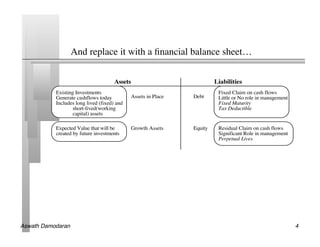
And replace it with a financial balance sheet…	


                                      Assets                            Liabilities
           Existing Investments                                          Fixed Claim on cash flows
           Generate cashflows today          Assets in Place   Debt      Little or No role in management
           Includes long lived (fixed) and                               Fixed Maturity
                   short-lived(working                                   Tax Deductible
                   capital) assets

           Expected Value that will be       Growth Assets     Equity    Residual Claim on cash flows
           created by future investments                                 Significant Role in management
                                                                         Perpetual Lives


Aswath Damodaran!                                                                                          4!
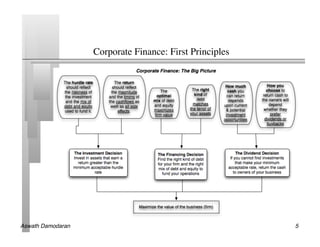
Corporate Finance: First Principles	


Aswath Damodaran!                                            5!
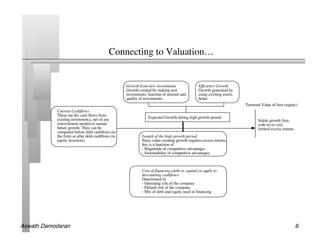
Connecting to Valuation…	


                                                    Growth from new investments                 Efficiency Growth
                                                    Growth created by making new                Growth generated by
                                                    investments; function of amount and         using existing assets
                                                    quality of investments                      better
                                                                                                                        Terminal Value of firm (equity)
            Current Cashflows
            These are the cash flows from                       Expected Growth during high growth period
            existing investment,s, net of any                                                                                  Stable growth firm,
            reinvestment needed to sustain                                                                                     with no or very
            future growth. They can be                                                                                         limited excess returns
            computed before debt cashflows (to
            the firm) or after debt cashflows (to            Length of the high growth period
            equity investors).                               Since value creating growth requires excess returns,
                                                             this is a function of
                                                             - Magnitude of competitive advantages
                                                             - Sustainability of competitive advantages


                                                             Cost of financing (debt or capital) to apply to
                                                             discounting cashflows
                                                             Determined by
                                                             - Operating risk of the company
                                                             - Default risk of the company
                                                             - Mix of debt and equity used in financing


Aswath Damodaran!                                                                                                                                       6!
Misconceptions about Valuation	


               Myth 1: A valuation is an objective search for “true” value	

                 •  Truth 1.1: All valuations are biased. The only questions are how much and in which
                    direction.	

                 •  Truth 1.2: The direction and magnitude of the bias in your valuation is directly
                    proportional to who pays you and how much you are paid.	

               Myth 2.: A good valuation provides a precise estimate of value	

                 •  Truth 2.1: There are no precise valuations	

                 •  Truth 2.2: The payoff to valuation is greatest when valuation is least precise.	

               Myth 3: . The more quantitative a model, the better the valuation	

                 •  Truth 3.1: One’s understanding of a valuation model is inversely proportional to
                    the number of inputs required for the model.	

                 •  Truth 3.2: Simpler valuation models do much better than complex ones.	


Aswath Damodaran!                                                                                        7!
Valuation: The Big Picture	

                    If you get the big picture, the details will follow…	


Aswath Damodaran!                                                             8!
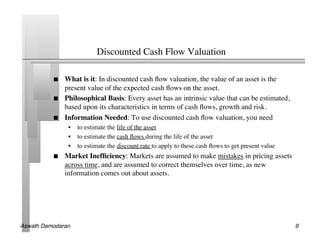
Discounted Cash Flow Valuation	


               What is it: In discounted cash flow valuation, the value of an asset is the
                present value of the expected cash flows on the asset.	

               Philosophical Basis: Every asset has an intrinsic value that can be estimated,
                based upon its characteristics in terms of cash flows, growth and risk.	

               Information Needed: To use discounted cash flow valuation, you need	

                 •  to estimate the life of the asset	

                 •  to estimate the cash flows during the life of the asset	

                 •  to estimate the discount rate to apply to these cash flows to get present value	

               Market Inefficiency: Markets are assumed to make mistakes in pricing assets
                across time, and are assumed to correct themselves over time, as new
                information comes out about assets.	


Aswath Damodaran!                                                                                       9!
DCF Choices: Equity Valuation versus Firm Valuation	

         Firm Valuation: Value the entire business	


                                     Assets                              Liabilities
          Existing Investments                                            Fixed Claim on cash flows
          Generate cashflows today          Assets in Place     Debt      Little or No role in management
          Includes long lived (fixed) and                                 Fixed Maturity
                  short-lived(working                                     Tax Deductible
                  capital) assets

          Expected Value that will be       Growth Assets       Equity    Residual Claim on cash flows
          created by future investments                                   Significant Role in management
                                                                          Perpetual Lives


                                                              Equity valuation: Value just the
                                                              equity claim in the business	


Aswath Damodaran!                                                                                           10!
DISCOUNTED CASHFLOW VALUATION

                     Cashflow to Firm                                   Expected Growth
                     EBIT (1-t)                                         Reinvestment Rate
                     - (Cap Ex - Depr)                                  * Return on Capital
                                                                                                   Firm is in stable growth:
                     - Change in WC
                                                                                                   Grows at constant rate
                     = FCFF
                                                                                                   forever


                                                                                   Terminal Value= FCFF n+1 /(r-g n)
                                FCFF1       FCFF2    FCFF3        FCFF4         FCFF5           FCFFn
Value of Operating Assets                                                              .........
+ Cash  Non-op Assets                                                                                          Forever
= Value of Firm
                                Discount at WACC= Cost of Equity (Equity/(Debt + Equity)) + Cost of Debt (Debt/(Debt+ Equity))
- Value of Debt
= Value of Equity


                     Cost of Equity                 Cost of Debt                            Weights
                                                    (Riskfree Rate                          Based on Market Value
                                                    + Default Spread) (1-t)

    Riskfree Rate :
    - No default risk                                               Risk Premium
    - No reinvestment risk         Beta                             - Premium for average
    - In same currency and    +    - Measures market risk      X
                                                                    risk investment
    in same terms (real or
    nominal as cash flows
                                Type of    Operating        Financial        Base Equity       Country Risk
                                Business   Leverage         Leverage         Premium           Premium

Aswath Damodaran!                                                                                                              11!
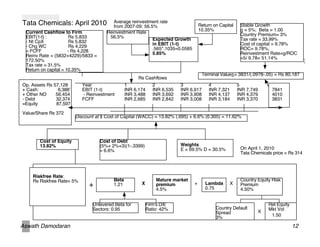
Tata Chemicals: April 2010                Average reinvestment rate
                                          from 2007-09: 56.5%                       Return on Capital    Stable Growth
 Current Cashflow to Firm              Reinvestment Rate                            10.35%               g = 5%; Beta = 1.00
 EBIT(1-t) :          Rs 5,833          56.5%                                                            Country Premium= 3%
                                                            Expected Growth                              Tax rate = 33.99%
 - Nt CpX             Rs 5,832                              in EBIT (1-t)                                Cost of capital = 9.78%
 - Chg WC              Rs 4,229                             .565*.1035=0.0585                            ROC= 9.78%;
 = FCFF               - Rs 4,228                            5.85%                                        Reinvestment Rate=g/ROC
 Reinv Rate = (5832+4229)/5833 =                                                                         =5/ 9.78= 51.14%
 172.50%
 Tax rate = 31.5%
 Return on capital = 10.35%
                                                                                     Terminal Value5= 3831/(.0978-.05) = Rs 80,187
                                                      Rs Cashflows
Op. Assets Rs 57,128        Year                 1             2           3             4              5
+ Cash:         6,388ʼ      EBIT (1-t)           INR 6,174     INR 6,535   INR 6,917     INR 7,321      INR 7,749      7841
+ Other NO     56,454       - Reinvestment       INR 3,488     INR 3,692   INR 3,908     INR 4,137      INR 4,379      4010
- Debt         32,374       FCFF                 INR 2,685     INR 2,842   INR 3,008     INR 3,184      INR 3,370      3831
=Equity        87,597
Value/Share Rs 372
                         Discount at $ Cost of Capital (WACC) = 13.82% (.695) + 6.6% (0.305) = 11.62%


        Cost of Equity              Cost of Debt
        13.82%                      (5%+ 2%+3)(1-.3399)                    Weights
                                                                           E = 69.5% D = 30.5%           On April 1, 2010
                                    = 6.6%                                                               Tata Chemicals price = Rs 314


    Riskfree Rate:
    Rs Riskfree Rate= 5%                  Beta                  Mature market                            Country Equity Risk
                               +          1.21          X       premium         +      Lambda      X     Premium
                                                                4.5%                   0.75              4.50%


                                 Unlevered Beta for         Firmʼs D/E                                                Rel Equity
                                 Sectors: 0.95              Ratio: 42%                      Country Default           Mkt Vol
                                                                                            Spread               X
                                                                                            3%                         1.50

Aswath Damodaran!                                                                                                                  12!
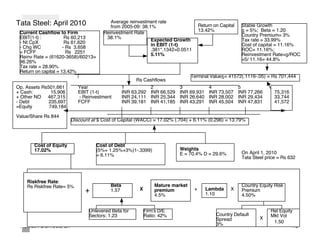
Tata Steel: April 2010                   Average reinvestment rate
                                         from 2005-09: 38.1%                        Return on Capital    Stable Growth
                                                                                    13.42%               g = 5%; Beta = 1.20
 Current Cashflow to Firm             Reinvestment Rate                                                  Country Premium= 3%
 EBIT(1-t) :           Rs 60,213       38.1%               Expected Growth                               Tax rate = 33.99%
 - Nt CpX              Rs 61,620                           in EBIT (1-t)                                 Cost of capital = 11.16%
 - Chg WC             - Rs 3,658                           .381*.1342=0.0511                             ROC= 11.16%;
 = FCFF                 Rs 2251                            5.11%                                         Reinvestment Rate=g/ROC
 Reinv Rate = (61620-3658)/60213=                                                                        =5/ 11.16= 44.8%
 96.26%
 Tax rate = 28.90%
 Return on capital = 13.42%
                                                                               Terminal Value5= 41572(.1116-.05) = Rs 701,444
                                                      Rs Cashflows
Op. Assets Rs501,661       Year                 1          2            3                4              5
+ Cash:        15,906      EBIT (1-t)           INR 63,292 INR 66,529   INR 69,931       INR 73,507     INR 77,266      75,316
+ Other NO 467,315         - Reinvestment       INR 24,111 INR 25,344   INR 26,640       INR 28,002     INR 29,434      33,744
- Debt        235,697      FCFF                 INR 39,181 INR 41,185   INR 43,291       INR 45,504     INR 47,831      41,572
=Equity       749,184

Value/Share Rs 844
                        Discount at $ Cost of Capital (WACC) = 17.02% (.704) + 6.11% (0.296) = 13.79%


       Cost of Equity               Cost of Debt
       17.02%                       (5%+ 1.25%+3%)1-.3399)              Weights
                                                                        E = 70.4% D = 29.6%              On April 1, 2010
                                    = 6.11%                                                              Tata Steel price = Rs 632


    Riskfree Rate:
    Rs Riskfree Rate= 5%                 Beta                  Mature market                             Country Equity Risk
                              +          1.57          X       premium          +      Lambda      X     Premium
                                                               4.5%                    1.10              4.50%


                                Unlevered Beta for         Firmʼs D/E                                                 Rel Equity
                                Sectors: 1.23              Ratio: 42%                       Country Default           Mkt Vol
                                                                                            Spread               X
                                                                                                                       1.50
 Aswath Damodaran!                                                                          3%                                   13!
Average reinvestment rate
Tata Motors: April 2010                    from 2005-09: 179.59%;                                       Return on Capital
                                           without acquisitions: 70%                                                              Stable Growth
 Current Cashflow to Firm                                                                               17.16%
                                                                                                                                  g = 5%; Beta = 1.00
 EBIT(1-t) :           Rs 20,116   Reinvestment Rate                                                                              Country Premium= 3%
                                    70%                                   Expected Growth
 - Nt CpX              Rs 31,590                                          from new inv.                                           Cost of capital = 10.39%
 - Chg WC              Rs 2,732                                           .70*.1716=0.1201                                        Tax rate = 33.99%
 = FCFF               - Rs 14,205                                                                                                 ROC= 12%;
 Reinv Rate = (31590+2732)/20116 =                                                                                                Reinvestment Rate=g/ROC
 170.61%; Tax rate = 21.00%                                                                                                       =5/ 12= 41.67%
 Return on capital = 17.16%
                                                                                                        Terminal Value5= 26412/(.1039-.05) = Rs 489,813
                                                              Rs Cashflows
Op. Assets Rs231,914    Year              1        2       3           4        5       6       7        8       9       10
+ Cash:        11418    EBIT (1-t)        22533    25240   28272       31668    35472   39236   42848    46192   49150   51607                 45278
+ Other NO 140576        - Reinvestment   15773    17668   19790       22168    24830   25242   25138    24482   23264   21503                 18866
- Debt        109198    FCFF              6760     7572    8482        9500     10642   13994   17711    21710   25886   30104                 26412
=Equity       274,710

Value/Share Rs 665
                        Discount at $ Cost of Capital (WACC) = 14.00% (.747) + 8.09% (0.253) = 12.50%
                                                                                                                                  Growth declines to 5%
                                                                                                                                  and cost of capital
                                                                                                                                  moves to stable period
                                                                                                                                  level.
       Cost of Equity                 Cost of Debt
       14.00%                         (5%+ 4.25%+3)(1-.3399)                               Weights
                                                                                           E = 74.7% D = 25.3%                   On April 1, 2010
                                      = 8.09%                                                                                    Tata Motors price = Rs 781


    Riskfree Rate:
    Rs Riskfree Rate= 5%                          Beta                         Mature market                                     Country Equity Risk
                                +                 1.20             X           premium             +       Lambda        X       Premium
                                                                               4.5%                        0.80                  4.50%


                                  Unlevered Beta for                   Firmʼs D/E                                                             Rel Equity
                                  Sectors: 1.04                        Ratio: 33%                                Country Default              Mkt Vol
                                                                                                                 Spread                  X
                                                                                                                                               1.50
                                                                                                                 3%
  Aswath Damodaran!                                                                                                                                           14!
TCS: April 2010                          Average reinvestment rate
                                         from 2005--2009 =56.73%%                                    Return on Capital
                                                                                                     40.63%                     Stable Growth
 Current Cashflow to Firm                                                                                                       g = 5%; Beta = 1.00
 EBIT(1-t) :          Rs 43,420              Reinvestment Rate
                                                                         Expected Growth                                        Country Premium= 3%
 - Nt CpX             Rs 5,611                56.73%
                                                                         from new inv.                                          Cost of capital = 9.52%
 - Chg WC             Rs 6,130                                                                                                  Tax rate = 33.99%
                                                                         5673*.4063=0.2305
 = FCFF               Rs 31,679                                                                                                 ROC= 15%;
 Reinv Rate = (56111+6130)/43420=                                                                                               Reinvestment Rate=g/ROC
 27.04%; Tax rate = 15.55%                                                                                                      =5/ 15= 33.33%
 Return on capital = 40.63%

                                                                                                     Terminal Value5= 118655/(.0952-.05) = 2,625,649
                                                              Rs Cashflows
Op. Assets 1,355,361       Year              1       2       3        4       5        6        7        8        9        10
+ Cash:        3,188       EBIT (1-t)        53429   65744   80897    99544   122488   146299   169458   190165   206538   216865             177982
+ Other NO    66,140        - Reinvestment   30308   37294   45890    56468   69483    76145    80271    81183    78509    72288               59327
- Debt           505       FCFF              23120   28450   35007    43076   53005    70154    89187    108983   128029   144577             118655
=Equity     1,424,185

Value/Share Rs 728
                        Discount at $ Cost of Capital (WACC) = 10.63% (.999) + 5.61% (0.001) = 10.62%
                                                                                                                                    Growth declines to 5%
                                                                                                                                    and cost of capital
                                                                                                                                    moves to stable period
                                                                                                                                    level.
       Cost of Equity                  Cost of Debt
       10.63%                          (5%+ 0.5%+3)(1-.3399)                            Weights
                                                                                        E = 99.9% D = 0.1%                    On April 1, 2010
                                       = 5.61%                                                                                TCS price = Rs 841


    Riskfree Rate:
    Rs Riskfree Rate= 5%                        Beta                     Mature market                                        Country Equity Risk
                                 +              1.05            X        premium                 +       Lambda        X      Premium
                                                                         4.5%                            0.20                 4.50%


                                   Unlevered Beta for                Firmʼs D/E                                                             Rel Equity
                                   Sectors: 1.05                     Ratio: 0.1%                              Country Default               Mkt Vol
                                                                                                              Spread                   X
                                                                                                                                             1.50
 Aswath Damodaran!                                                                                            3%                                       15!
Valuation: The Details	


Aswath Damodaran!                               16!
I. Estimating Discount Rates	


Aswath Damodaran!                                     17!
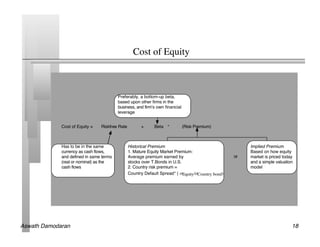
Cost of Equity	


Aswath Damodaran!                       18!
A. The Riskfree Rate	


                On a riskfree asset, the actual return is equal to the expected return. Therefore,
                 there is no variance around the expected return.	

                For an investment to be riskfree, then, it has to have	

                  •  No default risk	

                  •  No reinvestment risk	

           1.    Time horizon matters: Thus, the riskfree rates in valuation will depend upon
                 when the cash flow is expected to occur and will vary across time. 	

           2.    Not all government securities are riskfree: Some governments face default risk
                 and the rates on bonds issued by them will not be riskfree.	


           For a rate to be riskfree in valuation, it has to be long term, default free and
              currency matched (to the cash flows)	


Aswath Damodaran!                                                                                 19!
Estimating the Riskfree Rate in Rupees… and US dollars..	


                The Indian government had 10-year Rupee bonds outstanding, with a yield to
                 maturity of about 8% on April 1, 2010. In January 2010, the Indian
                 government had a local currency sovereign rating of Ba2. The typical default
                 spread (over a default free rate) for Ba2 rated country bonds in early 2010 was
                 3%.	

                The riskfree rate in Indian Rupees is	

           a)    The yield to maturity on the 10-year bond (8%)	

           b)    The yield to maturity on the 10-year bond + Default spread (8%+3% =11%)	

           c)    The yield to maturity on the 10-year bond – Default spread (8%-3% = 5%)	

           d)    None of the above	

                If you wanted to do you entire valuation in US dollars, what would you use as
                 your riskfree rate?	

                How would your answer change if you were doing the analysis in Euros?	


Aswath Damodaran!                                                                              20!
A Euro Riskfree Rate	


                        Figure 4: Goverment Bond Rates in Euros	


            6.00%	


            5.00%	


            4.00%	


            3.00%	

                                                                     2-year	

                                                                     10-year	

            2.00%	


            1.00%	


            0.00%	


Aswath Damodaran!                                                            21!
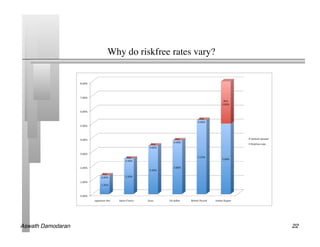
Why do riskfree rates vary?	


Aswath Damodaran!                                    22!
b. Equity Risk Premiums	


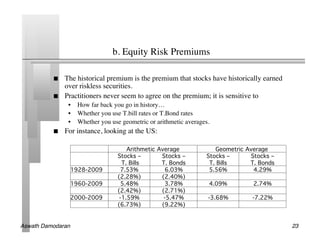
               The historical premium is the premium that stocks have historically earned
                over riskless securities.	

               Practitioners never seem to agree on the premium; it is sensitive to 	

                  •  How far back you go in history…	

                  •  Whether you use T.bill rates or T.Bond rates	

                  •  Whether you use geometric or arithmetic averages.	

                  For instance, looking at the US:	


                                         Arithmetic Average!              Geometric Average!
                                     Stocks –!       Stocks – !        Stocks – !    Stocks – !
                                       T. Bills!     T. Bonds!          T. Bills!    T. Bonds!
                  1928-2009!           7.53%!          6.03%!           5.56%!        4.29%!
                                     (2.28%)!        (2.40%)!
                  1960-2009!           5.48%!          3.78%!           4.09%!        2.74%!
                                     (2.42%)!        (2.71%)!
                  2000-2009!          -1.59%!         -5.47%!          -3.68%!        -7.22%!
                                     (6.73%)!        (9.22%)!


Aswath Damodaran!                                                                                 23!
The perils of trusting the past…….	


             Noisy estimates: Even with long time periods of history, the risk premium that
              you derive will have substantial standard error. For instance, if you go back to
              1928 (about 80 years of history) and you assume a standard deviation of 20%
              in annual stock returns, you arrive at a standard error of greater than 2%: 	

                            Standard Error in Premium = 20%/√80 = 2.26%	

             Survivorship Bias: Using historical data from the U.S. equity markets over the
              twentieth century does create a sampling bias. After all, the US economy and
              equity markets were among the most successful of the global economies that
              you could have invested in early in the century.	

           These problems get exacerbated in markets like India, where there is far less
              historical data and survivor bias is worse.	


Aswath Damodaran!                                                                            24!
An Alternative: Watch what I pay, not what I say…	


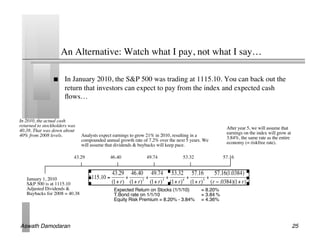
                     In January 2010, the SP 500 was trading at 1115.10. You can back out the
                      return that investors can expect to pay from the index and expected cash
                      flows…	


In 2010, the actual cash
returned to stockholders was                                                                          After year 5, we will assume that
40.38. That was down about                                                                            earnings on the index will grow at
40% from 2008 levels.          Analysts expect earnings to grow 21% in 2010, resulting in a           3.84%, the same rate as the entire
                               compounded annual growth rate of 7.2% over the next 5 years. We        economy (= riskfree rate).
                               will assume that dividends  buybacks will keep pace.

                           43.29             46.40             49.74             53.32               57.16


   January 1, 2010
   SP 500 is at 1115.10
   Adjusted Dividends                         Expected Return on Stocks (1/1/10)         = 8.20%
   Buybacks for 2008 = 40.38                   T.Bond rate on 1/1/10                      = 3.84 %
                                               Equity Risk Premium = 8.20% - 3.84%        = 4.36%


Aswath Damodaran!                                                                                                                          25!
Implied Premiums in the US	


Aswath Damodaran!                                   26!
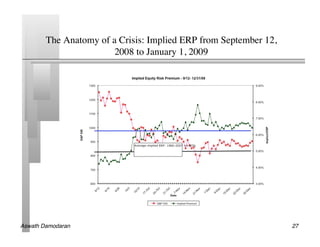
The Anatomy of a Crisis: Implied ERP from September 12,
                        2008 to January 1, 2009	


Aswath Damodaran!                                                 27!
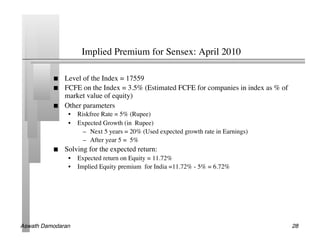
Implied Premium for Sensex: April 2010	


               Level of the Index = 17559	

               FCFE on the Index = 3.5% (Estimated FCFE for companies in index as % of
                market value of equity)	

               Other parameters	

                 •  Riskfree Rate = 5% (Rupee)	

                 •  Expected Growth (in Rupee)	

                      –  Next 5 years = 20% (Used expected growth rate in Earnings)	

                      –  After year 5 = 5%	

               Solving for the expected return:	

                 •  Expected return on Equity = 11.72%	

                 •  Implied Equity premium for India =11.72% - 5% = 6.72%	


Aswath Damodaran!                                                                         28!
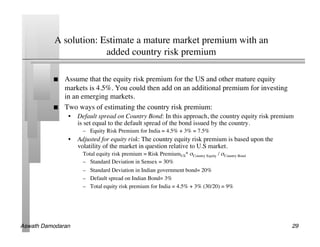
A solution: Estimate a mature market premium with an
                        added country risk premium	


               Assume that the equity risk premium for the US and other mature equity
                markets is 4.5%. You could then add on an additional premium for investing
                in an emerging markets.	

               Two ways of estimating the country risk premium:	

                 •  Default spread on Country Bond: In this approach, the country equity risk premium
                    is set equal to the default spread of the bond issued by the country.	

                      –  Equity Risk Premium for India = 4.5% + 3% = 7.5%	

                 •  Adjusted for equity risk: The country equity risk premium is based upon the
                    volatility of the market in question relative to U.S market.	

                      Total equity risk premium = Risk PremiumUS* σCountry Equity / σCountry Bond	

                      –  Standard Deviation in Sensex = 30%	

                      –  Standard Deviation in Indian government bond= 20%	

                      –  Default spread on Indian Bond= 3%	

                      –  Total equity risk premium for India = 4.5% + 3% (30/20) = 9%	


Aswath Damodaran!                                                                                      29!
Austria [1]	

       4.50%	

   Albania	

                  11.25%	

                                            Belgium [1]	

       4.95%	

   Armenia	

                   9.00%	

                                            Cyprus [1]	

        5.63%	

   Azerbaijan	

                8.25%	

                                            Denmark	

           4.50%	

   Belarus	

                  11.25%	

 Country Risk Premiums	

                   Finland [1]	

       4.50%	

   Bosnia and Herzegovina	

   12.75%	

 January 2010	

                            France [1]	

                                            Germany [1]	

                                                                 4.50%	

                                                                 4.50%	

                                                                            Bulgaria	

                                                                            Croatia	

                                                                                                         7.50%	

                                                                                                         7.50%	

                                            Greece [1]	

        6.08%	

   Czech Republic	

            5.85%	

                                            Iceland	

           7.50%	

   Estonia	

                   5.85%	

                                            Ireland [1]	

       4.95%	

   Hungary	

                   6.90%	

                                            Italy [1]	

         5.40%	

   Kazakhstan	

                7.20%	

 Canada	

                     4.50%	

     Malta [1]	

         5.85%	

   Latvia	

                    7.50%	

 Mexico	

                     6.90%	

                                     Lithuania	

                 6.90%	

                                            Netherlands [1]	

   4.50%	

 United States of America	

 4.50%	

                                       Moldova	

                  15.75%	

                                            Norway	

            4.50%	

                                                                            Montenegro	

                9.75%	

                                            Portugal [1]	

      5.40%	

                                                                            Poland	

                    6.08%	

                                            Spain [1]	

         4.50%	

                                                                            Romania	

                   7.50%	

                      Argentina	

          Sweden	

                                        14.25%	

                4.50%	

   Russia	

                    6.90%	

                      Belize	

             Switzerland	

                                        14.25%	

                4.50%	

   Slovakia	

                  5.85%	

                      Bolivia	

        12.75%	

 Kingdom	

                                            United               4.50%	

   Slovenia [1]	

              5.40%	

                      Brazil	

          7.50%	

                           Turkmenistan	

             12.75%	

                      Chile	

           5.85%	

                           Ukraine	

                  12.75%	

                      Colombia	

        7.50%	

                                                                             Bahrain	

                     6.08%	

 Australia	

     4.50%	

                      Costa Rica	

      8.25%	

                                                                             Israel	

                      5.85%	

 New Zealand	

   4.50%	

                      Ecuador	

        19.50%	

                                                                             Jordan	

                      7.50%	

                      El Salvador	

 19.50%	

                                                                             Kuwait	

                      5.40%	

                      Guatemala	

       8.25%	

                                                                             Lebanon	

                    12.75%	

                      Honduras	

       12.75%	

                                                                             Oman	

                        6.08%	

                      Nicaragua	

      14.25%	

                                                                             Qatar	

                       5.40%	

                      Panama	

          8.25%	

                                                                             Saudi Arabia	

                5.85%	

                      Paraguay	

       14.25%	

                                                                             United Arab Emirates	

        5.40%	

                      Peru	

            7.50%	

                      Uruguay	

         9.75%	

                      Venezuela	

      11.25%	

Aswath Damodaran!                                                                                                                       30!
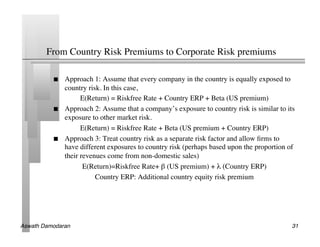
From Country Risk Premiums to Corporate Risk premiums	


               Approach 1: Assume that every company in the country is equally exposed to
                country risk. In this case, 	

                      E(Return) = Riskfree Rate + Country ERP + Beta (US premium)	

               Approach 2: Assume that a company’s exposure to country risk is similar to its
                exposure to other market risk.	

                      E(Return) = Riskfree Rate + Beta (US premium + Country ERP)	

               Approach 3: Treat country risk as a separate risk factor and allow firms to
                have different exposures to country risk (perhaps based upon the proportion of
                their revenues come from non-domestic sales)	

                       E(Return)=Riskfree Rate+ β (US premium) + λ (Country ERP)	

                           Country ERP: Additional country equity risk premium	


Aswath Damodaran!                                                                            31!
Estimating Company Exposure to Country Risk	


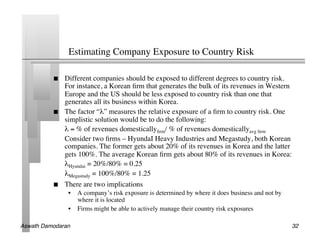
                    Different companies should be exposed to different degrees to country risk.
                     For instance, a Korean firm that generates the bulk of its revenues in Western
                     Europe and the US should be less exposed to country risk than one that
                     generates all its business within Korea.	

                    The factor “λ” measures the relative exposure of a firm to country risk. One
                     simplistic solution would be to do the following:	


λ = % of revenues domesticallyfirm/ % of revenues domesticallyavg firm	


Consider two firms – HyundaI Heavy Industries and Megastudy, both Korean
                     companies. The former gets about 20% of its revenues in Korea and the latter
                     gets 100%. The average Korean firm gets about 80% of its revenues in Korea:	


λHyundai = 20%/80% = 0.25	


λMegastudy = 100%/80% = 1.25	

                    There are two implications	

                 •  A company’s risk exposure is determined by where it does business and not by
                    where it is located	

                 •  Firms might be able to actively manage their country risk exposures	


Aswath Damodaran!                                                                                  32!
Estimating lambdas: Tata Group	


                                   Tata Chemicals    Tata Steel     Tata Motors          TCS


             % of production/
             operations in India        High           High            High              Low

             % of revenues in
             India                      75%           88.83%          91.37%            7.62%


             Lambda                     0.75           1.10             0.80            0.20
                                                                  Recently
                                   Gets 77% of its                acquired            While its
                                   raw material                   Jaguar/Land      operations are
                                   from non-                      Rover, with     spread all over, it
                                   domestic                       significant non- uses primarily
             Other factors         sources,                       domestic sales Indian personnel


Aswath Damodaran!                                                                                       33!
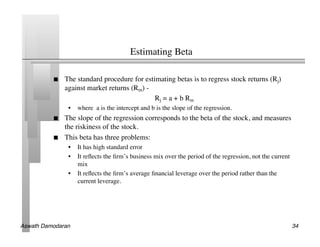
Estimating Beta	


               The standard procedure for estimating betas is to regress stock returns (Rj)
                against market returns (Rm) -	

                                                 Rj = a + b Rm	

                 •  where a is the intercept and b is the slope of the regression. 	

               The slope of the regression corresponds to the beta of the stock, and measures
                the riskiness of the stock. 	

               This beta has three problems:	

                 •  It has high standard error	

                 •  It reflects the firm’s business mix over the period of the regression, not the current
                    mix	

                 •  It reflects the firm’s average financial leverage over the period rather than the
                    current leverage.	


Aswath Damodaran!                                                                                          34!
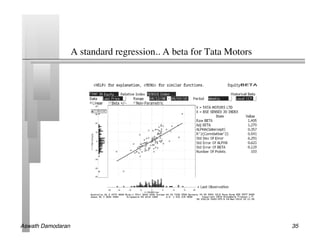
A standard regression.. A beta for Tata Motors	


Aswath Damodaran!                                                   35!
And another one..	


Aswath Damodaran!                          36!
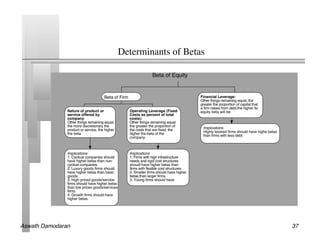
Determinants of Betas	


Aswath Damodaran!                              37!
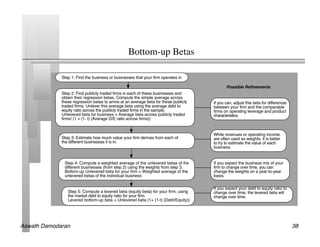
Bottom-up Betas	


Aswath Damodaran!                        38!
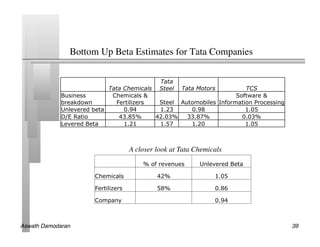
Bottom Up Beta Estimates for Tata Companies	


                                                Tata
                            Tata Chemicals        Tata Motors
                                                Steel                  TCS
             Business        Chemicals                             Software 
             breakdown        Fertilizers   Steel Automobiles Information Processing
             Unlevered beta      0.94       1.23     0.98              1.05
             D/E Ratio         43.85%      42.03%   33.87%            0.03%
             Levered Beta        1.21       1.57     1.20              1.05


                                     A closer look at Tata Chemicals	

                                          % of revenues       Unlevered Beta

                       Chemicals               42%                 1.05

                       Fertilizers             58%                 0.86

                       Company                                     0.94


Aswath Damodaran!                                                                      39!
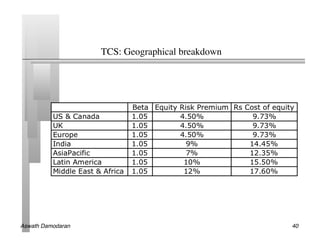
TCS: Geographical breakdown	


Aswath Damodaran!                                    40!
From Cost of Equity to Cost of Capital	


Aswath Damodaran!                                               41!
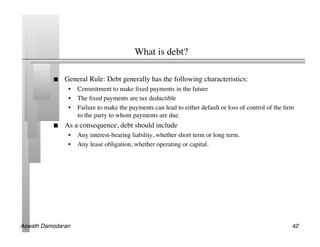
What is debt?	


               General Rule: Debt generally has the following characteristics:	

                 •  Commitment to make fixed payments in the future	

                 •  The fixed payments are tax deductible	

                 •  Failure to make the payments can lead to either default or loss of control of the firm
                    to the party to whom payments are due.	

               As a consequence, debt should include	

                 •  Any interest-bearing liability, whether short term or long term.	

                 •  Any lease obligation, whether operating or capital.	


Aswath Damodaran!                                                                                       42!
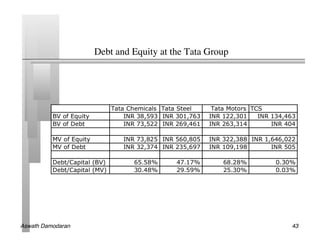
Debt and Equity at the Tata Group	


Aswath Damodaran!                                          43!
Estimating the Cost of Debt	


               If the firm has bonds outstanding, and the bonds are traded, the yield to
                maturity on a long-term, straight (no special features) bond can be used as the
                interest rate.	

               If the firm is rated, use the rating and a typical default spread on bonds with
                that rating to estimate the cost of debt.	

               If the firm is not rated, 	

                 •  and it has recently borrowed long term from a bank, use the interest rate on the
                    borrowing or	

                 •  estimate a synthetic rating for the company, and use the synthetic rating to arrive at
                    a default spread and a cost of debt	

               The cost of debt has to be estimated in the same currency as the cost of equity
                and the cash flows in the valuation.	


Aswath Damodaran!                                                                                        44!
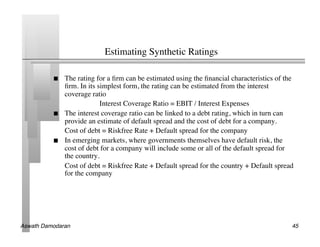
Estimating Synthetic Ratings	


                  The rating for a firm can be estimated using the financial characteristics of the
                   firm. In its simplest form, the rating can be estimated from the interest
                   coverage ratio	

                                Interest Coverage Ratio = EBIT / Interest Expenses	

                  The interest coverage ratio can be linked to a debt rating, which in turn can
                   provide an estimate of default spread and the cost of debt for a company.	


Cost of debt = Riskfree Rate + Default spread for the company	

                  In emerging markets, where governments themselves have default risk, the
                   cost of debt for a company will include some or all of the default spread for
                   the country. 	


Cost of debt = Riskfree Rate + Default spread for the country + Default spread
                   for the company	


Aswath Damodaran!                                                                                45!
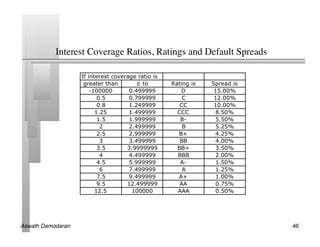
Interest Coverage Ratios, Ratings and Default Spreads	


Aswath Damodaran!                                                     46!
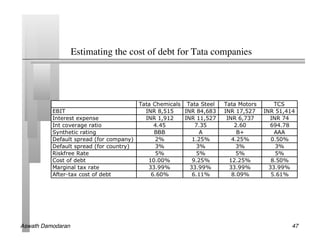
Estimating the cost of debt for Tata companies	


Aswath Damodaran!                                                   47!
Estimating Cost of Capital: Tata Group	


                                    Tata Chemicals    Tata Steel      Tata Motors      TCS
          Beta                           1.21            1.57            1.20         1.05
          Lambda                         0.75            1.10            0.80         0.20
          Cost of equity               13.82%          17.02%           14.00%       10.63%


          Synthetic rating                BBB              A              B+           AAA
          Cost of debt                   6.60%          6.11%           8.09%         5.61%

          Debt Ratio                     30.48%        29.59%          25.30%         0.03%

          Cost of Capital                11.62%        13.79%          12.50%        10.62%


                                   Tata Chemicals: Divisional Costs of Capital	

                                                  Cost of   Cost of    Debt     Cost of
                                          Beta     equity    debt      Ratio     capital
                           Chemicals      1.35    14.47%    6.60%     30.48%    12.07%
                           Fertilizers    1.11    13.37%    6.60%     30.48%    11.30%


Aswath Damodaran!                                                                             48!
II. Estimating Cashflows and Growth	


Aswath Damodaran!                                           49!
Defining Cashflow	


Aswath Damodaran!                        50!
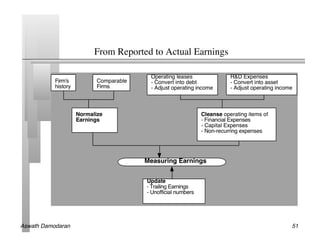
From Reported to Actual Earnings	


Aswath Damodaran!                                         51!
Dealing with Operating Lease Expenses	


               Operating Lease Expenses are treated as operating expenses in computing
                operating income. In reality, operating lease expenses should be treated as
                financing expenses, with the following adjustments to earnings and capital:	

               Debt Value of Operating Leases = Present value of Operating Lease
                Commitments at the pre-tax cost of debt	

               When you convert operating leases into debt, you also create an asset to
                counter it of exactly the same value.	

               Adjusted Operating Earnings	

                 Adjusted Operating Earnings = Operating Earnings + Operating Lease Expenses -
                    Depreciation on Leased Asset	

                 •  As an approximation, this works:	

                 Adjusted Operating Earnings = Operating Earnings + Pre-tax cost of Debt * PV of
                    Operating Leases.	


Aswath Damodaran!                                                                                  52!
RD Expenses: Operating or Capital Expenses	


               Accounting standards require us to consider RD as an operating expense
                even though it is designed to generate future growth. It is more logical to treat
                it as capital expenditures.	

               To capitalize RD,	

                 •  Specify an amortizable life for RD (2 - 10 years)	

                 •  Collect past RD expenses for as long as the amortizable life	

                 •  Sum up the unamortized RD over the period. (Thus, if the amortizable life is 5
                    years, the research asset can be obtained by adding up 1/5th of the RD expense
                    from five years ago, 2/5th of the RD expense from four years ago...:	


Aswath Damodaran!                                                                                     53!
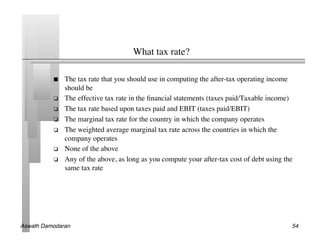
What tax rate?	


               The tax rate that you should use in computing the after-tax operating income
                should be	

               The effective tax rate in the financial statements (taxes paid/Taxable income)	

               The tax rate based upon taxes paid and EBIT (taxes paid/EBIT)	

               The marginal tax rate for the country in which the company operates	

               The weighted average marginal tax rate across the countries in which the
                company operates	

               None of the above	

               Any of the above, as long as you compute your after-tax cost of debt using the
                same tax rate	


Aswath Damodaran!                                                                              54!
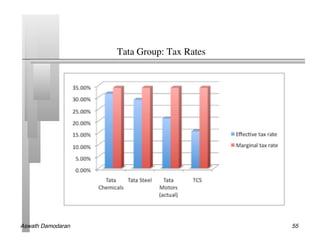
Tata Group: Tax Rates	


Aswath Damodaran!                              55!
Capital expenditures should include	


               Research and development expenses, once they have been re-categorized as
                capital expenses. The adjusted net cap ex will be	

                 Adjusted Net Capital Expenditures = Net Capital Expenditures + Current year’s RD
                    expenses - Amortization of Research Asset	

               Acquisitions of other firms, since these are like capital expenditures. The
                adjusted net cap ex will be	

                 Adjusted Net Cap Ex = Net Capital Expenditures + Acquisitions of other firms -
                     Amortization of such acquisitions	

                 Two caveats:	

                 1. Most firms do not do acquisitions every year. Hence, a normalized measure of
                     acquisitions (looking at an average over time) should be used	

                 2. The best place to find acquisitions is in the statement of cash flows, usually
                     categorized under other investment activities	


Aswath Damodaran!                                                                                    56!
Working Capital Investments	


               In accounting terms, the working capital is the difference between current
                assets (inventory, cash and accounts receivable) and current liabilities
                (accounts payables, short term debt and debt due within the next year)	

               A cleaner definition of working capital from a cash flow perspective is the
                difference between non-cash current assets (inventory and accounts
                receivable) and non-debt current liabilities (accounts payable)	

               Any investment in this measure of working capital ties up cash. Therefore, any
                increases (decreases) in working capital will reduce (increase) cash flows in
                that period.	

               When forecasting future growth, it is important to forecast the effects of such
                growth on working capital needs, and building these effects into the cash
                flows.	


Aswath Damodaran!                                                                             57!
Breaking down aggregate reinvestment over last 5 years:
                              Tata Group	


Aswath Damodaran!                                                   58!
Estimating FCFF: Tata Group	


                                                                                         Tax rate =21% 	

              Normalized EBIT = Normalized EBT + Interest Expense in 2009	


= Rs 18,727 + Rs 6,737 m= Rs 25,464 m	


               Normalized EBT = Revenues in 2009 * Average Margin	


= Rs 265,868 m* 7.04% = Rs 18,727 m	


                             2004	

        2005	

        2006	

        2007	

         2008	

        Total	


          Revenues	

     INR 206,487	

 INR 242,905	

 INR 320,648	

 INR 335,771	

 INR 295,252	

INR 1,401,063	

          EBT	

           INR 16,519	

 INR 20,534	

 INR 25,732	

 INR 25,765	

     INR 10,138	

 INR 98,688	

          EBT Margin	

        8.00%	

       8.45%	

       8.02%	

        7.67%	

      3.43%	

        7.04%	


Aswath Damodaran!                                                                                                   59!
Growth in Earnings	


               Look at the past	

                 •  The historical growth in earnings per share is usually a good starting point for
                    growth estimation	

               Look at what others are estimating	

                 •  Analysts estimate growth in earnings per share for many firms. It is useful to know
                    what their estimates are.	

               Look at fundamentals	

                 •  Ultimately, all growth in earnings can be traced to two fundamentals - how much
                    the firm is investing in new projects, and what returns these projects are making for
                    the firm.	


Aswath Damodaran!                                                                                        60!
The Determinants of Growth	


Aswath Damodaran!                                   61!
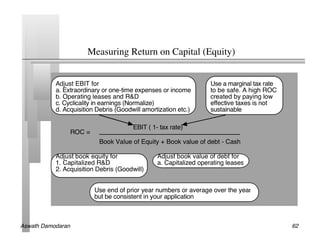
Measuring Return on Capital (Equity)	


Aswath Damodaran!                                             62!
Measuring Return on Capital at Tata Group	


                         Tata                  Tata Motors    Tata Motors
                       Chemicals Tata Steel      (actual)    (normalized)      TCS
                                    INR                                        INR
        EBIT           INR 8,515  84,683       INR 17,527    INR 25,464      51,414
        Tax rate        31.50%    28.90%         21.00%        21.00%        15.55%
                                    INR                                        INR
        EBIT (1-t)     INR 5,833  60,213       INR 13,846    INR 20,117      43,420

                                      INR
        BV of Debt    INR 23,438    180,217    INR 62,805    INR 62,805      INR 183
                                      INR                                      INR
        BV of Equity INR 35,717     273,007    INR 78,395    INR 78,395      110,048
        Cash          INR 2,776    INR 4,650   INR 23,973    INR 23,973     INR 3,370
        Invested                      INR                                      INR
        Capital      INR 56,379     448,574    INR 117,227   INR 117,227     106,861

        ROC             10.35%      13.42%       11.81%        17.16%        40.63%


Aswath Damodaran!                                                                       63!
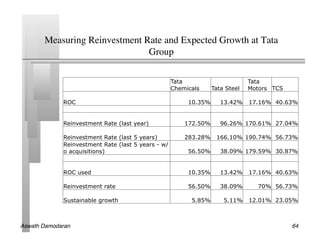
Measuring Reinvestment Rate and Expected Growth at Tata
                                Group	


                                                     Tata                       Tata
                                                     Chemicals     Tata Steel   Motors TCS

              ROC                                         10.35%      13.42%    17.16% 40.63%


              Reinvestment Rate (last year)              172.50%      96.26% 170.61% 27.04%

              Reinvestment Rate (last 5 years)           283.28%    166.10% 190.74% 56.73%
              Reinvestment Rate (last 5 years - w/
              o acquisitions)                             56.50%      38.09% 179.59% 30.87%


              ROC used                                    10.35%      13.42%    17.16% 40.63%

              Reinvestment rate                           56.50%      38.09%      70% 56.73%

              Sustainable growth                           5.85%       5.11%    12.01% 23.05%


Aswath Damodaran!                                                                            64!
III. The Tail that wags the dog… Terminal Value	


Aswath Damodaran!                                                  65!
Getting Closure in Valuation	


               A publicly traded firm potentially has an infinite life. The value is therefore the
                present value of cash flows forever.	

                                                t = ∞ CF
                                        Value = ∑          t
                                                              t
                                                 t = 1 (1+ r)


               Since we cannot estimate cash flows forever, we estimate cash flows for a
                “growth period” and then estimate a terminal value, to capture the value at the
                end of the period:	

                                          t = N CFt          Terminal Value
                                   Value = ∑               +
                                                         t      (1 + r)N
                                           t = 1 (1 + r)


Aswath Damodaran!                                                                               66!
Ways of Estimating Terminal Value	


Aswath Damodaran!                                          67!
Stable Growth and Terminal Value	


               When a firm’s cash flows grow at a “constant” rate forever, the present value
                of those cash flows can be written as:	

                 Value = Expected Cash Flow Next Period / (r - g)	

                 where,	


r = Discount rate (Cost of Equity or Cost of Capital)	


g = Expected growth rate	

               While companies can maintain high growth rates for extended periods, they
                will all approach “stable growth” at some point in time. When they will do so
                will depend upon:	

                 •  How large they are relative to the market in which they operate	

                 •  Their competitive advantages	


Aswath Damodaran!                                                                               68!
Four Rules for Terminal value	


               Respect the cap: The stable growth rate cannot exceed the growth rate of the
                economy but it can be set lower. One simple proxy for the nominal growth rate
                of the economy is the riskfree rate.	

                 •  Riskfree rate = Expected inflation + Expected Real Interest Rate	

                 •  Nominal growth rate in economy = Expected Inflation + Expected Real Growth	

                  Stable period excess returns: Firms that generate returns on capital that vastly
                   exceed their costs of capital should see these excess returns shrink in stable
                   growth as competition enters and size works against them.	

                  Reinvest to grow: Growth is never free and this is especially true in stable
                   growth. To grow at a perpetual rate, firms have to reinvest and how much they
                   reinvest will be a function of the return on capital:	


Reinvestment Rate = Stable growth rate/ Stable ROC	

                  Adjust risk and cost of capital: The cost of equity and capital in stable growth
                   should be reflective of a mature firm in stable growth. In particular,	

                 •  Betas should move towards one	

                 •  Debt ratios should converge on long-term sustainable averages 	


Aswath Damodaran!                                                                                  69!
1. How high can the stable growth rate be?	


               The stable growth rate cannot exceed the growth rate of the economy but it
                can be set lower. 	

                 •  If you assume that the economy is composed of high growth and stable growth
                    firms, the growth rate of the latter will probably be lower than the growth rate of the
                    economy.	

                 •  The stable growth rate can be negative. The terminal value will be lower and you
                    are assuming that your firm will disappear over time. 	

                 •  If you use nominal cashflows and discount rates, the growth rate should be nominal
                    in the currency in which the valuation is denominated.	

               One simple proxy for the nominal growth rate of the economy is the riskfree
                rate.	

                 •  Riskfree rate = Expected inflation + Expected Real Interest Rate	

                 •  Nominal growth rate in economy = Expected Inflation + Expected Real Growth	


Aswath Damodaran!                                                                                       70!
2. When will the firm reach stable growth?	


               Size of the firm 	

                 •  Success usually makes a firm larger. As firms become larger, it becomes much
                    more difficult for them to maintain high growth rates	

               Current growth rate 	

                 •  While past growth is not always a reliable indicator of future growth, there is a
                    correlation between current growth and future growth. Thus, a firm growing at 30%
                    currently probably has higher growth and a longer expected growth period than one
                    growing 10% a year now.	

               Barriers to entry and differential advantages 	

                 •  Ultimately, high growth comes from high project returns, which, in turn, comes
                    from barriers to entry and differential advantages.	

                 •  The question of how long growth will last and how high it will be can therefore be
                    framed as a question about what the barriers to entry are, how long they will stay up
                    and how strong they will remain.	


Aswath Damodaran!                                                                                      71!
3. What else should change in stable growth?	


               In stable growth, firms should have the characteristics of other stable growth
                firms. In particular,	

                 •  The risk of the firm, as measured by beta and ratings, should reflect that of a stable
                    growth firm.	

                      –  Beta should move towards one	

                      –  The cost of debt should reflect the safety of stable firms (BBB or higher)	

                 •  The debt ratio of the firm might increase to reflect the larger and more stable
                    earnings of these firms.	

                      –  The debt ratio of the firm might moved to the optimal or an industry average	

                      –  If the managers of the firm are deeply averse to debt, this may never happen	

                 •  The return on capital generated on investments should move to sustainable levels,
                    relative to both the sector and the company’s own cost of capital.	


Aswath Damodaran!                                                                                          72!
4. What excess returns will you generate in stable growth and
                           why does it matter?	


                  Strange though this may seem, the terminal value is not as much a function of
                   stable growth as it is a function of what you assume about excess returns in
                   stable growth.	

                  The key connecting link is the reinvestment rate that you have in stable
                   growth, which is a function of your return on capital:	

                                 Reinvestment Rate = Stable growth rate/ Stable ROC	


The terminal value can be written in terms of ROC as follows:	

                        Terminal Value = EBITn+1 (1-t) (1 – g/ ROC)/ (Cost of capital – g)	

                  In the scenario where you assume that a firm earns a return on capital equal to
                   its cost of capital in stable growth, the terminal value will not change as the
                   growth rate changes. 	

                  If you assume that your firm will earn positive (negative) excess returns in
                   perpetuity, the terminal value will increase (decrease) as the stable growth rate
                   increases.	


Aswath Damodaran!                                                                                  73!
Stable Growth Assumptions: Tata Group	

                                               Tata Chemicals   Tata Steel   Tata Motors    TCS
       Beta                    High Growth          1.21           1.57         1.20        1.05


          Stable Growth       1.00           1.20         1.00         1.00
       Lambda                  High Growth         0.75           1.10         0.80         0.20
                               Stable Growth       0.75           1.10         0.80         0.20
       Country Risk Premium    High Growth        4.50%          4.50%        4.50%        4.50%
                               Stable Growth      3.00%          3.00%        3.00%        3.00%
       Cost of equity          High Growth        13.82%         17.02%      14.00%        10.63%
                               Stable Growth      11.75%         13.70%      11.90%        10.10%
       Debt Ratio              High Growth        30.48%         29.59%      25.30%         0.03%
                               Stable Growth      30.48%         29.59%      25.30%         10%
       Cost of debt            High Growth        10.00%          9.25%      12.25%        8.50%
                               Stable Growth      8.00%          7.75%        9.00%        6.50%
       Cost of capital         High Growth        11.62%         13.79%      12.50%        10.62%
                               Stable Growth      9.78%          11.16%      10.39%        9.52%
       Reurn on capital        High Growth        13.42%         11.81%      17.16%        40.63%
                               Stable Growth      9.78%          11.16%      12.00%         15%
       Reinvestment Rate       High Growth        56.50%         38.09%      70.00%        56.73%
                               Stable Growth      51.14%         44.80%      41.67%        33.33%
       Expected growth rate    High Growth        5.85%          5.11%       12.01%        23.05%
                               Stable Growth        5%             5%           5%          5%
Aswath Damodaran!                                                                                  74!
Terminal Value and Growth: Contrasts	


Aswath Damodaran!                                             75!
V. Tying up Loose Ends	


                    For firm value to equity value per share	


Aswath Damodaran!                                                76!
1. Value cash and other non-operating assets	


               When you discount operating cash flows at the cost of capital, you have valued
                only the operating assets (that contribute to the operating income) of the firm.
                Any assets whose earnings are not counted as part of operating income have
                not been valued yet. In particular, these would include:	

                 •  Cash and marketable securities: The income from these are not part of operating
                    income. Hence, the current value of these assets has to be added to the value of the
                    operating assets.	

                 •  Non-operating assets: If the firm own other assets that have value but do not
                    contribute to operations, the value of these assets should also be included in the
                    firm value.	

               The key, though, is to not double count an asset. Thus, an asset (say your
                office headquarters building) that has value but is used for operations should
                not be added on to the value of operating assets.	


Aswath Damodaran!                                                                                          77!
2. Dealing with Holdings in Other firms	


               Cross holdings in other firms can create problems because the accounting for
                these holdings can vary widely across countries, across companies and even
                within the same company, across different holdings. In particular, we care
                about 	

                 •  How the income from these holdings is accounted for in the income statement	

                      –  What is counted as income? (Operating income, Net income or just dividends)	

                      –  Where is it shown? (Above or below the operating income line)	

                      –  How much of the income is shown? (The share of the holding, 100%?)	

                 •  How is the value of the asset recorded on the balance sheet?	

                      –  Is it recorded at original cost, updated book value or market value?	

                      –  Is just the net value of the holding shown or are all of the assets and liabilities recorded?	


Aswath Damodaran!                                                                                                           78!
How to value holdings in other firms.. In a perfect world..	


               In a perfect world, we would strip the parent company from its subsidiaries
                and value each one separately. The value of the combined firm will be	

                 •  Value of parent company + Proportion of value of each subsidiary	

               To do this right, you will need 	

                 •  to be provided detailed information on each subsidiary to estimated cash flows and
                    discount rates.	

                 •  To have a manageable number of subsidiaries	


Aswath Damodaran!                                                                                       79!
Three compromise solutions…	


               The market value solution: When the subsidiaries are publicly traded, you
                could use their traded market capitalizations to estimate the values of the cross
                holdings. You do risk carrying into your valuation any mistakes that the
                market may be making in valuation.	

               The relative value solution: When there are too many cross holdings to value
                separately or when there is insufficient information provided on cross
                holdings, you can convert the book values of holdings that you have on the
                balance sheet (for both minority holdings and minority interests in majority
                holdings) by using the average price to book value ratio of the sector in which
                the subsidiaries operate.	

               The “take what I can get” solution: Estimate the market value of those
                holdings that are publicly traded, the relative value of those holdings where
                there are publicly traded investments to obtain multiples from and book value
                for the rest.	


Aswath Damodaran!                                                                               80!
3. Subtract out “debt”	


               If you have under funded pension fund or health care plans, you should
                consider the under funding at this stage in getting to the value of equity.	

                 •  If you do so, you should not double count by also including a cash flow line item
                    reflecting cash you would need to set aside to meet the unfunded obligation.	

                 •  You should not be counting these items as debt in your cost of capital
                    calculations….	

               If you have contingent liabilities - for example, a potential liability from a
                lawsuit that has not been decided - you should consider the expected value of
                these contingent liabilities	

                 •  Value of contingent liability = Probability that the liability will occur * Expected
                    value of liability	


Aswath Damodaran!                                                                                          81!
4. Value other claims on equity	


               In recent years, firms have turned to giving employees (and especially top
                managers) equity option packages as part of compensation. These options are
                usually	

                 •  Long term	

                 •  At-the-money when issued	

                 •  On volatile stocks	

               Options outstanding	

                 •  Step 1: List all options outstanding, with maturity, exercise price and vesting status.	

                 •  Step 2: Value the options, taking into accoutning dilution, vesting and early
                    exercise considerations	

                 •  Step 3: Subtract from the value of equity and divide by the actual number of shares
                    outstanding (not diluted or partially diluted).	


Aswath Damodaran!                                                                                           82!
Getting to per share value: Tata Companies	


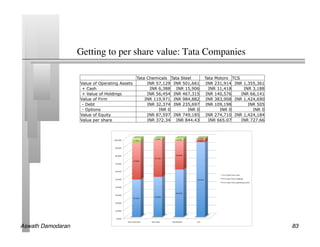
                                                Tata Chemicals Tata Steel      Tata Motors TCS
                    Value of Operating Assets        INR 57,129 INR 501,661     INR 231,914 INR 1,355,361
                     + Cash                           INR 6,388 INR 15,906       INR 11,418     INR 3,188
                     + Value of Holdings             INR 56,454 INR 467,315     INR 140,576    INR 66,141
                    Value of Firm                   INR 119,971 INR 984,882     INR 383,908 INR 1,424,690
                     - Debt                          INR 32,374 INR 235,697     INR 109,198       INR 505
                     - Options                            INR 0        INR 0          INR 0         INR 0
                    Value of Equity                  INR 87,597 INR 749,185     INR 274,710 INR 1,424,184
                    Value per share                  INR 372.34 INR 844.43       INR 665.07    INR 727.66


Aswath Damodaran!                                                                                           83!
Corporate Finance meets Value:
              The secret to value enhancement	


Aswath Damodaran!                                  84!
Price Enhancement versus Value Enhancement	


Aswath Damodaran!                                               85!
Value-Neutral Actions	


               Stock splits and stock dividends change the number of units of equity in a firm, but
                cannot affect firm value since they do not affect cash flows, growth or risk.	

               Accounting decisions that affect reported earnings but not cash flows should have no
                effect on value.	

                 •    Changing inventory valuation methods from FIFO to LIFO or vice versa in financial reports but
                      not for tax purposes	

                 •    Changing the depreciation method used in financial reports (but not the tax books) from
                      accelerated to straight line depreciation	

                 •    Major non-cash restructuring charges that reduce reported earnings but are not tax deductible	

                 •    Using pooling instead of purchase in acquisitions cannot change the value of a target firm.	

               Decisions that create new securities on the existing assets of the firm (without altering
                the financial mix) such as tracking stock.	


Aswath Damodaran!                                                                                                    86!
The Paths to Value Creation.. Back to the determinants of
                                  value..	


                         Are you investing optimally for
                         future growth?                                                                                    Is there scope for more
                                                       Growth from new investments                 Efficiency Growth       efficient utilization of
           How well do you manage your                 Growth created by making new                Growth generated by     exsting assets?
           existing investments/assets?                investments; function of amount and         using existing assets
                                                       quality of investments                      better


              Cashflows from existing assets
              Cashflows before debt payments,
              but after taxes and reinvestment to                   Expected Growth during high growth period
                                                                                                                                  Stable growth firm,
              maintain exising assets                                                                                             with no or very
                                                                                                                                  limited excess returns
                                                                Length of the high growth period
                                                                Since value creating growth requires excess returns,
                     Are you building on your                   this is a function of
                     competitive advantages?
                                                                - Magnitude of competitive advantages
                                                                - Sustainability of competitive advantages


                                                           Cost of capital to apply to discounting cashflows
                         Are you using the right           Determined by
                         amount and kind of                - Operating risk of the company
                         debt for your firm?               - Default risk of the company
                                                           - Mix of debt and equity used in financing


Aswath Damodaran!                                                                                                                                     87!
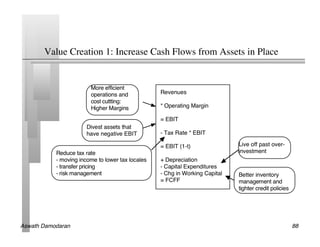
Value Creation 1: Increase Cash Flows from Assets in Place	


Aswath Damodaran!                                                      88!
1.1.: Poor Investments: Should you divest?	


               Every firm has at least a few investments in place that are poor investments,
                earning less than the cost of capital or even losing money.	

               In deciding whether to divest, there are three values that we need to consider:	

                 •  Continuing Value: This is the present value of the expected cash flows from
                    continuing the investment through the end of its life.	

                 •  Salvage or Liquidation Value: This is the net cash flow that the firm will receive
                    if it terminated the project today.	

                 •  Divestiture Value: This is the price that will be paid by the highest bidder for this
                    investment.	

               If the continuing value is the greatest, there can be no value created by
                terminating or liquidating this investment, even if it is a bad investment.	

               If the liquidation or divestiture value is greater than the continuing value, the
                firm value will increase by the difference between the two values:	

                 If liquidation is optimal: Liquidation Value - Continuing Value	

                 If divestiture is optimal: Divestiture Value - Continuing Value	


Aswath Damodaran!                                                                                           89!
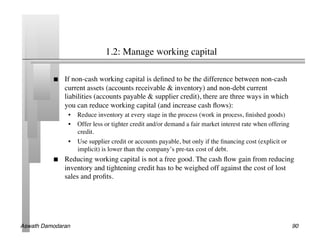
1.2: Manage working capital	


               If non-cash working capital is defined to be the difference between non-cash
                current assets (accounts receivable  inventory) and non-debt current
                liabilities (accounts payable  supplier credit), there are three ways in which
                you can reduce working capital (and increase cash flows):	

                 •  Reduce inventory at every stage in the process (work in process, finished goods)	

                 •  Offer less or tighter credit and/or demand a fair market interest rate when offering
                    credit.	

                 •  Use supplier credit or accounts payable, but only if the financing cost (explicit or
                    implicit) is lower than the company’s pre-tax cost of debt.	

               Reducing working capital is not a free good. The cash flow gain from reducing
                inventory and tightening credit has to be weighed off against the cost of lost
                sales and profits.	


Aswath Damodaran!                                                                                          90!
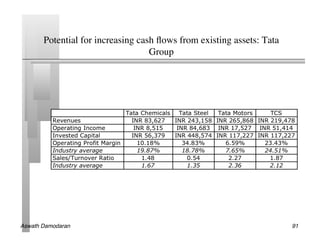
Potential for increasing cash flows from existing assets: Tata
                                   Group	


Aswath Damodaran!                                                      91!
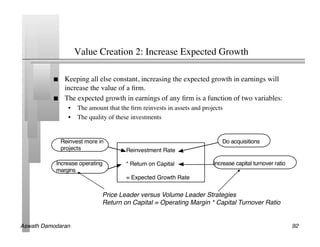
Value Creation 2: Increase Expected Growth	


               Keeping all else constant, increasing the expected growth in earnings will
                increase the value of a firm.	

               The expected growth in earnings of any firm is a function of two variables:	

                 •  The amount that the firm reinvests in assets and projects	

                 •  The quality of these investments	


                              Price Leader versus Volume Leader Strategies!
                              Return on Capital = Operating Margin * Capital Turnover Ratio!


Aswath Damodaran!                                                                               92!
2.1: Increase the Reinvestment Rate	


               Holding all else constant, increasing the reinvestment rate will increase the
                expected growth in earnings of a firm. Increasing the reinvestment rate will,
                however, reduce the cash flows of the firms. The net effect will determine
                whether value increases or decreases.	

               As a general rule,	

                 •  Increasing the reinvestment rate when the ROC is less than the cost of capital will
                    reduce the value of the firm	

                 •  Increasing the reinvestment rate when the ROC is greater than the cost of capital
                    will increase the value of the firm	


Aswath Damodaran!                                                                                         93!
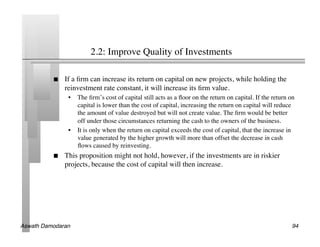
2.2: Improve Quality of Investments	


               If a firm can increase its return on capital on new projects, while holding the
                reinvestment rate constant, it will increase its firm value.	

                 •  The firm’s cost of capital still acts as a floor on the return on capital. If the return on
                    capital is lower than the cost of capital, increasing the return on capital will reduce
                    the amount of value destroyed but will not create value. The firm would be better
                    off under those circumstances returning the cash to the owners of the business.	

                 •  It is only when the return on capital exceeds the cost of capital, that the increase in
                    value generated by the higher growth will more than offset the decrease in cash
                    flows caused by reinvesting.	

               This proposition might not hold, however, if the investments are in riskier
                projects, because the cost of capital will then increase.	


Aswath Damodaran!                                                                                          94!
Assessing the Tata Companies Growth Potential	


Aswath Damodaran!                                                 95!
A postscript on creating growth: The Role of Acquisitions
                              and Divestitures	


               An acquisition is just a large-scale project. All of the rules that apply to
                individual investments apply to acquisitions, as well. For an acquisition to
                create value, it has to	

                 •  Generate a higher return on capital, after allowing for synergy and control factors,
                    than the cost of capital. 	

                 •  Put another way, an acquisition will create value only if the present value of the
                    cash flows on the acquired firm, inclusive of synergy and control benefits, exceeds
                    the cost of the acquisitons	

               A divestiture is the reverse of an acquisition, with a cash inflow now (from
                divesting the assets) followed by cash outflows (i.e., cash flows foregone on
                the divested asset) in the future. If the present value of the future cash outflows
                is less than the cash inflow today, the divestiture will increase value.	

               A fair-price acquisition or divestiture is value neutral.	


Aswath Damodaran!                                                                                          96!
Value Creating Growth… Evaluating the Alternatives..	


Aswath Damodaran!                                                    97!
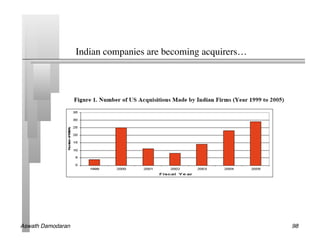
Indian companies are becoming acquirers… 	


Aswath Damodaran!                                                  98!
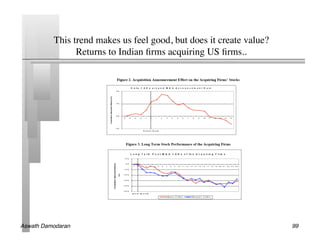
This trend makes us feel good, but does it create value?
                 Returns to Indian firms acquiring US firms..	


Aswath Damodaran!                                                        99!
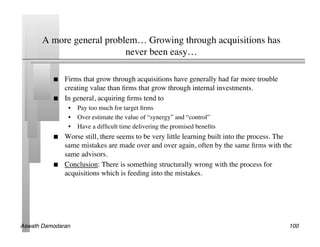
A more general problem… Growing through acquisitions has
                           never been easy…	


               Firms that grow through acquisitions have generally had far more trouble
                creating value than firms that grow through internal investments.	

               In general, acquiring firms tend to	

                 •  Pay too much for target firms	

                 •  Over estimate the value of “synergy” and “control”	

                 •  Have a difficult time delivering the promised benefits	

               Worse still, there seems to be very little learning built into the process. The
                same mistakes are made over and over again, often by the same firms with the
                same advisors.	

               Conclusion: There is something structurally wrong with the process for
                acquisitions which is feeding into the mistakes.	


Aswath Damodaran!                                                                             100!
Seven reasons why acquisitions fail…	


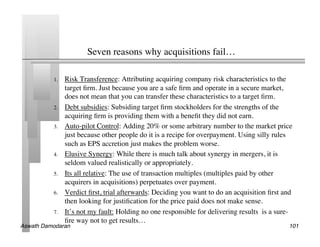
           1.    Risk Transference: Attributing acquiring company risk characteristics to the
                 target firm. Just because you are a safe firm and operate in a secure market,
                 does not mean that you can transfer these characteristics to a target firm.	

           2.    Debt subsidies: Subsiding target firm stockholders for the strengths of the
                 acquiring firm is providing them with a benefit they did not earn.	

           3.    Auto-pilot Control: Adding 20% or some arbitrary number to the market price
                 just because other people do it is a recipe for overpayment. Using silly rules
                 such as EPS accretion just makes the problem worse.	

           4.    Elusive Synergy: While there is much talk about synergy in mergers, it is
                 seldom valued realistically or appropriately.	

           5.    Its all relative: The use of transaction multiples (multiples paid by other
                 acquirers in acquisitions) perpetuates over payment.	

           6.    Verdict first, trial afterwards: Deciding you want to do an acquisition first and
                 then looking for justification for the price paid does not make sense.	

           7.    It’s not my fault: Holding no one responsible for delivering results is a sure-
                 fire way not to get results…	

Aswath Damodaran!                                                                             101!
Testing Tata’s acquisition strategy?	


               Do you use your company’s cost of equity to value the target company?	

               Do you use your company’s cost of debt and debt capacity to estimate the cost
                of capital for the target company?	

               Do you add arbitrary premiums for control and other components or justify
                acquisitions based upon EPS accretion?	

               Do you value synergy realistically? Do you try to bargain for a share of that
                value?	

               Do you use transaction multiples to justify acquisitions?	

               Do you decide on whether to do the acquisition before you look at the value?	

               Do you hold those who are the strongest advocates for the acquisitions
                (managers, investment bankers) accountable for their performance?	


Aswath Damodaran!                                                                            102!
III. Building Competitive Advantages: Increase length of the
                              growth period	


Aswath Damodaran!                                                     103!
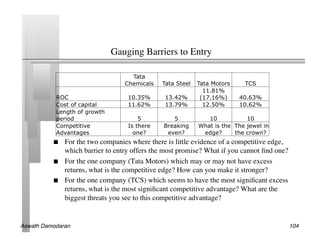
Gauging Barriers to Entry	


                                      Tata
                                    Chemicals    Tata Steel   Tata Motors     TCS
                                                                11.81%
           ROC                       10.35%       13.42%       (17.16%)     40.63%
           Cost of capital           11.62%       13.79%        12.50%      10.62%
           Length of growth
           period                        5           5           10           10
           Competitive               Is there     Breaking    What is the The jewel in
           Advantages                  one?        even?       edge?      the crown?
               For the two companies where there is little evidence of a competitive edge,
                which barrier to entry offers the most promise? What if you cannot find one?	

               For the one company (Tata Motors) which may or may not have excess
                returns, what is the competitive edge? How can you make it stronger?	

               For the one company (TCS) which seems to have the most significant excess
                returns, what is the most significant competitive advantage? What are the
                biggest threats you see to this competitive advantage?	


Aswath Damodaran!                                                                            104!
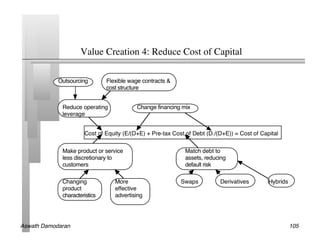
Value Creation 4: Reduce Cost of Capital 	


Aswath Damodaran!                                                  105!
Optimal Financing Mix: Tata Chemicals	


          Debt Ratio	

   Beta	

   Cost of Equity	

   Bond Rating	

 Interest rate on debt	

   Tax Rate	

   Cost of Debt (after-tax)	

   WACC	

     Firm Value (G)	

             0%	

        0.94	

      11.84%	

           AAA	

             8.50%	

            33.99%	

              5.61%	

             11.84%	

    INR 102,601 	

            10%	

        1.01	

      12.34%	

           AAA	

             8.50%	

            33.99%	

              5.61%	

             11.67%	

    INR 105,375 	

            20%	

        1.09	

      12.97%	

            A+	

             9.00%	

            33.99%	

              5.94%	

             11.56%	

    INR 107,152 	

            30%	

        1.20	

      13.78%	

            A-	

             9.50%	

            33.99%	

              6.27%	

             11.52%	

    INR 107,831 	

            40%	

        1.35	

      14.85%	

            B+	

            12.25%	

            33.99%	

              8.09%	

             12.14%	

     INR 98,001 	

            50%	

        1.56	

      16.36%	

            B-	

            13.50%	

            33.99%	

              8.91%	

             12.63%	

     INR 91,387 	

            60%	

        1.87	

      18.61%	

            CC	

            18.00%	

            33.99%	

             11.88%	

             14.57%	

     INR 71,784 	

            70%	

        2.46	

      22.92%	

            CC	

            18.00%	

            30.58%	

             12.50%	

             15.62%	

     INR 64,170 	

            80%	

        3.82	

      32.83%	

            C	

             20.00%	

            23.29%	

             15.34%	

             18.84%	

     INR 48,022 	

            90%	

        7.70	

      61.16%	

            C	

             20.00%	

            19.89%	

             16.02%	

             20.54%	

     INR 42,200 	


Aswath Damodaran!                                                                                                                                                       106!
Optimal Financing: Tata Companies	


  Is the debt matched to assets at these companies?	

  Can you reduce your fixed costs? If so, how?	

  Are there ways you can make your product/service less discretionary?	


Aswath Damodaran!                                                    107!
V. From fair value to fair price..	

                    There is many a slip between the cup and the lip…	


Aswath Damodaran!                                                          108!
Are markets fair?	


               In an efficient market, the market price converges instantaneously on value.
                Thus, a firm that takes value increasing actions will see its stock price go up
                and a firm that is value destructive will be punished by the market.	

               In practice, there are three potential impediments to this process working
                smoothly:	

                 •  Investors may be irrational and/or short term. 	

                 •  Markets may not trust the managers of the firm.	

                 •  Information about the actions may not get to markets or the message may be
                    muddled.	


Aswath Damodaran!                                                                                109!
I. The “right” investors	


               Optimally, a firm that is focused on long term value would like to get investors
                who	

                 •  Have long time horizons	

                 •  Care about fundamentals	

                 •  Do their research/homework	

               While firms do not get to pick their investors, they can influence the
                composition by	

                 •  Having a core of long term investors who may also be insiders in the firm	

                 •  Choosing a dividend policy that attracts the right type of investors	

                 •  What they focus on when they make decisions	


Aswath Damodaran!                                                                                 110!
II. Management Trust	


               Management trust is earned through a history of being focused on delivering
                value to investors. In other words, firms that have delivered solid returns to
                stockholders over time and taken good investments earn the trust of their
                stockholders, whereas firms that have delivered poor returns or over promised
                lose that trust.	

               When a firm loses the trust of its stockholders, it will not only find every
                action that it takes subjected to scrutiny and scrutiny but will come under
                intense pressure to return more of its cash to stockholders.	


Aswath Damodaran!                                                                           111!
A Symbol of Distrust
                    How much cash is too much cash?	


Aswath Damodaran!                                        112!
III. Information Gaps 	


               For markets to react appropriately to actions taken by a firm, information
                about those actions has to be conveyed clearly and credibly to markets. In
                practice, information disclosure is hindered by	

                 •  An unwillingness to provide “key” details of actions, for fear of letting competitors
                    in on secrets.	

                 •  A belief that investors are not intelligent or informed enough to use information
                    appropriately.	

                 •  An inability to communicate effectively and directly.	

                 •  Complexity and confusion in the disclosure, 	

               Managers will be better served trusting their investors to make the right
                judgments about actions and providing them with the information (positive
                and negative) to make these judgments.	


Aswath Damodaran!                                                                                      113!
Information Overload
                              A Discount for Complexity	


Company A      	

Company B	

           Operating Income 	

$ 1 billion              	

$ 1 billion	

           Tax rate            	

40%                   	

40%	

           ROIC                	

10%                   	

10%	

           Expected Growth 	

5%                        	

5%	

           Cost of capital     	

8%                    	

8%	

           Business Mix        	

Single Business       	

Multiple Businesses	

           Holdings            	

Simple                	

Complex	

           Accounting          	

Transparent           	

Opaque	

             Which firm would you value more highly?	


Aswath Damodaran!                                                                   114!
Measuring Complexity: Volume of Data in Financial
                              Statements	


                    Company             Number of pages in last 10Q   Number of pages in last 10K
                    General Electric                65                           410
                    Microsoft                       63                           218
                    Wal-mart                        38                           244
                    Exxon Mobil                     86                           332
                    Pfizer                         171                           460
                    Citigroup                      252                          1026
                    Intel                           69                           215
                    AIG                            164                           720
                    Johnson  Johnson               63                           218
                    IBM                             85                           353


Aswath Damodaran!                                                                                   115!
Measuring Complexity: A Complexity Score	

  Item	

                Factors	

                                     Follow-up Question	

                                    Answer	

 Weighting factor	

 Gerdau Score	

   GE Score	

  Operating Income	

    1. Multiple Businesses	

                      Number of businesses (with more than 10% of
                                                                        revenues) =	

                                             1	

         2.00	

              2	

           30	

                          2. One-time income and expenses	

                                                                        Percent of operating income =	

                          10%	

       10.00	

              1	

           0.8	

                          3. Income from unspecified sources	

                                                                        Percent of operating income =	

                          0%	

        10.00	

              0	

           1.2	

                          4. Items in income statement that are volatile	

                                                                        Percent of operating income =	

                          15%	

        5.00	

            0.75	

           1	

  Tax Rate	

             1. Income from multiple locales	

                                                                        Percent of revenues from non-domestic locales =	

        70%	

        3.00	

             2.1	

          1.8	

                          2. Different tax and reporting books	

                                                                        Yes or No	

                                               No	

       Yes=3	

              0	

            3	

                          3. Headquarters in tax havens	

                                                                        Yes or No	

                                               No	

       Yes=3	

              0	

            0	

                          4. Volatile effective tax rate	

                                                                        Yes or No	

                                              Yes	

       Yes=2	

              2	

            0	

  Capital Expenditures	

 1. Volatile capital expenditures	

                                                                        Yes or No	

                                              Yes	

       Yes=2	

              2	

            2	

                          2. Frequent and large acquisitions	

                                                                        Yes or No	

                                              Yes	

       Yes=4	

              4	

            4	

                          3. Stock payment for acquisitions and
                          investments	

                                Yes or No	

                                               No	

       Yes=4	

              0	

            4	

  Working capital	

      1. Unspecified current assets and current
                          liabilities	

                                Yes or No	

                                               No	

       Yes=3	

              0	

            0	

                          2. Volatile working capital items	

                                                                        Yes or No	

                                              Yes	

       Yes=2	

              2	

            2	

  Expected Growth rate	

 1. Off-balance sheet assets and liabilities
                          (operating leases and RD)	

                                                                        Yes or No	

                                               No	

       Yes=3	

              0	

            3	

                          2. Substantial stock buybacks	

                                                                        Yes or No	

                                               No	

       Yes=3	

              0	

            3	

                          3. Changing return on capital over time	

                                                                        Is your return on capital volatile?	

                    Yes	

       Yes=5	

              5	

            5	

                          4. Unsustainably high return	

                                                                        Is your firm's ROC much higher than industry average?	

 No	

          Yes=5	

              0	

            0	

  Cost of capital	

      1. Multiple businesses	

                                                                        Number of businesses (more than 10% of revenues) =	

      1	

         1.00	

              1	

           20	

                          2. Operations in emerging markets	

                                                                        Percent of revenues=	

                                   50%	

        5.00	

             2.5	

          2.5	

                          3. Is the debt market traded?	

                                                                        Yes or No	

                                               No	

       No=2	

               2	

            0	

                          4. Does the company have a rating?	

                                                                        Yes or No	

                                              Yes	

       No=2	

               0	

            0	

                          5. Does the company have off-balance sheet
                          debt?	

                                      Yes or No	

                                               No	

       Yes=5	

              0	

             5	

  No-operating assets	

 Minority holdings as percent of book assets	

                                                                        Minority holdings as percent of book assets	

            0%	

        20.00	

              0	

            0.8	

  Firm to Equity value	

 Consolidation of subsidiaries	

                                                                        Minority interest as percent of book value of equity	

   63%	

       20.00	

            12.6	

           1.2	

  Per share value	

      Shares with different voting rights	

                                                                        Does the firm have shares with different voting rights?	

 Yes	

      Yes = 10	

           10	

             0	

                          Equity options outstanding	

                                                                        Options outstanding as percent of shares	

               0%	

        10.00	

              0	

           0.25	

                                                                        Complexity Score =	

                                                                     48.95	

         90.55	

Aswath Damodaran!                                                                                                                                                                            116!
Back to Lemmings...	


Aswath Damodaran!                            117!

Tata valuation by aswath

  • 1.
    Two Sides toValue! Corporate Finance and Valuation Aswath Damodaran http://www.damodaran.com Tata Group, May 2010 Aswath Damodaran! 1!
  • 2.
    A motive forvaluation and corporate finance… One hundred thousand lemmings cannot be wrong Graffiti Aswath Damodaran! 2!
  • 3.
    Let’s start withan accounting balance sheet… The Balance Sheet Assets Liabilities Current Short-term liabilities of the firm Long Lived Real Assets Fixed Assets Liabilties Short-lived Assets Current Assets Debt Debt obligations of firm Investments in securities Financial Investments Other assets of other firms Liabilities Other long-term obligations Assets which are not physical, Intangible Assets like patents trademarks Equity Equity investment in firm Aswath Damodaran! 3!
  • 4.
    And replace itwith a financial balance sheet… Assets Liabilities Existing Investments Fixed Claim on cash flows Generate cashflows today Assets in Place Debt Little or No role in management Includes long lived (fixed) and Fixed Maturity short-lived(working Tax Deductible capital) assets Expected Value that will be Growth Assets Equity Residual Claim on cash flows created by future investments Significant Role in management Perpetual Lives Aswath Damodaran! 4!
  • 5.
    Corporate Finance: FirstPrinciples Aswath Damodaran! 5!
  • 6.
    Connecting to Valuation… Growth from new investments Efficiency Growth Growth created by making new Growth generated by investments; function of amount and using existing assets quality of investments better Terminal Value of firm (equity) Current Cashflows These are the cash flows from Expected Growth during high growth period existing investment,s, net of any Stable growth firm, reinvestment needed to sustain with no or very future growth. They can be limited excess returns computed before debt cashflows (to the firm) or after debt cashflows (to Length of the high growth period equity investors). Since value creating growth requires excess returns, this is a function of - Magnitude of competitive advantages - Sustainability of competitive advantages Cost of financing (debt or capital) to apply to discounting cashflows Determined by - Operating risk of the company - Default risk of the company - Mix of debt and equity used in financing Aswath Damodaran! 6!
  • 7.
    Misconceptions about Valuation   Myth 1: A valuation is an objective search for “true” value •  Truth 1.1: All valuations are biased. The only questions are how much and in which direction. •  Truth 1.2: The direction and magnitude of the bias in your valuation is directly proportional to who pays you and how much you are paid.   Myth 2.: A good valuation provides a precise estimate of value •  Truth 2.1: There are no precise valuations •  Truth 2.2: The payoff to valuation is greatest when valuation is least precise.   Myth 3: . The more quantitative a model, the better the valuation •  Truth 3.1: One’s understanding of a valuation model is inversely proportional to the number of inputs required for the model. •  Truth 3.2: Simpler valuation models do much better than complex ones. Aswath Damodaran! 7!
  • 8.
    Valuation: The BigPicture If you get the big picture, the details will follow… Aswath Damodaran! 8!
  • 9.
    Discounted Cash FlowValuation   What is it: In discounted cash flow valuation, the value of an asset is the present value of the expected cash flows on the asset.   Philosophical Basis: Every asset has an intrinsic value that can be estimated, based upon its characteristics in terms of cash flows, growth and risk.   Information Needed: To use discounted cash flow valuation, you need •  to estimate the life of the asset •  to estimate the cash flows during the life of the asset •  to estimate the discount rate to apply to these cash flows to get present value   Market Inefficiency: Markets are assumed to make mistakes in pricing assets across time, and are assumed to correct themselves over time, as new information comes out about assets. Aswath Damodaran! 9!
  • 10.
    DCF Choices: EquityValuation versus Firm Valuation Firm Valuation: Value the entire business Assets Liabilities Existing Investments Fixed Claim on cash flows Generate cashflows today Assets in Place Debt Little or No role in management Includes long lived (fixed) and Fixed Maturity short-lived(working Tax Deductible capital) assets Expected Value that will be Growth Assets Equity Residual Claim on cash flows created by future investments Significant Role in management Perpetual Lives Equity valuation: Value just the equity claim in the business Aswath Damodaran! 10!
  • 11.
    DISCOUNTED CASHFLOW VALUATION Cashflow to Firm Expected Growth EBIT (1-t) Reinvestment Rate - (Cap Ex - Depr) * Return on Capital Firm is in stable growth: - Change in WC Grows at constant rate = FCFF forever Terminal Value= FCFF n+1 /(r-g n) FCFF1 FCFF2 FCFF3 FCFF4 FCFF5 FCFFn Value of Operating Assets ......... + Cash Non-op Assets Forever = Value of Firm Discount at WACC= Cost of Equity (Equity/(Debt + Equity)) + Cost of Debt (Debt/(Debt+ Equity)) - Value of Debt = Value of Equity Cost of Equity Cost of Debt Weights (Riskfree Rate Based on Market Value + Default Spread) (1-t) Riskfree Rate : - No default risk Risk Premium - No reinvestment risk Beta - Premium for average - In same currency and + - Measures market risk X risk investment in same terms (real or nominal as cash flows Type of Operating Financial Base Equity Country Risk Business Leverage Leverage Premium Premium Aswath Damodaran! 11!
  • 12.
    Tata Chemicals: April2010 Average reinvestment rate from 2007-09: 56.5% Return on Capital Stable Growth Current Cashflow to Firm Reinvestment Rate 10.35% g = 5%; Beta = 1.00 EBIT(1-t) : Rs 5,833 56.5% Country Premium= 3% Expected Growth Tax rate = 33.99% - Nt CpX Rs 5,832 in EBIT (1-t) Cost of capital = 9.78% - Chg WC Rs 4,229 .565*.1035=0.0585 ROC= 9.78%; = FCFF - Rs 4,228 5.85% Reinvestment Rate=g/ROC Reinv Rate = (5832+4229)/5833 = =5/ 9.78= 51.14% 172.50% Tax rate = 31.5% Return on capital = 10.35% Terminal Value5= 3831/(.0978-.05) = Rs 80,187 Rs Cashflows Op. Assets Rs 57,128 Year 1 2 3 4 5 + Cash: 6,388ʼ EBIT (1-t) INR 6,174 INR 6,535 INR 6,917 INR 7,321 INR 7,749 7841 + Other NO 56,454 - Reinvestment INR 3,488 INR 3,692 INR 3,908 INR 4,137 INR 4,379 4010 - Debt 32,374 FCFF INR 2,685 INR 2,842 INR 3,008 INR 3,184 INR 3,370 3831 =Equity 87,597 Value/Share Rs 372 Discount at $ Cost of Capital (WACC) = 13.82% (.695) + 6.6% (0.305) = 11.62% Cost of Equity Cost of Debt 13.82% (5%+ 2%+3)(1-.3399) Weights E = 69.5% D = 30.5% On April 1, 2010 = 6.6% Tata Chemicals price = Rs 314 Riskfree Rate: Rs Riskfree Rate= 5% Beta Mature market Country Equity Risk + 1.21 X premium + Lambda X Premium 4.5% 0.75 4.50% Unlevered Beta for Firmʼs D/E Rel Equity Sectors: 0.95 Ratio: 42% Country Default Mkt Vol Spread X 3% 1.50 Aswath Damodaran! 12!
  • 13.
    Tata Steel: April2010 Average reinvestment rate from 2005-09: 38.1% Return on Capital Stable Growth 13.42% g = 5%; Beta = 1.20 Current Cashflow to Firm Reinvestment Rate Country Premium= 3% EBIT(1-t) : Rs 60,213 38.1% Expected Growth Tax rate = 33.99% - Nt CpX Rs 61,620 in EBIT (1-t) Cost of capital = 11.16% - Chg WC - Rs 3,658 .381*.1342=0.0511 ROC= 11.16%; = FCFF Rs 2251 5.11% Reinvestment Rate=g/ROC Reinv Rate = (61620-3658)/60213= =5/ 11.16= 44.8% 96.26% Tax rate = 28.90% Return on capital = 13.42% Terminal Value5= 41572(.1116-.05) = Rs 701,444 Rs Cashflows Op. Assets Rs501,661 Year 1 2 3 4 5 + Cash: 15,906 EBIT (1-t) INR 63,292 INR 66,529 INR 69,931 INR 73,507 INR 77,266 75,316 + Other NO 467,315 - Reinvestment INR 24,111 INR 25,344 INR 26,640 INR 28,002 INR 29,434 33,744 - Debt 235,697 FCFF INR 39,181 INR 41,185 INR 43,291 INR 45,504 INR 47,831 41,572 =Equity 749,184 Value/Share Rs 844 Discount at $ Cost of Capital (WACC) = 17.02% (.704) + 6.11% (0.296) = 13.79% Cost of Equity Cost of Debt 17.02% (5%+ 1.25%+3%)1-.3399) Weights E = 70.4% D = 29.6% On April 1, 2010 = 6.11% Tata Steel price = Rs 632 Riskfree Rate: Rs Riskfree Rate= 5% Beta Mature market Country Equity Risk + 1.57 X premium + Lambda X Premium 4.5% 1.10 4.50% Unlevered Beta for Firmʼs D/E Rel Equity Sectors: 1.23 Ratio: 42% Country Default Mkt Vol Spread X 1.50 Aswath Damodaran! 3% 13!
  • 14.
    Average reinvestment rate TataMotors: April 2010 from 2005-09: 179.59%; Return on Capital without acquisitions: 70% Stable Growth Current Cashflow to Firm 17.16% g = 5%; Beta = 1.00 EBIT(1-t) : Rs 20,116 Reinvestment Rate Country Premium= 3% 70% Expected Growth - Nt CpX Rs 31,590 from new inv. Cost of capital = 10.39% - Chg WC Rs 2,732 .70*.1716=0.1201 Tax rate = 33.99% = FCFF - Rs 14,205 ROC= 12%; Reinv Rate = (31590+2732)/20116 = Reinvestment Rate=g/ROC 170.61%; Tax rate = 21.00% =5/ 12= 41.67% Return on capital = 17.16% Terminal Value5= 26412/(.1039-.05) = Rs 489,813 Rs Cashflows Op. Assets Rs231,914 Year 1 2 3 4 5 6 7 8 9 10 + Cash: 11418 EBIT (1-t) 22533 25240 28272 31668 35472 39236 42848 46192 49150 51607 45278 + Other NO 140576 - Reinvestment 15773 17668 19790 22168 24830 25242 25138 24482 23264 21503 18866 - Debt 109198 FCFF 6760 7572 8482 9500 10642 13994 17711 21710 25886 30104 26412 =Equity 274,710 Value/Share Rs 665 Discount at $ Cost of Capital (WACC) = 14.00% (.747) + 8.09% (0.253) = 12.50% Growth declines to 5% and cost of capital moves to stable period level. Cost of Equity Cost of Debt 14.00% (5%+ 4.25%+3)(1-.3399) Weights E = 74.7% D = 25.3% On April 1, 2010 = 8.09% Tata Motors price = Rs 781 Riskfree Rate: Rs Riskfree Rate= 5% Beta Mature market Country Equity Risk + 1.20 X premium + Lambda X Premium 4.5% 0.80 4.50% Unlevered Beta for Firmʼs D/E Rel Equity Sectors: 1.04 Ratio: 33% Country Default Mkt Vol Spread X 1.50 3% Aswath Damodaran! 14!
  • 15.
    TCS: April 2010 Average reinvestment rate from 2005--2009 =56.73%% Return on Capital 40.63% Stable Growth Current Cashflow to Firm g = 5%; Beta = 1.00 EBIT(1-t) : Rs 43,420 Reinvestment Rate Expected Growth Country Premium= 3% - Nt CpX Rs 5,611 56.73% from new inv. Cost of capital = 9.52% - Chg WC Rs 6,130 Tax rate = 33.99% 5673*.4063=0.2305 = FCFF Rs 31,679 ROC= 15%; Reinv Rate = (56111+6130)/43420= Reinvestment Rate=g/ROC 27.04%; Tax rate = 15.55% =5/ 15= 33.33% Return on capital = 40.63% Terminal Value5= 118655/(.0952-.05) = 2,625,649 Rs Cashflows Op. Assets 1,355,361 Year 1 2 3 4 5 6 7 8 9 10 + Cash: 3,188 EBIT (1-t) 53429 65744 80897 99544 122488 146299 169458 190165 206538 216865 177982 + Other NO 66,140 - Reinvestment 30308 37294 45890 56468 69483 76145 80271 81183 78509 72288 59327 - Debt 505 FCFF 23120 28450 35007 43076 53005 70154 89187 108983 128029 144577 118655 =Equity 1,424,185 Value/Share Rs 728 Discount at $ Cost of Capital (WACC) = 10.63% (.999) + 5.61% (0.001) = 10.62% Growth declines to 5% and cost of capital moves to stable period level. Cost of Equity Cost of Debt 10.63% (5%+ 0.5%+3)(1-.3399) Weights E = 99.9% D = 0.1% On April 1, 2010 = 5.61% TCS price = Rs 841 Riskfree Rate: Rs Riskfree Rate= 5% Beta Mature market Country Equity Risk + 1.05 X premium + Lambda X Premium 4.5% 0.20 4.50% Unlevered Beta for Firmʼs D/E Rel Equity Sectors: 1.05 Ratio: 0.1% Country Default Mkt Vol Spread X 1.50 Aswath Damodaran! 3% 15!
  • 16.
  • 17.
    I. Estimating DiscountRates Aswath Damodaran! 17!
  • 18.
    Cost of Equity AswathDamodaran! 18!
  • 19.
    A. The RiskfreeRate   On a riskfree asset, the actual return is equal to the expected return. Therefore, there is no variance around the expected return.   For an investment to be riskfree, then, it has to have •  No default risk •  No reinvestment risk 1.  Time horizon matters: Thus, the riskfree rates in valuation will depend upon when the cash flow is expected to occur and will vary across time. 2.  Not all government securities are riskfree: Some governments face default risk and the rates on bonds issued by them will not be riskfree. For a rate to be riskfree in valuation, it has to be long term, default free and currency matched (to the cash flows) Aswath Damodaran! 19!
  • 20.
    Estimating the RiskfreeRate in Rupees… and US dollars..   The Indian government had 10-year Rupee bonds outstanding, with a yield to maturity of about 8% on April 1, 2010. In January 2010, the Indian government had a local currency sovereign rating of Ba2. The typical default spread (over a default free rate) for Ba2 rated country bonds in early 2010 was 3%.   The riskfree rate in Indian Rupees is a)  The yield to maturity on the 10-year bond (8%) b)  The yield to maturity on the 10-year bond + Default spread (8%+3% =11%) c)  The yield to maturity on the 10-year bond – Default spread (8%-3% = 5%) d)  None of the above   If you wanted to do you entire valuation in US dollars, what would you use as your riskfree rate?   How would your answer change if you were doing the analysis in Euros? Aswath Damodaran! 20!
  • 21.
    A Euro RiskfreeRate Figure 4: Goverment Bond Rates in Euros 6.00% 5.00% 4.00% 3.00% 2-year 10-year 2.00% 1.00% 0.00% Aswath Damodaran! 21!
  • 22.
    Why do riskfreerates vary? Aswath Damodaran! 22!
  • 23.
    b. Equity RiskPremiums   The historical premium is the premium that stocks have historically earned over riskless securities.   Practitioners never seem to agree on the premium; it is sensitive to •  How far back you go in history… •  Whether you use T.bill rates or T.Bond rates •  Whether you use geometric or arithmetic averages.   For instance, looking at the US: Arithmetic Average! Geometric Average! Stocks –! Stocks – ! Stocks – ! Stocks – ! T. Bills! T. Bonds! T. Bills! T. Bonds! 1928-2009! 7.53%! 6.03%! 5.56%! 4.29%! (2.28%)! (2.40%)! 1960-2009! 5.48%! 3.78%! 4.09%! 2.74%! (2.42%)! (2.71%)! 2000-2009! -1.59%! -5.47%! -3.68%! -7.22%! (6.73%)! (9.22%)! Aswath Damodaran! 23!
  • 24.
    The perils oftrusting the past…….   Noisy estimates: Even with long time periods of history, the risk premium that you derive will have substantial standard error. For instance, if you go back to 1928 (about 80 years of history) and you assume a standard deviation of 20% in annual stock returns, you arrive at a standard error of greater than 2%: Standard Error in Premium = 20%/√80 = 2.26%   Survivorship Bias: Using historical data from the U.S. equity markets over the twentieth century does create a sampling bias. After all, the US economy and equity markets were among the most successful of the global economies that you could have invested in early in the century. These problems get exacerbated in markets like India, where there is far less historical data and survivor bias is worse. Aswath Damodaran! 24!
  • 25.
    An Alternative: Watchwhat I pay, not what I say…   In January 2010, the SP 500 was trading at 1115.10. You can back out the return that investors can expect to pay from the index and expected cash flows… In 2010, the actual cash returned to stockholders was After year 5, we will assume that 40.38. That was down about earnings on the index will grow at 40% from 2008 levels. Analysts expect earnings to grow 21% in 2010, resulting in a 3.84%, the same rate as the entire compounded annual growth rate of 7.2% over the next 5 years. We economy (= riskfree rate). will assume that dividends buybacks will keep pace. 43.29 46.40 49.74 53.32 57.16 January 1, 2010 SP 500 is at 1115.10 Adjusted Dividends Expected Return on Stocks (1/1/10) = 8.20% Buybacks for 2008 = 40.38 T.Bond rate on 1/1/10 = 3.84 % Equity Risk Premium = 8.20% - 3.84% = 4.36% Aswath Damodaran! 25!
  • 26.
    Implied Premiums inthe US Aswath Damodaran! 26!
  • 27.
    The Anatomy ofa Crisis: Implied ERP from September 12, 2008 to January 1, 2009 Aswath Damodaran! 27!
  • 28.
    Implied Premium forSensex: April 2010   Level of the Index = 17559   FCFE on the Index = 3.5% (Estimated FCFE for companies in index as % of market value of equity)   Other parameters •  Riskfree Rate = 5% (Rupee) •  Expected Growth (in Rupee) –  Next 5 years = 20% (Used expected growth rate in Earnings) –  After year 5 = 5%   Solving for the expected return: •  Expected return on Equity = 11.72% •  Implied Equity premium for India =11.72% - 5% = 6.72% Aswath Damodaran! 28!
  • 29.
    A solution: Estimatea mature market premium with an added country risk premium   Assume that the equity risk premium for the US and other mature equity markets is 4.5%. You could then add on an additional premium for investing in an emerging markets.   Two ways of estimating the country risk premium: •  Default spread on Country Bond: In this approach, the country equity risk premium is set equal to the default spread of the bond issued by the country. –  Equity Risk Premium for India = 4.5% + 3% = 7.5% •  Adjusted for equity risk: The country equity risk premium is based upon the volatility of the market in question relative to U.S market. Total equity risk premium = Risk PremiumUS* σCountry Equity / σCountry Bond –  Standard Deviation in Sensex = 30% –  Standard Deviation in Indian government bond= 20% –  Default spread on Indian Bond= 3% –  Total equity risk premium for India = 4.5% + 3% (30/20) = 9% Aswath Damodaran! 29!
  • 30.
    Austria [1] 4.50% Albania 11.25% Belgium [1] 4.95% Armenia 9.00% Cyprus [1] 5.63% Azerbaijan 8.25% Denmark 4.50% Belarus 11.25% Country Risk Premiums Finland [1] 4.50% Bosnia and Herzegovina 12.75% January 2010 France [1] Germany [1] 4.50% 4.50% Bulgaria Croatia 7.50% 7.50% Greece [1] 6.08% Czech Republic 5.85% Iceland 7.50% Estonia 5.85% Ireland [1] 4.95% Hungary 6.90% Italy [1] 5.40% Kazakhstan 7.20% Canada 4.50% Malta [1] 5.85% Latvia 7.50% Mexico 6.90% Lithuania 6.90% Netherlands [1] 4.50% United States of America 4.50% Moldova 15.75% Norway 4.50% Montenegro 9.75% Portugal [1] 5.40% Poland 6.08% Spain [1] 4.50% Romania 7.50% Argentina Sweden 14.25% 4.50% Russia 6.90% Belize Switzerland 14.25% 4.50% Slovakia 5.85% Bolivia 12.75% Kingdom United 4.50% Slovenia [1] 5.40% Brazil 7.50% Turkmenistan 12.75% Chile 5.85% Ukraine 12.75% Colombia 7.50% Bahrain 6.08% Australia 4.50% Costa Rica 8.25% Israel 5.85% New Zealand 4.50% Ecuador 19.50% Jordan 7.50% El Salvador 19.50% Kuwait 5.40% Guatemala 8.25% Lebanon 12.75% Honduras 12.75% Oman 6.08% Nicaragua 14.25% Qatar 5.40% Panama 8.25% Saudi Arabia 5.85% Paraguay 14.25% United Arab Emirates 5.40% Peru 7.50% Uruguay 9.75% Venezuela 11.25% Aswath Damodaran! 30!
  • 31.
    From Country RiskPremiums to Corporate Risk premiums   Approach 1: Assume that every company in the country is equally exposed to country risk. In this case, E(Return) = Riskfree Rate + Country ERP + Beta (US premium)   Approach 2: Assume that a company’s exposure to country risk is similar to its exposure to other market risk. E(Return) = Riskfree Rate + Beta (US premium + Country ERP)   Approach 3: Treat country risk as a separate risk factor and allow firms to have different exposures to country risk (perhaps based upon the proportion of their revenues come from non-domestic sales) E(Return)=Riskfree Rate+ β (US premium) + λ (Country ERP) Country ERP: Additional country equity risk premium Aswath Damodaran! 31!
  • 32.
    Estimating Company Exposureto Country Risk   Different companies should be exposed to different degrees to country risk. For instance, a Korean firm that generates the bulk of its revenues in Western Europe and the US should be less exposed to country risk than one that generates all its business within Korea.   The factor “λ” measures the relative exposure of a firm to country risk. One simplistic solution would be to do the following: λ = % of revenues domesticallyfirm/ % of revenues domesticallyavg firm Consider two firms – HyundaI Heavy Industries and Megastudy, both Korean companies. The former gets about 20% of its revenues in Korea and the latter gets 100%. The average Korean firm gets about 80% of its revenues in Korea: λHyundai = 20%/80% = 0.25 λMegastudy = 100%/80% = 1.25   There are two implications •  A company’s risk exposure is determined by where it does business and not by where it is located •  Firms might be able to actively manage their country risk exposures Aswath Damodaran! 32!
  • 33.
    Estimating lambdas: TataGroup Tata Chemicals Tata Steel Tata Motors TCS % of production/ operations in India High High High Low % of revenues in India 75% 88.83% 91.37% 7.62% Lambda 0.75 1.10 0.80 0.20 Recently Gets 77% of its acquired While its raw material Jaguar/Land operations are from non- Rover, with spread all over, it domestic significant non- uses primarily Other factors sources, domestic sales Indian personnel Aswath Damodaran! 33!
  • 34.
    Estimating Beta   The standard procedure for estimating betas is to regress stock returns (Rj) against market returns (Rm) - Rj = a + b Rm •  where a is the intercept and b is the slope of the regression.   The slope of the regression corresponds to the beta of the stock, and measures the riskiness of the stock.   This beta has three problems: •  It has high standard error •  It reflects the firm’s business mix over the period of the regression, not the current mix •  It reflects the firm’s average financial leverage over the period rather than the current leverage. Aswath Damodaran! 34!
  • 35.
    A standard regression..A beta for Tata Motors Aswath Damodaran! 35!
  • 36.
  • 37.
  • 38.
  • 39.
    Bottom Up BetaEstimates for Tata Companies Tata Tata Chemicals Tata Motors Steel TCS Business Chemicals Software breakdown Fertilizers Steel Automobiles Information Processing Unlevered beta 0.94 1.23 0.98 1.05 D/E Ratio 43.85% 42.03% 33.87% 0.03% Levered Beta 1.21 1.57 1.20 1.05 A closer look at Tata Chemicals % of revenues Unlevered Beta Chemicals 42% 1.05 Fertilizers 58% 0.86 Company 0.94 Aswath Damodaran! 39!
  • 40.
  • 41.
    From Cost ofEquity to Cost of Capital Aswath Damodaran! 41!
  • 42.
    What is debt?   General Rule: Debt generally has the following characteristics: •  Commitment to make fixed payments in the future •  The fixed payments are tax deductible •  Failure to make the payments can lead to either default or loss of control of the firm to the party to whom payments are due.   As a consequence, debt should include •  Any interest-bearing liability, whether short term or long term. •  Any lease obligation, whether operating or capital. Aswath Damodaran! 42!
  • 43.
    Debt and Equityat the Tata Group Aswath Damodaran! 43!
  • 44.
    Estimating the Costof Debt   If the firm has bonds outstanding, and the bonds are traded, the yield to maturity on a long-term, straight (no special features) bond can be used as the interest rate.   If the firm is rated, use the rating and a typical default spread on bonds with that rating to estimate the cost of debt.   If the firm is not rated, •  and it has recently borrowed long term from a bank, use the interest rate on the borrowing or •  estimate a synthetic rating for the company, and use the synthetic rating to arrive at a default spread and a cost of debt   The cost of debt has to be estimated in the same currency as the cost of equity and the cash flows in the valuation. Aswath Damodaran! 44!
  • 45.
    Estimating Synthetic Ratings   The rating for a firm can be estimated using the financial characteristics of the firm. In its simplest form, the rating can be estimated from the interest coverage ratio Interest Coverage Ratio = EBIT / Interest Expenses   The interest coverage ratio can be linked to a debt rating, which in turn can provide an estimate of default spread and the cost of debt for a company. Cost of debt = Riskfree Rate + Default spread for the company   In emerging markets, where governments themselves have default risk, the cost of debt for a company will include some or all of the default spread for the country. Cost of debt = Riskfree Rate + Default spread for the country + Default spread for the company Aswath Damodaran! 45!
  • 46.
    Interest Coverage Ratios,Ratings and Default Spreads Aswath Damodaran! 46!
  • 47.
    Estimating the costof debt for Tata companies Aswath Damodaran! 47!
  • 48.
    Estimating Cost ofCapital: Tata Group Tata Chemicals Tata Steel Tata Motors TCS Beta 1.21 1.57 1.20 1.05 Lambda 0.75 1.10 0.80 0.20 Cost of equity 13.82% 17.02% 14.00% 10.63% Synthetic rating BBB A B+ AAA Cost of debt 6.60% 6.11% 8.09% 5.61% Debt Ratio 30.48% 29.59% 25.30% 0.03% Cost of Capital 11.62% 13.79% 12.50% 10.62% Tata Chemicals: Divisional Costs of Capital Cost of Cost of Debt Cost of Beta equity debt Ratio capital Chemicals 1.35 14.47% 6.60% 30.48% 12.07% Fertilizers 1.11 13.37% 6.60% 30.48% 11.30% Aswath Damodaran! 48!
  • 49.
    II. Estimating Cashflowsand Growth Aswath Damodaran! 49!
  • 50.
  • 51.
    From Reported toActual Earnings Aswath Damodaran! 51!
  • 52.
    Dealing with OperatingLease Expenses   Operating Lease Expenses are treated as operating expenses in computing operating income. In reality, operating lease expenses should be treated as financing expenses, with the following adjustments to earnings and capital:   Debt Value of Operating Leases = Present value of Operating Lease Commitments at the pre-tax cost of debt   When you convert operating leases into debt, you also create an asset to counter it of exactly the same value.   Adjusted Operating Earnings Adjusted Operating Earnings = Operating Earnings + Operating Lease Expenses - Depreciation on Leased Asset •  As an approximation, this works: Adjusted Operating Earnings = Operating Earnings + Pre-tax cost of Debt * PV of Operating Leases. Aswath Damodaran! 52!
  • 53.
    RD Expenses: Operatingor Capital Expenses   Accounting standards require us to consider RD as an operating expense even though it is designed to generate future growth. It is more logical to treat it as capital expenditures.   To capitalize RD, •  Specify an amortizable life for RD (2 - 10 years) •  Collect past RD expenses for as long as the amortizable life •  Sum up the unamortized RD over the period. (Thus, if the amortizable life is 5 years, the research asset can be obtained by adding up 1/5th of the RD expense from five years ago, 2/5th of the RD expense from four years ago...: Aswath Damodaran! 53!
  • 54.
    What tax rate?   The tax rate that you should use in computing the after-tax operating income should be   The effective tax rate in the financial statements (taxes paid/Taxable income)   The tax rate based upon taxes paid and EBIT (taxes paid/EBIT)   The marginal tax rate for the country in which the company operates   The weighted average marginal tax rate across the countries in which the company operates   None of the above   Any of the above, as long as you compute your after-tax cost of debt using the same tax rate Aswath Damodaran! 54!
  • 55.
    Tata Group: TaxRates Aswath Damodaran! 55!
  • 56.
    Capital expenditures shouldinclude   Research and development expenses, once they have been re-categorized as capital expenses. The adjusted net cap ex will be Adjusted Net Capital Expenditures = Net Capital Expenditures + Current year’s RD expenses - Amortization of Research Asset   Acquisitions of other firms, since these are like capital expenditures. The adjusted net cap ex will be Adjusted Net Cap Ex = Net Capital Expenditures + Acquisitions of other firms - Amortization of such acquisitions Two caveats: 1. Most firms do not do acquisitions every year. Hence, a normalized measure of acquisitions (looking at an average over time) should be used 2. The best place to find acquisitions is in the statement of cash flows, usually categorized under other investment activities Aswath Damodaran! 56!
  • 57.
    Working Capital Investments   In accounting terms, the working capital is the difference between current assets (inventory, cash and accounts receivable) and current liabilities (accounts payables, short term debt and debt due within the next year)   A cleaner definition of working capital from a cash flow perspective is the difference between non-cash current assets (inventory and accounts receivable) and non-debt current liabilities (accounts payable)   Any investment in this measure of working capital ties up cash. Therefore, any increases (decreases) in working capital will reduce (increase) cash flows in that period.   When forecasting future growth, it is important to forecast the effects of such growth on working capital needs, and building these effects into the cash flows. Aswath Damodaran! 57!
  • 58.
    Breaking down aggregatereinvestment over last 5 years: Tata Group Aswath Damodaran! 58!
  • 59.
    Estimating FCFF: TataGroup Tax rate =21% Normalized EBIT = Normalized EBT + Interest Expense in 2009 = Rs 18,727 + Rs 6,737 m= Rs 25,464 m Normalized EBT = Revenues in 2009 * Average Margin = Rs 265,868 m* 7.04% = Rs 18,727 m 2004 2005 2006 2007 2008 Total Revenues INR 206,487 INR 242,905 INR 320,648 INR 335,771 INR 295,252 INR 1,401,063 EBT INR 16,519 INR 20,534 INR 25,732 INR 25,765 INR 10,138 INR 98,688 EBT Margin 8.00% 8.45% 8.02% 7.67% 3.43% 7.04% Aswath Damodaran! 59!
  • 60.
    Growth in Earnings   Look at the past •  The historical growth in earnings per share is usually a good starting point for growth estimation   Look at what others are estimating •  Analysts estimate growth in earnings per share for many firms. It is useful to know what their estimates are.   Look at fundamentals •  Ultimately, all growth in earnings can be traced to two fundamentals - how much the firm is investing in new projects, and what returns these projects are making for the firm. Aswath Damodaran! 60!
  • 61.
    The Determinants ofGrowth Aswath Damodaran! 61!
  • 62.
    Measuring Return onCapital (Equity) Aswath Damodaran! 62!
  • 63.
    Measuring Return onCapital at Tata Group Tata Tata Motors Tata Motors Chemicals Tata Steel (actual) (normalized) TCS INR INR EBIT INR 8,515 84,683 INR 17,527 INR 25,464 51,414 Tax rate 31.50% 28.90% 21.00% 21.00% 15.55% INR INR EBIT (1-t) INR 5,833 60,213 INR 13,846 INR 20,117 43,420 INR BV of Debt INR 23,438 180,217 INR 62,805 INR 62,805 INR 183 INR INR BV of Equity INR 35,717 273,007 INR 78,395 INR 78,395 110,048 Cash INR 2,776 INR 4,650 INR 23,973 INR 23,973 INR 3,370 Invested INR INR Capital INR 56,379 448,574 INR 117,227 INR 117,227 106,861 ROC 10.35% 13.42% 11.81% 17.16% 40.63% Aswath Damodaran! 63!
  • 64.
    Measuring Reinvestment Rateand Expected Growth at Tata Group Tata Tata Chemicals Tata Steel Motors TCS ROC 10.35% 13.42% 17.16% 40.63% Reinvestment Rate (last year) 172.50% 96.26% 170.61% 27.04% Reinvestment Rate (last 5 years) 283.28% 166.10% 190.74% 56.73% Reinvestment Rate (last 5 years - w/ o acquisitions) 56.50% 38.09% 179.59% 30.87% ROC used 10.35% 13.42% 17.16% 40.63% Reinvestment rate 56.50% 38.09% 70% 56.73% Sustainable growth 5.85% 5.11% 12.01% 23.05% Aswath Damodaran! 64!
  • 65.
    III. The Tailthat wags the dog… Terminal Value Aswath Damodaran! 65!
  • 66.
    Getting Closure inValuation   A publicly traded firm potentially has an infinite life. The value is therefore the present value of cash flows forever. t = ∞ CF Value = ∑ t t t = 1 (1+ r)   Since we cannot estimate cash flows forever, we estimate cash flows for a “growth period” and then estimate a terminal value, to capture the value at the end of the period: t = N CFt Terminal Value Value = ∑ + t (1 + r)N t = 1 (1 + r) Aswath Damodaran! 66!
  • 67.
    Ways of EstimatingTerminal Value Aswath Damodaran! 67!
  • 68.
    Stable Growth andTerminal Value   When a firm’s cash flows grow at a “constant” rate forever, the present value of those cash flows can be written as: Value = Expected Cash Flow Next Period / (r - g) where, r = Discount rate (Cost of Equity or Cost of Capital) g = Expected growth rate   While companies can maintain high growth rates for extended periods, they will all approach “stable growth” at some point in time. When they will do so will depend upon: •  How large they are relative to the market in which they operate •  Their competitive advantages Aswath Damodaran! 68!
  • 69.
    Four Rules forTerminal value   Respect the cap: The stable growth rate cannot exceed the growth rate of the economy but it can be set lower. One simple proxy for the nominal growth rate of the economy is the riskfree rate. •  Riskfree rate = Expected inflation + Expected Real Interest Rate •  Nominal growth rate in economy = Expected Inflation + Expected Real Growth   Stable period excess returns: Firms that generate returns on capital that vastly exceed their costs of capital should see these excess returns shrink in stable growth as competition enters and size works against them.   Reinvest to grow: Growth is never free and this is especially true in stable growth. To grow at a perpetual rate, firms have to reinvest and how much they reinvest will be a function of the return on capital: Reinvestment Rate = Stable growth rate/ Stable ROC   Adjust risk and cost of capital: The cost of equity and capital in stable growth should be reflective of a mature firm in stable growth. In particular, •  Betas should move towards one •  Debt ratios should converge on long-term sustainable averages Aswath Damodaran! 69!
  • 70.
    1. How highcan the stable growth rate be?   The stable growth rate cannot exceed the growth rate of the economy but it can be set lower. •  If you assume that the economy is composed of high growth and stable growth firms, the growth rate of the latter will probably be lower than the growth rate of the economy. •  The stable growth rate can be negative. The terminal value will be lower and you are assuming that your firm will disappear over time. •  If you use nominal cashflows and discount rates, the growth rate should be nominal in the currency in which the valuation is denominated.   One simple proxy for the nominal growth rate of the economy is the riskfree rate. •  Riskfree rate = Expected inflation + Expected Real Interest Rate •  Nominal growth rate in economy = Expected Inflation + Expected Real Growth Aswath Damodaran! 70!
  • 71.
    2. When willthe firm reach stable growth?   Size of the firm •  Success usually makes a firm larger. As firms become larger, it becomes much more difficult for them to maintain high growth rates   Current growth rate •  While past growth is not always a reliable indicator of future growth, there is a correlation between current growth and future growth. Thus, a firm growing at 30% currently probably has higher growth and a longer expected growth period than one growing 10% a year now.   Barriers to entry and differential advantages •  Ultimately, high growth comes from high project returns, which, in turn, comes from barriers to entry and differential advantages. •  The question of how long growth will last and how high it will be can therefore be framed as a question about what the barriers to entry are, how long they will stay up and how strong they will remain. Aswath Damodaran! 71!
  • 72.
    3. What elseshould change in stable growth?   In stable growth, firms should have the characteristics of other stable growth firms. In particular, •  The risk of the firm, as measured by beta and ratings, should reflect that of a stable growth firm. –  Beta should move towards one –  The cost of debt should reflect the safety of stable firms (BBB or higher) •  The debt ratio of the firm might increase to reflect the larger and more stable earnings of these firms. –  The debt ratio of the firm might moved to the optimal or an industry average –  If the managers of the firm are deeply averse to debt, this may never happen •  The return on capital generated on investments should move to sustainable levels, relative to both the sector and the company’s own cost of capital. Aswath Damodaran! 72!
  • 73.
    4. What excessreturns will you generate in stable growth and why does it matter?   Strange though this may seem, the terminal value is not as much a function of stable growth as it is a function of what you assume about excess returns in stable growth.   The key connecting link is the reinvestment rate that you have in stable growth, which is a function of your return on capital: Reinvestment Rate = Stable growth rate/ Stable ROC The terminal value can be written in terms of ROC as follows: Terminal Value = EBITn+1 (1-t) (1 – g/ ROC)/ (Cost of capital – g)   In the scenario where you assume that a firm earns a return on capital equal to its cost of capital in stable growth, the terminal value will not change as the growth rate changes.   If you assume that your firm will earn positive (negative) excess returns in perpetuity, the terminal value will increase (decrease) as the stable growth rate increases. Aswath Damodaran! 73!
  • 74.
    Stable Growth Assumptions:Tata Group Tata Chemicals Tata Steel Tata Motors TCS Beta High Growth 1.21 1.57 1.20 1.05 Stable Growth 1.00 1.20 1.00 1.00 Lambda High Growth 0.75 1.10 0.80 0.20 Stable Growth 0.75 1.10 0.80 0.20 Country Risk Premium High Growth 4.50% 4.50% 4.50% 4.50% Stable Growth 3.00% 3.00% 3.00% 3.00% Cost of equity High Growth 13.82% 17.02% 14.00% 10.63% Stable Growth 11.75% 13.70% 11.90% 10.10% Debt Ratio High Growth 30.48% 29.59% 25.30% 0.03% Stable Growth 30.48% 29.59% 25.30% 10% Cost of debt High Growth 10.00% 9.25% 12.25% 8.50% Stable Growth 8.00% 7.75% 9.00% 6.50% Cost of capital High Growth 11.62% 13.79% 12.50% 10.62% Stable Growth 9.78% 11.16% 10.39% 9.52% Reurn on capital High Growth 13.42% 11.81% 17.16% 40.63% Stable Growth 9.78% 11.16% 12.00% 15% Reinvestment Rate High Growth 56.50% 38.09% 70.00% 56.73% Stable Growth 51.14% 44.80% 41.67% 33.33% Expected growth rate High Growth 5.85% 5.11% 12.01% 23.05% Stable Growth 5% 5% 5% 5% Aswath Damodaran! 74!
  • 75.
    Terminal Value andGrowth: Contrasts Aswath Damodaran! 75!
  • 76.
    V. Tying upLoose Ends For firm value to equity value per share Aswath Damodaran! 76!
  • 77.
    1. Value cashand other non-operating assets   When you discount operating cash flows at the cost of capital, you have valued only the operating assets (that contribute to the operating income) of the firm. Any assets whose earnings are not counted as part of operating income have not been valued yet. In particular, these would include: •  Cash and marketable securities: The income from these are not part of operating income. Hence, the current value of these assets has to be added to the value of the operating assets. •  Non-operating assets: If the firm own other assets that have value but do not contribute to operations, the value of these assets should also be included in the firm value.   The key, though, is to not double count an asset. Thus, an asset (say your office headquarters building) that has value but is used for operations should not be added on to the value of operating assets. Aswath Damodaran! 77!
  • 78.
    2. Dealing withHoldings in Other firms   Cross holdings in other firms can create problems because the accounting for these holdings can vary widely across countries, across companies and even within the same company, across different holdings. In particular, we care about •  How the income from these holdings is accounted for in the income statement –  What is counted as income? (Operating income, Net income or just dividends) –  Where is it shown? (Above or below the operating income line) –  How much of the income is shown? (The share of the holding, 100%?) •  How is the value of the asset recorded on the balance sheet? –  Is it recorded at original cost, updated book value or market value? –  Is just the net value of the holding shown or are all of the assets and liabilities recorded? Aswath Damodaran! 78!
  • 79.
    How to valueholdings in other firms.. In a perfect world..   In a perfect world, we would strip the parent company from its subsidiaries and value each one separately. The value of the combined firm will be •  Value of parent company + Proportion of value of each subsidiary   To do this right, you will need •  to be provided detailed information on each subsidiary to estimated cash flows and discount rates. •  To have a manageable number of subsidiaries Aswath Damodaran! 79!
  • 80.
    Three compromise solutions…   The market value solution: When the subsidiaries are publicly traded, you could use their traded market capitalizations to estimate the values of the cross holdings. You do risk carrying into your valuation any mistakes that the market may be making in valuation.   The relative value solution: When there are too many cross holdings to value separately or when there is insufficient information provided on cross holdings, you can convert the book values of holdings that you have on the balance sheet (for both minority holdings and minority interests in majority holdings) by using the average price to book value ratio of the sector in which the subsidiaries operate.   The “take what I can get” solution: Estimate the market value of those holdings that are publicly traded, the relative value of those holdings where there are publicly traded investments to obtain multiples from and book value for the rest. Aswath Damodaran! 80!
  • 81.
    3. Subtract out“debt”   If you have under funded pension fund or health care plans, you should consider the under funding at this stage in getting to the value of equity. •  If you do so, you should not double count by also including a cash flow line item reflecting cash you would need to set aside to meet the unfunded obligation. •  You should not be counting these items as debt in your cost of capital calculations….   If you have contingent liabilities - for example, a potential liability from a lawsuit that has not been decided - you should consider the expected value of these contingent liabilities •  Value of contingent liability = Probability that the liability will occur * Expected value of liability Aswath Damodaran! 81!
  • 82.
    4. Value otherclaims on equity   In recent years, firms have turned to giving employees (and especially top managers) equity option packages as part of compensation. These options are usually •  Long term •  At-the-money when issued •  On volatile stocks   Options outstanding •  Step 1: List all options outstanding, with maturity, exercise price and vesting status. •  Step 2: Value the options, taking into accoutning dilution, vesting and early exercise considerations •  Step 3: Subtract from the value of equity and divide by the actual number of shares outstanding (not diluted or partially diluted). Aswath Damodaran! 82!
  • 83.
    Getting to pershare value: Tata Companies Tata Chemicals Tata Steel Tata Motors TCS Value of Operating Assets INR 57,129 INR 501,661 INR 231,914 INR 1,355,361 + Cash INR 6,388 INR 15,906 INR 11,418 INR 3,188 + Value of Holdings INR 56,454 INR 467,315 INR 140,576 INR 66,141 Value of Firm INR 119,971 INR 984,882 INR 383,908 INR 1,424,690 - Debt INR 32,374 INR 235,697 INR 109,198 INR 505 - Options INR 0 INR 0 INR 0 INR 0 Value of Equity INR 87,597 INR 749,185 INR 274,710 INR 1,424,184 Value per share INR 372.34 INR 844.43 INR 665.07 INR 727.66 Aswath Damodaran! 83!
  • 84.
    Corporate Finance meetsValue: The secret to value enhancement Aswath Damodaran! 84!
  • 85.
    Price Enhancement versusValue Enhancement Aswath Damodaran! 85!
  • 86.
    Value-Neutral Actions   Stock splits and stock dividends change the number of units of equity in a firm, but cannot affect firm value since they do not affect cash flows, growth or risk.   Accounting decisions that affect reported earnings but not cash flows should have no effect on value. •  Changing inventory valuation methods from FIFO to LIFO or vice versa in financial reports but not for tax purposes •  Changing the depreciation method used in financial reports (but not the tax books) from accelerated to straight line depreciation •  Major non-cash restructuring charges that reduce reported earnings but are not tax deductible •  Using pooling instead of purchase in acquisitions cannot change the value of a target firm.   Decisions that create new securities on the existing assets of the firm (without altering the financial mix) such as tracking stock. Aswath Damodaran! 86!
  • 87.
    The Paths toValue Creation.. Back to the determinants of value.. Are you investing optimally for future growth? Is there scope for more Growth from new investments Efficiency Growth efficient utilization of How well do you manage your Growth created by making new Growth generated by exsting assets? existing investments/assets? investments; function of amount and using existing assets quality of investments better Cashflows from existing assets Cashflows before debt payments, but after taxes and reinvestment to Expected Growth during high growth period Stable growth firm, maintain exising assets with no or very limited excess returns Length of the high growth period Since value creating growth requires excess returns, Are you building on your this is a function of competitive advantages? - Magnitude of competitive advantages - Sustainability of competitive advantages Cost of capital to apply to discounting cashflows Are you using the right Determined by amount and kind of - Operating risk of the company debt for your firm? - Default risk of the company - Mix of debt and equity used in financing Aswath Damodaran! 87!
  • 88.
    Value Creation 1:Increase Cash Flows from Assets in Place Aswath Damodaran! 88!
  • 89.
    1.1.: Poor Investments:Should you divest?   Every firm has at least a few investments in place that are poor investments, earning less than the cost of capital or even losing money.   In deciding whether to divest, there are three values that we need to consider: •  Continuing Value: This is the present value of the expected cash flows from continuing the investment through the end of its life. •  Salvage or Liquidation Value: This is the net cash flow that the firm will receive if it terminated the project today. •  Divestiture Value: This is the price that will be paid by the highest bidder for this investment.   If the continuing value is the greatest, there can be no value created by terminating or liquidating this investment, even if it is a bad investment.   If the liquidation or divestiture value is greater than the continuing value, the firm value will increase by the difference between the two values: If liquidation is optimal: Liquidation Value - Continuing Value If divestiture is optimal: Divestiture Value - Continuing Value Aswath Damodaran! 89!
  • 90.
    1.2: Manage workingcapital   If non-cash working capital is defined to be the difference between non-cash current assets (accounts receivable inventory) and non-debt current liabilities (accounts payable supplier credit), there are three ways in which you can reduce working capital (and increase cash flows): •  Reduce inventory at every stage in the process (work in process, finished goods) •  Offer less or tighter credit and/or demand a fair market interest rate when offering credit. •  Use supplier credit or accounts payable, but only if the financing cost (explicit or implicit) is lower than the company’s pre-tax cost of debt.   Reducing working capital is not a free good. The cash flow gain from reducing inventory and tightening credit has to be weighed off against the cost of lost sales and profits. Aswath Damodaran! 90!
  • 91.
    Potential for increasingcash flows from existing assets: Tata Group Aswath Damodaran! 91!
  • 92.
    Value Creation 2:Increase Expected Growth   Keeping all else constant, increasing the expected growth in earnings will increase the value of a firm.   The expected growth in earnings of any firm is a function of two variables: •  The amount that the firm reinvests in assets and projects •  The quality of these investments Price Leader versus Volume Leader Strategies! Return on Capital = Operating Margin * Capital Turnover Ratio! Aswath Damodaran! 92!
  • 93.
    2.1: Increase theReinvestment Rate   Holding all else constant, increasing the reinvestment rate will increase the expected growth in earnings of a firm. Increasing the reinvestment rate will, however, reduce the cash flows of the firms. The net effect will determine whether value increases or decreases.   As a general rule, •  Increasing the reinvestment rate when the ROC is less than the cost of capital will reduce the value of the firm •  Increasing the reinvestment rate when the ROC is greater than the cost of capital will increase the value of the firm Aswath Damodaran! 93!
  • 94.
    2.2: Improve Qualityof Investments   If a firm can increase its return on capital on new projects, while holding the reinvestment rate constant, it will increase its firm value. •  The firm’s cost of capital still acts as a floor on the return on capital. If the return on capital is lower than the cost of capital, increasing the return on capital will reduce the amount of value destroyed but will not create value. The firm would be better off under those circumstances returning the cash to the owners of the business. •  It is only when the return on capital exceeds the cost of capital, that the increase in value generated by the higher growth will more than offset the decrease in cash flows caused by reinvesting.   This proposition might not hold, however, if the investments are in riskier projects, because the cost of capital will then increase. Aswath Damodaran! 94!
  • 95.
    Assessing the TataCompanies Growth Potential Aswath Damodaran! 95!
  • 96.
    A postscript oncreating growth: The Role of Acquisitions and Divestitures   An acquisition is just a large-scale project. All of the rules that apply to individual investments apply to acquisitions, as well. For an acquisition to create value, it has to •  Generate a higher return on capital, after allowing for synergy and control factors, than the cost of capital. •  Put another way, an acquisition will create value only if the present value of the cash flows on the acquired firm, inclusive of synergy and control benefits, exceeds the cost of the acquisitons   A divestiture is the reverse of an acquisition, with a cash inflow now (from divesting the assets) followed by cash outflows (i.e., cash flows foregone on the divested asset) in the future. If the present value of the future cash outflows is less than the cash inflow today, the divestiture will increase value.   A fair-price acquisition or divestiture is value neutral. Aswath Damodaran! 96!
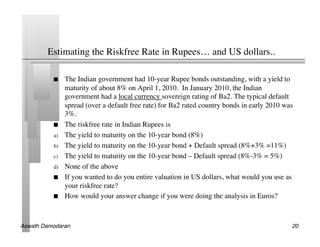
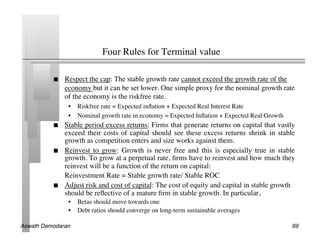
  • 97.
    Value Creating Growth…Evaluating the Alternatives.. Aswath Damodaran! 97!
  • 98.
    Indian companies arebecoming acquirers… Aswath Damodaran! 98!
  • 99.
    This trend makesus feel good, but does it create value? Returns to Indian firms acquiring US firms.. Aswath Damodaran! 99!
  • 100.
    A more generalproblem… Growing through acquisitions has never been easy…   Firms that grow through acquisitions have generally had far more trouble creating value than firms that grow through internal investments.   In general, acquiring firms tend to •  Pay too much for target firms •  Over estimate the value of “synergy” and “control” •  Have a difficult time delivering the promised benefits   Worse still, there seems to be very little learning built into the process. The same mistakes are made over and over again, often by the same firms with the same advisors.   Conclusion: There is something structurally wrong with the process for acquisitions which is feeding into the mistakes. Aswath Damodaran! 100!
  • 101.
    Seven reasons whyacquisitions fail… 1.  Risk Transference: Attributing acquiring company risk characteristics to the target firm. Just because you are a safe firm and operate in a secure market, does not mean that you can transfer these characteristics to a target firm. 2.  Debt subsidies: Subsiding target firm stockholders for the strengths of the acquiring firm is providing them with a benefit they did not earn. 3.  Auto-pilot Control: Adding 20% or some arbitrary number to the market price just because other people do it is a recipe for overpayment. Using silly rules such as EPS accretion just makes the problem worse. 4.  Elusive Synergy: While there is much talk about synergy in mergers, it is seldom valued realistically or appropriately. 5.  Its all relative: The use of transaction multiples (multiples paid by other acquirers in acquisitions) perpetuates over payment. 6.  Verdict first, trial afterwards: Deciding you want to do an acquisition first and then looking for justification for the price paid does not make sense. 7.  It’s not my fault: Holding no one responsible for delivering results is a sure- fire way not to get results… Aswath Damodaran! 101!
  • 102.
    Testing Tata’s acquisitionstrategy?   Do you use your company’s cost of equity to value the target company?   Do you use your company’s cost of debt and debt capacity to estimate the cost of capital for the target company?   Do you add arbitrary premiums for control and other components or justify acquisitions based upon EPS accretion?   Do you value synergy realistically? Do you try to bargain for a share of that value?   Do you use transaction multiples to justify acquisitions?   Do you decide on whether to do the acquisition before you look at the value?   Do you hold those who are the strongest advocates for the acquisitions (managers, investment bankers) accountable for their performance? Aswath Damodaran! 102!
  • 103.
    III. Building CompetitiveAdvantages: Increase length of the growth period Aswath Damodaran! 103!
  • 104.
    Gauging Barriers toEntry Tata Chemicals Tata Steel Tata Motors TCS 11.81% ROC 10.35% 13.42% (17.16%) 40.63% Cost of capital 11.62% 13.79% 12.50% 10.62% Length of growth period 5 5 10 10 Competitive Is there Breaking What is the The jewel in Advantages one? even? edge? the crown?   For the two companies where there is little evidence of a competitive edge, which barrier to entry offers the most promise? What if you cannot find one?   For the one company (Tata Motors) which may or may not have excess returns, what is the competitive edge? How can you make it stronger?   For the one company (TCS) which seems to have the most significant excess returns, what is the most significant competitive advantage? What are the biggest threats you see to this competitive advantage? Aswath Damodaran! 104!
  • 105.
    Value Creation 4:Reduce Cost of Capital Aswath Damodaran! 105!
  • 106.
    Optimal Financing Mix:Tata Chemicals Debt Ratio Beta Cost of Equity Bond Rating Interest rate on debt Tax Rate Cost of Debt (after-tax) WACC Firm Value (G) 0% 0.94 11.84% AAA 8.50% 33.99% 5.61% 11.84% INR 102,601 10% 1.01 12.34% AAA 8.50% 33.99% 5.61% 11.67% INR 105,375 20% 1.09 12.97% A+ 9.00% 33.99% 5.94% 11.56% INR 107,152 30% 1.20 13.78% A- 9.50% 33.99% 6.27% 11.52% INR 107,831 40% 1.35 14.85% B+ 12.25% 33.99% 8.09% 12.14% INR 98,001 50% 1.56 16.36% B- 13.50% 33.99% 8.91% 12.63% INR 91,387 60% 1.87 18.61% CC 18.00% 33.99% 11.88% 14.57% INR 71,784 70% 2.46 22.92% CC 18.00% 30.58% 12.50% 15.62% INR 64,170 80% 3.82 32.83% C 20.00% 23.29% 15.34% 18.84% INR 48,022 90% 7.70 61.16% C 20.00% 19.89% 16.02% 20.54% INR 42,200 Aswath Damodaran! 106!
  • 107.
    Optimal Financing: TataCompanies Is the debt matched to assets at these companies? Can you reduce your fixed costs? If so, how? Are there ways you can make your product/service less discretionary? Aswath Damodaran! 107!
  • 108.
    V. From fairvalue to fair price.. There is many a slip between the cup and the lip… Aswath Damodaran! 108!
  • 109.
    Are markets fair?   In an efficient market, the market price converges instantaneously on value. Thus, a firm that takes value increasing actions will see its stock price go up and a firm that is value destructive will be punished by the market.   In practice, there are three potential impediments to this process working smoothly: •  Investors may be irrational and/or short term. •  Markets may not trust the managers of the firm. •  Information about the actions may not get to markets or the message may be muddled. Aswath Damodaran! 109!
  • 110.
    I. The “right”investors   Optimally, a firm that is focused on long term value would like to get investors who •  Have long time horizons •  Care about fundamentals •  Do their research/homework   While firms do not get to pick their investors, they can influence the composition by •  Having a core of long term investors who may also be insiders in the firm •  Choosing a dividend policy that attracts the right type of investors •  What they focus on when they make decisions Aswath Damodaran! 110!
  • 111.
    II. Management Trust   Management trust is earned through a history of being focused on delivering value to investors. In other words, firms that have delivered solid returns to stockholders over time and taken good investments earn the trust of their stockholders, whereas firms that have delivered poor returns or over promised lose that trust.   When a firm loses the trust of its stockholders, it will not only find every action that it takes subjected to scrutiny and scrutiny but will come under intense pressure to return more of its cash to stockholders. Aswath Damodaran! 111!
  • 112.
    A Symbol ofDistrust How much cash is too much cash? Aswath Damodaran! 112!
  • 113.
    III. Information Gaps   For markets to react appropriately to actions taken by a firm, information about those actions has to be conveyed clearly and credibly to markets. In practice, information disclosure is hindered by •  An unwillingness to provide “key” details of actions, for fear of letting competitors in on secrets. •  A belief that investors are not intelligent or informed enough to use information appropriately. •  An inability to communicate effectively and directly. •  Complexity and confusion in the disclosure,   Managers will be better served trusting their investors to make the right judgments about actions and providing them with the information (positive and negative) to make these judgments. Aswath Damodaran! 113!
  • 114.
    Information Overload A Discount for Complexity Company A Company B Operating Income $ 1 billion $ 1 billion Tax rate 40% 40% ROIC 10% 10% Expected Growth 5% 5% Cost of capital 8% 8% Business Mix Single Business Multiple Businesses Holdings Simple Complex Accounting Transparent Opaque   Which firm would you value more highly? Aswath Damodaran! 114!
  • 115.
    Measuring Complexity: Volumeof Data in Financial Statements Company Number of pages in last 10Q Number of pages in last 10K General Electric 65 410 Microsoft 63 218 Wal-mart 38 244 Exxon Mobil 86 332 Pfizer 171 460 Citigroup 252 1026 Intel 69 215 AIG 164 720 Johnson Johnson 63 218 IBM 85 353 Aswath Damodaran! 115!
  • 116.
    Measuring Complexity: AComplexity Score Item Factors Follow-up Question Answer Weighting factor Gerdau Score GE Score Operating Income 1. Multiple Businesses Number of businesses (with more than 10% of revenues) = 1 2.00 2 30 2. One-time income and expenses Percent of operating income = 10% 10.00 1 0.8 3. Income from unspecified sources Percent of operating income = 0% 10.00 0 1.2 4. Items in income statement that are volatile Percent of operating income = 15% 5.00 0.75 1 Tax Rate 1. Income from multiple locales Percent of revenues from non-domestic locales = 70% 3.00 2.1 1.8 2. Different tax and reporting books Yes or No No Yes=3 0 3 3. Headquarters in tax havens Yes or No No Yes=3 0 0 4. Volatile effective tax rate Yes or No Yes Yes=2 2 0 Capital Expenditures 1. Volatile capital expenditures Yes or No Yes Yes=2 2 2 2. Frequent and large acquisitions Yes or No Yes Yes=4 4 4 3. Stock payment for acquisitions and investments Yes or No No Yes=4 0 4 Working capital 1. Unspecified current assets and current liabilities Yes or No No Yes=3 0 0 2. Volatile working capital items Yes or No Yes Yes=2 2 2 Expected Growth rate 1. Off-balance sheet assets and liabilities (operating leases and RD) Yes or No No Yes=3 0 3 2. Substantial stock buybacks Yes or No No Yes=3 0 3 3. Changing return on capital over time Is your return on capital volatile? Yes Yes=5 5 5 4. Unsustainably high return Is your firm's ROC much higher than industry average? No Yes=5 0 0 Cost of capital 1. Multiple businesses Number of businesses (more than 10% of revenues) = 1 1.00 1 20 2. Operations in emerging markets Percent of revenues= 50% 5.00 2.5 2.5 3. Is the debt market traded? Yes or No No No=2 2 0 4. Does the company have a rating? Yes or No Yes No=2 0 0 5. Does the company have off-balance sheet debt? Yes or No No Yes=5 0 5 No-operating assets Minority holdings as percent of book assets Minority holdings as percent of book assets 0% 20.00 0 0.8 Firm to Equity value Consolidation of subsidiaries Minority interest as percent of book value of equity 63% 20.00 12.6 1.2 Per share value Shares with different voting rights Does the firm have shares with different voting rights? Yes Yes = 10 10 0 Equity options outstanding Options outstanding as percent of shares 0% 10.00 0 0.25 Complexity Score = 48.95 90.55 Aswath Damodaran! 116!
  • 117.