1
ABSTRACT
A circuit to detect the exact location of breakage inside the PVC cover we employ our circuit
with a hex inverter CMOS which uses its actions to control an oscillator which in return
detects the presence of an ac current and shows the location till which the current is passing.
Portable loads such as video cameras, halogen flood lights, electrical irons, hand drillers,
grinders, and cutters are powered by connecting long 2- or 3-core cables to the mains plug.
Due to prolonged usage, the power cord wires are subjected to mechanical strain and stress,
which can lead to internal snapping of wires at any point. In such a case most people go for
replacing the core/cable, as finding the exact location of a broken wire is difficult. In 3-core
cables, it appears almost impossible to detect a broken wire and the point of break without
physically disturbing all the three wires that are concealed in a PVC jacket. The circuit
presented here can easily and quickly detect a broken/faulty wire and its breakage point in 1-
core, 2-core, and 3-core cables without physically disturbing wires. It is built using hex
inverter CMOS CD4069. Gates N3 and N4 are used as a pulse generator that oscillates at
around 1000 Hz in audio range. The frequency is determined by timing components
comprising resistors R3 and R4, and capacitor C1. Gates N1 and N2 are used to sense the
presence of 230V AC field around the live wire and buffer weak AC voltage picked from
the test probe. The voltage at output pin 10 of gate N2 can enable or inhibit the oscillator
circuit.
KE WORDS: LED, LCD, CMOS, PVC.
2
CHAPTER NO.1
INTRODUCTION
In today’s life we use various electronic appliances employing various complex components
in there circuitry and in the present era (previous) everyone is over dependent on electronic
gadgets. Due to prolonged usage, the power cord wires are subjected to mechanical strain
and stress, which can lead to internal snapping of wires at any point So we have built a circuit
which can easily detect the exact location of the broken wire and thus reduces unnecessary
expenses of the user. Invisible Broken wire detector is an instrument, very useful under these
circumstances since it can easily detect the location of internal snapping without contact and
physical disturbance. When it senses the breakage in the faulty wire the LED in the
instrument turns off, the user knows the location of the fault and the broken section of wire
can be replaced easily. The circuit presented in this report can easily and quickly detect a
broken/faulty wire and its breakage point in 1-core, 2-core, and 3-core cables without
physically disturbing wires. Finding out the exact location of breakage can be a problem to
the user as the wires are usually insulated by PVC or plastic jacket making the conducting
wires inside them invisible.
3
CHAPTER NO.2
COMPONENT DESCRIPTION
REQUIRED COMPONENTS
1. CMOS hex inverter CD4069UB:-
The CD4069UB consists of six inverter circuits and is manufactured using complementary
MOS (CMOS) to achieve wide power supply operating range, low power consumption, high
noise immunity, and symmetric controlled rise and fall times. The CD4069UB device consist
of six CMOS inverter circuits. These devices are intended for all general- purpose inverter
applications where the medium- power TTL-drive and logic-level-conversion capabilities of
circuits such as the CD4009 and CD4049 hex inverter and buffers are not required.
PINOUT
The main applications of CMOS hex inverter CD4069UB are as follows:-
 Logic Inversion
 Pulse Shaping
 Oscillators
 High-Input-Impedance Amplifiers
4
2. 1N4148 High speed switching diodes
Basically Switching diodes are a single p-n diode in a discrete package. A switching diode
provides the same functionality as a switch. It has high resistance below the specified applied
voltage similar to an open switch, whereas above that voltage it changes in a sudden way to
the low resistance of a closed switch. Switching diodes are used in devices such as ring
modulation. The 1N4148 is standard silicon switching signal diode. It is one of the most
popular and long-lived switching diodes because of its dependable specifications and low
cost. ... The 1N4148 is useful in switching applications up to about 100 MHz with a reverse-
recovery time of no more than 4 ns. These have high switching speed up to 4ns and have
continuous reverse voltage up to 100 volts, repetitive peak reverse voltage, max: 100V and
repetitive peak forward current, max: 450mA.
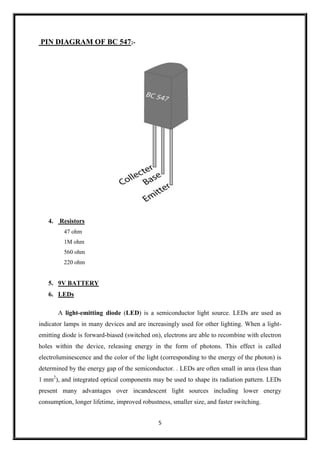
3. BC547 transistor
BC547 is an NPN bi-polar junction transistor. A transistor, stands for transfer of resistance, is
commonly used to amplify current. A small current at its base controls a larger current at
collector & emitter terminals.
BC547 is mainly used for amplification and switching purposes. It has a maximum current
gain of 800. Its equivalent transistors are BC548 and BC549.
The transistor terminals require a fixed DC voltage to operate in the desired region of its
characteristic curves. This is known as the biasing. For amplification applications, the
transistor is biased such that it is partly on for all input conditions. The input signal at base is
amplified and taken at the emitter. BC547 is used in common emitter configuration for
amplifiers. The voltage divider is the commonly used biasing mode. For switching
applications, transistor is biased so that it remains fully on if there is a signal at its base. In
the absence of base signal, it gets completely off.
5
PIN DIAGRAM OF BC 547:-
4. Resistors
47 ohm
1M ohm
560 ohm
220 ohm
5. 9V BATTERY
6. LEDs
A light-emitting diode (LED) is a semiconductor light source. LEDs are used as
indicator lamps in many devices and are increasingly used for other lighting. When a light-
emitting diode is forward-biased (switched on), electrons are able to recombine with electron
holes within the device, releasing energy in the form of photons. This effect is called
electroluminescence and the color of the light (corresponding to the energy of the photon) is
determined by the energy gap of the semiconductor. . LEDs are often small in area (less than
1 mm2
), and integrated optical components may be used to shape its radiation pattern. LEDs
present many advantages over incandescent light sources including lower energy
consumption, longer lifetime, improved robustness, smaller size, and faster switching.
6
LEDs powerful enough for room lighting are relatively expensive and require more
precise current and heat management than compact fluorescent lamp sources of comparable
output. LED materials technology grew more advanced, light output rose, while maintaining
efficiency and reliability at acceptable levels.
7. Capacitor
Fig. Capacitor
A capacitor (formerly known as condenser) is a passive two-terminal electrical
component used to store energy in an electric field. The forms of practical capacitors vary
widely, but all contain at least two electrical conductors separated by a dielectric (insulator);
for example, one common construction consists of metal foils separated by a thin layer of
insulating film. Capacitors are widely used as parts of electrical circuits in many common
electrical devices.
When there is a potential difference (voltage) across the conductors, a static electric
field develops across the dielectric, causing positive charge to collect on one plate and
negative charge on the other plate. Energy is stored in the electrostatic field. An ideal
capacitor is characterized by a single constant value, capacitance, measured in farads. This is
the ratio of the electric charge on each conductor to the potential difference between them.
8. Connecting wires and probe (ANTENA)
9. Switch
7
CHAPTER NO.4
CICRUIT DIAGRAM
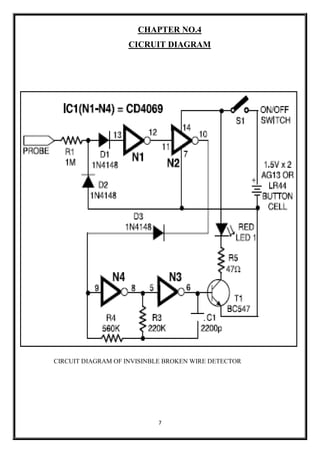
CIRCUIT DIAGRAM OF INVISINBLE BROKEN WIRE DETECTOR
8
CHAPTER NO.5
CIRCUIT DESCRIPTION
CONSTRUCTIONAL DESCRIPTION
The circuit presented here can easily and quickly detect a broken/faulty wire and its
breakage point in 1-core, 2-core, and 3-core cables without physically disturbing wires. It is
built using hex inverter CMOS CD4069. Gates N3 and N4 are used as a pulse generator that
oscillates at around 1000 Hz in audio range.
The frequency is determined by timing components comprising resistors R3
and R4, and capacitor C1. Gates N1 and N2 are used to sense the presence of 230V AC field
around the live wire and buffer weak AC voltage picked from the test probe.
The voltage at output pin 10 of gate N2 can enable or inhibit the oscillator
circuit. When the test probe is away from any high-voltage AC field, output pin 10 of gate N2
remains low.
As a result, diode D3 conducts and inhibits the oscillator circuit from oscillating.
Simultaneously, the output of gate N3 at pin 6 goes ‘low’ to cut off transistor T1.
As a result, LED1 goes off. When the test probe is moved closer to 230V
AC, 50Hz mains live wire, during every positive half cycle, output pin 10 of gate N2 goes
high.
Thus during every positive half-cycle of the mains frequency, the oscillator circuit is
allowed to oscillate at around 1 kHz, making red LED (LED1) to blink. (Due to the
persistence of vision, the LED appears to be glowing continuously.) This type of
blinking reduces consumption of the current from button cells used for power supply.
The 9v dc power supply is sufficient to the whole circuit. Which are also used
inside laser pointers or in LED-based continuity testers can be used for the circuit. The
circuit consumes 3 mA during the sensing of AC mains voltage.
The whole circuit can be mounted in small white box and used as a handy broken
wire detector Before detecting broken faulty wires, take out any connected load and find out
the faulty wire first by continuity method using any millimeter or continuity tester. Then
connect 230V AC mains live wire at one end of the faulty wire, leaving the other end free.
Connect neutral terminal of the mains AC to the remaining wires at one
end. However, if any of the remaining wires is also found to be faulty, then both ends of these
wires are connected to neutral. For single-wire testing, connecting neutral only to the live
wire at one end is sufficient to detect the breakage point.
9
In this circuit, a antenna is used as the test probe. To detect the breakage
point, turn on switch S1 and slowly move the test probe closer to the faulty wire,
beginning with the input point of the live wire and proceeding towards its other end. LED1
starts blowing during the presence of AC voltage in faulty wire. When the breakage point is
reached, LED1 immediately extinguishes due to the non-availability of mains AC voltage.
The point where LED1 is turned off is the exact broken-wire point. During testing avoid
any strong electric field close to the circuit to avoid false detection.
When there is no electro-magnetic field, then pin 4 of the IC 4096 remains high
and if the electro-magnetic field is present near the detector circuit, then pin 4 becomes low
and pin 12 becomes high which triggers the NPN transistor BC547 to light up the RED
LED.
WORKING:-
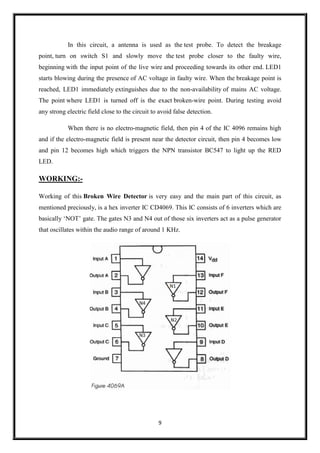
Working of this Broken Wire Detector is very easy and the main part of this circuit, as
mentioned preciously, is a hex inverter IC CD4069. This IC consists of 6 inverters which are
basically ‘NOT’ gate. The gates N3 and N4 out of those six inverters act as a pulse generator
that oscillates within the audio range of around 1 KHz.
10
The resistors R4 (470k) and R5 (220k) and the capacitor C1 (100nF) in this circuit are the
timing components which decide the frequency. The gates N1 and the N2 detect the
presence of the AC voltage around the live wire and weak AC voltage picked from test
probe. The oscillator circuit is enabled or disabled by the output pin of the gate N2 which is
output pin 10.
When there will be no AC voltage present near the live wire then the output pin 10
will remain low and as a result, the diode D3 conducts in the forward biased mode and
holds back the oscillator part from oscillating. Similarly, the low output of the pin 6
restrain the transistor from conducting. As a result, the LED will remain low.
When the circuit detects the presence of AC voltage near it, then the output pin 10
goes high. This will allow the oscillator to oscillate at around frequency of 1 KHz. When
the oscillator will oscillate, then it will make the LED blow.
11
CHAPTER NO.6
BASIC FEATURES
• We can use an inverter in between the LED and the oscillator which will then turn on
the LED only when the broken point is detected and keeping it off when the wire is
not broken.
• By making this change we can make our detector more user friendly which now
directly shows the broken point.
The basic features are as follows:-
1. Wide supply voltage range: 3V to 15V.
2. High noise immunity.
3. Operating temperature range: -55 C to +125 C.
4. Portable.
5. No physical disturbance.
6. Contactless detection.
7. Low power requirements.
8. Accurate.
9. Easy to use.
10. Useful and handy instrument.
12
CHAPTER NO.7
ADVANTAGES AND DISADVANTAGES
ADVANTAGES:
 Reduce the wastage of wire
 Circuit cost is low
 This circuit indicate exact location of the broken wire
 It is easy to fabricate the circuit
 Circuit operates only on DC 3V
DISADVANTAGES:
 Circuit is not able to detect the fiber optics cable
 This circuit is not indicate which wire is faulty
13
CHAPTER NO.8
RESULT AND DISCUSSIONS
Thus the circuit was made successfully which can easily detect broken point in the
wire inside PVC jacket without physically disturbing it.
The whole circuit can be accommodated in a small white box and used as a handy
broken-wire detector with connecting probe. This will make the circuit more compact and
east to handle. The handy broken-wire is portable and less prone to damage.
14
CHAPTER NO.9
CONCLUSION
Thus by using this project we can able to know the exact location of the broken wires.
This project can also be used in other components which may be harmed due to access.
It would not only able in reducing wastage of time but resources also. Thus using just
a hex inverter and few resistors we are able to construct a device which can easily detect a
faulty broken wire and thus save the extra cost of a user which is incurred on replacing the
faulty wire and not repairing it which is otherwise too difficult.
This project is useful in industry which makes the different wires. The fabrication of
this circuit is very easy and peoples are able to prepare its own circuit easily.
15
CHAPTER NO.10
REFERANCES
 www.google.com
 www.learningelectronics.net
 http://www.muengineers.in
 www.faadooengineers.com

Invisible broken wire detector

  • 1.
    1 ABSTRACT A circuit todetect the exact location of breakage inside the PVC cover we employ our circuit with a hex inverter CMOS which uses its actions to control an oscillator which in return detects the presence of an ac current and shows the location till which the current is passing. Portable loads such as video cameras, halogen flood lights, electrical irons, hand drillers, grinders, and cutters are powered by connecting long 2- or 3-core cables to the mains plug. Due to prolonged usage, the power cord wires are subjected to mechanical strain and stress, which can lead to internal snapping of wires at any point. In such a case most people go for replacing the core/cable, as finding the exact location of a broken wire is difficult. In 3-core cables, it appears almost impossible to detect a broken wire and the point of break without physically disturbing all the three wires that are concealed in a PVC jacket. The circuit presented here can easily and quickly detect a broken/faulty wire and its breakage point in 1- core, 2-core, and 3-core cables without physically disturbing wires. It is built using hex inverter CMOS CD4069. Gates N3 and N4 are used as a pulse generator that oscillates at around 1000 Hz in audio range. The frequency is determined by timing components comprising resistors R3 and R4, and capacitor C1. Gates N1 and N2 are used to sense the presence of 230V AC field around the live wire and buffer weak AC voltage picked from the test probe. The voltage at output pin 10 of gate N2 can enable or inhibit the oscillator circuit. KE WORDS: LED, LCD, CMOS, PVC.
  • 2.
    2 CHAPTER NO.1 INTRODUCTION In today’slife we use various electronic appliances employing various complex components in there circuitry and in the present era (previous) everyone is over dependent on electronic gadgets. Due to prolonged usage, the power cord wires are subjected to mechanical strain and stress, which can lead to internal snapping of wires at any point So we have built a circuit which can easily detect the exact location of the broken wire and thus reduces unnecessary expenses of the user. Invisible Broken wire detector is an instrument, very useful under these circumstances since it can easily detect the location of internal snapping without contact and physical disturbance. When it senses the breakage in the faulty wire the LED in the instrument turns off, the user knows the location of the fault and the broken section of wire can be replaced easily. The circuit presented in this report can easily and quickly detect a broken/faulty wire and its breakage point in 1-core, 2-core, and 3-core cables without physically disturbing wires. Finding out the exact location of breakage can be a problem to the user as the wires are usually insulated by PVC or plastic jacket making the conducting wires inside them invisible.
  • 3.
    3 CHAPTER NO.2 COMPONENT DESCRIPTION REQUIREDCOMPONENTS 1. CMOS hex inverter CD4069UB:- The CD4069UB consists of six inverter circuits and is manufactured using complementary MOS (CMOS) to achieve wide power supply operating range, low power consumption, high noise immunity, and symmetric controlled rise and fall times. The CD4069UB device consist of six CMOS inverter circuits. These devices are intended for all general- purpose inverter applications where the medium- power TTL-drive and logic-level-conversion capabilities of circuits such as the CD4009 and CD4049 hex inverter and buffers are not required. PINOUT The main applications of CMOS hex inverter CD4069UB are as follows:-  Logic Inversion  Pulse Shaping  Oscillators  High-Input-Impedance Amplifiers
  • 4.
    4 2. 1N4148 Highspeed switching diodes Basically Switching diodes are a single p-n diode in a discrete package. A switching diode provides the same functionality as a switch. It has high resistance below the specified applied voltage similar to an open switch, whereas above that voltage it changes in a sudden way to the low resistance of a closed switch. Switching diodes are used in devices such as ring modulation. The 1N4148 is standard silicon switching signal diode. It is one of the most popular and long-lived switching diodes because of its dependable specifications and low cost. ... The 1N4148 is useful in switching applications up to about 100 MHz with a reverse- recovery time of no more than 4 ns. These have high switching speed up to 4ns and have continuous reverse voltage up to 100 volts, repetitive peak reverse voltage, max: 100V and repetitive peak forward current, max: 450mA. 3. BC547 transistor BC547 is an NPN bi-polar junction transistor. A transistor, stands for transfer of resistance, is commonly used to amplify current. A small current at its base controls a larger current at collector & emitter terminals. BC547 is mainly used for amplification and switching purposes. It has a maximum current gain of 800. Its equivalent transistors are BC548 and BC549. The transistor terminals require a fixed DC voltage to operate in the desired region of its characteristic curves. This is known as the biasing. For amplification applications, the transistor is biased such that it is partly on for all input conditions. The input signal at base is amplified and taken at the emitter. BC547 is used in common emitter configuration for amplifiers. The voltage divider is the commonly used biasing mode. For switching applications, transistor is biased so that it remains fully on if there is a signal at its base. In the absence of base signal, it gets completely off.
  • 5.
    5 PIN DIAGRAM OFBC 547:- 4. Resistors 47 ohm 1M ohm 560 ohm 220 ohm 5. 9V BATTERY 6. LEDs A light-emitting diode (LED) is a semiconductor light source. LEDs are used as indicator lamps in many devices and are increasingly used for other lighting. When a light- emitting diode is forward-biased (switched on), electrons are able to recombine with electron holes within the device, releasing energy in the form of photons. This effect is called electroluminescence and the color of the light (corresponding to the energy of the photon) is determined by the energy gap of the semiconductor. . LEDs are often small in area (less than 1 mm2 ), and integrated optical components may be used to shape its radiation pattern. LEDs present many advantages over incandescent light sources including lower energy consumption, longer lifetime, improved robustness, smaller size, and faster switching.
  • 6.
    6 LEDs powerful enoughfor room lighting are relatively expensive and require more precise current and heat management than compact fluorescent lamp sources of comparable output. LED materials technology grew more advanced, light output rose, while maintaining efficiency and reliability at acceptable levels. 7. Capacitor Fig. Capacitor A capacitor (formerly known as condenser) is a passive two-terminal electrical component used to store energy in an electric field. The forms of practical capacitors vary widely, but all contain at least two electrical conductors separated by a dielectric (insulator); for example, one common construction consists of metal foils separated by a thin layer of insulating film. Capacitors are widely used as parts of electrical circuits in many common electrical devices. When there is a potential difference (voltage) across the conductors, a static electric field develops across the dielectric, causing positive charge to collect on one plate and negative charge on the other plate. Energy is stored in the electrostatic field. An ideal capacitor is characterized by a single constant value, capacitance, measured in farads. This is the ratio of the electric charge on each conductor to the potential difference between them. 8. Connecting wires and probe (ANTENA) 9. Switch
  • 7.
    7 CHAPTER NO.4 CICRUIT DIAGRAM CIRCUITDIAGRAM OF INVISINBLE BROKEN WIRE DETECTOR
  • 8.
    8 CHAPTER NO.5 CIRCUIT DESCRIPTION CONSTRUCTIONALDESCRIPTION The circuit presented here can easily and quickly detect a broken/faulty wire and its breakage point in 1-core, 2-core, and 3-core cables without physically disturbing wires. It is built using hex inverter CMOS CD4069. Gates N3 and N4 are used as a pulse generator that oscillates at around 1000 Hz in audio range. The frequency is determined by timing components comprising resistors R3 and R4, and capacitor C1. Gates N1 and N2 are used to sense the presence of 230V AC field around the live wire and buffer weak AC voltage picked from the test probe. The voltage at output pin 10 of gate N2 can enable or inhibit the oscillator circuit. When the test probe is away from any high-voltage AC field, output pin 10 of gate N2 remains low. As a result, diode D3 conducts and inhibits the oscillator circuit from oscillating. Simultaneously, the output of gate N3 at pin 6 goes ‘low’ to cut off transistor T1. As a result, LED1 goes off. When the test probe is moved closer to 230V AC, 50Hz mains live wire, during every positive half cycle, output pin 10 of gate N2 goes high. Thus during every positive half-cycle of the mains frequency, the oscillator circuit is allowed to oscillate at around 1 kHz, making red LED (LED1) to blink. (Due to the persistence of vision, the LED appears to be glowing continuously.) This type of blinking reduces consumption of the current from button cells used for power supply. The 9v dc power supply is sufficient to the whole circuit. Which are also used inside laser pointers or in LED-based continuity testers can be used for the circuit. The circuit consumes 3 mA during the sensing of AC mains voltage. The whole circuit can be mounted in small white box and used as a handy broken wire detector Before detecting broken faulty wires, take out any connected load and find out the faulty wire first by continuity method using any millimeter or continuity tester. Then connect 230V AC mains live wire at one end of the faulty wire, leaving the other end free. Connect neutral terminal of the mains AC to the remaining wires at one end. However, if any of the remaining wires is also found to be faulty, then both ends of these wires are connected to neutral. For single-wire testing, connecting neutral only to the live wire at one end is sufficient to detect the breakage point.
  • 9.
    9 In this circuit,a antenna is used as the test probe. To detect the breakage point, turn on switch S1 and slowly move the test probe closer to the faulty wire, beginning with the input point of the live wire and proceeding towards its other end. LED1 starts blowing during the presence of AC voltage in faulty wire. When the breakage point is reached, LED1 immediately extinguishes due to the non-availability of mains AC voltage. The point where LED1 is turned off is the exact broken-wire point. During testing avoid any strong electric field close to the circuit to avoid false detection. When there is no electro-magnetic field, then pin 4 of the IC 4096 remains high and if the electro-magnetic field is present near the detector circuit, then pin 4 becomes low and pin 12 becomes high which triggers the NPN transistor BC547 to light up the RED LED. WORKING:- Working of this Broken Wire Detector is very easy and the main part of this circuit, as mentioned preciously, is a hex inverter IC CD4069. This IC consists of 6 inverters which are basically ‘NOT’ gate. The gates N3 and N4 out of those six inverters act as a pulse generator that oscillates within the audio range of around 1 KHz.
  • 10.
    10 The resistors R4(470k) and R5 (220k) and the capacitor C1 (100nF) in this circuit are the timing components which decide the frequency. The gates N1 and the N2 detect the presence of the AC voltage around the live wire and weak AC voltage picked from test probe. The oscillator circuit is enabled or disabled by the output pin of the gate N2 which is output pin 10. When there will be no AC voltage present near the live wire then the output pin 10 will remain low and as a result, the diode D3 conducts in the forward biased mode and holds back the oscillator part from oscillating. Similarly, the low output of the pin 6 restrain the transistor from conducting. As a result, the LED will remain low. When the circuit detects the presence of AC voltage near it, then the output pin 10 goes high. This will allow the oscillator to oscillate at around frequency of 1 KHz. When the oscillator will oscillate, then it will make the LED blow.
  • 11.
    11 CHAPTER NO.6 BASIC FEATURES •We can use an inverter in between the LED and the oscillator which will then turn on the LED only when the broken point is detected and keeping it off when the wire is not broken. • By making this change we can make our detector more user friendly which now directly shows the broken point. The basic features are as follows:- 1. Wide supply voltage range: 3V to 15V. 2. High noise immunity. 3. Operating temperature range: -55 C to +125 C. 4. Portable. 5. No physical disturbance. 6. Contactless detection. 7. Low power requirements. 8. Accurate. 9. Easy to use. 10. Useful and handy instrument.
  • 12.
    12 CHAPTER NO.7 ADVANTAGES ANDDISADVANTAGES ADVANTAGES:  Reduce the wastage of wire  Circuit cost is low  This circuit indicate exact location of the broken wire  It is easy to fabricate the circuit  Circuit operates only on DC 3V DISADVANTAGES:  Circuit is not able to detect the fiber optics cable  This circuit is not indicate which wire is faulty
  • 13.
    13 CHAPTER NO.8 RESULT ANDDISCUSSIONS Thus the circuit was made successfully which can easily detect broken point in the wire inside PVC jacket without physically disturbing it. The whole circuit can be accommodated in a small white box and used as a handy broken-wire detector with connecting probe. This will make the circuit more compact and east to handle. The handy broken-wire is portable and less prone to damage.
  • 14.
    14 CHAPTER NO.9 CONCLUSION Thus byusing this project we can able to know the exact location of the broken wires. This project can also be used in other components which may be harmed due to access. It would not only able in reducing wastage of time but resources also. Thus using just a hex inverter and few resistors we are able to construct a device which can easily detect a faulty broken wire and thus save the extra cost of a user which is incurred on replacing the faulty wire and not repairing it which is otherwise too difficult. This project is useful in industry which makes the different wires. The fabrication of this circuit is very easy and peoples are able to prepare its own circuit easily.
  • 15.
    15 CHAPTER NO.10 REFERANCES  www.google.com www.learningelectronics.net  http://www.muengineers.in  www.faadooengineers.com