Democratic Socialist Republic of Sri Lanka
Ministry of Higher Education
Sri Lanka Institute of Advanced Technological Education
(SLIATE)
ENHANCEMENT AND UPGRADING OF TECHNICAL EDUCATION
AT MATTAKULIYA ADVANCED TECHNOLOGICAL INSTITUTE
AND
LABUDUWA ADVANCED TECHNOLOGICAL INSTITUTE
FINAL REPORT
PHASE 2 - SYLLABUS
SEMESTER SYSTEM
ELECTRICAL AND ELECTRONIC
ENGINEERING
MARCH 2010
BY
1. Key to the Subject Code
MA – Mathematics
EN - English
IT - Information Technology
CE - Civil Engineering
EE - Electrical, Electronics and Telecommunication Engineering
ME - Mechanical Engineering
2. Guide to the Four Digit Code
First Digit - Academic Year (1or 2 or3 for the three respective years)
Second Digit - Semester (1 or 2)
Third and Fourth Digit - Number for a Module for a respective Division the
module is offered. It starts with 01 and increases.
Example.
CE2113 – Offered by the Civil Engineering Department (Code is CE)
Second Year (First Digit = 2)
First Semester (Second Digit = 1)
13th
Module out of the Total number of Modules offered by the Civil
Engineering Department during total of 06 Semesters (03 Academic
Years) [Third & Fourth Digit = 13]
3. Guide to the Remarks Column
C,E,M – Common Module for all three Disciplines (i.e. Civil, Electrical, Mechanical)
C, E – Common to Civil and Electrical
C, M – Common to Civil and Mechanical
E, M – Common to Electrical and Mechanical
C – Civil only
E – Electrical only
M – Mechanical only
4. Other Abbreviations
Pro – Production
R & A – Refrigeration and Air Conditioning
Auto – Automobile
MR – Marine
1/206
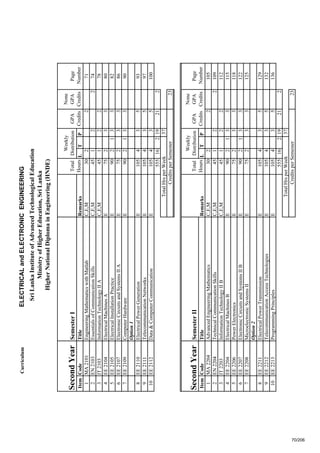
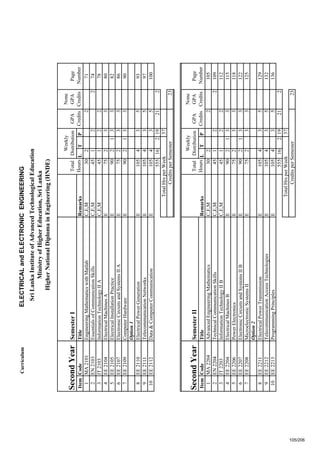
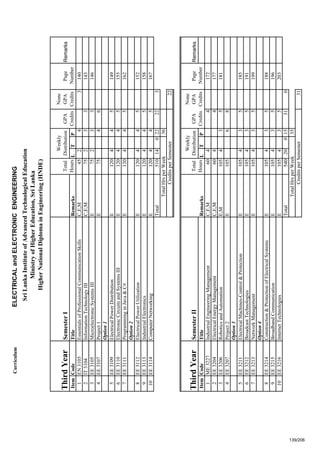
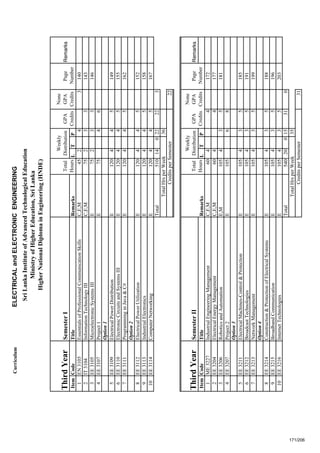
CurriculumELECTRICALandELECTRONICENGINEERING
FirstYearSemesterI
ItemCodeTitleRemarksLTP
1MA1101EngineeringMathematicsC,E,M30223
2EN1101EnglishC,E,M602246
3IT1101InformationTechnologyIC,E,M752339
4ME1101WorkshopEngineeringIC,E,M6013212
5ME1102EngineeringDrawingC,E,M6013220
6CE1102FluidMechanicsC,M90213323
7EE1107ElectricalPrinciplesAE90213327
8ME1103EngineeringMechanicsC,E,M90213331
55514320184
37
22
FirstYearSemesterII
ItemCodeTitleRemarksLTP
1MA1202AppliedEngineeringMathematicsC,E,M302236
2EN1202WorkshopEngineeringIIC,E,M6013239
3ME1205EngineeringGraphicsandAutoCADC,E,M6013343
4EE1208ElectricalPrinciplesBC,E,M6022346
5EE1209ElectronicCircuitsandSystemsIE9042450
6EE1210MicroelectronicSystemsIE7523354
7EE1211TelecommunicationPrinciplesE90213359
8EE1212IntroductiontoComputerSystemsE6022263
9EN1202EnglishforProfessionalsC,E,M6022366
58518120223
39
25
SriLankaInstituteofAdvancedTechnologicalEducation
MinistryofHigherEducation,SriLanka
HigherNationalDiplomainEngineering(HNDE)
CreditsperSemester
Total
Hours
Weekly
Distribution
TotalHrsperWeek
Weekly
Distribution
TotalHrsperWeek
CreditsperSemester
Page
Number
None
GPA
Credits
GPA
Credits
Total
Hours
GPA
Credits
None
GPA
Credits
Page
Number
2/206
1
Sri Lanka Institute of Advanced Technological Education
Ministry of Higher Education, Sri Lanka
Higher National Diploma in Engineering
ELECTRICAL and ELECTRONIC ENGINEERING
Learning Outcomes
 Knowledge on the use matrix algebra techniques in practical engineering
applications.
 Student will be knowledgeable in the area of infinite series and their convergence
so that he/ she will be familiar with limitations of using infinite series
approximations for solutions arising in mathematical modeling
 Familiar with the functions of several variables which is needed in many branches
of engineering
 Possession of the concepts of improper integrals, Gamma, Beta and Error
functions which are needed in engineering applications
 Acquaint with the mathematical tools needed in evaluating multiple integrals and
their usage
Syllabus
1. Matrices
Characteristic equation – Eigen values and Eigenvectors of a real matrix – Properties of
Eigen values and eigenvectors – Cayley-Hamilton Theorem – Diagonalization of
matrices – Reduction of a quadratic form to canonical form by orthogonal transformation
– Nature of quadratic forms.
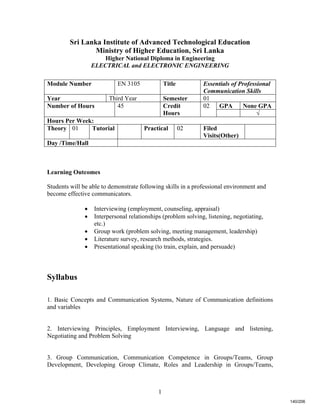
Module Number MA1101 Title Engineering Mathematics
Year First Year Semester 01
Number of Hours 30 Credit
Hours
02
Hours Per Week:
Theory 02 Tutorial Practical Filed
Visits(Other)
Day /Time/Hall
3/206
2
2. Infinite Series
Sequences – Convergence of series – General properties – Series of positive terms –
Tests of convergence (Comparison test, Integral test, Comparison of ratios and
D’Alembert’s ratio test) – Alternating series – Series of positive and negative terms –
Absolute and conditional convergence – Power Series – Convergence of exponential,
logarithmic and Binomial Series.
3. Functions of Several Variables
Indeterminate forms and L’ Hospital’s rule, successive differentiation of one variable and
Leibnitz theorem,
Limit and Continuity – Partial derivatives – Homogeneous functions and Euler’s
theorem – Total derivative – Differentiation of implicit functions – Change of
variables – Jacobians – Partial differentiation of implicit functions – Taylor’s series
for functions of two variables – Errors and approximations – Maxima and minima of
functions of two variables – Lagrange’s method of undetermined multipliers.
4. Improper Integrals
Improper integrals of the first and second kind and their convergence – Evaluation of
integrals involving a parameter by Leibnitz rule – Beta and Gamma functions –
Properties – Evaluation of integrals using Beta and Gamma functions – Error
functions.
5. Multiple Integrals
Double integrals – Change of order of integration – Double integrals in polar
coordinates – Area enclosed by plane curves – Triple integrals – Volume of Solids –
Change of variables in double and triple integrals – Area of a curved surface. Mass
center of gravity and moment of inertia of two and three-dimensional bodies
.
4/206
3
Recommended Textbooks
1. Grewal B.S., Higher Engineering Mathematics (40th
Edition), Khanna Publishers,
Delhi (2007).
2. Ramana B.V., Higher Engineering Mathematics, Tata McGraw Hill Co. Ltd.,
New Delhi (2007).
3. Jain R.K. and Iyengar S.R.K., Advanced Engineering Mathematics (3rd
Edition),
Narosa Publications, Delhi (2007).
4. Bali N., Goyal M. and Watkins C., Advanced Engineering Mathematics (7th
Edition), Firewall Media, New Delhi (2007).
5. Greenberg M.D., Advanced Engineering Mathematics (2nd
Edition), Pearson
Education, New Delhi (1998).
Schedule of Lectures (to be prepared by the Lecture and approved by the module
coordinator to be distributed to the students on the day of commencement of the module):
Week Topic Hours Lecturer Resource
Person/
Remarks
01
02
03
04
05
06
07
08
09
10
11
12
13
14
15
16
17
18 End Semester Exam
5/206
1
Sri Lanka Institute of Advanced Technological Education
Ministry of Higher Education, Sri Lanka
Higher National Diploma in Engineering
ELECTRICAL and ELECTRONIC ENGINEERING
Learning Outcomes
 To enable learners of English as an additional language to increase phonological
accuracy by developing an awareness of the features of English pronunciation, by
comparing learner language with the target language using real world and digital
media.
 To extend and apply English language learning strategies to improve listening and
speaking skills in a range of task-focused situations.
Syllabus
1. Further Development of Grammar from the Intensive Program
Review of tenses, conditional statements, question tags, use of time expressions, time
expressions- past of present perfect.
2. Focus on Pronunciation
- Strategies for improving accuracy in pronunciation
- Articulation of sounds
- Phonological patterning
- Pitch and intonation patterns
- Features of connected speech
3. Spoken English in Practice
- Strategies for autonomous language learning
- Vocabulary acquisition strategies
- Word formation principles
- Listening to and reading transcriptions of spoken material in a range of contexts
- Strategies and skills related to practical speaking tasks- Social and cultural contacts with
speakers of English on campus and in the community
Module Number EN 1101 Title English
Year First Year Semester 01
GPA None GPANumber of Hours 60 Credit
Hours
04
√
Hours Per Week:
Theory 04 Tutorial Practical Filed
Visits(Other)
Day /Time/Hall
6/206
2
4. Writing sentences
Sentence level accuracy, types of sentences and clauses; sentence structure issues, use
of appropriate vocabulary, narration/description, note making, formal and informal
letter writing, editing a passage
5. Language Laboratory activities
Introduction to the Sounds of English- Vowels, Diphthongs & Consonants,
Introduction to Stress and Intonation, Situational Dialogues / Role Play, Oral
Presentations- Prepared and Extempore, 'Just A Minute' Sessions (JAM), Describing
Objects / Situations / People, Information Transfer, Debate, Telephoning Skills,
Giving Directions.
Recommended Software:
1. Cambridge Advanced Learners' English Dictionary with CD.
2. The Rosetta Stone English Library
3. Clarity Pronunciation Power
4. Mastering English in Vocabulary, Grammar, Spellings, Composition
5. Dorling Kindersley series of Grammar, Punctuation, Composition etc.
6. Language in Use, Foundation Books Pvt Ltd with CD.
7. Learning to Speak English - 4 CDs
8. Microsoft Encarta with CD
9. Murphy's English Grammar, Cambridge with CD
Books to be procured for English Language Lab Library (to be located within the lab
in addition to the CDs of the text book which are loaded on the systems):
1. Spoken English (CIEFL) in 3 volumes with 6 cassettes, OUP.
2. English Pronouncing Dictionary Daniel Jones Current Edition with CD.
3. Spoken English- R. K. Bansal and J. B. Harrison, Orient Longman 2006 Edn.
4. A Practical course in English Pronunciation, (with two Audio cassettes) by J.
Sethi, Kamlesh Sadanand & D.V. Jindal, Prentice-Hall of India Pvt. Ltd., New Delhi.
5. A text book of English Phonetics for Indian Students by
T.Balasubramanian (Macmillan)
6. English Skills for Technical Students, WBSCTE with British Council, OL
7/206
3
Schedule of Lectures (to be prepared by the Lecture and approved by the module
coordinator to be distributed to the students on the day of commencement of the module):
Week Topic Hours Lecturer Resource
Person/
Remarks
01
02
03
04
05
06
07
08
09
10
11
12
13
14
15
16
17
18 End Semester Exam
8/206
1
Sri Lanka Institute of Advanced Technological Education
Ministry of Higher Education, Sri Lanka
Higher National Diploma in Engineering
ELECTRICAL and ELECTRONIC ENGINEERING
Learning Outcomes
On completion of this module the students will be able to acquire a fundamental
knowledge of computer systems and database handling, create professional quality
spreadsheets and technical drawings.
Syllabus
1. Introduction to Computers 2hrs
Types of computers , Main Components of a Computer, Central Processing Unit, Main
Memory, Input and Output Devices, Ergonomics of computer construction
2. Data Representation in the Computer 4hrs
Numerical Data Representation, Character Representation, Memory Capacity, Information
storage in the main memory.
3. Secondary Storage Devices 3hrs
Use of secondary storage devices., Hard Disks, Floppy Disks, Optical Disks and Magnetic
Tapes
4. Categories of Software 3hrs
Hardware, Software and Firmware, System Software and Application Software., Types of
system software, Packaged Software and Custom-Written Software
5. Database Systems 6hrs
Database Management Systems, Hierarchical Database, Network Database, Relational
Database, Object-Oriented Database
6. System Software 4hrs
The Operating System, CPU Management, File Management, Task Management, Operating
Systems: Linux, DOS, Windows and its applications and Network Operating Systems
Module Number IT1101 Title Information Technology I
Year First Year Semester 01
GPA None GPANumber of Hours 75 Credit
Hours
03
√
Hours Per Week:
Theory 02 Tutorial Practical 03 Filed
Visits(Other)
Day /Time/Hall
9/206
2
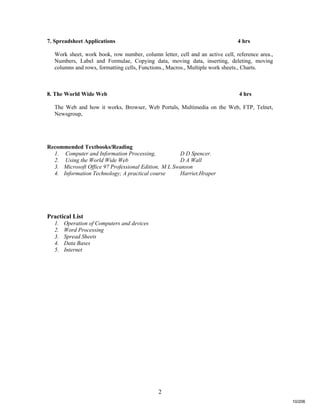
7. Spreadsheet Applications 4 hrs
Work sheet, work book, row number, column letter, cell and an active cell, reference area.,
Numbers, Label and Formulae, Copying data, moving data, inserting, deleting, moving
columns and rows, formatting cells, Functions., Macros., Multiple work sheets., Charts.
8. The World Wide Web 4 hrs
The Web and how it works, Browser, Web Portals, Multimedia on the Web, FTP, Telnet,
Newsgroup,
Recommended Textbooks/Reading
1. Computer and Information Processing, D D Spencer.
2. Using the World Wide Web D A Wall
3. Microsoft Office 97 Professional Edition, M L Swanson
4. Information Technology; A practical course Harriet.Hraper
Practical List
1. Operation of Computers and devices
2. Word Processing
3. Spread Sheets
4. Data Bases
5. Internet
10/206
3
Schedule of Lectures (to be prepared by the Lecture and approved by the module
coordinator to be distributed to the students on the day of commencement of the module):
Week Topic Hours Lecturer Resource
Person/
Remarks
01
02
03
04
05
06
07
08
09
10
11
12
13
14
15
16
17
18 End Semester Exam
11/206
1
Sri Lanka Institute of Advanced Technological Education
Ministry of Higher Education, Sri Lanka
Higher National Diploma in Engineering
ELECTRICAL and ELECTRONIC ENGINEERING
Learning Outcomes
 Knowledge on Workshop safety, operations, procedures, tools
 Knowledge and skills on handling of machine tools and accessories
 Knowledge and skills on Material processing for product design and manufacture
Syllabus
1. Introduction to workshop processes, tools and safety
a. The need for studying workshop technology, illustrations of different types of
workshops (i.e. mechanical, electrical, electronics, etc.) types of workshop processes,
overview of the tools/machinery/equipment, accepted operational procedures in different
workshops.
b. workman’s trade; craftsmanship, the working of materials, economics of production
c. Standards; purpose, creation of standards, advantages, SI units, ISO
d. Machine Tools; general, lathe, mill, shaper, bench and column drills, hand drills,
electric hand drills, saws, welding equipment.
e. Safety and accident prevention; causes of accidents, behavior, hygiene, housekeeping,
clothing, proper protective gear, harmful substances, start-stop controls, precautions,
lifting appliances, storage, electrical safety, lubrication and coolants,
f. Fire Fighting; Legal provisions, the fire fighting triangle, inflammable substance,
oxygen, heat(ignition temperatures), preventive fire protection, structural fire protection,
Module Number ME 1101 Title Workshop Engineering I
Year First Year Semester 01
GPA None GPANumber of Hours 60 Credit Hours 02
√
Hours Per Week:
Theory 01 Tutorial Practical 03 Filed Visits(Other)
Day /Time/Hall
12/206
2
preventive measures, conduct in case of fire, portable and other fire extinguishers,
testing, operational status and maintenance of protocols.
g. supply and handling of material.
2. Measuring
 Methods of Measuring; direct measuring instruments, indirect measuring instruments
 Accuracy of Measuring
 Types of Instrument
oRule; types of rule; metric, precision steel rule, folding rule
oStraight edge
oCalipers
oVernier caliper gauge; external measuring, internal and depth measurements
oGraduation of the vernier scale; reading the vernier scale
oVernier depth gauge
oVernier protractor
oExternal micrometer caliper; reading the micrometer scale
oDial gauge
Fits
 Terminology
oMating surfaces
oSizes; design size, tolerance, deviation, limits, actual size, clearance fit, interference
fit, transition fit
oFree dimensions
oTolerance grades
oLimit gauges; Go- not go gap gauge, Go-not go plug gauge, taper gauges, Feeler
gauges, Radius gauges
Marking out Tools
Scriber, center punch, surface plates and tables, surface gauge, scribing block, try square,
protector, dividers, vernier height gauge, rule stand, box square, center finder, odd-leg
calipers, trammels, Parallel marking gauge, bubble level, templates.
3. Engineering Materials
a. Classification (different types);
 Metals – Ferrous & Non-Ferrous
 Plastics – Thermoplastics, Thermo sets, Elastromers
 Ceramics & Other,
 Composites
13/206
3
Structure of Materials; atomic bonds, crystalline structure, deformation and strength of
single crystals, grains and grain boundaries, plastic deformation of Polycrystalline
Metals,
Steels;
Production of Iron and Steel, Casting of Ingots, Continuous Casting, Alloy Steels,
Stainless Steels, Tool and Die Steel.
Nonferrous Metals and Alloys;
Aluminum and Aluminum Alloys, Magnesium and Magnesium Alloys, Copper and
Copper Alloys, Nickel and Nickel Alloys, Super alloys, Titanium and Titanium Alloys,
Refractory Metals and Alloys, Beryllium, Zirconium, Low-melting Alloys, Precious
Metals, Shape-Memory Metals, Amorphous Alloys.
Plastics;
Structure of Plastics, Thermoplastics, Thermo sets, Additives, General Properties and
Applications of Thermoplastics, General Properties and Applications of Thermosetting
Plastics, Elastomers (Rubbers)
Composite Materials;
Structure of Reinforces Plastics, Properties of Reinforced Plastics, Applications, Metal-
Matrix and Ceramic-Matrix Composites, Honeycomb Structures.
b. Mechanical Behavior, Manufacturing Properties, Failure;
Tension, Compression, Torsion, Bending, Hardness, Fatigue, Creep,
c. Physical Properties;
Density, Melting Point, Specific Heat, Thermal Conductivity, Thermal Expansion,
Electrical and Magnetic Properties, Corrosion Resistance
d. Metal Alloys;
Structure, Phase Diagrams, Iron-Carbon Diagrams, Iron-Iron Carbide Phase Diagram and
Development of Microstructures in Steels, Cast Irons, Heat Treatment of Ferrous Alloys,
Harden ability of Ferrous Alloys, Heat Treatment of Nonferrous Alloys and Stainless
Steels, Case Hardening, Annealing, Heat-Treating Furnaces and Equipment.
4. Basic Workshop Operations and Tools
Common clamping devices
Parallel-jaw vice, Blacksmith’s vice, Toolmaker’s clamp, Machine vice, Hand vice, Pipe
vice, Other clamping devices, vice attachments, safe use of clamping devices.
14/206
4
Hammering;
 Hammers; riveting, hand, sledge Tinsmmith’s and other special purpose hammers
 Hammer-like tools; flatter, fuller, convex set hammer, Smith’s chisel
 Hammer construction and use of hammers
 Purpose of hammering
oMaterials which are easily shaped
oMaterials which are difficult to shape
 Hammer handles
 Accidents with the hammer
Straightening
 Changes in dimension
 Methods of straightening
oStraightening by hand; main tools used
oStraightening with a straightening machine
oStraightening by the application of heat
Bending
 Changes in structure, effect of cross section
 The bending radius; factors affecting the bending radius
 Materials with good bending properties
 Marking tools
 Bending methods
Sawing
 Definition
 Handsaws for metal
oHacksaw; hacksaw blades, tension file
oCoping saw
oMechanics’ saw
oSheet saw
 The saw blade
oMaterial with design features
oTooth spacing
 Working with a saw
oSecuring the blade
oApplication
 Power saws; jig saw, horizontal blade saw, circular saw, power hacksaw
 Safety
Chiseling
 The purpose of chiseling
 Chisel manufacture
 Common chisels; flat chisel, cross-cut chisel, drift punch, punching chisel, grooving
chisel, hole punch
15/206
5
 Chiseling
 Chisel sharpening (Grinding)
 Accident Prevention
Filing
 The file;
oClassification
oType of cut; single-cut file, double-cut file, Rasp-file
oType of width of cut; single-cut (mill saw file, Double-cut file, Rasp
oFile classification by grade
 Standard file nomenclature
oType of file
oFile cross section
oSecuring the work-piece for file
 Filing work
o Body position
oMovement of the file
oApplication
 Securing the file handle
 Care of the file
Scraping
 Purpose
 Scraper blade
 Types of scraper
 Scraping flat surfaces
 Coating with marking paste
Grinding
 Grinding Methods
oFlat surface grinding
oCylindrical grinding (internal and external)
oHand grinding
 Tool Grinding; Grinding wheels, cup and dish wheels, different shapes of grinding
wheel
 Wheel Construction
oGrinding wheels
 types of bonding material; vitrified bonding, synthetic resin bonding, rubber
bonding
 Types of abrasive; natural abrasive, artificial abrasive, fused alumina
 Particle size; abrasive particles, size classification, wheel structure
 Wheel hardness; grading
 Factors in wheel selection; guide to wheel selection, material to be ground, type of
grinding, bonding agent, abrasive and colour
16/206
6
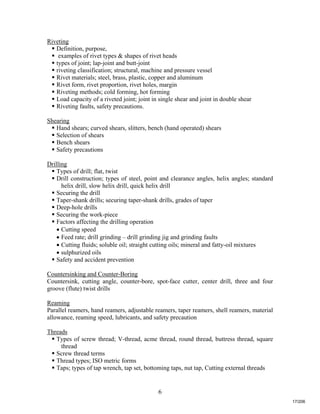
Riveting
 Definition, purpose,
 examples of rivet types & shapes of rivet heads
 types of joint; lap-joint and butt-joint
 riveting classification; structural, machine and pressure vessel
 Rivet materials; steel, brass, plastic, copper and aluminum
 Rivet form, rivet proportion, rivet holes, margin
 Riveting methods; cold forming, hot forming
 Load capacity of a riveted joint; joint in single shear and joint in double shear
 Riveting faults, safety precautions.
Shearing
 Hand shears; curved shears, slitters, bench (hand operated) shears
 Selection of shears
 Bench shears
 Safety precautions
Drilling
 Types of drill; flat, twist
 Drill construction; types of steel, point and clearance angles, helix angles; standard
helix drill, slow helix drill, quick helix drill
 Securing the drill
 Taper-shank drills; securing taper-shank drills, grades of taper
 Deep-hole drills
 Securing the work-piece
 Factors affecting the drilling operation
 Cutting speed
 Feed rate; drill grinding – drill grinding jig and grinding faults
 Cutting fluids; soluble oil; straight cutting oils; mineral and fatty-oil mixtures
 sulphurized oils
 Safety and accident prevention
Countersinking and Counter-Boring
Countersink, cutting angle, counter-bore, spot-face cutter, center drill, three and four
groove (flute) twist drills
Reaming
Parallel reamers, hand reamers, adjustable reamers, taper reamers, shell reamers, material
allowance, reaming speed, lubricants, and safety precaution
Threads
 Types of screw thread; V-thread, acme thread, round thread, buttress thread, square
thread
 Screw thread terms
 Thread types; ISO metric forms
 Taps; types of tap wrench, tap set, bottoming taps, nut tap, Cutting external threads
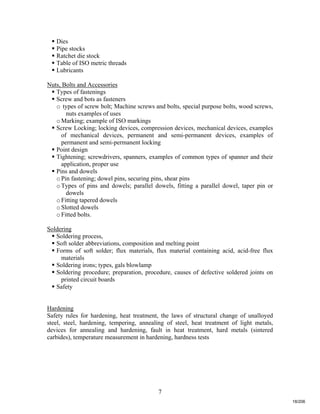
17/206
7
 Dies
 Pipe stocks
 Ratchet die stock
 Table of ISO metric threads
 Lubricants
Nuts, Bolts and Accessories
 Types of fastenings
 Screw and bots as fasteners
o types of screw bolt; Machine screws and bolts, special purpose bolts, wood screws,
nuts examples of uses
oMarking; example of ISO markings
 Screw Locking; locking devices, compression devices, mechanical devices, examples
of mechanical devices, permanent and semi-permanent devices, examples of
permanent and semi-permanent locking
 Point design
 Tightening; screwdrivers, spanners, examples of common types of spanner and their
application, proper use
 Pins and dowels
oPin fastening; dowel pins, securing pins, shear pins
oTypes of pins and dowels; parallel dowels, fitting a parallel dowel, taper pin or
dowels
oFitting tapered dowels
oSlotted dowels
oFitted bolts.
Soldering
 Soldering process,
 Soft solder abbreviations, composition and melting point
 Forms of soft solder; flux materials, flux material containing acid, acid-free flux
materials
 Soldering irons; types, gals blowlamp
 Soldering procedure; preparation, procedure, causes of defective soldered joints on
printed circuit boards
 Safety
Hardening
Safety rules for hardening, heat treatment, the laws of structural change of unalloyed
steel, steel, hardening, tempering, annealing of steel, heat treatment of light metals,
devices for annealing and hardening, fault in heat treatment, hard metals (sintered
carbides), temperature measurement in hardening, hardness tests
18/206
8
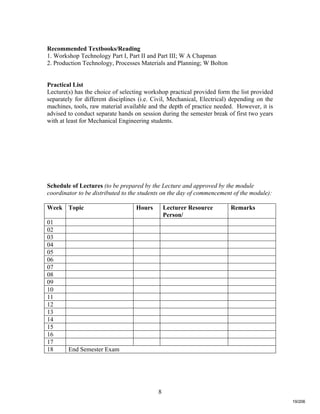
Recommended Textbooks/Reading
1. Workshop Technology Part I, Part II and Part III; W A Chapman
2. Production Technology, Processes Materials and Planning; W Bolton
Practical List
Lecture(s) has the choice of selecting workshop practical provided form the list provided
separately for different disciplines (i.e. Civil, Mechanical, Electrical) depending on the
machines, tools, raw material available and the depth of practice needed. However, it is
advised to conduct separate hands on session during the semester break of first two years
with at least for Mechanical Engineering students.
Schedule of Lectures (to be prepared by the Lecture and approved by the module
coordinator to be distributed to the students on the day of commencement of the module):
Week Topic Hours Lecturer Resource
Person/
Remarks
01
02
03
04
05
06
07
08
09
10
11
12
13
14
15
16
17
18 End Semester Exam
19/206
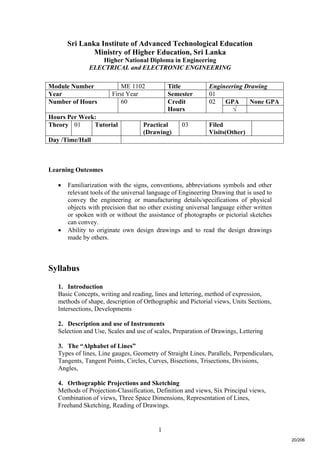
1
Sri Lanka Institute of Advanced Technological Education
Ministry of Higher Education, Sri Lanka
Higher National Diploma in Engineering
ELECTRICAL and ELECTRONIC ENGINEERING
Learning Outcomes
 Familiarization with the signs, conventions, abbreviations symbols and other
relevant tools of the universal language of Engineering Drawing that is used to
convey the engineering or manufacturing details/specifications of physical
objects with precision that no other existing universal language either written
or spoken with or without the assistance of photographs or pictorial sketches
can convey.
 Ability to originate own design drawings and to read the design drawings
made by others.
Syllabus
1. Introduction
Basic Concepts, writing and reading, lines and lettering, method of expression,
methods of shape, description of Orthographic and Pictorial views, Units Sections,
Intersections, Developments
2. Description and use of Instruments
Selection and Use, Scales and use of scales, Preparation of Drawings, Lettering
3. The “Alphabet of Lines”
Types of lines, Line gauges, Geometry of Straight Lines, Parallels, Perpendiculars,
Tangents, Tangent Points, Circles, Curves, Bisections, Trisections, Divisions,
Angles,
4. Orthographic Projections and Sketching
Methods of Projection-Classification, Definition and views, Six Principal views,
Combination of views, Three Space Dimensions, Representation of Lines,
Freehand Sketching, Reading of Drawings.
Module Number ME 1102 Title Engineering Drawing
Year First Year Semester 01
GPA None GPANumber of Hours 60 Credit
Hours
02
√
Hours Per Week:
Theory 01 Tutorial Practical
(Drawing)
03 Filed
Visits(Other)
Day /Time/Hall
20/206
2
5. Auxiliary Views
Basic Concepts, Classification of Surfaces, Skew Surfaces.
6. Sectional Views
Definition, Classification, Auxiliary Sections, Sections Showing Arms, Ribs, Lugs,
Crosshatching, Aligned Sections, Conventional Breaks and Symbols.
7. Pictorial Drawing and Sketching
Comparison with orthographic drawings, Isometrics, Perspective Drawings,
Oblique Projection, Sketching the Axes.
8. Dimensions, Notes, Limits and Precision
Lines and Symbols, Selection of Distances, Placement of Dimensions, Standard
Features, Precision and Tolerances, Production Methods.
Drawing Practice
Nine, 03 Hour Drawing Sessions to give students the adequate practice to grasp
each of the above 08 topics
Recommended Textbooks/Software
1. Siddheshwar, Machine Drawing, Tata-McGraw Hill.
2. K. L. Narayana and P. Kannaiah, Machine Drawing,New Age International
Ltd
3. Textbook On Engineering Drawing Engineering Graphics, (Paperback -2005),
Narayana KI, Kannaiah P
4. Engineering Drawing, (Paperback – 2008), Shah PJ.
21/206
3
Schedule of Lectures (to be prepared by the Lecture and approved by the module
coordinator to be distributed to the students on the day of commencement of the
module):
Week Topic Hours Lecturer Resource
Person/
Remarks
01
02
03
04
05
06
07
08
09
10
11
12
13
14
15
16
17
18 End Semester Exam
22/206
  1
Sri Lanka Institute of Advanced Technological Education
Ministry of Higher Education, Sri Lanka
Higher National Diploma in Engineering
ELECTRICAL and ELECTRONIC ENGINEERING
Learning Outcomes
 understand the basic principles governing the dynamics of non-viscous fluids
 be able to derive and deduce the consequences of the equation of conservation of
mass
 be able solve kinematics problems such as finding particle paths and streamlines
 be able to apply Bernoulli's theorem and the momentum integral to simple
problems including river flows
 calculate velocity fields and forces on bodies for simple steady and unsteady
flows derived from potentials
Syllabus
1. Static fluid systems
Immersed surfaces: rectangular and circular surfaces (eg retaining walls, tank sides,
sluice gates, inspection covers, valve flanges)
Centre of pressure: use of parallel axis theorem for immersed rectangular and circular
immersed surfaces
Devices: hydraulic presses; hydraulic jacks; hydraulic accumulators; braking systems;
determine outputs for given inputs
Module Number CE1102 Title Fluid Mechanics
Year First Year Semester 01
GPA None GPANumber of Hours 90 Credit
Hours
03
√
Hours Per Week:
Theory 02 Tutorial 01 Practical 03 Filed
Visits(Other)
Day /Time/Hall
23/206
  2
2. Viscosity
Viscosity: shear stress; shear rate; dynamic viscosity; kinematic viscosity
Viscosity measurement: operating principles and limitations of viscosity measuring
devices (e.g. falling sphere, capillary tube, rotational and orifice viscometers)
Real fluids: Newtonian fluids; non-Newtonian fluids including pseudoplastic,
Bingham plastic, Casson plastic and dilatent fluids
3. Flow of real fluids
Head losses: head loss in pipes by Darcy’s formula; Moody diagram; head loss due to
sudden enlargement and contraction of pipe diameter; head loss at entrance to a pipe;
head loss in valves; flow between reservoirs due to gravity; hydraulic gradient;
siphons; hammer blow in pipes
Reynolds’ number: inertia and viscous resistance forces; laminar and turbulent flow;
critical velocities
Viscous drag: dynamic pressure; form drag; skin friction drag; drag coefficient
Dimensional analysis: checking validity of equations such as those for pressure at
depth; thrust on immersed surfaces and impact of a jet; forecasting the form of
possible equations such as those for Darcy’s formula and critical velocity in pipes
4. Fluid Dynamics
Introduction to Navier-Stoke’s Equation, Euler equation of motion along a stream line,
ernoulli’s equation, application of Bernoulli’s equation to Pitot tube, Venturi meter, Orifices,
Orifice meter, Triangular Notch & Rectangular Notch .(Without considering Velocity of
Approach)
5. Hydraulic machines
Impact of a jet: power of a jet; normal thrust on a moving flat vane; thrust on a
moving hemispherical cup; velocity diagrams to determine thrust on moving curved
vanes; fluid friction losses; system efficiency
Operating principles: operating principles, applications and typical system
efficiencies of common turbomachines including the Pelton wheel, Francis turbine
and Kaplan turbine
24/206
  3
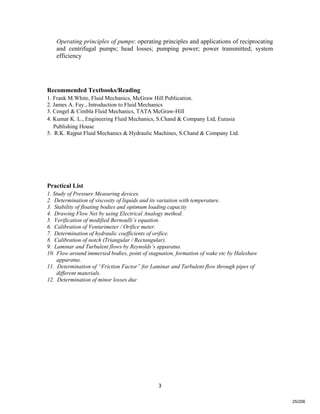
Operating principles of pumps: operating principles and applications of reciprocating
and centrifugal pumps; head losses; pumping power; power transmitted; system
efficiency
Recommended Textbooks/Reading
1. Frank M.White, Fluid Mechanics, McGraw Hill Publication.
2. James A. Fay., Introduction to Fluid Mechanics
3. Cengel & Cimbla Fluid Mechanics, TATA McGraw-Hill
4. Kumar K. L., Engineering Fluid Mechanics, S.Chand & Company Ltd, Eurasia
Publishing House
5. R.K. Rajput Fluid Mechanics & Hydraulic Machines, S.Chand & Company Ltd.
Practical List
1. Study of Pressure Measuring devices.
2. Determination of viscosity of liquids and its variation with temperature.
3. Stability of floating bodies and optimum loading capacity
4. Drawing Flow Net by using Electrical Analogy method.
5. Verification of modified Bernoulli’s equation.
6. Calibration of Venturimeter / Orifice meter.
7. Determination of hydraulic coefficients of orifice.
8. Calibration of notch (Triangular / Rectangular).
9. Laminar and Turbulent flows by Reynolds’s apparatus.
10. Flow around immersed bodies, point of stagnation, formation of wake etc by Haleshaw
apparatus.
11. Determination of “Friction Factor” for Laminar and Turbulent flow through pipes of
different materials.
12. Determination of minor losses due
25/206
  4
Schedule of Lectures (to be prepared by the Lecture and approved by the module coordinator to 
be distributed to the students on the day of commencement of the module):
 
Week  Topic  Hours  Lecturer Resource 
Person/ 
Remarks 
01         
02         
03         
04         
05         
06         
07         
08         
09         
10         
11         
12         
13         
14         
15         
16         
17         
18  End Semester Exam 
26/206
1
Sri Lanka Institute of Advanced Technological Education
Ministry of Higher Education, Sri Lanka
Higher National Diploma in Engineering
Electrical and Electronic Engineering
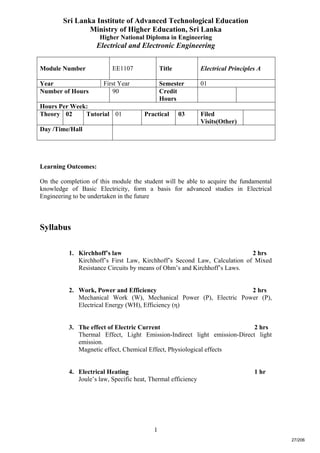
Module Number EE1107 Title Electrical Principles A
Year First Year Semester 01
Number of Hours 90 Credit
Hours
Hours Per Week:
Theory 02 Tutorial 01 Practical 03 Filed
Visits(Other)
Day /Time/Hall
Learning Outcomes:
On the completion of this module the student will be able to acquire the fundamental
knowledge of Basic Electricity, form a basis for advanced studies in Electrical
Engineering to be undertaken in the future
Syllabus
1. Kirchhoff’s law 2 hrs
Kirchhoff’s First Law, Kirchhoff’s Second Law, Calculation of Mixed
Resistance Circuits by means of Ohm’s and Kirchhoff’s Laws.
2. Work, Power and Efficiency 2 hrs
Mechanical Work (W), Mechanical Power (P), Electric Power (P),
Electrical Energy (WH), Efficiency (η)
3. The effect of Electric Current 2 hrs
Thermal Effect, Light Emission-Indirect light emission-Direct light
emission.
Magnetic effect, Chemical Effect, Physiological effects
4. Electrical Heating 1 hr
Joule’s law, Specific heat, Thermal efficiency
27/206
2
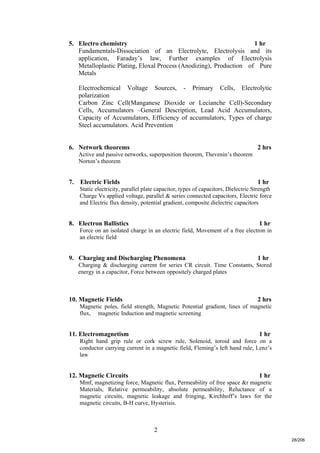
5. Electro chemistry 1 hr
Fundamentals-Dissociation of an Electrolyte, Electrolysis and its
application, Faraday’s law, Further examples of Electrolysis
Metalloplastic Plating, Eloxal Process (Anodizing), Production of Pure
Metals
Electrochemical Voltage Sources, - Primary Cells, Electrolytic
polarization
Carbon Zinc Cell(Manganese Dioxide or Lecianche Cell)-Secondary
Cells, Accumulators –General Description, Lead Acid Accumulators,
Capacity of Accumulators, Efficiency of accumulators, Types of charge
Steel accumulators. Acid Prevention
6. Network theorems 2 hrs
Active and passive networks, superposition theorem, Thevenin’s theorem
Norton’s theorem
7. Electric Fields 1 hr
Static electricity, parallel plate capacitor, types of capacitors, Dielectric Strength
Charge Vs applied voltage, parallel & series connected capacitors, Electric force
and Electric flux density, potential gradient, composite dielectric capacitors
8. Electron Ballistics 1 hr
Force on an isolated charge in an electric field, Movement of a free electron in
an electric field
9. Charging and Discharging Phenomena 1 hr
Charging & discharging current for series CR circuit. Time Constants, Stored
energy in a capacitor, Force between oppositely charged plates
10. Magnetic Fields 2 hrs
Magnetic poles, field strength, Magnetic Potential gradient, lines of magnetic
flux, magnetic Induction and magnetic screening
11. Electromagnetism 1 hr
Right hand grip rule or cork screw rule, Solenoid, toroid and force on a
conductor carrying current in a magnetic field, Fleming’s left hand rule, Lenz’s
law
12. Magnetic Circuits 1 hr
Mmf, magnetizing force, Magnetic flux, Permeability of free space &r magnetic
Materials, Relative permeability, absolute permeability, Reluctance of a
magnetic circuits, magnetic leakage and fringing, Kirchhoff’s laws for the
magnetic circuits, B-H curve, Hysterisis.
28/206
3
13. Inductance in DC Circuits 1 hr
Inductive and non inductive circuits, inductance of a coil, inductance of a long
straight solenoid and a toroid coil, Step response for LR circuit (Charging &
decaying), energy stored in an inductive circuit, time constant of an inductive
circuit
14. Mutual Inductance 1 hr
Mutual inductance, Self inductance, coupling coefficient
15. Alternating Voltages and Currents 1 hr
Sine wave, Phase angle (lead/lag), frequency, speed and no. of pole pairs
Amplitude Alternating emf (single phase), Average, Peak and rms values of an
alternating current, rotating vector, Manipulations with AC quantities, vector
diagrams using rms values
16. Single Phase Circuits 1 hr
Analysis of ac circuits with R, L, C, RLC in series & RLC in parallel, Phasor
diagrams, Power in ac circuits
17. Effect of Frequency in AC Circuits 1 hr
Series resonance, parallel resonance, active power and reactive power, power
factor using phase diagrams
18. Three Phase Circuits
Three phase generation, star and delta connection, line and phase voltage and
currents in a star connected system & delta connected system, power in three
phase system with balanced load
Recommended Text Books:
1 Electrical Circuit Theory and Bird J
2 Electric Circuits Nilsson J
3 Basic Circuit Analysis Johnson D
4 Power System Analyses and Design Glover J and Sarma M
List of Practices
1. Verification of Kirchhoff’s laws
2. Verification of Norton's and Thevenins Theorem .
3. RLC network in AC.
4. Q - meter/ Transformer O/C and S/C test
29/206
4
Schedule of Lectures (to be prepared by the Lecture and approved by the module
coordinator to be distributed to the students on the day of commencement of the module):
Week Topic Hours Lecturer Resource
Person/
Remarks
01
02
03
04
05
06
07
08
09
10
11
12
13
14
15
16
17
18 End Semester Exam
30/206
1
Sri Lanka Institute of Advanced Technological Education
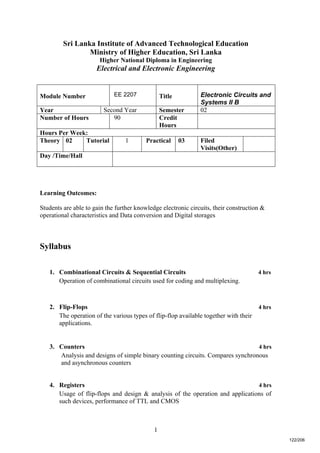
Ministry of Higher Education, Sri Lanka
Higher National Diploma in Engineering
ELECTRICAL and ELECTRONIC ENGINEERING
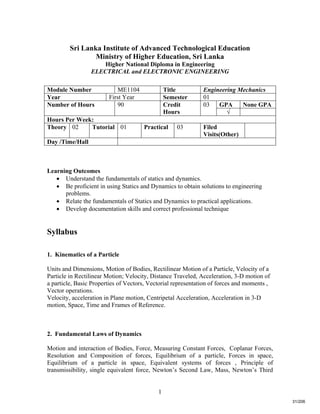
Learning Outcomes
 Understand the fundamentals of statics and dynamics.
 Be proficient in using Statics and Dynamics to obtain solutions to engineering
problems.
 Relate the fundamentals of Statics and Dynamics to practical applications.
 Develop documentation skills and correct professional technique
Syllabus
1. Kinematics of a Particle
Units and Dimensions, Motion of Bodies, Rectilinear Motion of a Particle, Velocity of a
Particle in Rectilinear Motion; Velocity, Distance Traveled, Acceleration, 3-D motion of
a particle, Basic Properties of Vectors, Vectorial representation of forces and moments ,
Vector operations.
Velocity, acceleration in Plane motion, Centripetal Acceleration, Acceleration in 3-D
motion, Space, Time and Frames of Reference.
2. Fundamental Laws of Dynamics
Motion and interaction of Bodies, Force, Measuring Constant Forces, Coplanar Forces,
Resolution and Composition of forces, Equilibrium of a particle, Forces in space,
Equilibrium of a particle in space, Equivalent systems of forces , Principle of
transmissibility, single equivalent force, Newton’s Second Law, Mass, Newton’s Third
Module Number ME1104 Title Engineering Mechanics
Year First Year Semester 01
GPA None GPANumber of Hours 90 Credit
Hours
03
√
Hours Per Week:
Theory 02 Tutorial 01 Practical 03 Filed
Visits(Other)
Day /Time/Hall
31/206
2
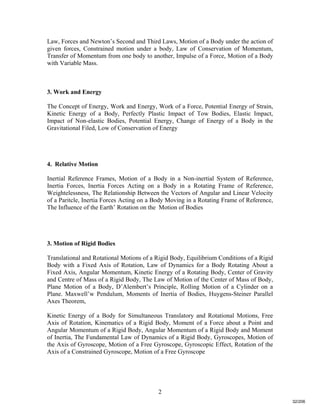
Law, Forces and Newton’s Second and Third Laws, Motion of a Body under the action of
given forces, Constrained motion under a body, Law of Conservation of Momentum,
Transfer of Momentum from one body to another, Impulse of a Force, Motion of a Body
with Variable Mass.
3. Work and Energy
The Concept of Energy, Work and Energy, Work of a Force, Potential Energy of Strain,
Kinetic Energy of a Body, Perfectly Plastic Impact of Tow Bodies, Elastic Impact,
Impact of Non-elastic Bodies, Potential Energy, Change of Energy of a Body in the
Gravitational Filed, Low of Conservation of Energy
4. Relative Motion
Inertial Reference Frames, Motion of a Body in a Non-inertial System of Reference,
Inertia Forces, Inertia Forces Acting on a Body in a Rotating Frame of Reference,
Weightelessness, The Relationship Between the Vectors of Angular and Linear Velocity
of a Paritcle, Inertia Forces Acting on a Body Moving in a Rotating Frame of Reference,
The Influence of the Earth’ Rotation on the Motion of Bodies
3. Motion of Rigid Bodies
Translational and Rotational Motions of a Rigid Body, Equilibrium Conditions of a Rigid
Body with a Fixed Axis of Rotation, Law of Dynamics for a Body Rotating About a
Fixed Axis, Angular Momentum, Kinetic Energy of a Rotating Body, Center of Gravity
and Centre of Mass of a Rigid Body, The Law of Motion of the Center of Mass of Body,
Plane Motion of a Body, D’Alembert’s Principle, Rolling Motion of a Cylinder on a
Plane. Maxwell’w Pendulum, Moments of Inertia of Bodies, Huygens-Steiner Parallel
Axes Theorem,
Kinetic Energy of a Body for Simultaneous Translatory and Rotational Motions, Free
Axis of Rotation, Kinematics of a Rigid Body, Moment of a Force about a Point and
Angular Momentum of a Rigid Body, Angular Momentum of a Rigid Body and Moment
of Inertia, The Fundamental Law of Dynamics of a Rigid Body, Gyroscopes, Motion of
the Axis of Gyroscope, Motion of a Free Gyroscope, Gyroscopic Effect, Rotation of the
Axis of a Constrained Gyroscope, Motion of a Free Gyroscope
32/206
3
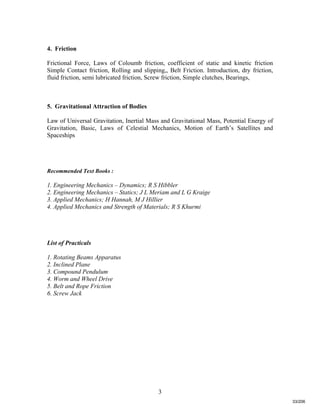
4. Friction
Frictional Force, Laws of Coloumb friction, coefficient of static and kinetic friction
Simple Contact friction, Rolling and slipping,, Belt Friction. Introduction, dry friction,
fluid friction, semi lubricated friction, Screw friction, Simple clutches, Bearings,
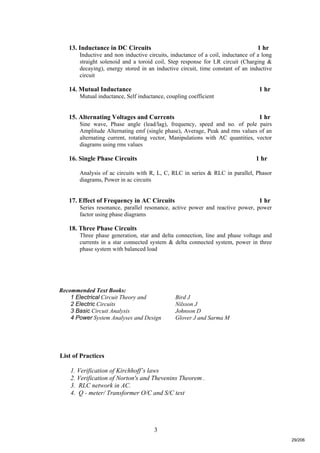
5. Gravitational Attraction of Bodies
Law of Universal Gravitation, Inertial Mass and Gravitational Mass, Potential Energy of
Gravitation, Basic, Laws of Celestial Mechanics, Motion of Earth’s Satellites and
Spaceships
Recommended Text Books :
1. Engineering Mechanics – Dynamics; R S Hibbler
2. Engineering Mechanics – Statics; J L Meriam and L G Kraige
3. Applied Mechanics; H Hannah, M J Hillier
4. Applied Mechanics and Strength of Materials; R S Khurmi
List of Practicals
1. Rotating Beams Apparatus
2. Inclined Plane
3. Compound Pendulum
4. Worm and Wheel Drive
5. Belt and Rope Friction
6. Screw Jack
33/206
4
Schedule of Lectures (to be prepared by the Lecture and approved by the module
coordinator to be distributed to the students on the day of commencement of the module):
Week Topic Hours Lecturer Resource
Person/
Remarks
01
02
03
04
05
06
07
08
09
10
11
12
13
14
15
16
17
18 End Semester Exam
34/206
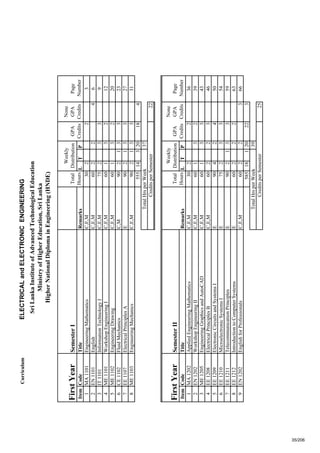
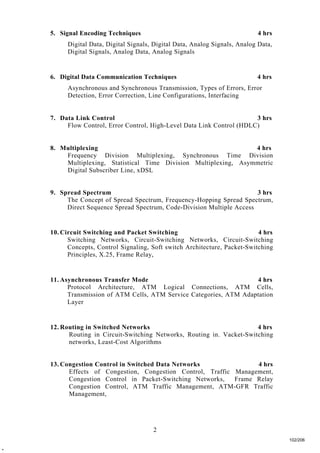
CurriculumELECTRICALandELECTRONICENGINEERING
FirstYearSemesterI
ItemCodeTitleRemarksLTP
1MA1101EngineeringMathematicsC,E,M30223
2EN1101EnglishC,E,M602246
3IT1101InformationTechnologyIC,E,M752339
4ME1101WorkshopEngineeringIC,E,M6013212
5ME1102EngineeringDrawingC,E,M6013220
6CE1102FluidMechanicsC,M90213323
7EE1107ElectricalPrinciplesAE90213327
8ME1103EngineeringMechanicsC,E,M90213331
55514320184
37
22
FirstYearSemesterII
ItemCodeTitleRemarksLTP
1MA1202AppliedEngineeringMathematicsC,E,M302236
2EN1202WorkshopEngineeringIIC,E,M6013239
3ME1205EngineeringGraphicsandAutoCADC,E,M6013343
4EE1208ElectricalPrinciplesBC,E,M6022346
5EE1209ElectronicCircuitsandSystemsIE9042450
6EE1210MicroelectronicSystemsIE7523354
7EE1211TelecommunicationPrinciplesE90213359
8EE1212IntroductiontoComputerSystemsE6022263
9EN1202EnglishforProfessionalsC,E,M6022366
58518120223
39
25
Weekly
Distribution
TotalHrsperWeek
CreditsperSemester
Page
Number
None
GPA
Credits
GPA
Credits
Total
Hours
GPA
Credits
None
GPA
Credits
Page
Number
SriLankaInstituteofAdvancedTechnologicalEducation
MinistryofHigherEducation,SriLanka
HigherNationalDiplomainEngineering(HNDE)
CreditsperSemester
Total
Hours
Weekly
Distribution
TotalHrsperWeek
35/206
1
Sri Lanka Institute of Advanced Technological Education
Ministry of Higher Education, Sri Lanka
Higher National Diploma in Engineering
ELECTRICAL and ELECTRONIC ENGINEERING
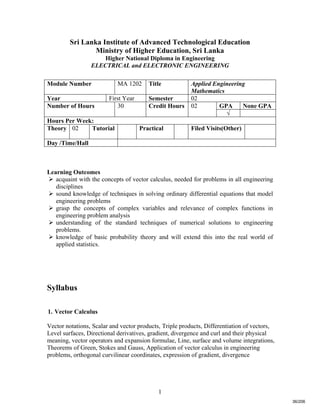
Learning Outcomes
 acquaint with the concepts of vector calculus, needed for problems in all engineering
disciplines
 sound knowledge of techniques in solving ordinary differential equations that model
engineering problems
 grasp the concepts of complex variables and relevance of complex functions in
engineering problem analysis
 understanding of the standard techniques of numerical solutions to engineering
problems.
 knowledge of basic probability theory and will extend this into the real world of
applied statistics.
Syllabus
1. Vector Calculus
Vector notations, Scalar and vector products, Triple products, Differentiation of vectors,
Level surfaces, Directional derivatives, gradient, divergence and curl and their physical
meaning, vector operators and expansion formulae, Line, surface and volume integrations,
Theorems of Green, Stokes and Gauss, Application of vector calculus in engineering
problems, orthogonal curvilinear coordinates, expression of gradient, divergence
Module Number MA 1202 Title Applied Engineering
Mathematics
Year First Year Semester 02
GPA None GPANumber of Hours 30 Credit Hours 02
√
Hours Per Week:
Theory 02 Tutorial Practical Filed Visits(Other)
Day /Time/Hall
36/206
2
2. Differential Equations
Differential equations of first order and higher degree, Higher order differential equations
with constant coefficient, Rules for finding C.F. and P.I., Method of variation of
parameter, Cauchy and Legendre’s linear equations.
Simultaneous linear equations with constant coefficients: Linear dependence of solution,
Removal of the first derivative-normal form, change of independent variable, single
integral differential equation. Various applications of higher order differential equations
in solution of engineering problem simple harmonic motion, free forced and damped
oscillations of springs and electrical circuits.
3. Analysis of Complex Variables
Limit continuity and differentiability of function of complex variables. Analytic functions.
Cauchy-Reimann’s and Cauchy’s integral theorem, Morera’s theorem , Cauchy’s Integral
formula, Expansion of function of complex variables in Taylor’s and Laurent’s series,
singularities and poles. Residues theorem, contour integration, conformal mappings and
its application, bilinear transformation.
4. Numerical Methods
Solution of equations in one variable, Successive substitution method, Method of false
position, Simple iterative method, Newton-Raphson method, Solution of simultaneous
linear equations; Jacobi method, Gauss – Seidal method, Finite differences and
interpolation, Numerical differentiation, Numerical integration: Trapezoidal and
Simpson’s rules, Runga-Kutta Method
5. Fundamentals of Probability & Statistics
Elementary probability theory, Conditional probability and Bayer’s theorem,
classification, tabulation and presentation of data, Measures of location and dispersion,
Discrete and continuous probability distributions: Binomial, Poisons and Normal with
simple applications.
37/206
3
Recommended Textbooks/Reading
1. Grewal B.S., Higher Engineering Mathematics (40th
Edition), Khanna Publishers,
Delhi (2007).
2. Ramana B.V., Higher Engineering Mathematics, Tata McGraw Hill Co. Ltd.,
New Delhi (2007).
3. Greenberg M.D., Advanced Engineering Mathematics (2nd
Edition), Pearson
Education, New Delhi (1998).
4. Ronald. E. Walpole, & Raymond. H. Myers. Macmillan, Probability and Statistics
for Engineers and Scientists (6th
Edition). ISBN 0-02-424210-1.
Schedule of Lectures (to be prepared by the Lecture and approved by the module
coordinator to be distributed to the students on the day of commencement of the module):
Week Topic Hours Lecturer Resource
Person/
Remarks
01
02
03
04
05
06
07
08
09
10
11
12
13
14
15
16
17
18 End Semester Exam
38/206
1
Sri Lanka Institute of Advanced Technological Education
Ministry of Higher Education, Sri Lanka
Higher National Diploma in Engineering
ELECTRICAL and ELECTRONIC ENGINEERING
Learning Outcomes
 Knowledge on Workshop safety, operations, procedures, tools
 Knowledge and skills on handling of machine tools and accessories
 Knowledge and skills on Material processing for product design and
manufacture
Syllabus
1. Sheet Metal work
 Flat sheets, sheet metal used for covering, material characteristics (steel, Aluminium,
Duralumin, Copper, Zinc, Brass, Lead, Tin, Corrosion and corrosion protection;
coating with oil and grease, painting and varnishing, enamel, plastic covering, metal
covering, dipping, electro-plating, spraying, chemically produced coatings, browning,
bonderising or Parkerizing, anodizing).
 Marking with tools, templates, material usage
 Cutting out (had shears, hand lever shear, machine shear, cutting with a chisel)
 Making holes; punching machines.
 Drilling of sheet metal, sawing and filling.
Module Number ME 1204 Title Workshop Engineering II
Year First Year Semester 02
GPA None GPANumber of Hours 60 Credit Hours 02
√
Hours Per Week:
Theory 01 Tutorial Practical 03 Filed Visits(Other)
Day /Time/Hall
39/206
2
 Shaping
oStraightening of sheets
oBending by hand; turning edges (folding), bending
oBending and folding with machines; using folding machine, bending formula
(general), press brakes, tolling and bending machine
2. Turning
 General; tidiness and the guidelines for tidiness and orderliness in order to prevent
accidents, safety on the lathe, turning, turning operation
 Construction of the lathe; base, lathe bed, headstock (main spindle noses, external
screw and internal taper, steep Morse taper with slotted nut, cam lock design and
bayonet mounting with taper), tool carriage (principal components, the apron, lathe
with reversing shaft, bathe with drag cable 10), tail stock, steadies (fixed steady,
traveling steady)
 Devices for clamping the work pieces; purpose of the clamping devices, different
methods
oLocating between centers; different types of centre drilling as per DIN 332, center
drilling R4×8.5 DIN 332, centre drilling A4×8.5 DIN 332, centre drilling
B4×8.5 DIN 332.
oTailstock centre; dead centre, live centre, revolving live centre, work piece driven
by lathe carrier, work piece driven with faceplate.
oClamping in a chuck; three-jaw chucks, four-jaw chuck
oClamping on mandrels; simple mandrels.
 The turning tool
oTool angles; tool in the middle of the work piece, tool below the centerline,
greater clearance angle, smaller rake angle, tool above centerline
 Turning tools; right-hand square nose tool; right cranked side tool, sintered carbides,
tool holder (multi-tool holders, quick release holder, clamping the tool, setting tool
height.
 Tool materials
 Cutting speeds
 Knurling
 Thread cutting
40/206
3
3. Milling
General housekeeping principals, care of tools and equipment, prevention of accidents,
Classification and design of milling machines, types of drives used in milling machines,
mounting work pieces, mounting milling attachments, Milling techniques, operating
procedures, operating parameters, cutting tools used for milling.
4. Gas Welding
Fusion welding, production of gases, safety precautions for gas welding and torch
cutting, physics of handling gas cylinders, classification of touches according to
construction, flames, accident prevention in gas welding, soldering – brazing, torch
cutting, simple testing methods, welding symbols, measuring welds, measures applied to
reduce deformation in gas-fusion welding,
5. Electric Welding
Safety regulations for arc welding, electric welding, welding electrodes, setting the
welding current, striking the arc, welding positions, are welding, common welds, welding
defects, weld testing methods
6. Introduction to Metal Casting.
Solidification of Metals, Flow of Molten Metal in Molds, Furnaces and Melting
Practices, Casting Defects.
Recommended Textbooks/Reading
1. Workshop Technology Part I, Part II and Part III; W A Chapman
2. Production Technology, Processes Materials and Planning; W Bolton
41/206
4
Practical List
Lecture(s) has the choice of selecting workshop practical provided form the list provided
separately for different disciplines (i.e. civil, Mechanical, Electrical) depending on the
machines, tools, raw material available and the depth of practice needed. However, it is
advised to conduct separate hands on session during the semester break of first two years
with at least for Mechanical Engineering students.
Schedule of Lectures (to be prepared by the Lecture and approved by the module
coordinator to be distributed to the students on the day of commencement of the module):
Week Topic Hours Lecturer Resource
Person/
Remarks
01
02
03
04
05
06
07
08
09
10
11
12
13
14
15
16
17
18 End Semester Exam
42/206
1
Sri Lanka Institute of Advanced Technological Education
Ministry of Higher Education, Sri Lanka
Higher National Diploma in Engineering (Mechanical)
ELECTRICAL and ELECTRONIC ENGINEERING
Learning Outcomes
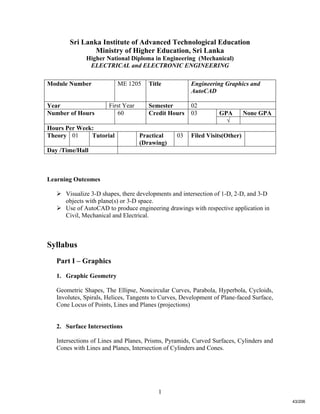
 Visualize 3-D shapes, there developments and intersection of 1-D, 2-D, and 3-D
objects with plane(s) or 3-D space.
 Use of AutoCAD to produce engineering drawings with respective application in
Civil, Mechanical and Electrical.
Syllabus
Part I – Graphics
1. Graphic Geometry
Geometric Shapes, The Ellipse, Noncircular Curves, Parabola, Hyperbola, Cycloids,
Involutes, Spirals, Helices, Tangents to Curves, Development of Plane-faced Surface,
Cone Locus of Points, Lines and Planes (projections)
2. Surface Intersections
Intersections of Lines and Planes, Prisms, Pyramids, Curved Surfaces, Cylinders and
Cones with Lines and Planes, Intersection of Cylinders and Cones.
Module Number ME 1205 Title Engineering Graphics and
AutoCAD
Year First Year Semester 02
GPA None GPANumber of Hours 60 Credit Hours 03
√
Hours Per Week:
Theory 01 Tutorial Practical
(Drawing)
03 Filed Visits(Other)
Day /Time/Hall
43/206
2
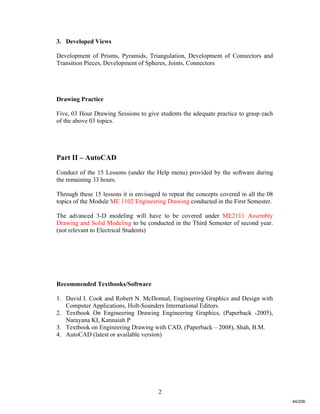
3. Developed Views
Development of Prisms, Pyramids, Triangulation, Development of Connectors and
Transition Pieces, Development of Spheres, Joints, Connectors
Drawing Practice
Five, 03 Hour Drawing Sessions to give students the adequate practice to grasp each
of the above 03 topics.
Part II – AutoCAD
Conduct of the 15 Lessons (under the Help menu) provided by the software during
the remaining 33 hours.
Through these 15 lessons it is envisaged to repeat the concepts covered in all the 08
topics of the Module ME 1102 Engineering Drawing conducted in the First Semester.
The advanced 3-D modeling will have to be covered under ME2111 Assembly
Drawing and Solid Modeling to be conducted in the Third Semester of second year.
(not relevant to Electrical Students)
Recommended Textbooks/Software
1. David I. Cook and Robert N. McDonnal, Engineering Graphics and Design with
Computer Applications, Holt-Sounders International Editors.
2. Textbook On Engineering Drawing Engineering Graphics, (Paperback -2005),
Narayana KI, Kannaiah P
3. Textbook on Engineering Drawing with CAD, (Paperback – 2008), Shah, B.M.
4. AutoCAD (latest or available version)
44/206
3
Schedule of Lectures (to be prepared by the Lecture and approved by the module
coordinator to be distributed to the students on the day of commencement of the module):
Week Topic Hours Lecturer Resource
Person/
Remarks
01
02
03
04
05
06
07
08
09
10
11
12
13
14
15
16
17
18 End Semester Exam
45/206
1
Sri Lanka Institute of Advanced Technological Education
Ministry of Higher Education, Sri Lanka
Higher National Diploma in Engineering
Electrical and Electronic Engineering
Learning Outcomes:
On the completion of this module the student will be able to acquire further knowledge of
Basic Electricity, form a basis for advanced studies in Electrical Engineering to be
undertaken in the future
Syllabus
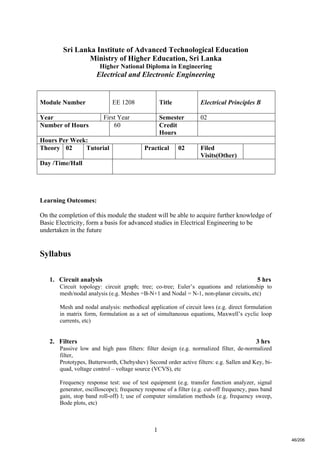
1. Circuit analysis 5 hrs
Circuit topology: circuit graph; tree; co-tree; Euler’s equations and relationship to
mesh/nodal analysis (e.g. Meshes =B-N+1 and Nodal = N-1, non-planar circuits, etc)
Mesh and nodal analysis: methodical application of circuit laws (e.g. direct formulation
in matrix form, formulation as a set of simultaneous equations, Maxwell’s cyclic loop
currents, etc)
2. Filters 3 hrs
Passive low and high pass filters: filter design (e.g. normalized filter, de-normalized
filter,
Prototypes, Butterworth, Chebyshev) Second order active filters: e.g. Sallen and Key, bi-
quad, voltage control – voltage source (VCVS), etc
Frequency response test: use of test equipment (e.g. transfer function analyzer, signal
generator, oscilloscope); frequency response of a filter (e.g. cut-off frequency, pass band
gain, stop band roll-off) l; use of computer simulation methods (e.g. frequency sweep,
Bode plots, etc)
Module Number EE 1208 Title Electrical Principles B
Year First Year Semester 02
Number of Hours 60 Credit
Hours
Hours Per Week:
Theory 02 Tutorial Practical 02 Filed
Visits(Other)
Day /Time/Hall
46/206
2
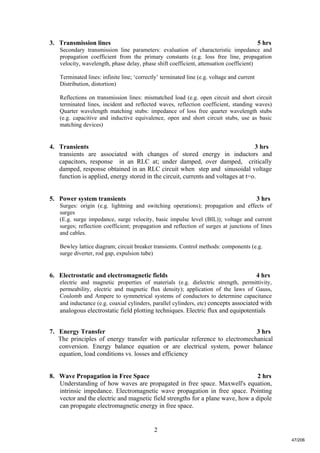
3. Transmission lines 5 hrs
Secondary transmission line parameters: evaluation of characteristic impedance and
propagation coefficient from the primary constants (e.g. loss free line, propagation
velocity, wavelength, phase delay, phase shift coefficient, attenuation coefficient)
Terminated lines: infinite line; ‘correctly’ terminated line (e.g. voltage and current
Distribution, distortion)
Reflections on transmission lines: mismatched load (e.g. open circuit and short circuit
terminated lines, incident and reflected waves, reflection coefficient, standing waves)
Quarter wavelength matching stubs: impedance of loss free quarter wavelength stubs
(e.g. capacitive and inductive equivalence, open and short circuit stubs, use as basic
matching devices)
4. Transients 3 hrs
transients are associated with changes of stored energy in inductors and
capacitors, response in an RLC at; under damped, over damped, critically
damped, response obtained in an RLC circuit when step and sinusoidal voltage
function is applied, energy stored in the circuit, currents and voltages at t=o.
5. Power system transients 3 hrs
Surges: origin (e.g. lightning and switching operations); propagation and effects of
surges
(E.g. surge impedance, surge velocity, basic impulse level (BIL)); voltage and current
surges; reflection coefficient; propagation and reflection of surges at junctions of lines
and cables.
Bewley lattice diagram; circuit breaker transients. Control methods: components (e.g.
surge diverter, rod gap, expulsion tube)
6. Electrostatic and electromagnetic fields 4 hrs
electric and magnetic properties of materials (e.g. dielectric strength, permittivity,
permeability, electric and magnetic flux density); application of the laws of Gauss,
Coulomb and Ampere to symmetrical systems of conductors to determine capacitance
and inductance (e.g. coaxial cylinders, parallel cylinders, etc) concepts associated with
analogous electrostatic field plotting techniques. Electric flux and equipotentials
7. Energy Transfer 3 hrs
The principles of energy transfer with particular reference to electromechanical
conversion. Energy balance equation or are electrical system, power balance
equation, load conditions vs. losses and efficiency
8. Wave Propagation in Free Space 2 hrs
Understanding of how waves are propagated in free space. Maxwell's equation,
intrinsic impedance. Electromagnetic wave propagation in free space. Pointing
vector and the electric and magnetic field strengths for a plane wave, how a dipole
can propagate electromagnetic energy in free space.
47/206
3
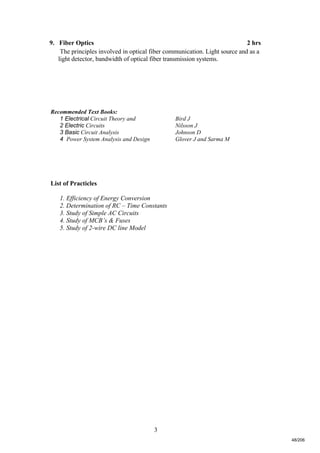
9. Fiber Optics 2 hrs
The principles involved in optical fiber communication. Light source and as a
light detector, bandwidth of optical fiber transmission systems.
Recommended Text Books:
1 Electrical Circuit Theory and Bird J
2 Electric Circuits Nilsson J
3 Basic Circuit Analysis Johnson D
4 Power System Analysis and Design Glover J and Sarma M
List of Practicles
1. Efficiency of Energy Conversion
2. Determination of RC – Time Constants
3. Study of Simple AC Circuits
4. Study of MCB’s & Fuses
5. Study of 2-wire DC line Model
48/206
4
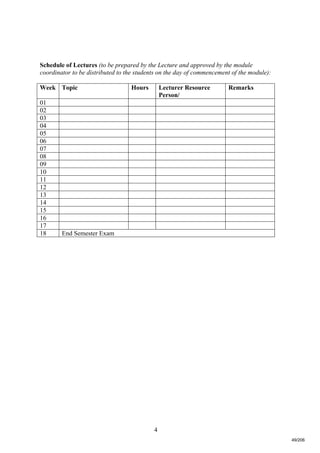
Schedule of Lectures (to be prepared by the Lecture and approved by the module
coordinator to be distributed to the students on the day of commencement of the module):
Week Topic Hours Lecturer Resource
Person/
Remarks
01
02
03
04
05
06
07
08
09
10
11
12
13
14
15
16
17
18 End Semester Exam
49/206
1
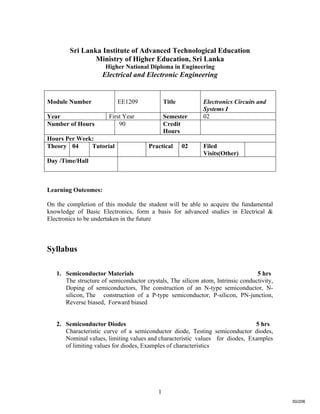
Sri Lanka Institute of Advanced Technological Education
Ministry of Higher Education, Sri Lanka
Higher National Diploma in Engineering
Electrical and Electronic Engineering
Learning Outcomes:
On the completion of this module the student will be able to acquire the fundamental
knowledge of Basic Electronics, form a basis for advanced studies in Electrical &
Electronics to be undertaken in the future
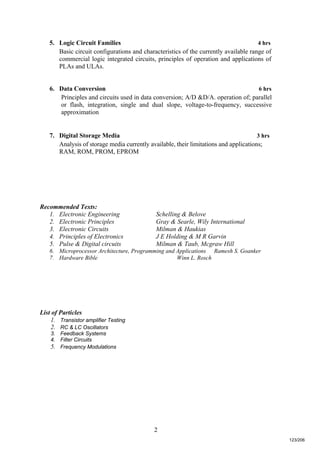
Syllabus
1. Semiconductor Materials 5 hrs
The structure of semiconductor crystals, The silicon atom, Intrinsic conductivity,
Doping of semiconductors, The construction of an N-type semiconductor, N-
silicon, The construction of a P-type semiconductor, P-silicon, PN-junction,
Reverse biased, Forward biased
2. Semiconductor Diodes 5 hrs
Characteristic curve of a semiconductor diode, Testing semiconductor diodes,
Nominal values, limiting values and characteristic values for diodes, Examples
of limiting values for diodes, Examples of characteristics
Module Number EE1209 Title Electronics Circuits and
Systems I
Year First Year Semester 02
Number of Hours 90 Credit
Hours
Hours Per Week:
Theory 04 Tutorial Practical 02 Filed
Visits(Other)
Day /Time/Hall
50/206
2
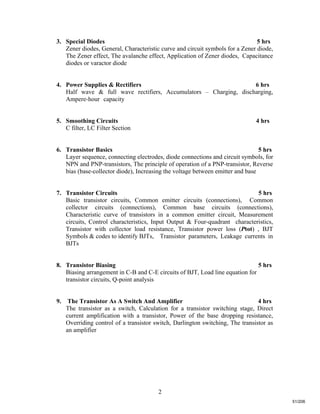
3. Special Diodes 5 hrs
Zener diodes, General, Characteristic curve and circuit symbols for a Zener diode,
The Zener effect, The avalanche effect, Application of Zener diodes, Capacitance
diodes or varactor diode
4. Power Supplies & Rectifiers 6 hrs
Half wave & full wave rectifiers, Accumulators – Charging, discharging,
Ampere-hour capacity
5. Smoothing Circuits 4 hrs
C filter, LC Filter Section
6. Transistor Basics 5 hrs
Layer sequence, connecting electrodes, diode connections and circuit symbols, for
NPN and PNP-transistors, The principle of operation of a PNP-transistor, Reverse
bias (base-collector diode), Increasing the voltage between emitter and base
7. Transistor Circuits 5 hrs
Basic transistor circuits, Common emitter circuits (connections), Common
collector circuits (connections), Common base circuits (connections),
Characteristic curve of transistors in a common emitter circuit, Measurement
circuits, Control characteristics, Input Output & Four-quadrant characteristics,
Transistor with collector load resistance, Transistor power loss (Ptot) , BJT
Symbols & codes to identify BJTs, Transistor parameters, Leakage currents in
BJTs
8. Transistor Biasing 5 hrs
Biasing arrangement in C-B and C-E circuits of BJT, Load line equation for
transistor circuits, Q-point analysis
9. The Transistor As A Switch And Amplifier 4 hrs
The transistor as a switch, Calculation for a transistor switching stage, Direct
current amplification with a transistor, Power of the base dropping resistance,
Overriding control of a transistor switch, Darlington switching, The transistor as
an amplifier
51/206
3
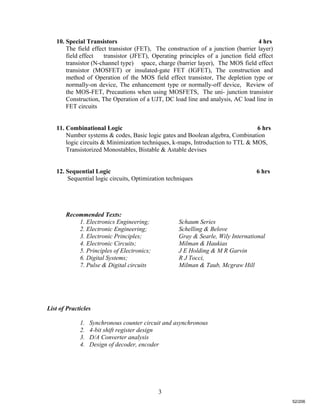
10. Special Transistors 4 hrs
The field effect transistor (FET), The construction of a junction (barrier layer)
field effect transistor (JFET), Operating principles of a junction field effect
transistor (N-channel type) space, charge (barrier layer), The MOS field effect
transistor (MOSFET) or insulated-gate FET (IGFET), The construction and
method of Operation of the MOS field effect transistor, The depletion type or
normally-on device, The enhancement type or normally-off device, Review of
the MOS-FET, Precautions when using MOSFETS, The uni- junction transistor
Construction, The Operation of a UJT, DC load line and analysis, AC load line in
FET circuits
11. Combinational Logic 6 hrs
Number systems & codes, Basic logic gates and Boolean algebra, Combination
logic circuits & Minimization techniques, k-maps, Introduction to TTL & MOS,
Transistorized Monostables, Bistable & Astable devises
12. Sequential Logic 6 hrs
Sequential logic circuits, Optimization techniques
Recommended Texts:
1. Electronics Engineering; Schaum Series
2. Electronic Engineering; Schelling & Belove
3. Electronic Principles; Gray & Searle, Wily International
4. Electronic Circuits; Milman & Haukias
5. Principles of Electronics; J E Holding & M R Garvin
6. Digital Systems; R J Tocci,
7. Pulse & Digital circuits Milman & Taub, Mcgraw Hill
List of Practicles
1. Synchronous counter circuit and asynchronous
2. 4-bit shift register design
3. D/A Converter analysis
4. Design of decoder, encoder
52/206
4
Schedule of Lectures (to be prepared by the Lecture and approved by the module
coordinator to be distributed to the students on the day of commencement of the module):
Week Topic Hours Lecturer Resource
Person/
Remarks
01
02
03
04
05
06
07
08
09
10
11
12
13
14
15
16
17
18 End Semester Exam
53/206
1
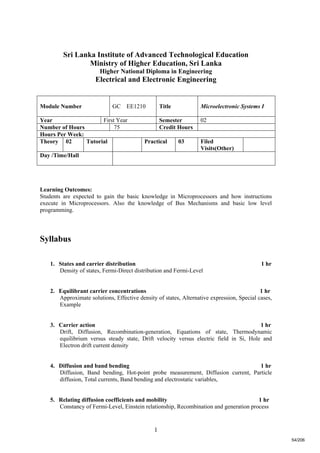
Sri Lanka Institute of Advanced Technological Education
Ministry of Higher Education, Sri Lanka
Higher National Diploma in Engineering
Electrical and Electronic Engineering
Learning Outcomes:
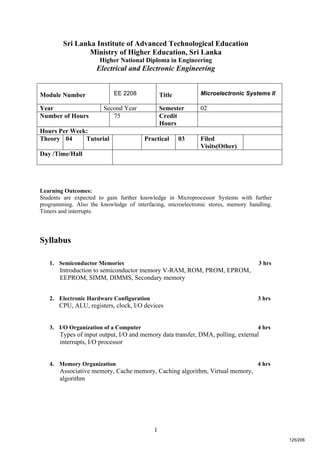
Students are expected to gain the basic knowledge in Microprocessors and how instructions
execute in Microprocessors. Also the knowledge of Bus Mechanisms and basic low level
programming.
Syllabus
1. States and carrier distribution 1 hr
Density of states, Fermi-Direct distribution and Fermi-Level
2. Equilibrant carrier concentrations 1 hr
Approximate solutions, Effective density of states, Alternative expression, Special cases,
Example
3. Carrier action 1 hr
Drift, Diffusion, Recombination-generation, Equations of state, Thermodynamic
equilibrium versus steady state, Drift velocity versus electric field in Si, Hole and
Electron drift current density
4. Diffusion and band bending 1 hr
Diffusion, Band bending, Hot-point probe measurement, Diffusion current, Particle
diffusion, Total currents, Band bending and electrostatic variables,
5. Relating diffusion coefficients and mobility 1 hr
Constancy of Fermi-Level, Einstein relationship, Recombination and generation process
Module Number GC EE1210 Title Microelectronic Systems I
Year First Year Semester 02
Number of Hours 75 Credit Hours
Hours Per Week:
Theory 02 Tutorial Practical 03 Filed
Visits(Other)
Day /Time/Hall
54/206
2
6. Recombination and generation statistics 1 hr
Photo generation, Band gaps of common semiconductors, indirect thermal
recombination-generation, R-G statistics, Photoconductivity decay measurement
7. Continuity equitation 1 hr
1-D Case, Minority carrier diffusion equations, Minority carrier diffusion length
8. PN-Junction electrostatics 1 hr
PN-junction fabrication, Examples, Quantative electrostatic relationships, Quantative
analysis, Electrostatic potential
9. Carrier injection under forward bias 1 hr
Equations explained, Deviations from the ideal
10. Small-signal admittance 1 hr
Reverse bias junction or depletion layer capacitance, Forward bias diffusion or charge
storage capacity, forward and reverse bias conductance
11. Transient response 1 hr
Turn-off transient, ideal switching circuit, Diode current and voltage-time transients,
Storage delay time, Transient response measurement
12. BJT-Deviations from the ideal 1 hr
Base-with modulation, Punch-trough, Avalanche multiplicator and break down
13. BJT-transient response 1 hr
Transient response, Base current, idealized switching circuits, Analysis, Methods to
speed-up turn-off transients
14. Schottky contact 1 hr
General, Ideal MS contacts, Energy band diagrams (MS), Schottky diode,
Schottky diode I-V characteristics
15. MOS Basics 1 hr
General, MOSFET, MOSFET operation, Ideal MOS capacitor, Energy band diagram and
density
16. MOS electrostatic: Quantitative analysis 1 hr
General, Electrostatic potential, Electrostatic parameters, Delta-depletion solution, Gate-
voltage relationship
55/206
3
17. MOS C-V characteristics 1 hr
General, p- and n-type Si, n-type Si, MOS-capacitor under accumulation, MOS-capacitor
under depletion, MOS-capacitor under inversion, Deep depletion
18. MOSFET 1 hr
General, NMOS, Threshold voltage for NMOS and PMOS, Shockley Model, Example,
MOSFET small-signal equivalent circuit, MOSFET ac response, Characteristics MOS-
C versus MOSFET
19. Non-ideal MOS 1 hr
General, Polysilicon gate MOS, Enhancement and depletion mode MOSFET`s
20. CCD-DRAM ½ hr
Charge coupled devices, Semiconductor memories, Concept of CCD-Imager, One
transistor DRAM cell
21. Fabrication ½ hr
General, Photographic process, Doping, Defects line break, Industrial issues
22. Microprocessor System Fundamentals. 1 hr
Block diagram of a typical microprocessor system, capability of controlling a
process, temporary and permanent information in a microcomputer, the operator
and the operand of an instruction,
Basic purposes of ; Instruction Register , Program Counter (PC), Store Address
Register, Accumulator, Arithmetic and Logic Unit (ALU), Status register,
Control and Timing Devices
Fetch & Execution of instruction
.
23. Microprocessor Instructions and Programming 2 hrs
Instruction execution, Fetch and execute cycle, Addressing modes and
Instruction types, Machine and timing cycles, Brief description of Z 80,8088,
6800,6502 processors 80486 processor / PI, PII, PIII, PIV, Algorithms and flow
charts for simple problems
24. Programming in Machine Code 2 hrs
Structure of an Instruction Set, Data Transfer Group, Arithmetic and Logic
Group, Conditional jumps and branch instructions, simple programs using 1 and
2 — byte instructions, entering the programs into the SDK85 kit, checking and
execution the programs. Verification of the contents of relevant registers.
Flaw chart and resting demonstration program, Identification of moos; Implied,
Immediate, Direct, Indexed/indirect, Relative
56/206
4
25. Program creation at machine code level 1 hr
Flow chart to solve a problem, successful programming through algorithms,
Need of some software to load and execute a simple program, the trace table.
.
26. Instruction sets 1 hr
The main types. Data Transfer Group, Arithmetic and Logic Group, Test and
Branch Group, the type of addressing, more complicated programs make use of
other forms of addressing.
27. Programs with loops 2 hrs
A loop as a body of program which is repeated a number of times, a program
containing a loop, loop controls, operand, jump instruction,
28. CPU and store. 1 hr
Operation & storage characteristics of a store , Chip Select /Enable, Read/ Write
Control, Data and Address Lines, storing of data or instruction or garbage.
29. Bus Mechanisms. 1 hr
Data address and control bus. Bidirectional data flow, `actively' connected
information at any one time, a tri-state device, usage a truth table, providing
signals from a control device and control actions; read, write, store or input/output
routs.
Rec. Readings
1. Computer System Architecture M. Morris Mano
2. Microprocessor Architecture, Programming and Applications Ramesh S. Goanker
3. Modern Operating Systems Andrew S. Tanenbaum
4. Hardware Bible Winn L. Rosch
5. The design & Analysis of Computer Algorithms Aho/Hopcroft/Ullman
6. Systems Programming John J. Donovan
List of Practicals
1. Input/Output and Data Transfer
2. Micro Computer Hardware Configuration
57/206
5
Schedule of Lectures (to be prepared by the Lecture and approved by the module
coordinator to be distributed to the students on the day of commencement of the module):
Week Topic Hours Lecturer Resource
Person/
Remarks
01
02
03
04
05
06
07
08
09
10
11
12
13
14
15
16
17
18 End Semester Exam
58/206
1
Sri Lanka Institute of Advanced Technological Education
Ministry of Higher Education, Sri Lanka
Higher National Diploma in Engineering
Electrical and Electronic Engineering
Learning Outcomes:
On the completion of this module the student will be able to acquire the fundamental
knowledge of Telecommunications, form a basis for advanced studies in Electrical &
Electronics to be undertaken in the future
Syllabus
1. Communication systems 7 hrs
Elements of analogue and digital communication systems: the transmitter
(information source), the channel and the receiver (eg wired and wireless
systems; simplex, duplex and half-duplex methods)
Characteristics of electro-magnetic waves: frequency (f), wavelength (λ) and
velocity (v) and their interrelationship; the electro-magnetic spectrum and
frequency/wavelength allocations
Signal spectra: time and frequency domains; fundamental and harmonic
frequencies; complex waveforms; digital signals (eg unipolar, bipolar, return-to-
zero (RTZ), non-return to-zero (NRZ))
Module Number GC EE1211 Title Telecommunications
Principles
Year First Year Semester 02
Number of Hours 90 Credit
Hours
Hours Per Week:
Theory 02 Tutorial 01 Practical 03 Filed
Visits(Other)
Day /Time/Hall
59/206
2
Logarithmic relationships: the need for logarithmic representation; the Decibel
and its common derivatives (eg dBm, dBW and dBR) and typical applications
including link budgets
2. Communication channels and their characteristics 8 hrs
Sources and effects of noise: sources (eg internal/external, natural/man-made);
types (eg Johnson, Shott, Partition); cumulative effects in cascaded/sequential
systems; signal-to noise ratio; noise figure and noise factor; noise temperature
Noise calculations: eg thermal/Johnson noise, signal-to-noise ratio, noise figure,
noise factor
Bandwidth and information capacity: Shannon-Hartley theorem (eg relationship
to the available bandwidth and the signal-to-noise ratio); bandwidth requirements
for typical applications (voice, radio and television broadcasting); the
implications for both analogue and digital signals
Channel impairments: attenuation and other losses; bandwidth limitation; phase
delay; effects on complex signals; inter-symbol interference; bit error rates
(typical examples)
3. Modulation and multiplexing techniques 8 hrs
Analogue modulation methods: amplitude/frequency/phase; pulse modulation
methods (eg pulse amplitude (PAM), pulse position (PPM), pulse duration/width
(PDM/PWM))
Modulation methods for digital signals over analogue networks: eg amplitude
shift keying (ASK), frequency shift keying (FSK), phase shift keying (PSK),
quaternary phase shift keying (QPSK), quaternary amplitude modulation (QAM))
Digital modulation methods: Pulse Code Modulation (PCM); Delta modulation;
Adaptive Delta modulation
Multiplexing techniques: space division; frequency division; time division;
wavelength Division
60/206
3
4. Telecommunication traffic 7 hrs
Telecommunications traffic over circuit switched networks: call duration; call
holding times; call arrival times (coincidence); busy hour; grade of service
Telecommunications traffic over packet switched networks: server traffic;
network traffic; congestion; congestion control techniques; the effects of delay
Mathematical formulae: Erlang B and Erlang C; Little’s theorem and applications
to queuing theory
Recommended Text Books :
1. Electronic Communication Systems Kennedy and Davis
2. Modern Electronic Communication Miller G
3. Communication Systems Engineering Proakis J
4. Electronic Communication Systems Schweber W
5.Computer Networks Tanenbaum A
6. Electronic Communication Techniques Young P
List of Practicals
1. AM and FM signal generation
2. Generator - Oscilloscope data transmission
3. Multiplexed - Data transmission
4. Study of communication channel characteristics
61/206
4
Schedule of Lectures (to be prepared by the Lecture and approved by the module
coordinator to be distributed to the students on the day of commencement of the module):
Week Topic Hours Lecturer Resource
Person/
Remarks
01
02
03
04
05
06
07
08
09
10
11
12
13
14
15
16
17
18 End Semester Exam
62/206
1
Sri Lanka Institute of Advanced Technological Education
Ministry of Higher Education, Sri Lanka
Higher National Diploma in Engineering
Electrical and Electronic Engineering
Learning Outcomes:
On the completion of this module the student will be able to acquire the fundamental
knowledge of Computer Systems, form a basis for further advanced studies to be
undertaken in the future
Syllabus
1. Introduction To Computers 2 hrs
Hardware and Software, How Computers Work, Inside a Computer, Parts
2. Input And Output Devices 4 hrs
The beginning and the chronological development of Mouse, Keyboard, Printer,
Monitor, Modem, Scanner, Video and Sound Card, Speakers, Headphones and
Webcam
3. Processing 4 hrs
Memory, Central Processing Unit, Memory Cache, Bus
Module Number GC EE 1212 Title Introduction to Computer
Systems
Year First Year Semester 02
Number of Hours 60 Credit
Hours
Hours Per Week:
Theory 02 Tutorial Practical 02 Filed
Visits(Other)
Day /Time/Hall
63/206
2
4. Storage Devices 2 hrs
Hard Drive, Floppy Drive, CD-ROM Drive, DVD-ROM Drive, DVD +/-RW
Drive, Memory Card Reader, Flash Drive
5. Software 3 hrs
Introduction to Software, Word Processor, Spreadsheet, Database, Application
Suite, Image Editor, Web Design Software
6. Operating Systems 3 hrs
Introduction to Operating Systems, MS-DOS, Windows 3.1, Windows 95, 98 and
Me, Windows NT, Windows 2000 and Windows XP 6.7. UNIX, Linux, Mac
OSX
7. Networks 4 hrs
Introduction to Networks, Network Hardware, How Information is Stored on a
Network, Home Networks, Protecting Data on a Network, Wireless Networking
8. The Internet 3 hrs
Introduction to the Internet, Capabilities and Limitations of the Internet, Getting
Connected, Web Browser, Creating and Publishing Web Pages, Message Boards,
Web-Based Chat and Blogs, Spy ware, Voice over IP
9. E-Mail And Instant Messaging 2 hrs
Introduction to Email, Creating and Working with Messages, Web-Based Email,
Reducing Spam, Instant Messaging
10. Multimedia And Handheld Devices 3 hrs
MP3 Player, Digital Camera, Digital Camcorder, Digital Media Player, Cell
Phone, Personal Digital Assistant, Blackberry
Recommended Text Books:
1. Computer and Information Processing, D D Spencer.
2. Using the World Wide Web D A Wall
3. Microsoft Office 97 Professional Edition, M L Swanson
4. Information Technology; A practical course Harriet.Hraper
List of Practicals
1. . Micro Computer Hardware Configuration
64/206
3
Schedule of Lectures (to be prepared by the Lecture and approved by the module
coordinator to be distributed to the students on the day of commencement of the module):
Week Topic Hours Lecturer Resource
Person/
Remarks
01
02
03
04
05
06
07
08
09
10
11
12
13
14
15
16
17
18 End Semester Exam
65/206
1
Sri Lanka Institute of Advanced Technological Education
Ministry of Higher Education, Sri Lanka
Higher National Diploma in Engineering
ELECTRICAL and ELECTRONIC ENGINEERING
Learning Outcomes
 Skills of formal writing; components of different forms of writing, strategies to
successfully complete the writing component of English medium tertiary courses.
 Knowledge in a range of written business communications within the context of a
global trading environment.
 Skill of silent reading and comprehension and awareness and significance on
silent reading.
 Ability to guess the meanings of words from context and grasp the overall
message of the text, draw inferences etc.
 Improved listening skills so that it helps improve their pronunciation.
 Necessary training in listening so that they can comprehend the speech of people
of different accents.
 Awareness on the role of ability to speak fluent English and its contribution to
their success.
 Express themselves fluently and appropriately in social and professional contexts.
Syllabus
1. Writing Skills
a. The writing process
Research skills and sources of information; direct quoting, paraphrasing and
summarizing,
b. Referencing;
Main academic genres, structuring a range of short and extended academic genres,
Academic text cohesion and coherence; Academic style and conventions; Strategies
for autonomous language learning.
Module Number EN 1202 Title English for Professionals
Year First Year Semester 02
GPA None GPANumber of Hours 60 Credit
Hours
03
√
Hours Per Week:
Theory 02 Tutorial Practical 02 Filed
Visits(Other)
Day /Time/Hall
66/206
2
c. Writing strategies for tests and exams.
d. Computer technology for language development and word processing.
e. Business Writing for International Contexts
- Editing and text analysis skills for business documents
- Cultural and social contexts of international business
- Genre in specific forms of written communication
- Professional reports for business contexts
- Business letters in a range of genres
- Authentic business documents e.g. agendas, memoranda
- Ethics and legal issues in business
2. Reading Skills
Skimming the text, Understanding the gist of an argument, identifying the topic sentence,
Inferring lexical and contextual meaning, Understanding discourse features, recognizing
coherence/sequencing of sentences
The students shall be trained in reading skills using the prescribed text/material for
detailed study. They shall be,
 examined in reading and answering questions using ‘unseen’ passages which
may be taken from the
 non-detailed text or other authentic texts, such as articles from
magazines/newspapers
 Use of the internet for academics purposes to improve the speed of the use of
computers.
3. Listening Skills
Listening for general content, Listening to fill up information, Intensive listening,
Listening for specific information
Students should be given practice in listening and identifying the sounds of English
language and to mark stress, right intonation in connected speech. Use of the language
Lab
67/206
3
4. Speaking Skills
Oral practice, Describing objects/situations/people, Role play; Individual/Group activities,
Just a Minute (JAM) Sessions.
Recommended Textbooks/Reading/Material
1. K. R. Lakshmi Narayanan, English for Technical Communication, Vol. 1 & 2, Sci
tech. Publications.
2. Andrea J Ruthurford, Basic Communication Skills for Technology, Pearson
Education, Asia.
3. Meenakshi Raman and Sangita Sharma, Technical Communication , Principle
and Practice, , OUP, 2009
4. Essential Grammar in Use, (with CD), 3/e, Cambridge University Press, 2009
5. M.Ashraf Rizvi, Tata Resumes and Interviews,– McGraw Hill, 2009
6. Robert J. Dixson, Everyday Dialogues in English, Prentice-Hall of India Ltd.,
2006.
7. Farhathullah, T.M., Orient Blackswan, Communication Skills for Technical
Students, , 2008
8. Krishna Mohan & Meera Banerji , Macmillan, Developing Communication Skills,
2/e., 2009
9. Longman Dictionary of Contemporary English with DVD, Pearson Longman.
68/206
4
Schedule of Lectures (to be prepared by the Lecture and approved by the module
coordinator to be distributed to the students on the day of commencement of the module):
Week Topic Hours Lecturer Resource
Person/
Remarks
01
02
03
04
05
06
07
08
09
10
11
12
13
14
15
16
17
18 End Semester Exam
69/206
CurriculumELECTRICALandELECTRONICENGINEERING
SecondYearSemesterI
ItemCodeTitleRemarksLTP
1MA2101EngineeringMathematicswithMatlabC,E,M302271
2EN2103EssentialsofCommunicationSkillsC,E,M4512274
3IT2103InformationTechnologyIIAC,E,M4512278
4EE2104ElectricalMachinesAE7523380
5EE2105ElectricalInstallationPracticeE90213382
6EE2107ElectronicCircuitsandSystemsIIAE7523386
7EE2109ComputerHardwareE90213390
Option1
8EE2110ElectricalPowerGenerationE10543593
9EE2111TelecommunicationNetworksE10543597
10EE2112Data&ComputerCommunicationE105435100
55516219212
37
23
SecondYearSemesterII
ItemCodeTitleRemarksLTP
1MA2204AdvancedEngineeringMathematicsC,E,M3022105
2EN2204TechnicalCommunicationSkillsC,E,M45122109
3IT2203InformationTechnologyIIBC,E,M45122112
4EE2204ElectricalMachinesBE902133115
5EE2206PowerElectronicsE75233118
6EE2207ElectronicCircuitsandSystemsIIBE902133122
7EE2208MicroelectronicSystemsIIE75233125
Option2
8EE2211ElectricalPowerTransmissionE105435129
9EE2212TelecommunicationAccessTechnologiesE105435132
10EE2213ProgrammingPrinciplesE105435136
55516219212
37
23
SriLankaInstituteofAdvancedTechnologicalEducation
MinistryofHigherEducation,SriLanka
HigherNationalDiplomainEngineering(HNDE)
CreditsperSemester
Total
Hours
Weekly
Distribution
TotalHrsperWeek
Weekly
Distribution
TotalHrsperWeek
CreditsperSemester
Page
Number
None
GPA
Credits
GPA
Credits
Total
Hours
GPA
Credits
None
GPA
Credits
Page
Number
70/206
1
Sri Lanka Institute of Advanced Technological Education
Ministry of Higher Education, Sri Lanka
Higher National Diploma in Engineering
Electrical and Electronic Engineering
Learning Outcomes
Skills of solving engineering mathematics problems with Matlab.
Syllabus
1. Application of Algebra
Application of Algebra in Engineering - Linear Equations
Application of Algebra in Engineering - Quadratic Equations
Lab #1: Application of Algebra in Engineering: The One-Loop Circuit
2. Trigonometry
Trigonometry - One-Link Planar Robot
Trigonometry - One and Two-Link Planar Robots
Lab #2: Trigonometric Relationships in One and Two-Link Planar Robots
Module Number MA2101 Title Engineering Mathematics
with Matlab
Year Second Year Semester 01
Number of Hours 30 Credit
Hours
02
Hours Per Week:
Theory 02 Tutorial Practical Filed
Visits(Other)
Day /Time/Hall
71/206
2
3. Vectors
2-D Vectors in Engineering
Complex Numbers in Engineering
Introduction and Meet the Lab GTA’s
Lab #3: Measurement and Analysis of Harmonic Signals
4. Sinusoids, Harmonics and Matrices
Sinusoids and Harmonic Signals in Engineering
Systems of Equations and Matrices in Engineering
Lab #4: Systems of Equations in Engineering: The Two-Loop Circuit
5. Derivatives
Introduction to Derivatives in Engineering
Application of Derivatives - Velocity and Acceleration
Application of Derivatives - Electric Circuits
Application of Derivatives - Deflection of Beams
Lab #5: Derivatives in Engineering: Velocity and Acceleration in Free-Fall
6. Integrals
Introduction to Integrals in Engineering
Application of Integrals in Static’s
Application of Integrals in Dynamics
Application of Integrals in Electric Circuits
Lab #6: Integrals in Engineering: Work and Stored Energy in a Spring
7. Differential Equations
Introduction to Differential Equations - The Leaking Bucket
Application of Differential Equations - Mechanical Systems
Lab #7: Differential Equations in Engineering: The Leaking Bucket
Application of Differential Equations - Electrical Systems
Lab #8: Differential Equations in Engineering: Spring-Mass Vibration
72/206
3
Textbook:
Gilat, A., Matlab: An Introduction with Applications, 2nd ed., John Wiley & Sons, 2004.
Schedule of Lectures (to be prepared by the Lecture and approved by the module
coordinator to be distributed to the students on the day of commencement of the module):
Week Topic Hours Lecturer Resource
Person/
Remarks
01
02
03
04
05
06
07
08
09
10
11
12
13
14
15
16
17
18 End Semester Exam
73/206
1
Sri Lanka Institute of Advanced Technological Education
Ministry of Higher Education, Sri Lanka
Higher National Diploma in Engineering
ELECTRICAL and ELECTRONIC ENGINEERING
Learning Outcomes
 Recognize different perspectives and assumptions in communication.
 Ability to explain the principles of good interpersonal communication and its
applications.
 Skills of persuasion and negotiation in communication.
 Ability to review and practice strategies for giving and receiving feedback.
 Setting attainable goals to improve personal communication skills.
 Improved soft skills and people skills, which will make the transition from student
to workplace smoother and help them to excel in their jobs.
 Enhanced students’ performance at Placement Interviews, Group Discussions and
other recruitment exercises.
Syllabus
Part I PC Based (40 %)
A. English Language Lab
1. Listening Comprehension
Listening and typing – Listening and sequencing of sentences –
Filling in the blanks – Listening and answering the questions
Module Number EN 2103 Title Essentials of
Communication Skills
Year Second Year Semester 01
GPA None GPANumber of Hours 45 Credit
Hours
02
√
Hours Per Week:
Theory 01 Tutorial Practical 02 Filed
Visits(Other)
Day /Time/Hall
74/206
2
2. Reading Comprehension and Vocabulary
Filling in the blanks - Close Exercises – Vocabulary building –
Reading and answering questions.
3. Speaking:
Phonetics: Intonation – Ear Training – Correct Pronunciation –
Sound recognition exercises -Common Errors in English
Conversations: Face to Face Conversation - Telephone conversation –
Role plays activities (Students take on roles and engage in conversation)
B. Career Lab
(Samples should be made available to learn and practice in the class room session)
1. Resume / Report Preparation / Letter Writing
Structuring the resume / report – Letter writing / E-mail communication –
Samples
2. Presentation Skills
Elements of an effective presentation – Structure of a presentation –
Presentation tools – Voice Modulation – Audience analysis – Body
Language – Video Samples
3. Soft Skill
Time Management – Articulateness – Assertiveness – Psychometrics –
Innovation and Creativity – Stress Management & Poise – Video Samples
4. Group Discussion
Why is GD part of selection process? – Structure of a GD – Moderator-led
and other GDs – Strategies in GD – Team work – Body Language – Mock
GD – Video Samples
75/206
3
5. Interview Skills
Kinds of Interviews – Required Key Skills – Corporate culture – Mock
Interviews – Video Samples
Part II 60%
Class Room Sessions (Practice Sessions)
1. Resume / Report Preparation /Letter writing : Students prepare their
own resume and report.
2. Presentation Skills: Students make presentations on given topics.
3. Group Discussion: Students participate in group discussions.
4. Interview Skills: Students participate in Mock interviews
Recommended Textbooks/Reading/Material
1. Meenakshi Raman and Sangeetha Sharma, Technical Communication –
Principles and Practice, Oxford University Press, New Delhi (2004)
2. Barker. A - Improve your communication skills – Kogan Page India Pvt Ltd, New
Delhi (2006)
3. Adrian Doff and Christopher Jones – Language in Use (Upper-Intermediate),
Cambridge University Press, First South Asian Edition (2004)
4. John Seely, The Oxford Guide to writing and speaking, Oxford University Press,
New Delhi (2004)
5. Orey, Maureen and Prisk, Jenni. Communication Skills Training. ASTD Press.
Current edition.
6. Instructor designed handouts, Video clips, WORKPLACE COMMUNICATION
SKILLS, BUSN-0156
76/206
4
Schedule of Lectures (to be prepared by the Lecture and approved by the module
coordinator to be distributed to the students on the day of commencement of the module):
Week Topic Hours Lecturer Resource
Person/
Remarks
01
02
03
04
05
06
07
08
09
10
11
12
13
14
15
16
17
18 End Semester Exam
77/206
1
Sri Lanka Institute of Advanced Technological Education
Ministry of Higher Education, Sri Lanka
Higher National Diploma in Engineering
Electrical and Electronic Engineering
Learning Outcomes:
Understanding of fundamentals of programming and start programming in Visual Basic
Syllabus
1. Fundamentals of Computer Programming 2 hrs
Visual development environment, Event driven programming, Variables and variable types.,
Input and Output , Sequence control structure, Selection control structure and Loop control
structure, Arrays., Modular programming.
2. Visual Basic 13 hrs
Taught as presently done- as proposed by lectures of ATI Mattakkuliya.
Recommended Text Books:
1. Developing Applications with Visual Basic P R Reed JR,
2. Teach Yourself Visual Basic 6 in 21 Days G Perry.
3. Computer Networks - Second Edition Tanenbaum, S Andrew
List of Particles
1. As done presently
Module Number IT 2103 Title Information Technology
IIA
Year 2nd year Semester 01
Number of Hours 45 Credit
Hours
Hours Per Week:
Theory 01 Tutorial Practical 02 Filed
Visits(Other)
Day /Time/Hall
78/206
2
Schedule of Lectures (to be prepared by the Lecture and approved by the module
coordinator to be distributed to the students on the day of commencement of the module):
Week Topic Hours Lecturer Resource
Person/
Remarks
01
02
03
04
05
06
07
08
09
10
11
12
13
14
15
16
17
18 End Semester Exam
79/206
1
t
Sri Lanka Institute of Advanced Technological Education
Ministry of Higher Education, Sri Lanka
Higher National Diploma in Engineering
Electrical and Electronic Engineering
Learning Outcomes:
Students are able to understand the construction, behavior and the optimal operation of
DC machines, AC machines, Transformers and Rectifiers.
Syllabus
1. Direct-Current Machines 7 hrs
Essential components (of D.C. machines) & their functions, D.C. Armature
Windings. Open-circuit characteristic and load characteristics of D.C. generators,
Torque/Armature Current; Speed/Armature Current; Torque/Speed characteristics
of D.C. motors. Starting of D.C. motors. Speed control methods.
2. Alternating Current Machines 8 hrs
Construction, operation, characteristics, relative performance and methods of
starting three-phase squirrel cage and wound rotor and, single-phase induction
motors. Construction, operation, characteristics and methods of starting
synchronous motors and synchronous induction motors. Speed, torque and power,
and the shape of the torque speed characteristic for a three-phase induction motor.
3. Transformers, 7 hrs
Construction, operation, BS terminal markings and connection and phasor
diagrams for star and delta methods of connection. Losses, efficiency, power
factors and load factor of transformers. Measuring techniques of losses and no
load & load tests. Voltage-ratio; current-ratio. Equivalent-circuit. Parallel
operation of transformers.
Module Number EE2104 Title Electrical Machines A
Year Second Year Semester 01
Number of Hours 75 Credit
Hours
Hours Per Week:
Theory 02 Tutorial Practical 03 Filed
Visits(Other)
Day /Time/Hall
80/206
2
t
4. Rectifiers 8 hrs
Understanding of methods of connection, the performance, the causes of ripple
and filters for smoothing in three-phase rectifiers
Recommended Text Books :
1. Alternating Current Machines H Cotton, Cleaver Hume Press, London
2. Alternating Current Machines E Hughes
3. Electrical Machinery A E Fitzgerald
4. Textbooks of Electrical Machines P P Ramlley & M P Mittal
List of Particles
1. Motor Controls
2. Phase controlled rectifiers
3. Inverter
Schedule of Lectures (to be prepared by the Lecture and approved by the module
coordinator to be distributed to the students on the day of commencement of the module):
Week Topic Hours Lecturer Resource
Person/
Remarks
01
02
03
04
05
06
07
08
09
10
11
12
13
14
15
16
17
18 End Semester Exam
81/206
1
t
Sri Lanka Institute of Advanced Technological Education
Ministry of Higher Education, Sri Lanka
Higher National Diploma in Engineering
Electrical and Electronic Engineering
Learning Outcomes:
Students are able to understand the essentials of electrical wiring and installation and
expected to gain the knowledge of problem solving in electrical installations
Syllabus
1. IEE regulations and safety of Electrical Installations 2 hrs
IEE wiring regulations, safety and Electrical shock, earthing, distribution
systems,
2. Symbols 2 hrs
Cables, number of conductors and cable crossovers, Voltage sources, types of
current, Lamps, domestic equipment, Fuses, switches, Two way switch, Sockets
and socket outlets, Other equipment, Telecommunications equipment
3. Basic circuits for electrical installations 3 hrs
Single pole switching, Two-pole and three-pole switching, Single-pole two-way
switching, circuit, multiple single pole switch units, Two-way switching circuits,
Two-way and intermediate switching circuit (cross connections), Pulsed relay
switching, Staircase time switch
Module Number EE2105 Title Electrical Installation
Practice
Year Second Year Semester 01
Number of Hours 90 Credit
Hours
Hours Per Week:
Theory 02 Tutorial 01 Practical 03 Filed
Visits(Other)
Day /Time/Hall
82/206
2
t
4. Materials used in Electrical Constructions 1 hr
Composition, physical properties and uses of magnetic materials
Insulating materials such as ceramics, glass, plastics, PVC, gases and oil and their
Applications Causes of deterioration such as age, environment, voltage, heat, and
rough usage IP (Index of Protection) value of different material products
5. Wiring Construction in Building Services 2 hrs
Classification of buildings (e.g. Commercial, factories, hotels, small industries
and households) Reading architectural plans: grid numbering, marking of
elevation, correlation of the cross sections. Methods of obtaining power supply
from utility (bulk supply with/without transformer, 30A single / three phases)
Standby generators and their installations
6. Selection of Cables 3 hrs
Different type of cables, price differences and other advantages/disadvantages,
Short circuit rating of a cable Cables & Tables, Selection of cables for different
types of applications, Methods of laying, bending, jointing, glanding, termination
and earthing of cables
7. Layout Design for Different Types of Buildings 2 hrs
Understanding the requirement of the client, Bill of Quantities, Preliminary
layout preparation, Final layout preparation, Single line diagram for a building,
Single line diagram of distribution boards, Identification of materials for a
particular construction, Tendering: Co-ordination between client-consultant-
contractor
8. Electrical Installation 2 hrs
Main feeding system (bus bar risers or cables) for commercial buildings & high-
risers. Bus bar risers: advantages, different ratings, installation, tapings and other
connection accessories (elbows, flanges, caps etc.), difficulties encountered in
installation (e.g. insufficient space for tap off units, piece to piece connection
problems) Cable risers: Installation (cable pulling, cable safety), tappings.
Factory installations, electrical installation for motor control centers, DOL,
delta/star, soft starter wiring
9. Installation in special areas 2 hrs
Special rooms and workplaces, Rooms which are occasionally damp (bathrooms),
Area of protection, Protective earthing, Installation of electrical appliances,
Permitted types of cable installation, Damp and wet rooms, Electrical installation,
Hot rooms, Rooms where there is a danger of fire, Inflammable materials, Areas
with an explosion danger,
83/206
3
t
10. Distribution Boards 2 hrs
Household distribution boards: Components and their mounting methods,
different types of enclosures ( metal recessed or surface) , selection of the size,
internal wiring Large scale distribution Boards; EFR, PFR, OCR etc.; MCCB;
ACB; MCB; RCCB; Isolators; Floor mounted enclosures etc.
11. Bells - door openers 1 hr
Installation material, General description of low-voltage installations, Bell
transformers, AC bells, Buzzer, DC bell, Electric door opener, Door intercom
12. Final Circuit Wiring 2 hrs
Selecting size of cables. Wiring of lamp points, power points & cocker points
according to IEE regulations. Ring or radial circuits: use of cables for ring/radial
wiring. Lamp fittings: types of fittings, calculation of luminar number in close
premises
13. Earthing & Lightning Protection Systems 2 hrs
Earthing for domestic wiring, Earthing of commercial buildings and factories;
equipment bonding, Lightning protection of high riser buildings; components in a
lightning protection system
14. Testing and Commissioning of Electrical Installations 2 hrs
Cable insulation resistance measurement, Bus duct insulation resistance; megger
test, Bus duct insulation resistance; pressure test, Earth resistance test and Earth
loop resistance. Handing over
Recommended Text Books:
1. IEE Wiring Regulations
2. BS & SL standards
3. Utilization of Electrical Energy E O Taylor, LUP (London)
84/206
4
t
List of Particles
1. Lamp Control using a single switch
Lamp control using 2 lamps & 2 switches
Lamp control 2 lamps, 2 switches & ceiling rose
Two way switch system
2. Wiring of two florescent lamps
Demonstration on an indicator board
3. Wiring of mercury lamp
4. Construction of ring circuit
5. Demonstration on the layout of a Domestic DB
6. Study & Demonstration of wiring regulations as applied to Domestic House Wiring
7. Study of wiring installation of a particular laboratory in the institute premises
Schedule of Lectures (to be prepared by the Lecture and approved by the module
coordinator to be distributed to the students on the day of commencement of the module):
Week Topic Hours Lecturer Resource
Person/
Remarks
01
02
03
04
05
06
07
08
09
10
11
12
13
14
15
16
17
18 End Semester Exam
85/206
1
Sri Lanka Institute of Advanced Technological Education
Ministry of Higher Education, Sri Lanka
Higher National Diploma in Engineering
Electrical and Electronic Engineering
Learning Outcomes:
Students are able to gain the knowledge of basic electronic circuits, their construction &
operational characteristics and behavior of power supplies.
Syllabus
1. Transistors 3 hrs
Fundamentals of transistor characteristics. Analysis of the action of a field effect
transistor (FET). Analysis of the circuit applications of FETs.
2. Amplifiers 3 hrs
Analysis of the performance of voltage amplifiers. Function of power amplifiers.
3. Small signal analysis of transistors 3 hrs
h- parameter and its equivalent circuits, h- parameters vs. static characteristics,
Analysis of common emitter transistor amplifier; Av' , Ap' , Al, RlN, and ROUT in
terms of common emitter transistor and Justification of Al-- hfe and RlN —hie ,
measuring of h parameters.
The equivalent circuits of F.E.T.s, FET as an amplifier and characteristics,
Module Number EE 2107 Title Electronic Circuits and
Systems IIA
Year Second Year Semester 01
Number of Hours 75 Credit
Hours
Hours Per Week:
Theory 02 Tutorial Practical 03 Filed
Visits(Other)
Day /Time/Hall
86/206
2
4. Large signal amplifier 2 hrs
Class A transistor power amp and disadvantages of single-ended operation,
class A and B push-pull amplifiers and characteristics; theoretical and practical
efficiencies, cross-over distortion, harmonic distortion, usages.
5. Feedback 2 hrs
Analyses the general principles of feedback. Gain; gain stability, bandwidth,
distortion and noise, input and output impedances. In terms of negative
feedback.
Block diagrams of voltage-series, voltage-shunt, current-series, and current-
shunt. Analysis of problems concerning stability in feedback amplifiers and
overcoming them it. Understands and analyses problems concerning stability in
feedback amplifiers
6. Sinusoidal oscillators 3 hrs
Characteristics of sinusoidal oscillators, Wien Bridge oscillator, and phase shift
oscillator, Hartley and Colpitt's transistor oscillator. The operational ccts and
their maintenance aspects.
7. Operational amplifiers 3 hrs
Characteristics of an ideal operational amplifier, configurations of inverting
amplifier, non-inverting amplifier, differential amplifier. Circuits for summer,
integrator, differentiator, follower. Analysis of inverting configuration, non-
inverting configuration, integrator
8. Electronic noise 3 hrs
The basic concepts of electrical noise and its relation to signal strength.
Electronic noise and its different forms, power density spectrum, thermal noise
voltage in a resistor and in a diode, noise equivalent circuit of an amplifier,
noise figures, noise temperature, Derivation of expressions for noise figure of a
resistor and multi-stage amplifier, noise properties of bipolar and field effect
transistors.
Measurement of noise, white noise, pink noise, the p.d.s. of white and pink
noise, noise characteristics of active and passive networks, a noise generator
87/206
3
9. Wave from generators and switches 3 hrs
Analysis of discrete component bitable& monostable circuit, Component
as table circuit, use of the operational amplifier in function generators,
Characteristics of basic sinusoidal oscillator circuits; L-C oscillators, R-C
oscillators Characteristics of non-sinusoidal oscillators and switches; astable,
monostable, bistable, Schmitt’s, Miller integrator, Blocking.
10. Linear integrated circuits 2 hrs
Properties and applications of a range of linear integrated circuits.
Performance of: operational, audio, differential, r.f. /i.f., wideband
11. Power supplies 3 hrs
Action of a series linear regulator, Analyses controlled rectifier circuits, Use of
the trice and GTO in power control.
Basic circuit techniques utilized in stabilized power supplies. Operation &
block diagram of a series stabilized power supply using the comparator
technique
Recommended Texts:
1. Electronic Engineering Schelling & Belove
2. Electronic Principles Gray & Searle, Wily International
3. Electronic Circuits Milman & Haukias
4. Principles of Electronics J E Holding & M R Garvin
5. Pulse & Digital circuits Milman & Taub, Mcgraw Hill
6. Microprocessor Architecture, Programming and Applications Ramesh S. Goanker
7. Hardware Bible Winn L. Rosch
List of Particles
1. Transistor at low frequency
2. Transistor at high frequency
3. Active filter analysis
4. Non-liner application of OP-AMP
88/206
4
Schedule of Lectures (to be prepared by the Lecture and approved by the module
coordinator to be distributed to the students on the day of commencement of the module):
Week Topic Hours Lecturer Resource
Person/
Remarks
01
02
03
04
05
06
07
08
09
10
11
12
13
14
15
16
17
18 End Semester Exam
89/206
1
Sri Lanka Institute of Advanced Technological Education
Ministry of Higher Education, Sri Lanka
Higher National Diploma in Engineering
Electrical and Electronic Engineering
Learning Outcomes:
On the completion of this module the student will be able to acquire further
knowledge of Computer Hardware Components and its behaviors form a basis for
advanced studies in Electrical Engineering to be undertaken in the future
Syllabus
1. Introduction to Computers 2 hrs
Evolution of computers, classification of computers. Basic block diagram of a
computer, Computer vs. programmable chips (PLCs) and other special purpose
devices
2. Basic Hardware used in Computers 5 hrs
Flip flops, registers, decoders, encoders, adders, tri state buffers, bus structure,
Functional explanation as blocks
3. Computer Memory 5 hrs
Types of semiconductor memory V-RAM, ROM, PROM, EPROM, EEPROM,
SIMM, DIMMS, Secondary memory, modules and in manufacturers' literature a
range of LSI chips, the timing for memory read/write
Module Number EE 2109 Title Computer Hardware
Year Second Year Semester 01
Number of Hours 90 Credit
Hours
Hours Per Week:
Theory 02 Tutorial 1 Practical 03 Filed
Visits(Other)
Day /Time/Hall
90/206
2
4. Computer Hardware Configuration 5 hrs
Computer bus structure, CPU, ALU, registers, clock, I/O devices
5. Networking and hardware 4 hrs
A network card, network adapter, network interface controller (NIC), a repeater,
network hub or repeater hub, Network Bridge, layer 2 switch, network switch
Router, Wireless access points
How Information is Stored on a Network, Home Networks, Protecting Data on a
Network, Wireless Networking
6. Multimedia and handheld devices 4 hrs
MP3 Player, Digital Camera, Digital Camcorder, Digital Media Player, Cell
Phone, Personal Digital Assistant, Blackberry
7. Special leads - coaxial cables 3 hrs
Characteristic cable values:, Capacitance per unit length C', Inductance per unit
length L', Resistance per unit length R' , Leakage per unit length G',
Characteristic impedance Z, Attenuation per unit length α, General Design
principles, Connection systems, Connection technique, Pin and socket
connections,
8. Special leads – ribbon cables 4 hrs
Characteristic values at 20 ° C, Colour coding, Usual ribbon cables with cross-
sections of 0.09 mm and 0.14 mm, Application examples:, Illustration of various
connections, Dual-in-line connector, Preparation of a ribbon cable
Recommended Text Books:
1. Using the World Wide Web D A Wa ll
2. Information Technology; A practical course, Harriet.Hraper
3. Computer Networks and Internets Comer D
4. Data Communications, Computer Networks and Open Systems. Halsall F
5. Windows NT TCP/IP Network Administration Thompson R and Hunt
6. Performance and Fault Management Maggiora D
91/206
3
Schedule of Lectures (to be prepared by the Lecture and approved by the module
coordinator to be distributed to the students on the day of commencement of the module):
Week Topic Hours Lecturer Resource
Person/
Remarks
01
02
03
04
05
06
07
08
09
10
11
12
13
14
15
16
17
18 End Semester Exam
92/206
1
t
Sri Lanka Institute of Advanced Technological Education
Ministry of Higher Education, Sri Lanka
Higher National Diploma in Engineering
Electrical and Electronic Engineering
Option 1 - Electrical Power Engineering
Learning Outcomes:
Students are expected to get the knowledge of Electrical Power Generation with
conventional methods, Renewable energy, Power station & Switch Yard equipments, and
Auxiliary systems in power houses, Boilers, Power Station Economics and how to design
a small micro hydro station.
Syllabus
1. Power Stations 3 hrs
Essential elements of a Power Station, Block diagram for a typical power station,
function of each element. Current global trends for power generation.
2. Energy Generation from Hydro Power 6 hrs
Basic elements of a Hydro Power Station, Conversion of head to an energy,
losses at conversion, High head, low head, mini hydro and micro hydro power
stations.
3. Energy Generation from Fossil Fuel 7 hrs
Basic elements of a Thermal Power Station, Conversion of Thermal energy to an
electrical energy, losses at conversion & conversion efficiency, Types of fuels
used and basic differentiation of each thermal P.S
Module Number EE2110 Title Electrical Power
Generation
Year Second Year Semester 01
Number of Hours 105 Credit
Hours
Hours Per Week:
Theory 04 Tutorial Practical 03 Filed
Visits(Other)
Day /Time/Hall
93/206
2
t
4. Energy Generation from Nuclear Power 4 hrs
Basic elements of a Nuclear Power Station, scale of operation of Nuclear Power
Station, Conversion of Nuclear energy to an electrical energy, losses at
conversion & conversion efficiency, Types of fuels used, operational safety,
disposal of nuclear garbage
5. Renewable Energy 6 hrs
Why adapting to renewable energy, concept of green energy, clean energy. Global
trends for harnessing green energy. Tariffs for green energy and promotions.
Techniques and technologies used in harnessing solar power, Wind power, Tidal
Power, Garbage Power, Hydro Cells etc.
6. Turbines 4 hrs
Selection factors of Hydro turbine, Francis, Kaplan, Pelton wheel etc. turbine
efficiency and the applications. Gas and Steam turbines. Applications and
operating efficiencies. Turbines Vs Prime movers. Cost of electrical energy
produced by each system.
7. Synchronous Generator 5 hrs
Construction of synchronous generators including salient pole and cylindrical rotor
machines. Method of excitation, equivalent circuit to investigate the performance,
condition required for synchronizing two synchronous generators. Effect of
change in excitation of synchronous generators in parallel. Effect of loading on the
synch generators connected parallel.
8. Auxiliary Systems in Power Generating Stations 4 hrs
Auxiliary power supply; standby generator, impotency of aux power supply,
Battery banks and operating voltages, Governor System ,Lubrication Systems,
Vacuum Systems, Central Air Conditioning system, Steam generating
systems, Fuel ; Oil , Nuclear storage or Coal handling systems. Fire protection
System & Alarming.
9. Switch yard equipments & Maintenance of switch yard equipments 4 hrs
Switch yard equipments from generator transformer, Boat diagram for operation
of equipments, Preparation of maintenance schedules and applicable criterion,
planning for minimum down time of equipments.
10. Boilers 3 hrs
Boilers and its principal operations, Boiler operators, boiler certificates.
11. Power Station Economics 6 hrs
Advantages and disadvantages, comparison of power plants. Economic load
curves, diversity factor, tariff systems, cost of power generation Station
94/206
3
t
auxiliaries, cost of starting, cost of running, capacity costs, spinning reserves and
cost of spinning reserves.
12. Design of a Micro Hydro Station. 8 hrs
Basic features governing, calculation of head, selection of pipes, selection of
turbine, governor, power output, energy output vs. rainfall, operating tariffs and
economics.
Recommended Text Books:
1. Electric Energy Conservation and Transmission Nasar
2. Electrical Power; Dr. S L Uppal
3. Power System Analysis and Design Glover J and Sarma M
4. Higher Electrical Engineering Sheperd J, Morton A and
Spence L
5. The Transmission and Distribution of Electrical Energy, H Cotton, H Barber
List of Particles
1. Parallel operation of transformers
2. Starting methods of 3 phase Induction motors
3. . Study of DC machines
4. Test on a single phase transformer
5. Single phase induction motors
6. Test on a DC series motor
7. Speed control of DC machines
95/206
4
t
Schedule of Lectures (to be prepared by the Lecture and approved by the module
coordinator to be distributed to the students on the day of commencement of the module):
Week Topic Hours Lecturer Resource
Person/
Remarks
01
02
03
04
05
06
07
08
09
10
11
12
13
14
15
16
17
18 End Semester Exam
96/206
1
Sri Lanka Institute of Advanced Technological Education
Ministry of Higher Education, Sri Lanka
Higher National Diploma in Engineering
Electrical and Electronic Engineering
Option 1 - Electronics & Telecommunication Engineering
Learning Outcomes:
Students are expected to get the knowledge of telecom networks, benefits of networks,
evaluation & management of networks and networking software.
Syllabus
1. PSTN and ISDN networks 4 hrs
PSTN: historical aspects (eg deregulation, service providers); the analogue local loop;
digital exchanges (local and trunk eg class 1, 2, 3, 4 and 5); hardware and software systems
(eg digital switching subsystems (DSS), management statistics subsystem (MSS), man
machine interface subsystem (MMIS), digital subscriber switching subsystem (DSSS),
maintenance control subsystem (MCS) processor utility subsystem (PUS), test network
subsystem (TNS) call processing subsystem (CPS), message transmission subsystem (MTS),
network synchronization subsystem (NSS), automatic announcement subsystem (AAS) etc);
digital trunk backbone (eg optical fiber, coaxial cables and microwave radio links)
ISDN: principles and architecture (eg B, D and H channels, system connections and
interfaces (R, S, T, U and V reference points), protocols); services (eg basic rate and primary
rate access, services and applications, circuit-switched and packet-switched data services);
hardware and software requirements; the European memorandum of understanding
Numbering schemes: national and international numbering schemes, ITU-T (CCITT)
Recommendations (eg E.164 and X.121); number portability issues
Module Number EE 2111 Title Telecom Networks
Year Second Year Semester 01
Number of Hours 105 Credit
Hours
Hours Per Week:
Theory 02 Tutorial Practical 03 Filed
Visits(Other)
Day /Time/Hall
97/206
2
2. PLMN ( Public Land Mobile Networks), 4 hrs
Standards, specifications, architecture, subsystems, management, and operations and
support systems
3. Signaling and switching of messages 5 hrs
Switching techniques: circuit, message and packet switching; switching in space and time;
Multiplexing techniques; stored program control (SPC)
Control of telephone calls: the four phases of call control (eg pre-selection, call completion,
conversation, release); network functions (eg scanning, signaling, routing, operation
charging); signaling systems (eg user signals, line signals, routing signals); common
channel signaling
Signaling: signaling systems (eg user signals, line signals, routing signals); common
channel signaling
4. Conveying analogue signals over digital networks 4 hrs
Digital transmission: advantages and features of digital techniques (eg efficiency, cost
factors, noise performance, multiplexing etc); analogue to digital conversion process; digital
to analogue conversion process
Pulse code modulation (PCM): the four stages (eg sampling, pulse amplitude modulation,
quantization, encoding); minimum sampling frequency; aliasing; quantization error (noise);
dynamic range; companding; non-linear quantization for voice (A law and _ law);
demodulation; synchronization; digital to analogue conversion
CEPT 30 channel PCM system: multiplex arrangement; frame and multi-frame alignment;
Synchronization; common channel signaling information
5. Transmission, switching and signaling in modern digital exchanges 3 hrs
Transmission systems: transmission media; multiplexing; digital multiplexing hierarchies
(North American and European); the plesiochronous digital hierarchy (PDH); synchronous
digital hierarchy (SDH); the synchronous transfer mode (STM) structure Switching
systems: switching capacity (eg step-by-step switching, time and space switches, digital
switch matrix, central processing, stored programme control (SPC))
Methods of signaling: eg in-channel/in-band, in-channel/out-band, loop and dual tone multi-
frequency (DTMF), access and trunk signals, channel associated and common channel
signalling, signalling systems
98/206
3
6. Benefit of networks 2 hrs
Network principles and applications definition of a network: evolution of network uses,
from simple file and print networks through small office computing, to client-server
architectures; review of remote access, starting with email through to intranets and the
internet, LANs (Local Area Networks), WANs (Wide Area Networks) and MANs,
(Metropolitan Area Networks); networked applications; cost/benefit analysis of network use
Network use: an overview of network resources (hardware and software); facilities of a
network operating system; understanding of security implications and software licensing
issues; constraints on capacity and performance (such as being asked to run video off a
10Mbit Ethernet connection)
7. Network software 3 hrs
User factors: design and definition of users and groups; the definition of directory structures
on the file server; file and directory attributes; trustee rights, IRM ( Inherited Rights
Management), and setting up security
Login scripts: definition of the user environment; menu systems Hardware and software
factors: printing set-up; understanding of printing options; installation and configuration of
applications on the network (including operating system constraints); file server installation
and utilities
8. Network management 3 hrs
Management responsibilities: the problems of creating large numbers of accounts on a
network and keeping it up-to-date; management of users; workgroup managers; network
security and virus protection, (elements of good practice)
Resource management: control resource usage estimation and tracing of resource usage;
managing printer queues; connecting of the network to the outside world, advantages (eg
internet) and disadvantages (eg. hackers); firewalls
Recommended Text Books:
1 Network Administrator’s Reference Parnell T
2 Networking Complete Sybex Inc
3 Computer Networks Tanenbaum A
99/206
4
List of Particles
1. Analysis of four terminal networks
2. High pass RC filter/ Low pass RC filter / Compensation attenuator
3 Wave propagation and signal attenuation in transmission lines
Schedule of Lectures (to be prepared by the Lecture and approved by the module
coordinator to be distributed to the students on the day of commencement of the module):
Week Topic Hours Lecturer Resource
Person/
Remarks
01
02
03
04
05
06
07
08
09
10
11
12
13
14
15
16
17
18 End Semester Exam
.
100/206
1
Sri Lanka Institute of Advanced Technological Education
Ministry of Higher Education, Sri Lanka
Higher National Diploma in Engineeri
Electrical and Electronic Engineering
Option 1 - Computer Systems & Network Engineering
Learning Outcomes:
The aim of this unit is to develop an understanding of the architecture, operation and major
design issues relating to Data and Computer communication. It also covers the networking
devices required for network operation and interconnection. Also focused on internetwork
protocols cellular wireless networks and network security
Syllabus
1. Data Communications and Networking Overview 2 hrs
Introduction, a Communications Model, Data Communications,
Data Communication Networking
2. Protocol Architecture 3 hrs
The Need for Protocol Architecture, a Simple Protocol Architecture,
OSI, The TCP/IP Protocol Architecture,
3. Data Transmission 4 hrs
Concepts and Terminology, Analog and Digital Data Transmission,
Transmission impairments, Channel Capacity
4. Guided and Wireless Transmission 3 hrs
Guided Transmission Media, Wireless Transmission,
Wireless Propagation, Line-of-Sight Transmission
Module Number EE 2112 Title Data & Computer
Communication
Year Second Year Semester 01
Number of Hours 105 Credit
Hours
Hours Per Week:
Theory 04 Tutorial Practical 03 Filed
Visits(Other)
Day /Time/Hall
4•
101/206
2
5. Signal Encoding Techniques 4 hrs
Digital Data, Digital Signals, Digital Data, Analog Signals, Analog Data,
Digital Signals, Analog Data, Analog Signals
6. Digital Data Communication Techniques 4 hrs
Asynchronous and Synchronous Transmission, Types of Errors, Error
Detection, Error Correction, Line Configurations, Interfacing
7. Data Link Control 3 hrs
Flow Control, Error Control, High-Level Data Link Control (HDLC)
8. Multiplexing 4 hrs
Frequency Division Multiplexing, Synchronous Time Division
Multiplexing, Statistical Time Division Multiplexing, Asymmetric
Digital Subscriber Line, xDSL
9. Spread Spectrum 3 hrs
The Concept of Spread Spectrum, Frequency-Hopping Spread Spectrum,
Direct Sequence Spread Spectrum, Code-Division Multiple Access
10. Circuit Switching and Packet Switching 4 hrs
Switching Networks, Circuit-Switching Networks, Circuit-Switching
Concepts, Control Signaling, Soft switch Architecture, Packet-Switching
Principles, X.25, Frame Relay,
11. Asynchronous Transfer Mode 4 hrs
Protocol Architecture, ATM Logical Connections, ATM Cells,
Transmission of ATM Cells, ATM Service Categories, ATM Adaptation
Layer
12. Routing in Switched Networks 4 hrs
Routing in Circuit-Switching Networks, Routing in. Vacket-Switching
networks, Least-Cost Algorithms
13. Congestion Control in Switched Data Networks 4 hrs
Effects of Congestion, Congestion Control, Traffic Management,
Congestion Control in Packet-Switching Networks, Frame Relay
Congestion Control, ATM Traffic Management, ATM-GFR Traffic
Management,
•
102/206
3
14. Cellular Wireless Networks 3 hrs
Principles of Cellular Networks, First-Generation Analog, Second-
Generation CDMA, Third-Generation Systems
15. Internet work Protocols 4 hrs
Basic Protocol Functions, Principles of Internetworking, Connectionless
Internetworking, Internet Protocol, IPv6
16. Internet work Operation 3hrs
Multicasting, Routing Protocols, Integrated Services Architecture,
Differentiated Services
17. Network Security 4 hrs
Security Requirements and Attacks, Confidentiality with Symmetric
Encryption, Message Authentication and flash Functions, Public-Key
Encryption and Digital Signatures, Secure Socket Layer and Transport Layer
Security, IPv4 and IPv6 Security
Recommended readings
1. Computer Networks and Internets with Internet Applications Comer D and Droms R
2. Telecommunications Protocols Russell T
3. Data and Computer Communications Stallings W
4. Computer Networks Tanenbaum A
5. OSI Reference Model for Telecommunications Wetteroth D
List of Particles
1. Characteristic impedance
2. Attenuation Vs Frequency
3. Impedance in transmission line
103/206
4
Schedule of Lectures (to be prepared by the Lecture and approved by the module
coordinator to be distributed to the students on the day of commencement of the module):
Week Topic Hours Lecturer Resource
Person/
Remarks
01
02
03
04
05
06
07
08
09
10
11
12
13
14
15
16
17
18 End Semester Exam
104/206
CurriculumELECTRICALandELECTRONICENGINEERING
SecondYearSemesterI
ItemCodeTitleRemarksLTP
1MA2101EngineeringMathematicswithMatlabC,E,M302271
2EN2103EssentialsofCommunicationSkillsC,E,M4512274
3IT2103InformationTechnologyIIAC,E,M4512278
4EE2104ElectricalMachinesAE7523380
5EE2105ElectricalInstallationPracticeE90213382
6EE2107ElectronicCircuitsandSystemsIIAE7523386
7EE2109ComputerHardwareE90213390
Option1
8EE2110ElectricalPowerGenerationE10543593
9EE2111TelecommunicationNetworksE10543597
10EE2112Data&ComputerCommunicationE105435100
55516219212
37
23
SecondYearSemesterII
ItemCodeTitleRemarksLTP
1MA2204AdvancedEngineeringMathematicsC,E,M3022105
2EN2204TechnicalCommunicationSkillsC,E,M45122109
3IT2203InformationTechnologyIIBC,E,M45122112
4EE2204ElectricalMachinesBE902133115
5EE2206PowerElectronicsE75233118
6EE2207ElectronicCircuitsandSystemsIIBE902133122
7EE2208MicroelectronicSystemsIIE75233125
Option2
8EE2211ElectricalPowerTransmissionE105435129
9EE2212TelecommunicationAccessTechnologiesE105435132
10EE2213ProgrammingPrinciplesE105435136
55516219212
37
23
SriLankaInstituteofAdvancedTechnologicalEducation
MinistryofHigherEducation,SriLanka
HigherNationalDiplomainEngineering(HNDE)
CreditsperSemester
Total
Hours
Weekly
Distribution
TotalHrsperWeek
Weekly
Distribution
TotalHrsperWeek
CreditsperSemester
Page
Number
None
GPA
Credits
GPA
Credits
Total
Hours
GPA
Credits
None
GPA
Credits
Page
Number
105/206
1
Sri Lanka Institute of Advanced Technological Education
Ministry of Higher Education, Sri Lanka
Higher National Diploma in Engineering
ELECTRICAL and ELECTRONIC ENGINEERING
Learning Outcomes
At the end of the course the students would
 Be capable of mathematically formulating certain practical problems in terms of
partial differential equations, solve them and physically interpret the results.
 Have gained a well founded knowledge of Fourier series, their different possible
forms and the frequently needed practical harmonic analysis that an engineer may
have to make from discrete data.
 Have obtained capacity to formulate and identify certain boundary value problems
encountered in engineering practices, decide on applicability of the Fourier series
method of solution, solve them and interpret the results.
 Have grasped the concept of expression of a function, under certain conditions, as
a double integral leading to identification of transform pair, and specialization on
Fourier transform pair, their properties, the possible special cases with attention to
their applications.
 Have learnt the basics of Z – transform in its applicability to discretely varying
functions, gained the skill to formulate certain problems in terms of difference
equations and solve them using the Z – transform technique bringing out the
elegance of the procedure involved.
Module Number MA 2204 Title Advanced Engineering
Mathematics
Year Second Year Semester 02
GPA None GPANumber of Hours 30 Credit Hours 02
√
Hours Per Week:
Theory 02 Tutorial Practical Filed Visits(Other)
Day /Time/Hall
106/206
2
Syllabus
1. Special Functions
Frobenious method solution in series of ordinary differential equations, singular points.
Solution of Bessel and Legendre equations, Bessel functions, recurrence relations for Jn
(x) and generating function for Jn
(x).
Legendre polynomial, Rodrigue’s formula, orthogonality properties, generating function
for Pn
(x). Elliptic integrals and properties.
2. Partial Differential Equations
Classification of partial differential equations, solutions of one dimensional wave
equation, one dimensional unsteady heat flow equation and two dimensional steady heat
flow equation in Cartesian and polar coordinates by variable separable method with
reference to Fourier trigonometric series and by Laplace transform technique.
3. Fourier Series
Dirichlet’s conditions – General Fourier series – Odd and even functions – Half range
sine series – Half range cosine series – Complex form of Fourier Series – Parseval’s
identify – Harmonic Analysis.
4. Fourier Transform
Fourier integral theorem (without proof) – Fourier transform pair – Sine and
Cosine transforms – Properties – Transforms of simple functions – Convolution theorem
– Parseval’s identity.
5. Laplace Transform
Laplace transforms of simple functions, first and second shifting theorems, multiplication
and t- division theorems; Laplace transforms of derivatives, integrals and periodic
functions.
Inverse of Laplace transform and convolution property. Use of Laplace transform in
evaluating complicated and improper integrals and solution of differential equations
related to engineering problems.
107/206
3
6. Z -Transform and Difference Equations
Z-transform - Elementary properties – Inverse Z – transform – Convolution theorem -
Formation of difference equations – Solution of difference equations using Z - transform.
Recommended Textbooks/Reading
1. Grewal, B.S., “Higher Engineering Mathematics”, Thirty Sixth Edition, Khanna
Publishers, Delhi, 2001.
2. Kandasamy, P., Thilagavathy, K., and Gunavathy, K., “Engineering Mathematics
Volume III”, S. Chand & Company ltd., New Delhi, 1996.
3. Wylie C. Ray and Barrett Louis, C., “Advanced Engineering Mathematics”, Sixth
Edition, McGraw-Hill, Inc., New York, 1995.
4. Andrews, L.A., and Shivamoggi B.K., “Integral Transforms for Engineers and
Applied Mathematicians”, Macmillen , New York ,1988.
5. Narayanan, S., Manicavachagom Pillay, T.K. and Ramaniah, G., “Advanced
Mathematics for Engineering Students”, Volumes II and III, S. Viswanathan (Printers
and Publishers) Pvt. Ltd. Chennai, 2002.
6. Churchill, R.V. and Brown, J.W., “Fourier Series and Boundary Value Problems”,
Fourth Edition, McGraw-Hill Book Co., Singapore, 1987.
108/206
4
Schedule of Lectures (to be prepared by the Lecture and approved by the module
coordinator to be distributed to the students on the day of commencement of the module):
Week Topic Hours Lecturer Resource
Person/
Remarks
01
02
03
04
05
06
07
08
09
10
11
12
13
14
15
16
17
18 End Semester Exam
109/206
1
Sri Lanka Institute of Advanced Technological Education
Ministry of Higher Education, Sri Lanka
Higher National Diploma in Engineering
ELECTRICAL and ELECTRONIC ENGINEERING
Learning Outcomes
 Communication skills in a safe, interactive environment.
 Public Speaking and Interpersonal Communication employing the principle of
invention by devising creative speech topics.
 Ability to
o Exercise ethical considerations in the development and presentation of
ideas.
o Adapt to ideas to listeners' attitudes, values and beliefs.
o Conduct library research, personal interviews, and other information-
gathering activities.
o Select verbal and audio/visual supporting material according to the
needs of the speech subject and situation.
o Employ the principle of disposition by organizing speech content in
compliance with standard structural rules.
o Develop effective speech introductions and conclusions.
o Present three speeches including informative, epideictic (speech of
tribute), and forensic (speech of argument).
o Evaluate classroom speeches, their own presentations, and messages to
which students are exposed in everyday life.
o Gain control and command over speech anxiety.
End Semester Examination is a closed/open book written examination of 01 hour(s)
duration and an oral examination of 30 min duration.
Module Number EN 2204 Title Technical Communication
Skills
Year Second Year Semester 02
GPA None GPANumber of Hours 45 Credit
Hours
02
√
Hours Per Week:
Theory 01 Tutorial Practical 02 Filed
Visits(Other)
Day /Time/Hall
110/206
2
Syllabus
Part I - Theory
1. Review of essentials of communication
2. Introduction to public speaking and communication anxiety, communication and the
self.
3. Communication with credibility and confidence.
4. Organizing and outlining for persuasive speaking.
5. Communication climate, introduction to managing conflicts.
6. Introduction to interpersonal communication, Impression management, perception.
Part II – Practical/Laboratory
7. Employ the principles of invention by devising creative speech topics, exercise ethical
considerations in the development and presentation of ideas. Select verbal and
audio/visual supporting material according to the needs of the speech subject and
situation. Adapt ideas to listeners' attitudes, values and beliefs. Conduct library research,
personal interviews, and other information-gathering activities. Develop effective speech
introductions and conclusions. Listening, none verbal communication, relational stages;
intimacy and distance.
8. Delivering effective speeches; Language, perception, emotions, Present three speeches
including informative, epideictic (speech of tribute), and forensic (speech of argument).
9. Evaluate classroom speeches, their own presentations, and messages to which students
are exposed in everyday life. Attraction and self-disclosure, Gain control and command
over speech anxiety.
10. Listening and paraphrasing.
111/206
3
Recommended Texts/Material
1. Lumsden, G. and Lumsden, D. (2003). Communication with credibility and
confidence, 2nd edition. Thomson-Wadsworth.
2. Adler, R., Proctor, R. and Towne, N. (2005), Looking Out/Looking In, 11th Ed.
Belmont, A: Wadsworth.
3. Wiemann, M. (1996), Activities Manual for Looking Out/Looking In, 8th ed.
Ft. Worth, Texas: Harcourt Brace.
4. Jaffe, C.I. (2004). Public Speaking: Concepts and Skills for a Diverse Society
4th edition. Belmont, CA: Wadsworth.
Schedule of Lectures (to be prepared by the Lecture and approved by the module
coordinator to be distributed to the students on the day of commencement of the module):
Week Topic Hours Lecturer Resource
Person/
Remarks
01
02
03
04
05
06
07
08
09
10
11
12
13
14
15
16
17
18 End Semester Exam
112/206
1
Sri Lanka Institute of Advanced Technological Education
Ministry of Higher Education, Sri Lanka
Higher National Diploma in Engineering
ELECTRICAL and ELECTRONIC ENGINEERING
Learning Outcomes
Further programming in Visual Basic and students are able to understand the database
management systems, 4GL & SQL programming and dynamic programming techniques.
Syllabus
1. Visual Basic 11 Contd.., 10 hrs
2. The use of information systems 1 hr
The range of scope of data used in information systems bibliographic/free text ,
formatted text, record oriented, file based , legacy data analyze and evaluate
existing information systems, investigate emerging developments in information
systems, extend existing information systems, apply multimedia formats and
their storage, and use transmission and compression techniques
3. Data management in information systems 2 hrs
Data management and data mining and the concept of a data warehouse, the role
of a database administrator, multi user relational database product including; data
management, application development techniques,
Module Number IT2203 Title Information Technology IIB
Year Second Year Semester 02
GPA None GPANumber of Hours 60 Credit
Hours
02
√
Hours Per Week:
Theory 01 Tutorial Practical 03 Filed
Visits(Other)
Day /Time/Hall
113/206
2
4. Use of forms as a metaphor to the interface to an information system 1 hr
Database user interface including; menu design, use of color, use of graphics
5. Assess programming 1 hr
Form activations using 4GL code, embedded SQL, event procedures, static and
dynamic programming techniques.
Recommended Text Books:
1. Engineering the Human Computer Interface Downton McGraw Hill
2. Fundamentals of Database Systems Elmasri, Navathe Addison Wesley
3. A Guide to SQL Pratt Boyd & Fraser
4. Designing the User Interface Scheiderman Addison-Wesley
List of Particles
1. VB exercises as done presently3.
114/206
3
Schedule of Lectures (to be prepared by the Lecture and approved by the module
coordinator to be distributed to the students on the day of commencement of the module):
Week Topic Hours Lecturer Resource
Person/
Remarks
01
02
03
04
05
06
07
08
09
10
11
12
13
14
15
16
17
18 End Semester Exam
115/206
1
Sri Lanka Institute of Advanced Technological Education
Ministry of Higher Education, Sri Lanka
Higher National Diploma in Engineering
Electrical and Electronic Engineering
Learning Outcomes:
Students are able to understand the construction, behavior and the optimal operation of
Induction machines, Industrial Drives and operational & maintenance aspects of
electrical machines. At the end students are expected to get the ideas of control systems
and their practical applications.
Syllabus
1. Fractional Horse-power Motor 4 hrs
Single-phase induction motors. Single phase repulsion, reluctance, hysterics’,
universal motors.
2. Measurements 8 hrs
Understanding of application and limitations of instruments in the testing of
electrical equipment. Dc potentiometer, commercial form of Dc Bridge, Megger
tester. Errors in measurements; limitations of the instrument, operator, circuit
disturbance
3. Fault diagnosis and maintenance 7 hrs
Understanding of procedures for fault finding on electrical equipment. The
procedures for safe working on electrical equipment. Faults on cables, motors,
transformers and switchgear.
Module Number EE2204 Title Electrical Machines B
Year Second Year Semester 02
Number of Hours 90 Credit
Hours
Hours Per Week:
Theory 02 Tutorial Practical 03 Filed
Visits(Other)
Day /Time/Hall
116/206
2
4. Industrial drives 5 hrs
Understanding of the suitability of ac and dc motors for various industrial
applications; conveyors, pumps, fans and compressors. Effect of environmental,
economic, torque, speed, and power output in selection of drives.
5. Control systems 6 hrs
Understanding of basic operation and applications of control system and
elements. Open and closed loop control system, transfer function for a control
system, Improvement of output linearity and negative feedback, block diagram
of temperature control system, speed control system, regulator/system and
process control system.
Recommended Text Books:
1. Alternating Current Machines H Cotton, Cleaver Hume Press, London
2. Alternating Current Machines E Hughes
3. Electrical Machinery A E Fitzgerald
4. Textbooks of Electrical Machines P P Ramlley & M P Mittal
List of Particles
1. Single phase in duct ion motors
2. Test on a DC series motor
3. Speed control of DC machines
4. AC motor speed control
117/206
3
Schedule of Lectures (to be prepared by the Lecture and approved by the module
coordinator to be distributed to the students on the day of commencement of the module):
Week Topic Hours Lecturer Resource
Person/
Remarks
01
02
03
04
05
06
07
08
09
10
11
12
13
14
15
16
17
18 End Semester Exam
118/206
1
Sri Lanka Institute of Advanced Technological Education
Ministry of Higher Education, Sri Lanka
Higher National Diploma in Engineering
Electrical and Electronic Engineering
Learning Outcomes:
Students are expected to obtain the knowledge of understanding and usages of power
electronics, protection of usages and applications such as power supplies, Heating, HV DC links
and CFL etc.
.
Syllabus
1. Single phase power control 7 hrs
Major characteristics of operation of a half controlled bridge with resistive and inductive
load. Waveform characteristics, single phase control applications using phase
controlled triacs, triac controlled loads: Oven, Cookers, Series a.c. motor, Lamps,
Heaters
2. Poly Phase Controlled Rectification 8 hrs
concepts of half and full-wave three phase controlled rectification with resistive
load, the points of natural commutation, the mean output voltages, peak off-state
thyristor (diode) voltage, r.m.s. current rating.
3. Integral Cycle (Burst Firing) 7 hrs
Understanding of integral cycling at an electrical control situation, Advantages
and disadvantages of using a triac, back to back thyristor and an opto-isolated
solid sate relay in integral cycle applications. Suitability of integral cycling
control for; fluorescent lamp, motor with light load (low inertia), motor with a
heavy load (high inertia), electromagnet, flashing beacon
Module Number EE 2206 Title Power Electronics
Year Second Year Semester 2
Number of Hours 75 Credit Hours
Hours Per Week:
Theory 04 Tutorial Practical 03 Filed
Visits(Other)
Day /Time/Hall
119/206
2
4. D.C. Motor Control 8 hrs
Understanding of a.c./d.c. converters and their usage for controlling of the speed
and torque of d.c. motors. Two quadrant and four quadrant operation of a D.C.
motor drive. Block diagrams for incorporating feedback loop for automatic current
limitation.
5. AC Power controls 8 hrs
Automatic temperature control and regulation circuits using triacs and diacs,
Induction and industrial Heat control circuits, Light dimmer control and
emergency light system, AC motor speed control
6. Power Control of a d.c. Energy Source 8 hrs
Commutation of a thyristor connected to a D.C. energy source, power transistor
in a D.C. power control application., advantages provided by new power control
devices, the principle of speed control of cage indulging motors
Time delay relay circuits using SCR, UJT and transistors, DC motor speed
control Lamp dimmer circuits, Bell/buzzer alarm circuits, Water, light and heat
alarm circuits
.
7. Protection Arrangements 7 hrs
The effect on thyristor/triac circuits of supply transients, and some standard
protection circuits. Basic requirements of fuses in thyristor and triac circuits
and selects appropriated fuses for common designs, thermal considerations
and cooling requirements
8. Applications of power electronics 7 hrs
Principles of operation; control techniques; use of block and circuit diagrams. Practical
applications: eg uninterruptible power supplies, high voltage dc links, inductive heating,
welding machines, compact fluorescent lighting, etc
Recommended Text Books :
1. Power Electronics & Controls Samir K Datta
2. Power Control Circuits Manual R M Marston
3. Power and Industrial Electronics R K Khadse
120/206
3
List of Particles
1. SCR Characteristics
2. TRIAC Characteristics
3. AC Power Control Using SCR
4. AC Power Control Using TRIAC
5. DC Motor Control (Speed) using PWM technique
6. Single phase power control by half controlled bridge (Resistive, Inductive loads
7. Poly phase controlled Rectification 3-phase Half wave controlled rectifier
8. DC Motor speed control using SCR
Schedule of Lectures (to be prepared by the Lecture and approved by the module
coordinator to be distributed to the students on the day of commencement of the module):
Week Topic Hours Lecturer Resource
Person/
Remarks
01
02
03
04
05
06
07
08
09
10
11
12
13
14
15
16
17
18 End Semester Exam
121/206
1
Sri Lanka Institute of Advanced Technological Education
Ministry of Higher Education, Sri Lanka
Higher National Diploma in Engineering
Electrical and Electronic Engineering
Learning Outcomes:
Students are able to gain the further knowledge electronic circuits, their construction &
operational characteristics and Data conversion and Digital storages
Syllabus
1. Combinational Circuits & Sequential Circuits 4 hrs
Operation of combinational circuits used for coding and multiplexing.
2. Flip-Flops 4 hrs
The operation of the various types of flip-flop available together with their
applications.
3. Counters 4 hrs
Analysis and designs of simple binary counting circuits. Compares synchronous
and asynchronous counters
4. Registers 4 hrs
Usage of flip-flops and design & analysis of the operation and applications of
such devices, performance of TTL and CMOS
Module Number EE 2207 Title Electronic Circuits and
Systems II B
Year Second Year Semester 02
Number of Hours 90 Credit
Hours
Hours Per Week:
Theory 02 Tutorial 1 Practical 03 Filed
Visits(Other)
Day /Time/Hall
122/206
2
5. Logic Circuit Families 4 hrs
Basic circuit configurations and characteristics of the currently available range of
commercial logic integrated circuits, principles of operation and applications of
PLAs and ULAs.
6. Data Conversion 6 hrs
Principles and circuits used in data conversion; A/D &D/A. operation of; parallel
or flash, integration, single and dual slope, voltage-to-frequency, successive
approximation
7. Digital Storage Media 3 hrs
Analysis of storage media currently available, their limitations and applications;
RAM, ROM, PROM, EPROM
Recommended Texts:
1. Electronic Engineering Schelling & Belove
2. Electronic Principles Gray & Searle, Wily International
3. Electronic Circuits Milman & Haukias
4. Principles of Electronics J E Holding & M R Garvin
5. Pulse & Digital circuits Milman & Taub, Mcgraw Hill
6. Microprocessor Architecture, Programming and Applications Ramesh S. Goanker
7. Hardware Bible Winn L. Rosch
List of Particles
1. Transistor amplifier Testing
2. RC & LC Oscillators
3. Feedback Systems
4. Filter Circuits
5. Frequency Modulations
123/206
3
Schedule of Lectures (to be prepared by the Lecture and approved by the module
coordinator to be distributed to the students on the day of commencement of the module):
Week Topic Hours Lecturer Resource
Person/
Remarks
01
02
03
04
05
06
07
08
09
10
11
12
13
14
15
16
17
18 End Semester Exam
124/206
1
Sri Lanka Institute of Advanced Technological Education
Ministry of Higher Education, Sri Lanka
Higher National Diploma in Engineering
Electrical and Electronic Engineering
Learning Outcomes:
Students are expected to gain further knowledge in Microprocessor Systems with further
programming. Also the knowledge of interfacing, microelectronic stores, memory handling.
Timers and interrupts.
Syllabus
1. Semiconductor Memories 3 hrs
Introduction to semiconductor memory V-RAM, ROM, PROM, EPROM,
EEPROM, SIMM, DIMMS, Secondary memory
2. Electronic Hardware Configuration 3 hrs
CPU, ALU, registers, clock, I/O devices
3. I/O Organization of a Computer 4 hrs
Types of input output, I/O and memory data transfer, DMA, polling, external
interrupts, I/O processor
4. Memory Organization 4 hrs
Associative memory, Cache memory, Caching algorithm, Virtual memory,
algorithm
Module Number EE 2208 Title Microelectronic Systems II
Year Second Year Semester 02
Number of Hours 75 Credit
Hours
Hours Per Week:
Theory 04 Tutorial Practical 03 Filed
Visits(Other)
Day /Time/Hall
125/206
2
5. Interfacing 6 hrs
The principles of interfacing, buffer, block diagram of a microprocessor system
device via buffers, Electrical buffering, Code conversion, Change in number of
lines, Timing control
Devices; USB, Serial and parallel communication Interfaces, Synchronous and
asynchronous communication, Data acquisition, Programmable I/O
6. Input/output timing 4 hrs
Principles and reasons for input/output timing, speeds of the peripheral devices,
speed of operation of a microcomputer and its peripherals,
Principals and communication techniques between peripherals and
microcomputer; software polling, interrupts initiated by peripherals
7. Decoding 5 hrs
Principles and need of decoding, decoding of three lines to one of eight store
locations.
8. Sub-routines 4 hrs
principles & basic mechanisms, important features; shorten the object code,
improvement of the program structure, readability, running time and
alternations, examples to illustrate ;timing delay, defined mathematical
function and performing of an input or output routine.
9. Stack 4 hrs
Introduction and mechanism of a stack, implementation, functions, nested
subroutine, usages and advantages.
10. Interrupts 4 hrs
Principles and usage of interrupts interrupt servicing routine, functions.
11. Microelectronic stores 4 hrs
Features of microelectronic storage devices. characteristics of various
microelectronics storage devices with respect to; type of assess, access/cycle
time, Read/Write or Read only, Volatility, Packing density, Relative cost,
Power consumption
12. Memory organization 4 hrs
Functions of memory organization , How an n bit wide memory can be made up
using proprietary devices less than n bit wide, words of storage, memory address
lines, use of decoders for locating addresses,
126/206
3
13. TIMERS 4 hrs
Function of timers in microelectronic systems, system clock, interval timer, real
time clock and their applications.
14. Further programming 4 hrs
Writing prgs include; the use of I/O routines, subroutines, an, interrupt service
routine
Recommended Text Books:
1. Computer System Architecture M. Morris Mano
2. Microprocessor Architecture, Programming and Applications Ramesh S. Goanker
3. Modern Operating Systems Andrew S. Tanenbaum
4. Hardware Bible Winn L. Rosch
5. The design & Analysis of Computer Algorithms Aho/Hopcroft/Ullman
6. Computer Networks Andrew S. Tanenbaum
7. Systems Programming John J. Donovan
8. Data Processing and Information Systems R.G. Anderson
9. Telecommunications and the Computer James Martin
List of Particles
1. Identification of basic components of EMMA-II micro computer and learn to operate the system
2. Writing assembly language program to add / Substract / Multiply two numbers
3. DC or Stepper motor control using Micro computer
127/206
4
Schedule of Lectures (to be prepared by the Lecture and approved by the module
coordinator to be distributed to the students on the day of commencement of the module):
Week Topic Hours Lecturer Resource
Person/
Remarks
01
02
03
04
05
06
07
08
09
10
11
12
13
14
15
16
17
18 End Semester Exam
128/206
1
Sri Lanka Institute of Advanced Technological Education
Ministry of Higher Education, Sri Lanka
Higher National Diploma in Engineering
Electrical and Electronic Engineering
Option 2 - Electrical Power Engineering
Learning Outcomes:
Students are expected to obtain the knowledge about electrical power transmission
systems, basics of transmission line design, and economic operations of Power systems.
Syllabus
1. Power Systems 8 hrs
The arrangement of power systems; sketch. The voltage levels for generation,
transmission and distribution and explain the reasons for adopting these voltage
levels. A.C and D.C transmission.
2. Interconnected systems, 8 hrs
The need and disadvantages of interconnected systems. Advantages of such
systems, operational policies and limiting factors for interconnections.
3. System earthing and sub-stations 10 hrs
The need and methods of system earthing. Grounding methods of power system
Earthing, methods for generator neutral and transformer neutral. Earthing
equipments; earthing resistors, earthing transformers and Peterson coil.
Module Number EE 2211 Title Electrical Power
Transmission
Year Second Year Semester 02
Number of Hours 105 Credit
Hours
Hours Per Week:
Theory 04 Tutorial Practical 03 Filed
Visits(Other)
Day /Time/Hall
129/206
2
4. Transmission lines 10 hrs
A.C and D.C transmission lines, the function, construction and materials of
transmission towers, lines, insulator strings, Dampers and insulators,
Transmission towers, sag and span, . Function and practical installation of earth
conductor
Resistance, Inductance and Capacitance of transmission lines, normal T and Π
representations, concept of long lines. Economic of transmission, voltage
regulation, corona
5. Switch Gears 10 hrs
Metal clad, open indoor and open outdoor types. Low oil, bulk oil, air blast and
SF6 circuit breakers, Arc control. Switch gear rating.
6. Grid Substation 9 hrs
Types of substation, Factors that influence the layout and choice of site of gird
substation, the layout of typical transmission/ distribution substations. Grid
substations equipments, location, mounting and maintenance of transformers.
7. Fundamentals of Overhead Transmission Line Designing 10 hrs
Mechanical and Electrical considerations, Conductor Selection, sag, and
vibration. Structure placement, spacing, loading considerations, insulation
design, corona and fields
8. System Analysis 10 hrs
The principles that control power flow in an inter-connected system during
steady-steady-state, fault & transient conditions and how high voltage
transients may be produced and their damaging effects be minimized.
9. Systems Operation 12 hrs
How voltage, frequency, active and reactive power may be controlled, and
economical operation of a power system. Simple calculations for mixed systems
(hydro, coal, oil, nuclear, pumped storage) to determine the most economic
operational scheme.
Recommended Text Books:
1. Principles of Power Systems V K Mehta
2. The Transmission and Distribution of Electrical Energy, H Cotton, H Barber
3. Electric Energy Conservation and Transmission Nasar
4. Electrical Power System, 4th edition Weedy Cary
6. Elements of Power Systems Analysis Stephenson,
List of Particles
130/206
3
1. Transmission Line 1
2. Peterson Coil
3. Measurement of earth Resistance
4. Synchronization Procedure
5. Differential relay
6. A study of over current relay
7. Study of Corona
Schedule of Lectures (to be prepared by the Lecture and approved by the module
coordinator to be distributed to the students on the day of commencement of the module):
Week Topic Hours Lecturer Resource
Person/
Remarks
01
02
03
04
05
06
07
08
09
10
11
12
13
14
15
16
17
18 End Semester Exam
131/206
1
Sri Lanka Institute of Advanced Technological Education
Ministry of Higher Education, Sri Lanka
Higher National Diploma in Engineering
Electrical and Electronic Engineering
Option 2 - Electronics & Telecommunication Engineering
Learning Outcomes:
Students are expected to understand the Radio Wave Propagation & techniques, Mobile
Radio & Cordless communication, Fiber Optics and Satellite communication techniques
Syllabus
1. Radio Wave Propagation – VHF And Above 6 hrs
Signal propagation: space wave; frequencies and bands; wavelength; absorption;
diffraction; refraction; reflection; multipath propagation; fading; radio horizon; k factor
Antennas: isotropic radiator; beam width; polarization; directivity; gain in decibels;
isotropic-related (dBi); dipole-related (dBd); practical antennas (eg monopole, dipole,
helical and parabolic dish)
2. Modulation, Multiple Access, Coding And Encryption Techniques 8 hrs
Digital modulation: waveforms and spectra; Frequency Shift Keying (FSK); Binary
Phase Shift Keying (BPSK) (including Gaussian Minimum Shift Keying (GMSK));
Quadrature Phase Shift Keying (QPSK) (including _/4QPSK)
Multiple access schemes: Frequency Division Multiple Access (FDMA); Time Division
Multiple Access (TDMA); Code Division Multiple Access (CDMA)
Module Number EE 2212 Title Telecommunication
Access Technologies
Year Second Year Semester 02
Number of Hours 105 Credit
Hours
Hours Per Week:
Theory 04 Tutorial Practical 03 Filed
Visits(Other)
Day /Time/Hall
132/206
2
3. Trunked Mobile Radio And Digital Cordless Telephone Systems 7 hrs
Global System for Mobile Telecommunications (GSM): general principles of cellular
communications; GSM spectrum allocation, network architecture; modulation (GMSK)
scheme; voice coding (Regular Pulse Excitation – Linear Predictive Coding (RPE-LPC))
scheme; multiple access (FDMA/TDMA) scheme; key network operating features (eg
authentication, call establishment and clear-down, handover, network security,
encryption, format over air interface, error protection over air interface, near-far effect,
subscriber mobility management)
Digital Enhanced Cordless Telecommunications System (DECT): practical applications;
telepoint; typical range; spectrum allocation; Time Division Multiplex (TDM) channels;
bandwidth; format; system capacity; registering; combination in dual-purpose
DECT/GSM mobiles; comparison with analogue systems
Synchronous Digital Hierarchy (SDH): use in fixed network; benefits; typical
frequencies; bandwidth; modulation; bit-rates; comparison and compatibility with
legacy Plesiochronous Digital Hierarchy (PDH) systems
4. Optical Fibre Transmission Lines 7 hrs
Operation of optical fibres: the physics of light (eg light as a wave, ray and a particle
(photon), the electromagnetic spectrum, frequency and wavelength of light – visible and
infra-red); behaviors of light (eg reflection, refraction, dispersion, diffraction, absorption
and scattering); refractive index (eg refractive indices of typical materials used for
opticalfibres, calculations involving Snell’s law; total internal reflection, critical angle,
acceptance angle, numerical aperture, dispersion and attenuation); fibre termination
techniques (eg splicing and connectors); polishing; typical losses
Advantages of optical fibres: bandwidth; security; lack of interference; cost
5. Sources And Modulating Devices in Fibre Optic Communication Systems
8 hrs
Characteristics of light sources: requirements in terms of output power, efficiency,
coupling, operating wavelength, line width, response time, stability, principles of
emission (spontaneous, stimulated); calculations to determine the wavelength of
emission (given the operating temperature and the band gap energy of the
semiconductor material)
6. Optical Detectors Used For Fibre Optic Communication Systems 6 hrs
Photo detectors: photo detector requirements (eg sensitivity, response times, linearity,
noise); principles of photo detection (eg electron-hole generation, energy gap, spectral
response); operation and characteristics of photo diodes (eg PN junction, PIN, APD,
PINFET); design and construction of photo diodes (eg PN junction, PIN, APD,
PINFET); calculations to determine values for the responsivity of photo detectors
Optical receivers: detector circuits; receivers (eg trans-impedance, integrating, APD,
high impedance, detectability, noise, and bandwidth)
133/206
3
7. Satellite Communication Systems 8 hrs
Orbit characteristics: advantages and disadvantages of typical orbit patterns (eg
equatorial, polar, Geostationary Earth Orbit (GEO), Medium Earth Orbit (MEO), Low
Earth Orbit, (LEO)); look angle calculations; antenna footprints; communication
satellites (GEO and LEO)
Earth station technology: block diagram representation of communication subsystems
(eg low noise amplifiers, high power amplifiers, modulation/demodulation, up/down
conversion, filtering and equalization); waveguide techniques and microwave
technology; types of antenna and feeding systems; tracking principles
Satellite sub-systems: block diagram representation of typical satellite communication
subsystems (eg antennae, low noise amplifiers, high power amplifiers, transponders,
up/down conversion); space platform structure; primary power; thermal control; attitude
control; tracking, telemetry and command equipment
Launching and positioning: expendable (ELVs) and reusable launch vehicles (RLVs);
Launch sites; transfer orbits; satellite drift and station keeping
8. Satellite Access Techniques 6 hrs
Frequency Division Multiple Accesses (FDMA): single carrier per channel/frequency
modulation/FDMA; single channel per carrier/phase shift keyed/FDMA; multi-channel
per carrier/frequency modulation/FDMA; multi-channel per carrier/phase shift
keyed/FDMA
Time Division Multiple Access (TDMA): burst generation; burst reception; frame
structures; reference bursts; unique word guard times; synchronization
Code Division Multiple Access (CDMA): direct sequence (CDMA); frequency hopping
(CDMA)
Assignment techniques: fixed and ‘on-demand’ assignment; random access (ALOHA)
Frequency re-uses techniques: beam separation; antenna polarization; Faraday Effect
9. More on Wireless 4 hrs
Overview of emerging wireless standards/technologies; WiMAX, and HSPA, and
LTE
134/206
4
Recommended Text Books:
1. Fibre Optics Technician’s Manual Hayes J
2. Understanding Fibre Optics Hecht J
3. Digital Mobile Communications Dunlop, Girma and Irvine
4. Satellite Communications Calcutt D and Tetley L
5. Satellite Communication Systems Evans B
6. CDMA: Access and Switching Gerakoulis D and Geraniotis
7. VSAT Networks Maral G
8. Satellite Communication Systems Maral G and Bousquet M
9. Satellite Communications Pratt T
List of Particles
1. Optoelectronics - dimmer
2. optical waveguides - Introduction
3. Combinational Logic Circuits
Schedule of Lectures (to be prepared by the Lecture and approved by the module
coordinator to be distributed to the students on the day of commencement of the module):
Week Topic Hours Lecturer Resource
Person/
Remarks
01
02
03
04
05
06
07
08
09
10
11
12
13
14
15
16
17
18 End Semester Exam
135/206
1
Sri Lanka Institute of Advanced Technological Education
Ministry of Higher Education, Sri Lanka
Higher National Diploma in Engineering
Electrical and Electronic Engineering
Option 2 - Computer Systems & Network Engineering
Learning Outcomes:
Aim of this module is to give students knowledge of programming principles
including SQ programming, Modularization, program documentation and Test
schedules prior to enter into Java and C++ programming
Syllabus
1. Structured Programming 10 hrs
Storage: the concepts of data storage within a computer program, using variables,
constants and literals; for a third generation language, the pre-defined data types,
integers, floating point, character, Boolean (logical), strings, 1D and 2D arrays of
simple types, and simple, files, consequences of using these types, and the available
operators within the supplied, language,
Control structures: identify and select appropriate iterative and selection structures
when writing simple programs
Programming language syntax: the facilities and rules of the language (operators,
I/0 commands etc)
Program design: employment of an algorithmic approach for the development of a
solution to a problem (structure charts, pseudo code etc); producing tested
programs to meet given specifications,
Programming standards and practice: use of comments; code layout eg consistent
indentation and descriptive identifiers
Module Number EE 2213 Title Programming
Principles
Year Second Year Semester 02
Number of Hours 105 Credit
Hours
Hours Per Week:
Theory 04 Tutorial Practical 03 Filed
Visits(Other)
Day /Time/Hall
136/206
2
2. Modularization 15 hrs
Use of functions/procedures: the learner should use/create functions/procedures
both predefined and user-defined, map structured design onto a program using
functions/procedures
Scope of variables: global, local, static and external variables
Parameters: passing data by value and reference, using return values
3. Documentation 15 hrs
Presentation of documentation: software applications (word processor or graphics);
analysis, design and implementation documentation; professional standards; needs
of industry
User documentation: user documentation for specified programming applications;
purpose and operation of the program developed
Program documentation: documentation that covers technical aspects of a given
programming application including algorithms implemented, data table, syntax
(selection, iteration) structures used, user interface methods adapted
4. Test schedules 20 hrs
Error types: semantic, syntax and run-time
Test documentation: test plan and related evidence of testing (may include reading
sample inputs from a file and/or writing test results to a file)
Test data and schedules: black box, white box and dry testing
Error detection techniques: compiler and linker error messages, debugging tools
and structured walk-through
Rec Readings
1. C++ Programming for the Absolute Beginner Henkmans D
2. Sams Teach Yourself Beginning Programming in 24 Hours Perry G
3. Sams Teach Yourself Shell Programming in 24 Hours Veeraraghavan S
137/206
3
Schedule of Lectures (to be prepared by the Lecture and approved by the module
coordinator to be distributed to the students on the day of commencement of the module):
Week Topic Hours Lecturer Resource
Person/
Remarks
01
02
03
04
05
06
07
08
09
10
11
12
13
14
15
16
17
18 End Semester Exam
138/206
CurriculumELECTRICALandELECTRONICENGINEERING
ThirdYearSemesterIRemarks
ItemCodeTitleRemarksLTP
1EN3105EssentialsofProfessionalCommunicationSkillsC,E,M45243140
2IT3104InformationTechnologyIIIC,E,M75233143
3EE3105MicroelectronicSystemsIIIE75233146
4EE3107Project1E7546
Option1
5EE3109ElectricalPowerDistributionE120445149
6EE3110ElectronicCircuitsandSystemsIIIE120445155
7EE3111ProgramminginJava&C#E120445162
Option2
8EE3112ElectricalPowerUtilizationE120445152
9EE3113IndustrialElectronicsE120445158
10EE3114ComputerNetworkingE120445167
Total51014022223
36
22
ThirdYearSemesterIIRemarks
ItemCodeTitleRemarksLTP
1ME3227IndustrialEngineeringManagementC,E,M6044172
2EE3204ElectricalEnergyManagementC,E,M6044177
3EE3206RoboticsandAutomationE,M105435181
4EE3207Project2E10568
Option3
5EE3211ElectricalMachines-Control&ProtectionE105435185
6EE3212BroadcastTechnologiesE105435191
7EE3213NetworkManagementE105435199
Option4
8EE3214Construction&ProtectionofElectricalSystemsE105435188
9EE3215BroadbandCommunicationE105435196
10EE3216InternetTechnologiesE105435203
Total54020015310
35
31
Weekly
Distribution
TotalHrsperWeek
CreditsperSemester
Page
Number
None
GPA
Credits
GPA
Credits
Total
Hours
GPA
Credits
None
GPA
Credits
Page
Number
SriLankaInstituteofAdvancedTechnologicalEducation
MinistryofHigherEducation,SriLanka
HigherNationalDiplomainEngineering(HNDE)
CreditsperSemester
Total
Hours
Weekly
Distribution
TotalHrsperWeek
139/206
1
Sri Lanka Institute of Advanced Technological Education
Ministry of Higher Education, Sri Lanka
Higher National Diploma in Engineering
ELECTRICAL and ELECTRONIC ENGINEERING
Learning Outcomes
Students will be able to demonstrate following skills in a professional environment and
become effective communicators.
 Interviewing (employment, counseling, appraisal)
 Interpersonal relationships (problem solving, listening, negotiating,
etc.)
 Group work (problem solving, meeting management, leadership)
 Literature survey, research methods, strategies.
 Presentational speaking (to train, explain, and persuade)
Syllabus
1. Basic Concepts and Communication Systems, Nature of Communication definitions
and variables
2. Interviewing Principles, Employment Interviewing, Language and listening,
Negotiating and Problem Solving
3. Group Communication, Communication Competence in Groups/Teams, Group
Development, Developing Group Climate, Roles and Leadership in Groups/Teams,
Module Number EN 3105 Title Essentials of Professional
Communication Skills
Year Third Year Semester 01
GPA None GPANumber of Hours 45 Credit
Hours
02
√
Hours Per Week:
Theory 01 Tutorial Practical 02 Filed
Visits(Other)
Day /Time/Hall
140/206
2
Developing Effective Teams, Conflict Management in Groups/Teams Conflict
Management in Groups/Teams, Online Groups/Teams: Electronic Meetings
4. Asking questions, research questions & hypotheses, Finding, reading & using research,
Observing and measuring variables, Introduce Literature Search, Searching strategies.
5. Agenda Setting, Delivering an Effective Presentation Presentational Speaking,
Proposal presentations
6. Anxiety/Uncertainty Management and Face Negotiation, Persuasive Speaking
7. Public Speaking Activity, Community Service Project Presentations
Recommended Textbooks/Reading
1. Adler, R. and Elmhorst, J. (2004), Communicating at Work: Principles and
Practices for Business and the Professions, eight edition, New York: McGraw-Hill.
2. Griffin, E. (2003). A first look at communication theory (5th Ed.). Boston:
McGraw-Hill.
3. Reinard, J. C. (2001). Introduction to communication research (3rd Ed.). Boston:
McGraw-Hill.
4. Rothwell, J.D. (2004) In Mixed Company: Communicating in Small Groups and
Teams, fifth edition, Belmont, Ca: Thomson/Wadsworth.
141/206
3
Schedule of Lectures (to be prepared by the Lecture and approved by the module
coordinator to be distributed to the students on the day of commencement of the module):
Week Topic Hours Lecturer Resource
Person/
Remarks
01
02
03
04
05
06
07
08
09
10
11
12
13
14
15
16
17
18 End Semester Exam
142/206
1
Sri Lanka Institute of Advanced Technological Education
Ministry of Higher Education, Sri Lanka
Higher National Diploma in Engineering
Electrical and Electronic Engineering
Learning Outcomes
Aim of this module is to give common ideas of PC Networks and Internet, Database
systems, Implementation of database Systems and World Wide Web based information
systems
Syllabus
1. Introduction to PC Networks and Internet 5 hrs
Introduction to a PC Network, Types of networks, Network based applications and
advantages of networks, Hardware requirements and software requirements. Internet its
resources.
2. Database systems 10 hrs
The principles of database design and implementation, methods for modeling
information systems including diagramming conventions Yourdon/SSADM
utilizing data flow diagrams (DFD) to show process modeling, entity relationship
(ER) diagrams, Unified Modelling Language (UML
3. Implementation of database Systems 8 hrs
Compare and evaluate different approaches, utilize relational modeling and data
analysis, functional dependency theory and normalization, Boyce Codd Normal
Form rule to a relational data set, mapping an ER model to form a relational data
set (Schema), coding a schema in SQL, indexes, keys and clusters, entity and referential
integrity
Module Number IT3104 Title Information Technology III
Year Third Year Semester 01
GPA None GPANumber of Hours 75 Credit
Hours
03
√
Hours Per Week:
Theory 02 Tutorial Practical 03 Filed
Visits(Other)
Day /Time/Hall
143/206
2
Data centered approach with the file based approach, data integrity and quality control,
transaction processing, use a data dictionary, data independence and physical views of
data, distributed information systems and database architectures, understand relational
calculus and algebra, understand theoretical foundations of SQL, the operators available
in single and multiple (Join) table queries use embedded SQL
4. Analyze and evaluate world wide web based information systems 7 hrs
www based information systems, comparison of different client server
architectures, apply www access to databases through techniques such as cgi
scripts and HTML, interactive graphical tools (applets) and the choice of tools
for web enabled information processing, effective implementation, evaluation
and testing of systems
Recommended Textbooks/Reading
1. Introduction to Database Systems Date Addison-Wesley
2. Data Analysis for Database Design Howe Oxford University Press
3. Using the World Wide Web D A Wa ll
4. Information Technology; A practical course, Harriet.Hraper
144/206
3
Schedule of Lectures (to be prepared by the Lecture and approved by the module
coordinator to be distributed to the students on the day of commencement of the module):
Week Topic Hours Lecturer Resource
Person/
Remarks
01
02
03
04
05
06
07
08
09
10
11
12
13
14
15
16
17
18 End Semester Exam
145/206
1
Sri Lanka Institute of Advanced Technological Education
Ministry of Higher Education, Sri Lanka
Higher National Diploma in Engineering
Electrical and Electronic Engineering
Learning Outcomes:
Students are expected to gain further knowledge in Microprocessor Systems with further
programming. Operating systems, Fault location, File System Management, Practical aspects
of programmable memory and Programmable Devices
Syllabus
1. General System Architecture 5 hrs
Stored programmed concept, Flynn’s classification of computers, Multi level
view point of a machine, Performance metrics
2. Pipelining 7 hrs
Parallel processing, RISC AND CISC pipelining, Multi-processing introduction,
threading concept
3. Microprocessor systems 6 hrs
Characteristics of current microprocessor systems and manufacturer's data., word
length, speed of operation of a typical instruction, size and facility of instruction
set (including available addressing modes), width of address bus and data bus,
power requirements, I/O facilities
Module Number EE 3105 Title Microelectronic
Systems III
Year Third Year Semester 01
Number of Hours 75 Credit
Hours
Hours Per Week:
Theory 04 Tutorial Practical 03 Filed
Visits(Other)
Day /Time/Hall
146/206
2
System devices; CPU, Memory, I/O devices, clock, bus buffer, bus
demultiplexers, decoders. Systems of small dedicated, semi dedicated and general
purpose. Development with reference, appropriate device technology, average
chip count, total cost, predicted production volume, bench marking.
4. Fault location 8 hrs
Typical faults ; chip failure, open circuit interconnection, bridging or short
circuit interconnection , externally induced interference, original software bugs.
Principles of fault location. Conventional techniques; DC test, use of logic probe,
use of CRO, visual inspection. Non conventional techniques; logic analyzer,
signature analyzer, use of software diagnostics both resident and non-resident,
5. System development 7 hrs
Recognizes and Analyses the typical stages used in developing systems.
Complexity of the task and the ratio of testing and debugging
The uses of developed systems and typical facilities,
Operating programs consisting of; operating system and monitor, editor,
assembler, debugger, PROM programmer, loader, linker, locater, software trace,
Memory - for applications program, development – for operating system - for non
volatile bulk storage
Keyboard and VDU/printer, PROM programmer, I/O facilities, in circuit
emulator
6. Operating Systems 6 hrs
Low level languages, compilers, interpreters, assemblers, device drivers,
Operating systems, semaphores, monitor debugging, Process and process
management, Process concepts, Scheduling
7. File System Management 4 hrs
File concepts, FAT 16/32, Access methods
8. Unix Systems and Windows NT Overview 4 hrs
UNIX system calls, Windows NT architecture
9. Practical aspects of programmable memory 7 hrs
Correct chip programming procedure, manufactures' data to select programmable
devices, programming and erasing of EPROM.
10. Programmable Devices 6 hrs
Fixed function devices, Logic families, Characteristics and use of PLCs, PLDs
and PLAs Logic cell array, PLA, Field programmable Gate array
147/206
3
Recommended Text Books:
1. Computer System Architecture M. Morris Mano
2. Microprocessor Architecture, Programming and Applications Ramesh S. Goanker
3. Modern Operating Systems Andrew S. Tanenbaum
4. Hardware Bible Winn L. Rosch
5. The design & Analysis of Computer Algorithms Aho/Hopcroft/Ullman
6. Computer Networks Andrew S. Tanenbaum
7. Systems Programming John J. Donovan
8. Data Processing and Information Systems R.G. Anderson
9. Telecommunications and the Computer James Martin
10. Rapidex Computer Course Vikas Gupta
List of Particles
1. Strain measurement using Micro computer
2. Fault Diagnosis in Microprocessor Based systems
Schedule of Lectures (to be prepared by the Lecture and approved by the module
coordinator to be distributed to the students on the day of commencement of the module):
Week Topic Hours Lecturer Resource
Person/
Remarks
01
02
03
04
05
06
07
08
09
10
11
12
13
14
15
16
17
18 End Semester Exam
148/206
1
t
Sri Lanka Institute of Advanced Technological Education
Ministry of Higher Education, Sri Lanka
Higher National Diploma in Engineering
Electrical and Electronic Engineering
Option 1 - Electrical Power Engineering
Learning Outcomes:
Students are expected to get the knowledge of Underground and overhead distribution
systems, Distribution System Economics, Distribution system Planning and Design,
Energy Metering Power Quality etc. at the end of this subject.
Syllabus
1. Low Voltage Distribution systems 5 hrs
Main characteristics of distribution systems; system integrity; radial feeders;
parallel feeders; open and closed rings; interconnector, Constructional features,
operational features, Types of distribution systems.
2. Underground and overhead distribution 5 hrs
Advantages, disadvantages, reasons for two different systems, Types of
materials used for each system. Operating parameters: load distribution; radial,
ring, parallel feeders, voltage and current profiles, permissible, voltage drop, power
losses, power efficiency
3. Domestic Installations 4 hrs
The service connection and wiring systems of Domestic systems, installation
of consumers service connection, means of control, distribution, Over current
protection , Over voltage protection , earth leakage protection, control of
lighting circuits, lightning protection. safety precautions and the need for
wiring regulations.
Module Number EE 3109 Title Electrical Power
Distribution
Year Third Year Semester 01
Number of Hours 120 Credit
Hours
Hours Per Week:
Theory 04 Tutorial Practical 03 Filed
Visits(Other)
Day /Time/Hall
149/206
2
t
4. Industrial installations 8 hrs
The service connection ,wiring systems and the earthing system, factory
earthing, equipment earthing, human safety measures, installation
requirements of service connection, means of control, Over current
protection , Over voltage protection , loss of phases and controls, lightning
protection., safety precautions and the need for wiring regulations
5. Distribution System Economics 5 hrs
Distribution costs. Minimizing the overall system cost by macroscopic and
microscopic model analysis. Impacts of high distribution cost to the
utility.
6. Distribution System Losses 8 hrs
Principle courses for distribution losses, analysis of technical and non
technical losses, loss evaluation techniques and simplifying the loss
calculation, current utility programs to effectively reduce the losses.
7. Equipments in Distribution systems 5 hrs
Selection of transformers and earthing of distribution transformers,
Capacitors and capacitor application in system and industry, Isolators, Air
Break Switches, Load Break Switches, Auto reclosers, Fault locators
8. Distribution system Planning and Design 6 hrs
Design fundamentals, protection and equipment application, economic
factors and technical impacts, optimization of locations,
9. Energy Metering 6 hrs
Utility tariffs, Methods of metering and their advantages & disadvantages, net
energy metering.
10. Power Quality 8 hrs
Introduction to power quality, power quality parameters, availability and
measurement of transients and harmonics.
Sources of harmonics: transformer magnetizing current; direct current power supply
units; general non-linear loads
Effects of harmonic: increased root-mean-square currents; zero sequence; triple-n
neutral currents in star systems; triple-n currents trapped in delta transformers;
overheating in neutral; overheating in motors and transformers; failure of power
factor correction capacitors; harmonic resonance; skin effect losses
Mitigation of harmonics: methods of mitigation such as oversized neutral, de-rating,
circuit separation, K factor and factor K, isolation transformers, passive and active
filters, total harmonic distortion, standards G5/4
150/206
3
t
Rec. Readings
1. Introduction to Electrical Power System Technology Bosela T
2. Electrical Power Systems Quality Dugan R
3. Electrical Motors and Drives Hughes A
4. Electrical Machines, Wildi T
List of Particles
1. Distribution System
2. Load and Diversity Factor
3. A.C. energy meter
4. Power and power factor in an AC single phase circuit
5. Utilization of electrical energy / power factor correction
Schedule of Lectures (to be prepared by the Lecture and approved by the module
coordinator to be distributed to the students on the day of commencement of the module):
Week Topic Hours Lecturer Resource
Person/
Remarks
01
02
03
04
05
06
07
08
09
10
11
12
13
14
15
16
17
18 End Semester Exam
151/206
1
Sri Lanka Institute of Advanced Technological Education
Ministry of Higher Education, Sri Lanka
Higher National Diploma in Engineering
Electrical and Electronic Engineering
Option 1 - Electronics & Telecommunication Engineering
Learning Outcomes:
Students are able to gain the further knowledge electronic circuits, their construction &
operational characteristics mainly of analogue electronics
Syllabus
1. D.C. Amplifiers 7 hrs
Stability of the D.C. amplifiers and the problems encountered the operation of the
long-tail pair, Evaluates the chopper amplifier.
2. Operational Amplifiers 8 hrs
Imperfections of operational amplifiers, analysis of improved forms of operational
amplifiers, stability and application of operational amplifiers.
3. A.C. Amplifiers 7 hrs
Analysis of wideband amplifiers, stability of wideband amplifiers and analysis of
tuned amplifiers.
Module Number EE 3110 Title Electronic Circuits and
Systems III
Year Third Year Semester 01
Number of Hours 120 Credit
Hours
Hours Per Week:
Theory 04 Tutorial Practical 03 Filed
Visits(Other)
Day /Time/Hall
152/206
2
4. Active Filters 8 hrs
Understanding of active filters using operational amplifiers, guidelines for the
design of active filters
5. Noise 8 hrs
Understanding of the effects of noise in electronic systems. Noise in particular
circuits, sources of noise in operational amplifiers and the techniques of its
minimization.
6. Power Supplies 7 hrs
Understanding of the action of a linear series regulator. Switched mode power
supplies, output voltage, speed of response and stability.
7. Analogue- Digital Conversion 8 hrs
Requirements for A-D converters, Understanding of the multiplexing of analogue
signals. Analogue multiplexing and demultiplexing.
8. Systems 7 hrs
Application of analogue integrated circuits in systems, operation of phase-locked
loops, capture range, lock range for PLL's to the loop parameters, reading of data
sheets for specialized I,C.'s
List of Particles
1. Cathode ray Oscilloscope
2. Bipolar junction transistors
3. Field effect transistors
4. Op-Amp Application in industrial measurements
5. Semiconductor diode and its application
6. Smoothing and regulating circuits
7. Trouble shooting of a single transistor circuit
153/206
3
Schedule of Lectures (to be prepared by the Lecture and approved by the module
coordinator to be distributed to the students on the day of commencement of the module):
Week Topic Hours Lecturer Resource
Person/
Remarks
01
02
03
04
05
06
07
08
09
10
11
12
13
14
15
16
17
18 End Semester Exam
154/206
1
Sri Lanka Institute of Advanced Technological Education
Ministry of Higher Education, Sri Lanka
Higher National Diploma in Engineering
Electrical and Electronic Engineering
Option 1 - Computer Systems & Network Engineering
Learning Outcomes:
Aim of this module is to give students knowledge of Java and C++ programming in
deeper manner
Syllabus
1 First steps in JAVA 3 hrs
What is JavaScript; JavaScript is not Java, Running JavaScript, Embedding
JavaScript into a HTML-page, Non-JavaScript browsers, Events, Functions
2 The HTML-document 2 hrs
JavaScript hierarchy, the location-object, Frames - PDF-version, Creating
frames and JavaScript, Navigation bars,
3 Windows and on-the-fly documents - PDF-version 2 hrs
Creating windows, closing windows, Creating documents on-the-fly, VRML
on-the-fly,
4 Status bar and timeouts - PDF-version 2 hrs
The status bar, Timeouts, Scroller, Predefined objects - PDF-version, The
Date-object, The Array-object, Arrays with JavaScript, the Math-object and
random numbers
Module Number EE 3111 Title Programming in Java &
C#
Year Third Year Semester 01
Number of Hours 120 Credit
Hours
Hours Per Week:
Theory 04 Tutorial Practical 03 Filed
Visits(Other)
Day /Time/Hall
155/206
2
5 Forms - PDF-version 2 hrs
Validating form input, checking for certain characters, submitting form input
How to set the focus to a certain element
6 The Image-object - PDF-version 2 hrs
Images on a web-page, loading new images, Preloading images, changing
images on user-initiated events
7 Layers I - PDF-version 2 hrs
What are layers? , Creating layers, Layers and JavaScript, Moving layers
8 Layers II - PDF-version 2 hrs
Clipping, Nested layers, Effects with transparent layers
9 JS 1.2 event model 2 hrs
New events, Event object, Event capturing
10 Drag & drop 2 hrs
What is drag & drop? , Mouse events with JavaScript, Mouse Down, Mouse
Move and Mouse Up, Displaying moving objects, dropping objects,
Improvements
11 Getting Started with C# 4 hrs
Getting Started - A C# Console Application, Saving the work, writing simple
command of C# code, How to Run C# Programs, C# Windows Form, Adding
Controls to a Form, Properties of a Control, Adding Code to a Button, C#
Message Boxes,
12 C# Variables 2 hrs
String Variables in C#, Assigning Text to a String Variable, C# Comments,
Numbers Variables, Double and Float Variables, Double Variables, Addition
in C# , Adding up with float Variables, Subtraction, Mixing Subtraction and
Addition, Operator Precedence, Multiplication and Division, Getting
Numbers from Text Boxes , C# Calculator - Design , C# Calculator - The
Code, The Plus Button ,The Equals Button
13 C# .NET: Conditional Logic 4 hrs
IF Statements, Else ... If, Switch Statements, C# Operators
156/206
3
14 C# Loops 4 hrs
C# and For Loops, Loop Start and End Values, A Times Table Program, Do
loops and While Loops, Checking for Blank Text Boxes in C#
15 C# Add Menus to Forms 2hrs
Add Menus to Windows Forms in C#, Sub Menus, Menu Shortcuts, Code for
Quit Menu, The Edit Menu, Copy and Paste in C# , The View Menu, Adding
Images in C# , . Open File Dialogue Box in C#, Open a Text File, the Save as
Dialogue Box, Check Boxes and Radio Buttons
16 C# Debugging Applications 3 hrs
Errors at Design Time, Run Time Errors, Logic Errors, Breakpoints, the
Locals Window, Try...Catch Statements in C#
17 C# Methods 2 hrs
Understanding C# Methods, Passing values to your C# Methods, Getting
values back from C# Methods
18 C# Understanding Arrays 2 hrs
Arrays in C# , Arrays and Loops, Arrays at Run Time, Multi Dimensional
Arrays in C#, Arrays and Text, C# Collections - Array Lists, C# Collections
– Hash Tables
19 C# String Manipulation 1 hr
C# String Variables, Trim Unwanted Characters, the Contains Method, the
Index of Method, the Insert Method, Pad Left and Pad Right, Remove and
Replace in C#, C# Substring, Split and Join in C#
20 C# Events 3 hrs
The Click Event, the Mouse down Event, Key Down, The Leave Event, C#
List Box and Combo Box Events, C# Custom Web Browser, The Tree View
Control, Adding Nodes to a Tree View, Add a Web Browser to a C#
Windows Form
21 C# Classes and Objects 2 hrs
Classes and Objects in C# .NET, A First Class, Create Objects from C#
Classes, Passing values to Classes, Adding Properties to C# Classes, Using
Class Properties, Class Constructors in C# Inheritance in C# , C# Method
Overloading, C# Static Methods
157/206
4
22 C# Manipulating Files 1 hr
How to open a Text File, Read a file line by line in C# .NET, Write to a Text
File, How to Copy, Move and Delete a File
23 C# Databases 3 hrs
SQL Server Express and C# .NET, Create a SQL Server Express Database,
Connect to a SQL Server Database, Connect to an Access Database, Datasets
and Data Adapters in C#, Display Data from a Dataset, Database Navigation
Buttons, Move Backwards through the Database, Move to the First and Last
Record, Add a New Record to a Database, Update and Delete Records,
Finding Records in a Database
24 C# Multiple Forms 2 hrs
Creating Multiple Forms, Modal Forms in C#, Getting at the values on other
Forms
25 C# Dates and Times 1 hr
Dates and Times in C# .NET How to Create a Class Library in C#
26 C# Graphics 3 hrs
Graphics in Visual C#, Drawing Rectangles in C#, Brushes, Drawing
Polygons in C#, Drawing Text
158/206
5
Schedule of Lectures (to be prepared by the Lecture and approved by the module
coordinator to be distributed to the students on the day of commencement of the module):
Week Topic Hours Lecturer Resource
Person/
Remarks
01
02
03
04
05
06
07
08
09
10
11
12
13
14
15
16
17
18 End Semester Exam
159/206
1
Sri Lanka Institute of Advanced Technological Education
Ministry of Higher Education, Sri Lanka
Higher National Diploma in Engineering
Electrical and Electronic Engineering
Option 2 - Electrical Power Engineering
Learning Outcomes:
Students will be able to understand the effective way utilization of Electrical Power,
selection of correct drives, design of illumination requirements, and power system
economics.
Syllabus
1. Industrial Distribution Systems 10 hrs
Factors to be considered when selecting an industrial distribution system-cost,
load centers, supply security, voltage regulation, future expansions.
Understanding the principles involved in the application of protective devices and
switchgear. The usage and the selection of a transformer, t/f cost, and replacement
cost. Behavior as a fault current limiter and a voltage regulator.
2. Economics 12 hrs
Types of loads; salient features of power requirements Electricity tariffs
applicable to industrial Sector and the terms associated with it; LOAD FACTOR,
KWH, KVA, KVAR, MAXIMUM DEMAND.
The benefits of maintaining a high power factor and the methods available for
improving the power factor of an industrial load
Module Number EE 3112 Title Electrical Power
Utilization
Year Third Year Semester 01
Number of Hours 120 Credit
Hours
Hours Per Week:
Theory 04 Tutorial Practical 04 Filed
Visits(Other)
Day /Time/Hall
160/206
2
3. Electric Drives 12 hrs
Starting methods of electric motors. The speed control of electric motors. The
principles involved in selecting a motor to drive a load of known torque (M) –
Speed (N) characteristic.
4. Electro-Heat 8 hrs
Aims of space heating, space heating methods, specifically those applicable to
industrial/commercial users. Heating systems including sensing devices,
temperature, and humidity controls. Heat requirements of a building
5. Illumination 10 hrs
The basic units and calculation methods adopted in designing lighting sources.
Using of the lumen method to calculate uniform lathing schemes. Use of a light
meter for lighting designing.
6. Electronic Power Control 8 hrs
Circuits and principle of operation for controlling a.c. /a.c. and a.c. /D.C.
power transfer between source and load. Applications of an A.C.
controller
.
Recommended Text Books:
1. Electrical Power Dr. S L Uppal
2. Electric Power Utilization N N Hancock, Allahabad: Wheeler
3. Textbooks of Electrical Machines P P Ramlley & M P Mittal
4. Power System Analysis and Design Glover J and Sarma M
List of Particles
1. Different types of lights
2. Torque slip characteristics of a 3-phase squirrel case induction motor
161/206
3
Schedule of Lectures (to be prepared by the Lecture and approved by the module
coordinator to be distributed to the students on the day of commencement of the module):
Week Topic Hours Lecturer Resource
Person/
Remarks
01
02
03
04
05
06
07
08
09
10
11
12
13
14
15
16
17
18 End Semester Exam
162/206
1
Sri Lanka Institute of Advanced Technological Education
Ministry of Higher Education, Sri Lanka
Higher National Diploma in Engineering
Electrical and Electronic Engineering
Option 2 - Electronics & Telecommunication Engineering
Learning Outcomes:
Students are able to gain knowledge of programmable logic controller concepts and their
applications in engineering. It focuses on the design characteristics and internal architecture of
programmable logic control systems, the signals which are used and the programming techniques,
giving students the opportunity to produce and demonstrate a programme for a programmable
logic device. Also investigates a range of Electronic Computer-Aided Design (ECAD) packages
and their implications on the design process.
Syllabus
1. Design and operational characteristics of PLCs 8 hrs
Design characteristics: unitary, modular, rack-mounted. Input and output devices:
mechanical switches, non-mechanical digital sources, transducers, relay. Communication
links: twisted pair, coaxial, fibre-optic, networks. Internal architecture: CPU, ALU,
storage devices, memory, opto-isolators, input and output units, flags, shift, registers.
Operational characteristics: scanning, performing logic operations, continuous updating,
mass I/O copying
2. PLC Information and communication techniques 8 hrs
Forms of signal: analogue (0-10 v dc, 4-20 mA), digital, discrete. Resolution and
relationships: 9-bit, 10-bit, 12-bit. Protocols: RS232, IEE488, RS422, 20 mA.
Networking methods and standards: master to slave, peer to peer, ISO, IEE, and MAP
Module Number EE 3113 Title Industrial Electronics
Year Third Year Semester 01
Number of Hours 120 Credit
Hours
Hours Per Week:
Theory 04 Tutorial Practical 04 Filed
Visits(Other)
Day /Time/Hall
163/206
2
3. PLC Programming techniques 10 hrs
Methods of programming: ladder and logic diagrams, statement lists, Boolean algebra,
function diagrams, BASIC, ‘C’ and Assembler, Graphical Programming language.
Advanced function: less than, greater than, binary to BCD, calculations, PID control
Producing and storing text: contact labels, rung labels, programming lists, cross-
referencing. Testing and debugging: forcing inputs, forcing outputs, changing data,
comparing files (tapes, EPROM, disc), and displayed error analysis. Associated
elements: contacts, coils, timers, counters, override facilities, flip-flops, shift registers,
sequences
4. Numerical Controls 8 hrs
NC machines, applications, advantages, Recent development of NC machines;
Computer Numerical Control(CNC), Direct Numerical Control(DNC),
Construction details of CNC machines and PART programming
5. Transducers 6 hrs
Measurement of non electrical quantities such as Strain, Temperature, pressure,
force, speed, flow, humidity, sound, etc. Optical sources and sensors. Application
of transducers in measurement and control, Bio medical engineering devices and
instruments
6. ECAD systems 14 hrs
Essential features: development platforms, hardware configurations, processor power,
memory requirements, installing software, workstation and PC-based systems, network
operations, license control and security, operating systems, essential command repertoire
for common host operating systems such as DOS, Windows, UNIX, VMS, OS/2 and
OS/9, file management and security
Software: ECAD tools for analogue and digital and mixed mode simulation; PCB, PLD
and ASIC design; integrated design systems incorporating project management;
hierarchical design and schematic capture; standard file formats; and import/export
protocols
7. Software packages 6 hrs
Software: initialization of project environments, library control, part and symbol creation,
schematic capture, fault-free simulation, stimuli design and selection, fault simulation
techniques, error analysis and rectification, design rules and checking, printing and
plotting, manufacture design files, VHDL programming
164/206
3
Evaluate: user instruction summaries and guidelines, software bugs and fixes and
hardware incompatibility, comparison of simulation results with predictions and
manually calculated results
Rec. Readings
1. Programmable Logic Controller Bolton W
2. Programmable Logic Controllers and their Engineering Application Crispin A J
3. Designing Electronic Hardware Loveday G L
4. Electrical Measurement and Measuring Instruments Goding & Widdis
5. Electronic Instrument Handbook, Comb
6. Introduction to power electronics Bird King, Pedder
List of Particles
1. Power Electronic devices
2. Regulator circuits
3. Measurement of Polyphase power and familiarization of power analyzer instrument.
4. Power supplies
165/206
4
Schedule of Lectures (to be prepared by the Lecture and approved by the module
coordinator to be distributed to the students on the day of commencement of the module):
Week Topic Hours Lecturer Resource
Person/
Remarks
01
02
03
04
05
06
07
08
09
10
11
12
13
14
15
16
17
18 End Semester Exam
166/206
1
Sri Lanka Institute of Advanced Technological Education
Ministry of Higher Education, Sri Lanka
Higher National Diploma in Engineering
Electrical and Electronic Engineering
Option 2 - Computer Systems & Network Engineering
Learning Outcomes:
On the completion of this module the student will be able to acquire further
knowledge of Computer Networking, Hardware Components basics Transmission
control Protocol and maintaining a connection, Internet broadcasting, Network
standardization
Syllabus
1. Introduction 4 hrs
Why computer networks, Social Issues, Why people are interested in computer networks,
including brief history of networking. Basics to network technologies, TCP/IP, Protocol,
server/client, sockets, hardware
2. Usage of computer networks 2 hrs
Business applications, Home usage, Mobile usage, social issues,
3. Type of Networks 4 hrs
Local Area Networks (LAN), Metropolitan Area Networks (MAN), Wide Area Networks
(WAN), Storage area network (SAN), Global Area Network, Virtual Private Networking
(VPN), Home Networks, Private Networks, Personal Area Network (PAN), Internet work ,
Intranet, Extranet, Internet
Module Number EE 3114 Title Computer Networking
Year Third Year Semester 01
Number of Hours 120 Credit
Hours
Hours Per Week:
Theory 04 Tutorial Practical 04 Filed
Visits(Other)
Day /Time/Hall
167/206
2
4. Hardware Components basics 3 hrs
Network card, network adapter or NIC, Repeaters, Hubs, Bridges, Switches, Router, Access
Point
5. Networking terminology 4 hrs
What is data (Bits, bytes, costs)?, What is bandwidth?, What is latency, What is difference
LAN/Internet, Speed in LAN, Speed in internet, Ethernet (LN, WAN, PAN, WLAN),
Ethernet protocol, hub, switch
6. Networking software 4 hrs
Protocols and hierarchies, Design of layers, Connection-Oriented vs. Connectionless Services,
Services and protocols in relation
7. Reference Models 3 hrs
Open Systems Interconnection Reference Model (OSI), TCP/IP Reference Model,
Comparison and advantages of Reference Models
8. Network Models 8 hrs
Internet, The Internet, The time before and brief history, TCP/IP introduction, Routers
connecting LAN, Introduction to standards, IP-Address, Subnet, host, DHCP, Packing and
sending data, IP-Datagram, routing standards, router protocol, IP Key hierarchy, IP becomes
standard, TCP/IP in detail, Name server, IP-addresses introduction, Governing Society
www.isoc.org, Institutions assigning IP-addresses and domain names, RIPE, AfriNIC,
APNIC, ARIN, LACNIC, Internet Service Providers, Internet connection, server farm, web
server, web space, Ethernet, Brief history of Ethernet, General description, Ethernet
repeaters and hubs, Bridging and switching, Variants of Ethernet, Wireless LAN, Brief
Introduction to WLAN, IEEE 802.11 Standard, Advantages disadvantages, Hotspot (Wi-Fi),
Security issues, Health issues, Hardware (router, gateway, antenna, wireless-cards)
9. Network programs 4 hrs
Ping, NS-Lookup, Trace route
10. Transmission control Protocol and maintaining a connection 4 hrs
Establish connection, data transfer; terminate connections, Reliability & flow control,
User Datagram Protocol (UDP)
11. Internet broadcasting 3 hrs
Broadcast (send to everyone), Address Resolution Protocol (ARP), Addressing, IP- Address,
Subnet Mask, Gateway, DNS –Server
12. Domain Name Server (DNS) 4 hrs
Distributed database maps, Hierarchical namespace, Top-level domain, second-level domain,
sub-domain, DNS and routing hierarchy
168/206
3
13. Sockets 2 hrs
What are sockets, TCP Byte Stream, Protocol Stack, Ports?
14. Connections 3 hrs
FTP, Telnet, peer-to-peer, Protocol stack and levels
15. Network Standardization 5 hrs
Brief History, CCIT, ITU-T, ISO, IAB
16. Transmission Media 3 hrs
Magnetic media, Twisted pair, Coaxial cable, Fibre optics, Wireless transmission,
Communication satellites, Phone systems, Mobile phone systems, Cable television
17. Building a simple network (to be covered in practical) 4 hrs
Hardware list, Connections, Security, firewall, Printer, Internet connection via WAN,
Testing
Recommended Text Books:
1. Electrical Circuit Theory and Bird J
2. Computer Networks and Internets with Internet Applications Comer D and Droms R
3. Telecommunications Protocols Russell T
4. Data and Computer Communications Stallings W
5. Computer Networks Tanenbaum A
6. OSI Reference Model for Telecommunications Wetteroth D
List of Particles
1. Industrial Visits
169/206
4
Schedule of Lectures (to be prepared by the Lecture and approved by the module
coordinator to be distributed to the students on the day of commencement of the module):
Week Topic Hours Lecturer Resource
Person/
Remarks
01
02
03
04
05
06
07
08
09
10
11
12
13
14
15
16
17
18 End Semester Exam
170/206
CurriculumELECTRICALandELECTRONICENGINEERING
ThirdYearSemesterIRemarks
ItemCodeTitleRemarksLTP
1EN3105EssentialsofProfessionalCommunicationSkillsC,E,M45243140
2IT3104InformationTechnologyIIIC,E,M75233143
3EE3105MicroelectronicSystemsIIIE75233146
4EE3107Project1E7546
Option1
5EE3109ElectricalPowerDistributionE120445149
6EE3110ElectronicCircuitsandSystemsIIIE120445155
7EE3111ProgramminginJava&C#E120445162
Option2
8EE3112ElectricalPowerUtilizationE120445152
9EE3113IndustrialElectronicsE120445158
10EE3114ComputerNetworkingE120445167
Total51014022223
36
22
ThirdYearSemesterIIRemarks
ItemCodeTitleRemarksLTP
1ME3227IndustrialEngineeringManagementC,E,M6044172
2EE3204ElectricalEnergyManagementC,E,M6044177
3EE3206RoboticsandAutomationE,M105435181
4EE3207Project2E10568
Option3
5EE3211ElectricalMachines-Control&ProtectionE105435185
6EE3212BroadcastTechnologiesE105435191
7EE3213NetworkManagementE105435199
Option4
8EE3214Construction&ProtectionofElectricalSystemsE105435188
9EE3215BroadbandCommunicationE105435196
10EE3216InternetTechnologiesE105435203
Total54020015310
35
31
Weekly
Distribution
TotalHrsperWeek
CreditsperSemester
Page
Number
None
GPA
Credits
GPA
Credits
Total
Hours
GPA
Credits
None
GPA
Credits
Page
Number
SriLankaInstituteofAdvancedTechnologicalEducation
MinistryofHigherEducation,SriLanka
HigherNationalDiplomainEngineering(HNDE)
CreditsperSemester
Total
Hours
Weekly
Distribution
TotalHrsperWeek
171/206
1
Sri Lanka Institute of Advanced Technological Education
Ministry of Higher Education, Sri Lanka
Higher National Diploma in Engineering
ELECTRICAL and ELECTRONIC ENGINEERING
Learning Outcomes
 Stochastic modeling relevant to problem solving in the area of industrial
engineering.
 Facilities management, resource planning and optimizing
 Human resource management
 Project management
 Financial management
 Quality control
 Marketing management, e- Business Design, entrepreneurship
 Environment management
Syllabus
1. Operational Research
model and modeling process, introduction to operational research, principle of
optimization and the role of analytic solution for problem solving, linear programming:
problem formulation and solution algorithm, goal programming and integer programming:
formulation and its solution algorithms, stochastic analytic methods and network analysis
for solving problems in industrial engineering, reliability model, maintenance, inventory
and supply-chain.
Module Number ME3227 Title Industrial Engineering
Management
Year Third Year Semester 02
GPA None GPANumber of Hours 60 Credit
Hours
04
√
Hours Per Week:
Theory 04 Tutorial Practical Filed
Visits(Other)
Day /Time/Hall
172/206
2
2. Industrial Statistics
Inferential and descriptive statistics, introduction to inferential statistics, sampling theory,
Central limit theorem, sampling distribution, estimation process, point and interval
estimation, basic of hypothesis test, process of hypothesis test including estimation of
mean, variance, proportion, and goodness of fit test, regression analysis and correlation,
variance analysis including block and observation analysis, one way classification,
fixed/random effects models, two ways classification and introduction of experimental
design, non-parametric statistics.
3. Industrial Psychology
definition of psychology, school of thought in psychology, research method and
measurement in psychology, work meaning for a human and evolution of working in an
industrial organization, individual differences.
4. Introduction to Economics
definition, terminology and the scope of science of economy, utility, supply and demand,
elasticity, production theory, cost of production, market structure, national income and
production, consumption, investment and saving, banking institution and money, fiscal
policy, international trade.
5. Engineering Economics
engineering economics, cash flow, concept of time value of money, present equivalent
value, annual value, internal rate of return, payback method, profitability index method,
sensitivity analysis, depreciation, inflation and deflation, replacement analysis, tax
analysis, public investment cost-benefit analysis.
6. Cost Analysis
accounting process, financial report, concept of cost, direct material cost, direct labour
cost, indirect factory cost, order costing, process costing, by product and joint product,
standard costing system and variance analysis, break event analysis.
173/206
3
7. Financial Management
financial management overview, financial report analysis (statement of cash flow,
financial ratio), capital market, time value money, risk & return, portfolio, stock & bond
valuation, cost of capital, capital budgeting, operating leverage & financial leverage,
capital structure, working capital management.
8. Database System
basic of database, data base management system (DBMS), modeling method and design
process of database, data definition, data manipulation and implementation of database
system using SQL, issues related to utilization of database for improving business
performance.
9. Information System Analysis
information and information system and its role in controlling process and decision
making process, methodology for information system development, system analysis,
system requirement analysis, system design, standard architecture and information
system implementation process.
10. Organization Design
organization concept, design of organization structure including organigram, main job
and function of operation activity.
11. Facility Lay Out Design
facility planning, facility lay out planning procedure, calculation of facility requirement,
systematic lay out planning, non-production activity, production activity, computer aided
layout design, selection evaluation and implementation, quantitative approach, group
technology lay out, heuristics algorithm.
174/206
4
12. Quality Control
concept of quality, quality management and assurance, product quality dimension, quality
control principle of process and design, statistical process control, design of quality
control chart and quality improvement through design by considering the concept
development and its implementation.
13. Human Resource Management System
strategy and planning of human resource management system, system development and
implementation, human resource management system applications, direction for the
human resource management system development.
14. Leadership and Motivation Theory
business context and contemporary public sector, human role in contemporary business,
leadership importance, leadership meaning in contemporary business, historical review
on leadership phenomena, cultural perspective on leadership, team development,
leadership pattern, changing management and learning organization.
15. Project Management
project management definition and life cycle of a project, project organization structure
and project management process, project planning and control: CPM method, PERT
method, project team determination, financial planning, planning communication,
documentation and project information system.
16. e-Business
introduction, e-business overview, e-business application, business to customer, business
to business, technical infrastructure of e-business system, strategy of e-business
development, supply chain management and e-business, risk management in e-business,
e-business policy and its social effect.
175/206
5
17. Entrepreneurship and Business Development
business concept, stakeholders and business environment, business initiation, business
plan, marketing plan, operation aspect, financial aspect, and business process
improvement, managing marketing function in an enterprise.
Recommended textbooks/Reading
Same list given under Industrial Engineering
Schedule of Lectures (to be prepared by the Lecture and approved by the module
coordinator to be distributed to the students on the day of commencement of the module):
Week Topic Hours Lecturer Resource
Person/
Remarks
01
02
03
04
05
06
07
08
09
10
11
12
13
14
15
16
17
18 End Semester Exam
176/206
1
Sri Lanka Institute of Advanced Technological Education
Ministry of Higher Education, Sri Lanka
Higher National Diploma in Engineering
Electrical and Electronic Engineering
Learning Outcomes:
Students’ are expected to get understanding of the underlying technology involved in the
utilization of electrical energy in some of the more important areas of electrical engineering. It
also contributes to a firm foundation of knowledge for work in engineering design, and forms a
basis for more advanced studies in this area.
Syllabus
1. Operation of power transformers 12 hrs
Construction: shell and core types
Operating principles: derive the equivalent circuit for an ideal transformer on load,
phasor diagram for an ideal transformer on load, identify the no-load losses, derive the
equivalent circuit to represent no-load losses, leakage reactance, winding impedance,
derive the complete equivalent circuit, components of the equivalent circuit referred to
one winding, phasor diagram for the loaded transformer, voltage regulation, approximate
formula for voltage regulation, calculation of voltage regulation, losses on load,
efficiency of transformer, calculation of efficiency under load conditions, effects of load
changes on losses, load conditions for maximum efficiency, calculation of maximum
efficiency
Connections: star-star, delta-star, delta-zigzag
Module Number EE 3204 Title Electrical Energy
Management
Year Third Year Semester 02
Number of Hours 60 Credit
Hours
Hours Per Week:
Theory 04 Tutorial Practical Filed
Visits(Other)
Day /Time/Hall
177/206
2
2. Design of a simple lighting system 10 hrs
Common lamp types: low pressure mercury, high pressure mercury, low pressure sodium,
high pressure sodium, fluorescent and halogen
Lighting design: quality of light, control of glare, luminance distribution, consistency of
lighting levels, interior lighting design codes, lighting for visual tasks, emergency
lighting
Light scheme: produce a scheme for one of the following developments or equivalent,
given the appropriate plans: small commercial development to involve roads, tunnel,
pedestrian areas and car parks; small supermarket; administration office of a college,
including computer stations
3. Energy management and tariffs 12 hrs
Tariff structures: domestic, Domestic Economy, Domestic Smart, business (eg Economy
all-purpose, Economy combined premises, evening and weekend), restricted
hour, methods of controlling maximum demand, metering arrangements
Energy consumption: load scheduling, power factor correction techniques, calculation of
apparent power rating of a capacitor to improve power factor of a load, location of power
factor correction capacitors, efficient control of heating and lighting systems, recycling
heat from heating and lighting systems
Cost of energy: cost of running a system using the different tariffs available, selection of
appropriate tariff for a given installation and set of circumstances
4. Operation of a polyphase induction motor 10 hrs
Types: single cage, double cage, wound rotor
Operating principles: production of a rotating magnetic field in the stator; synchronous
speed; rotor resistance, reactance, and induced voltage; standstill conditions; slip speed;
the effect of rotor speed on rotor resistance and reactance; torque equations; for a three-
phase induction motor; torque/speed characteristic, stator and rotor losses, efficiency
calculations
Starting methods: direct on-line, stator voltage reduction, rotor resistance method
Speed control: change of stator voltage and frequency
178/206
3
5. Energy Auditing 16 hrs
Supply side and demand side management, efficient handling of electrical
equipment and installations, concepts in energy auditing, case study for energy
auditing. minimizing the waste of energy. Design and Fixing of capacitor banks.
Recommended Readings
1. Lamps and Lightings Coaton , Marsden
2. Electric Motors and Drives Hughes A
3. Higher Electrical Technology McKenzie S
4. Higher Electrical Engineering Shepard, Morton and Shaw
List of Practicals
1. Current ratings of fuses and MCBs
2. Study the operation of transformer
3. Test on a single-phase transformer
4. Load test on a single-phase transformer
179/206
4
Schedule of Lectures (to be prepared by the Lecture and approved by the module
coordinator to be distributed to the students on the day of commencement of the module):
Week Topic Hours Lecturer Resource
Person/
Remarks
01
02
03
04
05
06
07
08
09
10
11
12
13
14
15
16
17
18 End Semester Exam
180/206
1
Sri Lanka Institute of Advanced Technological Education
Ministry of Higher Education, Sri Lanka
Higher National Diploma in Engineering
Electrical and Electronic Engineering
Learning Outcomes:
Students are expected to obtain the knowledge of Electronic component design, Printed
Circuit Boards, Assembling electronic products, Key elements of industrial robots, Methods
of programming industrial robots design and implementation of a Robot cell
.
Syllabus
1. Electronic component technology 7 hrs
Solid-state devices: semiconductors; silicon; wafer preparation; crystal growing; design
and production of transistors; diodes; capacitors; resistors; integrated circuits; film
deposition; oxidation; lithographic techniques; etching; diffusion; ion implantation;
metallization; bonding and packaging
Device packaging: comparison of leaded (eg DIP) and surface mount devices (eg PLCC),
Physical characteristics, production requirements, applications, motivators, economics of
production and market requirements
Module Number EE3206 Title Robotics & Automation
Year Third Year Semester 02
Number of H ours 105 Credit
Hours
Hours Per Week:
Theory 04 Tutorial Practical 03 Filed
Visits(Other)
Day /Time/Hall
181/206
2
2. Electronic component design parameters 8 hrs
Design rules: smallest obtainable transistor size – gains and losses; wet and dry etching –
minimum photo resist width, selectivity of etchants; effects of altering polysilicon gate
width on transistor speed
Failure modes: relationship with chip size; testing and prediction of failure modes –
statistical methods, failure mechanisms; wafer manufacture – effects of changes in chip
size, wafer size, process complexity
3. Printed Circuit Boards 11 hrs
Design and simulation: electromagnetic compatibility (EMC); special needs of radio
frequency (RF) circuits; benefits of surface mount technology; PCB layout – electronic
computer-aided design (ECAD); simulation of circuit operation; design for test; link to
CNC drilling and routing machines PCB manufacture: print and etch; drilling; routing;
deburring; wave and flow soldering; conductive adhesion; fluxes and cleaning;
component solder ability; thermal stresses; safety considerations; inspection methods and
equipment; reworking of PCBs
Testing of PCBs and finished products: ‘burn-in’ and accelerated life tests; Automatic
Test Equipment (ATE); boundary scanning; mean time to failure (MTTF)
Casings and housings: sheet metal fabrication; design of casings; minimum bend radii;
hole production; aesthetics; economics of production; design and manufacture of non-
metal casings and housings – design for molding, molding and forming methods,
aesthetics, economics of production
4. Assembling electronic products 10 hrs
Automated PCB assembly: component supply, packaging and form of supply;
component orientation and polarization; suitability for automated assembly; static
sensitivity; automated component placement
Use of robots: robotic assembly; selection criteria for assembly machines and systems –
sequential, simultaneous, test during placement, assembly performance and cost,
accuracy and reliability, re-tooling time and cost; adhesive dispensing; safe use of
adhesives; programming of machines
182/206
3
5. Key elements of industrial robots 6 hrs
Manipulator elements: electrical and fluid drive systems (harmonic, cycloidal, shaft, rod,
screw, belt, chain), sensors (absolute and incremental encoders, potentiometers, resolvers,
tachometers), brakes, counterbalance devices
Control elements: CPU, system and user memory, interface units, power units
Intelligence: relating to proximity, range, position, force, temperature, sound, gas
Sources of error or malfunction: environmental contamination (smoke, arc-flash, dirt,
fluids, heat), parallax, wear, data corruption, accessibility, sensitivity, accuracy, design
6. Methods of programming industrial robots 8 hrs
Programming methods: task programming, manual data input, teach programming,
explicit programming, goal-directed programming
Facilities: conditional loops, datum shifts, location shifts, interrupt peripheral
communications, TCP offsets, canned cycles, macros
Industrial tasks: welding, assembly, machining, gluing, surface coating, machine loading
Setting up and executing the program: program/location input, start-up inter-locking,
program testing, fine tuning, automatic operation
7. Robot cell 10 hrs
Design parameters: layout, cycle times, control, accessibility, error detection, component
specification, protection of the robot and peripherals, future developments, hazard
analysis (human, robot design, robot operation, workplace layout, hardware failure,
control system failure, control system malfunction, software failure, external equipment
failure, external sensor failure), guarding, fencing, intrusion monitoring, safe system of
work, restriction mechanisms
Selection criteria: accuracy, repeatability, velocity, range, operation cycle time, load
carrying capacity, life expectancy, reliability, maintenance requirements, control and
playback, cost, memory, fitness for purpose, working envelope
Design: station configuration, parts presentation, fixtures, parts recognition, sensors, cell
services, safety interlocks, end effectors design, flexibility
Implementation factors: company familiarization, planning, robot manufacturer back-up,
economic analysis, installations scheduling, training
183/206
4
Recommended Text Books:
1 Introduction to Robotics, Mechanics and Control Craig J J
2 Introduction to Robotics McKerrow P J
3 Manufacturing Systems An Introduction to the Williams J J
List of Particles
1. Opto-Electronic devices and their uses
2. Industrial application of thyristors
3. Programmable logic devices (PLA & PLC)
4. Transducers
Schedule of Lectures (to be prepared by the Lecture and approved by the module
coordinator to be distributed to the students on the day of commencement of the module):
Week Topic Hours Lecturer Resource
Person/
Remarks
01
02
03
04
05
06
07
08
09
10
11
12
13
14
15
16
17
18 End Semester Exam
184/206
1
Sri Lanka Institute of Advanced Technological Education
Ministry of Higher Education, Sri Lanka
Higher National Diploma in Engineering
Electrical and Electronic Engineering
Option 3 - Electrical Power Engineering
Learning Outcomes:
Students are expected to get the knowledge of various machine controls and the
electrical, mechanical and other associated protection methods applicable to them
Syllabus
1. Motor Starting 7 hrs
Principles and problems associated with starting a poly phase induction motor,
starting of a D.C. shunt (compound) motor, Operation of a solid-state
thyristor starter. The advantages of a solid-states starter with reference to:
Constant current soft start, Electronic protection, Energy saving.
2. Speed Control of Induction Motors 8 hrs
How extraction or injection of power into the rotor circuit controls rotor
speed, the advantages, disadvantages and limitations. Cage rotor motor
controls; varying stator voltage amplitude and supply frequency. Methods
of inverter voltage control; controlled rectifier, chopper, P WM.
3. Braking of electrical machines. 5 hrs
Methods of using; regenerative braking, rheostatic braking, plugging.
Module Number EE 3211 Title Electrical Machines
Control & Protection
Year Third Year Semester 02
Number of Hours 105 Credit
Hours
Hours Per Week:
Theory 04 Tutorial Practical 03 Filed
Visits(Other)
Day /Time/Hall
185/206
2
4. Special A.C Motors 7 hrs
Operation of a cylindrical rotor synchronous motor. Load angle, pull-out
torque and stability, brushless excitation system. Construction of an a.c.
commutates motor. Principles of speed variation running at; below
synchronous speed, synchronous speed, above synchronous speed.
5. Industrial Drives 10 hrs
suitability of a particular type of a.c. or d.c. motor for an industrial drive such
as a conveyor, pump, fan, compressor considering, environment, capital cost,
running cost, duty cycle, starts per hour, cooling, ambient temperature,
supply authority capability, the stable operation, dynamic relationships, the
speed-time cures for a complete stat-to-stop run, speed-distance curves,
power-time curves and energy consumed motor rating for a known duty cycle
of operation
6. Control Circuits and Protection 8 hrs
Electromagnetic overload relay. Applications and its disadvantages, a thermal
overload relay; ambient temperature compensation, phase failure and and/auto
resetting. back-up protection as applied to a motor starter, advantages of a
motor type HRC fuse and its selection, common causes of motor overheating,
temperature characteristics of thermistors and application to the motor
protection.
.
7. Generation 7 hrs
Electrical characteristics of a cylindrical rotor alternator. Methods used to
synchronize an alternator to an existing live network. The principles of
alternators operating on infinite bus bars.
8. Generator Protection 8 hrs
Generator faults; stator faults, rotor faults, close-up external faults and need
of protection. Protection vs. size and rating of a generator. Protection
provided for loss of excitation or field failure. States where protection is not
provided.
Rec Readings
1. Protection of Industrial Power Systems Davies T
2. Higher Electrical Engineering Sheperd J, Morton A and Spence L
186/206
3
List of Particles
1. Trigger circuit
2. Regulated power supplies
3. Series and parallel control of DC series motors
4. DC Motor speed control
5. Ward-Leonard method of speed control for DC Shunt motors
Schedule of Lectures (to be prepared by the Lecture and approved by the module
coordinator to be distributed to the students on the day of commencement of the module):
Week Topic Hours Lecturer Resource
Person/
Remarks
01
02
03
04
05
06
07
08
09
10
11
12
13
14
15
16
17
18 End Semester Exam
187/206
1
Sri Lanka Institute of Advanced Technological Education
Ministry of Higher Education, Sri Lanka
Higher National Diploma in Engineering
Electrical and Electronic Engineering
Option 3 - Electronics & Telecommunication Engineering
Learning Outcomes:
Students are expected to understand the current broadcast technologies, television
principles, digital signal processing and speech and audio techniques.
Syllabus
1. Stereophonic Sound 3 hrs
Intercity difference, Time difference (phase lag), sound stage width, intensity
stereophony.
2. Stereophonic Transmission Requirements 4 hrs
Computability, stereo reproduction, stereo disc, and stereo tape, recording.
`ZENITH-GE' system.
3. Matrixing Left (L) and Right (R) Signals 4 hrs
Methods used to produce L+R and L-R signals, separation of the L-R and L+R
signals, matrixing of L and R channel information, ,a `mono' receiver.,
reconstitution of L&R signals from the L-F and L+R signals ,
4. Suppressed Carrier Amplitude Modulation 5 hrs
Principles & reasons of suppressed carrier modulation, suppressed and non-
suppressed carrier amplitude modulated waves, resultant signal, push-pull'
Module Number EE 3212 Title Broadcast Technologies
Year Third Year Semester 02
Number of Hours 105 Credit
Hours
Hours Per Week:
Theory 04 Tutorial Practical 03 Filed
Visits(Other)
Day /Time/Hall
188/206
2
suppressed carrier modulator, a `ring modulator’, the sub-carrier frequency,
frequency spectrum and representation of L+R and L-R with sidebands.
5. The Pilot Tone 3 hrs
Use of a `pilot tone'. Pilot tone and sub carrier frequency
6. Multiplexing of Signal 5 hrs
Introduction , Obtaining L and R signals for producing the multiplex signal,
graphical processes, ,frequency spectrum of the multiplex signal, waveforms
which exist at various points, multiplex signal over V.H.F. carrier, ,bandwidth
of frequency modulated signal. Instantaneous deviation of the main carrier, peak
deviation of sum & difference signals; pilot tone and residual sub-carrier
7. Pre- Emphasis And De- Emphasis 3 hrs
Reasons for Pre-emphasizing the L & R signals, behavior of the noise output in
& Frequency Modulation receiver.
8. The Stereophonic F.M. Receiver 4 hrs
System and methods used to receive and decode the stereophonic transmission.
, block diagram of an F.M. stereo receiver. frequencies handled by, and the
bandwidth of each block I.F. and detector.
9. Decoding the multiplex signal 3 hrs
the envelope decoder system(block diagram), the production and synchronization
of the 38Kz signal in the receiver, phases error and `cross talk' between L and R
channels, a phase-locked-loop decoder system, stereo indicator and stereo/mono
switch,
Transistor detector. Compensation of cross talks, the decoding process (block
diagram), de-emphasis of L and R signals,
10. Encoding the Color Difference Signals 3 hrs
Introduction, encoc PAL operation, suppressed carrier modulation , phase of the
modulation product, polarity of the modulating color difference signal ,quadrature
amplitude modulation, resultant phasor , weighting, phasor for weighted
chrominance signals , frequency interleaving, phase Alternation Line, PAL colour
phases, PAL sub carrier frequency ,PAL sub carrier switching, colour burst
(NTSC), PAL swinging burst
11. Colour Television Reception 4 hrs
Block diagram of a colour television receiver, monochrome receiver block
diagram, block diagram of an RGB receiver, luminance and chrominance signal
processing, blocks in chrominance decoder.
189/206
3
12. Cathode-Ray Tubes and Associated Circuitry 3 hrs
Delta-gun C.R.T, shadow mask, colour separator, purity adjustment, deflection
center and colour deflection center, dynamic/static convergence assembly, static
convergence, blue lateral, the raster and dynamic convergence, trapezium and
pincushion distortion, parabolic and saw tooth waveforms, matrixes Red/Green
adjustments , pincushion correction, transduction, automatic degaussing of the
saadow mask and `p' band,
Self-converging c.r.t, the `pencil beam' , curvature of the image field and
astigmatism, saggital mean and meridional image surfaces, PIL and
20AX/30AXSystems, 30AX system c.r.t. , shadow-masts lots and phosphor
stripes, purity errors, degaussing in the delta-gun, `tolerance compensation' , tree-
in-line gun assembly and the unitized gun assembly , 4-pole dynamic correction
coils , 4 and 6-pole static correction magnets, correction of static and dynamic
convergence errors, setting up a picture ,use of degaussing coil,
13. Luminance Stages 3 hrs
Operation of a luminance output stage, a luminance/colour difference matrix, c.r.t.
drive circuits, and a G-Y matrix., biasing and h.f. compensation, cathode-drive
amplifier including black level, G-Y emitter matrixing, beam limiting, colour
control cct and zero colour , G-Y matrixing circuit.
14. Chrominance Stages 3 hrs
Chrominance amplifier, take-off point, burst blanking, the provision of colour-
killer bias, colour control and bandwidth, A.C.C. circuitry
PAL delay- line, PAL phase error correction, limitations, burst planking, and
colour control circuitry, amplitude and phase setting up
Synchronous demodulator, demodulation process to modulation at the encoder,
burst phase discriminator, effect of the PAL swinging burst,
Sub carrier oscillator, the frequency control process, effects of loss of colour
synchronization.
Operation of IDENT, obtaining an I dent waveform, the action of a colour-killer
circuit and its purpose, usefulness of by-phasing the colour-killer in fault
diagnosis
15. Digital signal processing (DSP) 5 hrs
Operation of DSP: filtering (eg Finite-duration Impulse Response (FIR) and Infinite
duration Impulse Response (IIR) filter structures); spectral analysis (eg the Discrete
Fourier Transform, Fast Fourier Transform (FFT) and Discrete Cosine Transform
190/206
4
(DCT)); review the advantages and disadvantages of DSP systems; concepts of analogue
signals and noise; examples of bandwidth and dynamic range applicable to speech, audio
and video signals
DSP sub-systems: analogue-to-digital converters (eg binary word length, quantization
errors, sampling frequency, the Nyquist sampling rate, aliasing and the use of anti-alias
filters); DSP hardware (fixed and floating-point devices); application of specific DSPs
and dedicated devices (eg hardware coder-decoder (CODEC)); digital-to-analogue
converters; reconstruction filters
16. Speech and audio 4 hrs
Audio waveform coding: eg principles and applications of companding (_-law and A-
law), Pulse Code Modulation (PCM), Delta Modulation (DM), Differential PCM
(DPCM), Adaptive DPCM (ADPCM), Adaptive DM (ADM) and Sub-Band Coding
(SBC)
Audio signal processing techniques: uncompressed high fidelity digital audio formats (eg
Compact Disc (CD) and Digital Audio Tape (DAT)); linear predictive coding; over
sampling and dithering
Compression standards: compressed high fidelity digital audio formats (eg NICAM,
Mini Disc (MD) and Digital Compact Cassette (DCC); psychoacoustic compression
Techniques; MPEG-Audio (Layers 1, 2 and 3); comparison of audio compression and
coding techniques and standards)
Recommended Text Books:
1. Intelligent Signal Processing Haykin S and Kosko B
2. Understanding Digital Signal Processing Lyons R –
3. A Simple Approach to Digital Signal Processing Marven C and Ewers G
4. DSP First McClellan J and Schafer
5. Digital Signal Processing Mulgrew B, Grant P and Thompson J
6. Signals, Systems and Transforms Phillips
7. Teach Yourself Digital Video and PC Editing Cope P
List of Particles
1. Monochromatic TV receiver
2. Colour T.V. Receiver
3. Power Amplifier
4. Familiarization with colour TV components
5. Purity and convergence adjustment
6. Fault finding procedure in a TV
191/206
5
Schedule of Lectures (to be prepared by the Lecture and approved by the module
coordinator to be distributed to the students on the day of commencement of the module):
Week Topic Hours Lecturer Resource
Person/
Remarks
01
02
03
04
05
06
07
08
09
10
11
12
13
14
15
16
17
18 End Semester Exam
192/206
1
Sri Lanka Institute of Advanced Technological Education
Ministry of Higher Education, Sri Lanka
Higher National Diploma in Engineering
Electrical and Electronic Engineering
Option 3 - Computer Systems & Network Engineering
Learning Outcomes:
Aim of this module is to give student’s deeper understanding of Networks and
Network Management including protocols and network accounting systems.
Syllabus
1. Benefit of networks 6 hrs
Evolution of network uses, from simple file and print networks through small office
computing, to client-server architectures; review of remote access, starting with email
through to intranets and the internet, LANs (Local Area Networks), WANs (Wide Area
Networks) and MANs, (Metropolitan Area Networks); networked applications;
cost/benefit analysis of network Use , an overview of network resources (hardware and
software); facilities of a network operating system; understanding of security
implications and software licensing issues; constraints on capacity and performance (such
as being asked to run video off a 10Mbit Ethernet connection)
2. Network software 7 hrs
design and definition of users and groups; the definition of directory, structures on the
file server; file and directory attributes; trustee rights, IRM (Inherited , Rights
Management), and setting up security, Login scripts: definition of the user environment;
menu systems, Hardware and software factors: printing set-up; understanding of printing
Module Number EE 3213 Title Network Management
Year Third Year Semester 02
Number of Hours 105 Credit
Hours
Hours Per Week:
Theory 04 Tutorial Practical 03 Filed
Visits(Other)
Day /Time/Hall
193/206
2
options; installation and configuration of applications on the network (including
operating system constraints); file server installation and utilities
3. Operating system 5 hrs
architecture and operational characteristics of relevant proprietary operating systems (eg
Linux, Windows, etc), operating system concepts (eg objectives and functions of an
operating system, processes, memory management, scheduling and resource
management, security and protection), Install and configure operating system software:
eg Linux, Windows, installation procedures, licensing agreements
4. Implement and support a proprietary operating system 6 hrs
Install, upgrade and configure the operating system; configure hardware components;
edit user and system profiles; configure network services; troubleshooting
5. Network management 8 hrs
Management responsibilities: the problems of creating large numbers of accounts on a
network and keeping it up-to-date; management of users; workgroup managers; network
security and virus protection, (elements of good practice), Resource management: control
resource usage estimation and tracing of resource usage; managing printer queues;
connecting of the network to the outside world, advantages (eg internet) and
disadvantages (eg hackers); firewalls
6. Network management systems 10 hrs
Management of remote networks: network availability and reliability; user access;
network plans, standards procedures and documentation; Simple Network Management
Protocol (SNMP); Management Information Base; compliance of network elements to
the OSI reference model; organizing network monitoring and maintenance functions ,
Elements of remote networks: network management architecture such as, end stations
and servers, network devices (eg bridges, routers, repeaters, concentrators, regenerators,
multiplexers); long distance (backbone) network requirements (eg transmission,
switching and signaling); the management of remote elements ,Strategies for efficient
network management: the International Standards Organization , (ISO)
telecommunications Management Network (TMN) model (eg configuration,
performance, faults, security and accounting Network Management protocols)
7. Network configuration and network performance 7 hrs
Configuration management: typical network configurations (eg the how, what and why
of network configuration) , Identification of critical devices: benefits of International
Standards to configuration management; prevention of network overload and strategies
to be employed; collecting data from network devices , Network efficiency: management
194/206
3
system features and tools; monitoring network performance; testing of remote circuits;
collecting and analyzing data; setting thresholds; network simulation
8. Fault management and network management protocols 6 hrs
Fault management: processes applied in fault management; gathering information; fault
management tools; workload generators; bit error rate testers (BERT); protocol analysers
Testing of remote circuits: use of test equipment; breakout boxes; fiber identifiers;
optical time domain reflectometer (OTDR); interpreting data and remedial actions,
Management protocols: review network management protocols (eg SNMP, etc);
development of standard protocols
9. Network security and accounting management 4 hrs
Security management: identifying sensitive information; maintaining secure access
points; restriction of access by unauthorized users , Quotas and accounting management:
setting and agreeing quotas; metering software; requirements for accounting
management (eg billing users); accounting management systems
Rec Readings
1. Computer Networks and Internets Comer D
2. Data Communications, Computer Networks and Open Systems. Halsall F
3. Teach Yourself MCSE Windows NT Server 4 in 14 Days Schaer Detal
4. Windows NT TCP/IP Network Administration Thompson R and Hunt C
5. Network Management Leinwand A, Fang K and Stone T
6. Performance and Fault Management Maggiora D
195/206
4
Schedule of Lectures (to be prepared by the Lecture and approved by the module
coordinator to be distributed to the students on the day of commencement of the module):
Week Topic Hours Lecturer Resource
Person/
Remarks
01
02
03
04
05
06
07
08
09
10
11
12
13
14
15
16
17
18 End Semester Exam
196/206
1
Sri Lanka Institute of Advanced Technological Education
Ministry of Higher Education, Sri Lanka
Higher National Diploma in Engineering
Electrical and Electronic Engineering
Option 4 - Electrical Power Engineering
Learning Outcomes:
Students are expected to understand the advance method of electrical protection systems,
fault calculation and coordination of equipments at fault conditions
Syllabus
1. Per Unit Systems 10 hrs
Introduction of p.u systems, importance and calculation of p.u. currents and p.u.
voltages and p.u. impedance. Fault limiting reactors, ring and tie bar reactors, per unit
values, fault level, fault current.
2. Fault Analysis 10 hrs
Balanced Fault, Unbalanced Fault, Open Circuit Fault, and Basic Fault
Calculations
3. Feeder protection 6 hrs
Non-Directional Over current and Earth fault Protection, Application and types of
Relays used,
Module Number EE 3214 Title Construction &
Protection of
Electrical Systems
Year Third Year Semester 02
Number of Hours 105 Credit
Hours
Hours Per Week:
Theory 04 Tutorial Practical 03 Filed
Visits(Other)
Day /Time/Hall
197/206
2
4. Feeder protection further 5 hrs
Directional Over current and Earth fault Protection, Application and types of
Relays used
5. Transformer Protection 7 hrs
Differential Protection for Transformers, restricted earth fault protection, over
current Protection, earth-fault Protection, types of Relays used, Buchholz relay.
6. Motor Protection 4 hrs
Over temperature conditions due to; thermal over loading, stall/locked rotor,
phase unbalance and single phasing. Shot cct, Earth fault, under current, over
current, over speed, under voltage protection, types of Relays used
7. Generator Protection 5 hrs
Why generator protection, Urgent, Non Urgent and Alarming, Generator Faults;
Insulation of rotor or stator failure, Excitation system failure, Governor failure,
Prime mover failure, Bearing failure, Excessive vibration, low steam pressure ,
types of Relays used
8. Distance Protection Principles, Characteristics and Application, Distance
Protection Schemes 5 hrs
9. Auto Reclosing 4 hrs
Auto Reclosing of Overhead Line Circuits, Principles and Application, Auto-
Reclosing in Distribution Systems, Auto-Reclosing in Transmission Systems
10. Busbar and Switchgear protection 4 hrs
Construction and operation of circuit breakers. Operating mechanism of circuit
breakers. Application of air, oil, gas and a vacuum as insulating media for circuit
breaker contacts. Interlocks. principles of air extinction and control., air control
derrises breakers.
Under voltage and over current protection, breaker failure, operation of under
voltage protection on hand-operated switchgear. Setting of over current devices.
Fuses for over current protection and its current-time characteristics, single-action
and double-action magnetic over current devices. Action of an electronic
protection device. Use of fuses, electronic, magnetic and thermal-type overloads
198/206
3
devices for various applications. Characteristics of various over load devices.
Earth fault protection, bonding metalwork. `protective multiple earthing' system.,
single-point earthing., current differential earth leakage circuit breakers.
Rec Readings:
1. Protection of Industrial Power Systems Davies T
2. Higher Electrical Engineering Sheperd J, Morton A and Spence L
List of Particles
1. Study of Triac to control the power flow to the load
2. Earth testing and measuring the earth resistance
Schedule of Lectures (to be prepared by the Lecture and approved by the module
coordinator to be distributed to the students on the day of commencement of the module):
Week Topic Hours Lecturer Resource
Person/
Remarks
01
02
03
04
05
06
07
08
09
10
11
12
13
14
15
16
17
18 End Semester Exam
199/206
1
Sri Lanka Institute of Advanced Technological Education
Ministry of Higher Education, Sri Lanka
Higher National Diploma in Engineering
Electrical and Electronic Engineering
Option 4 - Electronics & Telecommunication Engineering
Learning Outcomes:
It is expected to develop the students’ awareness of the method of operation and how the
technology copes with transmission constraints of the Access Network. Also to raise the
students’ awareness of commercial factors associated with competing technologies.
Syllabus
1. Residential Broadband technologies family (xDSL) 14 hrs
Family: Rate Adaptive Digital Subscriber Line (RDSL); High-Speed Digital Subscriber
Line (HDSL); Asymmetrical Digital Subscriber Line (ADSL); Symmetric Digital
Subscriber Line (SDSL); Very-high speed Digital Subscriber Line (VDSL)
Communication differences: typical transmission distances; typical bit rates (upstream
and downstream)
Types of communications: eg broadcast, video on demand, voice, video conferencing,
computers, streaming, games and entertainment, interactive, multimedia, etc
Module Number EE 3215 Title Broadband
Communication
Year Third Year Semester 02
Number of Hours 105 Credit
Hours
Hours Per Week:
Theory 04 Tutorial Practical 03 Filed
Visits(Other)
Day /Time/Hall
200/206
2
2. Operation of the Asymmetric Digital Subscriber Line (ADSL) 16 hrs
Configuration: use of ADSL router (sometimes referred to as an ADSL modem);
detailing of physical connections (eg CPE, RJ 45, RJ 11, USB) at premises and use of
splitter to isolate voice; Local Digital Exchange equipment (eg Digital Subscriber Line
Access Multiplexer (DSLAM)); subscribers premises ADSL equipment; twisted pair
metallic cable; typical distances
Signal processing methods: Carrier less Amplitude Phase-modulation (CAP); Discrete
Multi-Tone modulation (DMT); use of routers (sometimes referred to as ADSL
modems); frequencies utilized; typical bit rates upstream and downstream; channels
available; maximum distances for both upstream and downstream connections; use of
Frequency Division Multiplexing (FDM) to split the frequency spectrum; frequency
spectrum division of upstream; downstream and voice
Main protocols: Internet Protocol (IP); Asynchronous Transfer Mode (ATM)
3. Constraints of standard analogue copper wire PSTN access 14 hrs
Purpose: how the access network has evolved
Transmission constraints: distance from customer premises to local exchange; gauge of
wire; attenuation due to Leakage, Induction, Resistance, Capacitance; effect of loading
coils
How ADSL adapts: data rates (pass band) restricted by access line; filters; signal to
noise, quantization when encoded/decoded; modulation methods
4. Commercial factors associated with ADSL 12 hrs
Advantages of ADSL technology: home usage (eg fast, services offered, always-on,
simultaneous phone calls, improved web-cam, cost effective); asymmetric against
symmetrical
Commercial benefits: ADSL compared against competition (eg ISDN, cable modem,
conventional modem technologies such as V.90); ease of installation at subscriber
premises
Competing technologies: ISDN; Cable Modem; Satellite Broadband; conventional
modem connections
Service providers: eg Energies, BT, NTL
201/206
3
5. Wireless Broad Band technologies 4 hrs
Introduction and overview of WiMAX, and HSPA, and LTE. Characteristics and their
applications.
Recommended Text Books :
1. A Simple Approach to Digital Signal Processing Marven C and Ewers G
2. DSP First McClellan J and Schafer R
3. Digital Signal Processing Mulgrew B, Grant P and
Thompson J,
4. Signals, Systems and Transforms Phillips
5. CDMA: Access and Switching Gerakoulis D and Geraniotis
6. Digital Communication Systems Kolimbiris H
7. Communications Systems Lewis G
Schedule of Lectures (to be prepared by the Lecture and approved by the module
coordinator to be distributed to the students on the day of commencement of the module):
Week Topic Hours Lecturer Resource
Person/
Remarks
01
02
03
04
05
06
07
08
09
10
11
12
13
14
15
16
17
18 End Semester Exam
202/206
1
Sri Lanka Institute of Advanced Technological Education
Ministry of Higher Education, Sri Lanka
Higher National Diploma in Engineering
Electrical and Electronic Engineering
Option 4 - Computer Systems & Network Engineering
Learning Outcomes:
On the completion of this module the student will be able to acquire knowledge of
Internet Technologies from the beginning and the future of internet communication
and technologies.
Syllabus
1. Introduction 5 hrs
History of Internet i.e. Military, ARPA, DARPA, ARPANET in 1980ies, First Webpage
13.11.1990. Hypertext Mark-up Language HTML, lead to standards of W3C, Basics to
network technologies, TCP/IP , Protocol, server/client, sockets, Applications, Privacy and
legal matters, Security, Blogs, CMS, mail, Programming languages, static, dynamic contents,
Streaming and broadcasting technologies
2. Network Technologies and Standards 4 hrs
Data (Bits, bytes, costs), Bandwidth, Latency, Difference between LAN & Internet, Speed in
LAN, Speed in Internet, Ethernet (LN, WAN, PAN, WLAN), Ethernet protocol, Hub, Switch,
Module Number EE 3216 Title Internet Technologies
Year Third Year Semester 02
Number of Hours 105 Credit
Hours
Hours Per Week:
Theory 04 Tutorial Practical 03 Filed
Visits(Other)
Day /Time/Hall
203/206
2
3. The Internet 3 hrs
The time before, TCP/IP introduction , Routers connecting LAN, Introduction to standards,
IP-Address, Subnet, host, DHCP, Packing and sending data, IP-Datagram, routing standards,
router protocol, IP Key Points, IP routing, hierarchy, IP becomes standard., TCP/IP in detail,
Name server, IP-addresses introduction
4. Who is the internet? 3 hrs
Governing Society www.isoc.org, Institutions assigning IP-addresses and Domain names
RIPE, AfriNIC, APNIC, ARIN, LACNIC, Internet Service Providers, Internet connection,
server farm, web server, web space, email address,
5. Network programs 3 hrs
Ping, NS-Lookup, Trace route
6. Transmission Control Protocol and maintaining a connection 3 hrs
Establish connection, data transfer; terminate connections, Reliability & Flow Control, User
Datagram Protocol (UDP)
7. Internet broadcasting 6 hrs
Broadcast (send to everyone), Address Resolution Protocol (ARP), Addressing IP-Address,
Subnet Mask, Gateway, DNS –Server
8. Domain Name Server (DNS) 3 hrs
Distributed database maps, Hierarchical namespace, Top-level domain, second-level domain,
sub-domain, DNS and Routing hierarchy
9. Sockets 2 hrs
Basic introduction to socket, TCP byte stream, Protocol stack, Ports
10. Connections 2 hrs
FTP, Telnet, peer-to-peer, Protocol stack and levels
204/206
3
11. Applications 2 hrs
Brief introduction to application, Traditional PC-Api vs. Client/server, thick clients vs. thin
clients, Servers, Hardware server, Software server, Email Mail server, SMTP, POP, Imap,
web mail, mail applications, Email security
12. HTTP and HTML 6 hrs
Brief introduction, history, Client and server, Web browser types, Basic functionality of
HTTP server, HTML characteristics, HTML tags, Images, Tables, Comments, Special
HTML, HTML editors, Upload by FTP, Static and dynamic contents
13. Modern Web technologies 4 hrs
NET, ASP.NET, Cascading Style Sheet, PHP, AJAX, Flash, Java, JavaScript
14. Databases and XML 2 hrs
SQL - Introduction (Structured Query Language), XML – Introduction (Extensible Mark-up
Language)
15. Streaming Media 4 hrs
How to publish media on the internet, Radio on the Web, Internet TV and Video on demand
16. Publishing 2 hrs
CMS –Systems, Credentials of websites, Website structure and sitemaps, Intranet and
Extranet, Internet marketing search engine optimization
17. Internet security 4 hrs
Introduction to topic, Definition of security threats, (worms, virus, sniffing, abusing
passwords and credit card information), Measures of protection, Secure passwords,
Cryptography, Steganography, Encryption technologies, Secure Servers (HTPS)
18. The future of the Internet 2 hrs
Recommended Text Books:
1. Computer Networks and Internets with Internet Applications Comer D and Droms R
2. Telecommunications Protocols Russell T
3. Data and Computer Communications Stallings W
4. Computer Networks Tanenbaum A
205/206
4
Schedule of Lectures (to be prepared by the Lecture and approved by the module
coordinator to be distributed to the students on the day of commencement of the module):
Week Topic Hours Lecturer Resource
Person/
Remarks
01
02
03
04
05
06
07
08
09
10
11
12
13
14
15
16
17
18 End Semester Exam
206/206

HNDE Electrical Engineering Syllabus

  • 1.
    Democratic Socialist Republicof Sri Lanka Ministry of Higher Education Sri Lanka Institute of Advanced Technological Education (SLIATE) ENHANCEMENT AND UPGRADING OF TECHNICAL EDUCATION AT MATTAKULIYA ADVANCED TECHNOLOGICAL INSTITUTE AND LABUDUWA ADVANCED TECHNOLOGICAL INSTITUTE FINAL REPORT PHASE 2 - SYLLABUS SEMESTER SYSTEM ELECTRICAL AND ELECTRONIC ENGINEERING MARCH 2010 BY
  • 2.
    1. Key tothe Subject Code MA – Mathematics EN - English IT - Information Technology CE - Civil Engineering EE - Electrical, Electronics and Telecommunication Engineering ME - Mechanical Engineering 2. Guide to the Four Digit Code First Digit - Academic Year (1or 2 or3 for the three respective years) Second Digit - Semester (1 or 2) Third and Fourth Digit - Number for a Module for a respective Division the module is offered. It starts with 01 and increases. Example. CE2113 – Offered by the Civil Engineering Department (Code is CE) Second Year (First Digit = 2) First Semester (Second Digit = 1) 13th Module out of the Total number of Modules offered by the Civil Engineering Department during total of 06 Semesters (03 Academic Years) [Third & Fourth Digit = 13] 3. Guide to the Remarks Column C,E,M – Common Module for all three Disciplines (i.e. Civil, Electrical, Mechanical) C, E – Common to Civil and Electrical C, M – Common to Civil and Mechanical E, M – Common to Electrical and Mechanical C – Civil only E – Electrical only M – Mechanical only 4. Other Abbreviations Pro – Production R & A – Refrigeration and Air Conditioning Auto – Automobile MR – Marine 1/206
  • 3.
    CurriculumELECTRICALandELECTRONICENGINEERING FirstYearSemesterI ItemCodeTitleRemarksLTP 1MA1101EngineeringMathematicsC,E,M30223 2EN1101EnglishC,E,M602246 3IT1101InformationTechnologyIC,E,M752339 4ME1101WorkshopEngineeringIC,E,M6013212 5ME1102EngineeringDrawingC,E,M6013220 6CE1102FluidMechanicsC,M90213323 7EE1107ElectricalPrinciplesAE90213327 8ME1103EngineeringMechanicsC,E,M90213331 55514320184 37 22 FirstYearSemesterII ItemCodeTitleRemarksLTP 1MA1202AppliedEngineeringMathematicsC,E,M302236 2EN1202WorkshopEngineeringIIC,E,M6013239 3ME1205EngineeringGraphicsandAutoCADC,E,M6013343 4EE1208ElectricalPrinciplesBC,E,M6022346 5EE1209ElectronicCircuitsandSystemsIE9042450 6EE1210MicroelectronicSystemsIE7523354 7EE1211TelecommunicationPrinciplesE90213359 8EE1212IntroductiontoComputerSystemsE6022263 9EN1202EnglishforProfessionalsC,E,M6022366 58518120223 39 25 SriLankaInstituteofAdvancedTechnologicalEducation MinistryofHigherEducation,SriLanka HigherNationalDiplomainEngineering(HNDE) CreditsperSemester Total Hours Weekly Distribution TotalHrsperWeek Weekly Distribution TotalHrsperWeek CreditsperSemester Page Number None GPA Credits GPA Credits Total Hours GPA Credits None GPA Credits Page Number 2/206
  • 4.
    1 Sri Lanka Instituteof Advanced Technological Education Ministry of Higher Education, Sri Lanka Higher National Diploma in Engineering ELECTRICAL and ELECTRONIC ENGINEERING Learning Outcomes  Knowledge on the use matrix algebra techniques in practical engineering applications.  Student will be knowledgeable in the area of infinite series and their convergence so that he/ she will be familiar with limitations of using infinite series approximations for solutions arising in mathematical modeling  Familiar with the functions of several variables which is needed in many branches of engineering  Possession of the concepts of improper integrals, Gamma, Beta and Error functions which are needed in engineering applications  Acquaint with the mathematical tools needed in evaluating multiple integrals and their usage Syllabus 1. Matrices Characteristic equation – Eigen values and Eigenvectors of a real matrix – Properties of Eigen values and eigenvectors – Cayley-Hamilton Theorem – Diagonalization of matrices – Reduction of a quadratic form to canonical form by orthogonal transformation – Nature of quadratic forms. Module Number MA1101 Title Engineering Mathematics Year First Year Semester 01 Number of Hours 30 Credit Hours 02 Hours Per Week: Theory 02 Tutorial Practical Filed Visits(Other) Day /Time/Hall 3/206
  • 5.
    2 2. Infinite Series Sequences– Convergence of series – General properties – Series of positive terms – Tests of convergence (Comparison test, Integral test, Comparison of ratios and D’Alembert’s ratio test) – Alternating series – Series of positive and negative terms – Absolute and conditional convergence – Power Series – Convergence of exponential, logarithmic and Binomial Series. 3. Functions of Several Variables Indeterminate forms and L’ Hospital’s rule, successive differentiation of one variable and Leibnitz theorem, Limit and Continuity – Partial derivatives – Homogeneous functions and Euler’s theorem – Total derivative – Differentiation of implicit functions – Change of variables – Jacobians – Partial differentiation of implicit functions – Taylor’s series for functions of two variables – Errors and approximations – Maxima and minima of functions of two variables – Lagrange’s method of undetermined multipliers. 4. Improper Integrals Improper integrals of the first and second kind and their convergence – Evaluation of integrals involving a parameter by Leibnitz rule – Beta and Gamma functions – Properties – Evaluation of integrals using Beta and Gamma functions – Error functions. 5. Multiple Integrals Double integrals – Change of order of integration – Double integrals in polar coordinates – Area enclosed by plane curves – Triple integrals – Volume of Solids – Change of variables in double and triple integrals – Area of a curved surface. Mass center of gravity and moment of inertia of two and three-dimensional bodies . 4/206
  • 6.
    3 Recommended Textbooks 1. GrewalB.S., Higher Engineering Mathematics (40th Edition), Khanna Publishers, Delhi (2007). 2. Ramana B.V., Higher Engineering Mathematics, Tata McGraw Hill Co. Ltd., New Delhi (2007). 3. Jain R.K. and Iyengar S.R.K., Advanced Engineering Mathematics (3rd Edition), Narosa Publications, Delhi (2007). 4. Bali N., Goyal M. and Watkins C., Advanced Engineering Mathematics (7th Edition), Firewall Media, New Delhi (2007). 5. Greenberg M.D., Advanced Engineering Mathematics (2nd Edition), Pearson Education, New Delhi (1998). Schedule of Lectures (to be prepared by the Lecture and approved by the module coordinator to be distributed to the students on the day of commencement of the module): Week Topic Hours Lecturer Resource Person/ Remarks 01 02 03 04 05 06 07 08 09 10 11 12 13 14 15 16 17 18 End Semester Exam 5/206
  • 7.
    1 Sri Lanka Instituteof Advanced Technological Education Ministry of Higher Education, Sri Lanka Higher National Diploma in Engineering ELECTRICAL and ELECTRONIC ENGINEERING Learning Outcomes  To enable learners of English as an additional language to increase phonological accuracy by developing an awareness of the features of English pronunciation, by comparing learner language with the target language using real world and digital media.  To extend and apply English language learning strategies to improve listening and speaking skills in a range of task-focused situations. Syllabus 1. Further Development of Grammar from the Intensive Program Review of tenses, conditional statements, question tags, use of time expressions, time expressions- past of present perfect. 2. Focus on Pronunciation - Strategies for improving accuracy in pronunciation - Articulation of sounds - Phonological patterning - Pitch and intonation patterns - Features of connected speech 3. Spoken English in Practice - Strategies for autonomous language learning - Vocabulary acquisition strategies - Word formation principles - Listening to and reading transcriptions of spoken material in a range of contexts - Strategies and skills related to practical speaking tasks- Social and cultural contacts with speakers of English on campus and in the community Module Number EN 1101 Title English Year First Year Semester 01 GPA None GPANumber of Hours 60 Credit Hours 04 √ Hours Per Week: Theory 04 Tutorial Practical Filed Visits(Other) Day /Time/Hall 6/206
  • 8.
    2 4. Writing sentences Sentencelevel accuracy, types of sentences and clauses; sentence structure issues, use of appropriate vocabulary, narration/description, note making, formal and informal letter writing, editing a passage 5. Language Laboratory activities Introduction to the Sounds of English- Vowels, Diphthongs & Consonants, Introduction to Stress and Intonation, Situational Dialogues / Role Play, Oral Presentations- Prepared and Extempore, 'Just A Minute' Sessions (JAM), Describing Objects / Situations / People, Information Transfer, Debate, Telephoning Skills, Giving Directions. Recommended Software: 1. Cambridge Advanced Learners' English Dictionary with CD. 2. The Rosetta Stone English Library 3. Clarity Pronunciation Power 4. Mastering English in Vocabulary, Grammar, Spellings, Composition 5. Dorling Kindersley series of Grammar, Punctuation, Composition etc. 6. Language in Use, Foundation Books Pvt Ltd with CD. 7. Learning to Speak English - 4 CDs 8. Microsoft Encarta with CD 9. Murphy's English Grammar, Cambridge with CD Books to be procured for English Language Lab Library (to be located within the lab in addition to the CDs of the text book which are loaded on the systems): 1. Spoken English (CIEFL) in 3 volumes with 6 cassettes, OUP. 2. English Pronouncing Dictionary Daniel Jones Current Edition with CD. 3. Spoken English- R. K. Bansal and J. B. Harrison, Orient Longman 2006 Edn. 4. A Practical course in English Pronunciation, (with two Audio cassettes) by J. Sethi, Kamlesh Sadanand & D.V. Jindal, Prentice-Hall of India Pvt. Ltd., New Delhi. 5. A text book of English Phonetics for Indian Students by T.Balasubramanian (Macmillan) 6. English Skills for Technical Students, WBSCTE with British Council, OL 7/206
  • 9.
    3 Schedule of Lectures(to be prepared by the Lecture and approved by the module coordinator to be distributed to the students on the day of commencement of the module): Week Topic Hours Lecturer Resource Person/ Remarks 01 02 03 04 05 06 07 08 09 10 11 12 13 14 15 16 17 18 End Semester Exam 8/206
  • 10.
    1 Sri Lanka Instituteof Advanced Technological Education Ministry of Higher Education, Sri Lanka Higher National Diploma in Engineering ELECTRICAL and ELECTRONIC ENGINEERING Learning Outcomes On completion of this module the students will be able to acquire a fundamental knowledge of computer systems and database handling, create professional quality spreadsheets and technical drawings. Syllabus 1. Introduction to Computers 2hrs Types of computers , Main Components of a Computer, Central Processing Unit, Main Memory, Input and Output Devices, Ergonomics of computer construction 2. Data Representation in the Computer 4hrs Numerical Data Representation, Character Representation, Memory Capacity, Information storage in the main memory. 3. Secondary Storage Devices 3hrs Use of secondary storage devices., Hard Disks, Floppy Disks, Optical Disks and Magnetic Tapes 4. Categories of Software 3hrs Hardware, Software and Firmware, System Software and Application Software., Types of system software, Packaged Software and Custom-Written Software 5. Database Systems 6hrs Database Management Systems, Hierarchical Database, Network Database, Relational Database, Object-Oriented Database 6. System Software 4hrs The Operating System, CPU Management, File Management, Task Management, Operating Systems: Linux, DOS, Windows and its applications and Network Operating Systems Module Number IT1101 Title Information Technology I Year First Year Semester 01 GPA None GPANumber of Hours 75 Credit Hours 03 √ Hours Per Week: Theory 02 Tutorial Practical 03 Filed Visits(Other) Day /Time/Hall 9/206
  • 11.
    2 7. Spreadsheet Applications4 hrs Work sheet, work book, row number, column letter, cell and an active cell, reference area., Numbers, Label and Formulae, Copying data, moving data, inserting, deleting, moving columns and rows, formatting cells, Functions., Macros., Multiple work sheets., Charts. 8. The World Wide Web 4 hrs The Web and how it works, Browser, Web Portals, Multimedia on the Web, FTP, Telnet, Newsgroup, Recommended Textbooks/Reading 1. Computer and Information Processing, D D Spencer. 2. Using the World Wide Web D A Wall 3. Microsoft Office 97 Professional Edition, M L Swanson 4. Information Technology; A practical course Harriet.Hraper Practical List 1. Operation of Computers and devices 2. Word Processing 3. Spread Sheets 4. Data Bases 5. Internet 10/206
  • 12.
    3 Schedule of Lectures(to be prepared by the Lecture and approved by the module coordinator to be distributed to the students on the day of commencement of the module): Week Topic Hours Lecturer Resource Person/ Remarks 01 02 03 04 05 06 07 08 09 10 11 12 13 14 15 16 17 18 End Semester Exam 11/206
  • 13.
    1 Sri Lanka Instituteof Advanced Technological Education Ministry of Higher Education, Sri Lanka Higher National Diploma in Engineering ELECTRICAL and ELECTRONIC ENGINEERING Learning Outcomes  Knowledge on Workshop safety, operations, procedures, tools  Knowledge and skills on handling of machine tools and accessories  Knowledge and skills on Material processing for product design and manufacture Syllabus 1. Introduction to workshop processes, tools and safety a. The need for studying workshop technology, illustrations of different types of workshops (i.e. mechanical, electrical, electronics, etc.) types of workshop processes, overview of the tools/machinery/equipment, accepted operational procedures in different workshops. b. workman’s trade; craftsmanship, the working of materials, economics of production c. Standards; purpose, creation of standards, advantages, SI units, ISO d. Machine Tools; general, lathe, mill, shaper, bench and column drills, hand drills, electric hand drills, saws, welding equipment. e. Safety and accident prevention; causes of accidents, behavior, hygiene, housekeeping, clothing, proper protective gear, harmful substances, start-stop controls, precautions, lifting appliances, storage, electrical safety, lubrication and coolants, f. Fire Fighting; Legal provisions, the fire fighting triangle, inflammable substance, oxygen, heat(ignition temperatures), preventive fire protection, structural fire protection, Module Number ME 1101 Title Workshop Engineering I Year First Year Semester 01 GPA None GPANumber of Hours 60 Credit Hours 02 √ Hours Per Week: Theory 01 Tutorial Practical 03 Filed Visits(Other) Day /Time/Hall 12/206
  • 14.
    2 preventive measures, conductin case of fire, portable and other fire extinguishers, testing, operational status and maintenance of protocols. g. supply and handling of material. 2. Measuring  Methods of Measuring; direct measuring instruments, indirect measuring instruments  Accuracy of Measuring  Types of Instrument oRule; types of rule; metric, precision steel rule, folding rule oStraight edge oCalipers oVernier caliper gauge; external measuring, internal and depth measurements oGraduation of the vernier scale; reading the vernier scale oVernier depth gauge oVernier protractor oExternal micrometer caliper; reading the micrometer scale oDial gauge Fits  Terminology oMating surfaces oSizes; design size, tolerance, deviation, limits, actual size, clearance fit, interference fit, transition fit oFree dimensions oTolerance grades oLimit gauges; Go- not go gap gauge, Go-not go plug gauge, taper gauges, Feeler gauges, Radius gauges Marking out Tools Scriber, center punch, surface plates and tables, surface gauge, scribing block, try square, protector, dividers, vernier height gauge, rule stand, box square, center finder, odd-leg calipers, trammels, Parallel marking gauge, bubble level, templates. 3. Engineering Materials a. Classification (different types);  Metals – Ferrous & Non-Ferrous  Plastics – Thermoplastics, Thermo sets, Elastromers  Ceramics & Other,  Composites 13/206
  • 15.
    3 Structure of Materials;atomic bonds, crystalline structure, deformation and strength of single crystals, grains and grain boundaries, plastic deformation of Polycrystalline Metals, Steels; Production of Iron and Steel, Casting of Ingots, Continuous Casting, Alloy Steels, Stainless Steels, Tool and Die Steel. Nonferrous Metals and Alloys; Aluminum and Aluminum Alloys, Magnesium and Magnesium Alloys, Copper and Copper Alloys, Nickel and Nickel Alloys, Super alloys, Titanium and Titanium Alloys, Refractory Metals and Alloys, Beryllium, Zirconium, Low-melting Alloys, Precious Metals, Shape-Memory Metals, Amorphous Alloys. Plastics; Structure of Plastics, Thermoplastics, Thermo sets, Additives, General Properties and Applications of Thermoplastics, General Properties and Applications of Thermosetting Plastics, Elastomers (Rubbers) Composite Materials; Structure of Reinforces Plastics, Properties of Reinforced Plastics, Applications, Metal- Matrix and Ceramic-Matrix Composites, Honeycomb Structures. b. Mechanical Behavior, Manufacturing Properties, Failure; Tension, Compression, Torsion, Bending, Hardness, Fatigue, Creep, c. Physical Properties; Density, Melting Point, Specific Heat, Thermal Conductivity, Thermal Expansion, Electrical and Magnetic Properties, Corrosion Resistance d. Metal Alloys; Structure, Phase Diagrams, Iron-Carbon Diagrams, Iron-Iron Carbide Phase Diagram and Development of Microstructures in Steels, Cast Irons, Heat Treatment of Ferrous Alloys, Harden ability of Ferrous Alloys, Heat Treatment of Nonferrous Alloys and Stainless Steels, Case Hardening, Annealing, Heat-Treating Furnaces and Equipment. 4. Basic Workshop Operations and Tools Common clamping devices Parallel-jaw vice, Blacksmith’s vice, Toolmaker’s clamp, Machine vice, Hand vice, Pipe vice, Other clamping devices, vice attachments, safe use of clamping devices. 14/206
  • 16.
    4 Hammering;  Hammers; riveting,hand, sledge Tinsmmith’s and other special purpose hammers  Hammer-like tools; flatter, fuller, convex set hammer, Smith’s chisel  Hammer construction and use of hammers  Purpose of hammering oMaterials which are easily shaped oMaterials which are difficult to shape  Hammer handles  Accidents with the hammer Straightening  Changes in dimension  Methods of straightening oStraightening by hand; main tools used oStraightening with a straightening machine oStraightening by the application of heat Bending  Changes in structure, effect of cross section  The bending radius; factors affecting the bending radius  Materials with good bending properties  Marking tools  Bending methods Sawing  Definition  Handsaws for metal oHacksaw; hacksaw blades, tension file oCoping saw oMechanics’ saw oSheet saw  The saw blade oMaterial with design features oTooth spacing  Working with a saw oSecuring the blade oApplication  Power saws; jig saw, horizontal blade saw, circular saw, power hacksaw  Safety Chiseling  The purpose of chiseling  Chisel manufacture  Common chisels; flat chisel, cross-cut chisel, drift punch, punching chisel, grooving chisel, hole punch 15/206
  • 17.
    5  Chiseling  Chiselsharpening (Grinding)  Accident Prevention Filing  The file; oClassification oType of cut; single-cut file, double-cut file, Rasp-file oType of width of cut; single-cut (mill saw file, Double-cut file, Rasp oFile classification by grade  Standard file nomenclature oType of file oFile cross section oSecuring the work-piece for file  Filing work o Body position oMovement of the file oApplication  Securing the file handle  Care of the file Scraping  Purpose  Scraper blade  Types of scraper  Scraping flat surfaces  Coating with marking paste Grinding  Grinding Methods oFlat surface grinding oCylindrical grinding (internal and external) oHand grinding  Tool Grinding; Grinding wheels, cup and dish wheels, different shapes of grinding wheel  Wheel Construction oGrinding wheels  types of bonding material; vitrified bonding, synthetic resin bonding, rubber bonding  Types of abrasive; natural abrasive, artificial abrasive, fused alumina  Particle size; abrasive particles, size classification, wheel structure  Wheel hardness; grading  Factors in wheel selection; guide to wheel selection, material to be ground, type of grinding, bonding agent, abrasive and colour 16/206
  • 18.
    6 Riveting  Definition, purpose, examples of rivet types & shapes of rivet heads  types of joint; lap-joint and butt-joint  riveting classification; structural, machine and pressure vessel  Rivet materials; steel, brass, plastic, copper and aluminum  Rivet form, rivet proportion, rivet holes, margin  Riveting methods; cold forming, hot forming  Load capacity of a riveted joint; joint in single shear and joint in double shear  Riveting faults, safety precautions. Shearing  Hand shears; curved shears, slitters, bench (hand operated) shears  Selection of shears  Bench shears  Safety precautions Drilling  Types of drill; flat, twist  Drill construction; types of steel, point and clearance angles, helix angles; standard helix drill, slow helix drill, quick helix drill  Securing the drill  Taper-shank drills; securing taper-shank drills, grades of taper  Deep-hole drills  Securing the work-piece  Factors affecting the drilling operation  Cutting speed  Feed rate; drill grinding – drill grinding jig and grinding faults  Cutting fluids; soluble oil; straight cutting oils; mineral and fatty-oil mixtures  sulphurized oils  Safety and accident prevention Countersinking and Counter-Boring Countersink, cutting angle, counter-bore, spot-face cutter, center drill, three and four groove (flute) twist drills Reaming Parallel reamers, hand reamers, adjustable reamers, taper reamers, shell reamers, material allowance, reaming speed, lubricants, and safety precaution Threads  Types of screw thread; V-thread, acme thread, round thread, buttress thread, square thread  Screw thread terms  Thread types; ISO metric forms  Taps; types of tap wrench, tap set, bottoming taps, nut tap, Cutting external threads 17/206
  • 19.
    7  Dies  Pipestocks  Ratchet die stock  Table of ISO metric threads  Lubricants Nuts, Bolts and Accessories  Types of fastenings  Screw and bots as fasteners o types of screw bolt; Machine screws and bolts, special purpose bolts, wood screws, nuts examples of uses oMarking; example of ISO markings  Screw Locking; locking devices, compression devices, mechanical devices, examples of mechanical devices, permanent and semi-permanent devices, examples of permanent and semi-permanent locking  Point design  Tightening; screwdrivers, spanners, examples of common types of spanner and their application, proper use  Pins and dowels oPin fastening; dowel pins, securing pins, shear pins oTypes of pins and dowels; parallel dowels, fitting a parallel dowel, taper pin or dowels oFitting tapered dowels oSlotted dowels oFitted bolts. Soldering  Soldering process,  Soft solder abbreviations, composition and melting point  Forms of soft solder; flux materials, flux material containing acid, acid-free flux materials  Soldering irons; types, gals blowlamp  Soldering procedure; preparation, procedure, causes of defective soldered joints on printed circuit boards  Safety Hardening Safety rules for hardening, heat treatment, the laws of structural change of unalloyed steel, steel, hardening, tempering, annealing of steel, heat treatment of light metals, devices for annealing and hardening, fault in heat treatment, hard metals (sintered carbides), temperature measurement in hardening, hardness tests 18/206
  • 20.
    8 Recommended Textbooks/Reading 1. WorkshopTechnology Part I, Part II and Part III; W A Chapman 2. Production Technology, Processes Materials and Planning; W Bolton Practical List Lecture(s) has the choice of selecting workshop practical provided form the list provided separately for different disciplines (i.e. Civil, Mechanical, Electrical) depending on the machines, tools, raw material available and the depth of practice needed. However, it is advised to conduct separate hands on session during the semester break of first two years with at least for Mechanical Engineering students. Schedule of Lectures (to be prepared by the Lecture and approved by the module coordinator to be distributed to the students on the day of commencement of the module): Week Topic Hours Lecturer Resource Person/ Remarks 01 02 03 04 05 06 07 08 09 10 11 12 13 14 15 16 17 18 End Semester Exam 19/206
  • 21.
    1 Sri Lanka Instituteof Advanced Technological Education Ministry of Higher Education, Sri Lanka Higher National Diploma in Engineering ELECTRICAL and ELECTRONIC ENGINEERING Learning Outcomes  Familiarization with the signs, conventions, abbreviations symbols and other relevant tools of the universal language of Engineering Drawing that is used to convey the engineering or manufacturing details/specifications of physical objects with precision that no other existing universal language either written or spoken with or without the assistance of photographs or pictorial sketches can convey.  Ability to originate own design drawings and to read the design drawings made by others. Syllabus 1. Introduction Basic Concepts, writing and reading, lines and lettering, method of expression, methods of shape, description of Orthographic and Pictorial views, Units Sections, Intersections, Developments 2. Description and use of Instruments Selection and Use, Scales and use of scales, Preparation of Drawings, Lettering 3. The “Alphabet of Lines” Types of lines, Line gauges, Geometry of Straight Lines, Parallels, Perpendiculars, Tangents, Tangent Points, Circles, Curves, Bisections, Trisections, Divisions, Angles, 4. Orthographic Projections and Sketching Methods of Projection-Classification, Definition and views, Six Principal views, Combination of views, Three Space Dimensions, Representation of Lines, Freehand Sketching, Reading of Drawings. Module Number ME 1102 Title Engineering Drawing Year First Year Semester 01 GPA None GPANumber of Hours 60 Credit Hours 02 √ Hours Per Week: Theory 01 Tutorial Practical (Drawing) 03 Filed Visits(Other) Day /Time/Hall 20/206
  • 22.
    2 5. Auxiliary Views BasicConcepts, Classification of Surfaces, Skew Surfaces. 6. Sectional Views Definition, Classification, Auxiliary Sections, Sections Showing Arms, Ribs, Lugs, Crosshatching, Aligned Sections, Conventional Breaks and Symbols. 7. Pictorial Drawing and Sketching Comparison with orthographic drawings, Isometrics, Perspective Drawings, Oblique Projection, Sketching the Axes. 8. Dimensions, Notes, Limits and Precision Lines and Symbols, Selection of Distances, Placement of Dimensions, Standard Features, Precision and Tolerances, Production Methods. Drawing Practice Nine, 03 Hour Drawing Sessions to give students the adequate practice to grasp each of the above 08 topics Recommended Textbooks/Software 1. Siddheshwar, Machine Drawing, Tata-McGraw Hill. 2. K. L. Narayana and P. Kannaiah, Machine Drawing,New Age International Ltd 3. Textbook On Engineering Drawing Engineering Graphics, (Paperback -2005), Narayana KI, Kannaiah P 4. Engineering Drawing, (Paperback – 2008), Shah PJ. 21/206
  • 23.
    3 Schedule of Lectures(to be prepared by the Lecture and approved by the module coordinator to be distributed to the students on the day of commencement of the module): Week Topic Hours Lecturer Resource Person/ Remarks 01 02 03 04 05 06 07 08 09 10 11 12 13 14 15 16 17 18 End Semester Exam 22/206
  • 24.
      1 Sri LankaInstitute of Advanced Technological Education Ministry of Higher Education, Sri Lanka Higher National Diploma in Engineering ELECTRICAL and ELECTRONIC ENGINEERING Learning Outcomes  understand the basic principles governing the dynamics of non-viscous fluids  be able to derive and deduce the consequences of the equation of conservation of mass  be able solve kinematics problems such as finding particle paths and streamlines  be able to apply Bernoulli's theorem and the momentum integral to simple problems including river flows  calculate velocity fields and forces on bodies for simple steady and unsteady flows derived from potentials Syllabus 1. Static fluid systems Immersed surfaces: rectangular and circular surfaces (eg retaining walls, tank sides, sluice gates, inspection covers, valve flanges) Centre of pressure: use of parallel axis theorem for immersed rectangular and circular immersed surfaces Devices: hydraulic presses; hydraulic jacks; hydraulic accumulators; braking systems; determine outputs for given inputs Module Number CE1102 Title Fluid Mechanics Year First Year Semester 01 GPA None GPANumber of Hours 90 Credit Hours 03 √ Hours Per Week: Theory 02 Tutorial 01 Practical 03 Filed Visits(Other) Day /Time/Hall 23/206
  • 25.
      2 2. Viscosity Viscosity:shear stress; shear rate; dynamic viscosity; kinematic viscosity Viscosity measurement: operating principles and limitations of viscosity measuring devices (e.g. falling sphere, capillary tube, rotational and orifice viscometers) Real fluids: Newtonian fluids; non-Newtonian fluids including pseudoplastic, Bingham plastic, Casson plastic and dilatent fluids 3. Flow of real fluids Head losses: head loss in pipes by Darcy’s formula; Moody diagram; head loss due to sudden enlargement and contraction of pipe diameter; head loss at entrance to a pipe; head loss in valves; flow between reservoirs due to gravity; hydraulic gradient; siphons; hammer blow in pipes Reynolds’ number: inertia and viscous resistance forces; laminar and turbulent flow; critical velocities Viscous drag: dynamic pressure; form drag; skin friction drag; drag coefficient Dimensional analysis: checking validity of equations such as those for pressure at depth; thrust on immersed surfaces and impact of a jet; forecasting the form of possible equations such as those for Darcy’s formula and critical velocity in pipes 4. Fluid Dynamics Introduction to Navier-Stoke’s Equation, Euler equation of motion along a stream line, ernoulli’s equation, application of Bernoulli’s equation to Pitot tube, Venturi meter, Orifices, Orifice meter, Triangular Notch & Rectangular Notch .(Without considering Velocity of Approach) 5. Hydraulic machines Impact of a jet: power of a jet; normal thrust on a moving flat vane; thrust on a moving hemispherical cup; velocity diagrams to determine thrust on moving curved vanes; fluid friction losses; system efficiency Operating principles: operating principles, applications and typical system efficiencies of common turbomachines including the Pelton wheel, Francis turbine and Kaplan turbine 24/206
  • 26.
      3 Operating principlesof pumps: operating principles and applications of reciprocating and centrifugal pumps; head losses; pumping power; power transmitted; system efficiency Recommended Textbooks/Reading 1. Frank M.White, Fluid Mechanics, McGraw Hill Publication. 2. James A. Fay., Introduction to Fluid Mechanics 3. Cengel & Cimbla Fluid Mechanics, TATA McGraw-Hill 4. Kumar K. L., Engineering Fluid Mechanics, S.Chand & Company Ltd, Eurasia Publishing House 5. R.K. Rajput Fluid Mechanics & Hydraulic Machines, S.Chand & Company Ltd. Practical List 1. Study of Pressure Measuring devices. 2. Determination of viscosity of liquids and its variation with temperature. 3. Stability of floating bodies and optimum loading capacity 4. Drawing Flow Net by using Electrical Analogy method. 5. Verification of modified Bernoulli’s equation. 6. Calibration of Venturimeter / Orifice meter. 7. Determination of hydraulic coefficients of orifice. 8. Calibration of notch (Triangular / Rectangular). 9. Laminar and Turbulent flows by Reynolds’s apparatus. 10. Flow around immersed bodies, point of stagnation, formation of wake etc by Haleshaw apparatus. 11. Determination of “Friction Factor” for Laminar and Turbulent flow through pipes of different materials. 12. Determination of minor losses due 25/206
  • 27.
      4 Schedule of Lectures (to be prepared by the Lecture and approved by the module coordinator to  be distributed to the students on the day of commencement of the module):   Week  Topic Hours  Lecturer Resource  Person/  Remarks  01          02          03          04          05          06          07          08          09          10          11          12          13          14          15          16          17          18  End Semester Exam  26/206
  • 28.
    1 Sri Lanka Instituteof Advanced Technological Education Ministry of Higher Education, Sri Lanka Higher National Diploma in Engineering Electrical and Electronic Engineering Module Number EE1107 Title Electrical Principles A Year First Year Semester 01 Number of Hours 90 Credit Hours Hours Per Week: Theory 02 Tutorial 01 Practical 03 Filed Visits(Other) Day /Time/Hall Learning Outcomes: On the completion of this module the student will be able to acquire the fundamental knowledge of Basic Electricity, form a basis for advanced studies in Electrical Engineering to be undertaken in the future Syllabus 1. Kirchhoff’s law 2 hrs Kirchhoff’s First Law, Kirchhoff’s Second Law, Calculation of Mixed Resistance Circuits by means of Ohm’s and Kirchhoff’s Laws. 2. Work, Power and Efficiency 2 hrs Mechanical Work (W), Mechanical Power (P), Electric Power (P), Electrical Energy (WH), Efficiency (η) 3. The effect of Electric Current 2 hrs Thermal Effect, Light Emission-Indirect light emission-Direct light emission. Magnetic effect, Chemical Effect, Physiological effects 4. Electrical Heating 1 hr Joule’s law, Specific heat, Thermal efficiency 27/206
  • 29.
    2 5. Electro chemistry1 hr Fundamentals-Dissociation of an Electrolyte, Electrolysis and its application, Faraday’s law, Further examples of Electrolysis Metalloplastic Plating, Eloxal Process (Anodizing), Production of Pure Metals Electrochemical Voltage Sources, - Primary Cells, Electrolytic polarization Carbon Zinc Cell(Manganese Dioxide or Lecianche Cell)-Secondary Cells, Accumulators –General Description, Lead Acid Accumulators, Capacity of Accumulators, Efficiency of accumulators, Types of charge Steel accumulators. Acid Prevention 6. Network theorems 2 hrs Active and passive networks, superposition theorem, Thevenin’s theorem Norton’s theorem 7. Electric Fields 1 hr Static electricity, parallel plate capacitor, types of capacitors, Dielectric Strength Charge Vs applied voltage, parallel & series connected capacitors, Electric force and Electric flux density, potential gradient, composite dielectric capacitors 8. Electron Ballistics 1 hr Force on an isolated charge in an electric field, Movement of a free electron in an electric field 9. Charging and Discharging Phenomena 1 hr Charging & discharging current for series CR circuit. Time Constants, Stored energy in a capacitor, Force between oppositely charged plates 10. Magnetic Fields 2 hrs Magnetic poles, field strength, Magnetic Potential gradient, lines of magnetic flux, magnetic Induction and magnetic screening 11. Electromagnetism 1 hr Right hand grip rule or cork screw rule, Solenoid, toroid and force on a conductor carrying current in a magnetic field, Fleming’s left hand rule, Lenz’s law 12. Magnetic Circuits 1 hr Mmf, magnetizing force, Magnetic flux, Permeability of free space &r magnetic Materials, Relative permeability, absolute permeability, Reluctance of a magnetic circuits, magnetic leakage and fringing, Kirchhoff’s laws for the magnetic circuits, B-H curve, Hysterisis. 28/206
  • 30.
    3 13. Inductance inDC Circuits 1 hr Inductive and non inductive circuits, inductance of a coil, inductance of a long straight solenoid and a toroid coil, Step response for LR circuit (Charging & decaying), energy stored in an inductive circuit, time constant of an inductive circuit 14. Mutual Inductance 1 hr Mutual inductance, Self inductance, coupling coefficient 15. Alternating Voltages and Currents 1 hr Sine wave, Phase angle (lead/lag), frequency, speed and no. of pole pairs Amplitude Alternating emf (single phase), Average, Peak and rms values of an alternating current, rotating vector, Manipulations with AC quantities, vector diagrams using rms values 16. Single Phase Circuits 1 hr Analysis of ac circuits with R, L, C, RLC in series & RLC in parallel, Phasor diagrams, Power in ac circuits 17. Effect of Frequency in AC Circuits 1 hr Series resonance, parallel resonance, active power and reactive power, power factor using phase diagrams 18. Three Phase Circuits Three phase generation, star and delta connection, line and phase voltage and currents in a star connected system & delta connected system, power in three phase system with balanced load Recommended Text Books: 1 Electrical Circuit Theory and Bird J 2 Electric Circuits Nilsson J 3 Basic Circuit Analysis Johnson D 4 Power System Analyses and Design Glover J and Sarma M List of Practices 1. Verification of Kirchhoff’s laws 2. Verification of Norton's and Thevenins Theorem . 3. RLC network in AC. 4. Q - meter/ Transformer O/C and S/C test 29/206
  • 31.
    4 Schedule of Lectures(to be prepared by the Lecture and approved by the module coordinator to be distributed to the students on the day of commencement of the module): Week Topic Hours Lecturer Resource Person/ Remarks 01 02 03 04 05 06 07 08 09 10 11 12 13 14 15 16 17 18 End Semester Exam 30/206
  • 32.
    1 Sri Lanka Instituteof Advanced Technological Education Ministry of Higher Education, Sri Lanka Higher National Diploma in Engineering ELECTRICAL and ELECTRONIC ENGINEERING Learning Outcomes  Understand the fundamentals of statics and dynamics.  Be proficient in using Statics and Dynamics to obtain solutions to engineering problems.  Relate the fundamentals of Statics and Dynamics to practical applications.  Develop documentation skills and correct professional technique Syllabus 1. Kinematics of a Particle Units and Dimensions, Motion of Bodies, Rectilinear Motion of a Particle, Velocity of a Particle in Rectilinear Motion; Velocity, Distance Traveled, Acceleration, 3-D motion of a particle, Basic Properties of Vectors, Vectorial representation of forces and moments , Vector operations. Velocity, acceleration in Plane motion, Centripetal Acceleration, Acceleration in 3-D motion, Space, Time and Frames of Reference. 2. Fundamental Laws of Dynamics Motion and interaction of Bodies, Force, Measuring Constant Forces, Coplanar Forces, Resolution and Composition of forces, Equilibrium of a particle, Forces in space, Equilibrium of a particle in space, Equivalent systems of forces , Principle of transmissibility, single equivalent force, Newton’s Second Law, Mass, Newton’s Third Module Number ME1104 Title Engineering Mechanics Year First Year Semester 01 GPA None GPANumber of Hours 90 Credit Hours 03 √ Hours Per Week: Theory 02 Tutorial 01 Practical 03 Filed Visits(Other) Day /Time/Hall 31/206
  • 33.
    2 Law, Forces andNewton’s Second and Third Laws, Motion of a Body under the action of given forces, Constrained motion under a body, Law of Conservation of Momentum, Transfer of Momentum from one body to another, Impulse of a Force, Motion of a Body with Variable Mass. 3. Work and Energy The Concept of Energy, Work and Energy, Work of a Force, Potential Energy of Strain, Kinetic Energy of a Body, Perfectly Plastic Impact of Tow Bodies, Elastic Impact, Impact of Non-elastic Bodies, Potential Energy, Change of Energy of a Body in the Gravitational Filed, Low of Conservation of Energy 4. Relative Motion Inertial Reference Frames, Motion of a Body in a Non-inertial System of Reference, Inertia Forces, Inertia Forces Acting on a Body in a Rotating Frame of Reference, Weightelessness, The Relationship Between the Vectors of Angular and Linear Velocity of a Paritcle, Inertia Forces Acting on a Body Moving in a Rotating Frame of Reference, The Influence of the Earth’ Rotation on the Motion of Bodies 3. Motion of Rigid Bodies Translational and Rotational Motions of a Rigid Body, Equilibrium Conditions of a Rigid Body with a Fixed Axis of Rotation, Law of Dynamics for a Body Rotating About a Fixed Axis, Angular Momentum, Kinetic Energy of a Rotating Body, Center of Gravity and Centre of Mass of a Rigid Body, The Law of Motion of the Center of Mass of Body, Plane Motion of a Body, D’Alembert’s Principle, Rolling Motion of a Cylinder on a Plane. Maxwell’w Pendulum, Moments of Inertia of Bodies, Huygens-Steiner Parallel Axes Theorem, Kinetic Energy of a Body for Simultaneous Translatory and Rotational Motions, Free Axis of Rotation, Kinematics of a Rigid Body, Moment of a Force about a Point and Angular Momentum of a Rigid Body, Angular Momentum of a Rigid Body and Moment of Inertia, The Fundamental Law of Dynamics of a Rigid Body, Gyroscopes, Motion of the Axis of Gyroscope, Motion of a Free Gyroscope, Gyroscopic Effect, Rotation of the Axis of a Constrained Gyroscope, Motion of a Free Gyroscope 32/206
  • 34.
    3 4. Friction Frictional Force,Laws of Coloumb friction, coefficient of static and kinetic friction Simple Contact friction, Rolling and slipping,, Belt Friction. Introduction, dry friction, fluid friction, semi lubricated friction, Screw friction, Simple clutches, Bearings, 5. Gravitational Attraction of Bodies Law of Universal Gravitation, Inertial Mass and Gravitational Mass, Potential Energy of Gravitation, Basic, Laws of Celestial Mechanics, Motion of Earth’s Satellites and Spaceships Recommended Text Books : 1. Engineering Mechanics – Dynamics; R S Hibbler 2. Engineering Mechanics – Statics; J L Meriam and L G Kraige 3. Applied Mechanics; H Hannah, M J Hillier 4. Applied Mechanics and Strength of Materials; R S Khurmi List of Practicals 1. Rotating Beams Apparatus 2. Inclined Plane 3. Compound Pendulum 4. Worm and Wheel Drive 5. Belt and Rope Friction 6. Screw Jack 33/206
  • 35.
    4 Schedule of Lectures(to be prepared by the Lecture and approved by the module coordinator to be distributed to the students on the day of commencement of the module): Week Topic Hours Lecturer Resource Person/ Remarks 01 02 03 04 05 06 07 08 09 10 11 12 13 14 15 16 17 18 End Semester Exam 34/206
  • 36.
    CurriculumELECTRICALandELECTRONICENGINEERING FirstYearSemesterI ItemCodeTitleRemarksLTP 1MA1101EngineeringMathematicsC,E,M30223 2EN1101EnglishC,E,M602246 3IT1101InformationTechnologyIC,E,M752339 4ME1101WorkshopEngineeringIC,E,M6013212 5ME1102EngineeringDrawingC,E,M6013220 6CE1102FluidMechanicsC,M90213323 7EE1107ElectricalPrinciplesAE90213327 8ME1103EngineeringMechanicsC,E,M90213331 55514320184 37 22 FirstYearSemesterII ItemCodeTitleRemarksLTP 1MA1202AppliedEngineeringMathematicsC,E,M302236 2EN1202WorkshopEngineeringIIC,E,M6013239 3ME1205EngineeringGraphicsandAutoCADC,E,M6013343 4EE1208ElectricalPrinciplesBC,E,M6022346 5EE1209ElectronicCircuitsandSystemsIE9042450 6EE1210MicroelectronicSystemsIE7523354 7EE1211TelecommunicationPrinciplesE90213359 8EE1212IntroductiontoComputerSystemsE6022263 9EN1202EnglishforProfessionalsC,E,M6022366 58518120223 39 25 Weekly Distribution TotalHrsperWeek CreditsperSemester Page Number None GPA Credits GPA Credits Total Hours GPA Credits None GPA Credits Page Number SriLankaInstituteofAdvancedTechnologicalEducation MinistryofHigherEducation,SriLanka HigherNationalDiplomainEngineering(HNDE) CreditsperSemester Total Hours Weekly Distribution TotalHrsperWeek 35/206
  • 37.
    1 Sri Lanka Instituteof Advanced Technological Education Ministry of Higher Education, Sri Lanka Higher National Diploma in Engineering ELECTRICAL and ELECTRONIC ENGINEERING Learning Outcomes  acquaint with the concepts of vector calculus, needed for problems in all engineering disciplines  sound knowledge of techniques in solving ordinary differential equations that model engineering problems  grasp the concepts of complex variables and relevance of complex functions in engineering problem analysis  understanding of the standard techniques of numerical solutions to engineering problems.  knowledge of basic probability theory and will extend this into the real world of applied statistics. Syllabus 1. Vector Calculus Vector notations, Scalar and vector products, Triple products, Differentiation of vectors, Level surfaces, Directional derivatives, gradient, divergence and curl and their physical meaning, vector operators and expansion formulae, Line, surface and volume integrations, Theorems of Green, Stokes and Gauss, Application of vector calculus in engineering problems, orthogonal curvilinear coordinates, expression of gradient, divergence Module Number MA 1202 Title Applied Engineering Mathematics Year First Year Semester 02 GPA None GPANumber of Hours 30 Credit Hours 02 √ Hours Per Week: Theory 02 Tutorial Practical Filed Visits(Other) Day /Time/Hall 36/206
  • 38.
    2 2. Differential Equations Differentialequations of first order and higher degree, Higher order differential equations with constant coefficient, Rules for finding C.F. and P.I., Method of variation of parameter, Cauchy and Legendre’s linear equations. Simultaneous linear equations with constant coefficients: Linear dependence of solution, Removal of the first derivative-normal form, change of independent variable, single integral differential equation. Various applications of higher order differential equations in solution of engineering problem simple harmonic motion, free forced and damped oscillations of springs and electrical circuits. 3. Analysis of Complex Variables Limit continuity and differentiability of function of complex variables. Analytic functions. Cauchy-Reimann’s and Cauchy’s integral theorem, Morera’s theorem , Cauchy’s Integral formula, Expansion of function of complex variables in Taylor’s and Laurent’s series, singularities and poles. Residues theorem, contour integration, conformal mappings and its application, bilinear transformation. 4. Numerical Methods Solution of equations in one variable, Successive substitution method, Method of false position, Simple iterative method, Newton-Raphson method, Solution of simultaneous linear equations; Jacobi method, Gauss – Seidal method, Finite differences and interpolation, Numerical differentiation, Numerical integration: Trapezoidal and Simpson’s rules, Runga-Kutta Method 5. Fundamentals of Probability & Statistics Elementary probability theory, Conditional probability and Bayer’s theorem, classification, tabulation and presentation of data, Measures of location and dispersion, Discrete and continuous probability distributions: Binomial, Poisons and Normal with simple applications. 37/206
  • 39.
    3 Recommended Textbooks/Reading 1. GrewalB.S., Higher Engineering Mathematics (40th Edition), Khanna Publishers, Delhi (2007). 2. Ramana B.V., Higher Engineering Mathematics, Tata McGraw Hill Co. Ltd., New Delhi (2007). 3. Greenberg M.D., Advanced Engineering Mathematics (2nd Edition), Pearson Education, New Delhi (1998). 4. Ronald. E. Walpole, & Raymond. H. Myers. Macmillan, Probability and Statistics for Engineers and Scientists (6th Edition). ISBN 0-02-424210-1. Schedule of Lectures (to be prepared by the Lecture and approved by the module coordinator to be distributed to the students on the day of commencement of the module): Week Topic Hours Lecturer Resource Person/ Remarks 01 02 03 04 05 06 07 08 09 10 11 12 13 14 15 16 17 18 End Semester Exam 38/206
  • 40.
    1 Sri Lanka Instituteof Advanced Technological Education Ministry of Higher Education, Sri Lanka Higher National Diploma in Engineering ELECTRICAL and ELECTRONIC ENGINEERING Learning Outcomes  Knowledge on Workshop safety, operations, procedures, tools  Knowledge and skills on handling of machine tools and accessories  Knowledge and skills on Material processing for product design and manufacture Syllabus 1. Sheet Metal work  Flat sheets, sheet metal used for covering, material characteristics (steel, Aluminium, Duralumin, Copper, Zinc, Brass, Lead, Tin, Corrosion and corrosion protection; coating with oil and grease, painting and varnishing, enamel, plastic covering, metal covering, dipping, electro-plating, spraying, chemically produced coatings, browning, bonderising or Parkerizing, anodizing).  Marking with tools, templates, material usage  Cutting out (had shears, hand lever shear, machine shear, cutting with a chisel)  Making holes; punching machines.  Drilling of sheet metal, sawing and filling. Module Number ME 1204 Title Workshop Engineering II Year First Year Semester 02 GPA None GPANumber of Hours 60 Credit Hours 02 √ Hours Per Week: Theory 01 Tutorial Practical 03 Filed Visits(Other) Day /Time/Hall 39/206
  • 41.
    2  Shaping oStraightening ofsheets oBending by hand; turning edges (folding), bending oBending and folding with machines; using folding machine, bending formula (general), press brakes, tolling and bending machine 2. Turning  General; tidiness and the guidelines for tidiness and orderliness in order to prevent accidents, safety on the lathe, turning, turning operation  Construction of the lathe; base, lathe bed, headstock (main spindle noses, external screw and internal taper, steep Morse taper with slotted nut, cam lock design and bayonet mounting with taper), tool carriage (principal components, the apron, lathe with reversing shaft, bathe with drag cable 10), tail stock, steadies (fixed steady, traveling steady)  Devices for clamping the work pieces; purpose of the clamping devices, different methods oLocating between centers; different types of centre drilling as per DIN 332, center drilling R4×8.5 DIN 332, centre drilling A4×8.5 DIN 332, centre drilling B4×8.5 DIN 332. oTailstock centre; dead centre, live centre, revolving live centre, work piece driven by lathe carrier, work piece driven with faceplate. oClamping in a chuck; three-jaw chucks, four-jaw chuck oClamping on mandrels; simple mandrels.  The turning tool oTool angles; tool in the middle of the work piece, tool below the centerline, greater clearance angle, smaller rake angle, tool above centerline  Turning tools; right-hand square nose tool; right cranked side tool, sintered carbides, tool holder (multi-tool holders, quick release holder, clamping the tool, setting tool height.  Tool materials  Cutting speeds  Knurling  Thread cutting 40/206
  • 42.
    3 3. Milling General housekeepingprincipals, care of tools and equipment, prevention of accidents, Classification and design of milling machines, types of drives used in milling machines, mounting work pieces, mounting milling attachments, Milling techniques, operating procedures, operating parameters, cutting tools used for milling. 4. Gas Welding Fusion welding, production of gases, safety precautions for gas welding and torch cutting, physics of handling gas cylinders, classification of touches according to construction, flames, accident prevention in gas welding, soldering – brazing, torch cutting, simple testing methods, welding symbols, measuring welds, measures applied to reduce deformation in gas-fusion welding, 5. Electric Welding Safety regulations for arc welding, electric welding, welding electrodes, setting the welding current, striking the arc, welding positions, are welding, common welds, welding defects, weld testing methods 6. Introduction to Metal Casting. Solidification of Metals, Flow of Molten Metal in Molds, Furnaces and Melting Practices, Casting Defects. Recommended Textbooks/Reading 1. Workshop Technology Part I, Part II and Part III; W A Chapman 2. Production Technology, Processes Materials and Planning; W Bolton 41/206
  • 43.
    4 Practical List Lecture(s) hasthe choice of selecting workshop practical provided form the list provided separately for different disciplines (i.e. civil, Mechanical, Electrical) depending on the machines, tools, raw material available and the depth of practice needed. However, it is advised to conduct separate hands on session during the semester break of first two years with at least for Mechanical Engineering students. Schedule of Lectures (to be prepared by the Lecture and approved by the module coordinator to be distributed to the students on the day of commencement of the module): Week Topic Hours Lecturer Resource Person/ Remarks 01 02 03 04 05 06 07 08 09 10 11 12 13 14 15 16 17 18 End Semester Exam 42/206
  • 44.
    1 Sri Lanka Instituteof Advanced Technological Education Ministry of Higher Education, Sri Lanka Higher National Diploma in Engineering (Mechanical) ELECTRICAL and ELECTRONIC ENGINEERING Learning Outcomes  Visualize 3-D shapes, there developments and intersection of 1-D, 2-D, and 3-D objects with plane(s) or 3-D space.  Use of AutoCAD to produce engineering drawings with respective application in Civil, Mechanical and Electrical. Syllabus Part I – Graphics 1. Graphic Geometry Geometric Shapes, The Ellipse, Noncircular Curves, Parabola, Hyperbola, Cycloids, Involutes, Spirals, Helices, Tangents to Curves, Development of Plane-faced Surface, Cone Locus of Points, Lines and Planes (projections) 2. Surface Intersections Intersections of Lines and Planes, Prisms, Pyramids, Curved Surfaces, Cylinders and Cones with Lines and Planes, Intersection of Cylinders and Cones. Module Number ME 1205 Title Engineering Graphics and AutoCAD Year First Year Semester 02 GPA None GPANumber of Hours 60 Credit Hours 03 √ Hours Per Week: Theory 01 Tutorial Practical (Drawing) 03 Filed Visits(Other) Day /Time/Hall 43/206
  • 45.
    2 3. Developed Views Developmentof Prisms, Pyramids, Triangulation, Development of Connectors and Transition Pieces, Development of Spheres, Joints, Connectors Drawing Practice Five, 03 Hour Drawing Sessions to give students the adequate practice to grasp each of the above 03 topics. Part II – AutoCAD Conduct of the 15 Lessons (under the Help menu) provided by the software during the remaining 33 hours. Through these 15 lessons it is envisaged to repeat the concepts covered in all the 08 topics of the Module ME 1102 Engineering Drawing conducted in the First Semester. The advanced 3-D modeling will have to be covered under ME2111 Assembly Drawing and Solid Modeling to be conducted in the Third Semester of second year. (not relevant to Electrical Students) Recommended Textbooks/Software 1. David I. Cook and Robert N. McDonnal, Engineering Graphics and Design with Computer Applications, Holt-Sounders International Editors. 2. Textbook On Engineering Drawing Engineering Graphics, (Paperback -2005), Narayana KI, Kannaiah P 3. Textbook on Engineering Drawing with CAD, (Paperback – 2008), Shah, B.M. 4. AutoCAD (latest or available version) 44/206
  • 46.
    3 Schedule of Lectures(to be prepared by the Lecture and approved by the module coordinator to be distributed to the students on the day of commencement of the module): Week Topic Hours Lecturer Resource Person/ Remarks 01 02 03 04 05 06 07 08 09 10 11 12 13 14 15 16 17 18 End Semester Exam 45/206
  • 47.
    1 Sri Lanka Instituteof Advanced Technological Education Ministry of Higher Education, Sri Lanka Higher National Diploma in Engineering Electrical and Electronic Engineering Learning Outcomes: On the completion of this module the student will be able to acquire further knowledge of Basic Electricity, form a basis for advanced studies in Electrical Engineering to be undertaken in the future Syllabus 1. Circuit analysis 5 hrs Circuit topology: circuit graph; tree; co-tree; Euler’s equations and relationship to mesh/nodal analysis (e.g. Meshes =B-N+1 and Nodal = N-1, non-planar circuits, etc) Mesh and nodal analysis: methodical application of circuit laws (e.g. direct formulation in matrix form, formulation as a set of simultaneous equations, Maxwell’s cyclic loop currents, etc) 2. Filters 3 hrs Passive low and high pass filters: filter design (e.g. normalized filter, de-normalized filter, Prototypes, Butterworth, Chebyshev) Second order active filters: e.g. Sallen and Key, bi- quad, voltage control – voltage source (VCVS), etc Frequency response test: use of test equipment (e.g. transfer function analyzer, signal generator, oscilloscope); frequency response of a filter (e.g. cut-off frequency, pass band gain, stop band roll-off) l; use of computer simulation methods (e.g. frequency sweep, Bode plots, etc) Module Number EE 1208 Title Electrical Principles B Year First Year Semester 02 Number of Hours 60 Credit Hours Hours Per Week: Theory 02 Tutorial Practical 02 Filed Visits(Other) Day /Time/Hall 46/206
  • 48.
    2 3. Transmission lines5 hrs Secondary transmission line parameters: evaluation of characteristic impedance and propagation coefficient from the primary constants (e.g. loss free line, propagation velocity, wavelength, phase delay, phase shift coefficient, attenuation coefficient) Terminated lines: infinite line; ‘correctly’ terminated line (e.g. voltage and current Distribution, distortion) Reflections on transmission lines: mismatched load (e.g. open circuit and short circuit terminated lines, incident and reflected waves, reflection coefficient, standing waves) Quarter wavelength matching stubs: impedance of loss free quarter wavelength stubs (e.g. capacitive and inductive equivalence, open and short circuit stubs, use as basic matching devices) 4. Transients 3 hrs transients are associated with changes of stored energy in inductors and capacitors, response in an RLC at; under damped, over damped, critically damped, response obtained in an RLC circuit when step and sinusoidal voltage function is applied, energy stored in the circuit, currents and voltages at t=o. 5. Power system transients 3 hrs Surges: origin (e.g. lightning and switching operations); propagation and effects of surges (E.g. surge impedance, surge velocity, basic impulse level (BIL)); voltage and current surges; reflection coefficient; propagation and reflection of surges at junctions of lines and cables. Bewley lattice diagram; circuit breaker transients. Control methods: components (e.g. surge diverter, rod gap, expulsion tube) 6. Electrostatic and electromagnetic fields 4 hrs electric and magnetic properties of materials (e.g. dielectric strength, permittivity, permeability, electric and magnetic flux density); application of the laws of Gauss, Coulomb and Ampere to symmetrical systems of conductors to determine capacitance and inductance (e.g. coaxial cylinders, parallel cylinders, etc) concepts associated with analogous electrostatic field plotting techniques. Electric flux and equipotentials 7. Energy Transfer 3 hrs The principles of energy transfer with particular reference to electromechanical conversion. Energy balance equation or are electrical system, power balance equation, load conditions vs. losses and efficiency 8. Wave Propagation in Free Space 2 hrs Understanding of how waves are propagated in free space. Maxwell's equation, intrinsic impedance. Electromagnetic wave propagation in free space. Pointing vector and the electric and magnetic field strengths for a plane wave, how a dipole can propagate electromagnetic energy in free space. 47/206
  • 49.
    3 9. Fiber Optics2 hrs The principles involved in optical fiber communication. Light source and as a light detector, bandwidth of optical fiber transmission systems. Recommended Text Books: 1 Electrical Circuit Theory and Bird J 2 Electric Circuits Nilsson J 3 Basic Circuit Analysis Johnson D 4 Power System Analysis and Design Glover J and Sarma M List of Practicles 1. Efficiency of Energy Conversion 2. Determination of RC – Time Constants 3. Study of Simple AC Circuits 4. Study of MCB’s & Fuses 5. Study of 2-wire DC line Model 48/206
  • 50.
    4 Schedule of Lectures(to be prepared by the Lecture and approved by the module coordinator to be distributed to the students on the day of commencement of the module): Week Topic Hours Lecturer Resource Person/ Remarks 01 02 03 04 05 06 07 08 09 10 11 12 13 14 15 16 17 18 End Semester Exam 49/206
  • 51.
    1 Sri Lanka Instituteof Advanced Technological Education Ministry of Higher Education, Sri Lanka Higher National Diploma in Engineering Electrical and Electronic Engineering Learning Outcomes: On the completion of this module the student will be able to acquire the fundamental knowledge of Basic Electronics, form a basis for advanced studies in Electrical & Electronics to be undertaken in the future Syllabus 1. Semiconductor Materials 5 hrs The structure of semiconductor crystals, The silicon atom, Intrinsic conductivity, Doping of semiconductors, The construction of an N-type semiconductor, N- silicon, The construction of a P-type semiconductor, P-silicon, PN-junction, Reverse biased, Forward biased 2. Semiconductor Diodes 5 hrs Characteristic curve of a semiconductor diode, Testing semiconductor diodes, Nominal values, limiting values and characteristic values for diodes, Examples of limiting values for diodes, Examples of characteristics Module Number EE1209 Title Electronics Circuits and Systems I Year First Year Semester 02 Number of Hours 90 Credit Hours Hours Per Week: Theory 04 Tutorial Practical 02 Filed Visits(Other) Day /Time/Hall 50/206
  • 52.
    2 3. Special Diodes5 hrs Zener diodes, General, Characteristic curve and circuit symbols for a Zener diode, The Zener effect, The avalanche effect, Application of Zener diodes, Capacitance diodes or varactor diode 4. Power Supplies & Rectifiers 6 hrs Half wave & full wave rectifiers, Accumulators – Charging, discharging, Ampere-hour capacity 5. Smoothing Circuits 4 hrs C filter, LC Filter Section 6. Transistor Basics 5 hrs Layer sequence, connecting electrodes, diode connections and circuit symbols, for NPN and PNP-transistors, The principle of operation of a PNP-transistor, Reverse bias (base-collector diode), Increasing the voltage between emitter and base 7. Transistor Circuits 5 hrs Basic transistor circuits, Common emitter circuits (connections), Common collector circuits (connections), Common base circuits (connections), Characteristic curve of transistors in a common emitter circuit, Measurement circuits, Control characteristics, Input Output & Four-quadrant characteristics, Transistor with collector load resistance, Transistor power loss (Ptot) , BJT Symbols & codes to identify BJTs, Transistor parameters, Leakage currents in BJTs 8. Transistor Biasing 5 hrs Biasing arrangement in C-B and C-E circuits of BJT, Load line equation for transistor circuits, Q-point analysis 9. The Transistor As A Switch And Amplifier 4 hrs The transistor as a switch, Calculation for a transistor switching stage, Direct current amplification with a transistor, Power of the base dropping resistance, Overriding control of a transistor switch, Darlington switching, The transistor as an amplifier 51/206
  • 53.
    3 10. Special Transistors4 hrs The field effect transistor (FET), The construction of a junction (barrier layer) field effect transistor (JFET), Operating principles of a junction field effect transistor (N-channel type) space, charge (barrier layer), The MOS field effect transistor (MOSFET) or insulated-gate FET (IGFET), The construction and method of Operation of the MOS field effect transistor, The depletion type or normally-on device, The enhancement type or normally-off device, Review of the MOS-FET, Precautions when using MOSFETS, The uni- junction transistor Construction, The Operation of a UJT, DC load line and analysis, AC load line in FET circuits 11. Combinational Logic 6 hrs Number systems & codes, Basic logic gates and Boolean algebra, Combination logic circuits & Minimization techniques, k-maps, Introduction to TTL & MOS, Transistorized Monostables, Bistable & Astable devises 12. Sequential Logic 6 hrs Sequential logic circuits, Optimization techniques Recommended Texts: 1. Electronics Engineering; Schaum Series 2. Electronic Engineering; Schelling & Belove 3. Electronic Principles; Gray & Searle, Wily International 4. Electronic Circuits; Milman & Haukias 5. Principles of Electronics; J E Holding & M R Garvin 6. Digital Systems; R J Tocci, 7. Pulse & Digital circuits Milman & Taub, Mcgraw Hill List of Practicles 1. Synchronous counter circuit and asynchronous 2. 4-bit shift register design 3. D/A Converter analysis 4. Design of decoder, encoder 52/206
  • 54.
    4 Schedule of Lectures(to be prepared by the Lecture and approved by the module coordinator to be distributed to the students on the day of commencement of the module): Week Topic Hours Lecturer Resource Person/ Remarks 01 02 03 04 05 06 07 08 09 10 11 12 13 14 15 16 17 18 End Semester Exam 53/206
  • 55.
    1 Sri Lanka Instituteof Advanced Technological Education Ministry of Higher Education, Sri Lanka Higher National Diploma in Engineering Electrical and Electronic Engineering Learning Outcomes: Students are expected to gain the basic knowledge in Microprocessors and how instructions execute in Microprocessors. Also the knowledge of Bus Mechanisms and basic low level programming. Syllabus 1. States and carrier distribution 1 hr Density of states, Fermi-Direct distribution and Fermi-Level 2. Equilibrant carrier concentrations 1 hr Approximate solutions, Effective density of states, Alternative expression, Special cases, Example 3. Carrier action 1 hr Drift, Diffusion, Recombination-generation, Equations of state, Thermodynamic equilibrium versus steady state, Drift velocity versus electric field in Si, Hole and Electron drift current density 4. Diffusion and band bending 1 hr Diffusion, Band bending, Hot-point probe measurement, Diffusion current, Particle diffusion, Total currents, Band bending and electrostatic variables, 5. Relating diffusion coefficients and mobility 1 hr Constancy of Fermi-Level, Einstein relationship, Recombination and generation process Module Number GC EE1210 Title Microelectronic Systems I Year First Year Semester 02 Number of Hours 75 Credit Hours Hours Per Week: Theory 02 Tutorial Practical 03 Filed Visits(Other) Day /Time/Hall 54/206
  • 56.
    2 6. Recombination andgeneration statistics 1 hr Photo generation, Band gaps of common semiconductors, indirect thermal recombination-generation, R-G statistics, Photoconductivity decay measurement 7. Continuity equitation 1 hr 1-D Case, Minority carrier diffusion equations, Minority carrier diffusion length 8. PN-Junction electrostatics 1 hr PN-junction fabrication, Examples, Quantative electrostatic relationships, Quantative analysis, Electrostatic potential 9. Carrier injection under forward bias 1 hr Equations explained, Deviations from the ideal 10. Small-signal admittance 1 hr Reverse bias junction or depletion layer capacitance, Forward bias diffusion or charge storage capacity, forward and reverse bias conductance 11. Transient response 1 hr Turn-off transient, ideal switching circuit, Diode current and voltage-time transients, Storage delay time, Transient response measurement 12. BJT-Deviations from the ideal 1 hr Base-with modulation, Punch-trough, Avalanche multiplicator and break down 13. BJT-transient response 1 hr Transient response, Base current, idealized switching circuits, Analysis, Methods to speed-up turn-off transients 14. Schottky contact 1 hr General, Ideal MS contacts, Energy band diagrams (MS), Schottky diode, Schottky diode I-V characteristics 15. MOS Basics 1 hr General, MOSFET, MOSFET operation, Ideal MOS capacitor, Energy band diagram and density 16. MOS electrostatic: Quantitative analysis 1 hr General, Electrostatic potential, Electrostatic parameters, Delta-depletion solution, Gate- voltage relationship 55/206
  • 57.
    3 17. MOS C-Vcharacteristics 1 hr General, p- and n-type Si, n-type Si, MOS-capacitor under accumulation, MOS-capacitor under depletion, MOS-capacitor under inversion, Deep depletion 18. MOSFET 1 hr General, NMOS, Threshold voltage for NMOS and PMOS, Shockley Model, Example, MOSFET small-signal equivalent circuit, MOSFET ac response, Characteristics MOS- C versus MOSFET 19. Non-ideal MOS 1 hr General, Polysilicon gate MOS, Enhancement and depletion mode MOSFET`s 20. CCD-DRAM ½ hr Charge coupled devices, Semiconductor memories, Concept of CCD-Imager, One transistor DRAM cell 21. Fabrication ½ hr General, Photographic process, Doping, Defects line break, Industrial issues 22. Microprocessor System Fundamentals. 1 hr Block diagram of a typical microprocessor system, capability of controlling a process, temporary and permanent information in a microcomputer, the operator and the operand of an instruction, Basic purposes of ; Instruction Register , Program Counter (PC), Store Address Register, Accumulator, Arithmetic and Logic Unit (ALU), Status register, Control and Timing Devices Fetch & Execution of instruction . 23. Microprocessor Instructions and Programming 2 hrs Instruction execution, Fetch and execute cycle, Addressing modes and Instruction types, Machine and timing cycles, Brief description of Z 80,8088, 6800,6502 processors 80486 processor / PI, PII, PIII, PIV, Algorithms and flow charts for simple problems 24. Programming in Machine Code 2 hrs Structure of an Instruction Set, Data Transfer Group, Arithmetic and Logic Group, Conditional jumps and branch instructions, simple programs using 1 and 2 — byte instructions, entering the programs into the SDK85 kit, checking and execution the programs. Verification of the contents of relevant registers. Flaw chart and resting demonstration program, Identification of moos; Implied, Immediate, Direct, Indexed/indirect, Relative 56/206
  • 58.
    4 25. Program creationat machine code level 1 hr Flow chart to solve a problem, successful programming through algorithms, Need of some software to load and execute a simple program, the trace table. . 26. Instruction sets 1 hr The main types. Data Transfer Group, Arithmetic and Logic Group, Test and Branch Group, the type of addressing, more complicated programs make use of other forms of addressing. 27. Programs with loops 2 hrs A loop as a body of program which is repeated a number of times, a program containing a loop, loop controls, operand, jump instruction, 28. CPU and store. 1 hr Operation & storage characteristics of a store , Chip Select /Enable, Read/ Write Control, Data and Address Lines, storing of data or instruction or garbage. 29. Bus Mechanisms. 1 hr Data address and control bus. Bidirectional data flow, `actively' connected information at any one time, a tri-state device, usage a truth table, providing signals from a control device and control actions; read, write, store or input/output routs. Rec. Readings 1. Computer System Architecture M. Morris Mano 2. Microprocessor Architecture, Programming and Applications Ramesh S. Goanker 3. Modern Operating Systems Andrew S. Tanenbaum 4. Hardware Bible Winn L. Rosch 5. The design & Analysis of Computer Algorithms Aho/Hopcroft/Ullman 6. Systems Programming John J. Donovan List of Practicals 1. Input/Output and Data Transfer 2. Micro Computer Hardware Configuration 57/206
  • 59.
    5 Schedule of Lectures(to be prepared by the Lecture and approved by the module coordinator to be distributed to the students on the day of commencement of the module): Week Topic Hours Lecturer Resource Person/ Remarks 01 02 03 04 05 06 07 08 09 10 11 12 13 14 15 16 17 18 End Semester Exam 58/206
  • 60.
    1 Sri Lanka Instituteof Advanced Technological Education Ministry of Higher Education, Sri Lanka Higher National Diploma in Engineering Electrical and Electronic Engineering Learning Outcomes: On the completion of this module the student will be able to acquire the fundamental knowledge of Telecommunications, form a basis for advanced studies in Electrical & Electronics to be undertaken in the future Syllabus 1. Communication systems 7 hrs Elements of analogue and digital communication systems: the transmitter (information source), the channel and the receiver (eg wired and wireless systems; simplex, duplex and half-duplex methods) Characteristics of electro-magnetic waves: frequency (f), wavelength (λ) and velocity (v) and their interrelationship; the electro-magnetic spectrum and frequency/wavelength allocations Signal spectra: time and frequency domains; fundamental and harmonic frequencies; complex waveforms; digital signals (eg unipolar, bipolar, return-to- zero (RTZ), non-return to-zero (NRZ)) Module Number GC EE1211 Title Telecommunications Principles Year First Year Semester 02 Number of Hours 90 Credit Hours Hours Per Week: Theory 02 Tutorial 01 Practical 03 Filed Visits(Other) Day /Time/Hall 59/206
  • 61.
    2 Logarithmic relationships: theneed for logarithmic representation; the Decibel and its common derivatives (eg dBm, dBW and dBR) and typical applications including link budgets 2. Communication channels and their characteristics 8 hrs Sources and effects of noise: sources (eg internal/external, natural/man-made); types (eg Johnson, Shott, Partition); cumulative effects in cascaded/sequential systems; signal-to noise ratio; noise figure and noise factor; noise temperature Noise calculations: eg thermal/Johnson noise, signal-to-noise ratio, noise figure, noise factor Bandwidth and information capacity: Shannon-Hartley theorem (eg relationship to the available bandwidth and the signal-to-noise ratio); bandwidth requirements for typical applications (voice, radio and television broadcasting); the implications for both analogue and digital signals Channel impairments: attenuation and other losses; bandwidth limitation; phase delay; effects on complex signals; inter-symbol interference; bit error rates (typical examples) 3. Modulation and multiplexing techniques 8 hrs Analogue modulation methods: amplitude/frequency/phase; pulse modulation methods (eg pulse amplitude (PAM), pulse position (PPM), pulse duration/width (PDM/PWM)) Modulation methods for digital signals over analogue networks: eg amplitude shift keying (ASK), frequency shift keying (FSK), phase shift keying (PSK), quaternary phase shift keying (QPSK), quaternary amplitude modulation (QAM)) Digital modulation methods: Pulse Code Modulation (PCM); Delta modulation; Adaptive Delta modulation Multiplexing techniques: space division; frequency division; time division; wavelength Division 60/206
  • 62.
    3 4. Telecommunication traffic7 hrs Telecommunications traffic over circuit switched networks: call duration; call holding times; call arrival times (coincidence); busy hour; grade of service Telecommunications traffic over packet switched networks: server traffic; network traffic; congestion; congestion control techniques; the effects of delay Mathematical formulae: Erlang B and Erlang C; Little’s theorem and applications to queuing theory Recommended Text Books : 1. Electronic Communication Systems Kennedy and Davis 2. Modern Electronic Communication Miller G 3. Communication Systems Engineering Proakis J 4. Electronic Communication Systems Schweber W 5.Computer Networks Tanenbaum A 6. Electronic Communication Techniques Young P List of Practicals 1. AM and FM signal generation 2. Generator - Oscilloscope data transmission 3. Multiplexed - Data transmission 4. Study of communication channel characteristics 61/206
  • 63.
    4 Schedule of Lectures(to be prepared by the Lecture and approved by the module coordinator to be distributed to the students on the day of commencement of the module): Week Topic Hours Lecturer Resource Person/ Remarks 01 02 03 04 05 06 07 08 09 10 11 12 13 14 15 16 17 18 End Semester Exam 62/206
  • 64.
    1 Sri Lanka Instituteof Advanced Technological Education Ministry of Higher Education, Sri Lanka Higher National Diploma in Engineering Electrical and Electronic Engineering Learning Outcomes: On the completion of this module the student will be able to acquire the fundamental knowledge of Computer Systems, form a basis for further advanced studies to be undertaken in the future Syllabus 1. Introduction To Computers 2 hrs Hardware and Software, How Computers Work, Inside a Computer, Parts 2. Input And Output Devices 4 hrs The beginning and the chronological development of Mouse, Keyboard, Printer, Monitor, Modem, Scanner, Video and Sound Card, Speakers, Headphones and Webcam 3. Processing 4 hrs Memory, Central Processing Unit, Memory Cache, Bus Module Number GC EE 1212 Title Introduction to Computer Systems Year First Year Semester 02 Number of Hours 60 Credit Hours Hours Per Week: Theory 02 Tutorial Practical 02 Filed Visits(Other) Day /Time/Hall 63/206
  • 65.
    2 4. Storage Devices2 hrs Hard Drive, Floppy Drive, CD-ROM Drive, DVD-ROM Drive, DVD +/-RW Drive, Memory Card Reader, Flash Drive 5. Software 3 hrs Introduction to Software, Word Processor, Spreadsheet, Database, Application Suite, Image Editor, Web Design Software 6. Operating Systems 3 hrs Introduction to Operating Systems, MS-DOS, Windows 3.1, Windows 95, 98 and Me, Windows NT, Windows 2000 and Windows XP 6.7. UNIX, Linux, Mac OSX 7. Networks 4 hrs Introduction to Networks, Network Hardware, How Information is Stored on a Network, Home Networks, Protecting Data on a Network, Wireless Networking 8. The Internet 3 hrs Introduction to the Internet, Capabilities and Limitations of the Internet, Getting Connected, Web Browser, Creating and Publishing Web Pages, Message Boards, Web-Based Chat and Blogs, Spy ware, Voice over IP 9. E-Mail And Instant Messaging 2 hrs Introduction to Email, Creating and Working with Messages, Web-Based Email, Reducing Spam, Instant Messaging 10. Multimedia And Handheld Devices 3 hrs MP3 Player, Digital Camera, Digital Camcorder, Digital Media Player, Cell Phone, Personal Digital Assistant, Blackberry Recommended Text Books: 1. Computer and Information Processing, D D Spencer. 2. Using the World Wide Web D A Wall 3. Microsoft Office 97 Professional Edition, M L Swanson 4. Information Technology; A practical course Harriet.Hraper List of Practicals 1. . Micro Computer Hardware Configuration 64/206
  • 66.
    3 Schedule of Lectures(to be prepared by the Lecture and approved by the module coordinator to be distributed to the students on the day of commencement of the module): Week Topic Hours Lecturer Resource Person/ Remarks 01 02 03 04 05 06 07 08 09 10 11 12 13 14 15 16 17 18 End Semester Exam 65/206
  • 67.
    1 Sri Lanka Instituteof Advanced Technological Education Ministry of Higher Education, Sri Lanka Higher National Diploma in Engineering ELECTRICAL and ELECTRONIC ENGINEERING Learning Outcomes  Skills of formal writing; components of different forms of writing, strategies to successfully complete the writing component of English medium tertiary courses.  Knowledge in a range of written business communications within the context of a global trading environment.  Skill of silent reading and comprehension and awareness and significance on silent reading.  Ability to guess the meanings of words from context and grasp the overall message of the text, draw inferences etc.  Improved listening skills so that it helps improve their pronunciation.  Necessary training in listening so that they can comprehend the speech of people of different accents.  Awareness on the role of ability to speak fluent English and its contribution to their success.  Express themselves fluently and appropriately in social and professional contexts. Syllabus 1. Writing Skills a. The writing process Research skills and sources of information; direct quoting, paraphrasing and summarizing, b. Referencing; Main academic genres, structuring a range of short and extended academic genres, Academic text cohesion and coherence; Academic style and conventions; Strategies for autonomous language learning. Module Number EN 1202 Title English for Professionals Year First Year Semester 02 GPA None GPANumber of Hours 60 Credit Hours 03 √ Hours Per Week: Theory 02 Tutorial Practical 02 Filed Visits(Other) Day /Time/Hall 66/206
  • 68.
    2 c. Writing strategiesfor tests and exams. d. Computer technology for language development and word processing. e. Business Writing for International Contexts - Editing and text analysis skills for business documents - Cultural and social contexts of international business - Genre in specific forms of written communication - Professional reports for business contexts - Business letters in a range of genres - Authentic business documents e.g. agendas, memoranda - Ethics and legal issues in business 2. Reading Skills Skimming the text, Understanding the gist of an argument, identifying the topic sentence, Inferring lexical and contextual meaning, Understanding discourse features, recognizing coherence/sequencing of sentences The students shall be trained in reading skills using the prescribed text/material for detailed study. They shall be,  examined in reading and answering questions using ‘unseen’ passages which may be taken from the  non-detailed text or other authentic texts, such as articles from magazines/newspapers  Use of the internet for academics purposes to improve the speed of the use of computers. 3. Listening Skills Listening for general content, Listening to fill up information, Intensive listening, Listening for specific information Students should be given practice in listening and identifying the sounds of English language and to mark stress, right intonation in connected speech. Use of the language Lab 67/206
  • 69.
    3 4. Speaking Skills Oralpractice, Describing objects/situations/people, Role play; Individual/Group activities, Just a Minute (JAM) Sessions. Recommended Textbooks/Reading/Material 1. K. R. Lakshmi Narayanan, English for Technical Communication, Vol. 1 & 2, Sci tech. Publications. 2. Andrea J Ruthurford, Basic Communication Skills for Technology, Pearson Education, Asia. 3. Meenakshi Raman and Sangita Sharma, Technical Communication , Principle and Practice, , OUP, 2009 4. Essential Grammar in Use, (with CD), 3/e, Cambridge University Press, 2009 5. M.Ashraf Rizvi, Tata Resumes and Interviews,– McGraw Hill, 2009 6. Robert J. Dixson, Everyday Dialogues in English, Prentice-Hall of India Ltd., 2006. 7. Farhathullah, T.M., Orient Blackswan, Communication Skills for Technical Students, , 2008 8. Krishna Mohan & Meera Banerji , Macmillan, Developing Communication Skills, 2/e., 2009 9. Longman Dictionary of Contemporary English with DVD, Pearson Longman. 68/206
  • 70.
    4 Schedule of Lectures(to be prepared by the Lecture and approved by the module coordinator to be distributed to the students on the day of commencement of the module): Week Topic Hours Lecturer Resource Person/ Remarks 01 02 03 04 05 06 07 08 09 10 11 12 13 14 15 16 17 18 End Semester Exam 69/206
  • 71.
    CurriculumELECTRICALandELECTRONICENGINEERING SecondYearSemesterI ItemCodeTitleRemarksLTP 1MA2101EngineeringMathematicswithMatlabC,E,M302271 2EN2103EssentialsofCommunicationSkillsC,E,M4512274 3IT2103InformationTechnologyIIAC,E,M4512278 4EE2104ElectricalMachinesAE7523380 5EE2105ElectricalInstallationPracticeE90213382 6EE2107ElectronicCircuitsandSystemsIIAE7523386 7EE2109ComputerHardwareE90213390 Option1 8EE2110ElectricalPowerGenerationE10543593 9EE2111TelecommunicationNetworksE10543597 10EE2112Data&ComputerCommunicationE105435100 55516219212 37 23 SecondYearSemesterII ItemCodeTitleRemarksLTP 1MA2204AdvancedEngineeringMathematicsC,E,M3022105 2EN2204TechnicalCommunicationSkillsC,E,M45122109 3IT2203InformationTechnologyIIBC,E,M45122112 4EE2204ElectricalMachinesBE902133115 5EE2206PowerElectronicsE75233118 6EE2207ElectronicCircuitsandSystemsIIBE902133122 7EE2208MicroelectronicSystemsIIE75233125 Option2 8EE2211ElectricalPowerTransmissionE105435129 9EE2212TelecommunicationAccessTechnologiesE105435132 10EE2213ProgrammingPrinciplesE105435136 55516219212 37 23 SriLankaInstituteofAdvancedTechnologicalEducation MinistryofHigherEducation,SriLanka HigherNationalDiplomainEngineering(HNDE) CreditsperSemester Total Hours Weekly Distribution TotalHrsperWeek Weekly Distribution TotalHrsperWeek CreditsperSemester Page Number None GPA Credits GPA Credits Total Hours GPA Credits None GPA Credits Page Number 70/206
  • 72.
    1 Sri Lanka Instituteof Advanced Technological Education Ministry of Higher Education, Sri Lanka Higher National Diploma in Engineering Electrical and Electronic Engineering Learning Outcomes Skills of solving engineering mathematics problems with Matlab. Syllabus 1. Application of Algebra Application of Algebra in Engineering - Linear Equations Application of Algebra in Engineering - Quadratic Equations Lab #1: Application of Algebra in Engineering: The One-Loop Circuit 2. Trigonometry Trigonometry - One-Link Planar Robot Trigonometry - One and Two-Link Planar Robots Lab #2: Trigonometric Relationships in One and Two-Link Planar Robots Module Number MA2101 Title Engineering Mathematics with Matlab Year Second Year Semester 01 Number of Hours 30 Credit Hours 02 Hours Per Week: Theory 02 Tutorial Practical Filed Visits(Other) Day /Time/Hall 71/206
  • 73.
    2 3. Vectors 2-D Vectorsin Engineering Complex Numbers in Engineering Introduction and Meet the Lab GTA’s Lab #3: Measurement and Analysis of Harmonic Signals 4. Sinusoids, Harmonics and Matrices Sinusoids and Harmonic Signals in Engineering Systems of Equations and Matrices in Engineering Lab #4: Systems of Equations in Engineering: The Two-Loop Circuit 5. Derivatives Introduction to Derivatives in Engineering Application of Derivatives - Velocity and Acceleration Application of Derivatives - Electric Circuits Application of Derivatives - Deflection of Beams Lab #5: Derivatives in Engineering: Velocity and Acceleration in Free-Fall 6. Integrals Introduction to Integrals in Engineering Application of Integrals in Static’s Application of Integrals in Dynamics Application of Integrals in Electric Circuits Lab #6: Integrals in Engineering: Work and Stored Energy in a Spring 7. Differential Equations Introduction to Differential Equations - The Leaking Bucket Application of Differential Equations - Mechanical Systems Lab #7: Differential Equations in Engineering: The Leaking Bucket Application of Differential Equations - Electrical Systems Lab #8: Differential Equations in Engineering: Spring-Mass Vibration 72/206
  • 74.
    3 Textbook: Gilat, A., Matlab:An Introduction with Applications, 2nd ed., John Wiley & Sons, 2004. Schedule of Lectures (to be prepared by the Lecture and approved by the module coordinator to be distributed to the students on the day of commencement of the module): Week Topic Hours Lecturer Resource Person/ Remarks 01 02 03 04 05 06 07 08 09 10 11 12 13 14 15 16 17 18 End Semester Exam 73/206
  • 75.
    1 Sri Lanka Instituteof Advanced Technological Education Ministry of Higher Education, Sri Lanka Higher National Diploma in Engineering ELECTRICAL and ELECTRONIC ENGINEERING Learning Outcomes  Recognize different perspectives and assumptions in communication.  Ability to explain the principles of good interpersonal communication and its applications.  Skills of persuasion and negotiation in communication.  Ability to review and practice strategies for giving and receiving feedback.  Setting attainable goals to improve personal communication skills.  Improved soft skills and people skills, which will make the transition from student to workplace smoother and help them to excel in their jobs.  Enhanced students’ performance at Placement Interviews, Group Discussions and other recruitment exercises. Syllabus Part I PC Based (40 %) A. English Language Lab 1. Listening Comprehension Listening and typing – Listening and sequencing of sentences – Filling in the blanks – Listening and answering the questions Module Number EN 2103 Title Essentials of Communication Skills Year Second Year Semester 01 GPA None GPANumber of Hours 45 Credit Hours 02 √ Hours Per Week: Theory 01 Tutorial Practical 02 Filed Visits(Other) Day /Time/Hall 74/206
  • 76.
    2 2. Reading Comprehensionand Vocabulary Filling in the blanks - Close Exercises – Vocabulary building – Reading and answering questions. 3. Speaking: Phonetics: Intonation – Ear Training – Correct Pronunciation – Sound recognition exercises -Common Errors in English Conversations: Face to Face Conversation - Telephone conversation – Role plays activities (Students take on roles and engage in conversation) B. Career Lab (Samples should be made available to learn and practice in the class room session) 1. Resume / Report Preparation / Letter Writing Structuring the resume / report – Letter writing / E-mail communication – Samples 2. Presentation Skills Elements of an effective presentation – Structure of a presentation – Presentation tools – Voice Modulation – Audience analysis – Body Language – Video Samples 3. Soft Skill Time Management – Articulateness – Assertiveness – Psychometrics – Innovation and Creativity – Stress Management & Poise – Video Samples 4. Group Discussion Why is GD part of selection process? – Structure of a GD – Moderator-led and other GDs – Strategies in GD – Team work – Body Language – Mock GD – Video Samples 75/206
  • 77.
    3 5. Interview Skills Kindsof Interviews – Required Key Skills – Corporate culture – Mock Interviews – Video Samples Part II 60% Class Room Sessions (Practice Sessions) 1. Resume / Report Preparation /Letter writing : Students prepare their own resume and report. 2. Presentation Skills: Students make presentations on given topics. 3. Group Discussion: Students participate in group discussions. 4. Interview Skills: Students participate in Mock interviews Recommended Textbooks/Reading/Material 1. Meenakshi Raman and Sangeetha Sharma, Technical Communication – Principles and Practice, Oxford University Press, New Delhi (2004) 2. Barker. A - Improve your communication skills – Kogan Page India Pvt Ltd, New Delhi (2006) 3. Adrian Doff and Christopher Jones – Language in Use (Upper-Intermediate), Cambridge University Press, First South Asian Edition (2004) 4. John Seely, The Oxford Guide to writing and speaking, Oxford University Press, New Delhi (2004) 5. Orey, Maureen and Prisk, Jenni. Communication Skills Training. ASTD Press. Current edition. 6. Instructor designed handouts, Video clips, WORKPLACE COMMUNICATION SKILLS, BUSN-0156 76/206
  • 78.
    4 Schedule of Lectures(to be prepared by the Lecture and approved by the module coordinator to be distributed to the students on the day of commencement of the module): Week Topic Hours Lecturer Resource Person/ Remarks 01 02 03 04 05 06 07 08 09 10 11 12 13 14 15 16 17 18 End Semester Exam 77/206
  • 79.
    1 Sri Lanka Instituteof Advanced Technological Education Ministry of Higher Education, Sri Lanka Higher National Diploma in Engineering Electrical and Electronic Engineering Learning Outcomes: Understanding of fundamentals of programming and start programming in Visual Basic Syllabus 1. Fundamentals of Computer Programming 2 hrs Visual development environment, Event driven programming, Variables and variable types., Input and Output , Sequence control structure, Selection control structure and Loop control structure, Arrays., Modular programming. 2. Visual Basic 13 hrs Taught as presently done- as proposed by lectures of ATI Mattakkuliya. Recommended Text Books: 1. Developing Applications with Visual Basic P R Reed JR, 2. Teach Yourself Visual Basic 6 in 21 Days G Perry. 3. Computer Networks - Second Edition Tanenbaum, S Andrew List of Particles 1. As done presently Module Number IT 2103 Title Information Technology IIA Year 2nd year Semester 01 Number of Hours 45 Credit Hours Hours Per Week: Theory 01 Tutorial Practical 02 Filed Visits(Other) Day /Time/Hall 78/206
  • 80.
    2 Schedule of Lectures(to be prepared by the Lecture and approved by the module coordinator to be distributed to the students on the day of commencement of the module): Week Topic Hours Lecturer Resource Person/ Remarks 01 02 03 04 05 06 07 08 09 10 11 12 13 14 15 16 17 18 End Semester Exam 79/206
  • 81.
    1 t Sri Lanka Instituteof Advanced Technological Education Ministry of Higher Education, Sri Lanka Higher National Diploma in Engineering Electrical and Electronic Engineering Learning Outcomes: Students are able to understand the construction, behavior and the optimal operation of DC machines, AC machines, Transformers and Rectifiers. Syllabus 1. Direct-Current Machines 7 hrs Essential components (of D.C. machines) & their functions, D.C. Armature Windings. Open-circuit characteristic and load characteristics of D.C. generators, Torque/Armature Current; Speed/Armature Current; Torque/Speed characteristics of D.C. motors. Starting of D.C. motors. Speed control methods. 2. Alternating Current Machines 8 hrs Construction, operation, characteristics, relative performance and methods of starting three-phase squirrel cage and wound rotor and, single-phase induction motors. Construction, operation, characteristics and methods of starting synchronous motors and synchronous induction motors. Speed, torque and power, and the shape of the torque speed characteristic for a three-phase induction motor. 3. Transformers, 7 hrs Construction, operation, BS terminal markings and connection and phasor diagrams for star and delta methods of connection. Losses, efficiency, power factors and load factor of transformers. Measuring techniques of losses and no load & load tests. Voltage-ratio; current-ratio. Equivalent-circuit. Parallel operation of transformers. Module Number EE2104 Title Electrical Machines A Year Second Year Semester 01 Number of Hours 75 Credit Hours Hours Per Week: Theory 02 Tutorial Practical 03 Filed Visits(Other) Day /Time/Hall 80/206
  • 82.
    2 t 4. Rectifiers 8hrs Understanding of methods of connection, the performance, the causes of ripple and filters for smoothing in three-phase rectifiers Recommended Text Books : 1. Alternating Current Machines H Cotton, Cleaver Hume Press, London 2. Alternating Current Machines E Hughes 3. Electrical Machinery A E Fitzgerald 4. Textbooks of Electrical Machines P P Ramlley & M P Mittal List of Particles 1. Motor Controls 2. Phase controlled rectifiers 3. Inverter Schedule of Lectures (to be prepared by the Lecture and approved by the module coordinator to be distributed to the students on the day of commencement of the module): Week Topic Hours Lecturer Resource Person/ Remarks 01 02 03 04 05 06 07 08 09 10 11 12 13 14 15 16 17 18 End Semester Exam 81/206
  • 83.
    1 t Sri Lanka Instituteof Advanced Technological Education Ministry of Higher Education, Sri Lanka Higher National Diploma in Engineering Electrical and Electronic Engineering Learning Outcomes: Students are able to understand the essentials of electrical wiring and installation and expected to gain the knowledge of problem solving in electrical installations Syllabus 1. IEE regulations and safety of Electrical Installations 2 hrs IEE wiring regulations, safety and Electrical shock, earthing, distribution systems, 2. Symbols 2 hrs Cables, number of conductors and cable crossovers, Voltage sources, types of current, Lamps, domestic equipment, Fuses, switches, Two way switch, Sockets and socket outlets, Other equipment, Telecommunications equipment 3. Basic circuits for electrical installations 3 hrs Single pole switching, Two-pole and three-pole switching, Single-pole two-way switching, circuit, multiple single pole switch units, Two-way switching circuits, Two-way and intermediate switching circuit (cross connections), Pulsed relay switching, Staircase time switch Module Number EE2105 Title Electrical Installation Practice Year Second Year Semester 01 Number of Hours 90 Credit Hours Hours Per Week: Theory 02 Tutorial 01 Practical 03 Filed Visits(Other) Day /Time/Hall 82/206
  • 84.
    2 t 4. Materials usedin Electrical Constructions 1 hr Composition, physical properties and uses of magnetic materials Insulating materials such as ceramics, glass, plastics, PVC, gases and oil and their Applications Causes of deterioration such as age, environment, voltage, heat, and rough usage IP (Index of Protection) value of different material products 5. Wiring Construction in Building Services 2 hrs Classification of buildings (e.g. Commercial, factories, hotels, small industries and households) Reading architectural plans: grid numbering, marking of elevation, correlation of the cross sections. Methods of obtaining power supply from utility (bulk supply with/without transformer, 30A single / three phases) Standby generators and their installations 6. Selection of Cables 3 hrs Different type of cables, price differences and other advantages/disadvantages, Short circuit rating of a cable Cables & Tables, Selection of cables for different types of applications, Methods of laying, bending, jointing, glanding, termination and earthing of cables 7. Layout Design for Different Types of Buildings 2 hrs Understanding the requirement of the client, Bill of Quantities, Preliminary layout preparation, Final layout preparation, Single line diagram for a building, Single line diagram of distribution boards, Identification of materials for a particular construction, Tendering: Co-ordination between client-consultant- contractor 8. Electrical Installation 2 hrs Main feeding system (bus bar risers or cables) for commercial buildings & high- risers. Bus bar risers: advantages, different ratings, installation, tapings and other connection accessories (elbows, flanges, caps etc.), difficulties encountered in installation (e.g. insufficient space for tap off units, piece to piece connection problems) Cable risers: Installation (cable pulling, cable safety), tappings. Factory installations, electrical installation for motor control centers, DOL, delta/star, soft starter wiring 9. Installation in special areas 2 hrs Special rooms and workplaces, Rooms which are occasionally damp (bathrooms), Area of protection, Protective earthing, Installation of electrical appliances, Permitted types of cable installation, Damp and wet rooms, Electrical installation, Hot rooms, Rooms where there is a danger of fire, Inflammable materials, Areas with an explosion danger, 83/206
  • 85.
    3 t 10. Distribution Boards2 hrs Household distribution boards: Components and their mounting methods, different types of enclosures ( metal recessed or surface) , selection of the size, internal wiring Large scale distribution Boards; EFR, PFR, OCR etc.; MCCB; ACB; MCB; RCCB; Isolators; Floor mounted enclosures etc. 11. Bells - door openers 1 hr Installation material, General description of low-voltage installations, Bell transformers, AC bells, Buzzer, DC bell, Electric door opener, Door intercom 12. Final Circuit Wiring 2 hrs Selecting size of cables. Wiring of lamp points, power points & cocker points according to IEE regulations. Ring or radial circuits: use of cables for ring/radial wiring. Lamp fittings: types of fittings, calculation of luminar number in close premises 13. Earthing & Lightning Protection Systems 2 hrs Earthing for domestic wiring, Earthing of commercial buildings and factories; equipment bonding, Lightning protection of high riser buildings; components in a lightning protection system 14. Testing and Commissioning of Electrical Installations 2 hrs Cable insulation resistance measurement, Bus duct insulation resistance; megger test, Bus duct insulation resistance; pressure test, Earth resistance test and Earth loop resistance. Handing over Recommended Text Books: 1. IEE Wiring Regulations 2. BS & SL standards 3. Utilization of Electrical Energy E O Taylor, LUP (London) 84/206
  • 86.
    4 t List of Particles 1.Lamp Control using a single switch Lamp control using 2 lamps & 2 switches Lamp control 2 lamps, 2 switches & ceiling rose Two way switch system 2. Wiring of two florescent lamps Demonstration on an indicator board 3. Wiring of mercury lamp 4. Construction of ring circuit 5. Demonstration on the layout of a Domestic DB 6. Study & Demonstration of wiring regulations as applied to Domestic House Wiring 7. Study of wiring installation of a particular laboratory in the institute premises Schedule of Lectures (to be prepared by the Lecture and approved by the module coordinator to be distributed to the students on the day of commencement of the module): Week Topic Hours Lecturer Resource Person/ Remarks 01 02 03 04 05 06 07 08 09 10 11 12 13 14 15 16 17 18 End Semester Exam 85/206
  • 87.
    1 Sri Lanka Instituteof Advanced Technological Education Ministry of Higher Education, Sri Lanka Higher National Diploma in Engineering Electrical and Electronic Engineering Learning Outcomes: Students are able to gain the knowledge of basic electronic circuits, their construction & operational characteristics and behavior of power supplies. Syllabus 1. Transistors 3 hrs Fundamentals of transistor characteristics. Analysis of the action of a field effect transistor (FET). Analysis of the circuit applications of FETs. 2. Amplifiers 3 hrs Analysis of the performance of voltage amplifiers. Function of power amplifiers. 3. Small signal analysis of transistors 3 hrs h- parameter and its equivalent circuits, h- parameters vs. static characteristics, Analysis of common emitter transistor amplifier; Av' , Ap' , Al, RlN, and ROUT in terms of common emitter transistor and Justification of Al-- hfe and RlN —hie , measuring of h parameters. The equivalent circuits of F.E.T.s, FET as an amplifier and characteristics, Module Number EE 2107 Title Electronic Circuits and Systems IIA Year Second Year Semester 01 Number of Hours 75 Credit Hours Hours Per Week: Theory 02 Tutorial Practical 03 Filed Visits(Other) Day /Time/Hall 86/206
  • 88.
    2 4. Large signalamplifier 2 hrs Class A transistor power amp and disadvantages of single-ended operation, class A and B push-pull amplifiers and characteristics; theoretical and practical efficiencies, cross-over distortion, harmonic distortion, usages. 5. Feedback 2 hrs Analyses the general principles of feedback. Gain; gain stability, bandwidth, distortion and noise, input and output impedances. In terms of negative feedback. Block diagrams of voltage-series, voltage-shunt, current-series, and current- shunt. Analysis of problems concerning stability in feedback amplifiers and overcoming them it. Understands and analyses problems concerning stability in feedback amplifiers 6. Sinusoidal oscillators 3 hrs Characteristics of sinusoidal oscillators, Wien Bridge oscillator, and phase shift oscillator, Hartley and Colpitt's transistor oscillator. The operational ccts and their maintenance aspects. 7. Operational amplifiers 3 hrs Characteristics of an ideal operational amplifier, configurations of inverting amplifier, non-inverting amplifier, differential amplifier. Circuits for summer, integrator, differentiator, follower. Analysis of inverting configuration, non- inverting configuration, integrator 8. Electronic noise 3 hrs The basic concepts of electrical noise and its relation to signal strength. Electronic noise and its different forms, power density spectrum, thermal noise voltage in a resistor and in a diode, noise equivalent circuit of an amplifier, noise figures, noise temperature, Derivation of expressions for noise figure of a resistor and multi-stage amplifier, noise properties of bipolar and field effect transistors. Measurement of noise, white noise, pink noise, the p.d.s. of white and pink noise, noise characteristics of active and passive networks, a noise generator 87/206
  • 89.
    3 9. Wave fromgenerators and switches 3 hrs Analysis of discrete component bitable& monostable circuit, Component as table circuit, use of the operational amplifier in function generators, Characteristics of basic sinusoidal oscillator circuits; L-C oscillators, R-C oscillators Characteristics of non-sinusoidal oscillators and switches; astable, monostable, bistable, Schmitt’s, Miller integrator, Blocking. 10. Linear integrated circuits 2 hrs Properties and applications of a range of linear integrated circuits. Performance of: operational, audio, differential, r.f. /i.f., wideband 11. Power supplies 3 hrs Action of a series linear regulator, Analyses controlled rectifier circuits, Use of the trice and GTO in power control. Basic circuit techniques utilized in stabilized power supplies. Operation & block diagram of a series stabilized power supply using the comparator technique Recommended Texts: 1. Electronic Engineering Schelling & Belove 2. Electronic Principles Gray & Searle, Wily International 3. Electronic Circuits Milman & Haukias 4. Principles of Electronics J E Holding & M R Garvin 5. Pulse & Digital circuits Milman & Taub, Mcgraw Hill 6. Microprocessor Architecture, Programming and Applications Ramesh S. Goanker 7. Hardware Bible Winn L. Rosch List of Particles 1. Transistor at low frequency 2. Transistor at high frequency 3. Active filter analysis 4. Non-liner application of OP-AMP 88/206
  • 90.
    4 Schedule of Lectures(to be prepared by the Lecture and approved by the module coordinator to be distributed to the students on the day of commencement of the module): Week Topic Hours Lecturer Resource Person/ Remarks 01 02 03 04 05 06 07 08 09 10 11 12 13 14 15 16 17 18 End Semester Exam 89/206
  • 91.
    1 Sri Lanka Instituteof Advanced Technological Education Ministry of Higher Education, Sri Lanka Higher National Diploma in Engineering Electrical and Electronic Engineering Learning Outcomes: On the completion of this module the student will be able to acquire further knowledge of Computer Hardware Components and its behaviors form a basis for advanced studies in Electrical Engineering to be undertaken in the future Syllabus 1. Introduction to Computers 2 hrs Evolution of computers, classification of computers. Basic block diagram of a computer, Computer vs. programmable chips (PLCs) and other special purpose devices 2. Basic Hardware used in Computers 5 hrs Flip flops, registers, decoders, encoders, adders, tri state buffers, bus structure, Functional explanation as blocks 3. Computer Memory 5 hrs Types of semiconductor memory V-RAM, ROM, PROM, EPROM, EEPROM, SIMM, DIMMS, Secondary memory, modules and in manufacturers' literature a range of LSI chips, the timing for memory read/write Module Number EE 2109 Title Computer Hardware Year Second Year Semester 01 Number of Hours 90 Credit Hours Hours Per Week: Theory 02 Tutorial 1 Practical 03 Filed Visits(Other) Day /Time/Hall 90/206
  • 92.
    2 4. Computer HardwareConfiguration 5 hrs Computer bus structure, CPU, ALU, registers, clock, I/O devices 5. Networking and hardware 4 hrs A network card, network adapter, network interface controller (NIC), a repeater, network hub or repeater hub, Network Bridge, layer 2 switch, network switch Router, Wireless access points How Information is Stored on a Network, Home Networks, Protecting Data on a Network, Wireless Networking 6. Multimedia and handheld devices 4 hrs MP3 Player, Digital Camera, Digital Camcorder, Digital Media Player, Cell Phone, Personal Digital Assistant, Blackberry 7. Special leads - coaxial cables 3 hrs Characteristic cable values:, Capacitance per unit length C', Inductance per unit length L', Resistance per unit length R' , Leakage per unit length G', Characteristic impedance Z, Attenuation per unit length α, General Design principles, Connection systems, Connection technique, Pin and socket connections, 8. Special leads – ribbon cables 4 hrs Characteristic values at 20 ° C, Colour coding, Usual ribbon cables with cross- sections of 0.09 mm and 0.14 mm, Application examples:, Illustration of various connections, Dual-in-line connector, Preparation of a ribbon cable Recommended Text Books: 1. Using the World Wide Web D A Wa ll 2. Information Technology; A practical course, Harriet.Hraper 3. Computer Networks and Internets Comer D 4. Data Communications, Computer Networks and Open Systems. Halsall F 5. Windows NT TCP/IP Network Administration Thompson R and Hunt 6. Performance and Fault Management Maggiora D 91/206
  • 93.
    3 Schedule of Lectures(to be prepared by the Lecture and approved by the module coordinator to be distributed to the students on the day of commencement of the module): Week Topic Hours Lecturer Resource Person/ Remarks 01 02 03 04 05 06 07 08 09 10 11 12 13 14 15 16 17 18 End Semester Exam 92/206
  • 94.
    1 t Sri Lanka Instituteof Advanced Technological Education Ministry of Higher Education, Sri Lanka Higher National Diploma in Engineering Electrical and Electronic Engineering Option 1 - Electrical Power Engineering Learning Outcomes: Students are expected to get the knowledge of Electrical Power Generation with conventional methods, Renewable energy, Power station & Switch Yard equipments, and Auxiliary systems in power houses, Boilers, Power Station Economics and how to design a small micro hydro station. Syllabus 1. Power Stations 3 hrs Essential elements of a Power Station, Block diagram for a typical power station, function of each element. Current global trends for power generation. 2. Energy Generation from Hydro Power 6 hrs Basic elements of a Hydro Power Station, Conversion of head to an energy, losses at conversion, High head, low head, mini hydro and micro hydro power stations. 3. Energy Generation from Fossil Fuel 7 hrs Basic elements of a Thermal Power Station, Conversion of Thermal energy to an electrical energy, losses at conversion & conversion efficiency, Types of fuels used and basic differentiation of each thermal P.S Module Number EE2110 Title Electrical Power Generation Year Second Year Semester 01 Number of Hours 105 Credit Hours Hours Per Week: Theory 04 Tutorial Practical 03 Filed Visits(Other) Day /Time/Hall 93/206
  • 95.
    2 t 4. Energy Generationfrom Nuclear Power 4 hrs Basic elements of a Nuclear Power Station, scale of operation of Nuclear Power Station, Conversion of Nuclear energy to an electrical energy, losses at conversion & conversion efficiency, Types of fuels used, operational safety, disposal of nuclear garbage 5. Renewable Energy 6 hrs Why adapting to renewable energy, concept of green energy, clean energy. Global trends for harnessing green energy. Tariffs for green energy and promotions. Techniques and technologies used in harnessing solar power, Wind power, Tidal Power, Garbage Power, Hydro Cells etc. 6. Turbines 4 hrs Selection factors of Hydro turbine, Francis, Kaplan, Pelton wheel etc. turbine efficiency and the applications. Gas and Steam turbines. Applications and operating efficiencies. Turbines Vs Prime movers. Cost of electrical energy produced by each system. 7. Synchronous Generator 5 hrs Construction of synchronous generators including salient pole and cylindrical rotor machines. Method of excitation, equivalent circuit to investigate the performance, condition required for synchronizing two synchronous generators. Effect of change in excitation of synchronous generators in parallel. Effect of loading on the synch generators connected parallel. 8. Auxiliary Systems in Power Generating Stations 4 hrs Auxiliary power supply; standby generator, impotency of aux power supply, Battery banks and operating voltages, Governor System ,Lubrication Systems, Vacuum Systems, Central Air Conditioning system, Steam generating systems, Fuel ; Oil , Nuclear storage or Coal handling systems. Fire protection System & Alarming. 9. Switch yard equipments & Maintenance of switch yard equipments 4 hrs Switch yard equipments from generator transformer, Boat diagram for operation of equipments, Preparation of maintenance schedules and applicable criterion, planning for minimum down time of equipments. 10. Boilers 3 hrs Boilers and its principal operations, Boiler operators, boiler certificates. 11. Power Station Economics 6 hrs Advantages and disadvantages, comparison of power plants. Economic load curves, diversity factor, tariff systems, cost of power generation Station 94/206
  • 96.
    3 t auxiliaries, cost ofstarting, cost of running, capacity costs, spinning reserves and cost of spinning reserves. 12. Design of a Micro Hydro Station. 8 hrs Basic features governing, calculation of head, selection of pipes, selection of turbine, governor, power output, energy output vs. rainfall, operating tariffs and economics. Recommended Text Books: 1. Electric Energy Conservation and Transmission Nasar 2. Electrical Power; Dr. S L Uppal 3. Power System Analysis and Design Glover J and Sarma M 4. Higher Electrical Engineering Sheperd J, Morton A and Spence L 5. The Transmission and Distribution of Electrical Energy, H Cotton, H Barber List of Particles 1. Parallel operation of transformers 2. Starting methods of 3 phase Induction motors 3. . Study of DC machines 4. Test on a single phase transformer 5. Single phase induction motors 6. Test on a DC series motor 7. Speed control of DC machines 95/206
  • 97.
    4 t Schedule of Lectures(to be prepared by the Lecture and approved by the module coordinator to be distributed to the students on the day of commencement of the module): Week Topic Hours Lecturer Resource Person/ Remarks 01 02 03 04 05 06 07 08 09 10 11 12 13 14 15 16 17 18 End Semester Exam 96/206
  • 98.
    1 Sri Lanka Instituteof Advanced Technological Education Ministry of Higher Education, Sri Lanka Higher National Diploma in Engineering Electrical and Electronic Engineering Option 1 - Electronics & Telecommunication Engineering Learning Outcomes: Students are expected to get the knowledge of telecom networks, benefits of networks, evaluation & management of networks and networking software. Syllabus 1. PSTN and ISDN networks 4 hrs PSTN: historical aspects (eg deregulation, service providers); the analogue local loop; digital exchanges (local and trunk eg class 1, 2, 3, 4 and 5); hardware and software systems (eg digital switching subsystems (DSS), management statistics subsystem (MSS), man machine interface subsystem (MMIS), digital subscriber switching subsystem (DSSS), maintenance control subsystem (MCS) processor utility subsystem (PUS), test network subsystem (TNS) call processing subsystem (CPS), message transmission subsystem (MTS), network synchronization subsystem (NSS), automatic announcement subsystem (AAS) etc); digital trunk backbone (eg optical fiber, coaxial cables and microwave radio links) ISDN: principles and architecture (eg B, D and H channels, system connections and interfaces (R, S, T, U and V reference points), protocols); services (eg basic rate and primary rate access, services and applications, circuit-switched and packet-switched data services); hardware and software requirements; the European memorandum of understanding Numbering schemes: national and international numbering schemes, ITU-T (CCITT) Recommendations (eg E.164 and X.121); number portability issues Module Number EE 2111 Title Telecom Networks Year Second Year Semester 01 Number of Hours 105 Credit Hours Hours Per Week: Theory 02 Tutorial Practical 03 Filed Visits(Other) Day /Time/Hall 97/206
  • 99.
    2 2. PLMN (Public Land Mobile Networks), 4 hrs Standards, specifications, architecture, subsystems, management, and operations and support systems 3. Signaling and switching of messages 5 hrs Switching techniques: circuit, message and packet switching; switching in space and time; Multiplexing techniques; stored program control (SPC) Control of telephone calls: the four phases of call control (eg pre-selection, call completion, conversation, release); network functions (eg scanning, signaling, routing, operation charging); signaling systems (eg user signals, line signals, routing signals); common channel signaling Signaling: signaling systems (eg user signals, line signals, routing signals); common channel signaling 4. Conveying analogue signals over digital networks 4 hrs Digital transmission: advantages and features of digital techniques (eg efficiency, cost factors, noise performance, multiplexing etc); analogue to digital conversion process; digital to analogue conversion process Pulse code modulation (PCM): the four stages (eg sampling, pulse amplitude modulation, quantization, encoding); minimum sampling frequency; aliasing; quantization error (noise); dynamic range; companding; non-linear quantization for voice (A law and _ law); demodulation; synchronization; digital to analogue conversion CEPT 30 channel PCM system: multiplex arrangement; frame and multi-frame alignment; Synchronization; common channel signaling information 5. Transmission, switching and signaling in modern digital exchanges 3 hrs Transmission systems: transmission media; multiplexing; digital multiplexing hierarchies (North American and European); the plesiochronous digital hierarchy (PDH); synchronous digital hierarchy (SDH); the synchronous transfer mode (STM) structure Switching systems: switching capacity (eg step-by-step switching, time and space switches, digital switch matrix, central processing, stored programme control (SPC)) Methods of signaling: eg in-channel/in-band, in-channel/out-band, loop and dual tone multi- frequency (DTMF), access and trunk signals, channel associated and common channel signalling, signalling systems 98/206
  • 100.
    3 6. Benefit ofnetworks 2 hrs Network principles and applications definition of a network: evolution of network uses, from simple file and print networks through small office computing, to client-server architectures; review of remote access, starting with email through to intranets and the internet, LANs (Local Area Networks), WANs (Wide Area Networks) and MANs, (Metropolitan Area Networks); networked applications; cost/benefit analysis of network use Network use: an overview of network resources (hardware and software); facilities of a network operating system; understanding of security implications and software licensing issues; constraints on capacity and performance (such as being asked to run video off a 10Mbit Ethernet connection) 7. Network software 3 hrs User factors: design and definition of users and groups; the definition of directory structures on the file server; file and directory attributes; trustee rights, IRM ( Inherited Rights Management), and setting up security Login scripts: definition of the user environment; menu systems Hardware and software factors: printing set-up; understanding of printing options; installation and configuration of applications on the network (including operating system constraints); file server installation and utilities 8. Network management 3 hrs Management responsibilities: the problems of creating large numbers of accounts on a network and keeping it up-to-date; management of users; workgroup managers; network security and virus protection, (elements of good practice) Resource management: control resource usage estimation and tracing of resource usage; managing printer queues; connecting of the network to the outside world, advantages (eg internet) and disadvantages (eg. hackers); firewalls Recommended Text Books: 1 Network Administrator’s Reference Parnell T 2 Networking Complete Sybex Inc 3 Computer Networks Tanenbaum A 99/206
  • 101.
    4 List of Particles 1.Analysis of four terminal networks 2. High pass RC filter/ Low pass RC filter / Compensation attenuator 3 Wave propagation and signal attenuation in transmission lines Schedule of Lectures (to be prepared by the Lecture and approved by the module coordinator to be distributed to the students on the day of commencement of the module): Week Topic Hours Lecturer Resource Person/ Remarks 01 02 03 04 05 06 07 08 09 10 11 12 13 14 15 16 17 18 End Semester Exam . 100/206
  • 102.
    1 Sri Lanka Instituteof Advanced Technological Education Ministry of Higher Education, Sri Lanka Higher National Diploma in Engineeri Electrical and Electronic Engineering Option 1 - Computer Systems & Network Engineering Learning Outcomes: The aim of this unit is to develop an understanding of the architecture, operation and major design issues relating to Data and Computer communication. It also covers the networking devices required for network operation and interconnection. Also focused on internetwork protocols cellular wireless networks and network security Syllabus 1. Data Communications and Networking Overview 2 hrs Introduction, a Communications Model, Data Communications, Data Communication Networking 2. Protocol Architecture 3 hrs The Need for Protocol Architecture, a Simple Protocol Architecture, OSI, The TCP/IP Protocol Architecture, 3. Data Transmission 4 hrs Concepts and Terminology, Analog and Digital Data Transmission, Transmission impairments, Channel Capacity 4. Guided and Wireless Transmission 3 hrs Guided Transmission Media, Wireless Transmission, Wireless Propagation, Line-of-Sight Transmission Module Number EE 2112 Title Data & Computer Communication Year Second Year Semester 01 Number of Hours 105 Credit Hours Hours Per Week: Theory 04 Tutorial Practical 03 Filed Visits(Other) Day /Time/Hall 4• 101/206
  • 103.
    2 5. Signal EncodingTechniques 4 hrs Digital Data, Digital Signals, Digital Data, Analog Signals, Analog Data, Digital Signals, Analog Data, Analog Signals 6. Digital Data Communication Techniques 4 hrs Asynchronous and Synchronous Transmission, Types of Errors, Error Detection, Error Correction, Line Configurations, Interfacing 7. Data Link Control 3 hrs Flow Control, Error Control, High-Level Data Link Control (HDLC) 8. Multiplexing 4 hrs Frequency Division Multiplexing, Synchronous Time Division Multiplexing, Statistical Time Division Multiplexing, Asymmetric Digital Subscriber Line, xDSL 9. Spread Spectrum 3 hrs The Concept of Spread Spectrum, Frequency-Hopping Spread Spectrum, Direct Sequence Spread Spectrum, Code-Division Multiple Access 10. Circuit Switching and Packet Switching 4 hrs Switching Networks, Circuit-Switching Networks, Circuit-Switching Concepts, Control Signaling, Soft switch Architecture, Packet-Switching Principles, X.25, Frame Relay, 11. Asynchronous Transfer Mode 4 hrs Protocol Architecture, ATM Logical Connections, ATM Cells, Transmission of ATM Cells, ATM Service Categories, ATM Adaptation Layer 12. Routing in Switched Networks 4 hrs Routing in Circuit-Switching Networks, Routing in. Vacket-Switching networks, Least-Cost Algorithms 13. Congestion Control in Switched Data Networks 4 hrs Effects of Congestion, Congestion Control, Traffic Management, Congestion Control in Packet-Switching Networks, Frame Relay Congestion Control, ATM Traffic Management, ATM-GFR Traffic Management, • 102/206
  • 104.
    3 14. Cellular WirelessNetworks 3 hrs Principles of Cellular Networks, First-Generation Analog, Second- Generation CDMA, Third-Generation Systems 15. Internet work Protocols 4 hrs Basic Protocol Functions, Principles of Internetworking, Connectionless Internetworking, Internet Protocol, IPv6 16. Internet work Operation 3hrs Multicasting, Routing Protocols, Integrated Services Architecture, Differentiated Services 17. Network Security 4 hrs Security Requirements and Attacks, Confidentiality with Symmetric Encryption, Message Authentication and flash Functions, Public-Key Encryption and Digital Signatures, Secure Socket Layer and Transport Layer Security, IPv4 and IPv6 Security Recommended readings 1. Computer Networks and Internets with Internet Applications Comer D and Droms R 2. Telecommunications Protocols Russell T 3. Data and Computer Communications Stallings W 4. Computer Networks Tanenbaum A 5. OSI Reference Model for Telecommunications Wetteroth D List of Particles 1. Characteristic impedance 2. Attenuation Vs Frequency 3. Impedance in transmission line 103/206
  • 105.
    4 Schedule of Lectures(to be prepared by the Lecture and approved by the module coordinator to be distributed to the students on the day of commencement of the module): Week Topic Hours Lecturer Resource Person/ Remarks 01 02 03 04 05 06 07 08 09 10 11 12 13 14 15 16 17 18 End Semester Exam 104/206
  • 106.
    CurriculumELECTRICALandELECTRONICENGINEERING SecondYearSemesterI ItemCodeTitleRemarksLTP 1MA2101EngineeringMathematicswithMatlabC,E,M302271 2EN2103EssentialsofCommunicationSkillsC,E,M4512274 3IT2103InformationTechnologyIIAC,E,M4512278 4EE2104ElectricalMachinesAE7523380 5EE2105ElectricalInstallationPracticeE90213382 6EE2107ElectronicCircuitsandSystemsIIAE7523386 7EE2109ComputerHardwareE90213390 Option1 8EE2110ElectricalPowerGenerationE10543593 9EE2111TelecommunicationNetworksE10543597 10EE2112Data&ComputerCommunicationE105435100 55516219212 37 23 SecondYearSemesterII ItemCodeTitleRemarksLTP 1MA2204AdvancedEngineeringMathematicsC,E,M3022105 2EN2204TechnicalCommunicationSkillsC,E,M45122109 3IT2203InformationTechnologyIIBC,E,M45122112 4EE2204ElectricalMachinesBE902133115 5EE2206PowerElectronicsE75233118 6EE2207ElectronicCircuitsandSystemsIIBE902133122 7EE2208MicroelectronicSystemsIIE75233125 Option2 8EE2211ElectricalPowerTransmissionE105435129 9EE2212TelecommunicationAccessTechnologiesE105435132 10EE2213ProgrammingPrinciplesE105435136 55516219212 37 23 SriLankaInstituteofAdvancedTechnologicalEducation MinistryofHigherEducation,SriLanka HigherNationalDiplomainEngineering(HNDE) CreditsperSemester Total Hours Weekly Distribution TotalHrsperWeek Weekly Distribution TotalHrsperWeek CreditsperSemester Page Number None GPA Credits GPA Credits Total Hours GPA Credits None GPA Credits Page Number 105/206
  • 107.
    1 Sri Lanka Instituteof Advanced Technological Education Ministry of Higher Education, Sri Lanka Higher National Diploma in Engineering ELECTRICAL and ELECTRONIC ENGINEERING Learning Outcomes At the end of the course the students would  Be capable of mathematically formulating certain practical problems in terms of partial differential equations, solve them and physically interpret the results.  Have gained a well founded knowledge of Fourier series, their different possible forms and the frequently needed practical harmonic analysis that an engineer may have to make from discrete data.  Have obtained capacity to formulate and identify certain boundary value problems encountered in engineering practices, decide on applicability of the Fourier series method of solution, solve them and interpret the results.  Have grasped the concept of expression of a function, under certain conditions, as a double integral leading to identification of transform pair, and specialization on Fourier transform pair, their properties, the possible special cases with attention to their applications.  Have learnt the basics of Z – transform in its applicability to discretely varying functions, gained the skill to formulate certain problems in terms of difference equations and solve them using the Z – transform technique bringing out the elegance of the procedure involved. Module Number MA 2204 Title Advanced Engineering Mathematics Year Second Year Semester 02 GPA None GPANumber of Hours 30 Credit Hours 02 √ Hours Per Week: Theory 02 Tutorial Practical Filed Visits(Other) Day /Time/Hall 106/206
  • 108.
    2 Syllabus 1. Special Functions Frobeniousmethod solution in series of ordinary differential equations, singular points. Solution of Bessel and Legendre equations, Bessel functions, recurrence relations for Jn (x) and generating function for Jn (x). Legendre polynomial, Rodrigue’s formula, orthogonality properties, generating function for Pn (x). Elliptic integrals and properties. 2. Partial Differential Equations Classification of partial differential equations, solutions of one dimensional wave equation, one dimensional unsteady heat flow equation and two dimensional steady heat flow equation in Cartesian and polar coordinates by variable separable method with reference to Fourier trigonometric series and by Laplace transform technique. 3. Fourier Series Dirichlet’s conditions – General Fourier series – Odd and even functions – Half range sine series – Half range cosine series – Complex form of Fourier Series – Parseval’s identify – Harmonic Analysis. 4. Fourier Transform Fourier integral theorem (without proof) – Fourier transform pair – Sine and Cosine transforms – Properties – Transforms of simple functions – Convolution theorem – Parseval’s identity. 5. Laplace Transform Laplace transforms of simple functions, first and second shifting theorems, multiplication and t- division theorems; Laplace transforms of derivatives, integrals and periodic functions. Inverse of Laplace transform and convolution property. Use of Laplace transform in evaluating complicated and improper integrals and solution of differential equations related to engineering problems. 107/206
  • 109.
    3 6. Z -Transformand Difference Equations Z-transform - Elementary properties – Inverse Z – transform – Convolution theorem - Formation of difference equations – Solution of difference equations using Z - transform. Recommended Textbooks/Reading 1. Grewal, B.S., “Higher Engineering Mathematics”, Thirty Sixth Edition, Khanna Publishers, Delhi, 2001. 2. Kandasamy, P., Thilagavathy, K., and Gunavathy, K., “Engineering Mathematics Volume III”, S. Chand & Company ltd., New Delhi, 1996. 3. Wylie C. Ray and Barrett Louis, C., “Advanced Engineering Mathematics”, Sixth Edition, McGraw-Hill, Inc., New York, 1995. 4. Andrews, L.A., and Shivamoggi B.K., “Integral Transforms for Engineers and Applied Mathematicians”, Macmillen , New York ,1988. 5. Narayanan, S., Manicavachagom Pillay, T.K. and Ramaniah, G., “Advanced Mathematics for Engineering Students”, Volumes II and III, S. Viswanathan (Printers and Publishers) Pvt. Ltd. Chennai, 2002. 6. Churchill, R.V. and Brown, J.W., “Fourier Series and Boundary Value Problems”, Fourth Edition, McGraw-Hill Book Co., Singapore, 1987. 108/206
  • 110.
    4 Schedule of Lectures(to be prepared by the Lecture and approved by the module coordinator to be distributed to the students on the day of commencement of the module): Week Topic Hours Lecturer Resource Person/ Remarks 01 02 03 04 05 06 07 08 09 10 11 12 13 14 15 16 17 18 End Semester Exam 109/206
  • 111.
    1 Sri Lanka Instituteof Advanced Technological Education Ministry of Higher Education, Sri Lanka Higher National Diploma in Engineering ELECTRICAL and ELECTRONIC ENGINEERING Learning Outcomes  Communication skills in a safe, interactive environment.  Public Speaking and Interpersonal Communication employing the principle of invention by devising creative speech topics.  Ability to o Exercise ethical considerations in the development and presentation of ideas. o Adapt to ideas to listeners' attitudes, values and beliefs. o Conduct library research, personal interviews, and other information- gathering activities. o Select verbal and audio/visual supporting material according to the needs of the speech subject and situation. o Employ the principle of disposition by organizing speech content in compliance with standard structural rules. o Develop effective speech introductions and conclusions. o Present three speeches including informative, epideictic (speech of tribute), and forensic (speech of argument). o Evaluate classroom speeches, their own presentations, and messages to which students are exposed in everyday life. o Gain control and command over speech anxiety. End Semester Examination is a closed/open book written examination of 01 hour(s) duration and an oral examination of 30 min duration. Module Number EN 2204 Title Technical Communication Skills Year Second Year Semester 02 GPA None GPANumber of Hours 45 Credit Hours 02 √ Hours Per Week: Theory 01 Tutorial Practical 02 Filed Visits(Other) Day /Time/Hall 110/206
  • 112.
    2 Syllabus Part I -Theory 1. Review of essentials of communication 2. Introduction to public speaking and communication anxiety, communication and the self. 3. Communication with credibility and confidence. 4. Organizing and outlining for persuasive speaking. 5. Communication climate, introduction to managing conflicts. 6. Introduction to interpersonal communication, Impression management, perception. Part II – Practical/Laboratory 7. Employ the principles of invention by devising creative speech topics, exercise ethical considerations in the development and presentation of ideas. Select verbal and audio/visual supporting material according to the needs of the speech subject and situation. Adapt ideas to listeners' attitudes, values and beliefs. Conduct library research, personal interviews, and other information-gathering activities. Develop effective speech introductions and conclusions. Listening, none verbal communication, relational stages; intimacy and distance. 8. Delivering effective speeches; Language, perception, emotions, Present three speeches including informative, epideictic (speech of tribute), and forensic (speech of argument). 9. Evaluate classroom speeches, their own presentations, and messages to which students are exposed in everyday life. Attraction and self-disclosure, Gain control and command over speech anxiety. 10. Listening and paraphrasing. 111/206
  • 113.
    3 Recommended Texts/Material 1. Lumsden,G. and Lumsden, D. (2003). Communication with credibility and confidence, 2nd edition. Thomson-Wadsworth. 2. Adler, R., Proctor, R. and Towne, N. (2005), Looking Out/Looking In, 11th Ed. Belmont, A: Wadsworth. 3. Wiemann, M. (1996), Activities Manual for Looking Out/Looking In, 8th ed. Ft. Worth, Texas: Harcourt Brace. 4. Jaffe, C.I. (2004). Public Speaking: Concepts and Skills for a Diverse Society 4th edition. Belmont, CA: Wadsworth. Schedule of Lectures (to be prepared by the Lecture and approved by the module coordinator to be distributed to the students on the day of commencement of the module): Week Topic Hours Lecturer Resource Person/ Remarks 01 02 03 04 05 06 07 08 09 10 11 12 13 14 15 16 17 18 End Semester Exam 112/206
  • 114.
    1 Sri Lanka Instituteof Advanced Technological Education Ministry of Higher Education, Sri Lanka Higher National Diploma in Engineering ELECTRICAL and ELECTRONIC ENGINEERING Learning Outcomes Further programming in Visual Basic and students are able to understand the database management systems, 4GL & SQL programming and dynamic programming techniques. Syllabus 1. Visual Basic 11 Contd.., 10 hrs 2. The use of information systems 1 hr The range of scope of data used in information systems bibliographic/free text , formatted text, record oriented, file based , legacy data analyze and evaluate existing information systems, investigate emerging developments in information systems, extend existing information systems, apply multimedia formats and their storage, and use transmission and compression techniques 3. Data management in information systems 2 hrs Data management and data mining and the concept of a data warehouse, the role of a database administrator, multi user relational database product including; data management, application development techniques, Module Number IT2203 Title Information Technology IIB Year Second Year Semester 02 GPA None GPANumber of Hours 60 Credit Hours 02 √ Hours Per Week: Theory 01 Tutorial Practical 03 Filed Visits(Other) Day /Time/Hall 113/206
  • 115.
    2 4. Use offorms as a metaphor to the interface to an information system 1 hr Database user interface including; menu design, use of color, use of graphics 5. Assess programming 1 hr Form activations using 4GL code, embedded SQL, event procedures, static and dynamic programming techniques. Recommended Text Books: 1. Engineering the Human Computer Interface Downton McGraw Hill 2. Fundamentals of Database Systems Elmasri, Navathe Addison Wesley 3. A Guide to SQL Pratt Boyd & Fraser 4. Designing the User Interface Scheiderman Addison-Wesley List of Particles 1. VB exercises as done presently3. 114/206
  • 116.
    3 Schedule of Lectures(to be prepared by the Lecture and approved by the module coordinator to be distributed to the students on the day of commencement of the module): Week Topic Hours Lecturer Resource Person/ Remarks 01 02 03 04 05 06 07 08 09 10 11 12 13 14 15 16 17 18 End Semester Exam 115/206
  • 117.
    1 Sri Lanka Instituteof Advanced Technological Education Ministry of Higher Education, Sri Lanka Higher National Diploma in Engineering Electrical and Electronic Engineering Learning Outcomes: Students are able to understand the construction, behavior and the optimal operation of Induction machines, Industrial Drives and operational & maintenance aspects of electrical machines. At the end students are expected to get the ideas of control systems and their practical applications. Syllabus 1. Fractional Horse-power Motor 4 hrs Single-phase induction motors. Single phase repulsion, reluctance, hysterics’, universal motors. 2. Measurements 8 hrs Understanding of application and limitations of instruments in the testing of electrical equipment. Dc potentiometer, commercial form of Dc Bridge, Megger tester. Errors in measurements; limitations of the instrument, operator, circuit disturbance 3. Fault diagnosis and maintenance 7 hrs Understanding of procedures for fault finding on electrical equipment. The procedures for safe working on electrical equipment. Faults on cables, motors, transformers and switchgear. Module Number EE2204 Title Electrical Machines B Year Second Year Semester 02 Number of Hours 90 Credit Hours Hours Per Week: Theory 02 Tutorial Practical 03 Filed Visits(Other) Day /Time/Hall 116/206
  • 118.
    2 4. Industrial drives5 hrs Understanding of the suitability of ac and dc motors for various industrial applications; conveyors, pumps, fans and compressors. Effect of environmental, economic, torque, speed, and power output in selection of drives. 5. Control systems 6 hrs Understanding of basic operation and applications of control system and elements. Open and closed loop control system, transfer function for a control system, Improvement of output linearity and negative feedback, block diagram of temperature control system, speed control system, regulator/system and process control system. Recommended Text Books: 1. Alternating Current Machines H Cotton, Cleaver Hume Press, London 2. Alternating Current Machines E Hughes 3. Electrical Machinery A E Fitzgerald 4. Textbooks of Electrical Machines P P Ramlley & M P Mittal List of Particles 1. Single phase in duct ion motors 2. Test on a DC series motor 3. Speed control of DC machines 4. AC motor speed control 117/206
  • 119.
    3 Schedule of Lectures(to be prepared by the Lecture and approved by the module coordinator to be distributed to the students on the day of commencement of the module): Week Topic Hours Lecturer Resource Person/ Remarks 01 02 03 04 05 06 07 08 09 10 11 12 13 14 15 16 17 18 End Semester Exam 118/206
  • 120.
    1 Sri Lanka Instituteof Advanced Technological Education Ministry of Higher Education, Sri Lanka Higher National Diploma in Engineering Electrical and Electronic Engineering Learning Outcomes: Students are expected to obtain the knowledge of understanding and usages of power electronics, protection of usages and applications such as power supplies, Heating, HV DC links and CFL etc. . Syllabus 1. Single phase power control 7 hrs Major characteristics of operation of a half controlled bridge with resistive and inductive load. Waveform characteristics, single phase control applications using phase controlled triacs, triac controlled loads: Oven, Cookers, Series a.c. motor, Lamps, Heaters 2. Poly Phase Controlled Rectification 8 hrs concepts of half and full-wave three phase controlled rectification with resistive load, the points of natural commutation, the mean output voltages, peak off-state thyristor (diode) voltage, r.m.s. current rating. 3. Integral Cycle (Burst Firing) 7 hrs Understanding of integral cycling at an electrical control situation, Advantages and disadvantages of using a triac, back to back thyristor and an opto-isolated solid sate relay in integral cycle applications. Suitability of integral cycling control for; fluorescent lamp, motor with light load (low inertia), motor with a heavy load (high inertia), electromagnet, flashing beacon Module Number EE 2206 Title Power Electronics Year Second Year Semester 2 Number of Hours 75 Credit Hours Hours Per Week: Theory 04 Tutorial Practical 03 Filed Visits(Other) Day /Time/Hall 119/206
  • 121.
    2 4. D.C. MotorControl 8 hrs Understanding of a.c./d.c. converters and their usage for controlling of the speed and torque of d.c. motors. Two quadrant and four quadrant operation of a D.C. motor drive. Block diagrams for incorporating feedback loop for automatic current limitation. 5. AC Power controls 8 hrs Automatic temperature control and regulation circuits using triacs and diacs, Induction and industrial Heat control circuits, Light dimmer control and emergency light system, AC motor speed control 6. Power Control of a d.c. Energy Source 8 hrs Commutation of a thyristor connected to a D.C. energy source, power transistor in a D.C. power control application., advantages provided by new power control devices, the principle of speed control of cage indulging motors Time delay relay circuits using SCR, UJT and transistors, DC motor speed control Lamp dimmer circuits, Bell/buzzer alarm circuits, Water, light and heat alarm circuits . 7. Protection Arrangements 7 hrs The effect on thyristor/triac circuits of supply transients, and some standard protection circuits. Basic requirements of fuses in thyristor and triac circuits and selects appropriated fuses for common designs, thermal considerations and cooling requirements 8. Applications of power electronics 7 hrs Principles of operation; control techniques; use of block and circuit diagrams. Practical applications: eg uninterruptible power supplies, high voltage dc links, inductive heating, welding machines, compact fluorescent lighting, etc Recommended Text Books : 1. Power Electronics & Controls Samir K Datta 2. Power Control Circuits Manual R M Marston 3. Power and Industrial Electronics R K Khadse 120/206
  • 122.
    3 List of Particles 1.SCR Characteristics 2. TRIAC Characteristics 3. AC Power Control Using SCR 4. AC Power Control Using TRIAC 5. DC Motor Control (Speed) using PWM technique 6. Single phase power control by half controlled bridge (Resistive, Inductive loads 7. Poly phase controlled Rectification 3-phase Half wave controlled rectifier 8. DC Motor speed control using SCR Schedule of Lectures (to be prepared by the Lecture and approved by the module coordinator to be distributed to the students on the day of commencement of the module): Week Topic Hours Lecturer Resource Person/ Remarks 01 02 03 04 05 06 07 08 09 10 11 12 13 14 15 16 17 18 End Semester Exam 121/206
  • 123.
    1 Sri Lanka Instituteof Advanced Technological Education Ministry of Higher Education, Sri Lanka Higher National Diploma in Engineering Electrical and Electronic Engineering Learning Outcomes: Students are able to gain the further knowledge electronic circuits, their construction & operational characteristics and Data conversion and Digital storages Syllabus 1. Combinational Circuits & Sequential Circuits 4 hrs Operation of combinational circuits used for coding and multiplexing. 2. Flip-Flops 4 hrs The operation of the various types of flip-flop available together with their applications. 3. Counters 4 hrs Analysis and designs of simple binary counting circuits. Compares synchronous and asynchronous counters 4. Registers 4 hrs Usage of flip-flops and design & analysis of the operation and applications of such devices, performance of TTL and CMOS Module Number EE 2207 Title Electronic Circuits and Systems II B Year Second Year Semester 02 Number of Hours 90 Credit Hours Hours Per Week: Theory 02 Tutorial 1 Practical 03 Filed Visits(Other) Day /Time/Hall 122/206
  • 124.
    2 5. Logic CircuitFamilies 4 hrs Basic circuit configurations and characteristics of the currently available range of commercial logic integrated circuits, principles of operation and applications of PLAs and ULAs. 6. Data Conversion 6 hrs Principles and circuits used in data conversion; A/D &D/A. operation of; parallel or flash, integration, single and dual slope, voltage-to-frequency, successive approximation 7. Digital Storage Media 3 hrs Analysis of storage media currently available, their limitations and applications; RAM, ROM, PROM, EPROM Recommended Texts: 1. Electronic Engineering Schelling & Belove 2. Electronic Principles Gray & Searle, Wily International 3. Electronic Circuits Milman & Haukias 4. Principles of Electronics J E Holding & M R Garvin 5. Pulse & Digital circuits Milman & Taub, Mcgraw Hill 6. Microprocessor Architecture, Programming and Applications Ramesh S. Goanker 7. Hardware Bible Winn L. Rosch List of Particles 1. Transistor amplifier Testing 2. RC & LC Oscillators 3. Feedback Systems 4. Filter Circuits 5. Frequency Modulations 123/206
  • 125.
    3 Schedule of Lectures(to be prepared by the Lecture and approved by the module coordinator to be distributed to the students on the day of commencement of the module): Week Topic Hours Lecturer Resource Person/ Remarks 01 02 03 04 05 06 07 08 09 10 11 12 13 14 15 16 17 18 End Semester Exam 124/206
  • 126.
    1 Sri Lanka Instituteof Advanced Technological Education Ministry of Higher Education, Sri Lanka Higher National Diploma in Engineering Electrical and Electronic Engineering Learning Outcomes: Students are expected to gain further knowledge in Microprocessor Systems with further programming. Also the knowledge of interfacing, microelectronic stores, memory handling. Timers and interrupts. Syllabus 1. Semiconductor Memories 3 hrs Introduction to semiconductor memory V-RAM, ROM, PROM, EPROM, EEPROM, SIMM, DIMMS, Secondary memory 2. Electronic Hardware Configuration 3 hrs CPU, ALU, registers, clock, I/O devices 3. I/O Organization of a Computer 4 hrs Types of input output, I/O and memory data transfer, DMA, polling, external interrupts, I/O processor 4. Memory Organization 4 hrs Associative memory, Cache memory, Caching algorithm, Virtual memory, algorithm Module Number EE 2208 Title Microelectronic Systems II Year Second Year Semester 02 Number of Hours 75 Credit Hours Hours Per Week: Theory 04 Tutorial Practical 03 Filed Visits(Other) Day /Time/Hall 125/206
  • 127.
    2 5. Interfacing 6hrs The principles of interfacing, buffer, block diagram of a microprocessor system device via buffers, Electrical buffering, Code conversion, Change in number of lines, Timing control Devices; USB, Serial and parallel communication Interfaces, Synchronous and asynchronous communication, Data acquisition, Programmable I/O 6. Input/output timing 4 hrs Principles and reasons for input/output timing, speeds of the peripheral devices, speed of operation of a microcomputer and its peripherals, Principals and communication techniques between peripherals and microcomputer; software polling, interrupts initiated by peripherals 7. Decoding 5 hrs Principles and need of decoding, decoding of three lines to one of eight store locations. 8. Sub-routines 4 hrs principles & basic mechanisms, important features; shorten the object code, improvement of the program structure, readability, running time and alternations, examples to illustrate ;timing delay, defined mathematical function and performing of an input or output routine. 9. Stack 4 hrs Introduction and mechanism of a stack, implementation, functions, nested subroutine, usages and advantages. 10. Interrupts 4 hrs Principles and usage of interrupts interrupt servicing routine, functions. 11. Microelectronic stores 4 hrs Features of microelectronic storage devices. characteristics of various microelectronics storage devices with respect to; type of assess, access/cycle time, Read/Write or Read only, Volatility, Packing density, Relative cost, Power consumption 12. Memory organization 4 hrs Functions of memory organization , How an n bit wide memory can be made up using proprietary devices less than n bit wide, words of storage, memory address lines, use of decoders for locating addresses, 126/206
  • 128.
    3 13. TIMERS 4hrs Function of timers in microelectronic systems, system clock, interval timer, real time clock and their applications. 14. Further programming 4 hrs Writing prgs include; the use of I/O routines, subroutines, an, interrupt service routine Recommended Text Books: 1. Computer System Architecture M. Morris Mano 2. Microprocessor Architecture, Programming and Applications Ramesh S. Goanker 3. Modern Operating Systems Andrew S. Tanenbaum 4. Hardware Bible Winn L. Rosch 5. The design & Analysis of Computer Algorithms Aho/Hopcroft/Ullman 6. Computer Networks Andrew S. Tanenbaum 7. Systems Programming John J. Donovan 8. Data Processing and Information Systems R.G. Anderson 9. Telecommunications and the Computer James Martin List of Particles 1. Identification of basic components of EMMA-II micro computer and learn to operate the system 2. Writing assembly language program to add / Substract / Multiply two numbers 3. DC or Stepper motor control using Micro computer 127/206
  • 129.
    4 Schedule of Lectures(to be prepared by the Lecture and approved by the module coordinator to be distributed to the students on the day of commencement of the module): Week Topic Hours Lecturer Resource Person/ Remarks 01 02 03 04 05 06 07 08 09 10 11 12 13 14 15 16 17 18 End Semester Exam 128/206
  • 130.
    1 Sri Lanka Instituteof Advanced Technological Education Ministry of Higher Education, Sri Lanka Higher National Diploma in Engineering Electrical and Electronic Engineering Option 2 - Electrical Power Engineering Learning Outcomes: Students are expected to obtain the knowledge about electrical power transmission systems, basics of transmission line design, and economic operations of Power systems. Syllabus 1. Power Systems 8 hrs The arrangement of power systems; sketch. The voltage levels for generation, transmission and distribution and explain the reasons for adopting these voltage levels. A.C and D.C transmission. 2. Interconnected systems, 8 hrs The need and disadvantages of interconnected systems. Advantages of such systems, operational policies and limiting factors for interconnections. 3. System earthing and sub-stations 10 hrs The need and methods of system earthing. Grounding methods of power system Earthing, methods for generator neutral and transformer neutral. Earthing equipments; earthing resistors, earthing transformers and Peterson coil. Module Number EE 2211 Title Electrical Power Transmission Year Second Year Semester 02 Number of Hours 105 Credit Hours Hours Per Week: Theory 04 Tutorial Practical 03 Filed Visits(Other) Day /Time/Hall 129/206
  • 131.
    2 4. Transmission lines10 hrs A.C and D.C transmission lines, the function, construction and materials of transmission towers, lines, insulator strings, Dampers and insulators, Transmission towers, sag and span, . Function and practical installation of earth conductor Resistance, Inductance and Capacitance of transmission lines, normal T and Π representations, concept of long lines. Economic of transmission, voltage regulation, corona 5. Switch Gears 10 hrs Metal clad, open indoor and open outdoor types. Low oil, bulk oil, air blast and SF6 circuit breakers, Arc control. Switch gear rating. 6. Grid Substation 9 hrs Types of substation, Factors that influence the layout and choice of site of gird substation, the layout of typical transmission/ distribution substations. Grid substations equipments, location, mounting and maintenance of transformers. 7. Fundamentals of Overhead Transmission Line Designing 10 hrs Mechanical and Electrical considerations, Conductor Selection, sag, and vibration. Structure placement, spacing, loading considerations, insulation design, corona and fields 8. System Analysis 10 hrs The principles that control power flow in an inter-connected system during steady-steady-state, fault & transient conditions and how high voltage transients may be produced and their damaging effects be minimized. 9. Systems Operation 12 hrs How voltage, frequency, active and reactive power may be controlled, and economical operation of a power system. Simple calculations for mixed systems (hydro, coal, oil, nuclear, pumped storage) to determine the most economic operational scheme. Recommended Text Books: 1. Principles of Power Systems V K Mehta 2. The Transmission and Distribution of Electrical Energy, H Cotton, H Barber 3. Electric Energy Conservation and Transmission Nasar 4. Electrical Power System, 4th edition Weedy Cary 6. Elements of Power Systems Analysis Stephenson, List of Particles 130/206
  • 132.
    3 1. Transmission Line1 2. Peterson Coil 3. Measurement of earth Resistance 4. Synchronization Procedure 5. Differential relay 6. A study of over current relay 7. Study of Corona Schedule of Lectures (to be prepared by the Lecture and approved by the module coordinator to be distributed to the students on the day of commencement of the module): Week Topic Hours Lecturer Resource Person/ Remarks 01 02 03 04 05 06 07 08 09 10 11 12 13 14 15 16 17 18 End Semester Exam 131/206
  • 133.
    1 Sri Lanka Instituteof Advanced Technological Education Ministry of Higher Education, Sri Lanka Higher National Diploma in Engineering Electrical and Electronic Engineering Option 2 - Electronics & Telecommunication Engineering Learning Outcomes: Students are expected to understand the Radio Wave Propagation & techniques, Mobile Radio & Cordless communication, Fiber Optics and Satellite communication techniques Syllabus 1. Radio Wave Propagation – VHF And Above 6 hrs Signal propagation: space wave; frequencies and bands; wavelength; absorption; diffraction; refraction; reflection; multipath propagation; fading; radio horizon; k factor Antennas: isotropic radiator; beam width; polarization; directivity; gain in decibels; isotropic-related (dBi); dipole-related (dBd); practical antennas (eg monopole, dipole, helical and parabolic dish) 2. Modulation, Multiple Access, Coding And Encryption Techniques 8 hrs Digital modulation: waveforms and spectra; Frequency Shift Keying (FSK); Binary Phase Shift Keying (BPSK) (including Gaussian Minimum Shift Keying (GMSK)); Quadrature Phase Shift Keying (QPSK) (including _/4QPSK) Multiple access schemes: Frequency Division Multiple Access (FDMA); Time Division Multiple Access (TDMA); Code Division Multiple Access (CDMA) Module Number EE 2212 Title Telecommunication Access Technologies Year Second Year Semester 02 Number of Hours 105 Credit Hours Hours Per Week: Theory 04 Tutorial Practical 03 Filed Visits(Other) Day /Time/Hall 132/206
  • 134.
    2 3. Trunked MobileRadio And Digital Cordless Telephone Systems 7 hrs Global System for Mobile Telecommunications (GSM): general principles of cellular communications; GSM spectrum allocation, network architecture; modulation (GMSK) scheme; voice coding (Regular Pulse Excitation – Linear Predictive Coding (RPE-LPC)) scheme; multiple access (FDMA/TDMA) scheme; key network operating features (eg authentication, call establishment and clear-down, handover, network security, encryption, format over air interface, error protection over air interface, near-far effect, subscriber mobility management) Digital Enhanced Cordless Telecommunications System (DECT): practical applications; telepoint; typical range; spectrum allocation; Time Division Multiplex (TDM) channels; bandwidth; format; system capacity; registering; combination in dual-purpose DECT/GSM mobiles; comparison with analogue systems Synchronous Digital Hierarchy (SDH): use in fixed network; benefits; typical frequencies; bandwidth; modulation; bit-rates; comparison and compatibility with legacy Plesiochronous Digital Hierarchy (PDH) systems 4. Optical Fibre Transmission Lines 7 hrs Operation of optical fibres: the physics of light (eg light as a wave, ray and a particle (photon), the electromagnetic spectrum, frequency and wavelength of light – visible and infra-red); behaviors of light (eg reflection, refraction, dispersion, diffraction, absorption and scattering); refractive index (eg refractive indices of typical materials used for opticalfibres, calculations involving Snell’s law; total internal reflection, critical angle, acceptance angle, numerical aperture, dispersion and attenuation); fibre termination techniques (eg splicing and connectors); polishing; typical losses Advantages of optical fibres: bandwidth; security; lack of interference; cost 5. Sources And Modulating Devices in Fibre Optic Communication Systems 8 hrs Characteristics of light sources: requirements in terms of output power, efficiency, coupling, operating wavelength, line width, response time, stability, principles of emission (spontaneous, stimulated); calculations to determine the wavelength of emission (given the operating temperature and the band gap energy of the semiconductor material) 6. Optical Detectors Used For Fibre Optic Communication Systems 6 hrs Photo detectors: photo detector requirements (eg sensitivity, response times, linearity, noise); principles of photo detection (eg electron-hole generation, energy gap, spectral response); operation and characteristics of photo diodes (eg PN junction, PIN, APD, PINFET); design and construction of photo diodes (eg PN junction, PIN, APD, PINFET); calculations to determine values for the responsivity of photo detectors Optical receivers: detector circuits; receivers (eg trans-impedance, integrating, APD, high impedance, detectability, noise, and bandwidth) 133/206
  • 135.
    3 7. Satellite CommunicationSystems 8 hrs Orbit characteristics: advantages and disadvantages of typical orbit patterns (eg equatorial, polar, Geostationary Earth Orbit (GEO), Medium Earth Orbit (MEO), Low Earth Orbit, (LEO)); look angle calculations; antenna footprints; communication satellites (GEO and LEO) Earth station technology: block diagram representation of communication subsystems (eg low noise amplifiers, high power amplifiers, modulation/demodulation, up/down conversion, filtering and equalization); waveguide techniques and microwave technology; types of antenna and feeding systems; tracking principles Satellite sub-systems: block diagram representation of typical satellite communication subsystems (eg antennae, low noise amplifiers, high power amplifiers, transponders, up/down conversion); space platform structure; primary power; thermal control; attitude control; tracking, telemetry and command equipment Launching and positioning: expendable (ELVs) and reusable launch vehicles (RLVs); Launch sites; transfer orbits; satellite drift and station keeping 8. Satellite Access Techniques 6 hrs Frequency Division Multiple Accesses (FDMA): single carrier per channel/frequency modulation/FDMA; single channel per carrier/phase shift keyed/FDMA; multi-channel per carrier/frequency modulation/FDMA; multi-channel per carrier/phase shift keyed/FDMA Time Division Multiple Access (TDMA): burst generation; burst reception; frame structures; reference bursts; unique word guard times; synchronization Code Division Multiple Access (CDMA): direct sequence (CDMA); frequency hopping (CDMA) Assignment techniques: fixed and ‘on-demand’ assignment; random access (ALOHA) Frequency re-uses techniques: beam separation; antenna polarization; Faraday Effect 9. More on Wireless 4 hrs Overview of emerging wireless standards/technologies; WiMAX, and HSPA, and LTE 134/206
  • 136.
    4 Recommended Text Books: 1.Fibre Optics Technician’s Manual Hayes J 2. Understanding Fibre Optics Hecht J 3. Digital Mobile Communications Dunlop, Girma and Irvine 4. Satellite Communications Calcutt D and Tetley L 5. Satellite Communication Systems Evans B 6. CDMA: Access and Switching Gerakoulis D and Geraniotis 7. VSAT Networks Maral G 8. Satellite Communication Systems Maral G and Bousquet M 9. Satellite Communications Pratt T List of Particles 1. Optoelectronics - dimmer 2. optical waveguides - Introduction 3. Combinational Logic Circuits Schedule of Lectures (to be prepared by the Lecture and approved by the module coordinator to be distributed to the students on the day of commencement of the module): Week Topic Hours Lecturer Resource Person/ Remarks 01 02 03 04 05 06 07 08 09 10 11 12 13 14 15 16 17 18 End Semester Exam 135/206
  • 137.
    1 Sri Lanka Instituteof Advanced Technological Education Ministry of Higher Education, Sri Lanka Higher National Diploma in Engineering Electrical and Electronic Engineering Option 2 - Computer Systems & Network Engineering Learning Outcomes: Aim of this module is to give students knowledge of programming principles including SQ programming, Modularization, program documentation and Test schedules prior to enter into Java and C++ programming Syllabus 1. Structured Programming 10 hrs Storage: the concepts of data storage within a computer program, using variables, constants and literals; for a third generation language, the pre-defined data types, integers, floating point, character, Boolean (logical), strings, 1D and 2D arrays of simple types, and simple, files, consequences of using these types, and the available operators within the supplied, language, Control structures: identify and select appropriate iterative and selection structures when writing simple programs Programming language syntax: the facilities and rules of the language (operators, I/0 commands etc) Program design: employment of an algorithmic approach for the development of a solution to a problem (structure charts, pseudo code etc); producing tested programs to meet given specifications, Programming standards and practice: use of comments; code layout eg consistent indentation and descriptive identifiers Module Number EE 2213 Title Programming Principles Year Second Year Semester 02 Number of Hours 105 Credit Hours Hours Per Week: Theory 04 Tutorial Practical 03 Filed Visits(Other) Day /Time/Hall 136/206
  • 138.
    2 2. Modularization 15hrs Use of functions/procedures: the learner should use/create functions/procedures both predefined and user-defined, map structured design onto a program using functions/procedures Scope of variables: global, local, static and external variables Parameters: passing data by value and reference, using return values 3. Documentation 15 hrs Presentation of documentation: software applications (word processor or graphics); analysis, design and implementation documentation; professional standards; needs of industry User documentation: user documentation for specified programming applications; purpose and operation of the program developed Program documentation: documentation that covers technical aspects of a given programming application including algorithms implemented, data table, syntax (selection, iteration) structures used, user interface methods adapted 4. Test schedules 20 hrs Error types: semantic, syntax and run-time Test documentation: test plan and related evidence of testing (may include reading sample inputs from a file and/or writing test results to a file) Test data and schedules: black box, white box and dry testing Error detection techniques: compiler and linker error messages, debugging tools and structured walk-through Rec Readings 1. C++ Programming for the Absolute Beginner Henkmans D 2. Sams Teach Yourself Beginning Programming in 24 Hours Perry G 3. Sams Teach Yourself Shell Programming in 24 Hours Veeraraghavan S 137/206
  • 139.
    3 Schedule of Lectures(to be prepared by the Lecture and approved by the module coordinator to be distributed to the students on the day of commencement of the module): Week Topic Hours Lecturer Resource Person/ Remarks 01 02 03 04 05 06 07 08 09 10 11 12 13 14 15 16 17 18 End Semester Exam 138/206
  • 140.
    CurriculumELECTRICALandELECTRONICENGINEERING ThirdYearSemesterIRemarks ItemCodeTitleRemarksLTP 1EN3105EssentialsofProfessionalCommunicationSkillsC,E,M45243140 2IT3104InformationTechnologyIIIC,E,M75233143 3EE3105MicroelectronicSystemsIIIE75233146 4EE3107Project1E7546 Option1 5EE3109ElectricalPowerDistributionE120445149 6EE3110ElectronicCircuitsandSystemsIIIE120445155 7EE3111ProgramminginJava&C#E120445162 Option2 8EE3112ElectricalPowerUtilizationE120445152 9EE3113IndustrialElectronicsE120445158 10EE3114ComputerNetworkingE120445167 Total51014022223 36 22 ThirdYearSemesterIIRemarks ItemCodeTitleRemarksLTP 1ME3227IndustrialEngineeringManagementC,E,M6044172 2EE3204ElectricalEnergyManagementC,E,M6044177 3EE3206RoboticsandAutomationE,M105435181 4EE3207Project2E10568 Option3 5EE3211ElectricalMachines-Control&ProtectionE105435185 6EE3212BroadcastTechnologiesE105435191 7EE3213NetworkManagementE105435199 Option4 8EE3214Construction&ProtectionofElectricalSystemsE105435188 9EE3215BroadbandCommunicationE105435196 10EE3216InternetTechnologiesE105435203 Total54020015310 35 31 Weekly Distribution TotalHrsperWeek CreditsperSemester Page Number None GPA Credits GPA Credits Total Hours GPA Credits None GPA Credits Page Number SriLankaInstituteofAdvancedTechnologicalEducation MinistryofHigherEducation,SriLanka HigherNationalDiplomainEngineering(HNDE) CreditsperSemester Total Hours Weekly Distribution TotalHrsperWeek 139/206
  • 141.
    1 Sri Lanka Instituteof Advanced Technological Education Ministry of Higher Education, Sri Lanka Higher National Diploma in Engineering ELECTRICAL and ELECTRONIC ENGINEERING Learning Outcomes Students will be able to demonstrate following skills in a professional environment and become effective communicators.  Interviewing (employment, counseling, appraisal)  Interpersonal relationships (problem solving, listening, negotiating, etc.)  Group work (problem solving, meeting management, leadership)  Literature survey, research methods, strategies.  Presentational speaking (to train, explain, and persuade) Syllabus 1. Basic Concepts and Communication Systems, Nature of Communication definitions and variables 2. Interviewing Principles, Employment Interviewing, Language and listening, Negotiating and Problem Solving 3. Group Communication, Communication Competence in Groups/Teams, Group Development, Developing Group Climate, Roles and Leadership in Groups/Teams, Module Number EN 3105 Title Essentials of Professional Communication Skills Year Third Year Semester 01 GPA None GPANumber of Hours 45 Credit Hours 02 √ Hours Per Week: Theory 01 Tutorial Practical 02 Filed Visits(Other) Day /Time/Hall 140/206
  • 142.
    2 Developing Effective Teams,Conflict Management in Groups/Teams Conflict Management in Groups/Teams, Online Groups/Teams: Electronic Meetings 4. Asking questions, research questions & hypotheses, Finding, reading & using research, Observing and measuring variables, Introduce Literature Search, Searching strategies. 5. Agenda Setting, Delivering an Effective Presentation Presentational Speaking, Proposal presentations 6. Anxiety/Uncertainty Management and Face Negotiation, Persuasive Speaking 7. Public Speaking Activity, Community Service Project Presentations Recommended Textbooks/Reading 1. Adler, R. and Elmhorst, J. (2004), Communicating at Work: Principles and Practices for Business and the Professions, eight edition, New York: McGraw-Hill. 2. Griffin, E. (2003). A first look at communication theory (5th Ed.). Boston: McGraw-Hill. 3. Reinard, J. C. (2001). Introduction to communication research (3rd Ed.). Boston: McGraw-Hill. 4. Rothwell, J.D. (2004) In Mixed Company: Communicating in Small Groups and Teams, fifth edition, Belmont, Ca: Thomson/Wadsworth. 141/206
  • 143.
    3 Schedule of Lectures(to be prepared by the Lecture and approved by the module coordinator to be distributed to the students on the day of commencement of the module): Week Topic Hours Lecturer Resource Person/ Remarks 01 02 03 04 05 06 07 08 09 10 11 12 13 14 15 16 17 18 End Semester Exam 142/206
  • 144.
    1 Sri Lanka Instituteof Advanced Technological Education Ministry of Higher Education, Sri Lanka Higher National Diploma in Engineering Electrical and Electronic Engineering Learning Outcomes Aim of this module is to give common ideas of PC Networks and Internet, Database systems, Implementation of database Systems and World Wide Web based information systems Syllabus 1. Introduction to PC Networks and Internet 5 hrs Introduction to a PC Network, Types of networks, Network based applications and advantages of networks, Hardware requirements and software requirements. Internet its resources. 2. Database systems 10 hrs The principles of database design and implementation, methods for modeling information systems including diagramming conventions Yourdon/SSADM utilizing data flow diagrams (DFD) to show process modeling, entity relationship (ER) diagrams, Unified Modelling Language (UML 3. Implementation of database Systems 8 hrs Compare and evaluate different approaches, utilize relational modeling and data analysis, functional dependency theory and normalization, Boyce Codd Normal Form rule to a relational data set, mapping an ER model to form a relational data set (Schema), coding a schema in SQL, indexes, keys and clusters, entity and referential integrity Module Number IT3104 Title Information Technology III Year Third Year Semester 01 GPA None GPANumber of Hours 75 Credit Hours 03 √ Hours Per Week: Theory 02 Tutorial Practical 03 Filed Visits(Other) Day /Time/Hall 143/206
  • 145.
    2 Data centered approachwith the file based approach, data integrity and quality control, transaction processing, use a data dictionary, data independence and physical views of data, distributed information systems and database architectures, understand relational calculus and algebra, understand theoretical foundations of SQL, the operators available in single and multiple (Join) table queries use embedded SQL 4. Analyze and evaluate world wide web based information systems 7 hrs www based information systems, comparison of different client server architectures, apply www access to databases through techniques such as cgi scripts and HTML, interactive graphical tools (applets) and the choice of tools for web enabled information processing, effective implementation, evaluation and testing of systems Recommended Textbooks/Reading 1. Introduction to Database Systems Date Addison-Wesley 2. Data Analysis for Database Design Howe Oxford University Press 3. Using the World Wide Web D A Wa ll 4. Information Technology; A practical course, Harriet.Hraper 144/206
  • 146.
    3 Schedule of Lectures(to be prepared by the Lecture and approved by the module coordinator to be distributed to the students on the day of commencement of the module): Week Topic Hours Lecturer Resource Person/ Remarks 01 02 03 04 05 06 07 08 09 10 11 12 13 14 15 16 17 18 End Semester Exam 145/206
  • 147.
    1 Sri Lanka Instituteof Advanced Technological Education Ministry of Higher Education, Sri Lanka Higher National Diploma in Engineering Electrical and Electronic Engineering Learning Outcomes: Students are expected to gain further knowledge in Microprocessor Systems with further programming. Operating systems, Fault location, File System Management, Practical aspects of programmable memory and Programmable Devices Syllabus 1. General System Architecture 5 hrs Stored programmed concept, Flynn’s classification of computers, Multi level view point of a machine, Performance metrics 2. Pipelining 7 hrs Parallel processing, RISC AND CISC pipelining, Multi-processing introduction, threading concept 3. Microprocessor systems 6 hrs Characteristics of current microprocessor systems and manufacturer's data., word length, speed of operation of a typical instruction, size and facility of instruction set (including available addressing modes), width of address bus and data bus, power requirements, I/O facilities Module Number EE 3105 Title Microelectronic Systems III Year Third Year Semester 01 Number of Hours 75 Credit Hours Hours Per Week: Theory 04 Tutorial Practical 03 Filed Visits(Other) Day /Time/Hall 146/206
  • 148.
    2 System devices; CPU,Memory, I/O devices, clock, bus buffer, bus demultiplexers, decoders. Systems of small dedicated, semi dedicated and general purpose. Development with reference, appropriate device technology, average chip count, total cost, predicted production volume, bench marking. 4. Fault location 8 hrs Typical faults ; chip failure, open circuit interconnection, bridging or short circuit interconnection , externally induced interference, original software bugs. Principles of fault location. Conventional techniques; DC test, use of logic probe, use of CRO, visual inspection. Non conventional techniques; logic analyzer, signature analyzer, use of software diagnostics both resident and non-resident, 5. System development 7 hrs Recognizes and Analyses the typical stages used in developing systems. Complexity of the task and the ratio of testing and debugging The uses of developed systems and typical facilities, Operating programs consisting of; operating system and monitor, editor, assembler, debugger, PROM programmer, loader, linker, locater, software trace, Memory - for applications program, development – for operating system - for non volatile bulk storage Keyboard and VDU/printer, PROM programmer, I/O facilities, in circuit emulator 6. Operating Systems 6 hrs Low level languages, compilers, interpreters, assemblers, device drivers, Operating systems, semaphores, monitor debugging, Process and process management, Process concepts, Scheduling 7. File System Management 4 hrs File concepts, FAT 16/32, Access methods 8. Unix Systems and Windows NT Overview 4 hrs UNIX system calls, Windows NT architecture 9. Practical aspects of programmable memory 7 hrs Correct chip programming procedure, manufactures' data to select programmable devices, programming and erasing of EPROM. 10. Programmable Devices 6 hrs Fixed function devices, Logic families, Characteristics and use of PLCs, PLDs and PLAs Logic cell array, PLA, Field programmable Gate array 147/206
  • 149.
    3 Recommended Text Books: 1.Computer System Architecture M. Morris Mano 2. Microprocessor Architecture, Programming and Applications Ramesh S. Goanker 3. Modern Operating Systems Andrew S. Tanenbaum 4. Hardware Bible Winn L. Rosch 5. The design & Analysis of Computer Algorithms Aho/Hopcroft/Ullman 6. Computer Networks Andrew S. Tanenbaum 7. Systems Programming John J. Donovan 8. Data Processing and Information Systems R.G. Anderson 9. Telecommunications and the Computer James Martin 10. Rapidex Computer Course Vikas Gupta List of Particles 1. Strain measurement using Micro computer 2. Fault Diagnosis in Microprocessor Based systems Schedule of Lectures (to be prepared by the Lecture and approved by the module coordinator to be distributed to the students on the day of commencement of the module): Week Topic Hours Lecturer Resource Person/ Remarks 01 02 03 04 05 06 07 08 09 10 11 12 13 14 15 16 17 18 End Semester Exam 148/206
  • 150.
    1 t Sri Lanka Instituteof Advanced Technological Education Ministry of Higher Education, Sri Lanka Higher National Diploma in Engineering Electrical and Electronic Engineering Option 1 - Electrical Power Engineering Learning Outcomes: Students are expected to get the knowledge of Underground and overhead distribution systems, Distribution System Economics, Distribution system Planning and Design, Energy Metering Power Quality etc. at the end of this subject. Syllabus 1. Low Voltage Distribution systems 5 hrs Main characteristics of distribution systems; system integrity; radial feeders; parallel feeders; open and closed rings; interconnector, Constructional features, operational features, Types of distribution systems. 2. Underground and overhead distribution 5 hrs Advantages, disadvantages, reasons for two different systems, Types of materials used for each system. Operating parameters: load distribution; radial, ring, parallel feeders, voltage and current profiles, permissible, voltage drop, power losses, power efficiency 3. Domestic Installations 4 hrs The service connection and wiring systems of Domestic systems, installation of consumers service connection, means of control, distribution, Over current protection , Over voltage protection , earth leakage protection, control of lighting circuits, lightning protection. safety precautions and the need for wiring regulations. Module Number EE 3109 Title Electrical Power Distribution Year Third Year Semester 01 Number of Hours 120 Credit Hours Hours Per Week: Theory 04 Tutorial Practical 03 Filed Visits(Other) Day /Time/Hall 149/206
  • 151.
    2 t 4. Industrial installations8 hrs The service connection ,wiring systems and the earthing system, factory earthing, equipment earthing, human safety measures, installation requirements of service connection, means of control, Over current protection , Over voltage protection , loss of phases and controls, lightning protection., safety precautions and the need for wiring regulations 5. Distribution System Economics 5 hrs Distribution costs. Minimizing the overall system cost by macroscopic and microscopic model analysis. Impacts of high distribution cost to the utility. 6. Distribution System Losses 8 hrs Principle courses for distribution losses, analysis of technical and non technical losses, loss evaluation techniques and simplifying the loss calculation, current utility programs to effectively reduce the losses. 7. Equipments in Distribution systems 5 hrs Selection of transformers and earthing of distribution transformers, Capacitors and capacitor application in system and industry, Isolators, Air Break Switches, Load Break Switches, Auto reclosers, Fault locators 8. Distribution system Planning and Design 6 hrs Design fundamentals, protection and equipment application, economic factors and technical impacts, optimization of locations, 9. Energy Metering 6 hrs Utility tariffs, Methods of metering and their advantages & disadvantages, net energy metering. 10. Power Quality 8 hrs Introduction to power quality, power quality parameters, availability and measurement of transients and harmonics. Sources of harmonics: transformer magnetizing current; direct current power supply units; general non-linear loads Effects of harmonic: increased root-mean-square currents; zero sequence; triple-n neutral currents in star systems; triple-n currents trapped in delta transformers; overheating in neutral; overheating in motors and transformers; failure of power factor correction capacitors; harmonic resonance; skin effect losses Mitigation of harmonics: methods of mitigation such as oversized neutral, de-rating, circuit separation, K factor and factor K, isolation transformers, passive and active filters, total harmonic distortion, standards G5/4 150/206
  • 152.
    3 t Rec. Readings 1. Introductionto Electrical Power System Technology Bosela T 2. Electrical Power Systems Quality Dugan R 3. Electrical Motors and Drives Hughes A 4. Electrical Machines, Wildi T List of Particles 1. Distribution System 2. Load and Diversity Factor 3. A.C. energy meter 4. Power and power factor in an AC single phase circuit 5. Utilization of electrical energy / power factor correction Schedule of Lectures (to be prepared by the Lecture and approved by the module coordinator to be distributed to the students on the day of commencement of the module): Week Topic Hours Lecturer Resource Person/ Remarks 01 02 03 04 05 06 07 08 09 10 11 12 13 14 15 16 17 18 End Semester Exam 151/206
  • 153.
    1 Sri Lanka Instituteof Advanced Technological Education Ministry of Higher Education, Sri Lanka Higher National Diploma in Engineering Electrical and Electronic Engineering Option 1 - Electronics & Telecommunication Engineering Learning Outcomes: Students are able to gain the further knowledge electronic circuits, their construction & operational characteristics mainly of analogue electronics Syllabus 1. D.C. Amplifiers 7 hrs Stability of the D.C. amplifiers and the problems encountered the operation of the long-tail pair, Evaluates the chopper amplifier. 2. Operational Amplifiers 8 hrs Imperfections of operational amplifiers, analysis of improved forms of operational amplifiers, stability and application of operational amplifiers. 3. A.C. Amplifiers 7 hrs Analysis of wideband amplifiers, stability of wideband amplifiers and analysis of tuned amplifiers. Module Number EE 3110 Title Electronic Circuits and Systems III Year Third Year Semester 01 Number of Hours 120 Credit Hours Hours Per Week: Theory 04 Tutorial Practical 03 Filed Visits(Other) Day /Time/Hall 152/206
  • 154.
    2 4. Active Filters8 hrs Understanding of active filters using operational amplifiers, guidelines for the design of active filters 5. Noise 8 hrs Understanding of the effects of noise in electronic systems. Noise in particular circuits, sources of noise in operational amplifiers and the techniques of its minimization. 6. Power Supplies 7 hrs Understanding of the action of a linear series regulator. Switched mode power supplies, output voltage, speed of response and stability. 7. Analogue- Digital Conversion 8 hrs Requirements for A-D converters, Understanding of the multiplexing of analogue signals. Analogue multiplexing and demultiplexing. 8. Systems 7 hrs Application of analogue integrated circuits in systems, operation of phase-locked loops, capture range, lock range for PLL's to the loop parameters, reading of data sheets for specialized I,C.'s List of Particles 1. Cathode ray Oscilloscope 2. Bipolar junction transistors 3. Field effect transistors 4. Op-Amp Application in industrial measurements 5. Semiconductor diode and its application 6. Smoothing and regulating circuits 7. Trouble shooting of a single transistor circuit 153/206
  • 155.
    3 Schedule of Lectures(to be prepared by the Lecture and approved by the module coordinator to be distributed to the students on the day of commencement of the module): Week Topic Hours Lecturer Resource Person/ Remarks 01 02 03 04 05 06 07 08 09 10 11 12 13 14 15 16 17 18 End Semester Exam 154/206
  • 156.
    1 Sri Lanka Instituteof Advanced Technological Education Ministry of Higher Education, Sri Lanka Higher National Diploma in Engineering Electrical and Electronic Engineering Option 1 - Computer Systems & Network Engineering Learning Outcomes: Aim of this module is to give students knowledge of Java and C++ programming in deeper manner Syllabus 1 First steps in JAVA 3 hrs What is JavaScript; JavaScript is not Java, Running JavaScript, Embedding JavaScript into a HTML-page, Non-JavaScript browsers, Events, Functions 2 The HTML-document 2 hrs JavaScript hierarchy, the location-object, Frames - PDF-version, Creating frames and JavaScript, Navigation bars, 3 Windows and on-the-fly documents - PDF-version 2 hrs Creating windows, closing windows, Creating documents on-the-fly, VRML on-the-fly, 4 Status bar and timeouts - PDF-version 2 hrs The status bar, Timeouts, Scroller, Predefined objects - PDF-version, The Date-object, The Array-object, Arrays with JavaScript, the Math-object and random numbers Module Number EE 3111 Title Programming in Java & C# Year Third Year Semester 01 Number of Hours 120 Credit Hours Hours Per Week: Theory 04 Tutorial Practical 03 Filed Visits(Other) Day /Time/Hall 155/206
  • 157.
    2 5 Forms -PDF-version 2 hrs Validating form input, checking for certain characters, submitting form input How to set the focus to a certain element 6 The Image-object - PDF-version 2 hrs Images on a web-page, loading new images, Preloading images, changing images on user-initiated events 7 Layers I - PDF-version 2 hrs What are layers? , Creating layers, Layers and JavaScript, Moving layers 8 Layers II - PDF-version 2 hrs Clipping, Nested layers, Effects with transparent layers 9 JS 1.2 event model 2 hrs New events, Event object, Event capturing 10 Drag & drop 2 hrs What is drag & drop? , Mouse events with JavaScript, Mouse Down, Mouse Move and Mouse Up, Displaying moving objects, dropping objects, Improvements 11 Getting Started with C# 4 hrs Getting Started - A C# Console Application, Saving the work, writing simple command of C# code, How to Run C# Programs, C# Windows Form, Adding Controls to a Form, Properties of a Control, Adding Code to a Button, C# Message Boxes, 12 C# Variables 2 hrs String Variables in C#, Assigning Text to a String Variable, C# Comments, Numbers Variables, Double and Float Variables, Double Variables, Addition in C# , Adding up with float Variables, Subtraction, Mixing Subtraction and Addition, Operator Precedence, Multiplication and Division, Getting Numbers from Text Boxes , C# Calculator - Design , C# Calculator - The Code, The Plus Button ,The Equals Button 13 C# .NET: Conditional Logic 4 hrs IF Statements, Else ... If, Switch Statements, C# Operators 156/206
  • 158.
    3 14 C# Loops4 hrs C# and For Loops, Loop Start and End Values, A Times Table Program, Do loops and While Loops, Checking for Blank Text Boxes in C# 15 C# Add Menus to Forms 2hrs Add Menus to Windows Forms in C#, Sub Menus, Menu Shortcuts, Code for Quit Menu, The Edit Menu, Copy and Paste in C# , The View Menu, Adding Images in C# , . Open File Dialogue Box in C#, Open a Text File, the Save as Dialogue Box, Check Boxes and Radio Buttons 16 C# Debugging Applications 3 hrs Errors at Design Time, Run Time Errors, Logic Errors, Breakpoints, the Locals Window, Try...Catch Statements in C# 17 C# Methods 2 hrs Understanding C# Methods, Passing values to your C# Methods, Getting values back from C# Methods 18 C# Understanding Arrays 2 hrs Arrays in C# , Arrays and Loops, Arrays at Run Time, Multi Dimensional Arrays in C#, Arrays and Text, C# Collections - Array Lists, C# Collections – Hash Tables 19 C# String Manipulation 1 hr C# String Variables, Trim Unwanted Characters, the Contains Method, the Index of Method, the Insert Method, Pad Left and Pad Right, Remove and Replace in C#, C# Substring, Split and Join in C# 20 C# Events 3 hrs The Click Event, the Mouse down Event, Key Down, The Leave Event, C# List Box and Combo Box Events, C# Custom Web Browser, The Tree View Control, Adding Nodes to a Tree View, Add a Web Browser to a C# Windows Form 21 C# Classes and Objects 2 hrs Classes and Objects in C# .NET, A First Class, Create Objects from C# Classes, Passing values to Classes, Adding Properties to C# Classes, Using Class Properties, Class Constructors in C# Inheritance in C# , C# Method Overloading, C# Static Methods 157/206
  • 159.
    4 22 C# ManipulatingFiles 1 hr How to open a Text File, Read a file line by line in C# .NET, Write to a Text File, How to Copy, Move and Delete a File 23 C# Databases 3 hrs SQL Server Express and C# .NET, Create a SQL Server Express Database, Connect to a SQL Server Database, Connect to an Access Database, Datasets and Data Adapters in C#, Display Data from a Dataset, Database Navigation Buttons, Move Backwards through the Database, Move to the First and Last Record, Add a New Record to a Database, Update and Delete Records, Finding Records in a Database 24 C# Multiple Forms 2 hrs Creating Multiple Forms, Modal Forms in C#, Getting at the values on other Forms 25 C# Dates and Times 1 hr Dates and Times in C# .NET How to Create a Class Library in C# 26 C# Graphics 3 hrs Graphics in Visual C#, Drawing Rectangles in C#, Brushes, Drawing Polygons in C#, Drawing Text 158/206
  • 160.
    5 Schedule of Lectures(to be prepared by the Lecture and approved by the module coordinator to be distributed to the students on the day of commencement of the module): Week Topic Hours Lecturer Resource Person/ Remarks 01 02 03 04 05 06 07 08 09 10 11 12 13 14 15 16 17 18 End Semester Exam 159/206
  • 161.
    1 Sri Lanka Instituteof Advanced Technological Education Ministry of Higher Education, Sri Lanka Higher National Diploma in Engineering Electrical and Electronic Engineering Option 2 - Electrical Power Engineering Learning Outcomes: Students will be able to understand the effective way utilization of Electrical Power, selection of correct drives, design of illumination requirements, and power system economics. Syllabus 1. Industrial Distribution Systems 10 hrs Factors to be considered when selecting an industrial distribution system-cost, load centers, supply security, voltage regulation, future expansions. Understanding the principles involved in the application of protective devices and switchgear. The usage and the selection of a transformer, t/f cost, and replacement cost. Behavior as a fault current limiter and a voltage regulator. 2. Economics 12 hrs Types of loads; salient features of power requirements Electricity tariffs applicable to industrial Sector and the terms associated with it; LOAD FACTOR, KWH, KVA, KVAR, MAXIMUM DEMAND. The benefits of maintaining a high power factor and the methods available for improving the power factor of an industrial load Module Number EE 3112 Title Electrical Power Utilization Year Third Year Semester 01 Number of Hours 120 Credit Hours Hours Per Week: Theory 04 Tutorial Practical 04 Filed Visits(Other) Day /Time/Hall 160/206
  • 162.
    2 3. Electric Drives12 hrs Starting methods of electric motors. The speed control of electric motors. The principles involved in selecting a motor to drive a load of known torque (M) – Speed (N) characteristic. 4. Electro-Heat 8 hrs Aims of space heating, space heating methods, specifically those applicable to industrial/commercial users. Heating systems including sensing devices, temperature, and humidity controls. Heat requirements of a building 5. Illumination 10 hrs The basic units and calculation methods adopted in designing lighting sources. Using of the lumen method to calculate uniform lathing schemes. Use of a light meter for lighting designing. 6. Electronic Power Control 8 hrs Circuits and principle of operation for controlling a.c. /a.c. and a.c. /D.C. power transfer between source and load. Applications of an A.C. controller . Recommended Text Books: 1. Electrical Power Dr. S L Uppal 2. Electric Power Utilization N N Hancock, Allahabad: Wheeler 3. Textbooks of Electrical Machines P P Ramlley & M P Mittal 4. Power System Analysis and Design Glover J and Sarma M List of Particles 1. Different types of lights 2. Torque slip characteristics of a 3-phase squirrel case induction motor 161/206
  • 163.
    3 Schedule of Lectures(to be prepared by the Lecture and approved by the module coordinator to be distributed to the students on the day of commencement of the module): Week Topic Hours Lecturer Resource Person/ Remarks 01 02 03 04 05 06 07 08 09 10 11 12 13 14 15 16 17 18 End Semester Exam 162/206
  • 164.
    1 Sri Lanka Instituteof Advanced Technological Education Ministry of Higher Education, Sri Lanka Higher National Diploma in Engineering Electrical and Electronic Engineering Option 2 - Electronics & Telecommunication Engineering Learning Outcomes: Students are able to gain knowledge of programmable logic controller concepts and their applications in engineering. It focuses on the design characteristics and internal architecture of programmable logic control systems, the signals which are used and the programming techniques, giving students the opportunity to produce and demonstrate a programme for a programmable logic device. Also investigates a range of Electronic Computer-Aided Design (ECAD) packages and their implications on the design process. Syllabus 1. Design and operational characteristics of PLCs 8 hrs Design characteristics: unitary, modular, rack-mounted. Input and output devices: mechanical switches, non-mechanical digital sources, transducers, relay. Communication links: twisted pair, coaxial, fibre-optic, networks. Internal architecture: CPU, ALU, storage devices, memory, opto-isolators, input and output units, flags, shift, registers. Operational characteristics: scanning, performing logic operations, continuous updating, mass I/O copying 2. PLC Information and communication techniques 8 hrs Forms of signal: analogue (0-10 v dc, 4-20 mA), digital, discrete. Resolution and relationships: 9-bit, 10-bit, 12-bit. Protocols: RS232, IEE488, RS422, 20 mA. Networking methods and standards: master to slave, peer to peer, ISO, IEE, and MAP Module Number EE 3113 Title Industrial Electronics Year Third Year Semester 01 Number of Hours 120 Credit Hours Hours Per Week: Theory 04 Tutorial Practical 04 Filed Visits(Other) Day /Time/Hall 163/206
  • 165.
    2 3. PLC Programmingtechniques 10 hrs Methods of programming: ladder and logic diagrams, statement lists, Boolean algebra, function diagrams, BASIC, ‘C’ and Assembler, Graphical Programming language. Advanced function: less than, greater than, binary to BCD, calculations, PID control Producing and storing text: contact labels, rung labels, programming lists, cross- referencing. Testing and debugging: forcing inputs, forcing outputs, changing data, comparing files (tapes, EPROM, disc), and displayed error analysis. Associated elements: contacts, coils, timers, counters, override facilities, flip-flops, shift registers, sequences 4. Numerical Controls 8 hrs NC machines, applications, advantages, Recent development of NC machines; Computer Numerical Control(CNC), Direct Numerical Control(DNC), Construction details of CNC machines and PART programming 5. Transducers 6 hrs Measurement of non electrical quantities such as Strain, Temperature, pressure, force, speed, flow, humidity, sound, etc. Optical sources and sensors. Application of transducers in measurement and control, Bio medical engineering devices and instruments 6. ECAD systems 14 hrs Essential features: development platforms, hardware configurations, processor power, memory requirements, installing software, workstation and PC-based systems, network operations, license control and security, operating systems, essential command repertoire for common host operating systems such as DOS, Windows, UNIX, VMS, OS/2 and OS/9, file management and security Software: ECAD tools for analogue and digital and mixed mode simulation; PCB, PLD and ASIC design; integrated design systems incorporating project management; hierarchical design and schematic capture; standard file formats; and import/export protocols 7. Software packages 6 hrs Software: initialization of project environments, library control, part and symbol creation, schematic capture, fault-free simulation, stimuli design and selection, fault simulation techniques, error analysis and rectification, design rules and checking, printing and plotting, manufacture design files, VHDL programming 164/206
  • 166.
    3 Evaluate: user instructionsummaries and guidelines, software bugs and fixes and hardware incompatibility, comparison of simulation results with predictions and manually calculated results Rec. Readings 1. Programmable Logic Controller Bolton W 2. Programmable Logic Controllers and their Engineering Application Crispin A J 3. Designing Electronic Hardware Loveday G L 4. Electrical Measurement and Measuring Instruments Goding & Widdis 5. Electronic Instrument Handbook, Comb 6. Introduction to power electronics Bird King, Pedder List of Particles 1. Power Electronic devices 2. Regulator circuits 3. Measurement of Polyphase power and familiarization of power analyzer instrument. 4. Power supplies 165/206
  • 167.
    4 Schedule of Lectures(to be prepared by the Lecture and approved by the module coordinator to be distributed to the students on the day of commencement of the module): Week Topic Hours Lecturer Resource Person/ Remarks 01 02 03 04 05 06 07 08 09 10 11 12 13 14 15 16 17 18 End Semester Exam 166/206
  • 168.
    1 Sri Lanka Instituteof Advanced Technological Education Ministry of Higher Education, Sri Lanka Higher National Diploma in Engineering Electrical and Electronic Engineering Option 2 - Computer Systems & Network Engineering Learning Outcomes: On the completion of this module the student will be able to acquire further knowledge of Computer Networking, Hardware Components basics Transmission control Protocol and maintaining a connection, Internet broadcasting, Network standardization Syllabus 1. Introduction 4 hrs Why computer networks, Social Issues, Why people are interested in computer networks, including brief history of networking. Basics to network technologies, TCP/IP, Protocol, server/client, sockets, hardware 2. Usage of computer networks 2 hrs Business applications, Home usage, Mobile usage, social issues, 3. Type of Networks 4 hrs Local Area Networks (LAN), Metropolitan Area Networks (MAN), Wide Area Networks (WAN), Storage area network (SAN), Global Area Network, Virtual Private Networking (VPN), Home Networks, Private Networks, Personal Area Network (PAN), Internet work , Intranet, Extranet, Internet Module Number EE 3114 Title Computer Networking Year Third Year Semester 01 Number of Hours 120 Credit Hours Hours Per Week: Theory 04 Tutorial Practical 04 Filed Visits(Other) Day /Time/Hall 167/206
  • 169.
    2 4. Hardware Componentsbasics 3 hrs Network card, network adapter or NIC, Repeaters, Hubs, Bridges, Switches, Router, Access Point 5. Networking terminology 4 hrs What is data (Bits, bytes, costs)?, What is bandwidth?, What is latency, What is difference LAN/Internet, Speed in LAN, Speed in internet, Ethernet (LN, WAN, PAN, WLAN), Ethernet protocol, hub, switch 6. Networking software 4 hrs Protocols and hierarchies, Design of layers, Connection-Oriented vs. Connectionless Services, Services and protocols in relation 7. Reference Models 3 hrs Open Systems Interconnection Reference Model (OSI), TCP/IP Reference Model, Comparison and advantages of Reference Models 8. Network Models 8 hrs Internet, The Internet, The time before and brief history, TCP/IP introduction, Routers connecting LAN, Introduction to standards, IP-Address, Subnet, host, DHCP, Packing and sending data, IP-Datagram, routing standards, router protocol, IP Key hierarchy, IP becomes standard, TCP/IP in detail, Name server, IP-addresses introduction, Governing Society www.isoc.org, Institutions assigning IP-addresses and domain names, RIPE, AfriNIC, APNIC, ARIN, LACNIC, Internet Service Providers, Internet connection, server farm, web server, web space, Ethernet, Brief history of Ethernet, General description, Ethernet repeaters and hubs, Bridging and switching, Variants of Ethernet, Wireless LAN, Brief Introduction to WLAN, IEEE 802.11 Standard, Advantages disadvantages, Hotspot (Wi-Fi), Security issues, Health issues, Hardware (router, gateway, antenna, wireless-cards) 9. Network programs 4 hrs Ping, NS-Lookup, Trace route 10. Transmission control Protocol and maintaining a connection 4 hrs Establish connection, data transfer; terminate connections, Reliability & flow control, User Datagram Protocol (UDP) 11. Internet broadcasting 3 hrs Broadcast (send to everyone), Address Resolution Protocol (ARP), Addressing, IP- Address, Subnet Mask, Gateway, DNS –Server 12. Domain Name Server (DNS) 4 hrs Distributed database maps, Hierarchical namespace, Top-level domain, second-level domain, sub-domain, DNS and routing hierarchy 168/206
  • 170.
    3 13. Sockets 2hrs What are sockets, TCP Byte Stream, Protocol Stack, Ports? 14. Connections 3 hrs FTP, Telnet, peer-to-peer, Protocol stack and levels 15. Network Standardization 5 hrs Brief History, CCIT, ITU-T, ISO, IAB 16. Transmission Media 3 hrs Magnetic media, Twisted pair, Coaxial cable, Fibre optics, Wireless transmission, Communication satellites, Phone systems, Mobile phone systems, Cable television 17. Building a simple network (to be covered in practical) 4 hrs Hardware list, Connections, Security, firewall, Printer, Internet connection via WAN, Testing Recommended Text Books: 1. Electrical Circuit Theory and Bird J 2. Computer Networks and Internets with Internet Applications Comer D and Droms R 3. Telecommunications Protocols Russell T 4. Data and Computer Communications Stallings W 5. Computer Networks Tanenbaum A 6. OSI Reference Model for Telecommunications Wetteroth D List of Particles 1. Industrial Visits 169/206
  • 171.
    4 Schedule of Lectures(to be prepared by the Lecture and approved by the module coordinator to be distributed to the students on the day of commencement of the module): Week Topic Hours Lecturer Resource Person/ Remarks 01 02 03 04 05 06 07 08 09 10 11 12 13 14 15 16 17 18 End Semester Exam 170/206
  • 172.
    CurriculumELECTRICALandELECTRONICENGINEERING ThirdYearSemesterIRemarks ItemCodeTitleRemarksLTP 1EN3105EssentialsofProfessionalCommunicationSkillsC,E,M45243140 2IT3104InformationTechnologyIIIC,E,M75233143 3EE3105MicroelectronicSystemsIIIE75233146 4EE3107Project1E7546 Option1 5EE3109ElectricalPowerDistributionE120445149 6EE3110ElectronicCircuitsandSystemsIIIE120445155 7EE3111ProgramminginJava&C#E120445162 Option2 8EE3112ElectricalPowerUtilizationE120445152 9EE3113IndustrialElectronicsE120445158 10EE3114ComputerNetworkingE120445167 Total51014022223 36 22 ThirdYearSemesterIIRemarks ItemCodeTitleRemarksLTP 1ME3227IndustrialEngineeringManagementC,E,M6044172 2EE3204ElectricalEnergyManagementC,E,M6044177 3EE3206RoboticsandAutomationE,M105435181 4EE3207Project2E10568 Option3 5EE3211ElectricalMachines-Control&ProtectionE105435185 6EE3212BroadcastTechnologiesE105435191 7EE3213NetworkManagementE105435199 Option4 8EE3214Construction&ProtectionofElectricalSystemsE105435188 9EE3215BroadbandCommunicationE105435196 10EE3216InternetTechnologiesE105435203 Total54020015310 35 31 Weekly Distribution TotalHrsperWeek CreditsperSemester Page Number None GPA Credits GPA Credits Total Hours GPA Credits None GPA Credits Page Number SriLankaInstituteofAdvancedTechnologicalEducation MinistryofHigherEducation,SriLanka HigherNationalDiplomainEngineering(HNDE) CreditsperSemester Total Hours Weekly Distribution TotalHrsperWeek 171/206
  • 173.
    1 Sri Lanka Instituteof Advanced Technological Education Ministry of Higher Education, Sri Lanka Higher National Diploma in Engineering ELECTRICAL and ELECTRONIC ENGINEERING Learning Outcomes  Stochastic modeling relevant to problem solving in the area of industrial engineering.  Facilities management, resource planning and optimizing  Human resource management  Project management  Financial management  Quality control  Marketing management, e- Business Design, entrepreneurship  Environment management Syllabus 1. Operational Research model and modeling process, introduction to operational research, principle of optimization and the role of analytic solution for problem solving, linear programming: problem formulation and solution algorithm, goal programming and integer programming: formulation and its solution algorithms, stochastic analytic methods and network analysis for solving problems in industrial engineering, reliability model, maintenance, inventory and supply-chain. Module Number ME3227 Title Industrial Engineering Management Year Third Year Semester 02 GPA None GPANumber of Hours 60 Credit Hours 04 √ Hours Per Week: Theory 04 Tutorial Practical Filed Visits(Other) Day /Time/Hall 172/206
  • 174.
    2 2. Industrial Statistics Inferentialand descriptive statistics, introduction to inferential statistics, sampling theory, Central limit theorem, sampling distribution, estimation process, point and interval estimation, basic of hypothesis test, process of hypothesis test including estimation of mean, variance, proportion, and goodness of fit test, regression analysis and correlation, variance analysis including block and observation analysis, one way classification, fixed/random effects models, two ways classification and introduction of experimental design, non-parametric statistics. 3. Industrial Psychology definition of psychology, school of thought in psychology, research method and measurement in psychology, work meaning for a human and evolution of working in an industrial organization, individual differences. 4. Introduction to Economics definition, terminology and the scope of science of economy, utility, supply and demand, elasticity, production theory, cost of production, market structure, national income and production, consumption, investment and saving, banking institution and money, fiscal policy, international trade. 5. Engineering Economics engineering economics, cash flow, concept of time value of money, present equivalent value, annual value, internal rate of return, payback method, profitability index method, sensitivity analysis, depreciation, inflation and deflation, replacement analysis, tax analysis, public investment cost-benefit analysis. 6. Cost Analysis accounting process, financial report, concept of cost, direct material cost, direct labour cost, indirect factory cost, order costing, process costing, by product and joint product, standard costing system and variance analysis, break event analysis. 173/206
  • 175.
    3 7. Financial Management financialmanagement overview, financial report analysis (statement of cash flow, financial ratio), capital market, time value money, risk & return, portfolio, stock & bond valuation, cost of capital, capital budgeting, operating leverage & financial leverage, capital structure, working capital management. 8. Database System basic of database, data base management system (DBMS), modeling method and design process of database, data definition, data manipulation and implementation of database system using SQL, issues related to utilization of database for improving business performance. 9. Information System Analysis information and information system and its role in controlling process and decision making process, methodology for information system development, system analysis, system requirement analysis, system design, standard architecture and information system implementation process. 10. Organization Design organization concept, design of organization structure including organigram, main job and function of operation activity. 11. Facility Lay Out Design facility planning, facility lay out planning procedure, calculation of facility requirement, systematic lay out planning, non-production activity, production activity, computer aided layout design, selection evaluation and implementation, quantitative approach, group technology lay out, heuristics algorithm. 174/206
  • 176.
    4 12. Quality Control conceptof quality, quality management and assurance, product quality dimension, quality control principle of process and design, statistical process control, design of quality control chart and quality improvement through design by considering the concept development and its implementation. 13. Human Resource Management System strategy and planning of human resource management system, system development and implementation, human resource management system applications, direction for the human resource management system development. 14. Leadership and Motivation Theory business context and contemporary public sector, human role in contemporary business, leadership importance, leadership meaning in contemporary business, historical review on leadership phenomena, cultural perspective on leadership, team development, leadership pattern, changing management and learning organization. 15. Project Management project management definition and life cycle of a project, project organization structure and project management process, project planning and control: CPM method, PERT method, project team determination, financial planning, planning communication, documentation and project information system. 16. e-Business introduction, e-business overview, e-business application, business to customer, business to business, technical infrastructure of e-business system, strategy of e-business development, supply chain management and e-business, risk management in e-business, e-business policy and its social effect. 175/206
  • 177.
    5 17. Entrepreneurship andBusiness Development business concept, stakeholders and business environment, business initiation, business plan, marketing plan, operation aspect, financial aspect, and business process improvement, managing marketing function in an enterprise. Recommended textbooks/Reading Same list given under Industrial Engineering Schedule of Lectures (to be prepared by the Lecture and approved by the module coordinator to be distributed to the students on the day of commencement of the module): Week Topic Hours Lecturer Resource Person/ Remarks 01 02 03 04 05 06 07 08 09 10 11 12 13 14 15 16 17 18 End Semester Exam 176/206
  • 178.
    1 Sri Lanka Instituteof Advanced Technological Education Ministry of Higher Education, Sri Lanka Higher National Diploma in Engineering Electrical and Electronic Engineering Learning Outcomes: Students’ are expected to get understanding of the underlying technology involved in the utilization of electrical energy in some of the more important areas of electrical engineering. It also contributes to a firm foundation of knowledge for work in engineering design, and forms a basis for more advanced studies in this area. Syllabus 1. Operation of power transformers 12 hrs Construction: shell and core types Operating principles: derive the equivalent circuit for an ideal transformer on load, phasor diagram for an ideal transformer on load, identify the no-load losses, derive the equivalent circuit to represent no-load losses, leakage reactance, winding impedance, derive the complete equivalent circuit, components of the equivalent circuit referred to one winding, phasor diagram for the loaded transformer, voltage regulation, approximate formula for voltage regulation, calculation of voltage regulation, losses on load, efficiency of transformer, calculation of efficiency under load conditions, effects of load changes on losses, load conditions for maximum efficiency, calculation of maximum efficiency Connections: star-star, delta-star, delta-zigzag Module Number EE 3204 Title Electrical Energy Management Year Third Year Semester 02 Number of Hours 60 Credit Hours Hours Per Week: Theory 04 Tutorial Practical Filed Visits(Other) Day /Time/Hall 177/206
  • 179.
    2 2. Design ofa simple lighting system 10 hrs Common lamp types: low pressure mercury, high pressure mercury, low pressure sodium, high pressure sodium, fluorescent and halogen Lighting design: quality of light, control of glare, luminance distribution, consistency of lighting levels, interior lighting design codes, lighting for visual tasks, emergency lighting Light scheme: produce a scheme for one of the following developments or equivalent, given the appropriate plans: small commercial development to involve roads, tunnel, pedestrian areas and car parks; small supermarket; administration office of a college, including computer stations 3. Energy management and tariffs 12 hrs Tariff structures: domestic, Domestic Economy, Domestic Smart, business (eg Economy all-purpose, Economy combined premises, evening and weekend), restricted hour, methods of controlling maximum demand, metering arrangements Energy consumption: load scheduling, power factor correction techniques, calculation of apparent power rating of a capacitor to improve power factor of a load, location of power factor correction capacitors, efficient control of heating and lighting systems, recycling heat from heating and lighting systems Cost of energy: cost of running a system using the different tariffs available, selection of appropriate tariff for a given installation and set of circumstances 4. Operation of a polyphase induction motor 10 hrs Types: single cage, double cage, wound rotor Operating principles: production of a rotating magnetic field in the stator; synchronous speed; rotor resistance, reactance, and induced voltage; standstill conditions; slip speed; the effect of rotor speed on rotor resistance and reactance; torque equations; for a three- phase induction motor; torque/speed characteristic, stator and rotor losses, efficiency calculations Starting methods: direct on-line, stator voltage reduction, rotor resistance method Speed control: change of stator voltage and frequency 178/206
  • 180.
    3 5. Energy Auditing16 hrs Supply side and demand side management, efficient handling of electrical equipment and installations, concepts in energy auditing, case study for energy auditing. minimizing the waste of energy. Design and Fixing of capacitor banks. Recommended Readings 1. Lamps and Lightings Coaton , Marsden 2. Electric Motors and Drives Hughes A 3. Higher Electrical Technology McKenzie S 4. Higher Electrical Engineering Shepard, Morton and Shaw List of Practicals 1. Current ratings of fuses and MCBs 2. Study the operation of transformer 3. Test on a single-phase transformer 4. Load test on a single-phase transformer 179/206
  • 181.
    4 Schedule of Lectures(to be prepared by the Lecture and approved by the module coordinator to be distributed to the students on the day of commencement of the module): Week Topic Hours Lecturer Resource Person/ Remarks 01 02 03 04 05 06 07 08 09 10 11 12 13 14 15 16 17 18 End Semester Exam 180/206
  • 182.
    1 Sri Lanka Instituteof Advanced Technological Education Ministry of Higher Education, Sri Lanka Higher National Diploma in Engineering Electrical and Electronic Engineering Learning Outcomes: Students are expected to obtain the knowledge of Electronic component design, Printed Circuit Boards, Assembling electronic products, Key elements of industrial robots, Methods of programming industrial robots design and implementation of a Robot cell . Syllabus 1. Electronic component technology 7 hrs Solid-state devices: semiconductors; silicon; wafer preparation; crystal growing; design and production of transistors; diodes; capacitors; resistors; integrated circuits; film deposition; oxidation; lithographic techniques; etching; diffusion; ion implantation; metallization; bonding and packaging Device packaging: comparison of leaded (eg DIP) and surface mount devices (eg PLCC), Physical characteristics, production requirements, applications, motivators, economics of production and market requirements Module Number EE3206 Title Robotics & Automation Year Third Year Semester 02 Number of H ours 105 Credit Hours Hours Per Week: Theory 04 Tutorial Practical 03 Filed Visits(Other) Day /Time/Hall 181/206
  • 183.
    2 2. Electronic componentdesign parameters 8 hrs Design rules: smallest obtainable transistor size – gains and losses; wet and dry etching – minimum photo resist width, selectivity of etchants; effects of altering polysilicon gate width on transistor speed Failure modes: relationship with chip size; testing and prediction of failure modes – statistical methods, failure mechanisms; wafer manufacture – effects of changes in chip size, wafer size, process complexity 3. Printed Circuit Boards 11 hrs Design and simulation: electromagnetic compatibility (EMC); special needs of radio frequency (RF) circuits; benefits of surface mount technology; PCB layout – electronic computer-aided design (ECAD); simulation of circuit operation; design for test; link to CNC drilling and routing machines PCB manufacture: print and etch; drilling; routing; deburring; wave and flow soldering; conductive adhesion; fluxes and cleaning; component solder ability; thermal stresses; safety considerations; inspection methods and equipment; reworking of PCBs Testing of PCBs and finished products: ‘burn-in’ and accelerated life tests; Automatic Test Equipment (ATE); boundary scanning; mean time to failure (MTTF) Casings and housings: sheet metal fabrication; design of casings; minimum bend radii; hole production; aesthetics; economics of production; design and manufacture of non- metal casings and housings – design for molding, molding and forming methods, aesthetics, economics of production 4. Assembling electronic products 10 hrs Automated PCB assembly: component supply, packaging and form of supply; component orientation and polarization; suitability for automated assembly; static sensitivity; automated component placement Use of robots: robotic assembly; selection criteria for assembly machines and systems – sequential, simultaneous, test during placement, assembly performance and cost, accuracy and reliability, re-tooling time and cost; adhesive dispensing; safe use of adhesives; programming of machines 182/206
  • 184.
    3 5. Key elementsof industrial robots 6 hrs Manipulator elements: electrical and fluid drive systems (harmonic, cycloidal, shaft, rod, screw, belt, chain), sensors (absolute and incremental encoders, potentiometers, resolvers, tachometers), brakes, counterbalance devices Control elements: CPU, system and user memory, interface units, power units Intelligence: relating to proximity, range, position, force, temperature, sound, gas Sources of error or malfunction: environmental contamination (smoke, arc-flash, dirt, fluids, heat), parallax, wear, data corruption, accessibility, sensitivity, accuracy, design 6. Methods of programming industrial robots 8 hrs Programming methods: task programming, manual data input, teach programming, explicit programming, goal-directed programming Facilities: conditional loops, datum shifts, location shifts, interrupt peripheral communications, TCP offsets, canned cycles, macros Industrial tasks: welding, assembly, machining, gluing, surface coating, machine loading Setting up and executing the program: program/location input, start-up inter-locking, program testing, fine tuning, automatic operation 7. Robot cell 10 hrs Design parameters: layout, cycle times, control, accessibility, error detection, component specification, protection of the robot and peripherals, future developments, hazard analysis (human, robot design, robot operation, workplace layout, hardware failure, control system failure, control system malfunction, software failure, external equipment failure, external sensor failure), guarding, fencing, intrusion monitoring, safe system of work, restriction mechanisms Selection criteria: accuracy, repeatability, velocity, range, operation cycle time, load carrying capacity, life expectancy, reliability, maintenance requirements, control and playback, cost, memory, fitness for purpose, working envelope Design: station configuration, parts presentation, fixtures, parts recognition, sensors, cell services, safety interlocks, end effectors design, flexibility Implementation factors: company familiarization, planning, robot manufacturer back-up, economic analysis, installations scheduling, training 183/206
  • 185.
    4 Recommended Text Books: 1Introduction to Robotics, Mechanics and Control Craig J J 2 Introduction to Robotics McKerrow P J 3 Manufacturing Systems An Introduction to the Williams J J List of Particles 1. Opto-Electronic devices and their uses 2. Industrial application of thyristors 3. Programmable logic devices (PLA & PLC) 4. Transducers Schedule of Lectures (to be prepared by the Lecture and approved by the module coordinator to be distributed to the students on the day of commencement of the module): Week Topic Hours Lecturer Resource Person/ Remarks 01 02 03 04 05 06 07 08 09 10 11 12 13 14 15 16 17 18 End Semester Exam 184/206
  • 186.
    1 Sri Lanka Instituteof Advanced Technological Education Ministry of Higher Education, Sri Lanka Higher National Diploma in Engineering Electrical and Electronic Engineering Option 3 - Electrical Power Engineering Learning Outcomes: Students are expected to get the knowledge of various machine controls and the electrical, mechanical and other associated protection methods applicable to them Syllabus 1. Motor Starting 7 hrs Principles and problems associated with starting a poly phase induction motor, starting of a D.C. shunt (compound) motor, Operation of a solid-state thyristor starter. The advantages of a solid-states starter with reference to: Constant current soft start, Electronic protection, Energy saving. 2. Speed Control of Induction Motors 8 hrs How extraction or injection of power into the rotor circuit controls rotor speed, the advantages, disadvantages and limitations. Cage rotor motor controls; varying stator voltage amplitude and supply frequency. Methods of inverter voltage control; controlled rectifier, chopper, P WM. 3. Braking of electrical machines. 5 hrs Methods of using; regenerative braking, rheostatic braking, plugging. Module Number EE 3211 Title Electrical Machines Control & Protection Year Third Year Semester 02 Number of Hours 105 Credit Hours Hours Per Week: Theory 04 Tutorial Practical 03 Filed Visits(Other) Day /Time/Hall 185/206
  • 187.
    2 4. Special A.CMotors 7 hrs Operation of a cylindrical rotor synchronous motor. Load angle, pull-out torque and stability, brushless excitation system. Construction of an a.c. commutates motor. Principles of speed variation running at; below synchronous speed, synchronous speed, above synchronous speed. 5. Industrial Drives 10 hrs suitability of a particular type of a.c. or d.c. motor for an industrial drive such as a conveyor, pump, fan, compressor considering, environment, capital cost, running cost, duty cycle, starts per hour, cooling, ambient temperature, supply authority capability, the stable operation, dynamic relationships, the speed-time cures for a complete stat-to-stop run, speed-distance curves, power-time curves and energy consumed motor rating for a known duty cycle of operation 6. Control Circuits and Protection 8 hrs Electromagnetic overload relay. Applications and its disadvantages, a thermal overload relay; ambient temperature compensation, phase failure and and/auto resetting. back-up protection as applied to a motor starter, advantages of a motor type HRC fuse and its selection, common causes of motor overheating, temperature characteristics of thermistors and application to the motor protection. . 7. Generation 7 hrs Electrical characteristics of a cylindrical rotor alternator. Methods used to synchronize an alternator to an existing live network. The principles of alternators operating on infinite bus bars. 8. Generator Protection 8 hrs Generator faults; stator faults, rotor faults, close-up external faults and need of protection. Protection vs. size and rating of a generator. Protection provided for loss of excitation or field failure. States where protection is not provided. Rec Readings 1. Protection of Industrial Power Systems Davies T 2. Higher Electrical Engineering Sheperd J, Morton A and Spence L 186/206
  • 188.
    3 List of Particles 1.Trigger circuit 2. Regulated power supplies 3. Series and parallel control of DC series motors 4. DC Motor speed control 5. Ward-Leonard method of speed control for DC Shunt motors Schedule of Lectures (to be prepared by the Lecture and approved by the module coordinator to be distributed to the students on the day of commencement of the module): Week Topic Hours Lecturer Resource Person/ Remarks 01 02 03 04 05 06 07 08 09 10 11 12 13 14 15 16 17 18 End Semester Exam 187/206
  • 189.
    1 Sri Lanka Instituteof Advanced Technological Education Ministry of Higher Education, Sri Lanka Higher National Diploma in Engineering Electrical and Electronic Engineering Option 3 - Electronics & Telecommunication Engineering Learning Outcomes: Students are expected to understand the current broadcast technologies, television principles, digital signal processing and speech and audio techniques. Syllabus 1. Stereophonic Sound 3 hrs Intercity difference, Time difference (phase lag), sound stage width, intensity stereophony. 2. Stereophonic Transmission Requirements 4 hrs Computability, stereo reproduction, stereo disc, and stereo tape, recording. `ZENITH-GE' system. 3. Matrixing Left (L) and Right (R) Signals 4 hrs Methods used to produce L+R and L-R signals, separation of the L-R and L+R signals, matrixing of L and R channel information, ,a `mono' receiver., reconstitution of L&R signals from the L-F and L+R signals , 4. Suppressed Carrier Amplitude Modulation 5 hrs Principles & reasons of suppressed carrier modulation, suppressed and non- suppressed carrier amplitude modulated waves, resultant signal, push-pull' Module Number EE 3212 Title Broadcast Technologies Year Third Year Semester 02 Number of Hours 105 Credit Hours Hours Per Week: Theory 04 Tutorial Practical 03 Filed Visits(Other) Day /Time/Hall 188/206
  • 190.
    2 suppressed carrier modulator,a `ring modulator’, the sub-carrier frequency, frequency spectrum and representation of L+R and L-R with sidebands. 5. The Pilot Tone 3 hrs Use of a `pilot tone'. Pilot tone and sub carrier frequency 6. Multiplexing of Signal 5 hrs Introduction , Obtaining L and R signals for producing the multiplex signal, graphical processes, ,frequency spectrum of the multiplex signal, waveforms which exist at various points, multiplex signal over V.H.F. carrier, ,bandwidth of frequency modulated signal. Instantaneous deviation of the main carrier, peak deviation of sum & difference signals; pilot tone and residual sub-carrier 7. Pre- Emphasis And De- Emphasis 3 hrs Reasons for Pre-emphasizing the L & R signals, behavior of the noise output in & Frequency Modulation receiver. 8. The Stereophonic F.M. Receiver 4 hrs System and methods used to receive and decode the stereophonic transmission. , block diagram of an F.M. stereo receiver. frequencies handled by, and the bandwidth of each block I.F. and detector. 9. Decoding the multiplex signal 3 hrs the envelope decoder system(block diagram), the production and synchronization of the 38Kz signal in the receiver, phases error and `cross talk' between L and R channels, a phase-locked-loop decoder system, stereo indicator and stereo/mono switch, Transistor detector. Compensation of cross talks, the decoding process (block diagram), de-emphasis of L and R signals, 10. Encoding the Color Difference Signals 3 hrs Introduction, encoc PAL operation, suppressed carrier modulation , phase of the modulation product, polarity of the modulating color difference signal ,quadrature amplitude modulation, resultant phasor , weighting, phasor for weighted chrominance signals , frequency interleaving, phase Alternation Line, PAL colour phases, PAL sub carrier frequency ,PAL sub carrier switching, colour burst (NTSC), PAL swinging burst 11. Colour Television Reception 4 hrs Block diagram of a colour television receiver, monochrome receiver block diagram, block diagram of an RGB receiver, luminance and chrominance signal processing, blocks in chrominance decoder. 189/206
  • 191.
    3 12. Cathode-Ray Tubesand Associated Circuitry 3 hrs Delta-gun C.R.T, shadow mask, colour separator, purity adjustment, deflection center and colour deflection center, dynamic/static convergence assembly, static convergence, blue lateral, the raster and dynamic convergence, trapezium and pincushion distortion, parabolic and saw tooth waveforms, matrixes Red/Green adjustments , pincushion correction, transduction, automatic degaussing of the saadow mask and `p' band, Self-converging c.r.t, the `pencil beam' , curvature of the image field and astigmatism, saggital mean and meridional image surfaces, PIL and 20AX/30AXSystems, 30AX system c.r.t. , shadow-masts lots and phosphor stripes, purity errors, degaussing in the delta-gun, `tolerance compensation' , tree- in-line gun assembly and the unitized gun assembly , 4-pole dynamic correction coils , 4 and 6-pole static correction magnets, correction of static and dynamic convergence errors, setting up a picture ,use of degaussing coil, 13. Luminance Stages 3 hrs Operation of a luminance output stage, a luminance/colour difference matrix, c.r.t. drive circuits, and a G-Y matrix., biasing and h.f. compensation, cathode-drive amplifier including black level, G-Y emitter matrixing, beam limiting, colour control cct and zero colour , G-Y matrixing circuit. 14. Chrominance Stages 3 hrs Chrominance amplifier, take-off point, burst blanking, the provision of colour- killer bias, colour control and bandwidth, A.C.C. circuitry PAL delay- line, PAL phase error correction, limitations, burst planking, and colour control circuitry, amplitude and phase setting up Synchronous demodulator, demodulation process to modulation at the encoder, burst phase discriminator, effect of the PAL swinging burst, Sub carrier oscillator, the frequency control process, effects of loss of colour synchronization. Operation of IDENT, obtaining an I dent waveform, the action of a colour-killer circuit and its purpose, usefulness of by-phasing the colour-killer in fault diagnosis 15. Digital signal processing (DSP) 5 hrs Operation of DSP: filtering (eg Finite-duration Impulse Response (FIR) and Infinite duration Impulse Response (IIR) filter structures); spectral analysis (eg the Discrete Fourier Transform, Fast Fourier Transform (FFT) and Discrete Cosine Transform 190/206
  • 192.
    4 (DCT)); review theadvantages and disadvantages of DSP systems; concepts of analogue signals and noise; examples of bandwidth and dynamic range applicable to speech, audio and video signals DSP sub-systems: analogue-to-digital converters (eg binary word length, quantization errors, sampling frequency, the Nyquist sampling rate, aliasing and the use of anti-alias filters); DSP hardware (fixed and floating-point devices); application of specific DSPs and dedicated devices (eg hardware coder-decoder (CODEC)); digital-to-analogue converters; reconstruction filters 16. Speech and audio 4 hrs Audio waveform coding: eg principles and applications of companding (_-law and A- law), Pulse Code Modulation (PCM), Delta Modulation (DM), Differential PCM (DPCM), Adaptive DPCM (ADPCM), Adaptive DM (ADM) and Sub-Band Coding (SBC) Audio signal processing techniques: uncompressed high fidelity digital audio formats (eg Compact Disc (CD) and Digital Audio Tape (DAT)); linear predictive coding; over sampling and dithering Compression standards: compressed high fidelity digital audio formats (eg NICAM, Mini Disc (MD) and Digital Compact Cassette (DCC); psychoacoustic compression Techniques; MPEG-Audio (Layers 1, 2 and 3); comparison of audio compression and coding techniques and standards) Recommended Text Books: 1. Intelligent Signal Processing Haykin S and Kosko B 2. Understanding Digital Signal Processing Lyons R – 3. A Simple Approach to Digital Signal Processing Marven C and Ewers G 4. DSP First McClellan J and Schafer 5. Digital Signal Processing Mulgrew B, Grant P and Thompson J 6. Signals, Systems and Transforms Phillips 7. Teach Yourself Digital Video and PC Editing Cope P List of Particles 1. Monochromatic TV receiver 2. Colour T.V. Receiver 3. Power Amplifier 4. Familiarization with colour TV components 5. Purity and convergence adjustment 6. Fault finding procedure in a TV 191/206
  • 193.
    5 Schedule of Lectures(to be prepared by the Lecture and approved by the module coordinator to be distributed to the students on the day of commencement of the module): Week Topic Hours Lecturer Resource Person/ Remarks 01 02 03 04 05 06 07 08 09 10 11 12 13 14 15 16 17 18 End Semester Exam 192/206
  • 194.
    1 Sri Lanka Instituteof Advanced Technological Education Ministry of Higher Education, Sri Lanka Higher National Diploma in Engineering Electrical and Electronic Engineering Option 3 - Computer Systems & Network Engineering Learning Outcomes: Aim of this module is to give student’s deeper understanding of Networks and Network Management including protocols and network accounting systems. Syllabus 1. Benefit of networks 6 hrs Evolution of network uses, from simple file and print networks through small office computing, to client-server architectures; review of remote access, starting with email through to intranets and the internet, LANs (Local Area Networks), WANs (Wide Area Networks) and MANs, (Metropolitan Area Networks); networked applications; cost/benefit analysis of network Use , an overview of network resources (hardware and software); facilities of a network operating system; understanding of security implications and software licensing issues; constraints on capacity and performance (such as being asked to run video off a 10Mbit Ethernet connection) 2. Network software 7 hrs design and definition of users and groups; the definition of directory, structures on the file server; file and directory attributes; trustee rights, IRM (Inherited , Rights Management), and setting up security, Login scripts: definition of the user environment; menu systems, Hardware and software factors: printing set-up; understanding of printing Module Number EE 3213 Title Network Management Year Third Year Semester 02 Number of Hours 105 Credit Hours Hours Per Week: Theory 04 Tutorial Practical 03 Filed Visits(Other) Day /Time/Hall 193/206
  • 195.
    2 options; installation andconfiguration of applications on the network (including operating system constraints); file server installation and utilities 3. Operating system 5 hrs architecture and operational characteristics of relevant proprietary operating systems (eg Linux, Windows, etc), operating system concepts (eg objectives and functions of an operating system, processes, memory management, scheduling and resource management, security and protection), Install and configure operating system software: eg Linux, Windows, installation procedures, licensing agreements 4. Implement and support a proprietary operating system 6 hrs Install, upgrade and configure the operating system; configure hardware components; edit user and system profiles; configure network services; troubleshooting 5. Network management 8 hrs Management responsibilities: the problems of creating large numbers of accounts on a network and keeping it up-to-date; management of users; workgroup managers; network security and virus protection, (elements of good practice), Resource management: control resource usage estimation and tracing of resource usage; managing printer queues; connecting of the network to the outside world, advantages (eg internet) and disadvantages (eg hackers); firewalls 6. Network management systems 10 hrs Management of remote networks: network availability and reliability; user access; network plans, standards procedures and documentation; Simple Network Management Protocol (SNMP); Management Information Base; compliance of network elements to the OSI reference model; organizing network monitoring and maintenance functions , Elements of remote networks: network management architecture such as, end stations and servers, network devices (eg bridges, routers, repeaters, concentrators, regenerators, multiplexers); long distance (backbone) network requirements (eg transmission, switching and signaling); the management of remote elements ,Strategies for efficient network management: the International Standards Organization , (ISO) telecommunications Management Network (TMN) model (eg configuration, performance, faults, security and accounting Network Management protocols) 7. Network configuration and network performance 7 hrs Configuration management: typical network configurations (eg the how, what and why of network configuration) , Identification of critical devices: benefits of International Standards to configuration management; prevention of network overload and strategies to be employed; collecting data from network devices , Network efficiency: management 194/206
  • 196.
    3 system features andtools; monitoring network performance; testing of remote circuits; collecting and analyzing data; setting thresholds; network simulation 8. Fault management and network management protocols 6 hrs Fault management: processes applied in fault management; gathering information; fault management tools; workload generators; bit error rate testers (BERT); protocol analysers Testing of remote circuits: use of test equipment; breakout boxes; fiber identifiers; optical time domain reflectometer (OTDR); interpreting data and remedial actions, Management protocols: review network management protocols (eg SNMP, etc); development of standard protocols 9. Network security and accounting management 4 hrs Security management: identifying sensitive information; maintaining secure access points; restriction of access by unauthorized users , Quotas and accounting management: setting and agreeing quotas; metering software; requirements for accounting management (eg billing users); accounting management systems Rec Readings 1. Computer Networks and Internets Comer D 2. Data Communications, Computer Networks and Open Systems. Halsall F 3. Teach Yourself MCSE Windows NT Server 4 in 14 Days Schaer Detal 4. Windows NT TCP/IP Network Administration Thompson R and Hunt C 5. Network Management Leinwand A, Fang K and Stone T 6. Performance and Fault Management Maggiora D 195/206
  • 197.
    4 Schedule of Lectures(to be prepared by the Lecture and approved by the module coordinator to be distributed to the students on the day of commencement of the module): Week Topic Hours Lecturer Resource Person/ Remarks 01 02 03 04 05 06 07 08 09 10 11 12 13 14 15 16 17 18 End Semester Exam 196/206
  • 198.
    1 Sri Lanka Instituteof Advanced Technological Education Ministry of Higher Education, Sri Lanka Higher National Diploma in Engineering Electrical and Electronic Engineering Option 4 - Electrical Power Engineering Learning Outcomes: Students are expected to understand the advance method of electrical protection systems, fault calculation and coordination of equipments at fault conditions Syllabus 1. Per Unit Systems 10 hrs Introduction of p.u systems, importance and calculation of p.u. currents and p.u. voltages and p.u. impedance. Fault limiting reactors, ring and tie bar reactors, per unit values, fault level, fault current. 2. Fault Analysis 10 hrs Balanced Fault, Unbalanced Fault, Open Circuit Fault, and Basic Fault Calculations 3. Feeder protection 6 hrs Non-Directional Over current and Earth fault Protection, Application and types of Relays used, Module Number EE 3214 Title Construction & Protection of Electrical Systems Year Third Year Semester 02 Number of Hours 105 Credit Hours Hours Per Week: Theory 04 Tutorial Practical 03 Filed Visits(Other) Day /Time/Hall 197/206
  • 199.
    2 4. Feeder protectionfurther 5 hrs Directional Over current and Earth fault Protection, Application and types of Relays used 5. Transformer Protection 7 hrs Differential Protection for Transformers, restricted earth fault protection, over current Protection, earth-fault Protection, types of Relays used, Buchholz relay. 6. Motor Protection 4 hrs Over temperature conditions due to; thermal over loading, stall/locked rotor, phase unbalance and single phasing. Shot cct, Earth fault, under current, over current, over speed, under voltage protection, types of Relays used 7. Generator Protection 5 hrs Why generator protection, Urgent, Non Urgent and Alarming, Generator Faults; Insulation of rotor or stator failure, Excitation system failure, Governor failure, Prime mover failure, Bearing failure, Excessive vibration, low steam pressure , types of Relays used 8. Distance Protection Principles, Characteristics and Application, Distance Protection Schemes 5 hrs 9. Auto Reclosing 4 hrs Auto Reclosing of Overhead Line Circuits, Principles and Application, Auto- Reclosing in Distribution Systems, Auto-Reclosing in Transmission Systems 10. Busbar and Switchgear protection 4 hrs Construction and operation of circuit breakers. Operating mechanism of circuit breakers. Application of air, oil, gas and a vacuum as insulating media for circuit breaker contacts. Interlocks. principles of air extinction and control., air control derrises breakers. Under voltage and over current protection, breaker failure, operation of under voltage protection on hand-operated switchgear. Setting of over current devices. Fuses for over current protection and its current-time characteristics, single-action and double-action magnetic over current devices. Action of an electronic protection device. Use of fuses, electronic, magnetic and thermal-type overloads 198/206
  • 200.
    3 devices for variousapplications. Characteristics of various over load devices. Earth fault protection, bonding metalwork. `protective multiple earthing' system., single-point earthing., current differential earth leakage circuit breakers. Rec Readings: 1. Protection of Industrial Power Systems Davies T 2. Higher Electrical Engineering Sheperd J, Morton A and Spence L List of Particles 1. Study of Triac to control the power flow to the load 2. Earth testing and measuring the earth resistance Schedule of Lectures (to be prepared by the Lecture and approved by the module coordinator to be distributed to the students on the day of commencement of the module): Week Topic Hours Lecturer Resource Person/ Remarks 01 02 03 04 05 06 07 08 09 10 11 12 13 14 15 16 17 18 End Semester Exam 199/206
  • 201.
    1 Sri Lanka Instituteof Advanced Technological Education Ministry of Higher Education, Sri Lanka Higher National Diploma in Engineering Electrical and Electronic Engineering Option 4 - Electronics & Telecommunication Engineering Learning Outcomes: It is expected to develop the students’ awareness of the method of operation and how the technology copes with transmission constraints of the Access Network. Also to raise the students’ awareness of commercial factors associated with competing technologies. Syllabus 1. Residential Broadband technologies family (xDSL) 14 hrs Family: Rate Adaptive Digital Subscriber Line (RDSL); High-Speed Digital Subscriber Line (HDSL); Asymmetrical Digital Subscriber Line (ADSL); Symmetric Digital Subscriber Line (SDSL); Very-high speed Digital Subscriber Line (VDSL) Communication differences: typical transmission distances; typical bit rates (upstream and downstream) Types of communications: eg broadcast, video on demand, voice, video conferencing, computers, streaming, games and entertainment, interactive, multimedia, etc Module Number EE 3215 Title Broadband Communication Year Third Year Semester 02 Number of Hours 105 Credit Hours Hours Per Week: Theory 04 Tutorial Practical 03 Filed Visits(Other) Day /Time/Hall 200/206
  • 202.
    2 2. Operation ofthe Asymmetric Digital Subscriber Line (ADSL) 16 hrs Configuration: use of ADSL router (sometimes referred to as an ADSL modem); detailing of physical connections (eg CPE, RJ 45, RJ 11, USB) at premises and use of splitter to isolate voice; Local Digital Exchange equipment (eg Digital Subscriber Line Access Multiplexer (DSLAM)); subscribers premises ADSL equipment; twisted pair metallic cable; typical distances Signal processing methods: Carrier less Amplitude Phase-modulation (CAP); Discrete Multi-Tone modulation (DMT); use of routers (sometimes referred to as ADSL modems); frequencies utilized; typical bit rates upstream and downstream; channels available; maximum distances for both upstream and downstream connections; use of Frequency Division Multiplexing (FDM) to split the frequency spectrum; frequency spectrum division of upstream; downstream and voice Main protocols: Internet Protocol (IP); Asynchronous Transfer Mode (ATM) 3. Constraints of standard analogue copper wire PSTN access 14 hrs Purpose: how the access network has evolved Transmission constraints: distance from customer premises to local exchange; gauge of wire; attenuation due to Leakage, Induction, Resistance, Capacitance; effect of loading coils How ADSL adapts: data rates (pass band) restricted by access line; filters; signal to noise, quantization when encoded/decoded; modulation methods 4. Commercial factors associated with ADSL 12 hrs Advantages of ADSL technology: home usage (eg fast, services offered, always-on, simultaneous phone calls, improved web-cam, cost effective); asymmetric against symmetrical Commercial benefits: ADSL compared against competition (eg ISDN, cable modem, conventional modem technologies such as V.90); ease of installation at subscriber premises Competing technologies: ISDN; Cable Modem; Satellite Broadband; conventional modem connections Service providers: eg Energies, BT, NTL 201/206
  • 203.
    3 5. Wireless BroadBand technologies 4 hrs Introduction and overview of WiMAX, and HSPA, and LTE. Characteristics and their applications. Recommended Text Books : 1. A Simple Approach to Digital Signal Processing Marven C and Ewers G 2. DSP First McClellan J and Schafer R 3. Digital Signal Processing Mulgrew B, Grant P and Thompson J, 4. Signals, Systems and Transforms Phillips 5. CDMA: Access and Switching Gerakoulis D and Geraniotis 6. Digital Communication Systems Kolimbiris H 7. Communications Systems Lewis G Schedule of Lectures (to be prepared by the Lecture and approved by the module coordinator to be distributed to the students on the day of commencement of the module): Week Topic Hours Lecturer Resource Person/ Remarks 01 02 03 04 05 06 07 08 09 10 11 12 13 14 15 16 17 18 End Semester Exam 202/206
  • 204.
    1 Sri Lanka Instituteof Advanced Technological Education Ministry of Higher Education, Sri Lanka Higher National Diploma in Engineering Electrical and Electronic Engineering Option 4 - Computer Systems & Network Engineering Learning Outcomes: On the completion of this module the student will be able to acquire knowledge of Internet Technologies from the beginning and the future of internet communication and technologies. Syllabus 1. Introduction 5 hrs History of Internet i.e. Military, ARPA, DARPA, ARPANET in 1980ies, First Webpage 13.11.1990. Hypertext Mark-up Language HTML, lead to standards of W3C, Basics to network technologies, TCP/IP , Protocol, server/client, sockets, Applications, Privacy and legal matters, Security, Blogs, CMS, mail, Programming languages, static, dynamic contents, Streaming and broadcasting technologies 2. Network Technologies and Standards 4 hrs Data (Bits, bytes, costs), Bandwidth, Latency, Difference between LAN & Internet, Speed in LAN, Speed in Internet, Ethernet (LN, WAN, PAN, WLAN), Ethernet protocol, Hub, Switch, Module Number EE 3216 Title Internet Technologies Year Third Year Semester 02 Number of Hours 105 Credit Hours Hours Per Week: Theory 04 Tutorial Practical 03 Filed Visits(Other) Day /Time/Hall 203/206
  • 205.
    2 3. The Internet3 hrs The time before, TCP/IP introduction , Routers connecting LAN, Introduction to standards, IP-Address, Subnet, host, DHCP, Packing and sending data, IP-Datagram, routing standards, router protocol, IP Key Points, IP routing, hierarchy, IP becomes standard., TCP/IP in detail, Name server, IP-addresses introduction 4. Who is the internet? 3 hrs Governing Society www.isoc.org, Institutions assigning IP-addresses and Domain names RIPE, AfriNIC, APNIC, ARIN, LACNIC, Internet Service Providers, Internet connection, server farm, web server, web space, email address, 5. Network programs 3 hrs Ping, NS-Lookup, Trace route 6. Transmission Control Protocol and maintaining a connection 3 hrs Establish connection, data transfer; terminate connections, Reliability & Flow Control, User Datagram Protocol (UDP) 7. Internet broadcasting 6 hrs Broadcast (send to everyone), Address Resolution Protocol (ARP), Addressing IP-Address, Subnet Mask, Gateway, DNS –Server 8. Domain Name Server (DNS) 3 hrs Distributed database maps, Hierarchical namespace, Top-level domain, second-level domain, sub-domain, DNS and Routing hierarchy 9. Sockets 2 hrs Basic introduction to socket, TCP byte stream, Protocol stack, Ports 10. Connections 2 hrs FTP, Telnet, peer-to-peer, Protocol stack and levels 204/206
  • 206.
    3 11. Applications 2hrs Brief introduction to application, Traditional PC-Api vs. Client/server, thick clients vs. thin clients, Servers, Hardware server, Software server, Email Mail server, SMTP, POP, Imap, web mail, mail applications, Email security 12. HTTP and HTML 6 hrs Brief introduction, history, Client and server, Web browser types, Basic functionality of HTTP server, HTML characteristics, HTML tags, Images, Tables, Comments, Special HTML, HTML editors, Upload by FTP, Static and dynamic contents 13. Modern Web technologies 4 hrs NET, ASP.NET, Cascading Style Sheet, PHP, AJAX, Flash, Java, JavaScript 14. Databases and XML 2 hrs SQL - Introduction (Structured Query Language), XML – Introduction (Extensible Mark-up Language) 15. Streaming Media 4 hrs How to publish media on the internet, Radio on the Web, Internet TV and Video on demand 16. Publishing 2 hrs CMS –Systems, Credentials of websites, Website structure and sitemaps, Intranet and Extranet, Internet marketing search engine optimization 17. Internet security 4 hrs Introduction to topic, Definition of security threats, (worms, virus, sniffing, abusing passwords and credit card information), Measures of protection, Secure passwords, Cryptography, Steganography, Encryption technologies, Secure Servers (HTPS) 18. The future of the Internet 2 hrs Recommended Text Books: 1. Computer Networks and Internets with Internet Applications Comer D and Droms R 2. Telecommunications Protocols Russell T 3. Data and Computer Communications Stallings W 4. Computer Networks Tanenbaum A 205/206
  • 207.
    4 Schedule of Lectures(to be prepared by the Lecture and approved by the module coordinator to be distributed to the students on the day of commencement of the module): Week Topic Hours Lecturer Resource Person/ Remarks 01 02 03 04 05 06 07 08 09 10 11 12 13 14 15 16 17 18 End Semester Exam 206/206