Basic Electronics
PRESENTED BY: BTVTED 4B
Major Subject
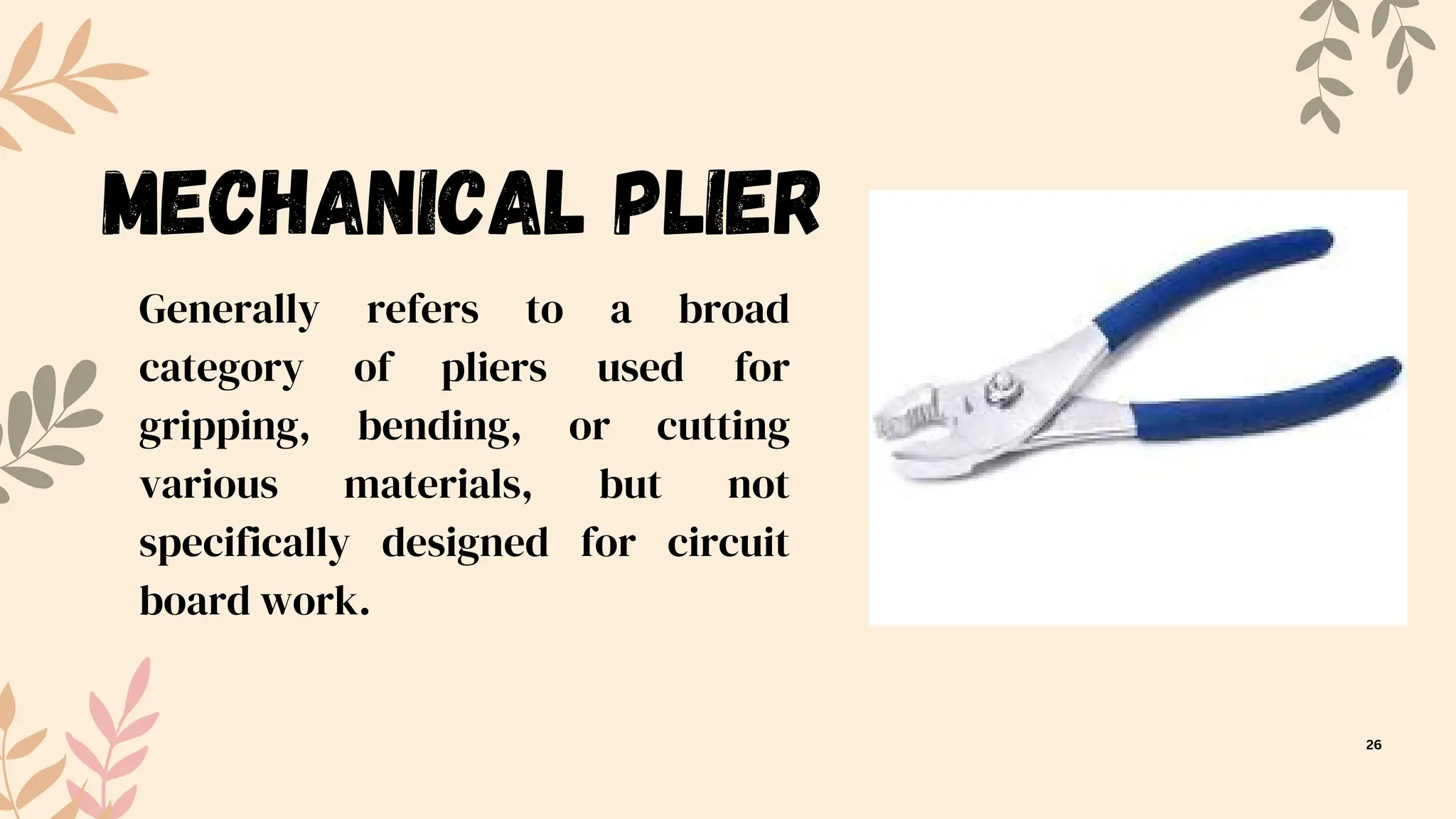
Generally refers to a broad
category of pliers used for
gripping, bending, or cutting
various materials, but not
specifically designed for circuit
board work.
Mechanical Plier
26
Also known as side-cutting pliers,
these are used for cutting, twisting
wires, and heavy-duty gripping in
electrical work, not delicate enough
for picking up small electronic
components.
Lineman plier
This plier has narrow,
pointed tips that allow
precise gripping of small
components, ideal for use
in tight spaces such as a
circuit board.
LONG NOSE PLIER
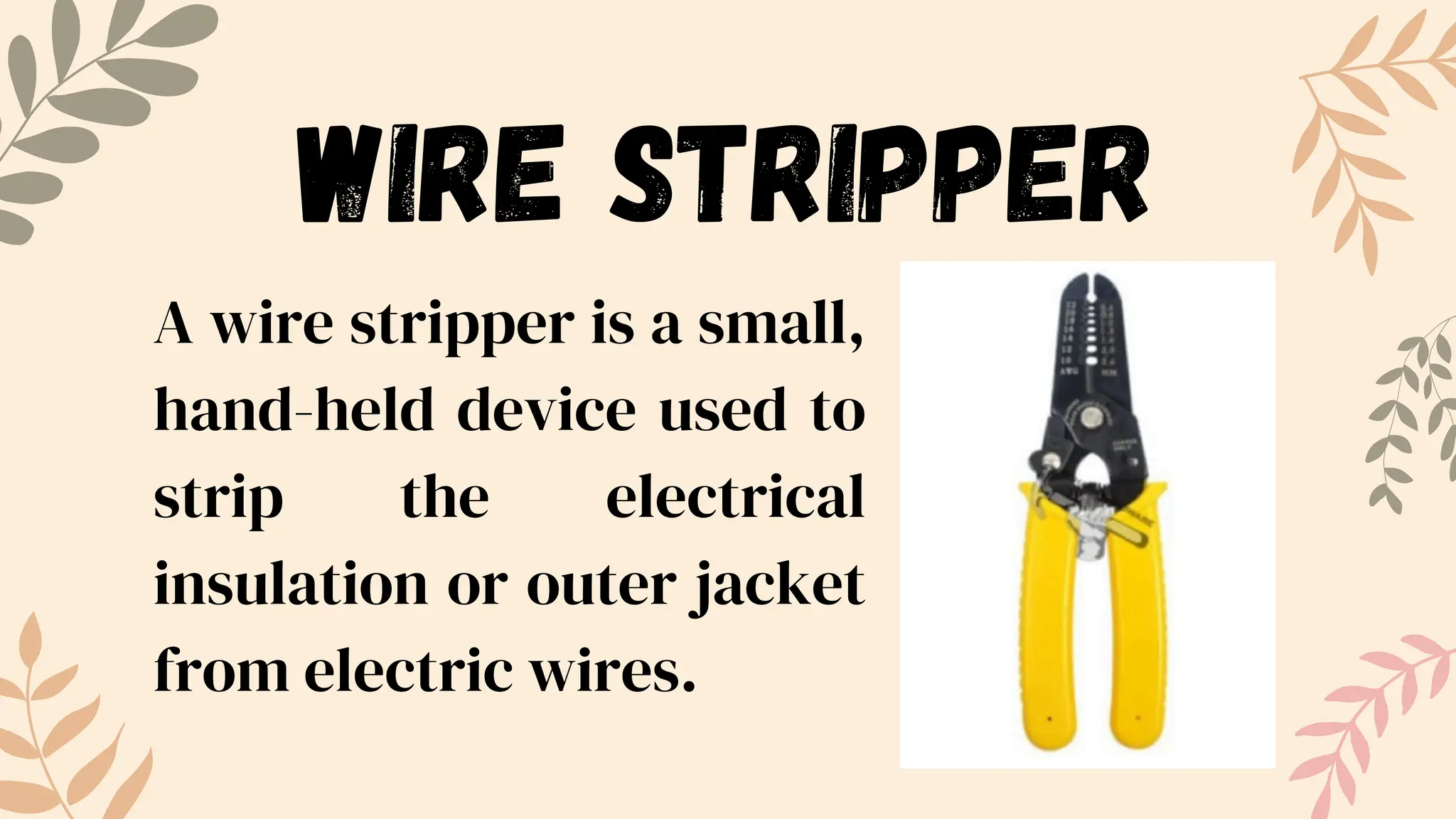
WIRE STRIPPER
A wire stripper is a small,
hand-held device used to
strip the electrical
insulation or outer jacket
from electric wires.
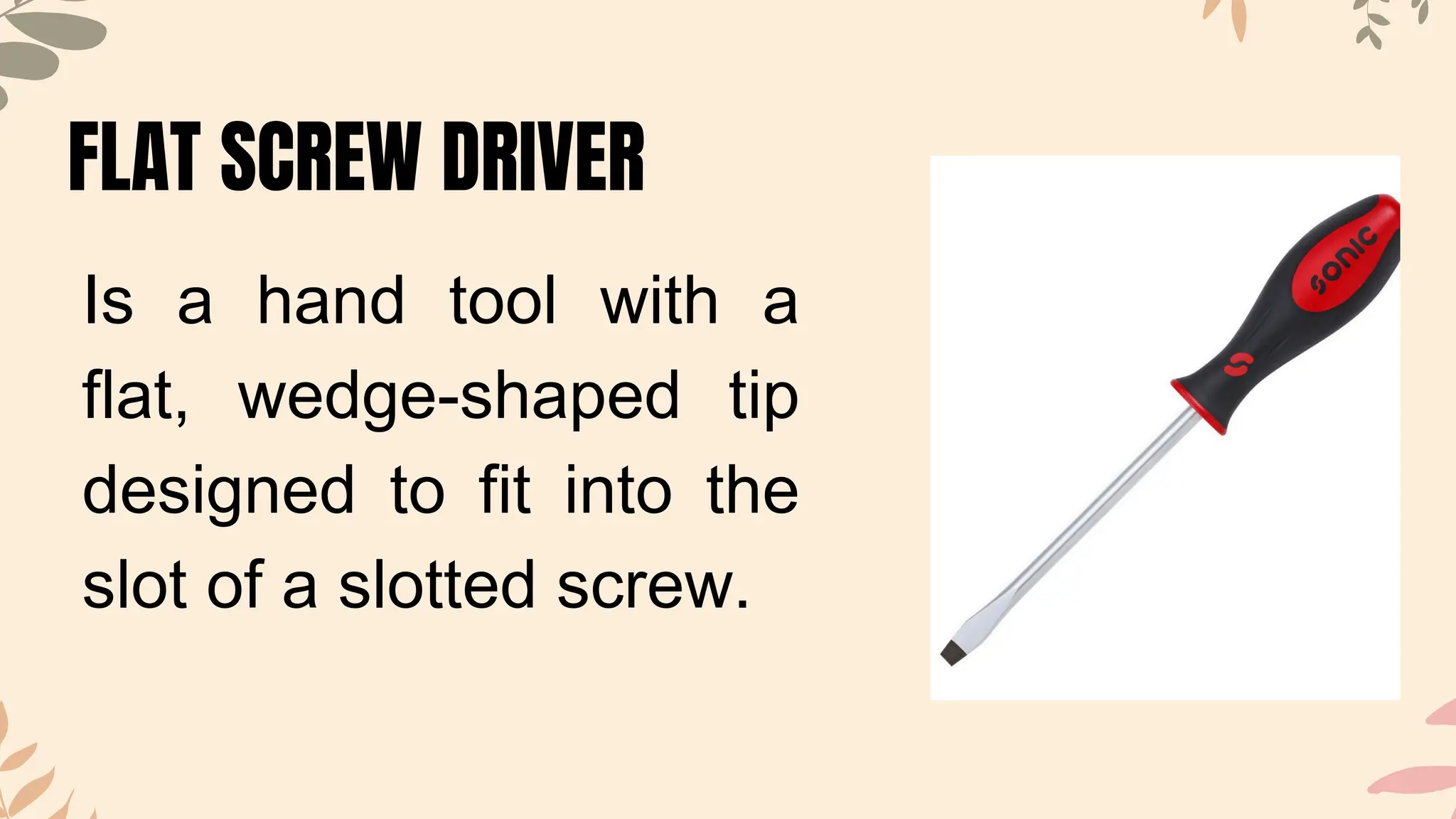
FLAT SCREW DRIVER
Is a hand tool with a
flat, wedge-shaped tip
designed to fit into the
slot of a slotted screw.
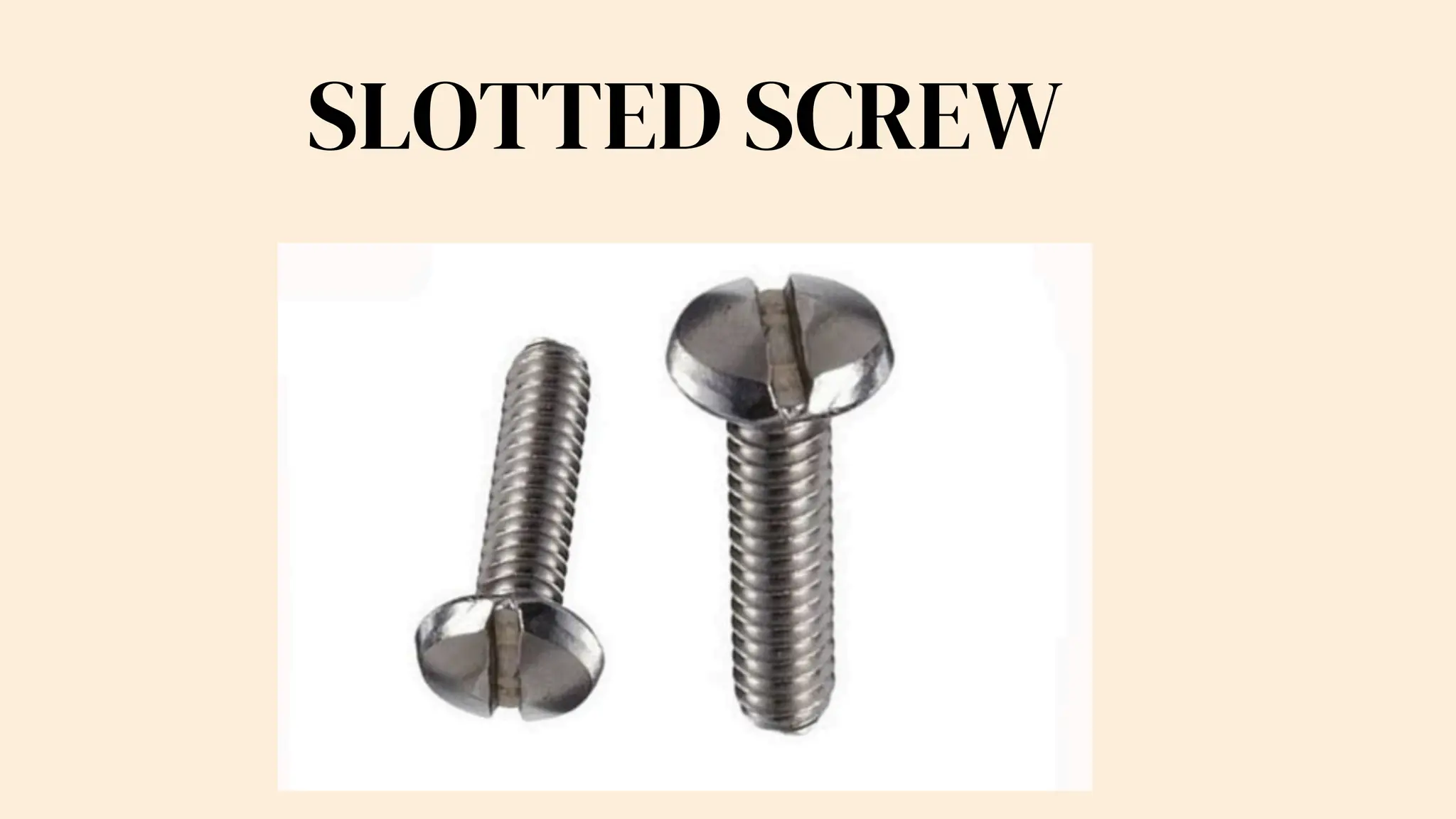
SLOTTED SCREW
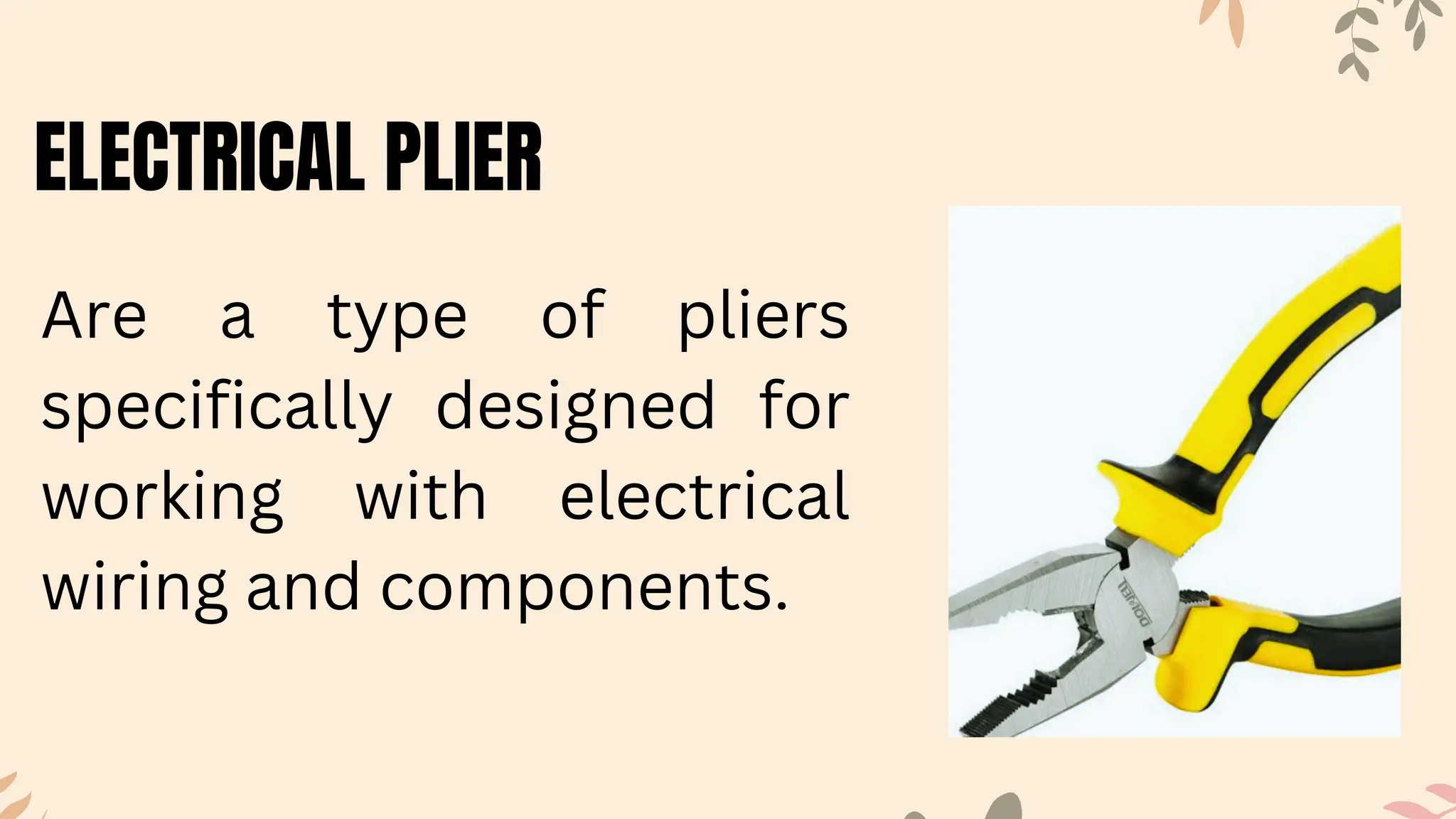
ELECTRICAL PLIER
Are a type of pliers
specifically designed for
working with electrical
wiring and components.
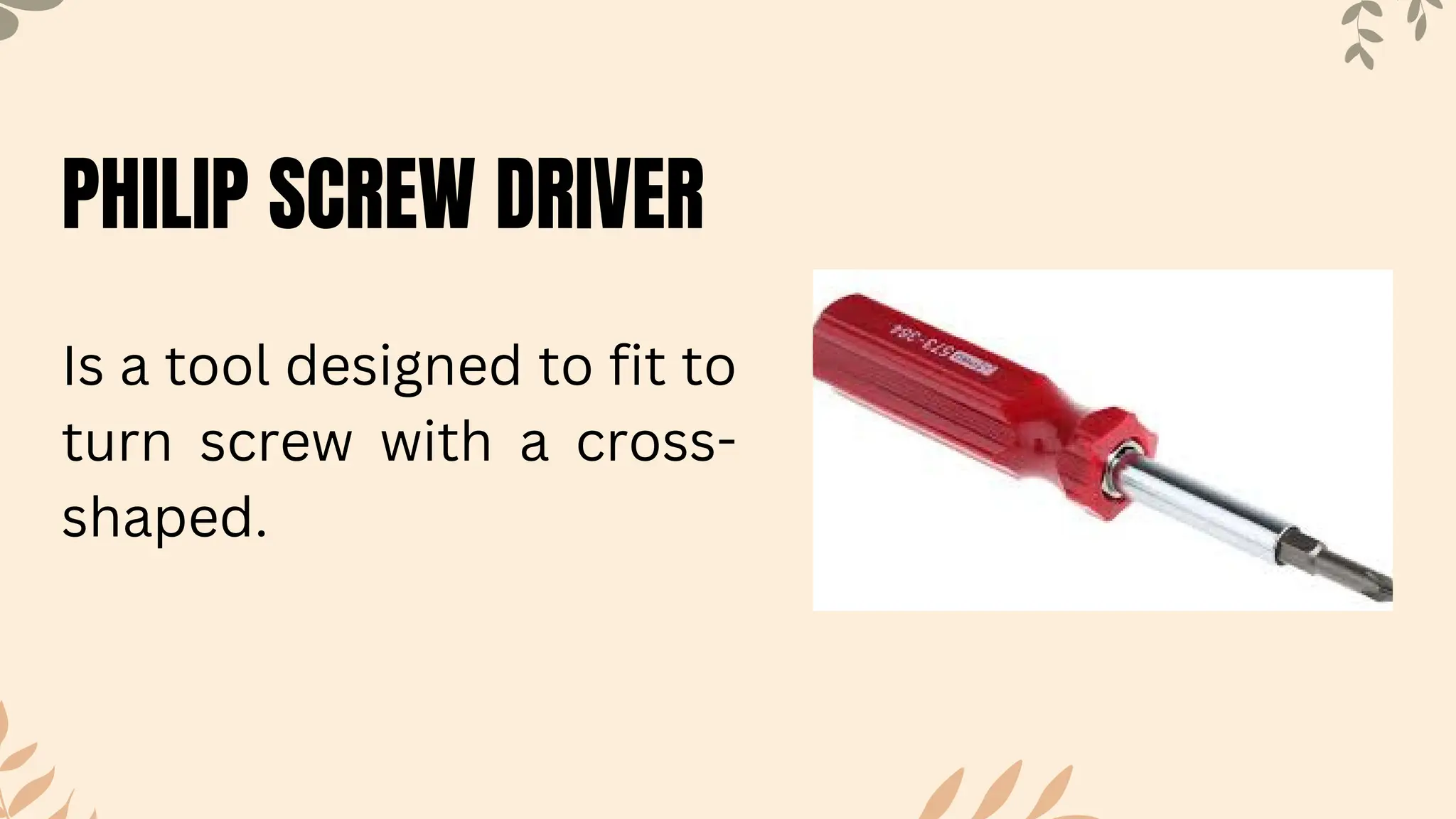
PHILIP SCREW DRIVER
Is a tool designed to fit to
turn screw with a cross-
shaped.
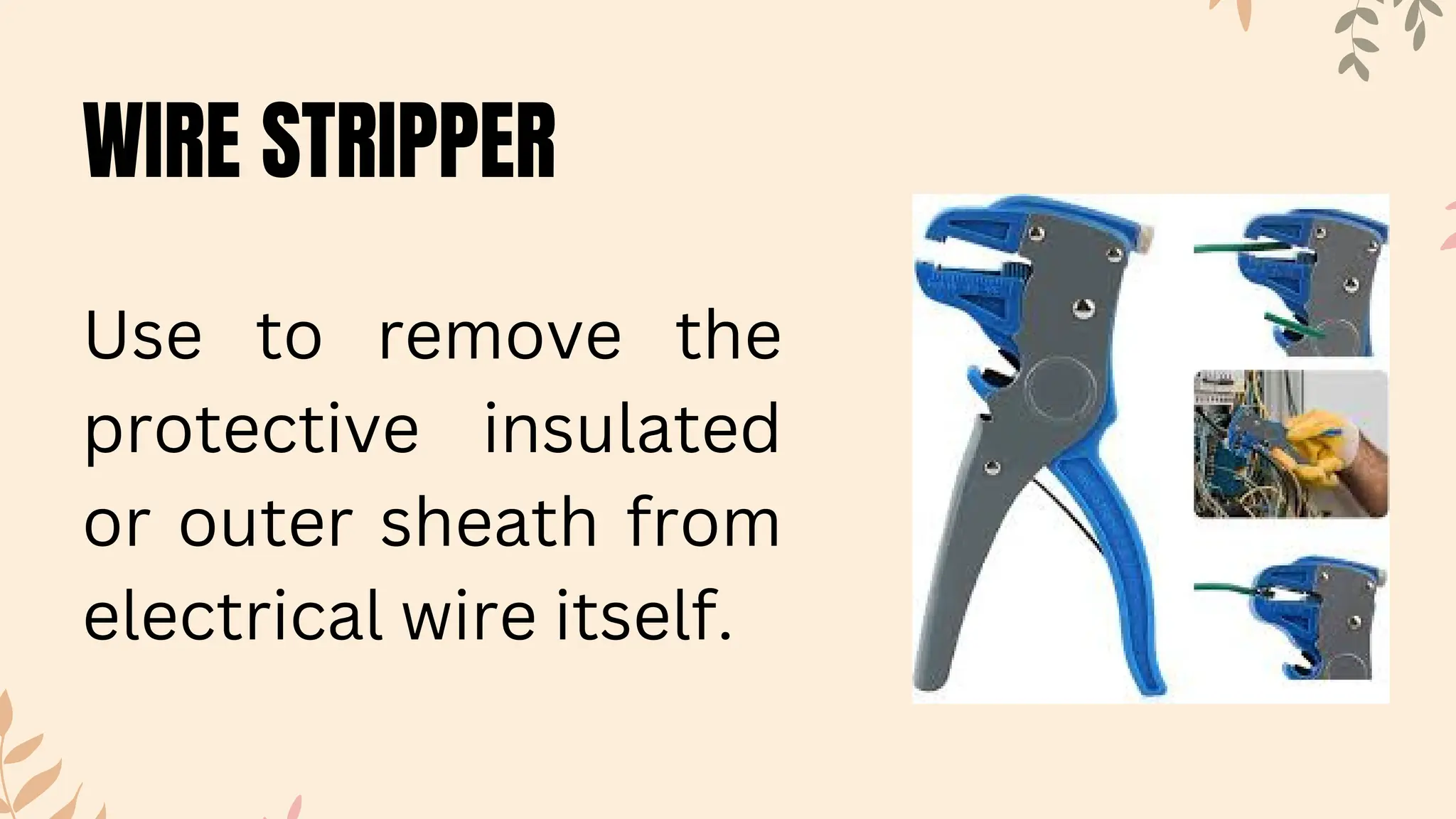
WIRE STRIPPER
Use to remove the
protective insulated
or outer sheath from
electrical wire itself.
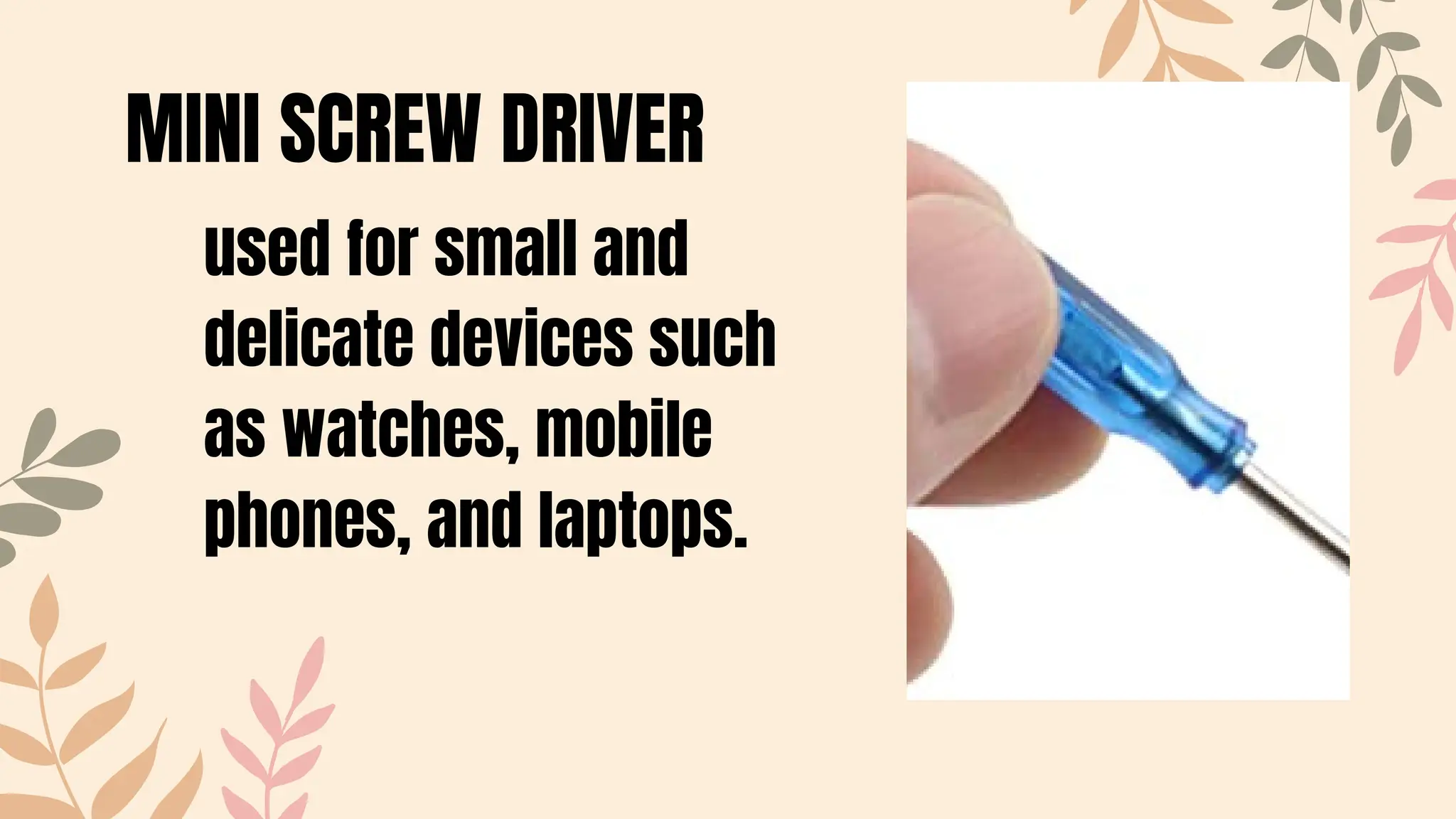
MINI SCREW DRIVER
used for small and
delicate devices such
as watches, mobile
phones, and laptops.
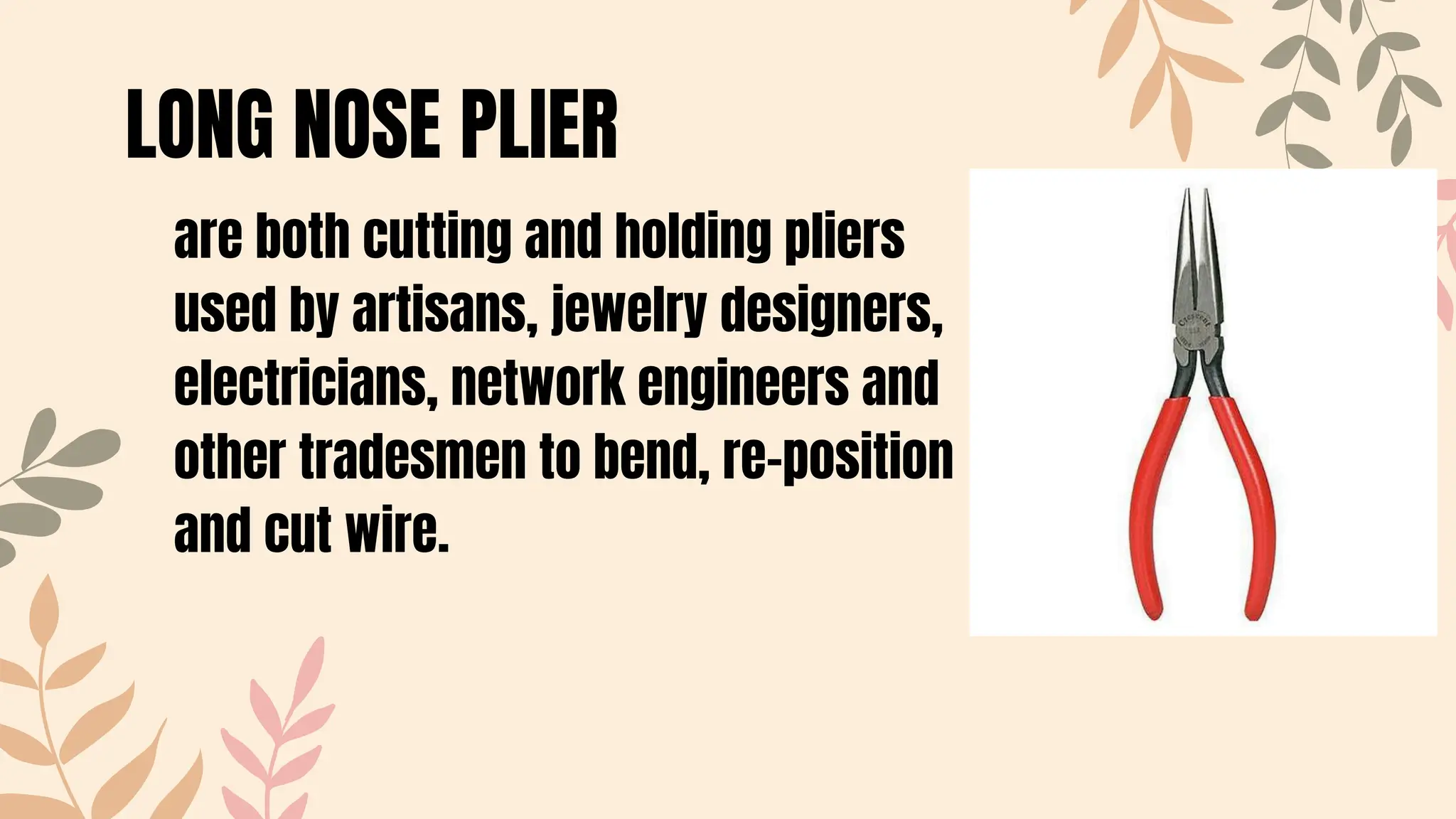
are both cutting and holding pliers
used by artisans, jewelry designers,
electricians, network engineers and
other tradesmen to bend, re-position
and cut wire.
LONG NOSE PLIER
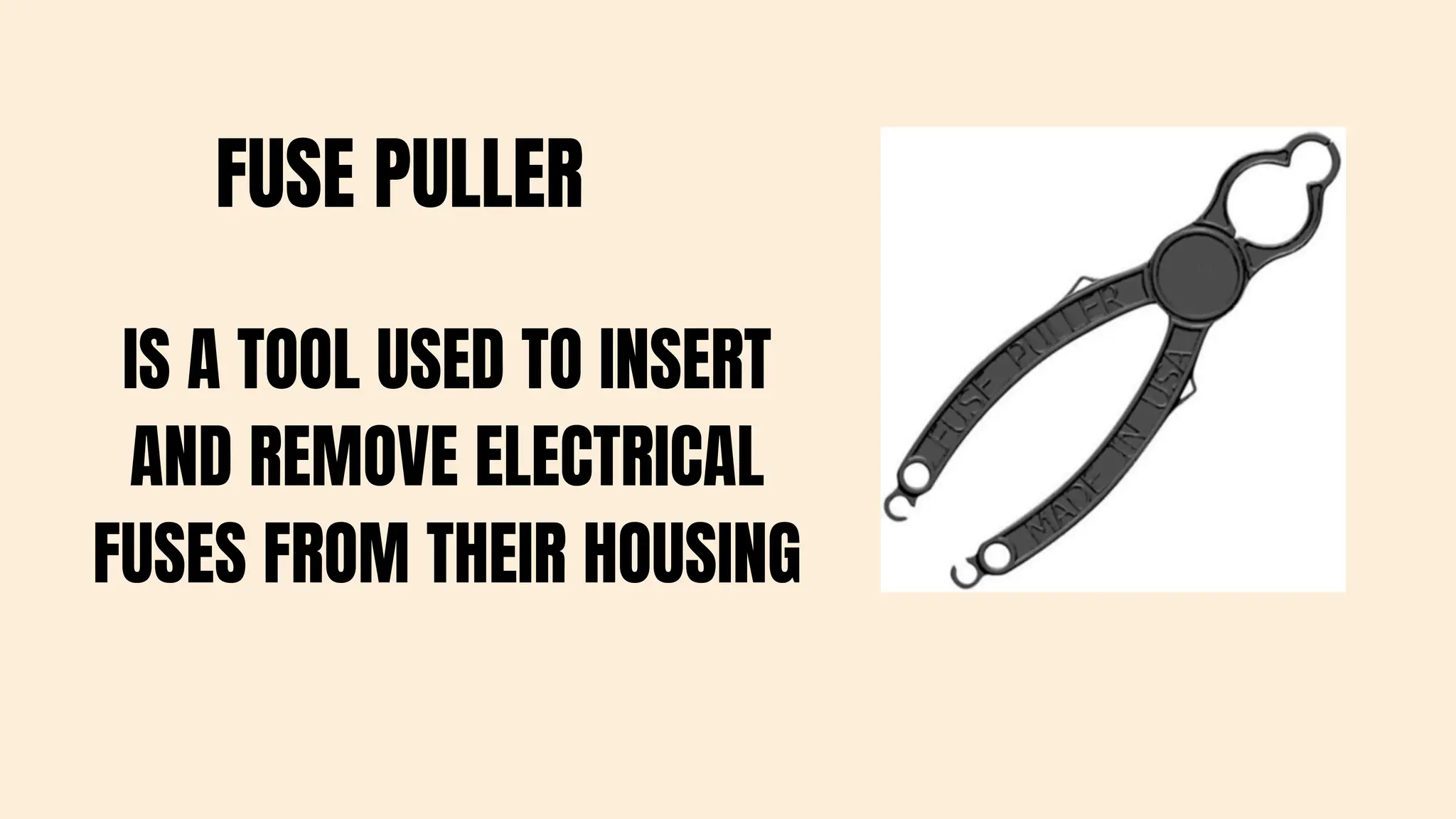
IS A TOOL USED TO INSERT
AND REMOVE ELECTRICAL
FUSES FROM THEIR HOUSING
FUSE PULLER
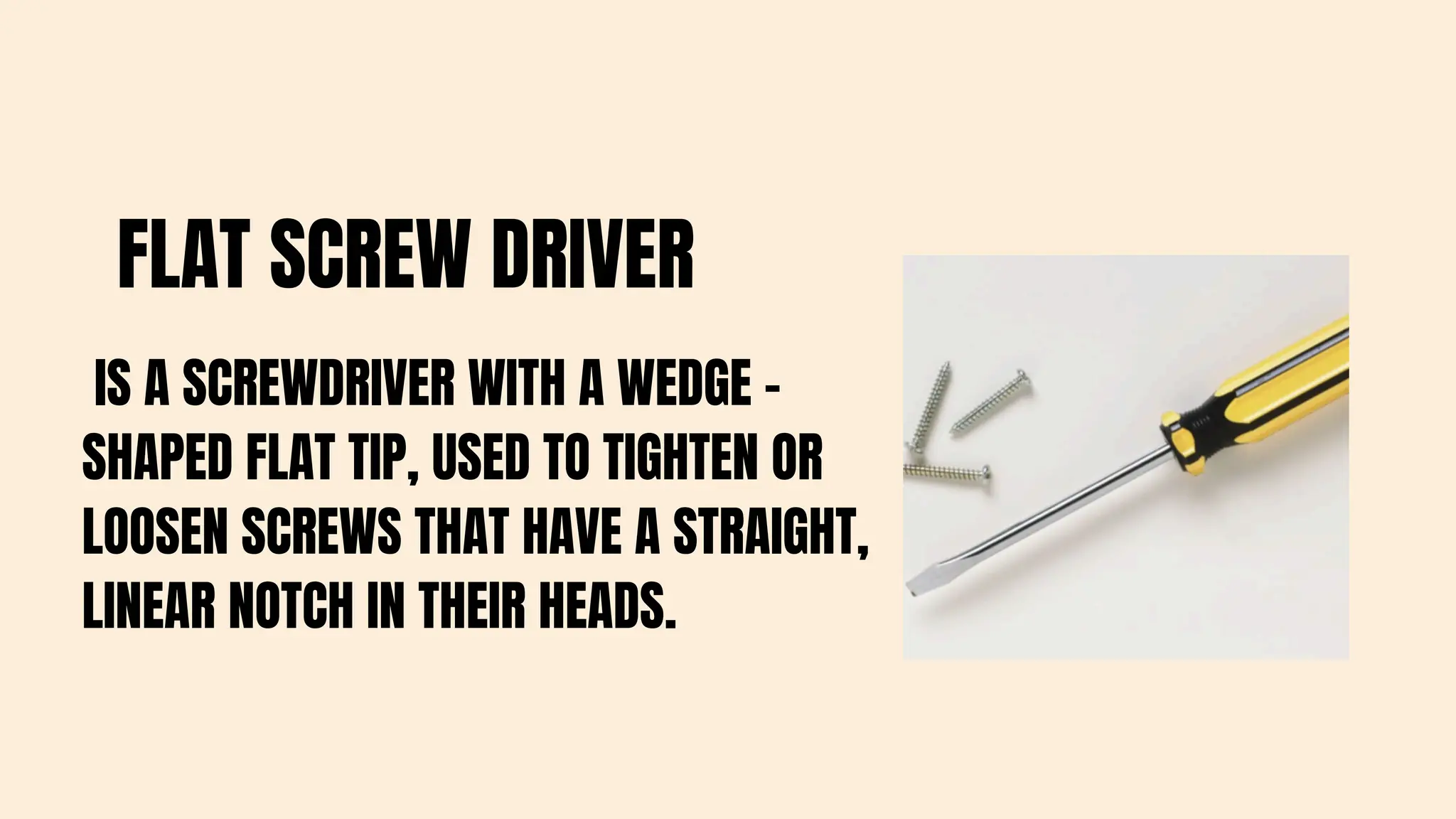
FLAT SCREW DRIVER
IS A SCREWDRIVER WITH A WEDGE -
SHAPED FLAT TIP, USED TO TIGHTEN OR
LOOSEN SCREWS THAT HAVE A STRAIGHT,
LINEAR NOTCH IN THEIR HEADS.
BASED BIASED RESISTOR
Is an electronic circuit that uses resistors to divide a
voltage in a specific ratio.
LOAD RESISTOR
Is a resistor that is used to stimulate the expected load of
a circuit or device, allowing for testing, measurement or
voltage regulation.
COLLECTOR- This is the region that collects the majority carriers from the
base region.It is typically connected to the positive terminal of a power
supply.
BASE-This is the thin region between the collector and emitter. It controls
the flow of current between the collector and emitter.
EMITTER- This is the region that emits the majority carriers into the base
region. It is typically connected to the negative terminal of a power supply.
POSITIVE- in electronics generally refers to a higher potential compared to
a reference point. It is often represented by the symbol "+".
31
HEAT SINK
SILICON GREASE
Is a device used to dissipate heat away from electronic
components, such as CPUs, transistors, or power
regulators, to prevent them from overheating.
Is a thick, slippery substance made from silicone oil
and a thickening agent, such as silica. It is commonly
used as a thermal compound and lubricant in various
electrical and mechanical applications.
35
INSULATOR
Is an object that does not conduct heat well.
EXHAUST FAN
A piece of equipment used to remove steam,
smoke or unpleasant smells from a room or
building.
REVERSE
-The term "reverse" generally
refers to moving backward or
going in the opposite direction.
36
Forward
-Refers to a movement or direction
toward a place, position, or time that is
ahead or in front of you.
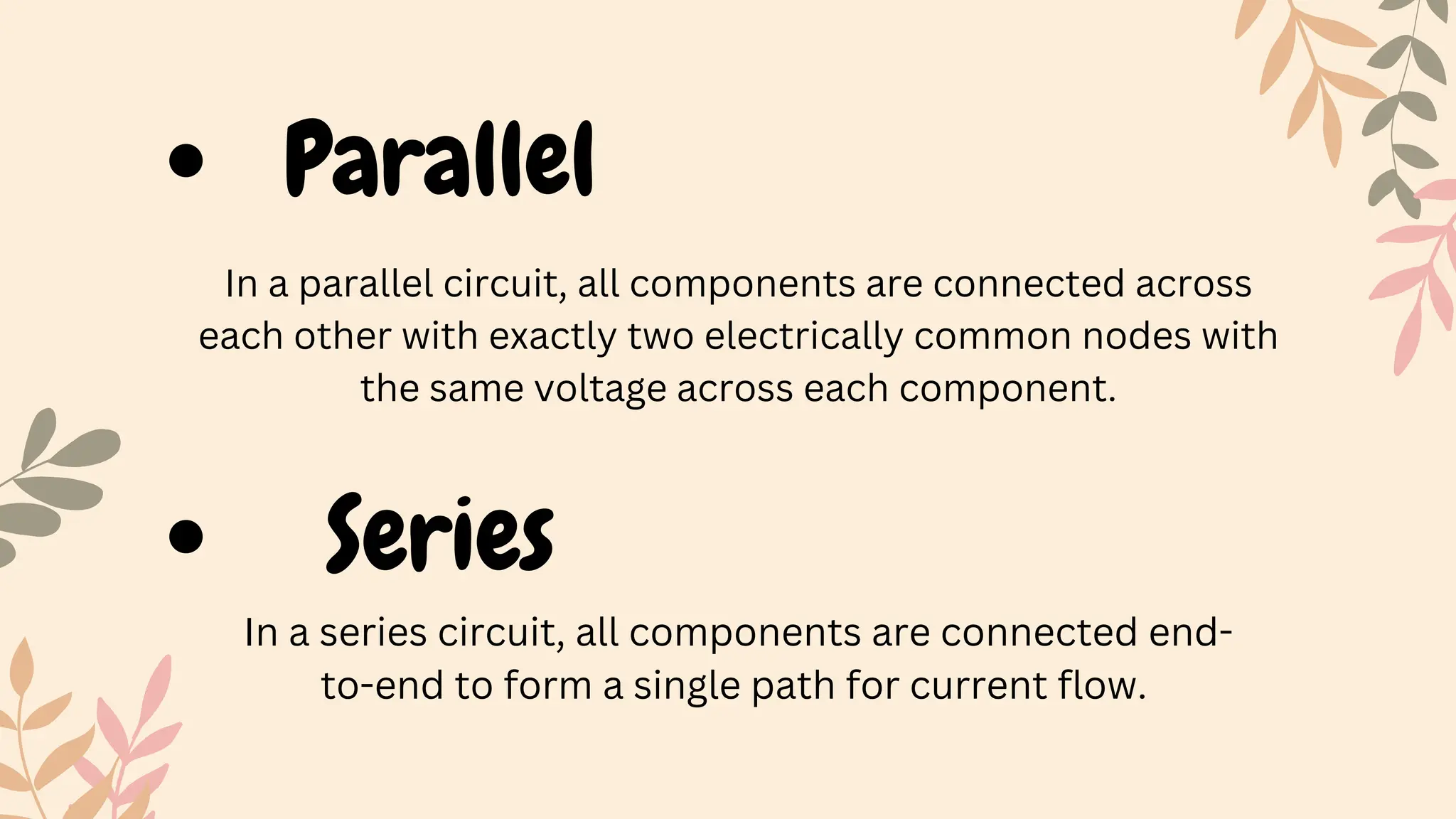
Parallel
In a series circuit, all components are connected end-
to-end to form a single path for current flow.
In a parallel circuit, all components are connected across
each other with exactly two electrically common nodes with
the same voltage across each component.
Series
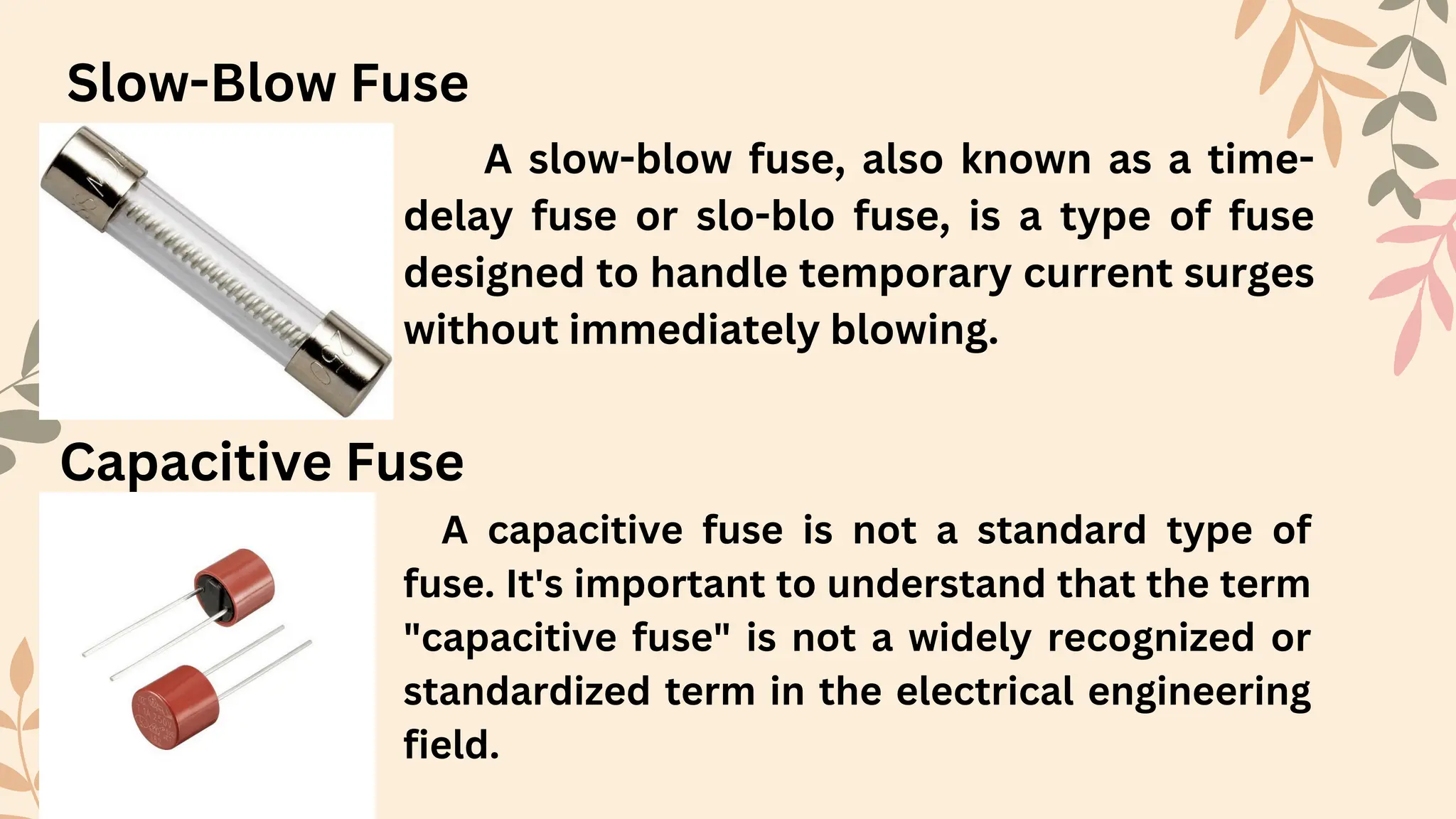
Slow-Blow Fuse
A slow-blow fuse, also known as a time-
delay fuse or slo-blo fuse, is a type of fuse
designed to handle temporary current surges
without immediately blowing.
Capacitive Fuse
A capacitive fuse is not a standard type of
fuse. It's important to understand that the term
"capacitive fuse" is not a widely recognized or
standardized term in the electrical engineering
field.
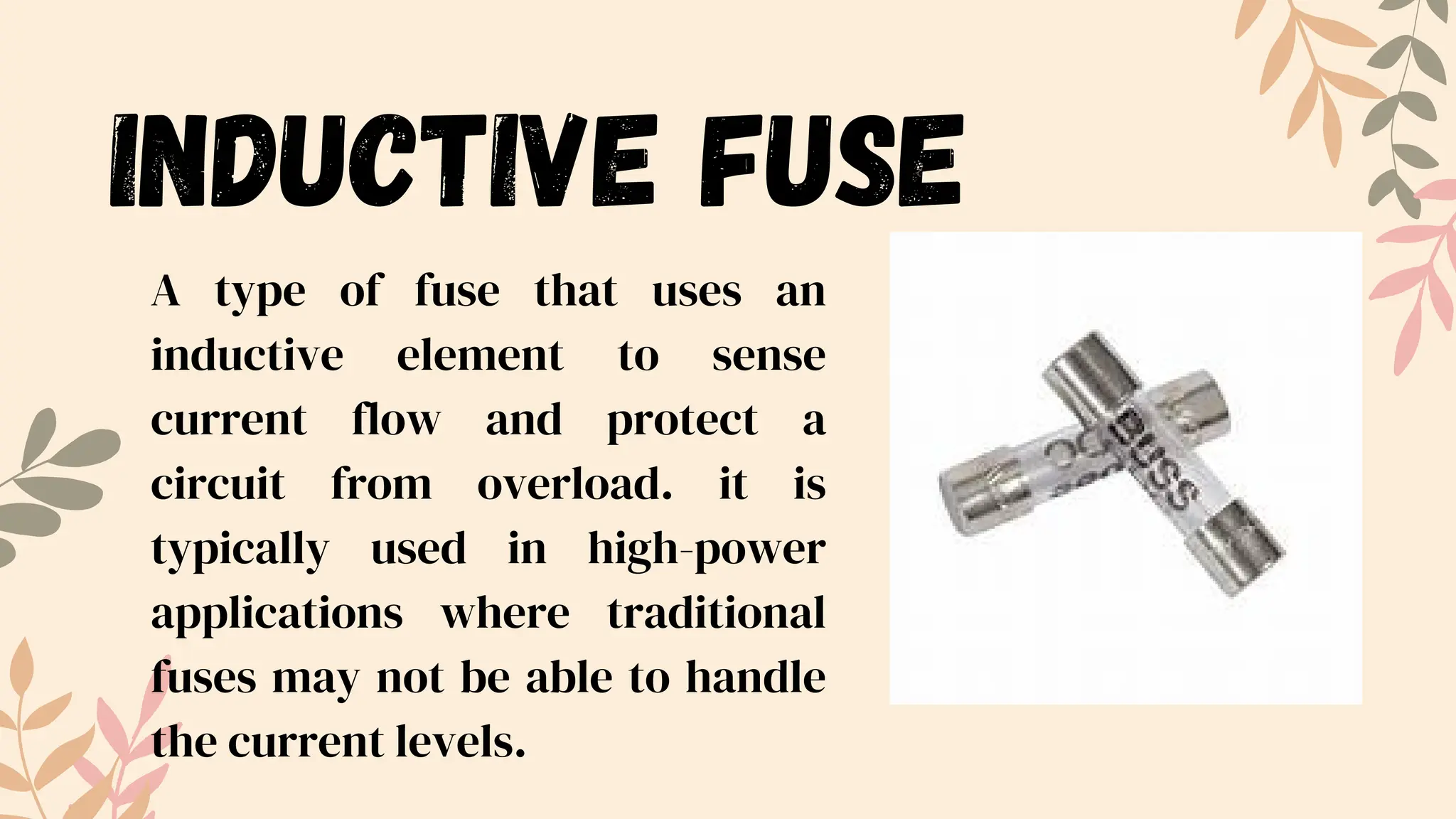
inductive fuse
A type of fuse that uses an
inductive element to sense
current flow and protect a
circuit from overload. it is
typically used in high-power
applications where traditional
fuses may not be able to handle
the current levels.
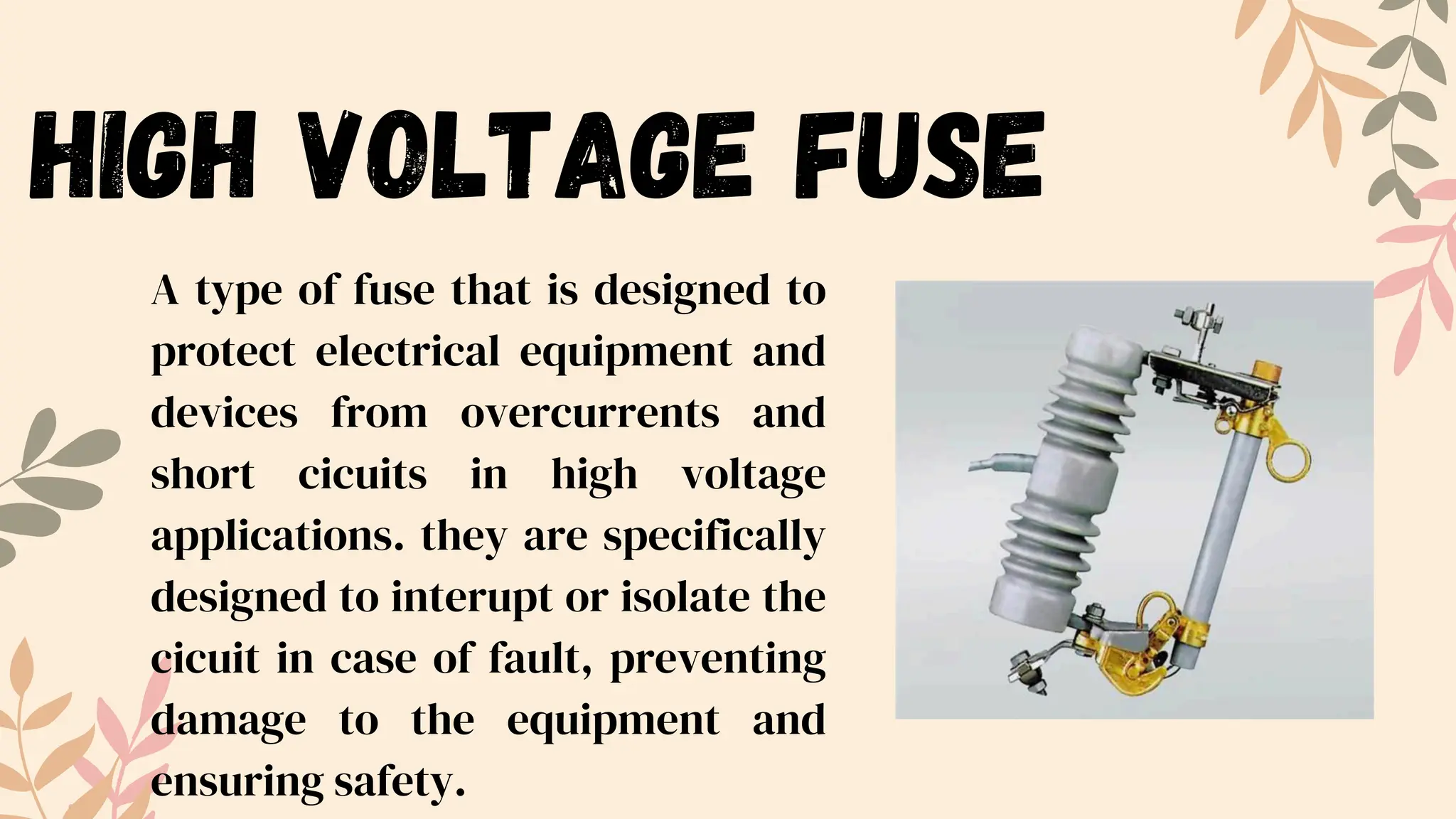
high voltage fuse
A type of fuse that is designed to
protect electrical equipment and
devices from overcurrents and
short cicuits in high voltage
applications. they are specifically
designed to interupt or isolate the
cicuit in case of fault, preventing
damage to the equipment and
ensuring safety.
WHICH IS TRUE OF A SERIES DC MOTOR WITH NO LOAD?
Tends to stop or not start - switching-off or application of reverse
polarity (reversing the power supply to motor).
Has reversed direction - Incorrect component installation
Maybe damaged by excessive speed - it will run at a dangerous speed. It
will burn out. A DC series motor wouldn't be allowed to operate in no
load condition
Becomes an AC generator - Inverters are an essential part of any
electronic device that converts direct current (DC) power to alternating
current (AC) power. 39
Graph
Fluctuation
are used to represent various
relationships between electrical
refer to variations in electrical
quantities such as voltage, current, or
power over time.
40
Sine Wave
Cycle
is a smooth, periodic oscillation that represents
a mathematical curve defined by the sine
function.
refers to one complete waveform, which includes one full
oscillation from the starting point to the peak, down
through the equilibrium point to the trough, and back to
the starting point.
41
Capacitor
is a two-terminal electrical device that can
store energy in the form of an electric
charge.
Parllel Circuit
has two or more paths for current to flow through.
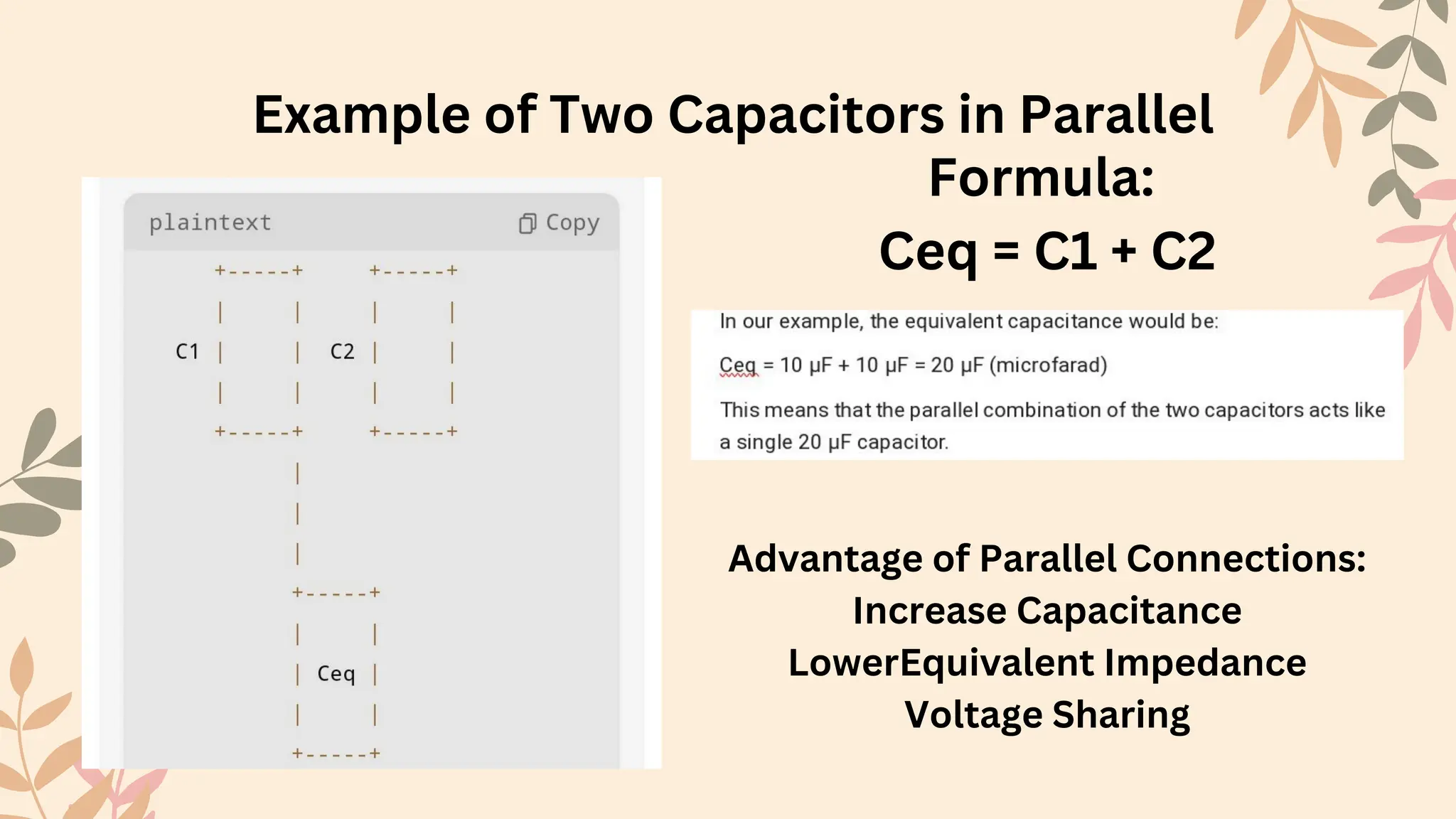
Example of Two Capacitors in Parallel
Formula:
Ceq = C1 + C2
Advantage of Parallel Connections:
Increase Capacitance
LowerEquivalent Impedance
Voltage Sharing
If two capacitors of the same value are
connected in parallel, the total capacitance
will increase. The total capacitance in parallel
is simply the sum of the individual
capacitance.
If two capacitors in parallel are changed so that one increases
in value and the other decreases, the total capacitance will
depend on the new values of each capacitor.
▪︎When a capacitor's value increases, it adds more capacitance
to the total, meaning the system can store more charge.
▪︎When a capacitor's value decreases, it subtracts from the
total capacitance, reducing the system's ability to store charge.
Half-Wave Rectifier
- A Half-wave rectifier uses one diode to convert
an AC signal into pulsating DC. It allows only one
half of the AC waveform (either positive or negative)
to pass through, blocking the other half.
Full-Wave Center-Tap Rectifier
- A Full-wave center-tap rectifier uses two diodes
and a center-tapped transformer. It rectifies both
halves of the AC waveform, producing a full-wave
rectified output.
Full-Wave Bridge Rectifier
- uses four diodes arranged in a bridge configuration to
convert the full AC waveform into pulsating DC. It
efficiently rectifies both halves of the AC signal.
Split-Type Rectifier
- is less common and may refer to rectification that
uses separate paths for each half of the AC waveform. It
can involve different methods for rectifying each side of
the waveform, though it doesn't specifically require four
diodes.
Increases- refer to rises in voltage, current, or power,
enhancing device performance and efficiency.
Decreases- involve reductions in voltage, current, or
resistance, which can significantly affect circuit
performance. Lower voltage may lead to insufficient
power delivery, while decreased current can limit device
functionality.
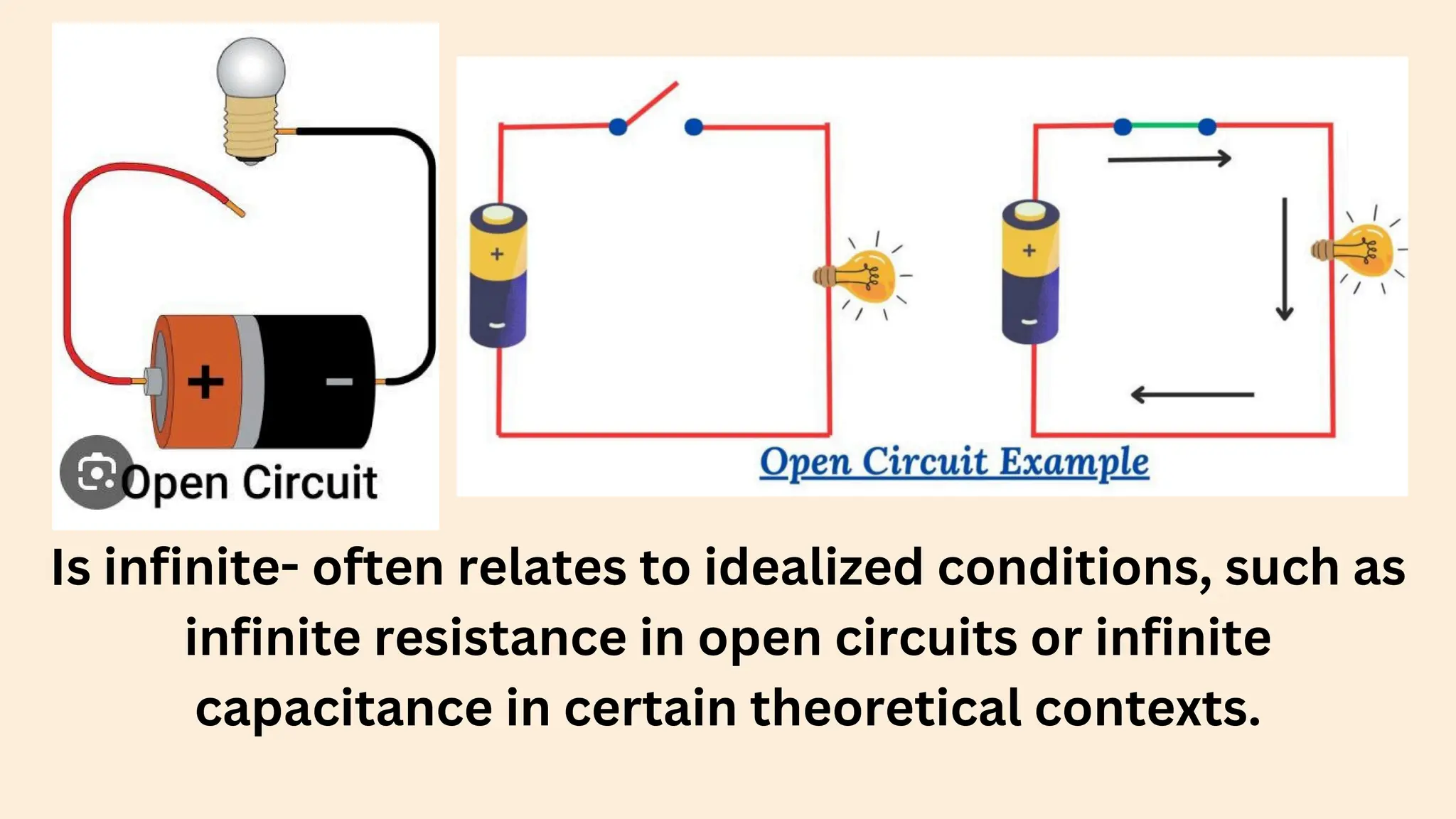
Is infinite- often relates to idealized conditions, such as
infinite resistance in open circuits or infinite
capacitance in certain theoretical contexts.
Peak Reverse Voltage (PRV)
refers to the maximum reverse voltage that a diode can withstand
without breaking down or conducting in reverse. It’s crucial for ensuring
the diode operates safely in its reverse bias condition without being
damaged.
Blow Up Voltage
often referred to in the context of electrical components, is the voltage
at which a component, such as a diode or capacitor, fails
catastrophically, typically leading to permanent damage or destruction.
This is usually higher than the rated maximum voltage, and operating at
or beyond this voltage can cause failure.
47
WORKING VOLTAGE
refers to the maximum continuous voltage that can be applied to a
component, device, or insulation without causing damage or failure during
its normal operation. It is the highest voltage that the equipment can handle
safely and reliably over time without breaking down.
BREAKDOWN VOLTAGE
is the minimum voltage at which an insulating material or electrical
component begins to conduct electricity uncontrollably, leading to failure
or damage. It occurs when the electric field becomes strong enough to
ionize the material, causing a sudden surge of current.
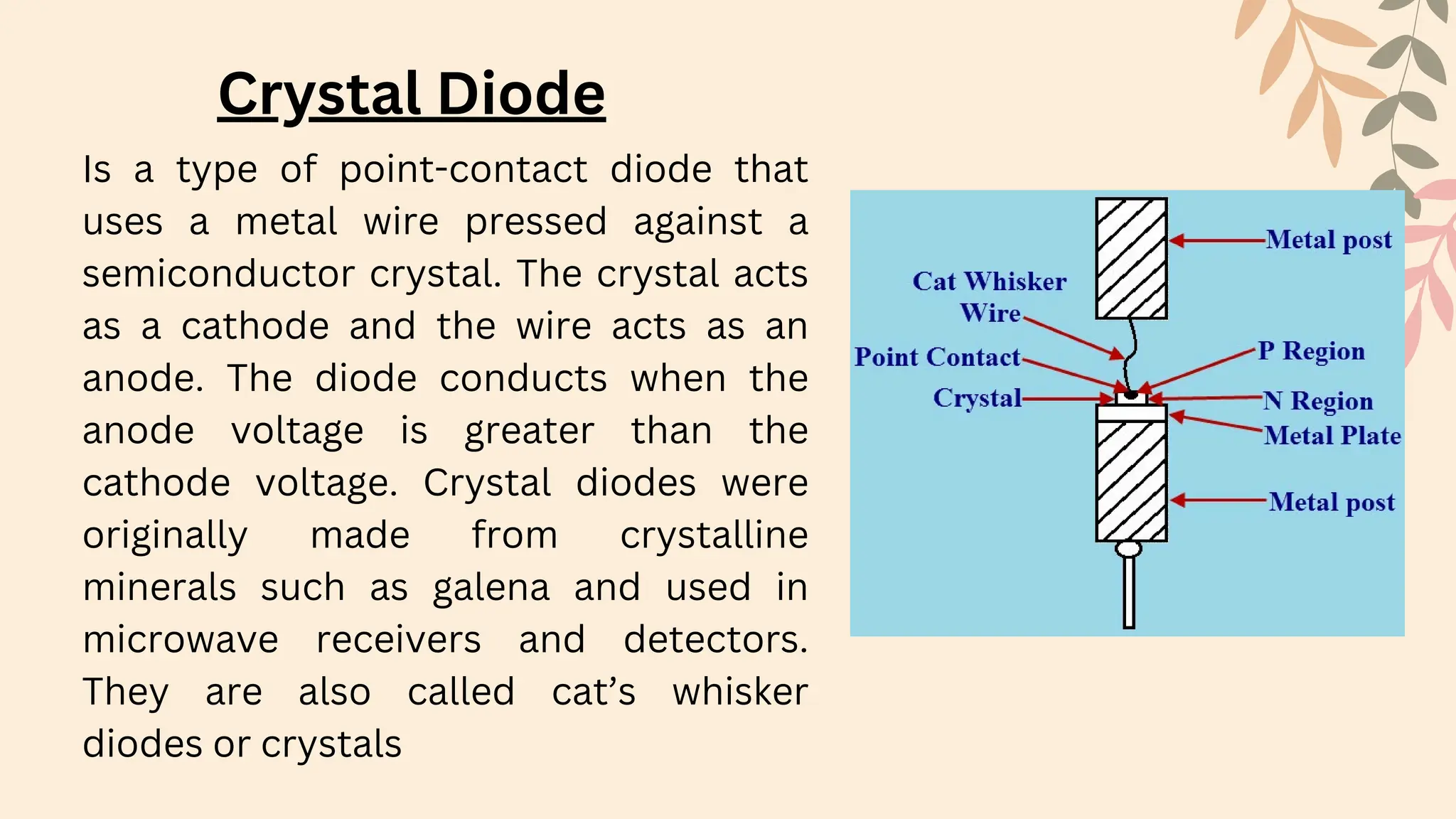
Crystal Diode
Is a type of point-contact diode that
uses a metal wire pressed against a
semiconductor crystal. The crystal acts
as a cathode and the wire acts as an
anode. The diode conducts when the
anode voltage is greater than the
cathode voltage. Crystal diodes were
originally made from crystalline
minerals such as galena and used in
microwave receivers and detectors.
They are also called cat’s whisker
diodes or crystals
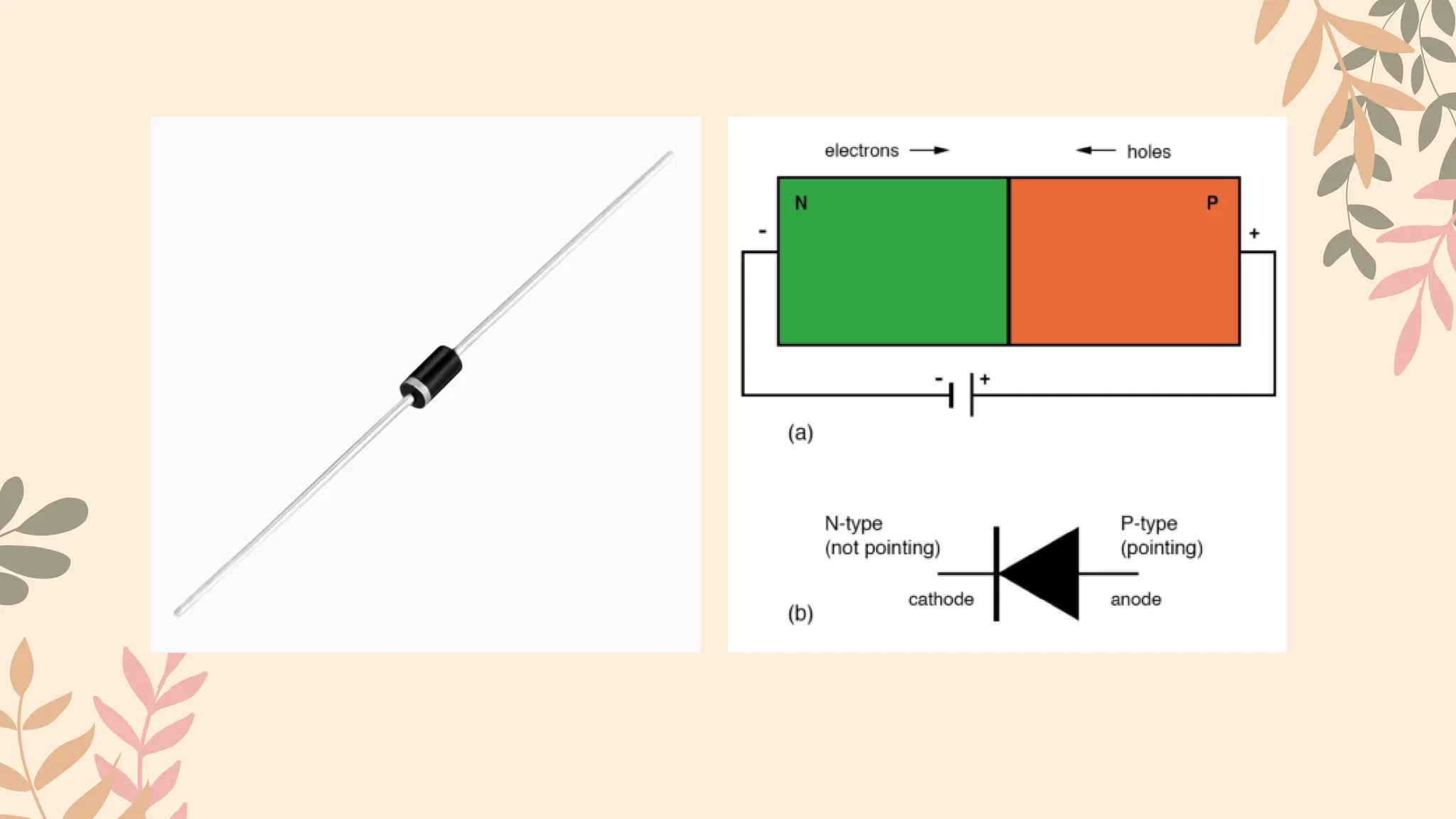
Silicon Diode
A silicon diode is a two-terminal semiconductor
device constructed from a silicon crystal. It has a
PN junction, with one side doped with atoms
containing more electrons (N-type) and the other
side doped with atoms containing fewer electrons
(P-type). The P-type side is called the anode, and
the N-type side is called the cathode.
ZENNER
is a special type of diode designed to operate in
the reverse breakdown region, where it allows
current to flow in the reverse direction when a
specific voltage is reached.
LIGHT EMITTING
is a semiconductor device that emits light when
current flows through it. Electrons in the
semiconductor recombine with electron holes,
releasing energy in the form of photons.
Thank
You
BREAKDOWN
WORKING
refers to the process of analyzing or dividing something into
smaller, more manageable parts to understand it better. It can
also refer to a failure or malfunction in a system, machine, or
process.t
refers to the process of engaging in tasks, activities, or labor with the
aim of achieving a specific goal, fulfilling responsibilities, or earning
compensation. It involves applying effort, skills, time, and often
knowledge to accomplish something, whether in a professional,
academic, or personal context.
Major-Subject-BASIC-ELECTRONICS-BTVTED-4B_20241019_103625_0000.pdf

  • 1.
    Basic Electronics PRESENTED BY:BTVTED 4B Major Subject
  • 2.
    Generally refers toa broad category of pliers used for gripping, bending, or cutting various materials, but not specifically designed for circuit board work. Mechanical Plier 26
  • 3.
    Also known asside-cutting pliers, these are used for cutting, twisting wires, and heavy-duty gripping in electrical work, not delicate enough for picking up small electronic components. Lineman plier
  • 4.
    This plier hasnarrow, pointed tips that allow precise gripping of small components, ideal for use in tight spaces such as a circuit board. LONG NOSE PLIER
  • 5.
    WIRE STRIPPER A wirestripper is a small, hand-held device used to strip the electrical insulation or outer jacket from electric wires.
  • 6.
    FLAT SCREW DRIVER Isa hand tool with a flat, wedge-shaped tip designed to fit into the slot of a slotted screw.
  • 7.
  • 8.
    ELECTRICAL PLIER Are atype of pliers specifically designed for working with electrical wiring and components.
  • 9.
    PHILIP SCREW DRIVER Isa tool designed to fit to turn screw with a cross- shaped.
  • 10.
    WIRE STRIPPER Use toremove the protective insulated or outer sheath from electrical wire itself.
  • 11.
    MINI SCREW DRIVER usedfor small and delicate devices such as watches, mobile phones, and laptops.
  • 12.
    are both cuttingand holding pliers used by artisans, jewelry designers, electricians, network engineers and other tradesmen to bend, re-position and cut wire. LONG NOSE PLIER
  • 13.
    IS A TOOLUSED TO INSERT AND REMOVE ELECTRICAL FUSES FROM THEIR HOUSING FUSE PULLER
  • 14.
    FLAT SCREW DRIVER ISA SCREWDRIVER WITH A WEDGE - SHAPED FLAT TIP, USED TO TIGHTEN OR LOOSEN SCREWS THAT HAVE A STRAIGHT, LINEAR NOTCH IN THEIR HEADS.
  • 15.
    BASED BIASED RESISTOR Isan electronic circuit that uses resistors to divide a voltage in a specific ratio. LOAD RESISTOR Is a resistor that is used to stimulate the expected load of a circuit or device, allowing for testing, measurement or voltage regulation.
  • 16.
    COLLECTOR- This isthe region that collects the majority carriers from the base region.It is typically connected to the positive terminal of a power supply. BASE-This is the thin region between the collector and emitter. It controls the flow of current between the collector and emitter. EMITTER- This is the region that emits the majority carriers into the base region. It is typically connected to the negative terminal of a power supply. POSITIVE- in electronics generally refers to a higher potential compared to a reference point. It is often represented by the symbol "+". 31
  • 17.
    HEAT SINK SILICON GREASE Isa device used to dissipate heat away from electronic components, such as CPUs, transistors, or power regulators, to prevent them from overheating. Is a thick, slippery substance made from silicone oil and a thickening agent, such as silica. It is commonly used as a thermal compound and lubricant in various electrical and mechanical applications. 35
  • 18.
    INSULATOR Is an objectthat does not conduct heat well. EXHAUST FAN A piece of equipment used to remove steam, smoke or unpleasant smells from a room or building.
  • 19.
    REVERSE -The term "reverse"generally refers to moving backward or going in the opposite direction. 36
  • 20.
    Forward -Refers to amovement or direction toward a place, position, or time that is ahead or in front of you.
  • 21.
    Parallel In a seriescircuit, all components are connected end- to-end to form a single path for current flow. In a parallel circuit, all components are connected across each other with exactly two electrically common nodes with the same voltage across each component. Series
  • 22.
    Slow-Blow Fuse A slow-blowfuse, also known as a time- delay fuse or slo-blo fuse, is a type of fuse designed to handle temporary current surges without immediately blowing. Capacitive Fuse A capacitive fuse is not a standard type of fuse. It's important to understand that the term "capacitive fuse" is not a widely recognized or standardized term in the electrical engineering field.
  • 23.
    inductive fuse A typeof fuse that uses an inductive element to sense current flow and protect a circuit from overload. it is typically used in high-power applications where traditional fuses may not be able to handle the current levels.
  • 24.
    high voltage fuse Atype of fuse that is designed to protect electrical equipment and devices from overcurrents and short cicuits in high voltage applications. they are specifically designed to interupt or isolate the cicuit in case of fault, preventing damage to the equipment and ensuring safety.
  • 25.
    WHICH IS TRUEOF A SERIES DC MOTOR WITH NO LOAD? Tends to stop or not start - switching-off or application of reverse polarity (reversing the power supply to motor). Has reversed direction - Incorrect component installation Maybe damaged by excessive speed - it will run at a dangerous speed. It will burn out. A DC series motor wouldn't be allowed to operate in no load condition Becomes an AC generator - Inverters are an essential part of any electronic device that converts direct current (DC) power to alternating current (AC) power. 39
  • 26.
    Graph Fluctuation are used torepresent various relationships between electrical refer to variations in electrical quantities such as voltage, current, or power over time. 40
  • 27.
    Sine Wave Cycle is asmooth, periodic oscillation that represents a mathematical curve defined by the sine function. refers to one complete waveform, which includes one full oscillation from the starting point to the peak, down through the equilibrium point to the trough, and back to the starting point.
  • 28.
    41 Capacitor is a two-terminalelectrical device that can store energy in the form of an electric charge. Parllel Circuit has two or more paths for current to flow through.
  • 29.
    Example of TwoCapacitors in Parallel Formula: Ceq = C1 + C2 Advantage of Parallel Connections: Increase Capacitance LowerEquivalent Impedance Voltage Sharing
  • 30.
    If two capacitorsof the same value are connected in parallel, the total capacitance will increase. The total capacitance in parallel is simply the sum of the individual capacitance.
  • 31.
    If two capacitorsin parallel are changed so that one increases in value and the other decreases, the total capacitance will depend on the new values of each capacitor. ▪︎When a capacitor's value increases, it adds more capacitance to the total, meaning the system can store more charge. ▪︎When a capacitor's value decreases, it subtracts from the total capacitance, reducing the system's ability to store charge.
  • 32.
    Half-Wave Rectifier - AHalf-wave rectifier uses one diode to convert an AC signal into pulsating DC. It allows only one half of the AC waveform (either positive or negative) to pass through, blocking the other half. Full-Wave Center-Tap Rectifier - A Full-wave center-tap rectifier uses two diodes and a center-tapped transformer. It rectifies both halves of the AC waveform, producing a full-wave rectified output.
  • 33.
    Full-Wave Bridge Rectifier -uses four diodes arranged in a bridge configuration to convert the full AC waveform into pulsating DC. It efficiently rectifies both halves of the AC signal. Split-Type Rectifier - is less common and may refer to rectification that uses separate paths for each half of the AC waveform. It can involve different methods for rectifying each side of the waveform, though it doesn't specifically require four diodes.
  • 34.
    Increases- refer torises in voltage, current, or power, enhancing device performance and efficiency. Decreases- involve reductions in voltage, current, or resistance, which can significantly affect circuit performance. Lower voltage may lead to insufficient power delivery, while decreased current can limit device functionality.
  • 35.
    Is infinite- oftenrelates to idealized conditions, such as infinite resistance in open circuits or infinite capacitance in certain theoretical contexts.
  • 36.
    Peak Reverse Voltage(PRV) refers to the maximum reverse voltage that a diode can withstand without breaking down or conducting in reverse. It’s crucial for ensuring the diode operates safely in its reverse bias condition without being damaged. Blow Up Voltage often referred to in the context of electrical components, is the voltage at which a component, such as a diode or capacitor, fails catastrophically, typically leading to permanent damage or destruction. This is usually higher than the rated maximum voltage, and operating at or beyond this voltage can cause failure. 47
  • 37.
    WORKING VOLTAGE refers tothe maximum continuous voltage that can be applied to a component, device, or insulation without causing damage or failure during its normal operation. It is the highest voltage that the equipment can handle safely and reliably over time without breaking down. BREAKDOWN VOLTAGE is the minimum voltage at which an insulating material or electrical component begins to conduct electricity uncontrollably, leading to failure or damage. It occurs when the electric field becomes strong enough to ionize the material, causing a sudden surge of current.
  • 38.
    Crystal Diode Is atype of point-contact diode that uses a metal wire pressed against a semiconductor crystal. The crystal acts as a cathode and the wire acts as an anode. The diode conducts when the anode voltage is greater than the cathode voltage. Crystal diodes were originally made from crystalline minerals such as galena and used in microwave receivers and detectors. They are also called cat’s whisker diodes or crystals
  • 39.
    Silicon Diode A silicondiode is a two-terminal semiconductor device constructed from a silicon crystal. It has a PN junction, with one side doped with atoms containing more electrons (N-type) and the other side doped with atoms containing fewer electrons (P-type). The P-type side is called the anode, and the N-type side is called the cathode.
  • 41.
    ZENNER is a specialtype of diode designed to operate in the reverse breakdown region, where it allows current to flow in the reverse direction when a specific voltage is reached. LIGHT EMITTING is a semiconductor device that emits light when current flows through it. Electrons in the semiconductor recombine with electron holes, releasing energy in the form of photons.
  • 42.
  • 43.
    BREAKDOWN WORKING refers to theprocess of analyzing or dividing something into smaller, more manageable parts to understand it better. It can also refer to a failure or malfunction in a system, machine, or process.t refers to the process of engaging in tasks, activities, or labor with the aim of achieving a specific goal, fulfilling responsibilities, or earning compensation. It involves applying effort, skills, time, and often knowledge to accomplish something, whether in a professional, academic, or personal context.