PROGRAMMING

Professor
Jo B. Bitonio

DM 211
Project Development
and Management

Presented by:
Sheryle A. Domingo
MDM Public Mgmt.
To begin with the presentation, let us

review how investment

programming is related to
Development Planning Process and
Strategic Planning Process Model
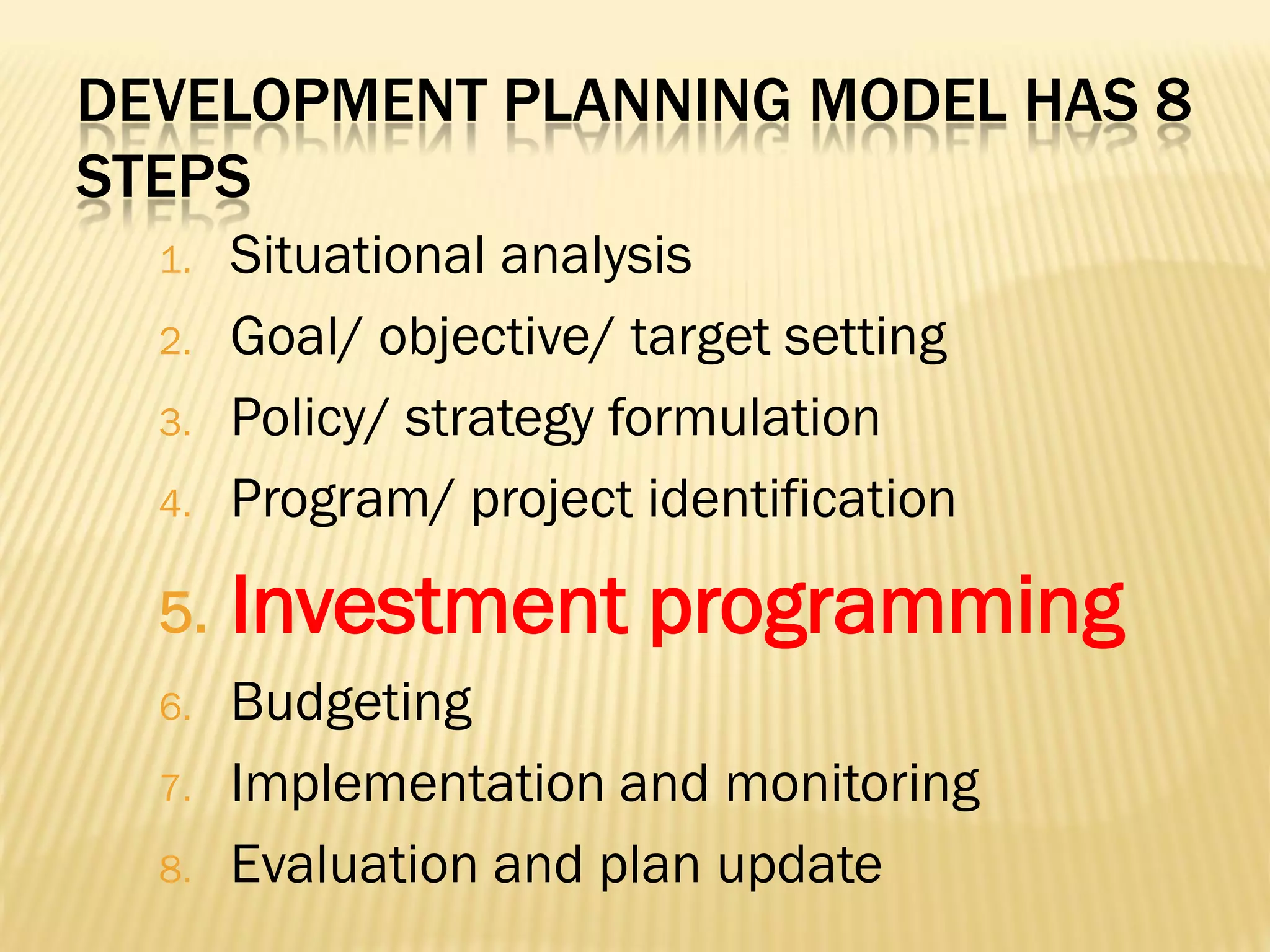
DEVELOPMENT PLANNING MODEL HAS 8
STEPS

4.

Situational analysis
Goal/ objective/ target setting
Policy/ strategy formulation
Program/ project identification

5.

Investment programming

1.

2.
3.

6.
7.
8.

Budgeting
Implementation and monitoring
Evaluation and plan update
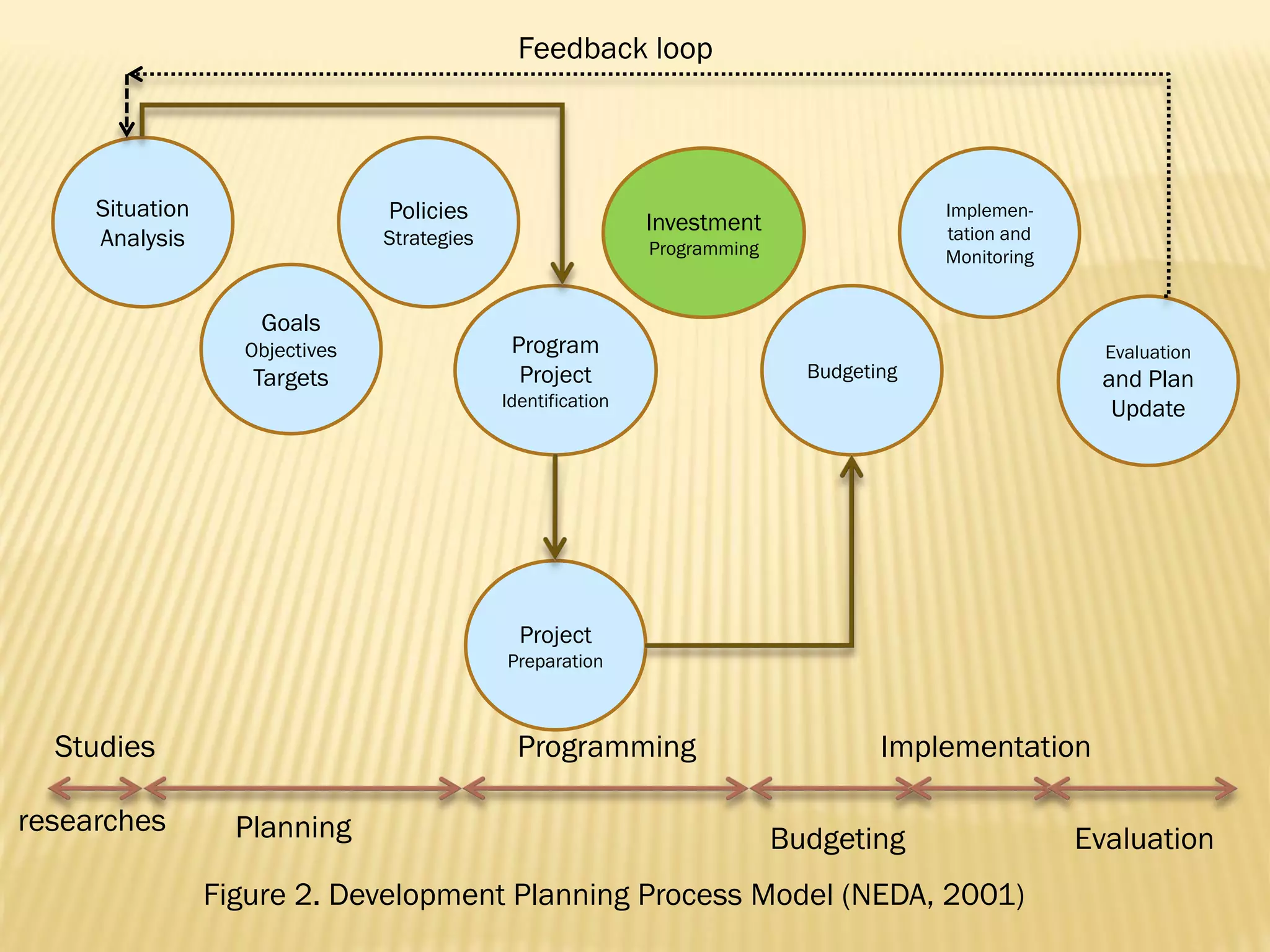
Feedback loop

Situation
Analysis

Policies
Strategies

Goals
Objectives

Targets

Implementation and
Monitoring

Investment
Programming

Program
Project

Evaluation

Budgeting

and Plan
Update

Identification

Project
Preparation

Studies
researches

Programming
Planning

Implementation
Budgeting

Figure 2. Development Planning Process Model (NEDA, 2001)

Evaluation
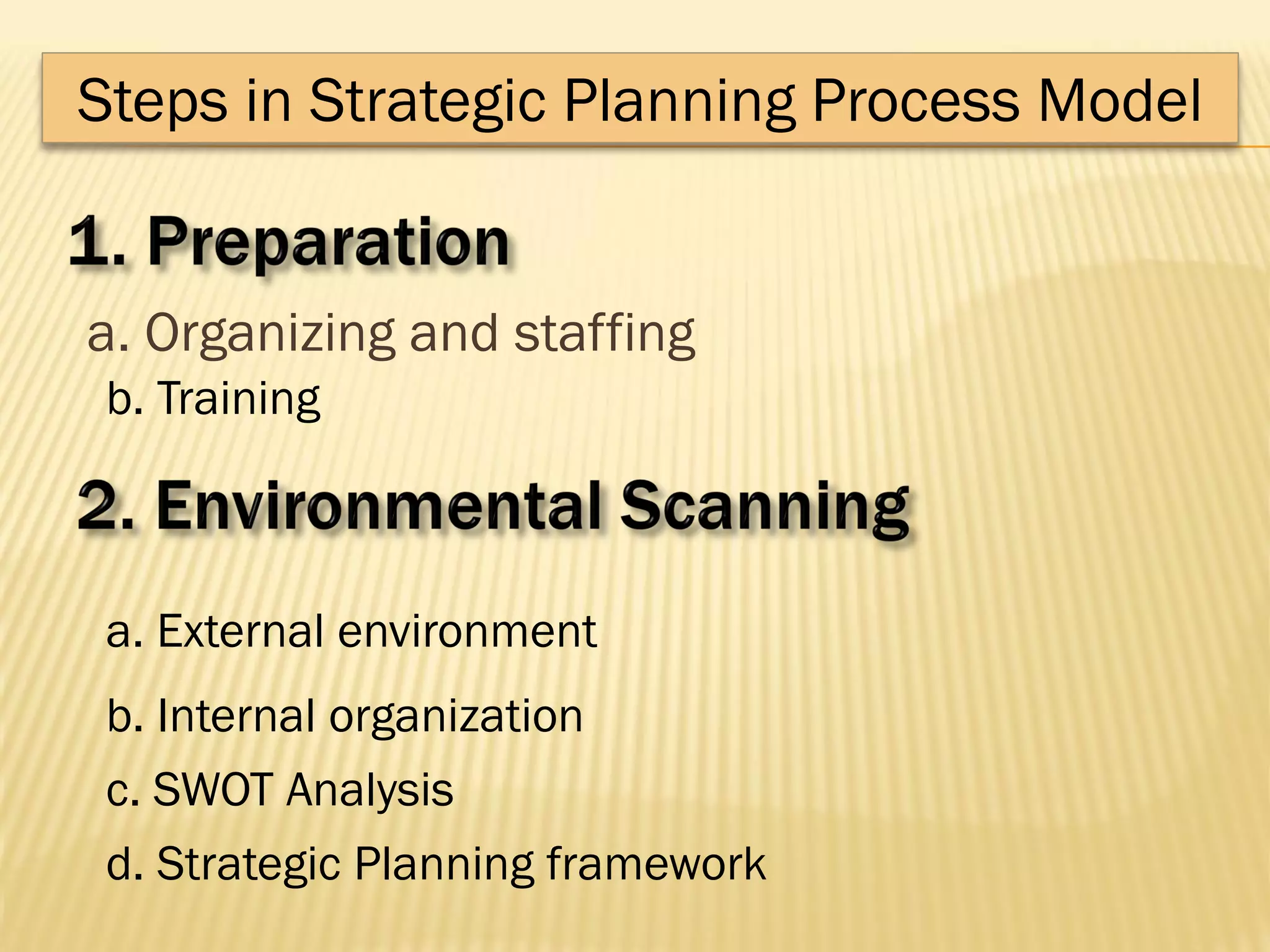
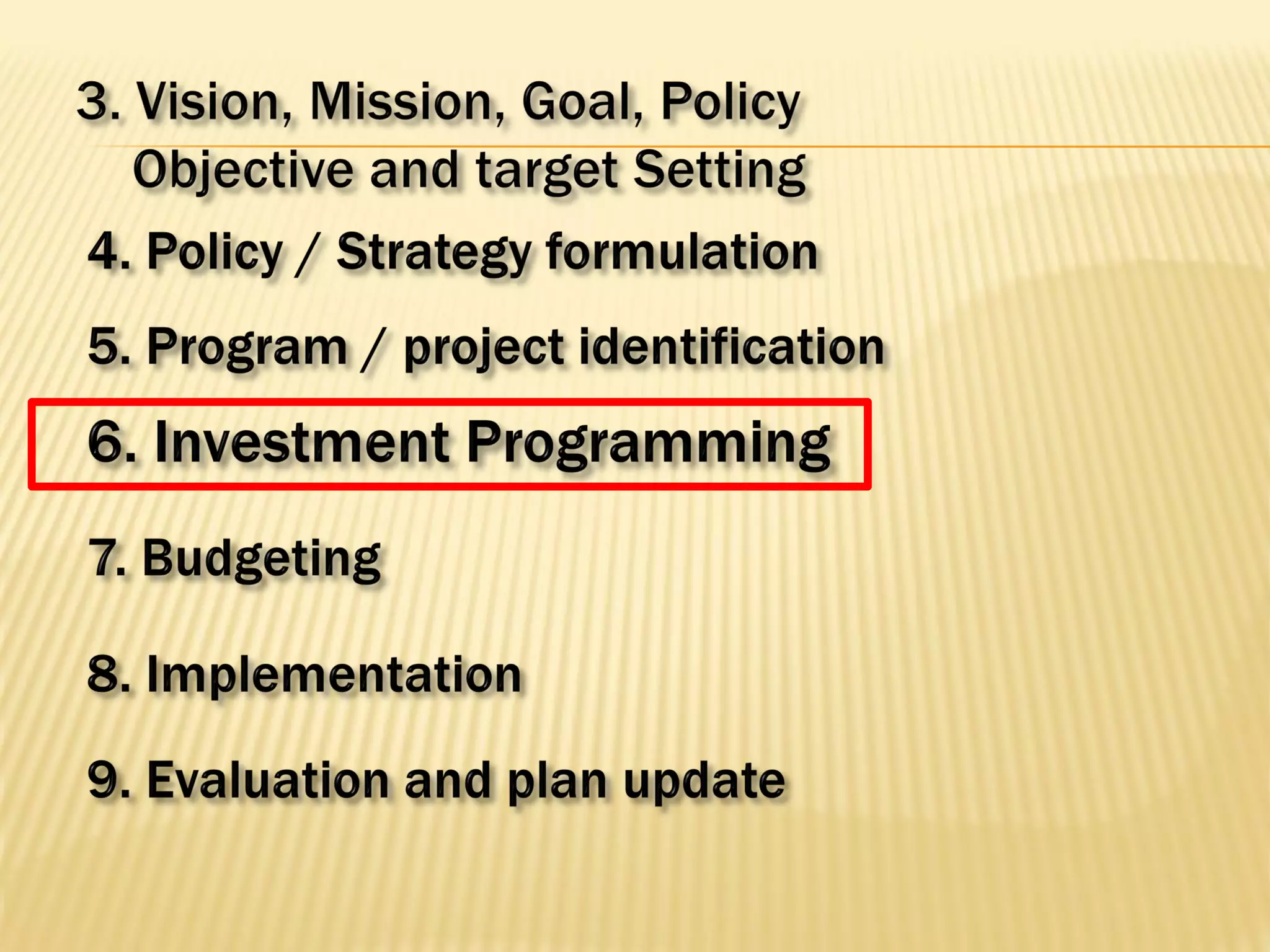
Steps in Strategic Planning Process Model

a. Organizing and staffing
b. Training

a. External environment

b. Internal organization
c. SWOT Analysis
d. Strategic Planning framework
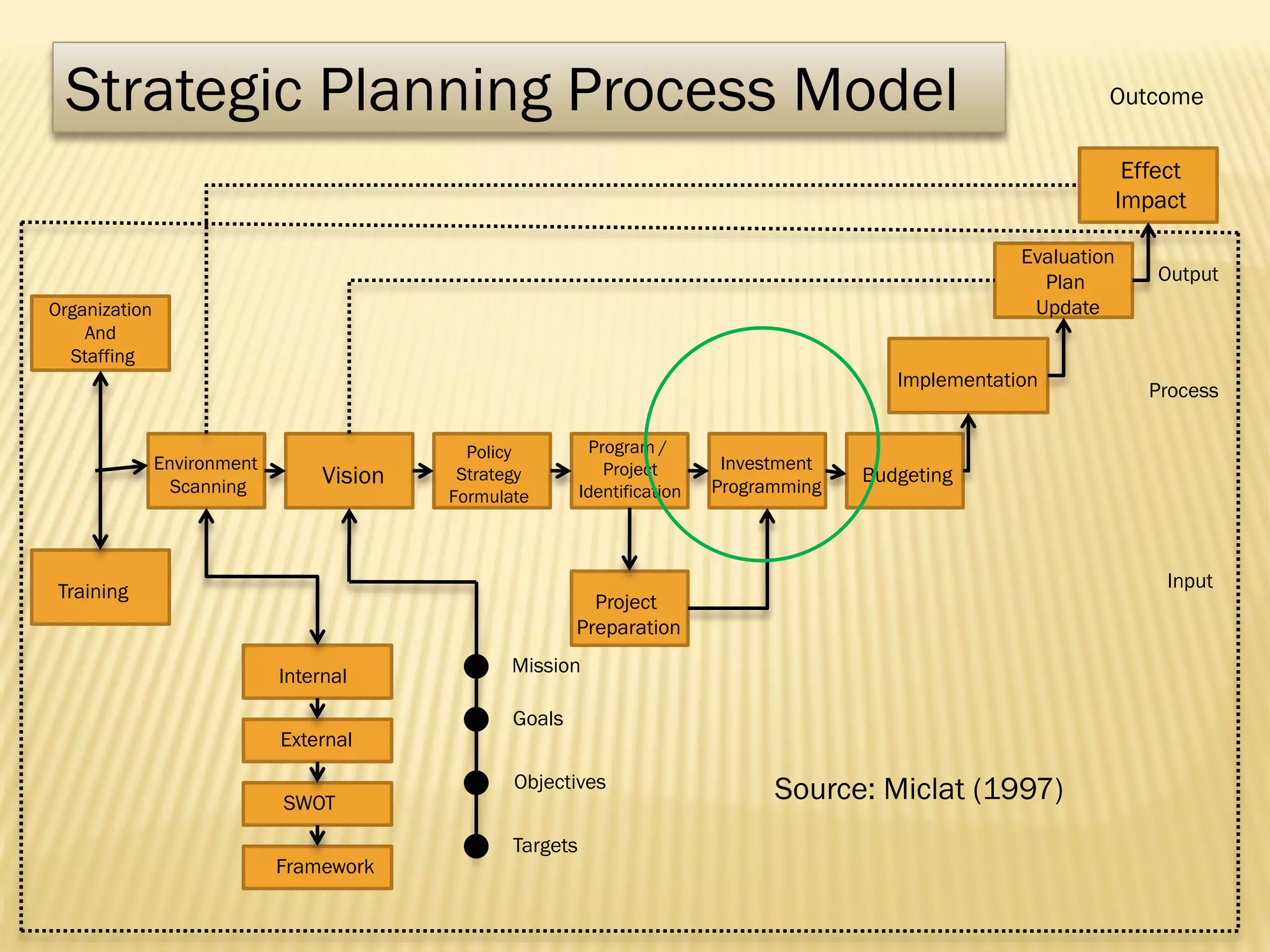
Strategic Planning Process Model

Outcome
Effect
Impact
Evaluation
Plan
Update

Organization
And
Staffing

Implementation

Environment
Scanning

Vision

Program /
Project
Identification

Policy
Strategy
Formulate

Training

Investment
Programming

External
SWOT

Input

Framework

Mission
Goals
Objectives
Targets

Process

Budgeting

Project
Preparation
Internal

Output

Source: Miclat (1997)
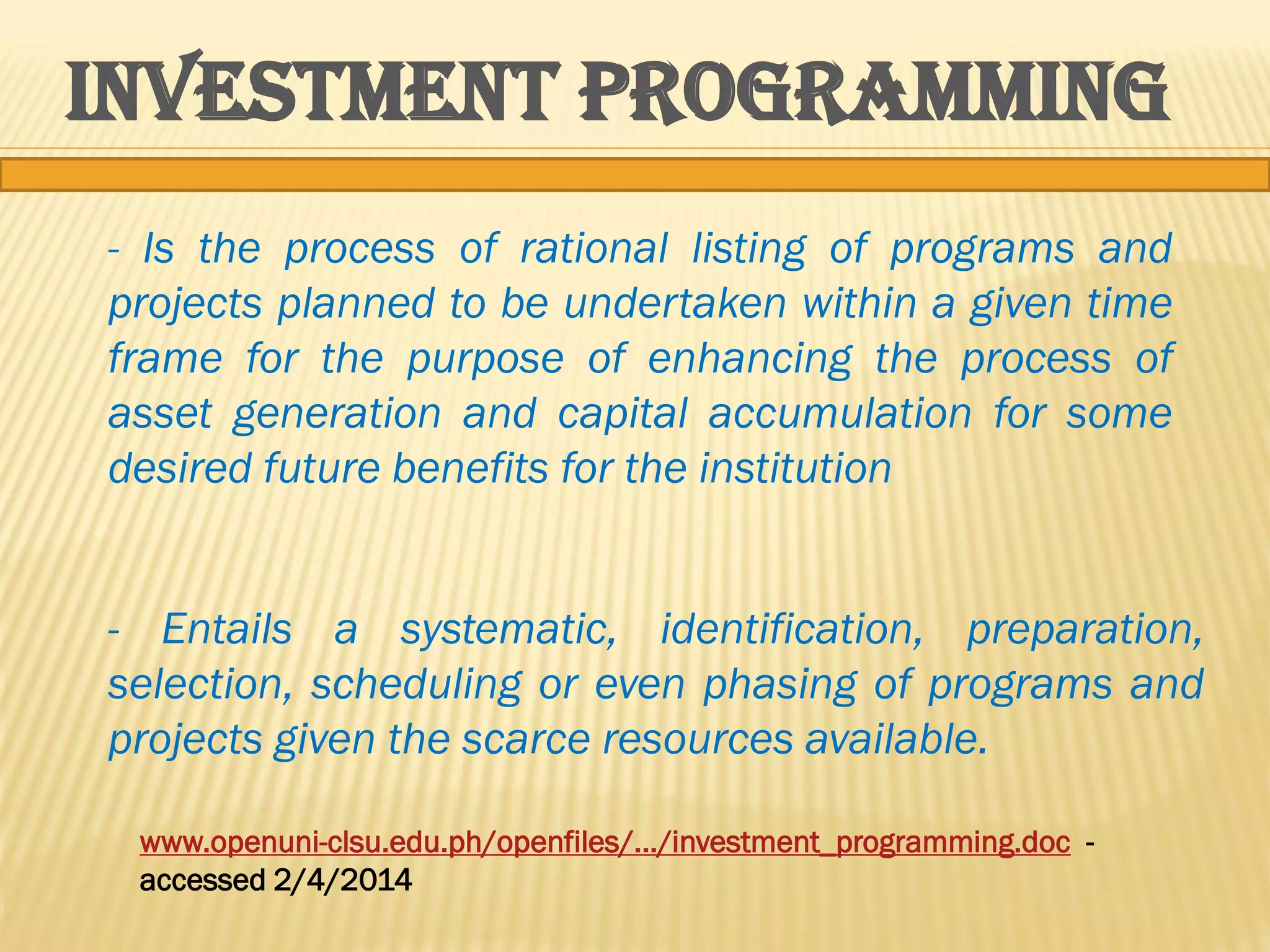
INVESTMENT PROGRAMMING
- Is the process of rational listing of programs and
projects planned to be undertaken within a given time
frame for the purpose of enhancing the process of
asset generation and capital accumulation for some
desired future benefits for the institution
- Entails a systematic, identification, preparation,
selection, scheduling or even phasing of programs and
projects given the scarce resources available.
www.openuni-clsu.edu.ph/openfiles/.../investment_programming.doc accessed 2/4/2014
INVESTMENT PROGRAMMING
The investment program is the basis for
programs and projects that are considered
or included in the preparation of the annual
plan corresponding budget estimates
(Miclat, 2005).
www.openuni-clsu.edu.ph/openfiles/.../investment_programming.doc accessed 2/4/2014
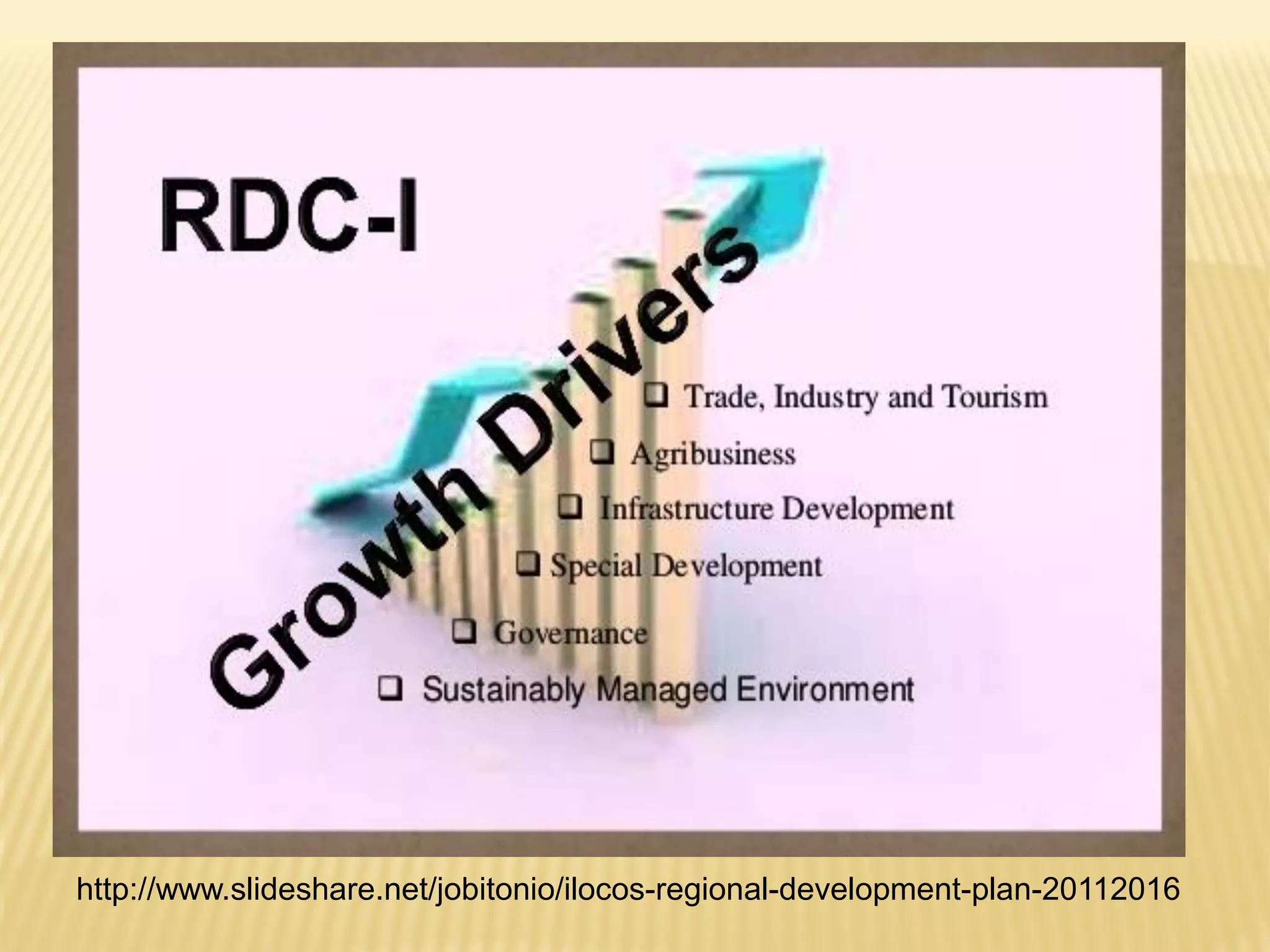
http://www.slideshare.net/jobitonio/ilocos-regional-development-plan-20112016
The 2011-2016 PIP shall serve as:
(a) an instrument to tighten the planning, programming,
budgeting and monitoring and evaluation linkages;
(b) basis for public sector resource allocation and for pipelining
public sector PAPs for processing at the Investment
Coordination Committee (ICC)/NEDA Board (NB);
(c) Basis in monitoring public investment performance in terms
of achieving the goals and targets under the PDP/RM pursuant
to AO 25 s, 2011
http://www.neda.gov.ph/?page_id=1231 –accessed 2/6/2014
The PIP contains PAPs to be implemented by the NG,
GOCCs, GFIs and other offices and instrumentalities
within the medium-term regardless of financing but
which indicates, nonetheless, sources of funding
whether purely NG, GOCCs, GFIs, ODA grants, publicprivate partnerships, including joint ventures, or from
local government units (LGUs) for their counterpart in NG
projects. It includes identification of the spatial coverage
of PAPs, including the PDP Chapter and 16 point agenda
being addressed and their objectively verifiable
indicators (OVIs).
http://www.neda.gov.ph/?page_id=1231 –accessed 2/6/2014
EXCLUDED
 recurrent cost on the general operation of the
government, personnel services, relending and/or
guarantee related activities to private institutions, and
other administrative capital expenditures.
 PAPs to be financed purely from LGU revenues and
independent projects of the private sector including
those of non governmental organizations (NGOs)
http://www.neda.gov.ph/?page_id=1231 –accessed 2/6/2014
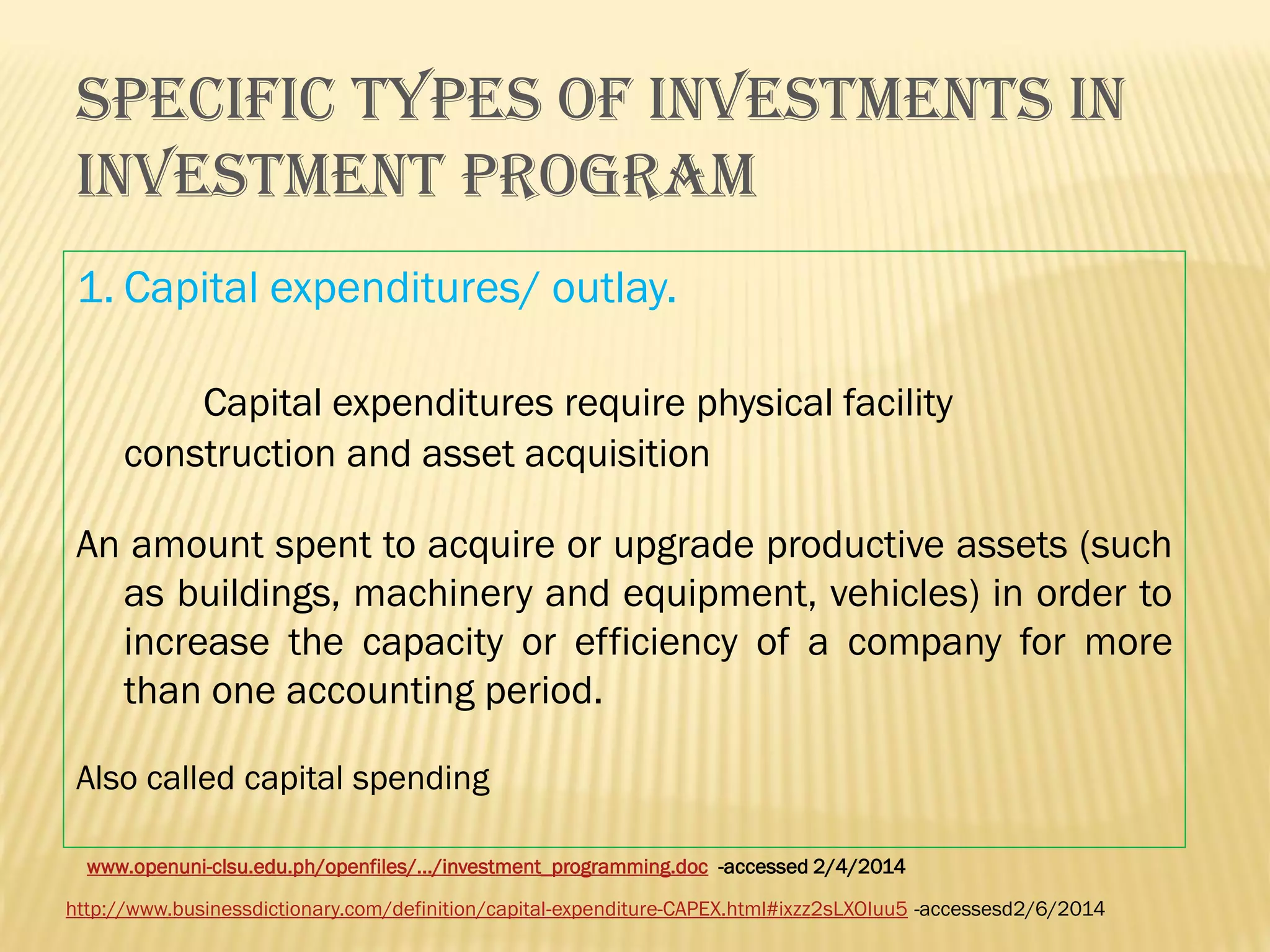
There are four types of instruments through which a strategic development plan
may be carried out (Miclat, 2005). These instruments are:

1. Government investments and development services to
promote development of the public sector;
2. Government investments and development services to
* 1 & 2 controlled by the
promote development of the private sector;
government and contained in the
investment program

3. Private sector
activities; and

investments

and

other

development

3. Private sector initiative subject to influence by
Government

4. Government policies and regulation affecting public and
private sector development.
4. Supports proposed investments and services
www.openuni-clsu.edu.ph/openfiles/.../investment_programming.doc -accessed 2/4/2014
SPECIFIC TYPES OF INVESTMENTS IN
INVESTMENT PROGRAM
1. Capital expenditures/ outlay.
Capital expenditures require physical facility
construction and asset acquisition
An amount spent to acquire or upgrade productive assets (such
as buildings, machinery and equipment, vehicles) in order to
increase the capacity or efficiency of a company for more
than one accounting period.
Also called capital spending
www.openuni-clsu.edu.ph/openfiles/.../investment_programming.doc -accessed 2/4/2014

http://www.businessdictionary.com/definition/capital-expenditure-CAPEX.html#ixzz2sLXOIuu5 -accessesd2/6/2014
Cont. SPECIFIC TYPES OF INVESTMENTS IN
…….
INVESTMENT PROGRAM
2. Outlays for social and human development
Outlays for social and human development investments
on health, education, counseling, placement as well as physical
infrastructure like academic buildings and laboratory rooms and
administrative buildings and structures.

3. Equity investments and financial and technical
assistance.
These are direct investments of the government and
bilateral or cooperative ventures with private sector like
loans, financing, grants, endowments, etc.
www.openuni-clsu.edu.ph/openfiles/.../investment_programming.doc -accessed 2/4/2014
Cont. SPECIFIC TYPES OF INVESTMENTS IN
INVESTMENT PROGRAM
4. Expenditures for project development.
These are expenses for project identification,
environmental and institutional scanning, pre-feasibility
studies, feasibility studies proper and other expenditures
related to and necessary in determining the desirability of a
project.

5. Other expenditures attributable to any of the above
items.
These are recurrent or repetitive expenses for operations
and maintenance of facilities or services resulting from and
directly attributable to the afforested programs and projects.
www.openuni-clsu.edu.ph/openfiles/.../investment_programming.doc -accessed 2/4/2014
OTHER TYPES OF
INVESTMENTS
Bonds
 grouped under the general
category called fixed-income securities

 commonly used to refer to any securities that are
founded on debt
When you purchase a bond, you are lending out your
money to a company or government. In return, they agree
to give you interest on your money and eventually pay you
back the amount you lent out.
http://www.investopedia.com/articles/younginvestors/10/what-is-an-investment.asp accessed 2/5/2014
STOCKS
Real Estate

 literally certificates that say you own a portion of a company
which entitles you to vote at the shareholders’ meeting and
allows you to receive any profits that the company allocates to
its owners. These profits are referred to as dividends

Houses, apartments or other
dwellings that you buy to rent
out or repair and resell are
investments
Precious Objects
Paintings, jewelries and other collections

MUTUAL FUNDS

http://www.investopedia.com/university/beginner/beginner5.asp -accessed 2/5/2014
INVESTMENT PROGRAMMING PROCESS
1. Project Identification
In identifying projects, meeting of development needs and
solving problems and constraints are taken into account. The
identification of projects begin with ideas which are believed or
perceived to be effective solutions to development problems
and unsatisfied demands and unmet needs; utilization of
present and potential human physical and financial resources;
and required response to external threats to government
incentives, and to local political and economic pressures such
as growing disparities in the level of development of faculty
and colleges, and among faculty members and non teaching
staff.
www.openuni-clsu.edu.ph/openfiles/.../investment_programming.doc -accessed 2/4/2014
Cont.

INVESTMENT PROGRAMMING PROCESS

2. Project Integration
 refers to the unification of various sets of programs, projects
and activities in the institution to achieve efficiency,
effectiveness, unity, cohesiveness, and complementarily.
Uses the techniques Sanitization and Augmentation

a. Sanitization


programs and projects are screened, evaluated. Modified,
and eliminated considering the factors of redundancy,
impracticality, undesirability or inefficiency in relation to the
goals and objectives of the strategic plan.
b. Augmentation
 Refers to adding or increasing potential and viable project
ideas as well as modifying proposed programs, projects
and activities in order to better attain the specific target of
the strategic development plan.
 Aims to achieve maximum possible economic efficiency.
 Identified additional programs and projects must be those
considered critical, supplemental, supportive, and
innovative

www.openuni-clsu.edu.ph/openfiles/.../investment_programming.doc -accessed 2/4/2014
Cont. INVESTMENT PROGRAMMING PROCESS

3. Project Packaging
 Refers to the combination of mutually reinforcing
investments from different sectors and agencies required to
achieve common development.
Mutually reinforcing simply means that the combined
benefits of two or more objectives will be larger than the sum
total of benefits of these projects if they are implemented
separately
Each development package shall have as its focus a
development objective and the geographic unit to which the
objective is directed or aimed.
Project components can be derived from:
A. The goal and objectives of the strategic plan which are
disaggregated into sectoral or sub-sectoral levels;
B. Project ideas from the local level which originate from the
recognition and analysis of unsatisfied needs, constraints
or potentials;
C. A combination of the two.
Cont. INVESTMENT PROGRAMMING PROCESS
4. Project Prioritization
With scarce capital resources, it is normally not possible
to implement at the same time all programs and projects
which have been identified, screened, and packaged. The
logic of investment programming lies in the task of matching
the requirements of proposed investment projects with
expected available financial resources over a specified
timetable.
 process for determining which projects will be scheduled
for implementation ahead of others.
www.openuni-clsu.edu.ph/openfiles/.../investment_programming.doc -accessed 2/4/2014
COMMON METHODOLOGIES IN
PRIORITIZATION
1. Problem structure approach
The project which addresses the problem identified as
the most significant obstacle to development is
considered.
2. Supply and demand projection.
By extrapolation and use of coefficient through time and
space, areas with larger supply and demand gap are
given priority.
COMMON METHODOLOGIES IN
PRIORITIZATION
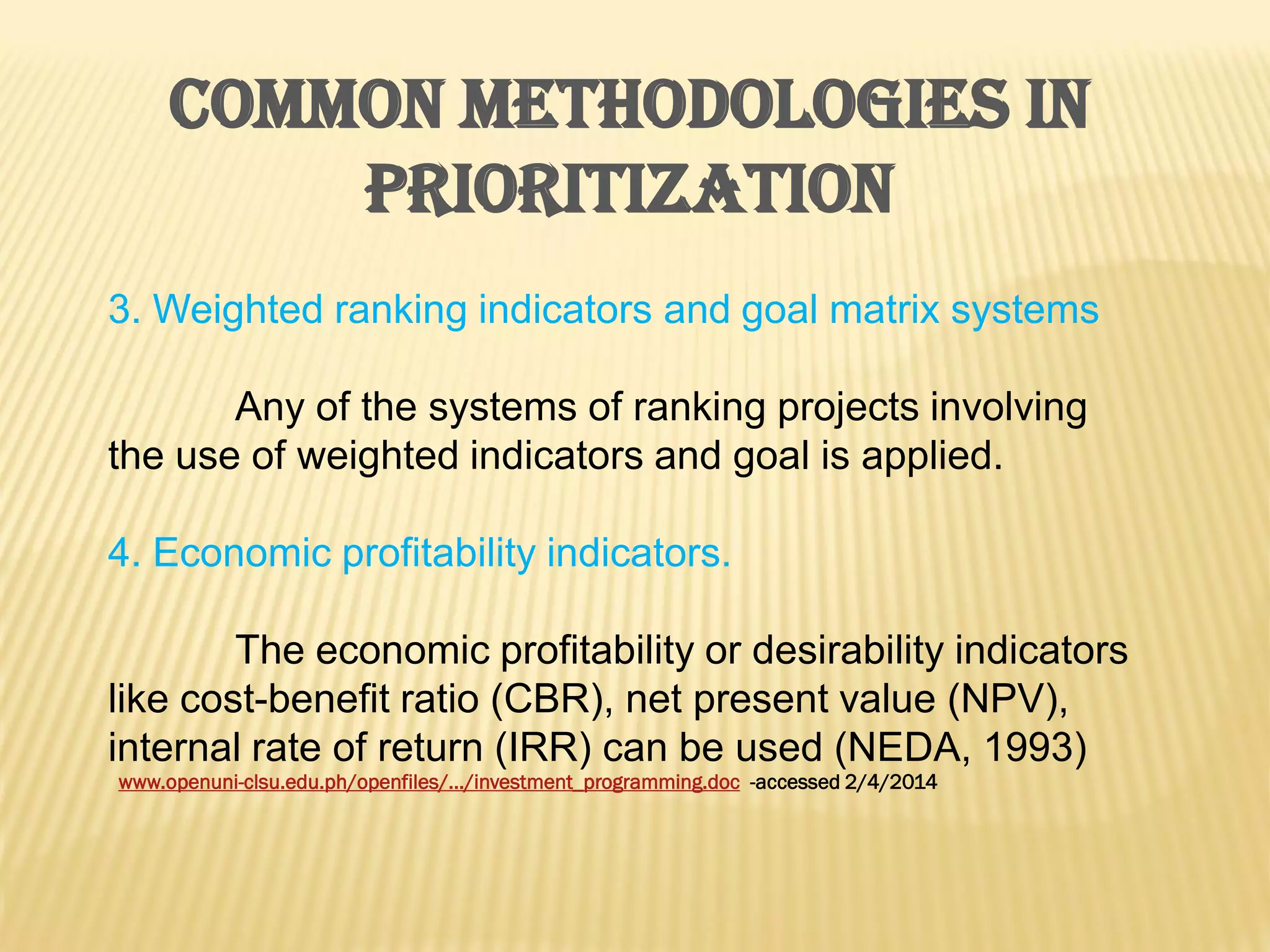
3. Weighted ranking indicators and goal matrix systems
Any of the systems of ranking projects involving
the use of weighted indicators and goal is applied.
4. Economic profitability indicators.
The economic profitability or desirability indicators
like cost-benefit ratio (CBR), net present value (NPV),
internal rate of return (IRR) can be used (NEDA, 1993)
www.openuni-clsu.edu.ph/openfiles/.../investment_programming.doc -accessed 2/4/2014
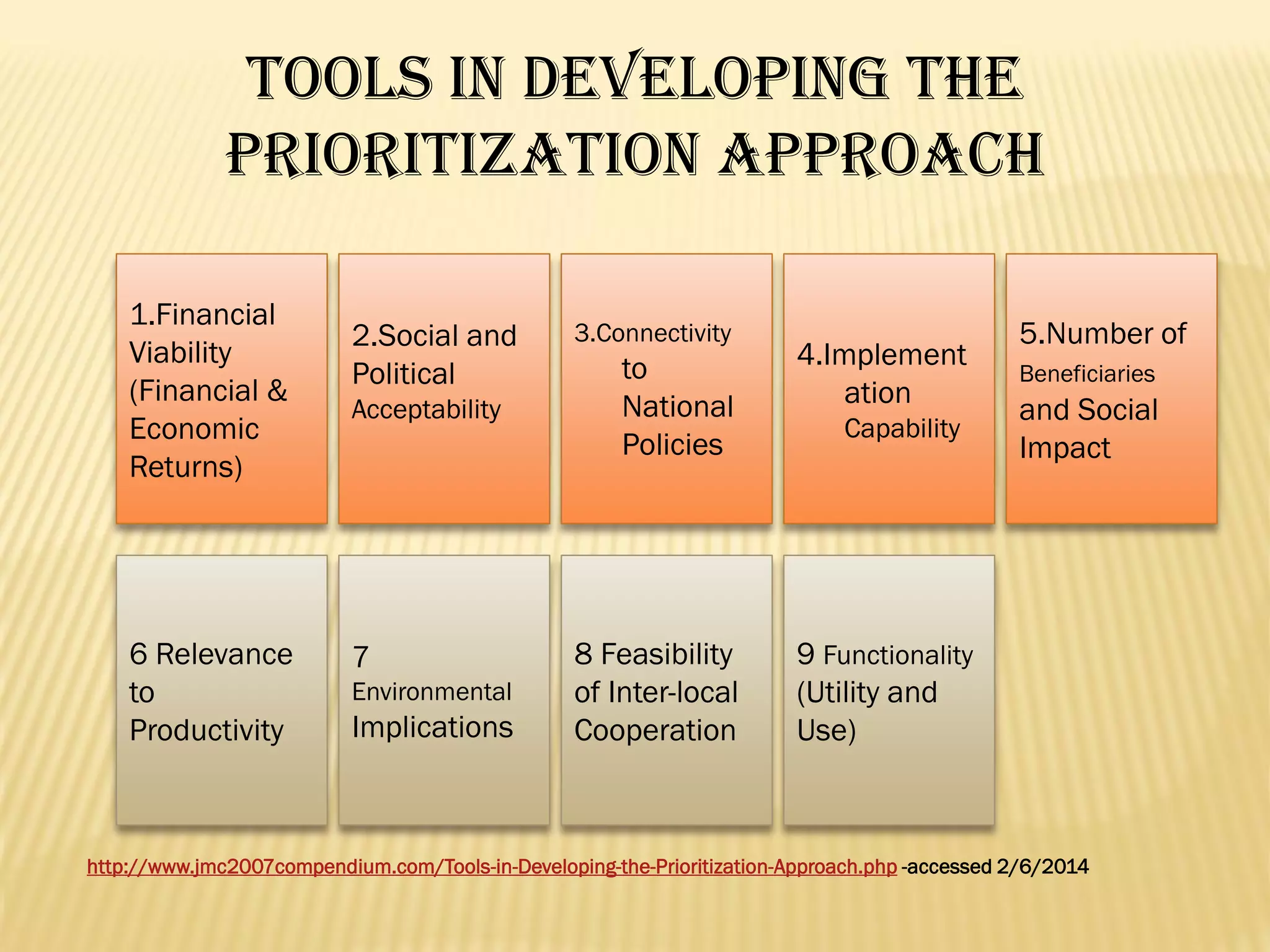
TOOLS IN DEVELOPING THE
PRIORITIZATION APPROACH
1.Financial
Viability
(Financial &
Economic
Returns)

6 Relevance
to
Productivity

2.Social and
Political
Acceptability

7
Environmental

Implications

3.Connectivity

to
National
Policies

4.Implement
ation

8 Feasibility
of Inter-local
Cooperation

5.Number of

9 Functionality
(Utility and
Use)

Capability

Beneficiaries

and Social
Impact

http://www.jmc2007compendium.com/Tools-in-Developing-the-Prioritization-Approach.php -accessed 2/6/2014
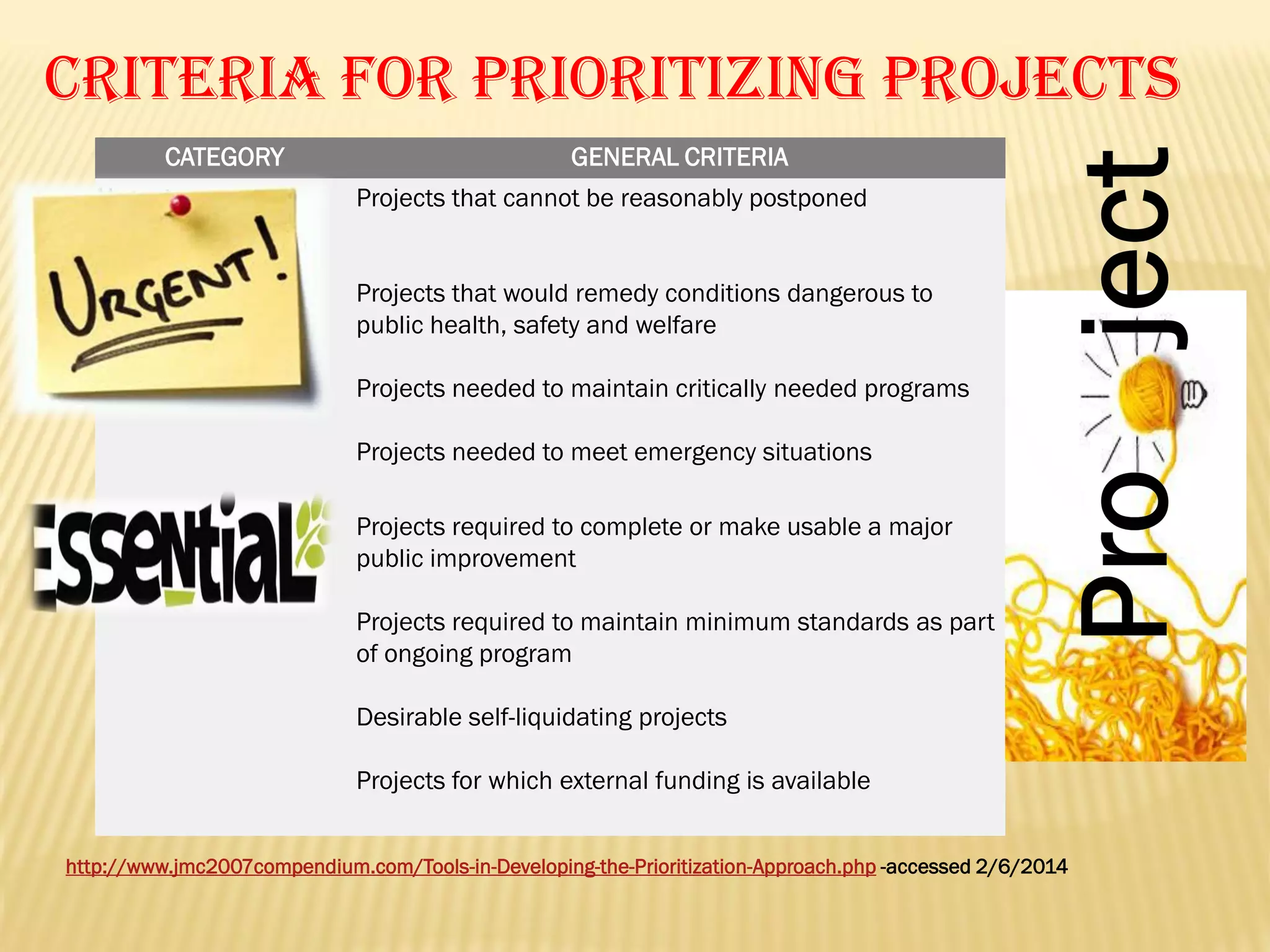
CRITERIA FOR PRIORITIZING PROJECTS
CATEGORY
Urgent

GENERAL CRITERIA
Projects that cannot be reasonably postponed
Projects that would remedy conditions dangerous to
public health, safety and welfare
Projects needed to maintain critically needed programs
Projects needed to meet emergency situations

Essential

Projects required to complete or make usable a major
public improvement
Projects required to maintain minimum standards as part
of ongoing program
Desirable self-liquidating projects
Projects for which external funding is available

http://www.jmc2007compendium.com/Tools-in-Developing-the-Prioritization-Approach.php -accessed 2/6/2014
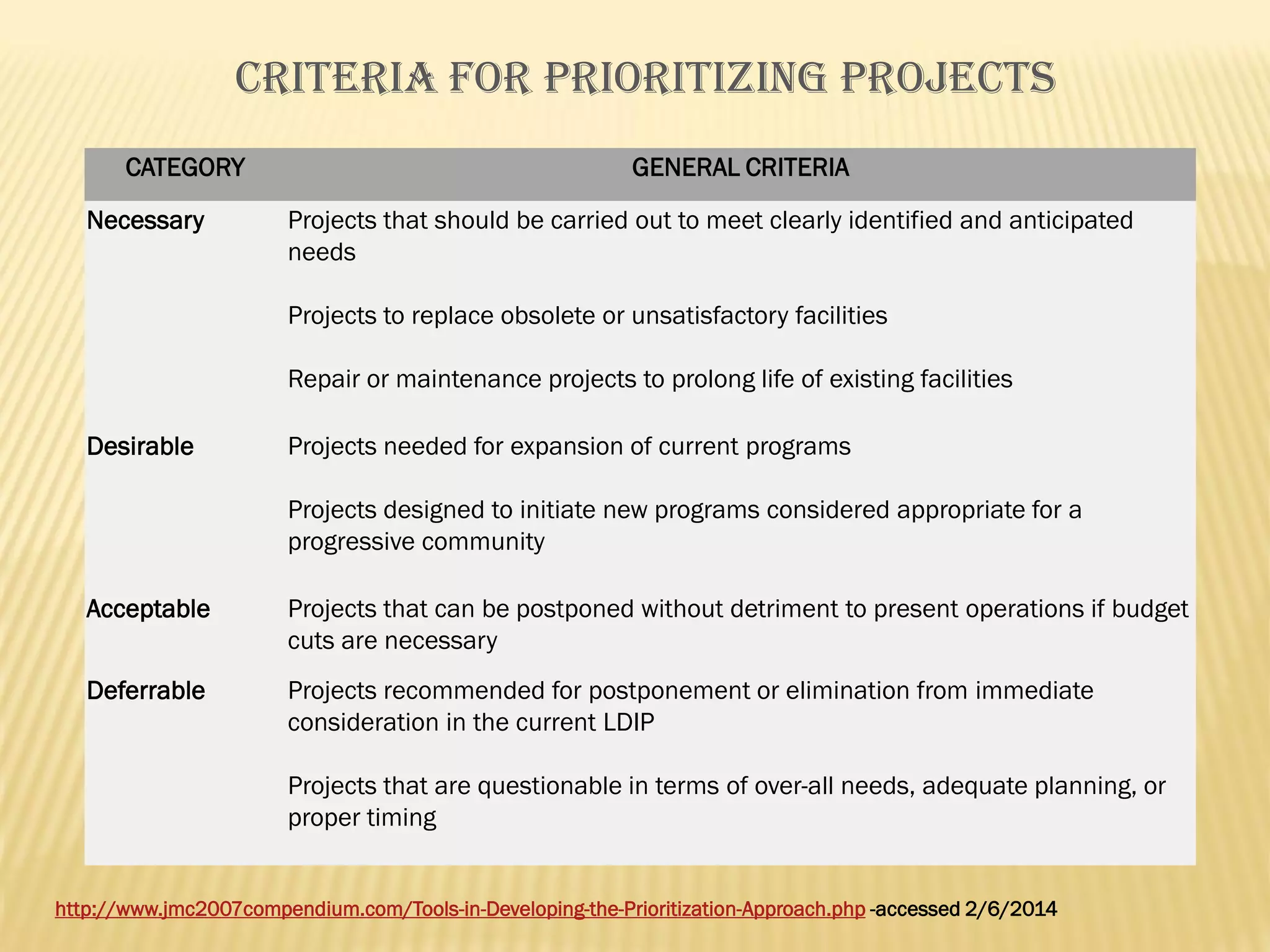
CRITERIA FOR PRIORITIZING PROJECTS
CATEGORY
Necessary

GENERAL CRITERIA
Projects that should be carried out to meet clearly identified and anticipated
needs
Projects to replace obsolete or unsatisfactory facilities
Repair or maintenance projects to prolong life of existing facilities

Desirable

Projects needed for expansion of current programs
Projects designed to initiate new programs considered appropriate for a
progressive community

Acceptable

Projects that can be postponed without detriment to present operations if budget
cuts are necessary

Deferrable

Projects recommended for postponement or elimination from immediate
consideration in the current LDIP
Projects that are questionable in terms of over-all needs, adequate planning, or
proper timing

http://www.jmc2007compendium.com/Tools-in-Developing-the-Prioritization-Approach.php -accessed 2/6/2014
References:
http://www.jmc2007compendium.com/Tools-in-Developing-the-PrioritizationApproach.php -accessed 2/6/2014
http://www.neda.gov.ph/?page_id=1231 –accessed 2/6/2014
www.openuni-clsu.edu.ph/openfiles/.../investment_programming.doc -accessed
2/4/2014
http://www.businessdictionary.com/definition/capital-expenditureCAPEX.html#ixzz2sLXOIuu5 -accessesd2/6/2014
http://www.investopedia.com/university/beginner/beginner5.asp -accessed
2/5/2014
http://www.investopedia.com/articles/younginvestors/10/what-is-aninvestment.asp accessed 2/5/2014

Investment Programming

  • 1.
    PROGRAMMING Professor Jo B. Bitonio DM211 Project Development and Management Presented by: Sheryle A. Domingo MDM Public Mgmt.
  • 2.
    To begin withthe presentation, let us review how investment programming is related to Development Planning Process and Strategic Planning Process Model
  • 3.
    DEVELOPMENT PLANNING MODELHAS 8 STEPS 4. Situational analysis Goal/ objective/ target setting Policy/ strategy formulation Program/ project identification 5. Investment programming 1. 2. 3. 6. 7. 8. Budgeting Implementation and monitoring Evaluation and plan update
  • 4.
    Feedback loop Situation Analysis Policies Strategies Goals Objectives Targets Implementation and Monitoring Investment Programming Program Project Evaluation Budgeting andPlan Update Identification Project Preparation Studies researches Programming Planning Implementation Budgeting Figure 2. Development Planning Process Model (NEDA, 2001) Evaluation
  • 5.
    Steps in StrategicPlanning Process Model a. Organizing and staffing b. Training a. External environment b. Internal organization c. SWOT Analysis d. Strategic Planning framework
  • 7.
    Strategic Planning ProcessModel Outcome Effect Impact Evaluation Plan Update Organization And Staffing Implementation Environment Scanning Vision Program / Project Identification Policy Strategy Formulate Training Investment Programming External SWOT Input Framework Mission Goals Objectives Targets Process Budgeting Project Preparation Internal Output Source: Miclat (1997)
  • 8.
    INVESTMENT PROGRAMMING - Isthe process of rational listing of programs and projects planned to be undertaken within a given time frame for the purpose of enhancing the process of asset generation and capital accumulation for some desired future benefits for the institution - Entails a systematic, identification, preparation, selection, scheduling or even phasing of programs and projects given the scarce resources available. www.openuni-clsu.edu.ph/openfiles/.../investment_programming.doc accessed 2/4/2014
  • 9.
    INVESTMENT PROGRAMMING The investmentprogram is the basis for programs and projects that are considered or included in the preparation of the annual plan corresponding budget estimates (Miclat, 2005). www.openuni-clsu.edu.ph/openfiles/.../investment_programming.doc accessed 2/4/2014
  • 10.
  • 11.
    The 2011-2016 PIPshall serve as: (a) an instrument to tighten the planning, programming, budgeting and monitoring and evaluation linkages; (b) basis for public sector resource allocation and for pipelining public sector PAPs for processing at the Investment Coordination Committee (ICC)/NEDA Board (NB); (c) Basis in monitoring public investment performance in terms of achieving the goals and targets under the PDP/RM pursuant to AO 25 s, 2011 http://www.neda.gov.ph/?page_id=1231 –accessed 2/6/2014
  • 12.
    The PIP containsPAPs to be implemented by the NG, GOCCs, GFIs and other offices and instrumentalities within the medium-term regardless of financing but which indicates, nonetheless, sources of funding whether purely NG, GOCCs, GFIs, ODA grants, publicprivate partnerships, including joint ventures, or from local government units (LGUs) for their counterpart in NG projects. It includes identification of the spatial coverage of PAPs, including the PDP Chapter and 16 point agenda being addressed and their objectively verifiable indicators (OVIs). http://www.neda.gov.ph/?page_id=1231 –accessed 2/6/2014
  • 13.
    EXCLUDED  recurrent coston the general operation of the government, personnel services, relending and/or guarantee related activities to private institutions, and other administrative capital expenditures.  PAPs to be financed purely from LGU revenues and independent projects of the private sector including those of non governmental organizations (NGOs) http://www.neda.gov.ph/?page_id=1231 –accessed 2/6/2014
  • 14.
    There are fourtypes of instruments through which a strategic development plan may be carried out (Miclat, 2005). These instruments are: 1. Government investments and development services to promote development of the public sector; 2. Government investments and development services to * 1 & 2 controlled by the promote development of the private sector; government and contained in the investment program 3. Private sector activities; and investments and other development 3. Private sector initiative subject to influence by Government 4. Government policies and regulation affecting public and private sector development. 4. Supports proposed investments and services www.openuni-clsu.edu.ph/openfiles/.../investment_programming.doc -accessed 2/4/2014
  • 15.
    SPECIFIC TYPES OFINVESTMENTS IN INVESTMENT PROGRAM 1. Capital expenditures/ outlay. Capital expenditures require physical facility construction and asset acquisition An amount spent to acquire or upgrade productive assets (such as buildings, machinery and equipment, vehicles) in order to increase the capacity or efficiency of a company for more than one accounting period. Also called capital spending www.openuni-clsu.edu.ph/openfiles/.../investment_programming.doc -accessed 2/4/2014 http://www.businessdictionary.com/definition/capital-expenditure-CAPEX.html#ixzz2sLXOIuu5 -accessesd2/6/2014
  • 16.
    Cont. SPECIFIC TYPESOF INVESTMENTS IN ……. INVESTMENT PROGRAM 2. Outlays for social and human development Outlays for social and human development investments on health, education, counseling, placement as well as physical infrastructure like academic buildings and laboratory rooms and administrative buildings and structures. 3. Equity investments and financial and technical assistance. These are direct investments of the government and bilateral or cooperative ventures with private sector like loans, financing, grants, endowments, etc. www.openuni-clsu.edu.ph/openfiles/.../investment_programming.doc -accessed 2/4/2014
  • 17.
    Cont. SPECIFIC TYPESOF INVESTMENTS IN INVESTMENT PROGRAM 4. Expenditures for project development. These are expenses for project identification, environmental and institutional scanning, pre-feasibility studies, feasibility studies proper and other expenditures related to and necessary in determining the desirability of a project. 5. Other expenditures attributable to any of the above items. These are recurrent or repetitive expenses for operations and maintenance of facilities or services resulting from and directly attributable to the afforested programs and projects. www.openuni-clsu.edu.ph/openfiles/.../investment_programming.doc -accessed 2/4/2014
  • 18.
    OTHER TYPES OF INVESTMENTS Bonds grouped under the general category called fixed-income securities  commonly used to refer to any securities that are founded on debt When you purchase a bond, you are lending out your money to a company or government. In return, they agree to give you interest on your money and eventually pay you back the amount you lent out. http://www.investopedia.com/articles/younginvestors/10/what-is-an-investment.asp accessed 2/5/2014
  • 19.
    STOCKS Real Estate  literallycertificates that say you own a portion of a company which entitles you to vote at the shareholders’ meeting and allows you to receive any profits that the company allocates to its owners. These profits are referred to as dividends Houses, apartments or other dwellings that you buy to rent out or repair and resell are investments
  • 20.
    Precious Objects Paintings, jewelriesand other collections MUTUAL FUNDS http://www.investopedia.com/university/beginner/beginner5.asp -accessed 2/5/2014
  • 21.
    INVESTMENT PROGRAMMING PROCESS 1.Project Identification In identifying projects, meeting of development needs and solving problems and constraints are taken into account. The identification of projects begin with ideas which are believed or perceived to be effective solutions to development problems and unsatisfied demands and unmet needs; utilization of present and potential human physical and financial resources; and required response to external threats to government incentives, and to local political and economic pressures such as growing disparities in the level of development of faculty and colleges, and among faculty members and non teaching staff. www.openuni-clsu.edu.ph/openfiles/.../investment_programming.doc -accessed 2/4/2014
  • 22.
    Cont. INVESTMENT PROGRAMMING PROCESS 2.Project Integration  refers to the unification of various sets of programs, projects and activities in the institution to achieve efficiency, effectiveness, unity, cohesiveness, and complementarily. Uses the techniques Sanitization and Augmentation a. Sanitization  programs and projects are screened, evaluated. Modified, and eliminated considering the factors of redundancy, impracticality, undesirability or inefficiency in relation to the goals and objectives of the strategic plan.
  • 23.
    b. Augmentation  Refersto adding or increasing potential and viable project ideas as well as modifying proposed programs, projects and activities in order to better attain the specific target of the strategic development plan.  Aims to achieve maximum possible economic efficiency.  Identified additional programs and projects must be those considered critical, supplemental, supportive, and innovative www.openuni-clsu.edu.ph/openfiles/.../investment_programming.doc -accessed 2/4/2014
  • 24.
    Cont. INVESTMENT PROGRAMMINGPROCESS 3. Project Packaging  Refers to the combination of mutually reinforcing investments from different sectors and agencies required to achieve common development. Mutually reinforcing simply means that the combined benefits of two or more objectives will be larger than the sum total of benefits of these projects if they are implemented separately
  • 25.
    Each development packageshall have as its focus a development objective and the geographic unit to which the objective is directed or aimed. Project components can be derived from: A. The goal and objectives of the strategic plan which are disaggregated into sectoral or sub-sectoral levels; B. Project ideas from the local level which originate from the recognition and analysis of unsatisfied needs, constraints or potentials; C. A combination of the two.
  • 26.
    Cont. INVESTMENT PROGRAMMINGPROCESS 4. Project Prioritization With scarce capital resources, it is normally not possible to implement at the same time all programs and projects which have been identified, screened, and packaged. The logic of investment programming lies in the task of matching the requirements of proposed investment projects with expected available financial resources over a specified timetable.  process for determining which projects will be scheduled for implementation ahead of others. www.openuni-clsu.edu.ph/openfiles/.../investment_programming.doc -accessed 2/4/2014
  • 27.
    COMMON METHODOLOGIES IN PRIORITIZATION 1.Problem structure approach The project which addresses the problem identified as the most significant obstacle to development is considered. 2. Supply and demand projection. By extrapolation and use of coefficient through time and space, areas with larger supply and demand gap are given priority.
  • 28.
    COMMON METHODOLOGIES IN PRIORITIZATION 3.Weighted ranking indicators and goal matrix systems Any of the systems of ranking projects involving the use of weighted indicators and goal is applied. 4. Economic profitability indicators. The economic profitability or desirability indicators like cost-benefit ratio (CBR), net present value (NPV), internal rate of return (IRR) can be used (NEDA, 1993) www.openuni-clsu.edu.ph/openfiles/.../investment_programming.doc -accessed 2/4/2014
  • 29.
    TOOLS IN DEVELOPINGTHE PRIORITIZATION APPROACH 1.Financial Viability (Financial & Economic Returns) 6 Relevance to Productivity 2.Social and Political Acceptability 7 Environmental Implications 3.Connectivity to National Policies 4.Implement ation 8 Feasibility of Inter-local Cooperation 5.Number of 9 Functionality (Utility and Use) Capability Beneficiaries and Social Impact http://www.jmc2007compendium.com/Tools-in-Developing-the-Prioritization-Approach.php -accessed 2/6/2014
  • 30.
    CRITERIA FOR PRIORITIZINGPROJECTS CATEGORY Urgent GENERAL CRITERIA Projects that cannot be reasonably postponed Projects that would remedy conditions dangerous to public health, safety and welfare Projects needed to maintain critically needed programs Projects needed to meet emergency situations Essential Projects required to complete or make usable a major public improvement Projects required to maintain minimum standards as part of ongoing program Desirable self-liquidating projects Projects for which external funding is available http://www.jmc2007compendium.com/Tools-in-Developing-the-Prioritization-Approach.php -accessed 2/6/2014
  • 31.
    CRITERIA FOR PRIORITIZINGPROJECTS CATEGORY Necessary GENERAL CRITERIA Projects that should be carried out to meet clearly identified and anticipated needs Projects to replace obsolete or unsatisfactory facilities Repair or maintenance projects to prolong life of existing facilities Desirable Projects needed for expansion of current programs Projects designed to initiate new programs considered appropriate for a progressive community Acceptable Projects that can be postponed without detriment to present operations if budget cuts are necessary Deferrable Projects recommended for postponement or elimination from immediate consideration in the current LDIP Projects that are questionable in terms of over-all needs, adequate planning, or proper timing http://www.jmc2007compendium.com/Tools-in-Developing-the-Prioritization-Approach.php -accessed 2/6/2014
  • 32.
    References: http://www.jmc2007compendium.com/Tools-in-Developing-the-PrioritizationApproach.php -accessed 2/6/2014 http://www.neda.gov.ph/?page_id=1231–accessed 2/6/2014 www.openuni-clsu.edu.ph/openfiles/.../investment_programming.doc -accessed 2/4/2014 http://www.businessdictionary.com/definition/capital-expenditureCAPEX.html#ixzz2sLXOIuu5 -accessesd2/6/2014 http://www.investopedia.com/university/beginner/beginner5.asp -accessed 2/5/2014 http://www.investopedia.com/articles/younginvestors/10/what-is-aninvestment.asp accessed 2/5/2014