STRATEGIC LOCAL ECONOMIC DEVELOPMENT:              1
                   A Guide for Local Governments
STRATEGIC LOCAL ECONOMIC DEVELOPMENT:
              A Guide for Local Governments
              Copyright © 2009 Local Governance Support Program in ARMM
              (LGSPA)

              All rights reserved.

              The Local Governance Support Program in ARMM (LGSPA) encourages the use, translation, adaptation and copying
              of this material for noncommercial use, with appropriate credit given to LGSPA.

              Although reasonable care has been taken in the preparation of this manual, neither the publisher nor contributor,
              nor writer can accept any liability for any consequences arising from the use thereof or from any information
              contained herein.

              ISBN 978-971-94065-9-4

              Printed and bound in Davao City, Philippines

              Published by:

              Local Governance Support Program in ARMM (LGSPA)
              Unit 72 Landco Corporate Centre
              J.P Laurel Avenue, Bajada
                 .
              8000 Davao City, Philippines
              Tel. No. 63 2 227 7980-81
              www.lgspa.org.ph

              This project was undertaken with the financial support of the Government of Canada provided through the Canadian
              International Development Agency (CIDA).


                                                             Te c h n i c a l Te a m
                                Writers                      Technical Review Team               Photography
                              Chona Balagat                       Myn Garcia                   Bobby Timonera
                              Anami Canag                       Mags Z. Maglana          cover photo, pages 13, 21, 75
                                                                Rizal Barandino
                           Technical Advisor                     Edgar Catalan                  Rizal Barandino
                         Emma Barbara Remitio                    Sef Carandang                      page 91

                     Editorial and Creative Direction        Technical Coordination        Cover Design and Layout
                                Myn Garcia                    Maya Vandenbroeck                   Tata Lao


4   STRATEGIC LOCAL ECONOMIC DEVELOPMENT:
    A Guide for Local Governments
STRATEGIC LOCAL ECONOMIC DEVELOPMENT:
A Guide for Local Governments


                      STRATEGIC LOCAL ECONOMIC DEVELOPMENT:              5
                                         A Guide for Local Governments
6   STRATEGIC LOCAL ECONOMIC DEVELOPMENT:
    A Guide for Local Governments
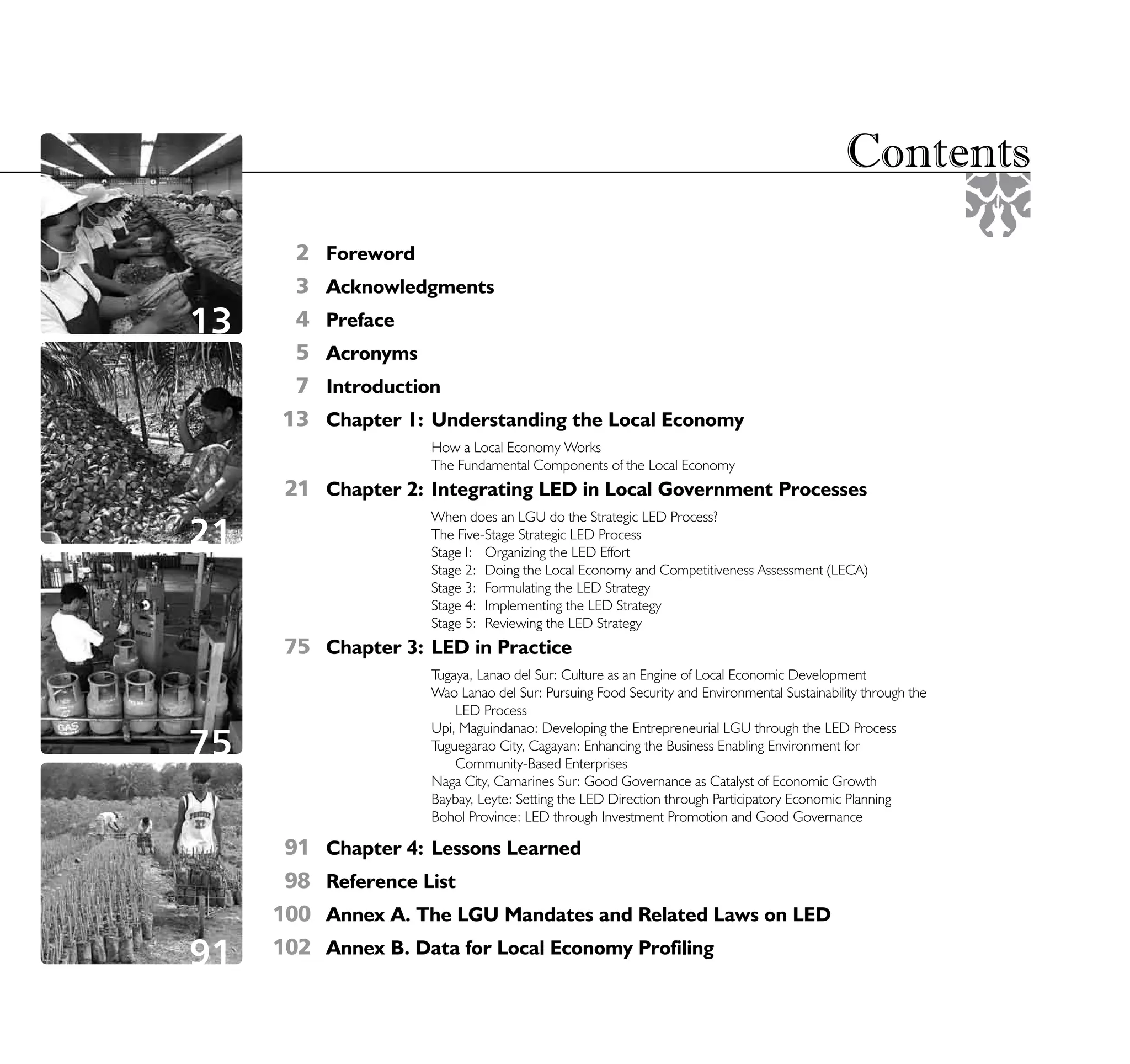
Contents
      2    Foreword
      3    Acknowledgments
13    4    Preface
      5    Acronyms
      7    Introduction
     13    Chapter 1: Understanding the Local Economy
                      How a Local Economy Works
                      The Fundamental Components of the Local Economy
     21 Chapter 2: Integrating LED in Local Government Processes
                      When does an LGU do the Strategic LED Process?
21                    The Five-Stage Strategic LED Process
                      Stage I: Organizing the LED Effort
                      Stage 2: Doing the Local Economy and Competitiveness Assessment (LECA)
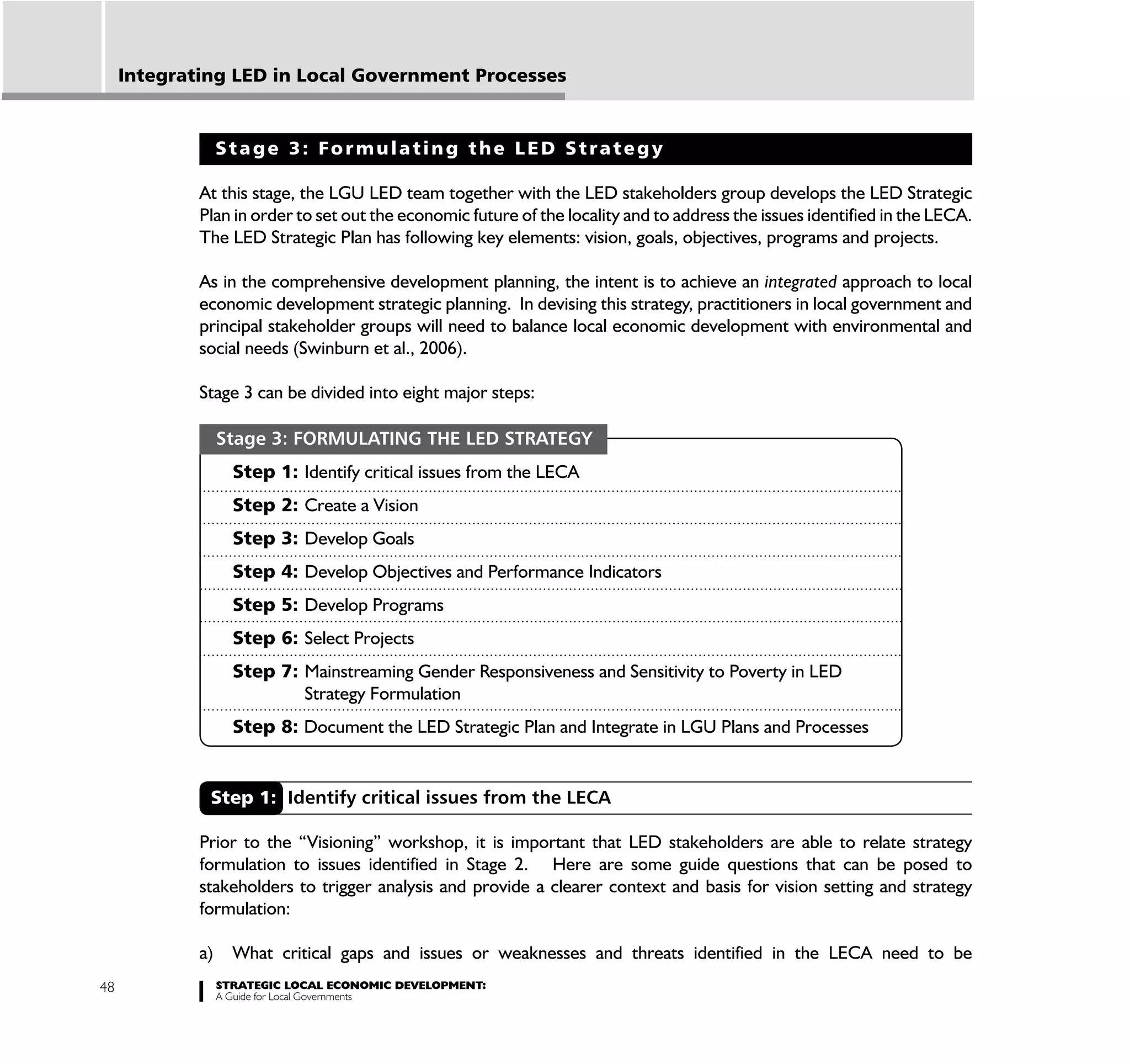
                      Stage 3: Formulating the LED Strategy
                      Stage 4: Implementing the LED Strategy
                      Stage 5: Reviewing the LED Strategy
     75 Chapter 3: LED in Practice
                      Tugaya, Lanao del Sur: Culture as an Engine of Local Economic Development
                      Wao Lanao del Sur: Pursuing Food Security and Environmental Sustainability through the
                          LED Process
                      Upi, Maguindanao: Developing the Entrepreneurial LGU through the LED Process
75                    Tuguegarao City, Cagayan: Enhancing the Business Enabling Environment for
                          Community-Based Enterprises
                      Naga City, Camarines Sur: Good Governance as Catalyst of Economic Growth
                      Baybay, Leyte: Setting the LED Direction through Participatory Economic Planning
                      Bohol Province: LED through Investment Promotion and Good Governance

      91   Chapter 4: Lessons Learned
      98   Reference List
     100   Annex A. The LGU Mandates and Related Laws on LED

91   102   Annex B. Data for Local Economy Profiling
                                                          STRATEGIC LOCAL ECONOMIC DEVELOPMENT:                5
                                                                             A Guide for Local Governments
Foreword
    Assalamo Alaikum Warahmatullahi Wabarakatuho!

    Today many local governments are already looking beyond planning and the delivery of social welfare
    services as priorities. LGUs are now findings ways of undertaking programs and improving capacities that
    would enable constituents to take part in promoting and implementing initiatives that spur local economic
    development. The transformation of communities from being recipients of services to becoming active
    participants in economic development is gaining ground and wider acceptance among LGUs.

    Strategic Local Economic Development: A Guide for Local Governments is a very timely publication considering
    the growing clamor for local governments to take active part in promoting local economic development
    both as a goal and as a program in local governance. This publication serves not only as an eye opener
    but also as a guide for LGUs to understand and integrate local economic development processes and
    mechanisms into local government functions. The LGU experiences featured in the publication are good
    examples of how local leadership can steer economic progress through participatory, transparent and
    accountable governance. The publication is also inspiring coming as it is from the experiences of local
    governments in the Autonomous Region in Muslim Mindanao (ARMM). One important insight is that local
    economic development can happen in any type or class of LGU.

    This Guide also highlights the importance of LGU, community stakeholders and government agency
    interaction as a critical element in achieving local economic development. Each one has a role to play in
    the local economic development process. The steps provided in this Guide are not only useful to LGUs
    but also to other stakeholders, especially to agencies such as the DTI-ARMM. Strategic Local Economic
    Development: A Guide for Local Governments emboldens us to strengthen further our efforts in integrating
    the LED process within the DTI-ARMM’s mandate, plans and programs.

    We trust that this publication will motivate and inspire more LGUs to embark on a meaningful, deliberate
    and strategic LED process.

    Our congratulations to the LGSPA for coming out with this relevant and most useful knowledge
    resource!


    SAJID S. DRUZ ALI
    Regional Secretary
    Department of Trade and Industry-ARMM (DTI-ARMM)

2     STRATEGIC LOCAL ECONOMIC DEVELOPMENT:
      A Guide for Local Governments
Acknowledgements
This publication was made possible through the dedication and collective efforts of individuals and teams
who willingly shared their ideas and valuable time in conceptualizing and developing this Guide.

The Local Governance Support Program in ARMM thanks:

The local economic development stakeholders of the municipalities of Upi, Datu Odin Sinsuat, Sultan
Kudarat and Parang in Maguindanao; Wao and Tugaya in Lanao del Sur; Lamitan in Basilan, Bongao in Tawi-
Tawi; and Jolo in Sulu, whose experience in facilitating local economic development in their respective
areas inspired the writing of this Guide

LGSPA Program Officers Jaime Dumarpa, Jim Hassan, Veronica Quinday, Fatima Darwissa Yussah and
Assistant Manager Cecile Isubal for providing technical assistance to their respective LGUs in undertaking
the LED process

The DTI-ARMM LED coach team headed by ASec Maritess Maguindra for continuing the support to
LGUs and for integrating the LED process in their agency’s programs

The technical team of this publication -- Chona Balagat, Anami Canag, Emma Barbara Remitio, Myn
Garcia, Rizal Barandino, Edgar Catalan, Mags Z. Maglana, Maya Vandenbroeck, Sef Carandang and Tata
Lao -- who passionately saw through the development and completion of this Guide

LGSPA managers and staff who contributed in many ways to promoting local economic development and
to producing this knowledge product


                                                                  STRATEGIC LOCAL ECONOMIC DEVELOPMENT:              3
                                                                                     A Guide for Local Governments
Preface
     Strategic Local Economic Development: A Guide for Local Governments is the embodiment of the collective
     experience of local government units, government agencies and the Local Governance Support Program
     in ARMM (LGSPA) in promoting local economic development in the Autonomous Region in Muslim
     Mindanao. Despite difficulties and conditions that were inimical to durable economic development and
     peace, the work of LGSPA has produced a wealth of knowledge that contributes to the further evolution
     of the framework and strategies in local economic development promotion that were initially pursued in
     the second phase of the Local Government Support Program (LGSP II). In this connection, the electronic
     file of the Local Economic Development: Stimulating Growth and Improving Quality of Life publication of LGSP
     II has been included as a companion CD to this material.

     Strategic Local Economic Development: A Guide for Local Governments is based on the field application
     by LGSPA of existing local economic development (LED) general processes and guidelines. Using the
     tenets of good governance as anchors, the LGSPA experience highlights the importance of participation,
     transparency and accountability as very important elements in local government-facilitated economic
     development. In the context of the ARMM, the experience underscores the importance of integrated,
     collaborative and purposive undertakings among economic agencies, private stakeholders and local
     government units in maximizing opportunities for local economic development.

     This Guide hopes to fill in knowledge gaps in boosting the capacities of local governments to engage
     stakeholders and players of local economic development. It emphasizes the industry approach,
     promotes entrepreneurship for wealth and job creation and recommends more robust ways of assessing
     competitiveness and crafting LED strategies. It also links LED to gender equality and poverty reduction,
     themes that are equally important to LGUs and citizens. The Guide includes LED experiences in ARMM
     through the work of LGSPA and of other areas in the Philippines.

     With Strategic Local Economic Development: A Guide for Local Governments, LGSPA hopes to have shown
     that local economic development can be implemented in the context of promoting good governance and
     that good governance is vital to local economic development.

     Local Governance Support Program in ARMM (LGSPA)


4      STRATEGIC LOCAL ECONOMIC DEVELOPMENT:
       A Guide for Local Governments
Acronyms
ABC        Association of Barangay Captains          DSWD       Department of Social Welfare and
ADB        Asian Development Bank                               Development
AI         Artificial Insemination                   DTI        Department of Trade and Industry
AIP        Annual Investment Plan                    ELA        Executive-Legislative Agenda
ARD-GOLD   Associates in Rural Development –         EO         Executive Order
           Governance and Local Democracy            e-TRACS    Electronic Tax and Revenue Assessment and
ARMM       Autonomous Region in Muslim Mindanao                 Collection System
ATI        Agricultural Training Institute           EU         European Union
BDC        Business Development Center               FARMC      Fisheries and Aquatic Resources Management
BEMO       Bohol Environmental Management Office                Council
BEPO       Bohol Employment and Placement Office     GAD        Gender and Development
BIPC       Bohol Investment Promotion Center         GFI        Government Financing Institutions
BIPP       Bohol Investment Promotion Program        GTZ        German Technical Cooperation
BIR        Bureau of Internal Revenue                HVCC       High Value Commercial Crops
BLECS      Bohol Law Enforcement Communication       IEC        Information, Education, Communication
           System                                    ILO        International Labor Organization
BOL        Build-Operate-Lease                       IPAG       Investment Promotion Advisory Group
BOO        Build-Operate-Own                         IRA        Internal Revenue Allotment
BOT        Build-Operate-Transfer                    IT         Information Technology
BPRMO      Bohol Poverty Reduction and Management    KAS        Konrad Adenauer Stiftung
           Office                                    LCE        Local Chief Executive
CALABARZON Cavite, Laguna, Batangas, Rizal, Quezon   LDC        Local Development Council
           Economic Zone                             LDIP       Local Development Investment Program
CDP        Comprehensive Development Plan            LDIS       Local Development Indicator System
CDS        City Development Strategy                 LECA       Local Economy and Competitiveness
CLUP       Comprehensive Land Use Plan                          Assessment
CMU        Central Mindanao University               LED        Local Economic Development
CSO        Civil Society Organization                LGPMS      Local Governance Performance Management
DA         Department of Agriculture                            System
DAR        Department of Agrarian Reform             LGSP II    Local Government Support Program Phase 2
DENR       Department of Environment and Natural     LGSPA      Local Governance Support Program in the
           Resources                                            Autonomous Region in Muslim Mindanao
DepEd      Department of Education                   LGU        Local Government Unit
DILG       Department of the Interior and Local      LRED       Local and Regional Economic Development
           Government                                LRIA       Local Resource Inventory and Assessment
DOH        Department of Health                      M&E        Monitoring and Evaluation
DOLE       Department of Labor and Employment        MEDCo      Mindanao Economic Development Council
DOST       Department of Science and Technology      MNDC       Metro Naga Development Council
DOT        Department of Tourism                     MPDC       Municipal Planning and Development
DPWH       Department of Public Works and Highways              Coordinator
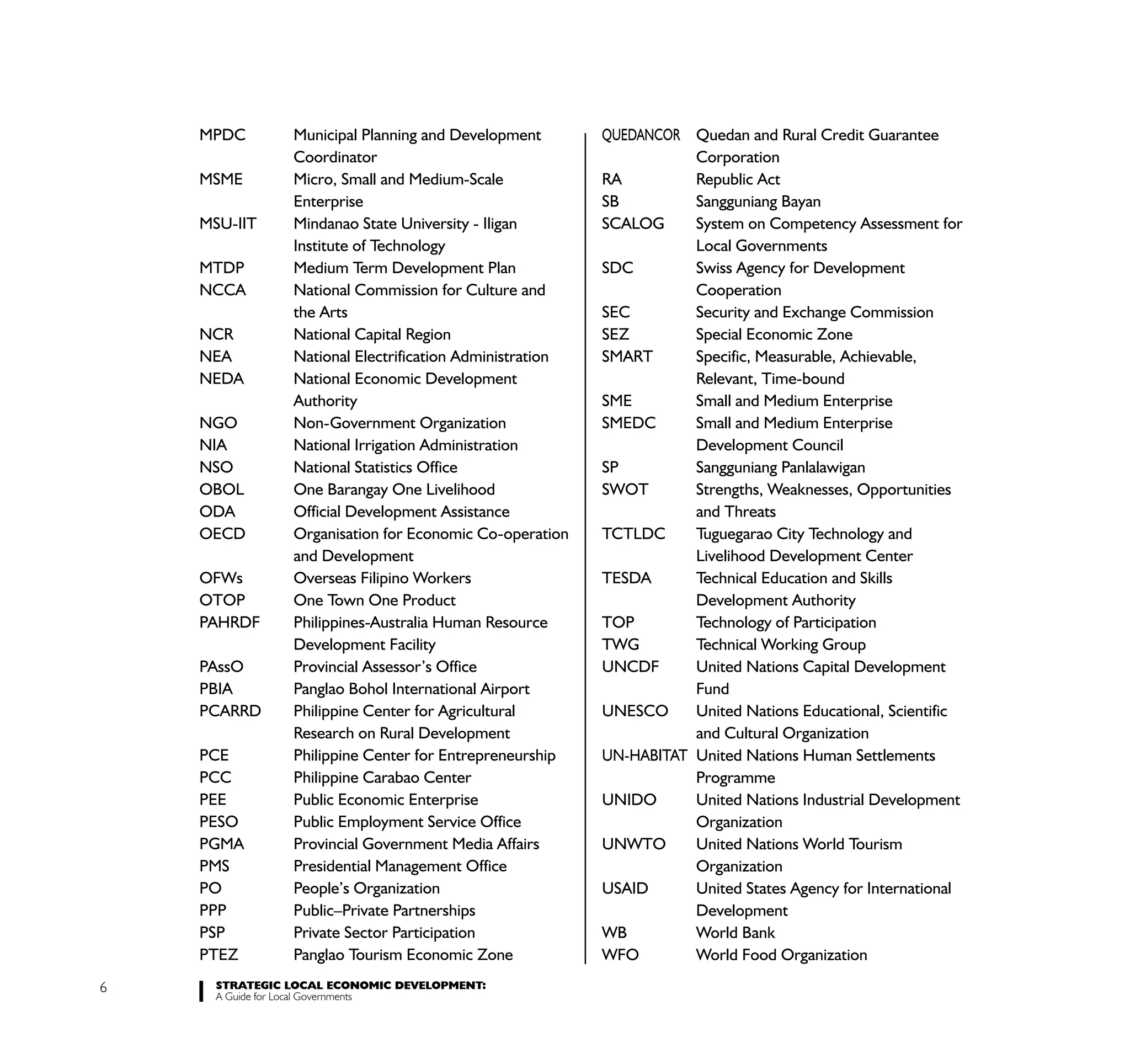
                                                     MSME       Micro, Small and Medium-Scale Enterprise

                                                               STRATEGIC LOCAL ECONOMIC DEVELOPMENT:              5
                                                                                  A Guide for Local Governments
MPDC        Municipal Planning and Development        QUEDANCOR Quedan and Rural Credit Guarantee
                Coordinator                                          Corporation
    MSME        Micro, Small and Medium-Scale             RA         Republic Act
                Enterprise                                SB         Sangguniang Bayan
    MSU-IIT     Mindanao State University - Iligan        SCALOG     System on Competency Assessment for
                Institute of Technology                              Local Governments
    MTDP        Medium Term Development Plan              SDC        Swiss Agency for Development
    NCCA        National Commission for Culture and                  Cooperation
                the Arts                                  SEC        Security and Exchange Commission
    NCR         National Capital Region                   SEZ        Special Economic Zone
    NEA         National Electrification Administration   SMART      Specific, Measurable, Achievable,
    NEDA        National Economic Development                        Relevant, Time-bound
                Authority                                 SME        Small and Medium Enterprise
    NGO         Non-Government Organization               SMEDC      Small and Medium Enterprise
    NIA         National Irrigation Administration                   Development Council
    NSO         National Statistics Office                SP         Sangguniang Panlalawigan
    OBOL        One Barangay One Livelihood               SWOT       Strengths, Weaknesses, Opportunities
    ODA         Official Development Assistance                      and Threats
    OECD        Organisation for Economic Co-operation    TCTLDC     Tuguegarao City Technology and
                and Development                                      Livelihood Development Center
    OFWs        Overseas Filipino Workers                 TESDA      Technical Education and Skills
    OTOP        One Town One Product                                 Development Authority
    PAHRDF      Philippines-Australia Human Resource      TOP        Technology of Participation
                Development Facility                      TWG        Technical Working Group
    PAssO       Provincial Assessor’s Office              UNCDF      United Nations Capital Development
    PBIA        Panglao Bohol International Airport                  Fund
    PCARRD      Philippine Center for Agricultural        UNESCO     United Nations Educational, Scientific
                Research on Rural Development                        and Cultural Organization
    PCE         Philippine Center for Entrepreneurship    UN-HABITAT United Nations Human Settlements
    PCC         Philippine Carabao Center                            Programme
    PEE         Public Economic Enterprise                UNIDO      United Nations Industrial Development
    PESO        Public Employment Service Office                     Organization
    PGMA        Provincial Government Media Affairs       UNWTO      United Nations World Tourism
    PMS         Presidential Management Office                       Organization
    PO          People’s Organization                     USAID      United States Agency for International
    PPP         Public–Private Partnerships                          Development
    PSP         Private Sector Participation              WB         World Bank
    PTEZ        Panglao Tourism Economic Zone             WFO        World Food Organization
6     STRATEGIC LOCAL ECONOMIC DEVELOPMENT:
      A Guide for Local Governments
Introduction
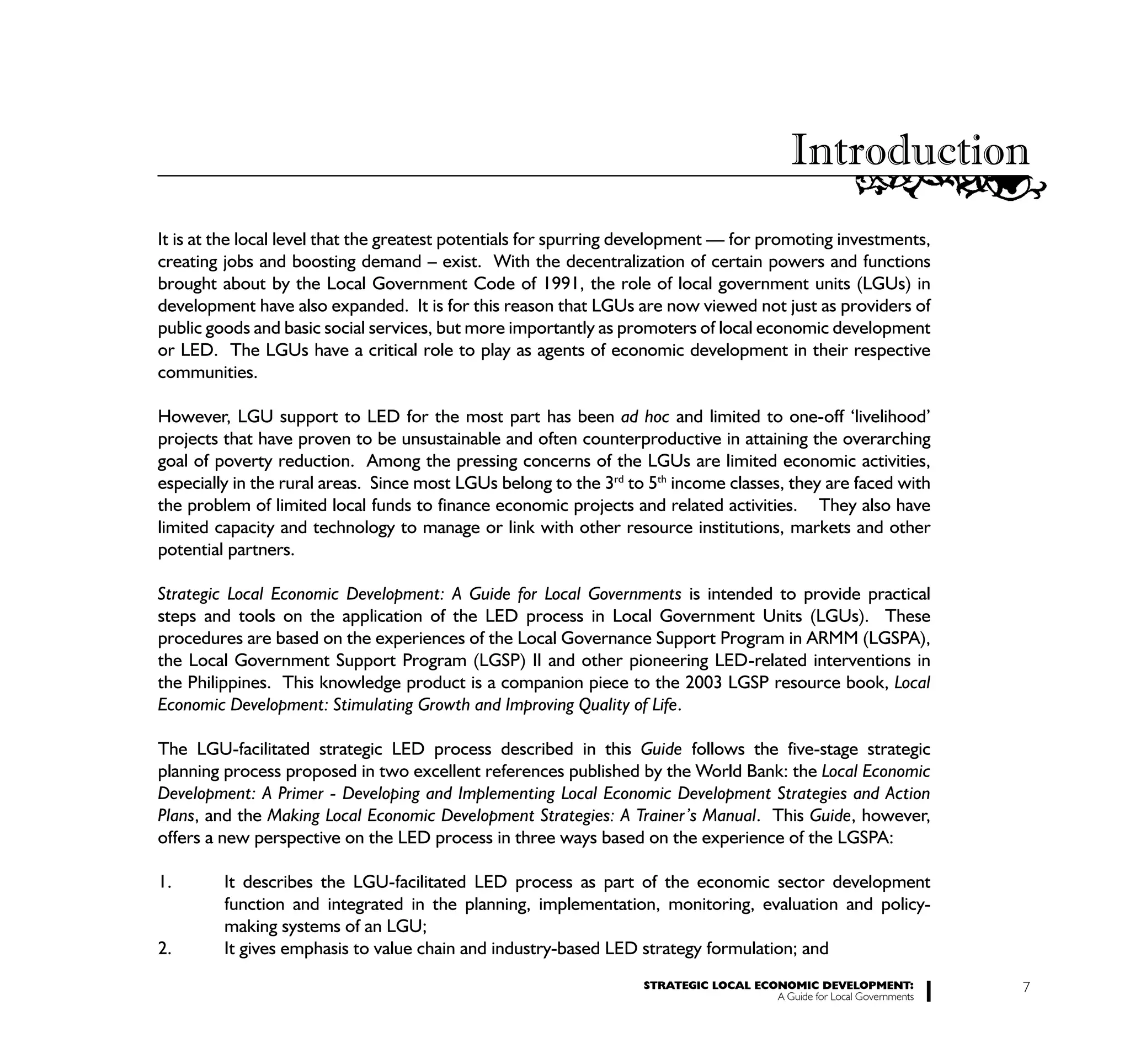
It is at the local level that the greatest potentials for spurring development — for promoting investments,
creating jobs and boosting demand – exist. With the decentralization of certain powers and functions
brought about by the Local Government Code of 1991, the role of local government units (LGUs) in
development have also expanded. It is for this reason that LGUs are now viewed not just as providers of
public goods and basic social services, but more importantly as promoters of local economic development
or LED. The LGUs have a critical role to play as agents of economic development in their respective
communities.

However, LGU support to LED for the most part has been ad hoc and limited to one-off ‘livelihood’
projects that have proven to be unsustainable and often counterproductive in attaining the overarching
goal of poverty reduction. Among the pressing concerns of the LGUs are limited economic activities,
especially in the rural areas. Since most LGUs belong to the 3rd to 5th income classes, they are faced with
the problem of limited local funds to finance economic projects and related activities. They also have
limited capacity and technology to manage or link with other resource institutions, markets and other
potential partners.

Strategic Local Economic Development: A Guide for Local Governments is intended to provide practical
steps and tools on the application of the LED process in Local Government Units (LGUs). These
procedures are based on the experiences of the Local Governance Support Program in ARMM (LGSPA),
the Local Government Support Program (LGSP) II and other pioneering LED-related interventions in
the Philippines. This knowledge product is a companion piece to the 2003 LGSP resource book, Local
Economic Development: Stimulating Growth and Improving Quality of Life.

The LGU-facilitated strategic LED process described in this Guide follows the five-stage strategic
planning process proposed in two excellent references published by the World Bank: the Local Economic
Development: A Primer - Developing and Implementing Local Economic Development Strategies and Action
Plans, and the Making Local Economic Development Strategies: A Trainer’s Manual. This Guide, however,
offers a new perspective on the LED process in three ways based on the experience of the LGSPA:

1.       It describes the LGU-facilitated LED process as part of the economic sector development
         function and integrated in the planning, implementation, monitoring, evaluation and policy-
         making systems of an LGU;
2.       It gives emphasis to value chain and industry-based LED strategy formulation; and
                                                                   STRATEGIC LOCAL ECONOMIC DEVELOPMENT:              7
                                                                                      A Guide for Local Governments
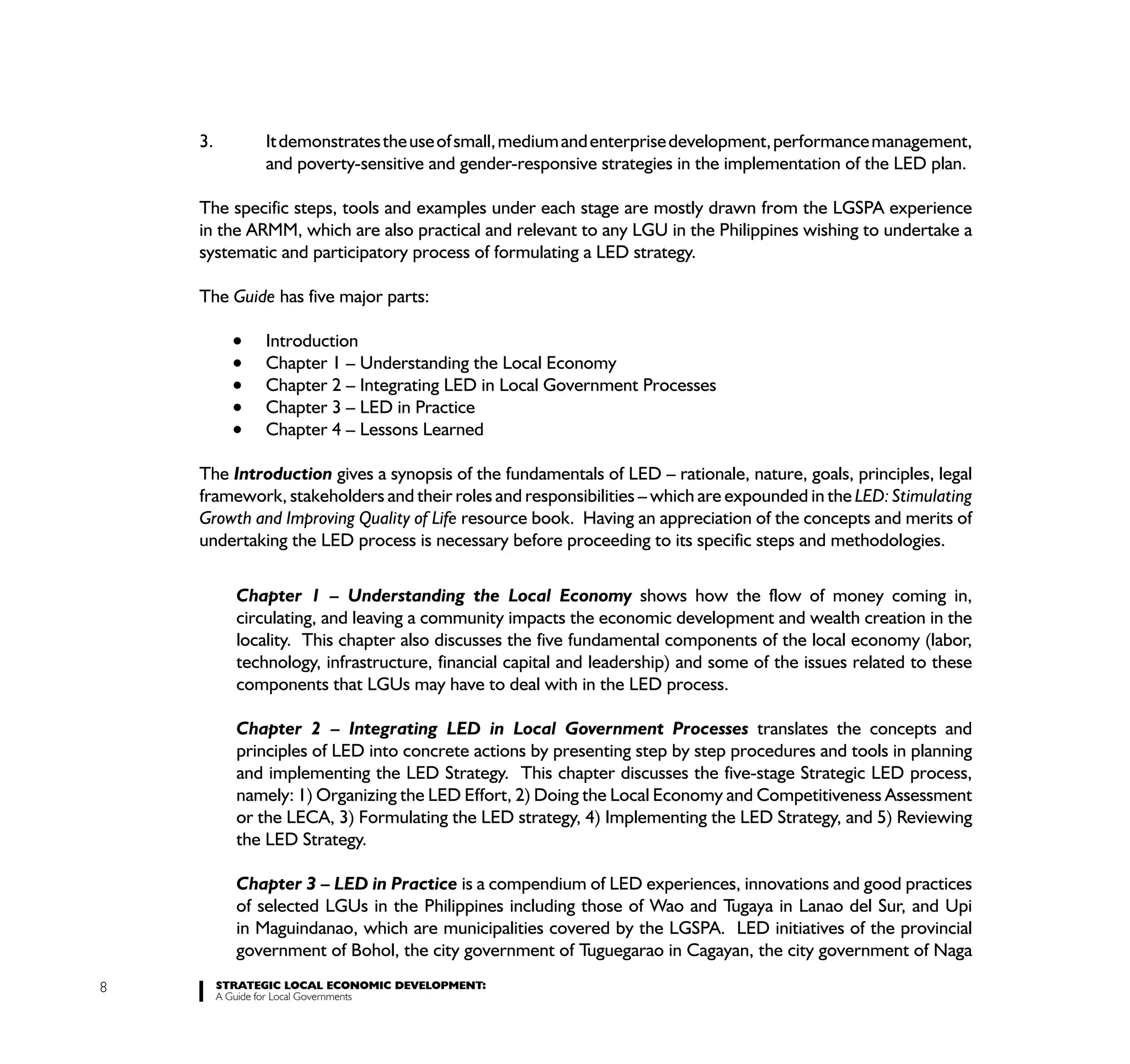
3.         It demonstrates the use of small, medium and enterprise development, performance management,
               and poverty-sensitive and gender-responsive strategies in the implementation of the LED plan.

    The specific steps, tools and examples under each stage are mostly drawn from the LGSPA experience
    in the ARMM, which are also practical and relevant to any LGU in the Philippines wishing to undertake a
    systematic and participatory process of formulating a LED strategy.

    The Guide has five major parts:

               Introduction
               Chapter 1 – Understanding the Local Economy
               Chapter 2 – Integrating LED in Local Government Processes
               Chapter 3 – LED in Practice
               Chapter 4 – Lessons Learned

    The Introduction gives a synopsis of the fundamentals of LED – rationale, nature, goals, principles, legal
    framework, stakeholders and their roles and responsibilities – which are expounded in the LED: Stimulating
    Growth and Improving Quality of Life resource book. Having an appreciation of the concepts and merits of
    undertaking the LED process is necessary before proceeding to its specific steps and methodologies.

           Chapter 1 – Understanding the Local Economy shows how the flow of money coming in,
           circulating, and leaving a community impacts the economic development and wealth creation in the
           locality. This chapter also discusses the five fundamental components of the local economy (labor,
           technology, infrastructure, financial capital and leadership) and some of the issues related to these
           components that LGUs may have to deal with in the LED process.

           Chapter 2 – Integrating LED in Local Government Processes translates the concepts and
           principles of LED into concrete actions by presenting step by step procedures and tools in planning
           and implementing the LED Strategy. This chapter discusses the five-stage Strategic LED process,
           namely: 1) Organizing the LED Effort, 2) Doing the Local Economy and Competitiveness Assessment
           or the LECA, 3) Formulating the LED strategy, 4) Implementing the LED Strategy, and 5) Reviewing
           the LED Strategy.

           Chapter 3 – LED in Practice is a compendium of LED experiences, innovations and good practices
           of selected LGUs in the Philippines including those of Wao and Tugaya in Lanao del Sur, and Upi
           in Maguindanao, which are municipalities covered by the LGSPA. LED initiatives of the provincial
           government of Bohol, the city government of Tuguegarao in Cagayan, the city government of Naga
8        STRATEGIC LOCAL ECONOMIC DEVELOPMENT:
         A Guide for Local Governments
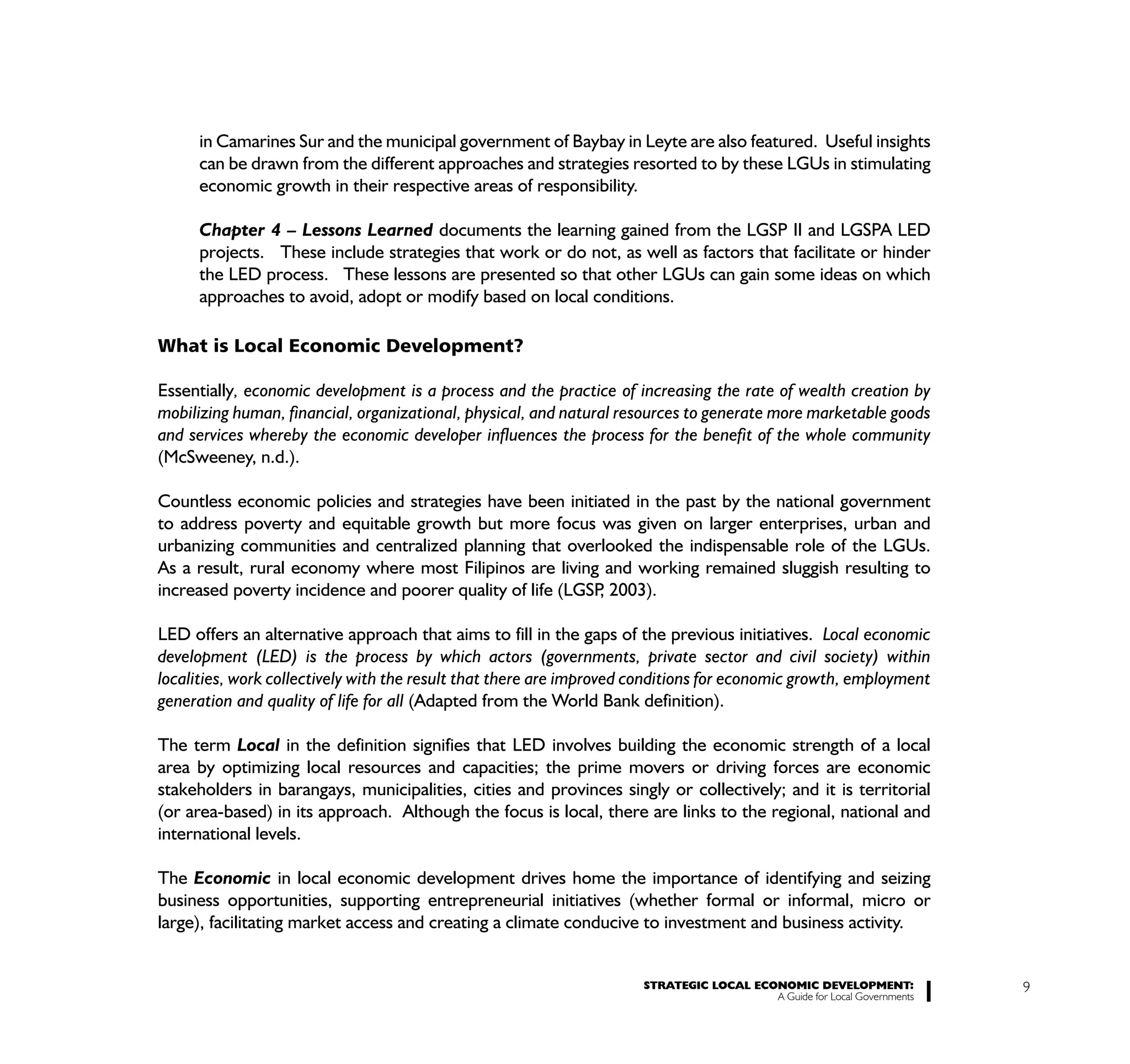
in Camarines Sur and the municipal government of Baybay in Leyte are also featured. Useful insights
      can be drawn from the different approaches and strategies resorted to by these LGUs in stimulating
      economic growth in their respective areas of responsibility.

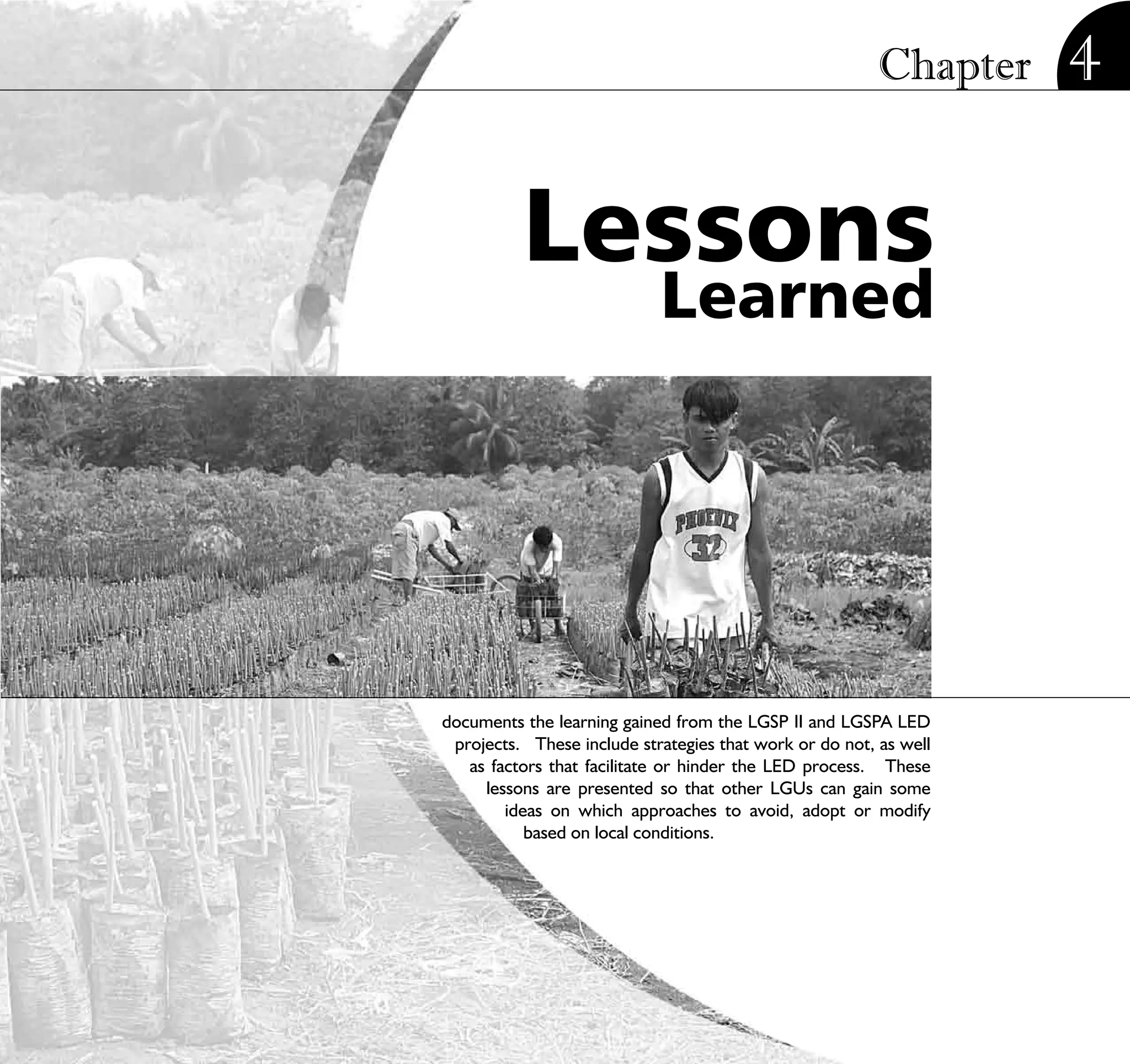
      Chapter 4 – Lessons Learned documents the learning gained from the LGSP II and LGSPA LED
      projects. These include strategies that work or do not, as well as factors that facilitate or hinder
      the LED process. These lessons are presented so that other LGUs can gain some ideas on which
      approaches to avoid, adopt or modify based on local conditions.

What is Local Economic Development?

Essentially, economic development is a process and the practice of increasing the rate of wealth creation by
mobilizing human, financial, organizational, physical, and natural resources to generate more marketable goods
and services whereby the economic developer influences the process for the benefit of the whole community
(McSweeney, n.d.).

Countless economic policies and strategies have been initiated in the past by the national government
to address poverty and equitable growth but more focus was given on larger enterprises, urban and
urbanizing communities and centralized planning that overlooked the indispensable role of the LGUs.
As a result, rural economy where most Filipinos are living and working remained sluggish resulting to
increased poverty incidence and poorer quality of life (LGSP 2003).
                                                            ,

LED offers an alternative approach that aims to fill in the gaps of the previous initiatives. Local economic
development (LED) is the process by which actors (governments, private sector and civil society) within
localities, work collectively with the result that there are improved conditions for economic growth, employment
generation and quality of life for all (Adapted from the World Bank definition).

The term Local in the definition signifies that LED involves building the economic strength of a local
area by optimizing local resources and capacities; the prime movers or driving forces are economic
stakeholders in barangays, municipalities, cities and provinces singly or collectively; and it is territorial
(or area-based) in its approach. Although the focus is local, there are links to the regional, national and
international levels.

The Economic in local economic development drives home the importance of identifying and seizing
business opportunities, supporting entrepreneurial initiatives (whether formal or informal, micro or
large), facilitating market access and creating a climate conducive to investment and business activity.


                                                                      STRATEGIC LOCAL ECONOMIC DEVELOPMENT:              9
                                                                                         A Guide for Local Governments
The term Development emphasizes that LED is holistic; it does not only cover the economic dimension
     but also includes social, politico-administrative and cultural aspects. The quality and direction of growth
     is as important as its quantity and size. Sustainable development is at the heart of LED which means
     satisfying the needs of the present generation without sacrificing the future of succeeding ones (LGSP    ,
     2003).

     LED enables and promotes the coordination and optimization of scarce resources available in an area, the
     integration of LED plans, priorities and programs into regional and national plans (with direction from the
     bottom going up) and citizen participation and consensus building among stakeholders.

     Goals and Principles of LED

     The goals of LED are to create wealth, generate jobs, increase incomes and, ultimately, reduce poverty
     and improve the quality of life in the locality.

     LED operates on several principles. First, LED promotes equitable and sustainable economic growth.
     Equitable means opportunities to wealth creation are open to both men and women of working-age, to
     the rich and poor, to urban and rural dwellers, and to all ethnic and religious groups. To sustain economic
     growth, local resources may be transformed to marketable goods for the current population but it must
     be continuously regenerated so as not to deprive the future generation of the same resources.

     Second, LED is a multi-stakeholder partnership. Those who are affected and can affect the economic
     growth in the locality (such as government, business and civil society) have a stake and a role in LED.
     Third, the private sector is the acknowledged engine of employment and growth and as such, LGUs
     must be conscious of its “enabler” role, which is setting the right environment for the local economy to
     grow. The LGU may, however, prudently decide to provide certain services in situations where there
     are insufficient private or voluntary sector providers of such services or when cartels control the prices
     of certain commodities in the locality.

     Finally, good economy thrives when there is transparent and accountable governance – a practice that
     should permeate the political and economic structures in the community.

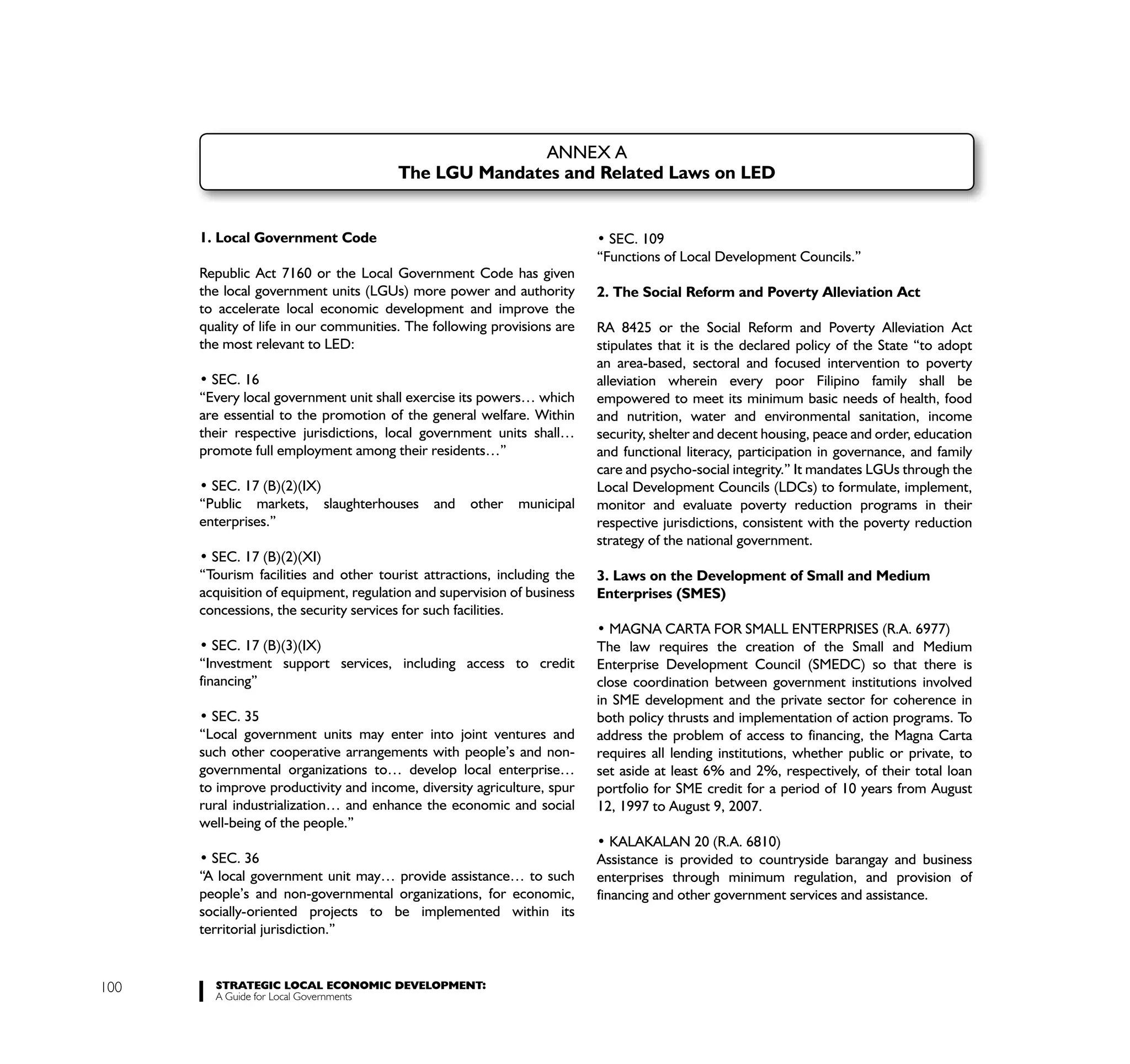
     The LGU Mandates and Related Laws on LED

     Some LGUs have already started economic programs and activities, drawing power and authority from
     existing statutes. These laws and mandates are fully discussed in LED: Stimulating Growth and Improving
     Quality of Life. Among these laws is the Local Government Code of 1991 (RA 7160) which has given the
10     STRATEGIC LOCAL ECONOMIC DEVELOPMENT:
       A Guide for Local Governments
LGUs more power and authority to accelerate local economic development and improve the quality of
life in their communities.

RA 8425 or the Social Reform and Poverty Alleviation Act also mandates LGUs through the Local
Development Councils (LDCs) to formulate, implement, monitor and evaluate poverty reduction
programs in their respective jurisdictions, which are consistent with the poverty reduction strategy of the
national government. These are further bolstered by the laws on the development of Small and Medium-
Scale Enterprises (SMEs) such as the Magna Carta for Small Enterprises (RA 6977), Kalakalan 20 (RA
6810), An Act Providing Assistance to Women Entrepreneurs (RA 7882) and the Omnibus Investment
Code (EO 226).

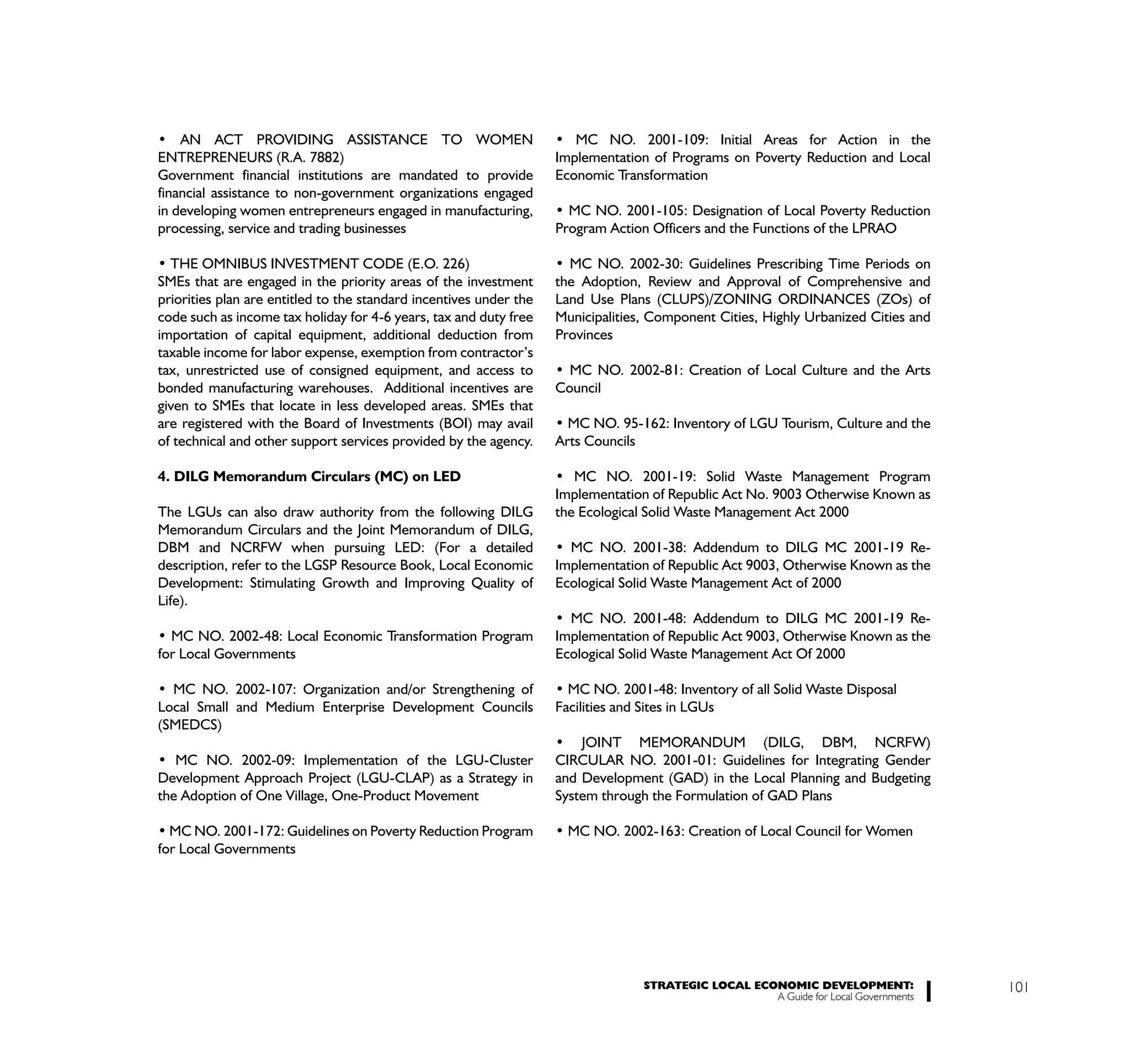
The Department of the Interior and Local Government (DILG) has also issued memorandum circulars
to the local governments pertinent to the pursuit of local economic growth and poverty reduction. See
Annex A for a complete list of LGU mandates and related laws on LED.
The LED Stakeholders, their Roles and Responsibilities

The LED process calls for the collective efforts of local stakeholders to spur economic growth. They
bring with them different levels of knowledge and expertise, perspectives, resources or assets that would
render LED effective and successful in attaining its targets. No matter how small the role of a stakeholder is,
engaging it is important in spreading ownership of the community’s economic development strategies.

Actions of community and government leaders can change, alter and direct the condition of their local
economy. The economic quality of life of the residents and the success of businesses many times are
directly affected by the policies and leadership of those who have the influence and power to create a
climate conducive to economic growth (Fruth, W., n.d.).

The LGU takes the role of provider, enabler or facilitator of local economic development. As provider,
it sees to it that the infrastructure and subsidy requirements of existing and potential industries are in
place. As enabler or facilitator, it ensures the economic players’ access to information and advisory
services, formulates relevant and supportive policies and regulations, provides incentives, and works for
the stability of peace and order. In addition, it has to carry out regular functions that have bearing on
the success of LED, namely: policy making and taxation; regulatory functions; planning and budgeting;
information collection, storage and dissemination; procurement of goods and services; marketing and
public relations; investment and enterprise promotion; management of public economic enterprises
(PEE) and the provision of physical facilities; public safety and cultural heritage activities; and, provision of
social and environmental services.


                                                                       STRATEGIC LOCAL ECONOMIC DEVELOPMENT:              11
                                                                                          A Guide for Local Governments
The LGU may also take on the role of service provider in situations where there are insufficient private
     or voluntary sector providers or when the capacities of these service providers are inadequate. This
     option, however, must be weighed carefully and the extent of LGU intervention must be clearly qualified
     considering its limited resources and array of social concerns other than infrastructure and economic
     projects.

     The private or business sector is represented by micro, small, medium and large-scale enterprises. With
     their role as engine for local employment and growth, they are tasked to scan and seize opportunities,
     take risks, develop markets and create economic value. Micro enterprises represent the informal
     economy and though not a significant generator of employment, they are considered incubators of bigger
     enterprises and fallback mechanism in times of economic crisis. Small and medium-scale enterprises are
     employment generators, the largest taxpayers, users of the latest technologies, and sources of managerial,
     technical and financial competencies.

     Organized business groups like chambers of commerce, industry associations, craft and professional
     associations and local guilds play a crucial role in setting and enforcing quality standards, upgrading human
     and technological resources, product development, marketing, business development, financing and
     creation of an LGU brand.

     Cooperatives (producers, credit, consumers) and microfinance institutions serve as depositories of
     community savings; providers of credit assistance, social protection measures such as health insurance,
     mortuary packages, and emergency loans; and promoters of frugality, discipline, trust, self and mutual
     help, and entrepreneurship.

     Civil social organizations (CSOs) such as non-government organizations (NGOs) and people’s
     organizations (POs) from the informal sector (vendors, tricycle drivers) and agriculture sector (farmers,
     fishers), represent the grassroots’ sentiments, needs and views making them excellent collaborators in
     planning, service delivery, community organizing and mobilization and in monitoring and evaluation of
     projects thereby promoting transparency and accountability.

     Educational institutions are providers of knowledge, developers and promoters of new technologies,
     trainers, and providers of talents and services for business institutions.

     National government agencies assist the LGU in the organization, planning, implementation and
     evaluation of the LED strategy by providing technical assistance, helping in fund sourcing, advocating
     LED among the stakeholders, developing and enforcing standards, and providing information and other
     market and resource linkages.

12     STRATEGIC LOCAL ECONOMIC DEVELOPMENT:
       A Guide for Local Governments
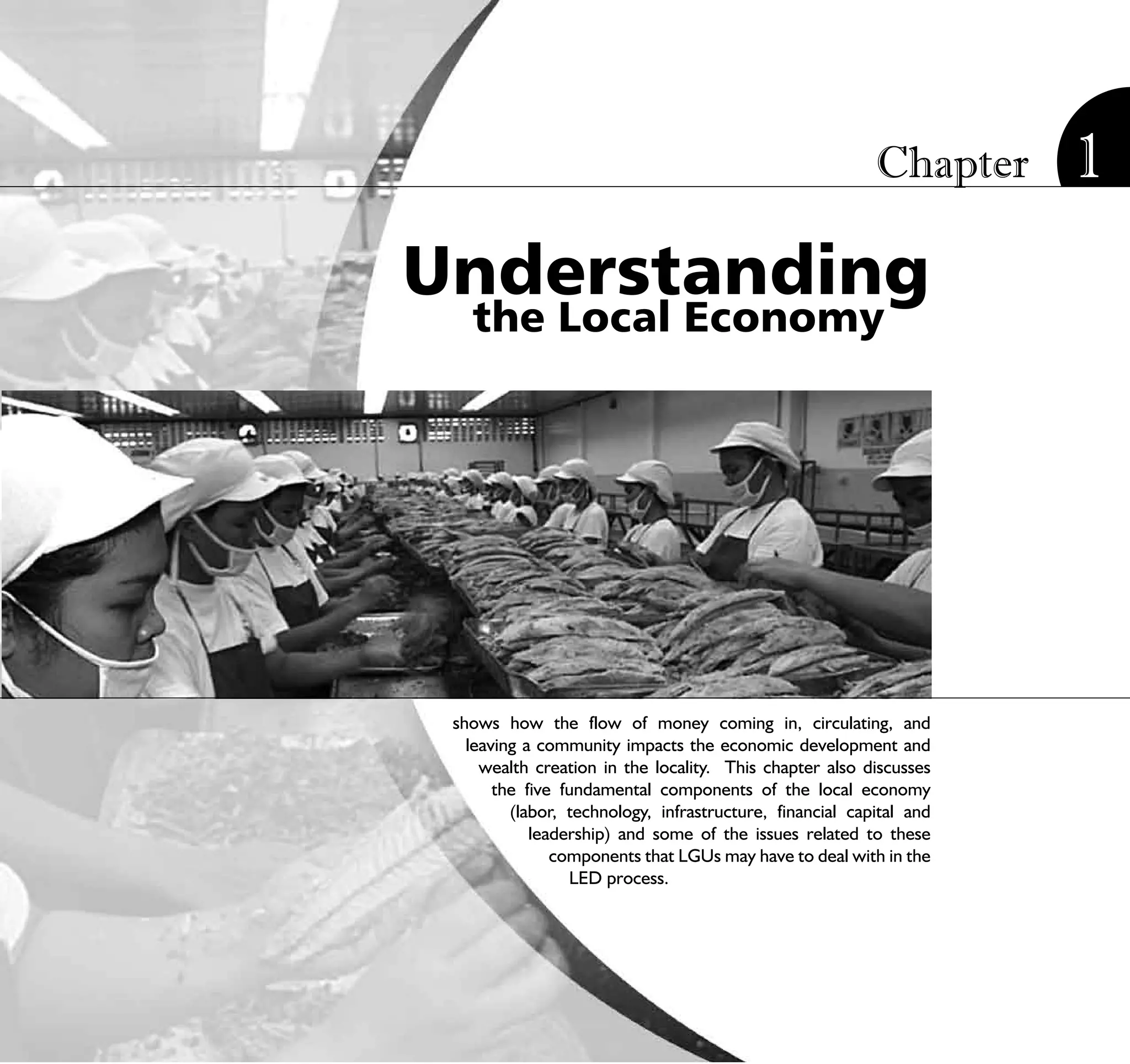
Chapter        1
Understanding
   the Local Economy


 shows how the flow of money coming in, circulating, and
   leaving a community impacts the economic development and
     wealth creation in the locality. This chapter also discusses
       the five fundamental components of the local economy
         (labor, technology, infrastructure, financial capital and
            leadership) and some of the issues related to these
               components that LGUs may have to deal with in the
                 LED process.


                          STRATEGIC LOCAL ECONOMIC DEVELOPMENT:              13
                                             A Guide for Local Governments
Understanding the Local Economy


            The Introduction provided a brief background on LED concepts and principles and underscored the
            importance of mobilizing local people and organizations in provinces, cities or municipalities to attain a
            vibrant local economy. However, to better understand the context in which the LED process operates,
            it is important to have an appreciation of how the local economy works and the factors that determine
            economic growth.

            How a Local Economy Works

            A local economy is a geographic area where people predominantly live and work and also earn and spend
            (Fruth, W., n.d.). As used in this Guide, the local economy refers to the geographic area within a political
            unit which could be a province, city or municipality.

            Money flows into the local economy in two ways: first, from the earned monies when products are sold to
            an outside customer (exported) and when people work out-of-town; second, from the unearned monies
            from outside sources to the local government and to community citizens. Also referred to as captured
            monies, these come from social security, retirement payments, interest income, rent and dividend from
            outside investments, revenue allotments and grants from national governmental agencies, grants and
            investments from official development assistance (ODA), foundations, NGOs, cooperatives and investors
            and remittances from family members working outside the community (Darling, 1991).

            When money pours in, it is circulated through spending on local goods and services. Some are spent
            locally, thus, generating more jobs and employment as goods and services are consumed.

            Money also flows out of the community in several ways: when local business firms and their employees
            buy their needs from outside sources, pay their taxes and social security to national governmental offices;
            when local households buy goods and services out-of-town; when local residents invest their money in
            businesses outside the locality; when there is inefficient use of local assets such as land, buildings and
            human skills and talents or when local investments do not pay off; when estate settlements are bequeathed
            to heirs living in other areas; and through investments on education of children who eventually leave the
            area for better opportunities elsewhere.

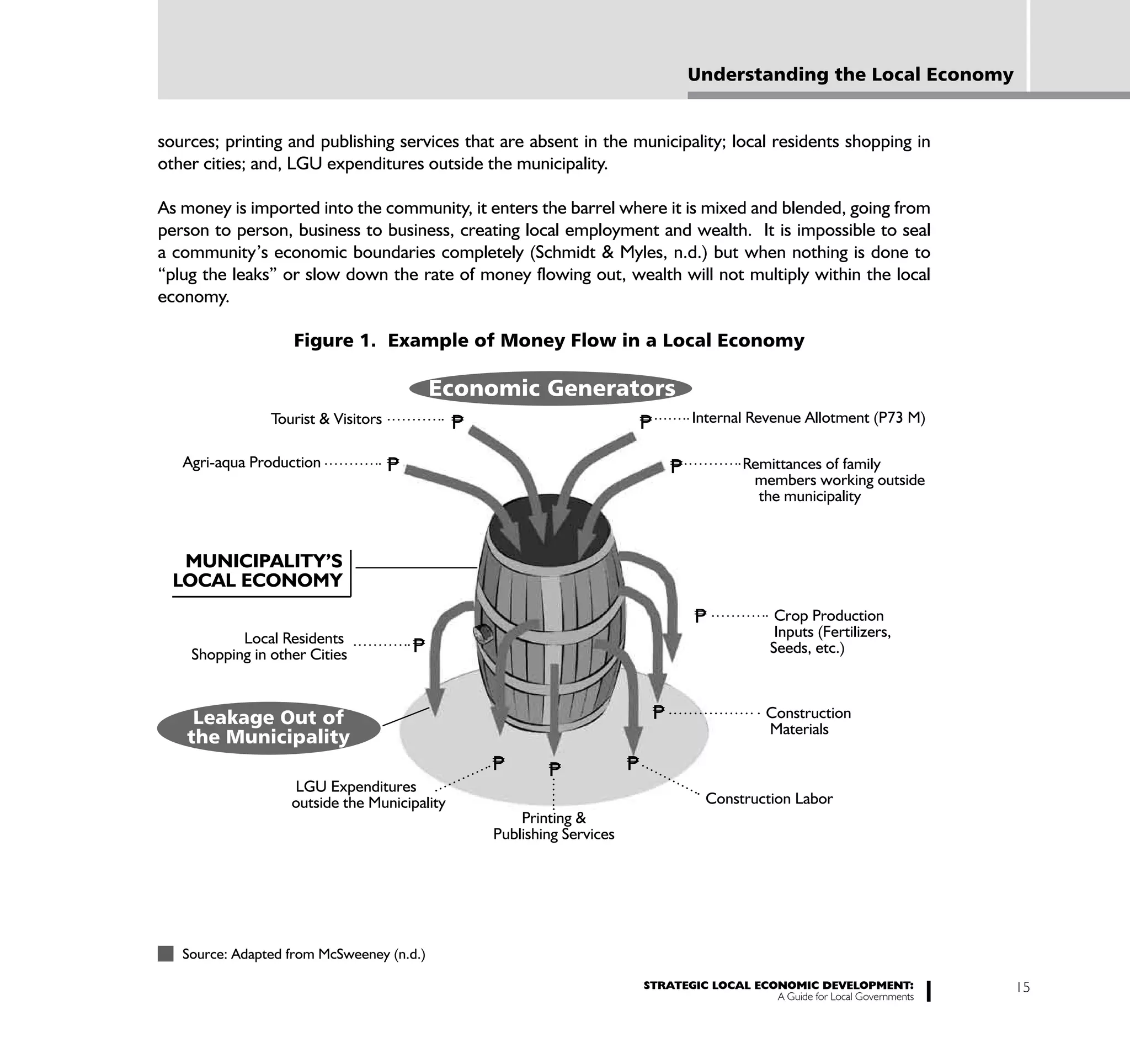
            The inflow and outflow of money in a local economy can be illustrated using the “leaking barrel” of wealth
            model. The example in Figure 1 shows that the money coming into a municipality’s local economy
            largely come from tourists and visitors, the LGU’s Internal Revenue Allotment (IRA), family member
            remittances, and agricultural products sold to buyers and consumers outside the locality. The leaks in the
            barrel represent the money or income leaving the economy. In the example, the leaks in the economy
            come in the form of crop production inputs, construction materials and labor that come from outside

14            STRATEGIC LOCAL ECONOMIC DEVELOPMENT:
              A Guide for Local Governments
Understanding the Local Economy


sources; printing and publishing services that are absent in the municipality; local residents shopping in
other cities; and, LGU expenditures outside the municipality.

As money is imported into the community, it enters the barrel where it is mixed and blended, going from
person to person, business to business, creating local employment and wealth. It is impossible to seal
a community’s economic boundaries completely (Schmidt & Myles, n.d.) but when nothing is done to
“plug the leaks” or slow down the rate of money flowing out, wealth will not multiply within the local
economy.

                   Figure 1. Example of Money Flow in a Local Economy

                                             Economic Generators
                Tourist & Visitors            P
                                              =                         P
                                                                        =            Internal Revenue Allotment (P73 M)

   Agri-aqua Production              P
                                     =
                                                                                 P
                                                                                 =           Remittances of family
                                                                                              members working outside
                                                                                               the municipality


   MUNICIPALITY’S
  LOCAL ECONOMY
                                                                                     P
                                                                                     =             Crop Production
           Local Residents                                                                         Inputs (Fertilizers,
    Shopping in other Cities             P
                                         =                                                        Seeds, etc.)


    Leakage Out of                                                           P
                                                                             =                   Construction
                                                                                                 Materials
   the Municipality
                                                  P
                                                  =
                                                          P
                                                          =             P
                                                                        =

                   LGU Expenditures
                   outside the Municipality                                            Construction Labor
                                                      Printing &
                                                  Publishing Services


   Source: Adapted from McSweeney (n.d.)

                                                                            STRATEGIC LOCAL ECONOMIC DEVELOPMENT:              15
                                                                                               A Guide for Local Governments
Understanding the Local Economy


            Fundamental Components of the Local Economy

            Local economic growth is determined by the interplay of the economy’s labor, financial capital, technology,
            infrastructure and leadership components. These are the factors that must be analyzed during the LED
            process particularly in the Local Economy and Competitiveness Assessment (LECA) so that specific issues
            (strengths, weaknesses, opportunities and threats) in each of the component can be pinpointed and later
            addressed accordingly during the LED strategy formulation.

            Labor

            Labor, as a factor of production, pertains to the community’s most precious and abundant resource
            – its workforce. Factors affecting labor productivity in the local economy include housing, health and
            education services, skills availability, security, and training opportunities.

            Some of the problems besetting the labor sector of our local communities are the high unemployment
            rate in the rural area, among female and male youths and those with higher education (LGSPA, 2007).
            This suggests that population growth is higher than the production growth. Although there are masses of
            people who can provide “raw labor,” the quality of human capital is still below par making it difficult for
            job seekers to meet the required qualifications. The current demand gives preference to a broader set of
            skills such as better analytical, problem-solving and communication skills. The quality of labor is becoming
            more important than the cost of labor.

            In terms of gender equality, more women are now joining the workforce and a significant number are
            occupying management level positions. The Philippines is the 2nd highest in percentage of entrepreneurially
            active females (among 42 countries) (Madarang, Habito, & Philippine Center for Enterpreneurship (PCE),
            n.d.). The service sector has been absorbing an increasing number of workers, particularly women
            (LGSPA, 2007).

            The human resource is the means for social and material progress and at the same time the end or
            object of development. Economic development is concerned with the equitable distribution of real
            income, which is indicated by the average per capita income of the working age population and improved
            purchasing power of individuals.

            A productive labor force requires continuing enhancement of human capital. Investments on education,
            skills training, health and basic infrastructure like water, roads and electricity have positive effects on
            the locality’s manpower. By providing these facilities and services, the LGU can help educated, healthy,
            creative, proactive, and skilled male and female workers meet the labor requirements of businesses

16            STRATEGIC LOCAL ECONOMIC DEVELOPMENT:
              A Guide for Local Governments
Understanding the Local Economy


in or outside the locality. Generating local business investments and jobs to absorb the community’s
unemployed is another challenge to the LGU.

Technology

Technology generally refers to better techniques or methods of production (Fajardo, 1985). The
development of a new technique is an invention and its application to production is called innovation.
Technological advances impact the local economy by changing the nature of products and production
techniques and improving productivity so that the economy remains competitive. Industry and business
have become so knowledge-driven that the cost of products, particularly those requiring advanced
technology, are driven by investments on knowledge or research rather than by actual production costs.

Given their limited resources to conduct research and development, LGUs can harness the expertise
of institutions and individuals by eliciting their participation in local economic development planning and
implementation. Examples of research and technology development institutions are the Agricultural
Training Institute (ATI), universities and colleges, Department of Science and Technology (DOST),
Technical Education and Skills Development Authority (TESDA), Philippine Center for Agricultural
Research on Rural Development (PCARRD), Technology and Livelihood Development Center (TLDC)
as well as corporations that are willing to provide technical assistance on product development to small
businesses as part of their corporate social responsibility.

Infrastructure

Infrastructures are large-scale public systems, services and facilities that are necessary for economic
activities, including power and water supplies, public transportation, telecommunications, roads, schools,
training and research centers, and health care facilities.

The infrastructure needs of business have changed in recent years. The quality of service in terms of
dependability, timeliness and convenience has become more important to the investors and the consuming
public. Public investment in infrastructure leads to increased return on investment for business, higher
productivity and a boost in private sector investment.

The absence or lack of infrastructure, particularly in the rural areas, is due to the fact that most LGUs are
cash-strapped. Some innovative and proactive LGUs have tapped the private sector for infrastructure
development and management through such schemes as Build-Operate-Transfer (BOT), Build-Operate-
Own (BOO), and Build-Operate-Lease (BOL). LGUs who have aggressively sought assistance, networked
and demonstrated exemplary governance practices have attracted foreign funding agencies to finance the

                                                                    STRATEGIC LOCAL ECONOMIC DEVELOPMENT:              17
                                                                                       A Guide for Local Governments
Understanding the Local Economy


            establishment of local infrastructures.

            Unfortunately, there are infrastructure projects that have turned into white elephants or have benefited
            only a few because investment decisions were not based on sound economic analysis and financial planning.
            An example of this is a seaweed processing plant lying idle because of inadequate working capital. These
            unutilized or underutilized facilities present another leak in the community’s barrel of wealth and could
            be prevented through careful analysis and planning that is being espoused in the LED process.

            Financial Capital

            Financial capital fuels businesses. There are two types of financial capital and both are required at different
            stages of business growth. The first type is debt which is the lending or loaning of money with interest. It
            involves minimal risk to the lender because it is being secured by requiring collateral from the business or
            its owner. It requires regular payments of the loan principal and the interest. The second type of financial
            capital is equity which is money invested without interest. It involves a higher risk since it is unsecured by
            assets. In return for his or her investment, the investor acquires shares of ownership and sometimes is
            involved in the management of the business (McSweeney, n.d.).

            The lack of financial capital is the hindering factor most frequently cited by micro, small and medium-
            scale enterprise owners. The usual measure being adopted by LGUs, national government agencies,
            foundations and other development institutions in response to this issue is the shelling out of small
            livelihood grants or loans, without sufficient support to other aspects of the business like production and
            marketing. This one-off intervention, by and large, serves only as a temporary remedy and seldom results
            to sustained economic activity.

            Financial capital may be generated from various internal and external sources including the LGU (with its
            IRA and local revenues), banks, cooperatives, microfinance institutions, government financing institutions,
            NGOs/foundations, foreign-assisted projects, local businesses/industries and family savings (from
            remittances of family members, retirement fees, property rentals, pensions and insurances). Capital may
            also pour in from investors outside of the locality, which can be maximized by the LGU through investor-
            friendly policies.

            Leadership

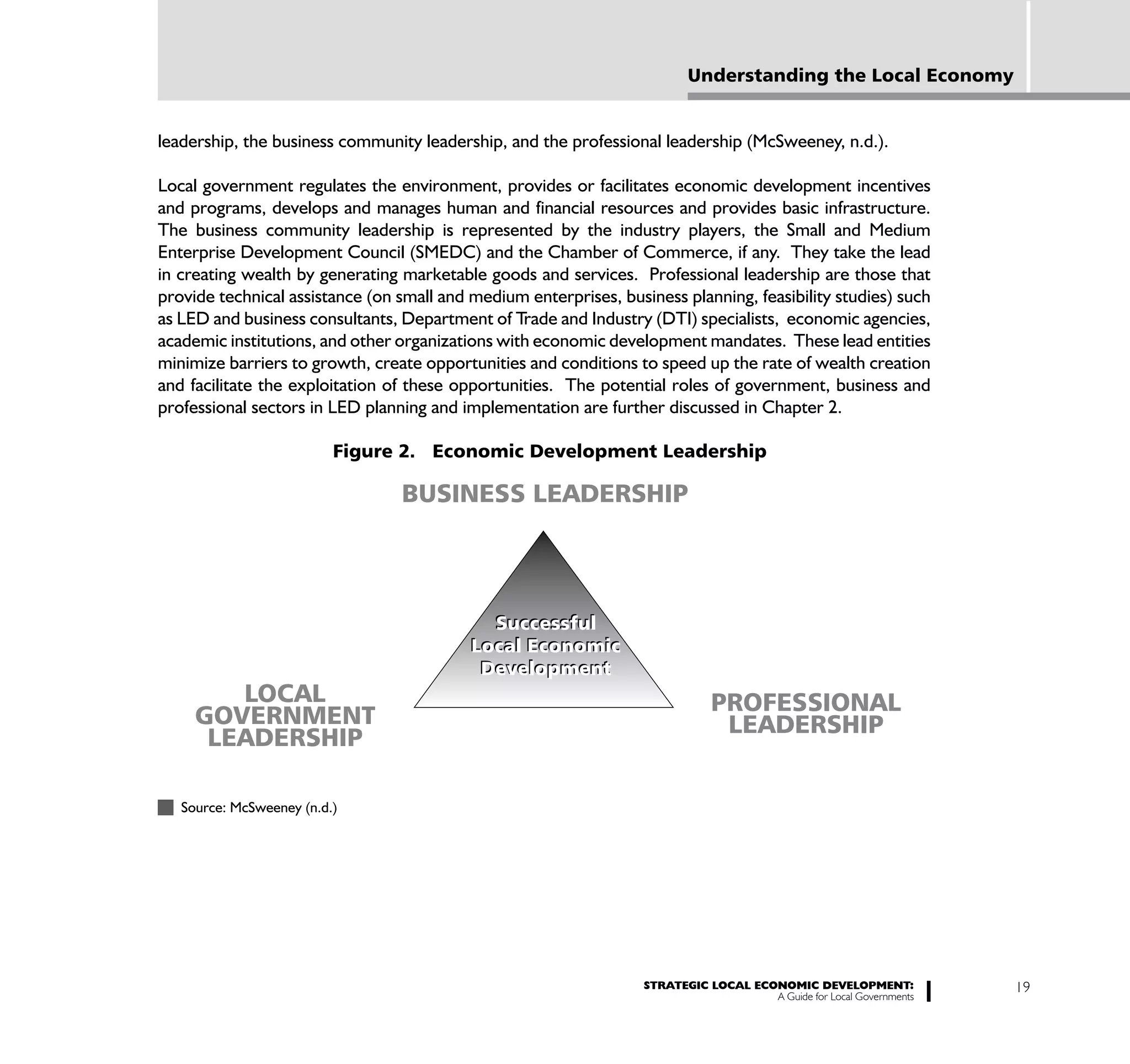
            The leadership triangle in Figure 2 shows that there are three economic development interests that must
            cooperate for a successful local economic development. These are the local government or political
18            STRATEGIC LOCAL ECONOMIC DEVELOPMENT:
              A Guide for Local Governments
Understanding the Local Economy


leadership, the business community leadership, and the professional leadership (McSweeney, n.d.).

Local government regulates the environment, provides or facilitates economic development incentives
and programs, develops and manages human and financial resources and provides basic infrastructure.
The business community leadership is represented by the industry players, the Small and Medium
Enterprise Development Council (SMEDC) and the Chamber of Commerce, if any. They take the lead
in creating wealth by generating marketable goods and services. Professional leadership are those that
provide technical assistance (on small and medium enterprises, business planning, feasibility studies) such
as LED and business consultants, Department of Trade and Industry (DTI) specialists, economic agencies,
academic institutions, and other organizations with economic development mandates. These lead entities
minimize barriers to growth, create opportunities and conditions to speed up the rate of wealth creation
and facilitate the exploitation of these opportunities. The potential roles of government, business and
professional sectors in LED planning and implementation are further discussed in Chapter 2.

                          Figure 2. Economic Development Leadership

                                 BUSINESS LEADERSHIP


                                             Successful
                                           Local Economic
                                            Development
        LOCAL                                                                 PROFESSIONAL
     GOVERNMENT                                                                LEADERSHIP
      LEADERSHIP

   Source: McSweeney (n.d.)


                                                                   STRATEGIC LOCAL ECONOMIC DEVELOPMENT:              19
                                                                                      A Guide for Local Governments
20   STRATEGIC LOCAL ECONOMIC DEVELOPMENT:
     A Guide for Local Governments
Chapter        2

Integrating LED
     in Local Government
                      Processes


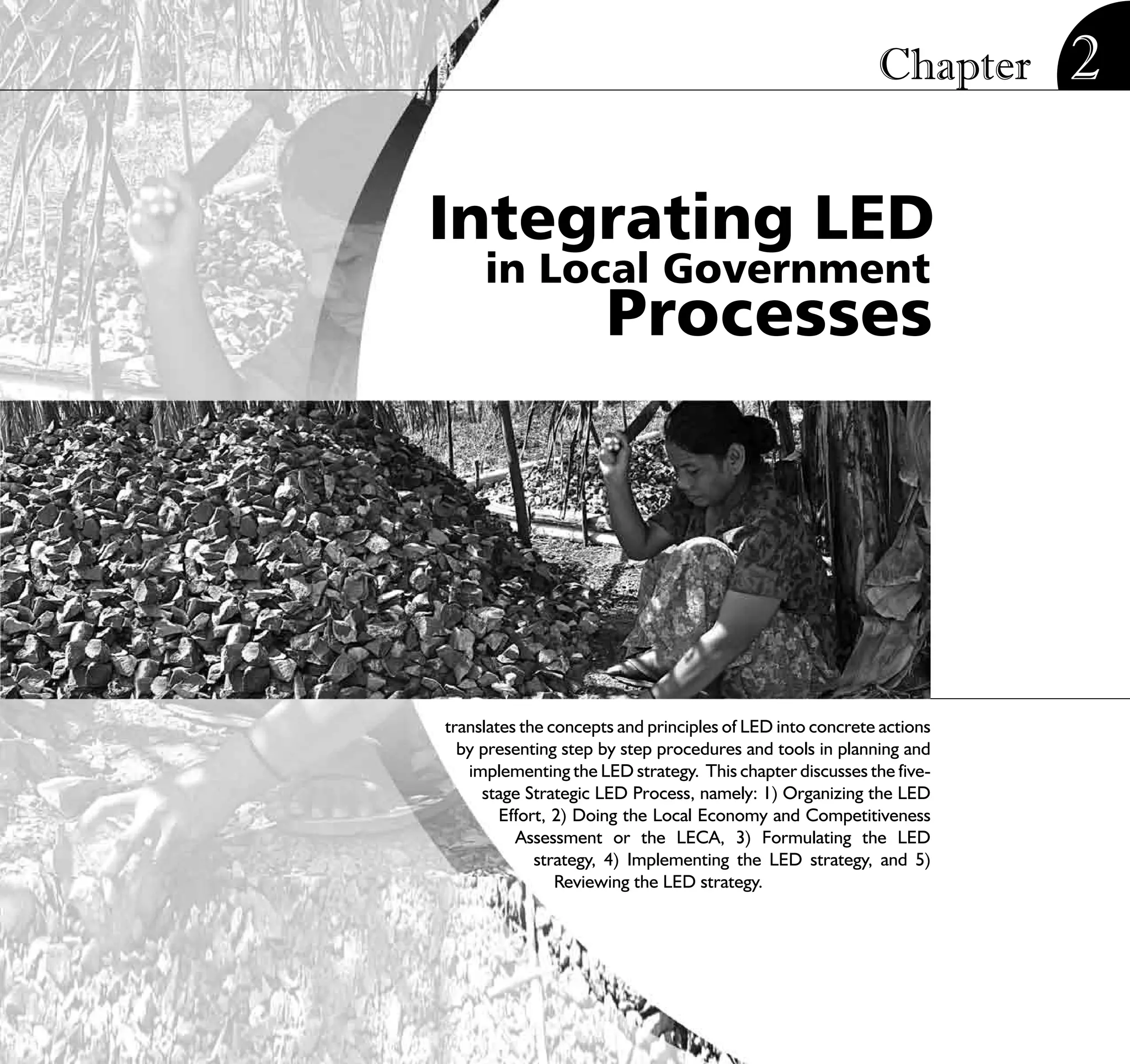
translates the concepts and principles of LED into concrete actions
  by presenting step by step procedures and tools in planning and
   implementing the LED strategy. This chapter discusses the five-
     stage Strategic LED Process, namely: 1) Organizing the LED
        Effort, 2) Doing the Local Economy and Competitiveness
          Assessment or the LECA, 3) Formulating the LED
             strategy, 4) Implementing the LED strategy, and 5)
                Reviewing the LED strategy.


                           STRATEGIC LOCAL ECONOMIC DEVELOPMENT:              21
                                              A Guide for Local Governments
Integrating LED in Local Government Processes


      “For a LED initiative to be successful it has to be
      clearly defined around economically functional space,
      and should be locally owned and championed.
      Leadership is key to bring together shared vision,
      actors and resources. The generic processes,
      approaches and tools have to be adapted and
      contextualized.”
      – (Kebede, 2008)


             The previous chapter discussed how the local economy works from a perspective of money flowing into,
             circulating in and leaving a locality. It also presented the major components that affect the productive
             capacity of a local economy: labor force, technology, infrastructure, financial capital, and leadership. These
             factors and the strategies to create wealth are some of the issues that can be addressed within the LED
             process. It must be recognized though that the “leaking barrel of wealth” model and the components of
             economic growth as described in Chapter 1 may only be a partial representation of the economic reality
             in a specific locality. In the course of undertaking the LED process, other factors that impact a community
             or locality may unfold and will have to be considered in the formulation of the LED strategy.

             In this chapter, the concepts and principles of LED are translated into concrete actions in an LGU-
             facilitated LED process. The components of the local economy presented in Chapter 1 provide the
             bases for analysis and strategy formulation during the LED process. What critical issues in the locality’s
             labor force, technology and other components should be addressed and how?

             One of the most important insights gained from the LGSP and LGSPA LED initiatives is that the success
             and sustainability of LED rest on a participatory, strategic and planned approach. It should be a process
             that is purposeful, deliberate and founded on sound analyses. Undertaking a strategic planning process is

22             STRATEGIC LOCAL ECONOMIC DEVELOPMENT:
               A Guide for Local Governments
Integrating LED in Local Government Processes


necessary to guide local leaders and implementers in identifying and carrying out the best alternatives to
an LGU-facilitated LED. The LED Strategic Plan is the landmark document in the LED process.
This Guide is not designed to prescribe implementation activities for specific LED programs and projects.
This is because LED approaches are wide-ranging and different for each LGU, depending on local
conditions. However, the basic factors to consider in implementing and monitoring the LED strategy are
incorporated in this chapter. Also, examples of actual LED strategies and how these were implemented
by LGUs are provided throughout this Guide.

When does an LGU do the Strategic LED Process?

LGUs in the Philippines are mandated to prepare two major plans – the Comprehensive Land Use Plan
(CLUP) and the Comprehensive Development Plan (CDP). The CLUP is a long-term plan that outlines
strategies for managing the local territory in terms of its physical land use. The CDP on the other hand,
                                                                                           ,
set out the vision, goals, objectives, programs, projects and activities relevant to five development sectors,
namely, social, economic, infrastructure, environmental and institutional. LGUs operationalize these
plans with an organized mechanisms and instruments including the term-based Executive and Legislative
Agenda (ELA), the Local Development Investment Program (LDIP), and the Annual Investment Plan
(AIP). These plans and strategies are all products of an integrated and iterative process that include
economic sector planning (LGSPA, 2008).

The strategic LED process, which involves a participatory process of formulating and implementing a LED
Strategic Plan between the LGU and stakeholders, is both a vehicle to implement and an instrument to
concretize the economic sector plan of the LGU. The LED Strategic Plan should serve as the economic
sector plan integral to the bigger local development plans of the LGU. It should tie to and build on
the LGU’s overall vision and goals as articulated in the CDP and ELA. Thus, it would be ideal if the
LED strategy formulation is done in conjunction with the preparation of the CDP ELA or the Provincial
                                                                                  ,
Physical Framework Development Plan.

The LED process, however, may also be done at any other time as long as the LGU is ready to pursue
LED.


                                                                     STRATEGIC LOCAL ECONOMIC DEVELOPMENT:              23
                                                                                        A Guide for Local Governments
Integrating LED in Local Government Processes


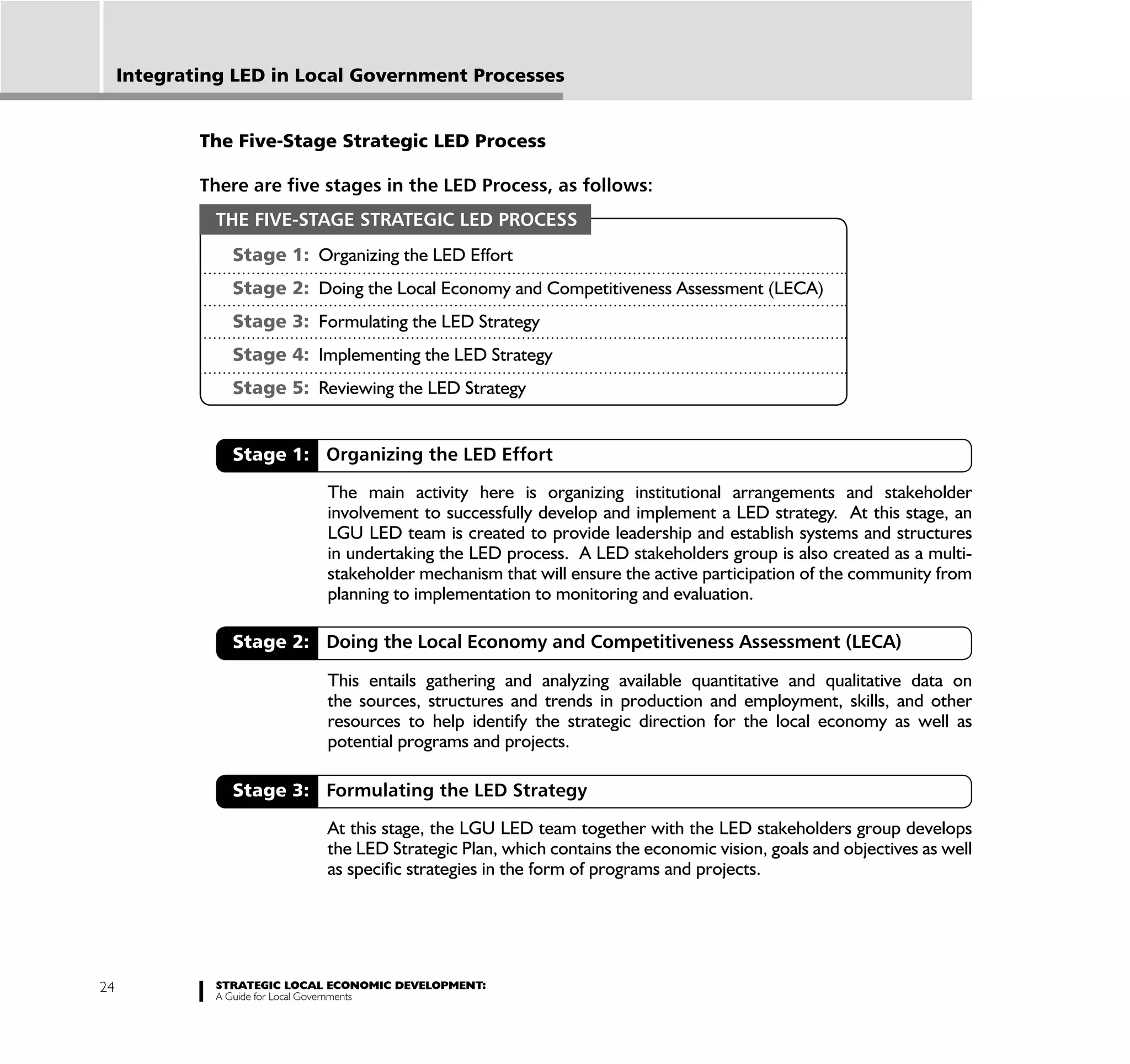
             The Five-Stage Strategic LED Process

             There are five stages in the LED Process, as follows:
               THE FIVE-STAGE STRATEGIC LED PROCESS
                 Stage 1: Organizing the LED Effort
                 Stage 2: Doing the Local Economy and Competitiveness Assessment (LECA)
                 Stage 3: Formulating the LED Strategy
                 Stage 4: Implementing the LED Strategy
                 Stage 5: Reviewing the LED Strategy


                 Stage 1: Organizing the LED Effort

                              The main activity here is organizing institutional arrangements and stakeholder
                              involvement to successfully develop and implement a LED strategy. At this stage, an
                              LGU LED team is created to provide leadership and establish systems and structures
                              in undertaking the LED process. A LED stakeholders group is also created as a multi-
                              stakeholder mechanism that will ensure the active participation of the community from
                              planning to implementation to monitoring and evaluation.

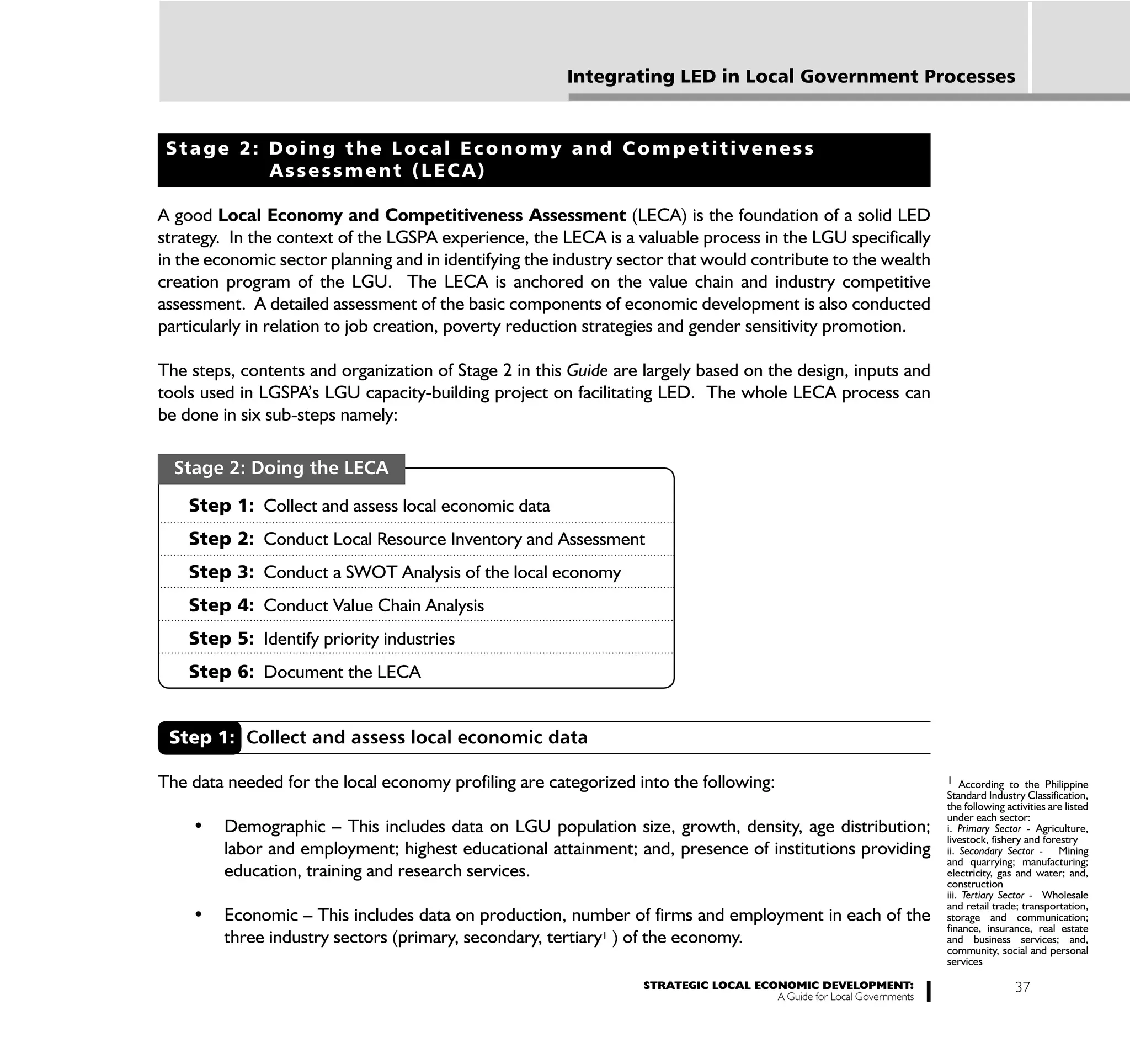
                 Stage 2: Doing the Local Economy and Competitiveness Assessment (LECA)

                              This entails gathering and analyzing available quantitative and qualitative data on
                              the sources, structures and trends in production and employment, skills, and other
                              resources to help identify the strategic direction for the local economy as well as
                              potential programs and projects.

                 Stage 3: Formulating the LED Strategy

                              At this stage, the LGU LED team together with the LED stakeholders group develops
                              the LED Strategic Plan, which contains the economic vision, goals and objectives as well
                              as specific strategies in the form of programs and projects.


24             STRATEGIC LOCAL ECONOMIC DEVELOPMENT:
               A Guide for Local Governments
Integrating LED in Local Government Processes


    Stage 4: Implementing the LED Strategy
                 LED program and project implementers from the LGU and other stakeholders carry
                 out the LED strategy guided by the LED Strategic Plan, the overall LED implementation
                 strategy, and individual project action plans.

    Stage 5: Reviewing the LED Strategy

                 This involves monitoring and evaluation (M & E) activities and reviewing and enhancing
                 the LED Strategy based on the M & E results and on changing local conditions.

The following sections discuss in detail how the LED process is carried out and integrated in LGU functions
and activities.

 Stage 1: Organizing the LED Effort

This marks the beginning of a collaborative undertaking wherein the LGU and community stakeholders
agree on pursuing LED as an end result and as a process. The primary goal of Stage 1 is for the LGU to
organize institutional arrangements and stakeholder involvement in LED planning and implementation.

The principle of participatory governance should be appreciated and demonstrated by the LGU as early
as Stage 1 in order to gain public support and credibility. By engaging and organizing stakeholders at the
outset, the LED activity becomes a province, city or municipal-wide undertaking.

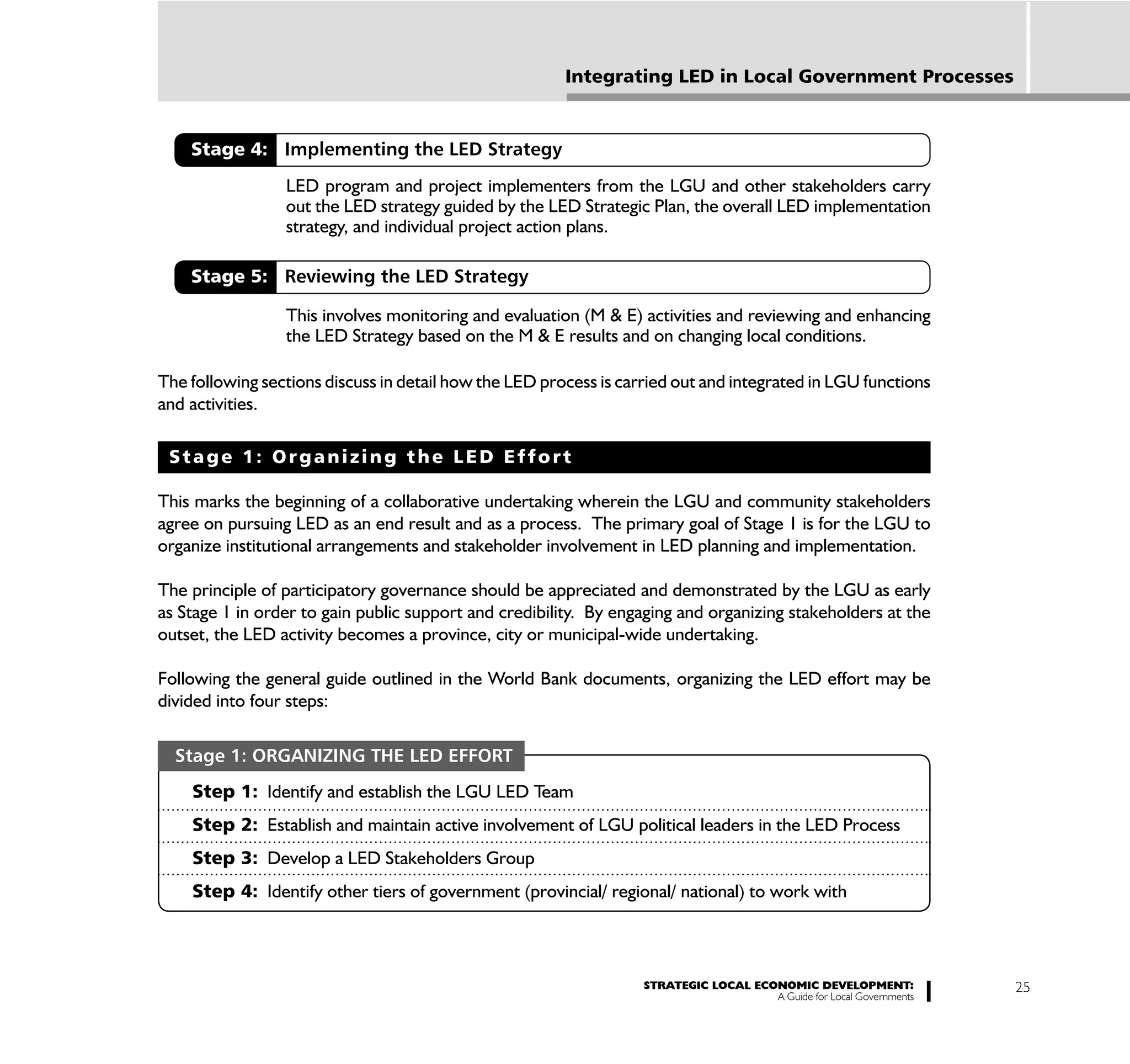
Following the general guide outlined in the World Bank documents, organizing the LED effort may be
divided into four steps:

  Stage 1: ORGANIZING THE LED EFFORT
    Step 1: Identify and establish the LGU LED Team
    Step 2: Establish and maintain active involvement of LGU political leaders in the LED Process
    Step 3: Develop a LED Stakeholders Group
    Step 4: Identify other tiers of government (provincial/ regional/ national) to work with


                                                                   STRATEGIC LOCAL ECONOMIC DEVELOPMENT:              25
                                                                                      A Guide for Local Governments
Integrating LED in Local Government Processes


              Step 1: Identify & establish the LGU LED Team

             The LGU LED team is composed of LGU officials and staff that shall take the lead in initiating and facilitating
             the LED process. The LGU LED team is expected to provide the leadership of and establish the structures
             and systems in the whole LED process. It is not only concerned with managing the technical side of the
             process but also in getting ‘buy-in’ from political leaders, the relevant and related government agencies,
             business and non-government sector. Thus, it is important to have a good mix of relevant technical
             staff and elected officials in the LGU LED team who can influence and build partnerships with other
             stakeholders and resource institutions.

             The following considerations are important in the LED team composition:

             Involvement and leadership of the LCE and the Legislative Council. A very important consideration
             in the formation of the team is the degree of participation and involvement of the LCE and the members
             of the local legislative council (Sangguniang Bayan, Panglunsod or Panlalawigan). The LCE in particular
             should provide a visible leadership of the team to bring in the legitimacy, credibility and commitment of
             all the sectors involved in the process.

             The Sangguniang members, on the other hand, have a key role in terms of pushing legislation and approving
             budget appropriation in relation to LED.
             In the LGSPA experience, one thing common among successful LED cases is the Mayor himself/herself
             taking primary responsibility for LED as the Team Leader. The leadership of the mayor facilitates and
             moves the implementation of activities faster.

             Multi-disciplinary. The LED process requires multi-disciplinary and multi-faceted activities. The
             members of the LED team should have the background, skills and the attitude to push forward and
             champion the process. It should be a multi-disciplinary team that can work across LGU departmental
             lines, as well as between governmental and non-governmental lines.

             The LGU LED team and the departments that will be involved in the process, at the minimum, should
             have knowledge and skills of the following:


                   community

                   locality

26             STRATEGIC LOCAL ECONOMIC DEVELOPMENT:
               A Guide for Local Governments
Integrating LED in Local Government Processes


      processes, project management, financial management and fund-raising


For LGUs that have completed the CDP-ELA, the economic sector planning committee can serve as the
initial core members of the LGU LED team. This can be expanded based on the requirements of the
LED process.

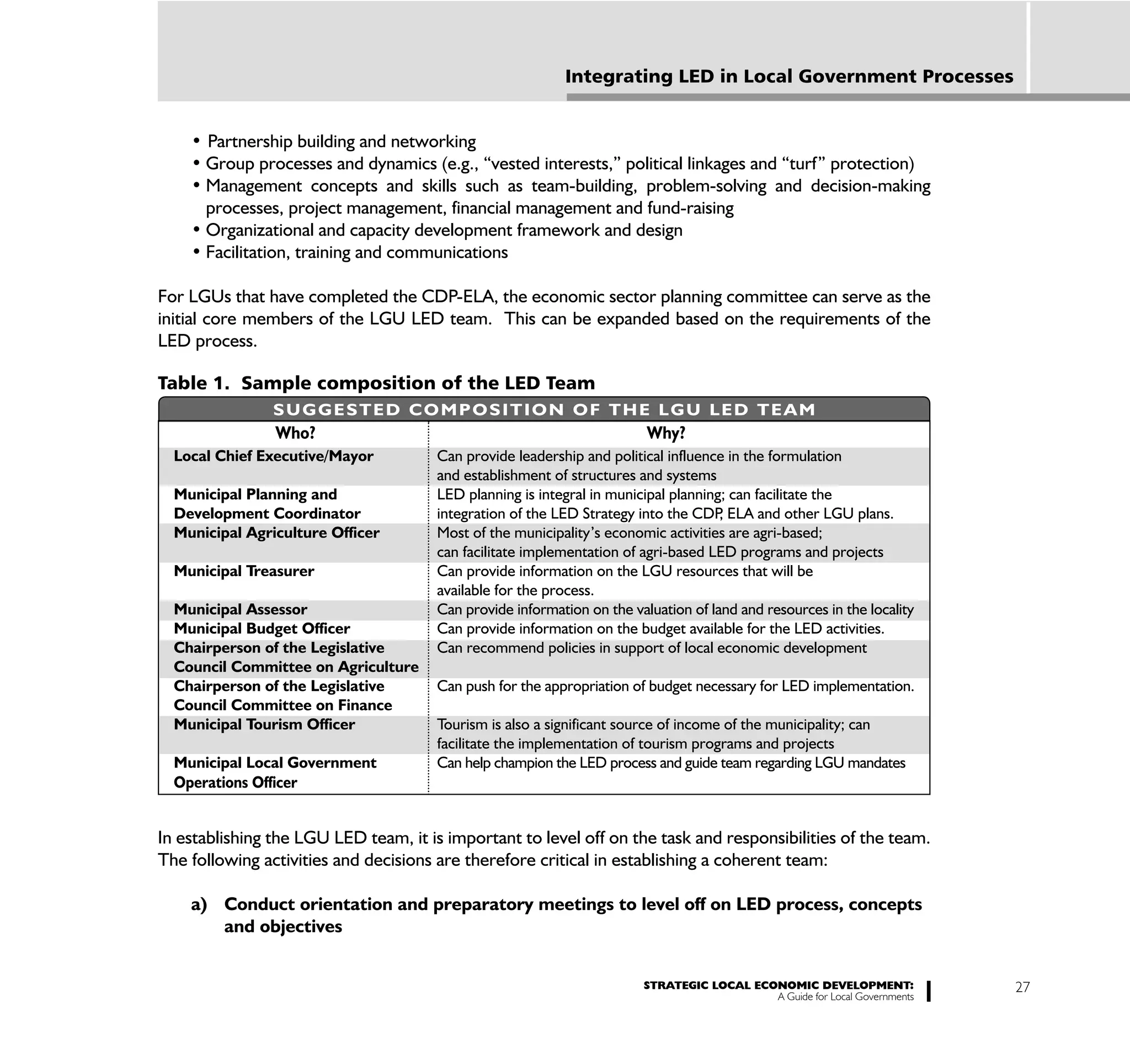
Table 1. Sample composition of the LED Team
                SUGGESTED COMPOSITION OF THE LGU LED TEAM
                Who?                                                     Why?
  Local Chief Executive/Mayor          Can provide leadership and political influence in the formulation
                                       and establishment of structures and systems
  Municipal Planning and               LED planning is integral in municipal planning; can facilitate the
  Development Coordinator              integration of the LED Strategy into the CDP ELA and other LGU plans.
                                                                                     ,
  Municipal Agriculture Officer        Most of the municipality’s economic activities are agri-based;
                                       can facilitate implementation of agri-based LED programs and projects
  Municipal Treasurer                  Can provide information on the LGU resources that will be
                                       available for the process.
  Municipal Assessor                   Can provide information on the valuation of land and resources in the locality
  Municipal Budget Officer             Can provide information on the budget available for the LED activities.
  Chairperson of the Legislative       Can recommend policies in support of local economic development
  Council Committee on Agriculture
  Chairperson of the Legislative       Can push for the appropriation of budget necessary for LED implementation.
  Council Committee on Finance
  Municipal Tourism Officer            Tourism is also a significant source of income of the municipality; can
                                       facilitate the implementation of tourism programs and projects
  Municipal Local Government           Can help champion the LED process and guide team regarding LGU mandates
  Operations Officer


In establishing the LGU LED team, it is important to level off on the task and responsibilities of the team.
The following activities and decisions are therefore critical in establishing a coherent team:

    a) Conduct orientation and preparatory meetings to level off on LED process, concepts
       and objectives


                                                                        STRATEGIC LOCAL ECONOMIC DEVELOPMENT:              27
                                                                                           A Guide for Local Governments
Integrating LED in Local Government Processes


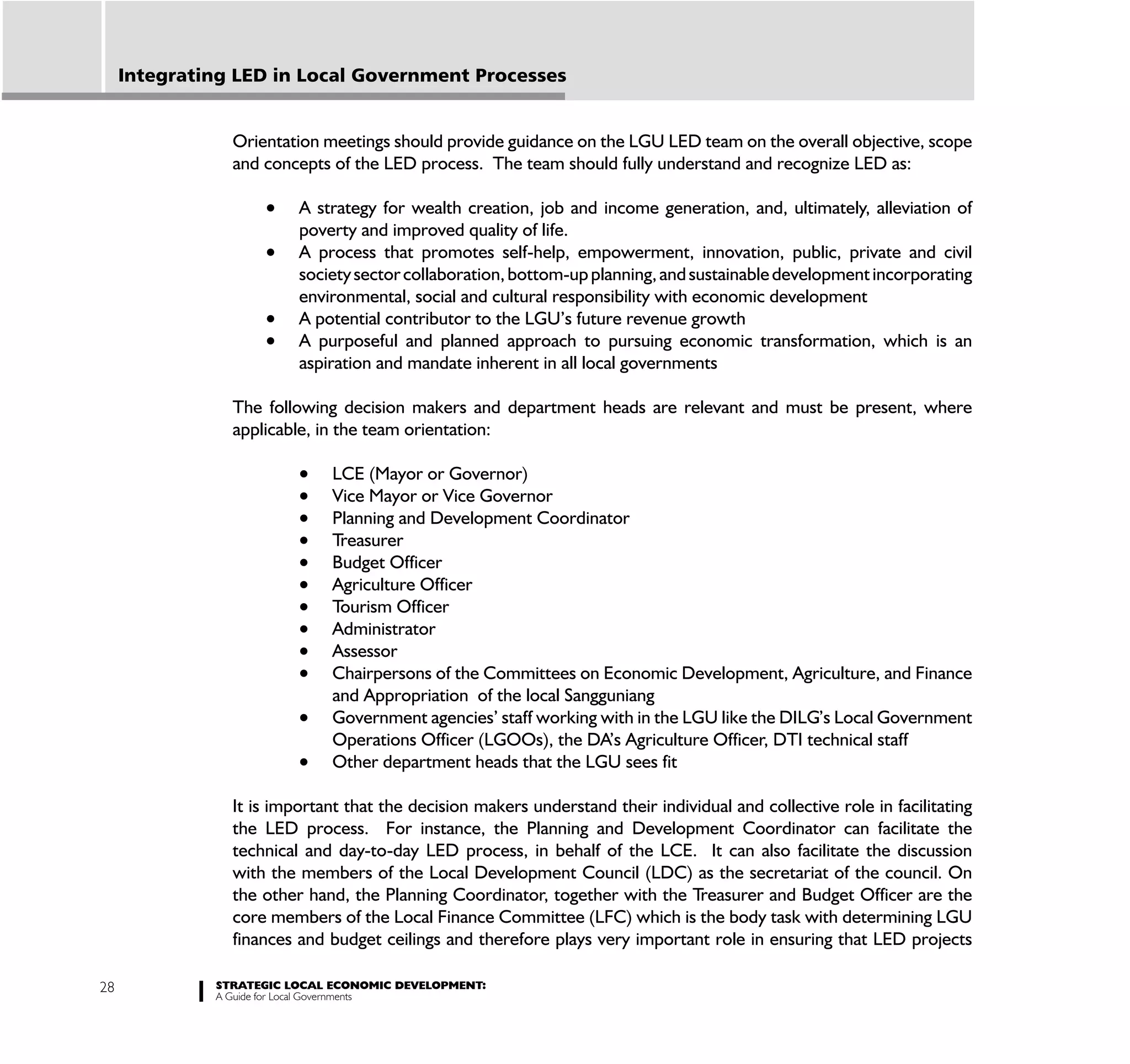
                Orientation meetings should provide guidance on the LGU LED team on the overall objective, scope
                and concepts of the LED process. The team should fully understand and recognize LED as:

                         A strategy for wealth creation, job and income generation, and, ultimately, alleviation of
                         poverty and improved quality of life.
                         A process that promotes self-help, empowerment, innovation, public, private and civil
                         society sector collaboration, bottom-up planning, and sustainable development incorporating
                         environmental, social and cultural responsibility with economic development
                         A potential contributor to the LGU’s future revenue growth
                         A purposeful and planned approach to pursuing economic transformation, which is an
                         aspiration and mandate inherent in all local governments

                The following decision makers and department heads are relevant and must be present, where
                applicable, in the team orientation:

                              LCE (Mayor or Governor)
                              Vice Mayor or Vice Governor
                              Planning and Development Coordinator
                              Treasurer
                              Budget Officer
                              Agriculture Officer
                              Tourism Officer
                              Administrator
                              Assessor
                              Chairpersons of the Committees on Economic Development, Agriculture, and Finance
                              and Appropriation of the local Sangguniang
                              Government agencies’ staff working with in the LGU like the DILG’s Local Government
                              Operations Officer (LGOOs), the DA’s Agriculture Officer, DTI technical staff
                              Other department heads that the LGU sees fit

                It is important that the decision makers understand their individual and collective role in facilitating
                the LED process. For instance, the Planning and Development Coordinator can facilitate the
                technical and day-to-day LED process, in behalf of the LCE. It can also facilitate the discussion
                with the members of the Local Development Council (LDC) as the secretariat of the council. On
                the other hand, the Planning Coordinator, together with the Treasurer and Budget Officer are the
                core members of the Local Finance Committee (LFC) which is the body task with determining LGU
                finances and budget ceilings and therefore plays very important role in ensuring that LED projects

28            STRATEGIC LOCAL ECONOMIC DEVELOPMENT:
              A Guide for Local Governments
Integrating LED in Local Government Processes


and activities are prioritize and allocated resources.

The LGU can tap LED experts coming from the government (i.e., DTI), the private sector (e.g., local
consultants, business groups, or entrepreneurs) or the academe to assist in the orientation and the
orientation and initial preparations for the LED process.

b) Agree on the terms of reference for the LGU LED Team

In the course of team meetings and consultations, the LGU LED team has to agree on is its own terms
of reference. As mentioned, the main objectives of the LGU LED team are to provide leadership in
the LED process and establish the structures and systems in the formulation and implementation of
the LED Plan. The LGU LED team members and their functions and activities at each stage of the
LED process should also be specified in a terms of reference so that there is a clear delineation of
responsibilities and accountabilities.

The team has also to agree on the operational guidelines of the whole LED process. While the LCE
can exercise overall leadership, the functional and day-to-day project management and coordination
work can be delegated to a key office. In the LGSPA experience, this task is normally delegated to
the Municipal Planning and Development Coordinator (MPDC), or the Municipal Administrator or
another senior officer who has the LCE’s confidence. Sometimes, a member of the LED team who,
in the course of the LED process, exhibits leadership qualities and develops a reputation of getting
things done becomes the de facto Assistant Team Leader.

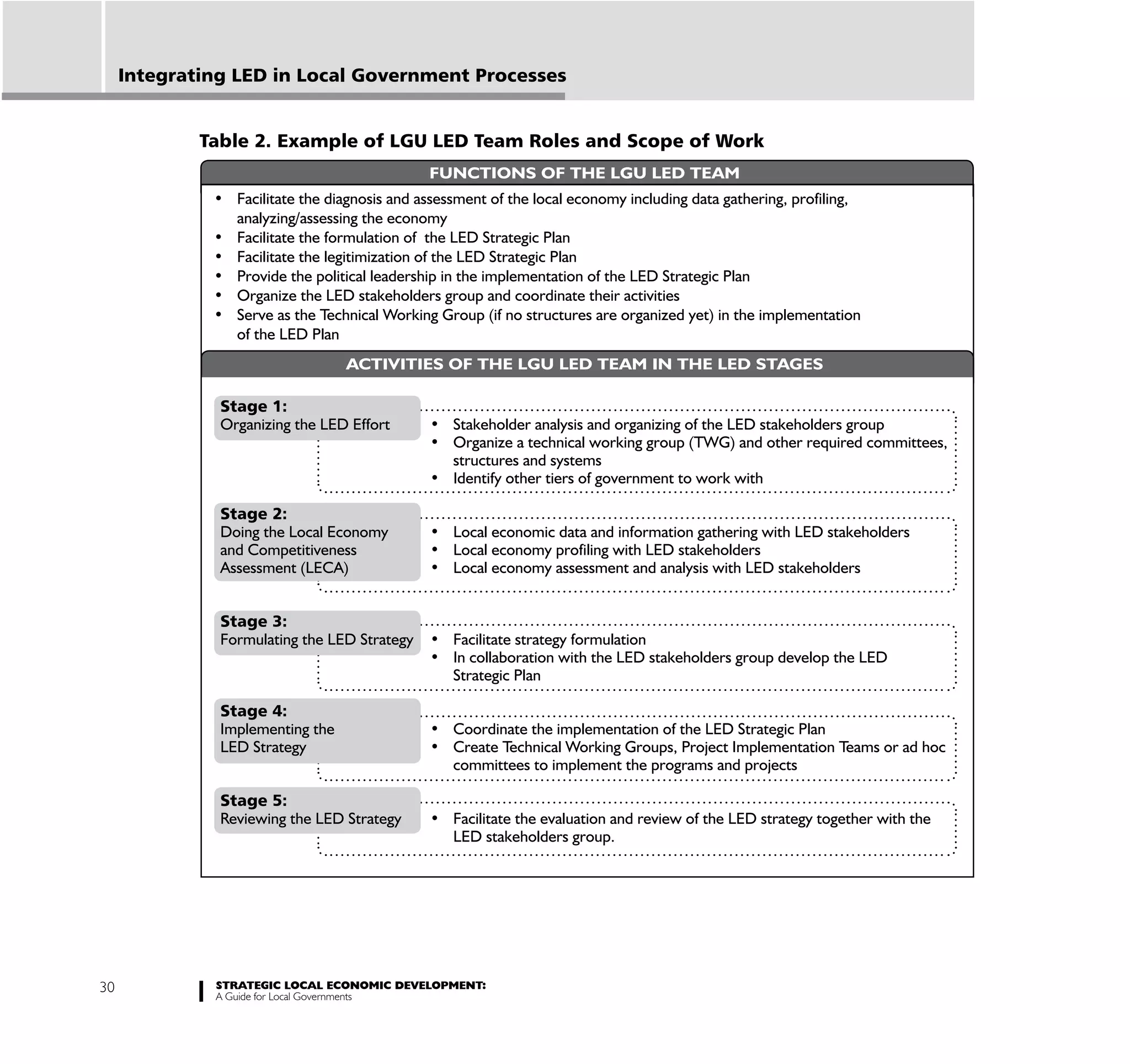
Table 2 gives an example of the decisions made by an LGU regarding the specific roles of the LGU
LED team. After such working arrangements are agreed upon, the LCE then issues an executive
order creating the LGU LED team and defining its composition and functions.


                                                             STRATEGIC LOCAL ECONOMIC DEVELOPMENT:              29
                                                                                A Guide for Local Governments
Integrating LED in Local Government Processes


             Table 2. Example of LGU LED Team Roles and Scope of Work
                                             FUNCTIONS OF THE LGU LED TEAM

                 analyzing/assessing the economy


                 of the LED Plan
                                   ACTIVITIES OF THE LGU LED TEAM IN THE LED STAGES

               Stage 1:


                                                   structures and systems


               Stage 2:


               Stage 3:


                                                   Strategic Plan

               Stage 4:


                                                   committees to implement the programs and projects

               Stage 5:

                                                   LED stakeholders group.


30            STRATEGIC LOCAL ECONOMIC DEVELOPMENT:
              A Guide for Local Governments
Integrating LED in Local Government Processes


    c) Determine the appropriate budget for the LED Strategy formulation

    A key decision that the LGU LED team has to agree is the budget required for the LED process.
    The LGU LED team should have enough resources for meetings, coordination, data collection and
    workshops. The budget for LED organizing up to planning may include cost of materials, meals,
    transportation, printing, communication, as well as the cost of LED experts that may be tapped by
    the LGU.

    d) Determine where the LGU LED Team will be established in the LGU

    In the initial stages of the LED process, the activities of the LED team can be coordinated by the office
    of the Mayor (or Governor) especially if the LCE is the designated leader of the LED team. In the
    course of the LED process and particularly in the execution of the LED strategy, the LGU eventually
    have to decide to organize mechanisms to support the implementation of the LED plan including the
    possible formalizing of the LED team as an economic coordinating or support group in the LGU.

    In the LED project of LGSPA, the LGU LED team was usually lodged in the Mayor’s Office. Establishing
    the LED team in the office of the LCE has the advantage of ‘visibility’ and political weight. Situated
    in this department, LED is likely to have a higher profile and exhibit more of a policy and facilitation
    focus, which in turn can help guarantee coordination with other LGU departments.


 Step 2: Establish and maintain active participation and involvement of

           LGU political leaders

As already emphasized, the strong and visible support from the leaders is important and imperative in the
LED process from planning up to the execution of the economic development strategy. The consistent
participation and interest of the LGU political leaders are important from the planning to the executing
stages of the LED process.

The LGU LED team should agree on the involvement of the political leaders in the entire LED process and
not just on the membership in the team. The political leaders as managers and as esteemed community
leaders should champion the process within the LGU and among the community stakeholders.

The political leaders need to ensure that the LED process and strategy are incorporated or adopted in the
formal development plans of the LGU such as the CDP and ELA. The LGU leaders also need to assure
that the LED process and strategy are included in the long term and annual investment programs of the
                                                                    STRATEGIC LOCAL ECONOMIC DEVELOPMENT:              31
                                                                                       A Guide for Local Governments
Integrating LED in Local Government Processes


             LGU.

             Other areas where participation of political leaders may be concretized in the LED process are by:

             a) Involving the Local Development Councils, relevant Local Special Bodies, and the Association of
                 Barangay Captains in the LED planning and implementation mechanisms.

             b) Establishing monitoring, evaluation and reporting system and performance management system that
                 would include participation from stakeholders and relevant special bodies that would become a basis
                 for economic plan improvement and policy development

             c) Ensuring that the LED process and strategy are given due importance and priority in the LGU annual
                 budget process


              Step 3: Develop a LED Stakeholders Group

             With the LGU LED team formally organized, it can now move on to the heart of LED process - the
             identification and involvement of the community-based stakeholders group.

             The World Bank’s LED Trainer’s Manual defines stakeholders as individuals, businesses, organizations or
             groups in the public, private and non-profit sectors that have an interest in strategizing and implementing
             LED programs and projects. These are individuals and organizations who: a) have a stake in LED issues,
             b) might benefit or be affected negatively by the LED process, c) should be included because of their
             formal position, d) should be included because they control resources or e) have the power to block LED
             implementation.

             LED stakeholders vary across LGUs. Normally in low-income and generally rural/urbanizing areas,
             private sector economic stakeholders largely come from producers (e.g., farmers and farmer groups)
             and traders including cooperatives. The critical question that the LGU LED team needs to answer is who
             are its economic development stakeholders? Who is the private sector in the locality?

             Aside from the private business sector, the LGU LED team also needs to identify stakeholders from the
             public sector (including the appropriate regional and provincial line agencies), the labor sector, and the
             community and civil society organizations. National, regional and provincial levels of governments have
             a key role to play in facilitating an environment that is conducive to local economic development, and it
             is therefore appropriate to include these levels of government into the strategic planning process when
             necessary (Swinburn et al., 2006).
32             STRATEGIC LOCAL ECONOMIC DEVELOPMENT:
               A Guide for Local Governments
Integrating LED in Local Government Processes


In the context of the ARMM, the following agencies and offices in the Autonomous Regional Government
(ARG) were included as stakeholders in the LGU LED process: Department of Trade and Industry-
ARMM (DTI-ARMM); Department of Agriculture and Fisheries (DAF-ARMM) and attached agencies like
the Philippine Carabao Center (PCC); Department of Science and Technology; chambers of commerce;
business councils; provincial government; government financing institutions such as Land Bank of the
Philippines; state colleges and universities.

It is also important to add that stakeholders identified should be those that have offices or area of
operations located in the city/municipality if it is a city/municipal LED process or located in the province
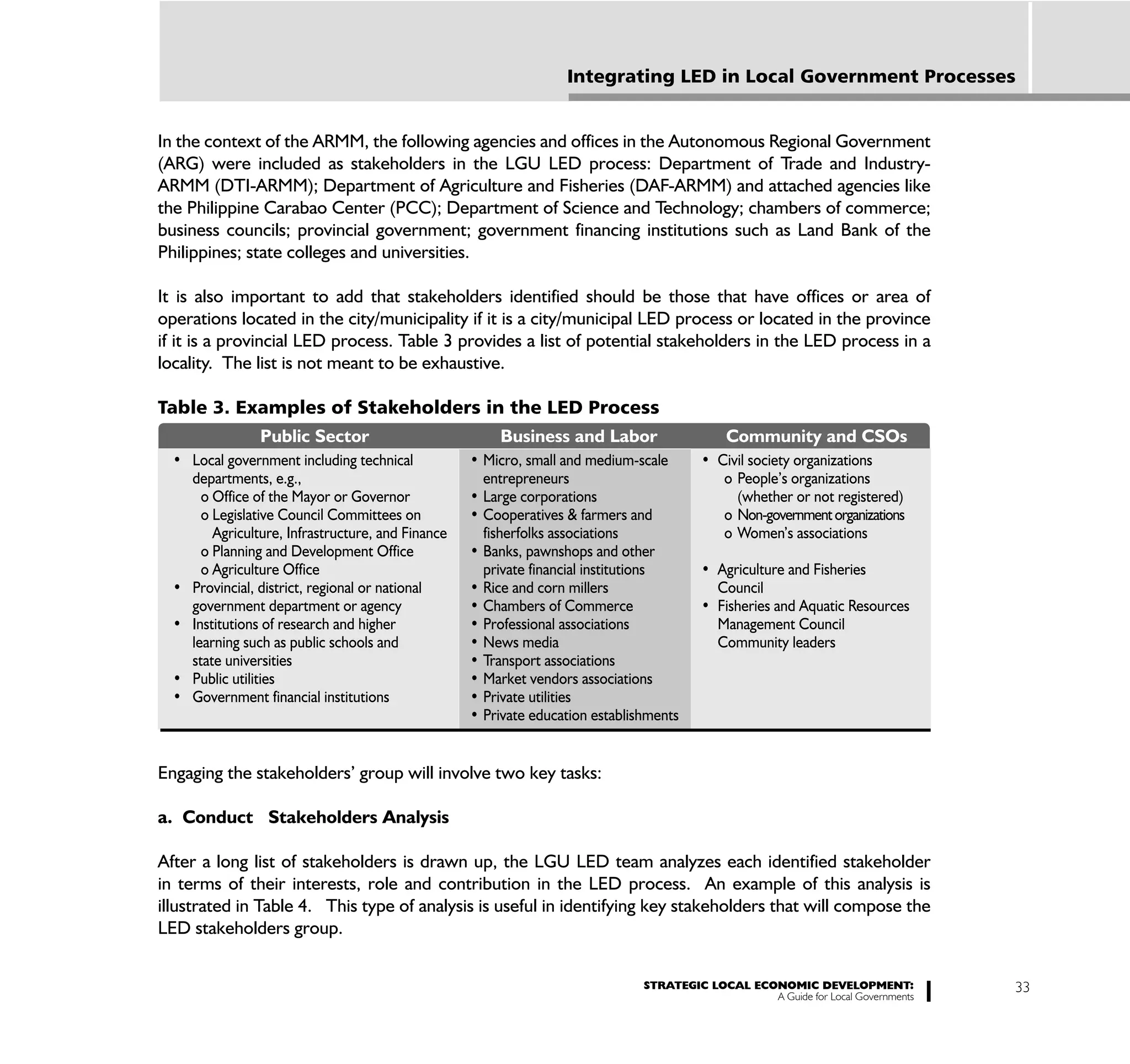
if it is a provincial LED process. Table 3 provides a list of potential stakeholders in the LED process in a
locality. The list is not meant to be exhaustive.

Table 3. Examples of Stakeholders in the LED Process
               Public Sector                         Business and Labor                    Community and CSOs

    departments, e.g.,                            entrepreneurs                            o People’s organizations


       Agriculture, Infrastructure, and Finance   fisherfolks associations                 o Women’s associations


Engaging the stakeholders’ group will involve two key tasks:

a. Conduct Stakeholders Analysis

After a long list of stakeholders is drawn up, the LGU LED team analyzes each identified stakeholder
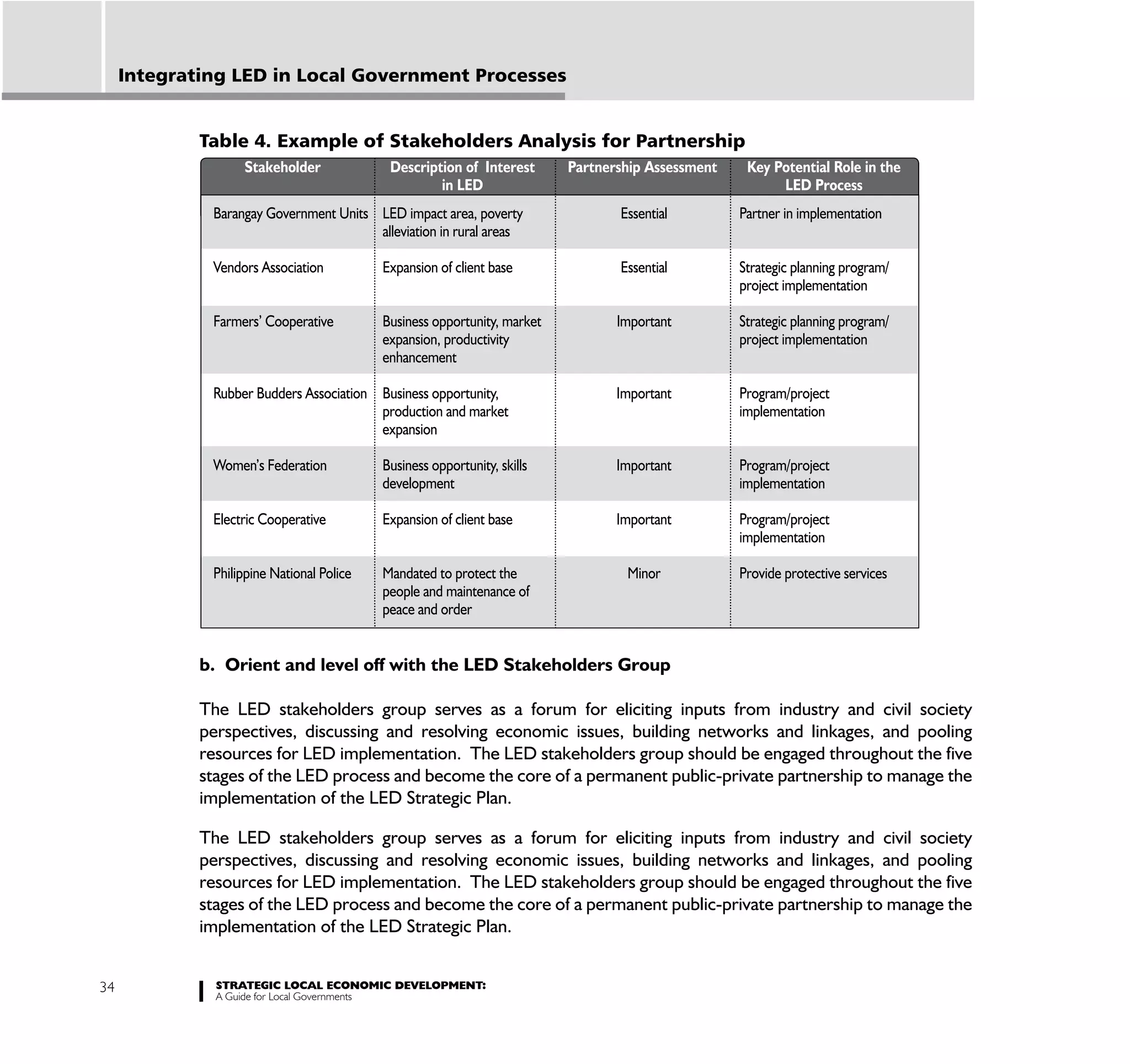
in terms of their interests, role and contribution in the LED process. An example of this analysis is
illustrated in Table 4. This type of analysis is useful in identifying key stakeholders that will compose the
LED stakeholders group.

                                                                             STRATEGIC LOCAL ECONOMIC DEVELOPMENT:              33
                                                                                                A Guide for Local Governments
Integrating LED in Local Government Processes


             Table 4. Example of Stakeholders Analysis for Partnership
                   Stakeholder              Description of Interest       Partnership Assessment    Key Potential Role in the
                                                    in LED                                               LED Process
              Barangay Government Units LED impact area, poverty                 Essential         Partner in implementation
                                        alleviation in rural areas

              Vendors Association          Expansion of client base              Essential         Strategic planning program/
                                                                                                   project implementation

              Farmers’ Cooperative         Business opportunity, market          Important         Strategic planning program/
                                           expansion, productivity                                 project implementation
                                           enhancement

              Rubber Budders Association Business opportunity,                   Important         Program/project
                                         production and market                                     implementation
                                         expansion

              Women’s Federation           Business opportunity, skills          Important         Program/project
                                           development                                             implementation

              Electric Cooperative         Expansion of client base              Important         Program/project
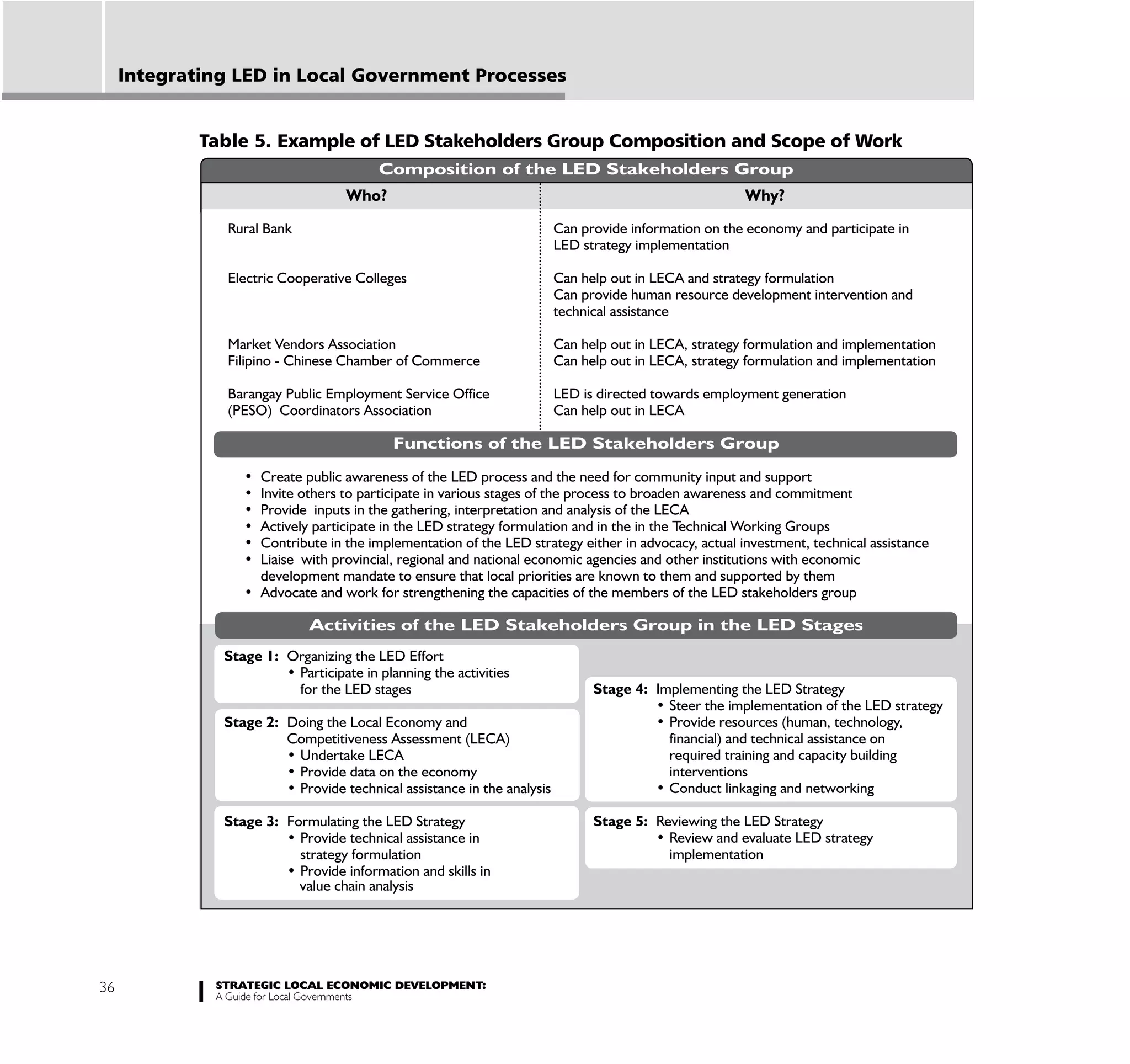
                                                                                                   implementation

              Philippine National Police   Mandated to protect the                Minor            Provide protective services
                                           people and maintenance of
                                           peace and order


             b. Orient and level off with the LED Stakeholders Group

             The LED stakeholders group serves as a forum for eliciting inputs from industry and civil society
             perspectives, discussing and resolving economic issues, building networks and linkages, and pooling
             resources for LED implementation. The LED stakeholders group should be engaged throughout the five
             stages of the LED process and become the core of a permanent public-private partnership to manage the
             implementation of the LED Strategic Plan.

             The LED stakeholders group serves as a forum for eliciting inputs from industry and civil society
             perspectives, discussing and resolving economic issues, building networks and linkages, and pooling
             resources for LED implementation. The LED stakeholders group should be engaged throughout the five
             stages of the LED process and become the core of a permanent public-private partnership to manage the
             implementation of the LED Strategic Plan.


34             STRATEGIC LOCAL ECONOMIC DEVELOPMENT:
               A Guide for Local Governments
Integrating LED in Local Government Processes


The LED stakeholders group must be large enough to ensure representation of all major groups in the
community, but small enough to carry on meaningful discussions and reach consensus (USAID LED
Ukraine, n.d.). A minimum of 20 and a maximum of about 35 members would be a good size.

In the LGU-facilitated LED cases in LGSPA, the Mayor also headed the LED stakeholders group. A
secretariat of about three to five people from the LGU and (in the case of Tugaya) the private sector was
also formed to provide administrative and support services including documentation, record-keeping,
communications, arranging meetings and keeping the Mayor abreast with LED activities.

The LED stakeholders group may start out as an ad-hoc advisory body created through an executive order
and, in the course of LED implementation, evolves into a formal organization by virtue of a Legislative
Council resolution. It can take the form of a coordinative council, a task force, an advisory committee
or any other variation. For example, the Provincial LED stakeholders group in the province of Sulu
is the Sulu Kahawa Sug Task Force. The provincial, city or municipal Small and Medium Enterprise
Development Council (SMEDC), which is mandated by DILG Memorandum Circular 2002-107, may
also be looked into as a possible organization to function as the stakeholders group. Whether or not the
stakeholders group should be subsumed in any existing multi-sectoral body is a decision that rests with
the LGU and other stakeholders.

Like the LGU LED team, the LED stakeholders group should also draw up a ‘terms of reference’ as to
their objectives, functions and composition as illustrated in Table 5


                                                                  STRATEGIC LOCAL ECONOMIC DEVELOPMENT:              35
                                                                                     A Guide for Local Governments
Integrating LED in Local Government Processes


             Table 5. Example of LED Stakeholders Group Composition and Scope of Work
                                          Composition of the LED Stakeholders Group
                                     Who?                                                        Why?
                Rural Bank                                         Can provide information on the economy and participate in
                                                                   LED strategy implementation

                Electric Cooperative Colleges                      Can help out in LECA and strategy formulation
                                                                   Can provide human resource development intervention and
                                                                   technical assistance

                Market Vendors Association                         Can help out in LECA, strategy formulation and implementation
                Filipino - Chinese Chamber of Commerce             Can help out in LECA, strategy formulation and implementation

                Barangay Public Employment Service Office          LED is directed towards employment generation
                (PESO) Coordinators Association                    Can help out in LECA

                                             Functions of the LED Stakeholders Group


                     development mandate to ensure that local priorities are known to them and supported by them


                              Activities of the LED Stakeholders Group in the LED Stages
               Stage 1: Organizing the LED Effort

                             for the LED stages                          Stage 4: Implementing the LED Strategy

               Stage 2: Doing the Local Economy and
                        Competitiveness Assessment (LECA)                            financial) and technical assistance on
                                                                                     required training and capacity building
                                                                                     interventions


               Stage 3: Formulating the LED Strategy                     Stage 5: Reviewing the LED Strategy

                             strategy formulation                                    implementation

                             value chain analysis


36            STRATEGIC LOCAL ECONOMIC DEVELOPMENT:
              A Guide for Local Governments
Integrating LED in Local Government Processes


 Stage 2: Doing the Local Economy and Competitiveness
          Assessment (LECA)

A good Local Economy and Competitiveness Assessment (LECA) is the foundation of a solid LED
strategy. In the context of the LGSPA experience, the LECA is a valuable process in the LGU specifically
in the economic sector planning and in identifying the industry sector that would contribute to the wealth
creation program of the LGU. The LECA is anchored on the value chain and industry competitive
assessment. A detailed assessment of the basic components of economic development is also conducted
particularly in relation to job creation, poverty reduction strategies and gender sensitivity promotion.

The steps, contents and organization of Stage 2 in this Guide are largely based on the design, inputs and
tools used in LGSPA’s LGU capacity-building project on facilitating LED. The whole LECA process can
be done in six sub-steps namely:

  Stage 2: Doing the LECA

    Step 1: Collect and assess local economic data
    Step 2: Conduct Local Resource Inventory and Assessment
    Step 3: Conduct a SWOT Analysis of the local economy
    Step 4: Conduct Value Chain Analysis
    Step 5: Identify priority industries
    Step 6: Document the LECA


 Step 1: Collect and assess local economic data

The data needed for the local economy profiling are categorized into the following:                                  1 According to the Philippine
                                                                                                                     Standard Industry Classification,
                                                                                                                     the following activities are listed
                                                                                                                     under each sector:
                                                                                                                     i. Primary Sector - Agriculture,
                                                                                                                     livestock, fishery and forestry
         labor and employment; highest educational attainment; and, presence of institutions providing               ii. Secondary Sector - Mining
                                                                                                                     and quarrying; manufacturing;
         education, training and research services.                                                                  electricity, gas and water; and,
                                                                                                                     construction
                                                                                                                     iii. Tertiary Sector - Wholesale
                                                                                                                     and retail trade; transportation,
                                                                                                                     storage and communication;
                                                                                                                     finance, insurance, real estate
         three industry sectors (primary, secondary, tertiary1 ) of the economy.                                     and business services; and,
                                                                                                                     community, social and personal
                                                                                                                     services

                                                                  STRATEGIC LOCAL ECONOMIC DEVELOPMENT:                              37
                                                                                     A Guide for Local Governments
Integrating LED in Local Government Processes


                      support systems in the LGU taxation and business registration system, bureaucratic procedures,
                      and business and investment promotion services. This also includes an assessment of the local
                      government capacity to carry out local economic development functions based on LGU income,
                      assets, capacity of the structures, skills of key LGU officials on LED planning and implementation,
                      and existence of approved development plans.


                      modalities, telecommunication, land and real estate development, and agriculture development
                      infrastructure.


                      provincial, regional, and national programs and policies and global trends.

             The full list data requirement for the economic profiling is attached in Annex B of this Guide. The LGU
             LED team and the LED stakeholders group should identify sources and plan where to collect the data
             required for the local economy profiling.

             Data Sources

             A broad range of approaches can be used to obtain information for the profiling such as desk-based
             research, questionnaires and surveys (e.g., local business enabling environment and business attitude
             surveys), structured/unstructured key informant interviews and focus group discussions. The LGU
             should choose the approach that is the most doable given the availability of data and time and cost
             considerations.

             One excellent source of information is the Socio-Economic Profile (SEP) and the Ecological Profile (EP)
             updated by the LGU in the formulation of the CDP-ELA. Updating the SEP and EP during the LED
             process reinforces the importance of socio-economic data and thus, contributes to the enhancement and
             development of the LGU’s economic database and sectoral plans.

             Among the specific data sources are the National Statistics Office for official statistics on population and
             demographics. For the economic data, sources include the DTI, DA, NEDA, area-based offices such as
             the MEDCo (in Mindanao) and other similar agencies, and the provincial government.

             For the business enabling environment, the information on this can be generated from the LGU personnel
             and the LED stakeholders group through a focus group discussion or survey. LGU self-assessment of
             the LGPMS is also an important source particularly for the indicators under the Economic Governance
38             STRATEGIC LOCAL ECONOMIC DEVELOPMENT:
               A Guide for Local Governments
Integrating LED in Local Government Processes


performance area of the system.

The following information, which are the result of the analysis of the economic data as discussed in the
Guide to Comprehensive Development Plan (CDP) for the Local Government Unit (DILG, 2008), can
also be used as reference for LGUs that have already undertaken these kinds of economic analysis during
CDP formulation:

         Food self-sufficiency or security
         Level of urbanization or the percentage of the population engaged in non-agricultural activities.
         Structural shift or changes in the relative share of each sector (primary, secondary and tertiary)
         to the total economy over time.
         The locality’s industry or sector specialization using the location quotient (L.Q.), which is an
         indicator of the relative importance of an area in terms of selected industry types or sectors.
         Linked economic activities in terms of production backward and forward linkages as well as
         trade and services linkages.
         The inflow and outflow of money into the local economy using the money flow theory (like the
         “leaking barrel” model shown in Chapter 1).

Results of performance and competitive assessments are also important sources of information that
the LGU can utilize. This includes information generated from the Local Governance Performance
Management System (LGPMS)2 and other systems such as the Competitive Assessment Program (used
mostly by cities), Balance Scorecard and others.

Understanding the data

The collected data are then organized according to Local Economy Profile outline. For data to be
meaningful, these have to be interpreted and presented in context. For example, if the volume of corn
production in a municipality is 100 tons annually, how does this compare against other crops in the area,
against corn production in other municipalities or against the provincial or regional performance?                    2 The LGPMS is a web-based
                                                                                                                      database system of an LGU self-
                                                                                                                      assessment tool that enables
In assessing the local economy, it is necessary to compare, contrast and evaluate local data with the                 provincial, city and municipal
                                                                                                                      governments to monitor and
larger area of which the LGU is a part: nation, region and province. Understanding the community’s                    evaluate their performance
                                                                                                                      in five performance areas/
relative competitiveness requires a comparison with other municipalities or communities located nearby,               sectors, namely, governance,
                                                                                                                      administration, social services,
perhaps within the same metropolitan area or region, or adjacent to the community. It is important to                 economic development and
                                                                                                                      environmental     management,
evaluate local indicators and trends, and compare them with national data to determine differences and                at three levels of results:
                                                                                                                      input, output and outcome
commonalities. This can provide important information on the competitiveness of an LGU at a national                  levels (LGSPA, 2008). LGUs
                                                                                                                      are required by the DILG to
level. A local economy assessment also requires comparisons of trends over time. (World Bank & Cities                 collect data and assess their
                                                                                                                      performance against these
of Change, n.d.).                                                                                                     LGPMS measures.

                                                                   STRATEGIC LOCAL ECONOMIC DEVELOPMENT:                             39
                                                                                      A Guide for Local Governments
Integrating LED in Local Government Processes


              Step 2: Conduct Local Resource Inventory and Assessment

             The Local Resource Inventory and Assessment (LRIA) is used to determine the major economic resources
             in the area and to assess the potential contribution of each resource to local economic development. The
             LRIA forms the basis for value chain analysis and priority industry selection. Some of the data needed for
             this step can be obtained from the data generated in Step 1.

             In the LRIA, as illustrated in Table 5, the LED stakeholders group determines the:

             a) Major land, sea and forest resources in the area under the three economic sectors: primary, secondary
                and tertiary.
             b) Location and size of each resource in terms of area covered and value and volume of production.
             c) Existing local economic activities with regards to each resource
             d) Forward and backward linkages of these industries/economic activities, including linkages outside
                of the local economy. Production, trade and services linkages identified in the CDP formulation
                can be used as a reference for this. Industry players and industry studies can also provide more
                information.
             e) Opportunities for development including regional, provincial, national programs and policies that
                provide financial, technical, development services in support to the development of the resource
                such as official development assistance and national agencies’ program assistance relevant to the
                resource. These can be gleaned from the “Provincial, Regional, and International Factors” section of
                the Local Economy Profile. Opportunities can also include potential markets for each resource.

             Table 6. Example of Template for Local Resource Inventory and Assessment
                  Sector/Resource        Location and Size      Activities Done   Forward and Backward       Opportunities for
                                                                in the Locality          Linkages              Development
                                                                  Land Resources
                  Example:             20 barangays              Corn farming       Forward:                DA subsidizes seeds and
                  Agriculture Sector   18,268 hectares 67%       Corn shelling      Milling                 provides technical
                  Corn                 of agricultural land                         Trading                 and marketing
                                                                                    Warehousing             assistance
                                       Volume:
                                       36,000 tons/year                             Backward:
                                       Value:                                       Seedling production
                                       PhP468 million/year                          Pesticide production
                                                                                    Fertilizer production
                                                                                    Machinery fabrication

                                                               Sea/Aquamarine Resources

                                                              Forest and Mineral Resources

40                STRATEGIC LOCAL ECONOMIC DEVELOPMENT:
                  A Guide for Local Governments
Integrating LED in Local Government Processes


 Step 3: Conduct a SWOT Analysis of the Local Economy

Strengths-Weaknesses-Opportunities-Threats (SWOT) Analysis is conducted by the LGU LED team
together with the LED stakeholders group to integrate and summarize data, information and perceptions
on the local economy from a standpoint of overall competitiveness (Cities Alliance, 2007). A community’s
competitive position is a function of internal (strengths and weaknesses) and external (opportunities
and threats) factors. The Local Economic Profile and the result of the LRIA are important sources of
information for this exercise.

Internal factors are attributes of the locality and are within the influence of the LGU while external factors
refer to trends and conditions of the external environment that are beyond the LGU’s control. Strengths
are local assets or factors that give the area an advantage and make it attractive for investment, growth
and development. Weaknesses are local obstacles or constraints to a thriving economy: these can be
social, legal, physical, environmental, financial or regulatory constraints. Opportunities are external factors
that make it easier to develop a competitive advantage. Threats are unfavorable trends or developments
external to the economy that can lead to a decline in competitive advantage.

The SWOT Analysis is most useful in defining the focus of the LED Strategic Plan. Issues identified in
the SWOT inform the crafting of the vision, goals and objectives and designing of programs and projects
that eliminate or minimize the weaknesses, maximize strengths, take advantage of opportunities and
overcome or reduce the influence of threats.

Table 7 gives specific parameters, based on the five fundamental components of the economy discussed
in Chapter 1, which can be used in doing a SWOT analysis of the local economy.
Source: Adopted from World Bank & Cities of Change LED Trainer’s Manual


                                                                          STRATEGIC LOCAL ECONOMIC DEVELOPMENT:              41
                                                                                             A Guide for Local Governments
Integrating LED in Local Government Processes


             Table 7. Example of a Template for SWOT Analysis of the Local Economy
                           FACTOR                       INTERNAL ANALYSIS                     EXTERNAL ANALYSIS
                                                    STRENGTHS     WEAKNESSES             OPPORTUNITIES   THREATS
                Labor Market
                Skills
                Wage Rates
                Availability

                Financial Capital
                Private capital
                Public capital
                Access to Markets
                Proximity or distance to
                 market centers
                Proximity to suppliers
                Transportation
                Access to major highways
                Access to airports
                Access to ports
                Access to trains
                Sites and facilities
                Number of sites and size
                Infrastructure
                Utilities
                Telecommunications
                Number of existing structures
                Knowledge Resources
                Research/Development facilities
                Industry or trade Association

                Education and T          raining
                Colleges or universities
                Higher technical training
                Vocational skills training
                Business services and Technical
                Support
                Business Climate
                Government responsiveness
                 (including capacity to carry out
                 LED functions)
                Taxes
                Regulations and controls
                Cooperation/assistance with
                 private sector
                Quality of Life
                Cost of living
                Culture and recreation
                Public services (including peace
                 and order)
                Attractiveness of city
                Natural resources

               Source: Adopted from World Bank & Cities of Change LED Trainer’s Manual

42             STRATEGIC LOCAL ECONOMIC DEVELOPMENT:
               A Guide for Local Governments
Integrating LED in Local Government Processes


 Step 4: Conduct Value Chain Analysis

The LED stakeholders group then selects as much as the top ten resources of the LGU in terms of
value or volume of production as determined in Step 2, the LRIA. Each of the resources is subjected to
a value chain analysis, which is a tool in mapping industry structure (how industry participants interact to
bring products to the market) and assessing industry-specific competitiveness. The result of the SWOT
analysis is also important information in the value chain analysis.

A value chain can be defined as all the firms within a subsector or industry that buy and sell from each
other in order to supply a particular set of products or services to final consumers (Lusby & Panlibuton,
2007). It shows the relationships and linkages among buyers, suppliers, and a range of market actors in
between.

The basic objectives of the value chain analysis are to:

    Identify market channels, market trends and market potentials within the value chain
    Identify the primary actors in the value chain, their number, roles, and interrelationships, including
    the number of women industry players
    Identify constraints (weaknesses and threats) that are holding back growth and competitiveness of
    local firms participating in the value chain
    Pinpoint priority areas for reform within the environment in which these industries or firms
    operate
    Identify the strengths of the industry and opportunities for stimulating wealth creation and alleviating
    poverty in the local economy

Table 8 describes the industry competitiveness factors (market demand, reach, presence of MSMEs,
forward and backward linkages, and participation of women) that can be analyzed using the value chain:


                                                                   STRATEGIC LOCAL ECONOMIC DEVELOPMENT:              43
                                                                                      A Guide for Local Governments
Integrating LED in Local Government Processes


             Table 8: Examples of Factors to Consider in a Value Chain Analysis
                  FACTOR                                                              DESCRIPTION
               Market Demand


               Reach
                                         producers, wholesalers, etc.)

                                         employees/employed


               Significant
               Presence of               exist outside of urban areas
               MSMEs in the
               rural areas*              areas

               Significance of
               Forward and               value chain
               Backward Linkages
               among Local               firms
               Market Actors

               Participation of
               Women                     (should include participation at all levels of the value chain)

             *In this example, emphasis is given to the rural area it being the target of poverty reduction goals.


             A good starting point for conducting any analysis is to access existing studies, reports, or statistics that
             provide information on the targeted value chain. These can be found in government agencies, with
             donors, and with implementing organizations. It is also important to identify “key informants” who
             are particularly knowledgeable about the value chain as a whole (Lusby & Panlibuton, 2007). They can
             include members of the LED stakeholders group. The value chain analysis activity can bring together
             producers, government agencies and other stakeholders in the different segments of the value chain to
             jointly seek solutions to overcome key impediments that affect the performance of the chain (The World
             Bank Group, 2007).

             A value chain map presents, in graphical form, all the major actors in a targeted value chain as illustrated
             in Figure 3. The determination of forward and backward linkages that is done in the LRIA provides the
             starting point for the value chain analysis.


44              STRATEGIC LOCAL ECONOMIC DEVELOPMENT:
                A Guide for Local Governments
Integrating LED in Local Government Processes


                             Figure 3. Value Chain Map: Dairy Subsector


                                                                                                                     D
                                                                                                                     O
                                                                                                                     M
                                                                                                                     E
                                                                                                                     S
                                                                                                                     T
                                                                                                                     I
                                                                                                                     C

                                                                                                                     M
                                                                                                                     A
                                                                                                                     R
                                                                                                                     K
                                                                                                                     E
                                                                                                                     T

                                            SUPPORT INDUSTRIES
           INFRA SUPPORT UTILITIES                     FINANCING           RESEARCH AND DEVELOPMENT
          Water, Power & Communication              HR DEVELOPMENT        ANIMAL WASTE AND UTILIZATION

   Source: Wao, Lanao Sur Livestock and Poultry Industry Study, 2007.


 Step 5: Identify priority industries

Priority industry selection is important so that the LGU can maximize the use of its limited resources and
give focus to local industries which have the greatest potential of pushing local economic development.
Table 8 shows a tool that can be used for industry prioritization. Using a tool such as this will allow
the LED stakeholders group to identify – in a systematic way – industries or products which have a
competitive advantage that it would like to develop and promote (similar to the One Town One Product
concept). However, the LGU may opt to skip this industry ranking and prioritization process if there
are obviously only a few, say one to three, industries in the locality that can have a substantial and wide-
reaching impact on the economy.

The criteria for selection can include availability of resources (human, physical, capital and knowledge
resources, and infrastructure), demand conditions, number of supplier industries, number of local players
                                                                         STRATEGIC LOCAL ECONOMIC DEVELOPMENT:              45
                                                                                            A Guide for Local Governments
Integrating LED in Local Government Processes


             operating in the industry, number of forward and backward linkages, and relative ease in promoting and
             developing the industry. It can also include other criteria that reflect the priorities of the LGU such as
             potential for employment generation, participation of women or environmental conservation.

             Industries with the highest weighted scores are the priority industries.

             Table 9. Sample Criteria Used in Priority Industry Selection
                   Factors/Criteriaa                                Description/Remarks                         Weight (%)      Industry
               A. Conditions of Factors of                                                                         25        Scoreb   Weighted
               Production                                                                                                              Score
                                                                                                                                      (Score x
                                                                                                                                      Weight)

               1. Human resources                     Availability of human resources (in terms of quantity         5
                                                      and skills)
               2. Physical resources                  Location, abundance, quality, accessibility and cost of       7
                                                      water, land and other physical resources necessary
                                                      to compete in the industry
               3. Capital resources                   Amount and cost of capital available to the industry          7
               4. Knowledge resources                 The stock of scientific, technical, and market                2
                                                      knowledge on the industry
               5. Infrastructure                      The type, quality and user cost of infrastructure             4
                                                      available that affects the industry

               B. Demand Conditionsc

               1. Size of local demand                Based on opinions & data from key informants on              15
               2. Number of independent               market trends & value chain competitiveness &
                  buyers                              information from existing statistics/studies.

               C. Number of Related and               Based on the number of enterprises for each type of          15
               Supporting /Supplier Industries        firm in the value chain (input suppliers, producers,
               (Indicated by the number of            wholesalers, etc.)
               activities that are located locally)

               D. Number of Players in the            Based on the number of MSMEs (at all levels of the           15
               Industry                               subsector) that exists in rural areas.
               E. Number of forward and               Based on the volume and number of transactions               10
               backward linkages                      that take place among domestic market actors in
                                                      the value chain

               F Requires relatively modest or
                .                                                                                                  20
               unsophisticated private & social
               investment or easiest to develop
               or address as it is supported by
               ODA and government programs

               Notes:
               a
                 Most factors are based on Michael Porter’s Model for Industry Analysis.
               b
                 Each industry is assigned a score per criterion ranging from 1 to 3, with 3 as the highest score.
               c
                 Refer to results of the value chain analysis as illustrated in Table 7.

46             STRATEGIC LOCAL ECONOMIC DEVELOPMENT:
               A Guide for Local Governments
Integrating LED in Local Government Processes


 Step 6: Document the LECA

The LGU LED team then puts together and packages the LECA Report and presents the final output to
the LED stakeholders group for validation before the strategy formulation workshops begin. Box 1 gives
an example of a LECA Report outline.

Box 1: Example of a Local Economy and Competitive Assessment Report Outline

     I. Introduction (Location and Background of the LGU)

     II. Local Economy and Competitiveness Assessment

              A. Local Economy Profile
                       1. Demographic
                       2. Economic Profile
                       3. Business Environment
                       4. Infrastructure
                       5. Provincial, Regional, International Factors

              B. Competitiveness Assessment
                     1. Local Resource Inventory and Assessment (LRIA)
                                1.1 Land Resources
                                1.2 Sea/Aquamarine Resources
                                1.3 Forest and Mineral Resources
                     2. SWOT Analysis of the Local Economy
                                2.1 Strengths
                                2.2 Weakness
                                2.3 Opportunities
                                2.4 Threats
                     3. List of Industries, Ranked in Order of Competitiveness
                     4. T 5 Industries that the Locality has Competitive Advantage
                          op
                                4.1 Profile and Value Chain Analysis of Industry A
                                4.2 Profile and Value Chain Analysis of Industry B
                                4.3 Profile and Value Chain Analysis of Industry C
                                4.4 Profile and Value Chain Analysis of Industry D
                                4.5 Profile and Value Chain Analysis of Industry E


                                                                    STRATEGIC LOCAL ECONOMIC DEVELOPMENT:              47
                                                                                       A Guide for Local Governments
Integrating LED in Local Government Processes


                  Stage 3: Formulating the LED Strategy

             At this stage, the LGU LED team together with the LED stakeholders group develops the LED Strategic
             Plan in order to set out the economic future of the locality and to address the issues identified in the LECA.
             The LED Strategic Plan has following key elements: vision, goals, objectives, programs and projects.

             As in the comprehensive development planning, the intent is to achieve an integrated approach to local
             economic development strategic planning. In devising this strategy, practitioners in local government and
             principal stakeholder groups will need to balance local economic development with environmental and
             social needs (Swinburn et al., 2006).

             Stage 3 can be divided into eight major steps:

                  Stage 3: FORMULATING THE LED STRATEGY
                    Step 1: Identify critical issues from the LECA
                    Step 2: Create a Vision
                    Step 3: Develop Goals
                    Step 4: Develop Objectives and Performance Indicators
                    Step 5: Develop Programs
                    Step 6: Select Projects
                    Step 7: Mainstreaming Gender Responsiveness and Sensitivity to Poverty in LED
                            Strategy Formulation
                    Step 8: Document the LED Strategic Plan and Integrate in LGU Plans and Processes


              Step 1: Identify critical issues from the LECA

             Prior to the “Visioning” workshop, it is important that LED stakeholders are able to relate strategy
             formulation to issues identified in Stage 2. Here are some guide questions that can be posed to
             stakeholders to trigger analysis and provide a clearer context and basis for vision setting and strategy
             formulation:

             a)     What critical gaps and issues or weaknesses and threats identified in the LECA need to be
48                STRATEGIC LOCAL ECONOMIC DEVELOPMENT:
                  A Guide for Local Governments
Integrating LED in Local Government Processes


     addressed?
b)   What strengths and opportunities can the LED strategy seek to build on?
c)   What conclusions can be made about the competitive position of the locality?
d)   What can be realistically achieved in the timeframe of the LED strategy?
e)   What groups in the community are perceived to be disadvantaged (e.g., rural poor, indigenous
     people) and must be given special attention?

 Step 2: Create a Vision

In a workshop, the LED stakeholders group dialogue and agree on a vision of the preferred economic
future of the community. Stakeholders are first asked to give concise statements about their “dreams
for the economic future of the community.” They can draw ideas and inspiration from the critical issues
identified in Step 1 in composing a vision statement. In Tugaya, recognizing the municipality’s competitive
position in arts and culture-based industries, the LED stakeholders group came up with this LED vision -
“A prosperous and productive Tugaya that is the center of Maranao Arts and Culture in the Philippines, as
showcased by its metal and wood craft industry.”

The LGU’s overall vision as articulated in the CDP and ELA can also be reviewed and reframed to reflect
economic aspects and aspirations of the locality.

In general, vision statements should be: a) understood and shared by members of the community, b)
broad enough to allow a diverse variety of local perspectives to be encompassed within them, c) inspiring
and uplifting to everyone involved, and d) easy to communicate (Nagy & Fawcett, n.d.).

 Step 3: Develop Goals

Goals point to specific outcomes that the community seeks to achieve. Goals are much more descriptive
and concrete than a vision statement, and should be directly related to the findings from the LECA
including the key issues arising from Step 1. Good practice indicates that in selecting goals, a manageable
number is usually no more than six (Swinburn et al., 2006).


                                                                   STRATEGIC LOCAL ECONOMIC DEVELOPMENT:              49
                                                                                      A Guide for Local Governments
Integrating LED in Local Government Processes


             Table 10 illustrates how goal statements are linked to LED issues.

             Table 10. Example of Goal Statements and their Link to LED Issues
                              Goal                                   Link to LED Issues from the LECA
                  To be the leading producer of
                  cattle, carabao and goats in the     supply of crops and agricultural by-products for feedstuffs
                  region
                                                       production, proximity to market centers outside of municipality through well paved
                                                       roads


                  To be the halal organic fertilizer
                  capital in the region                of local corn production. Of the PhP500 million annual value of corn production,
                                                       PhP400 million were draining out of the local economy because farmers were buying
                                                       inputs from outside sources

                                                       provide income opportunities and protect the environment

                  To develop an efficient
                  municipal power supply system        are being used whenever electricity from the provincial electric cooperative is not
                                                       available

                                                       metalcraft and woodcraft production

             Each goal statement should have the following characteristics:

             a) Clear regarding what is to be done and why – it should be based on the LECA and flow directly from
                the vision formulated in Step 1
             b) Outcome oriented – represents specific key result areas on which the LED strategy will focus to
                achieve the vision. The specific key result areas will be the gaps and critical issues identified in the
                SWOT Analysis
             c) Robust - it leaves open a variety of possible means
             d) Inclusive - reflects the voices of all people who are involved and the greatest needs and highest
                economic priorities of the municipality
             e) Concise

             The set of goals can include statements that are industry-specific as well as goals that impact and cut
             across all economic activities such as “improved local business investment climate.” What is important
             is that these goals reflect the LGU priorities and addresses the major LED issues. Having industry-based
             goals, however, provide focus or a clear sense of purpose to the LGU and these normally become the
50                STRATEGIC LOCAL ECONOMIC DEVELOPMENT:
                  A Guide for Local Governments
Integrating LED in Local Government Processes


bases and motivation in the development and improvement of the various enterprise-related programs
and services of the local government.

 Step 4: Develop Objectives and Performance Indicators

Objectives are even more specific. They serve as performance standards and targets for each goal identified
in Step 3. In developing objectives, it is important to clearly describe the markers or benchmarks that
would help the community assess where it is now (baseline or pre-intervention) and where it will be if the
initiative were successful (objectives). For example: “To increase corn production by 10% by 2010.”

Objectives should be specific, measurable, attainable, realistic, and time bound (SMART). To measure
progress toward the achievement of goals and objectives, a clear and structured set of key performance
indicators should be developed. Performance indicators can be both quantitative and qualitative.
Quantitative indicators will include numbers, percentages, percentage changes, etc. Qualitative indicators
are more difficult to measure. They focus on aspects such as the quality of a result or an individual’s
attitude towards a new service (Swinburn et al., 2006).

As suggested in the World Bank LED Primer, indicators should be:

    valid - they are valid in the eyes of the key participatory M&E stakeholders and should actually
    measure what they set out to measure
    reliable - conclusions based on the indicators should be the same if measured by different people
    gender sensitive - indicators should be disaggregated by sex
    sensitive - they should be sensitive enough to measure important changes in the situation being
    observed
    cost-effective - the information/learning should be well worth the time and money it costs to collect
    the data
    timely - it should be possible to collect and analyze the data fairly quickly
    in-line with local capabilities/resources - they should not be overly complex and burdensome to
    the project partners
    build on what exists - indicators should not ‘reinvent the wheel’ and should draw on existing local
    data collection activities, or from indicators used with other projects, where possible. For example,
    local economic development performance indicators available in the Local Governance Performance
    Management System (LGPMS) of the DILG can be used as a guide in framing performance
    indicators.


                                                                   STRATEGIC LOCAL ECONOMIC DEVELOPMENT:              51
                                                                                      A Guide for Local Governments
Integrating LED in Local Government Processes


              Step 5: Develop Programs

             Having completed the LECA and determined the vision, goals and objectives, the LED stakeholders
             group will need to decide on the key programs that will become the core of its LED strategy. A program
             is a package of interrelated projects. Programs and projects should seek to build on strengths, minimize
             weaknesses, exploit opportunities or mitigate threats identified in the LECA, particularly in the SWOT
             and value chain analyses.

             In developing programs and projects, identify:

             a)     Those participants/beneficiaries that are to be targeted at each different level - i.e., individuals,
                    groups, organizations and sectors, and/or broader systems. These targets should be linked to the
                    highlights of the LECA. They could be the economic players of the priority industries or of areas that
                    have been adjudged as economic strengths of the locality or opportunities.

             b) The personal and environmental factors to be addressed by the initiative

                        Personal factors can include: knowledge, beliefs, skills, education and training, experience,
                        cultural norms and practices, social status, cognitive or physical abilities, gender, age
                        Environmental factors can include: social support, available resources and services, barriers
                        (including financial, physical, and communication), social approval, policies, environmental
                        hazards, living conditions

             c)     Those who can contribute and how they can be reached or involved in the effort. Identify agents
                    of change or LED champions, i.e., those who may be in a position to contribute to the initiative or
                    commit to leading it.

                    It is a good practice to undertake programs and projects where clear champions are committed to
                    being involved in leading them. Project champions may come from local government, the private
                    sector, community or other sectors (e.g. research or educational institution) (Swinburn et al.,
                    2006).


52                STRATEGIC LOCAL ECONOMIC DEVELOPMENT:
                  A Guide for Local Governments
Integrating LED in Local Government Processes


The results of the above scoping can be rendered as part of a matrix for strategy formulation as presented
in table 11.

Table 11. Matrix for Strategy Formulation
            LEVELS & LIST OF TARGET                              POTENTIAL CHAMPIONS (4)
         PARTICIPANTS/BENEFICIARIES (1)

  A. Individuals
     1.                                              1.
     2.                                              2.
     x.                                              x.

  B. Groups & Organizations
     1.                                              1.
     2.                                              2.
     x.                                              x.

  C. Sectors
     1.                                              1.
     2.                                              2.
     x.                                              x.

  D. Broader Systems
    1.                                               1.
    2.                                               2.
    x.                                               x.


Recommended Approach to LED Program Development

Chapter 4 of the first LGSP resource book on LED presents some of the programs that can be adopted
by the LGU to facilitate LED. A comprehensive list of program options is also discussed in detail in the
World Bank LED Primer.

Although there are other several recommendations in various LED and enterprise development resources
and literature, clearly, program and project selection must be limited according to the needs and resources
of the LGU and must be consistent with the LED vision, goals and objectives.

However, some already existing frameworks or theories related to economic development are highlighted
in this Guide, namely the Money Flow or “Leaking Barrel” theory, the SME Development Framework, the
LGPMS economic development indicators, and Integrating Gender Equality and Poverty Reduction in LED,
                                                                   STRATEGIC LOCAL ECONOMIC DEVELOPMENT:              53
                                                                                      A Guide for Local Governments
Integrating LED in Local Government Processes


             which can aid the LGU in ensuring that issues affecting all components of the local economy (discussed in
             Chapter 1) are taken into account in the formulation of programs and projects and, ultimately, come up
             with an integrated plan. A set of procedures is recommended to help LGUs come up with LED programs
             that are coherent and have added value.

             a. Using LGPMS Indicators to Review LGU Performance in LED

             There are also indicators set out in the LGPMS wherein the economic development sector is divided into
             two “service areas”, namely 1) Agriculture and Fisheries Development and 2) Entrepreneurship, Business
             and Industry Promotion. They exemplify standard LGU inputs and outputs that directly concern local
             economic development. For each service area governance performance indicators have been identified.
             Hence, it is helpful to check LGU performance in the indicators shown in Table 12 and to verify gaps or
             areas that need to be improved.

             Those LGPMS economic development indicators that have not been addressed or require further
             strengthening and which are directly linked to the priority industries need to be among the programs that
             the LGU should focus on. Among the outcome indicators in LGPMS that needs to be addressed include
             unemployment and underemployment rates, poverty incidence, income per capita and family income.


54             STRATEGIC LOCAL ECONOMIC DEVELOPMENT:
               A Guide for Local Governments
Integrating LED in Local Government Processes


Table 12. LGPMS Economic Governance Performance Indicators
                     SERVICE AREA: AGRICULTURE AND FISHERIES DEVELOPMENT
   Infrastructure support for agriculture development, e.g.,
            Rehabilitation or construction of irrigation system for irrigated or irrigable areas.
            Provision of post-harvest equipment, machines or facilities
            Rehabilitation or construction of feeder roads or farm-to-market roads

   Local government agricultural extension and on-site research services or facilities, e.g.,
            Credit facilitation services
            Production support services
            Research and development services
            Market development services
            Other alternative and innovative assistance to farmers

   Making the Fisheries and Aquatic Resources Management Council (FARMC) functional
   Infrastructure support for fishery development, e.g.,
            Rehabilitation or construction of fishery related infrastructure
            Credit facilitation services
            Production support services
            Research and development services
            Market development services
            Other alternative and innovative assistance to fisherfolks

        SERVICE AREA: ENTREPRENEURSHIP BUSINESS AND INDUSTRY PROMOTION
                                      ,

   Promoting a business-friendly environment and promoting businesses, enterprises and industries, e.g.,
           Improving business application and processing time
           A local government-supported administrative body that is responsible in the promotion of
           business and industry in the LGU
           Provision of tax incentive
           Assistance in product labeling especially for small and medium enterprises
           Training of business-employed personnel or private sector employees
           Maintenance of industrial peace
           Support to job fairs

  Source: LGPMS Manual

The Manual on the Local Planning Process: Formulating CDP and ELA for ARMM, another LGSPA knowledge
product, presents in detail how the LGPMS can be used in both strategy formulation and monitoring and
evaluation.


                                                                                  STRATEGIC LOCAL ECONOMIC DEVELOPMENT:              55
                                                                                                     A Guide for Local Governments
Integrating LED in Local Government Processes


             b. Using the Money Flow or the “Leaking Barrel” Theory

             As shown in Chapter 1, money flows in and out of the local economy like water flowing in and out a
             barrel. The water level in the barrel will rise and fall and represents the level of wealth or prosperity in
             the community. This theory can help LGUs analyze how to increase wealth in the local economy and how
             to reduce income leakage. It suggests the following economic strategies (Darling, 1991) that the LED
             planners can consider in formulating programs and projects:

             To increase inflows:

                 Selling more goods and services to outside customers (export)
                 Accessing resources from ODA programs, higher government agencies and other external
                 organizations

             To slow down outflows and create more wealth locally:

                 Providing locally those goods or services currently being purchased outside the area. This idea is
                 called import substitution. (For example: producing organic fertilizer locally in order to reduce
                 dependence on inorganic fertilizers from outside sources). This creates new businesses in the locality
                 and will entail improving linkages between local buyers and sellers
                 Encouraging people to invest their savings locally. This keeps the money circulating in the economy
                 and adds to the productive capacity of the local economy
                 Improving the community’s quality of life, which is important not only to retain and attract residents
                 but also outside investors
                 Putting the inefficiently utilized local resource to work more productively

             The level of wealth is not only dependent on the volume of money inflows and outflows but also on
             the productive capacity of all firms, households, government units and other producing and consuming
             entities participating in the local economy. When these are functioning at full capacity, the level of
             prosperity is high (Darling, 1991). Local firms will respond to changes in internal and external markets.
             However, their ability to react to changes in markets will depend upon the condition of the fundamental
             components of the economy within the locality, that is, the availability of resources such as investment
             capital, skilled workers, and the know-how to produce at costs that are competitive, as well as the
             presence of adequate infrastructure and an environment conducive to business.

             LED planners should give emphasis to programs that would help grow the level of wealth in the locality
             and that have a direct bearing on the results of the LECA – those that would optimize local strengths and
             available opportunities and develop the priority industries.
56             STRATEGIC LOCAL ECONOMIC DEVELOPMENT:
               A Guide for Local Governments
Integrating LED in Local Government Processes


c. Using the SME Development Framework

One of the most effective ways of facilitating wealth and job creation is to develop LED programs and
projects that improve the local business enabling environment and support the development of micro,
small and medium sized businesses3 (Swinburn et al., 2006). The Philippines’ SME Development Plan 2004-
2010 prescribes integrated efforts to strengthen and stimulate the SME (includes “micro-enterprises”)
sector so it can contribute significantly to the country’s development.

           CATEGORY                  VALUE OF TOTAL ASSETS IN PhP                    NUMBER OF EMPLOYEES
      Micro-enterprises                    3,000,000 – or less                                  1–9
      Small Enterprises                    3,000,001 – 15,000,000                               10 – 99
      Medium Enterprise                    15,000,001 – 100,000,000                             100 – 199


The Plan presents four major SME development outcomes (DTI, n.d.), as follows:


LED planners should look at programs that would meet the requirements of the priority industries in
terms of materials, technology, finance, markets and policy support.

Table 13 shows a list of possible interventions to enhance the business and investment environment,
access to finance, access to markets, and productivity and efficiency of SMEs that can be incorporated in
the LED Strategic Plan.


                                                                                                                         3Philippine SMEs are categorized
                                                                                                                         based on assets (excluding land)
                                                                                                                         and number of employees. In
                                                                                                                         January 2003, the SMED Council
                                                                                                                         categorized the SME sector
                                                                                                                         into:

                                                                      STRATEGIC LOCAL ECONOMIC DEVELOPMENT:                            57
                                                                                         A Guide for Local Governments
Integrating LED in Local Government Processes


             Table 13. Examples of SME Development Strategies
                                                       SME OBJECTIVES AND STRATEGIES

               Strategies to enhance the Business and Investment Enabling Environment, e.g.,
                     Streamlining of business regulatory requirements (e.g., one-stop licensing and business registration office)
                     Promotion of ordinances/ policies supporting local SMEs (e.g., Zoning Ordinance, CLUP)
                     Organizing of structures supporting local SMEs (e.g., LED Assistance Unit, Business Development Center,
                     Technology and Livelihood Development Center)

               Strategies to enhance Access to Finance, e.g.,
                     Local SME financing programs
                     Encouraging the setting up of rural banks
                     Partnering with national line agencies regarding financing programs like the Multi-livestock Development Loan
                     Program
                     Systems and structures to assist SMEs in accessing financing programs like the One Town One Product of the DTI

               Strategies to enhance Access to Market, e.g.,
                     SME market information support
                     Facilitating partnership/ linkages with suppliers and buyers
                     Systems and structures to assist SMEs link with programs that enhance access to market
                     Infrastructures that enhance access to market

               Strategies to enhance Access to Production, e.g.,
                     Business development and extension services
                     Entrepreneurship training
                     Skills training to improve productivity or provide livelihood opportunities
                     Systems and structures to assist local industry productivity and product quality enhancement
                     Infrastructures that enhance productivity and product quality


             Rationalizing the Priority Programs

             At this point in the LED strategy formulation, the team and stakeholders would have come up with a long
             list of programs that must be systematically trimmed down to a set of focused, coherent and integrated
             initiatives. The long list of program would have come from reviewing LGU performance in the LGPMS
             economic development service area, from applying the leaking barrel theory, and from utilizing the SME
             development framework

             The short-listing process can be aided by verifying the links of and matching the programs to:

                    The identified Goals and Objectives and Performance Indicators
58             STRATEGIC LOCAL ECONOMIC DEVELOPMENT:
               A Guide for Local Governments
Integrating LED in Local Government Processes


       Strengths and Opportunities of the LECA particularly the priority industries so that they could be
       optimized
       Weaknesses and Threats to the local economy and its competitiveness, particularly to the priority
       industries in order to mitigate/manage them
       The target participants/beneficiaries and the relevant personal and environmental factors that
       need to be addressed

The planners can also begin to brainstorm on which government agency to involve as well as the potential
champions from the private sector, academe or civil society organizations that could be mobilized (refer
to Table 14) mindful that further particularization and finalization would occur as the programs are
translated into projects.

In relation to role definition, the programs that are considered as part of LGU mandates are those that
are linked to LGPMS (infrastructure support for agricultural development, local government agricultural
extension and on-site research services or facilities making the FARMC functional, and promoting a
business-friendly environment and promoting businesses, enterprises and industries); programs that
are “public” in nature and can not be taken on by other levels of government; and those that are
“strategic” and can not (yet) be taken on by the private sector.

Table 14. Brainstorm Matrix on LED Program Development
   LEVELS & LIST OF TARGET             PRIORITY STRATEGIES         RESPONSIBLE               POTENTIAL
 PARTICIPANTS/BENEFICIARIES (1)                 (2)               GOV’T OFFICE (3)          CHAMPIONS (4)

   A. Individuals
      1.                                                                                    1.
      2.                                                                                    2.
      x.                                                                                    x.

   B. Groups & Organizations
      1.                                                                                    1.
      2.                                                                                    2.
      x.                                                                                    x.

   C. Sectors
      1.                                                                                    1.
      2.                                                                                    2.
      x.                                                                                    x.

   D. Broader Systems
     1.                                                                                     1.
     2.                                                                                     2.
     x.                                                                                     x.

                                                                 STRATEGIC LOCAL ECONOMIC DEVELOPMENT:              59
                                                                                    A Guide for Local Governments
Integrating LED in Local Government Processes


              Step 6: Select Projects

             Within each program area, the next step is to propose and select projects on the basis of clear criteria.
             LGUs are often interested in comparing the benefits of a project proposal in terms of generating new
             jobs, improving income, creating new enterprises, increasing revenue, and value-for-money (Swinburn et
             al., 2006). The potential impact to a target sector, such as women, may also be a factor.

             Each proposed project should also be assessed as to whether it meets the broader LED goals, objectives
             and priorities that were agreed by the LED stakeholders group.

             Including ‘early-win’ projects that will achieve visible and tangible impact in the short-term will be
             fundamental to the overall LED strategy development process in ensuring the continued support of the
             different stakeholders. Complex projects with larger resource and longer timeframe requirements will
             need to go through a more rigorous selection process and should include an initial viability assessment,
             feasibility studies, design review, business plan preparation and tailored monitoring and evaluation
             program (Swinburn et al., 2006).

             Table 15 shows the LED Vision to Projects Matrix formulated by the LED stakeholders group of the
             municipality of Wao, Lanao del Sur.


60             STRATEGIC LOCAL ECONOMIC DEVELOPMENT:
               A Guide for Local Governments
Integrating LED in Local Government Processes


Table 15. LED Vision to Projects Matrix of the Municipality of Wao, Lanao del Sur
    VISION                     GOALS                 OBJECTIVES        PROGRAMS                       PROJECTS
 Food Security and    1. To develop the Wao         1.1 To increase    Wao Livestock
 Environmental        livestock and poultry         number of          and Poultry          enterprise profiling project
 Sustainability       production in order to        livestock          Industry
                      provide additional income     and poultry        Development
                      source to farmers             producers by       Program              Technicians
                                                    10% each year

                      2. To increase Wao corn       2.1 To Increase    Wao Corn
                      productivity in order to      corn production    Industry             Project
                      increase income of corn       by 10% per         Development
                      farmers                       year               Program
                                                                                            Farmers Field School Project

                      3. To develop organic         3.1 To increase    Organic Rice
                      fancy rice production in      organic rice       Production           project
                      order to conserve Wao’s       production by      Development
                      land resources                10% in 2010        Program

                      4. To develop Wao’s           4.1To increase     Rubber Industry
                      rubber industry in order      rubber             Development
                      to increase forest cover      production area    Program
                      and income of farmers         by 20% in 2010

                      5. To develop high-           5.1 To develop     Wao HVCC
                      value commercial crops        2,000 hectares     Production           Project
                      production in order to        planted to         Program
                      provide additional income     HVCC by 2010                            Development Project
                      and promote diversified
                      farming in the municipality

                      6. To develop organic         6.1 To establish   Wao
                      fertilizer production in      one organic        Commercial           the Solid Waste Management
                      order to provide farm         fertilizer         Organic              Program
                      inputs that conserve Wao’s    processing plant   Fertilizer
                      land resources and provide    by year 2010       Industry             Materials Production Training
                      income opportunities for                         Program              Project
                      the women sector.

   Source: Wao LED Strategic Plan


Again, it is important that the LED stakeholders are involved in project selection. This way the potential
roles and contributions of the LGU and of relevant individual stakeholders, businesses or institutions,
in project implementation can be ascertained early on. Some projects may require private sector
investments with the local government providing enterprise organizing, linkages, training and other types
of assistance without necessarily infusing any equity capital to a business. In certain conditions, the LGU
                                                                             STRATEGIC LOCAL ECONOMIC DEVELOPMENT:              61
                                                                                                A Guide for Local Governments
Integrating LED in Local Government Processes


             may also opt to set up a public economic enterprise in order to provide the intended product or service
             itself. Still other projects may be developed as public-private sector joint ventures. The roles of the LGU
             and stakeholders should be set out in the individual project action plan, which will be discussed in the
             next chapter.

             The LGSPA’s Manual on the Local Planning Process: Formulating CDP and ELA for ARMM provides a tool
             (Table 16) for sifting projects to define possible ownership and for guiding the LGU LED team in integrating
             projects to higher level plans, or for categorizing projects according to administrative responsibility
             (provincial, city/municipal or barangay) or for identifying projects which can be better done by the private
             sector. This approach is practical especially if the LGU LED team and the stakeholders consider the LGUs
             limited resources and also to maximize the roles of the stakeholders in the LED Strategic Plan.

             Table 16. Sifting Projects for Ownership
                          PROJECT              NATIONAL               LOCAL GOVERNMENT                      PRIVATE
                                                           Province        Municipal   Barangay
                                                                               x
                industry/ enterprise
                profiling project

                                                  x                            x
                A.I. Technicians

                                                                                                                x
                Production Project

                                                                               x                                x
                                                               x               x                x
                Farmers Field School Project

                                                  x                                             x               x
                Project

                                                                               x                                x
                Development Project

                                                                               x                x               x
                the Solid Waste Management
                Program

                                                                                                                x
                Project

62             STRATEGIC LOCAL ECONOMIC DEVELOPMENT:
               A Guide for Local Governments
Integrating LED in Local Government Processes


 Step 7: Mainstreaming Gender Responsiveness and Sensitivity to Poverty in LED
            Strategy Formulation

In the Philippines, about 69% of businesses that are 3.5 months old are owned by women. However,
of the businesses that are more than 42 months old, only 44% are owned by women (Madarang et al.,
n.d.). Although the initiative to set up an enterprise usually comes from women, only a small percentage
of them are able to continue their business because of conflicts with family time or child-rearing, issues
with the husband, gender discrimination and health-related concerns. Hence, the LED Strategic Plan
should include programs and projects that create an enabling environment for women entrepreneurs and
that provide business development services in support of women (LGSPA, 2007). The LGU may use the
GAD budget to allocate additional resources for such programs and services.

Box 2 shows a checklist that the LGU can use to assess whether gender equality is integrated in the LED
Strategy.

Box 2. Gender Equality Checklist for LED Strategy Formulation

      Do the LED policies, programs and services support women’s equal access to productive resources for enter
      prise development?


      Will women workers be protected from gender-based violence and other labor law violations?
      Will the informal sector producers and workers be able to avail of support mechanisms (such as social
      protection, child-minding centers, etc.) that empower women?
      Do skills trainings and product-related services delivered to women avoid gender stereotyping?
      Are issues and concerns that impact on women’s ability to access productive resources or to become
      economically empowered addressed?


      Do the strategies pay special attention to the needs of rural women and indigenous women?


   Source: LGSPA, 2009.
                                                                         STRATEGIC LOCAL ECONOMIC DEVELOPMENT:              63
                                                                                            A Guide for Local Governments
Integrating LED in Local Government Processes


             Also, the LED strategy should be able contribute to poverty alleviation targets and positively impact
             the most vulnerable sectors of the population. The following are some guide questions on assessing a
             program or project’s sensitivity to the needs of the poor:

                 Will the program or project benefit a large number of poor families?
                 Will the program or project empower these families to meet the minimum basic needs of income,
                 employment, health, nutrition, shelter, water and sanitation, basic education, and peace and order?
                 Will the impact on each of the basic needs or poverty dimensions be direct or indirect?
                 What is the anticipated degree of impact of the program or project on each basic need: high, medium,
                 low?
                 Will the benefits of the program or project be felt immediately, in the medium-term or the long
                 term?

             Priority should be given to programs and projects with more direct, a higher degree and wider-reaching
             impact on the ability of the community to meet its basic needs.


              Step 8: Document the LED Strategic Plan and Integrate in LGU Plans and Processes

             At this point, the LGU LED team has five important tasks:

                 a)   Put together the LED Strategic Plan according to an outline agreed upon by stakeholders(see
                      Box 3 for an example of the LED Strategic Plan Outline)

                 b) Plan for strategy presentation to and approval by the Local Development Council and Legislative
                    Council

                 c)   Integrate the LED Strategic Plan in the CDP and ELA

                 d) Prioritize the programs and projects identified in the LED plan in the LGUs 3-year Local
                    Development Investment Program (LDIP) and the Annual Investment Plan; and

                 e) Incorporate the LED plan and accomplishments in the LGU annual processes including the
                    preparation of the department or unit-level operations plans and budgets, the State of Local
                    Governance Reports (SLGR), Annual Reports and the LCEs State of the Municipality/City/
                    Province Address (SOMA/SOCA/SOPA)

             In integrating the LED Strategic Plan, the planning team should also be able to make the links between
64             STRATEGIC LOCAL ECONOMIC DEVELOPMENT:
               A Guide for Local Governments
Integrating LED in Local Government Processes


the clearly entrepreneurial or economic strategies in the LED Strategic Plan and the other strategies
contained in the CDP and ELA that would impact on the local economy in the overall. Some examples
are social service and environmental management strategies that would shape the human capital and
ecological and natural resources in the locality in the medium to long-term.

Box 3. Example of a LED Strategic Plan Outline

           LOCAL ECONOMIC DEVELOPMENT STRATEGIC PLAN OUTLINE


    Executive Summary
      I. Introduction
         A. Rationale/ LGU Background
         B. The LGU LED Team
         C. The LED Stakeholders Group

      II. Local Economy and Competitive Assessment
          A. Local Economy Profile
             1. Demographic
             2. Economic
             3. Business Environment
             4. Hard Infrastructure
             5. Provincial, Regional, and National Factors
          B. Competitiveness Assessment
             1. Local Resource Inventory and Assessment
             2. Strengths, Weaknesses, Opportunities, and Threats of the Local Economy
             3. Profile and Value Chain Analysis of Industries that the Locality Has Competitive Advantage

      III. LED Strategic Plan
           A. Vision, Goals, Objectives and Performance Indicators
           B. LED Strategies (Programs and Projects)

      IV. Annexes
          A. Demographic Data and Information Tables
          B. Local Industry Competitiveness Ranking Matrix


                                                                      STRATEGIC LOCAL ECONOMIC DEVELOPMENT:              65
                                                                                         A Guide for Local Governments
Integrating LED in Local Government Processes


               Stage 4: Implementing the LED Strategy

             For the LED process to gain credibility and for the LGU and other LED stakeholders to demonstrate their
             commitment to this endeavor, implementation should be carried out immediately after the LED Strategic
             Plan is completed. This is also to take advantage of the momentum created in the preceding stages.

             Stage 4 can be broken down into five steps:

                  Stage 4: IMPLEMENTING THE LED STRATEGY
                    Step 1: Prepare an Overall LED Implementation Strategy
                    Step 2: Prepare Individual Project Action Plans
                    Step 3: Build Institutional Frameworks for LED Implementation, Monitoring and
                            Sustainability
                    Step 4: Build Linkages with other Tiers of Government
                    Step 5: Carry Out Tasks in Project Action Plans


              Step 1: Prepare an Overall LED Implementation Strategy

             The execution of the LED Plan is driven by a broad implementation strategy, which in turn is driven
             by individual project action plans. The overall implementation strategy lays out the budgetary, human
             resource, institutional and procedural implications. It is thus the point of integration of all LED programs
             and projects (Swinburn et al., 2006).

             Swinburn et al. (2006) enumerates the key issues in implementing the LED Strategic Plan, as follows:

             a) Who takes responsibility for each program or project?
             b) What are the targets in terms of outputs and timing?
             c) What steps need to be taken to achieve the targets?
             d) What will the reporting structures and communication strategy consist of and how will they be put
                into effect?
             e) What are the performance monitoring and evaluation systems and processes?
             f) What are the budgetary and human resource requirements for the sustained delivery of the project
                or program?
66                STRATEGIC LOCAL ECONOMIC DEVELOPMENT:
                  A Guide for Local Governments
Integrating LED in Local Government Processes


g) What are the institutional implications of the LED programs and projects, including internal
   implications of the procedures and processes of the LGU?
h) What new departmental and staff coordination will be necessary to fulfill the project?
i) What are the new skills required for the implementation of programs and projects? (This is similar to
   the LGU’s Capacity Development Plan for ELA Implementation)

 Step 2: Prepare Individual Project Action Plans

After program and project selection has been completed, it is necessary to detail the actions that need to
be undertaken to implement each project. Table 17 shows an example of a project action plan template
that can be used to organize project components and activities, the expected results, the target sector,
the possible stakeholders and their respective roles or contributions, the project manager, the source of
funding, and the timeframe, outputs and costs of each activity.

Table 17. Example of a Project Action Planning Template
 Project Title:                                                   LED Program Title:
 Short Description of the Project (Project components and major activities):
             Expected Results (Objectives):                     Target individuals, groups, organizations and sectors, and/
   1.                                                                               or broader systems:
   2.
   3.
   4.
                       Stakeholders:                                           Contributions to the Project:
   1.
   2.
   3.
   4.
 Project Manager:                                              Source(s) of Funding:
           Activity               Timeframe per Activity            Outputs per Activity              Cost per Activity
     1.
     2.
     3.
     4.


The individual action plans can then be discussed by the LGU LED team and select members of the
stakeholders group with the Local Finance Committee (LFC) for prioritization in the LGUs Annual
Investment Plan and for linking the actions plans to LGU budget. The LFC, together with the Local
Development Council (LDC), is a very important body in the LGU as it is in charge of setting up of the
level of annual expenditures and ceilings including that of the LED priority projects.

In making the case for LED programs and projects and seeking local government funding, it would be
                                                                                  STRATEGIC LOCAL ECONOMIC DEVELOPMENT:              67
                                                                                                     A Guide for Local Governments
Integrating LED in Local Government Processes


             helpful for the LGU LED team to present to the Local Finance Council, the LDC and the Legislative Council
             a cost-benefit analysis, showing how the economic benefits outweigh the investment and operating costs.
             The same can also be done when accessing external fund sources.

              Step 3: Build Institutional Frameworks for LED Implementation, Monitoring and
                        Sustainability

             As the LED process moves from planning to implementation, the LGU needs to study the organizational
             needs for implementing the LED Strategic Plan. Based on the LED strategy, programs and projects, and
             the resources available for implementation, the LGU should analyze requirements for an effective LED
             implementation. The following considerations can guide the LGU on its decision-making in this regard:

             a) Propose an organizational ‘home’ and structure for LED implementation. Identify the three main
                reasons why this is the most favorable solution for the LGU. For example, the LGU LED team
                headed by the Mayor may still continue to coordinate strategy implementation but with project
                management duties delegated to the respective project implementation teams, committees or
                technical working groups consisting of members from the LGU LED team and the LED stakeholders
                group. The LGU LED team and LED stakeholders group, which started off as ad hoc structures in
                Stage 1, may be formalized through a Legislative Council resolution or a separate LED Assistance
                Unit may be created through a local ordinance.

             b) Based on the LED project action plans, identify which committees, task forces or teams should
                participate in project implementation.

             c) For the chosen home and structure, indicate how this structure will be established, how it will be
                funded and what the reporting structure will be. Indicate the potential obstacles or problems that are
                likely to need resolving in establishing and funding this organizational structure.

                 In Upi, the LGU passed a municipal ordinance creating a Business Development Center (i.e., as a
                 separate unit dedicated to facilitate LED programs and projects). This is to ensure that the structure
                 will remain even beyond the term of the current LCE. The BDC reports to the LGU LED team,
                 which in turn reports to the LED stakeholders group in regular monthly or quarterly meetings. The
                 BDC has a dedicated manager and staff to take the lead in the execution of the LED strategy and
                 provide business development and assistance services.

                 In Tugaya, primary cooperatives were organized to support the LGU implement the LED strategy.
                 The cooperatives manage common service facilities (kiln dryer and metal foundry) for its metal-craft

68             STRATEGIC LOCAL ECONOMIC DEVELOPMENT:
               A Guide for Local Governments
Integrating LED in Local Government Processes


     and woodcraft industries as separate business enterprises.

d) Establish a group profile of the types of individuals that will comprise the key staff, and identify the
   types of skills that these staff will need. Estimate the likely budget for undertaking this. In the case
   of Upi’s Business Development Center, three plantilla positions were created including that of the
   Business Manager. Four additional personnel from other LGU departments were detailed to the
   office.

e) Determine which partner organizations or institutions are crucial to achieving successful project
   implementation. What should their respective role be in the management and coordination of the
   project?

     Depending on the nature of the project, the private sector may be called on to provide logistical
     support, technical assistance or even invest in an industry or enterprise being proposed in the LED
     plan. In Upi, the active participation of the business sector in the LED stakeholders group led to the
     establishment of the Upi Agricultural Ventures Corporation, a SEC-registered company, that is partly
     owned by the LGU and some private investors. The corporation will own, operate and manage a
     Halal organic fertilizer production enterprise as part of Upi’s LED Strategy implementation. In Wao,
     the setting up of a rubber nursery, identified as one of the projects in the LGU’s LED plan, was also
     taken on by private investors.

f)   Organize the necessary policy, legislative and administrative support mechanisms needed to
     implement the LED Strategic Plan. The LGU LED team and technical staff, in coordination with
     the legislative council, should ensure that required legislations are included in the Legislative Agenda
     of the Council. The LED team, together with the LCE and other elected officials, also need to
     ensure that technical and legislative coordination and complementation are establish for programs
     and projects that requires support at all levels (e.g., regional, provincial or barangay governments).

     The political leaders can use their influence to initiate and build multi-level partnerships and networks
     to support the LED process, and make the case for LED resource allocation (Swinburn et al., 2006).
     They can engage the business sector and secure support from higher-level government agencies.

 Step 4: Build Linkages with Other Tiers of Government

The LED process also entails not only working with other local organizations but also with other tiers of
government as discussed in Stage 1 and shown in Figure 4.

Building linkages with other tiers of government at the provincial, regional and national levels is necessary
                                                                     STRATEGIC LOCAL ECONOMIC DEVELOPMENT:              69
                                                                                        A Guide for Local Governments
Integrating LED in Local Government Processes


             in planning for specific economic projects, formulating implementation strategies, and accessing external
             technical and financial resources. For example, what provincial, regional and national programs are
             available for industry sectors that the LGU deems as their most competitive? If livestock development is
             a priority, what agencies have mandates related to livestock development?

                                         Figure 4. Links with Other Tiers of Government
                                                                          National Government Agencies
                                              National Level              and Attached Agencies such as
                                                                            DTI, DA, QUEDANCOR


                                                                            Regional Office of Agencies
                                              Regional Level                 such as DTI, DA, DOST


                                                                         SMEDC, Chamber of Commerce,
                                              Provincial Level                 Industry Association,
                                                                           Provincial Offices of DTI, DA


                                                   L O C A L         L E V E L


              Step 5: Carry Out Tasks in Project Action Plans

             In carrying out the Project Action Plans, make sure that:

             a) A Project Manager is designated for each project. It is not necessary that the project manager
                has a high level of expertise. However, he or she has to have a reasonable understanding of the
                technical needs of the project. Political sensitivity, leadership and ability to handle stress are other
                skills normally required of the project manager
             b) Members of the TWGs, Project Implementation Teams or committees have a clear grasp of their
                respective roles and responsibilities in the project implementation
             c) A Business Plan is prepared for each enterprise development project
             d) A memorandum of agreement (MOA) is forged with any institution the LGU wants to partner with
                during project implementation. The LGU of Tugaya, Lanao del Sur, for example, has forged a MOA
                with the Mindanao State University-Iligan Institute of Technology (MSU-IIT) whereby the latter will
                provide technical assistance on the setting up and operations of a wood kiln dryer and metal foundry
                for a period of five years
             e) Regular project monitoring and evaluation is conducted through meetings, site inspections, and
                progress reporting

70                STRATEGIC LOCAL ECONOMIC DEVELOPMENT:
                  A Guide for Local Governments
Integrating LED in Local Government Processes


  Stage 5: Reviewing the LED Strategy

Although the LED strategy is usually written for a five to 10-year period, it should be quickly reviewed
each year in case it needs to be adjusted in response to dynamic local economic conditions. It is not
something set in stone, but a dynamic instrument that should be changed as local conditions change
(Swinburn, 2006).

The implementation of the LED strategy should go through a more rigorous annual assessment. This
review should make use of established monitoring and evaluation indicators of the local economy and
resources available for the strategy effort. The review needs to cover not just inputs, outputs, outcomes
(and where possible impact), but the implementation processes, including levels of participation. Alongside
the review of the entire strategy, systems should be in place to monitor the progress of every project. All
these systems will give decision-makers the tools they need to adjust the strategy in response to dynamic
local conditions (Swinburn, 2006).

This stage can be broken down into two steps:

  Stage 5: REVIEWING THE LED STRATEGY
     Step 1: Implement an M & E Strategy
     Step 2: Revise the LED Strategy according to M & E Results


 Step 1: Implement an M & E Strategy

Monitoring is the continuous assessment of the LED strategy and/or project implementation in relation to
agreed schedules, and of the use of inputs, infrastructure, and services by project beneficiaries (Swinburn
et al., 2006).

Evaluation is the periodic assessment of a LED project’s relevance, performance, efficiency, and impact
(both planned and unplanned) in relation to stated objectives. Evaluations can be divided into two categories.
‘Process evaluations’ focus on the implementation of programs or projects, while ‘outcome evaluations’
focus on program results. Process evaluation is concerned with how a program can be improved while
outcome evaluation is concerned with whether the program actually works. Process evaluations overlap
with monitoring activities and both are concerned with project or program implementation (Swinburn
et al., 2006).


                                                                     STRATEGIC LOCAL ECONOMIC DEVELOPMENT:              71
                                                                                        A Guide for Local Governments
Integrating LED in Local Government Processes


             Monitoring and evaluation (M&E) is a very important management tool in the LED implementation.
             Performance indicators as laid out Stage 3 particularly in the step on “Objectives and Performance
             Indicators” will be a major component of the LED Implementation M&E system. Input and output
             tracking are also important regular activity of the LED M&E system along with process assessments. LED
             impact assessments should also be done and should coincide with the other outcome assessments in the
             LGU like the LGPMS development assessments which is done every three years.

             The M&E system should also include existing performance self-assessment systems that would help
             enhance the LGUs capacity to implement the LED strategy. This includes the LGPMS, the System on
             Competency Assessment for Local Governments (SCALOG), competitive assessments programs and
             others.

             As described in the LGSPA Manual on the Local Planning Process, the following are the key elements of
             an M & E strategy:

             a) Performance indicators and targets to measure progress towards the achievement of goals, objectives
                and outputs developed in Stage 3
             b) Data source to assess performance vis-à-vis target
             c) Collection methods to gather data on each indicator
             d) Frequency at which measurements will be made
             e) Responsibility centers for monitoring progress towards each result

             It can also include the frequency of reporting the M&E results and to whom. For example, M&E results
             can be reported back to the LED stakeholders group during monthly or quarterly meetings as well
             as to the Local Development Council. These can also be fed into the annual LGPMS database and,
             consequently, to the State of Local Governance Report. Information on significant LED outputs or
             outcomes may also be disseminated to the general public through the LCE’s State of the Municipality/
             City/Province Address (SOMA/SOCA/SOPA).

             The LED M&E system should also build on and utilize existing monitoring and evaluation mechanisms
             in the LGU. For instance, impact assessments can be assigned to the Local Planning and Development
             Office together with the appropriate sectoral committee of the LDC. The LDCs Project Monitoring
             Committee (PMC) can also be tapped for monitoring of LED projects funded by the LGU development
             funds, ODA and national funds.


72                STRATEGIC LOCAL ECONOMIC DEVELOPMENT:
                  A Guide for Local Governments
Integrating LED in Local Government Processes


 Step 2: Revise the LED Strategy according to M&E Results

The LED Strategic Plan can then be reviewed and enhanced periodically based on the results of the
M&E to ensure that it continues to be relevant and responsive to current conditions. The World Bank
LED Primer recommends that the following issues should be taken into account when revising the LED
strategy:

    Is the SWOT analysis still valid or have circumstances changed?
    Is more information available and have key issues changed as a result?
    Should changes be made to the vision, goals or objectives to reflect changing circumstances?
    Are projects achieving the expected results? If not, what can be done?
    Are performance indicators being met? If not, why not?
    What changes need to be made?
    Should the indicators be changed?
    Should there be more action on projects?
    Should the projects be changed?


                                                                STRATEGIC LOCAL ECONOMIC DEVELOPMENT:              73
                                                                                   A Guide for Local Governments
74   STRATEGIC LOCAL ECONOMIC DEVELOPMENT:
     A Guide for Local Governments
Chapter        3

LED in Practice


 is a compendium of LED experiences, innovations and good
   practices of selected LGUs in the Philippines including those of
     Wao and Tugaya in Lanao del Sur, and Upi in Maguindanao, which
      are municipalities covered by the LGSPA. LED initiatives of
        the provincial government of Bohol the city government of
           Tuguegarao in Cagayan, the city government of Naga in
             Camarines Sur and the municipal government of Baybay
               in Leyte are also featured. Useful insights can be
                  drawn from the different approaches and strategies
                     resorted to by these LGUs in stimulating
                        economic growth in their respective areas of
                           responsibility.
                           STRATEGIC LOCAL ECONOMIC DEVELOPMENT:              75
                                              A Guide for Local Governments
LED in Practice


             This chapter presents some notable practices and positive results that were engendered in the application
             of the LED process by selected LGUs. The first three cases follow the experiences of three LGUs in
             the ARMM in the formulation of their LED strategies, their achievements to date (just one year into
             the implementation of their LED plans) and the major factors that facilitated the LED process. The
             last four stories feature local governments in other regions that also pursued economic development
             initiatives through a strategic planning and participatory development process with assistance from other
             development or foreign-funded programs. Hopefully, these success stories will motivate and inspire more
             LGUs and LED practitioners to advocate LED both as a process and as a goal of good local governance.

             Tugaya, Lanao Del Sur: Culture as an Engine of Local Economic Development

             Tugaya is a small municipality along the western shore of Lake Lanao in the Province of Lanao del Sur,
             with a population of 20,000 and a land area of a little over 4,000 hectares. The industry that fuels its
             economy is its age-old arts and crafts that have been preserved and handed down through generations.
             The whole town is virtually a workshop and a “museum” of Maranao arts and crafts – all intricately and
             painstakingly done using traditional tools and methods and indigenous decorative designs. In fact, due to
             its cultural value that is fostered by the distinctive artistry and skills of its people, Tugaya has earned an
             NCCA (National Commission for Culture and the Arts) nomination to the United Nations Educational,
             Scientific and Cultural Organization (UNESCO) World Heritage List. Despite this recognition, Tugaya is
             largely unknown in the country as the source of Maranao brasswares, handlooms, hand-carved wooden
             chests (baor) and furniture which are being sold in native crafts and furniture stores.

             Formulating and Implementing the LED Strategy

             In 2006, through the LGSPA’s LGU capacity-building project on facilitating LED, Tugaya completed its
             LED Strategic Plan. As contained in the plan, the LGU envisions a “prosperous and productive Tugaya
             that is the center of Maranao Arts and Culture in the Philippines, as showcased by its metal and wood
             craft industry”. In its Local Economic and Competitiveness Assessment (LECA), the LGU LED Team,
             together with the private sector and other LED stakeholders (including representatives from the Tugaya
             Brassware Producers Association, Baor Producers Cooperative, Loom Weaving Association and the
             Pandiaranao Womens’ Association), identified the following as the town’s most competitive industries:
             handloom weaving, iron works, brass wares, wood carving, and goldsmithing.

             In 2007, LGSPA organized a study tour for the Tugaya LED team and private sector representatives to
             LGUs in Luzon known for their metal and wood crafts. This opened more opportunities in terms of
             networking and market and production expansion. It also turned out that Tugaya was the first LGU
             to visit the NCCA. The commission was so impressed by Tugaya’s initiative that it offered to provide
             technical and financial assistance for a “cultural mapping” to support its nomination as a World Heritage
76             STRATEGIC LOCAL ECONOMIC DEVELOPMENT:
               A Guide for Local Governments
LED in Practice


Site.

The LGU LED team then enhanced the wood and metal crafts industry development plan incorporating
the learnings and knowledge gained from the study tour. A multi-disciplinary committee composed of
representatives from POs, academic institutions and metal and woodcraft organizations was also formed
by the LGU to conduct the cultural mapping, i.e., the research and documentation of the Maranao
tradition and culture in the municipality.

In 2008, the LGU passed a municipal ordinance to preserve, conserve and protect all places, structures,
relics and the like that are part of the heritage of Tugaya, particularly its metal and woodcraft industry. It
also passed a municipal resolution declaring metal and wood craft as its priority product under the “One
Town One Product” (OTOP) program of the Department of Trade and Industry.

Of late, the LED stakeholders group developed a business plan for its metal and woodcrafts industry and is
in the process of establishing a multi-purpose wood kiln dryer, a melting furnace, and a blacksmithing facility
in order to improve productivity and product quality. Two more benchmarking tours were conducted
to observe the design and operations of such facilities in Mindanao. The LGU and the Mindanao State
University - Iligan Institute of Technology (MSU-IIT) also reached a Memorandum of Agreement whereby
MSU-IIT shall provide technical assistance in the design, setting up, and operations and maintenance of
the said facilities. However, as mandated by the municipal ordinance, sites that use traditional equipment
and methods will still be preserved.

Towards the end of the LED project, LGSPA assisted the LGU organize the artisans and craftsmen into
three cooperatives. The wood and metal craft cooperatives will operate their respective common service
facilities as a business. The handicrafts cooperative, composed mainly of women weavers, will set up a
microfinance facility and a consumer store, and undertake bulk buying of raw materials.

Prior to the LGSPA LED project, the LGU was focused mainly on expanding the market of its handicrafts,
particularly in the retail market. After undergoing the LECA and LED strategy formulation, the LGU
realized that the development of the industry required an integrated approach addressing all aspects of
an enterprise, including: a) ensuring a sustainable supply of raw materials through environmentally sound
utilization of resources and production methods, b) enhancing productivity and product quality through
new but appropriate technologies that keep cultural integrity intact, c) accessing or facilitating access
to financial resources such as the OTOP d) building LGU brand recognition and breaking into new and
                                           ,
institutional markets such as hotels, restaurants and interior decorators, and, e) creating a business and
investment enabling environment including the provision of infrastructure and power and water utilities
required by the industry.

                                                                     STRATEGIC LOCAL ECONOMIC DEVELOPMENT:                    77
                                                                                        A Guide for Local Governments
LED in Practice


             Factors that Facilitated the LED Process

             The LED process by no means had a smooth start in Tugaya and only began to resonate to participants
             when arts and culture, in which all of them had a common stake, was identified as the town’s main eco-
             nomic driver. The participants also began to appreciate the process more when inputs and discussions
             were translated or done in the Maranao language. Moreover, the nomination to the World Heritage List
             produced a renewed sense of purpose to the LGU, private sector, academe and other government agen-
             cies. With this recognition, the LGU hopes to position the municipality as a cultural tourism destination
             and attract more support and investments for the preservation and promotion of its arts and crafts. It has
             already received an award for “Culture-friendly Local Government” from the Office of the President.

             The arts have been instrumental in facilitating social cohesion, bringing tourism to unlikely places,
             fostering a sense of belonging, and preserving collective memory (Creative City Network of Canada,
             2005). Despite a long history of clan feuding and political rivalries, the arts and crafts have truly built
             community identity and pride in Tugaya. In fact, due to a shared interest and passion for their art, the LED
             process has brought together community members from different clans and of different political colors
             (as evidenced by the profile of the LGU LED team, stakeholders group and PO members). With the
             continued collaboration in the implementation of the LED strategy, Tugaya will be an excellent testament
             that culture-based industries can also provide a strong impetus to achieving local economic development
             and peace.

             Wao, Lanao del Sur: Pursuing Food Security and Environmental Sustainability
             through the LED Process

             The municipality of Wao is one of the 37 municipalities of the province of Lanao del Sur and geographically
             the farthest from the seat of the provincial government in Marawi City, which is 325 kilometers away via
             the Bukidnon - Cagayan de Oro City - Iligan City route.

             Formulating and Implementing the LED Strategy

             In 2007, with technical assistance from the LGSPA, the Wao LED stakeholders completed the LGU LED
             strategy that articulates their vision of food security and environmental sustainability and their industry
             priorities: upgrading and increasing the local herd of cattle and carabao, goat and dairy production, organic
             fertilizer production, organic rice production, rice and corn seeds production, and rubber tree farming.
             (See Table 12 in Chapter 2 for a summary of the Wao LED strategy).

             Livestock industry development was first on the LGU’s LED implementation agenda. The LGU LED
             team of Wao along with teams from two other LGUs in the ARMM went on a study tour organized by the
78             STRATEGIC LOCAL ECONOMIC DEVELOPMENT:
               A Guide for Local Governments
LED in Practice


LGSPA to LGU-managed livestock production centers and relevant government institutions in Mindanao.
As a result, Wao was able to enhance its LED strategy, refine its livestock industry action plan, and secure
technical support from the Philippine Carabao Center (PCC) at the Central Mindanao University (CMU)
in Bukidnon and from the livestock division of the Department of Agriculture - Region X in Cagayan de
Oro City. The partnership between LGU and PCC-CMU for the implementation of the Wao Livestock
Industry Development Program was formalized through a Memorandum of Agreement. Wao sent seven
technicians to the PCC-CMU for a month-long training on Artificial Insemination (AI) for large ruminants.
The PCC-CMU has also provided the LGU with AI equipment while the LGU has set aside budget for
liquid nitrogen and AI supplies. In addition, the LGU is conducting IEC activities and working with the
newly trained village-level technicians to promote the use of AI in large ruminants.

Technical Working Groups composed of members of the LGU LED team and the LED stakeholders
group are now finalizing business plans for the organic fertilizer production enterprise, goat production
enterprise and rubber production. The LGSPA organized a study tour for the team to visit organic fertilizer
producers in Mindanao and gain more knowledge about production and marketing. The organic fertilizer
enterprise will make use of compost from the LGU’s materials recovery facility that has equipment to
convert the biodegradable component of collected municipal wastes into compost. The enterprise will
also be working closely with the people’s organizations and households in several barangays that have
already been taught vermicomposting by the Helen Keller Foundation. It will buy vermicast from these
households as feedstock to the organic fertilizer production. The LGU is studying two options as to the
enterprise organization: a public economic enterprise or a corporation wherein the LGU will own 40%
to 60% of the stock while the rest will be private investments.

Meanwhile, a supplemental budget for the operations of the goat production public economic enterprise
has already been approved by the Sangguniang Bayan. Goat housing facilities have already been set-up;
an order for 25 upgraded does and one Anglo-Nubian buck has already been booked with the CMU; and,
staffing and management group of the goat farm has already been drawn-up. As for rubber production,
a rubber nursery has been established and is being managed by the private sector.

Factors that Facilitated the LED Process

The integration of crosscutting themes, particularly poverty reduction, gender equality and environmental
sustainability, is evident in Wao LGU’s priority programs and advances the principles of sustainable
development. To illustrate, the proposed organic fertilizer production ties with the LGU’s concerns for
solid waste management, land conservation, job creation, and gender equality (since women are actively
involved in vermicomposting). The LGU’s goat dairy production is envisioned to supply fresh milk to
the LGU’s feeding program, an initiative to address the high rate of malnutrition in the locality, as well as
create an alternative source of income to livestock farmers. Goat raising and milk processing also provide
                                                                    STRATEGIC LOCAL ECONOMIC DEVELOPMENT:                    79
                                                                                       A Guide for Local Governments
LED in Practice


             business opportunities for women. Rubber tree production, on the other hand, is not only a source of
             income but can be used for reforestation purposes.

             The momentum of the LED process was only disrupted once and this was around the time of the local
             elections when a change in administration resulted in the shuffling of technical personnel from one
             department to another. But despite the many local industry development action plans simultaneously
             getting off the ground, the Wao LGU has been able to keep the LED strategy implementation moving due
             to several factors:


                 priority industries such as the PCC, CMU, and DA Region X

                 implementation stage

                 organic fertilizer projects. The Municipal Agriculture Office personnel in charge of crops and livestock
                 head the TWGs for the first two concerns. The Municipal Environment and Natural Resources Office,
                 on the other hand, is spearheading the organic fertilizer project

                 Thus, local funds for the LED projects are easily accessed

             Upi, Maguindanao: Developing the Entrepreneurial LGU through the LED Process

             Upi, a 3rd class municipality, is one of the more progressive municipalities in the province of Maguindanao
             in ARMM. A community of “tri-people”, Upi is predominantly populated by Tedurays (44%), the native
             inhabitant of the place, followed by the Maguindanaons (27%) and the Ilonggos and other settlers (17%).
             It has a total land area of 74,295 hectares with 24, 350 hectares devoted to Forest area. It has a population
             is at 51,650.

             Economically, the municipality is known for its corn (18,268 hectares) and upland rice (6,724 hectares)
             production. Based on its municipal agricultural profile, the area has 25,000 farmers with an average
             annual income of P50, 000.00. Employment and business shares a small percentage. Native handicrafts
             such as bags, baskets, decors made of rattan and bamboo craft are available and can be customized upon
             request. Culturally, Upi promotes its tri-people approach to traditions through celebrations like the
             Meguyaya Festival.


80             STRATEGIC LOCAL ECONOMIC DEVELOPMENT:
               A Guide for Local Governments
LED in Practice


Formulating and Implementing the LED Strategy

The LED program of the municipality of Upi, Maguindanao started in 2005 during LGSP II. This was
followed up by LGSPA in 2008 with technical support for the implementation of the Upi LED Strategic
Plan. This particular assistance was aimed at a) deepening the Upi LED team and the Upi stakeholders
group’s appreciation of the LED process and of the Upi LED program, b) building their knowledge and
skills in identifying priority industries or economic sectors, and c) enhancing their capacity to support and
assist local SMEs, especially in these priority sectors. The LED stakeholders group identified cereals,
high-value commercial crops, rubber, ecotourism and livestock as the municipality’s most competitive
industries. The group then undertook a series of planning workshops and study tours to enhance the
strategic plan and fine-tune individual project action plans.

While doing the value chain analysis of Upi’s corn industry, the LED stakeholders group discovered that
fertilizers, seeds, and pesticides accounted for 80% of the cost of local corn production. Of the PhP500
million annual value of corn production in Upi, PhP400 million was draining out of the local economy because
farmers were buying these inputs from outside sources. The LGU then saw an opportunity for import
substitution, job creation, and reduction in crop production cost in setting up a Halal organic fertilizer
enterprise. This enterprise eventually became a top priority in the LED strategy implementation. The
Upi LGU in partnership with the business sector has created the Upi Agricultural Ventures Corporation,
a SEC-registered company, that will own, operate and manage the organic fertilizer enterprise. The
business sector has invested PhP200,000 to the corporation while the LGU has put up PhP2 million for
the licensing fee of a particular organic fertilizer brand.

In 2007, the LGU created a Business Development Center (BDC), a unit under the Mayor’s Office, to
provide business development support services to entrepreneurs. LGSPA assisted Upi in the formulation
of the BDC operations manual and strengthened its capacity in mainstreaming gender equality in the
BDC services and the LED programs and projects. During a review of the BDC structure, systems
and operations plan in 2009, the Upi LED stakeholders’ group agreed that the BDC functions would
encompass the strategies for SME development (See Stage 4 of the LED Process), namely, business
investment and environment, facilitating access of Upi SMEs to finance and market, and providing support
services to enhance productivity including improvement of production of Upi SMEs. As of writing,
the BDC is working on establishing a one-stop office for business registration in partnership with the
DTI Maguindanao Provincial Office and organizing farmer-entrepreneurs, including the Upi Women’s
Federation, as LGU partners in developing the ginger and other high value commercial crops production
and the organic fertilizer raw material production.

In addition, the LGU is negotiating with the Land Bank of the Philippines to establish the first ever banking
services in the municipality. It is also developing its tourism potential through the Tourism Council to
                                                                    STRATEGIC LOCAL ECONOMIC DEVELOPMENT:                    81
                                                                                       A Guide for Local Governments
LED in Practice


                                 promote spelunking, waterfalls, and other outdoor challenge activities.

                                 Factors that Facilitated the LED Process

                                 Like other successful LED cases, the local chief Executive in Upi took primary responsibility for LED
                                 planning and implementation. Guided by Mayor Ramon Piang’s drive, leadership and analytical skills,
                                 the LGU was able to make significant investments in the LED program in a short period of time. Other
                                 helpful factors include the active participation of the private sector through the LED stakeholders group,
                                 the LGU’s judicious use of funds, and its strong linkages with higher levels of government.

                                 Tuguegarao City, Cagayan: Enhancing the Business Enabling Environment for
                                 Community-Based Enterprises

                                 Tuguegarao City is the capital of the Province of Cagayan and the center of the Cagayan Valley Region,
                                 located in Northeast Philippines. It is one of the cities included in Phase 2 of the City Development
                                 Strategy4 (CDS) Program in the Philippines in 2002. The CDS is a participatory planning process that is
                                 a combination of learnings derived from the CDS process developed by the World Bank and the Local
                                 Environmental Planning and Management Program, which is based on the Sustainable Cities Approach of
                                 UNDP The objectives of the CDS are to:
                                       .

                                 a) Guide the city’s direction for economic development with the aim of creating more employment
                                    opportunities;
                                 b) Develop a consensus building process to establish the city’s priorities, strategies and actions;
                                 c) Assist the local authorities outline their financing and investment strategies; and
                                 d) Build local capacity for more effective urban management.

4In the annual Cities Alliance   Strategies Employed
Public Policy Forum in 2007,
the League of Cities of the
Philippines (LCP) Secretary      In a speech given in a 2004 CDS Conference in Hanoi Vietnam, then Mayor Randoph S. Ting of Tuguegarao
General Mayor Mel Senen
Sarmiento of Calbayog City
                                 shared that several tools were used in formulating their CDS. These include the Technology of Participation
said that “Through the CDS,      (TOP), Strengths-Weaknesses-Opportunities-Threats (SWOT) Analysis, Priority Identification, Consensus-
cities have adopted a new
approach to managing their       building, Strategy Formulation, Decision Analysis, Forecasting and Capital Investment Planning. He said
cities. First and foremost is
the realization of the city as
                                 that CDS has taught the LGU to involve all stakeholders in developing their urban indicators, formulating
an economic space. Cities are    the City Vision, agreeing on strategies and priority projects, deciding on the best mix of resources and
identifying their competitive
advantages and maximizing        reviewing their efforts together.
these in promoting local
economic        development.”
(Retrieved      from   http://   One of the LED programs adopted by Tuguegarao under its CDS is the One Barangay, One Livelihood
www.lcp.org.ph/04142008_
PhilCities.htm).                 (OBOL) Program, which was inspired by the One Village, One Product Movement of the Oita Prefecture
           82                         STRATEGIC LOCAL ECONOMIC DEVELOPMENT:
                                      A Guide for Local Governments
LED in Practice


of Japan. The program is aimed at enabling barangays to successfully operate economic activities, provide
gainful employment, boost the local economy, and create products that shall become their respective
trademarks.

In 2003, the LGU also launched the Tuguegarao City Technology and Livelihood Development Center
(TCTLDC), a knowledge and skills center in the countryside (Tuguegarao LGU, n.d.). It is tasked to
provide the needed technology and networks to transform Tuguegaraoeños into self-reliant and globally
competitive entrepreneurs. It offers the following services to the public:

    Technical Assistance (on-site trainings, post training services and techno forum)
    Business/Livelihood Technology Trainings (project development and packaging. Business counseling
    and capability building
    Marketing Services (market linkages, trade fairs, events marketing)
    Financing Assistance (micro/project lending and venture capital)

In 2005, the TCTLDC conducted a total of 20 trainings, techno-demos and seminar-workshops including
the highly successful livelihood-training-workshop “Isang Gunting, Isang Suklay, Hanapbuhay.” Market
linkages and promotions for the Padday na Ybanag products were also strengthened through participation
in local and national trade fairs.

Tuguegarao City also launched a “Kasanayan sa Hanapbuhay” (Apprenticeship and Learnership Program),
an employment generation strategy in cooperation with TESDA, DTI, DOLE and the private sector.
Thirty firms registered and successfully completed the training of 244 apprentices/learners.

Results Achieved

In his 2004 speech, Mayor Randolph Ting said that the CDS has dramatically improved the implementation
of the LGU’s Poverty Reduction Agenda and Local Economic Development program. The number of
households living below the poverty threshold has decreased from 11,416 households in 2000 to 5,121
households in 2003 (Ting, 2004).

As of 2004, under the OBOL program, the city government has successfully facilitated the establishment
and operations of community-based enterprises in 21 out of its 49 barangays. The most popular products
include the roasted peanuts of Pallua, the carabao milk candy and chocomilk of Namabbalan and the
cacao choco balls of Capatan, which is a favorite centuries-old family recipe. The wide-ranging OBOL
enterprises featured in the Tuguegarao City government website, http://www.tuguegaraocity.gov.ph,
include swine fattening in Libag Sur, organic fertilizer production in Cataggaman Nuevo, and metal craft
in Larion Bajo, among others.
                                                                  STRATEGIC LOCAL ECONOMIC DEVELOPMENT:                    83
                                                                                     A Guide for Local Governments
LED in Practice


             Naga City, Camarines Sur: Good Governance as Catalyst of Economic Growth

             Naga City is located in the province of Camarines Sur, Bicol region (Region V) and is 450 kilometers
             southeast of the National Capital Region (NCR). It has a total population of 160,516 as of 2007 (NSO
             Census) and a land area of 8,448 hectares.

             In the early 1980’s, Naga City was not a desirable place to live in as gambling and other vices proliferated,
             the city government was spending more than its resources and the quality of life was not getting any
             better. This situation turned around when then 29 year-old Jesse Robredo was elected as city mayor in
             the 1988 election (Mangahas, 2006).

             Strategies Employed

             Naga’s achievements were not realized overnight. Its exemplary governance practices evolved over time
             through the following initiatives (Mangahas, 2006):

             Economic Governance - The city government propelled economic activities by instituting and nurturing
             strong partnerships with organized sectors, encouraging people’s participation, taking the lead in strategic
             planning, and empowering the private sector.

             Improved Local Government Capability – Personnel hiring and staffing is based on aptitude and
             competence, not on patronage. A Productivity Improvement Program and a Merit and Promotion Board
             were established to encourage innovation and productivity improvement.

             Formation of the Metro Naga Development Council (MNDC) or Metro Naga – The Council,
             comprising of Naga City and 14 towns of Camarines Sur, is a mechanism that allows complementation of
             limited resources and pooling of investment potentials and comparative advantages to ensure balanced
             growth and sustainable development in the Metro Naga region. The city government of Naga served as
             a competent and willing regional development catalyst by spearheading the formation of an economic
             region out of disparate political units in the province.

             Partnerships with the Private Sector - The city government encouraged private sector partnerships
             by improving cost-efficiency in the construction of public works, practicing transparency in its operations,
             and implementing other confidence-building measures.

             Institutionalized Participatory and Inclusive Governance – The city government organized and
             authorized a People’s Council (composed of accredited NGOs) to sit in every legislative committee and
             local special body through Ordinance 95-092. It also published the Naga Citizen’s Charter that provides
84             STRATEGIC LOCAL ECONOMIC DEVELOPMENT:
               A Guide for Local Governments
LED in Practice


step-by-step procedures for availing its 150 frontline services and has set up a website (www.naga.gov.
ph) that updates citizens on the city’s finances, policies and activities.

Local Policies and Initiatives - By virtue of Ordinance No. 97-114, the city government grants incentives
to investors in preferred industries to generate jobs and promote balanced growth. The Investment
Promotions and Action Center implements the investment Board’s objectives, markets Metro Naga as an
investment site, facilitates joint venture projects with local and external investors, and provides assistance
to investors.

Economic Planning and Analysis – The Mayor transformed the planning process into one that is
participatory, need-focused, long-term and views the city as an economic space whose sustainability also
depends on conditions beyond its geographic environment.

Financing Development – Development projects were financed from bank borrowings, mixed public-
private financing, grants and local revenues (which account for over 40% of the city’s total income).

Results Achieved

As a result, the city government income rose from $0.5 million in 1988 to about $6.0 million in 2001.
To date, Naga boasts of a dynamic economy made evident by its 6.5% average annual growth rate, an
average family income that is 126% and 42% higher than the national and regional averages, lower
unemployment rate of 5.2%, and a lower poverty incidence of 29% compared to 50% of the region. It
accounts for 21% of total investments in the Bicol region. It has garnered more then 100 international,
national, and regional awards. The most notable of which are being one of the Philippines’ most livable
cities (Interface Newsmagazine), one of four most improved cities in Asia (Asiaweek,1999), and having
one of the Top 10 Best Practices worldwide (Dubai International Award, 1998). Naga City is now one
of the country’s brightest economic spots, a model local government unit and a center for innovation in
local governance (Naga LGU, n.d.).

The Naga Governance Model has been tested and fine-tuned over the years and rests on three key
elements, namely: progressive development perspective, functional partnerships and people participation.
Growth-oriented and equity-building strategies were particularly employed to forge and nurture city
government and private sector partnership (Naga LGU, n.d.). Growth-oriented strategies promote
economic development and expand investment opportunities while equity-building strategies ensure that
the poor benefit from the fruits of development. These are service delivery mechanisms that fulfill the
promise of development for all, particularly the poorest sectors of society.


                                                                     STRATEGIC LOCAL ECONOMIC DEVELOPMENT:                    85
                                                                                        A Guide for Local Governments
LED in Practice


                                 Baybay, Leyte: Setting the LED Direction through Participatory Economic
                                 Planning5

                                 Baybay is one of the 41 towns of Leyte Province. It has 92 barangays with a total land area of 46,050
                                 hectares, making it the largest town in Eastern Visayas (Region VIII). Based on the 2007 NSO census,
                                 Baybay registered a total population of 102,526. It is home to the world renowned Visayas State
                                 University (VSU), the biggest agricultural school in the Philippines. It is an agricultural community with a
                                 high potential for agro-industries. Specialty Pulp Manufacturing, the largest abaca pulp mill in Asia, two
                                 coconut mills and a big activated carbon plant are some of Baybay’s
                                 industry locators.

                                 Strategies Employed

                                 The local government unit (LGU) of Baybay believed that huge resources are required for local economic
                                 projects to be successful. This mindset plus the traditional practice of implementing projects from a list
                                 prepared and prioritized by department heads characterized the development outlook of the LGU prior to
                                 the Department of Trade and Industry (DTI) and German Technical Cooperation (GTZ) interventions.

                                 In 2005, consultation workshops were held to build a consensus on the economic issues, local needs
                                 and doable strategies that would stimulate economic growth in the municipality. The participatory
                                 planning process of the Local and Regional Economic Development (LRED) approach was introduced
                                 to the participants who came from both public and private sectors. Emphasis on building private-public
                                 partnerships, motivation and engagement of the stakeholders, encouraging learning and creativity, shifting
                                 ways of thinking, building local ownership and securing “buy-in” of key stakeholders to actively cooperate
                                 for a common economic good were emphasized.

                                 This initiative was made possible through the Small and Medium Enterprise Development for Sustainable
                                 Employment Program (SMEDSEP), a development cooperation project between the Republic of the
                                 Philippines and the Federal Republic of Germany that aims to improve the Business and Investment
                                 Climate for Small and Medium Enterprises (SMEs) in the Philippines, especially in the Visayas. SMEDSEP
                                 is implemented in partnership with the DTI at the national, regional and provincial levels and the GTZ on
                                 behalf of the German Federal Ministry for Economic Cooperation and Development (BMZ).

5This account is largely based   The participatory planning process was appreciated by the participants representing stakeholders from
on the Small and Medium
Enterprise      Development
                                 the private sector, community residents, local partner NGOs and the local government. As a result, a
for Sustainable Employment       strong sense of ownership of the Local Economic Development (LED) Action Plan of Baybay emerged
Program’s         (SMEDSEP)
success story on Baybay          and motivated the stakeholders group into action.
written by Ria Adapon (n.d.).

           86                      STRATEGIC LOCAL ECONOMIC DEVELOPMENT:
                                   A Guide for Local Governments
LED in Practice


The LGU ensured the smooth implementation of the LED Action Plan by having four representatives
from the public and private sectors trained and coached by GTZ SMEDSEP and DTI on specific tools for
planning, implementation, monitoring and assessing the progress of the Action Plan and communicating
its results not only within the municipality but also to other areas in the Eastern Visayas Region. These
facilitators guided the local stakeholders in the LRED process with DTI and GTZ providing coaching
support. Mayor Jose Carlos Cari and Councilor Vic Veloso championed the process and their active
involvement facilitated the realization of the plan. Mayor Cari advocated the LRED in Knowledge Sharing
Fora and in Sensitizing Workshops in the Eastern Visayas. The LGU and private sector representatives
jointly monitored the progress of the Action Plan every month. The progress meetings, most often
attended by the Mayor, discussed key milestones, issues and next steps.

The LED Action Plan focused on tourism and investment promotion as its priority development areas.
The LGU reactivated the Tourism and Investment Council which established the Tourism and Investment
Promotion Office (TIPO). The position of Tourism and Investment Officer (TIO) was created and was
tasked to operate the TIPO. The TIO also acted as the LGU’s focal person for the LRED initiatives closely
coordinating with the GTZ and the regional office of the Department of Tourism.

Results Achieved

Consequently, Baybay was recognized for its effectiveness in tourism and investment promotion through
its promotion materials, participation in outbound investment and benchmarking missions to Malaysia and
Singapore, and active participation to Tourism Fairs outside the Leyte Province. Better coordination with
the regional Department of Tourism (DOT) has likewise resulted to the inclusion of Baybay in the region’s
promotional materials, activities and in the Tourism Map of Eastern Visayas.

The Baybay Tourism and Investment Promotion Office has also aggressively promoted the municipality as
a location for business and a tourist destination in its website and has established links directly with hotels
and tourism operators in the Visayas. Since 2005, approximately PhP 125 million was invested in Baybay,
a clear demonstration that Baybay has improved its business climate and institutional environment. As a
result, the Philippine Chamber of Commerce and Industry’s Most Business Friendly LGU Award Program
cited LGU Baybay in 2006 for its efficient Investment Promotion.

While the LGU recognizes the quick wins, specifically in the areas of Tourism and Investment Promotion, it
has further taken the following steps in 2007 to sustain the gains: integrating the short term LRED Action
Plan to its Comprehensive Development Plan and applying the participatory planning approach of LRED
in all planning activities. The LGU is also committed to institutionalize the planning approach through
iterative capacity building, allocation of financial resources to sustain LRED initiatives and creation of
monitoring mechanisms.
                                                                     STRATEGIC LOCAL ECONOMIC DEVELOPMENT:                    87
                                                                                        A Guide for Local Governments
LED in Practice


             Bohol: Local Economic Development (LED) through Investments Promotion and
             Good Governance

             Bohol is the tenth largest island in the country, located between the islands of Cebu and Leyte (Gawad
             Galing Pook, 2001). It has a population of 1,230,110 (2007 NSO Census) and a land area of 4,117 square
             kilometers. It consists of 47 municipalities and one city.

             Bohol was one of the provinces that experienced severe unemployment and massive out-migration
             due to lack of countryside opportunities. This led to a low population growth rate (average of 0.89%
             yearly) (Gawad Galing Pook, 2001), underinvestment and brain drain. Then Governor Rene Relampagos
             initiated the Bohol Investment Promotion Program (BIPP) to promote Bohol as an investment and
             tourist destination; to encourage business and finance projects; involve citizens in policy formulation
             on investment promotion; and establish and maintain an information base to aid policy formulation and
             technical assistance.

             Strategies Employed

             A brief account of BIPC’s humble beginnings was documented by Gawad Galing Pook (2001), as
             follows:

             1. Public Consultation -The provincial government with the assistance of the ARD-GOLD of the
             USAID conducted a series of consultation-workshops from October 1995 to December 1996 using the
             Technology of Participation. These were participated in by provincial and municipal officials, selected
             national agencies, NGOs and private sector. Participants were clustered by municipalities based on the
             grouping of the League of Municipalities. Determining the province’s preferred growth focus, the strategic
             public and private investments and project requirements per growth focus were done. A Technical
             Working Group (TWG) was created to define the direction of the province, followed by the formation
             of the multi-sectoral Bohol Investment Promotion Advisory Group (IPAG) which took on the functions
             identified by the TWG. The consultations identified three drivers of economic growth: eco-cultural
             tourism, agro-industrialization and light manufacturing.

             2. Creation of the Bohol Investment Promotion Center - The program capacitated the technical
             support group called Bohol Investment Promotion team on investment promotion through cross-visits,
             formal orientations on special skills, production of promotion collaterals and project packaging. The
             provincial government provided office space, equipment and materials amounting to PhP1.4 million.

             A series of Industry Assessment Workshops on the agro-industrial sector were also conducted that led
             to the identification of nine priority agricultural sub-sectors. The Bohol Investment Promotion Team was
88             STRATEGIC LOCAL ECONOMIC DEVELOPMENT:
               A Guide for Local Governments
LED in Practice


replaced by the Bohol Investment Promotion Center (BIPC), which is tasked to facilitate the immediate
setting up of investors’ projects. In October 1998, BIPC was created through an Executive Order by the
Provincial Governor. It was formally established on February 1999 by virtue of a Sangguniang Panlalawigan
ordinance.

The BIPC embarked on promotion activities such as materials production for the investors, infrastructure-
support organizations, government agencies and private sector; participation in travel marts, investment
exhibits, study and promotion missions to CALABARZON, Laguna, Cavite, United States and Osaka, Japan
to gain more insights on promotion and marketing, operation, and management. BIPC also developed a
website to provide access to international information-seekers.

3. Creation of a Livelihood Promotion Unit – In March 2000, a Livelihood Unit was created under the
BIPC to respond to the needs of existing and would-be small entrepreneurs.

4. Adoption of the Bohol Investment Code – The Sangguniang Panlalawigan adopted the Investment
Code that serves as a guide in the granting of fiscal and non-fiscal incentives.

5. Financing the Program – The Bohol Investment Promotion Program was financed by the Provincial
Government from various sources.

Results Achieved

After 13 years of persistent participatory and transparent home-grown initiatives, Bohol has successfully
extricated itself from “Club 20”, i.e., the 20 poorest provinces in the country. Bohol has been a recipient
of various awards and citations for its exemplary performance in poverty reduction and economic
growth. In 2008, it was cited by the Konrad Adenauer Stiftung (KAS) for its excellence in governance
and sustainable development. Incumbent Governor Erico Aumentado was awarded a KAS Medal of
Excellence for piloting Bohol’s phenomenal growth and sustained development (Blanco, 2008a).

Gawad Galing Pook has been consistently giving out awards from 2000 to 2005 to the Provincial
Government of Bohol for its programs. It cited as Trailblazing Programs Bohol’s Investment Promotion
Program Providing Barangay Livestock Assistance for Income Generation and Sustainable Livelihood in
2000 and the Poverty Reduction, Peace and Development Program in 2005. Included in Gawad Galing
Pook’s Top Ten Programs in the country were Bohol’s Cultural Renaissance: Towards Synergy of Heritage,
Arts and Eco-cultural Tourism Development in 2002; the Bohol Coastal Law Enforcement Council in
2003; and, Bohol Ecotourism Development Program in 2004 (Gawad Galing Pook, 2005).

Bohol has hugely attracted both public and private investors in the country and abroad. ODA, national
                                                                   STRATEGIC LOCAL ECONOMIC DEVELOPMENT:                    89
                                                                                      A Guide for Local Governments
government funding, private sector investments, and grants from foundations or NGOs have been
     pouring in to finance and stimulate Bohol’s economic drivers. Funding for hard infrastructure such as
     roads, bridges, international airport, irrigation, mini hydro-electric plant, school buildings among others
     has been sourced out. Likewise, technical assistance, job placements, human resource development and
     other soft infrastructure are being provided by foreign-funded programs and international agencies like
     the ADB, WB, GTZ, WFO, UNWTO, PAHRDF, USAID, EU; the governments of South Korea, Austria,
     Bulgaria, China; national agencies like the PMS, DPWH, NEA, DA, NIA, DepEd, DTI, DAR, DOH, DSWD
     and DOST; and, NGOs and foundations.


90     STRATEGIC LOCAL ECONOMIC DEVELOPMENT:
       A Guide for Local Governments
Chapter        4

          Lessons
                            Learned


documents the learning gained from the LGSP II and LGSPA LED
 projects. These include strategies that work or do not, as well
   as factors that facilitate or hinder the LED process. These
     lessons are presented so that other LGUs can gain some
        ideas on which approaches to avoid, adopt or modify
           based on local conditions.


                          STRATEGIC LOCAL ECONOMIC DEVELOPMENT:              91
                                             A Guide for Local Governments
Lessons Learned


             This chapter presents some insights drawn from the LGSP II and LGSPA LED experiences. It includes
             the factors that contribute to or hinder the successful implementation of the LED process as well as the
             strategies that were found effective and those that were not. These LED experiences offer the following
             lessons that will hopefully prove invaluable in enhancing approaches and strategies in advocating and
             facilitating the LED process.

             1. The prospect of community wealth creation is the major ‘selling point’
             that has motivated LGUs and stakeholders to buy into and commit to the LED
             Process.

             In all communities, especially where there is chronic inability to meet basic needs, the proposition of
             generating jobs, creating wealth and, ultimately, reducing poverty by embarking on the LED process
             appeals to government and ordinary citizens alike. These are the themes that resonate to all stakeholders
             – the poor and the vulnerable sector, civil society organizations, learning institutions, the business sector,
             and all tiers of government. Some local leaders also recognize that a successful LGU-facilitated LED,
             with its anticipated impact on the poorer and larger segment of the population, makes for good political
             platform.

             It is thus important that individuals and organizations advocating the LED process should be able to
             communicate its connection to wealth creation, empowerment, sustainable development and other good
             governance principles to be able to gain the attention and cooperation of LGUs and other stakeholders.

             One way this can be concretely done is to make the links to economic and poverty data from the LECA,
             the LGPMS and sectoral plans such as the Local Poverty Reduction Action Plan.

             2. Any LGU can undertake the LED process.

             The LED process can be done in or by any LGU, whether a municipality, city or province, and regardless
             of income classification, as long as it is interested and willing to pursue local economic development
             following the principles and procedures presented in this Guide. There are no other requirements or
             criteria that an LGU should meet in order to begin the LED process or to qualify for technical assistance
             from any program, institution or individual that provide capacity-building interventions to LGUs on LED.

             3. A new initiative requires champions and new structures for implementation.

             One of the immediate objectives of LED is to marshal the stakeholders and gain their acceptance and
             cooperation to undertake the LED process. Championing this initiative primarily rests with the local chief
             executive (LCE) who holds the greatest influence and authority among the local actors. Among LGSPA-
92             STRATEGIC LOCAL ECONOMIC DEVELOPMENT:
               A Guide for Local Governments
Lessons Learned


assisted LGUs, the ones that have made significant strides in LED are those with LCEs that have bought
into and shown commitment to the LED process. It is also essential to get the cooperation of members
of the legislature so that ordinances and resolutions toward a favorable business climate can be passed
and fund allocation for LED programs and project can be facilitated. LED champions may also come
from the private sector and the community. The more advocates, the greater the likelihood of success
in achieving the LED goals.

Developing systems and structures for LED implementation begins with the organization of the LGU LED
team and the LED stakeholders group. These structures provide the foundation for more formal and
long-term collaboration – to include public-private enterprise partnerships – among representatives of
the three economic leaderships (Figure 2) in carrying out LED programs and projects. It is also important
to note that the municipal LGUs in LGSPA areas appreciated and recognized structures formed through
participatory analysis and planning processes, such as the LED stakeholders group, than they do existing
but inactive local bodies that were mostly created simply to comply with a national law.

4. LED success and sustainability rests on a strategic and planned approach.

The foundation of a good LED program is a sound participatory planning process. LED stakeholders are
able to come up with informed and resolute decisions through a deliberate, organized and systematic
strategic planning.

Undertaking the Local Economic Competitiveness Assessment (LECA) or Stage 2 of the LED process is
critical to be able to formulate LED strategies that are appropriate to the conditions and responsive to
the issues in the locality. Recent studies also show that an area’s competitive advantage is determined not
so much by one-shot, step-by-step planning but more so by an iterative process of “self-discovery” and
“searching and learning” consisting of both flexible planning and entrepreneurial risk-taking.

As shown in Figure 5, “Examples of LGU Behavior Models in LED”, a sustainable and purposeful LED
program or project is characterized by a high concern for both system (orderliness) and risk. A well-
planned LED stems from a highly systematic approach and an enthusiasm for innovation.


                                                                   STRATEGIC LOCAL ECONOMIC DEVELOPMENT:                   93
                                                                                      A Guide for Local Governments
Lessons Learned


                                   Figure 5. Examples of LGU Behavior Models in LED
                                    Examples of LGU Behavior Models in LED
                        HIGH
                                                        TRADITIONAL LED        PURPOSEFUL/


                                   Concern for System
                                                                             SUSTAINABLE LED


                                                           CRISIS LED      OPPORTUNISTIC LED


                         LOW                                       Concern for Risk      HIGH
             *Adapted from the LGSP II PEE Behavior Models


             5. There is not one exclusive approach for LGUs to facilitate LED. In fact, one of
             the lessons from LED initiatives has been that duplication of initiatives is rarely
             successful. Each locality is unique and LGUs are themselves entrepreneurial and
             innovative.

             Economic interventions should be customized according to the conditions unique to each target
             community. Although two localities may have the same leading industries or resources, these industries
             may differ in scale (e.g., volume of production and area covered), technologies used, access to support
             facilities and markets, and other factors. LED strategies should take into consideration the physical,
             natural, financial and human resource factors peculiar to each LGU.

             LED programs proved to be successful in LGUs that are entrepreneurial and innovative. Such LGUs
             promote competition between service providers. They empower citizens by pushing control out of
             the bureaucracy, into the community. They measure the performance of their agencies, focusing not
             on inputs but on outcomes. They are driven by their goals – their missions – not by their rules and
             regulations. They prefer market mechanisms to bureaucratic mechanisms. They redefine their clients as
             customers and offer them choices, e.g., between schools, between training programs, between housing
             options. They prevent problems before they emerge, rather than simply offering solutions afterward.
94             STRATEGIC LOCAL ECONOMIC DEVELOPMENT:
               A Guide for Local Governments
Lessons Learned


They put their energies into earning money, not simply spending it. They decentralize authority and
embrace participatory management. And they do not simply focus on providing public services, but also
on catalyzing all sectors (public, private, and voluntary) into action (Osborne & Gaebler, 1992).

6. LED gains credibility when planned initiatives are immediately carried out.

After strategy formulation, it is necessary to immediately move to the implementation of priority LED
projects in order that the momentum and the energy created from the previous LED stages can be
carried over into implementation, and also for the LED process and its implementers to gain the trust and
confidence of stakeholders and the larger community. Concrete results early in the strategy execution
will ensure continued support and participation from local and external development partners. Pursuing
and sustaining LED then becomes high on the agenda not only of the LGU but of all LED stakeholders.

7. LED gives focus and direction to other programs of the local government.

All activities of the LGU influence the local economy. Social programs on health, education and
welfare as well as gender and development services impact the productive capacity of the labor sector.
Environmental projects protect and improve the locality’s natural resource base that is necessary for
sustainable economic activities. Infrastructure development facilitates production and marketing of
goods. Having a LED strategy, however, provides the various LGU programs a clear basis and focus. For
example, identifying organic fertilizer production as a LED priority in Wao provided direction to the solid
waste management program of the LGU. Prioritizing the metal craft and woodcraft industry in Tugaya
led to the development of programs for biomass fuel production (for kiln drying and firing purposes) and
support infrastructure and underscored the need for sustainable forest management.

8. The benefits of LED can be effectively reaped when the partnership between
the local government and the community translates into concrete and day-to-day
actions the principles of participation, responsiveness, equity, accountability and
transparency throughout the LED process.

Any LGU committed to LED must put in practice the principles of participation, responsiveness, equity,
accountability and transparency.

For the LED process to be inclusive and participatory, the LGU must seek the broad representation of
the economic sector stakeholders to ensure that economic development strategies capture the interests
and have the approval of everyone concerned. The convergence of the stakeholders’ ideas, resources
and networks is critical in successfully pushing economic growth. It also ensures the responsiveness of
strategies, programs and projects to the needs and core competitiveness of the community. On the
                                                                   STRATEGIC LOCAL ECONOMIC DEVELOPMENT:                   95
                                                                                      A Guide for Local Governments
Lessons Learned


             contrary, economic strategies that are left to the hands of a privileged and influential few promote elitism
             and often fail.

             Equity is crystallized when economic gains, privileges, rights and responsibilities are, as much as possible,
             equitably distributed. Economic growth should not only be characterized by increasing total earnings in
             the local economy (such as growth in the “Gross Community Product”) but also by a narrowing of the
             income gap between the rich and the poor.

             Accountability should also be established for every deliverable in the LED process in order to get things
             done right, on time and within budget. That is why the roles, duties and responsibilities of the stakeholders
             group, LGU LED team and TWGs should be clearly defined from the very start but modifications and
             innovations can be done later or when necessary. Economic interventions can go to waste due to
             unorganized and uncoordinated implementation.

             No less important among these principles is transparency, which promotes mutual trust among stakeholders.
             This entails instituting mechanisms for information-sharing, making available economic sector information
             to the general public and clarifying government economic rules, regulations, and decisions. Transparency
             mechanisms include regular LED program or project performance (including financial) reporting to LED
             stakeholders and the Local Development Council, community feedback mechanisms, and participatory
             decision-making and monitoring.

             9. Analyzing LED strategies through the gender lens promotes women’s
             economic empowerment

             Women play an important role in community building and local economic development. As cited in
             Chapter 2, although more women than men have the propensity to start a business venture, more
             women-owned enterprises fold prematurely. This phenomenon should be one of the concerns to be
             addressed within the LED process. Gender equality should be analyzed in the LECA and espoused and
             integrated in LED strategic plans. The LED process can serve as the springboard for women’s economic
             empowerment.

             10. There is a need to ensure that the LED process is supported and that key
             outputs are achieved.

             In undertaking the activities in the LED process, specific LED technical expert maybe required to ensure
             the accomplishment of the activity. For instance, based on the LGSPA experience LGUs need technical
             assistance in determining their comparative advantage and in formulating strategies to harness this (tools,
             information requirements, an entrepreneurial mindset, replicable practices, new models). LED experts
96             STRATEGIC LOCAL ECONOMIC DEVELOPMENT:
               A Guide for Local Governments
Lessons Learned


may come from government agencies (e.g., DTI), from the private sector (e.g. consulting firms or even
entrepreneurs), and from the academe.

Appropriate technical support is also needed in guiding the LGUs in various approaches in implementing
the LED Plan (start-up versus scaling up; including agricultural, ensuring an entrepreneurial and value
chain-oriented approach; opting for a strategic response: enabling or facilitative; if direct service provider,
with a clear exit strategy).


                                                                     STRATEGIC LOCAL ECONOMIC DEVELOPMENT:                   97
                                                                                        A Guide for Local Governments
Reference List

     Adapon, R. (n.d.) Success Stories: Managing the Promotion of         Gawad Galing Pook (2005). Province of Bohol Award for Continuing
         Capacities for Sustainable Development. Retrieved from               Excellence. Retrieved from http://www.galingpook.org/
         http://www.smedsep.ph/Download/SS%20LRED%20                          awardees/2005/2005_ace01_bohol.htm
         v3%2027Nov07.pdf
                                                                          Kebede, G. (2008). Local economic development: a snapshot of
     Blanco, J. S. (2008a, October - November). KAS cites Bohol for           capacity building needs and lessons. Villes en développement,
          Excellence. The Capitol News. The official publication of the       80. Retrieved from http://www.citiesalliance.org/doc/
          Provincial Government of Bohol. 5 (1), p. 10. Retrieved from        resources/cds/ved-80-eng.pdf
          http://www.bohol.gov.ph/downloads/october-november.
          pdf                                                             Local Governance Support Program in ARMM (LGSPA). (2007).
                                                                               Mainstreaming Gender Equality in Enterprise Development
     Blanco, J. S. (2008b, October - November). Guv assures no                 Initiatives of ARMM LGUs [PowerPoint slides]. Unpublished
          casualty in Capitol reengineering. The Capitol News. The             document.
          official publication of the Provincial Government of Bohol. 5
          (1), pp. 4, 8. Retrieved from http://www.bohol.gov.ph/          Local Governance Support Program in ARMM (LGSPA). (2008).
          downloads/october-november.pdf                                       Manual on the Local Planning Process for ARMM. Manila,
                                                                               Philippines: Author.
     Creative City Network of Canada. (2005) Making the Case for
         Culture - Building Community Identity And Pride. Vancouver,      Local Governance Support Program in ARMM (LGSPA).
         BC: Author. Retrieved from http://creativecity.ca/making-             (2009). Experiences & Insights on Facilitating Sustainable
         the-case/building-comm-identity-pride.pdf                             Local Economic Development: Lessons from LGSP & LGSPA
                                                                               [PowerPoint slides]. Unpublished document.
     Darling, D., Jr. (1991, May). Understanding Your Community’s
          Economy. Community Development Series, L-775. Kansas            Lusby, F. & Panlibuton, H. (2007). Value Chain Program
          State University Agricultural Experiment Station and                 Design: Promoting Market-Based Solutions for MSME and
          Cooperative Extension Service.                                       Industry Competitiveness. Retrieved from http://www.
                                                                               actionforenterprise.org/paper07.pdf
     Department of the Interior and Local Government, Philippines
         (2008). Guide to Comprehensive Development Plan (CDP)            Madarang, I. J., Habito, C. F. & Philippine Center for
         Preparation. Retrieved from http://www.dilg.gov.ph/                  Enterpreneurship (PCE). (n.d.) Global Entrepreneurship
         attachments/0000/1349/CDP_GUIDE_-_Updated.pdf                        Monitor (GEM) - The Philippine Report (2006-2007)
                                                                              [PowerPoint slides].
     Fajardo, F. R. (1990). Economic Development (Revised Edition).
          Navotas City, Philippines: National Book Store, Inc.            Mangahas, J. V. (2006). The Philippines. In B. Roberts & T.
                                                                              Kanaley (Eds.), Urbanization and Sustainability in Asia:
     Fruth, W. H. (n.d.) The Flow of Money and Its Impact on Local            Case Studies of Good Practice. (pp. 295-299). Philippines:
          Economies. Retrieved from http://www.naiop.org/                     Asian Development Bank. Retrieved from http://www.
          governmentaffairs/growth/fruth_report.pdf.                          adb.org/Documents/Books/Urbanization-Sustainability/
                                                                              urbanization-sustainability.pdf.
     Gawad Galing Pook (2001). Kaban Galing: The Philippine
         Case Bank on Innovation and Exemplary Practices in Local         McSweeney, E. (n.d.) Strategic Economic Planning & Economic
         Governance. Volume No. 3: Transforming the Local                     Development. [Powerpoint Slides].
         Economy.

98     STRATEGIC LOCAL ECONOMIC DEVELOPMENT:
       A Guide for Local Governments
Reference List

Naga LGU (n.d.) Naga: Innovations and Best Practices. Retrieved       The Cities Alliance. (2007). Understanding Your Local Economy:
    from http://www.naga.gov.ph                                           A Resource Guide for Cities. Washington, D.C.: Author.
                                                                          Retrieved       from      http://www.citiesalliance.org/doc/
Nagy, J. & Fawcett, S. (n.d.). An Overview of Strategic Planning or       resources/led/full-led-guide.pdf
    “VMOSA” (Vision, Mission, Objectives, Strategies, and Action
    Plans). Retrieved June 9, 2009 from http://ctb.ku.edu/en/         Ting, R. (2004, November). Strategies for Moving CDS to
    tablecontents/sub_section_main_1085.htm                                Scale. Paper presented at Cities Development Strategies
                                                                           Conference From Vision to Growth to Poverty Reduction,
Osborne, D. and Gaebler, T. (1992). Reinventing Government:                Hanoi, Vietnam. Retrieved from http://www.citiesalliance.
    How the Entrepreneurial Spirit is Transforming the Public              org/events/2004/2004-cds-hanoi/hanoi-web/files/
    Sector. Addison-Wesley, Reading.                                       Session%203/S3-02-Randolph%20Ting%20docEN.pdf

Philippines-Canada Local Government Support Program                   Tuguegarao LGU (n.d.). Livelihood Development. Retrieved from
      (LGSP). (2003). Local Economic Development: Stimulating             http://www.tuguegaraocity.gov.ph
      Growth and Improving Quality of Life. Manila, Philippines:
      Author.                                                         The World Bank Group (2007). Moving Toward Competitiveness:
Schmidt, J.F. & Myles, A.E. (n.d.). Understanding Your Community’s        A Value Chain Approach. Retrieved from http://www.ifc.
      Economy. Mississippi State University. Retrieved from               org/ifcext/fias.nsf/AttachmentsByTitle/MovingTowardCo
      http://msucares.com/pubs/publications/p1646.htm                     mpetitiveness/$FILE/Value+Chain+Manual.pdf

Swinburn, G. (2006). Local Economic Development LED Quick             United States Agency for International Development (USAID)
    Reference. Retrieved from http://www.worldbank.org/                    LED Ukraine. (n.d.) LED Toolkit. Retrieved from http://
    urban/led                                                              site50.tangram-studio.com/eng/tools/index.html

Swinburn, G., Goga, S., & Murphy, F. (2006). Local Economic           World Bank & Cities of Change Initiative. (n.d.). Making Local
    Development: A Primer - Developing and Implementing                   Economic Development Strategies: A Trainer’s Manual.
    Local Economic Development Strategies and Action Plans.               Retrieved from http://www.worldbank.org/urban/local/
    Retrieved    from    http://siteresources.worldbank.org/              toolkit/pages/home.htm
    INTLED/423069-1099670772921/20738133/led_primer.
    pdf


                                                                                     STRATEGIC LOCAL ECONOMIC DEVELOPMENT:               99
                                                                                                        A Guide for Local Governments
ANNEX A
                                       The LGU Mandates and Related Laws on LED


      1. Local Government Code
                                                                         “Functions of Local Development Councils.”
      Republic Act 7160 or the Local Government Code has given
      the local government units (LGUs) more power and authority         2. The Social Reform and Poverty Alleviation Act
      to accelerate local economic development and improve the
      quality of life in our communities. The following provisions are   RA 8425 or the Social Reform and Poverty Alleviation Act
      the most relevant to LED:                                          stipulates that it is the declared policy of the State “to adopt
                                                                         an area-based, sectoral and focused intervention to poverty
        SEC. 16                                                          alleviation wherein every poor Filipino family shall be
      “Every local government unit shall exercise its powers… which      empowered to meet its minimum basic needs of health, food
      are essential to the promotion of the general welfare. Within      and nutrition, water and environmental sanitation, income
      their respective jurisdictions, local government units shall…      security, shelter and decent housing, peace and order, education
      promote full employment among their residents…”                    and functional literacy, participation in governance, and family
                                                                         care and psycho-social integrity.” It mandates LGUs through the
        SEC. 17 (B)(2)(IX)                                               Local Development Councils (LDCs) to formulate, implement,
      “Public markets, slaughterhouses       and    other   municipal    monitor and evaluate poverty reduction programs in their
      enterprises.”                                                      respective jurisdictions, consistent with the poverty reduction
                                                                         strategy of the national government.
        SEC. 17 (B)(2)(XI)
      “Tourism facilities and other tourist attractions, including the   3. Laws on the Development of Small and Medium
      acquisition of equipment, regulation and supervision of business   Enterprises (SMES)
      concessions, the security services for such facilities.

                                                                         The law requires the creation of the Small and Medium
      “Investment support services, including access to credit           Enterprise Development Council (SMEDC) so that there is
      financing”                                                         close coordination between government institutions involved
                                                                         in SME development and the private sector for coherence in
                                                                         both policy thrusts and implementation of action programs. To
      “Local government units may enter into joint ventures and          address the problem of access to financing, the Magna Carta
      such other cooperative arrangements with people’s and non-         requires all lending institutions, whether public or private, to
      governmental organizations to… develop local enterprise…           set aside at least 6% and 2%, respectively, of their total loan
      to improve productivity and income, diversity agriculture, spur    portfolio for SME credit for a period of 10 years from August
      rural industrialization… and enhance the economic and social       12, 1997 to August 9, 2007.
      well-being of the people.”

                                                                         Assistance is provided to countryside barangay and business
      “A local government unit may… provide assistance… to such          enterprises through minimum regulation, and provision of
      people’s and non-governmental organizations, for economic,         financing and other government services and assistance.
      socially-oriented projects to be implemented within its
      territorial jurisdiction.”


100     STRATEGIC LOCAL ECONOMIC DEVELOPMENT:
        A Guide for Local Governments
ENTREPRENEURS (R.A. 7882)                                           Implementation of Programs on Poverty Reduction and Local
Government financial institutions are mandated to provide           Economic Transformation
financial assistance to non-government organizations engaged
in developing women entrepreneurs engaged in manufacturing,
processing, service and trading businesses                          Program Action Officers and the Functions of the LPRAO


SMEs that are engaged in the priority areas of the investment       the Adoption, Review and Approval of Comprehensive and
priorities plan are entitled to the standard incentives under the   Land Use Plans (CLUPS)/ZONING ORDINANCES (ZOs) of
code such as income tax holiday for 4-6 years, tax and duty free    Municipalities, Component Cities, Highly Urbanized Cities and
importation of capital equipment, additional deduction from         Provinces
taxable income for labor expense, exemption from contractor’s
tax, unrestricted use of consigned equipment, and access to
bonded manufacturing warehouses. Additional incentives are          Council
given to SMEs that locate in less developed areas. SMEs that
are registered with the Board of Investments (BOI) may avail
of technical and other support services provided by the agency.     Arts Councils

4. DILG Memorandum Circulars (MC) on LED
                                                                    Implementation of Republic Act No. 9003 Otherwise Known as
The LGUs can also draw authority from the following DILG            the Ecological Solid Waste Management Act 2000
Memorandum Circulars and the Joint Memorandum of DILG,
DBM and NCRFW when pursuing LED: (For a detailed
description, refer to the LGSP Resource Book, Local Economic        Implementation of Republic Act 9003, Otherwise Known as the
Development: Stimulating Growth and Improving Quality of            Ecological Solid Waste Management Act of 2000
Life).

                                                                    Implementation of Republic Act 9003, Otherwise Known as the
for Local Governments                                               Ecological Solid Waste Management Act Of 2000


Local Small and Medium Enterprise Development Councils              Facilities and Sites in LGUs
(SMEDCS)

                                                                    CIRCULAR NO. 2001-01: Guidelines for Integrating Gender
Development Approach Project (LGU-CLAP) as a Strategy in            and Development (GAD) in the Local Planning and Budgeting
the Adoption of One Village, One-Product Movement                   System through the Formulation of GAD Plans


for Local Governments


                                                                                    STRATEGIC LOCAL ECONOMIC DEVELOPMENT:              101
                                                                                                       A Guide for Local Governments
ANNEX B
                                             Data for Local Economy Profiling


      1. Demographic

         1.1 Population


                - 0-14 yrs old
                - 15-64
                - 65 above

         1.2 Labor and Employment
             Use the ‘Table: Household Population 15-65 Years Old by Employment Status and Sex’ to show data and
             information on Labor and Employment. This is contained in all Socio-economic or Ecological Profiles of LGUs and
             NSO Population Surveys

         1.3 Education and Training

                schools)

                Educational Attainment Completed and Sex’. This is contained in all Socio-economic Profiles of LGUs and NSO
                Population Surveys.


      2. Economic Profile

         2.1. Primary Sector (Agriculture)

              a. Crops (other than fruits and vegetables, e.g., rice, corn, coconut, sugarcane, cassava, coffee, rubber tree, etc.)

                    average yearly volume and value of production (Compare with other municipalities in the province and in
                    the region), average yield per hectare (Compare with provincial or regional figures from the Department of
                    Agriculture Bureau of Agricultural Statistics)

                    national. Important for staple food crops like rice, corn, and cassava.


102   STRATEGIC LOCAL ECONOMIC DEVELOPMENT:
      A Guide for Local Governments
b. Fruits and Vegetables

           average yearly volume and value of production (Compare with other municipalities in the province and in
           the region), average yield per hectare (Compare with provincial or regional figures from the Department of
           Agriculture Bureau of Agricultural Statistics)

           with regional and national.

           c. Aquaculture and Fisheries

           and value of fish catch. (Compare with other municipalities in the province and in the region).

           with Regional, and National).


     d. Livestock and Poultry


           (if not available use Regional Per Capita Consumption) and multiply by total local population to get local
           consumption

           livestock multiplied by the estimated percentage of herd inventory available for slaughter)


     e. Support Services to Local Agriculture
        No of LGU Staff that provide agricultural extension services (Crop technician, fishery technician, livestock
        technician, etc.) and their areas of expertise and highest educational attainment.
        Provincial, Regional, and National DAF programs/projects currently implemented in the locality in partnership
        with the LGU.

2.2 Secondary Sector

     a. Manufacturing – Type, number of firms, name of firms, and number employed in each firm
     b. Construction – Number of firms, name of firms, and number employed in each firm
     c. Mining & quarrying - Type, number of firms, name of firms, and number employed in each firm
     d. Water, electricity, & gas - Type, number of firms, name of firms, and number employed in each firm

2.3. Tertiary Sector

     a. Financial services - Type, number of firms, name of firms, and number employed in each firm
     b. Transport - Type, number of firms, name of firms, and number employed in each firm
     c. Tourism & other related services - Type, number of firms, name of firms, and number employed in each firm
     d. Community, social and personal services (health and wellness facilities, sports facilities, etc. Including government
        facilities) - Type, number of firms, name of firms, and number employed in each firm
     e. Wholesale and retail trade - Type, number of firms, name of firms, and number employed in each firm


                                                                             STRATEGIC LOCAL ECONOMIC DEVELOPMENT:              103
                                                                                                A Guide for Local Governments
2.4 Unaccounted (informal economy)
             Type, number of firms, name of firms, and number employed in each firm

      3. Business Environment - Data and information that detail how the local government helps or hinders
         businesses in the formal and informal sectors.


              Services)

              assets, capacity of the structures, skills of key LGU officials on LED planning and implementation, existence of
              approved CLUP).


      4. Infrastructure


              Business Districts

              railroads, fishports, etc.)


              dryers, water impounding system, public markets/trading post/food terminals, etc.)

      5. Provincial, Regional, and International Factors - Presents Provincial, Regional and National information that
         impact the local economy.


              PCA programs, National Dairy Development program, etc.)


104   STRATEGIC LOCAL ECONOMIC DEVELOPMENT:
      A Guide for Local Governments
STRATEGIC LOCAL ECONOMIC DEVELOPMENT:              105
                   A Guide for Local Governments
106   STRATEGIC LOCAL ECONOMIC DEVELOPMENT:
      A Guide for Local Governments
STRATEGIC LOCAL ECONOMIC DEVELOPMENT:              107
                   A Guide for Local Governments
108   STRATEGIC LOCAL ECONOMIC DEVELOPMENT:
      A Guide for Local Governments

Strategic Local Economic Development: A Guide for Local Governments

  • 1.
    STRATEGIC LOCAL ECONOMICDEVELOPMENT: 1 A Guide for Local Governments
  • 2.
    STRATEGIC LOCAL ECONOMICDEVELOPMENT: A Guide for Local Governments Copyright © 2009 Local Governance Support Program in ARMM (LGSPA) All rights reserved. The Local Governance Support Program in ARMM (LGSPA) encourages the use, translation, adaptation and copying of this material for noncommercial use, with appropriate credit given to LGSPA. Although reasonable care has been taken in the preparation of this manual, neither the publisher nor contributor, nor writer can accept any liability for any consequences arising from the use thereof or from any information contained herein. ISBN 978-971-94065-9-4 Printed and bound in Davao City, Philippines Published by: Local Governance Support Program in ARMM (LGSPA) Unit 72 Landco Corporate Centre J.P Laurel Avenue, Bajada . 8000 Davao City, Philippines Tel. No. 63 2 227 7980-81 www.lgspa.org.ph This project was undertaken with the financial support of the Government of Canada provided through the Canadian International Development Agency (CIDA). Te c h n i c a l Te a m Writers Technical Review Team Photography Chona Balagat Myn Garcia Bobby Timonera Anami Canag Mags Z. Maglana cover photo, pages 13, 21, 75 Rizal Barandino Technical Advisor Edgar Catalan Rizal Barandino Emma Barbara Remitio Sef Carandang page 91 Editorial and Creative Direction Technical Coordination Cover Design and Layout Myn Garcia Maya Vandenbroeck Tata Lao 4 STRATEGIC LOCAL ECONOMIC DEVELOPMENT: A Guide for Local Governments
  • 3.
    STRATEGIC LOCAL ECONOMICDEVELOPMENT: A Guide for Local Governments STRATEGIC LOCAL ECONOMIC DEVELOPMENT: 5 A Guide for Local Governments
  • 4.
    6 STRATEGIC LOCAL ECONOMIC DEVELOPMENT: A Guide for Local Governments
  • 5.
    Contents 2 Foreword 3 Acknowledgments 13 4 Preface 5 Acronyms 7 Introduction 13 Chapter 1: Understanding the Local Economy How a Local Economy Works The Fundamental Components of the Local Economy 21 Chapter 2: Integrating LED in Local Government Processes When does an LGU do the Strategic LED Process? 21 The Five-Stage Strategic LED Process Stage I: Organizing the LED Effort Stage 2: Doing the Local Economy and Competitiveness Assessment (LECA) Stage 3: Formulating the LED Strategy Stage 4: Implementing the LED Strategy Stage 5: Reviewing the LED Strategy 75 Chapter 3: LED in Practice Tugaya, Lanao del Sur: Culture as an Engine of Local Economic Development Wao Lanao del Sur: Pursuing Food Security and Environmental Sustainability through the LED Process Upi, Maguindanao: Developing the Entrepreneurial LGU through the LED Process 75 Tuguegarao City, Cagayan: Enhancing the Business Enabling Environment for Community-Based Enterprises Naga City, Camarines Sur: Good Governance as Catalyst of Economic Growth Baybay, Leyte: Setting the LED Direction through Participatory Economic Planning Bohol Province: LED through Investment Promotion and Good Governance 91 Chapter 4: Lessons Learned 98 Reference List 100 Annex A. The LGU Mandates and Related Laws on LED 91 102 Annex B. Data for Local Economy Profiling STRATEGIC LOCAL ECONOMIC DEVELOPMENT: 5 A Guide for Local Governments
  • 6.
    Foreword Assalamo Alaikum Warahmatullahi Wabarakatuho! Today many local governments are already looking beyond planning and the delivery of social welfare services as priorities. LGUs are now findings ways of undertaking programs and improving capacities that would enable constituents to take part in promoting and implementing initiatives that spur local economic development. The transformation of communities from being recipients of services to becoming active participants in economic development is gaining ground and wider acceptance among LGUs. Strategic Local Economic Development: A Guide for Local Governments is a very timely publication considering the growing clamor for local governments to take active part in promoting local economic development both as a goal and as a program in local governance. This publication serves not only as an eye opener but also as a guide for LGUs to understand and integrate local economic development processes and mechanisms into local government functions. The LGU experiences featured in the publication are good examples of how local leadership can steer economic progress through participatory, transparent and accountable governance. The publication is also inspiring coming as it is from the experiences of local governments in the Autonomous Region in Muslim Mindanao (ARMM). One important insight is that local economic development can happen in any type or class of LGU. This Guide also highlights the importance of LGU, community stakeholders and government agency interaction as a critical element in achieving local economic development. Each one has a role to play in the local economic development process. The steps provided in this Guide are not only useful to LGUs but also to other stakeholders, especially to agencies such as the DTI-ARMM. Strategic Local Economic Development: A Guide for Local Governments emboldens us to strengthen further our efforts in integrating the LED process within the DTI-ARMM’s mandate, plans and programs. We trust that this publication will motivate and inspire more LGUs to embark on a meaningful, deliberate and strategic LED process. Our congratulations to the LGSPA for coming out with this relevant and most useful knowledge resource! SAJID S. DRUZ ALI Regional Secretary Department of Trade and Industry-ARMM (DTI-ARMM) 2 STRATEGIC LOCAL ECONOMIC DEVELOPMENT: A Guide for Local Governments
  • 7.
    Acknowledgements This publication wasmade possible through the dedication and collective efforts of individuals and teams who willingly shared their ideas and valuable time in conceptualizing and developing this Guide. The Local Governance Support Program in ARMM thanks: The local economic development stakeholders of the municipalities of Upi, Datu Odin Sinsuat, Sultan Kudarat and Parang in Maguindanao; Wao and Tugaya in Lanao del Sur; Lamitan in Basilan, Bongao in Tawi- Tawi; and Jolo in Sulu, whose experience in facilitating local economic development in their respective areas inspired the writing of this Guide LGSPA Program Officers Jaime Dumarpa, Jim Hassan, Veronica Quinday, Fatima Darwissa Yussah and Assistant Manager Cecile Isubal for providing technical assistance to their respective LGUs in undertaking the LED process The DTI-ARMM LED coach team headed by ASec Maritess Maguindra for continuing the support to LGUs and for integrating the LED process in their agency’s programs The technical team of this publication -- Chona Balagat, Anami Canag, Emma Barbara Remitio, Myn Garcia, Rizal Barandino, Edgar Catalan, Mags Z. Maglana, Maya Vandenbroeck, Sef Carandang and Tata Lao -- who passionately saw through the development and completion of this Guide LGSPA managers and staff who contributed in many ways to promoting local economic development and to producing this knowledge product STRATEGIC LOCAL ECONOMIC DEVELOPMENT: 3 A Guide for Local Governments
  • 8.
    Preface Strategic Local Economic Development: A Guide for Local Governments is the embodiment of the collective experience of local government units, government agencies and the Local Governance Support Program in ARMM (LGSPA) in promoting local economic development in the Autonomous Region in Muslim Mindanao. Despite difficulties and conditions that were inimical to durable economic development and peace, the work of LGSPA has produced a wealth of knowledge that contributes to the further evolution of the framework and strategies in local economic development promotion that were initially pursued in the second phase of the Local Government Support Program (LGSP II). In this connection, the electronic file of the Local Economic Development: Stimulating Growth and Improving Quality of Life publication of LGSP II has been included as a companion CD to this material. Strategic Local Economic Development: A Guide for Local Governments is based on the field application by LGSPA of existing local economic development (LED) general processes and guidelines. Using the tenets of good governance as anchors, the LGSPA experience highlights the importance of participation, transparency and accountability as very important elements in local government-facilitated economic development. In the context of the ARMM, the experience underscores the importance of integrated, collaborative and purposive undertakings among economic agencies, private stakeholders and local government units in maximizing opportunities for local economic development. This Guide hopes to fill in knowledge gaps in boosting the capacities of local governments to engage stakeholders and players of local economic development. It emphasizes the industry approach, promotes entrepreneurship for wealth and job creation and recommends more robust ways of assessing competitiveness and crafting LED strategies. It also links LED to gender equality and poverty reduction, themes that are equally important to LGUs and citizens. The Guide includes LED experiences in ARMM through the work of LGSPA and of other areas in the Philippines. With Strategic Local Economic Development: A Guide for Local Governments, LGSPA hopes to have shown that local economic development can be implemented in the context of promoting good governance and that good governance is vital to local economic development. Local Governance Support Program in ARMM (LGSPA) 4 STRATEGIC LOCAL ECONOMIC DEVELOPMENT: A Guide for Local Governments
  • 9.
    Acronyms ABC Association of Barangay Captains DSWD Department of Social Welfare and ADB Asian Development Bank Development AI Artificial Insemination DTI Department of Trade and Industry AIP Annual Investment Plan ELA Executive-Legislative Agenda ARD-GOLD Associates in Rural Development – EO Executive Order Governance and Local Democracy e-TRACS Electronic Tax and Revenue Assessment and ARMM Autonomous Region in Muslim Mindanao Collection System ATI Agricultural Training Institute EU European Union BDC Business Development Center FARMC Fisheries and Aquatic Resources Management BEMO Bohol Environmental Management Office Council BEPO Bohol Employment and Placement Office GAD Gender and Development BIPC Bohol Investment Promotion Center GFI Government Financing Institutions BIPP Bohol Investment Promotion Program GTZ German Technical Cooperation BIR Bureau of Internal Revenue HVCC High Value Commercial Crops BLECS Bohol Law Enforcement Communication IEC Information, Education, Communication System ILO International Labor Organization BOL Build-Operate-Lease IPAG Investment Promotion Advisory Group BOO Build-Operate-Own IRA Internal Revenue Allotment BOT Build-Operate-Transfer IT Information Technology BPRMO Bohol Poverty Reduction and Management KAS Konrad Adenauer Stiftung Office LCE Local Chief Executive CALABARZON Cavite, Laguna, Batangas, Rizal, Quezon LDC Local Development Council Economic Zone LDIP Local Development Investment Program CDP Comprehensive Development Plan LDIS Local Development Indicator System CDS City Development Strategy LECA Local Economy and Competitiveness CLUP Comprehensive Land Use Plan Assessment CMU Central Mindanao University LED Local Economic Development CSO Civil Society Organization LGPMS Local Governance Performance Management DA Department of Agriculture System DAR Department of Agrarian Reform LGSP II Local Government Support Program Phase 2 DENR Department of Environment and Natural LGSPA Local Governance Support Program in the Resources Autonomous Region in Muslim Mindanao DepEd Department of Education LGU Local Government Unit DILG Department of the Interior and Local LRED Local and Regional Economic Development Government LRIA Local Resource Inventory and Assessment DOH Department of Health M&E Monitoring and Evaluation DOLE Department of Labor and Employment MEDCo Mindanao Economic Development Council DOST Department of Science and Technology MNDC Metro Naga Development Council DOT Department of Tourism MPDC Municipal Planning and Development DPWH Department of Public Works and Highways Coordinator MSME Micro, Small and Medium-Scale Enterprise STRATEGIC LOCAL ECONOMIC DEVELOPMENT: 5 A Guide for Local Governments
  • 10.
    MPDC Municipal Planning and Development QUEDANCOR Quedan and Rural Credit Guarantee Coordinator Corporation MSME Micro, Small and Medium-Scale RA Republic Act Enterprise SB Sangguniang Bayan MSU-IIT Mindanao State University - Iligan SCALOG System on Competency Assessment for Institute of Technology Local Governments MTDP Medium Term Development Plan SDC Swiss Agency for Development NCCA National Commission for Culture and Cooperation the Arts SEC Security and Exchange Commission NCR National Capital Region SEZ Special Economic Zone NEA National Electrification Administration SMART Specific, Measurable, Achievable, NEDA National Economic Development Relevant, Time-bound Authority SME Small and Medium Enterprise NGO Non-Government Organization SMEDC Small and Medium Enterprise NIA National Irrigation Administration Development Council NSO National Statistics Office SP Sangguniang Panlalawigan OBOL One Barangay One Livelihood SWOT Strengths, Weaknesses, Opportunities ODA Official Development Assistance and Threats OECD Organisation for Economic Co-operation TCTLDC Tuguegarao City Technology and and Development Livelihood Development Center OFWs Overseas Filipino Workers TESDA Technical Education and Skills OTOP One Town One Product Development Authority PAHRDF Philippines-Australia Human Resource TOP Technology of Participation Development Facility TWG Technical Working Group PAssO Provincial Assessor’s Office UNCDF United Nations Capital Development PBIA Panglao Bohol International Airport Fund PCARRD Philippine Center for Agricultural UNESCO United Nations Educational, Scientific Research on Rural Development and Cultural Organization PCE Philippine Center for Entrepreneurship UN-HABITAT United Nations Human Settlements PCC Philippine Carabao Center Programme PEE Public Economic Enterprise UNIDO United Nations Industrial Development PESO Public Employment Service Office Organization PGMA Provincial Government Media Affairs UNWTO United Nations World Tourism PMS Presidential Management Office Organization PO People’s Organization USAID United States Agency for International PPP Public–Private Partnerships Development PSP Private Sector Participation WB World Bank PTEZ Panglao Tourism Economic Zone WFO World Food Organization 6 STRATEGIC LOCAL ECONOMIC DEVELOPMENT: A Guide for Local Governments
  • 11.
    Introduction It is atthe local level that the greatest potentials for spurring development — for promoting investments, creating jobs and boosting demand – exist. With the decentralization of certain powers and functions brought about by the Local Government Code of 1991, the role of local government units (LGUs) in development have also expanded. It is for this reason that LGUs are now viewed not just as providers of public goods and basic social services, but more importantly as promoters of local economic development or LED. The LGUs have a critical role to play as agents of economic development in their respective communities. However, LGU support to LED for the most part has been ad hoc and limited to one-off ‘livelihood’ projects that have proven to be unsustainable and often counterproductive in attaining the overarching goal of poverty reduction. Among the pressing concerns of the LGUs are limited economic activities, especially in the rural areas. Since most LGUs belong to the 3rd to 5th income classes, they are faced with the problem of limited local funds to finance economic projects and related activities. They also have limited capacity and technology to manage or link with other resource institutions, markets and other potential partners. Strategic Local Economic Development: A Guide for Local Governments is intended to provide practical steps and tools on the application of the LED process in Local Government Units (LGUs). These procedures are based on the experiences of the Local Governance Support Program in ARMM (LGSPA), the Local Government Support Program (LGSP) II and other pioneering LED-related interventions in the Philippines. This knowledge product is a companion piece to the 2003 LGSP resource book, Local Economic Development: Stimulating Growth and Improving Quality of Life. The LGU-facilitated strategic LED process described in this Guide follows the five-stage strategic planning process proposed in two excellent references published by the World Bank: the Local Economic Development: A Primer - Developing and Implementing Local Economic Development Strategies and Action Plans, and the Making Local Economic Development Strategies: A Trainer’s Manual. This Guide, however, offers a new perspective on the LED process in three ways based on the experience of the LGSPA: 1. It describes the LGU-facilitated LED process as part of the economic sector development function and integrated in the planning, implementation, monitoring, evaluation and policy- making systems of an LGU; 2. It gives emphasis to value chain and industry-based LED strategy formulation; and STRATEGIC LOCAL ECONOMIC DEVELOPMENT: 7 A Guide for Local Governments
  • 12.
    3. It demonstrates the use of small, medium and enterprise development, performance management, and poverty-sensitive and gender-responsive strategies in the implementation of the LED plan. The specific steps, tools and examples under each stage are mostly drawn from the LGSPA experience in the ARMM, which are also practical and relevant to any LGU in the Philippines wishing to undertake a systematic and participatory process of formulating a LED strategy. The Guide has five major parts: Introduction Chapter 1 – Understanding the Local Economy Chapter 2 – Integrating LED in Local Government Processes Chapter 3 – LED in Practice Chapter 4 – Lessons Learned The Introduction gives a synopsis of the fundamentals of LED – rationale, nature, goals, principles, legal framework, stakeholders and their roles and responsibilities – which are expounded in the LED: Stimulating Growth and Improving Quality of Life resource book. Having an appreciation of the concepts and merits of undertaking the LED process is necessary before proceeding to its specific steps and methodologies. Chapter 1 – Understanding the Local Economy shows how the flow of money coming in, circulating, and leaving a community impacts the economic development and wealth creation in the locality. This chapter also discusses the five fundamental components of the local economy (labor, technology, infrastructure, financial capital and leadership) and some of the issues related to these components that LGUs may have to deal with in the LED process. Chapter 2 – Integrating LED in Local Government Processes translates the concepts and principles of LED into concrete actions by presenting step by step procedures and tools in planning and implementing the LED Strategy. This chapter discusses the five-stage Strategic LED process, namely: 1) Organizing the LED Effort, 2) Doing the Local Economy and Competitiveness Assessment or the LECA, 3) Formulating the LED strategy, 4) Implementing the LED Strategy, and 5) Reviewing the LED Strategy. Chapter 3 – LED in Practice is a compendium of LED experiences, innovations and good practices of selected LGUs in the Philippines including those of Wao and Tugaya in Lanao del Sur, and Upi in Maguindanao, which are municipalities covered by the LGSPA. LED initiatives of the provincial government of Bohol, the city government of Tuguegarao in Cagayan, the city government of Naga 8 STRATEGIC LOCAL ECONOMIC DEVELOPMENT: A Guide for Local Governments
  • 13.
    in Camarines Surand the municipal government of Baybay in Leyte are also featured. Useful insights can be drawn from the different approaches and strategies resorted to by these LGUs in stimulating economic growth in their respective areas of responsibility. Chapter 4 – Lessons Learned documents the learning gained from the LGSP II and LGSPA LED projects. These include strategies that work or do not, as well as factors that facilitate or hinder the LED process. These lessons are presented so that other LGUs can gain some ideas on which approaches to avoid, adopt or modify based on local conditions. What is Local Economic Development? Essentially, economic development is a process and the practice of increasing the rate of wealth creation by mobilizing human, financial, organizational, physical, and natural resources to generate more marketable goods and services whereby the economic developer influences the process for the benefit of the whole community (McSweeney, n.d.). Countless economic policies and strategies have been initiated in the past by the national government to address poverty and equitable growth but more focus was given on larger enterprises, urban and urbanizing communities and centralized planning that overlooked the indispensable role of the LGUs. As a result, rural economy where most Filipinos are living and working remained sluggish resulting to increased poverty incidence and poorer quality of life (LGSP 2003). , LED offers an alternative approach that aims to fill in the gaps of the previous initiatives. Local economic development (LED) is the process by which actors (governments, private sector and civil society) within localities, work collectively with the result that there are improved conditions for economic growth, employment generation and quality of life for all (Adapted from the World Bank definition). The term Local in the definition signifies that LED involves building the economic strength of a local area by optimizing local resources and capacities; the prime movers or driving forces are economic stakeholders in barangays, municipalities, cities and provinces singly or collectively; and it is territorial (or area-based) in its approach. Although the focus is local, there are links to the regional, national and international levels. The Economic in local economic development drives home the importance of identifying and seizing business opportunities, supporting entrepreneurial initiatives (whether formal or informal, micro or large), facilitating market access and creating a climate conducive to investment and business activity. STRATEGIC LOCAL ECONOMIC DEVELOPMENT: 9 A Guide for Local Governments
  • 14.
    The term Developmentemphasizes that LED is holistic; it does not only cover the economic dimension but also includes social, politico-administrative and cultural aspects. The quality and direction of growth is as important as its quantity and size. Sustainable development is at the heart of LED which means satisfying the needs of the present generation without sacrificing the future of succeeding ones (LGSP , 2003). LED enables and promotes the coordination and optimization of scarce resources available in an area, the integration of LED plans, priorities and programs into regional and national plans (with direction from the bottom going up) and citizen participation and consensus building among stakeholders. Goals and Principles of LED The goals of LED are to create wealth, generate jobs, increase incomes and, ultimately, reduce poverty and improve the quality of life in the locality. LED operates on several principles. First, LED promotes equitable and sustainable economic growth. Equitable means opportunities to wealth creation are open to both men and women of working-age, to the rich and poor, to urban and rural dwellers, and to all ethnic and religious groups. To sustain economic growth, local resources may be transformed to marketable goods for the current population but it must be continuously regenerated so as not to deprive the future generation of the same resources. Second, LED is a multi-stakeholder partnership. Those who are affected and can affect the economic growth in the locality (such as government, business and civil society) have a stake and a role in LED. Third, the private sector is the acknowledged engine of employment and growth and as such, LGUs must be conscious of its “enabler” role, which is setting the right environment for the local economy to grow. The LGU may, however, prudently decide to provide certain services in situations where there are insufficient private or voluntary sector providers of such services or when cartels control the prices of certain commodities in the locality. Finally, good economy thrives when there is transparent and accountable governance – a practice that should permeate the political and economic structures in the community. The LGU Mandates and Related Laws on LED Some LGUs have already started economic programs and activities, drawing power and authority from existing statutes. These laws and mandates are fully discussed in LED: Stimulating Growth and Improving Quality of Life. Among these laws is the Local Government Code of 1991 (RA 7160) which has given the 10 STRATEGIC LOCAL ECONOMIC DEVELOPMENT: A Guide for Local Governments
  • 15.
    LGUs more powerand authority to accelerate local economic development and improve the quality of life in their communities. RA 8425 or the Social Reform and Poverty Alleviation Act also mandates LGUs through the Local Development Councils (LDCs) to formulate, implement, monitor and evaluate poverty reduction programs in their respective jurisdictions, which are consistent with the poverty reduction strategy of the national government. These are further bolstered by the laws on the development of Small and Medium- Scale Enterprises (SMEs) such as the Magna Carta for Small Enterprises (RA 6977), Kalakalan 20 (RA 6810), An Act Providing Assistance to Women Entrepreneurs (RA 7882) and the Omnibus Investment Code (EO 226). The Department of the Interior and Local Government (DILG) has also issued memorandum circulars to the local governments pertinent to the pursuit of local economic growth and poverty reduction. See Annex A for a complete list of LGU mandates and related laws on LED. The LED Stakeholders, their Roles and Responsibilities The LED process calls for the collective efforts of local stakeholders to spur economic growth. They bring with them different levels of knowledge and expertise, perspectives, resources or assets that would render LED effective and successful in attaining its targets. No matter how small the role of a stakeholder is, engaging it is important in spreading ownership of the community’s economic development strategies. Actions of community and government leaders can change, alter and direct the condition of their local economy. The economic quality of life of the residents and the success of businesses many times are directly affected by the policies and leadership of those who have the influence and power to create a climate conducive to economic growth (Fruth, W., n.d.). The LGU takes the role of provider, enabler or facilitator of local economic development. As provider, it sees to it that the infrastructure and subsidy requirements of existing and potential industries are in place. As enabler or facilitator, it ensures the economic players’ access to information and advisory services, formulates relevant and supportive policies and regulations, provides incentives, and works for the stability of peace and order. In addition, it has to carry out regular functions that have bearing on the success of LED, namely: policy making and taxation; regulatory functions; planning and budgeting; information collection, storage and dissemination; procurement of goods and services; marketing and public relations; investment and enterprise promotion; management of public economic enterprises (PEE) and the provision of physical facilities; public safety and cultural heritage activities; and, provision of social and environmental services. STRATEGIC LOCAL ECONOMIC DEVELOPMENT: 11 A Guide for Local Governments
  • 16.
    The LGU mayalso take on the role of service provider in situations where there are insufficient private or voluntary sector providers or when the capacities of these service providers are inadequate. This option, however, must be weighed carefully and the extent of LGU intervention must be clearly qualified considering its limited resources and array of social concerns other than infrastructure and economic projects. The private or business sector is represented by micro, small, medium and large-scale enterprises. With their role as engine for local employment and growth, they are tasked to scan and seize opportunities, take risks, develop markets and create economic value. Micro enterprises represent the informal economy and though not a significant generator of employment, they are considered incubators of bigger enterprises and fallback mechanism in times of economic crisis. Small and medium-scale enterprises are employment generators, the largest taxpayers, users of the latest technologies, and sources of managerial, technical and financial competencies. Organized business groups like chambers of commerce, industry associations, craft and professional associations and local guilds play a crucial role in setting and enforcing quality standards, upgrading human and technological resources, product development, marketing, business development, financing and creation of an LGU brand. Cooperatives (producers, credit, consumers) and microfinance institutions serve as depositories of community savings; providers of credit assistance, social protection measures such as health insurance, mortuary packages, and emergency loans; and promoters of frugality, discipline, trust, self and mutual help, and entrepreneurship. Civil social organizations (CSOs) such as non-government organizations (NGOs) and people’s organizations (POs) from the informal sector (vendors, tricycle drivers) and agriculture sector (farmers, fishers), represent the grassroots’ sentiments, needs and views making them excellent collaborators in planning, service delivery, community organizing and mobilization and in monitoring and evaluation of projects thereby promoting transparency and accountability. Educational institutions are providers of knowledge, developers and promoters of new technologies, trainers, and providers of talents and services for business institutions. National government agencies assist the LGU in the organization, planning, implementation and evaluation of the LED strategy by providing technical assistance, helping in fund sourcing, advocating LED among the stakeholders, developing and enforcing standards, and providing information and other market and resource linkages. 12 STRATEGIC LOCAL ECONOMIC DEVELOPMENT: A Guide for Local Governments
  • 17.
    Chapter 1 Understanding the Local Economy shows how the flow of money coming in, circulating, and leaving a community impacts the economic development and wealth creation in the locality. This chapter also discusses the five fundamental components of the local economy (labor, technology, infrastructure, financial capital and leadership) and some of the issues related to these components that LGUs may have to deal with in the LED process. STRATEGIC LOCAL ECONOMIC DEVELOPMENT: 13 A Guide for Local Governments
  • 18.
    Understanding the LocalEconomy The Introduction provided a brief background on LED concepts and principles and underscored the importance of mobilizing local people and organizations in provinces, cities or municipalities to attain a vibrant local economy. However, to better understand the context in which the LED process operates, it is important to have an appreciation of how the local economy works and the factors that determine economic growth. How a Local Economy Works A local economy is a geographic area where people predominantly live and work and also earn and spend (Fruth, W., n.d.). As used in this Guide, the local economy refers to the geographic area within a political unit which could be a province, city or municipality. Money flows into the local economy in two ways: first, from the earned monies when products are sold to an outside customer (exported) and when people work out-of-town; second, from the unearned monies from outside sources to the local government and to community citizens. Also referred to as captured monies, these come from social security, retirement payments, interest income, rent and dividend from outside investments, revenue allotments and grants from national governmental agencies, grants and investments from official development assistance (ODA), foundations, NGOs, cooperatives and investors and remittances from family members working outside the community (Darling, 1991). When money pours in, it is circulated through spending on local goods and services. Some are spent locally, thus, generating more jobs and employment as goods and services are consumed. Money also flows out of the community in several ways: when local business firms and their employees buy their needs from outside sources, pay their taxes and social security to national governmental offices; when local households buy goods and services out-of-town; when local residents invest their money in businesses outside the locality; when there is inefficient use of local assets such as land, buildings and human skills and talents or when local investments do not pay off; when estate settlements are bequeathed to heirs living in other areas; and through investments on education of children who eventually leave the area for better opportunities elsewhere. The inflow and outflow of money in a local economy can be illustrated using the “leaking barrel” of wealth model. The example in Figure 1 shows that the money coming into a municipality’s local economy largely come from tourists and visitors, the LGU’s Internal Revenue Allotment (IRA), family member remittances, and agricultural products sold to buyers and consumers outside the locality. The leaks in the barrel represent the money or income leaving the economy. In the example, the leaks in the economy come in the form of crop production inputs, construction materials and labor that come from outside 14 STRATEGIC LOCAL ECONOMIC DEVELOPMENT: A Guide for Local Governments
  • 19.
    Understanding the LocalEconomy sources; printing and publishing services that are absent in the municipality; local residents shopping in other cities; and, LGU expenditures outside the municipality. As money is imported into the community, it enters the barrel where it is mixed and blended, going from person to person, business to business, creating local employment and wealth. It is impossible to seal a community’s economic boundaries completely (Schmidt & Myles, n.d.) but when nothing is done to “plug the leaks” or slow down the rate of money flowing out, wealth will not multiply within the local economy. Figure 1. Example of Money Flow in a Local Economy Economic Generators Tourist & Visitors P = P = Internal Revenue Allotment (P73 M) Agri-aqua Production P = P = Remittances of family members working outside the municipality MUNICIPALITY’S LOCAL ECONOMY P = Crop Production Local Residents Inputs (Fertilizers, Shopping in other Cities P = Seeds, etc.) Leakage Out of P = Construction Materials the Municipality P = P = P = LGU Expenditures outside the Municipality Construction Labor Printing & Publishing Services Source: Adapted from McSweeney (n.d.) STRATEGIC LOCAL ECONOMIC DEVELOPMENT: 15 A Guide for Local Governments
  • 20.
    Understanding the LocalEconomy Fundamental Components of the Local Economy Local economic growth is determined by the interplay of the economy’s labor, financial capital, technology, infrastructure and leadership components. These are the factors that must be analyzed during the LED process particularly in the Local Economy and Competitiveness Assessment (LECA) so that specific issues (strengths, weaknesses, opportunities and threats) in each of the component can be pinpointed and later addressed accordingly during the LED strategy formulation. Labor Labor, as a factor of production, pertains to the community’s most precious and abundant resource – its workforce. Factors affecting labor productivity in the local economy include housing, health and education services, skills availability, security, and training opportunities. Some of the problems besetting the labor sector of our local communities are the high unemployment rate in the rural area, among female and male youths and those with higher education (LGSPA, 2007). This suggests that population growth is higher than the production growth. Although there are masses of people who can provide “raw labor,” the quality of human capital is still below par making it difficult for job seekers to meet the required qualifications. The current demand gives preference to a broader set of skills such as better analytical, problem-solving and communication skills. The quality of labor is becoming more important than the cost of labor. In terms of gender equality, more women are now joining the workforce and a significant number are occupying management level positions. The Philippines is the 2nd highest in percentage of entrepreneurially active females (among 42 countries) (Madarang, Habito, & Philippine Center for Enterpreneurship (PCE), n.d.). The service sector has been absorbing an increasing number of workers, particularly women (LGSPA, 2007). The human resource is the means for social and material progress and at the same time the end or object of development. Economic development is concerned with the equitable distribution of real income, which is indicated by the average per capita income of the working age population and improved purchasing power of individuals. A productive labor force requires continuing enhancement of human capital. Investments on education, skills training, health and basic infrastructure like water, roads and electricity have positive effects on the locality’s manpower. By providing these facilities and services, the LGU can help educated, healthy, creative, proactive, and skilled male and female workers meet the labor requirements of businesses 16 STRATEGIC LOCAL ECONOMIC DEVELOPMENT: A Guide for Local Governments
  • 21.
    Understanding the LocalEconomy in or outside the locality. Generating local business investments and jobs to absorb the community’s unemployed is another challenge to the LGU. Technology Technology generally refers to better techniques or methods of production (Fajardo, 1985). The development of a new technique is an invention and its application to production is called innovation. Technological advances impact the local economy by changing the nature of products and production techniques and improving productivity so that the economy remains competitive. Industry and business have become so knowledge-driven that the cost of products, particularly those requiring advanced technology, are driven by investments on knowledge or research rather than by actual production costs. Given their limited resources to conduct research and development, LGUs can harness the expertise of institutions and individuals by eliciting their participation in local economic development planning and implementation. Examples of research and technology development institutions are the Agricultural Training Institute (ATI), universities and colleges, Department of Science and Technology (DOST), Technical Education and Skills Development Authority (TESDA), Philippine Center for Agricultural Research on Rural Development (PCARRD), Technology and Livelihood Development Center (TLDC) as well as corporations that are willing to provide technical assistance on product development to small businesses as part of their corporate social responsibility. Infrastructure Infrastructures are large-scale public systems, services and facilities that are necessary for economic activities, including power and water supplies, public transportation, telecommunications, roads, schools, training and research centers, and health care facilities. The infrastructure needs of business have changed in recent years. The quality of service in terms of dependability, timeliness and convenience has become more important to the investors and the consuming public. Public investment in infrastructure leads to increased return on investment for business, higher productivity and a boost in private sector investment. The absence or lack of infrastructure, particularly in the rural areas, is due to the fact that most LGUs are cash-strapped. Some innovative and proactive LGUs have tapped the private sector for infrastructure development and management through such schemes as Build-Operate-Transfer (BOT), Build-Operate- Own (BOO), and Build-Operate-Lease (BOL). LGUs who have aggressively sought assistance, networked and demonstrated exemplary governance practices have attracted foreign funding agencies to finance the STRATEGIC LOCAL ECONOMIC DEVELOPMENT: 17 A Guide for Local Governments
  • 22.
    Understanding the LocalEconomy establishment of local infrastructures. Unfortunately, there are infrastructure projects that have turned into white elephants or have benefited only a few because investment decisions were not based on sound economic analysis and financial planning. An example of this is a seaweed processing plant lying idle because of inadequate working capital. These unutilized or underutilized facilities present another leak in the community’s barrel of wealth and could be prevented through careful analysis and planning that is being espoused in the LED process. Financial Capital Financial capital fuels businesses. There are two types of financial capital and both are required at different stages of business growth. The first type is debt which is the lending or loaning of money with interest. It involves minimal risk to the lender because it is being secured by requiring collateral from the business or its owner. It requires regular payments of the loan principal and the interest. The second type of financial capital is equity which is money invested without interest. It involves a higher risk since it is unsecured by assets. In return for his or her investment, the investor acquires shares of ownership and sometimes is involved in the management of the business (McSweeney, n.d.). The lack of financial capital is the hindering factor most frequently cited by micro, small and medium- scale enterprise owners. The usual measure being adopted by LGUs, national government agencies, foundations and other development institutions in response to this issue is the shelling out of small livelihood grants or loans, without sufficient support to other aspects of the business like production and marketing. This one-off intervention, by and large, serves only as a temporary remedy and seldom results to sustained economic activity. Financial capital may be generated from various internal and external sources including the LGU (with its IRA and local revenues), banks, cooperatives, microfinance institutions, government financing institutions, NGOs/foundations, foreign-assisted projects, local businesses/industries and family savings (from remittances of family members, retirement fees, property rentals, pensions and insurances). Capital may also pour in from investors outside of the locality, which can be maximized by the LGU through investor- friendly policies. Leadership The leadership triangle in Figure 2 shows that there are three economic development interests that must cooperate for a successful local economic development. These are the local government or political 18 STRATEGIC LOCAL ECONOMIC DEVELOPMENT: A Guide for Local Governments
  • 23.
    Understanding the LocalEconomy leadership, the business community leadership, and the professional leadership (McSweeney, n.d.). Local government regulates the environment, provides or facilitates economic development incentives and programs, develops and manages human and financial resources and provides basic infrastructure. The business community leadership is represented by the industry players, the Small and Medium Enterprise Development Council (SMEDC) and the Chamber of Commerce, if any. They take the lead in creating wealth by generating marketable goods and services. Professional leadership are those that provide technical assistance (on small and medium enterprises, business planning, feasibility studies) such as LED and business consultants, Department of Trade and Industry (DTI) specialists, economic agencies, academic institutions, and other organizations with economic development mandates. These lead entities minimize barriers to growth, create opportunities and conditions to speed up the rate of wealth creation and facilitate the exploitation of these opportunities. The potential roles of government, business and professional sectors in LED planning and implementation are further discussed in Chapter 2. Figure 2. Economic Development Leadership BUSINESS LEADERSHIP Successful Local Economic Development LOCAL PROFESSIONAL GOVERNMENT LEADERSHIP LEADERSHIP Source: McSweeney (n.d.) STRATEGIC LOCAL ECONOMIC DEVELOPMENT: 19 A Guide for Local Governments
  • 24.
    20 STRATEGIC LOCAL ECONOMIC DEVELOPMENT: A Guide for Local Governments
  • 25.
    Chapter 2 Integrating LED in Local Government Processes translates the concepts and principles of LED into concrete actions by presenting step by step procedures and tools in planning and implementing the LED strategy. This chapter discusses the five- stage Strategic LED Process, namely: 1) Organizing the LED Effort, 2) Doing the Local Economy and Competitiveness Assessment or the LECA, 3) Formulating the LED strategy, 4) Implementing the LED strategy, and 5) Reviewing the LED strategy. STRATEGIC LOCAL ECONOMIC DEVELOPMENT: 21 A Guide for Local Governments
  • 26.
    Integrating LED inLocal Government Processes “For a LED initiative to be successful it has to be clearly defined around economically functional space, and should be locally owned and championed. Leadership is key to bring together shared vision, actors and resources. The generic processes, approaches and tools have to be adapted and contextualized.” – (Kebede, 2008) The previous chapter discussed how the local economy works from a perspective of money flowing into, circulating in and leaving a locality. It also presented the major components that affect the productive capacity of a local economy: labor force, technology, infrastructure, financial capital, and leadership. These factors and the strategies to create wealth are some of the issues that can be addressed within the LED process. It must be recognized though that the “leaking barrel of wealth” model and the components of economic growth as described in Chapter 1 may only be a partial representation of the economic reality in a specific locality. In the course of undertaking the LED process, other factors that impact a community or locality may unfold and will have to be considered in the formulation of the LED strategy. In this chapter, the concepts and principles of LED are translated into concrete actions in an LGU- facilitated LED process. The components of the local economy presented in Chapter 1 provide the bases for analysis and strategy formulation during the LED process. What critical issues in the locality’s labor force, technology and other components should be addressed and how? One of the most important insights gained from the LGSP and LGSPA LED initiatives is that the success and sustainability of LED rest on a participatory, strategic and planned approach. It should be a process that is purposeful, deliberate and founded on sound analyses. Undertaking a strategic planning process is 22 STRATEGIC LOCAL ECONOMIC DEVELOPMENT: A Guide for Local Governments
  • 27.
    Integrating LED inLocal Government Processes necessary to guide local leaders and implementers in identifying and carrying out the best alternatives to an LGU-facilitated LED. The LED Strategic Plan is the landmark document in the LED process. This Guide is not designed to prescribe implementation activities for specific LED programs and projects. This is because LED approaches are wide-ranging and different for each LGU, depending on local conditions. However, the basic factors to consider in implementing and monitoring the LED strategy are incorporated in this chapter. Also, examples of actual LED strategies and how these were implemented by LGUs are provided throughout this Guide. When does an LGU do the Strategic LED Process? LGUs in the Philippines are mandated to prepare two major plans – the Comprehensive Land Use Plan (CLUP) and the Comprehensive Development Plan (CDP). The CLUP is a long-term plan that outlines strategies for managing the local territory in terms of its physical land use. The CDP on the other hand, , set out the vision, goals, objectives, programs, projects and activities relevant to five development sectors, namely, social, economic, infrastructure, environmental and institutional. LGUs operationalize these plans with an organized mechanisms and instruments including the term-based Executive and Legislative Agenda (ELA), the Local Development Investment Program (LDIP), and the Annual Investment Plan (AIP). These plans and strategies are all products of an integrated and iterative process that include economic sector planning (LGSPA, 2008). The strategic LED process, which involves a participatory process of formulating and implementing a LED Strategic Plan between the LGU and stakeholders, is both a vehicle to implement and an instrument to concretize the economic sector plan of the LGU. The LED Strategic Plan should serve as the economic sector plan integral to the bigger local development plans of the LGU. It should tie to and build on the LGU’s overall vision and goals as articulated in the CDP and ELA. Thus, it would be ideal if the LED strategy formulation is done in conjunction with the preparation of the CDP ELA or the Provincial , Physical Framework Development Plan. The LED process, however, may also be done at any other time as long as the LGU is ready to pursue LED. STRATEGIC LOCAL ECONOMIC DEVELOPMENT: 23 A Guide for Local Governments
  • 28.
    Integrating LED inLocal Government Processes The Five-Stage Strategic LED Process There are five stages in the LED Process, as follows: THE FIVE-STAGE STRATEGIC LED PROCESS Stage 1: Organizing the LED Effort Stage 2: Doing the Local Economy and Competitiveness Assessment (LECA) Stage 3: Formulating the LED Strategy Stage 4: Implementing the LED Strategy Stage 5: Reviewing the LED Strategy Stage 1: Organizing the LED Effort The main activity here is organizing institutional arrangements and stakeholder involvement to successfully develop and implement a LED strategy. At this stage, an LGU LED team is created to provide leadership and establish systems and structures in undertaking the LED process. A LED stakeholders group is also created as a multi- stakeholder mechanism that will ensure the active participation of the community from planning to implementation to monitoring and evaluation. Stage 2: Doing the Local Economy and Competitiveness Assessment (LECA) This entails gathering and analyzing available quantitative and qualitative data on the sources, structures and trends in production and employment, skills, and other resources to help identify the strategic direction for the local economy as well as potential programs and projects. Stage 3: Formulating the LED Strategy At this stage, the LGU LED team together with the LED stakeholders group develops the LED Strategic Plan, which contains the economic vision, goals and objectives as well as specific strategies in the form of programs and projects. 24 STRATEGIC LOCAL ECONOMIC DEVELOPMENT: A Guide for Local Governments
  • 29.
    Integrating LED inLocal Government Processes Stage 4: Implementing the LED Strategy LED program and project implementers from the LGU and other stakeholders carry out the LED strategy guided by the LED Strategic Plan, the overall LED implementation strategy, and individual project action plans. Stage 5: Reviewing the LED Strategy This involves monitoring and evaluation (M & E) activities and reviewing and enhancing the LED Strategy based on the M & E results and on changing local conditions. The following sections discuss in detail how the LED process is carried out and integrated in LGU functions and activities. Stage 1: Organizing the LED Effort This marks the beginning of a collaborative undertaking wherein the LGU and community stakeholders agree on pursuing LED as an end result and as a process. The primary goal of Stage 1 is for the LGU to organize institutional arrangements and stakeholder involvement in LED planning and implementation. The principle of participatory governance should be appreciated and demonstrated by the LGU as early as Stage 1 in order to gain public support and credibility. By engaging and organizing stakeholders at the outset, the LED activity becomes a province, city or municipal-wide undertaking. Following the general guide outlined in the World Bank documents, organizing the LED effort may be divided into four steps: Stage 1: ORGANIZING THE LED EFFORT Step 1: Identify and establish the LGU LED Team Step 2: Establish and maintain active involvement of LGU political leaders in the LED Process Step 3: Develop a LED Stakeholders Group Step 4: Identify other tiers of government (provincial/ regional/ national) to work with STRATEGIC LOCAL ECONOMIC DEVELOPMENT: 25 A Guide for Local Governments
  • 30.
    Integrating LED inLocal Government Processes Step 1: Identify & establish the LGU LED Team The LGU LED team is composed of LGU officials and staff that shall take the lead in initiating and facilitating the LED process. The LGU LED team is expected to provide the leadership of and establish the structures and systems in the whole LED process. It is not only concerned with managing the technical side of the process but also in getting ‘buy-in’ from political leaders, the relevant and related government agencies, business and non-government sector. Thus, it is important to have a good mix of relevant technical staff and elected officials in the LGU LED team who can influence and build partnerships with other stakeholders and resource institutions. The following considerations are important in the LED team composition: Involvement and leadership of the LCE and the Legislative Council. A very important consideration in the formation of the team is the degree of participation and involvement of the LCE and the members of the local legislative council (Sangguniang Bayan, Panglunsod or Panlalawigan). The LCE in particular should provide a visible leadership of the team to bring in the legitimacy, credibility and commitment of all the sectors involved in the process. The Sangguniang members, on the other hand, have a key role in terms of pushing legislation and approving budget appropriation in relation to LED. In the LGSPA experience, one thing common among successful LED cases is the Mayor himself/herself taking primary responsibility for LED as the Team Leader. The leadership of the mayor facilitates and moves the implementation of activities faster. Multi-disciplinary. The LED process requires multi-disciplinary and multi-faceted activities. The members of the LED team should have the background, skills and the attitude to push forward and champion the process. It should be a multi-disciplinary team that can work across LGU departmental lines, as well as between governmental and non-governmental lines. The LGU LED team and the departments that will be involved in the process, at the minimum, should have knowledge and skills of the following: community locality 26 STRATEGIC LOCAL ECONOMIC DEVELOPMENT: A Guide for Local Governments
  • 31.
    Integrating LED inLocal Government Processes processes, project management, financial management and fund-raising For LGUs that have completed the CDP-ELA, the economic sector planning committee can serve as the initial core members of the LGU LED team. This can be expanded based on the requirements of the LED process. Table 1. Sample composition of the LED Team SUGGESTED COMPOSITION OF THE LGU LED TEAM Who? Why? Local Chief Executive/Mayor Can provide leadership and political influence in the formulation and establishment of structures and systems Municipal Planning and LED planning is integral in municipal planning; can facilitate the Development Coordinator integration of the LED Strategy into the CDP ELA and other LGU plans. , Municipal Agriculture Officer Most of the municipality’s economic activities are agri-based; can facilitate implementation of agri-based LED programs and projects Municipal Treasurer Can provide information on the LGU resources that will be available for the process. Municipal Assessor Can provide information on the valuation of land and resources in the locality Municipal Budget Officer Can provide information on the budget available for the LED activities. Chairperson of the Legislative Can recommend policies in support of local economic development Council Committee on Agriculture Chairperson of the Legislative Can push for the appropriation of budget necessary for LED implementation. Council Committee on Finance Municipal Tourism Officer Tourism is also a significant source of income of the municipality; can facilitate the implementation of tourism programs and projects Municipal Local Government Can help champion the LED process and guide team regarding LGU mandates Operations Officer In establishing the LGU LED team, it is important to level off on the task and responsibilities of the team. The following activities and decisions are therefore critical in establishing a coherent team: a) Conduct orientation and preparatory meetings to level off on LED process, concepts and objectives STRATEGIC LOCAL ECONOMIC DEVELOPMENT: 27 A Guide for Local Governments
  • 32.
    Integrating LED inLocal Government Processes Orientation meetings should provide guidance on the LGU LED team on the overall objective, scope and concepts of the LED process. The team should fully understand and recognize LED as: A strategy for wealth creation, job and income generation, and, ultimately, alleviation of poverty and improved quality of life. A process that promotes self-help, empowerment, innovation, public, private and civil society sector collaboration, bottom-up planning, and sustainable development incorporating environmental, social and cultural responsibility with economic development A potential contributor to the LGU’s future revenue growth A purposeful and planned approach to pursuing economic transformation, which is an aspiration and mandate inherent in all local governments The following decision makers and department heads are relevant and must be present, where applicable, in the team orientation: LCE (Mayor or Governor) Vice Mayor or Vice Governor Planning and Development Coordinator Treasurer Budget Officer Agriculture Officer Tourism Officer Administrator Assessor Chairpersons of the Committees on Economic Development, Agriculture, and Finance and Appropriation of the local Sangguniang Government agencies’ staff working with in the LGU like the DILG’s Local Government Operations Officer (LGOOs), the DA’s Agriculture Officer, DTI technical staff Other department heads that the LGU sees fit It is important that the decision makers understand their individual and collective role in facilitating the LED process. For instance, the Planning and Development Coordinator can facilitate the technical and day-to-day LED process, in behalf of the LCE. It can also facilitate the discussion with the members of the Local Development Council (LDC) as the secretariat of the council. On the other hand, the Planning Coordinator, together with the Treasurer and Budget Officer are the core members of the Local Finance Committee (LFC) which is the body task with determining LGU finances and budget ceilings and therefore plays very important role in ensuring that LED projects 28 STRATEGIC LOCAL ECONOMIC DEVELOPMENT: A Guide for Local Governments
  • 33.
    Integrating LED inLocal Government Processes and activities are prioritize and allocated resources. The LGU can tap LED experts coming from the government (i.e., DTI), the private sector (e.g., local consultants, business groups, or entrepreneurs) or the academe to assist in the orientation and the orientation and initial preparations for the LED process. b) Agree on the terms of reference for the LGU LED Team In the course of team meetings and consultations, the LGU LED team has to agree on is its own terms of reference. As mentioned, the main objectives of the LGU LED team are to provide leadership in the LED process and establish the structures and systems in the formulation and implementation of the LED Plan. The LGU LED team members and their functions and activities at each stage of the LED process should also be specified in a terms of reference so that there is a clear delineation of responsibilities and accountabilities. The team has also to agree on the operational guidelines of the whole LED process. While the LCE can exercise overall leadership, the functional and day-to-day project management and coordination work can be delegated to a key office. In the LGSPA experience, this task is normally delegated to the Municipal Planning and Development Coordinator (MPDC), or the Municipal Administrator or another senior officer who has the LCE’s confidence. Sometimes, a member of the LED team who, in the course of the LED process, exhibits leadership qualities and develops a reputation of getting things done becomes the de facto Assistant Team Leader. Table 2 gives an example of the decisions made by an LGU regarding the specific roles of the LGU LED team. After such working arrangements are agreed upon, the LCE then issues an executive order creating the LGU LED team and defining its composition and functions. STRATEGIC LOCAL ECONOMIC DEVELOPMENT: 29 A Guide for Local Governments
  • 34.
    Integrating LED inLocal Government Processes Table 2. Example of LGU LED Team Roles and Scope of Work FUNCTIONS OF THE LGU LED TEAM analyzing/assessing the economy of the LED Plan ACTIVITIES OF THE LGU LED TEAM IN THE LED STAGES Stage 1: structures and systems Stage 2: Stage 3: Strategic Plan Stage 4: committees to implement the programs and projects Stage 5: LED stakeholders group. 30 STRATEGIC LOCAL ECONOMIC DEVELOPMENT: A Guide for Local Governments
  • 35.
    Integrating LED inLocal Government Processes c) Determine the appropriate budget for the LED Strategy formulation A key decision that the LGU LED team has to agree is the budget required for the LED process. The LGU LED team should have enough resources for meetings, coordination, data collection and workshops. The budget for LED organizing up to planning may include cost of materials, meals, transportation, printing, communication, as well as the cost of LED experts that may be tapped by the LGU. d) Determine where the LGU LED Team will be established in the LGU In the initial stages of the LED process, the activities of the LED team can be coordinated by the office of the Mayor (or Governor) especially if the LCE is the designated leader of the LED team. In the course of the LED process and particularly in the execution of the LED strategy, the LGU eventually have to decide to organize mechanisms to support the implementation of the LED plan including the possible formalizing of the LED team as an economic coordinating or support group in the LGU. In the LED project of LGSPA, the LGU LED team was usually lodged in the Mayor’s Office. Establishing the LED team in the office of the LCE has the advantage of ‘visibility’ and political weight. Situated in this department, LED is likely to have a higher profile and exhibit more of a policy and facilitation focus, which in turn can help guarantee coordination with other LGU departments. Step 2: Establish and maintain active participation and involvement of LGU political leaders As already emphasized, the strong and visible support from the leaders is important and imperative in the LED process from planning up to the execution of the economic development strategy. The consistent participation and interest of the LGU political leaders are important from the planning to the executing stages of the LED process. The LGU LED team should agree on the involvement of the political leaders in the entire LED process and not just on the membership in the team. The political leaders as managers and as esteemed community leaders should champion the process within the LGU and among the community stakeholders. The political leaders need to ensure that the LED process and strategy are incorporated or adopted in the formal development plans of the LGU such as the CDP and ELA. The LGU leaders also need to assure that the LED process and strategy are included in the long term and annual investment programs of the STRATEGIC LOCAL ECONOMIC DEVELOPMENT: 31 A Guide for Local Governments
  • 36.
    Integrating LED inLocal Government Processes LGU. Other areas where participation of political leaders may be concretized in the LED process are by: a) Involving the Local Development Councils, relevant Local Special Bodies, and the Association of Barangay Captains in the LED planning and implementation mechanisms. b) Establishing monitoring, evaluation and reporting system and performance management system that would include participation from stakeholders and relevant special bodies that would become a basis for economic plan improvement and policy development c) Ensuring that the LED process and strategy are given due importance and priority in the LGU annual budget process Step 3: Develop a LED Stakeholders Group With the LGU LED team formally organized, it can now move on to the heart of LED process - the identification and involvement of the community-based stakeholders group. The World Bank’s LED Trainer’s Manual defines stakeholders as individuals, businesses, organizations or groups in the public, private and non-profit sectors that have an interest in strategizing and implementing LED programs and projects. These are individuals and organizations who: a) have a stake in LED issues, b) might benefit or be affected negatively by the LED process, c) should be included because of their formal position, d) should be included because they control resources or e) have the power to block LED implementation. LED stakeholders vary across LGUs. Normally in low-income and generally rural/urbanizing areas, private sector economic stakeholders largely come from producers (e.g., farmers and farmer groups) and traders including cooperatives. The critical question that the LGU LED team needs to answer is who are its economic development stakeholders? Who is the private sector in the locality? Aside from the private business sector, the LGU LED team also needs to identify stakeholders from the public sector (including the appropriate regional and provincial line agencies), the labor sector, and the community and civil society organizations. National, regional and provincial levels of governments have a key role to play in facilitating an environment that is conducive to local economic development, and it is therefore appropriate to include these levels of government into the strategic planning process when necessary (Swinburn et al., 2006). 32 STRATEGIC LOCAL ECONOMIC DEVELOPMENT: A Guide for Local Governments
  • 37.
    Integrating LED inLocal Government Processes In the context of the ARMM, the following agencies and offices in the Autonomous Regional Government (ARG) were included as stakeholders in the LGU LED process: Department of Trade and Industry- ARMM (DTI-ARMM); Department of Agriculture and Fisheries (DAF-ARMM) and attached agencies like the Philippine Carabao Center (PCC); Department of Science and Technology; chambers of commerce; business councils; provincial government; government financing institutions such as Land Bank of the Philippines; state colleges and universities. It is also important to add that stakeholders identified should be those that have offices or area of operations located in the city/municipality if it is a city/municipal LED process or located in the province if it is a provincial LED process. Table 3 provides a list of potential stakeholders in the LED process in a locality. The list is not meant to be exhaustive. Table 3. Examples of Stakeholders in the LED Process Public Sector Business and Labor Community and CSOs departments, e.g., entrepreneurs o People’s organizations Agriculture, Infrastructure, and Finance fisherfolks associations o Women’s associations Engaging the stakeholders’ group will involve two key tasks: a. Conduct Stakeholders Analysis After a long list of stakeholders is drawn up, the LGU LED team analyzes each identified stakeholder in terms of their interests, role and contribution in the LED process. An example of this analysis is illustrated in Table 4. This type of analysis is useful in identifying key stakeholders that will compose the LED stakeholders group. STRATEGIC LOCAL ECONOMIC DEVELOPMENT: 33 A Guide for Local Governments
  • 38.
    Integrating LED inLocal Government Processes Table 4. Example of Stakeholders Analysis for Partnership Stakeholder Description of Interest Partnership Assessment Key Potential Role in the in LED LED Process Barangay Government Units LED impact area, poverty Essential Partner in implementation alleviation in rural areas Vendors Association Expansion of client base Essential Strategic planning program/ project implementation Farmers’ Cooperative Business opportunity, market Important Strategic planning program/ expansion, productivity project implementation enhancement Rubber Budders Association Business opportunity, Important Program/project production and market implementation expansion Women’s Federation Business opportunity, skills Important Program/project development implementation Electric Cooperative Expansion of client base Important Program/project implementation Philippine National Police Mandated to protect the Minor Provide protective services people and maintenance of peace and order b. Orient and level off with the LED Stakeholders Group The LED stakeholders group serves as a forum for eliciting inputs from industry and civil society perspectives, discussing and resolving economic issues, building networks and linkages, and pooling resources for LED implementation. The LED stakeholders group should be engaged throughout the five stages of the LED process and become the core of a permanent public-private partnership to manage the implementation of the LED Strategic Plan. The LED stakeholders group serves as a forum for eliciting inputs from industry and civil society perspectives, discussing and resolving economic issues, building networks and linkages, and pooling resources for LED implementation. The LED stakeholders group should be engaged throughout the five stages of the LED process and become the core of a permanent public-private partnership to manage the implementation of the LED Strategic Plan. 34 STRATEGIC LOCAL ECONOMIC DEVELOPMENT: A Guide for Local Governments
  • 39.
    Integrating LED inLocal Government Processes The LED stakeholders group must be large enough to ensure representation of all major groups in the community, but small enough to carry on meaningful discussions and reach consensus (USAID LED Ukraine, n.d.). A minimum of 20 and a maximum of about 35 members would be a good size. In the LGU-facilitated LED cases in LGSPA, the Mayor also headed the LED stakeholders group. A secretariat of about three to five people from the LGU and (in the case of Tugaya) the private sector was also formed to provide administrative and support services including documentation, record-keeping, communications, arranging meetings and keeping the Mayor abreast with LED activities. The LED stakeholders group may start out as an ad-hoc advisory body created through an executive order and, in the course of LED implementation, evolves into a formal organization by virtue of a Legislative Council resolution. It can take the form of a coordinative council, a task force, an advisory committee or any other variation. For example, the Provincial LED stakeholders group in the province of Sulu is the Sulu Kahawa Sug Task Force. The provincial, city or municipal Small and Medium Enterprise Development Council (SMEDC), which is mandated by DILG Memorandum Circular 2002-107, may also be looked into as a possible organization to function as the stakeholders group. Whether or not the stakeholders group should be subsumed in any existing multi-sectoral body is a decision that rests with the LGU and other stakeholders. Like the LGU LED team, the LED stakeholders group should also draw up a ‘terms of reference’ as to their objectives, functions and composition as illustrated in Table 5 STRATEGIC LOCAL ECONOMIC DEVELOPMENT: 35 A Guide for Local Governments
  • 40.
    Integrating LED inLocal Government Processes Table 5. Example of LED Stakeholders Group Composition and Scope of Work Composition of the LED Stakeholders Group Who? Why? Rural Bank Can provide information on the economy and participate in LED strategy implementation Electric Cooperative Colleges Can help out in LECA and strategy formulation Can provide human resource development intervention and technical assistance Market Vendors Association Can help out in LECA, strategy formulation and implementation Filipino - Chinese Chamber of Commerce Can help out in LECA, strategy formulation and implementation Barangay Public Employment Service Office LED is directed towards employment generation (PESO) Coordinators Association Can help out in LECA Functions of the LED Stakeholders Group development mandate to ensure that local priorities are known to them and supported by them Activities of the LED Stakeholders Group in the LED Stages Stage 1: Organizing the LED Effort for the LED stages Stage 4: Implementing the LED Strategy Stage 2: Doing the Local Economy and Competitiveness Assessment (LECA) financial) and technical assistance on required training and capacity building interventions Stage 3: Formulating the LED Strategy Stage 5: Reviewing the LED Strategy strategy formulation implementation value chain analysis 36 STRATEGIC LOCAL ECONOMIC DEVELOPMENT: A Guide for Local Governments
  • 41.
    Integrating LED inLocal Government Processes Stage 2: Doing the Local Economy and Competitiveness Assessment (LECA) A good Local Economy and Competitiveness Assessment (LECA) is the foundation of a solid LED strategy. In the context of the LGSPA experience, the LECA is a valuable process in the LGU specifically in the economic sector planning and in identifying the industry sector that would contribute to the wealth creation program of the LGU. The LECA is anchored on the value chain and industry competitive assessment. A detailed assessment of the basic components of economic development is also conducted particularly in relation to job creation, poverty reduction strategies and gender sensitivity promotion. The steps, contents and organization of Stage 2 in this Guide are largely based on the design, inputs and tools used in LGSPA’s LGU capacity-building project on facilitating LED. The whole LECA process can be done in six sub-steps namely: Stage 2: Doing the LECA Step 1: Collect and assess local economic data Step 2: Conduct Local Resource Inventory and Assessment Step 3: Conduct a SWOT Analysis of the local economy Step 4: Conduct Value Chain Analysis Step 5: Identify priority industries Step 6: Document the LECA Step 1: Collect and assess local economic data The data needed for the local economy profiling are categorized into the following: 1 According to the Philippine Standard Industry Classification, the following activities are listed under each sector: i. Primary Sector - Agriculture, livestock, fishery and forestry labor and employment; highest educational attainment; and, presence of institutions providing ii. Secondary Sector - Mining and quarrying; manufacturing; education, training and research services. electricity, gas and water; and, construction iii. Tertiary Sector - Wholesale and retail trade; transportation, storage and communication; finance, insurance, real estate three industry sectors (primary, secondary, tertiary1 ) of the economy. and business services; and, community, social and personal services STRATEGIC LOCAL ECONOMIC DEVELOPMENT: 37 A Guide for Local Governments
  • 42.
    Integrating LED inLocal Government Processes support systems in the LGU taxation and business registration system, bureaucratic procedures, and business and investment promotion services. This also includes an assessment of the local government capacity to carry out local economic development functions based on LGU income, assets, capacity of the structures, skills of key LGU officials on LED planning and implementation, and existence of approved development plans. modalities, telecommunication, land and real estate development, and agriculture development infrastructure. provincial, regional, and national programs and policies and global trends. The full list data requirement for the economic profiling is attached in Annex B of this Guide. The LGU LED team and the LED stakeholders group should identify sources and plan where to collect the data required for the local economy profiling. Data Sources A broad range of approaches can be used to obtain information for the profiling such as desk-based research, questionnaires and surveys (e.g., local business enabling environment and business attitude surveys), structured/unstructured key informant interviews and focus group discussions. The LGU should choose the approach that is the most doable given the availability of data and time and cost considerations. One excellent source of information is the Socio-Economic Profile (SEP) and the Ecological Profile (EP) updated by the LGU in the formulation of the CDP-ELA. Updating the SEP and EP during the LED process reinforces the importance of socio-economic data and thus, contributes to the enhancement and development of the LGU’s economic database and sectoral plans. Among the specific data sources are the National Statistics Office for official statistics on population and demographics. For the economic data, sources include the DTI, DA, NEDA, area-based offices such as the MEDCo (in Mindanao) and other similar agencies, and the provincial government. For the business enabling environment, the information on this can be generated from the LGU personnel and the LED stakeholders group through a focus group discussion or survey. LGU self-assessment of the LGPMS is also an important source particularly for the indicators under the Economic Governance 38 STRATEGIC LOCAL ECONOMIC DEVELOPMENT: A Guide for Local Governments
  • 43.
    Integrating LED inLocal Government Processes performance area of the system. The following information, which are the result of the analysis of the economic data as discussed in the Guide to Comprehensive Development Plan (CDP) for the Local Government Unit (DILG, 2008), can also be used as reference for LGUs that have already undertaken these kinds of economic analysis during CDP formulation: Food self-sufficiency or security Level of urbanization or the percentage of the population engaged in non-agricultural activities. Structural shift or changes in the relative share of each sector (primary, secondary and tertiary) to the total economy over time. The locality’s industry or sector specialization using the location quotient (L.Q.), which is an indicator of the relative importance of an area in terms of selected industry types or sectors. Linked economic activities in terms of production backward and forward linkages as well as trade and services linkages. The inflow and outflow of money into the local economy using the money flow theory (like the “leaking barrel” model shown in Chapter 1). Results of performance and competitive assessments are also important sources of information that the LGU can utilize. This includes information generated from the Local Governance Performance Management System (LGPMS)2 and other systems such as the Competitive Assessment Program (used mostly by cities), Balance Scorecard and others. Understanding the data The collected data are then organized according to Local Economy Profile outline. For data to be meaningful, these have to be interpreted and presented in context. For example, if the volume of corn production in a municipality is 100 tons annually, how does this compare against other crops in the area, against corn production in other municipalities or against the provincial or regional performance? 2 The LGPMS is a web-based database system of an LGU self- assessment tool that enables In assessing the local economy, it is necessary to compare, contrast and evaluate local data with the provincial, city and municipal governments to monitor and larger area of which the LGU is a part: nation, region and province. Understanding the community’s evaluate their performance in five performance areas/ relative competitiveness requires a comparison with other municipalities or communities located nearby, sectors, namely, governance, administration, social services, perhaps within the same metropolitan area or region, or adjacent to the community. It is important to economic development and environmental management, evaluate local indicators and trends, and compare them with national data to determine differences and at three levels of results: input, output and outcome commonalities. This can provide important information on the competitiveness of an LGU at a national levels (LGSPA, 2008). LGUs are required by the DILG to level. A local economy assessment also requires comparisons of trends over time. (World Bank & Cities collect data and assess their performance against these of Change, n.d.). LGPMS measures. STRATEGIC LOCAL ECONOMIC DEVELOPMENT: 39 A Guide for Local Governments
  • 44.
    Integrating LED inLocal Government Processes Step 2: Conduct Local Resource Inventory and Assessment The Local Resource Inventory and Assessment (LRIA) is used to determine the major economic resources in the area and to assess the potential contribution of each resource to local economic development. The LRIA forms the basis for value chain analysis and priority industry selection. Some of the data needed for this step can be obtained from the data generated in Step 1. In the LRIA, as illustrated in Table 5, the LED stakeholders group determines the: a) Major land, sea and forest resources in the area under the three economic sectors: primary, secondary and tertiary. b) Location and size of each resource in terms of area covered and value and volume of production. c) Existing local economic activities with regards to each resource d) Forward and backward linkages of these industries/economic activities, including linkages outside of the local economy. Production, trade and services linkages identified in the CDP formulation can be used as a reference for this. Industry players and industry studies can also provide more information. e) Opportunities for development including regional, provincial, national programs and policies that provide financial, technical, development services in support to the development of the resource such as official development assistance and national agencies’ program assistance relevant to the resource. These can be gleaned from the “Provincial, Regional, and International Factors” section of the Local Economy Profile. Opportunities can also include potential markets for each resource. Table 6. Example of Template for Local Resource Inventory and Assessment Sector/Resource Location and Size Activities Done Forward and Backward Opportunities for in the Locality Linkages Development Land Resources Example: 20 barangays Corn farming Forward: DA subsidizes seeds and Agriculture Sector 18,268 hectares 67% Corn shelling Milling provides technical Corn of agricultural land Trading and marketing Warehousing assistance Volume: 36,000 tons/year Backward: Value: Seedling production PhP468 million/year Pesticide production Fertilizer production Machinery fabrication Sea/Aquamarine Resources Forest and Mineral Resources 40 STRATEGIC LOCAL ECONOMIC DEVELOPMENT: A Guide for Local Governments
  • 45.
    Integrating LED inLocal Government Processes Step 3: Conduct a SWOT Analysis of the Local Economy Strengths-Weaknesses-Opportunities-Threats (SWOT) Analysis is conducted by the LGU LED team together with the LED stakeholders group to integrate and summarize data, information and perceptions on the local economy from a standpoint of overall competitiveness (Cities Alliance, 2007). A community’s competitive position is a function of internal (strengths and weaknesses) and external (opportunities and threats) factors. The Local Economic Profile and the result of the LRIA are important sources of information for this exercise. Internal factors are attributes of the locality and are within the influence of the LGU while external factors refer to trends and conditions of the external environment that are beyond the LGU’s control. Strengths are local assets or factors that give the area an advantage and make it attractive for investment, growth and development. Weaknesses are local obstacles or constraints to a thriving economy: these can be social, legal, physical, environmental, financial or regulatory constraints. Opportunities are external factors that make it easier to develop a competitive advantage. Threats are unfavorable trends or developments external to the economy that can lead to a decline in competitive advantage. The SWOT Analysis is most useful in defining the focus of the LED Strategic Plan. Issues identified in the SWOT inform the crafting of the vision, goals and objectives and designing of programs and projects that eliminate or minimize the weaknesses, maximize strengths, take advantage of opportunities and overcome or reduce the influence of threats. Table 7 gives specific parameters, based on the five fundamental components of the economy discussed in Chapter 1, which can be used in doing a SWOT analysis of the local economy. Source: Adopted from World Bank & Cities of Change LED Trainer’s Manual STRATEGIC LOCAL ECONOMIC DEVELOPMENT: 41 A Guide for Local Governments
  • 46.
    Integrating LED inLocal Government Processes Table 7. Example of a Template for SWOT Analysis of the Local Economy FACTOR INTERNAL ANALYSIS EXTERNAL ANALYSIS STRENGTHS WEAKNESSES OPPORTUNITIES THREATS Labor Market Skills Wage Rates Availability Financial Capital Private capital Public capital Access to Markets Proximity or distance to market centers Proximity to suppliers Transportation Access to major highways Access to airports Access to ports Access to trains Sites and facilities Number of sites and size Infrastructure Utilities Telecommunications Number of existing structures Knowledge Resources Research/Development facilities Industry or trade Association Education and T raining Colleges or universities Higher technical training Vocational skills training Business services and Technical Support Business Climate Government responsiveness (including capacity to carry out LED functions) Taxes Regulations and controls Cooperation/assistance with private sector Quality of Life Cost of living Culture and recreation Public services (including peace and order) Attractiveness of city Natural resources Source: Adopted from World Bank & Cities of Change LED Trainer’s Manual 42 STRATEGIC LOCAL ECONOMIC DEVELOPMENT: A Guide for Local Governments
  • 47.
    Integrating LED inLocal Government Processes Step 4: Conduct Value Chain Analysis The LED stakeholders group then selects as much as the top ten resources of the LGU in terms of value or volume of production as determined in Step 2, the LRIA. Each of the resources is subjected to a value chain analysis, which is a tool in mapping industry structure (how industry participants interact to bring products to the market) and assessing industry-specific competitiveness. The result of the SWOT analysis is also important information in the value chain analysis. A value chain can be defined as all the firms within a subsector or industry that buy and sell from each other in order to supply a particular set of products or services to final consumers (Lusby & Panlibuton, 2007). It shows the relationships and linkages among buyers, suppliers, and a range of market actors in between. The basic objectives of the value chain analysis are to: Identify market channels, market trends and market potentials within the value chain Identify the primary actors in the value chain, their number, roles, and interrelationships, including the number of women industry players Identify constraints (weaknesses and threats) that are holding back growth and competitiveness of local firms participating in the value chain Pinpoint priority areas for reform within the environment in which these industries or firms operate Identify the strengths of the industry and opportunities for stimulating wealth creation and alleviating poverty in the local economy Table 8 describes the industry competitiveness factors (market demand, reach, presence of MSMEs, forward and backward linkages, and participation of women) that can be analyzed using the value chain: STRATEGIC LOCAL ECONOMIC DEVELOPMENT: 43 A Guide for Local Governments
  • 48.
    Integrating LED inLocal Government Processes Table 8: Examples of Factors to Consider in a Value Chain Analysis FACTOR DESCRIPTION Market Demand Reach producers, wholesalers, etc.) employees/employed Significant Presence of exist outside of urban areas MSMEs in the rural areas* areas Significance of Forward and value chain Backward Linkages among Local firms Market Actors Participation of Women (should include participation at all levels of the value chain) *In this example, emphasis is given to the rural area it being the target of poverty reduction goals. A good starting point for conducting any analysis is to access existing studies, reports, or statistics that provide information on the targeted value chain. These can be found in government agencies, with donors, and with implementing organizations. It is also important to identify “key informants” who are particularly knowledgeable about the value chain as a whole (Lusby & Panlibuton, 2007). They can include members of the LED stakeholders group. The value chain analysis activity can bring together producers, government agencies and other stakeholders in the different segments of the value chain to jointly seek solutions to overcome key impediments that affect the performance of the chain (The World Bank Group, 2007). A value chain map presents, in graphical form, all the major actors in a targeted value chain as illustrated in Figure 3. The determination of forward and backward linkages that is done in the LRIA provides the starting point for the value chain analysis. 44 STRATEGIC LOCAL ECONOMIC DEVELOPMENT: A Guide for Local Governments
  • 49.
    Integrating LED inLocal Government Processes Figure 3. Value Chain Map: Dairy Subsector D O M E S T I C M A R K E T SUPPORT INDUSTRIES INFRA SUPPORT UTILITIES FINANCING RESEARCH AND DEVELOPMENT Water, Power & Communication HR DEVELOPMENT ANIMAL WASTE AND UTILIZATION Source: Wao, Lanao Sur Livestock and Poultry Industry Study, 2007. Step 5: Identify priority industries Priority industry selection is important so that the LGU can maximize the use of its limited resources and give focus to local industries which have the greatest potential of pushing local economic development. Table 8 shows a tool that can be used for industry prioritization. Using a tool such as this will allow the LED stakeholders group to identify – in a systematic way – industries or products which have a competitive advantage that it would like to develop and promote (similar to the One Town One Product concept). However, the LGU may opt to skip this industry ranking and prioritization process if there are obviously only a few, say one to three, industries in the locality that can have a substantial and wide- reaching impact on the economy. The criteria for selection can include availability of resources (human, physical, capital and knowledge resources, and infrastructure), demand conditions, number of supplier industries, number of local players STRATEGIC LOCAL ECONOMIC DEVELOPMENT: 45 A Guide for Local Governments
  • 50.
    Integrating LED inLocal Government Processes operating in the industry, number of forward and backward linkages, and relative ease in promoting and developing the industry. It can also include other criteria that reflect the priorities of the LGU such as potential for employment generation, participation of women or environmental conservation. Industries with the highest weighted scores are the priority industries. Table 9. Sample Criteria Used in Priority Industry Selection Factors/Criteriaa Description/Remarks Weight (%) Industry A. Conditions of Factors of 25 Scoreb Weighted Production Score (Score x Weight) 1. Human resources Availability of human resources (in terms of quantity 5 and skills) 2. Physical resources Location, abundance, quality, accessibility and cost of 7 water, land and other physical resources necessary to compete in the industry 3. Capital resources Amount and cost of capital available to the industry 7 4. Knowledge resources The stock of scientific, technical, and market 2 knowledge on the industry 5. Infrastructure The type, quality and user cost of infrastructure 4 available that affects the industry B. Demand Conditionsc 1. Size of local demand Based on opinions & data from key informants on 15 2. Number of independent market trends & value chain competitiveness & buyers information from existing statistics/studies. C. Number of Related and Based on the number of enterprises for each type of 15 Supporting /Supplier Industries firm in the value chain (input suppliers, producers, (Indicated by the number of wholesalers, etc.) activities that are located locally) D. Number of Players in the Based on the number of MSMEs (at all levels of the 15 Industry subsector) that exists in rural areas. E. Number of forward and Based on the volume and number of transactions 10 backward linkages that take place among domestic market actors in the value chain F Requires relatively modest or . 20 unsophisticated private & social investment or easiest to develop or address as it is supported by ODA and government programs Notes: a Most factors are based on Michael Porter’s Model for Industry Analysis. b Each industry is assigned a score per criterion ranging from 1 to 3, with 3 as the highest score. c Refer to results of the value chain analysis as illustrated in Table 7. 46 STRATEGIC LOCAL ECONOMIC DEVELOPMENT: A Guide for Local Governments
  • 51.
    Integrating LED inLocal Government Processes Step 6: Document the LECA The LGU LED team then puts together and packages the LECA Report and presents the final output to the LED stakeholders group for validation before the strategy formulation workshops begin. Box 1 gives an example of a LECA Report outline. Box 1: Example of a Local Economy and Competitive Assessment Report Outline I. Introduction (Location and Background of the LGU) II. Local Economy and Competitiveness Assessment A. Local Economy Profile 1. Demographic 2. Economic Profile 3. Business Environment 4. Infrastructure 5. Provincial, Regional, International Factors B. Competitiveness Assessment 1. Local Resource Inventory and Assessment (LRIA) 1.1 Land Resources 1.2 Sea/Aquamarine Resources 1.3 Forest and Mineral Resources 2. SWOT Analysis of the Local Economy 2.1 Strengths 2.2 Weakness 2.3 Opportunities 2.4 Threats 3. List of Industries, Ranked in Order of Competitiveness 4. T 5 Industries that the Locality has Competitive Advantage op 4.1 Profile and Value Chain Analysis of Industry A 4.2 Profile and Value Chain Analysis of Industry B 4.3 Profile and Value Chain Analysis of Industry C 4.4 Profile and Value Chain Analysis of Industry D 4.5 Profile and Value Chain Analysis of Industry E STRATEGIC LOCAL ECONOMIC DEVELOPMENT: 47 A Guide for Local Governments
  • 52.
    Integrating LED inLocal Government Processes Stage 3: Formulating the LED Strategy At this stage, the LGU LED team together with the LED stakeholders group develops the LED Strategic Plan in order to set out the economic future of the locality and to address the issues identified in the LECA. The LED Strategic Plan has following key elements: vision, goals, objectives, programs and projects. As in the comprehensive development planning, the intent is to achieve an integrated approach to local economic development strategic planning. In devising this strategy, practitioners in local government and principal stakeholder groups will need to balance local economic development with environmental and social needs (Swinburn et al., 2006). Stage 3 can be divided into eight major steps: Stage 3: FORMULATING THE LED STRATEGY Step 1: Identify critical issues from the LECA Step 2: Create a Vision Step 3: Develop Goals Step 4: Develop Objectives and Performance Indicators Step 5: Develop Programs Step 6: Select Projects Step 7: Mainstreaming Gender Responsiveness and Sensitivity to Poverty in LED Strategy Formulation Step 8: Document the LED Strategic Plan and Integrate in LGU Plans and Processes Step 1: Identify critical issues from the LECA Prior to the “Visioning” workshop, it is important that LED stakeholders are able to relate strategy formulation to issues identified in Stage 2. Here are some guide questions that can be posed to stakeholders to trigger analysis and provide a clearer context and basis for vision setting and strategy formulation: a) What critical gaps and issues or weaknesses and threats identified in the LECA need to be 48 STRATEGIC LOCAL ECONOMIC DEVELOPMENT: A Guide for Local Governments
  • 53.
    Integrating LED inLocal Government Processes addressed? b) What strengths and opportunities can the LED strategy seek to build on? c) What conclusions can be made about the competitive position of the locality? d) What can be realistically achieved in the timeframe of the LED strategy? e) What groups in the community are perceived to be disadvantaged (e.g., rural poor, indigenous people) and must be given special attention? Step 2: Create a Vision In a workshop, the LED stakeholders group dialogue and agree on a vision of the preferred economic future of the community. Stakeholders are first asked to give concise statements about their “dreams for the economic future of the community.” They can draw ideas and inspiration from the critical issues identified in Step 1 in composing a vision statement. In Tugaya, recognizing the municipality’s competitive position in arts and culture-based industries, the LED stakeholders group came up with this LED vision - “A prosperous and productive Tugaya that is the center of Maranao Arts and Culture in the Philippines, as showcased by its metal and wood craft industry.” The LGU’s overall vision as articulated in the CDP and ELA can also be reviewed and reframed to reflect economic aspects and aspirations of the locality. In general, vision statements should be: a) understood and shared by members of the community, b) broad enough to allow a diverse variety of local perspectives to be encompassed within them, c) inspiring and uplifting to everyone involved, and d) easy to communicate (Nagy & Fawcett, n.d.). Step 3: Develop Goals Goals point to specific outcomes that the community seeks to achieve. Goals are much more descriptive and concrete than a vision statement, and should be directly related to the findings from the LECA including the key issues arising from Step 1. Good practice indicates that in selecting goals, a manageable number is usually no more than six (Swinburn et al., 2006). STRATEGIC LOCAL ECONOMIC DEVELOPMENT: 49 A Guide for Local Governments
  • 54.
    Integrating LED inLocal Government Processes Table 10 illustrates how goal statements are linked to LED issues. Table 10. Example of Goal Statements and their Link to LED Issues Goal Link to LED Issues from the LECA To be the leading producer of cattle, carabao and goats in the supply of crops and agricultural by-products for feedstuffs region production, proximity to market centers outside of municipality through well paved roads To be the halal organic fertilizer capital in the region of local corn production. Of the PhP500 million annual value of corn production, PhP400 million were draining out of the local economy because farmers were buying inputs from outside sources provide income opportunities and protect the environment To develop an efficient municipal power supply system are being used whenever electricity from the provincial electric cooperative is not available metalcraft and woodcraft production Each goal statement should have the following characteristics: a) Clear regarding what is to be done and why – it should be based on the LECA and flow directly from the vision formulated in Step 1 b) Outcome oriented – represents specific key result areas on which the LED strategy will focus to achieve the vision. The specific key result areas will be the gaps and critical issues identified in the SWOT Analysis c) Robust - it leaves open a variety of possible means d) Inclusive - reflects the voices of all people who are involved and the greatest needs and highest economic priorities of the municipality e) Concise The set of goals can include statements that are industry-specific as well as goals that impact and cut across all economic activities such as “improved local business investment climate.” What is important is that these goals reflect the LGU priorities and addresses the major LED issues. Having industry-based goals, however, provide focus or a clear sense of purpose to the LGU and these normally become the 50 STRATEGIC LOCAL ECONOMIC DEVELOPMENT: A Guide for Local Governments
  • 55.
    Integrating LED inLocal Government Processes bases and motivation in the development and improvement of the various enterprise-related programs and services of the local government. Step 4: Develop Objectives and Performance Indicators Objectives are even more specific. They serve as performance standards and targets for each goal identified in Step 3. In developing objectives, it is important to clearly describe the markers or benchmarks that would help the community assess where it is now (baseline or pre-intervention) and where it will be if the initiative were successful (objectives). For example: “To increase corn production by 10% by 2010.” Objectives should be specific, measurable, attainable, realistic, and time bound (SMART). To measure progress toward the achievement of goals and objectives, a clear and structured set of key performance indicators should be developed. Performance indicators can be both quantitative and qualitative. Quantitative indicators will include numbers, percentages, percentage changes, etc. Qualitative indicators are more difficult to measure. They focus on aspects such as the quality of a result or an individual’s attitude towards a new service (Swinburn et al., 2006). As suggested in the World Bank LED Primer, indicators should be: valid - they are valid in the eyes of the key participatory M&E stakeholders and should actually measure what they set out to measure reliable - conclusions based on the indicators should be the same if measured by different people gender sensitive - indicators should be disaggregated by sex sensitive - they should be sensitive enough to measure important changes in the situation being observed cost-effective - the information/learning should be well worth the time and money it costs to collect the data timely - it should be possible to collect and analyze the data fairly quickly in-line with local capabilities/resources - they should not be overly complex and burdensome to the project partners build on what exists - indicators should not ‘reinvent the wheel’ and should draw on existing local data collection activities, or from indicators used with other projects, where possible. For example, local economic development performance indicators available in the Local Governance Performance Management System (LGPMS) of the DILG can be used as a guide in framing performance indicators. STRATEGIC LOCAL ECONOMIC DEVELOPMENT: 51 A Guide for Local Governments
  • 56.
    Integrating LED inLocal Government Processes Step 5: Develop Programs Having completed the LECA and determined the vision, goals and objectives, the LED stakeholders group will need to decide on the key programs that will become the core of its LED strategy. A program is a package of interrelated projects. Programs and projects should seek to build on strengths, minimize weaknesses, exploit opportunities or mitigate threats identified in the LECA, particularly in the SWOT and value chain analyses. In developing programs and projects, identify: a) Those participants/beneficiaries that are to be targeted at each different level - i.e., individuals, groups, organizations and sectors, and/or broader systems. These targets should be linked to the highlights of the LECA. They could be the economic players of the priority industries or of areas that have been adjudged as economic strengths of the locality or opportunities. b) The personal and environmental factors to be addressed by the initiative Personal factors can include: knowledge, beliefs, skills, education and training, experience, cultural norms and practices, social status, cognitive or physical abilities, gender, age Environmental factors can include: social support, available resources and services, barriers (including financial, physical, and communication), social approval, policies, environmental hazards, living conditions c) Those who can contribute and how they can be reached or involved in the effort. Identify agents of change or LED champions, i.e., those who may be in a position to contribute to the initiative or commit to leading it. It is a good practice to undertake programs and projects where clear champions are committed to being involved in leading them. Project champions may come from local government, the private sector, community or other sectors (e.g. research or educational institution) (Swinburn et al., 2006). 52 STRATEGIC LOCAL ECONOMIC DEVELOPMENT: A Guide for Local Governments
  • 57.
    Integrating LED inLocal Government Processes The results of the above scoping can be rendered as part of a matrix for strategy formulation as presented in table 11. Table 11. Matrix for Strategy Formulation LEVELS & LIST OF TARGET POTENTIAL CHAMPIONS (4) PARTICIPANTS/BENEFICIARIES (1) A. Individuals 1. 1. 2. 2. x. x. B. Groups & Organizations 1. 1. 2. 2. x. x. C. Sectors 1. 1. 2. 2. x. x. D. Broader Systems 1. 1. 2. 2. x. x. Recommended Approach to LED Program Development Chapter 4 of the first LGSP resource book on LED presents some of the programs that can be adopted by the LGU to facilitate LED. A comprehensive list of program options is also discussed in detail in the World Bank LED Primer. Although there are other several recommendations in various LED and enterprise development resources and literature, clearly, program and project selection must be limited according to the needs and resources of the LGU and must be consistent with the LED vision, goals and objectives. However, some already existing frameworks or theories related to economic development are highlighted in this Guide, namely the Money Flow or “Leaking Barrel” theory, the SME Development Framework, the LGPMS economic development indicators, and Integrating Gender Equality and Poverty Reduction in LED, STRATEGIC LOCAL ECONOMIC DEVELOPMENT: 53 A Guide for Local Governments
  • 58.
    Integrating LED inLocal Government Processes which can aid the LGU in ensuring that issues affecting all components of the local economy (discussed in Chapter 1) are taken into account in the formulation of programs and projects and, ultimately, come up with an integrated plan. A set of procedures is recommended to help LGUs come up with LED programs that are coherent and have added value. a. Using LGPMS Indicators to Review LGU Performance in LED There are also indicators set out in the LGPMS wherein the economic development sector is divided into two “service areas”, namely 1) Agriculture and Fisheries Development and 2) Entrepreneurship, Business and Industry Promotion. They exemplify standard LGU inputs and outputs that directly concern local economic development. For each service area governance performance indicators have been identified. Hence, it is helpful to check LGU performance in the indicators shown in Table 12 and to verify gaps or areas that need to be improved. Those LGPMS economic development indicators that have not been addressed or require further strengthening and which are directly linked to the priority industries need to be among the programs that the LGU should focus on. Among the outcome indicators in LGPMS that needs to be addressed include unemployment and underemployment rates, poverty incidence, income per capita and family income. 54 STRATEGIC LOCAL ECONOMIC DEVELOPMENT: A Guide for Local Governments
  • 59.
    Integrating LED inLocal Government Processes Table 12. LGPMS Economic Governance Performance Indicators SERVICE AREA: AGRICULTURE AND FISHERIES DEVELOPMENT Infrastructure support for agriculture development, e.g., Rehabilitation or construction of irrigation system for irrigated or irrigable areas. Provision of post-harvest equipment, machines or facilities Rehabilitation or construction of feeder roads or farm-to-market roads Local government agricultural extension and on-site research services or facilities, e.g., Credit facilitation services Production support services Research and development services Market development services Other alternative and innovative assistance to farmers Making the Fisheries and Aquatic Resources Management Council (FARMC) functional Infrastructure support for fishery development, e.g., Rehabilitation or construction of fishery related infrastructure Credit facilitation services Production support services Research and development services Market development services Other alternative and innovative assistance to fisherfolks SERVICE AREA: ENTREPRENEURSHIP BUSINESS AND INDUSTRY PROMOTION , Promoting a business-friendly environment and promoting businesses, enterprises and industries, e.g., Improving business application and processing time A local government-supported administrative body that is responsible in the promotion of business and industry in the LGU Provision of tax incentive Assistance in product labeling especially for small and medium enterprises Training of business-employed personnel or private sector employees Maintenance of industrial peace Support to job fairs Source: LGPMS Manual The Manual on the Local Planning Process: Formulating CDP and ELA for ARMM, another LGSPA knowledge product, presents in detail how the LGPMS can be used in both strategy formulation and monitoring and evaluation. STRATEGIC LOCAL ECONOMIC DEVELOPMENT: 55 A Guide for Local Governments
  • 60.
    Integrating LED inLocal Government Processes b. Using the Money Flow or the “Leaking Barrel” Theory As shown in Chapter 1, money flows in and out of the local economy like water flowing in and out a barrel. The water level in the barrel will rise and fall and represents the level of wealth or prosperity in the community. This theory can help LGUs analyze how to increase wealth in the local economy and how to reduce income leakage. It suggests the following economic strategies (Darling, 1991) that the LED planners can consider in formulating programs and projects: To increase inflows: Selling more goods and services to outside customers (export) Accessing resources from ODA programs, higher government agencies and other external organizations To slow down outflows and create more wealth locally: Providing locally those goods or services currently being purchased outside the area. This idea is called import substitution. (For example: producing organic fertilizer locally in order to reduce dependence on inorganic fertilizers from outside sources). This creates new businesses in the locality and will entail improving linkages between local buyers and sellers Encouraging people to invest their savings locally. This keeps the money circulating in the economy and adds to the productive capacity of the local economy Improving the community’s quality of life, which is important not only to retain and attract residents but also outside investors Putting the inefficiently utilized local resource to work more productively The level of wealth is not only dependent on the volume of money inflows and outflows but also on the productive capacity of all firms, households, government units and other producing and consuming entities participating in the local economy. When these are functioning at full capacity, the level of prosperity is high (Darling, 1991). Local firms will respond to changes in internal and external markets. However, their ability to react to changes in markets will depend upon the condition of the fundamental components of the economy within the locality, that is, the availability of resources such as investment capital, skilled workers, and the know-how to produce at costs that are competitive, as well as the presence of adequate infrastructure and an environment conducive to business. LED planners should give emphasis to programs that would help grow the level of wealth in the locality and that have a direct bearing on the results of the LECA – those that would optimize local strengths and available opportunities and develop the priority industries. 56 STRATEGIC LOCAL ECONOMIC DEVELOPMENT: A Guide for Local Governments
  • 61.
    Integrating LED inLocal Government Processes c. Using the SME Development Framework One of the most effective ways of facilitating wealth and job creation is to develop LED programs and projects that improve the local business enabling environment and support the development of micro, small and medium sized businesses3 (Swinburn et al., 2006). The Philippines’ SME Development Plan 2004- 2010 prescribes integrated efforts to strengthen and stimulate the SME (includes “micro-enterprises”) sector so it can contribute significantly to the country’s development. CATEGORY VALUE OF TOTAL ASSETS IN PhP NUMBER OF EMPLOYEES Micro-enterprises 3,000,000 – or less 1–9 Small Enterprises 3,000,001 – 15,000,000 10 – 99 Medium Enterprise 15,000,001 – 100,000,000 100 – 199 The Plan presents four major SME development outcomes (DTI, n.d.), as follows: LED planners should look at programs that would meet the requirements of the priority industries in terms of materials, technology, finance, markets and policy support. Table 13 shows a list of possible interventions to enhance the business and investment environment, access to finance, access to markets, and productivity and efficiency of SMEs that can be incorporated in the LED Strategic Plan. 3Philippine SMEs are categorized based on assets (excluding land) and number of employees. In January 2003, the SMED Council categorized the SME sector into: STRATEGIC LOCAL ECONOMIC DEVELOPMENT: 57 A Guide for Local Governments
  • 62.
    Integrating LED inLocal Government Processes Table 13. Examples of SME Development Strategies SME OBJECTIVES AND STRATEGIES Strategies to enhance the Business and Investment Enabling Environment, e.g., Streamlining of business regulatory requirements (e.g., one-stop licensing and business registration office) Promotion of ordinances/ policies supporting local SMEs (e.g., Zoning Ordinance, CLUP) Organizing of structures supporting local SMEs (e.g., LED Assistance Unit, Business Development Center, Technology and Livelihood Development Center) Strategies to enhance Access to Finance, e.g., Local SME financing programs Encouraging the setting up of rural banks Partnering with national line agencies regarding financing programs like the Multi-livestock Development Loan Program Systems and structures to assist SMEs in accessing financing programs like the One Town One Product of the DTI Strategies to enhance Access to Market, e.g., SME market information support Facilitating partnership/ linkages with suppliers and buyers Systems and structures to assist SMEs link with programs that enhance access to market Infrastructures that enhance access to market Strategies to enhance Access to Production, e.g., Business development and extension services Entrepreneurship training Skills training to improve productivity or provide livelihood opportunities Systems and structures to assist local industry productivity and product quality enhancement Infrastructures that enhance productivity and product quality Rationalizing the Priority Programs At this point in the LED strategy formulation, the team and stakeholders would have come up with a long list of programs that must be systematically trimmed down to a set of focused, coherent and integrated initiatives. The long list of program would have come from reviewing LGU performance in the LGPMS economic development service area, from applying the leaking barrel theory, and from utilizing the SME development framework The short-listing process can be aided by verifying the links of and matching the programs to: The identified Goals and Objectives and Performance Indicators 58 STRATEGIC LOCAL ECONOMIC DEVELOPMENT: A Guide for Local Governments
  • 63.
    Integrating LED inLocal Government Processes Strengths and Opportunities of the LECA particularly the priority industries so that they could be optimized Weaknesses and Threats to the local economy and its competitiveness, particularly to the priority industries in order to mitigate/manage them The target participants/beneficiaries and the relevant personal and environmental factors that need to be addressed The planners can also begin to brainstorm on which government agency to involve as well as the potential champions from the private sector, academe or civil society organizations that could be mobilized (refer to Table 14) mindful that further particularization and finalization would occur as the programs are translated into projects. In relation to role definition, the programs that are considered as part of LGU mandates are those that are linked to LGPMS (infrastructure support for agricultural development, local government agricultural extension and on-site research services or facilities making the FARMC functional, and promoting a business-friendly environment and promoting businesses, enterprises and industries); programs that are “public” in nature and can not be taken on by other levels of government; and those that are “strategic” and can not (yet) be taken on by the private sector. Table 14. Brainstorm Matrix on LED Program Development LEVELS & LIST OF TARGET PRIORITY STRATEGIES RESPONSIBLE POTENTIAL PARTICIPANTS/BENEFICIARIES (1) (2) GOV’T OFFICE (3) CHAMPIONS (4) A. Individuals 1. 1. 2. 2. x. x. B. Groups & Organizations 1. 1. 2. 2. x. x. C. Sectors 1. 1. 2. 2. x. x. D. Broader Systems 1. 1. 2. 2. x. x. STRATEGIC LOCAL ECONOMIC DEVELOPMENT: 59 A Guide for Local Governments
  • 64.
    Integrating LED inLocal Government Processes Step 6: Select Projects Within each program area, the next step is to propose and select projects on the basis of clear criteria. LGUs are often interested in comparing the benefits of a project proposal in terms of generating new jobs, improving income, creating new enterprises, increasing revenue, and value-for-money (Swinburn et al., 2006). The potential impact to a target sector, such as women, may also be a factor. Each proposed project should also be assessed as to whether it meets the broader LED goals, objectives and priorities that were agreed by the LED stakeholders group. Including ‘early-win’ projects that will achieve visible and tangible impact in the short-term will be fundamental to the overall LED strategy development process in ensuring the continued support of the different stakeholders. Complex projects with larger resource and longer timeframe requirements will need to go through a more rigorous selection process and should include an initial viability assessment, feasibility studies, design review, business plan preparation and tailored monitoring and evaluation program (Swinburn et al., 2006). Table 15 shows the LED Vision to Projects Matrix formulated by the LED stakeholders group of the municipality of Wao, Lanao del Sur. 60 STRATEGIC LOCAL ECONOMIC DEVELOPMENT: A Guide for Local Governments
  • 65.
    Integrating LED inLocal Government Processes Table 15. LED Vision to Projects Matrix of the Municipality of Wao, Lanao del Sur VISION GOALS OBJECTIVES PROGRAMS PROJECTS Food Security and 1. To develop the Wao 1.1 To increase Wao Livestock Environmental livestock and poultry number of and Poultry enterprise profiling project Sustainability production in order to livestock Industry provide additional income and poultry Development source to farmers producers by Program Technicians 10% each year 2. To increase Wao corn 2.1 To Increase Wao Corn productivity in order to corn production Industry Project increase income of corn by 10% per Development farmers year Program Farmers Field School Project 3. To develop organic 3.1 To increase Organic Rice fancy rice production in organic rice Production project order to conserve Wao’s production by Development land resources 10% in 2010 Program 4. To develop Wao’s 4.1To increase Rubber Industry rubber industry in order rubber Development to increase forest cover production area Program and income of farmers by 20% in 2010 5. To develop high- 5.1 To develop Wao HVCC value commercial crops 2,000 hectares Production Project production in order to planted to Program provide additional income HVCC by 2010 Development Project and promote diversified farming in the municipality 6. To develop organic 6.1 To establish Wao fertilizer production in one organic Commercial the Solid Waste Management order to provide farm fertilizer Organic Program inputs that conserve Wao’s processing plant Fertilizer land resources and provide by year 2010 Industry Materials Production Training income opportunities for Program Project the women sector. Source: Wao LED Strategic Plan Again, it is important that the LED stakeholders are involved in project selection. This way the potential roles and contributions of the LGU and of relevant individual stakeholders, businesses or institutions, in project implementation can be ascertained early on. Some projects may require private sector investments with the local government providing enterprise organizing, linkages, training and other types of assistance without necessarily infusing any equity capital to a business. In certain conditions, the LGU STRATEGIC LOCAL ECONOMIC DEVELOPMENT: 61 A Guide for Local Governments
  • 66.
    Integrating LED inLocal Government Processes may also opt to set up a public economic enterprise in order to provide the intended product or service itself. Still other projects may be developed as public-private sector joint ventures. The roles of the LGU and stakeholders should be set out in the individual project action plan, which will be discussed in the next chapter. The LGSPA’s Manual on the Local Planning Process: Formulating CDP and ELA for ARMM provides a tool (Table 16) for sifting projects to define possible ownership and for guiding the LGU LED team in integrating projects to higher level plans, or for categorizing projects according to administrative responsibility (provincial, city/municipal or barangay) or for identifying projects which can be better done by the private sector. This approach is practical especially if the LGU LED team and the stakeholders consider the LGUs limited resources and also to maximize the roles of the stakeholders in the LED Strategic Plan. Table 16. Sifting Projects for Ownership PROJECT NATIONAL LOCAL GOVERNMENT PRIVATE Province Municipal Barangay x industry/ enterprise profiling project x x A.I. Technicians x Production Project x x x x x Farmers Field School Project x x x Project x x Development Project x x x the Solid Waste Management Program x Project 62 STRATEGIC LOCAL ECONOMIC DEVELOPMENT: A Guide for Local Governments
  • 67.
    Integrating LED inLocal Government Processes Step 7: Mainstreaming Gender Responsiveness and Sensitivity to Poverty in LED Strategy Formulation In the Philippines, about 69% of businesses that are 3.5 months old are owned by women. However, of the businesses that are more than 42 months old, only 44% are owned by women (Madarang et al., n.d.). Although the initiative to set up an enterprise usually comes from women, only a small percentage of them are able to continue their business because of conflicts with family time or child-rearing, issues with the husband, gender discrimination and health-related concerns. Hence, the LED Strategic Plan should include programs and projects that create an enabling environment for women entrepreneurs and that provide business development services in support of women (LGSPA, 2007). The LGU may use the GAD budget to allocate additional resources for such programs and services. Box 2 shows a checklist that the LGU can use to assess whether gender equality is integrated in the LED Strategy. Box 2. Gender Equality Checklist for LED Strategy Formulation Do the LED policies, programs and services support women’s equal access to productive resources for enter prise development? Will women workers be protected from gender-based violence and other labor law violations? Will the informal sector producers and workers be able to avail of support mechanisms (such as social protection, child-minding centers, etc.) that empower women? Do skills trainings and product-related services delivered to women avoid gender stereotyping? Are issues and concerns that impact on women’s ability to access productive resources or to become economically empowered addressed? Do the strategies pay special attention to the needs of rural women and indigenous women? Source: LGSPA, 2009. STRATEGIC LOCAL ECONOMIC DEVELOPMENT: 63 A Guide for Local Governments
  • 68.
    Integrating LED inLocal Government Processes Also, the LED strategy should be able contribute to poverty alleviation targets and positively impact the most vulnerable sectors of the population. The following are some guide questions on assessing a program or project’s sensitivity to the needs of the poor: Will the program or project benefit a large number of poor families? Will the program or project empower these families to meet the minimum basic needs of income, employment, health, nutrition, shelter, water and sanitation, basic education, and peace and order? Will the impact on each of the basic needs or poverty dimensions be direct or indirect? What is the anticipated degree of impact of the program or project on each basic need: high, medium, low? Will the benefits of the program or project be felt immediately, in the medium-term or the long term? Priority should be given to programs and projects with more direct, a higher degree and wider-reaching impact on the ability of the community to meet its basic needs. Step 8: Document the LED Strategic Plan and Integrate in LGU Plans and Processes At this point, the LGU LED team has five important tasks: a) Put together the LED Strategic Plan according to an outline agreed upon by stakeholders(see Box 3 for an example of the LED Strategic Plan Outline) b) Plan for strategy presentation to and approval by the Local Development Council and Legislative Council c) Integrate the LED Strategic Plan in the CDP and ELA d) Prioritize the programs and projects identified in the LED plan in the LGUs 3-year Local Development Investment Program (LDIP) and the Annual Investment Plan; and e) Incorporate the LED plan and accomplishments in the LGU annual processes including the preparation of the department or unit-level operations plans and budgets, the State of Local Governance Reports (SLGR), Annual Reports and the LCEs State of the Municipality/City/ Province Address (SOMA/SOCA/SOPA) In integrating the LED Strategic Plan, the planning team should also be able to make the links between 64 STRATEGIC LOCAL ECONOMIC DEVELOPMENT: A Guide for Local Governments
  • 69.
    Integrating LED inLocal Government Processes the clearly entrepreneurial or economic strategies in the LED Strategic Plan and the other strategies contained in the CDP and ELA that would impact on the local economy in the overall. Some examples are social service and environmental management strategies that would shape the human capital and ecological and natural resources in the locality in the medium to long-term. Box 3. Example of a LED Strategic Plan Outline LOCAL ECONOMIC DEVELOPMENT STRATEGIC PLAN OUTLINE Executive Summary I. Introduction A. Rationale/ LGU Background B. The LGU LED Team C. The LED Stakeholders Group II. Local Economy and Competitive Assessment A. Local Economy Profile 1. Demographic 2. Economic 3. Business Environment 4. Hard Infrastructure 5. Provincial, Regional, and National Factors B. Competitiveness Assessment 1. Local Resource Inventory and Assessment 2. Strengths, Weaknesses, Opportunities, and Threats of the Local Economy 3. Profile and Value Chain Analysis of Industries that the Locality Has Competitive Advantage III. LED Strategic Plan A. Vision, Goals, Objectives and Performance Indicators B. LED Strategies (Programs and Projects) IV. Annexes A. Demographic Data and Information Tables B. Local Industry Competitiveness Ranking Matrix STRATEGIC LOCAL ECONOMIC DEVELOPMENT: 65 A Guide for Local Governments
  • 70.
    Integrating LED inLocal Government Processes Stage 4: Implementing the LED Strategy For the LED process to gain credibility and for the LGU and other LED stakeholders to demonstrate their commitment to this endeavor, implementation should be carried out immediately after the LED Strategic Plan is completed. This is also to take advantage of the momentum created in the preceding stages. Stage 4 can be broken down into five steps: Stage 4: IMPLEMENTING THE LED STRATEGY Step 1: Prepare an Overall LED Implementation Strategy Step 2: Prepare Individual Project Action Plans Step 3: Build Institutional Frameworks for LED Implementation, Monitoring and Sustainability Step 4: Build Linkages with other Tiers of Government Step 5: Carry Out Tasks in Project Action Plans Step 1: Prepare an Overall LED Implementation Strategy The execution of the LED Plan is driven by a broad implementation strategy, which in turn is driven by individual project action plans. The overall implementation strategy lays out the budgetary, human resource, institutional and procedural implications. It is thus the point of integration of all LED programs and projects (Swinburn et al., 2006). Swinburn et al. (2006) enumerates the key issues in implementing the LED Strategic Plan, as follows: a) Who takes responsibility for each program or project? b) What are the targets in terms of outputs and timing? c) What steps need to be taken to achieve the targets? d) What will the reporting structures and communication strategy consist of and how will they be put into effect? e) What are the performance monitoring and evaluation systems and processes? f) What are the budgetary and human resource requirements for the sustained delivery of the project or program? 66 STRATEGIC LOCAL ECONOMIC DEVELOPMENT: A Guide for Local Governments
  • 71.
    Integrating LED inLocal Government Processes g) What are the institutional implications of the LED programs and projects, including internal implications of the procedures and processes of the LGU? h) What new departmental and staff coordination will be necessary to fulfill the project? i) What are the new skills required for the implementation of programs and projects? (This is similar to the LGU’s Capacity Development Plan for ELA Implementation) Step 2: Prepare Individual Project Action Plans After program and project selection has been completed, it is necessary to detail the actions that need to be undertaken to implement each project. Table 17 shows an example of a project action plan template that can be used to organize project components and activities, the expected results, the target sector, the possible stakeholders and their respective roles or contributions, the project manager, the source of funding, and the timeframe, outputs and costs of each activity. Table 17. Example of a Project Action Planning Template Project Title: LED Program Title: Short Description of the Project (Project components and major activities): Expected Results (Objectives): Target individuals, groups, organizations and sectors, and/ 1. or broader systems: 2. 3. 4. Stakeholders: Contributions to the Project: 1. 2. 3. 4. Project Manager: Source(s) of Funding: Activity Timeframe per Activity Outputs per Activity Cost per Activity 1. 2. 3. 4. The individual action plans can then be discussed by the LGU LED team and select members of the stakeholders group with the Local Finance Committee (LFC) for prioritization in the LGUs Annual Investment Plan and for linking the actions plans to LGU budget. The LFC, together with the Local Development Council (LDC), is a very important body in the LGU as it is in charge of setting up of the level of annual expenditures and ceilings including that of the LED priority projects. In making the case for LED programs and projects and seeking local government funding, it would be STRATEGIC LOCAL ECONOMIC DEVELOPMENT: 67 A Guide for Local Governments
  • 72.
    Integrating LED inLocal Government Processes helpful for the LGU LED team to present to the Local Finance Council, the LDC and the Legislative Council a cost-benefit analysis, showing how the economic benefits outweigh the investment and operating costs. The same can also be done when accessing external fund sources. Step 3: Build Institutional Frameworks for LED Implementation, Monitoring and Sustainability As the LED process moves from planning to implementation, the LGU needs to study the organizational needs for implementing the LED Strategic Plan. Based on the LED strategy, programs and projects, and the resources available for implementation, the LGU should analyze requirements for an effective LED implementation. The following considerations can guide the LGU on its decision-making in this regard: a) Propose an organizational ‘home’ and structure for LED implementation. Identify the three main reasons why this is the most favorable solution for the LGU. For example, the LGU LED team headed by the Mayor may still continue to coordinate strategy implementation but with project management duties delegated to the respective project implementation teams, committees or technical working groups consisting of members from the LGU LED team and the LED stakeholders group. The LGU LED team and LED stakeholders group, which started off as ad hoc structures in Stage 1, may be formalized through a Legislative Council resolution or a separate LED Assistance Unit may be created through a local ordinance. b) Based on the LED project action plans, identify which committees, task forces or teams should participate in project implementation. c) For the chosen home and structure, indicate how this structure will be established, how it will be funded and what the reporting structure will be. Indicate the potential obstacles or problems that are likely to need resolving in establishing and funding this organizational structure. In Upi, the LGU passed a municipal ordinance creating a Business Development Center (i.e., as a separate unit dedicated to facilitate LED programs and projects). This is to ensure that the structure will remain even beyond the term of the current LCE. The BDC reports to the LGU LED team, which in turn reports to the LED stakeholders group in regular monthly or quarterly meetings. The BDC has a dedicated manager and staff to take the lead in the execution of the LED strategy and provide business development and assistance services. In Tugaya, primary cooperatives were organized to support the LGU implement the LED strategy. The cooperatives manage common service facilities (kiln dryer and metal foundry) for its metal-craft 68 STRATEGIC LOCAL ECONOMIC DEVELOPMENT: A Guide for Local Governments
  • 73.
    Integrating LED inLocal Government Processes and woodcraft industries as separate business enterprises. d) Establish a group profile of the types of individuals that will comprise the key staff, and identify the types of skills that these staff will need. Estimate the likely budget for undertaking this. In the case of Upi’s Business Development Center, three plantilla positions were created including that of the Business Manager. Four additional personnel from other LGU departments were detailed to the office. e) Determine which partner organizations or institutions are crucial to achieving successful project implementation. What should their respective role be in the management and coordination of the project? Depending on the nature of the project, the private sector may be called on to provide logistical support, technical assistance or even invest in an industry or enterprise being proposed in the LED plan. In Upi, the active participation of the business sector in the LED stakeholders group led to the establishment of the Upi Agricultural Ventures Corporation, a SEC-registered company, that is partly owned by the LGU and some private investors. The corporation will own, operate and manage a Halal organic fertilizer production enterprise as part of Upi’s LED Strategy implementation. In Wao, the setting up of a rubber nursery, identified as one of the projects in the LGU’s LED plan, was also taken on by private investors. f) Organize the necessary policy, legislative and administrative support mechanisms needed to implement the LED Strategic Plan. The LGU LED team and technical staff, in coordination with the legislative council, should ensure that required legislations are included in the Legislative Agenda of the Council. The LED team, together with the LCE and other elected officials, also need to ensure that technical and legislative coordination and complementation are establish for programs and projects that requires support at all levels (e.g., regional, provincial or barangay governments). The political leaders can use their influence to initiate and build multi-level partnerships and networks to support the LED process, and make the case for LED resource allocation (Swinburn et al., 2006). They can engage the business sector and secure support from higher-level government agencies. Step 4: Build Linkages with Other Tiers of Government The LED process also entails not only working with other local organizations but also with other tiers of government as discussed in Stage 1 and shown in Figure 4. Building linkages with other tiers of government at the provincial, regional and national levels is necessary STRATEGIC LOCAL ECONOMIC DEVELOPMENT: 69 A Guide for Local Governments
  • 74.
    Integrating LED inLocal Government Processes in planning for specific economic projects, formulating implementation strategies, and accessing external technical and financial resources. For example, what provincial, regional and national programs are available for industry sectors that the LGU deems as their most competitive? If livestock development is a priority, what agencies have mandates related to livestock development? Figure 4. Links with Other Tiers of Government National Government Agencies National Level and Attached Agencies such as DTI, DA, QUEDANCOR Regional Office of Agencies Regional Level such as DTI, DA, DOST SMEDC, Chamber of Commerce, Provincial Level Industry Association, Provincial Offices of DTI, DA L O C A L L E V E L Step 5: Carry Out Tasks in Project Action Plans In carrying out the Project Action Plans, make sure that: a) A Project Manager is designated for each project. It is not necessary that the project manager has a high level of expertise. However, he or she has to have a reasonable understanding of the technical needs of the project. Political sensitivity, leadership and ability to handle stress are other skills normally required of the project manager b) Members of the TWGs, Project Implementation Teams or committees have a clear grasp of their respective roles and responsibilities in the project implementation c) A Business Plan is prepared for each enterprise development project d) A memorandum of agreement (MOA) is forged with any institution the LGU wants to partner with during project implementation. The LGU of Tugaya, Lanao del Sur, for example, has forged a MOA with the Mindanao State University-Iligan Institute of Technology (MSU-IIT) whereby the latter will provide technical assistance on the setting up and operations of a wood kiln dryer and metal foundry for a period of five years e) Regular project monitoring and evaluation is conducted through meetings, site inspections, and progress reporting 70 STRATEGIC LOCAL ECONOMIC DEVELOPMENT: A Guide for Local Governments
  • 75.
    Integrating LED inLocal Government Processes Stage 5: Reviewing the LED Strategy Although the LED strategy is usually written for a five to 10-year period, it should be quickly reviewed each year in case it needs to be adjusted in response to dynamic local economic conditions. It is not something set in stone, but a dynamic instrument that should be changed as local conditions change (Swinburn, 2006). The implementation of the LED strategy should go through a more rigorous annual assessment. This review should make use of established monitoring and evaluation indicators of the local economy and resources available for the strategy effort. The review needs to cover not just inputs, outputs, outcomes (and where possible impact), but the implementation processes, including levels of participation. Alongside the review of the entire strategy, systems should be in place to monitor the progress of every project. All these systems will give decision-makers the tools they need to adjust the strategy in response to dynamic local conditions (Swinburn, 2006). This stage can be broken down into two steps: Stage 5: REVIEWING THE LED STRATEGY Step 1: Implement an M & E Strategy Step 2: Revise the LED Strategy according to M & E Results Step 1: Implement an M & E Strategy Monitoring is the continuous assessment of the LED strategy and/or project implementation in relation to agreed schedules, and of the use of inputs, infrastructure, and services by project beneficiaries (Swinburn et al., 2006). Evaluation is the periodic assessment of a LED project’s relevance, performance, efficiency, and impact (both planned and unplanned) in relation to stated objectives. Evaluations can be divided into two categories. ‘Process evaluations’ focus on the implementation of programs or projects, while ‘outcome evaluations’ focus on program results. Process evaluation is concerned with how a program can be improved while outcome evaluation is concerned with whether the program actually works. Process evaluations overlap with monitoring activities and both are concerned with project or program implementation (Swinburn et al., 2006). STRATEGIC LOCAL ECONOMIC DEVELOPMENT: 71 A Guide for Local Governments
  • 76.
    Integrating LED inLocal Government Processes Monitoring and evaluation (M&E) is a very important management tool in the LED implementation. Performance indicators as laid out Stage 3 particularly in the step on “Objectives and Performance Indicators” will be a major component of the LED Implementation M&E system. Input and output tracking are also important regular activity of the LED M&E system along with process assessments. LED impact assessments should also be done and should coincide with the other outcome assessments in the LGU like the LGPMS development assessments which is done every three years. The M&E system should also include existing performance self-assessment systems that would help enhance the LGUs capacity to implement the LED strategy. This includes the LGPMS, the System on Competency Assessment for Local Governments (SCALOG), competitive assessments programs and others. As described in the LGSPA Manual on the Local Planning Process, the following are the key elements of an M & E strategy: a) Performance indicators and targets to measure progress towards the achievement of goals, objectives and outputs developed in Stage 3 b) Data source to assess performance vis-à-vis target c) Collection methods to gather data on each indicator d) Frequency at which measurements will be made e) Responsibility centers for monitoring progress towards each result It can also include the frequency of reporting the M&E results and to whom. For example, M&E results can be reported back to the LED stakeholders group during monthly or quarterly meetings as well as to the Local Development Council. These can also be fed into the annual LGPMS database and, consequently, to the State of Local Governance Report. Information on significant LED outputs or outcomes may also be disseminated to the general public through the LCE’s State of the Municipality/ City/Province Address (SOMA/SOCA/SOPA). The LED M&E system should also build on and utilize existing monitoring and evaluation mechanisms in the LGU. For instance, impact assessments can be assigned to the Local Planning and Development Office together with the appropriate sectoral committee of the LDC. The LDCs Project Monitoring Committee (PMC) can also be tapped for monitoring of LED projects funded by the LGU development funds, ODA and national funds. 72 STRATEGIC LOCAL ECONOMIC DEVELOPMENT: A Guide for Local Governments
  • 77.
    Integrating LED inLocal Government Processes Step 2: Revise the LED Strategy according to M&E Results The LED Strategic Plan can then be reviewed and enhanced periodically based on the results of the M&E to ensure that it continues to be relevant and responsive to current conditions. The World Bank LED Primer recommends that the following issues should be taken into account when revising the LED strategy: Is the SWOT analysis still valid or have circumstances changed? Is more information available and have key issues changed as a result? Should changes be made to the vision, goals or objectives to reflect changing circumstances? Are projects achieving the expected results? If not, what can be done? Are performance indicators being met? If not, why not? What changes need to be made? Should the indicators be changed? Should there be more action on projects? Should the projects be changed? STRATEGIC LOCAL ECONOMIC DEVELOPMENT: 73 A Guide for Local Governments
  • 78.
    74 STRATEGIC LOCAL ECONOMIC DEVELOPMENT: A Guide for Local Governments
  • 79.
    Chapter 3 LED in Practice is a compendium of LED experiences, innovations and good practices of selected LGUs in the Philippines including those of Wao and Tugaya in Lanao del Sur, and Upi in Maguindanao, which are municipalities covered by the LGSPA. LED initiatives of the provincial government of Bohol the city government of Tuguegarao in Cagayan, the city government of Naga in Camarines Sur and the municipal government of Baybay in Leyte are also featured. Useful insights can be drawn from the different approaches and strategies resorted to by these LGUs in stimulating economic growth in their respective areas of responsibility. STRATEGIC LOCAL ECONOMIC DEVELOPMENT: 75 A Guide for Local Governments
  • 80.
    LED in Practice This chapter presents some notable practices and positive results that were engendered in the application of the LED process by selected LGUs. The first three cases follow the experiences of three LGUs in the ARMM in the formulation of their LED strategies, their achievements to date (just one year into the implementation of their LED plans) and the major factors that facilitated the LED process. The last four stories feature local governments in other regions that also pursued economic development initiatives through a strategic planning and participatory development process with assistance from other development or foreign-funded programs. Hopefully, these success stories will motivate and inspire more LGUs and LED practitioners to advocate LED both as a process and as a goal of good local governance. Tugaya, Lanao Del Sur: Culture as an Engine of Local Economic Development Tugaya is a small municipality along the western shore of Lake Lanao in the Province of Lanao del Sur, with a population of 20,000 and a land area of a little over 4,000 hectares. The industry that fuels its economy is its age-old arts and crafts that have been preserved and handed down through generations. The whole town is virtually a workshop and a “museum” of Maranao arts and crafts – all intricately and painstakingly done using traditional tools and methods and indigenous decorative designs. In fact, due to its cultural value that is fostered by the distinctive artistry and skills of its people, Tugaya has earned an NCCA (National Commission for Culture and the Arts) nomination to the United Nations Educational, Scientific and Cultural Organization (UNESCO) World Heritage List. Despite this recognition, Tugaya is largely unknown in the country as the source of Maranao brasswares, handlooms, hand-carved wooden chests (baor) and furniture which are being sold in native crafts and furniture stores. Formulating and Implementing the LED Strategy In 2006, through the LGSPA’s LGU capacity-building project on facilitating LED, Tugaya completed its LED Strategic Plan. As contained in the plan, the LGU envisions a “prosperous and productive Tugaya that is the center of Maranao Arts and Culture in the Philippines, as showcased by its metal and wood craft industry”. In its Local Economic and Competitiveness Assessment (LECA), the LGU LED Team, together with the private sector and other LED stakeholders (including representatives from the Tugaya Brassware Producers Association, Baor Producers Cooperative, Loom Weaving Association and the Pandiaranao Womens’ Association), identified the following as the town’s most competitive industries: handloom weaving, iron works, brass wares, wood carving, and goldsmithing. In 2007, LGSPA organized a study tour for the Tugaya LED team and private sector representatives to LGUs in Luzon known for their metal and wood crafts. This opened more opportunities in terms of networking and market and production expansion. It also turned out that Tugaya was the first LGU to visit the NCCA. The commission was so impressed by Tugaya’s initiative that it offered to provide technical and financial assistance for a “cultural mapping” to support its nomination as a World Heritage 76 STRATEGIC LOCAL ECONOMIC DEVELOPMENT: A Guide for Local Governments
  • 81.
    LED in Practice Site. TheLGU LED team then enhanced the wood and metal crafts industry development plan incorporating the learnings and knowledge gained from the study tour. A multi-disciplinary committee composed of representatives from POs, academic institutions and metal and woodcraft organizations was also formed by the LGU to conduct the cultural mapping, i.e., the research and documentation of the Maranao tradition and culture in the municipality. In 2008, the LGU passed a municipal ordinance to preserve, conserve and protect all places, structures, relics and the like that are part of the heritage of Tugaya, particularly its metal and woodcraft industry. It also passed a municipal resolution declaring metal and wood craft as its priority product under the “One Town One Product” (OTOP) program of the Department of Trade and Industry. Of late, the LED stakeholders group developed a business plan for its metal and woodcrafts industry and is in the process of establishing a multi-purpose wood kiln dryer, a melting furnace, and a blacksmithing facility in order to improve productivity and product quality. Two more benchmarking tours were conducted to observe the design and operations of such facilities in Mindanao. The LGU and the Mindanao State University - Iligan Institute of Technology (MSU-IIT) also reached a Memorandum of Agreement whereby MSU-IIT shall provide technical assistance in the design, setting up, and operations and maintenance of the said facilities. However, as mandated by the municipal ordinance, sites that use traditional equipment and methods will still be preserved. Towards the end of the LED project, LGSPA assisted the LGU organize the artisans and craftsmen into three cooperatives. The wood and metal craft cooperatives will operate their respective common service facilities as a business. The handicrafts cooperative, composed mainly of women weavers, will set up a microfinance facility and a consumer store, and undertake bulk buying of raw materials. Prior to the LGSPA LED project, the LGU was focused mainly on expanding the market of its handicrafts, particularly in the retail market. After undergoing the LECA and LED strategy formulation, the LGU realized that the development of the industry required an integrated approach addressing all aspects of an enterprise, including: a) ensuring a sustainable supply of raw materials through environmentally sound utilization of resources and production methods, b) enhancing productivity and product quality through new but appropriate technologies that keep cultural integrity intact, c) accessing or facilitating access to financial resources such as the OTOP d) building LGU brand recognition and breaking into new and , institutional markets such as hotels, restaurants and interior decorators, and, e) creating a business and investment enabling environment including the provision of infrastructure and power and water utilities required by the industry. STRATEGIC LOCAL ECONOMIC DEVELOPMENT: 77 A Guide for Local Governments
  • 82.
    LED in Practice Factors that Facilitated the LED Process The LED process by no means had a smooth start in Tugaya and only began to resonate to participants when arts and culture, in which all of them had a common stake, was identified as the town’s main eco- nomic driver. The participants also began to appreciate the process more when inputs and discussions were translated or done in the Maranao language. Moreover, the nomination to the World Heritage List produced a renewed sense of purpose to the LGU, private sector, academe and other government agen- cies. With this recognition, the LGU hopes to position the municipality as a cultural tourism destination and attract more support and investments for the preservation and promotion of its arts and crafts. It has already received an award for “Culture-friendly Local Government” from the Office of the President. The arts have been instrumental in facilitating social cohesion, bringing tourism to unlikely places, fostering a sense of belonging, and preserving collective memory (Creative City Network of Canada, 2005). Despite a long history of clan feuding and political rivalries, the arts and crafts have truly built community identity and pride in Tugaya. In fact, due to a shared interest and passion for their art, the LED process has brought together community members from different clans and of different political colors (as evidenced by the profile of the LGU LED team, stakeholders group and PO members). With the continued collaboration in the implementation of the LED strategy, Tugaya will be an excellent testament that culture-based industries can also provide a strong impetus to achieving local economic development and peace. Wao, Lanao del Sur: Pursuing Food Security and Environmental Sustainability through the LED Process The municipality of Wao is one of the 37 municipalities of the province of Lanao del Sur and geographically the farthest from the seat of the provincial government in Marawi City, which is 325 kilometers away via the Bukidnon - Cagayan de Oro City - Iligan City route. Formulating and Implementing the LED Strategy In 2007, with technical assistance from the LGSPA, the Wao LED stakeholders completed the LGU LED strategy that articulates their vision of food security and environmental sustainability and their industry priorities: upgrading and increasing the local herd of cattle and carabao, goat and dairy production, organic fertilizer production, organic rice production, rice and corn seeds production, and rubber tree farming. (See Table 12 in Chapter 2 for a summary of the Wao LED strategy). Livestock industry development was first on the LGU’s LED implementation agenda. The LGU LED team of Wao along with teams from two other LGUs in the ARMM went on a study tour organized by the 78 STRATEGIC LOCAL ECONOMIC DEVELOPMENT: A Guide for Local Governments
  • 83.
    LED in Practice LGSPAto LGU-managed livestock production centers and relevant government institutions in Mindanao. As a result, Wao was able to enhance its LED strategy, refine its livestock industry action plan, and secure technical support from the Philippine Carabao Center (PCC) at the Central Mindanao University (CMU) in Bukidnon and from the livestock division of the Department of Agriculture - Region X in Cagayan de Oro City. The partnership between LGU and PCC-CMU for the implementation of the Wao Livestock Industry Development Program was formalized through a Memorandum of Agreement. Wao sent seven technicians to the PCC-CMU for a month-long training on Artificial Insemination (AI) for large ruminants. The PCC-CMU has also provided the LGU with AI equipment while the LGU has set aside budget for liquid nitrogen and AI supplies. In addition, the LGU is conducting IEC activities and working with the newly trained village-level technicians to promote the use of AI in large ruminants. Technical Working Groups composed of members of the LGU LED team and the LED stakeholders group are now finalizing business plans for the organic fertilizer production enterprise, goat production enterprise and rubber production. The LGSPA organized a study tour for the team to visit organic fertilizer producers in Mindanao and gain more knowledge about production and marketing. The organic fertilizer enterprise will make use of compost from the LGU’s materials recovery facility that has equipment to convert the biodegradable component of collected municipal wastes into compost. The enterprise will also be working closely with the people’s organizations and households in several barangays that have already been taught vermicomposting by the Helen Keller Foundation. It will buy vermicast from these households as feedstock to the organic fertilizer production. The LGU is studying two options as to the enterprise organization: a public economic enterprise or a corporation wherein the LGU will own 40% to 60% of the stock while the rest will be private investments. Meanwhile, a supplemental budget for the operations of the goat production public economic enterprise has already been approved by the Sangguniang Bayan. Goat housing facilities have already been set-up; an order for 25 upgraded does and one Anglo-Nubian buck has already been booked with the CMU; and, staffing and management group of the goat farm has already been drawn-up. As for rubber production, a rubber nursery has been established and is being managed by the private sector. Factors that Facilitated the LED Process The integration of crosscutting themes, particularly poverty reduction, gender equality and environmental sustainability, is evident in Wao LGU’s priority programs and advances the principles of sustainable development. To illustrate, the proposed organic fertilizer production ties with the LGU’s concerns for solid waste management, land conservation, job creation, and gender equality (since women are actively involved in vermicomposting). The LGU’s goat dairy production is envisioned to supply fresh milk to the LGU’s feeding program, an initiative to address the high rate of malnutrition in the locality, as well as create an alternative source of income to livestock farmers. Goat raising and milk processing also provide STRATEGIC LOCAL ECONOMIC DEVELOPMENT: 79 A Guide for Local Governments
  • 84.
    LED in Practice business opportunities for women. Rubber tree production, on the other hand, is not only a source of income but can be used for reforestation purposes. The momentum of the LED process was only disrupted once and this was around the time of the local elections when a change in administration resulted in the shuffling of technical personnel from one department to another. But despite the many local industry development action plans simultaneously getting off the ground, the Wao LGU has been able to keep the LED strategy implementation moving due to several factors: priority industries such as the PCC, CMU, and DA Region X implementation stage organic fertilizer projects. The Municipal Agriculture Office personnel in charge of crops and livestock head the TWGs for the first two concerns. The Municipal Environment and Natural Resources Office, on the other hand, is spearheading the organic fertilizer project Thus, local funds for the LED projects are easily accessed Upi, Maguindanao: Developing the Entrepreneurial LGU through the LED Process Upi, a 3rd class municipality, is one of the more progressive municipalities in the province of Maguindanao in ARMM. A community of “tri-people”, Upi is predominantly populated by Tedurays (44%), the native inhabitant of the place, followed by the Maguindanaons (27%) and the Ilonggos and other settlers (17%). It has a total land area of 74,295 hectares with 24, 350 hectares devoted to Forest area. It has a population is at 51,650. Economically, the municipality is known for its corn (18,268 hectares) and upland rice (6,724 hectares) production. Based on its municipal agricultural profile, the area has 25,000 farmers with an average annual income of P50, 000.00. Employment and business shares a small percentage. Native handicrafts such as bags, baskets, decors made of rattan and bamboo craft are available and can be customized upon request. Culturally, Upi promotes its tri-people approach to traditions through celebrations like the Meguyaya Festival. 80 STRATEGIC LOCAL ECONOMIC DEVELOPMENT: A Guide for Local Governments
  • 85.
    LED in Practice Formulatingand Implementing the LED Strategy The LED program of the municipality of Upi, Maguindanao started in 2005 during LGSP II. This was followed up by LGSPA in 2008 with technical support for the implementation of the Upi LED Strategic Plan. This particular assistance was aimed at a) deepening the Upi LED team and the Upi stakeholders group’s appreciation of the LED process and of the Upi LED program, b) building their knowledge and skills in identifying priority industries or economic sectors, and c) enhancing their capacity to support and assist local SMEs, especially in these priority sectors. The LED stakeholders group identified cereals, high-value commercial crops, rubber, ecotourism and livestock as the municipality’s most competitive industries. The group then undertook a series of planning workshops and study tours to enhance the strategic plan and fine-tune individual project action plans. While doing the value chain analysis of Upi’s corn industry, the LED stakeholders group discovered that fertilizers, seeds, and pesticides accounted for 80% of the cost of local corn production. Of the PhP500 million annual value of corn production in Upi, PhP400 million was draining out of the local economy because farmers were buying these inputs from outside sources. The LGU then saw an opportunity for import substitution, job creation, and reduction in crop production cost in setting up a Halal organic fertilizer enterprise. This enterprise eventually became a top priority in the LED strategy implementation. The Upi LGU in partnership with the business sector has created the Upi Agricultural Ventures Corporation, a SEC-registered company, that will own, operate and manage the organic fertilizer enterprise. The business sector has invested PhP200,000 to the corporation while the LGU has put up PhP2 million for the licensing fee of a particular organic fertilizer brand. In 2007, the LGU created a Business Development Center (BDC), a unit under the Mayor’s Office, to provide business development support services to entrepreneurs. LGSPA assisted Upi in the formulation of the BDC operations manual and strengthened its capacity in mainstreaming gender equality in the BDC services and the LED programs and projects. During a review of the BDC structure, systems and operations plan in 2009, the Upi LED stakeholders’ group agreed that the BDC functions would encompass the strategies for SME development (See Stage 4 of the LED Process), namely, business investment and environment, facilitating access of Upi SMEs to finance and market, and providing support services to enhance productivity including improvement of production of Upi SMEs. As of writing, the BDC is working on establishing a one-stop office for business registration in partnership with the DTI Maguindanao Provincial Office and organizing farmer-entrepreneurs, including the Upi Women’s Federation, as LGU partners in developing the ginger and other high value commercial crops production and the organic fertilizer raw material production. In addition, the LGU is negotiating with the Land Bank of the Philippines to establish the first ever banking services in the municipality. It is also developing its tourism potential through the Tourism Council to STRATEGIC LOCAL ECONOMIC DEVELOPMENT: 81 A Guide for Local Governments
  • 86.
    LED in Practice promote spelunking, waterfalls, and other outdoor challenge activities. Factors that Facilitated the LED Process Like other successful LED cases, the local chief Executive in Upi took primary responsibility for LED planning and implementation. Guided by Mayor Ramon Piang’s drive, leadership and analytical skills, the LGU was able to make significant investments in the LED program in a short period of time. Other helpful factors include the active participation of the private sector through the LED stakeholders group, the LGU’s judicious use of funds, and its strong linkages with higher levels of government. Tuguegarao City, Cagayan: Enhancing the Business Enabling Environment for Community-Based Enterprises Tuguegarao City is the capital of the Province of Cagayan and the center of the Cagayan Valley Region, located in Northeast Philippines. It is one of the cities included in Phase 2 of the City Development Strategy4 (CDS) Program in the Philippines in 2002. The CDS is a participatory planning process that is a combination of learnings derived from the CDS process developed by the World Bank and the Local Environmental Planning and Management Program, which is based on the Sustainable Cities Approach of UNDP The objectives of the CDS are to: . a) Guide the city’s direction for economic development with the aim of creating more employment opportunities; b) Develop a consensus building process to establish the city’s priorities, strategies and actions; c) Assist the local authorities outline their financing and investment strategies; and d) Build local capacity for more effective urban management. 4In the annual Cities Alliance Strategies Employed Public Policy Forum in 2007, the League of Cities of the Philippines (LCP) Secretary In a speech given in a 2004 CDS Conference in Hanoi Vietnam, then Mayor Randoph S. Ting of Tuguegarao General Mayor Mel Senen Sarmiento of Calbayog City shared that several tools were used in formulating their CDS. These include the Technology of Participation said that “Through the CDS, (TOP), Strengths-Weaknesses-Opportunities-Threats (SWOT) Analysis, Priority Identification, Consensus- cities have adopted a new approach to managing their building, Strategy Formulation, Decision Analysis, Forecasting and Capital Investment Planning. He said cities. First and foremost is the realization of the city as that CDS has taught the LGU to involve all stakeholders in developing their urban indicators, formulating an economic space. Cities are the City Vision, agreeing on strategies and priority projects, deciding on the best mix of resources and identifying their competitive advantages and maximizing reviewing their efforts together. these in promoting local economic development.” (Retrieved from http:// One of the LED programs adopted by Tuguegarao under its CDS is the One Barangay, One Livelihood www.lcp.org.ph/04142008_ PhilCities.htm). (OBOL) Program, which was inspired by the One Village, One Product Movement of the Oita Prefecture 82 STRATEGIC LOCAL ECONOMIC DEVELOPMENT: A Guide for Local Governments
  • 87.
    LED in Practice ofJapan. The program is aimed at enabling barangays to successfully operate economic activities, provide gainful employment, boost the local economy, and create products that shall become their respective trademarks. In 2003, the LGU also launched the Tuguegarao City Technology and Livelihood Development Center (TCTLDC), a knowledge and skills center in the countryside (Tuguegarao LGU, n.d.). It is tasked to provide the needed technology and networks to transform Tuguegaraoeños into self-reliant and globally competitive entrepreneurs. It offers the following services to the public: Technical Assistance (on-site trainings, post training services and techno forum) Business/Livelihood Technology Trainings (project development and packaging. Business counseling and capability building Marketing Services (market linkages, trade fairs, events marketing) Financing Assistance (micro/project lending and venture capital) In 2005, the TCTLDC conducted a total of 20 trainings, techno-demos and seminar-workshops including the highly successful livelihood-training-workshop “Isang Gunting, Isang Suklay, Hanapbuhay.” Market linkages and promotions for the Padday na Ybanag products were also strengthened through participation in local and national trade fairs. Tuguegarao City also launched a “Kasanayan sa Hanapbuhay” (Apprenticeship and Learnership Program), an employment generation strategy in cooperation with TESDA, DTI, DOLE and the private sector. Thirty firms registered and successfully completed the training of 244 apprentices/learners. Results Achieved In his 2004 speech, Mayor Randolph Ting said that the CDS has dramatically improved the implementation of the LGU’s Poverty Reduction Agenda and Local Economic Development program. The number of households living below the poverty threshold has decreased from 11,416 households in 2000 to 5,121 households in 2003 (Ting, 2004). As of 2004, under the OBOL program, the city government has successfully facilitated the establishment and operations of community-based enterprises in 21 out of its 49 barangays. The most popular products include the roasted peanuts of Pallua, the carabao milk candy and chocomilk of Namabbalan and the cacao choco balls of Capatan, which is a favorite centuries-old family recipe. The wide-ranging OBOL enterprises featured in the Tuguegarao City government website, http://www.tuguegaraocity.gov.ph, include swine fattening in Libag Sur, organic fertilizer production in Cataggaman Nuevo, and metal craft in Larion Bajo, among others. STRATEGIC LOCAL ECONOMIC DEVELOPMENT: 83 A Guide for Local Governments
  • 88.
    LED in Practice Naga City, Camarines Sur: Good Governance as Catalyst of Economic Growth Naga City is located in the province of Camarines Sur, Bicol region (Region V) and is 450 kilometers southeast of the National Capital Region (NCR). It has a total population of 160,516 as of 2007 (NSO Census) and a land area of 8,448 hectares. In the early 1980’s, Naga City was not a desirable place to live in as gambling and other vices proliferated, the city government was spending more than its resources and the quality of life was not getting any better. This situation turned around when then 29 year-old Jesse Robredo was elected as city mayor in the 1988 election (Mangahas, 2006). Strategies Employed Naga’s achievements were not realized overnight. Its exemplary governance practices evolved over time through the following initiatives (Mangahas, 2006): Economic Governance - The city government propelled economic activities by instituting and nurturing strong partnerships with organized sectors, encouraging people’s participation, taking the lead in strategic planning, and empowering the private sector. Improved Local Government Capability – Personnel hiring and staffing is based on aptitude and competence, not on patronage. A Productivity Improvement Program and a Merit and Promotion Board were established to encourage innovation and productivity improvement. Formation of the Metro Naga Development Council (MNDC) or Metro Naga – The Council, comprising of Naga City and 14 towns of Camarines Sur, is a mechanism that allows complementation of limited resources and pooling of investment potentials and comparative advantages to ensure balanced growth and sustainable development in the Metro Naga region. The city government of Naga served as a competent and willing regional development catalyst by spearheading the formation of an economic region out of disparate political units in the province. Partnerships with the Private Sector - The city government encouraged private sector partnerships by improving cost-efficiency in the construction of public works, practicing transparency in its operations, and implementing other confidence-building measures. Institutionalized Participatory and Inclusive Governance – The city government organized and authorized a People’s Council (composed of accredited NGOs) to sit in every legislative committee and local special body through Ordinance 95-092. It also published the Naga Citizen’s Charter that provides 84 STRATEGIC LOCAL ECONOMIC DEVELOPMENT: A Guide for Local Governments
  • 89.
    LED in Practice step-by-stepprocedures for availing its 150 frontline services and has set up a website (www.naga.gov. ph) that updates citizens on the city’s finances, policies and activities. Local Policies and Initiatives - By virtue of Ordinance No. 97-114, the city government grants incentives to investors in preferred industries to generate jobs and promote balanced growth. The Investment Promotions and Action Center implements the investment Board’s objectives, markets Metro Naga as an investment site, facilitates joint venture projects with local and external investors, and provides assistance to investors. Economic Planning and Analysis – The Mayor transformed the planning process into one that is participatory, need-focused, long-term and views the city as an economic space whose sustainability also depends on conditions beyond its geographic environment. Financing Development – Development projects were financed from bank borrowings, mixed public- private financing, grants and local revenues (which account for over 40% of the city’s total income). Results Achieved As a result, the city government income rose from $0.5 million in 1988 to about $6.0 million in 2001. To date, Naga boasts of a dynamic economy made evident by its 6.5% average annual growth rate, an average family income that is 126% and 42% higher than the national and regional averages, lower unemployment rate of 5.2%, and a lower poverty incidence of 29% compared to 50% of the region. It accounts for 21% of total investments in the Bicol region. It has garnered more then 100 international, national, and regional awards. The most notable of which are being one of the Philippines’ most livable cities (Interface Newsmagazine), one of four most improved cities in Asia (Asiaweek,1999), and having one of the Top 10 Best Practices worldwide (Dubai International Award, 1998). Naga City is now one of the country’s brightest economic spots, a model local government unit and a center for innovation in local governance (Naga LGU, n.d.). The Naga Governance Model has been tested and fine-tuned over the years and rests on three key elements, namely: progressive development perspective, functional partnerships and people participation. Growth-oriented and equity-building strategies were particularly employed to forge and nurture city government and private sector partnership (Naga LGU, n.d.). Growth-oriented strategies promote economic development and expand investment opportunities while equity-building strategies ensure that the poor benefit from the fruits of development. These are service delivery mechanisms that fulfill the promise of development for all, particularly the poorest sectors of society. STRATEGIC LOCAL ECONOMIC DEVELOPMENT: 85 A Guide for Local Governments
  • 90.
    LED in Practice Baybay, Leyte: Setting the LED Direction through Participatory Economic Planning5 Baybay is one of the 41 towns of Leyte Province. It has 92 barangays with a total land area of 46,050 hectares, making it the largest town in Eastern Visayas (Region VIII). Based on the 2007 NSO census, Baybay registered a total population of 102,526. It is home to the world renowned Visayas State University (VSU), the biggest agricultural school in the Philippines. It is an agricultural community with a high potential for agro-industries. Specialty Pulp Manufacturing, the largest abaca pulp mill in Asia, two coconut mills and a big activated carbon plant are some of Baybay’s industry locators. Strategies Employed The local government unit (LGU) of Baybay believed that huge resources are required for local economic projects to be successful. This mindset plus the traditional practice of implementing projects from a list prepared and prioritized by department heads characterized the development outlook of the LGU prior to the Department of Trade and Industry (DTI) and German Technical Cooperation (GTZ) interventions. In 2005, consultation workshops were held to build a consensus on the economic issues, local needs and doable strategies that would stimulate economic growth in the municipality. The participatory planning process of the Local and Regional Economic Development (LRED) approach was introduced to the participants who came from both public and private sectors. Emphasis on building private-public partnerships, motivation and engagement of the stakeholders, encouraging learning and creativity, shifting ways of thinking, building local ownership and securing “buy-in” of key stakeholders to actively cooperate for a common economic good were emphasized. This initiative was made possible through the Small and Medium Enterprise Development for Sustainable Employment Program (SMEDSEP), a development cooperation project between the Republic of the Philippines and the Federal Republic of Germany that aims to improve the Business and Investment Climate for Small and Medium Enterprises (SMEs) in the Philippines, especially in the Visayas. SMEDSEP is implemented in partnership with the DTI at the national, regional and provincial levels and the GTZ on behalf of the German Federal Ministry for Economic Cooperation and Development (BMZ). 5This account is largely based The participatory planning process was appreciated by the participants representing stakeholders from on the Small and Medium Enterprise Development the private sector, community residents, local partner NGOs and the local government. As a result, a for Sustainable Employment strong sense of ownership of the Local Economic Development (LED) Action Plan of Baybay emerged Program’s (SMEDSEP) success story on Baybay and motivated the stakeholders group into action. written by Ria Adapon (n.d.). 86 STRATEGIC LOCAL ECONOMIC DEVELOPMENT: A Guide for Local Governments
  • 91.
    LED in Practice TheLGU ensured the smooth implementation of the LED Action Plan by having four representatives from the public and private sectors trained and coached by GTZ SMEDSEP and DTI on specific tools for planning, implementation, monitoring and assessing the progress of the Action Plan and communicating its results not only within the municipality but also to other areas in the Eastern Visayas Region. These facilitators guided the local stakeholders in the LRED process with DTI and GTZ providing coaching support. Mayor Jose Carlos Cari and Councilor Vic Veloso championed the process and their active involvement facilitated the realization of the plan. Mayor Cari advocated the LRED in Knowledge Sharing Fora and in Sensitizing Workshops in the Eastern Visayas. The LGU and private sector representatives jointly monitored the progress of the Action Plan every month. The progress meetings, most often attended by the Mayor, discussed key milestones, issues and next steps. The LED Action Plan focused on tourism and investment promotion as its priority development areas. The LGU reactivated the Tourism and Investment Council which established the Tourism and Investment Promotion Office (TIPO). The position of Tourism and Investment Officer (TIO) was created and was tasked to operate the TIPO. The TIO also acted as the LGU’s focal person for the LRED initiatives closely coordinating with the GTZ and the regional office of the Department of Tourism. Results Achieved Consequently, Baybay was recognized for its effectiveness in tourism and investment promotion through its promotion materials, participation in outbound investment and benchmarking missions to Malaysia and Singapore, and active participation to Tourism Fairs outside the Leyte Province. Better coordination with the regional Department of Tourism (DOT) has likewise resulted to the inclusion of Baybay in the region’s promotional materials, activities and in the Tourism Map of Eastern Visayas. The Baybay Tourism and Investment Promotion Office has also aggressively promoted the municipality as a location for business and a tourist destination in its website and has established links directly with hotels and tourism operators in the Visayas. Since 2005, approximately PhP 125 million was invested in Baybay, a clear demonstration that Baybay has improved its business climate and institutional environment. As a result, the Philippine Chamber of Commerce and Industry’s Most Business Friendly LGU Award Program cited LGU Baybay in 2006 for its efficient Investment Promotion. While the LGU recognizes the quick wins, specifically in the areas of Tourism and Investment Promotion, it has further taken the following steps in 2007 to sustain the gains: integrating the short term LRED Action Plan to its Comprehensive Development Plan and applying the participatory planning approach of LRED in all planning activities. The LGU is also committed to institutionalize the planning approach through iterative capacity building, allocation of financial resources to sustain LRED initiatives and creation of monitoring mechanisms. STRATEGIC LOCAL ECONOMIC DEVELOPMENT: 87 A Guide for Local Governments
  • 92.
    LED in Practice Bohol: Local Economic Development (LED) through Investments Promotion and Good Governance Bohol is the tenth largest island in the country, located between the islands of Cebu and Leyte (Gawad Galing Pook, 2001). It has a population of 1,230,110 (2007 NSO Census) and a land area of 4,117 square kilometers. It consists of 47 municipalities and one city. Bohol was one of the provinces that experienced severe unemployment and massive out-migration due to lack of countryside opportunities. This led to a low population growth rate (average of 0.89% yearly) (Gawad Galing Pook, 2001), underinvestment and brain drain. Then Governor Rene Relampagos initiated the Bohol Investment Promotion Program (BIPP) to promote Bohol as an investment and tourist destination; to encourage business and finance projects; involve citizens in policy formulation on investment promotion; and establish and maintain an information base to aid policy formulation and technical assistance. Strategies Employed A brief account of BIPC’s humble beginnings was documented by Gawad Galing Pook (2001), as follows: 1. Public Consultation -The provincial government with the assistance of the ARD-GOLD of the USAID conducted a series of consultation-workshops from October 1995 to December 1996 using the Technology of Participation. These were participated in by provincial and municipal officials, selected national agencies, NGOs and private sector. Participants were clustered by municipalities based on the grouping of the League of Municipalities. Determining the province’s preferred growth focus, the strategic public and private investments and project requirements per growth focus were done. A Technical Working Group (TWG) was created to define the direction of the province, followed by the formation of the multi-sectoral Bohol Investment Promotion Advisory Group (IPAG) which took on the functions identified by the TWG. The consultations identified three drivers of economic growth: eco-cultural tourism, agro-industrialization and light manufacturing. 2. Creation of the Bohol Investment Promotion Center - The program capacitated the technical support group called Bohol Investment Promotion team on investment promotion through cross-visits, formal orientations on special skills, production of promotion collaterals and project packaging. The provincial government provided office space, equipment and materials amounting to PhP1.4 million. A series of Industry Assessment Workshops on the agro-industrial sector were also conducted that led to the identification of nine priority agricultural sub-sectors. The Bohol Investment Promotion Team was 88 STRATEGIC LOCAL ECONOMIC DEVELOPMENT: A Guide for Local Governments
  • 93.
    LED in Practice replacedby the Bohol Investment Promotion Center (BIPC), which is tasked to facilitate the immediate setting up of investors’ projects. In October 1998, BIPC was created through an Executive Order by the Provincial Governor. It was formally established on February 1999 by virtue of a Sangguniang Panlalawigan ordinance. The BIPC embarked on promotion activities such as materials production for the investors, infrastructure- support organizations, government agencies and private sector; participation in travel marts, investment exhibits, study and promotion missions to CALABARZON, Laguna, Cavite, United States and Osaka, Japan to gain more insights on promotion and marketing, operation, and management. BIPC also developed a website to provide access to international information-seekers. 3. Creation of a Livelihood Promotion Unit – In March 2000, a Livelihood Unit was created under the BIPC to respond to the needs of existing and would-be small entrepreneurs. 4. Adoption of the Bohol Investment Code – The Sangguniang Panlalawigan adopted the Investment Code that serves as a guide in the granting of fiscal and non-fiscal incentives. 5. Financing the Program – The Bohol Investment Promotion Program was financed by the Provincial Government from various sources. Results Achieved After 13 years of persistent participatory and transparent home-grown initiatives, Bohol has successfully extricated itself from “Club 20”, i.e., the 20 poorest provinces in the country. Bohol has been a recipient of various awards and citations for its exemplary performance in poverty reduction and economic growth. In 2008, it was cited by the Konrad Adenauer Stiftung (KAS) for its excellence in governance and sustainable development. Incumbent Governor Erico Aumentado was awarded a KAS Medal of Excellence for piloting Bohol’s phenomenal growth and sustained development (Blanco, 2008a). Gawad Galing Pook has been consistently giving out awards from 2000 to 2005 to the Provincial Government of Bohol for its programs. It cited as Trailblazing Programs Bohol’s Investment Promotion Program Providing Barangay Livestock Assistance for Income Generation and Sustainable Livelihood in 2000 and the Poverty Reduction, Peace and Development Program in 2005. Included in Gawad Galing Pook’s Top Ten Programs in the country were Bohol’s Cultural Renaissance: Towards Synergy of Heritage, Arts and Eco-cultural Tourism Development in 2002; the Bohol Coastal Law Enforcement Council in 2003; and, Bohol Ecotourism Development Program in 2004 (Gawad Galing Pook, 2005). Bohol has hugely attracted both public and private investors in the country and abroad. ODA, national STRATEGIC LOCAL ECONOMIC DEVELOPMENT: 89 A Guide for Local Governments
  • 94.
    government funding, privatesector investments, and grants from foundations or NGOs have been pouring in to finance and stimulate Bohol’s economic drivers. Funding for hard infrastructure such as roads, bridges, international airport, irrigation, mini hydro-electric plant, school buildings among others has been sourced out. Likewise, technical assistance, job placements, human resource development and other soft infrastructure are being provided by foreign-funded programs and international agencies like the ADB, WB, GTZ, WFO, UNWTO, PAHRDF, USAID, EU; the governments of South Korea, Austria, Bulgaria, China; national agencies like the PMS, DPWH, NEA, DA, NIA, DepEd, DTI, DAR, DOH, DSWD and DOST; and, NGOs and foundations. 90 STRATEGIC LOCAL ECONOMIC DEVELOPMENT: A Guide for Local Governments
  • 95.
    Chapter 4 Lessons Learned documents the learning gained from the LGSP II and LGSPA LED projects. These include strategies that work or do not, as well as factors that facilitate or hinder the LED process. These lessons are presented so that other LGUs can gain some ideas on which approaches to avoid, adopt or modify based on local conditions. STRATEGIC LOCAL ECONOMIC DEVELOPMENT: 91 A Guide for Local Governments
  • 96.
    Lessons Learned This chapter presents some insights drawn from the LGSP II and LGSPA LED experiences. It includes the factors that contribute to or hinder the successful implementation of the LED process as well as the strategies that were found effective and those that were not. These LED experiences offer the following lessons that will hopefully prove invaluable in enhancing approaches and strategies in advocating and facilitating the LED process. 1. The prospect of community wealth creation is the major ‘selling point’ that has motivated LGUs and stakeholders to buy into and commit to the LED Process. In all communities, especially where there is chronic inability to meet basic needs, the proposition of generating jobs, creating wealth and, ultimately, reducing poverty by embarking on the LED process appeals to government and ordinary citizens alike. These are the themes that resonate to all stakeholders – the poor and the vulnerable sector, civil society organizations, learning institutions, the business sector, and all tiers of government. Some local leaders also recognize that a successful LGU-facilitated LED, with its anticipated impact on the poorer and larger segment of the population, makes for good political platform. It is thus important that individuals and organizations advocating the LED process should be able to communicate its connection to wealth creation, empowerment, sustainable development and other good governance principles to be able to gain the attention and cooperation of LGUs and other stakeholders. One way this can be concretely done is to make the links to economic and poverty data from the LECA, the LGPMS and sectoral plans such as the Local Poverty Reduction Action Plan. 2. Any LGU can undertake the LED process. The LED process can be done in or by any LGU, whether a municipality, city or province, and regardless of income classification, as long as it is interested and willing to pursue local economic development following the principles and procedures presented in this Guide. There are no other requirements or criteria that an LGU should meet in order to begin the LED process or to qualify for technical assistance from any program, institution or individual that provide capacity-building interventions to LGUs on LED. 3. A new initiative requires champions and new structures for implementation. One of the immediate objectives of LED is to marshal the stakeholders and gain their acceptance and cooperation to undertake the LED process. Championing this initiative primarily rests with the local chief executive (LCE) who holds the greatest influence and authority among the local actors. Among LGSPA- 92 STRATEGIC LOCAL ECONOMIC DEVELOPMENT: A Guide for Local Governments
  • 97.
    Lessons Learned assisted LGUs,the ones that have made significant strides in LED are those with LCEs that have bought into and shown commitment to the LED process. It is also essential to get the cooperation of members of the legislature so that ordinances and resolutions toward a favorable business climate can be passed and fund allocation for LED programs and project can be facilitated. LED champions may also come from the private sector and the community. The more advocates, the greater the likelihood of success in achieving the LED goals. Developing systems and structures for LED implementation begins with the organization of the LGU LED team and the LED stakeholders group. These structures provide the foundation for more formal and long-term collaboration – to include public-private enterprise partnerships – among representatives of the three economic leaderships (Figure 2) in carrying out LED programs and projects. It is also important to note that the municipal LGUs in LGSPA areas appreciated and recognized structures formed through participatory analysis and planning processes, such as the LED stakeholders group, than they do existing but inactive local bodies that were mostly created simply to comply with a national law. 4. LED success and sustainability rests on a strategic and planned approach. The foundation of a good LED program is a sound participatory planning process. LED stakeholders are able to come up with informed and resolute decisions through a deliberate, organized and systematic strategic planning. Undertaking the Local Economic Competitiveness Assessment (LECA) or Stage 2 of the LED process is critical to be able to formulate LED strategies that are appropriate to the conditions and responsive to the issues in the locality. Recent studies also show that an area’s competitive advantage is determined not so much by one-shot, step-by-step planning but more so by an iterative process of “self-discovery” and “searching and learning” consisting of both flexible planning and entrepreneurial risk-taking. As shown in Figure 5, “Examples of LGU Behavior Models in LED”, a sustainable and purposeful LED program or project is characterized by a high concern for both system (orderliness) and risk. A well- planned LED stems from a highly systematic approach and an enthusiasm for innovation. STRATEGIC LOCAL ECONOMIC DEVELOPMENT: 93 A Guide for Local Governments
  • 98.
    Lessons Learned Figure 5. Examples of LGU Behavior Models in LED Examples of LGU Behavior Models in LED HIGH TRADITIONAL LED PURPOSEFUL/ Concern for System SUSTAINABLE LED CRISIS LED OPPORTUNISTIC LED LOW Concern for Risk HIGH *Adapted from the LGSP II PEE Behavior Models 5. There is not one exclusive approach for LGUs to facilitate LED. In fact, one of the lessons from LED initiatives has been that duplication of initiatives is rarely successful. Each locality is unique and LGUs are themselves entrepreneurial and innovative. Economic interventions should be customized according to the conditions unique to each target community. Although two localities may have the same leading industries or resources, these industries may differ in scale (e.g., volume of production and area covered), technologies used, access to support facilities and markets, and other factors. LED strategies should take into consideration the physical, natural, financial and human resource factors peculiar to each LGU. LED programs proved to be successful in LGUs that are entrepreneurial and innovative. Such LGUs promote competition between service providers. They empower citizens by pushing control out of the bureaucracy, into the community. They measure the performance of their agencies, focusing not on inputs but on outcomes. They are driven by their goals – their missions – not by their rules and regulations. They prefer market mechanisms to bureaucratic mechanisms. They redefine their clients as customers and offer them choices, e.g., between schools, between training programs, between housing options. They prevent problems before they emerge, rather than simply offering solutions afterward. 94 STRATEGIC LOCAL ECONOMIC DEVELOPMENT: A Guide for Local Governments
  • 99.
    Lessons Learned They puttheir energies into earning money, not simply spending it. They decentralize authority and embrace participatory management. And they do not simply focus on providing public services, but also on catalyzing all sectors (public, private, and voluntary) into action (Osborne & Gaebler, 1992). 6. LED gains credibility when planned initiatives are immediately carried out. After strategy formulation, it is necessary to immediately move to the implementation of priority LED projects in order that the momentum and the energy created from the previous LED stages can be carried over into implementation, and also for the LED process and its implementers to gain the trust and confidence of stakeholders and the larger community. Concrete results early in the strategy execution will ensure continued support and participation from local and external development partners. Pursuing and sustaining LED then becomes high on the agenda not only of the LGU but of all LED stakeholders. 7. LED gives focus and direction to other programs of the local government. All activities of the LGU influence the local economy. Social programs on health, education and welfare as well as gender and development services impact the productive capacity of the labor sector. Environmental projects protect and improve the locality’s natural resource base that is necessary for sustainable economic activities. Infrastructure development facilitates production and marketing of goods. Having a LED strategy, however, provides the various LGU programs a clear basis and focus. For example, identifying organic fertilizer production as a LED priority in Wao provided direction to the solid waste management program of the LGU. Prioritizing the metal craft and woodcraft industry in Tugaya led to the development of programs for biomass fuel production (for kiln drying and firing purposes) and support infrastructure and underscored the need for sustainable forest management. 8. The benefits of LED can be effectively reaped when the partnership between the local government and the community translates into concrete and day-to-day actions the principles of participation, responsiveness, equity, accountability and transparency throughout the LED process. Any LGU committed to LED must put in practice the principles of participation, responsiveness, equity, accountability and transparency. For the LED process to be inclusive and participatory, the LGU must seek the broad representation of the economic sector stakeholders to ensure that economic development strategies capture the interests and have the approval of everyone concerned. The convergence of the stakeholders’ ideas, resources and networks is critical in successfully pushing economic growth. It also ensures the responsiveness of strategies, programs and projects to the needs and core competitiveness of the community. On the STRATEGIC LOCAL ECONOMIC DEVELOPMENT: 95 A Guide for Local Governments
  • 100.
    Lessons Learned contrary, economic strategies that are left to the hands of a privileged and influential few promote elitism and often fail. Equity is crystallized when economic gains, privileges, rights and responsibilities are, as much as possible, equitably distributed. Economic growth should not only be characterized by increasing total earnings in the local economy (such as growth in the “Gross Community Product”) but also by a narrowing of the income gap between the rich and the poor. Accountability should also be established for every deliverable in the LED process in order to get things done right, on time and within budget. That is why the roles, duties and responsibilities of the stakeholders group, LGU LED team and TWGs should be clearly defined from the very start but modifications and innovations can be done later or when necessary. Economic interventions can go to waste due to unorganized and uncoordinated implementation. No less important among these principles is transparency, which promotes mutual trust among stakeholders. This entails instituting mechanisms for information-sharing, making available economic sector information to the general public and clarifying government economic rules, regulations, and decisions. Transparency mechanisms include regular LED program or project performance (including financial) reporting to LED stakeholders and the Local Development Council, community feedback mechanisms, and participatory decision-making and monitoring. 9. Analyzing LED strategies through the gender lens promotes women’s economic empowerment Women play an important role in community building and local economic development. As cited in Chapter 2, although more women than men have the propensity to start a business venture, more women-owned enterprises fold prematurely. This phenomenon should be one of the concerns to be addressed within the LED process. Gender equality should be analyzed in the LECA and espoused and integrated in LED strategic plans. The LED process can serve as the springboard for women’s economic empowerment. 10. There is a need to ensure that the LED process is supported and that key outputs are achieved. In undertaking the activities in the LED process, specific LED technical expert maybe required to ensure the accomplishment of the activity. For instance, based on the LGSPA experience LGUs need technical assistance in determining their comparative advantage and in formulating strategies to harness this (tools, information requirements, an entrepreneurial mindset, replicable practices, new models). LED experts 96 STRATEGIC LOCAL ECONOMIC DEVELOPMENT: A Guide for Local Governments
  • 101.
    Lessons Learned may comefrom government agencies (e.g., DTI), from the private sector (e.g. consulting firms or even entrepreneurs), and from the academe. Appropriate technical support is also needed in guiding the LGUs in various approaches in implementing the LED Plan (start-up versus scaling up; including agricultural, ensuring an entrepreneurial and value chain-oriented approach; opting for a strategic response: enabling or facilitative; if direct service provider, with a clear exit strategy). STRATEGIC LOCAL ECONOMIC DEVELOPMENT: 97 A Guide for Local Governments
  • 102.
    Reference List Adapon, R. (n.d.) Success Stories: Managing the Promotion of Gawad Galing Pook (2005). Province of Bohol Award for Continuing Capacities for Sustainable Development. Retrieved from Excellence. Retrieved from http://www.galingpook.org/ http://www.smedsep.ph/Download/SS%20LRED%20 awardees/2005/2005_ace01_bohol.htm v3%2027Nov07.pdf Kebede, G. (2008). Local economic development: a snapshot of Blanco, J. S. (2008a, October - November). KAS cites Bohol for capacity building needs and lessons. Villes en développement, Excellence. The Capitol News. The official publication of the 80. Retrieved from http://www.citiesalliance.org/doc/ Provincial Government of Bohol. 5 (1), p. 10. Retrieved from resources/cds/ved-80-eng.pdf http://www.bohol.gov.ph/downloads/october-november. pdf Local Governance Support Program in ARMM (LGSPA). (2007). Mainstreaming Gender Equality in Enterprise Development Blanco, J. S. (2008b, October - November). Guv assures no Initiatives of ARMM LGUs [PowerPoint slides]. Unpublished casualty in Capitol reengineering. The Capitol News. The document. official publication of the Provincial Government of Bohol. 5 (1), pp. 4, 8. Retrieved from http://www.bohol.gov.ph/ Local Governance Support Program in ARMM (LGSPA). (2008). downloads/october-november.pdf Manual on the Local Planning Process for ARMM. Manila, Philippines: Author. Creative City Network of Canada. (2005) Making the Case for Culture - Building Community Identity And Pride. Vancouver, Local Governance Support Program in ARMM (LGSPA). BC: Author. Retrieved from http://creativecity.ca/making- (2009). Experiences & Insights on Facilitating Sustainable the-case/building-comm-identity-pride.pdf Local Economic Development: Lessons from LGSP & LGSPA [PowerPoint slides]. Unpublished document. Darling, D., Jr. (1991, May). Understanding Your Community’s Economy. Community Development Series, L-775. Kansas Lusby, F. & Panlibuton, H. (2007). Value Chain Program State University Agricultural Experiment Station and Design: Promoting Market-Based Solutions for MSME and Cooperative Extension Service. Industry Competitiveness. Retrieved from http://www. actionforenterprise.org/paper07.pdf Department of the Interior and Local Government, Philippines (2008). Guide to Comprehensive Development Plan (CDP) Madarang, I. J., Habito, C. F. & Philippine Center for Preparation. Retrieved from http://www.dilg.gov.ph/ Enterpreneurship (PCE). (n.d.) Global Entrepreneurship attachments/0000/1349/CDP_GUIDE_-_Updated.pdf Monitor (GEM) - The Philippine Report (2006-2007) [PowerPoint slides]. Fajardo, F. R. (1990). Economic Development (Revised Edition). Navotas City, Philippines: National Book Store, Inc. Mangahas, J. V. (2006). The Philippines. In B. Roberts & T. Kanaley (Eds.), Urbanization and Sustainability in Asia: Fruth, W. H. (n.d.) The Flow of Money and Its Impact on Local Case Studies of Good Practice. (pp. 295-299). Philippines: Economies. Retrieved from http://www.naiop.org/ Asian Development Bank. Retrieved from http://www. governmentaffairs/growth/fruth_report.pdf. adb.org/Documents/Books/Urbanization-Sustainability/ urbanization-sustainability.pdf. Gawad Galing Pook (2001). Kaban Galing: The Philippine Case Bank on Innovation and Exemplary Practices in Local McSweeney, E. (n.d.) Strategic Economic Planning & Economic Governance. Volume No. 3: Transforming the Local Development. [Powerpoint Slides]. Economy. 98 STRATEGIC LOCAL ECONOMIC DEVELOPMENT: A Guide for Local Governments
  • 103.
    Reference List Naga LGU(n.d.) Naga: Innovations and Best Practices. Retrieved The Cities Alliance. (2007). Understanding Your Local Economy: from http://www.naga.gov.ph A Resource Guide for Cities. Washington, D.C.: Author. Retrieved from http://www.citiesalliance.org/doc/ Nagy, J. & Fawcett, S. (n.d.). An Overview of Strategic Planning or resources/led/full-led-guide.pdf “VMOSA” (Vision, Mission, Objectives, Strategies, and Action Plans). Retrieved June 9, 2009 from http://ctb.ku.edu/en/ Ting, R. (2004, November). Strategies for Moving CDS to tablecontents/sub_section_main_1085.htm Scale. Paper presented at Cities Development Strategies Conference From Vision to Growth to Poverty Reduction, Osborne, D. and Gaebler, T. (1992). Reinventing Government: Hanoi, Vietnam. Retrieved from http://www.citiesalliance. How the Entrepreneurial Spirit is Transforming the Public org/events/2004/2004-cds-hanoi/hanoi-web/files/ Sector. Addison-Wesley, Reading. Session%203/S3-02-Randolph%20Ting%20docEN.pdf Philippines-Canada Local Government Support Program Tuguegarao LGU (n.d.). Livelihood Development. Retrieved from (LGSP). (2003). Local Economic Development: Stimulating http://www.tuguegaraocity.gov.ph Growth and Improving Quality of Life. Manila, Philippines: Author. The World Bank Group (2007). Moving Toward Competitiveness: Schmidt, J.F. & Myles, A.E. (n.d.). Understanding Your Community’s A Value Chain Approach. Retrieved from http://www.ifc. Economy. Mississippi State University. Retrieved from org/ifcext/fias.nsf/AttachmentsByTitle/MovingTowardCo http://msucares.com/pubs/publications/p1646.htm mpetitiveness/$FILE/Value+Chain+Manual.pdf Swinburn, G. (2006). Local Economic Development LED Quick United States Agency for International Development (USAID) Reference. Retrieved from http://www.worldbank.org/ LED Ukraine. (n.d.) LED Toolkit. Retrieved from http:// urban/led site50.tangram-studio.com/eng/tools/index.html Swinburn, G., Goga, S., & Murphy, F. (2006). Local Economic World Bank & Cities of Change Initiative. (n.d.). Making Local Development: A Primer - Developing and Implementing Economic Development Strategies: A Trainer’s Manual. Local Economic Development Strategies and Action Plans. Retrieved from http://www.worldbank.org/urban/local/ Retrieved from http://siteresources.worldbank.org/ toolkit/pages/home.htm INTLED/423069-1099670772921/20738133/led_primer. pdf STRATEGIC LOCAL ECONOMIC DEVELOPMENT: 99 A Guide for Local Governments
  • 104.
    ANNEX A The LGU Mandates and Related Laws on LED 1. Local Government Code “Functions of Local Development Councils.” Republic Act 7160 or the Local Government Code has given the local government units (LGUs) more power and authority 2. The Social Reform and Poverty Alleviation Act to accelerate local economic development and improve the quality of life in our communities. The following provisions are RA 8425 or the Social Reform and Poverty Alleviation Act the most relevant to LED: stipulates that it is the declared policy of the State “to adopt an area-based, sectoral and focused intervention to poverty SEC. 16 alleviation wherein every poor Filipino family shall be “Every local government unit shall exercise its powers… which empowered to meet its minimum basic needs of health, food are essential to the promotion of the general welfare. Within and nutrition, water and environmental sanitation, income their respective jurisdictions, local government units shall… security, shelter and decent housing, peace and order, education promote full employment among their residents…” and functional literacy, participation in governance, and family care and psycho-social integrity.” It mandates LGUs through the SEC. 17 (B)(2)(IX) Local Development Councils (LDCs) to formulate, implement, “Public markets, slaughterhouses and other municipal monitor and evaluate poverty reduction programs in their enterprises.” respective jurisdictions, consistent with the poverty reduction strategy of the national government. SEC. 17 (B)(2)(XI) “Tourism facilities and other tourist attractions, including the 3. Laws on the Development of Small and Medium acquisition of equipment, regulation and supervision of business Enterprises (SMES) concessions, the security services for such facilities. The law requires the creation of the Small and Medium “Investment support services, including access to credit Enterprise Development Council (SMEDC) so that there is financing” close coordination between government institutions involved in SME development and the private sector for coherence in both policy thrusts and implementation of action programs. To “Local government units may enter into joint ventures and address the problem of access to financing, the Magna Carta such other cooperative arrangements with people’s and non- requires all lending institutions, whether public or private, to governmental organizations to… develop local enterprise… set aside at least 6% and 2%, respectively, of their total loan to improve productivity and income, diversity agriculture, spur portfolio for SME credit for a period of 10 years from August rural industrialization… and enhance the economic and social 12, 1997 to August 9, 2007. well-being of the people.” Assistance is provided to countryside barangay and business “A local government unit may… provide assistance… to such enterprises through minimum regulation, and provision of people’s and non-governmental organizations, for economic, financing and other government services and assistance. socially-oriented projects to be implemented within its territorial jurisdiction.” 100 STRATEGIC LOCAL ECONOMIC DEVELOPMENT: A Guide for Local Governments
  • 105.
    ENTREPRENEURS (R.A. 7882) Implementation of Programs on Poverty Reduction and Local Government financial institutions are mandated to provide Economic Transformation financial assistance to non-government organizations engaged in developing women entrepreneurs engaged in manufacturing, processing, service and trading businesses Program Action Officers and the Functions of the LPRAO SMEs that are engaged in the priority areas of the investment the Adoption, Review and Approval of Comprehensive and priorities plan are entitled to the standard incentives under the Land Use Plans (CLUPS)/ZONING ORDINANCES (ZOs) of code such as income tax holiday for 4-6 years, tax and duty free Municipalities, Component Cities, Highly Urbanized Cities and importation of capital equipment, additional deduction from Provinces taxable income for labor expense, exemption from contractor’s tax, unrestricted use of consigned equipment, and access to bonded manufacturing warehouses. Additional incentives are Council given to SMEs that locate in less developed areas. SMEs that are registered with the Board of Investments (BOI) may avail of technical and other support services provided by the agency. Arts Councils 4. DILG Memorandum Circulars (MC) on LED Implementation of Republic Act No. 9003 Otherwise Known as The LGUs can also draw authority from the following DILG the Ecological Solid Waste Management Act 2000 Memorandum Circulars and the Joint Memorandum of DILG, DBM and NCRFW when pursuing LED: (For a detailed description, refer to the LGSP Resource Book, Local Economic Implementation of Republic Act 9003, Otherwise Known as the Development: Stimulating Growth and Improving Quality of Ecological Solid Waste Management Act of 2000 Life). Implementation of Republic Act 9003, Otherwise Known as the for Local Governments Ecological Solid Waste Management Act Of 2000 Local Small and Medium Enterprise Development Councils Facilities and Sites in LGUs (SMEDCS) CIRCULAR NO. 2001-01: Guidelines for Integrating Gender Development Approach Project (LGU-CLAP) as a Strategy in and Development (GAD) in the Local Planning and Budgeting the Adoption of One Village, One-Product Movement System through the Formulation of GAD Plans for Local Governments STRATEGIC LOCAL ECONOMIC DEVELOPMENT: 101 A Guide for Local Governments
  • 106.
    ANNEX B Data for Local Economy Profiling 1. Demographic 1.1 Population - 0-14 yrs old - 15-64 - 65 above 1.2 Labor and Employment Use the ‘Table: Household Population 15-65 Years Old by Employment Status and Sex’ to show data and information on Labor and Employment. This is contained in all Socio-economic or Ecological Profiles of LGUs and NSO Population Surveys 1.3 Education and Training schools) Educational Attainment Completed and Sex’. This is contained in all Socio-economic Profiles of LGUs and NSO Population Surveys. 2. Economic Profile 2.1. Primary Sector (Agriculture) a. Crops (other than fruits and vegetables, e.g., rice, corn, coconut, sugarcane, cassava, coffee, rubber tree, etc.) average yearly volume and value of production (Compare with other municipalities in the province and in the region), average yield per hectare (Compare with provincial or regional figures from the Department of Agriculture Bureau of Agricultural Statistics) national. Important for staple food crops like rice, corn, and cassava. 102 STRATEGIC LOCAL ECONOMIC DEVELOPMENT: A Guide for Local Governments
  • 107.
    b. Fruits andVegetables average yearly volume and value of production (Compare with other municipalities in the province and in the region), average yield per hectare (Compare with provincial or regional figures from the Department of Agriculture Bureau of Agricultural Statistics) with regional and national. c. Aquaculture and Fisheries and value of fish catch. (Compare with other municipalities in the province and in the region). with Regional, and National). d. Livestock and Poultry (if not available use Regional Per Capita Consumption) and multiply by total local population to get local consumption livestock multiplied by the estimated percentage of herd inventory available for slaughter) e. Support Services to Local Agriculture No of LGU Staff that provide agricultural extension services (Crop technician, fishery technician, livestock technician, etc.) and their areas of expertise and highest educational attainment. Provincial, Regional, and National DAF programs/projects currently implemented in the locality in partnership with the LGU. 2.2 Secondary Sector a. Manufacturing – Type, number of firms, name of firms, and number employed in each firm b. Construction – Number of firms, name of firms, and number employed in each firm c. Mining & quarrying - Type, number of firms, name of firms, and number employed in each firm d. Water, electricity, & gas - Type, number of firms, name of firms, and number employed in each firm 2.3. Tertiary Sector a. Financial services - Type, number of firms, name of firms, and number employed in each firm b. Transport - Type, number of firms, name of firms, and number employed in each firm c. Tourism & other related services - Type, number of firms, name of firms, and number employed in each firm d. Community, social and personal services (health and wellness facilities, sports facilities, etc. Including government facilities) - Type, number of firms, name of firms, and number employed in each firm e. Wholesale and retail trade - Type, number of firms, name of firms, and number employed in each firm STRATEGIC LOCAL ECONOMIC DEVELOPMENT: 103 A Guide for Local Governments
  • 108.
    2.4 Unaccounted (informaleconomy) Type, number of firms, name of firms, and number employed in each firm 3. Business Environment - Data and information that detail how the local government helps or hinders businesses in the formal and informal sectors. Services) assets, capacity of the structures, skills of key LGU officials on LED planning and implementation, existence of approved CLUP). 4. Infrastructure Business Districts railroads, fishports, etc.) dryers, water impounding system, public markets/trading post/food terminals, etc.) 5. Provincial, Regional, and International Factors - Presents Provincial, Regional and National information that impact the local economy. PCA programs, National Dairy Development program, etc.) 104 STRATEGIC LOCAL ECONOMIC DEVELOPMENT: A Guide for Local Governments
  • 109.
    STRATEGIC LOCAL ECONOMICDEVELOPMENT: 105 A Guide for Local Governments
  • 110.
    106 STRATEGIC LOCAL ECONOMIC DEVELOPMENT: A Guide for Local Governments
  • 111.
    STRATEGIC LOCAL ECONOMICDEVELOPMENT: 107 A Guide for Local Governments
  • 112.
    108 STRATEGIC LOCAL ECONOMIC DEVELOPMENT: A Guide for Local Governments