Prepared by:
Daphne Meir E. Abat
Maureen G. Ferrer
Edilberto D. Ronquillo, Jr.
MPA 203 Local Governance & Administration
LOCAL FISCAL
ADMINISTRATION
Topic Outline
I. Nature & Scope
II. Legal Basis for Local Fiscal Administration
III. Financial Performance
a. Class A Municipality
b. Class B Municipality
c. Class C Municipality
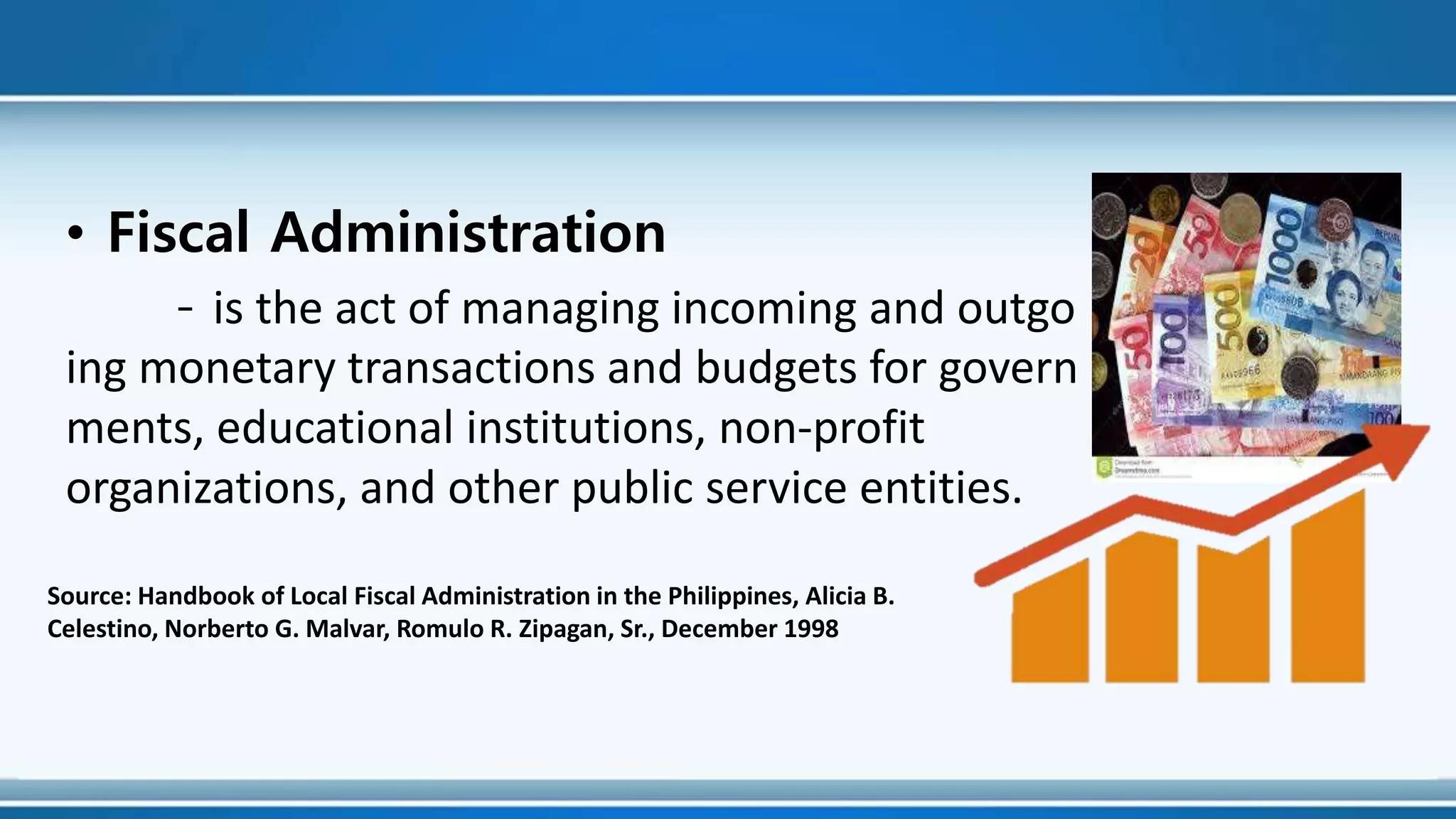
• Fiscal Administration
- is the act of managing incoming and outgo
ing monetary transactions and budgets for govern
ments, educational institutions, non-profit
organizations, and other public service entities.
Source: Handbook of Local Fiscal Administration in the Philippines, Alicia B.
Celestino, Norberto G. Malvar, Romulo R. Zipagan, Sr., December 1998
I. Nature & Scope
LOCAL FISCAL ADMINISTRATION
Refers to systems, structures, processes, officials, and personnel and the policy
environment governing intergovernmental, and inter-local fiscal relations,
affecting among others:
the giving & receipt of allotments and grants from the National Government
(NG) to local government units (LGUs);
allotment sharing between LGUs;
sharing of taxing powers between the national government (NG) and LGUs,
and among LGUs;
 policy on tax rates and structures;
Source: Handbook of Local Fiscal Administration in the Philippines, Alicia B.
Celestino, Norberto G. Malvar, Romulo R. Zipagan, Sr., December 1998
 revenue and expenditure planning;
revenue utilization & expenditure allocation; monitoring & approval
budgets, tax ordinances & other fiscal measures;
 policy on borrowing and borrowing instruments; and
 Appointment & supervision of local fiscal officers. (Cuaresma & Ilago)
Source: Handbook of Local Fiscal Administration in the Philippines, Alicia B.
Celestino, Norberto G. Malvar, Romulo R. Zipagan, Sr., December 1998
This broad definition comprehends 5 major elements as the scope of LFA. These are:
 Systems
 Structures;
 Processes;
 Official/personnel; and
Policy environment governing inter-governmental and inter-local fiscal relations.
• In public administration, Local Fiscal Administration is commonly referred
to as the formulation, implementation, and evaluation of local fiscal
policies by local governments.
Source: Handbook of Local Fiscal Administration in the Philippines, Alicia B.
Celestino, Norberto G. Malvar, Romulo R. Zipagan, Sr., December 1998
Local Government Finances
• Fiscal relations between national and local government centre on the followi
ng major areas of fiscal administration ;
 Allotment of internal revenue shares;
 Shares of local governments in national wealth exploitation;
 Shares of earnings of gov’t agencies or gov’t-owned or controlled
corporations engaged in the utilization & development of national wealth
 Local government borrowing; and
 Review of local gov’t budgets.
Source: Local Fiscal Administration, Jocelyn C. Cuaresma and
Simeon A. Ilago
Aspects of Local Fiscal Administration
1. The fiscal relations between the national government and its agencies,
on the one hand, and the LGUs on the other, which we may call
vertical financial relations. This is also referred to in the literature as
central-local fiscal relations, with the Internal Revenue Allotments at
its core; and
2. The fiscal relations among LGUs themselves, which may be referred to
as the inter-local fiscal relations.
Source: Local Fiscal Administration, Jocelyn C. Cuaresma and
Simeon A. Ilago
Scope
The definitions of local fiscal administration enumerated the areas
covered. However, it is helpful to specify once more the scope of
the field according to their functional categories, w/c fall into the
main traditional divisions of:
A. Revenue Generations:
• All aspects of local taxation;
• Borrowing and its management;
• Operation of public enterprises;
• Revenue enhancement measures;
• Revenue planning, forecasting and accounting;
Source: Local Fiscal Administration, Jocelyn C. Cuaresma and Simeon A. Ilago
Scope
B. Revenue Allocation and Utilization
• Budgeting system & process, including the linkage of planning and
budgeting, expenditure planning, expenditure allocation and
expenditure monitoring;
• Accounting and auditing of expenditures;
C. Other Aspects
• Property and supply management;
• Internal control which cuts across all fiscal functions; and
• Other related matters, like the central grant and allotment system,
organization for local fiscal administration, and computerization of
fiscal operations/systems.
Source: Local Fiscal Administration, Jocelyn C. Cuaresma and Simeon A. Ilago
II. Legal Basis for Local Fiscal Administration
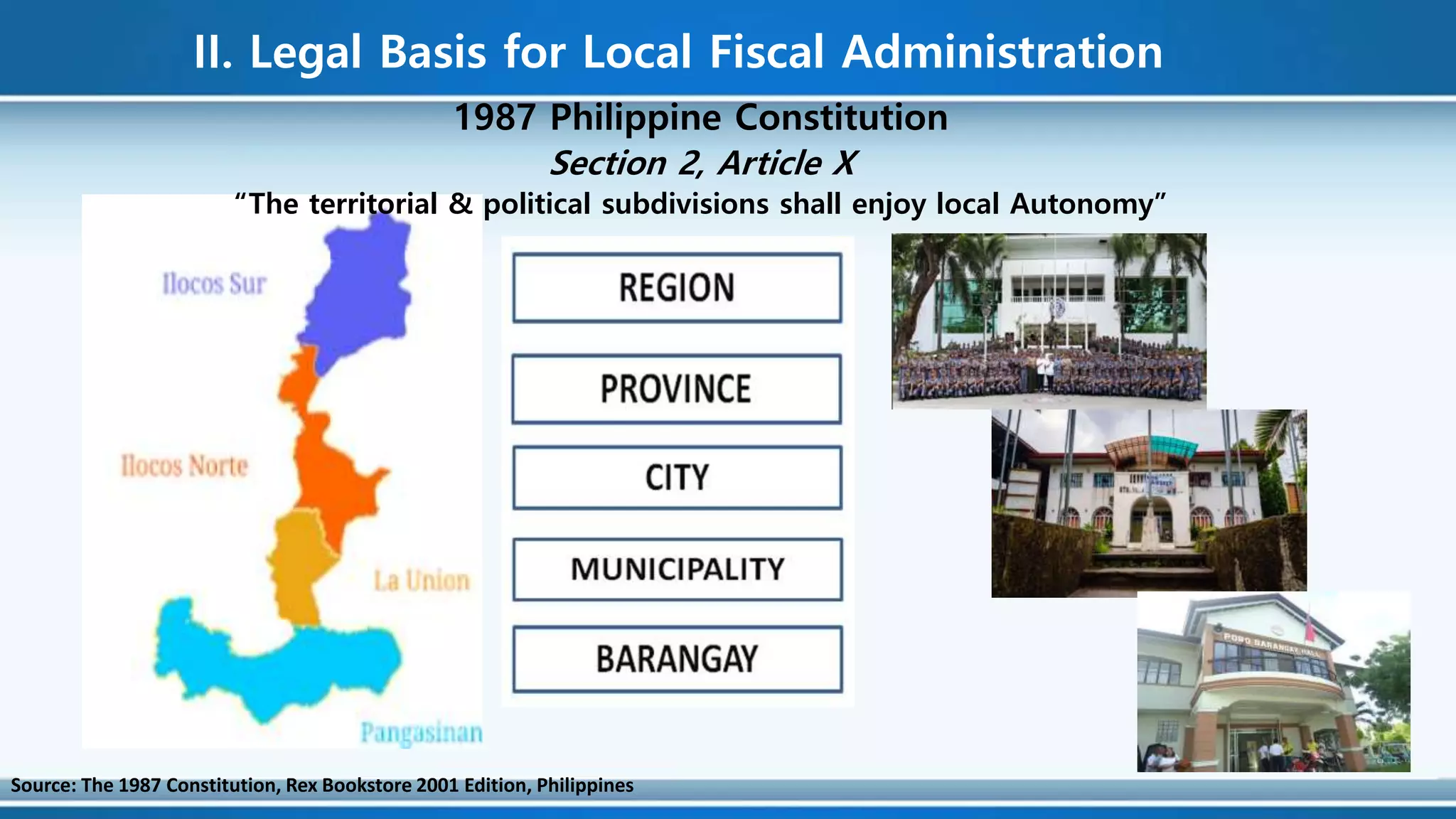
1987 Philippine Constitution
Section 2, Article X
“The territorial & political subdivisions shall enjoy local Autonomy”
Source: The 1987 Constitution, Rex Bookstore 2001 Edition, Philippines
Number of Provinces, Cities, and Municipalities by Island Group
(As of September 30, 2018)
Source: https://dilg.gov.ph/PDF_File/factsfigures
2017 INTERNAL REVENUE ALLOTMENT
Source: DBM-Local Budget Memorandum No. 74-A
2018 INTERNAL REVENUE ALLOTMENT
Source: DBM-Local Budget Memorandum No. 75-A
Section 289. Share in the Proceeds from the Development and Utilization of the National
Wealth.
 The Local Government Code provides that local government shall have an equitable share
in the proceeds derived from the utilization and development of national wealth within
their respective areas and sharing these with the inhabitants by way of direct benefits.
Section 290. Amount of Share of Local Government Units.
 Local government units shall, in addition to the internal revenue allotment, have a share of
forty percent (40%) of the gross collection derived by the national government from the
preceding fiscal year from mining taxes, royalties, forestry and fishery charges, and such
other taxes, fees, or charges, including related surcharges, interests, or fines, and from its
share in any co-production, joint venture or production sharing agreement in the
utilization and development of the national wealth within their territorial jurisdiction.
Source: www.officialgazette.gov.ph
LOCAL GOVERNMENT CODE OF 1991
Section 291. Share of the Local Governments from any Government Agency or
Government-Owned or -Controlled Corporation.
 Local government units shall have a share based on the preceding fiscal year from the
proceeds derived by any government agency or government-owned or -controlled
corporation engaged in the utilization and development of the national wealth based
on the following formula whichever will produce a higher share for the local
government unit:
(a) One percent (1%) of the gross sales or receipts of the preceding
calendar year; or
(b) Forty percent (40%) of the mining taxes, royalties, forestry and
fishery charges and such other taxes, fees or charges, including
related surcharges, interests, or fines the government agency or
government-owned or - controlled corporation would have paid if it
were not otherwise exempt.
Source: www.officialgazette.gov.ph
LOCAL GOVERNMENT CODE OF 1991
Powers in Pursuance of Local Fiscal Administration
1. General Welfare Clause (Sec. 16, RA 7160)
– Every local government unit shall exercise the powers expressly granted, those
necessarily implied therefrom, as well as powers necessary, appropriate, or
incidental for its efficient and effective governance, and those which are essential to
the promotion of the general welfare. Within their respective territorial jurisdictions,
local government units shall ensure and support, among other things, the
preservation and enrichment of culture, promote health and safety, enhance the
right of the people to a balanced ecology, encourage and support the development
of appropriate and self-reliant scientific and technological capabilities, improve
public morals, enhance economic prosperity and social justice, promote full
employment among their residents, maintain peace and order, and preserve the
comfort and convenience of their inhabitants.
Source: www.officialgazette.gov.ph
Powers in Pursuance of Local Fiscal Administration
Source: www.officialgazette.gov.ph
2. Power to Generate and Apply Resources (Sec. 18, RA 7160)
1. – Local government units shall have the power and authority to establish
an organization that shall be responsible for the efficient and effective
implementation of their development plans, program objectives and
priorities; to create their own sources of revenues and to levy taxes, fees,
and charges which shall accrue exclusively for their use and disposition
and which shall be retained by them; to have a just share in national taxes
which shall be automatically and directly released to them without need
of any further action; to have an equitable share in the proceeds from the
utilization and development of the national wealth and resources within
their respective territorial jurisdictions including sharing the same with
the inhabitants by way of direct benefits; …
2. Power to Generate and Apply Resources (Sec. 18, RA 7160)
…to acquire, develop, lease, encumber, alienate, or otherwise
dispose of real or personal property held by them in their
proprietary capacity and to apply their resources and assets
for productive, developmental, or welfare purposes, in the
exercise or furtherance of their governmental or proprietary
powers and functions and thereby ensure their development
into self-reliant communities and active participants in the
attainment of national goals.
Continuation…
Powers in Pursuance of Local Fiscal Administration
Source: www.officialgazette.gov.ph
3. Reclassification of Lands (Sec. 16, RA 7160)
– (a) A city or municipality may, through an ordinance passed by the sanggunian after
conducting public hearings for the purpose, authorize the reclassification of agricultural
lands and provide for the manner of their utilization or disposition in the following cases:
(1) when the land ceases to be economically feasible and sound for
agricultural purposes as determined by the Department of Agriculture
or
(2 )where the land shall have substantially greater economic value for
residential, commercial, or industrial purposes, as determined by the
sanggunian concerned:
Powers in Pursuance of Local Fiscal Administration
Source: www.officialgazette.gov.ph
Provided, That such reclassification shall be limited to the following percentage of the
total agricultural land area at the time of the passage of the ordinance:
(1) For highly urbanized and independent component cities, fifteen
percent (15%);
(2) For component cities and first to the third class municipalities, ten
percent (10%);and
(3) For fourth to sixth class municipalities, five percent (5%): Provided,
further, that agricultural lands distributed to agrarian reform beneficiaries pursuant to
R.A. No. 6657 otherwise known as “The Comprehensive Agrarian Reform Law”, shall
not be affected by the said reclassification and the conversion of such lands into other
purposes shall be governed by Section 65 of said Act.
Powers in Pursuance of Local Fiscal Administration
Source: www.officialgazette.gov.ph
4. Closure and opening of roads (Sec. 21, RA 7160)
1. – A local government unit may, pursuant to an ordinance,
permanently or temporarily close or open any local road, alley,
park, or square falling within its jurisdiction: Provided, however,
that in case of permanent closure, such ordinance must be
approved by at least two-thirds (2/3) of all the members of the
sanggunian, and when necessary, an adequate substitute for
the public facility that is subject to closure is provided.
Powers in Pursuance of Local Fiscal Administration
Source: www.officialgazette.gov.ph
5. Corporate Powers (Sec. 22, RA 7160)
– (a) Every local government unit, as a corporation, shall have the
following powers:
(1) To have continuous succession in its corporate name;
(2) To sue and be sued;
(3) To have and use a corporate seal;
(4) To acquire and convey real or personal property;
Powers in Pursuance of Local Fiscal Administration
Source: www.officialgazette.gov.ph
6. Authority to negotiate and secure grants (Sec. 23, RA 7160)
– Local chief executives may, upon authority of the sanggunian, negotiate and
secure financial grants or donations in kind, in support of the basic services or
facilities enumerated under Section 17 hereof, from local and foreign assistance
agencies without necessity of securing clearance or approval therefor from any
department, agency, or office of the National Government or from any higher local
government unit: Provided, That projects financed by such grants or assistance with
national security implications shall be approved by the national agency concerned:
Provided, further, That when such national agency fails to act on the request for
approval within thirty (30) days from receipt thereof, the same shall be deemed
approved.
Powers in Pursuance of Local Fiscal Administration
Source: www.officialgazette.gov.ph
7. Liability for damages (Sec. 24, RA 7160)
– Local government units and their officials are not exempt from
liability for death or injury to persons or damage to property.
Other Laws and Government Issuances
Local fiscal administration is also governed by laws and issuances from the national agencies that
exercise supervisory power over local government units. Such agencies are the following:
a. Department of Finance (DOF)
- The DOF maintains the Bureau of Local Government
Finance (BLGF) which is the unit primarily involved in local
financial administration.
- Provides technical assistance and training for local
governments on local finance.
- It administers credit facilities such as the Municipal
Development Fund, and prepares guidelines and standards
on matters related to taxation, credit financing, and
imposition of various fees and charges.
- It also exercises technical supervision on local assessment
and treasury operations, and performs monitoring and
evaluation of financial performance.
Other Laws and Government Issuances
b. Department of Budget and Management (DBM)
- The DBM is primarily responsible for
disseminating information on Internal Revenue
Allotment (IRA) allocation and the local
government’s share from the utilization and
development of national wealth.
- The Department releases the share of internal
revenue allotment directly to the provinces,
cities, municipalities and barangays.
Other Laws and Government Issuances
c. Commission on Audit (COA)
- The COA is primarily responsible for the accountability
phase of the local budget process.
- The Commission maintains the Local Government
Audit Office (LGAO), through which it implements
auditing rules and regulations in local government
units.
- The Commission also settles accounts and fixes the
liability of accountable officers, as well as determines
whether fiscal responsibility has been properly and
effectively discharged by the local chief executives.
Other Laws and Government Issuances
d. Department of Interior and Local Government (DILG)
- The DILG, upon which the supervisory power of the President is
reposed, at times issues guidelines which are fiscal-related
e. Office of the President (OP)
- The President of the Philippines has general
supervisory power over the local government units, as
provided by Section 4 of the 1987 Constitution. As
such, the OP still issues from time to time executive
and administrative orders that affect local government
units.
CLASSIFICATION OF PROVINCES/CITIES
CLASS AVERAGE ANNUAL INCOME
First Thirty million pesos or more
Second Twenty million pesos or more but less than thirty million pesos
Third Fifteen Million Pesos or more but less than twenty million pesos
Fourth Ten million pesos or more but less than fifteen million pesos
Fifth Five million pesos or more but less than ten million pesos
Sixth Less than five million pesos
EXECUTIVE ORDER NO. 249 S. 1987
* * Except Manila and Quezon City
Source: www.officialgazette.gov.ph
EXECUTIVE ORDER NO. 249 S. 1987
CLASSIFICATION OF MUNICIPALITIES
CLASS AVERAGE ANNUAL INCOME
First Fifteen million pesos or more
Second Ten million pesos or more but less than fifteen million pesos
Third Five Million Pesos or more but less than ten million pesos
Fourth Three million pesos or more but less than five million pesos
Fifth One million pesos or more but less than ten million pesos
Sixth Less than one million pesos
Source: www.officialgazette.gov.ph
References:
1. Handbook of Local Fiscal Administration in the Philippines, Alicia B. Celestino,
Norberto G. Malvar, Romulo R. Zipagan, Sr., December 1998
2. The 1987 Constitution, Rex Bookstore 2001 Edition, Philippines
3. The Local Government Code of 1991, Rex Bookstore 2001 Edition, Philippines
4. Wikipedia
5. Local Fiscal Administration, Jocelyn C. Cuaresma and Simeon A. Ilago
Source: psa.gov.ph
MUNICIPALITY OF BACNOTAN, LA
UNION
Municipality of Bacnotan, is a 1st class municipality in the province
of La Union . Its economic activities in Bacnotan mostly involve
farming, fishing, bee-keeping, pebble extraction, tourism and
Portland cement manufacture. Bacnotan is the seat of the
beekeeping industry in La Union.
“Home of Honey, Silk and Mushroom”
QUICK FACTS
Land Area: 6,507 hectares
Population: 38,430
Number of Barangays: 47
Classification: First Class Municipality
In Barangay Carcarmay stands the towering
La Union Centennial Tree which was planted
way back in 1896 as certified by the
Department of Environment and Natural
Resources.
Honey is the One Town One Product (Otop) of La
Union. The province’s apiculture program has been
cited by the government as the Luzon Island Best Otop
Implementor.
The Sericulture Research Development Institute (SERDI) at Don
Mariano Marcos Memorial State University, North La Union
Campus which apparently started as a research project of the
Agriculture Department in the '80s. Its mission is to develop
sericulture (silk farming) as a rural agro-based industry in the
country. It is the only national silk research center in the
country.
http://www.thelettersinnovember.com/2013/10/bacnotan-my-hometown-sericulture.html
PRODUCTS
FINANCIAL PERFORMANCE
Source: 2016 & 2017 COA Annual Financial Report
2016 2017 Increase /
(Decrease)
Revenue P 245,747,000.00 P 166,416,000.00 (P 79,331,000.00)
Expenses 114,789,000.00 123,172,000.00 8,383,000.00
Income P 130,958,000.00 P 43,245,000.00 (P87,713,000.00)
REVENUE Business Tax
License Tax
Income Tax
Source: www.coa.gov.ph
Other Tax
Tax Revenue
REVENUE
Permits & Licenses
Certificate Fees
Source: www.coa.gov.ph
Processing Fees
Service Income
Balaoan is one of the oldest municipalities in the Province of La Union,
having been founded in 1704. The vast land area consists of
agricultural lands interspersed with residential, commercial and
institutional areas. The town is agro-fishery based, the reason for its
being perennially more than sufficient in rice, cereals, legumes and
other crops. It has rich variety of marine fishes along its coralline
fishing ground in the west. Being at the center of La Union first
congressional district, it is potentially bright to business industry,
commerce and tourism and others. With its strategic central location, it
serves as an ideal trading post for produce from other surrounding
inland and mountain communities.
MUNICIPALITY OF BALAOAN, LA
UNION “Sea Urchin Capital of the North”
https://launion.gov.ph/the-province/general-information/city-and-municipalities/balaoan-la-union/
QUICK FACTS
Land Area: 6,450 hectares
Population: 37,592
Number of Barangays: 36
Classification: First Class Municipality
Tourists may visit the Eco tourism in
Balaoan called “Immunity island”
FINANCIAL PERFORMANCE
Source: 2016 & 2017 COA Annual Financial Report
2016 2017 Increase /
(Decrease)
Revenue P 289,519,000.00 P 124,306,000.00 (P 165,213,000.00)
Expenses 95,318,000.00 146,845,000.00 51,527,000.00
Income P 194,201,000.00 P (22,539,000.00) - (P 171,662,000.00)
REVENUE
Tax Revenue
Real Property Tax
Tax on Business
Real Property Tax - Basic
Special Levy on Idle Lands
Tax on Delivery Trucks and Vans
Franchise tax
Business Tax
Amusement tax
Other Tax
Professional Tax
Community Tax
http://www.balaoanlaunion.gov.ph
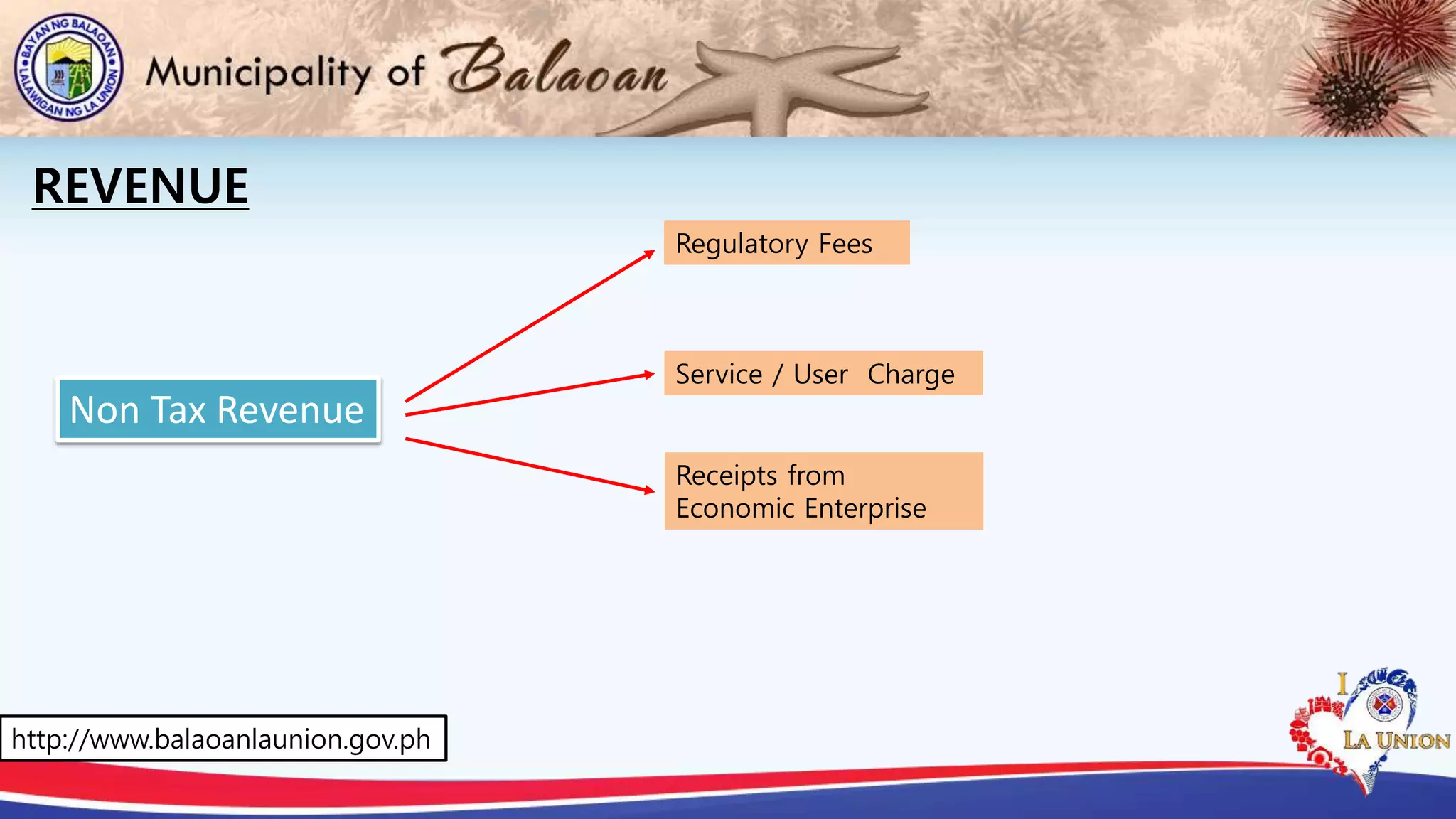
REVENUE
Non Tax Revenue
Regulatory Fees
Receipts from
Economic Enterprise
Service / User Charge
http://www.balaoanlaunion.gov.ph
___________________________
Municipality of Bauang, La Union
“Food Basket of the North”
Established as a settlement in 1590, Bauang was
recognized as a town in 1765 as part of Pangasinan.
When La Union was created in 1850, Bauang was one of
the original 12 towns that formed the province. Bauang
also earned the appellation as “Beach Capital of the
Philippines” during the 70’s for its pristine beaches and
is still a most sought-after swimming area as shown by
the continuous influx of tourists and establishments of
new resorts.
QUICK FACTS
Land Area: 7,160 hectares
Population: 75,032
Number of Barangays: 39
Classification: First Class Municipality
Source: https://launion.gov.ph/bauang-la-union/
Bauang celebrates its
Parochial Fiesta on
April 26 in honor of St.
Peter and St. Paul and
the Panagkakararua
Festival every October
31 of the year.
Bauang beach is accessible to any
form of land transportation. Its calm
waters, fine sand, and languidly
swaying coconut trees along the
shoreline from Baccuit Sur to
Pagdalagan Sur make it perfect for jet
skiing, scuba diving and swimming.
Tourists can have a guapple
and grapes picking adventure
at Barangay Urayong. Famous
for its large, thick and crispy
with a tangy taste, other
Guapple products include pies,
jams, candies and grapes.
FINANCIAL PERFORMANCE
Source: 2016 & 2017 COA Annual Financial Report
2016 2017 Increase /
(Decrease)
Revenue P 310,308,000.00 P 289,855,000.00 (P 20,453,000.00)
Expenses 223,874,000.00 221,678,000.00 (2,196,000.00)
Income P 86,434,000.00 P 68,177,000.00 (P18,257,000.00)
REVENUE Franchise Tax
Property Tax
Professional Tax
Source: www.coa.gov.ph
Tax on Business
Local Taxes
REVENUE
Permits & Licenses
Certificate Fees
Authentication Fees
Source: www.coa.gov.ph
Processing Fees
Service Income
___________________________
Municipality of Naguilian, La Union
“Home of the Original Basi”
Originally a part of Bauang in the province of Pangasinan,
Naguilian derived its name from the Iloko phrase “Nag-ili-an
dagiti gan-ganaet” meaning “a place where people from other
places come to stay”. It is formed from the Iloko root word “ili”
meaning “town” which was later modified as “NAGUILIAN”. Its
separation from Bauang coincided with the centennial
celebration of the Catholic Church of Naguilian in 1839. When La
Union was created by a Royal Decree in 1850, Naguilian was one
of the twelve (12) towns that comprised the province.
QUICK FACTS
Land Area: 10,086.85 hectares
Population: 54,221
Number of Barangays: 37
Classification: First Class Municipality
Source: https://launion.gov.ph/naguilian-la-union/
Naguilian is also known for being
the home of the original Basi where
the tradition of Basi making dates
back to the World War II era. With
the help of the local government,
this industry has been revived and
is now one of the main sources of
income of the Province.
Endowed with rich natural resources,
Naguilian is largely an agricultural town. Its
fertile land yields rice, tobacco, root crops,
vegetables and sugarcane which produces
two of the municipality’s famous products,
vinegar and basi.
The Catholic Church in
Naguilian was constructed in
1739 after the Spaniards
established their authority
thereat. The centennial of the
Catholic Church was held in
1839 which marked the
separation of the town of
Naguilian from the town of
Bauang.
FINANCIAL PERFORMANCE
Source: 2016 & 2017 COA Annual Financial Report
2016 2017 Increase /
(Decrease)
Revenue P 199,886,000.00 P 173,778,000.00 (P 26,108,000.00)
Expenses 101,351,000.00 115,057,000.00 13,706,000.00
Income P 98,535,000.00 P 58,721,000.00 (P39,814,000.00)
REVENUE
Tax Revenue
Individual and Corporation: Professional Tax
Property: Real Property Tax-Basic,
Real Property Transfer Tax
Fines & Penalties: Property Tax
Source: www.coa.gov.ph
REVENUE
Other Income
Permit & Licenses
Registration Plates, Tags & Sticker Fees
Business Income
Source: www.coa.gov.ph
___________________________
Municipality of Agoo, La Union
“The Center of Education, Trade & Commerce in Southern, La Union”
Like most of the LGUs in the Province located along the
National Highway, Agoo, being a picture of sustainable
progress and development, has become a town that never
sleeps. Agoo was named after the river along whose banks it
was built which at that time was a forest of pine-like trees
locally called “agoo” or “aroo”. The town also became the
center of pacification and conquest of the mountain tribes in
the Cordilleras.
QUICK FACTS
Land Area: 5,135 hectares
Population: 63,692
Number of Barangays: 48
Classification: First Class Municipality
Source: https://launion.gov.ph/agoo-la-union/
Agoo’s overall development may not be
completed without mentioning the
continuing devotion of the people to
their faith. The countless miracle stories
attributed to Apo Caridad which includes
the dramatic rise of Agoo from the
rubble of the July 1990 Killer Quake and
religious structures.
The Basilica Minore of Our
Lady of Charity is noted for its
Mexican-Baroque architectural
features. A rosette stained
glass window upon the
Basilica’s facade is a marked
contrast to the gray color of
the front wall.
To promote the Iloco delicacy,
every 6th of May is
designated as Dinengdeng
Festival, where more than
100 recipes of the popular
Iloco meal are showcased.
FINANCIAL PERFORMANCE
Source: 2016 & 2017 COA Annual Financial Report
2016 2017 Increase /
(Decrease)
Revenue P 298,601,000.00 P 246,524,000.00 (P 52,077,000.00)
Expenses 177,430,000.00 192,693,000.00 15,263,000.00
Income P 121,171,000.00 P 53,831,000.00 (P67,340,000.00)
REVENUE
Tax Revenue
Real Property Tax
Tax on Business
Other Taxes
Source: agoogov.com
REVENUE
Non-Tax Revenue
Regulatory Fees
Service/User Charges
Receipts from Economic Enterprises
Source: agoogov.com
Other Receipts
REVENUE
External Sources
Internal Revenue Allotment
Other Shares from National Tax Collections
Inter-Local Transfers
Source: agoogov.com
Extraordinary Receipts/Grants/Donations/Aids
___________________________
Municipality of Rosario, La Union
“The Center of Wood Carving in Southern La Union”
Rosario is the last town on the southern
portion of La Union. From the south, it is the
first town in the Ilocos region. Travelers aptly
call it the “Gateway to Ilocandia”. Rosario
used to be a sitio and then a barrio of Santo
Tomas, La Union. It was converted into a
municipality in 1869.
QUICK FACTS
Land Area: 7,419.41 hectares
Population: 55,458
Number of Barangays: 33
Classification: First Class Municipality
Source: https://launion.gov.ph/rosario-la-union/
Around 216 kilometers away from
Manila, Rosario requires a four-hour
drive and serves as a link to the Ilocos
and Cordillera Provinces. Kennon Road
starts from this town and ends at Baguio
City.
Predominantly Roman
Catholic, Rosario’s
Parochial Fiesta, the
Feast of Immaculate
Concepcion, falls every
December 8.
The Rosario Nature Park, a multi-
hectare haven of lush green is La
Union’s biggest camping site.
Because of its wide area and
excellent vegetation, it is used by
the Boys Scouts and Girls Scouts
of the Philippines as a venue for
Jamborees.
FINANCIAL PERFORMANCE
Source: 2016 & 2017 COA Annual Financial Report
2016 2017 Increase /
(Decrease)
Revenue P 199,379,000.00 P 192,712,000.00 (P 6,667,000.00)
Expenses 166,274,000.00 169,354,000.00 3,080,000.00
Income P 33,105,000.00 P 23,358,000.00 (P9,747,000.00)
REVENUE
Tax Revenue
RPT-General
Business Tax
Other Taxes
Source: launion.gov.ph
REVENUE
Operation &
Miscellaneous
Revenue
Fees and Charges
Economic Enterprise
Other Receipt
Source: launion.gov.ph
There are 19
municipalities as
of 11 January
2019.
Source: psa.gov.ph
___________________________
Municipality of Aringay, La Union
“Home of Tasty Bangus”
Municipality of Aringay boasts a wide hectarage
of milkfish, prawn and oyster culture in barangays
Alaska, Dulao and Samara. The eastern part of the
town is mountainous with some fertile valleys
cultivated with rice, tobacco, vegetable and other
root crops. Irrigation system has also benefited
farmers in some areas to plant twice or thrice a
year.
QUICK FACTS
Land Area: 10,950 hectares
Population: 47,458
Number of Barangays: 24
Classification: Second Class Municipality
Aringay celebrates
its Town Fiesta
from December 1
to 13 as well as its
Parochial Fiesta,
the Feast of Saint
Lucy, every 4th of
May.
The municipality also
serves as home for
the Philippine
National Police
Regional Training
Center.
Aringay is also the
hometown of the country’s
first Ms. Universe, Ms.
Gloria Diaz.
Source: https://launion.gov.ph/aringay-la-union/
PRODUCTS
Buyos is one of the product of Aringay which is made out of ground glutinous
rice and coconuts strips wrapped in banana leaves then cooked over
charcoal. It is sticky, sweet, chewy, and delicious specially if it is still hot. The
chewy sweet centre with bits of fresh young coconut strips and the crunchy
charred bits will definitely make you ask for more.
Barangay Dulao has the most number of fishpens in La Union. The high
quality and the most delicious milkfish (bangus) are being cultured here.
Aringay is one of the best producer of corn husks products. The examples of
corn husks products that are made in Aringay are baskets, house
decorations and many more.
Source: www.aringay.gov.ph
FINANCIAL PERFORMANCE
Source: 2016 & 2017 COA Annual Financial Report
2016 2017 Increase /
(Decrease)
Revenue P 156,825,000.00 P 132,560,000.00 (P 24,265,000.00)
Expenses 99,426,000.00 117,373,000.00 17,947,000.00
Income P 57,399,000.00 P 15,187,000.00 (P42,212,000.00)
REVENUE
Tax Revenue
Individual and Corporation: Professional Tax
Property: Real Property Tax-Basic,
Real Property Transfer Tax
Goods & Services: Tax on sand, Gravel and other
Quarry, Tax on Delivery Trucks and Vans, Franchise
Tax
Fines & Penalties: Property Tax
Source: www.coa.gov.ph
REVENUE
Source: www.coa.gov.ph
Services Income
Permit Fees
Registration Plates, Tags & Sticker Fees
Clearance & Certificate Fees
Verification and Authentication Fees
Inspection Fees
Processing Fees
REVENUE
Business Income
Rent / Lease Income
Receipts from operation of
Hostels / Resorts
Sales Revenue
Interest Income
Source: www.coa.gov.ph
REVENUE
Source: www.coa.gov.ph
Shares from PCSO
_________________________________
Municipality of San Juan, La Union
“The Surfing Capital of the North”
San Juan, with its rolling waves and delightful
beach scenes, has become a household name in
the surfing and tourism industry. A haven for local
and foreign surfers alike, surf lessons are readily
available wherein first-timers can be taught the
basics in just an hour. San Juan is also a laid-back
town known for its pottery industry. Earthenware
of various sizes and designs, all of superb quality,
are sold at Barangay Taboc.
QUICK FACTS
Land Area: 5,186 hectares
Population: 37,188
Number of Barangays: 41
Classification: Second Class Municipality
The La Union Surfing Break, scheduled every end of
October, has continually attracted tourists, surfers,
college students, beach-lovers, and party-goers,
contributing to the rising popularity of this holiday
destination.
Source: https://launion.gov.ph/san-juan-la-union/
In honor of its St. John
the Baptist, San Juan
holds its patronal fiesta
every 24th of June, and
celebrates its annual
town fiesta every third
week of December.
ECONOMY TOURISM
San Juan is considered to be the Surfing Capital of the Northern
Philippines, and is known for its consistent intermediate quality surf and
two surfing seasons from July to October and November to March.
COTTAGE INDUSTRIES
Pottery, blanket-weaving, basketry, bamboo-craft and broom-making are
produced as a folk-industry. Hollow concrete blocks are manufactured in
the rural villages for local building projects.
AGRICULTURE
Yellow corn is one of the most important crops in San Juan, and is used as a
raw material for food and industrial products such as starch, corn oil,
beverages, gluten, snacks etc. It constitutes about 50% of the feed for local
livestock and poultry enterprises. It was nominated as the product for the
One Town One Product (OTOP) Philippines program of President Gloria
Macapagal-Arroyo to promote entrepreneurship and create jobs.
Source: en.wikipedia.org/wiki/San_Juan,_La_Union
FINANCIAL PERFORMANCE
Source: 2016 & 2017 COA Annual Financial Report
2016 2017 Increase / (De
crease)
Revenue P 212,512,000.00 P 129,538,000.0
0
(P 82,974,000.0
0)
Expenses 117,292,000.00 110,903,000.00 (6,389,000.00)
Income P 95,220,000.0
0
P 18,635,000.
00
(P76,585,000.0
0)
REVENUE
Tax Revenue
RPT - General
Business Tax
Other Taxes
Source: www.coa.gov.ph
REVENUE
Source: www.coa.gov.ph
Internal Revenue
Collections
Business Tax /
License Tax
Registration Plates, Tags
& Sticker Fees
REVENUE
Operation &
Miscellaneous
Revenue
Fees and Charges
Economic
Enterprise
Other Receipt
Source: www.coa.gov.ph
REVENUE
Shares from PCSO
Source: www.coa.gov.ph
Sources: psa.gov.ph
https://launion.gov.ph/luna-la-
union/
https://launion.gov.ph/bangar-la-
MUNICIPALITY OF BANGAR, LA
UNION“Loom Weaving Capital of the North”
Bangar is famous for its loom-
weaving industry. The big bulk of
orders for placemats, towels,
draperies, curtains, blankets and even
bathrobes from all over the country
and even abroad speaks well of the
quality of Bangar woven products.
Source: https://launion.gov.ph/bangar-la-union/
QUICK FACTS
Land Area: 3,729.17 hectares
Population: 37,188
Number of Barangays: 33
Classification: Third Class Municipality
On the northern side of the town flowed the Amburayan
river which later on became the setting of the Ilocano epic
Biag ni Lam-ang penned by the Prince of Ilocano Poets,
Pedro Bucaneg. This river was also another source of
income for the inhabitants because in it were gold dusts
and granules which were panned and collected
The Parish Church is a must to see attraction, other than its
intricate ceiling murals, it also takes pride for being one of the few
churches in the country with three belfries.
ECONOMY Agriculture, however, still remains the main source of income for the people of Bangar. Its
principal crop is rice while tobacco comes next. Farmers also find planting corn, peanuts,
and vegetable crops as a quite lucrative source of additional income in between
cropping.
Fishing also occupies a greater time of the people from the coastal barangays of Bangar.
Ipon which comes out from the month of August to April is caught abundantly along these
coastal areas. Bangus fry is caught from March to the earlier part of July. Tuna fish locally
known as oriles and codfish abound in the coastal waters of this town. The Amburayan
river also teems with fresh water varieties of fish (purong, tibek and birot) and shell
(jusiling, suso and gusipeng).
Loom weaving industry and metal crafts (bolo and agricultural implements)
2016 2017 Increase / (De
crease)
Revenue P 213,256,000.00 P 121,328,000.00 (P 91,928,000.00)
Expenses 63,833,000.00 65,434,000.00 1,601,000.00
Income P 149,423,000.00 P 55,894,000.00 (P93,529,000.00)
FINANCIAL
PERFORMANCE
REVENUE
Locally Source Revenue
Regulatory Fees
Receipts from
Economic Enterprise
Service / User Charge
Real Property Tax
Other Taxes
Tax on Business
blgf.gov.ph/.../FYs-2009-2016-LGUs-Annual-Regular-
Income-ARI-Data-by-Municipality
MUNICIPALITY OF LUNA, LA UNION
“Pebble Beach of La Union”
Luna is also known for its beaches, particularly in Nalvo Sur
and Darigayos. Beach shades, cottages and resorts are
found in these barangays. The municipality is also known for
its native delicacies and pottery products which are
comparable to San Juan's.
QUICK FACTS
Land Area: 7,419.41 hectares
Population: 49,025
Number of Barangays: 40
Classification: Third Class Municipality
The town’s original name is Namacpacan, an Iloco
word which means “one who had given food” due to
the generosity of the locals of sharing their food to
travelers going north during the Spanish times
Luna is also home to the famous Ilocano delicacies bibingka and tupig. Damili
products (clay products) of various kinds are also made in barangay Barrientos
ECONOMY
Agricultural farming is main occupation of the people . Rice is planted twice or
thrice a year in some areas. In between cropping, people plant vegetables and
root crops.
Fishing is the most important occupation of the residents of Luna especially the
inhabitants along the coastal areas. Various kinds of fishes and different species of
edible sea weed and sea shells abound in the seawater of Luna.
Luna is also known for its stone-picking industry which is the main source of
income of 14 of its barangays. These stones have found market not only in the
country but also overseas.
2016 2017 Increase / (De
crease)
Revenue P 112,124,000.00 P 98,576,000.00 (P 13,548,000.00)
Expenses 55,165,000.00 67,076,000.00 11,911,000.00
Income P 56,959,000.00 P 31,500,000.00 (P24,459,000.00)
FINANCIAL PERFORMANCE
REVENUE
Tax Revenue
RPT - General
Business Tax
Other Taxes
Source: www.coa.gov.ph
REVENUE
Business Income
Rent / Lease Income
Receipts from operation of
Hostels / Resorts
Sales Revenue
Interest Income
Source: www.coa.gov.ph
REVENUE
Non Tax Revenue
Regulatory Fees
Receipts from
Economic Enterprise
Service / User Charge
http://www.coa.gov.ph
The City of San Fernando is situated in the mountainous area at
almost the mid-section of La Union along the China Sea. It is the
first city created in the province of La Union by virtue of Republic
Act 8509, sponsored by the Congressman Victor F. Ortega in the
House of Representatives, signed by President Fidel V. Ramos on
February 13, 1998 and was ratified by a plebiscite on March 20,
1998. The City of San Fernando is now the seat of national
government agencies in Region I and center of trade, commerce,
financial and educational institutions, among others.
“Booming Metropolis of the North”
CITY OF SAN FERNANDO, LA UNION
QUICK FACTS
Land Area: 10,688 hectares
Population: 115,494
Number of Barangays: 59
Classification: Class C Component City
Pindangan was the former name of the
City of San Fernando, which was derived
from the Iloko word Pindang, a
traditional method of drying fish
Ma-cho Temple, a Taoist
temple located in San
Fernando, La union. The
temple gives a panoramic view
of the city and the San
Fernando Bay.
2016 2017 Increase / (Decr
ease)
Revenue P 703,054,000.00 P 725,660,000.00 P 22,606,000.00
Expenses 537,916,000.00 525,741,000.00 (12,175,000.00)
Income P 165,138,000.00 P 199,919,000.00 P34,781,000.00
FINANCIAL PERFORMANCE
REVENUE
Tax Revenue Local Taxes
Business Tax
Community Tax
Real Property Tax
Amusement Tax
Other Local Tax
REVENUE
General Income
Permits and Licenses
Service Income
Business Income

Local Fiscal Administration

  • 1.
    Prepared by: Daphne MeirE. Abat Maureen G. Ferrer Edilberto D. Ronquillo, Jr. MPA 203 Local Governance & Administration LOCAL FISCAL ADMINISTRATION
  • 2.
    Topic Outline I. Nature& Scope II. Legal Basis for Local Fiscal Administration III. Financial Performance a. Class A Municipality b. Class B Municipality c. Class C Municipality
  • 3.
    • Fiscal Administration -is the act of managing incoming and outgo ing monetary transactions and budgets for govern ments, educational institutions, non-profit organizations, and other public service entities. Source: Handbook of Local Fiscal Administration in the Philippines, Alicia B. Celestino, Norberto G. Malvar, Romulo R. Zipagan, Sr., December 1998
  • 4.
    I. Nature &Scope LOCAL FISCAL ADMINISTRATION Refers to systems, structures, processes, officials, and personnel and the policy environment governing intergovernmental, and inter-local fiscal relations, affecting among others: the giving & receipt of allotments and grants from the National Government (NG) to local government units (LGUs); allotment sharing between LGUs; sharing of taxing powers between the national government (NG) and LGUs, and among LGUs;  policy on tax rates and structures; Source: Handbook of Local Fiscal Administration in the Philippines, Alicia B. Celestino, Norberto G. Malvar, Romulo R. Zipagan, Sr., December 1998
  • 5.
     revenue andexpenditure planning; revenue utilization & expenditure allocation; monitoring & approval budgets, tax ordinances & other fiscal measures;  policy on borrowing and borrowing instruments; and  Appointment & supervision of local fiscal officers. (Cuaresma & Ilago) Source: Handbook of Local Fiscal Administration in the Philippines, Alicia B. Celestino, Norberto G. Malvar, Romulo R. Zipagan, Sr., December 1998
  • 6.
    This broad definitioncomprehends 5 major elements as the scope of LFA. These are:  Systems  Structures;  Processes;  Official/personnel; and Policy environment governing inter-governmental and inter-local fiscal relations. • In public administration, Local Fiscal Administration is commonly referred to as the formulation, implementation, and evaluation of local fiscal policies by local governments. Source: Handbook of Local Fiscal Administration in the Philippines, Alicia B. Celestino, Norberto G. Malvar, Romulo R. Zipagan, Sr., December 1998
  • 7.
    Local Government Finances •Fiscal relations between national and local government centre on the followi ng major areas of fiscal administration ;  Allotment of internal revenue shares;  Shares of local governments in national wealth exploitation;  Shares of earnings of gov’t agencies or gov’t-owned or controlled corporations engaged in the utilization & development of national wealth  Local government borrowing; and  Review of local gov’t budgets. Source: Local Fiscal Administration, Jocelyn C. Cuaresma and Simeon A. Ilago
  • 8.
    Aspects of LocalFiscal Administration 1. The fiscal relations between the national government and its agencies, on the one hand, and the LGUs on the other, which we may call vertical financial relations. This is also referred to in the literature as central-local fiscal relations, with the Internal Revenue Allotments at its core; and 2. The fiscal relations among LGUs themselves, which may be referred to as the inter-local fiscal relations. Source: Local Fiscal Administration, Jocelyn C. Cuaresma and Simeon A. Ilago
  • 9.
    Scope The definitions oflocal fiscal administration enumerated the areas covered. However, it is helpful to specify once more the scope of the field according to their functional categories, w/c fall into the main traditional divisions of: A. Revenue Generations: • All aspects of local taxation; • Borrowing and its management; • Operation of public enterprises; • Revenue enhancement measures; • Revenue planning, forecasting and accounting; Source: Local Fiscal Administration, Jocelyn C. Cuaresma and Simeon A. Ilago
  • 10.
    Scope B. Revenue Allocationand Utilization • Budgeting system & process, including the linkage of planning and budgeting, expenditure planning, expenditure allocation and expenditure monitoring; • Accounting and auditing of expenditures; C. Other Aspects • Property and supply management; • Internal control which cuts across all fiscal functions; and • Other related matters, like the central grant and allotment system, organization for local fiscal administration, and computerization of fiscal operations/systems. Source: Local Fiscal Administration, Jocelyn C. Cuaresma and Simeon A. Ilago
  • 11.
    II. Legal Basisfor Local Fiscal Administration 1987 Philippine Constitution Section 2, Article X “The territorial & political subdivisions shall enjoy local Autonomy” Source: The 1987 Constitution, Rex Bookstore 2001 Edition, Philippines
  • 12.
    Number of Provinces,Cities, and Municipalities by Island Group (As of September 30, 2018) Source: https://dilg.gov.ph/PDF_File/factsfigures
  • 13.
    2017 INTERNAL REVENUEALLOTMENT Source: DBM-Local Budget Memorandum No. 74-A
  • 14.
    2018 INTERNAL REVENUEALLOTMENT Source: DBM-Local Budget Memorandum No. 75-A
  • 15.
    Section 289. Sharein the Proceeds from the Development and Utilization of the National Wealth.  The Local Government Code provides that local government shall have an equitable share in the proceeds derived from the utilization and development of national wealth within their respective areas and sharing these with the inhabitants by way of direct benefits. Section 290. Amount of Share of Local Government Units.  Local government units shall, in addition to the internal revenue allotment, have a share of forty percent (40%) of the gross collection derived by the national government from the preceding fiscal year from mining taxes, royalties, forestry and fishery charges, and such other taxes, fees, or charges, including related surcharges, interests, or fines, and from its share in any co-production, joint venture or production sharing agreement in the utilization and development of the national wealth within their territorial jurisdiction. Source: www.officialgazette.gov.ph LOCAL GOVERNMENT CODE OF 1991
  • 16.
    Section 291. Shareof the Local Governments from any Government Agency or Government-Owned or -Controlled Corporation.  Local government units shall have a share based on the preceding fiscal year from the proceeds derived by any government agency or government-owned or -controlled corporation engaged in the utilization and development of the national wealth based on the following formula whichever will produce a higher share for the local government unit: (a) One percent (1%) of the gross sales or receipts of the preceding calendar year; or (b) Forty percent (40%) of the mining taxes, royalties, forestry and fishery charges and such other taxes, fees or charges, including related surcharges, interests, or fines the government agency or government-owned or - controlled corporation would have paid if it were not otherwise exempt. Source: www.officialgazette.gov.ph LOCAL GOVERNMENT CODE OF 1991
  • 17.
    Powers in Pursuanceof Local Fiscal Administration 1. General Welfare Clause (Sec. 16, RA 7160) – Every local government unit shall exercise the powers expressly granted, those necessarily implied therefrom, as well as powers necessary, appropriate, or incidental for its efficient and effective governance, and those which are essential to the promotion of the general welfare. Within their respective territorial jurisdictions, local government units shall ensure and support, among other things, the preservation and enrichment of culture, promote health and safety, enhance the right of the people to a balanced ecology, encourage and support the development of appropriate and self-reliant scientific and technological capabilities, improve public morals, enhance economic prosperity and social justice, promote full employment among their residents, maintain peace and order, and preserve the comfort and convenience of their inhabitants. Source: www.officialgazette.gov.ph
  • 18.
    Powers in Pursuanceof Local Fiscal Administration Source: www.officialgazette.gov.ph 2. Power to Generate and Apply Resources (Sec. 18, RA 7160) 1. – Local government units shall have the power and authority to establish an organization that shall be responsible for the efficient and effective implementation of their development plans, program objectives and priorities; to create their own sources of revenues and to levy taxes, fees, and charges which shall accrue exclusively for their use and disposition and which shall be retained by them; to have a just share in national taxes which shall be automatically and directly released to them without need of any further action; to have an equitable share in the proceeds from the utilization and development of the national wealth and resources within their respective territorial jurisdictions including sharing the same with the inhabitants by way of direct benefits; …
  • 19.
    2. Power toGenerate and Apply Resources (Sec. 18, RA 7160) …to acquire, develop, lease, encumber, alienate, or otherwise dispose of real or personal property held by them in their proprietary capacity and to apply their resources and assets for productive, developmental, or welfare purposes, in the exercise or furtherance of their governmental or proprietary powers and functions and thereby ensure their development into self-reliant communities and active participants in the attainment of national goals. Continuation…
  • 20.
    Powers in Pursuanceof Local Fiscal Administration Source: www.officialgazette.gov.ph 3. Reclassification of Lands (Sec. 16, RA 7160) – (a) A city or municipality may, through an ordinance passed by the sanggunian after conducting public hearings for the purpose, authorize the reclassification of agricultural lands and provide for the manner of their utilization or disposition in the following cases: (1) when the land ceases to be economically feasible and sound for agricultural purposes as determined by the Department of Agriculture or (2 )where the land shall have substantially greater economic value for residential, commercial, or industrial purposes, as determined by the sanggunian concerned:
  • 21.
    Powers in Pursuanceof Local Fiscal Administration Source: www.officialgazette.gov.ph Provided, That such reclassification shall be limited to the following percentage of the total agricultural land area at the time of the passage of the ordinance: (1) For highly urbanized and independent component cities, fifteen percent (15%); (2) For component cities and first to the third class municipalities, ten percent (10%);and (3) For fourth to sixth class municipalities, five percent (5%): Provided, further, that agricultural lands distributed to agrarian reform beneficiaries pursuant to R.A. No. 6657 otherwise known as “The Comprehensive Agrarian Reform Law”, shall not be affected by the said reclassification and the conversion of such lands into other purposes shall be governed by Section 65 of said Act.
  • 22.
    Powers in Pursuanceof Local Fiscal Administration Source: www.officialgazette.gov.ph 4. Closure and opening of roads (Sec. 21, RA 7160) 1. – A local government unit may, pursuant to an ordinance, permanently or temporarily close or open any local road, alley, park, or square falling within its jurisdiction: Provided, however, that in case of permanent closure, such ordinance must be approved by at least two-thirds (2/3) of all the members of the sanggunian, and when necessary, an adequate substitute for the public facility that is subject to closure is provided.
  • 23.
    Powers in Pursuanceof Local Fiscal Administration Source: www.officialgazette.gov.ph 5. Corporate Powers (Sec. 22, RA 7160) – (a) Every local government unit, as a corporation, shall have the following powers: (1) To have continuous succession in its corporate name; (2) To sue and be sued; (3) To have and use a corporate seal; (4) To acquire and convey real or personal property;
  • 24.
    Powers in Pursuanceof Local Fiscal Administration Source: www.officialgazette.gov.ph 6. Authority to negotiate and secure grants (Sec. 23, RA 7160) – Local chief executives may, upon authority of the sanggunian, negotiate and secure financial grants or donations in kind, in support of the basic services or facilities enumerated under Section 17 hereof, from local and foreign assistance agencies without necessity of securing clearance or approval therefor from any department, agency, or office of the National Government or from any higher local government unit: Provided, That projects financed by such grants or assistance with national security implications shall be approved by the national agency concerned: Provided, further, That when such national agency fails to act on the request for approval within thirty (30) days from receipt thereof, the same shall be deemed approved.
  • 25.
    Powers in Pursuanceof Local Fiscal Administration Source: www.officialgazette.gov.ph 7. Liability for damages (Sec. 24, RA 7160) – Local government units and their officials are not exempt from liability for death or injury to persons or damage to property.
  • 26.
    Other Laws andGovernment Issuances Local fiscal administration is also governed by laws and issuances from the national agencies that exercise supervisory power over local government units. Such agencies are the following: a. Department of Finance (DOF) - The DOF maintains the Bureau of Local Government Finance (BLGF) which is the unit primarily involved in local financial administration. - Provides technical assistance and training for local governments on local finance. - It administers credit facilities such as the Municipal Development Fund, and prepares guidelines and standards on matters related to taxation, credit financing, and imposition of various fees and charges. - It also exercises technical supervision on local assessment and treasury operations, and performs monitoring and evaluation of financial performance.
  • 27.
    Other Laws andGovernment Issuances b. Department of Budget and Management (DBM) - The DBM is primarily responsible for disseminating information on Internal Revenue Allotment (IRA) allocation and the local government’s share from the utilization and development of national wealth. - The Department releases the share of internal revenue allotment directly to the provinces, cities, municipalities and barangays.
  • 28.
    Other Laws andGovernment Issuances c. Commission on Audit (COA) - The COA is primarily responsible for the accountability phase of the local budget process. - The Commission maintains the Local Government Audit Office (LGAO), through which it implements auditing rules and regulations in local government units. - The Commission also settles accounts and fixes the liability of accountable officers, as well as determines whether fiscal responsibility has been properly and effectively discharged by the local chief executives.
  • 29.
    Other Laws andGovernment Issuances d. Department of Interior and Local Government (DILG) - The DILG, upon which the supervisory power of the President is reposed, at times issues guidelines which are fiscal-related
  • 30.
    e. Office ofthe President (OP) - The President of the Philippines has general supervisory power over the local government units, as provided by Section 4 of the 1987 Constitution. As such, the OP still issues from time to time executive and administrative orders that affect local government units.
  • 31.
    CLASSIFICATION OF PROVINCES/CITIES CLASSAVERAGE ANNUAL INCOME First Thirty million pesos or more Second Twenty million pesos or more but less than thirty million pesos Third Fifteen Million Pesos or more but less than twenty million pesos Fourth Ten million pesos or more but less than fifteen million pesos Fifth Five million pesos or more but less than ten million pesos Sixth Less than five million pesos EXECUTIVE ORDER NO. 249 S. 1987 * * Except Manila and Quezon City Source: www.officialgazette.gov.ph
  • 32.
    EXECUTIVE ORDER NO.249 S. 1987 CLASSIFICATION OF MUNICIPALITIES CLASS AVERAGE ANNUAL INCOME First Fifteen million pesos or more Second Ten million pesos or more but less than fifteen million pesos Third Five Million Pesos or more but less than ten million pesos Fourth Three million pesos or more but less than five million pesos Fifth One million pesos or more but less than ten million pesos Sixth Less than one million pesos Source: www.officialgazette.gov.ph
  • 33.
    References: 1. Handbook ofLocal Fiscal Administration in the Philippines, Alicia B. Celestino, Norberto G. Malvar, Romulo R. Zipagan, Sr., December 1998 2. The 1987 Constitution, Rex Bookstore 2001 Edition, Philippines 3. The Local Government Code of 1991, Rex Bookstore 2001 Edition, Philippines 4. Wikipedia 5. Local Fiscal Administration, Jocelyn C. Cuaresma and Simeon A. Ilago
  • 35.
  • 36.
    MUNICIPALITY OF BACNOTAN,LA UNION Municipality of Bacnotan, is a 1st class municipality in the province of La Union . Its economic activities in Bacnotan mostly involve farming, fishing, bee-keeping, pebble extraction, tourism and Portland cement manufacture. Bacnotan is the seat of the beekeeping industry in La Union. “Home of Honey, Silk and Mushroom”
  • 37.
    QUICK FACTS Land Area:6,507 hectares Population: 38,430 Number of Barangays: 47 Classification: First Class Municipality In Barangay Carcarmay stands the towering La Union Centennial Tree which was planted way back in 1896 as certified by the Department of Environment and Natural Resources.
  • 38.
    Honey is theOne Town One Product (Otop) of La Union. The province’s apiculture program has been cited by the government as the Luzon Island Best Otop Implementor. The Sericulture Research Development Institute (SERDI) at Don Mariano Marcos Memorial State University, North La Union Campus which apparently started as a research project of the Agriculture Department in the '80s. Its mission is to develop sericulture (silk farming) as a rural agro-based industry in the country. It is the only national silk research center in the country. http://www.thelettersinnovember.com/2013/10/bacnotan-my-hometown-sericulture.html PRODUCTS
  • 39.
    FINANCIAL PERFORMANCE Source: 2016& 2017 COA Annual Financial Report 2016 2017 Increase / (Decrease) Revenue P 245,747,000.00 P 166,416,000.00 (P 79,331,000.00) Expenses 114,789,000.00 123,172,000.00 8,383,000.00 Income P 130,958,000.00 P 43,245,000.00 (P87,713,000.00)
  • 40.
    REVENUE Business Tax LicenseTax Income Tax Source: www.coa.gov.ph Other Tax Tax Revenue
  • 41.
    REVENUE Permits & Licenses CertificateFees Source: www.coa.gov.ph Processing Fees Service Income
  • 42.
    Balaoan is oneof the oldest municipalities in the Province of La Union, having been founded in 1704. The vast land area consists of agricultural lands interspersed with residential, commercial and institutional areas. The town is agro-fishery based, the reason for its being perennially more than sufficient in rice, cereals, legumes and other crops. It has rich variety of marine fishes along its coralline fishing ground in the west. Being at the center of La Union first congressional district, it is potentially bright to business industry, commerce and tourism and others. With its strategic central location, it serves as an ideal trading post for produce from other surrounding inland and mountain communities. MUNICIPALITY OF BALAOAN, LA UNION “Sea Urchin Capital of the North” https://launion.gov.ph/the-province/general-information/city-and-municipalities/balaoan-la-union/
  • 43.
    QUICK FACTS Land Area:6,450 hectares Population: 37,592 Number of Barangays: 36 Classification: First Class Municipality Tourists may visit the Eco tourism in Balaoan called “Immunity island”
  • 44.
    FINANCIAL PERFORMANCE Source: 2016& 2017 COA Annual Financial Report 2016 2017 Increase / (Decrease) Revenue P 289,519,000.00 P 124,306,000.00 (P 165,213,000.00) Expenses 95,318,000.00 146,845,000.00 51,527,000.00 Income P 194,201,000.00 P (22,539,000.00) - (P 171,662,000.00)
  • 45.
    REVENUE Tax Revenue Real PropertyTax Tax on Business Real Property Tax - Basic Special Levy on Idle Lands Tax on Delivery Trucks and Vans Franchise tax Business Tax Amusement tax Other Tax Professional Tax Community Tax http://www.balaoanlaunion.gov.ph
  • 46.
    REVENUE Non Tax Revenue RegulatoryFees Receipts from Economic Enterprise Service / User Charge http://www.balaoanlaunion.gov.ph
  • 47.
    ___________________________ Municipality of Bauang,La Union “Food Basket of the North” Established as a settlement in 1590, Bauang was recognized as a town in 1765 as part of Pangasinan. When La Union was created in 1850, Bauang was one of the original 12 towns that formed the province. Bauang also earned the appellation as “Beach Capital of the Philippines” during the 70’s for its pristine beaches and is still a most sought-after swimming area as shown by the continuous influx of tourists and establishments of new resorts.
  • 48.
    QUICK FACTS Land Area:7,160 hectares Population: 75,032 Number of Barangays: 39 Classification: First Class Municipality Source: https://launion.gov.ph/bauang-la-union/ Bauang celebrates its Parochial Fiesta on April 26 in honor of St. Peter and St. Paul and the Panagkakararua Festival every October 31 of the year. Bauang beach is accessible to any form of land transportation. Its calm waters, fine sand, and languidly swaying coconut trees along the shoreline from Baccuit Sur to Pagdalagan Sur make it perfect for jet skiing, scuba diving and swimming. Tourists can have a guapple and grapes picking adventure at Barangay Urayong. Famous for its large, thick and crispy with a tangy taste, other Guapple products include pies, jams, candies and grapes.
  • 49.
    FINANCIAL PERFORMANCE Source: 2016& 2017 COA Annual Financial Report 2016 2017 Increase / (Decrease) Revenue P 310,308,000.00 P 289,855,000.00 (P 20,453,000.00) Expenses 223,874,000.00 221,678,000.00 (2,196,000.00) Income P 86,434,000.00 P 68,177,000.00 (P18,257,000.00)
  • 50.
    REVENUE Franchise Tax PropertyTax Professional Tax Source: www.coa.gov.ph Tax on Business Local Taxes
  • 51.
    REVENUE Permits & Licenses CertificateFees Authentication Fees Source: www.coa.gov.ph Processing Fees Service Income
  • 52.
    ___________________________ Municipality of Naguilian,La Union “Home of the Original Basi” Originally a part of Bauang in the province of Pangasinan, Naguilian derived its name from the Iloko phrase “Nag-ili-an dagiti gan-ganaet” meaning “a place where people from other places come to stay”. It is formed from the Iloko root word “ili” meaning “town” which was later modified as “NAGUILIAN”. Its separation from Bauang coincided with the centennial celebration of the Catholic Church of Naguilian in 1839. When La Union was created by a Royal Decree in 1850, Naguilian was one of the twelve (12) towns that comprised the province.
  • 53.
    QUICK FACTS Land Area:10,086.85 hectares Population: 54,221 Number of Barangays: 37 Classification: First Class Municipality Source: https://launion.gov.ph/naguilian-la-union/ Naguilian is also known for being the home of the original Basi where the tradition of Basi making dates back to the World War II era. With the help of the local government, this industry has been revived and is now one of the main sources of income of the Province. Endowed with rich natural resources, Naguilian is largely an agricultural town. Its fertile land yields rice, tobacco, root crops, vegetables and sugarcane which produces two of the municipality’s famous products, vinegar and basi. The Catholic Church in Naguilian was constructed in 1739 after the Spaniards established their authority thereat. The centennial of the Catholic Church was held in 1839 which marked the separation of the town of Naguilian from the town of Bauang.
  • 54.
    FINANCIAL PERFORMANCE Source: 2016& 2017 COA Annual Financial Report 2016 2017 Increase / (Decrease) Revenue P 199,886,000.00 P 173,778,000.00 (P 26,108,000.00) Expenses 101,351,000.00 115,057,000.00 13,706,000.00 Income P 98,535,000.00 P 58,721,000.00 (P39,814,000.00)
  • 55.
    REVENUE Tax Revenue Individual andCorporation: Professional Tax Property: Real Property Tax-Basic, Real Property Transfer Tax Fines & Penalties: Property Tax Source: www.coa.gov.ph
  • 56.
    REVENUE Other Income Permit &Licenses Registration Plates, Tags & Sticker Fees Business Income Source: www.coa.gov.ph
  • 57.
    ___________________________ Municipality of Agoo,La Union “The Center of Education, Trade & Commerce in Southern, La Union” Like most of the LGUs in the Province located along the National Highway, Agoo, being a picture of sustainable progress and development, has become a town that never sleeps. Agoo was named after the river along whose banks it was built which at that time was a forest of pine-like trees locally called “agoo” or “aroo”. The town also became the center of pacification and conquest of the mountain tribes in the Cordilleras.
  • 58.
    QUICK FACTS Land Area:5,135 hectares Population: 63,692 Number of Barangays: 48 Classification: First Class Municipality Source: https://launion.gov.ph/agoo-la-union/ Agoo’s overall development may not be completed without mentioning the continuing devotion of the people to their faith. The countless miracle stories attributed to Apo Caridad which includes the dramatic rise of Agoo from the rubble of the July 1990 Killer Quake and religious structures. The Basilica Minore of Our Lady of Charity is noted for its Mexican-Baroque architectural features. A rosette stained glass window upon the Basilica’s facade is a marked contrast to the gray color of the front wall. To promote the Iloco delicacy, every 6th of May is designated as Dinengdeng Festival, where more than 100 recipes of the popular Iloco meal are showcased.
  • 59.
    FINANCIAL PERFORMANCE Source: 2016& 2017 COA Annual Financial Report 2016 2017 Increase / (Decrease) Revenue P 298,601,000.00 P 246,524,000.00 (P 52,077,000.00) Expenses 177,430,000.00 192,693,000.00 15,263,000.00 Income P 121,171,000.00 P 53,831,000.00 (P67,340,000.00)
  • 60.
    REVENUE Tax Revenue Real PropertyTax Tax on Business Other Taxes Source: agoogov.com
  • 61.
    REVENUE Non-Tax Revenue Regulatory Fees Service/UserCharges Receipts from Economic Enterprises Source: agoogov.com Other Receipts
  • 62.
    REVENUE External Sources Internal RevenueAllotment Other Shares from National Tax Collections Inter-Local Transfers Source: agoogov.com Extraordinary Receipts/Grants/Donations/Aids
  • 63.
    ___________________________ Municipality of Rosario,La Union “The Center of Wood Carving in Southern La Union” Rosario is the last town on the southern portion of La Union. From the south, it is the first town in the Ilocos region. Travelers aptly call it the “Gateway to Ilocandia”. Rosario used to be a sitio and then a barrio of Santo Tomas, La Union. It was converted into a municipality in 1869.
  • 64.
    QUICK FACTS Land Area:7,419.41 hectares Population: 55,458 Number of Barangays: 33 Classification: First Class Municipality Source: https://launion.gov.ph/rosario-la-union/ Around 216 kilometers away from Manila, Rosario requires a four-hour drive and serves as a link to the Ilocos and Cordillera Provinces. Kennon Road starts from this town and ends at Baguio City. Predominantly Roman Catholic, Rosario’s Parochial Fiesta, the Feast of Immaculate Concepcion, falls every December 8. The Rosario Nature Park, a multi- hectare haven of lush green is La Union’s biggest camping site. Because of its wide area and excellent vegetation, it is used by the Boys Scouts and Girls Scouts of the Philippines as a venue for Jamborees.
  • 65.
    FINANCIAL PERFORMANCE Source: 2016& 2017 COA Annual Financial Report 2016 2017 Increase / (Decrease) Revenue P 199,379,000.00 P 192,712,000.00 (P 6,667,000.00) Expenses 166,274,000.00 169,354,000.00 3,080,000.00 Income P 33,105,000.00 P 23,358,000.00 (P9,747,000.00)
  • 66.
  • 67.
    REVENUE Operation & Miscellaneous Revenue Fees andCharges Economic Enterprise Other Receipt Source: launion.gov.ph
  • 69.
    There are 19 municipalitiesas of 11 January 2019. Source: psa.gov.ph
  • 70.
    ___________________________ Municipality of Aringay,La Union “Home of Tasty Bangus” Municipality of Aringay boasts a wide hectarage of milkfish, prawn and oyster culture in barangays Alaska, Dulao and Samara. The eastern part of the town is mountainous with some fertile valleys cultivated with rice, tobacco, vegetable and other root crops. Irrigation system has also benefited farmers in some areas to plant twice or thrice a year.
  • 71.
    QUICK FACTS Land Area:10,950 hectares Population: 47,458 Number of Barangays: 24 Classification: Second Class Municipality Aringay celebrates its Town Fiesta from December 1 to 13 as well as its Parochial Fiesta, the Feast of Saint Lucy, every 4th of May. The municipality also serves as home for the Philippine National Police Regional Training Center. Aringay is also the hometown of the country’s first Ms. Universe, Ms. Gloria Diaz. Source: https://launion.gov.ph/aringay-la-union/
  • 72.
    PRODUCTS Buyos is oneof the product of Aringay which is made out of ground glutinous rice and coconuts strips wrapped in banana leaves then cooked over charcoal. It is sticky, sweet, chewy, and delicious specially if it is still hot. The chewy sweet centre with bits of fresh young coconut strips and the crunchy charred bits will definitely make you ask for more. Barangay Dulao has the most number of fishpens in La Union. The high quality and the most delicious milkfish (bangus) are being cultured here. Aringay is one of the best producer of corn husks products. The examples of corn husks products that are made in Aringay are baskets, house decorations and many more. Source: www.aringay.gov.ph
  • 73.
    FINANCIAL PERFORMANCE Source: 2016& 2017 COA Annual Financial Report 2016 2017 Increase / (Decrease) Revenue P 156,825,000.00 P 132,560,000.00 (P 24,265,000.00) Expenses 99,426,000.00 117,373,000.00 17,947,000.00 Income P 57,399,000.00 P 15,187,000.00 (P42,212,000.00)
  • 74.
    REVENUE Tax Revenue Individual andCorporation: Professional Tax Property: Real Property Tax-Basic, Real Property Transfer Tax Goods & Services: Tax on sand, Gravel and other Quarry, Tax on Delivery Trucks and Vans, Franchise Tax Fines & Penalties: Property Tax Source: www.coa.gov.ph
  • 75.
    REVENUE Source: www.coa.gov.ph Services Income PermitFees Registration Plates, Tags & Sticker Fees Clearance & Certificate Fees Verification and Authentication Fees Inspection Fees Processing Fees
  • 76.
    REVENUE Business Income Rent /Lease Income Receipts from operation of Hostels / Resorts Sales Revenue Interest Income Source: www.coa.gov.ph
  • 77.
  • 79.
    _________________________________ Municipality of SanJuan, La Union “The Surfing Capital of the North” San Juan, with its rolling waves and delightful beach scenes, has become a household name in the surfing and tourism industry. A haven for local and foreign surfers alike, surf lessons are readily available wherein first-timers can be taught the basics in just an hour. San Juan is also a laid-back town known for its pottery industry. Earthenware of various sizes and designs, all of superb quality, are sold at Barangay Taboc.
  • 80.
    QUICK FACTS Land Area:5,186 hectares Population: 37,188 Number of Barangays: 41 Classification: Second Class Municipality The La Union Surfing Break, scheduled every end of October, has continually attracted tourists, surfers, college students, beach-lovers, and party-goers, contributing to the rising popularity of this holiday destination. Source: https://launion.gov.ph/san-juan-la-union/ In honor of its St. John the Baptist, San Juan holds its patronal fiesta every 24th of June, and celebrates its annual town fiesta every third week of December.
  • 81.
    ECONOMY TOURISM San Juanis considered to be the Surfing Capital of the Northern Philippines, and is known for its consistent intermediate quality surf and two surfing seasons from July to October and November to March. COTTAGE INDUSTRIES Pottery, blanket-weaving, basketry, bamboo-craft and broom-making are produced as a folk-industry. Hollow concrete blocks are manufactured in the rural villages for local building projects. AGRICULTURE Yellow corn is one of the most important crops in San Juan, and is used as a raw material for food and industrial products such as starch, corn oil, beverages, gluten, snacks etc. It constitutes about 50% of the feed for local livestock and poultry enterprises. It was nominated as the product for the One Town One Product (OTOP) Philippines program of President Gloria Macapagal-Arroyo to promote entrepreneurship and create jobs. Source: en.wikipedia.org/wiki/San_Juan,_La_Union
  • 82.
    FINANCIAL PERFORMANCE Source: 2016& 2017 COA Annual Financial Report 2016 2017 Increase / (De crease) Revenue P 212,512,000.00 P 129,538,000.0 0 (P 82,974,000.0 0) Expenses 117,292,000.00 110,903,000.00 (6,389,000.00) Income P 95,220,000.0 0 P 18,635,000. 00 (P76,585,000.0 0)
  • 83.
    REVENUE Tax Revenue RPT -General Business Tax Other Taxes Source: www.coa.gov.ph
  • 84.
    REVENUE Source: www.coa.gov.ph Internal Revenue Collections BusinessTax / License Tax Registration Plates, Tags & Sticker Fees
  • 85.
    REVENUE Operation & Miscellaneous Revenue Fees andCharges Economic Enterprise Other Receipt Source: www.coa.gov.ph
  • 86.
  • 88.
  • 89.
    MUNICIPALITY OF BANGAR,LA UNION“Loom Weaving Capital of the North” Bangar is famous for its loom- weaving industry. The big bulk of orders for placemats, towels, draperies, curtains, blankets and even bathrobes from all over the country and even abroad speaks well of the quality of Bangar woven products. Source: https://launion.gov.ph/bangar-la-union/
  • 90.
    QUICK FACTS Land Area:3,729.17 hectares Population: 37,188 Number of Barangays: 33 Classification: Third Class Municipality On the northern side of the town flowed the Amburayan river which later on became the setting of the Ilocano epic Biag ni Lam-ang penned by the Prince of Ilocano Poets, Pedro Bucaneg. This river was also another source of income for the inhabitants because in it were gold dusts and granules which were panned and collected The Parish Church is a must to see attraction, other than its intricate ceiling murals, it also takes pride for being one of the few churches in the country with three belfries.
  • 91.
    ECONOMY Agriculture, however,still remains the main source of income for the people of Bangar. Its principal crop is rice while tobacco comes next. Farmers also find planting corn, peanuts, and vegetable crops as a quite lucrative source of additional income in between cropping. Fishing also occupies a greater time of the people from the coastal barangays of Bangar. Ipon which comes out from the month of August to April is caught abundantly along these coastal areas. Bangus fry is caught from March to the earlier part of July. Tuna fish locally known as oriles and codfish abound in the coastal waters of this town. The Amburayan river also teems with fresh water varieties of fish (purong, tibek and birot) and shell (jusiling, suso and gusipeng). Loom weaving industry and metal crafts (bolo and agricultural implements)
  • 92.
    2016 2017 Increase/ (De crease) Revenue P 213,256,000.00 P 121,328,000.00 (P 91,928,000.00) Expenses 63,833,000.00 65,434,000.00 1,601,000.00 Income P 149,423,000.00 P 55,894,000.00 (P93,529,000.00) FINANCIAL PERFORMANCE
  • 93.
    REVENUE Locally Source Revenue RegulatoryFees Receipts from Economic Enterprise Service / User Charge Real Property Tax Other Taxes Tax on Business blgf.gov.ph/.../FYs-2009-2016-LGUs-Annual-Regular- Income-ARI-Data-by-Municipality
  • 94.
    MUNICIPALITY OF LUNA,LA UNION “Pebble Beach of La Union” Luna is also known for its beaches, particularly in Nalvo Sur and Darigayos. Beach shades, cottages and resorts are found in these barangays. The municipality is also known for its native delicacies and pottery products which are comparable to San Juan's.
  • 95.
    QUICK FACTS Land Area:7,419.41 hectares Population: 49,025 Number of Barangays: 40 Classification: Third Class Municipality The town’s original name is Namacpacan, an Iloco word which means “one who had given food” due to the generosity of the locals of sharing their food to travelers going north during the Spanish times Luna is also home to the famous Ilocano delicacies bibingka and tupig. Damili products (clay products) of various kinds are also made in barangay Barrientos
  • 96.
    ECONOMY Agricultural farming ismain occupation of the people . Rice is planted twice or thrice a year in some areas. In between cropping, people plant vegetables and root crops. Fishing is the most important occupation of the residents of Luna especially the inhabitants along the coastal areas. Various kinds of fishes and different species of edible sea weed and sea shells abound in the seawater of Luna. Luna is also known for its stone-picking industry which is the main source of income of 14 of its barangays. These stones have found market not only in the country but also overseas.
  • 97.
    2016 2017 Increase/ (De crease) Revenue P 112,124,000.00 P 98,576,000.00 (P 13,548,000.00) Expenses 55,165,000.00 67,076,000.00 11,911,000.00 Income P 56,959,000.00 P 31,500,000.00 (P24,459,000.00) FINANCIAL PERFORMANCE
  • 98.
    REVENUE Tax Revenue RPT -General Business Tax Other Taxes Source: www.coa.gov.ph
  • 99.
    REVENUE Business Income Rent /Lease Income Receipts from operation of Hostels / Resorts Sales Revenue Interest Income Source: www.coa.gov.ph
  • 100.
    REVENUE Non Tax Revenue RegulatoryFees Receipts from Economic Enterprise Service / User Charge http://www.coa.gov.ph
  • 101.
    The City ofSan Fernando is situated in the mountainous area at almost the mid-section of La Union along the China Sea. It is the first city created in the province of La Union by virtue of Republic Act 8509, sponsored by the Congressman Victor F. Ortega in the House of Representatives, signed by President Fidel V. Ramos on February 13, 1998 and was ratified by a plebiscite on March 20, 1998. The City of San Fernando is now the seat of national government agencies in Region I and center of trade, commerce, financial and educational institutions, among others. “Booming Metropolis of the North” CITY OF SAN FERNANDO, LA UNION
  • 102.
    QUICK FACTS Land Area:10,688 hectares Population: 115,494 Number of Barangays: 59 Classification: Class C Component City Pindangan was the former name of the City of San Fernando, which was derived from the Iloko word Pindang, a traditional method of drying fish Ma-cho Temple, a Taoist temple located in San Fernando, La union. The temple gives a panoramic view of the city and the San Fernando Bay.
  • 103.
    2016 2017 Increase/ (Decr ease) Revenue P 703,054,000.00 P 725,660,000.00 P 22,606,000.00 Expenses 537,916,000.00 525,741,000.00 (12,175,000.00) Income P 165,138,000.00 P 199,919,000.00 P34,781,000.00 FINANCIAL PERFORMANCE
  • 104.
    REVENUE Tax Revenue LocalTaxes Business Tax Community Tax Real Property Tax Amusement Tax Other Local Tax
  • 105.
    REVENUE General Income Permits andLicenses Service Income Business Income

Editor's Notes

  • #4 For example, local fiscal administration for a town or municipality involves receiving, budgeting, and dispersing monies to support local infrastructure. In terms of governmental administration, fiscal responsibility necessitates numerous departments or divisions to manage the large task of funding government operations. Each division or department carries responsibility for different aspects such as budgeting, reporting, collecting revenues in the form of fees and taxes or purchasing.
  • #7 The first four elements can be interpreted as comprising the internal environment of local fiscal administration, while the policy environment is part of the larger external environment of local fiscal administration.
  • #12 Region- comprising of several provinces having more or less homogenous characteristics, such as ethnic origin of inhabitants, dialect spoken, agricultural produce, etc. Province The largest unit in the political structure of the Philippines. It consists of municipalities and, in some cases, of component cities. City-composed of a cluster of municipalities or municipalities and component cities. -There are 3 classes of cities in the Phils. ; the highly urbanized, the independent component cities, and the component cities. Municipality is a political corporate body w/c is endowed w/ the facilities of a municipal corporation, exercised by and through the municipal gov’t in conformity w/ the law. Consists of a number of barangays. Barangay The smallest political unit into w/c cities and municipalities in the Philippines are divided. It is the basic unit of the Philippine political system. Headed by a barangay chairman (punong barangay)
  • #18 The General Welfare Clause is the statutory grant of police power to local government units. As such, LGUs may in the exercise of police power under the general welfare clause, order the closure of bank for failure to secure the appropriate mayor’s permit and business licenses (Rural Bank of Makati vs. Municipality of Makati)
  • #20 The Local Government Unit do have the power to establish an organization where they can implement their plans, programs, and project and on that particular plans, programs, and project they were able to have a source of income.