{
Presentation on
Gravity Die Casting
Presentation By- Saliganti Shiva Kumar
M.Tech-1st Year
FFT (2018-20)
NIFFT Ranchi
INTRODUCTION:
Gravity die casting (or) Permanent mold
casting uses mold which is permanent .
Molten Metal is poured into mold under
gravity only, no other pressure is applied to
pour the molten metal . However liquid metal
solidifies under pressure of metal in the risers
.
Permanent molds:
 These are made of dense, fine grained, heat resistant cast iron,
steel, bronze, aluminium , graphite or other suitable
refractories.
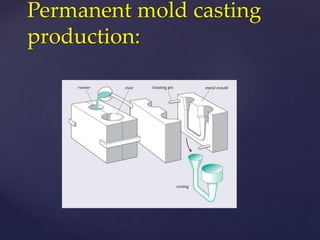
 This is made into two halves in order to facilitate the removal
of casting from the mold .
 This is designed with horizontal or vertical parting line like as
in sand molds .
 Pouring cup , sprue, gates and riser are built in the mold halves
itself.
 The two mold halves are securely clamped together before
pouring.
 Cores for this type of casting used is metal
generally or dry sand.
 For facilitating the removal of metal cores ,
surfaces should have a draft of at least 3 to 5
degrees.
 Molds using dry sand cores or shell cores are
known as semi- permanent molds.
 Dry sand cores positioned and supported in
core prints.
Cores for permanent molds
 This coating is nothing but refractory coating.
 After the mold surfaces have been heated to the
required temperature , a refractory coating is
sprayed on the mold cavity .
Chills:
A chill is used to promote directional solidification.
These are mostly pieces of Cu , Brass or Aluminium and
are inserted into the mold’s inner surface .
Coatings:
Permanent mold casting
production:
 Carburetor bodies
 Hydraulic brake cylinders
 Refrigeration castings
 Oil pump bodies
 Aircraft and missile castings
Applications:
Gravity die casting

Gravity die casting

  • 1.
    { Presentation on Gravity DieCasting Presentation By- Saliganti Shiva Kumar M.Tech-1st Year FFT (2018-20) NIFFT Ranchi
  • 2.
    INTRODUCTION: Gravity die casting(or) Permanent mold casting uses mold which is permanent . Molten Metal is poured into mold under gravity only, no other pressure is applied to pour the molten metal . However liquid metal solidifies under pressure of metal in the risers .
  • 3.
    Permanent molds:  Theseare made of dense, fine grained, heat resistant cast iron, steel, bronze, aluminium , graphite or other suitable refractories.  This is made into two halves in order to facilitate the removal of casting from the mold .  This is designed with horizontal or vertical parting line like as in sand molds .  Pouring cup , sprue, gates and riser are built in the mold halves itself.  The two mold halves are securely clamped together before pouring.
  • 4.
     Cores forthis type of casting used is metal generally or dry sand.  For facilitating the removal of metal cores , surfaces should have a draft of at least 3 to 5 degrees.  Molds using dry sand cores or shell cores are known as semi- permanent molds.  Dry sand cores positioned and supported in core prints. Cores for permanent molds
  • 5.
     This coatingis nothing but refractory coating.  After the mold surfaces have been heated to the required temperature , a refractory coating is sprayed on the mold cavity . Chills: A chill is used to promote directional solidification. These are mostly pieces of Cu , Brass or Aluminium and are inserted into the mold’s inner surface . Coatings:
  • 6.
  • 7.
     Carburetor bodies Hydraulic brake cylinders  Refrigeration castings  Oil pump bodies  Aircraft and missile castings Applications: