BY ANJU D
I MDS
DEPT OF PROSTHODONTICS
1
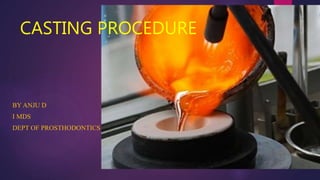
CASTING PROCEDURE
Contents
 HISTORY
 DEFINITIONS
 BASIC STEPS OF CASTING PROCEDURE
 FABRICATION OF WAX PATTERN
 SPRUING
 SPRUE FORMER AND ITS ATTACHMENT
 CASTING RINGS AND LINERS
 CASTING MACHINES
2
 INVESTING PROCEDURE
 CASTING PROCEDURE
 RECOVERY AND FINISHING OF CASTING
 SPECIAL CASTING SITUATIONS
 CASTING DEFECTS
 RULES OF CASTING
 CONCLUSION
 REFERENCE
3
4
INTRODUCTION
HISTORY
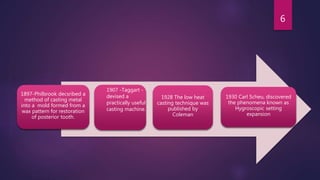
3000 B.C- Copper
was cast by
Mesopotomians.
2500 B.C -Dental
prosthesis
fabricated from
gold wire was
found in egypt.
500 B.C- Etruscans
made bridges of
soldered gold
bands.
1571- Benvenuto
cellini has done
casting of both
gold and bronze
5
1928 The low heat
casting technique was
published by
Coleman
1930 Carl Scheu, discovered
the phenomena known as
Hygroscopic setting
expansion
1897-Philbrook decsribed a
method of casting metal
into a mold formed from a
wax pattern for restoration
of posterior tooth.
1907 -Taggart -
devised a
practically useful
casting machine.
6
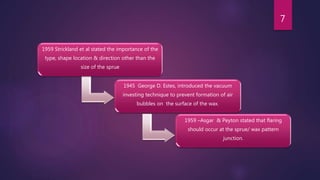
1959 Strickland et al stated the importance of the
type, shape location & direction other than the
size of the sprue
1945 George D. Estes, introduced the vacuum
investing technique to prevent formation of air
bubbles on the surface of the wax.
1959 –Asgar & Peyton stated that flaring
should occur at the sprue/ wax pattern
junction.
7
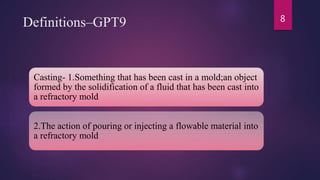
Definitions–GPT9
Casting- 1.Something that has been cast in a mold;an object
formed by the solidification of a fluid that has been cast into
a refractory mold
2.The action of pouring or injecting a flowable material into
a refractory mold
8
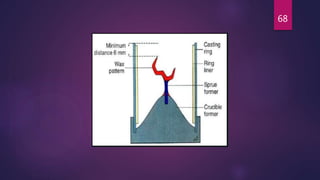
Casting Ring: A metal or silicone tube in which a refractory mold is
made for casting dental restorations
Crucible : A vessel or container made of any refractory material
(frequently ceramics) used for melting or calcining any substance that
requires a high degree of heat
Crucible Former : The base to which a sprue former is attached
while the wax pattern is being invested in refractory investment; a
convex rubber, plastic, or metal base that forms a concave depression
or crucible in the refractory investment
9
Sprue: 1. The channel or hole through which plastic or metal is
poured or cast into a gate or reservoir and then into a mold;
2. The cast metal or plastic that connects a casting to the residual sprue
button
Sprue button: The excess material remaining at the base of the mold
after a dental casting
Sprue former: A wax, plastic, or metal pattern used to form the
channel or channels allowing molten metal to flow into a mold to
make a casting
10
Objectives of casting
1) To heat the alloy as quickly as possible to a
completely molten condition.
2) To prevent oxidation by heating the metal with
a well adjusted torch
3) To produce a casting with sharp details by
having adequate pressure to the well melted metal
to force into the mold.
11
Sequence of casting
Wax pattern
fabrication
Spruing Investing Burnout
Placement in casting
machine
CastingDivesting
Cleaning and
polishing of casted
restoration
12
Fabrication of wax pattern
13
Precursor of the finished cast restoration
Requirements of a good inlay wax:
• 1. It must flow readily when heated, without chipping, flaking or losing its
smoothness.
• 2. When cooled, it must be rigid.
• 3. It must be capable of being carved precisely, without chipping, distorting
or smearing.
14
Wax pattern-GPT 9: A wax form that is the positive likeness of an
object to be fabricated
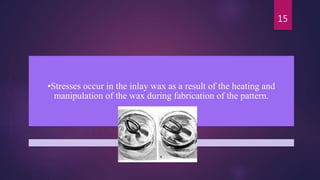
•Stresses occur in the inlay wax as a result of the heating and
manipulation of the wax during fabrication of the pattern.
15
16
•Patterns should never be left off the die.
•Invested as soon as possible after
fabrication.
2 TECHNIQUES 17
DIRECT METHOD: INDIRECT METHOD:
Type II inlay wax(soft)
Done on die
Type I inlay wax(soft)
Done in mouth itself
The wax pattern in indirect method can be constructed by
1. Dipping method.
2. Addition method.
3. Molten press
method.
4. Injection method
18
1. Dipping method:
. A thin, uniform and adapted layer of wax on the die.
. By dipping the die into wax that has been thoroughly melted
19
Addition method:
 By melting the wax and dropping on the die
 Using a heated wax instrument
 Done until complete building of the pattern
 Carved by sharp carver.
Drawback : Stress collected from multiple addition of wax
tends to release with time.
20
Different types of waxes used:-
 Special wax for electrical wax heating unit (vario therm),
 Dark blue - Hard and Light blue soft - modelling,
trimming and dipping application
 Lilac-medium hard , red - stress free for cervical margins,
 Green wax-hard for trimming.
 Dip application yellow wax of uniform strength
21
Die spacer
 Provide relief space for cement.
 Applied within 0.5mm of the preparation finish line to
provide relief for the cement luting agent.
Example- resins (most commonly used)
 - model paint
 - colored nail polish
 - thermoplastic polymers dissolved in volatile solvents.
22
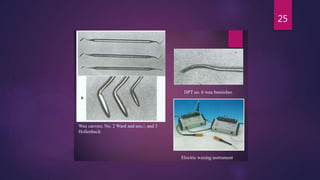
WAX INSTRUMENTS
 P.K.T No.1 and 2 -Wax addition instruments
 P.K.T No.3 -Burnisher
 P.K.T No.4 and 5 -Wax carvers
23
24
25
Electric Wax Instruments
 Advantages:
1) Precise temp control of the wax for proper manipulation.
2) Time saving
3) Carbon buildup minimum.
26
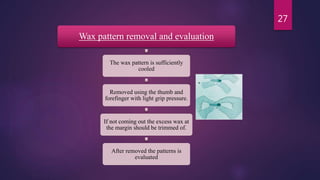
Wax pattern removal and evaluation
The wax pattern is sufficiently
cooled
Removed using the thumb and
forefinger with light grip pressure.
If not coming out the excess wax at
the margin should be trimmed of.
After removed the patterns is
evaluated
27
28
Sprue
Definition: It’s a channel through which molten alloy can reach the
mold in an invested ring after the wax has been eliminated
Role of a sprue :
.Holds the wax pattern to avoid distortion.
.Creates a channel to allow the molten wax to escape from the mold.
.Enables the molten alloy to flow into the mold
29
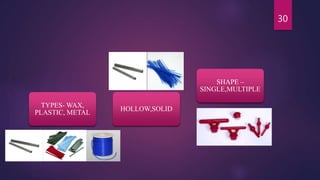
TYPES- WAX,
PLASTIC, METAL
HOLLOW,SOLID
SHAPE –
SINGLE,MULTIPLE
30
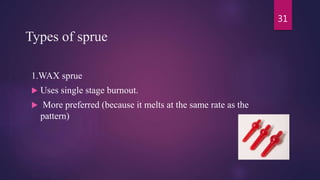
Types of sprue
1.WAX sprue
 Uses single stage burnout.
 More preferred (because it melts at the same rate as the
pattern)
31
Plastic sprues
 In 2 stage burn out
 With Phosphate bonded investment.
 Its softening temperature is higher than wax pattern,may
block escape of wax.
 Undergo expansion before softening
 Used for casting FPD’s because of their high rigidity,
which minimizes distortion.
 May be completely solid (or) hollow plastic,prefabricated
or self made.
32
2 stage burnout
 30 min heat soak @ 8000F
 Oven preheated to this temp burnout for 30min
 Continue burnout @ desired temp
33
Metal sprue
 Should be a non-rust metal
 Hollow metallic sprue contact surface area
 Strengthen the attachment between the sprue and pattern.
 Removed from the investment at the same time as the
crucible former.
34
Advantages of hollow sprue former
 Increases the contact area
 Holds less heat
35
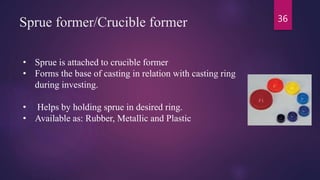
Sprue former/Crucible former
• Sprue is attached to crucible former
• Forms the base of casting in relation with casting ring
during investing.
• Helps by holding sprue in desired ring.
• Available as: Rubber, Metallic and Plastic
36
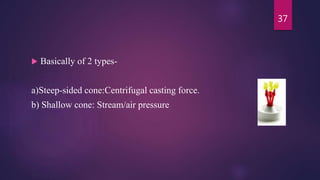
 Basically of 2 types-
a)Steep-sided cone:Centrifugal casting force.
b) Shallow cone: Stream/air pressure
37
Spruing
The process of attaching a sprue former/sprue pin to the
wax pattern is called as spruing
Purpose: To provide a channel through which molten alloy
can reach the mold in an invested ring after the wax has
been eliminated..
38
Sprue former diameter
 Depends on: -
 The type and size of the pattern.
 Type of casting machine used.
 The dimensions of the casting rings in which casting is
made.
39
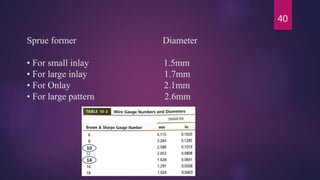
Sprue former Diameter
• For small inlay 1.5mm
• For large inlay 1.7mm
• For Onlay 2.1mm
• For large pattern 2.6mm
40
 Molar around 2.5 mm ( 10 gauge), premolar 2 mm (12
gauge)
 Pre fabricated sprue former are available of gauge from 6
to 18.
 Diameter should be equal to the thickest portion the wax
pattern.
41
Large diameter sprue: Improves the flow of molten metal into
the mould.
Less diameter sprue: Causes localized shrinkage porosity
42
 A narrow sprue may be useful in air pressure casting
procedure where the metal is melted in conical depression
formed by crucible former.
43
 Very short sprue : Porosity in casting at the junction of
sprue and pattern.
 Very long sprue : Sprue solidifies first leading to casting
shrinkage and incomplete casting
44
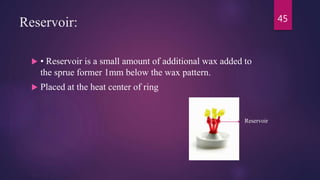
Reservoir:
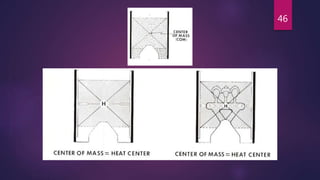
 • Reservoir is a small amount of additional wax added to
the sprue former 1mm below the wax pattern.
 Placed at the heat center of ring
45
Reservoir
46
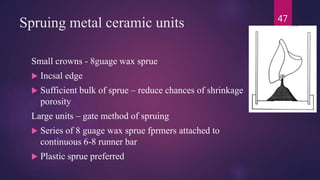
Spruing metal ceramic units
Small crowns - 8guage wax sprue
 Incsal edge
 Sufficient bulk of sprue – reduce chances of shrinkage
porosity
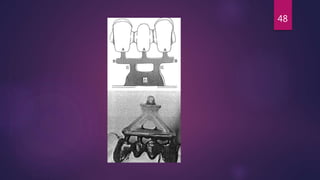
Large units – gate method of spruing
 Series of 8 guage wax sprue fprmers attached to
continuous 6-8 runner bar
 Plastic sprue preferred
47
48
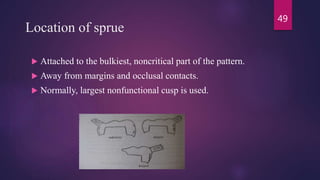
Location of sprue
 Attached to the bulkiest, noncritical part of the pattern.
 Away from margins and occlusal contacts.
 Normally, largest nonfunctional cusp is used.
49
 Full veneer crown - Maxillary buccal and mandibular
lingual cusp.
 Partial veneer crown - Cusp that encompasses the
preparation.
Attached to cusp tips near margins
Distortion and restriction of flow of molten metal
50
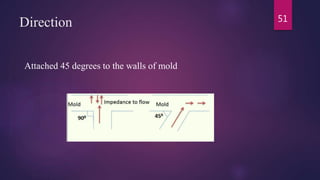
Direction
Attached 45 degrees to the walls of mold
51
 The attachment should be smooth
 Do not posses pits or irregularities.
 Irregularities tags of investment fracture by
molten alloy casting failure.
52
Types of attachment
Direct In direct
53
54
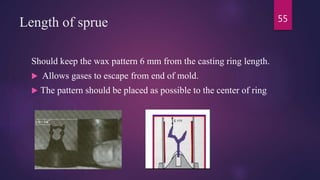
Length of sprue
Should keep the wax pattern 6 mm from the casting ring length.
 Allows gases to escape from end of mold.
 The pattern should be placed as possible to the center of ring
55
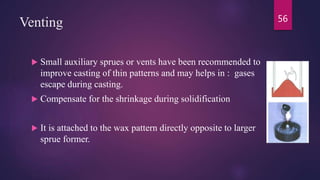
Venting
 Small auxiliary sprues or vents have been recommended to
improve casting of thin patterns and may helps in : gases
escape during casting.
 Compensate for the shrinkage during solidification
 It is attached to the wax pattern directly opposite to larger
sprue former.
56
57
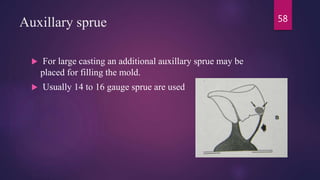
Auxillary sprue
 For large casting an additional auxillary sprue may be
placed for filling the mold.
 Usually 14 to 16 gauge sprue are used
58
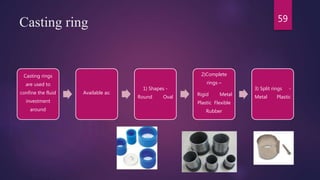
Casting ring
Casting rings
are used to
confine the fluid
investment
around
Available as:
1) Shapes -
Round Oval
2)Complete
rings –
Rigid Metal
Plastic Flexible
Rubber
3) Split rings -
Metal Plastic
59
1)Internal diameter of casting ring should be 5-10mm greater
than the widest measurement of the pattern
About 6 mm higher.
2) For single crown/inlay - small rings as used. Diameter -
32 mm
3) For large fixed partial denture – 63mm round/oval shaped
casting ring are used
60
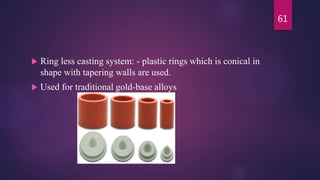
 Ring less casting system: - plastic rings which is conical in
shape with tapering walls are used.
 Used for traditional gold-base alloys
61
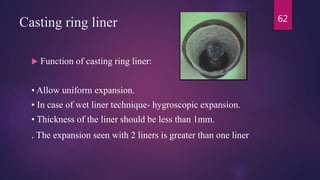
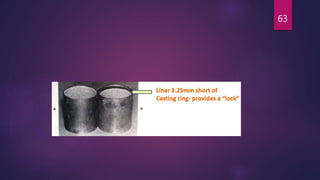
Casting ring liner
 Function of casting ring liner:
• Allow uniform expansion.
• In case of wet liner technique- hygroscopic expansion.
• Thickness of the liner should be less than 1mm.
. The expansion seen with 2 liners is greater than one liner
62
63
Materials
used are: -
Asbestos
liner
Cellulose
liner
Ceramic
liner
Combination of
ceramic and
cellulose liner
64
Preparation of wax pattern
 The wax pattern should be cleaned of any debris, grease,
or oils.
 A commercial pattern cleaner or a diluted synthetic
detergent is used.
65
 Cleaning the debris is followed by the application of
Debubblizer.
 Debubblizer :
Citric acid
Sodium 2-phenylpropane-2-sulfonate
Propane-1,2-diol - also known as propylene glycol
66
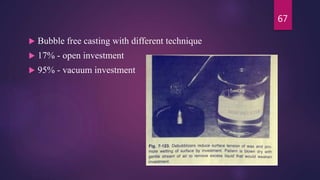
 Bubble free casting with different technique
 17% - open investment
 95% - vacuum investment
67
68
Investing the Wax pattern
69
Investing procedure
 Investing is the process by which the sprued wax pattern
is embedded in a material called an investment.
An Investment must fulfill these requirements:
 Precise reproduction of wax pattern.
 Sufficient strength to withstand burnout and casting.
 Sufficiently porous to allow escape of gases.
 Expand enough to compensate solidification shrinkage of
alloy.
70
3 types of investments materials available:
 Gypsum bonded investments:
• For conventional casting of gold alloy inlays, • Onlays,
crowns & FPD’s.
 Phosphate bonded investments:
• For metal ceramic restorations
• Pressable ceramics & for base metal alloys.
 Ethyl- silicate bonded investments:
. For casting of removable partial dentures with base metal
alloy.
71
Technique
Hand
mixing
Vacuum
mixing
72
 After the casting ring has been filled with investment material,
any excess should be removed before the material sets
 The filled ring is now set aside to allow the investment
material to complete its setting reaction & the accompanying
setting expansion.
73
 GRINDING THE INVESTMENT
 • Carefully Grinding(on a model trimmer) or scraping the
shiny skin off the end of the investment just prior to burn
out.
 • Removes the impervious layer, opening the pores of the
investment and facilitating gas release as the alloy is cast
into the mold.
74
 3mm on each end is left as it serves to lock the investment
within the ring & equalize radial & axial expansion
 Setting is complete in 30-40min.
 Hygroscopic technique is used. - Freshly filled
investment ring is immediately placed into water bath for
30min. & kept at 100ºF(38ºC).
 If burnout is not carried within 1-2hrs, the ring should be
stored in a humidor at 100% humidity, not soaked in water
since excessive hygroscopic expansion may result
75
Four mechanisms to produce mold expansion:
 Setting Expansion of Investment
 Hygroscopic Expansion
 Wax Pattern Expansion
 Thermal Expansion
76
 Setting Expansion : Result of normal gypsum crystal
growth in air.
 About 0.4% but partly restricted by metal investment ring.
 Hygroscopic Expansion : Max expansion ,water bath at
38°C.
 Water in bath replaces water used by hydration process
 Space between growing crystals is maintained
 Crystals grow longer outward expansion of mold.
 About 1.2 to 2.2% max with expandable ring.
77
 When the investment has set, the "skin" at the top of the
ring is trimmed off.
 •The rubber crucible former is removed, and any loose
particles of investment are blown off.
 •The ring is then placed in the furnace for the
recommended burnout schedule
78
Thermal Expansion : Investment is heated in burnout oven.
79
Burnout procedure
 Once the investment has set for an appropriate period
45min,ready for burnout.
 Crucible former is then carefully removed
 It is advisable to begin the burnout procedure while the
mold is still wet, because water trapped in the pores of
investment reduces the absorption of wax & as water
vaporizes, it flushes wax from mold.
80
 Wax elimination or burnout consists of heating the
investment in a thermostatically controlled furnace until all
traces of the wax are vaporized.
 Once the investment is heated during the wax elimination
procedure, heating must be continued, and casting must be
completed.
81
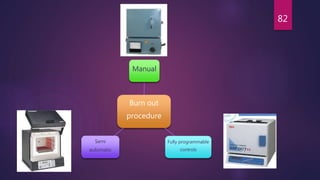
Burn out
procedure
Manual
Fully programmable
controls
Semi
automatic
82
 Heating of ring should be done slowly.
 - Hygroscopic low-heat technique
 - High-heat thermal expansion technique
83
Hygroscopic low-heat technique
 • The temperature used is 500°c for 60-90 mins.
 • Obtain compensation expansion from three sources:
 1. Immersion of investment in 37°c water bath.
 2. The warm water entering the investment mold from the
top adds some of the expansion.
 3. The thermal expansion at 500°c
• This technique causes 0.55% of expansion.
84
 Standardized hygroscopic technique was developed for
alloys with high gold content; the newer noble alloy may
require slightly more expansion. This added expansion
may be obtained by making 1 or more of following
changes.
 1. Increasing water bath temperature to 40°C.
 2. Using two layers of liners.
 3. Increasing burnout temperature to a range of 600°C to
650°C.
85
High-heat thermal expansion technique
 Gypsum bonded Investment :
 • The investment is slowly heated to 650°c - 700°c in
60mins.
 Maintained for 15-30 mins at this temperature.
 Above 700°c sulfur dioxide - Contaminates gold castings
and makes them extremely brittle
86
Phosphate bonded investment :
 • They need higher 2nd stage temperature for total
elimination of wax and revent premature solidification of
higher melting alloys.
 • After initial slow raise of temp to 315°c, the temperature
is rapidly raised to 750-900°C and maintained for 30 mins.
 • The technique cause 1.33-1.58 % of thermal expansion
87
 Ethyl silicate bonded investment- 1090 degree c
88
 Accelerated casting method (J Prost dent. 66: 155,1991)
• To reduce the total time, Alternative Accelerated casting
technique is proposed that uses phosphate bonded investment
which sets in 15 mins and then 15 min burn out is done at
815°c.
• This method is used for preparing post and core restorations
89
 HEAT SOURCES: two basic modes
• Torch flame Gas air torch
 Gas oxygen torch
 Oxy acetylene torch
 Hydrogen oxygen generator
• Electricity
90
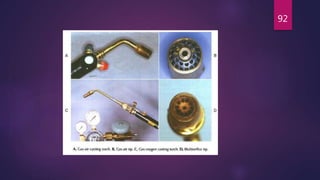
 Two type of torch tips:
 1. Multi-orifice
 2. Single-orifice
91
92
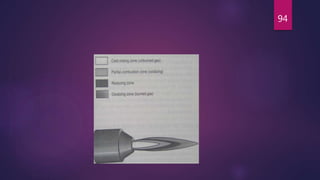
 Zones of the blow touch flame:
 • Zone 1 - colorless zone
 • Zone 2 – Combustion zone
 • Zone 3 - Reducing zone
 • Zone 4 - oxidizing zone
93
94
 During melting of the gold alloys flux may be added-
.To minimizing porosity
.To increase fusing of metal
.Prevent oxidation
• Commonly used fluxes are fused borax powder ground with
boric acid power,Charcoal
95
 Gas air torch:
• To melt conventional noble metal alloys (used for inlays,
crown and bridge) whose melting points less than 1000°c
Alloy should be approx. 38°C to 66°C above liquidus
temperature
Alloy will become
Red Orange
White
(dull)
White
(Mirror-
like)
96
 Gas–oxygen torch:
 Used to melt metal ceramic alloys of higher temperature
up to 1200°c.
 The tip of torch is available as single orifice/multiorifice.
 The oxygen pressure is adjusted to1015 psi.
 The flame is directed onto metal with the nozzle of the
torch about 1.5 cm away from the metal.
 Complete fluid should be obtained within 30 second at
which point the metal is poured into the mould.
97
 Oxy-acetylene torch :
 The actual production of flame can be done by adjusting
the pressure and flow of individual gases .
 commonly advised pressure for acetylene nozzle is 3.5
N/cm2 and oxygen nozzle 7-10 N/cm2
 one part of acetylene + 2 and half part of oxygen
98
 The best results are obtained when flame is used with a distance of 10cm
between the face of blow torch nozzle and the base of crucible.
 If distance is reduced to -7.5 mm slight porosity
- 5 mm increased porosity due to occluded H2 gas
99
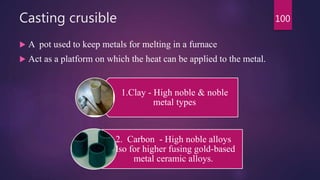
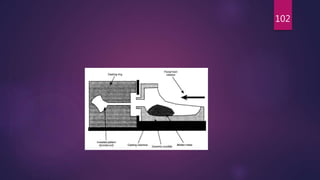
Casting crusible
 A pot used to keep metals for melting in a furnace
 Act as a platform on which the heat can be applied to the metal.
1.Clay - High noble & noble
metal types
2. Carbon - High noble alloys
also for higher fusing gold-based
metal ceramic alloys.
100
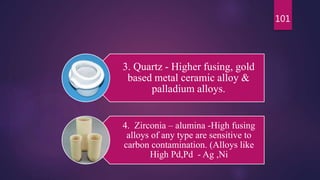
3. Quartz - Higher fusing, gold
based metal ceramic alloy &
palladium alloys.
4. Zirconia – alumina -High fusing
alloys of any type are sensitive to
carbon contamination. (Alloys like
High Pd,Pd - Ag ,Ni
101
102
 The crucibles used with noble metal alloys should not be
used for melting base metal alloy
 Discarded if it contains large amount of oxides and
contaminants from previous metals
103
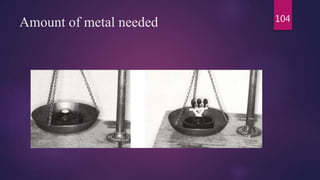
Amount of metal needed 104
•Sufficient mass of alloy must be present to
sustain adequate casting pressure –
6gm is typically adequate for premolar and
anterior casting
10gm is adequate for molar casting
12 g is adequate for pontic
105
Casting machines 106
The modern dental casting machines came into
existence only in the year of 1907 when Taggart
introduced the pressure-casting machine .
Air
pressure
casting
machine.
Torch melting
/Centrifugal
casting
machine.
Electrical
resistance–
heated casting
machine.
Induction
melting
casting
machine.
Vacuum or
pressure
assisted
casting
machine.
Direct-current
arc melting
machine
107
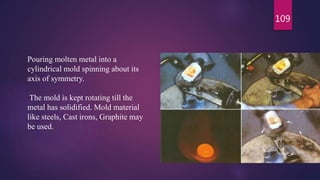
Centrifugal casting machine
 Make use of centrifugal force to thrust the liquid metal
into the mold.
 Centrifugal casting is a method of casting parts having
axial symmetry.
108
109
Pouring molten metal into a
cylindrical mold spinning about its
axis of symmetry.
The mold is kept rotating till the
metal has solidified. Mold material
like steels, Cast irons, Graphite may
be used.
Air Pressure casting machine
 Alloy is melted in the hollow left by the crucible former by
torch flame and then air pressure is applied through a
piston.
 Carbon dioxide, carbon monoxide or nitrogen gas can be
used.
 Pressure of 10-15 psi is usually applied.
110
111
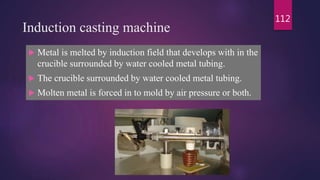
Induction casting machine
 Metal is melted by induction field that develops with in the
crucible surrounded by water cooled metal tubing.
 The crucible surrounded by water cooled metal tubing.
 Molten metal is forced in to mold by air pressure or both.
112
 The electric induction furnace is a transformer in which an
alternating current flows through the primary winding coil
and generates a variable magnetic field in the location of
the alloy to be melted in a crucible
 • It is more commonly used for melting base metal alloys
not been used for noble alloy casting as much as other
machines
113
Direct current arc melting machine
 The alloy is vacuum melted & cast by pressure in an argon
atmosphere.
 Direct current arc is produced between 2 electrodes Alloy
& water cooled tungsten electrode.
 The temperature within the arc exceeds 4000 ˚c, the alloy
melts very quickly. Disadvantage- alloy can become
overheated
114
115
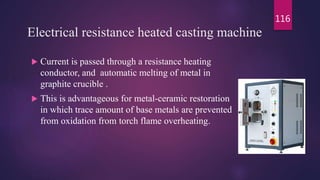
Electrical resistance heated casting machine
 Current is passed through a resistance heating
conductor, and automatic melting of metal in
graphite crucible .
 This is advantageous for metal-ceramic restoration
in which trace amount of base metals are prevented
from oxidation from torch flame overheating.
116
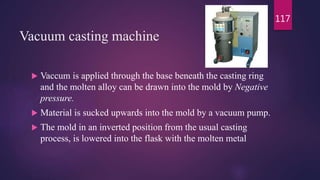
Vacuum casting machine
 Vaccum is applied through the base beneath the casting ring
and the molten alloy can be drawn into the mold by Negative
pressure.
 Material is sucked upwards into the mold by a vacuum pump.
 The mold in an inverted position from the usual casting
process, is lowered into the flask with the molten metal
117
Other methods of fabrication of restoration
 CAPTEK
 Electroforming
 CAD/CAM
 Copy milling
 Electrical discharge machine
 3Dprinting(additive fabrication)
118
Casting force:
 • Casting force > Surface tension of alloy + Resistance
offered by gas in the mold.
 • This can be done by use of following different type of
force • Vacuum force • Air or Gas Pressure • Centrifugal
force
119
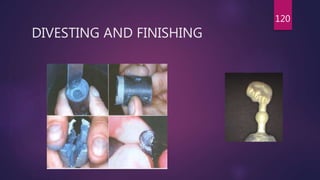
DIVESTING AND FINISHING
120
Quenching
 After casting has been completed, ring is removed &
quenched in water.
Advantages:
 1. Noble metal is left in an annealed enables
burnishing & Polishing.
 2. When water contacts hot investment becomes soft,
granular & casting is more easily cleaned
121
Recovery of casting from investment
 Care must be taken to avoid damaging the margin
122
A.Trimming is
done from the
bottom end of
the ring.
B. Investment is
being pushed
out of the
casting ring.
C.The mold is
broken open.
D.Investment is
removed from
the casting.
Sandblasting
 The casting is held in a sandblasting machine to clean the
remaining investment from its surface.
123
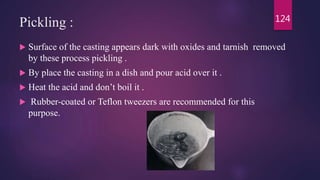
Pickling :
 Surface of the casting appears dark with oxides and tarnish removed
by these process pickling .
 By place the casting in a dish and pour acid over it .
 Heat the acid and don’t boil it .
 Rubber-coated or Teflon tweezers are recommended for this
purpose.
124
Type of acids :
 Hydrochloric acid(50%)
 Sulfuric acid (50%)
 Ultrasonic devices
 AQUA REGIA : Hcl + Nitric acid (1:3)
Gold and palladium based metal ceramic alloys and base
metals, these alloys are not generally pickled.
125
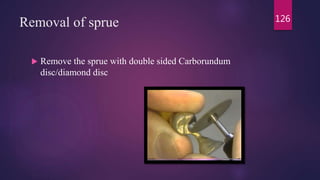
Removal of sprue
 Remove the sprue with double sided Carborundum
disc/diamond disc
126
Finishing
Done to remove small irregularities on the surface
 Fitting surface- Blebs(Extrusions) removed using sharp
chisel or finishing bur
 External surface- Carbide trimming burs
 Try Casting on the die- Look for the Rocking movement
 Marginal Burnishability- To protect friable enamel at the
margins Sliding lap joint at gingival cavosurface margin
127
128
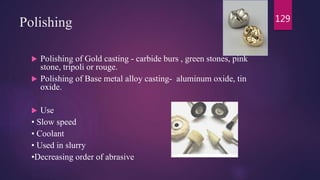
Polishing
 Polishing of Gold casting - carbide burs , green stones, pink
stone, tripoli or rouge.
 Polishing of Base metal alloy casting- aluminum oxide, tin
oxide.
 Use
• Slow speed
• Coolant
• Used in slurry
•Decreasing order of abrasive
129
CASTING IN SPECIAL SITUATIONS
130
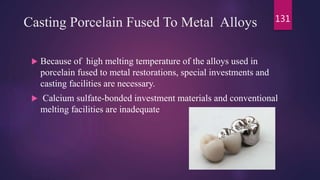
Casting Porcelain Fused To Metal Alloys
 Because of high melting temperature of the alloys used in
porcelain fused to metal restorations, special investments and
casting facilities are necessary.
 Calcium sulfate-bonded investment materials and conventional
melting facilities are inadequate
131
 Proper spruing for escape of gas.The bar type of spruing
used for casting these alloys
 Disadvantage of the bar type of sprue - increased amount
of alloy required to make castings
 So bar type is not used to make castings of alloys with low
melting ranges and gypsum-bonded investment
132
 Other steps in the investing and casting procedure include
 Vacuum investing,
 Careful wax elimination,
 A gas-oxygen torch or other high- temperature melting
facility,
 Centrifugal casting with adequate casting pressure
133
Casting Co-Cr and Ni-Cr Alloys and Partial
Denture Frameworks
 High freezing temperatures of base nmetal
alloys, more shrinkage of the alloy must be
compensated
 The extra compensation can be obtained by
(1) Painting a die spacer (varnish) on the die, but
short of the margins, before preparing the
wax pattern
(2) Using two layers of ceramic paper liner in
the investing ring
134
 In CPD construction, a suitable cast of refractory material
is used
 A gypsum-bonded investment is used when a low-fusion
point (<13000 C liquidus) alloy is used
 But a phosphate or silica bonded investment is used with
high-fusing point alloys (>13000C solidus)
135
 Variables such as mold temperature, temperature of the molten
alloy, and the sprue size and arrangement affect the properties
of the finished casting as much as does the composition.
 Therefore, Co-Cr and Ni-Cr alloys are generally considered
technique-sensitive
 Careful control of manipulative variables in the casting
operations is therefore essential.
136
 The alloy melting temperature is an important factor in the
selection and control of the melting and casting equipment
and in the choice of technique and mold equipment used
for the casting of base-metal alloys.
 Only a base-metal alloy that melts below 13000 C can be
cast into a calcium sulfate-bonded investment.
137
 Special electric or induction melting facilities or, less
commonly with an oxygen-acetylene torch
 Some investments for cast base-metal alloys lack sufficient
porosity for the rapid escape of gases from the mold cavity
when the hot metal enters.
 Gases may therefore be trapped in the mold cavity and
produce voids and casting defects.
138
 Methods such as venting to the surface of the mold to
permit rapid elimination of gases
 When properly designed and cast, the cast base-metal
alloys give acceptable removable partial-denture
restorations.
139
Casting Titanium
 Titanium is difficult to cast in comparison with the common dental
casting alloys because it requires relatively complex and expensive
equipment.
 Two problems in casting titanium
1. Its high melting point
2. The tendency for the molten metal to become contaminated.
3. Low density
The MP of commercially pure titanium is 16710 C
140
 To prevent absorption of gases, titanium is cast under the
protective atmosphere of argon or in a vacuum.
 To achieve the high melting temperatures, arc melting in
either graphite or water-cooled copper crucibles is used.
 The casting systems force the metal into the mold using
either pressure or centrifugal casting techniques.
141
142
 A wax pattern is prepared and sprued, as before, but here
only the more temperature resistant investments can be
used.
 Both phosphate bonded , silica and magnesia investments
produce good castings
143
CASTING DEFECTS
144
 Any imperfections or irregularities that result in
unsuccessful casting which interferes with the fit of final
restoration or its esthetic and mechanical properties.
145
CLASSIFICATION
According to Anusavice
 Distortion
 Surface roughness and irregularities
 Porosity
 Incomplete or missing details
 Based on location
 Internal
 External
146
 According to Rosensteil
 Roughness
 Nodules
 Fins
 Incompleteness
 Voids or porosity
 Marginal discrepancy
 Dimensional inaccuracies
147
Distortion
 Related to distortion of the wax pattern. Causes:
 Can occur from the time of wax pattern preparation to the
time of investing due to stress relaxation.
 During the investment procedure.
148
Minimized by:
 Application of minimum pressure
 Manipulation of wax at high temperature
 Investing pattern immediately
 If storage is necessary, store in refrigerator
149
Discoloration
 Over-heating: Attracts oxides
 Under-heating: Incomplete wax elimination
 Carbon Inclusions: Crucible/Investment
 Mixture of Alloys: Re-use of Sprue and button
 Mercury Contamination
 Solder
150
Surface roughness & Surface irregularities
 Relatively finely spaced surface imperfections whose
height, width and direction establish the predominant
surface pattern.
 Isolated imperfections such as nodules that are not
characteristic of the entire surface area
 Greater than the wax pattern - the particle size of the
investment and -its ability to reproduce the pattern in
microscopic detail
151
Air bubbles
 Small nodules on the casting are caused by air bubbles,
that become attached to the surface during or subsequent
to the investing procedure.
 Prevented By:
 Proper investment technique
 Vibration of mix or by vacuum mixing
 Application of wetting agent properly and correctly –
important that it be applied in a thin layer.
152
Water films
 Wax is repellent to water, & If the Investment becomes
separated from the wax pattern, a water film may form
irregularly over the surface.
 Appears as minute ridges or veins on the surface.
 Prevented By: 1.Use of wetting agent
2.Correct L/P ratio (Too high L/P ratio
may produce these irregularAities)
153
Rapid heating rates
 It produces Fins or spines on the casting
 Cause: because of flaking of the investment
Prevented by:
 Heat gradually at least 60min from room temperature to
700 c.
 Greater the bulk – more slowly heated
154
Under heating
 Incomplete elimination of wax residue
 This factor is mainly important for low heat technique.
155
Prolonged heating
 Decomposition or disintegration of the investment & the
walls of the mold are roughened.
 Product of decomposition are sulphour compounds-
contaminates the casting - Why the surface of the casting
does not respond to pickling sometimes
Prevented by-
Thermal expansion technique - the mold should be heated to
the casting temperature & Never higher
156
Liquid/Powder Ratio
 The amount of water and powder measure should be
accurate.
 Too little water- investment too thick & cannot be applied
to the wax pattern
 Too much water- making investment easier but reproduces
poor casting.
machine.
157
Casting pressure
 To high pressure – rough surface of the casting
 To low pressure – incomplete casting
 Average – 0.10 to 0.14 Mpa in an air pressure machine
and - 3 to 4 turns of the spring in centrifugal casting
158
 Foreign bodies
 Shows sharp, well defined deficiencies
 May be: -
Pieces of the investment
Bits of the carbon from the flux
Sulfur components from
Decomposition of the gypsum investment
High sulfur content torch flame
159
Pattern position
 Should not place too close together
 Should not place many patterns in same plane
 Space between the pattern is atleast 3mm
160
Impact of metal alloy
Cause:
 Direct impact of molten alloy on the weak portion of the
mold surface, may fracture or abrade the mold surface
regardless of its bulk.
Prevented by:
 Proper spruing.
 Placement of sprue at 45 degree
161
Carbon inclusions
 Carbon from carbon crucible, carbon containing
investment, improperly adjusted torch - absorbed by the
alloys during casting – Carbides ,Carbon inclusions
162
Porosity
 Classified as follows:
I. Solidification defects
A. localized shrinkage porosity
B. B. Micro porosity
II. Trapped gases
A. pin hole porosity
B. gas inclusion porosity
C. sub surface porosity
III. Residual air
163
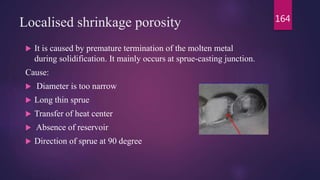
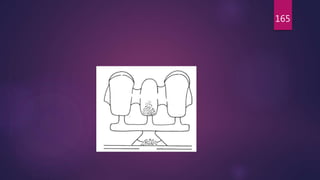
Localised shrinkage porosity
 It is caused by premature termination of the molten metal
during solidification. It mainly occurs at sprue-casting junction.
Cause:
 Diameter is too narrow
 Long thin sprue
 Transfer of heat center
 Absence of reservoir
 Direction of sprue at 90 degree
164
165
Prevented by
 Using sprue of correct thickness
 Attach sprue to the thickest portion of the wax pattern
 Flaring the sprue at the point of attachment
 Placing reservoir close to the attachment
166
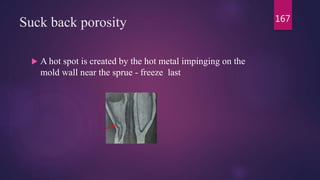
Suck back porosity
 A hot spot is created by the hot metal impinging on the
mold wall near the sprue - freeze last
167
 Often occurs at occlusoaxial or incisoaxial line angle
PREVENTED BY
 Flaring the point of sprue attachment
 Reducing the temperature between the mold & molten alloy
 Sprue placed at 45 degree
168
Pin hole or gas inclusion porossity
 Spherical contour
 Gas inclusion porosities are much larger than pin hole
porosity.
Causes
 Metals dissolve gases when molten, expelled during
solidification.
Eg- copper & silver dissolves oxygen platinum & palladium
dissolves hydrogen
169
 Gas occluded from a poorly adjusted torch flame
 Use of oxidizing zone rather than reducing zone.
 Casting is usually black, do not clean easily on pickling
Can be reduced not avoided
170
Sub surface porosity
Causes
 Simultaneous nucleation of solid grains and gas bubbles at
the first moment that the alloy freezes at mold walls
Prevented by
 Controlling the rate at which the molten metal enters the
mold.
171
Back pressure porosity
 Some times referred to as entrapped-air porosity.
 Outer surface of the casting
 When the casting or mold temperature is low
 Solidification occurs before the trapped air can escape.
172
 Causes
Inability of the air in the mold to escape through the pores in
the investment
 Prevented by:
Proper burnout
Sufficiently high casting pressure
Adequate L/P ratio
Thickness of investment between tip of pattern and end of
ring is not greater than 6mm.
173
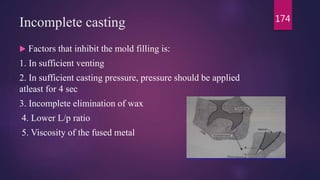
Incomplete casting
 Factors that inhibit the mold filling is:
1. In sufficient venting
2. In sufficient casting pressure, pressure should be applied
atleast for 4 sec
3. Incomplete elimination of wax
4. Lower L/p ratio
5. Viscosity of the fused metal
174
Casting is both an art and science governed by numerous rules, or
“laws”.
 • Based on earlier work of Ingersoll & Wandling (1986), W.
Patrick Naylor formulated an expanded set of 17 separate
recommendations for Spruing, investing, burnout, and melting
and casting procedures.
 • Collectively these guidelines are referred to as the laws of
casting.
175
RULES OF CASTING
1. Attach the pattern sprue former to the thickest part of thr
wax pattern
2. Orient wax patterns so all the restoration margins will
face the trailing edge when the ring is placed in the
casting machine
3. Position the wax pattern in a “cold zone” of the
investment mold and the reservoir in the “heat centre” of
the casting ring
176
4. A reservoir must have sufficient molten alloy to
accommodate the shrinkage that occurs within the
restorations
5. Do not cast a button if a connector (runner) bar, or other
internal reservoir, is used
6. Turbulence must be minimized, if not totally eliminated
177
7. Select a casting ring of sufficient length and diameter to
accommodate the patterns to be invested
8. Increase the wettability of the wax patterns
9. Weigh any bulk investment and measure the investment
liquid for a precise powder-liquid ratio
178
10. Eliminate the incorporation of air in the casting
investment and remove the ammonia gas by product of
phosphate-bonded investments by mixing under vacuum
11. Allow the casting investment to set completely before
initiating the burnout procedure
12. Use a wax elimination (burnout) technique that is specific
for the type patterns involved (wax versus plastic) and
recommended for the particular type of casting alloy selected
179
13. Adequate heat must be available to properly melt and cast
the alloy
14.When torch casting, use the “reducing zone” of the flame
to melt the alloy and not the oxidizing zone
15. Provide enough force to cause the liquid alloy to flow
onto the heated mold
180
16. Cast toward the margins of the wax patterns
17. Do not quench the ring immediately after casting
181
REVIEW OF LITERATURE
The effects of sprue design on the roughness and
porosity of titanium castings
Improvements in the degree of roughness and porosity of titanium
crown castings were the result of the double sprue design. The
disadvantage of casting lower density metal, such as titanium, with
centrifugal casting machines can be coun- teracted by higher rotational
speed or by using special sprue design
(J Prosthet Dent 1997;78:400-4.)
182
Evaluation of three variables affecting the casting of
base metal alloys
 Effect of venting on the ability to make castings without voids or
other defects.
 The use of vents in conjunction with sprues of sufficient width gave
consistently accept- able castings, whereas identical patterns without
vents resulted in extensive defects in the castings.
 The results also confirm that an adequately sized sprue is required
for successful castings, since the 1 mm sprue gave defective
castings, even with the concomitant use of vents.
 JPD APRIL 1980 VOLUME 43 NUMBER 4
183
The effect of sprue attachment design on castability and
porosity
 It has been implied that the sprue attachment designs
empirically observed to provide acceptable castability can
be uniformly applied to all alloys.
 JPD APRIL 1989 VOLUME 61 NUMBER 4
184
Effects of sprue design, casting machine, and heat
source on casting porosity
 Excellent castings can be fabricated with any of the casting
machines and heat sources tested. The results also demonstrated that
casting failures occur, even when a technique with a generally high
degree of success is used.
 Sprue design is more critical by far than either the type of casting
machine or the source of heat. The sprue should allow the molten
alloy to fill the casting void quickly and not allow the metal to
solidify prematurely.
 JPD JULY 1984 VOLUME 52 NUMBER 1
185
The effect of investment material type on the
contamination zone and mechanical properties of
commercially pure titanium castings
 According to the results of this study, the extent of the contamination
zone as well as the yield strength and percentage elongation of the
cpTi castings were significantly affected by the type of the
investment material.
 JPDVolume 94, Issue 6, December 2005
186
Conclusion
187
References
 K. J. Anusavice, Phillips Science of Dental Materials, 11th edition
 Introduction to metal ceramic technology, W.P. Naylor
 Craig R.G, Restorative Dental Materials;10th edition
 Rudd And Morrow, Dental Laboratory Procedures- Removable
Partial Denture, 2nd edition
 John J. Manappallil, basic dental materials, 2nd edition
 Shillinburg, fundamentals of fixed Prosthodontics
 Contemporary Fixed Prosthodontics Stephen F. Rosenstiel, 4th
Edition.
 Materials used in dentistry – S Mahalaxmi
188
189

Casting procedure

  • 1.
    BY ANJU D IMDS DEPT OF PROSTHODONTICS 1 CASTING PROCEDURE
  • 2.
    Contents  HISTORY  DEFINITIONS BASIC STEPS OF CASTING PROCEDURE  FABRICATION OF WAX PATTERN  SPRUING  SPRUE FORMER AND ITS ATTACHMENT  CASTING RINGS AND LINERS  CASTING MACHINES 2
  • 3.
     INVESTING PROCEDURE CASTING PROCEDURE  RECOVERY AND FINISHING OF CASTING  SPECIAL CASTING SITUATIONS  CASTING DEFECTS  RULES OF CASTING  CONCLUSION  REFERENCE 3
  • 4.
  • 5.
    HISTORY 3000 B.C- Copper wascast by Mesopotomians. 2500 B.C -Dental prosthesis fabricated from gold wire was found in egypt. 500 B.C- Etruscans made bridges of soldered gold bands. 1571- Benvenuto cellini has done casting of both gold and bronze 5
  • 6.
    1928 The lowheat casting technique was published by Coleman 1930 Carl Scheu, discovered the phenomena known as Hygroscopic setting expansion 1897-Philbrook decsribed a method of casting metal into a mold formed from a wax pattern for restoration of posterior tooth. 1907 -Taggart - devised a practically useful casting machine. 6
  • 7.
    1959 Strickland etal stated the importance of the type, shape location & direction other than the size of the sprue 1945 George D. Estes, introduced the vacuum investing technique to prevent formation of air bubbles on the surface of the wax. 1959 –Asgar & Peyton stated that flaring should occur at the sprue/ wax pattern junction. 7
  • 8.
    Definitions–GPT9 Casting- 1.Something thathas been cast in a mold;an object formed by the solidification of a fluid that has been cast into a refractory mold 2.The action of pouring or injecting a flowable material into a refractory mold 8
  • 9.
    Casting Ring: Ametal or silicone tube in which a refractory mold is made for casting dental restorations Crucible : A vessel or container made of any refractory material (frequently ceramics) used for melting or calcining any substance that requires a high degree of heat Crucible Former : The base to which a sprue former is attached while the wax pattern is being invested in refractory investment; a convex rubber, plastic, or metal base that forms a concave depression or crucible in the refractory investment 9
  • 10.
    Sprue: 1. Thechannel or hole through which plastic or metal is poured or cast into a gate or reservoir and then into a mold; 2. The cast metal or plastic that connects a casting to the residual sprue button Sprue button: The excess material remaining at the base of the mold after a dental casting Sprue former: A wax, plastic, or metal pattern used to form the channel or channels allowing molten metal to flow into a mold to make a casting 10
  • 11.
    Objectives of casting 1)To heat the alloy as quickly as possible to a completely molten condition. 2) To prevent oxidation by heating the metal with a well adjusted torch 3) To produce a casting with sharp details by having adequate pressure to the well melted metal to force into the mold. 11
  • 12.
    Sequence of casting Waxpattern fabrication Spruing Investing Burnout Placement in casting machine CastingDivesting Cleaning and polishing of casted restoration 12
  • 13.
  • 14.
    Precursor of thefinished cast restoration Requirements of a good inlay wax: • 1. It must flow readily when heated, without chipping, flaking or losing its smoothness. • 2. When cooled, it must be rigid. • 3. It must be capable of being carved precisely, without chipping, distorting or smearing. 14 Wax pattern-GPT 9: A wax form that is the positive likeness of an object to be fabricated
  • 15.
    •Stresses occur inthe inlay wax as a result of the heating and manipulation of the wax during fabrication of the pattern. 15
  • 16.
    16 •Patterns should neverbe left off the die. •Invested as soon as possible after fabrication.
  • 17.
    2 TECHNIQUES 17 DIRECTMETHOD: INDIRECT METHOD: Type II inlay wax(soft) Done on die Type I inlay wax(soft) Done in mouth itself
  • 18.
    The wax patternin indirect method can be constructed by 1. Dipping method. 2. Addition method. 3. Molten press method. 4. Injection method 18
  • 19.
    1. Dipping method: .A thin, uniform and adapted layer of wax on the die. . By dipping the die into wax that has been thoroughly melted 19
  • 20.
    Addition method:  Bymelting the wax and dropping on the die  Using a heated wax instrument  Done until complete building of the pattern  Carved by sharp carver. Drawback : Stress collected from multiple addition of wax tends to release with time. 20
  • 21.
    Different types ofwaxes used:-  Special wax for electrical wax heating unit (vario therm),  Dark blue - Hard and Light blue soft - modelling, trimming and dipping application  Lilac-medium hard , red - stress free for cervical margins,  Green wax-hard for trimming.  Dip application yellow wax of uniform strength 21
  • 22.
    Die spacer  Providerelief space for cement.  Applied within 0.5mm of the preparation finish line to provide relief for the cement luting agent. Example- resins (most commonly used)  - model paint  - colored nail polish  - thermoplastic polymers dissolved in volatile solvents. 22
  • 23.
    WAX INSTRUMENTS  P.K.TNo.1 and 2 -Wax addition instruments  P.K.T No.3 -Burnisher  P.K.T No.4 and 5 -Wax carvers 23
  • 24.
  • 25.
  • 26.
    Electric Wax Instruments Advantages: 1) Precise temp control of the wax for proper manipulation. 2) Time saving 3) Carbon buildup minimum. 26
  • 27.
    Wax pattern removaland evaluation The wax pattern is sufficiently cooled Removed using the thumb and forefinger with light grip pressure. If not coming out the excess wax at the margin should be trimmed of. After removed the patterns is evaluated 27
  • 28.
  • 29.
    Sprue Definition: It’s achannel through which molten alloy can reach the mold in an invested ring after the wax has been eliminated Role of a sprue : .Holds the wax pattern to avoid distortion. .Creates a channel to allow the molten wax to escape from the mold. .Enables the molten alloy to flow into the mold 29
  • 30.
  • 31.
    Types of sprue 1.WAXsprue  Uses single stage burnout.  More preferred (because it melts at the same rate as the pattern) 31
  • 32.
    Plastic sprues  In2 stage burn out  With Phosphate bonded investment.  Its softening temperature is higher than wax pattern,may block escape of wax.  Undergo expansion before softening  Used for casting FPD’s because of their high rigidity, which minimizes distortion.  May be completely solid (or) hollow plastic,prefabricated or self made. 32
  • 33.
    2 stage burnout 30 min heat soak @ 8000F  Oven preheated to this temp burnout for 30min  Continue burnout @ desired temp 33
  • 34.
    Metal sprue  Shouldbe a non-rust metal  Hollow metallic sprue contact surface area  Strengthen the attachment between the sprue and pattern.  Removed from the investment at the same time as the crucible former. 34
  • 35.
    Advantages of hollowsprue former  Increases the contact area  Holds less heat 35
  • 36.
    Sprue former/Crucible former •Sprue is attached to crucible former • Forms the base of casting in relation with casting ring during investing. • Helps by holding sprue in desired ring. • Available as: Rubber, Metallic and Plastic 36
  • 37.
     Basically of2 types- a)Steep-sided cone:Centrifugal casting force. b) Shallow cone: Stream/air pressure 37
  • 38.
    Spruing The process ofattaching a sprue former/sprue pin to the wax pattern is called as spruing Purpose: To provide a channel through which molten alloy can reach the mold in an invested ring after the wax has been eliminated.. 38
  • 39.
    Sprue former diameter Depends on: -  The type and size of the pattern.  Type of casting machine used.  The dimensions of the casting rings in which casting is made. 39
  • 40.
    Sprue former Diameter •For small inlay 1.5mm • For large inlay 1.7mm • For Onlay 2.1mm • For large pattern 2.6mm 40
  • 41.
     Molar around2.5 mm ( 10 gauge), premolar 2 mm (12 gauge)  Pre fabricated sprue former are available of gauge from 6 to 18.  Diameter should be equal to the thickest portion the wax pattern. 41
  • 42.
    Large diameter sprue:Improves the flow of molten metal into the mould. Less diameter sprue: Causes localized shrinkage porosity 42
  • 43.
     A narrowsprue may be useful in air pressure casting procedure where the metal is melted in conical depression formed by crucible former. 43
  • 44.
     Very shortsprue : Porosity in casting at the junction of sprue and pattern.  Very long sprue : Sprue solidifies first leading to casting shrinkage and incomplete casting 44
  • 45.
    Reservoir:  • Reservoiris a small amount of additional wax added to the sprue former 1mm below the wax pattern.  Placed at the heat center of ring 45 Reservoir
  • 46.
  • 47.
    Spruing metal ceramicunits Small crowns - 8guage wax sprue  Incsal edge  Sufficient bulk of sprue – reduce chances of shrinkage porosity Large units – gate method of spruing  Series of 8 guage wax sprue fprmers attached to continuous 6-8 runner bar  Plastic sprue preferred 47
  • 48.
  • 49.
    Location of sprue Attached to the bulkiest, noncritical part of the pattern.  Away from margins and occlusal contacts.  Normally, largest nonfunctional cusp is used. 49
  • 50.
     Full veneercrown - Maxillary buccal and mandibular lingual cusp.  Partial veneer crown - Cusp that encompasses the preparation. Attached to cusp tips near margins Distortion and restriction of flow of molten metal 50
  • 51.
    Direction Attached 45 degreesto the walls of mold 51
  • 52.
     The attachmentshould be smooth  Do not posses pits or irregularities.  Irregularities tags of investment fracture by molten alloy casting failure. 52
  • 53.
  • 54.
  • 55.
    Length of sprue Shouldkeep the wax pattern 6 mm from the casting ring length.  Allows gases to escape from end of mold.  The pattern should be placed as possible to the center of ring 55
  • 56.
    Venting  Small auxiliarysprues or vents have been recommended to improve casting of thin patterns and may helps in : gases escape during casting.  Compensate for the shrinkage during solidification  It is attached to the wax pattern directly opposite to larger sprue former. 56
  • 57.
  • 58.
    Auxillary sprue  Forlarge casting an additional auxillary sprue may be placed for filling the mold.  Usually 14 to 16 gauge sprue are used 58
  • 59.
    Casting ring Casting rings areused to confine the fluid investment around Available as: 1) Shapes - Round Oval 2)Complete rings – Rigid Metal Plastic Flexible Rubber 3) Split rings - Metal Plastic 59
  • 60.
    1)Internal diameter ofcasting ring should be 5-10mm greater than the widest measurement of the pattern About 6 mm higher. 2) For single crown/inlay - small rings as used. Diameter - 32 mm 3) For large fixed partial denture – 63mm round/oval shaped casting ring are used 60
  • 61.
     Ring lesscasting system: - plastic rings which is conical in shape with tapering walls are used.  Used for traditional gold-base alloys 61
  • 62.
    Casting ring liner Function of casting ring liner: • Allow uniform expansion. • In case of wet liner technique- hygroscopic expansion. • Thickness of the liner should be less than 1mm. . The expansion seen with 2 liners is greater than one liner 62
  • 63.
  • 64.
  • 65.
    Preparation of waxpattern  The wax pattern should be cleaned of any debris, grease, or oils.  A commercial pattern cleaner or a diluted synthetic detergent is used. 65
  • 66.
     Cleaning thedebris is followed by the application of Debubblizer.  Debubblizer : Citric acid Sodium 2-phenylpropane-2-sulfonate Propane-1,2-diol - also known as propylene glycol 66
  • 67.
     Bubble freecasting with different technique  17% - open investment  95% - vacuum investment 67
  • 68.
  • 69.
  • 70.
    Investing procedure  Investingis the process by which the sprued wax pattern is embedded in a material called an investment. An Investment must fulfill these requirements:  Precise reproduction of wax pattern.  Sufficient strength to withstand burnout and casting.  Sufficiently porous to allow escape of gases.  Expand enough to compensate solidification shrinkage of alloy. 70
  • 71.
    3 types ofinvestments materials available:  Gypsum bonded investments: • For conventional casting of gold alloy inlays, • Onlays, crowns & FPD’s.  Phosphate bonded investments: • For metal ceramic restorations • Pressable ceramics & for base metal alloys.  Ethyl- silicate bonded investments: . For casting of removable partial dentures with base metal alloy. 71
  • 72.
  • 73.
     After thecasting ring has been filled with investment material, any excess should be removed before the material sets  The filled ring is now set aside to allow the investment material to complete its setting reaction & the accompanying setting expansion. 73
  • 74.
     GRINDING THEINVESTMENT  • Carefully Grinding(on a model trimmer) or scraping the shiny skin off the end of the investment just prior to burn out.  • Removes the impervious layer, opening the pores of the investment and facilitating gas release as the alloy is cast into the mold. 74
  • 75.
     3mm oneach end is left as it serves to lock the investment within the ring & equalize radial & axial expansion  Setting is complete in 30-40min.  Hygroscopic technique is used. - Freshly filled investment ring is immediately placed into water bath for 30min. & kept at 100ºF(38ºC).  If burnout is not carried within 1-2hrs, the ring should be stored in a humidor at 100% humidity, not soaked in water since excessive hygroscopic expansion may result 75
  • 76.
    Four mechanisms toproduce mold expansion:  Setting Expansion of Investment  Hygroscopic Expansion  Wax Pattern Expansion  Thermal Expansion 76
  • 77.
     Setting Expansion: Result of normal gypsum crystal growth in air.  About 0.4% but partly restricted by metal investment ring.  Hygroscopic Expansion : Max expansion ,water bath at 38°C.  Water in bath replaces water used by hydration process  Space between growing crystals is maintained  Crystals grow longer outward expansion of mold.  About 1.2 to 2.2% max with expandable ring. 77
  • 78.
     When theinvestment has set, the "skin" at the top of the ring is trimmed off.  •The rubber crucible former is removed, and any loose particles of investment are blown off.  •The ring is then placed in the furnace for the recommended burnout schedule 78
  • 79.
    Thermal Expansion :Investment is heated in burnout oven. 79
  • 80.
    Burnout procedure  Oncethe investment has set for an appropriate period 45min,ready for burnout.  Crucible former is then carefully removed  It is advisable to begin the burnout procedure while the mold is still wet, because water trapped in the pores of investment reduces the absorption of wax & as water vaporizes, it flushes wax from mold. 80
  • 81.
     Wax eliminationor burnout consists of heating the investment in a thermostatically controlled furnace until all traces of the wax are vaporized.  Once the investment is heated during the wax elimination procedure, heating must be continued, and casting must be completed. 81
  • 82.
  • 83.
     Heating ofring should be done slowly.  - Hygroscopic low-heat technique  - High-heat thermal expansion technique 83
  • 84.
    Hygroscopic low-heat technique • The temperature used is 500°c for 60-90 mins.  • Obtain compensation expansion from three sources:  1. Immersion of investment in 37°c water bath.  2. The warm water entering the investment mold from the top adds some of the expansion.  3. The thermal expansion at 500°c • This technique causes 0.55% of expansion. 84
  • 85.
     Standardized hygroscopictechnique was developed for alloys with high gold content; the newer noble alloy may require slightly more expansion. This added expansion may be obtained by making 1 or more of following changes.  1. Increasing water bath temperature to 40°C.  2. Using two layers of liners.  3. Increasing burnout temperature to a range of 600°C to 650°C. 85
  • 86.
    High-heat thermal expansiontechnique  Gypsum bonded Investment :  • The investment is slowly heated to 650°c - 700°c in 60mins.  Maintained for 15-30 mins at this temperature.  Above 700°c sulfur dioxide - Contaminates gold castings and makes them extremely brittle 86
  • 87.
    Phosphate bonded investment:  • They need higher 2nd stage temperature for total elimination of wax and revent premature solidification of higher melting alloys.  • After initial slow raise of temp to 315°c, the temperature is rapidly raised to 750-900°C and maintained for 30 mins.  • The technique cause 1.33-1.58 % of thermal expansion 87
  • 88.
     Ethyl silicatebonded investment- 1090 degree c 88
  • 89.
     Accelerated castingmethod (J Prost dent. 66: 155,1991) • To reduce the total time, Alternative Accelerated casting technique is proposed that uses phosphate bonded investment which sets in 15 mins and then 15 min burn out is done at 815°c. • This method is used for preparing post and core restorations 89
  • 90.
     HEAT SOURCES:two basic modes • Torch flame Gas air torch  Gas oxygen torch  Oxy acetylene torch  Hydrogen oxygen generator • Electricity 90
  • 91.
     Two typeof torch tips:  1. Multi-orifice  2. Single-orifice 91
  • 92.
  • 93.
     Zones ofthe blow touch flame:  • Zone 1 - colorless zone  • Zone 2 – Combustion zone  • Zone 3 - Reducing zone  • Zone 4 - oxidizing zone 93
  • 94.
  • 95.
     During meltingof the gold alloys flux may be added- .To minimizing porosity .To increase fusing of metal .Prevent oxidation • Commonly used fluxes are fused borax powder ground with boric acid power,Charcoal 95
  • 96.
     Gas airtorch: • To melt conventional noble metal alloys (used for inlays, crown and bridge) whose melting points less than 1000°c Alloy should be approx. 38°C to 66°C above liquidus temperature Alloy will become Red Orange White (dull) White (Mirror- like) 96
  • 97.
     Gas–oxygen torch: Used to melt metal ceramic alloys of higher temperature up to 1200°c.  The tip of torch is available as single orifice/multiorifice.  The oxygen pressure is adjusted to1015 psi.  The flame is directed onto metal with the nozzle of the torch about 1.5 cm away from the metal.  Complete fluid should be obtained within 30 second at which point the metal is poured into the mould. 97
  • 98.
     Oxy-acetylene torch:  The actual production of flame can be done by adjusting the pressure and flow of individual gases .  commonly advised pressure for acetylene nozzle is 3.5 N/cm2 and oxygen nozzle 7-10 N/cm2  one part of acetylene + 2 and half part of oxygen 98
  • 99.
     The bestresults are obtained when flame is used with a distance of 10cm between the face of blow torch nozzle and the base of crucible.  If distance is reduced to -7.5 mm slight porosity - 5 mm increased porosity due to occluded H2 gas 99
  • 100.
    Casting crusible  Apot used to keep metals for melting in a furnace  Act as a platform on which the heat can be applied to the metal. 1.Clay - High noble & noble metal types 2. Carbon - High noble alloys also for higher fusing gold-based metal ceramic alloys. 100
  • 101.
    3. Quartz -Higher fusing, gold based metal ceramic alloy & palladium alloys. 4. Zirconia – alumina -High fusing alloys of any type are sensitive to carbon contamination. (Alloys like High Pd,Pd - Ag ,Ni 101
  • 102.
  • 103.
     The cruciblesused with noble metal alloys should not be used for melting base metal alloy  Discarded if it contains large amount of oxides and contaminants from previous metals 103
  • 104.
    Amount of metalneeded 104
  • 105.
    •Sufficient mass ofalloy must be present to sustain adequate casting pressure – 6gm is typically adequate for premolar and anterior casting 10gm is adequate for molar casting 12 g is adequate for pontic 105
  • 106.
    Casting machines 106 Themodern dental casting machines came into existence only in the year of 1907 when Taggart introduced the pressure-casting machine .
  • 107.
  • 108.
    Centrifugal casting machine Make use of centrifugal force to thrust the liquid metal into the mold.  Centrifugal casting is a method of casting parts having axial symmetry. 108
  • 109.
    109 Pouring molten metalinto a cylindrical mold spinning about its axis of symmetry. The mold is kept rotating till the metal has solidified. Mold material like steels, Cast irons, Graphite may be used.
  • 110.
    Air Pressure castingmachine  Alloy is melted in the hollow left by the crucible former by torch flame and then air pressure is applied through a piston.  Carbon dioxide, carbon monoxide or nitrogen gas can be used.  Pressure of 10-15 psi is usually applied. 110
  • 111.
  • 112.
    Induction casting machine Metal is melted by induction field that develops with in the crucible surrounded by water cooled metal tubing.  The crucible surrounded by water cooled metal tubing.  Molten metal is forced in to mold by air pressure or both. 112
  • 113.
     The electricinduction furnace is a transformer in which an alternating current flows through the primary winding coil and generates a variable magnetic field in the location of the alloy to be melted in a crucible  • It is more commonly used for melting base metal alloys not been used for noble alloy casting as much as other machines 113
  • 114.
    Direct current arcmelting machine  The alloy is vacuum melted & cast by pressure in an argon atmosphere.  Direct current arc is produced between 2 electrodes Alloy & water cooled tungsten electrode.  The temperature within the arc exceeds 4000 ˚c, the alloy melts very quickly. Disadvantage- alloy can become overheated 114
  • 115.
  • 116.
    Electrical resistance heatedcasting machine  Current is passed through a resistance heating conductor, and automatic melting of metal in graphite crucible .  This is advantageous for metal-ceramic restoration in which trace amount of base metals are prevented from oxidation from torch flame overheating. 116
  • 117.
    Vacuum casting machine Vaccum is applied through the base beneath the casting ring and the molten alloy can be drawn into the mold by Negative pressure.  Material is sucked upwards into the mold by a vacuum pump.  The mold in an inverted position from the usual casting process, is lowered into the flask with the molten metal 117
  • 118.
    Other methods offabrication of restoration  CAPTEK  Electroforming  CAD/CAM  Copy milling  Electrical discharge machine  3Dprinting(additive fabrication) 118
  • 119.
    Casting force:  •Casting force > Surface tension of alloy + Resistance offered by gas in the mold.  • This can be done by use of following different type of force • Vacuum force • Air or Gas Pressure • Centrifugal force 119
  • 120.
  • 121.
    Quenching  After castinghas been completed, ring is removed & quenched in water. Advantages:  1. Noble metal is left in an annealed enables burnishing & Polishing.  2. When water contacts hot investment becomes soft, granular & casting is more easily cleaned 121
  • 122.
    Recovery of castingfrom investment  Care must be taken to avoid damaging the margin 122 A.Trimming is done from the bottom end of the ring. B. Investment is being pushed out of the casting ring. C.The mold is broken open. D.Investment is removed from the casting.
  • 123.
    Sandblasting  The castingis held in a sandblasting machine to clean the remaining investment from its surface. 123
  • 124.
    Pickling :  Surfaceof the casting appears dark with oxides and tarnish removed by these process pickling .  By place the casting in a dish and pour acid over it .  Heat the acid and don’t boil it .  Rubber-coated or Teflon tweezers are recommended for this purpose. 124
  • 125.
    Type of acids:  Hydrochloric acid(50%)  Sulfuric acid (50%)  Ultrasonic devices  AQUA REGIA : Hcl + Nitric acid (1:3) Gold and palladium based metal ceramic alloys and base metals, these alloys are not generally pickled. 125
  • 126.
    Removal of sprue Remove the sprue with double sided Carborundum disc/diamond disc 126
  • 127.
    Finishing Done to removesmall irregularities on the surface  Fitting surface- Blebs(Extrusions) removed using sharp chisel or finishing bur  External surface- Carbide trimming burs  Try Casting on the die- Look for the Rocking movement  Marginal Burnishability- To protect friable enamel at the margins Sliding lap joint at gingival cavosurface margin 127
  • 128.
  • 129.
    Polishing  Polishing ofGold casting - carbide burs , green stones, pink stone, tripoli or rouge.  Polishing of Base metal alloy casting- aluminum oxide, tin oxide.  Use • Slow speed • Coolant • Used in slurry •Decreasing order of abrasive 129
  • 130.
    CASTING IN SPECIALSITUATIONS 130
  • 131.
    Casting Porcelain FusedTo Metal Alloys  Because of high melting temperature of the alloys used in porcelain fused to metal restorations, special investments and casting facilities are necessary.  Calcium sulfate-bonded investment materials and conventional melting facilities are inadequate 131
  • 132.
     Proper spruingfor escape of gas.The bar type of spruing used for casting these alloys  Disadvantage of the bar type of sprue - increased amount of alloy required to make castings  So bar type is not used to make castings of alloys with low melting ranges and gypsum-bonded investment 132
  • 133.
     Other stepsin the investing and casting procedure include  Vacuum investing,  Careful wax elimination,  A gas-oxygen torch or other high- temperature melting facility,  Centrifugal casting with adequate casting pressure 133
  • 134.
    Casting Co-Cr andNi-Cr Alloys and Partial Denture Frameworks  High freezing temperatures of base nmetal alloys, more shrinkage of the alloy must be compensated  The extra compensation can be obtained by (1) Painting a die spacer (varnish) on the die, but short of the margins, before preparing the wax pattern (2) Using two layers of ceramic paper liner in the investing ring 134
  • 135.
     In CPDconstruction, a suitable cast of refractory material is used  A gypsum-bonded investment is used when a low-fusion point (<13000 C liquidus) alloy is used  But a phosphate or silica bonded investment is used with high-fusing point alloys (>13000C solidus) 135
  • 136.
     Variables suchas mold temperature, temperature of the molten alloy, and the sprue size and arrangement affect the properties of the finished casting as much as does the composition.  Therefore, Co-Cr and Ni-Cr alloys are generally considered technique-sensitive  Careful control of manipulative variables in the casting operations is therefore essential. 136
  • 137.
     The alloymelting temperature is an important factor in the selection and control of the melting and casting equipment and in the choice of technique and mold equipment used for the casting of base-metal alloys.  Only a base-metal alloy that melts below 13000 C can be cast into a calcium sulfate-bonded investment. 137
  • 138.
     Special electricor induction melting facilities or, less commonly with an oxygen-acetylene torch  Some investments for cast base-metal alloys lack sufficient porosity for the rapid escape of gases from the mold cavity when the hot metal enters.  Gases may therefore be trapped in the mold cavity and produce voids and casting defects. 138
  • 139.
     Methods suchas venting to the surface of the mold to permit rapid elimination of gases  When properly designed and cast, the cast base-metal alloys give acceptable removable partial-denture restorations. 139
  • 140.
    Casting Titanium  Titaniumis difficult to cast in comparison with the common dental casting alloys because it requires relatively complex and expensive equipment.  Two problems in casting titanium 1. Its high melting point 2. The tendency for the molten metal to become contaminated. 3. Low density The MP of commercially pure titanium is 16710 C 140
  • 141.
     To preventabsorption of gases, titanium is cast under the protective atmosphere of argon or in a vacuum.  To achieve the high melting temperatures, arc melting in either graphite or water-cooled copper crucibles is used.  The casting systems force the metal into the mold using either pressure or centrifugal casting techniques. 141
  • 142.
  • 143.
     A waxpattern is prepared and sprued, as before, but here only the more temperature resistant investments can be used.  Both phosphate bonded , silica and magnesia investments produce good castings 143
  • 144.
  • 145.
     Any imperfectionsor irregularities that result in unsuccessful casting which interferes with the fit of final restoration or its esthetic and mechanical properties. 145
  • 146.
    CLASSIFICATION According to Anusavice Distortion  Surface roughness and irregularities  Porosity  Incomplete or missing details  Based on location  Internal  External 146
  • 147.
     According toRosensteil  Roughness  Nodules  Fins  Incompleteness  Voids or porosity  Marginal discrepancy  Dimensional inaccuracies 147
  • 148.
    Distortion  Related todistortion of the wax pattern. Causes:  Can occur from the time of wax pattern preparation to the time of investing due to stress relaxation.  During the investment procedure. 148
  • 149.
    Minimized by:  Applicationof minimum pressure  Manipulation of wax at high temperature  Investing pattern immediately  If storage is necessary, store in refrigerator 149
  • 150.
    Discoloration  Over-heating: Attractsoxides  Under-heating: Incomplete wax elimination  Carbon Inclusions: Crucible/Investment  Mixture of Alloys: Re-use of Sprue and button  Mercury Contamination  Solder 150
  • 151.
    Surface roughness &Surface irregularities  Relatively finely spaced surface imperfections whose height, width and direction establish the predominant surface pattern.  Isolated imperfections such as nodules that are not characteristic of the entire surface area  Greater than the wax pattern - the particle size of the investment and -its ability to reproduce the pattern in microscopic detail 151
  • 152.
    Air bubbles  Smallnodules on the casting are caused by air bubbles, that become attached to the surface during or subsequent to the investing procedure.  Prevented By:  Proper investment technique  Vibration of mix or by vacuum mixing  Application of wetting agent properly and correctly – important that it be applied in a thin layer. 152
  • 153.
    Water films  Waxis repellent to water, & If the Investment becomes separated from the wax pattern, a water film may form irregularly over the surface.  Appears as minute ridges or veins on the surface.  Prevented By: 1.Use of wetting agent 2.Correct L/P ratio (Too high L/P ratio may produce these irregularAities) 153
  • 154.
    Rapid heating rates It produces Fins or spines on the casting  Cause: because of flaking of the investment Prevented by:  Heat gradually at least 60min from room temperature to 700 c.  Greater the bulk – more slowly heated 154
  • 155.
    Under heating  Incompleteelimination of wax residue  This factor is mainly important for low heat technique. 155
  • 156.
    Prolonged heating  Decompositionor disintegration of the investment & the walls of the mold are roughened.  Product of decomposition are sulphour compounds- contaminates the casting - Why the surface of the casting does not respond to pickling sometimes Prevented by- Thermal expansion technique - the mold should be heated to the casting temperature & Never higher 156
  • 157.
    Liquid/Powder Ratio  Theamount of water and powder measure should be accurate.  Too little water- investment too thick & cannot be applied to the wax pattern  Too much water- making investment easier but reproduces poor casting. machine. 157
  • 158.
    Casting pressure  Tohigh pressure – rough surface of the casting  To low pressure – incomplete casting  Average – 0.10 to 0.14 Mpa in an air pressure machine and - 3 to 4 turns of the spring in centrifugal casting 158
  • 159.
     Foreign bodies Shows sharp, well defined deficiencies  May be: - Pieces of the investment Bits of the carbon from the flux Sulfur components from Decomposition of the gypsum investment High sulfur content torch flame 159
  • 160.
    Pattern position  Shouldnot place too close together  Should not place many patterns in same plane  Space between the pattern is atleast 3mm 160
  • 161.
    Impact of metalalloy Cause:  Direct impact of molten alloy on the weak portion of the mold surface, may fracture or abrade the mold surface regardless of its bulk. Prevented by:  Proper spruing.  Placement of sprue at 45 degree 161
  • 162.
    Carbon inclusions  Carbonfrom carbon crucible, carbon containing investment, improperly adjusted torch - absorbed by the alloys during casting – Carbides ,Carbon inclusions 162
  • 163.
    Porosity  Classified asfollows: I. Solidification defects A. localized shrinkage porosity B. B. Micro porosity II. Trapped gases A. pin hole porosity B. gas inclusion porosity C. sub surface porosity III. Residual air 163
  • 164.
    Localised shrinkage porosity It is caused by premature termination of the molten metal during solidification. It mainly occurs at sprue-casting junction. Cause:  Diameter is too narrow  Long thin sprue  Transfer of heat center  Absence of reservoir  Direction of sprue at 90 degree 164
  • 165.
  • 166.
    Prevented by  Usingsprue of correct thickness  Attach sprue to the thickest portion of the wax pattern  Flaring the sprue at the point of attachment  Placing reservoir close to the attachment 166
  • 167.
    Suck back porosity A hot spot is created by the hot metal impinging on the mold wall near the sprue - freeze last 167
  • 168.
     Often occursat occlusoaxial or incisoaxial line angle PREVENTED BY  Flaring the point of sprue attachment  Reducing the temperature between the mold & molten alloy  Sprue placed at 45 degree 168
  • 169.
    Pin hole orgas inclusion porossity  Spherical contour  Gas inclusion porosities are much larger than pin hole porosity. Causes  Metals dissolve gases when molten, expelled during solidification. Eg- copper & silver dissolves oxygen platinum & palladium dissolves hydrogen 169
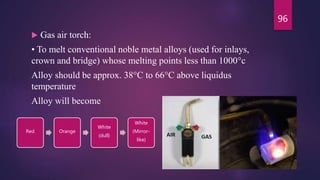
  • 170.
     Gas occludedfrom a poorly adjusted torch flame  Use of oxidizing zone rather than reducing zone.  Casting is usually black, do not clean easily on pickling Can be reduced not avoided 170
  • 171.
    Sub surface porosity Causes Simultaneous nucleation of solid grains and gas bubbles at the first moment that the alloy freezes at mold walls Prevented by  Controlling the rate at which the molten metal enters the mold. 171
  • 172.
    Back pressure porosity Some times referred to as entrapped-air porosity.  Outer surface of the casting  When the casting or mold temperature is low  Solidification occurs before the trapped air can escape. 172
  • 173.
     Causes Inability ofthe air in the mold to escape through the pores in the investment  Prevented by: Proper burnout Sufficiently high casting pressure Adequate L/P ratio Thickness of investment between tip of pattern and end of ring is not greater than 6mm. 173
  • 174.
    Incomplete casting  Factorsthat inhibit the mold filling is: 1. In sufficient venting 2. In sufficient casting pressure, pressure should be applied atleast for 4 sec 3. Incomplete elimination of wax 4. Lower L/p ratio 5. Viscosity of the fused metal 174
  • 175.
    Casting is bothan art and science governed by numerous rules, or “laws”.  • Based on earlier work of Ingersoll & Wandling (1986), W. Patrick Naylor formulated an expanded set of 17 separate recommendations for Spruing, investing, burnout, and melting and casting procedures.  • Collectively these guidelines are referred to as the laws of casting. 175
  • 176.
    RULES OF CASTING 1.Attach the pattern sprue former to the thickest part of thr wax pattern 2. Orient wax patterns so all the restoration margins will face the trailing edge when the ring is placed in the casting machine 3. Position the wax pattern in a “cold zone” of the investment mold and the reservoir in the “heat centre” of the casting ring 176
  • 177.
    4. A reservoirmust have sufficient molten alloy to accommodate the shrinkage that occurs within the restorations 5. Do not cast a button if a connector (runner) bar, or other internal reservoir, is used 6. Turbulence must be minimized, if not totally eliminated 177
  • 178.
    7. Select acasting ring of sufficient length and diameter to accommodate the patterns to be invested 8. Increase the wettability of the wax patterns 9. Weigh any bulk investment and measure the investment liquid for a precise powder-liquid ratio 178
  • 179.
    10. Eliminate theincorporation of air in the casting investment and remove the ammonia gas by product of phosphate-bonded investments by mixing under vacuum 11. Allow the casting investment to set completely before initiating the burnout procedure 12. Use a wax elimination (burnout) technique that is specific for the type patterns involved (wax versus plastic) and recommended for the particular type of casting alloy selected 179
  • 180.
    13. Adequate heatmust be available to properly melt and cast the alloy 14.When torch casting, use the “reducing zone” of the flame to melt the alloy and not the oxidizing zone 15. Provide enough force to cause the liquid alloy to flow onto the heated mold 180
  • 181.
    16. Cast towardthe margins of the wax patterns 17. Do not quench the ring immediately after casting 181
  • 182.
    REVIEW OF LITERATURE Theeffects of sprue design on the roughness and porosity of titanium castings Improvements in the degree of roughness and porosity of titanium crown castings were the result of the double sprue design. The disadvantage of casting lower density metal, such as titanium, with centrifugal casting machines can be coun- teracted by higher rotational speed or by using special sprue design (J Prosthet Dent 1997;78:400-4.) 182
  • 183.
    Evaluation of threevariables affecting the casting of base metal alloys  Effect of venting on the ability to make castings without voids or other defects.  The use of vents in conjunction with sprues of sufficient width gave consistently accept- able castings, whereas identical patterns without vents resulted in extensive defects in the castings.  The results also confirm that an adequately sized sprue is required for successful castings, since the 1 mm sprue gave defective castings, even with the concomitant use of vents.  JPD APRIL 1980 VOLUME 43 NUMBER 4 183
  • 184.
    The effect ofsprue attachment design on castability and porosity  It has been implied that the sprue attachment designs empirically observed to provide acceptable castability can be uniformly applied to all alloys.  JPD APRIL 1989 VOLUME 61 NUMBER 4 184
  • 185.
    Effects of spruedesign, casting machine, and heat source on casting porosity  Excellent castings can be fabricated with any of the casting machines and heat sources tested. The results also demonstrated that casting failures occur, even when a technique with a generally high degree of success is used.  Sprue design is more critical by far than either the type of casting machine or the source of heat. The sprue should allow the molten alloy to fill the casting void quickly and not allow the metal to solidify prematurely.  JPD JULY 1984 VOLUME 52 NUMBER 1 185

  • 186.
    The effect ofinvestment material type on the contamination zone and mechanical properties of commercially pure titanium castings  According to the results of this study, the extent of the contamination zone as well as the yield strength and percentage elongation of the cpTi castings were significantly affected by the type of the investment material.  JPDVolume 94, Issue 6, December 2005 186
  • 187.
  • 188.
    References  K. J.Anusavice, Phillips Science of Dental Materials, 11th edition  Introduction to metal ceramic technology, W.P. Naylor  Craig R.G, Restorative Dental Materials;10th edition  Rudd And Morrow, Dental Laboratory Procedures- Removable Partial Denture, 2nd edition  John J. Manappallil, basic dental materials, 2nd edition  Shillinburg, fundamentals of fixed Prosthodontics  Contemporary Fixed Prosthodontics Stephen F. Rosenstiel, 4th Edition.  Materials used in dentistry – S Mahalaxmi 188
  • 189.