Relining and rebasing
Ayam Chhatkuli
Chitwan medical college
Content
• Introduction
• Indication and contraindication
• Preparatory phase
• Relining techniques
• Direct method
• Open mouth technique
• Closed mouth technique
• Functional impression
• Laboratory procedure
• Conclusion
• Questions and answer
• It is the procedures used to resurface the
tissue-side of a denture with new material
layer, thus producing an accurate adaptation
to the denture foundation area. (GPT8)
• It is usually carried out when the fitness of
the denture has been deteriorated and it is
not necessary to construct a new one.
Reline
• It is the laboratory process of replacing
the entire denture base material on an
existing prosthesis, without changing the
dental arch, and the occlusal relationship.
(GPT8)
• It is perfomed for extensive tissue changes
and the entire denture base is changed
following impression procedure
Rebase
Indication for Relining
• Poor adaptation of denture base to the
ridge
• Patient with complaint of looseness or
instability of dentures following a long
standing history of comfort and satisfaction
with the denture
• 3-6 month after construction of immediate
denture
• For geriatric or chronically ill patient
Indications
• Patient cannot afford the cost
Rebasing Indications:
1) Porous or artifact of the denture base
2) Loss of retention & stability
3) Should have correct jaw relations
• Excessive ridge resorption
• Presence of abused soft tissue
• Temporomandibular joint problem
• Dentures with poor aesthetics
• Dentures with major speech problems
• Presence of severe osseous undercuts
Contraindicati
on
Tissue preparation
• Oral mucosa free of any irritantion
• Dentures should be left out of mouth 2or 3
days before making the final impression
• Hypertrophic tissue should be removed
• Removal of denture at night and
massaging of the tissues
Preparatory Phase
Denture preparation
• Border extension is checked and corrected
• Undercuts are relieved
• Occlusal disharmony is corrected by
selective grinding
• Pressure spots are adjusted
• Accurate posterior palatal seal is
established
Relining techniques
Direct method Indirect method
Static impression
Functional
impression
Open-mouth Closed-mouth
Direct method
It is also known as chair side technique
Cold cured acrylic or tissue conditioner material is used, but
are not very durable. Direct relining is less time
consuming.
• The fitting surface of the denture is cleaned, roughened,
and slightly reduced.
• The flanges are trimmed
(to reduce danger of overextension)
and the undercuts removed.
• Put lubricant over polished surface to prevent the new
resin material to adhere on it.
• The new self-curing relining material is then mixed and
applied to the fitting surface.
• The denture is inserted and the patient asked to bite
gently on the denture to ensure that the occlusion is not
altered by the procedure.
• Border molding can
then be carried out.
• The denture is kept in
situ for about 5
minutes after which
it is removed and
carefully examined
Disadvantages
• Material is porous and has an unpleasant
odour
• Excess monomer that leaches out may
irritate the mucosa
• Exothermic heat produced can burn the
mucosa
• Poor colour stability
• If not positioned correctly, it can lead to gross
discrepancies.
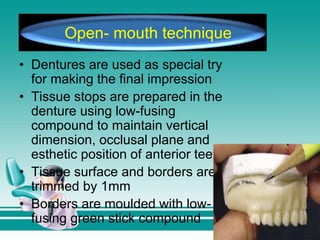
• Dentures are used as special try
for making the final impression
• Tissue stops are prepared in the
denture using low-fusing
compound to maintain vertical
dimension, occlusal plane and
esthetic position of anterior teeth
• Tissue surface and borders are
trimmed by 1mm
• Borders are moulded with low-
fusing green stick compound
Open- mouth technique
• Final impression is made with ZOE
impression paste
• Impression of maxillary denture is made
followed by mandibular
• New CR record is made using
interocclusal check methods
Advantagess
• Selective impression is made without any
occlusal interferences
• Operator need not worry about making jaw
relation while making impression, as a
separate record is made
• The CR record is varifiable
Disadvantages
• Chances of increase in vertical dimension
even though tissue stops are provided
• High possibility of denture moving forward
• Demanding and laborious technique
• Requires more clinical and laboratory time
Closed mouth technique
• Dentures use the special tray for making
the final impression
• The tissue surface and borders of the
denture are trimmed by 1-2 mm expect for
the posterior border of the maxillary
denture
• Borders are moulded with low fusing green
stick compound
• Final impression is made with ZOE
impression paste
Advantages
• Less chance of Increase in vertical
dimension
• Takes less time
• Chances of denture moving forward during
impression is less
Disadvantages
• Existing errors in centric occlusion can
produce pressure points and inaccurate
impresion
• Hydrostatic pressure in palate during
impression making and packing of acrylic,
can still cause increase in vertical
dimension
Modification to alleviate the above
disadvantages
• Making new CR record before making the
impression and then asking the patient to
close in the CR record as the impression
are made
• Palatal portion is modified to reduce
hydrostatic pressure during impression
making and packing
• Labial and buccal flanges of dentures are
perforated which will decrease pressure
during impression making and packing
• Use of impression wax instead of ZOE
impression paste suggested to make final
impression but wax is difficult to work with
and there is possibility of distortion
Functional technique
• Simple, practical and popular method.
• Tissue conditioners are used as an
impression material.
• The areas of the denture which are not to
be contacted by fluid resin are painted with
a lubricant.
• The powder and liquid of the soft liner are
mixed according to the manufactures
instruction and allowed to polymerize in
the mixing cup
• On creamy and fluid stage
poured in the tissue surface
• When material stops flow
inserted in the patient mouth
• Patient instructed to close in centric
maintaining vertical dimension
• Active and passive method of border
moulding is performed
• Patient also instructed to performe the
functional movement like swallowing
smiling, speaking until impression reaches
a more stable rubber like stage
• After removal excess tissue conditioner is
removed and voids corrected with new
material
• Recall and maintenance similar as
described for tissue conditioners.
• When the patient returns after 3-5 days,
the underextensions, denuded areas and
pressure spots corrected by trimming and/
or adding new material.
• The material is changed periodically till the
tissues return to a state of health and then
the patient is scheduled for final
impression.
• A ZOE impression paste or light- body
wash impression is then made over the
conditioning material and verified.
• This method is similar to the functional
reline technique
Laboratory procedures
• Flask method
• Articulator method
• Jig method
Flask method
• The relined impression is poured with
dental stone
• Master cast is poured around the
impression similar to the original master
cast by beading and boxing
• The cast provides the surface against
which the denture is relined by invading it
in a processing flask
• The flask is warmed to soften the
impression compound before opening it to
remove the impression material
• Seperating medium is applied on the
plaster and stone mould and heat
polymerized denture base resin is packed
into the mould
• The flask is closed and clamped to ensure
maintainence of occlusal vertical
dimension
• After processing flask is cooled slowely
and the denture is retrived from the stone
mould, finished and polished
Articulator method
• Master cast is poured
• Cast not separated from the impression
• A layer of plaster is arranged in platform
fashion on the lower member of articulator
• As the plater is set the cast with relinied
impression is placed on the wet plaster
such that the teeth penetrate the plaster
surface to the depth of 2mm
• This forms an index or key of the teeth
which allows the repostioning of the teeth
• Once the plasters sets additional plaster is
placed on the base of the cast and is
mounted on the upper membrane of
articulator
• When mounting sets articulator can be
opened and the denture with impression is
seperated from the cast
• The denture base is waxed, cast and
denture are removed from mounting,
flasked and processed with heat cure
denture base acrylic resin
Jig method
• Jig is a device used to maintain
mechanically correct positional
relationship between a piece of work and a
tool or between the components during
assembly or alteration (GPT8)
• Seat the occlusal surface of the denture
on the plaster form on lower membrane of
relining jig
• After the stone index is made, mount the
denture with the cast to the upper
membrane in reline jig similar to the
articulator method
• Open the jig, remove the teeth from the
denture base and adapt baseplate wax on
the cast and wax the denture
• After processing replace the cured denture
check and correct occlusion using the
indentation made in the jig during
mounting of denture
• A hoopers duplicator can also be used.
• It is similar to jig method
Questions asked in board
exams
• Short note on relining and
rebasing(2071/2) and (2065/1) for 5 marks
• Discuss relining and rebasing in complete
denture (2069/2) for 6 + 6 marks
Thank you!!!!!!!!

Relining and rebasing

  • 1.
    Relining and rebasing AyamChhatkuli Chitwan medical college
  • 2.
    Content • Introduction • Indicationand contraindication • Preparatory phase • Relining techniques • Direct method • Open mouth technique • Closed mouth technique • Functional impression • Laboratory procedure • Conclusion • Questions and answer
  • 3.
    • It isthe procedures used to resurface the tissue-side of a denture with new material layer, thus producing an accurate adaptation to the denture foundation area. (GPT8) • It is usually carried out when the fitness of the denture has been deteriorated and it is not necessary to construct a new one. Reline
  • 4.
    • It isthe laboratory process of replacing the entire denture base material on an existing prosthesis, without changing the dental arch, and the occlusal relationship. (GPT8) • It is perfomed for extensive tissue changes and the entire denture base is changed following impression procedure Rebase
  • 5.
    Indication for Relining •Poor adaptation of denture base to the ridge • Patient with complaint of looseness or instability of dentures following a long standing history of comfort and satisfaction with the denture • 3-6 month after construction of immediate denture • For geriatric or chronically ill patient Indications
  • 6.
    • Patient cannotafford the cost Rebasing Indications: 1) Porous or artifact of the denture base 2) Loss of retention & stability 3) Should have correct jaw relations
  • 7.
    • Excessive ridgeresorption • Presence of abused soft tissue • Temporomandibular joint problem • Dentures with poor aesthetics • Dentures with major speech problems • Presence of severe osseous undercuts Contraindicati on
  • 8.
    Tissue preparation • Oralmucosa free of any irritantion • Dentures should be left out of mouth 2or 3 days before making the final impression • Hypertrophic tissue should be removed • Removal of denture at night and massaging of the tissues Preparatory Phase
  • 9.
    Denture preparation • Borderextension is checked and corrected • Undercuts are relieved • Occlusal disharmony is corrected by selective grinding • Pressure spots are adjusted • Accurate posterior palatal seal is established
  • 10.
    Relining techniques Direct methodIndirect method Static impression Functional impression Open-mouth Closed-mouth
  • 11.
    Direct method It isalso known as chair side technique Cold cured acrylic or tissue conditioner material is used, but are not very durable. Direct relining is less time consuming. • The fitting surface of the denture is cleaned, roughened, and slightly reduced. • The flanges are trimmed (to reduce danger of overextension) and the undercuts removed.
  • 12.
    • Put lubricantover polished surface to prevent the new resin material to adhere on it. • The new self-curing relining material is then mixed and applied to the fitting surface. • The denture is inserted and the patient asked to bite gently on the denture to ensure that the occlusion is not altered by the procedure.
  • 13.
    • Border moldingcan then be carried out. • The denture is kept in situ for about 5 minutes after which it is removed and carefully examined
  • 14.
    Disadvantages • Material isporous and has an unpleasant odour • Excess monomer that leaches out may irritate the mucosa • Exothermic heat produced can burn the mucosa • Poor colour stability • If not positioned correctly, it can lead to gross discrepancies.
  • 15.
    • Dentures areused as special try for making the final impression • Tissue stops are prepared in the denture using low-fusing compound to maintain vertical dimension, occlusal plane and esthetic position of anterior teeth • Tissue surface and borders are trimmed by 1mm • Borders are moulded with low- fusing green stick compound Open- mouth technique
  • 16.
    • Final impressionis made with ZOE impression paste • Impression of maxillary denture is made followed by mandibular • New CR record is made using interocclusal check methods
  • 18.
    Advantagess • Selective impressionis made without any occlusal interferences • Operator need not worry about making jaw relation while making impression, as a separate record is made • The CR record is varifiable
  • 19.
    Disadvantages • Chances ofincrease in vertical dimension even though tissue stops are provided • High possibility of denture moving forward • Demanding and laborious technique • Requires more clinical and laboratory time
  • 20.
    Closed mouth technique •Dentures use the special tray for making the final impression • The tissue surface and borders of the denture are trimmed by 1-2 mm expect for the posterior border of the maxillary denture • Borders are moulded with low fusing green stick compound • Final impression is made with ZOE impression paste
  • 22.
    Advantages • Less chanceof Increase in vertical dimension • Takes less time • Chances of denture moving forward during impression is less
  • 23.
    Disadvantages • Existing errorsin centric occlusion can produce pressure points and inaccurate impresion • Hydrostatic pressure in palate during impression making and packing of acrylic, can still cause increase in vertical dimension
  • 24.
    Modification to alleviatethe above disadvantages • Making new CR record before making the impression and then asking the patient to close in the CR record as the impression are made • Palatal portion is modified to reduce hydrostatic pressure during impression making and packing
  • 25.
    • Labial andbuccal flanges of dentures are perforated which will decrease pressure during impression making and packing • Use of impression wax instead of ZOE impression paste suggested to make final impression but wax is difficult to work with and there is possibility of distortion
  • 26.
    Functional technique • Simple,practical and popular method. • Tissue conditioners are used as an impression material. • The areas of the denture which are not to be contacted by fluid resin are painted with a lubricant. • The powder and liquid of the soft liner are mixed according to the manufactures instruction and allowed to polymerize in the mixing cup
  • 27.
    • On creamyand fluid stage poured in the tissue surface • When material stops flow inserted in the patient mouth • Patient instructed to close in centric maintaining vertical dimension • Active and passive method of border moulding is performed
  • 28.
    • Patient alsoinstructed to performe the functional movement like swallowing smiling, speaking until impression reaches a more stable rubber like stage • After removal excess tissue conditioner is removed and voids corrected with new material • Recall and maintenance similar as described for tissue conditioners.
  • 29.
    • When thepatient returns after 3-5 days, the underextensions, denuded areas and pressure spots corrected by trimming and/ or adding new material. • The material is changed periodically till the tissues return to a state of health and then the patient is scheduled for final impression.
  • 30.
    • A ZOEimpression paste or light- body wash impression is then made over the conditioning material and verified. • This method is similar to the functional reline technique
  • 31.
    Laboratory procedures • Flaskmethod • Articulator method • Jig method
  • 32.
    Flask method • Therelined impression is poured with dental stone • Master cast is poured around the impression similar to the original master cast by beading and boxing • The cast provides the surface against which the denture is relined by invading it in a processing flask
  • 34.
    • The flaskis warmed to soften the impression compound before opening it to remove the impression material • Seperating medium is applied on the plaster and stone mould and heat polymerized denture base resin is packed into the mould • The flask is closed and clamped to ensure maintainence of occlusal vertical dimension
  • 35.
    • After processingflask is cooled slowely and the denture is retrived from the stone mould, finished and polished
  • 36.
    Articulator method • Mastercast is poured • Cast not separated from the impression • A layer of plaster is arranged in platform fashion on the lower member of articulator • As the plater is set the cast with relinied impression is placed on the wet plaster such that the teeth penetrate the plaster surface to the depth of 2mm
  • 38.
    • This formsan index or key of the teeth which allows the repostioning of the teeth • Once the plasters sets additional plaster is placed on the base of the cast and is mounted on the upper membrane of articulator • When mounting sets articulator can be opened and the denture with impression is seperated from the cast
  • 39.
    • The denturebase is waxed, cast and denture are removed from mounting, flasked and processed with heat cure denture base acrylic resin
  • 40.
    Jig method • Jigis a device used to maintain mechanically correct positional relationship between a piece of work and a tool or between the components during assembly or alteration (GPT8)
  • 41.
    • Seat theocclusal surface of the denture on the plaster form on lower membrane of relining jig • After the stone index is made, mount the denture with the cast to the upper membrane in reline jig similar to the articulator method • Open the jig, remove the teeth from the denture base and adapt baseplate wax on the cast and wax the denture
  • 42.
    • After processingreplace the cured denture check and correct occlusion using the indentation made in the jig during mounting of denture • A hoopers duplicator can also be used. • It is similar to jig method
  • 43.
    Questions asked inboard exams • Short note on relining and rebasing(2071/2) and (2065/1) for 5 marks • Discuss relining and rebasing in complete denture (2069/2) for 6 + 6 marks
  • 44.

Editor's Notes

  • #6 Poor adaptation is due to resorption of the residual alveolar ridge