WELCOME TO MY
PRESENTATION
Presented By
MD Muzahidul Haque
M.Sc. (Evening), 10th Batch
Roll / Student ID:
Dept. of Electrical and Electronic Engineering
Islamic University, Kushtia, Bangladesh
1
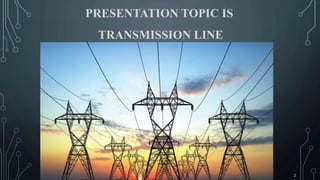
PRESENTATION TOPIC IS
TRANSMISSION LINE
2
INDEX
• Transmission Lines
• Classification Of Transmission Lines
• Overhead Power Line
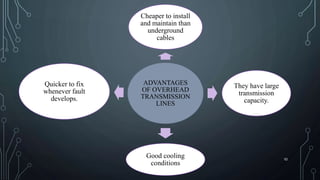
• Advantages Of Overhead Transmission Lines
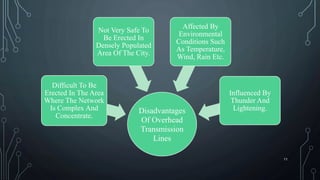
• Disadvantages Of Overhead Transmission Lines
• Nominal “T” Method
• Nominal “Pi” Model of a Medium Transmission Line
• Underground Transmission Lines
• Classification Of Underground Cables
• Advantages Of Underground Cables
• Disadvantages Of Underground Cables 3
TRANSMISSION LINES
A transmission line is used for the transmission of electrical power from
generating substation to the various distribution units. It transmits the wave of
voltage and current from one end to another. The transmission line is made up
of a conductor having a uniform cross-section along the line. Air act as an
insulating or dielectric medium between the conductors.
4
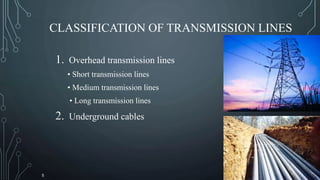
CLASSIFICATION OF TRANSMISSION LINES
1. Overhead transmission lines
• Short transmission lines
• Medium transmission lines
• Long transmission lines
2. Underground cables
5
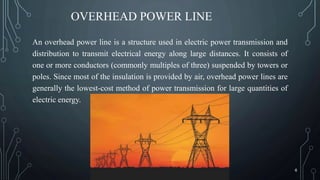
OVERHEAD POWER LINE
An overhead power line is a structure used in electric power transmission and
distribution to transmit electrical energy along large distances. It consists of
one or more conductors (commonly multiples of three) suspended by towers or
poles. Since most of the insulation is provided by air, overhead power lines are
generally the lowest-cost method of power transmission for large quantities of
electric energy.
6
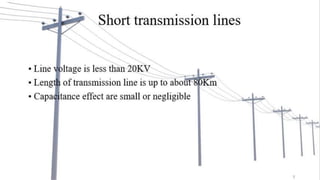
SHORT TRANSMISSION LINES
• Line voltage is less than 20KV
• Length of transmission line is up to about 80Km
• Capacitance effect are small or negligible
7
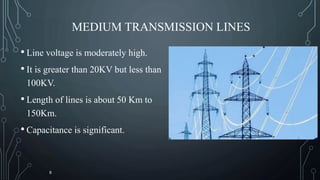
MEDIUM TRANSMISSION LINES
• Line voltage is moderately high.
• It is greater than 20KV but less than
100KV.
• Length of lines is about 50 Km to
150Km.
• Capacitance is significant.
8
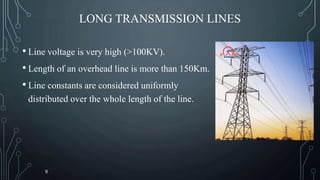
LONG TRANSMISSION LINES
• Line voltage is very high (>100KV).
• Length of an overhead line is more than 150Km.
• Line constants are considered uniformly
distributed over the whole length of the line.
9
10
ADVANTAGES
OF OVERHEAD
TRANSMISSION
LINES
Cheaper to install
and maintain than
underground
cables
They have large
transmission
capacity.
Good cooling
conditions
Quicker to fix
whenever fault
develops.
11
Disadvantages
Of Overhead
Transmission
Lines
Difficult To Be
Erected In The Area
Where The Network
Is Complex And
Concentrate.
Not Very Safe To
Be Erected In
Densely Populated
Area Of The City.
Affected By
Environmental
Conditions Such
As Temperature,
Wind, Rain Etc.
Influenced By
Thunder And
Lightening.
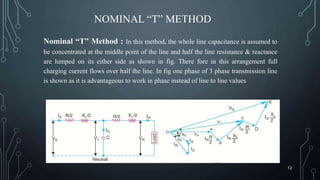
NOMINAL “T” METHOD
Nominal “T” Method : In this method, the whole line capacitance is assumed to
be concentrated at the middle point of the line and half the line resistance & reactance
are lumped on its either side as shown in fig. There fore in this arrangement full
charging current flows over half the line. In fig one phase of 3 phase transmission line
is shown as it is advantageous to work in phase instead of line to line values
12
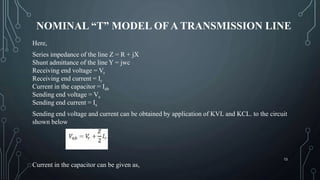
NOMINAL “T” MODEL OF A TRANSMISSION LINE
Here,
Series impedance of the line Z = R + jX
Shunt admittance of the line Y = jwc
Receiving end voltage = Vr
Receiving end current = Ir
Current in the capacitor = Iab
Sending end voltage = Vs
Sending end current = Is
Sending end voltage and current can be obtained by application of KVL and KCL. to the circuit
shown below
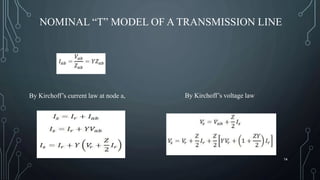
Current in the capacitor can be given as,
13
NOMINAL “T” MODEL OF A TRANSMISSION LINE
By Kirchoff’s current law at node a, By Kirchoff’s voltage law
14
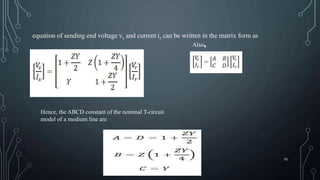
equation of sending end voltage vs and current is can be written in the matrix form as
Also,
Hence, the ABCD constant of the nominal T-circuit
model of a medium line are
15
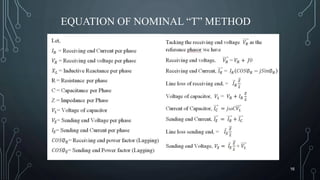
EQUATION OF NOMINAL “T” METHOD
16
NOMINAL “PI” MODEL OF A MEDIUM TRANSMISSION LINE
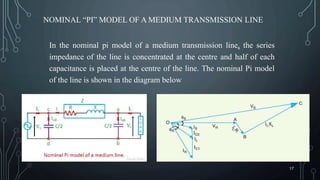
In the nominal pi model of a medium transmission line, the series
impedance of the line is concentrated at the centre and half of each
capacitance is placed at the centre of the line. The nominal Pi model
of the line is shown in the diagram below
17
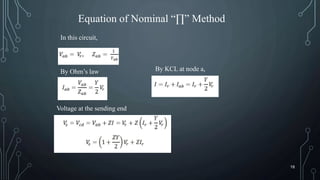
Equation of Nominal “∏” Method
In this circuit,
By Ohm’s law By KCL at node a,
Voltage at the sending end
18
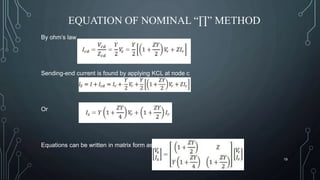
EQUATION OF NOMINAL “∏” METHOD
By ohm’s law
Sending-end current is found by applying KCL at node c
Or
Equations can be written in matrix form as
19
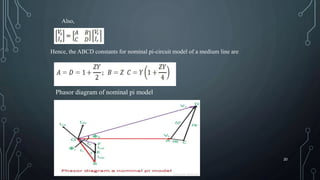
Also,
Hence, the ABCD constants for nominal pi-circuit model of a medium line are
Phasor diagram of nominal pi model
20
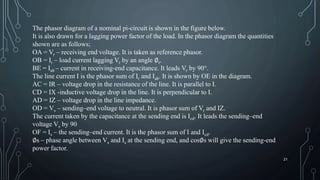
The phasor diagram of a nominal pi-circuit is shown in the figure below.
It is also drawn for a lagging power factor of the load. In the phasor diagram the quantities
shown are as follows;
OA = Vr – receiving end voltage. It is taken as reference phasor.
OB = Ir – load current lagging Vr by an angle ∅r.
BE = Iab – current in receiving-end capacitance. It leads Vr by 90°.
The line current I is the phasor sum of Ir and Iab. It is shown by OE in the diagram.
AC = IR – voltage drop in the resistance of the line. It is parallel to I.
CD = IX -inductive voltage drop in the line. It is perpendicular to I.
AD = IZ – voltage drop in the line impedance.
OD = Vs – sending–end voltage to neutral. It is phasor sum of Vr and IZ.
The current taken by the capacitance at the sending end is Icd. It leads the sending–end
voltage Vs by 90
OF = Is – the sending–end current. It is the phasor sum of I and Icd.
∅s – phase angle between Vs and Is at the sending end, and cos∅s will give the sending-end
power factor.
21
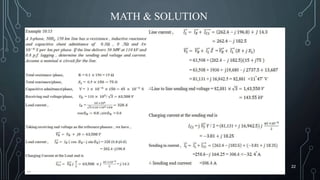
MATH & SOLUTION
22
UNDERGROUND TRANSMISSION LINES
Undergrounding is the replacement of overhead cables providing electrical
power or telecommunications, with underground cables. This is typically
performed for aesthetic purposes, but also serves the additional significant
purpose of making the power lines less susceptible to outages during high wind
thunderstorms or heavy snow or ice storms. Undergrounding can increase the
initial costs of electric power transmission and distribution but may decrease
operational costs over the lifetime of the cables.
23
CLASSIFICATION OF UNDERGROUND CABLES
 BY VOLTAGE
• LT cables: Low-tension cables with a maximum capacity of 1000 V
• HT Cables: High-tension cables with a maximum of 11KV
• ST cables: Super-tension cables with a rating of between 22 KV and 33 KV
• EHT cables: Extra high-tension cables with a rating of between 33 KV and 66 KV
• Extra super voltage cables: with maximum voltage ratings beyond 132 KV
 BY CONSTRUCTION
• Belted cables: Maximum voltage of 11KVA
• Screened cables: Maximum voltage of 66 KVA
• Pressure cables: Maximum voltage of more than 66KVA
24
ADVANTAGES OF UNDERGROUND CABLES
• Low chances of developing faults.
• Low maintenance cost.
• Not influenced by environmental conditions.
• More durable in comparison to overhead transmission lines.
• Underground cables are more safer fore mankind.
• Requires a narrow band of length to install.
25
DISADVANTAGES OF UNDERGROUND CABLES
• Very expensive. It costs four times the overhead lines.
• Repairing of underground cables is not easy and it takes more time
to repair than overhead lines.
• Maintenance cost is also very high.
26
THANK YOU ALL

Presentation topic is transmission line

  • 1.
    WELCOME TO MY PRESENTATION PresentedBy MD Muzahidul Haque M.Sc. (Evening), 10th Batch Roll / Student ID: Dept. of Electrical and Electronic Engineering Islamic University, Kushtia, Bangladesh 1
  • 2.
  • 3.
    INDEX • Transmission Lines •Classification Of Transmission Lines • Overhead Power Line • Advantages Of Overhead Transmission Lines • Disadvantages Of Overhead Transmission Lines • Nominal “T” Method • Nominal “Pi” Model of a Medium Transmission Line • Underground Transmission Lines • Classification Of Underground Cables • Advantages Of Underground Cables • Disadvantages Of Underground Cables 3
  • 4.
    TRANSMISSION LINES A transmissionline is used for the transmission of electrical power from generating substation to the various distribution units. It transmits the wave of voltage and current from one end to another. The transmission line is made up of a conductor having a uniform cross-section along the line. Air act as an insulating or dielectric medium between the conductors. 4
  • 5.
    CLASSIFICATION OF TRANSMISSIONLINES 1. Overhead transmission lines • Short transmission lines • Medium transmission lines • Long transmission lines 2. Underground cables 5
  • 6.
    OVERHEAD POWER LINE Anoverhead power line is a structure used in electric power transmission and distribution to transmit electrical energy along large distances. It consists of one or more conductors (commonly multiples of three) suspended by towers or poles. Since most of the insulation is provided by air, overhead power lines are generally the lowest-cost method of power transmission for large quantities of electric energy. 6
  • 7.
    SHORT TRANSMISSION LINES •Line voltage is less than 20KV • Length of transmission line is up to about 80Km • Capacitance effect are small or negligible 7
  • 8.
    MEDIUM TRANSMISSION LINES •Line voltage is moderately high. • It is greater than 20KV but less than 100KV. • Length of lines is about 50 Km to 150Km. • Capacitance is significant. 8
  • 9.
    LONG TRANSMISSION LINES •Line voltage is very high (>100KV). • Length of an overhead line is more than 150Km. • Line constants are considered uniformly distributed over the whole length of the line. 9
  • 10.
    10 ADVANTAGES OF OVERHEAD TRANSMISSION LINES Cheaper toinstall and maintain than underground cables They have large transmission capacity. Good cooling conditions Quicker to fix whenever fault develops.
  • 11.
    11 Disadvantages Of Overhead Transmission Lines Difficult ToBe Erected In The Area Where The Network Is Complex And Concentrate. Not Very Safe To Be Erected In Densely Populated Area Of The City. Affected By Environmental Conditions Such As Temperature, Wind, Rain Etc. Influenced By Thunder And Lightening.
  • 12.
    NOMINAL “T” METHOD Nominal“T” Method : In this method, the whole line capacitance is assumed to be concentrated at the middle point of the line and half the line resistance & reactance are lumped on its either side as shown in fig. There fore in this arrangement full charging current flows over half the line. In fig one phase of 3 phase transmission line is shown as it is advantageous to work in phase instead of line to line values 12
  • 13.
    NOMINAL “T” MODELOF A TRANSMISSION LINE Here, Series impedance of the line Z = R + jX Shunt admittance of the line Y = jwc Receiving end voltage = Vr Receiving end current = Ir Current in the capacitor = Iab Sending end voltage = Vs Sending end current = Is Sending end voltage and current can be obtained by application of KVL and KCL. to the circuit shown below Current in the capacitor can be given as, 13
  • 14.
    NOMINAL “T” MODELOF A TRANSMISSION LINE By Kirchoff’s current law at node a, By Kirchoff’s voltage law 14
  • 15.
    equation of sendingend voltage vs and current is can be written in the matrix form as Also, Hence, the ABCD constant of the nominal T-circuit model of a medium line are 15
  • 16.
    EQUATION OF NOMINAL“T” METHOD 16
  • 17.
    NOMINAL “PI” MODELOF A MEDIUM TRANSMISSION LINE In the nominal pi model of a medium transmission line, the series impedance of the line is concentrated at the centre and half of each capacitance is placed at the centre of the line. The nominal Pi model of the line is shown in the diagram below 17
  • 18.
    Equation of Nominal“∏” Method In this circuit, By Ohm’s law By KCL at node a, Voltage at the sending end 18
  • 19.
    EQUATION OF NOMINAL“∏” METHOD By ohm’s law Sending-end current is found by applying KCL at node c Or Equations can be written in matrix form as 19
  • 20.
    Also, Hence, the ABCDconstants for nominal pi-circuit model of a medium line are Phasor diagram of nominal pi model 20
  • 21.
    The phasor diagramof a nominal pi-circuit is shown in the figure below. It is also drawn for a lagging power factor of the load. In the phasor diagram the quantities shown are as follows; OA = Vr – receiving end voltage. It is taken as reference phasor. OB = Ir – load current lagging Vr by an angle ∅r. BE = Iab – current in receiving-end capacitance. It leads Vr by 90°. The line current I is the phasor sum of Ir and Iab. It is shown by OE in the diagram. AC = IR – voltage drop in the resistance of the line. It is parallel to I. CD = IX -inductive voltage drop in the line. It is perpendicular to I. AD = IZ – voltage drop in the line impedance. OD = Vs – sending–end voltage to neutral. It is phasor sum of Vr and IZ. The current taken by the capacitance at the sending end is Icd. It leads the sending–end voltage Vs by 90 OF = Is – the sending–end current. It is the phasor sum of I and Icd. ∅s – phase angle between Vs and Is at the sending end, and cos∅s will give the sending-end power factor. 21
  • 22.
  • 23.
    UNDERGROUND TRANSMISSION LINES Undergroundingis the replacement of overhead cables providing electrical power or telecommunications, with underground cables. This is typically performed for aesthetic purposes, but also serves the additional significant purpose of making the power lines less susceptible to outages during high wind thunderstorms or heavy snow or ice storms. Undergrounding can increase the initial costs of electric power transmission and distribution but may decrease operational costs over the lifetime of the cables. 23
  • 24.
    CLASSIFICATION OF UNDERGROUNDCABLES  BY VOLTAGE • LT cables: Low-tension cables with a maximum capacity of 1000 V • HT Cables: High-tension cables with a maximum of 11KV • ST cables: Super-tension cables with a rating of between 22 KV and 33 KV • EHT cables: Extra high-tension cables with a rating of between 33 KV and 66 KV • Extra super voltage cables: with maximum voltage ratings beyond 132 KV  BY CONSTRUCTION • Belted cables: Maximum voltage of 11KVA • Screened cables: Maximum voltage of 66 KVA • Pressure cables: Maximum voltage of more than 66KVA 24
  • 25.
    ADVANTAGES OF UNDERGROUNDCABLES • Low chances of developing faults. • Low maintenance cost. • Not influenced by environmental conditions. • More durable in comparison to overhead transmission lines. • Underground cables are more safer fore mankind. • Requires a narrow band of length to install. 25
  • 26.
    DISADVANTAGES OF UNDERGROUNDCABLES • Very expensive. It costs four times the overhead lines. • Repairing of underground cables is not easy and it takes more time to repair than overhead lines. • Maintenance cost is also very high. 26
  • 27.