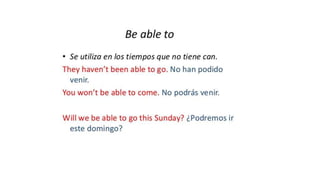
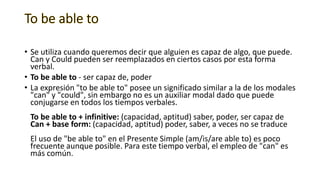
• Se utiliza cuando queremos decir que alguien es capaz de algo, que puede.
Can y Could pueden ser reemplazados en ciertos casos por esta forma
verbal.
• To be able to - ser capaz de, poder
• La expresión "to be able to" posee un significado similar a la de los modales
"can" y "could", sin embargo no es un auxiliar modal dado que puede
conjugarse en todos los tiempos verbales.
To be able to + infinitive: (capacidad, aptitud) saber, poder, ser capaz de
Can + base form: (capacidad, aptitud) poder, saber, a veces no se traduce
El uso de "be able to" en el Presente Simple (am/is/are able to) es poco
frecuente aunque posible. Para este tiempo verbal, el empleo de "can" es
más común.
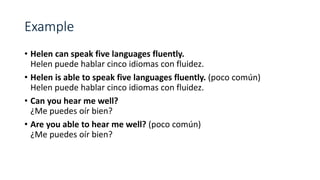
• Helen can speak five languages fluently.
Helen puede hablar cinco idiomas con fluidez.
• Helen is able to speak five languages fluently. (poco común)
Helen puede hablar cinco idiomas con fluidez.
• Can you hear me well?
¿Me puedes oír bien?
• Are you able to hear me well? (poco común)
¿Me puedes oír bien?
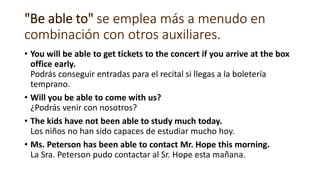
• You will be able to get tickets to the concert if you arrive at the box
office early.
Podrás conseguir entradas para el recital si llegas a la boletería
temprano.
• Will you be able to come with us?
¿Podrás venir con nosotros?
• The kids have not been able to study much today.
Los niños no han sido capaces de estudiar mucho hoy.
• Ms. Peterson has been able to contact Mr. Hope this morning.
La Sra. Peterson pudo contactar al Sr. Hope esta mañana.
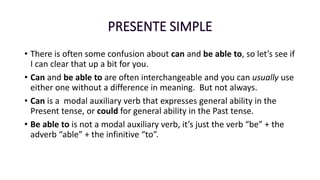
• There is often some confusion about can and be able to, so let’s see if
I can clear that up a bit for you.
• Can and be able to are often interchangeable and you can usually use
either one without a difference in meaning. But not always.
• Can is a modal auxiliary verb that expresses general ability in the
Present tense, or could for general ability in the Past tense.
• Be able to is not a modal auxiliary verb, it’s just the verb “be” + the
adverb “able” + the infinitive “to”.
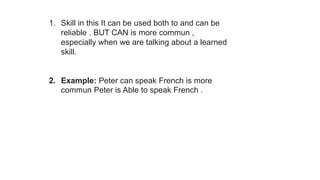
1. Skill in this It can be used both to and can be
reliable . BUT CAN is more commun ,
especially when we are talking about a learned
skill.
2. Example: Peter can speak French is more
commun Peter is Able to speak French .
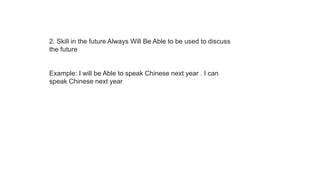
2. Skill in the future Always Will Be Able to be used to discuss
the future
Example: I will be Able to speak Chinese next year . I can
speak Chinese next year
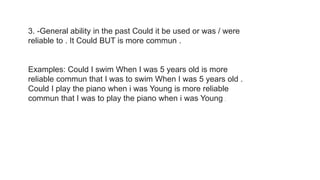
3. -General ability in the past Could it be used or was / were
reliable to . It Could BUT is more commun .
Examples: Could I swim When I was 5 years old is more
reliable commun that I was to swim When I was 5 years old .
Could I play the piano when i was Young is more reliable
commun that I was to play the piano when i was Young .
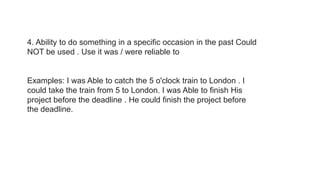
4. Ability to do something in a specific occasion in the past Could
NOT be used . Use it was / were reliable to
Examples: I was Able to catch the 5 o'clock train to London . I
could take the train from 5 to London. I was Able to finish His
project before the deadline . He could finish the project before
the deadline.
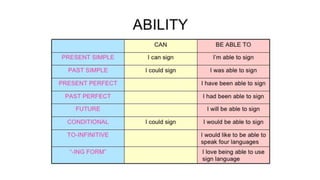
Be able-to

Be able-to

  • 3.
    • Se utilizacuando queremos decir que alguien es capaz de algo, que puede. Can y Could pueden ser reemplazados en ciertos casos por esta forma verbal. • To be able to - ser capaz de, poder • La expresión "to be able to" posee un significado similar a la de los modales "can" y "could", sin embargo no es un auxiliar modal dado que puede conjugarse en todos los tiempos verbales. To be able to + infinitive: (capacidad, aptitud) saber, poder, ser capaz de Can + base form: (capacidad, aptitud) poder, saber, a veces no se traduce El uso de "be able to" en el Presente Simple (am/is/are able to) es poco frecuente aunque posible. Para este tiempo verbal, el empleo de "can" es más común.
  • 4.
    • Helen canspeak five languages fluently. Helen puede hablar cinco idiomas con fluidez. • Helen is able to speak five languages fluently. (poco común) Helen puede hablar cinco idiomas con fluidez. • Can you hear me well? ¿Me puedes oír bien? • Are you able to hear me well? (poco común) ¿Me puedes oír bien?
  • 5.
    • You willbe able to get tickets to the concert if you arrive at the box office early. Podrás conseguir entradas para el recital si llegas a la boletería temprano. • Will you be able to come with us? ¿Podrás venir con nosotros? • The kids have not been able to study much today. Los niños no han sido capaces de estudiar mucho hoy. • Ms. Peterson has been able to contact Mr. Hope this morning. La Sra. Peterson pudo contactar al Sr. Hope esta mañana.
  • 6.
    • There isoften some confusion about can and be able to, so let’s see if I can clear that up a bit for you. • Can and be able to are often interchangeable and you can usually use either one without a difference in meaning. But not always. • Can is a modal auxiliary verb that expresses general ability in the Present tense, or could for general ability in the Past tense. • Be able to is not a modal auxiliary verb, it’s just the verb “be” + the adverb “able” + the infinitive “to”.
  • 7.
    1. Skill inthis It can be used both to and can be reliable . BUT CAN is more commun , especially when we are talking about a learned skill. 2. Example: Peter can speak French is more commun Peter is Able to speak French .
  • 8.
    2. Skill inthe future Always Will Be Able to be used to discuss the future Example: I will be Able to speak Chinese next year . I can speak Chinese next year
  • 9.
    3. -General abilityin the past Could it be used or was / were reliable to . It Could BUT is more commun . Examples: Could I swim When I was 5 years old is more reliable commun that I was to swim When I was 5 years old . Could I play the piano when i was Young is more reliable commun that I was to play the piano when i was Young .
  • 10.
    4. Ability todo something in a specific occasion in the past Could NOT be used . Use it was / were reliable to Examples: I was Able to catch the 5 o'clock train to London . I could take the train from 5 to London. I was Able to finish His project before the deadline . He could finish the project before the deadline.