INVERSION
(inverted subject-verb)
AUBJECT & VERB IN SENTENCES
š Normally, subject will come first and then followed by the verb, especially in affirmative and
negative sentences or in dependent clauses:
We need more experts in agriculture and micro-economy.
Tigers have not been seen for years for years in this forest.
Where the plant will be build is still subject of debate.
š Interrogative sentences, however, the verb (in the form of auxiliaries) come before the subjects:
Have you finished the report?
Why can’t we cash a check in this bank?
How did they mange to arrive before us?
INVERTED SUBJECT-VERB WITH PLACE EXPRESSIONS
š Single place expressions such as There, Here, and Nowhere, if placed in the beginning of a sentence will
the subject and verb invert:
There were thirty thousand people in the camp who need immediate help.
Here is the CD that I told you about
Nowhere did a power plant generate electricity for more than 50 million homes like this one.
š Other place expressions are in the form of prepositional phrase such as Inside the house, Between the
two mountains, Under the tree, Beyond the river, In the classroom etc.
Inside the house were two bedrooms, a kitchen, and a living room.
Between the two mountains lies the city that is known for its majestic view.
Behind the house stood a two-hundred-year-old redwood.
North to the building is the Art Gallery.
Note on Place Expression
š The subject and verb are not inverted if the place expression is not inseparable part of the sentence
regarding the meaning. Compare the following sentences:
In the middle of the plaza lies the Statue of St. Michael.
In the middle of the Plaza people gathered for prayer.
š The S and V in first sentence are inverted because the place expression cannot be omitted to complete
the meaning of the sentence:
“The Statue of St. Michael” cannot stand alone and does not complete meaning.
š While in the second sentence, the S and V are not inverted because the place expression in a pure
adverb and can be omitted without making the sentence incomplete.
“People gathered for prayer” can stand alone and has complete meaning.
š Another example:
On the fourth floor is the fitness center.
On the fourth floor we can find the fitness center.
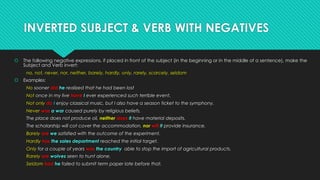
INVERTED SUBJECT & VERB WITH NEGATIVES
š The following negative expressions, if placed in front of the subject (in the beginning or in the middle of a sentence), make the
Subject and Verb invert:
no, not, never, nor, neither, barely, hardly, only, rarely, scarcely, seldom
š Examples:
No sooner did he realized that he had been lost
Not once in my live have I ever experienced such terrible event.
Not only do I enjoy classical music, but I also have a season ticket to the symphony.
Never was a war caused purely by religious beliefs.
The place does not produce oil, neither does it have material deposits.
The scholarship will cot cover the accommodation, nor will it provide insurance.
Barely are we satisfied with the outcome of the experiment.
Hardly has the sales department reached the initial target.
Only for a couple of years was the country able to stop the import of agricultural products.
Rarely are wolves seen to hunt alone.
Seldom had he failed to submit term paper late before that.
NOTES
š Negative expressions like no, not, and only are usually combined with other words and form negative phrases,
such as not until, no sooner, only then, only after, only once, only when etc.
š Examples:
Not until the end of the 19th century did people travel by sea in large vessels.
No sooner had he finished dinner, when she walked in the door.
Only then did she understand the problem.
Only after understanding the situation does the teacher make a comment.
Only when all the trees have been cut will we grasp the significance of forests.
š Other expressions with similar inverted construction are little, so + adjective, and such:
Little have people understood the complexity of global economy.
So difficult is the test that students need three months to prepare.
Such was the moment that all greats traverse.
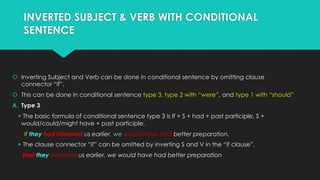
INVERTED SUBJECT & VERB WITH CONDITIONAL
SENTENCE
š Inverting Subject and Verb can be done in conditional sentence by omitting clause
connector “if”.
š This can be done in conditional sentence type 3, type 2 with “were”, and type 1 with “should”
A. Type 3
§ The basic formula of conditional sentence type 3 is If + S + had + past participle, S +
would/could/might have + past participle.
If they had informed us earlier, we would have had better preparation.
§ The clause connector “if” can be omitted by inverting S and V in the “if clause”.
Had they informed us earlier, we would have had better preparation
š More examples:
He would have succeeded if he had put more effort.
He would have succeeded had he put more effort.
The dam might have not perforated if it had not been raining heavily for three days.
The dam might have not perforated had it not been raining heavily for three days.
If the firemen had arrived thirty minutes later, the house could have been completely burnt down.
Had the firemen arrived thirty minutes later, the house could have been completely burnt down
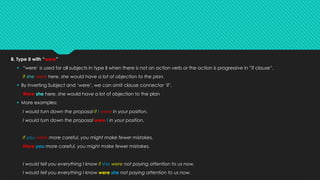
B. Type II with “were”
§ “were’ is used for all subjects in type II when there is not an action verb or the action is progressive in ”if clause”.
If she were here, she would have a lot of objection to the plan.
§ By inverting Subject and ‘were’, we can omit clause connector ‘if’.
Were she here, she would have a lot of objection to the plan
§ More examples:
I would turn down the proposal if I were in your position.
I would turn down the proposal were I in your position.
If you were more careful, you might make fewer mistakes.
Were you more careful, you might make fewer mistakes.
I would tell you everything I know if she were not paying attention to us now.
I would tell you everything I know were she not paying attention to us now.
C. Type One with “should”
With if : If they should contact you, tell them to get all of the documents ready
Without if : Should they contact you, tell them to get all of the documents ready.
With if : We will be delighted to have you as our guest if you should visit the city again.
Without if : We will be delighted to have you as our guest should you visit the city again.
With if : If she should be vacant this afternoon, she will surely see you.
Without if : Should she be vacant this afternoon, she will surely see you.
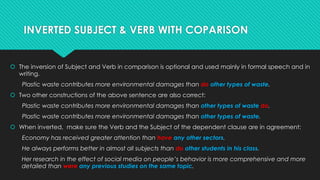
š The inversion of Subject and Verb in comparison is optional and used mainly in formal speech and in
writing.
Plastic waste contributes more environmental damages than do other types of waste.
š Two other constructions of the above sentence are also correct:
Plastic waste contributes more environmental damages than other types of waste do.
Plastic waste contributes more environmental damages than other types of waste.
š When inverted, make sure the Verb and the Subject of the dependent clause are in agreement:
Economy has received greater attention than have any other sectors.
He always performs better in almost all subjects than do other students in his class.
Her research in the effect of social media on people’s behavior is more comprehensive and more
detailed than were any previous studies on the same topic.
INVERTED SUBJECT & VERB WITH COPARISON
EXERCISES
1. We can find such massive metal structure nowhere in the world.
2. The oldest desert stretches five hundred miles to the North and across the border of neighboring countries.
3. On the city square every Sunday people sell various traditional food and crafts.
4. The fountain provides clean water, but also it becomes the icon of the area. (Not only)
5. She had rarely gone out to town until she was married.
6. I barely had a chance to react to what was happening.
7. He gave the information only after he was severely beaten by the interrogating officers.
8. The Teachers’ Association will not attend the forum. The Parents’ Association will not attend the forum (neither).
9. She had not written the term paper. She had not completed other assignments. (nor)
10. I had known little about the history of this place.
11. The village was so remote and secluded that we had to travel forty miles to buy supplies.
12. The team would not have underperformed if it had had sufficient time to recover .
13. If it had not been an emergency situation, we could have delivered the aid earlier.
14. We would be able to proceed if the machinery were not in trouble.
15. If you should see him after work, please tell him to return the report immediately.
16. His last album is much more impressive than his three previous albums
ANSWERS
1. Nowhere in the world can we find such massive metal structure.
2. Five hundred miles to the North and across the border of neighboring countries stretches oldest desert.
3. On the city square every Sunday people sell various traditional food and crafts.
4. Not only does the fountain provide clean water, but also it becomes the icon of the area.
5. Rarely had she gone out to town until she was married.
6. Barely did I have a chance to react to what was happening.
7. Only after he was severely beaten by the interrogating officers did he give the information.
8. The Teachers’ Association will not attend the forum, neither will The Parents’ Association.
9. She had not written the term paper, nor had she completed other assignments.
10. Little had I known about the history of this place.
11. So remote and secluded was the village that we had to travel forty miles to buy supplies.
12. The team would not have underperformed had it had sufficient time to recover .
13. Had it not been an emergency situation, we could have delivered the aid earlier.
14. We would be able to proceed were the machinery were not in trouble.
15. Should you see him after work, please tell him to return the report immediately.
16. His last album is much more impressive than were his three previous albums

English Inversion.pdf

  • 1.
  • 2.
    AUBJECT & VERBIN SENTENCES š Normally, subject will come first and then followed by the verb, especially in affirmative and negative sentences or in dependent clauses: We need more experts in agriculture and micro-economy. Tigers have not been seen for years for years in this forest. Where the plant will be build is still subject of debate. š Interrogative sentences, however, the verb (in the form of auxiliaries) come before the subjects: Have you finished the report? Why can’t we cash a check in this bank? How did they mange to arrive before us?
  • 3.
    INVERTED SUBJECT-VERB WITHPLACE EXPRESSIONS š Single place expressions such as There, Here, and Nowhere, if placed in the beginning of a sentence will the subject and verb invert: There were thirty thousand people in the camp who need immediate help. Here is the CD that I told you about Nowhere did a power plant generate electricity for more than 50 million homes like this one. š Other place expressions are in the form of prepositional phrase such as Inside the house, Between the two mountains, Under the tree, Beyond the river, In the classroom etc. Inside the house were two bedrooms, a kitchen, and a living room. Between the two mountains lies the city that is known for its majestic view. Behind the house stood a two-hundred-year-old redwood. North to the building is the Art Gallery.
  • 4.
    Note on PlaceExpression š The subject and verb are not inverted if the place expression is not inseparable part of the sentence regarding the meaning. Compare the following sentences: In the middle of the plaza lies the Statue of St. Michael. In the middle of the Plaza people gathered for prayer. š The S and V in first sentence are inverted because the place expression cannot be omitted to complete the meaning of the sentence: “The Statue of St. Michael” cannot stand alone and does not complete meaning. š While in the second sentence, the S and V are not inverted because the place expression in a pure adverb and can be omitted without making the sentence incomplete. “People gathered for prayer” can stand alone and has complete meaning. š Another example: On the fourth floor is the fitness center. On the fourth floor we can find the fitness center.
  • 5.
    INVERTED SUBJECT &VERB WITH NEGATIVES š The following negative expressions, if placed in front of the subject (in the beginning or in the middle of a sentence), make the Subject and Verb invert: no, not, never, nor, neither, barely, hardly, only, rarely, scarcely, seldom š Examples: No sooner did he realized that he had been lost Not once in my live have I ever experienced such terrible event. Not only do I enjoy classical music, but I also have a season ticket to the symphony. Never was a war caused purely by religious beliefs. The place does not produce oil, neither does it have material deposits. The scholarship will cot cover the accommodation, nor will it provide insurance. Barely are we satisfied with the outcome of the experiment. Hardly has the sales department reached the initial target. Only for a couple of years was the country able to stop the import of agricultural products. Rarely are wolves seen to hunt alone. Seldom had he failed to submit term paper late before that.
  • 6.
    NOTES š Negative expressionslike no, not, and only are usually combined with other words and form negative phrases, such as not until, no sooner, only then, only after, only once, only when etc. š Examples: Not until the end of the 19th century did people travel by sea in large vessels. No sooner had he finished dinner, when she walked in the door. Only then did she understand the problem. Only after understanding the situation does the teacher make a comment. Only when all the trees have been cut will we grasp the significance of forests. š Other expressions with similar inverted construction are little, so + adjective, and such: Little have people understood the complexity of global economy. So difficult is the test that students need three months to prepare. Such was the moment that all greats traverse.
  • 7.
    INVERTED SUBJECT &VERB WITH CONDITIONAL SENTENCE š Inverting Subject and Verb can be done in conditional sentence by omitting clause connector “if”. š This can be done in conditional sentence type 3, type 2 with “were”, and type 1 with “should” A. Type 3 § The basic formula of conditional sentence type 3 is If + S + had + past participle, S + would/could/might have + past participle. If they had informed us earlier, we would have had better preparation. § The clause connector “if” can be omitted by inverting S and V in the “if clause”. Had they informed us earlier, we would have had better preparation
  • 8.
    š More examples: Hewould have succeeded if he had put more effort. He would have succeeded had he put more effort. The dam might have not perforated if it had not been raining heavily for three days. The dam might have not perforated had it not been raining heavily for three days. If the firemen had arrived thirty minutes later, the house could have been completely burnt down. Had the firemen arrived thirty minutes later, the house could have been completely burnt down
  • 9.
    B. Type IIwith “were” § “were’ is used for all subjects in type II when there is not an action verb or the action is progressive in ”if clause”. If she were here, she would have a lot of objection to the plan. § By inverting Subject and ‘were’, we can omit clause connector ‘if’. Were she here, she would have a lot of objection to the plan § More examples: I would turn down the proposal if I were in your position. I would turn down the proposal were I in your position. If you were more careful, you might make fewer mistakes. Were you more careful, you might make fewer mistakes. I would tell you everything I know if she were not paying attention to us now. I would tell you everything I know were she not paying attention to us now.
  • 10.
    C. Type Onewith “should” With if : If they should contact you, tell them to get all of the documents ready Without if : Should they contact you, tell them to get all of the documents ready. With if : We will be delighted to have you as our guest if you should visit the city again. Without if : We will be delighted to have you as our guest should you visit the city again. With if : If she should be vacant this afternoon, she will surely see you. Without if : Should she be vacant this afternoon, she will surely see you.
  • 11.
    š The inversionof Subject and Verb in comparison is optional and used mainly in formal speech and in writing. Plastic waste contributes more environmental damages than do other types of waste. š Two other constructions of the above sentence are also correct: Plastic waste contributes more environmental damages than other types of waste do. Plastic waste contributes more environmental damages than other types of waste. š When inverted, make sure the Verb and the Subject of the dependent clause are in agreement: Economy has received greater attention than have any other sectors. He always performs better in almost all subjects than do other students in his class. Her research in the effect of social media on people’s behavior is more comprehensive and more detailed than were any previous studies on the same topic. INVERTED SUBJECT & VERB WITH COPARISON
  • 12.
    EXERCISES 1. We canfind such massive metal structure nowhere in the world. 2. The oldest desert stretches five hundred miles to the North and across the border of neighboring countries. 3. On the city square every Sunday people sell various traditional food and crafts. 4. The fountain provides clean water, but also it becomes the icon of the area. (Not only) 5. She had rarely gone out to town until she was married. 6. I barely had a chance to react to what was happening. 7. He gave the information only after he was severely beaten by the interrogating officers. 8. The Teachers’ Association will not attend the forum. The Parents’ Association will not attend the forum (neither). 9. She had not written the term paper. She had not completed other assignments. (nor) 10. I had known little about the history of this place. 11. The village was so remote and secluded that we had to travel forty miles to buy supplies. 12. The team would not have underperformed if it had had sufficient time to recover . 13. If it had not been an emergency situation, we could have delivered the aid earlier. 14. We would be able to proceed if the machinery were not in trouble. 15. If you should see him after work, please tell him to return the report immediately. 16. His last album is much more impressive than his three previous albums
  • 13.
    ANSWERS 1. Nowhere inthe world can we find such massive metal structure. 2. Five hundred miles to the North and across the border of neighboring countries stretches oldest desert. 3. On the city square every Sunday people sell various traditional food and crafts. 4. Not only does the fountain provide clean water, but also it becomes the icon of the area. 5. Rarely had she gone out to town until she was married. 6. Barely did I have a chance to react to what was happening. 7. Only after he was severely beaten by the interrogating officers did he give the information. 8. The Teachers’ Association will not attend the forum, neither will The Parents’ Association. 9. She had not written the term paper, nor had she completed other assignments. 10. Little had I known about the history of this place. 11. So remote and secluded was the village that we had to travel forty miles to buy supplies. 12. The team would not have underperformed had it had sufficient time to recover . 13. Had it not been an emergency situation, we could have delivered the aid earlier. 14. We would be able to proceed were the machinery were not in trouble. 15. Should you see him after work, please tell him to return the report immediately. 16. His last album is much more impressive than were his three previous albums