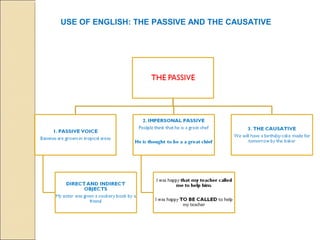
USE OF ENGLISH: THE PASSIVE AND THE CAUSATIVE
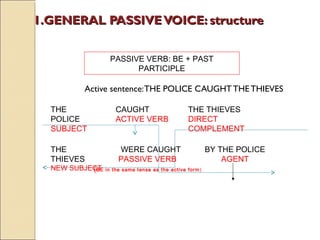
1.GENERAL PASSIVE VVOOIICCEE:: ssttrruuccttuurree 
PASSIVE VERB: BE + PAST 
Active sentence: THE POLICE CAUGHT THE THIEVES 
THE 
POLICE 
SUBJECT 
CAUGHT 
ACTIVE VERB 
THE THIEVES 
DIRECT 
COMPLEMENT 
PARTICIPLE 
THE 
THIEVES 
NEW SUBJECT 
WERE CAUGHT 
PASSIVE VERB 
(BE in the same tense as the active form) 
BY THE POLICE 
AGENT
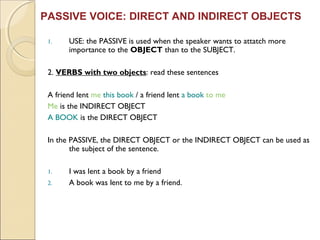
PASSIVE VOICE: DIRECT AND INDIRECT OBJECTS 
1. USE: the PASSIVE is used when the speaker wants to attatch more 
importance to the OBJECT than to the SUBJECT. 
2. VERBS with two objects: read these sentences 
A friend lent me this book / a friend lent a book to me 
Me is the INDIRECT OBJECT 
A BOOK is the DIRECT OBJECT 
In the PASSIVE, the DIRECT OBJECT or the INDIRECT OBJECT can be used as 
the subject of the sentence. 
1. I was lent a book by a friend 
2. A book was lent to me by a friend.
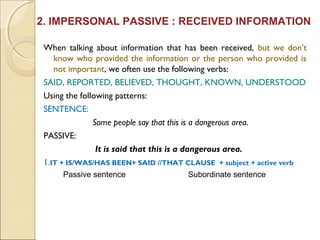
2. IMPERSONAL PASSIVE : RECEIVED INFORMATION 
When talking about information that has been received, but we don’t 
know who provided the information or the person who provided is 
not important, we often use the following verbs: 
SAID, REPORTED, BELIEVED, THOUGHT, KNOWN, UNDERSTOOD 
Using the following patterns: 
SENTENCE: 
Some people say that this is a dangerous area. 
PASSIVE: 
It is said that this is a dangerous area. 
1.IT + IS/WAS/HAS BEEN+ SAID //THAT CLAUSE + subject + active verb 
Passive sentence Subordinate sentence
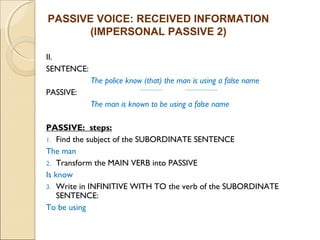
PASSIVE VOICE: RECEIVED INFORMATION 
II. 
SENTENCE: 
(IMPERSONAL PASSIVE 2) 
The police know (that) the man is using a false name 
PASSIVE: 
The man is known to be using a false name 
PASSIVE: steps: 
1. Find the subject of the SUBORDINATE SENTENCE 
The man 
2. Transform the MAIN VERB into PASSIVE 
Is know 
3. Write in INFINITIVE WITH TO the verb of the SUBORDINATE 
SENTENCE: 
To be using
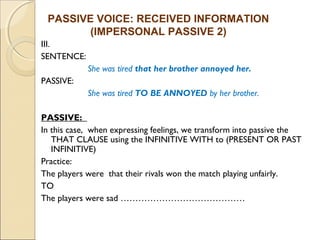
PASSIVE VOICE: RECEIVED INFORMATION 
III. 
SENTENCE: 
(IMPERSONAL PASSIVE 2) 
She was tired that her brother annoyed her. 
PASSIVE: 
She was tired TO BE ANNOYED by her brother. 
PASSIVE: 
In this case, when expressing feelings, we transform into passive the 
THAT CLAUSE using the INFINITIVE WITH to (PRESENT OR PAST 
INFINITIVE) 
Practice: 
The players were that their rivals won the match playing unfairly. 
TO 
The players were sad ……………………………………
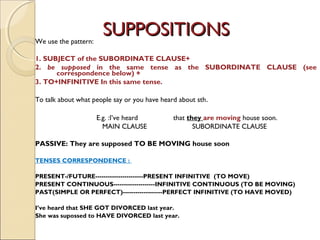
SSUUPPPPOOSSIITTIIOONNSS 
We use the pattern: 
1. SUBJECT of the SUBORDINATE CLAUSE+ 
2. be supposed in the same tense as the SUBORDINATE CLAUSE (see 
correspondence below) + 
3. TO+INFINITIVE In this same tense. 
To talk about what people say or you have heard about sth. 
E.g. :I’ve heard that they are moving house soon. 
MAIN CLAUSE SUBORDINATE CLAUSE 
PASSIVE: They are supposed TO BE MOVING house soon 
TENSES CORRESPONDENCE : 
PRESENT-/FUTURE-----------------------PRESENT INFINITIVE (TO MOVE) 
PRESENT CONTINUOUS--------------------INFINITIVE CONTINUOUS (TO BE MOVING) 
PAST(SIMPLE OR PERFECT)-------------------PERFECT INFINITIVE (TO HAVE MOVED) 
I’ve heard that SHE GOT DIVORCED last year. 
She was supossed to HAVE DIVORCED last year.
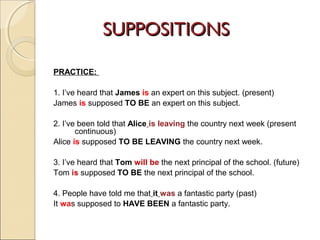
SSUUPPPPOOSSIITTIIOONNSS 
PRACTICE: 
1. I’ve heard that James is an expert on this subject. (present) 
James is supposed TO BE an expert on this subject. 
2. I’ve been told that Alice is leaving the country next week (present 
continuous) 
Alice is supposed TO BE LEAVING the country next week. 
3. I’ve heard that Tom will be the next principal of the school. (future) 
Tom is supposed TO BE the next principal of the school. 
4. People have told me that it was a fantastic party (past) 
It was supposed to HAVE BEEN a fantastic party.
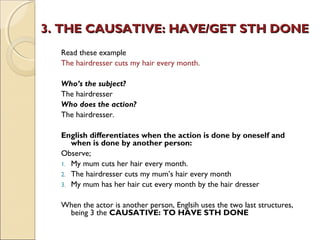
3. THE CAUSATIVE: HHAAVVEE//GGEETT SSTTHH DDOONNEE 
Read these example 
The hairdresser cuts my hair every month. 
Who’s the subject? 
The hairdresser 
Who does the action? 
The hairdresser. 
English differentiates when the action is done by oneself and 
when is done by another person: 
Observe; 
1. My mum cuts her hair every month. 
2. The hairdresser cuts my mum’s hair every month 
3. My mum has her hair cut every month by the hair dresser 
When the actor is another person, Englsih uses the two last structures, 
being 3 the CAUSATIVE: TO HAVE STH DONE
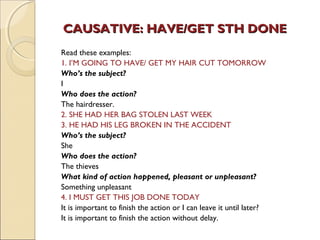
CAUSATIVE: HHAAVVEE//GGEETT SSTTHH DDOONNEE 
Read these examples: 
1. I’M GOING TO HAVE/ GET MY HAIR CUT TOMORROW 
Who’s the subject? 
I 
Who does the action? 
The hairdresser. 
2. SHE HAD HER BAG STOLEN LAST WEEK 
3. HE HAD HIS LEG BROKEN IN THE ACCIDENT 
Who’s the subject? 
She 
Who does the action? 
The thieves 
What kind of action happened, pleasant or unpleasant? 
Something unpleasant 
4. I MUST GET THIS JOB DONE TODAY 
It is important to finish the action or I can leave it until later? 
It is important to finish the action without delay.
CAUSATIVE: HHAAVVEE//GGEETT SSTTHH DDOONNEE 
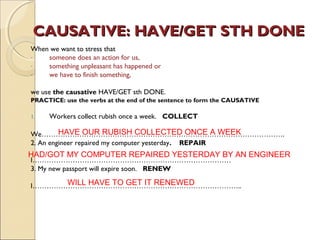
When we want to stress that 
- someone does an action for us, 
- something unpleasant has happened or 
- we have to finish something, 
we use the causative HAVE/GET sth DONE. 
PRACTICE: use the verbs at the end of the sentence to form the CAUSATIVE 
1. Workers collect rubish once a week. COLLECT 
HAVE OUR RUBISH COLLECTED ONCE A WEEK 
We…………………………………………………………………………………………. 
2. An engineer repaired my computer yesterday. REPAIR 
I………………………………………………………………………… 
3. My new passport will expire soon. RENEW 
I…………………………………………………………………………….. 
HAD/GOT MY COMPUTER REPAIRED YESTERDAY BY AN ENGINEER 
WILL HAVE TO GET IT RENEWED
UUSSEE OOFF EENNGGLLIISSHH,, PPAARRTT 44 
PASSIVES AND 
CAUSATIVE 
practice
USE OF ENGLISH, PART 4. 
PASSIVES AND CAUSATIVE 
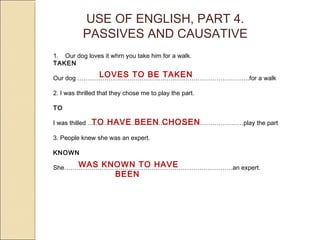
1. Our dog loves it whrn you take him for a walk. 
TAKEN 
Our dog ………………………….…………………………………………….LOVES TO BE TAKEN 
for a walk 
2. I was thrilled that they chose me to play the part. 
TO 
I was thilled …………………………………………………………………TO HAVE BEEN CHOSEN 
play the part 
3. People knew she was an expert. 
KNOWN 
She………………………………………………………………………WAS KNOWN TO HAVE 
an expert. 
BEEN
USE OF ENGLISH, PART 4. 
PASSIVES AND CAUSATIVE 
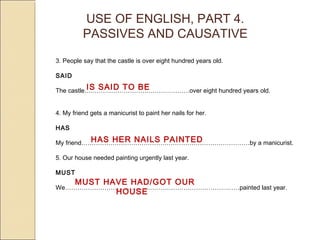
3. People say that the castle is over eight hundred years old. 
SAID 
The castle….………………………….…………….IS SAID TO BE 
over eight hundred years old. 
4. My friend gets a manicurist to paint her nails for her. 
HAS 
My friend………………………………………………………………………HAS HER NAILS PAINTED 
by a manicurist. 
5. Our house needed painting urgently last year. 
MUST 
MUST HAVE HAD/GOT OUR 
We…………………………………………………………………………painted last year. 
HOUSE
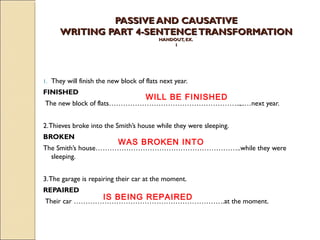
PPAASSSSIIVVEE AANNDD CCAAUUSSAATTIIVVEE 
WWRRIITTIINNGG PPAARRTT 44--SSEENNTTEENNCCEE TTRRAANNSSFFOORRMMAATTIIOONN 
HHAANNDDOOUUTT,, EEXX.. 
11 
1. They will finish the new block of flats next year. 
FINISHED 
WILL BE FINISHED 
The new block of flats………………………………………………..,..…next year. 
2. Thieves broke into the Smith’s house while they were sleeping. 
BROKEN 
WAS BROKEN INTO 
The Smith’s house……………………………………………………..while they were 
sleeping. 
3. The garage is repairing their car at the moment. 
REPAIRED 
IS BEING REPAIRED 
Their car ……………………………………………………….at the moment.
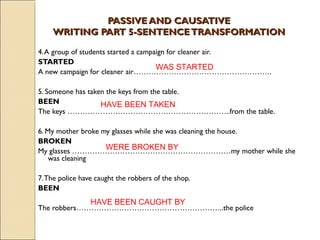
PPAASSSSIIVVEE AANNDD CCAAUUSSAATTIIVVEE 
WWRRIITTIINNGG PPAARRTT 55--SSEENNTTEENNCCEE TTRRAANNSSFFOORRMMAATTIIOONN 
4. A group of students started a campaign for cleaner air. 
STARTED 
WAS STARTED 
A new campaign for cleaner air………………………………………………. 
5. Someone has taken the keys from the table. 
BEEN 
HAVE BEEN TAKEN 
The keys ………………………………………………………..from the table. 
6. My mother broke my glasses while she was cleaning the house. 
BROKEN 
My glasses ………………………………………………………my mother while she 
was cleaning 
WERE BROKEN BY 
7. The police have caught the robbers of the shop. 
BEEN 
HAVE BEEN CAUGHT BY 
The robbers…………………………………………………..the police
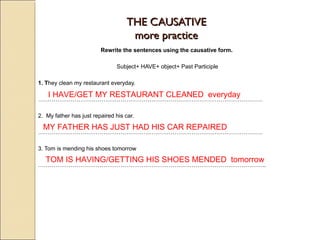
TTHHEE CCAAUUSSAATTIIVVEE 
mmoorree pprraaccttiiccee 
Rewrite the sentences using the causative form. 
Subject+ HAVE+ object+ Past Participle 
1. They clean my restaurant everyday. 
I HAVE/GET MY RESTAURANT CLEANED everyday 
……………………………………………………………………………………………………… 
2. My father has just repaired his car. 
MY FATHER HAS JUST HAD HIS CAR REPAIRED 
……………………………………………………………………………………………………… 
3. Tom is mending his shoes tomorrow 
TOM IS HAVING/GETTING HIS SHOES MENDED tomorrow 
………………………………………………………………………………………………………..
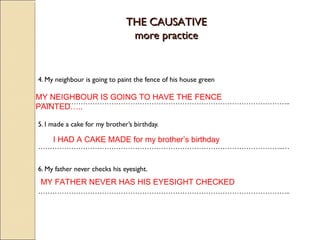
TTHHEE CCAAUUSSAATTIIVVEE 
mmoorree pprraaccttiiccee 
4. My neighbour is going to paint the fence of his house green 
MY NEIGHBOUR IS GOING TO HAVE THE FENCE 
PAINTED….. 
…………………………………………………………………………………………….. 
5. I made a cake for my brother’s birthday. 
I HAD A CAKE MADE for my brother’s birthday 
…………………………………………………………………………………………..… 
6. My father never checks his eyesight. 
MY FATHER NEVER HAS HIS EYESIGHT CHECKED 
……………………………………………………………………………………………..

Passive and causative

  • 2.
    USE OF ENGLISH:THE PASSIVE AND THE CAUSATIVE
  • 3.
    1.GENERAL PASSIVE VVOOIICCEE::ssttrruuccttuurree PASSIVE VERB: BE + PAST Active sentence: THE POLICE CAUGHT THE THIEVES THE POLICE SUBJECT CAUGHT ACTIVE VERB THE THIEVES DIRECT COMPLEMENT PARTICIPLE THE THIEVES NEW SUBJECT WERE CAUGHT PASSIVE VERB (BE in the same tense as the active form) BY THE POLICE AGENT
  • 4.
    PASSIVE VOICE: DIRECTAND INDIRECT OBJECTS 1. USE: the PASSIVE is used when the speaker wants to attatch more importance to the OBJECT than to the SUBJECT. 2. VERBS with two objects: read these sentences A friend lent me this book / a friend lent a book to me Me is the INDIRECT OBJECT A BOOK is the DIRECT OBJECT In the PASSIVE, the DIRECT OBJECT or the INDIRECT OBJECT can be used as the subject of the sentence. 1. I was lent a book by a friend 2. A book was lent to me by a friend.
  • 5.
    2. IMPERSONAL PASSIVE: RECEIVED INFORMATION When talking about information that has been received, but we don’t know who provided the information or the person who provided is not important, we often use the following verbs: SAID, REPORTED, BELIEVED, THOUGHT, KNOWN, UNDERSTOOD Using the following patterns: SENTENCE: Some people say that this is a dangerous area. PASSIVE: It is said that this is a dangerous area. 1.IT + IS/WAS/HAS BEEN+ SAID //THAT CLAUSE + subject + active verb Passive sentence Subordinate sentence
  • 6.
    PASSIVE VOICE: RECEIVEDINFORMATION II. SENTENCE: (IMPERSONAL PASSIVE 2) The police know (that) the man is using a false name PASSIVE: The man is known to be using a false name PASSIVE: steps: 1. Find the subject of the SUBORDINATE SENTENCE The man 2. Transform the MAIN VERB into PASSIVE Is know 3. Write in INFINITIVE WITH TO the verb of the SUBORDINATE SENTENCE: To be using
  • 7.
    PASSIVE VOICE: RECEIVEDINFORMATION III. SENTENCE: (IMPERSONAL PASSIVE 2) She was tired that her brother annoyed her. PASSIVE: She was tired TO BE ANNOYED by her brother. PASSIVE: In this case, when expressing feelings, we transform into passive the THAT CLAUSE using the INFINITIVE WITH to (PRESENT OR PAST INFINITIVE) Practice: The players were that their rivals won the match playing unfairly. TO The players were sad ……………………………………
  • 8.
    SSUUPPPPOOSSIITTIIOONNSS We usethe pattern: 1. SUBJECT of the SUBORDINATE CLAUSE+ 2. be supposed in the same tense as the SUBORDINATE CLAUSE (see correspondence below) + 3. TO+INFINITIVE In this same tense. To talk about what people say or you have heard about sth. E.g. :I’ve heard that they are moving house soon. MAIN CLAUSE SUBORDINATE CLAUSE PASSIVE: They are supposed TO BE MOVING house soon TENSES CORRESPONDENCE : PRESENT-/FUTURE-----------------------PRESENT INFINITIVE (TO MOVE) PRESENT CONTINUOUS--------------------INFINITIVE CONTINUOUS (TO BE MOVING) PAST(SIMPLE OR PERFECT)-------------------PERFECT INFINITIVE (TO HAVE MOVED) I’ve heard that SHE GOT DIVORCED last year. She was supossed to HAVE DIVORCED last year.
  • 9.
    SSUUPPPPOOSSIITTIIOONNSS PRACTICE: 1.I’ve heard that James is an expert on this subject. (present) James is supposed TO BE an expert on this subject. 2. I’ve been told that Alice is leaving the country next week (present continuous) Alice is supposed TO BE LEAVING the country next week. 3. I’ve heard that Tom will be the next principal of the school. (future) Tom is supposed TO BE the next principal of the school. 4. People have told me that it was a fantastic party (past) It was supposed to HAVE BEEN a fantastic party.
  • 10.
    3. THE CAUSATIVE:HHAAVVEE//GGEETT SSTTHH DDOONNEE Read these example The hairdresser cuts my hair every month. Who’s the subject? The hairdresser Who does the action? The hairdresser. English differentiates when the action is done by oneself and when is done by another person: Observe; 1. My mum cuts her hair every month. 2. The hairdresser cuts my mum’s hair every month 3. My mum has her hair cut every month by the hair dresser When the actor is another person, Englsih uses the two last structures, being 3 the CAUSATIVE: TO HAVE STH DONE
  • 11.
    CAUSATIVE: HHAAVVEE//GGEETT SSTTHHDDOONNEE Read these examples: 1. I’M GOING TO HAVE/ GET MY HAIR CUT TOMORROW Who’s the subject? I Who does the action? The hairdresser. 2. SHE HAD HER BAG STOLEN LAST WEEK 3. HE HAD HIS LEG BROKEN IN THE ACCIDENT Who’s the subject? She Who does the action? The thieves What kind of action happened, pleasant or unpleasant? Something unpleasant 4. I MUST GET THIS JOB DONE TODAY It is important to finish the action or I can leave it until later? It is important to finish the action without delay.
  • 12.
    CAUSATIVE: HHAAVVEE//GGEETT SSTTHHDDOONNEE When we want to stress that - someone does an action for us, - something unpleasant has happened or - we have to finish something, we use the causative HAVE/GET sth DONE. PRACTICE: use the verbs at the end of the sentence to form the CAUSATIVE 1. Workers collect rubish once a week. COLLECT HAVE OUR RUBISH COLLECTED ONCE A WEEK We…………………………………………………………………………………………. 2. An engineer repaired my computer yesterday. REPAIR I………………………………………………………………………… 3. My new passport will expire soon. RENEW I…………………………………………………………………………….. HAD/GOT MY COMPUTER REPAIRED YESTERDAY BY AN ENGINEER WILL HAVE TO GET IT RENEWED
  • 13.
    UUSSEE OOFF EENNGGLLIISSHH,,PPAARRTT 44 PASSIVES AND CAUSATIVE practice
  • 14.
    USE OF ENGLISH,PART 4. PASSIVES AND CAUSATIVE 1. Our dog loves it whrn you take him for a walk. TAKEN Our dog ………………………….…………………………………………….LOVES TO BE TAKEN for a walk 2. I was thrilled that they chose me to play the part. TO I was thilled …………………………………………………………………TO HAVE BEEN CHOSEN play the part 3. People knew she was an expert. KNOWN She………………………………………………………………………WAS KNOWN TO HAVE an expert. BEEN
  • 15.
    USE OF ENGLISH,PART 4. PASSIVES AND CAUSATIVE 3. People say that the castle is over eight hundred years old. SAID The castle….………………………….…………….IS SAID TO BE over eight hundred years old. 4. My friend gets a manicurist to paint her nails for her. HAS My friend………………………………………………………………………HAS HER NAILS PAINTED by a manicurist. 5. Our house needed painting urgently last year. MUST MUST HAVE HAD/GOT OUR We…………………………………………………………………………painted last year. HOUSE
  • 16.
    PPAASSSSIIVVEE AANNDD CCAAUUSSAATTIIVVEE WWRRIITTIINNGG PPAARRTT 44--SSEENNTTEENNCCEE TTRRAANNSSFFOORRMMAATTIIOONN HHAANNDDOOUUTT,, EEXX.. 11 1. They will finish the new block of flats next year. FINISHED WILL BE FINISHED The new block of flats………………………………………………..,..…next year. 2. Thieves broke into the Smith’s house while they were sleeping. BROKEN WAS BROKEN INTO The Smith’s house……………………………………………………..while they were sleeping. 3. The garage is repairing their car at the moment. REPAIRED IS BEING REPAIRED Their car ……………………………………………………….at the moment.
  • 17.
    PPAASSSSIIVVEE AANNDD CCAAUUSSAATTIIVVEE WWRRIITTIINNGG PPAARRTT 55--SSEENNTTEENNCCEE TTRRAANNSSFFOORRMMAATTIIOONN 4. A group of students started a campaign for cleaner air. STARTED WAS STARTED A new campaign for cleaner air………………………………………………. 5. Someone has taken the keys from the table. BEEN HAVE BEEN TAKEN The keys ………………………………………………………..from the table. 6. My mother broke my glasses while she was cleaning the house. BROKEN My glasses ………………………………………………………my mother while she was cleaning WERE BROKEN BY 7. The police have caught the robbers of the shop. BEEN HAVE BEEN CAUGHT BY The robbers…………………………………………………..the police
  • 18.
    TTHHEE CCAAUUSSAATTIIVVEE mmoorreepprraaccttiiccee Rewrite the sentences using the causative form. Subject+ HAVE+ object+ Past Participle 1. They clean my restaurant everyday. I HAVE/GET MY RESTAURANT CLEANED everyday ……………………………………………………………………………………………………… 2. My father has just repaired his car. MY FATHER HAS JUST HAD HIS CAR REPAIRED ……………………………………………………………………………………………………… 3. Tom is mending his shoes tomorrow TOM IS HAVING/GETTING HIS SHOES MENDED tomorrow ………………………………………………………………………………………………………..
  • 19.
    TTHHEE CCAAUUSSAATTIIVVEE mmoorreepprraaccttiiccee 4. My neighbour is going to paint the fence of his house green MY NEIGHBOUR IS GOING TO HAVE THE FENCE PAINTED….. …………………………………………………………………………………………….. 5. I made a cake for my brother’s birthday. I HAD A CAKE MADE for my brother’s birthday …………………………………………………………………………………………..… 6. My father never checks his eyesight. MY FATHER NEVER HAS HIS EYESIGHT CHECKED ……………………………………………………………………………………………..