Which one you go for?? Nokia E-71   Nokia 6030   Nokia 3310
Presented By N oman A nil   F ahad A dil RISK IN CAPITAL BUDGETING AND TIME VALUE OF MONEY
Investors Main Strategies
 
Simple & Compound Interest Simple Interest:  Interest continues to accrue over a period of time at a given rate. SI = P(r)(n) Compounding of interest: compensation for the investor not actually receiving interest periodically. A = P (1+ r)n
Future & Present value Future Value :  Value that money will acquire in future, if compounded at a given rate of return. FV = PV (1+r)n Present Value:  Value of money that is expected in future, today . PV = FV/ (1+r)n
 
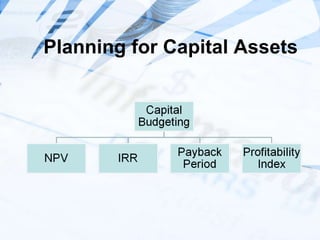
What is Capital Budgeting? Capital budgeting is used to determine the requirements of the long-term investments of a company. Examples of long-term investments are those required for replacement of equipments and machinery.
Purpose…
Planning for Capital Assets
Approaches NPV: If we consider a series of cash flows, and compute present values of all the cash flows at a particular discounting rate, and then sum up the present values, the result is called  net present value . NPV = CF0 – (CF1/(1+r)1 +CF2/(1+r)2+ .....+CFn/(1+r)n) IRR:  The word internal or implicit is only to state that on the face of it, the rate was not explicit. IRR is the rate where NPV = 0 NPV = 0 = CF0 – (CF1/(1+r)1 +CF2/(1+r)2+ .....+CFn/(1+r)n) Or; CF0 = (CF1/(1+r)1 +CF2/(1+r)2+ .....+CFn/(1+r)n)  
Approaches Profitability Index: A ratio of whether and how much an investment will result in a profit. It is calculated by taking the NPV of expected future cash flows from an investment and dividing by the investment's original cost. A ratio above one indicates that the investment will be profitable, while a ratio below one means that it will not. PI=PV of future cash flows/ Initial Investment Payback Period: The length of time it takes to recover the cost of an investment. It is calculated as shown here:    PB= Cost of Project/ Annual Cash Inflows
 
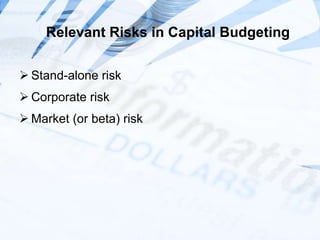
Relevant Risks in Capital Budgeting Stand-alone risk Corporate risk Market (or beta) risk
Stand-Alone Risk The project’s risk if it were the firm’s only asset and there were no shareholders. Ignores both firm and shareholder diversification.  Measured by the    or CV of NPV, IRR, or MIRR.
Corporate Risk Reflects the project’s effect on corporate earnings stability. Considers firm’s other assets (diversification within firm). Depends on: project’s   , and its correlation with returns on  firm’s other assets. Measured by the project’s corporate beta.
Market Risk Reflects the project’s effect on a well-diversified stock portfolio. Takes account of stockholders’ other assets.  Depends on project’s    and correlation with the stock market. Measured by the project’s market beta.
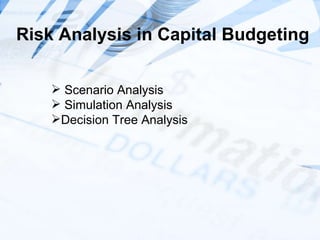
Risk Analysis in Capital Budgeting Scenario Analysis Simulation Analysis Decision Tree Analysis
Scenario Analysis Examines several possible situations, usually  worst  case,  most likely  case, and  best  case. Provides a  range  of possible outcomes.
Examples Scenario   Probability   NPV(000) Worst  0.25 $  15 Base  0.50 82   Best  0.25 148 E(NPV) = $  82  (NPV) =  47 CV(NPV) =   (NPV)/E(NPV) = 0.57 Since CV = 0.57 > 0.4, this project has  high risk .
Simulation Analysis A computerized version of scenario analysis which uses  continuous probability distributions . Computer selects values for each variable based on given probability distributions.
Example NPV and IRR are calculated. Process is repeated many times (1,000 or more). End result:  Probability distribution of NPV and IRR based on sample of simulated values. Also gives   NPV , CV NPV , probability of NPV > 0.
 
 
Noman Usman Anil Saleem Fahad Ali Adil Rahman

Risk In Capital Budgeting

  • 1.
    Which one yougo for?? Nokia E-71 Nokia 6030 Nokia 3310
  • 2.
    Presented By Noman A nil F ahad A dil RISK IN CAPITAL BUDGETING AND TIME VALUE OF MONEY
  • 3.
  • 4.
  • 5.
    Simple & CompoundInterest Simple Interest: Interest continues to accrue over a period of time at a given rate. SI = P(r)(n) Compounding of interest: compensation for the investor not actually receiving interest periodically. A = P (1+ r)n
  • 6.
    Future & Presentvalue Future Value : Value that money will acquire in future, if compounded at a given rate of return. FV = PV (1+r)n Present Value: Value of money that is expected in future, today . PV = FV/ (1+r)n
  • 7.
  • 8.
    What is CapitalBudgeting? Capital budgeting is used to determine the requirements of the long-term investments of a company. Examples of long-term investments are those required for replacement of equipments and machinery.
  • 9.
  • 10.
  • 11.
    Approaches NPV: Ifwe consider a series of cash flows, and compute present values of all the cash flows at a particular discounting rate, and then sum up the present values, the result is called net present value . NPV = CF0 – (CF1/(1+r)1 +CF2/(1+r)2+ .....+CFn/(1+r)n) IRR: The word internal or implicit is only to state that on the face of it, the rate was not explicit. IRR is the rate where NPV = 0 NPV = 0 = CF0 – (CF1/(1+r)1 +CF2/(1+r)2+ .....+CFn/(1+r)n) Or; CF0 = (CF1/(1+r)1 +CF2/(1+r)2+ .....+CFn/(1+r)n)  
  • 12.
    Approaches Profitability Index:A ratio of whether and how much an investment will result in a profit. It is calculated by taking the NPV of expected future cash flows from an investment and dividing by the investment's original cost. A ratio above one indicates that the investment will be profitable, while a ratio below one means that it will not. PI=PV of future cash flows/ Initial Investment Payback Period: The length of time it takes to recover the cost of an investment. It is calculated as shown here: PB= Cost of Project/ Annual Cash Inflows
  • 13.
  • 14.
    Relevant Risks inCapital Budgeting Stand-alone risk Corporate risk Market (or beta) risk
  • 15.
    Stand-Alone Risk Theproject’s risk if it were the firm’s only asset and there were no shareholders. Ignores both firm and shareholder diversification. Measured by the  or CV of NPV, IRR, or MIRR.
  • 16.
    Corporate Risk Reflectsthe project’s effect on corporate earnings stability. Considers firm’s other assets (diversification within firm). Depends on: project’s  , and its correlation with returns on firm’s other assets. Measured by the project’s corporate beta.
  • 17.
    Market Risk Reflectsthe project’s effect on a well-diversified stock portfolio. Takes account of stockholders’ other assets. Depends on project’s  and correlation with the stock market. Measured by the project’s market beta.
  • 18.
    Risk Analysis inCapital Budgeting Scenario Analysis Simulation Analysis Decision Tree Analysis
  • 19.
    Scenario Analysis Examinesseveral possible situations, usually worst case, most likely case, and best case. Provides a range of possible outcomes.
  • 20.
    Examples Scenario Probability NPV(000) Worst 0.25 $ 15 Base 0.50 82 Best 0.25 148 E(NPV) = $ 82  (NPV) = 47 CV(NPV) =  (NPV)/E(NPV) = 0.57 Since CV = 0.57 > 0.4, this project has high risk .
  • 21.
    Simulation Analysis Acomputerized version of scenario analysis which uses continuous probability distributions . Computer selects values for each variable based on given probability distributions.
  • 22.
    Example NPV andIRR are calculated. Process is repeated many times (1,000 or more). End result: Probability distribution of NPV and IRR based on sample of simulated values. Also gives  NPV , CV NPV , probability of NPV > 0.
  • 23.
  • 24.
  • 25.
    Noman Usman AnilSaleem Fahad Ali Adil Rahman