Facing Up to the Challenge Informed Consent in Vulnerable Populations
Vulnerable populations ICH definition: Individuals whose willingness to volunteer in a clinical trial may be unduly influenced by the expectation, whether justified or not, of benefits associated with participation {…}.
Not to harm Subjects who are vulnerable should not be exposed to interventions involving more than minimal risks.
Delimiting the problem Science should never consider human beings as an instrument to be employed for scientific purposes.   With the advancing technology of medicine, rights of the society as a whole and those of the individual are frequently in conflict.
Good of many  or respect of the few? There is now a dual focus to do on groups AND on individuals Moral principles cross one another; which principles/values should take priority?
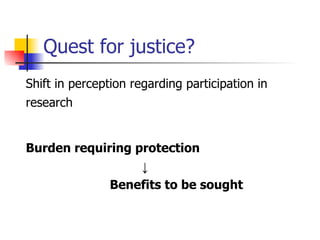
Quest for justice?  Shift in perception regarding participation in research   Burden requiring protection ↓ Benefits to be sought
Timeline concept of protection People who cannot protect themselves should be protected by society.
Current challenge Are we putting excessive obstacles in the way of needed and legitimate research activities?
Protective concept of justice Requirement of individual informed consent to medical experimentation
Protective concept of justice (continued) Requirement that IRBs/ECs review research protocols, to ensure a genuine prospect of benefit and an acceptable level of risk
Protective concept of justice (continued) Requirement that benefits and burdens are distributed among social groups within the society.
A new concept of justice Participation in medical research is more of a benefit to be sought, than a burden or risk from which vulnerable patients required protection.
Possible pitfalls of the new concept Drug trials are valuable opportunities for patients and subjects to obtain health benefits for themselves ↓ Blurred line between research and health care?
Proposed course of action Protective concept may have been exaggerated in some instances, but it does not mean it ought to be abandoned.
Essential elements to consider Need appropriate balance of: Autonomy Beneficience Justice
Informed consent  It is the first and most basic element of the protective concept of justice.
Informed consent (continued) Language of integrity, self determination, autonomy and privacy
Definition Free and informed consent encompasses a process which begins with the initial contact and carries through to the end of the involvement of research subjects in the project
Kant’s Imperative Moral objection to use another human being for a given purpose, legitimate or not.
Basis of research  Research of objective knowledge requires that subjects/patients are considered in a unique way
Free and informed consent ? There is no question of using and taking advantage of individual, since it would be their own decision
Barriers to informed consent Acquiescence does not mean comprehension. Possible barriers:  Patient-centered Process-centered
Patient-centered barriers Illness Hewlett , S.  Consent to Clinical Research-Adequately Voluntary or Substantially Influenced?,  Journal of Medical Ethics, Vol. 22, 1996, pp.232-237 Schaffer et al.  The Impact of Disease Severity on the Informed Consent Process in Clinical Research,  The American Journal of Medicine, Vol. 100, 1996, pp.261-268 Enrollment in research for treatment Overestimation of benefits
Process-centered barriers Timing of consent Readability of the consent form Content of the consent form Individual guiding the subject/patient through the informed consent
Overall message Informed consent goes beyond the printed document, and encompasses a continuum of patient/subject and investigator interactions and responses.
How to proceed? General consensus on the need for informed consent ↓ Uncertainty on how to achieve meaningful consent
How to adapt the informed consent concept to vulnerable populations?
First case study Research on patients/subjects in Emergency Settings
Setting the case Patient temporarily incompetent due to  a traumatic injury, a myocardial infarction, a stroke. Solution:  Informed consent may be provided by a legal representative
Any foreseen difficulties? Legal representative may not be immediately available Treatment cannot be safely delayed Solution:  Limit eligibility to patients who have a legal representative present to provide consent Downfall:  Accrual to study will be too slow…
Proposed alternatives ‘ Deferred consent’  Rejected by FDA/NIH in 1993 Waiving of the informed consent
FDA ‘Final Rule’ Guidelines (1996)  Treatment must be initiated due to life-threatening situations Must impart minimal risk to the patient Clinical investigation could not be carried out without the waiver
Final Rule Guidelines (continued) Waiving informed consent requires: Community notification of the planned study Exchange of negative reviews by IRBs/ECs Establishment of independent data monitoring committees
Weak provisions? Community consultation/public notification not enough feedback to the FDA? negative community feedback may encourage site closure?
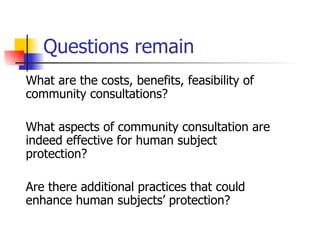
Questions remain What are the costs, benefits, feasibility of community consultations? What aspects of community consultation are indeed effective for human subject protection? Are there additional practices that could enhance human subjects’ protection?
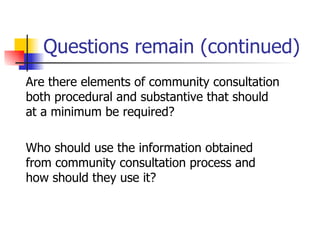
Questions remain (continued) Are there elements of community consultation both procedural and substantive that should at a minimum be required? Who should use the information obtained from community consultation process and how should they use it?
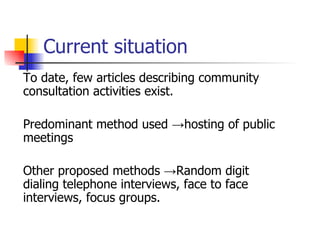
Current situation To date, few articles describing community consultation activities exist. Predominant method used  -> hosting of public meetings Other proposed methods  ->Random digit dialing telephone interviews, face to face interviews, focus groups.
Publications: Waiver of Informed Consent Mosesso and Cone,  Using the Exception from Informed Consent Regulations in Research , Acad. Emerg. Med, Vol. 12, 2005, pp. 1031-1039 Santora et al.,  Working through public disclosure process mandated by use of 21 CFR 50.24 (exception to informed consent): Guidelines for success , J. Trauma, Vol. 45, Issue 5, 1998, pp. 907-913 Kremers et al.,  Initial experience using the FDA guidelines for emergency research without consent , Ann. Emerg. Med, Vol. 33, Issue 2, 1999, pp.224-229 Baren et al.,  An approach to community consultation prior to initiating an emergency research study incorporating a waiver of informed consent , Acad. Emerg. Med., Vol. 6, 1999, pp.1210-1215.
Publications: Waiver of Informed Consent (continued) Mosesso et al.,  Conducting research using the emergency exception from informed consent: the public access defibrillation trial experience , Resuscitation, Vol. 61, 2004, pp. 29-36 Morris et al.,  Exception from informed consent for pediatric resuscitation research: Community consultation for a trial of brain cooling after in-hospital cardiac arrest , Pediatrics, Vol. 114, 2004, pp. 776-781 Dix et al.,  Implementation of community consultation for waiver of informed consent in emergency research: one institutional review board’s experience,  J. Inv. Med., Vol. 52, Issue 2, 2004, pp. 113-115. Contant et al.,  Community consultation in emergency research , Crit. Care Med., Vol. 34, Issue 8, 2006, pp. 2049-2052
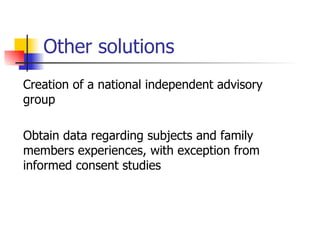
Other solutions Creation of a national independent advisory group  Obtain data regarding subjects and family members experiences, with exception from informed consent studies
Tri-Council Policy Statement Does not mandate public notification or community outreach
Canadian overview REBs must: ensure additional patient protection ensure thorough review of protocol/study design to confirm the ‘waived informed consent’ ↓ Unusually lengthy approval process
Back to the beginning ? Can subjects who cannot voice their consent be protected if community speaks for them? Are we not blurring the line between research and therapy, by implying that research studies requiring waiver of informed consent are therapeutic in themselves?
Second case study Research on patients/subjects facing cancer
Setting the case Patient with strong emotional feelings created by needs of self-preservation and multiple personal, psychosocial, economic and family concerns.
Competency to consent to research Requirement that a subject be competent to provide informed consent. Evidencing a choice in regard to research participation Factual understanding of the issues Rational manipulation of information Appreciation of the nature of the situation
Competency, subject to change? Over time According to the choice to make According to circumstances surrounding decisions
Any foreseen difficulties? Life-threatening illness affects the ability of the patient to rationalize what is best for him/her. -> ‘ Emotional’ consent
Any foreseen difficulties? (continued) Overwhelming amount of technical information Miscommunication about roles, expectations, study procedures.
Proposed alternatives What strategies enhance understanding? What communication methods promote understanding?
Complexity/Nature of the Informed Consent Content Fractions or percentages for probabilities? Verbal or written numerical probability value?  Numerical data is useful?
Complexity/Nature of the Informed Consent Content Are relative risks important elements? Are decision making strategies similar within families or across cultural groups? Graphic or text presentation of data?
Effectiveness of Various Delivery Systems Audio/Videotaped informed consent communications Ruckdeschel et al.,  Communication, Accrual to Clinical Trials, and the physician-patient relationship: Implications for training programs,  Journal  of Cancer Education, Vol. 11, 1996, pp. 73-79 McHugh et al., The Efficacy of audiotapes in promoting psychological well being in cancer patients: a randomized, controlled trial,  British Journal of  Cancer,Vol. 71, 1995, pp. 388-392  Written communications Morrow et al., A simple technique for increasing patients’ knowledge of  informed consent to treatment, Cancer, Vol. 42, 1978, pp. 793-799
Effectiveness of Various Delivery Systems (continued) Supplementary aids/tools (e.g. phone calls) Aaranson et al.,  Telephone-based nursing interventions improve effectiveness of the informed consent process in cancer clinical trials,  Journal of Clinical Oncology, Vol. 4, Issue 3, 1996, pp. 984-996
Effectiveness of Various Delivery Systems (continued) Multimodality approaches Interventions should not be crafted for a ‘one size fits  all” Tailored to meet specific informational needs of  subjects Involve more than one sense Cognitive and emotional support
Question remains What is the most efficacious communication delivery system?
Back to the beginning? Society clearly cannot operates without rules Individuals cannot always follow these rules
Conclusions Need to communicate clinical trial informed consent information in an understandable manner
Conclusions (continued) At the end…  is Subject/Patient’s only real protection depending ultimately on the conscience and compassion of the investigator and his peers?
Contact information Veronique Brisson, B.Sc., MA Associate, Clinical Quality Assurance MethylGene E-mail address:  brissonv@methylgene.com

Facing Up The Challenge Sep 27 2007

  • 1.
    Facing Up tothe Challenge Informed Consent in Vulnerable Populations
  • 2.
    Vulnerable populations ICHdefinition: Individuals whose willingness to volunteer in a clinical trial may be unduly influenced by the expectation, whether justified or not, of benefits associated with participation {…}.
  • 3.
    Not to harmSubjects who are vulnerable should not be exposed to interventions involving more than minimal risks.
  • 4.
    Delimiting the problemScience should never consider human beings as an instrument to be employed for scientific purposes. With the advancing technology of medicine, rights of the society as a whole and those of the individual are frequently in conflict.
  • 5.
    Good of many or respect of the few? There is now a dual focus to do on groups AND on individuals Moral principles cross one another; which principles/values should take priority?
  • 6.
    Quest for justice? Shift in perception regarding participation in research Burden requiring protection ↓ Benefits to be sought
  • 7.
    Timeline concept ofprotection People who cannot protect themselves should be protected by society.
  • 8.
    Current challenge Arewe putting excessive obstacles in the way of needed and legitimate research activities?
  • 9.
    Protective concept ofjustice Requirement of individual informed consent to medical experimentation
  • 10.
    Protective concept ofjustice (continued) Requirement that IRBs/ECs review research protocols, to ensure a genuine prospect of benefit and an acceptable level of risk
  • 11.
    Protective concept ofjustice (continued) Requirement that benefits and burdens are distributed among social groups within the society.
  • 12.
    A new conceptof justice Participation in medical research is more of a benefit to be sought, than a burden or risk from which vulnerable patients required protection.
  • 13.
    Possible pitfalls ofthe new concept Drug trials are valuable opportunities for patients and subjects to obtain health benefits for themselves ↓ Blurred line between research and health care?
  • 14.
    Proposed course ofaction Protective concept may have been exaggerated in some instances, but it does not mean it ought to be abandoned.
  • 15.
    Essential elements toconsider Need appropriate balance of: Autonomy Beneficience Justice
  • 16.
    Informed consent It is the first and most basic element of the protective concept of justice.
  • 17.
    Informed consent (continued)Language of integrity, self determination, autonomy and privacy
  • 18.
    Definition Free andinformed consent encompasses a process which begins with the initial contact and carries through to the end of the involvement of research subjects in the project
  • 19.
    Kant’s Imperative Moralobjection to use another human being for a given purpose, legitimate or not.
  • 20.
    Basis of research Research of objective knowledge requires that subjects/patients are considered in a unique way
  • 21.
    Free and informedconsent ? There is no question of using and taking advantage of individual, since it would be their own decision
  • 22.
    Barriers to informedconsent Acquiescence does not mean comprehension. Possible barriers: Patient-centered Process-centered
  • 23.
    Patient-centered barriers IllnessHewlett , S. Consent to Clinical Research-Adequately Voluntary or Substantially Influenced?, Journal of Medical Ethics, Vol. 22, 1996, pp.232-237 Schaffer et al. The Impact of Disease Severity on the Informed Consent Process in Clinical Research, The American Journal of Medicine, Vol. 100, 1996, pp.261-268 Enrollment in research for treatment Overestimation of benefits
  • 24.
    Process-centered barriers Timingof consent Readability of the consent form Content of the consent form Individual guiding the subject/patient through the informed consent
  • 25.
    Overall message Informedconsent goes beyond the printed document, and encompasses a continuum of patient/subject and investigator interactions and responses.
  • 26.
    How to proceed?General consensus on the need for informed consent ↓ Uncertainty on how to achieve meaningful consent
  • 27.
    How to adaptthe informed consent concept to vulnerable populations?
  • 28.
    First case studyResearch on patients/subjects in Emergency Settings
  • 29.
    Setting the casePatient temporarily incompetent due to a traumatic injury, a myocardial infarction, a stroke. Solution: Informed consent may be provided by a legal representative
  • 30.
    Any foreseen difficulties?Legal representative may not be immediately available Treatment cannot be safely delayed Solution: Limit eligibility to patients who have a legal representative present to provide consent Downfall: Accrual to study will be too slow…
  • 31.
    Proposed alternatives ‘Deferred consent’ Rejected by FDA/NIH in 1993 Waiving of the informed consent
  • 32.
    FDA ‘Final Rule’Guidelines (1996) Treatment must be initiated due to life-threatening situations Must impart minimal risk to the patient Clinical investigation could not be carried out without the waiver
  • 33.
    Final Rule Guidelines(continued) Waiving informed consent requires: Community notification of the planned study Exchange of negative reviews by IRBs/ECs Establishment of independent data monitoring committees
  • 34.
    Weak provisions? Communityconsultation/public notification not enough feedback to the FDA? negative community feedback may encourage site closure?
  • 35.
    Questions remain Whatare the costs, benefits, feasibility of community consultations? What aspects of community consultation are indeed effective for human subject protection? Are there additional practices that could enhance human subjects’ protection?
  • 36.
    Questions remain (continued)Are there elements of community consultation both procedural and substantive that should at a minimum be required? Who should use the information obtained from community consultation process and how should they use it?
  • 37.
    Current situation Todate, few articles describing community consultation activities exist. Predominant method used -> hosting of public meetings Other proposed methods ->Random digit dialing telephone interviews, face to face interviews, focus groups.
  • 38.
    Publications: Waiver ofInformed Consent Mosesso and Cone, Using the Exception from Informed Consent Regulations in Research , Acad. Emerg. Med, Vol. 12, 2005, pp. 1031-1039 Santora et al., Working through public disclosure process mandated by use of 21 CFR 50.24 (exception to informed consent): Guidelines for success , J. Trauma, Vol. 45, Issue 5, 1998, pp. 907-913 Kremers et al., Initial experience using the FDA guidelines for emergency research without consent , Ann. Emerg. Med, Vol. 33, Issue 2, 1999, pp.224-229 Baren et al., An approach to community consultation prior to initiating an emergency research study incorporating a waiver of informed consent , Acad. Emerg. Med., Vol. 6, 1999, pp.1210-1215.
  • 39.
    Publications: Waiver ofInformed Consent (continued) Mosesso et al., Conducting research using the emergency exception from informed consent: the public access defibrillation trial experience , Resuscitation, Vol. 61, 2004, pp. 29-36 Morris et al., Exception from informed consent for pediatric resuscitation research: Community consultation for a trial of brain cooling after in-hospital cardiac arrest , Pediatrics, Vol. 114, 2004, pp. 776-781 Dix et al., Implementation of community consultation for waiver of informed consent in emergency research: one institutional review board’s experience, J. Inv. Med., Vol. 52, Issue 2, 2004, pp. 113-115. Contant et al., Community consultation in emergency research , Crit. Care Med., Vol. 34, Issue 8, 2006, pp. 2049-2052
  • 40.
    Other solutions Creationof a national independent advisory group Obtain data regarding subjects and family members experiences, with exception from informed consent studies
  • 41.
    Tri-Council Policy StatementDoes not mandate public notification or community outreach
  • 42.
    Canadian overview REBsmust: ensure additional patient protection ensure thorough review of protocol/study design to confirm the ‘waived informed consent’ ↓ Unusually lengthy approval process
  • 43.
    Back to thebeginning ? Can subjects who cannot voice their consent be protected if community speaks for them? Are we not blurring the line between research and therapy, by implying that research studies requiring waiver of informed consent are therapeutic in themselves?
  • 44.
    Second case studyResearch on patients/subjects facing cancer
  • 45.
    Setting the casePatient with strong emotional feelings created by needs of self-preservation and multiple personal, psychosocial, economic and family concerns.
  • 46.
    Competency to consentto research Requirement that a subject be competent to provide informed consent. Evidencing a choice in regard to research participation Factual understanding of the issues Rational manipulation of information Appreciation of the nature of the situation
  • 47.
    Competency, subject tochange? Over time According to the choice to make According to circumstances surrounding decisions
  • 48.
    Any foreseen difficulties?Life-threatening illness affects the ability of the patient to rationalize what is best for him/her. -> ‘ Emotional’ consent
  • 49.
    Any foreseen difficulties?(continued) Overwhelming amount of technical information Miscommunication about roles, expectations, study procedures.
  • 50.
    Proposed alternatives Whatstrategies enhance understanding? What communication methods promote understanding?
  • 51.
    Complexity/Nature of theInformed Consent Content Fractions or percentages for probabilities? Verbal or written numerical probability value? Numerical data is useful?
  • 52.
    Complexity/Nature of theInformed Consent Content Are relative risks important elements? Are decision making strategies similar within families or across cultural groups? Graphic or text presentation of data?
  • 53.
    Effectiveness of VariousDelivery Systems Audio/Videotaped informed consent communications Ruckdeschel et al., Communication, Accrual to Clinical Trials, and the physician-patient relationship: Implications for training programs, Journal of Cancer Education, Vol. 11, 1996, pp. 73-79 McHugh et al., The Efficacy of audiotapes in promoting psychological well being in cancer patients: a randomized, controlled trial, British Journal of Cancer,Vol. 71, 1995, pp. 388-392 Written communications Morrow et al., A simple technique for increasing patients’ knowledge of informed consent to treatment, Cancer, Vol. 42, 1978, pp. 793-799
  • 54.
    Effectiveness of VariousDelivery Systems (continued) Supplementary aids/tools (e.g. phone calls) Aaranson et al., Telephone-based nursing interventions improve effectiveness of the informed consent process in cancer clinical trials, Journal of Clinical Oncology, Vol. 4, Issue 3, 1996, pp. 984-996
  • 55.
    Effectiveness of VariousDelivery Systems (continued) Multimodality approaches Interventions should not be crafted for a ‘one size fits all” Tailored to meet specific informational needs of subjects Involve more than one sense Cognitive and emotional support
  • 56.
    Question remains Whatis the most efficacious communication delivery system?
  • 57.
    Back to thebeginning? Society clearly cannot operates without rules Individuals cannot always follow these rules
  • 58.
    Conclusions Need tocommunicate clinical trial informed consent information in an understandable manner
  • 59.
    Conclusions (continued) Atthe end… is Subject/Patient’s only real protection depending ultimately on the conscience and compassion of the investigator and his peers?
  • 60.
    Contact information VeroniqueBrisson, B.Sc., MA Associate, Clinical Quality Assurance MethylGene E-mail address: brissonv@methylgene.com