A Seminar on

Presented by
Rathi K. N.
M Ed. Sem II (2010-11)
N. S. S. Training College
Ottapalam
Instructional theory
Curriculum
Model of teaching

Jerome S Bruner
Biography
Education
PhD, Harvard, 1941 (Psychology)
BA, Duke University, 1937

Present
University Professor
New York University School of Law
E-mail : jerome.bruner@nyu.edu

Publications
The Culture of Education, 1996
Acts of Meaning, 1991
Actual Minds, Possible Worlds, 1987
The Process of Education, 1960
Cognitive Development
Enactive
Iconic

Symbolic
Discovery Learning
“Discovery learning is „an approach
to instruction through which
students interact with their
environment – by exploring and
manipulating objects, wrestling with
questions and controversies, or
performing experiments‟.”
Advantages of Discovery
Learning
active engagement
promotes motivation
Promotes ownership of learning
the development of creativity and
problem solving skills.
a tailored learning experience
problems of Discovery
Learning
Arrangement problem
compatibility problem
Problem on activating students
Problem on hypothesis testing
Self loop Problem
Problem of handling information
INSTRUCTIONAL THEORY
A theory of Instruction sets forth or
prescribes rules for the most effective
way to attain the desired results.
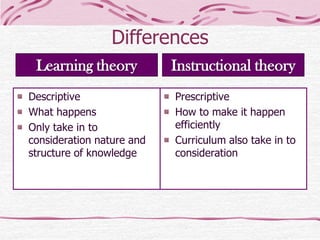
Differences
Learning theory

Instructional theory

Descriptive
What happens
Only take in to
consideration nature and
structure of knowledge

Prescriptive
How to make it happen
efficiently
Curriculum also take in to
consideration
Characteristics of
an Instructional
theory
Relationship between people and
things in school environment
Structure of body of knowledge
Sequence for effective learning
Reward and punishment
Predisposition
Curiosity
Competence
Modeling
Reciprocity
Interest
Motivation
exploration
Relating knowledge to the
learner
Structuring of the subject matter
Economy
Effective power
Sequence
Acquire, transform and use
what they are learning.

Speed of learning,
resistance to forgetting,
transferability, economy
and power.
Optimum sequence

Enactive

Iconic

Symbolic
Form and pacing of Reinforcement
„Corrective knowledge‟
„Satisfying state of affairs‟
Self sufficient
Natural consequences
of action
Punishment

1) Leads to high anxiety
2) Learning is less generic and less

transferable
3) Masks the satisfaction of intrinsic reward
CURRICULUM
Enactive
Representation
Ikonic
Representation
Symbolic
Representation

Spiral approach
Intuition
Antithesis of
Understanding
knowing by the
through Art, poetry,
scientific knowledge,
myths and humanity
logical and
mathematical
proof
Immediate apprehension of cognition
Disciplined Intuition
Teachers think intuitively
Provide varied experience
Emphasis on structure
Encouragement of guessing
Building self confidence
Modify reward and
punishment
Education for future
Increasing understanding of Human as
a species
Increasing understanding of Nature of
Individual mental growth
A clearer understanding of process of
education
The accelerating rate of change in
society
Teaching models are instructional designs.
They describe the process of specifying
and producing particular environmental
situations which cause the students to
interact in such a way that specific change
occurs in his behaviour”.
“
Families of teaching models
MODELS OF TEACHING

INFORMATION
PROCESSING
FAMILY

CONCEPT
ATTAINMEN
T MODEL

ADVANCE
ORGANISER
MODEL

PERSONAL
FAMILY

SYNETIC
MODEL

NON
DIRECTIVE
TEACHING
MODEL

SOCIAL
INTERACTION
FAMILY

JURISPUDE
NTIAL
INQUIRY
MODEL

SOCIAL
INQUIRY
MODEL

BEHAVIOUR
AL FAMILY

CONTINGEN
CY
MANAGEME
NT
MODEL

ASSERTIVE
TRAINING
MODEL
Concept Attainment Model
Jerome S.Bruner
Jacqueline
Goodnow
George Austin.
Concept attainment strategies

Nature of Concept

Thinking strategy
Nature of Concept


Name

 Exemplar
-Positive & Negative
 Attributes
-Essential &Nonessential


Attribute value



Rule
THINKING STRATEGY
Simultaneous scanning
All Exemplars at a time
Successive scanning
One Exemplar at a Time
Conservative focusing
Test one Attribute to all exemplars
Focus gambling
Test all Attributes to one Exemplar.
Syntax
Phases
1. Presentation of data and
Identification of oncept
2. Testing attainment of concept
3. Analysis of thinking strategy
Three Phases for the model
Social System
The system has a moderate structure.
The teacher controls the class.
Students interaction is encouraged.
Principles of Reaction
The Teacher:
• Give support.

Helps to create a dialogue .
Focus attention on specific features of
exemplars.
Assists students in evaluating their
thinking strategies.
Support System
Materials in the form of positive and
negative exemplars.
Materials as unlabelled exemplars if
any.
Instructional and Nurturant Effect
Instructional
Nurturant

Nature Of Concepts

Concept
Attainment Model

Improved Concept
Building Strategies

Specific Concepts

Awareness of
Alternative Prospective

Sensitivity to logical
Reasoning in
Communication

Tolerance of Ambiguity

Inductive Reasoning
Uniqueness
1. Responding to situations differently.
2. Internalizing events into a “ storage
system.”
3. Increased capacity for language.
4. Systematic interaction with a tutor.
5. Language as an instrument for
ordering the environment.
6. Increasing capacity to deal with
multiple demands.
Process of education
Education as a social invention
Thank you
Rathi

Bruner on education