Introduction to Theory of Constraints Presented by Hasham Muhammed [email_address]   23rd  September, 2008
Contents Introduction –  The Philosophy Thinking Process System’s Thinking Goal Concept of System Constraints TOC intro Steps in TOC Example Conclusion 23rd  September, 2008
Do we really want or need  another  New Theory? 23rd  September, 2008
Do we really want or need  another  New Theory? 23rd  September, 2008 “ The significant problems we face today can not be resolved at the same level of thinking we were at when we created them.” - Albert Einstein
Thinking Process The process of how an entity learns to gain understanding of the environment or System 23rd  September, 2008
Thinking Processes 23rd  September, 2008 The process of how an entity learns to gain understanding of the environment or System The KEY focus being Thinking from a SYSTEM’s point of view
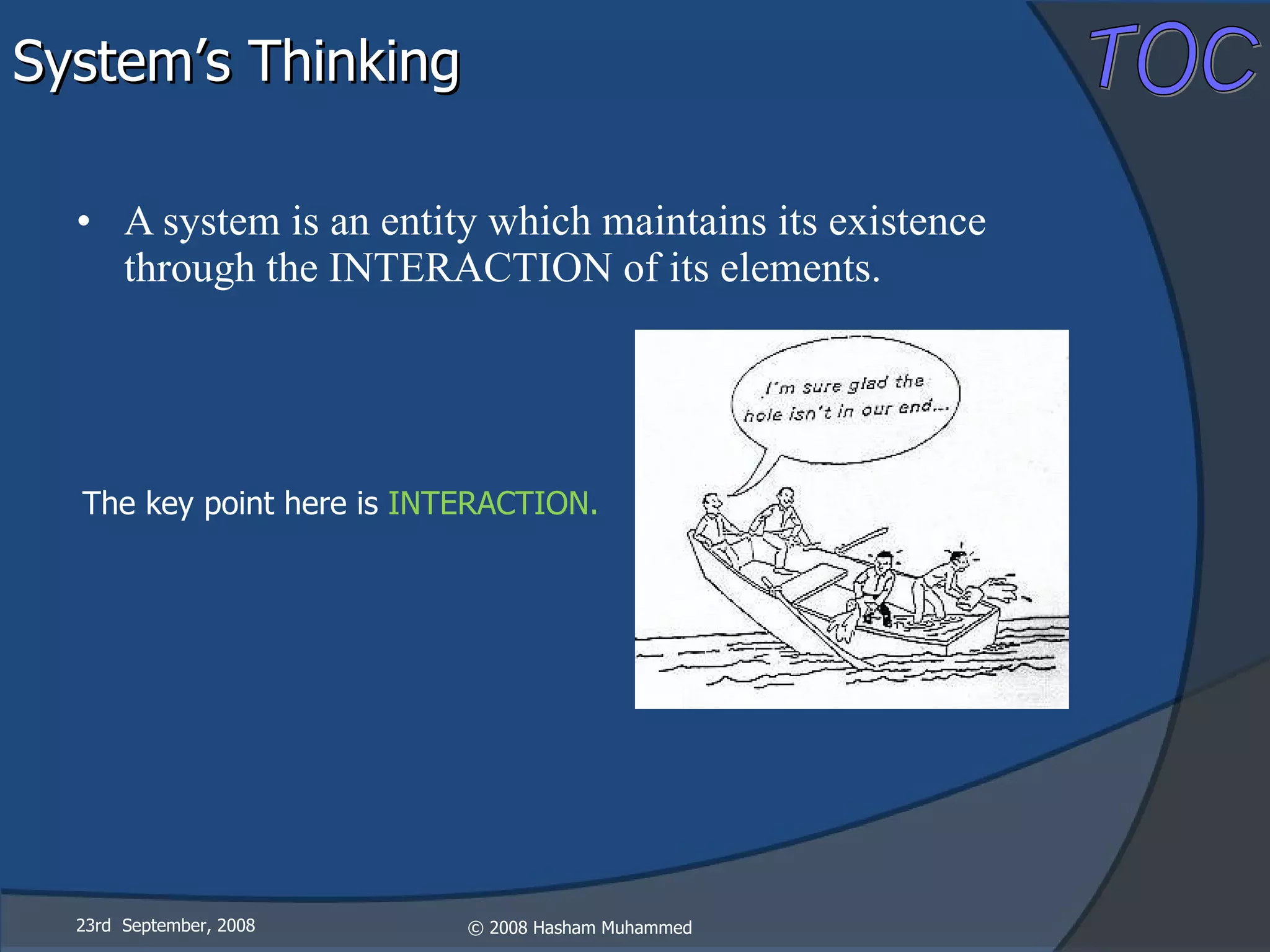
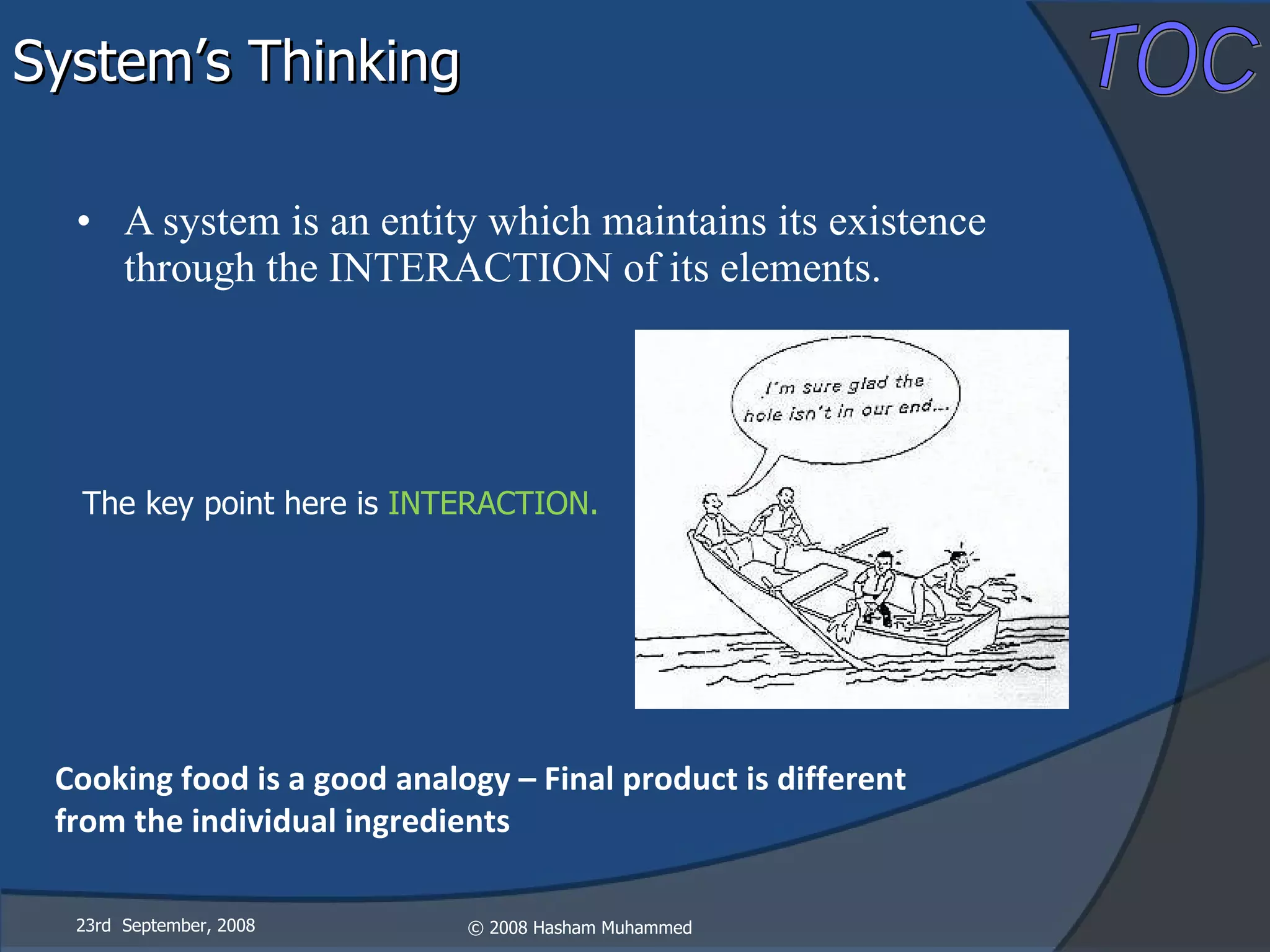
A system is an entity which maintains its existence through the INTERACTION of its elements.  System’s Thinking 23rd  September, 2008
A system is an entity which maintains its existence through the INTERACTION of its elements.  23rd  September, 2008 The key point here is  INTERACTION. System’s Thinking
A system is an entity which maintains its existence through the INTERACTION of its elements.  23rd  September, 2008 Cooking food is a good analogy – Final product is different  from the individual ingredients The key point here is  INTERACTION. System’s Thinking
The System’s Goal Why do Systems exist? 23rd  September, 2008
The System’s Goal 23rd  September, 2008 Why do Systems exist? To achieve a “Goal”
The System’s Goal 23rd  September, 2008 Why do Systems exist? To achieve a “Goal” A result or achievement toward which effort is directed.
Who gets to decide what the goal should be? The System’s Goal 23rd  September, 2008
23rd  September, 2008 Who gets to decide what the goal should be? The System’s Goal The Leader is responsible for the Goal
23rd  September, 2008 Who gets to decide what the goal should be? The Leader is responsible for the Goal The System’s Goal Everyone may be considered as a Leader of something (Whole Organization, Unit, Integrated Business, department, small team, life, career…) that is supported by a System
Theory of Constraints is about Management 23rd  September, 2008
The  three important questions for a manager What is the Ultimate goal? Where does he or she stand in relation to the goal? The magnitude and direction of the change needed to move from the status quo to where he or she wants to be (the goal). 23rd  September, 2008 Theory of Constraints is about Management
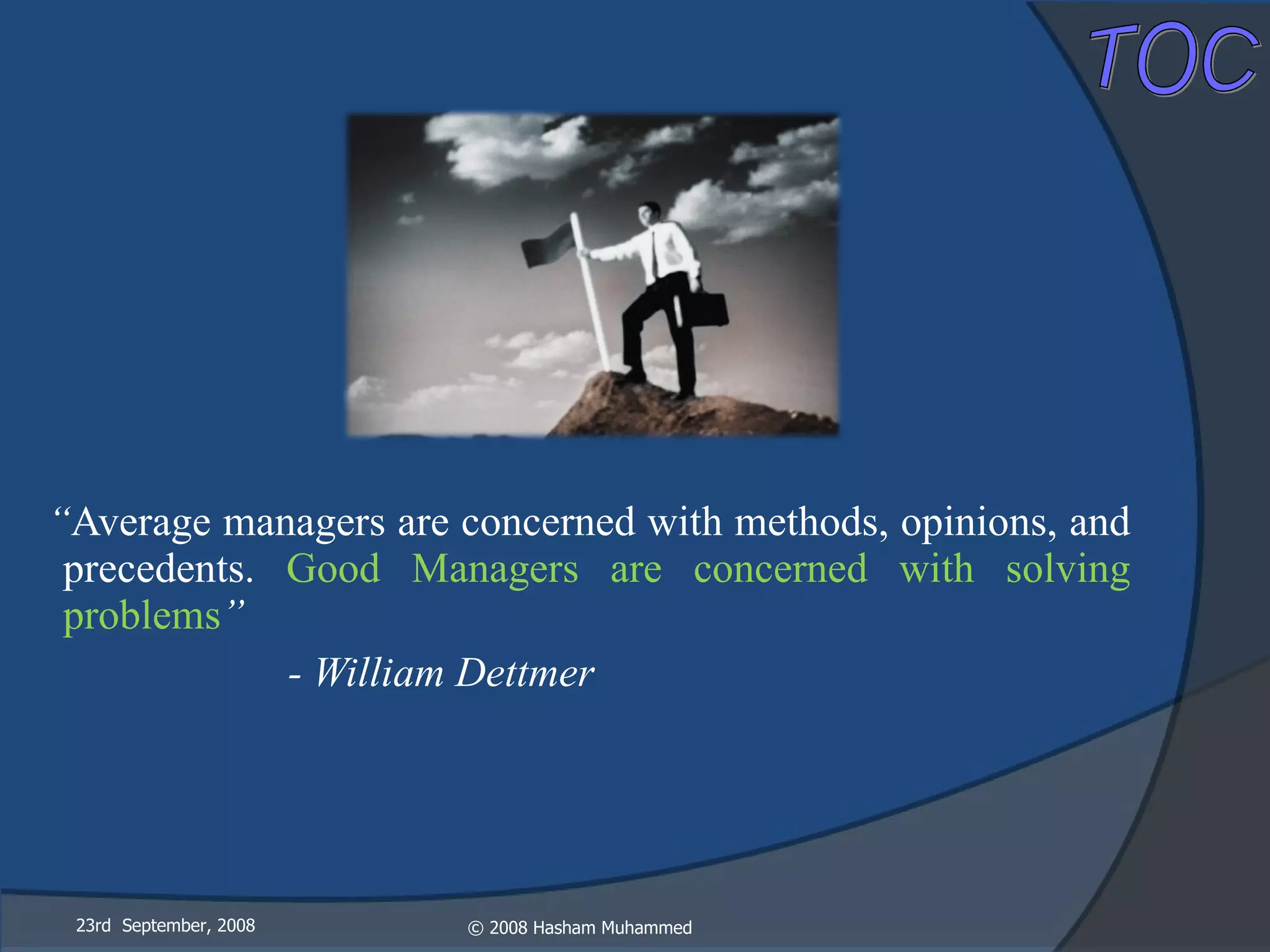
“ Average managers are concerned with methods, opinions, and precedents.  Good Managers are concerned with solving problems ” - William Dettmer 23rd  September, 2008
Concept of System Constraints 23rd  September, 2008
Concept of System Constraints 23rd  September, 2008 What keeps your system from doing better?
Concept of System Constraints 23rd  September, 2008 What keeps your system from doing better? Is there something that is constraining your system from reaching its GOAL?
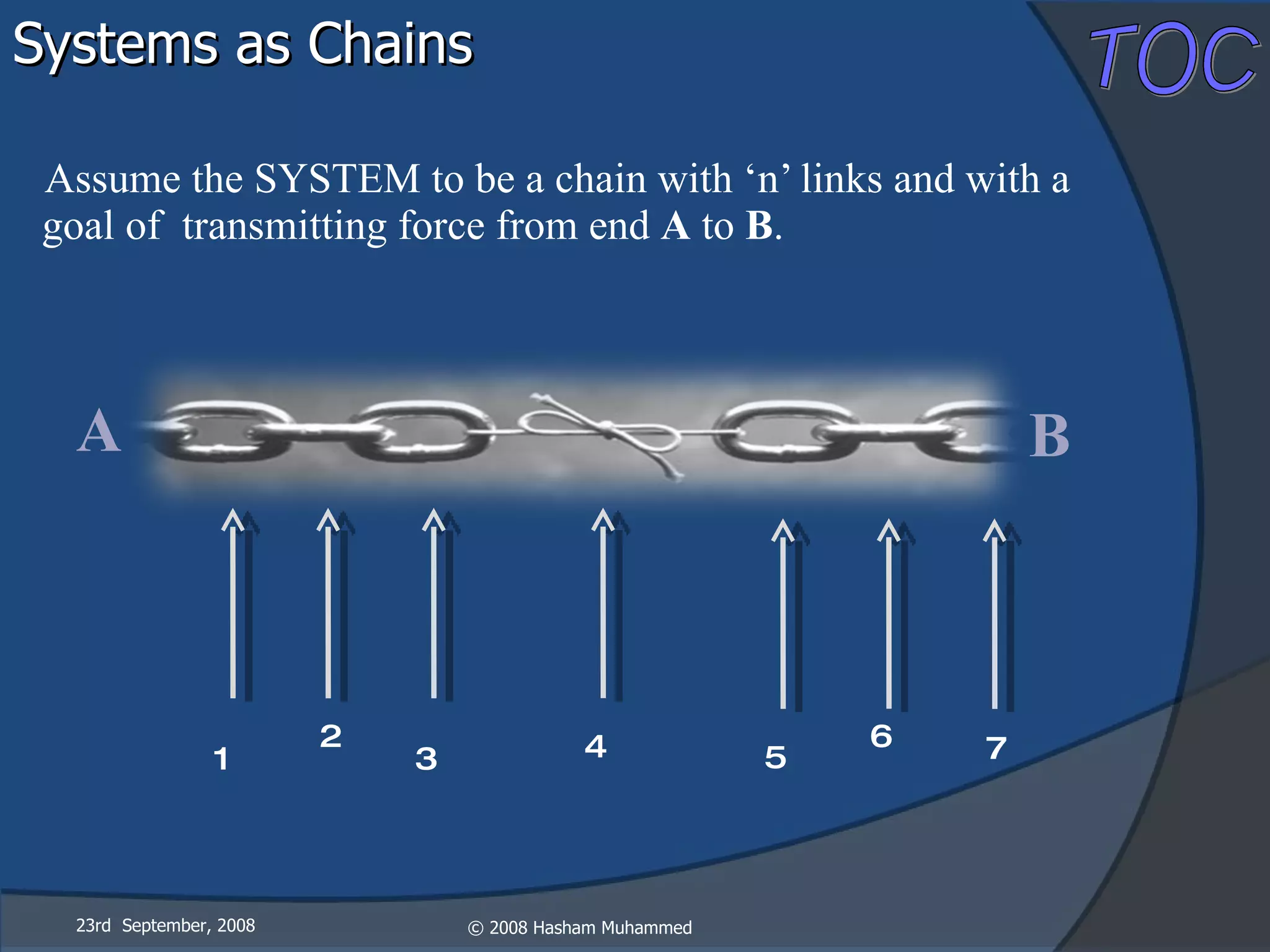
Systems as Chains Assume the SYSTEM to be a chain with ‘n’ links and with a goal of  transmitting force from end  A  to  B . 23rd  September, 2008 A B 1 2 3 6 5 7 4
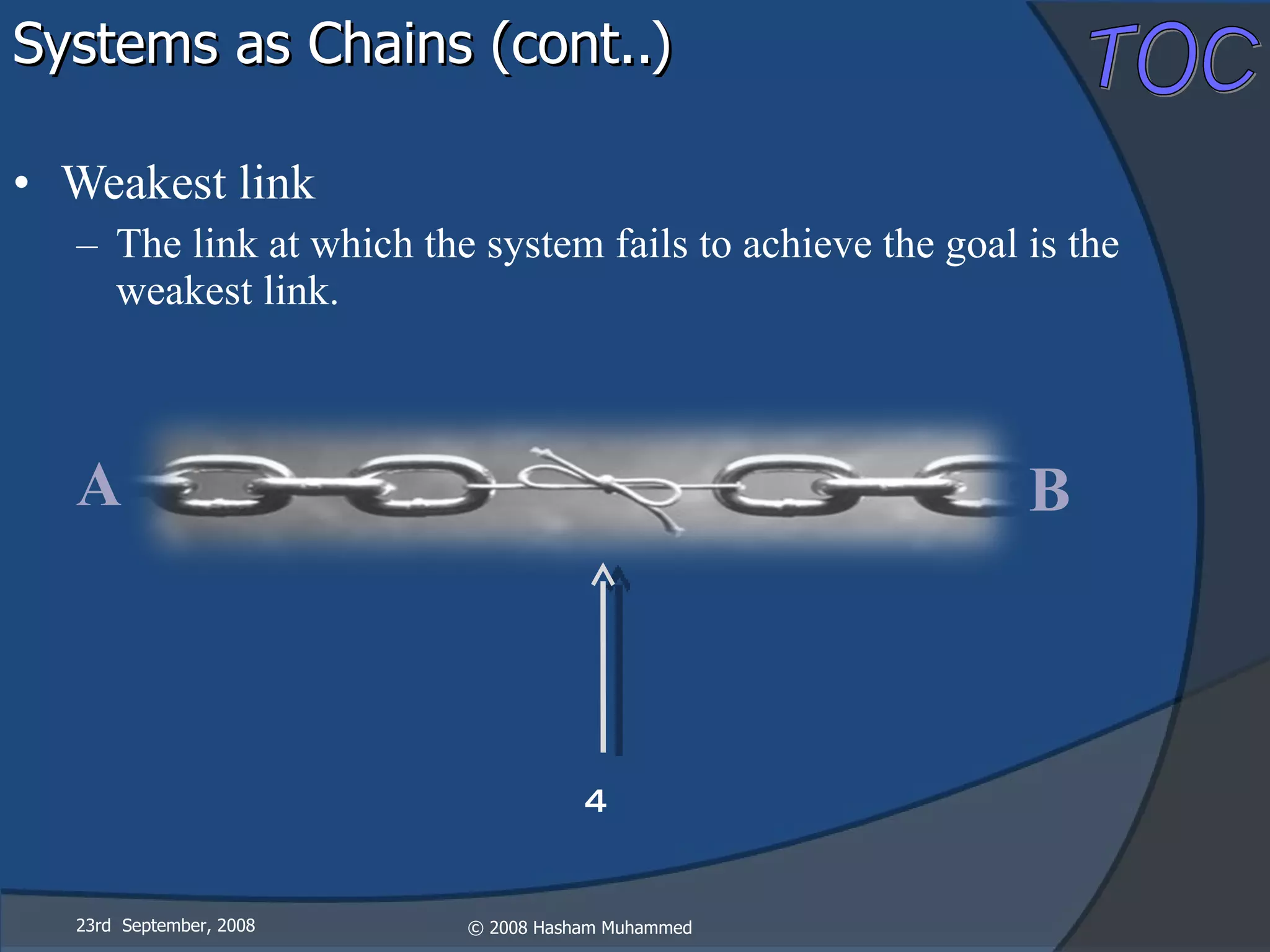
Systems as Chains (cont..) Weakest link The link at which the system fails to achieve the goal is the weakest link. 23rd  September, 2008 A B 4
Constraints and Non-Constraints 23rd  September, 2008
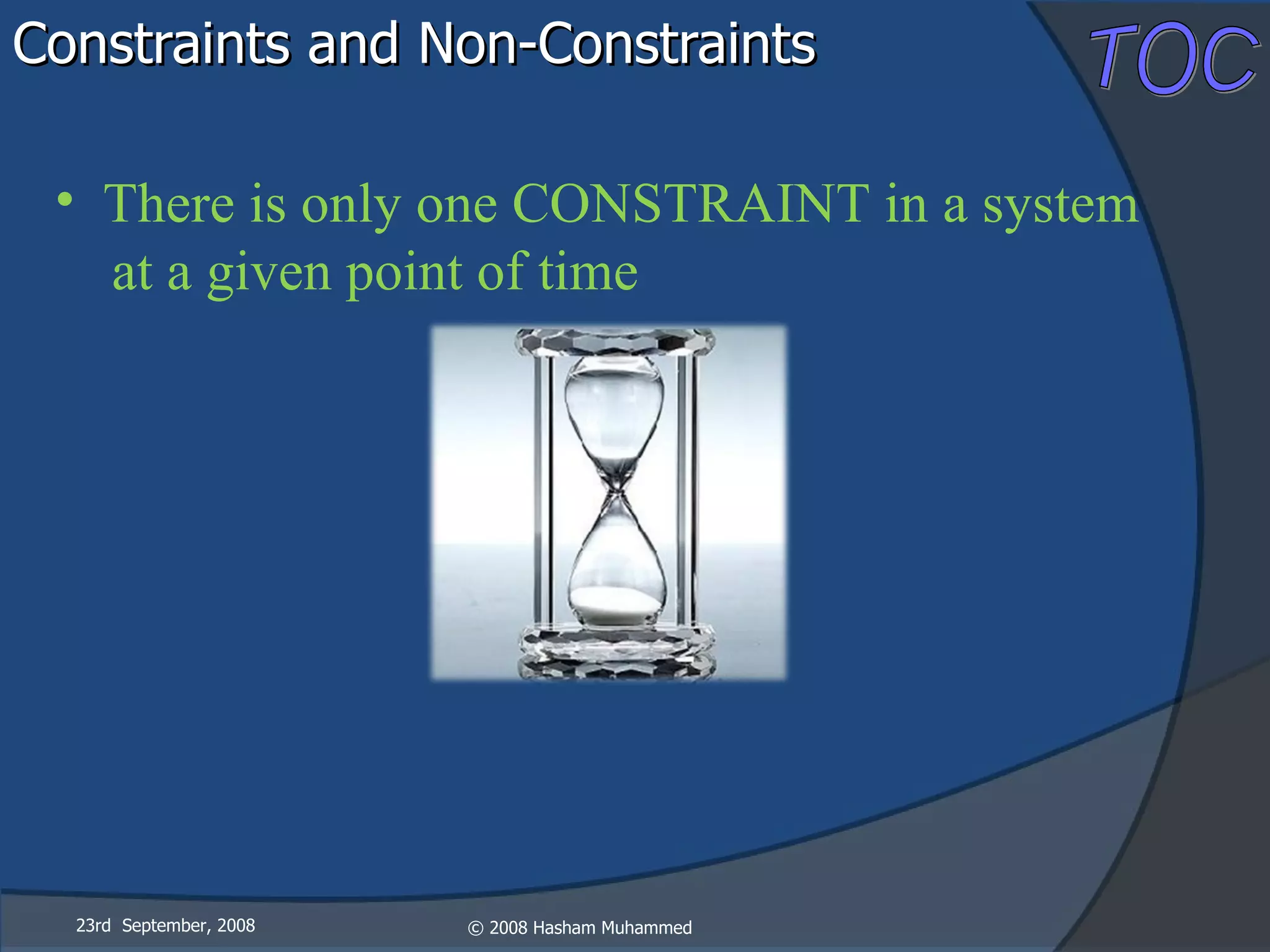
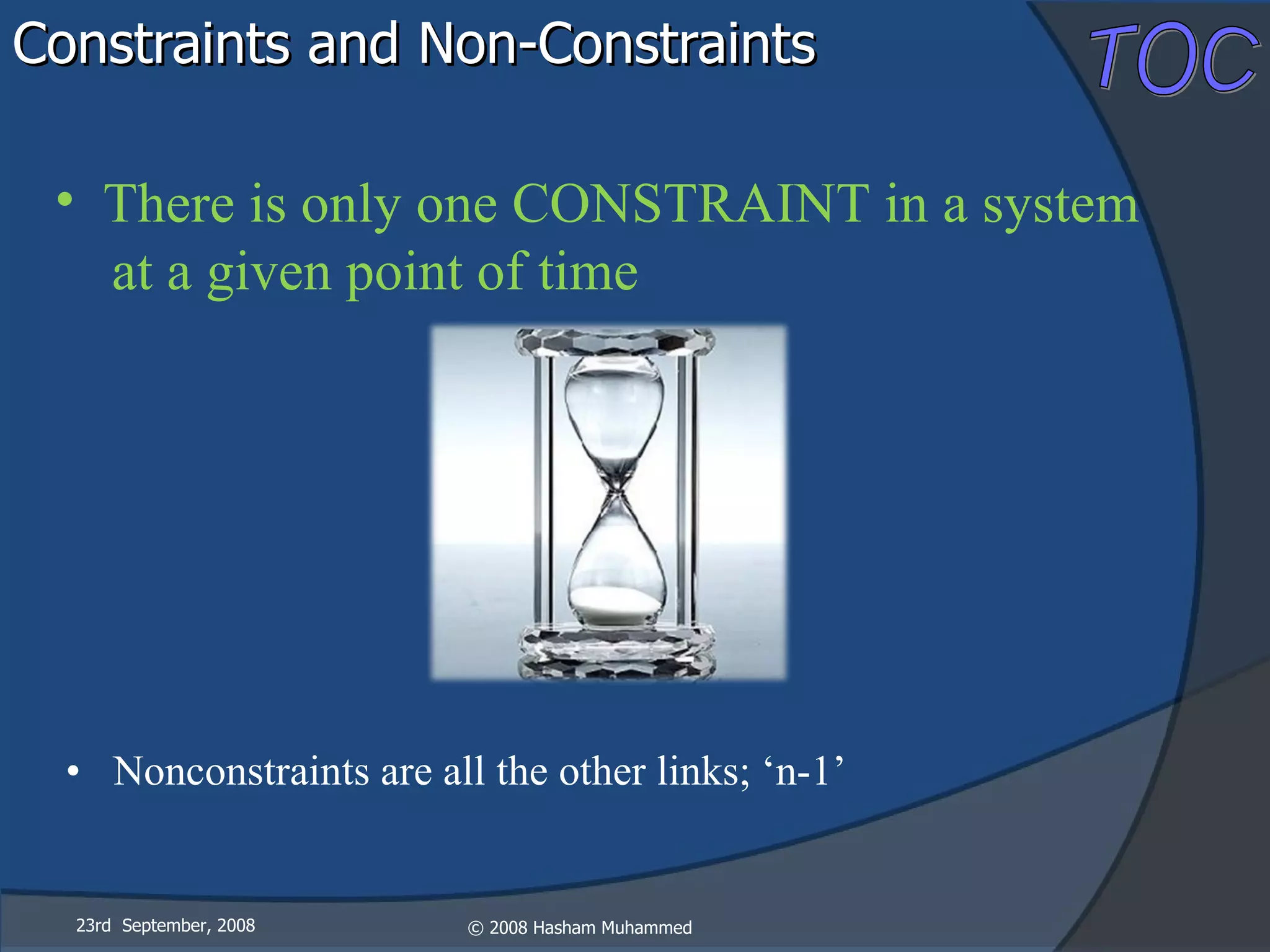
Constraints and Non-Constraints 23rd  September, 2008 There is only one CONSTRAINT in a system at a given point of time
Constraints and Non-Constraints Nonconstraints are all the other links; ‘n-1’  23rd  September, 2008 There is only one CONSTRAINT in a system at a given point of time
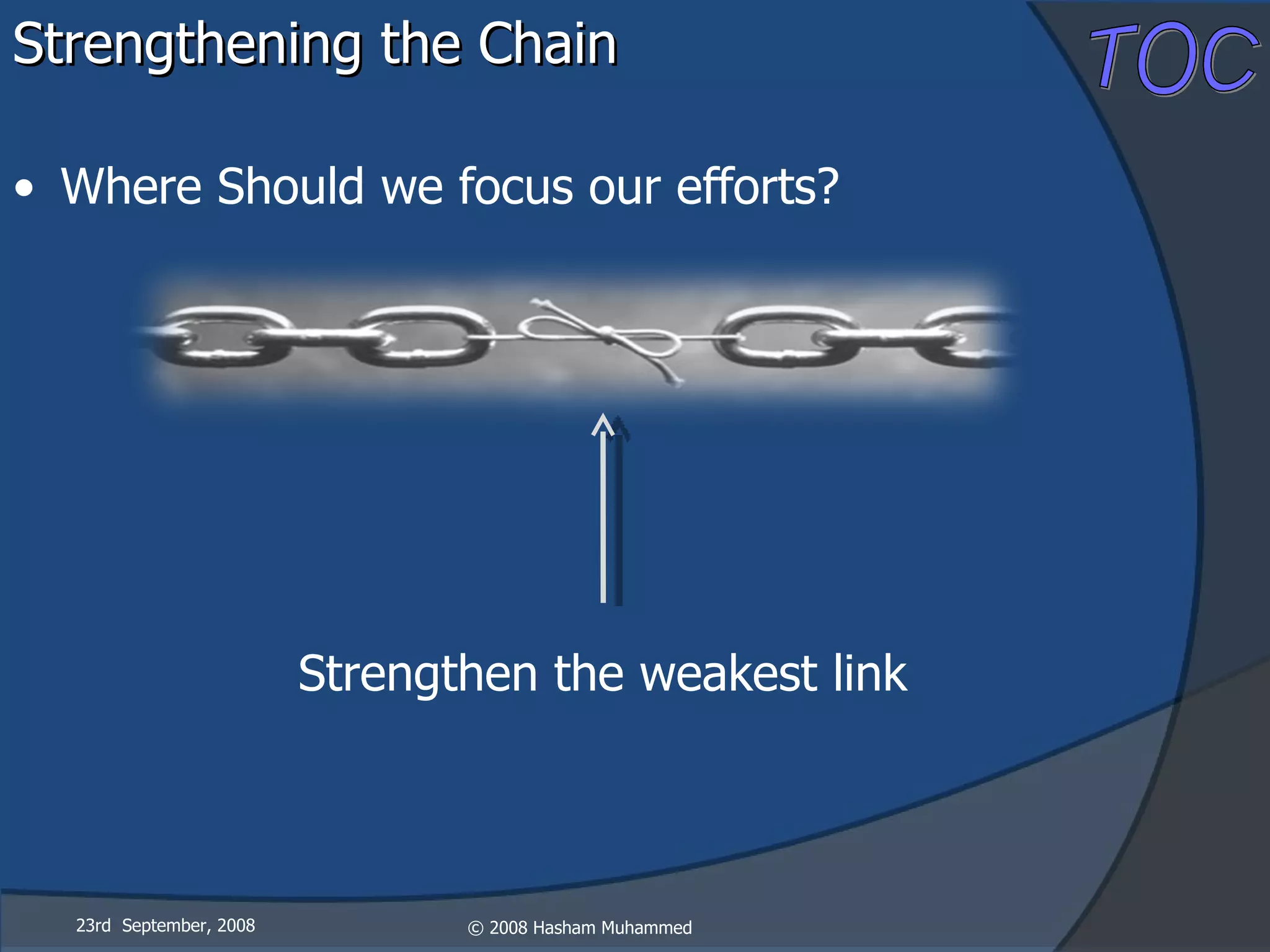
Strengthening the Chain 23rd  September, 2008
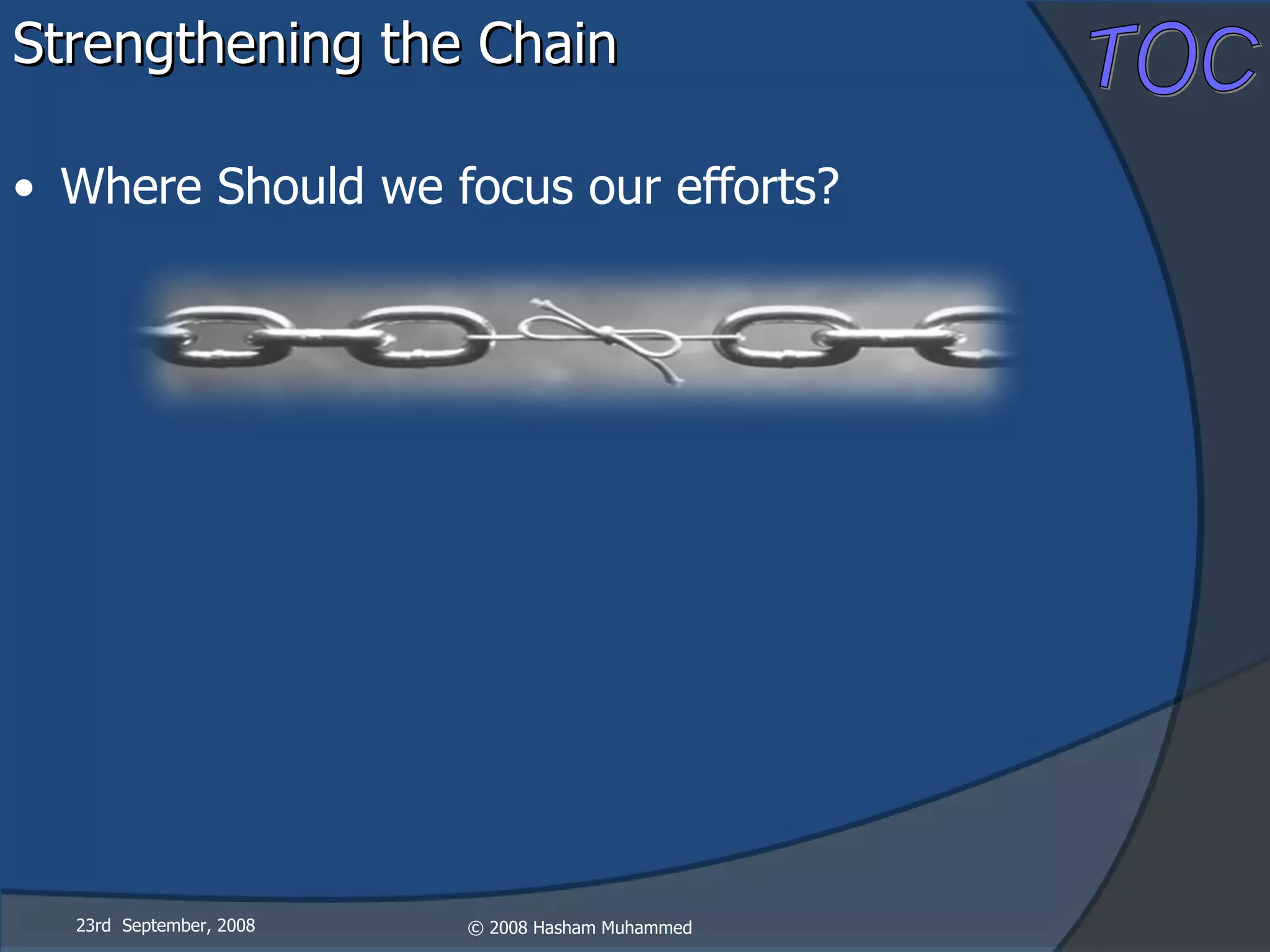
Strengthening the Chain Where Should we focus our efforts? 23rd  September, 2008
Strengthening the Chain Where Should we focus our efforts? 23rd  September, 2008 Strengthen the weakest link
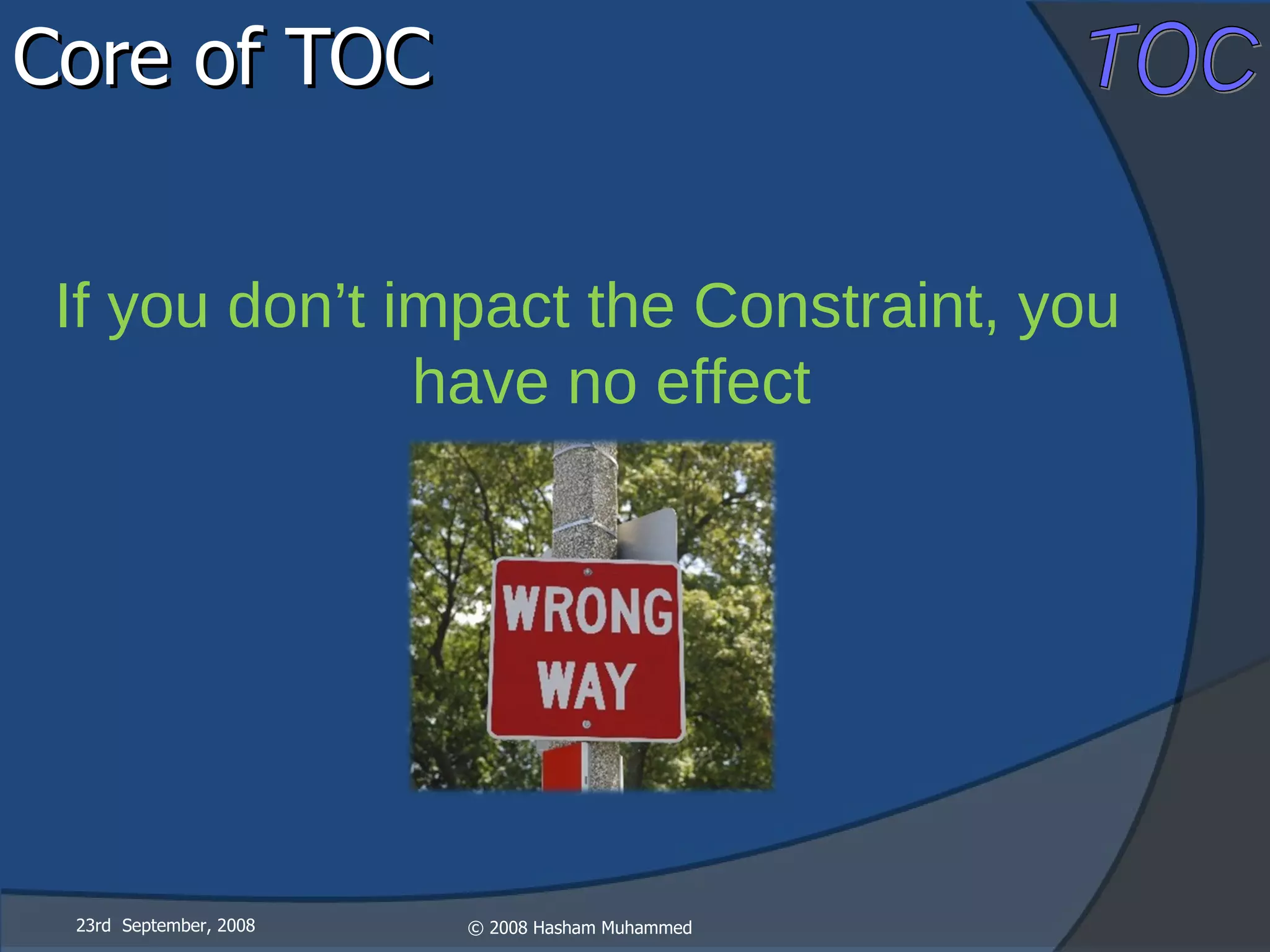
Core of TOC  23rd  September, 2008
Core of TOC  23rd  September, 2008 If you don’t impact the Constraint, you have no effect
Basic Questions for Managers What’s the desired standard of performance  (System’s Goal ) What to change?  (Where is the constraint?) What to change to?  (What should we do with the constraint?) How to cause the change?  ( How do we implement the change?) 23rd  September, 2008 Note:  These are system-level questions, not process-level
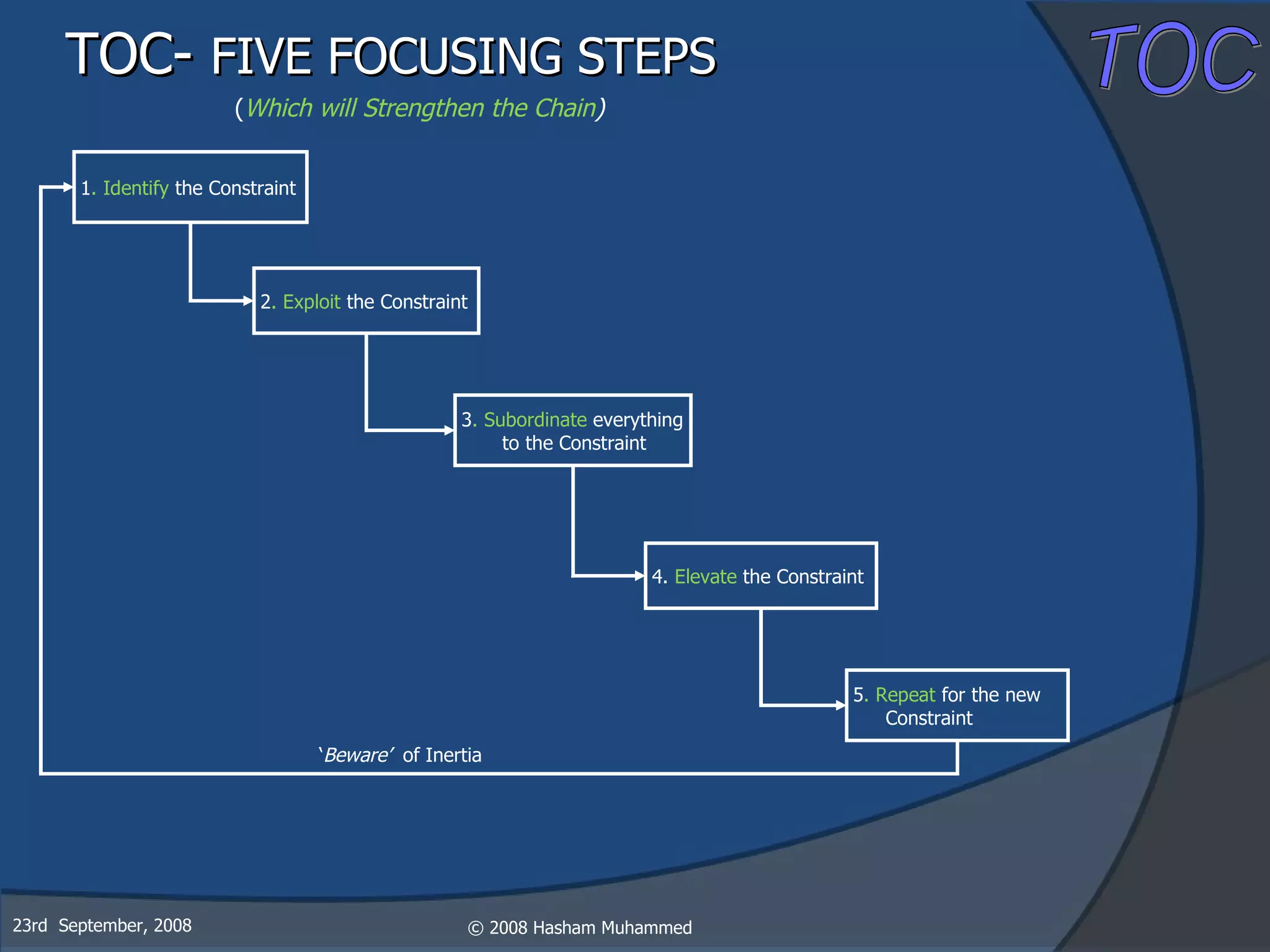
23rd  September, 2008 TOC-  FIVE FOCUSING STEPS   ( Which will Strengthen the Chain )
23rd  September, 2008 1 . Identify  the Constraint 2 . Exploit  the Constraint 3 . Subordinate  everything to the Constraint 4.  Elevate  the Constraint 5 . Repeat  for the new  Constraint ‘ Beware’  of Inertia TOC-  FIVE FOCUSING STEPS   ( Which will Strengthen the Chain )
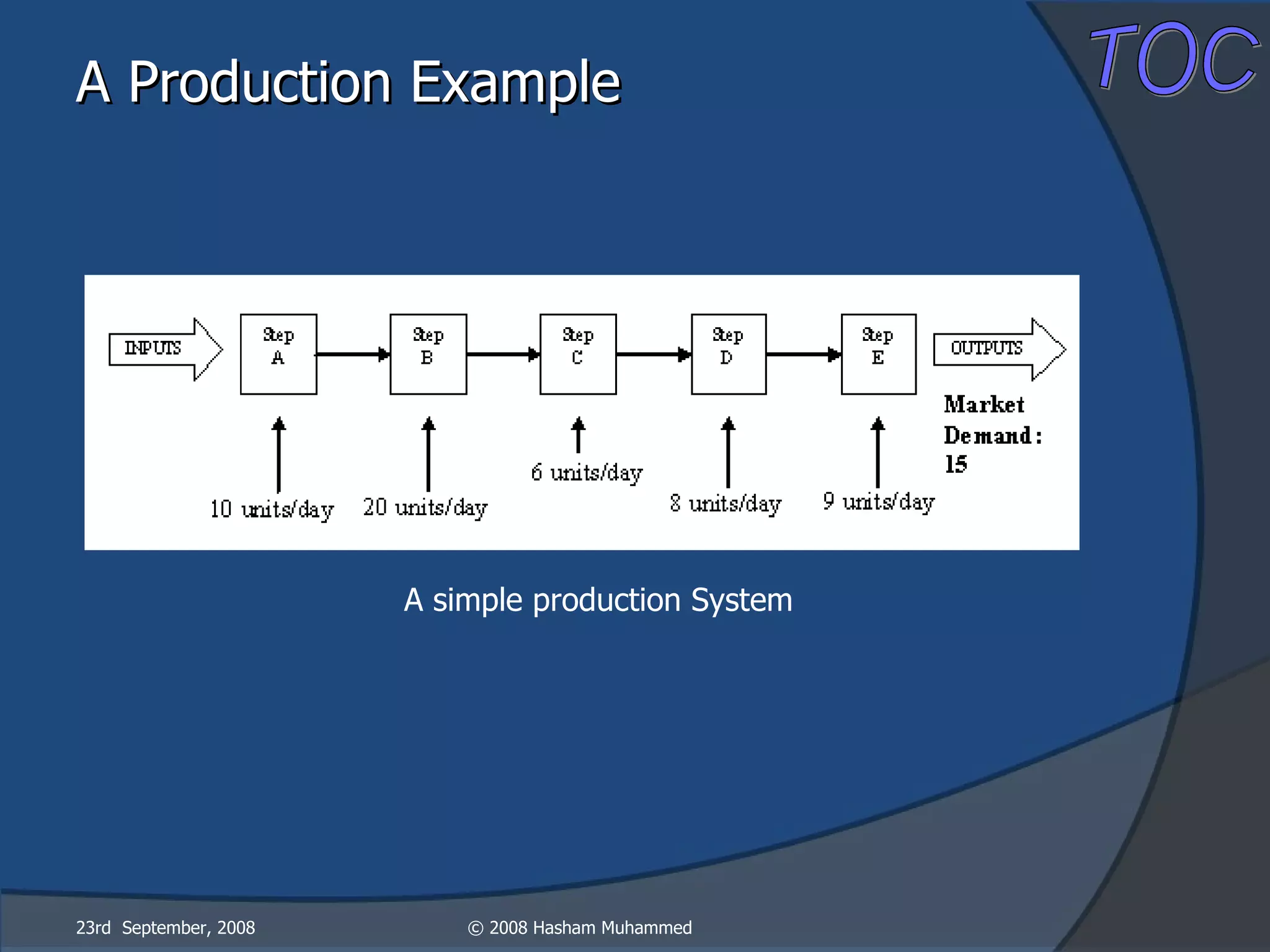
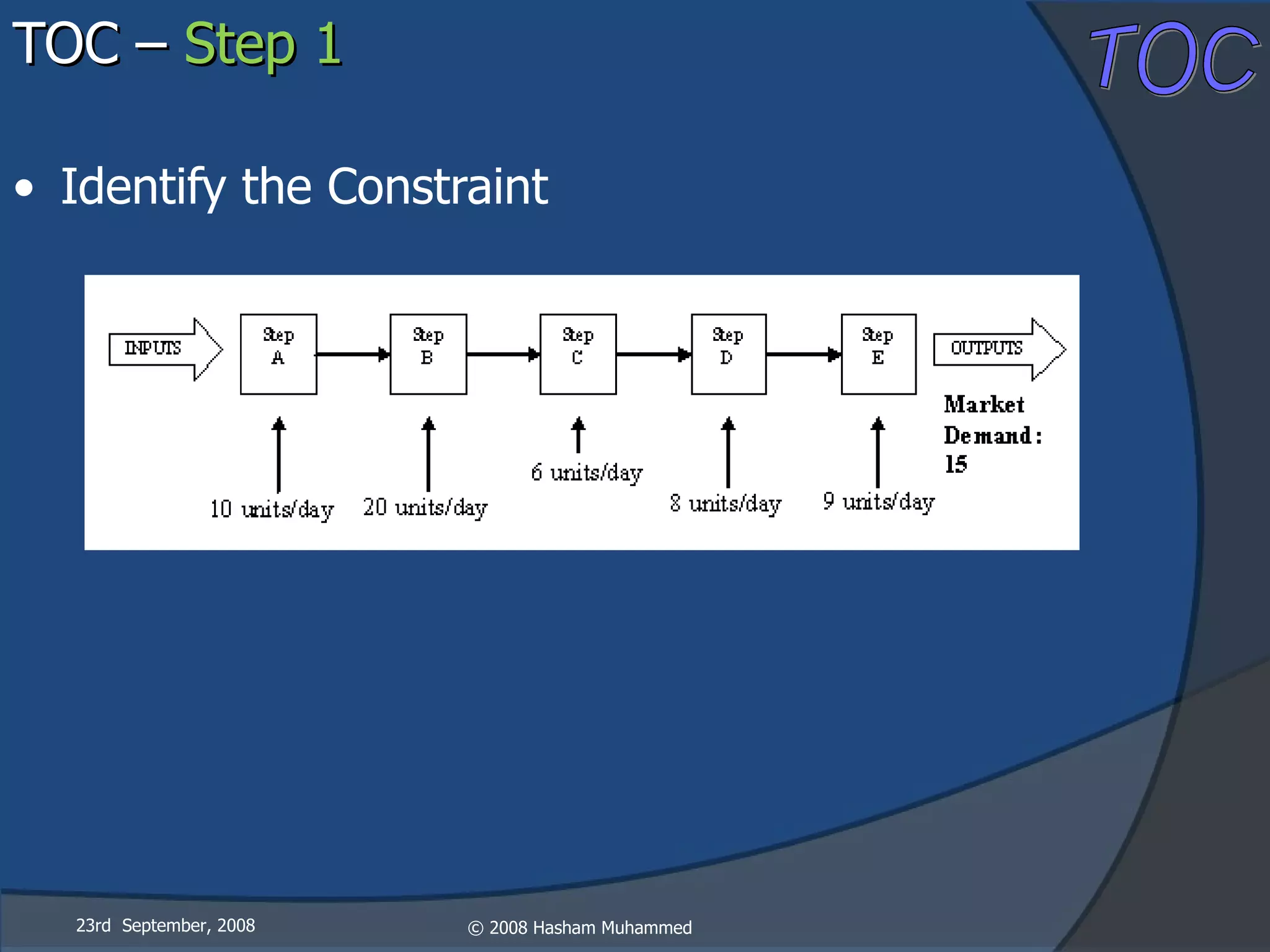
A Production Example 23rd  September, 2008 A simple production System
TOC –  Step 1 23rd  September, 2008
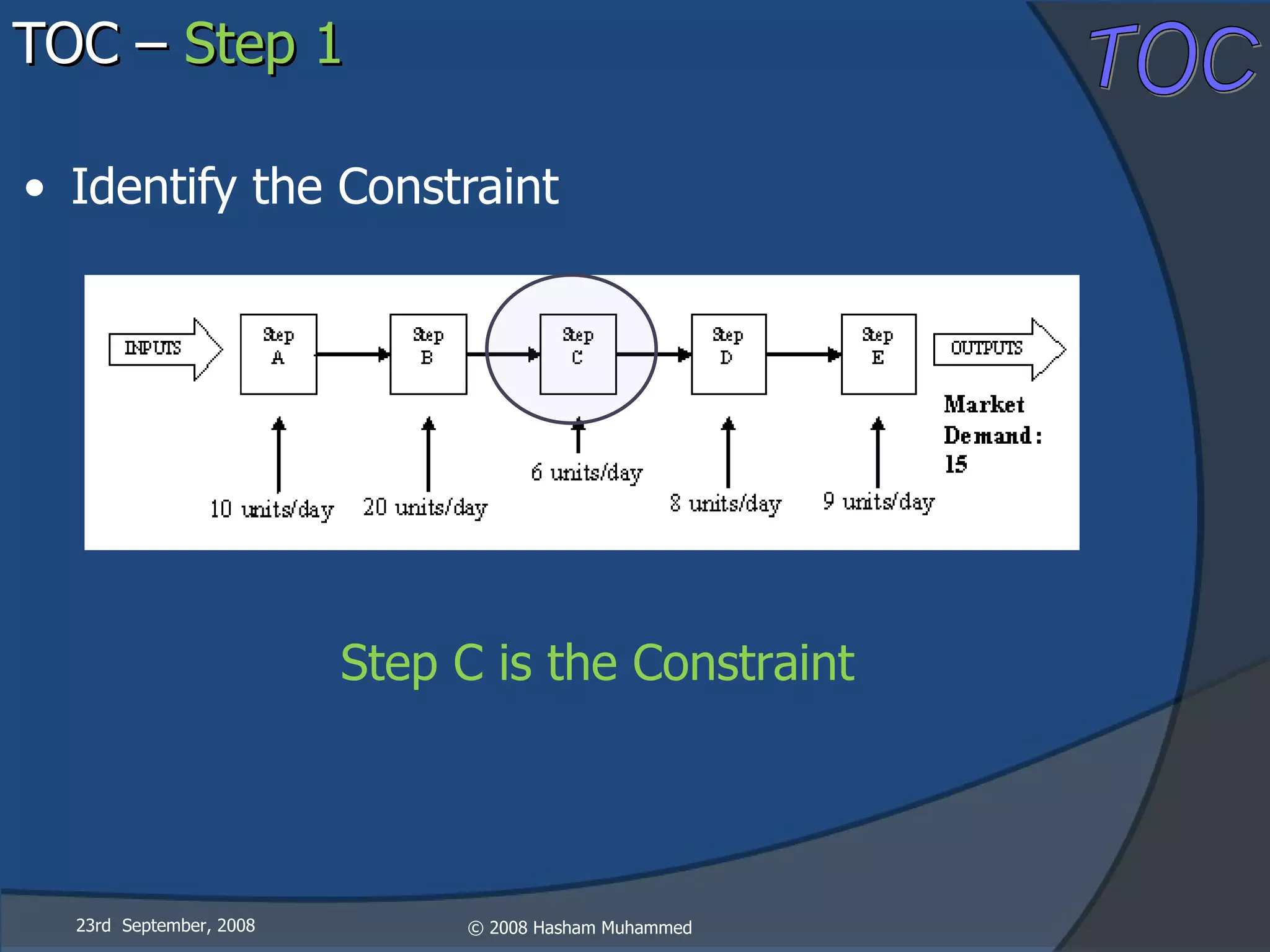
Identify the Constraint TOC –  Step 1 23rd  September, 2008
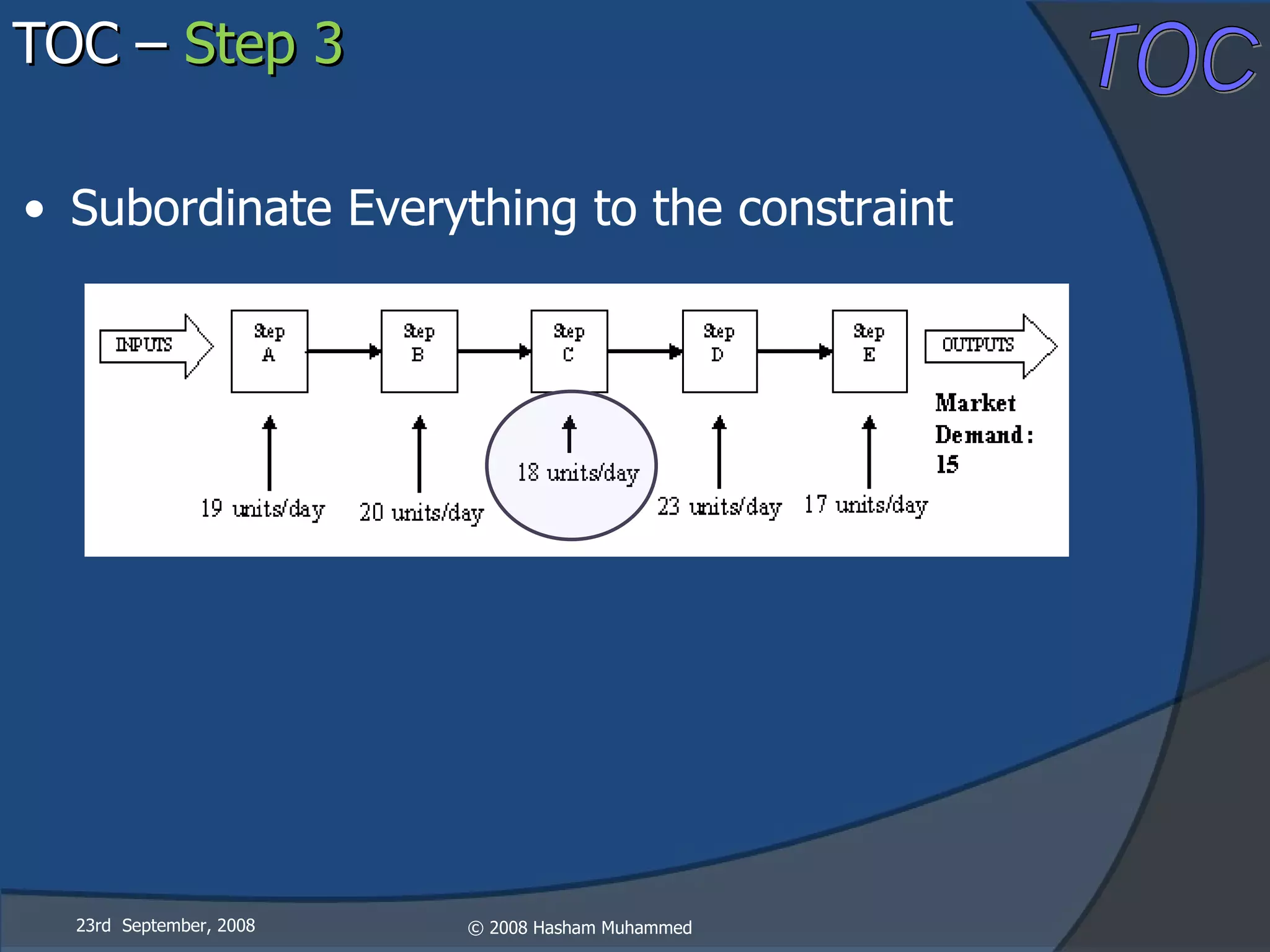
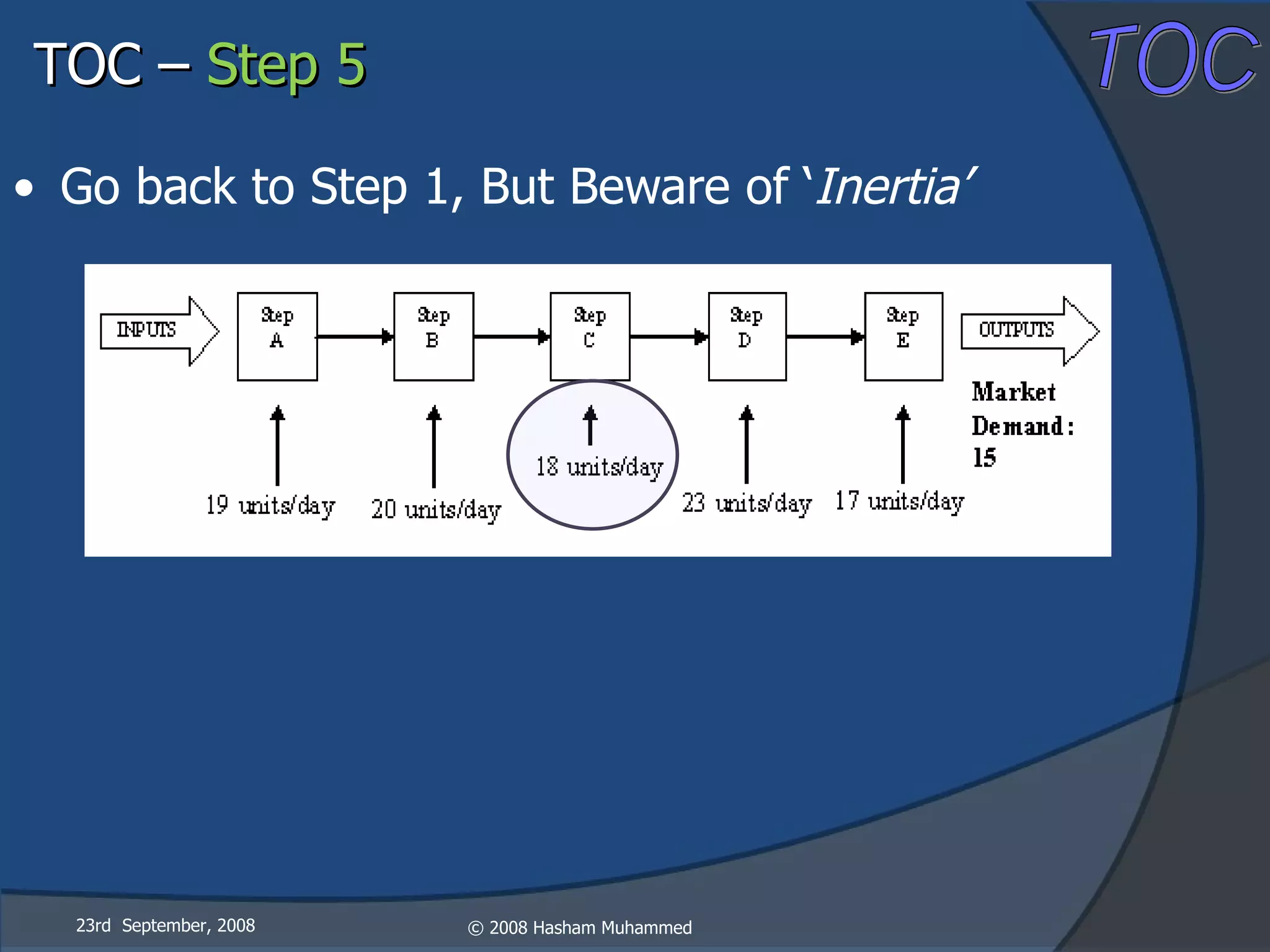
TOC –  Step 1 Identify the Constraint 23rd  September, 2008 Step C is the Constraint
TOC –  Step 2 23rd  September, 2008
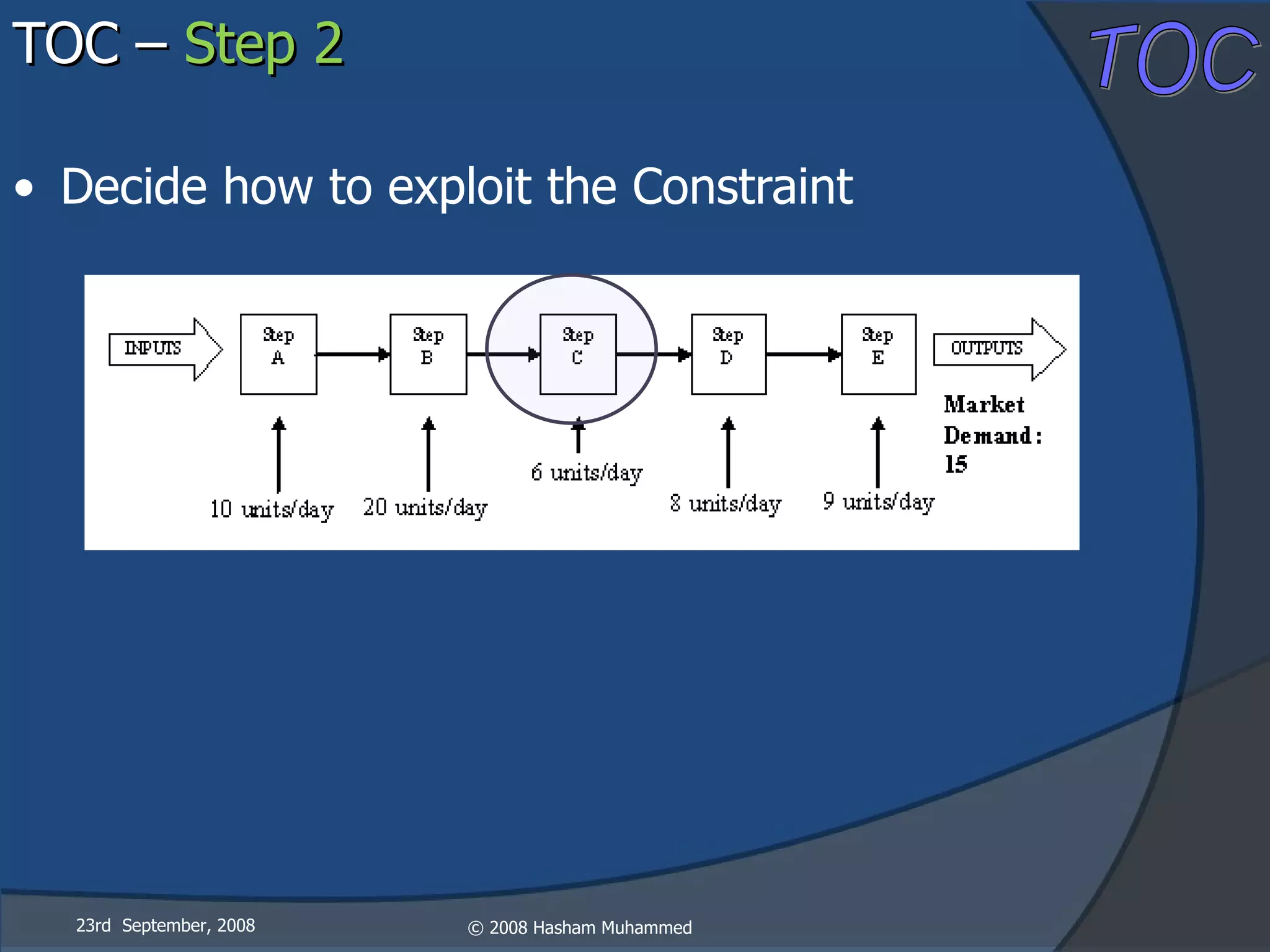
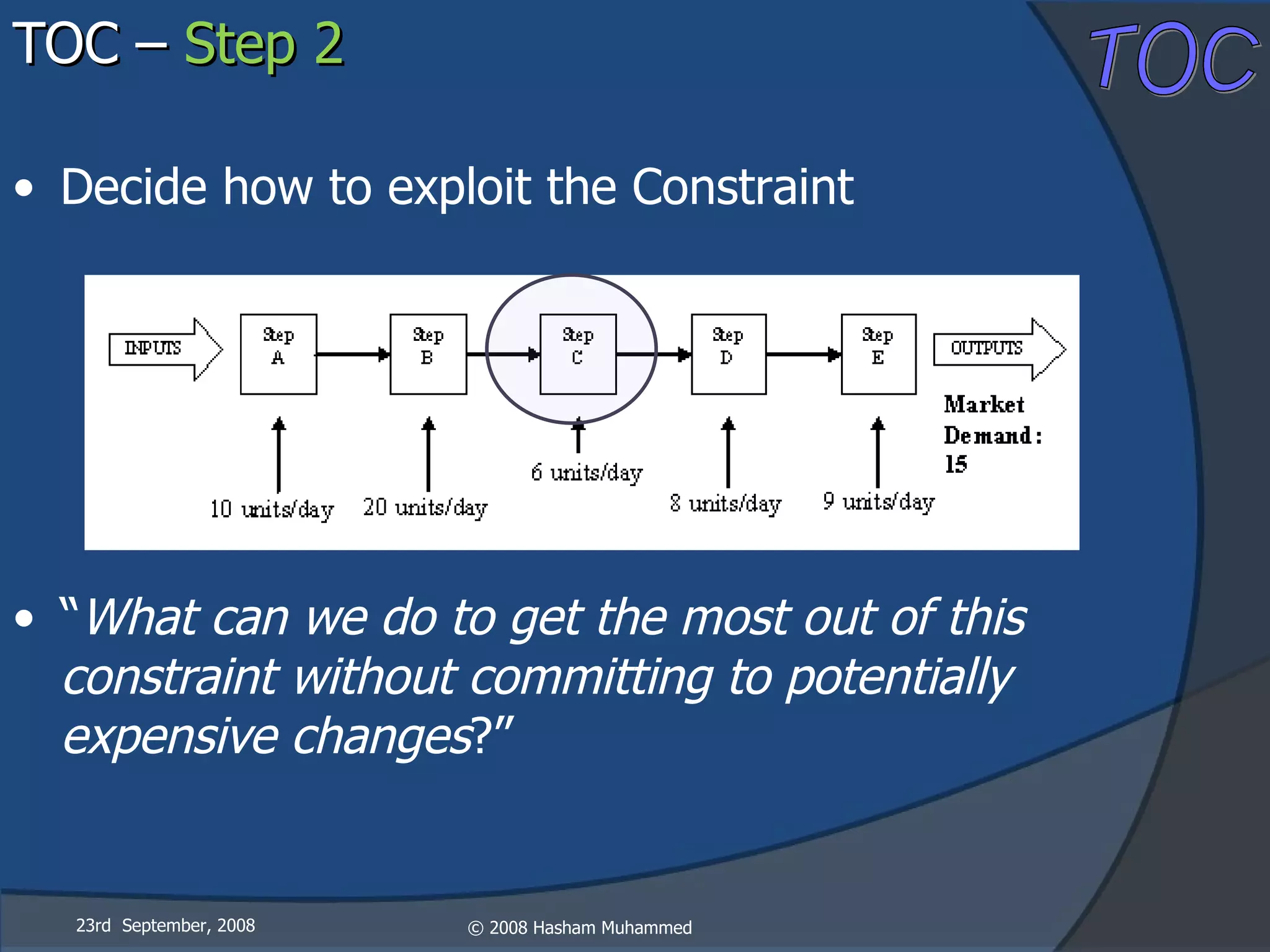
Decide how to exploit the Constraint TOC –  Step 2 23rd  September, 2008
“ What can we do to get the most out of this constraint without committing to potentially expensive changes ?” TOC –  Step 2 23rd  September, 2008 Decide how to exploit the Constraint
TOC –  Step 3 23rd  September, 2008
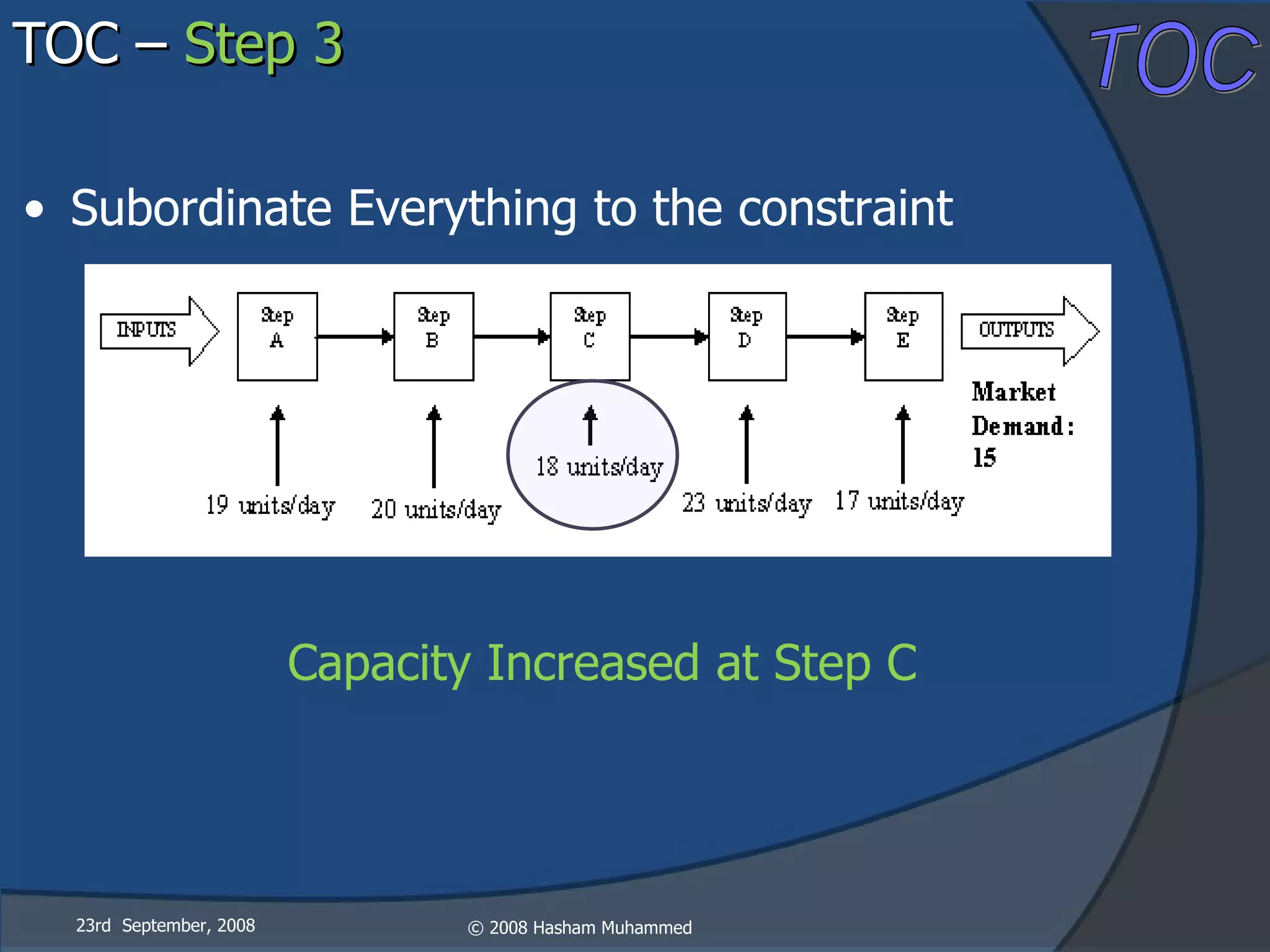
TOC –  Step 3 23rd  September, 2008 Subordinate Everything to the constraint
TOC –  Step 3 23rd  September, 2008 Subordinate Everything to the constraint Capacity Increased at Step C
23rd  September, 2008 TOC –  Step 4
23rd  September, 2008 TOC –  Step 4 Elevate the Constraint
23rd  September, 2008 Elevate the Constraint If we are doing Step 4, it means that Steps 2 & 3 weren’t sufficient to eliminate the constraint. TOC –  Step 4
23rd  September, 2008 Elevate the Constraint If we are doing Step 4, it means that Steps 2 & 3 weren’t sufficient to eliminate the constraint. ‘ Elevating’  the constraint means we take whatever action is required to eliminate the constraint. TOC –  Step 4
23rd  September, 2008 TOC –  Step 5
Go back to Step 1, But Beware of ‘ Inertia’ 23rd  September, 2008 TOC –  Step 5
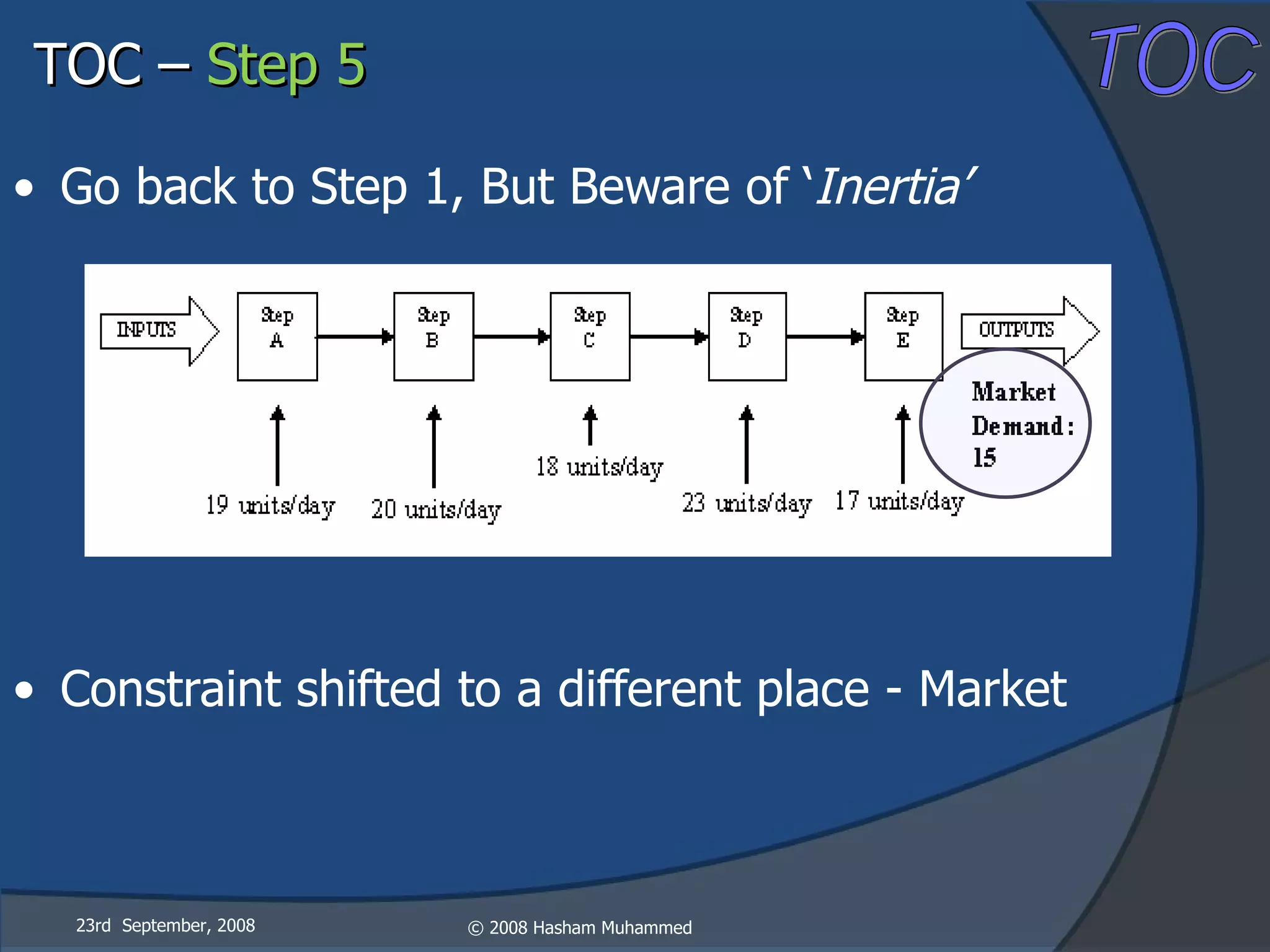
Go back to Step 1, But Beware of ‘ Inertia’ Constraint shifted to a different place - Market 23rd  September, 2008 TOC –  Step 5
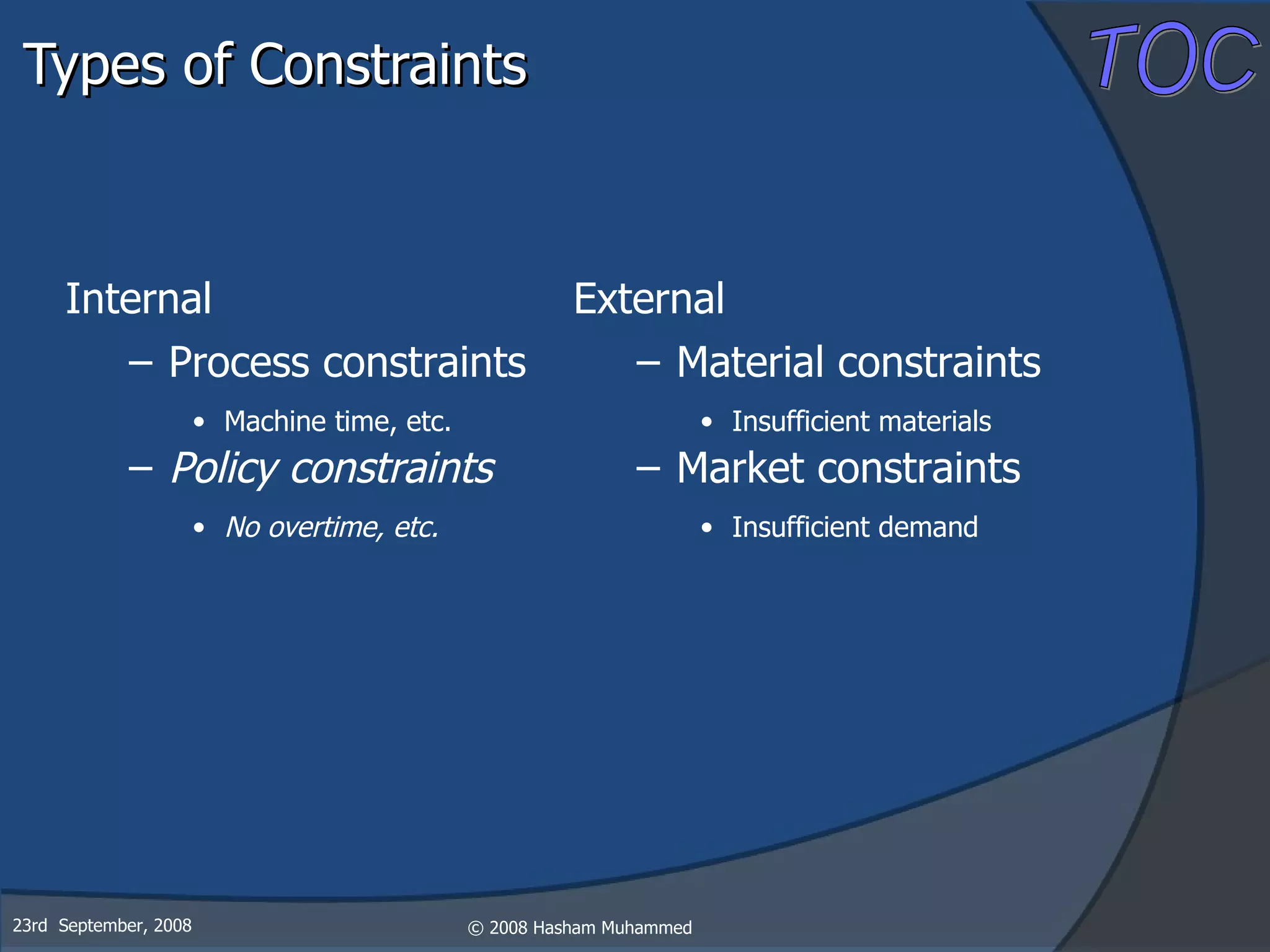
Types of Constraints Internal External Process constraints Machine time, etc. Policy constraints No overtime, etc. Material constraints Insufficient materials Market constraints Insufficient demand 23rd  September, 2008
23rd  September, 2008 1 . Identify  the Constraint 2 . Exploit  the Constraint 3 . Subordinate  everything to the Constraint 4.  Elevate  the Constraint 5 . Repeat  for the new  Constraint ‘ Beware’  of Inertia TOC-  FIVE FOCUSING STEPS   ( Which will Strengthen the Chain )
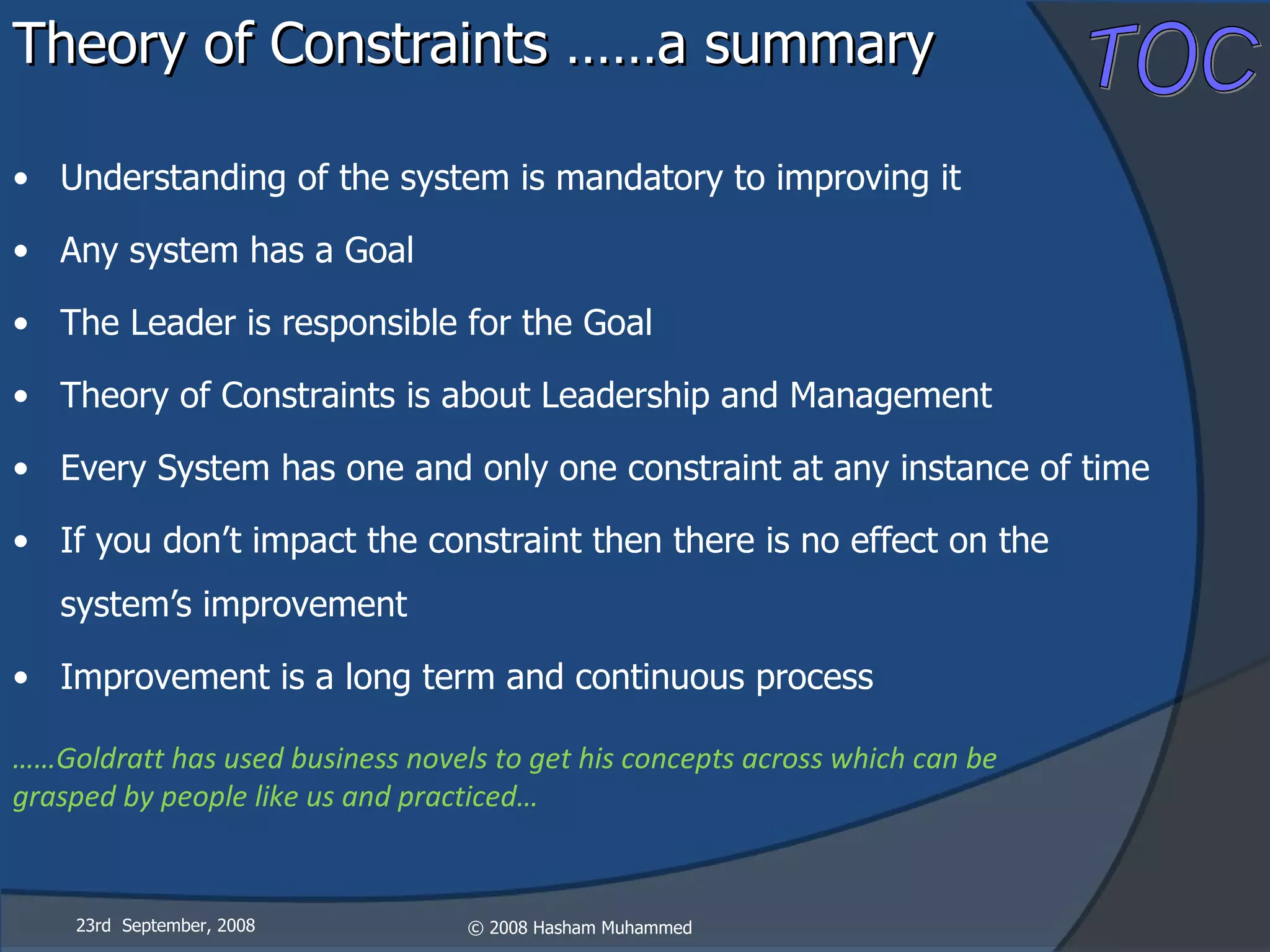
Theory of Constraints ……a summary Understanding of the system is mandatory to improving it Any system has a Goal The Leader is responsible for the Goal Theory of Constraints is about Leadership and Management Every System has one and only one constraint at any instance of time If you don’t impact the constraint then there is no effect on the system’s improvement Improvement is a long term and continuous process …… Goldratt has used business novels to get his concepts across which can be grasped by people like us and practiced… 23rd  September, 2008
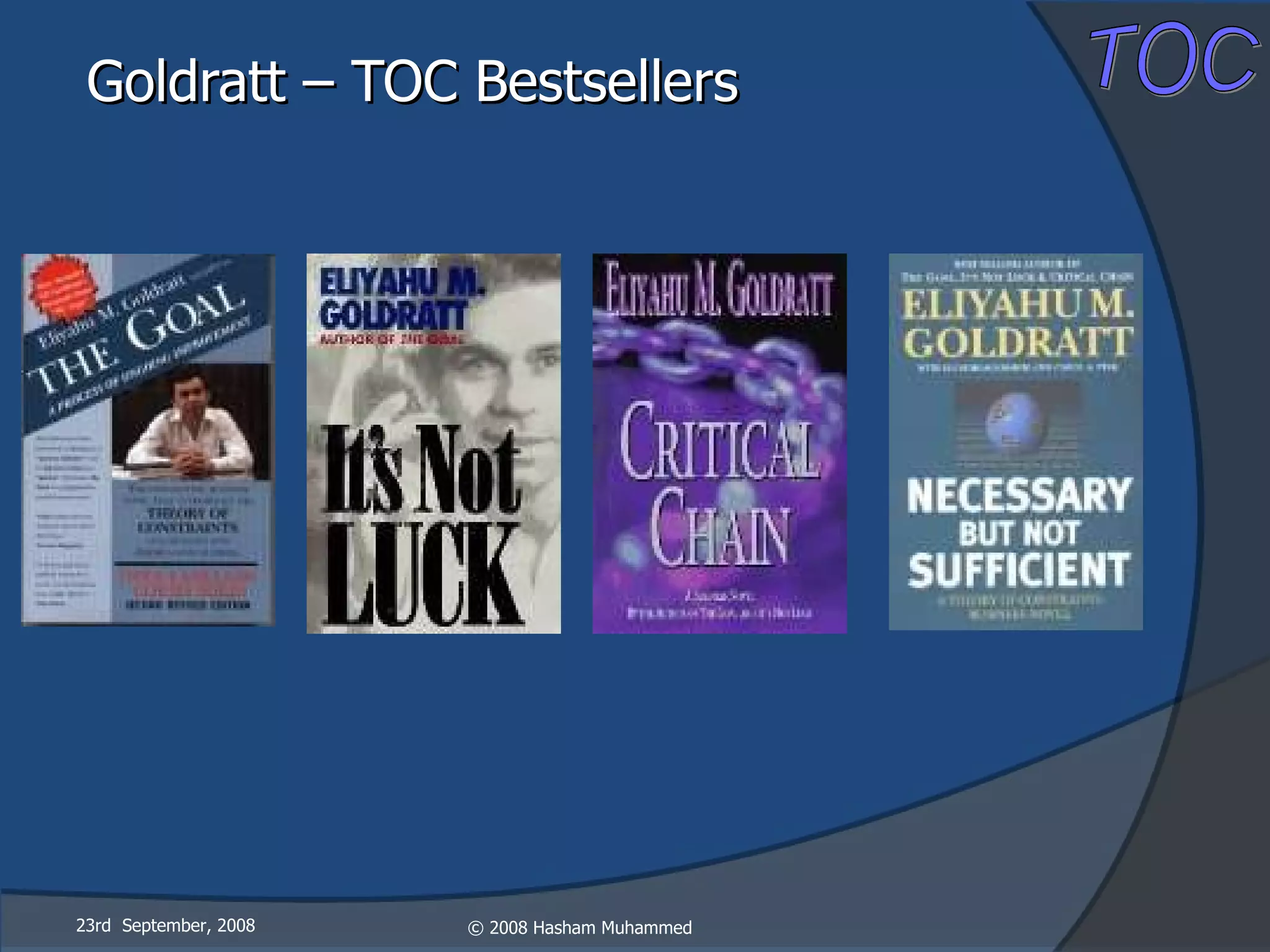
Goldratt – TOC Bestsellers 23rd  September, 2008
23rd  September, 2008 There is no such thing as staying the same. You are either striving to make yourself better or allowing yourself to get worse. -  Source Unknown
23rd  September, 2008 The Logical Thinking Process  – A systems approach to complex problem solving -  H. William Dettmer References Thank You!

Introductionto toc

  • 1.
    Introduction to Theoryof Constraints Presented by Hasham Muhammed [email_address] 23rd September, 2008
  • 2.
    Contents Introduction – The Philosophy Thinking Process System’s Thinking Goal Concept of System Constraints TOC intro Steps in TOC Example Conclusion 23rd September, 2008
  • 3.
    Do we reallywant or need another New Theory? 23rd September, 2008
  • 4.
    Do we reallywant or need another New Theory? 23rd September, 2008 “ The significant problems we face today can not be resolved at the same level of thinking we were at when we created them.” - Albert Einstein
  • 5.
    Thinking Process Theprocess of how an entity learns to gain understanding of the environment or System 23rd September, 2008
  • 6.
    Thinking Processes 23rd September, 2008 The process of how an entity learns to gain understanding of the environment or System The KEY focus being Thinking from a SYSTEM’s point of view
  • 7.
    A system isan entity which maintains its existence through the INTERACTION of its elements. System’s Thinking 23rd September, 2008
  • 8.
    A system isan entity which maintains its existence through the INTERACTION of its elements. 23rd September, 2008 The key point here is INTERACTION. System’s Thinking
  • 9.
    A system isan entity which maintains its existence through the INTERACTION of its elements. 23rd September, 2008 Cooking food is a good analogy – Final product is different from the individual ingredients The key point here is INTERACTION. System’s Thinking
  • 10.
    The System’s GoalWhy do Systems exist? 23rd September, 2008
  • 11.
    The System’s Goal23rd September, 2008 Why do Systems exist? To achieve a “Goal”
  • 12.
    The System’s Goal23rd September, 2008 Why do Systems exist? To achieve a “Goal” A result or achievement toward which effort is directed.
  • 13.
    Who gets todecide what the goal should be? The System’s Goal 23rd September, 2008
  • 14.
    23rd September,2008 Who gets to decide what the goal should be? The System’s Goal The Leader is responsible for the Goal
  • 15.
    23rd September,2008 Who gets to decide what the goal should be? The Leader is responsible for the Goal The System’s Goal Everyone may be considered as a Leader of something (Whole Organization, Unit, Integrated Business, department, small team, life, career…) that is supported by a System
  • 16.
    Theory of Constraintsis about Management 23rd September, 2008
  • 17.
    The threeimportant questions for a manager What is the Ultimate goal? Where does he or she stand in relation to the goal? The magnitude and direction of the change needed to move from the status quo to where he or she wants to be (the goal). 23rd September, 2008 Theory of Constraints is about Management
  • 18.
    “ Average managersare concerned with methods, opinions, and precedents. Good Managers are concerned with solving problems ” - William Dettmer 23rd September, 2008
  • 19.
    Concept of SystemConstraints 23rd September, 2008
  • 20.
    Concept of SystemConstraints 23rd September, 2008 What keeps your system from doing better?
  • 21.
    Concept of SystemConstraints 23rd September, 2008 What keeps your system from doing better? Is there something that is constraining your system from reaching its GOAL?
  • 22.
    Systems as ChainsAssume the SYSTEM to be a chain with ‘n’ links and with a goal of transmitting force from end A to B . 23rd September, 2008 A B 1 2 3 6 5 7 4
  • 23.
    Systems as Chains(cont..) Weakest link The link at which the system fails to achieve the goal is the weakest link. 23rd September, 2008 A B 4
  • 24.
    Constraints and Non-Constraints23rd September, 2008
  • 25.
    Constraints and Non-Constraints23rd September, 2008 There is only one CONSTRAINT in a system at a given point of time
  • 26.
    Constraints and Non-Constraints23rd September, 2008 There is only one CONSTRAINT in a system at a given point of time
  • 27.
    Constraints and Non-ConstraintsNonconstraints are all the other links; ‘n-1’ 23rd September, 2008 There is only one CONSTRAINT in a system at a given point of time
  • 28.
    Strengthening the Chain23rd September, 2008
  • 29.
    Strengthening the ChainWhere Should we focus our efforts? 23rd September, 2008
  • 30.
    Strengthening the ChainWhere Should we focus our efforts? 23rd September, 2008 Strengthen the weakest link
  • 31.
    Core of TOC 23rd September, 2008
  • 32.
    Core of TOC 23rd September, 2008 If you don’t impact the Constraint, you have no effect
  • 33.
    Basic Questions forManagers What’s the desired standard of performance (System’s Goal ) What to change? (Where is the constraint?) What to change to? (What should we do with the constraint?) How to cause the change? ( How do we implement the change?) 23rd September, 2008 Note: These are system-level questions, not process-level
  • 34.
    23rd September,2008 TOC- FIVE FOCUSING STEPS ( Which will Strengthen the Chain )
  • 35.
    23rd September,2008 1 . Identify the Constraint 2 . Exploit the Constraint 3 . Subordinate everything to the Constraint 4. Elevate the Constraint 5 . Repeat for the new Constraint ‘ Beware’ of Inertia TOC- FIVE FOCUSING STEPS ( Which will Strengthen the Chain )
  • 36.
    A Production Example23rd September, 2008 A simple production System
  • 37.
    TOC – Step 1 23rd September, 2008
  • 38.
    Identify the ConstraintTOC – Step 1 23rd September, 2008
  • 39.
    TOC – Step 1 Identify the Constraint 23rd September, 2008 Step C is the Constraint
  • 40.
    TOC – Step 2 23rd September, 2008
  • 41.
    Decide how toexploit the Constraint TOC – Step 2 23rd September, 2008
  • 42.
    “ What canwe do to get the most out of this constraint without committing to potentially expensive changes ?” TOC – Step 2 23rd September, 2008 Decide how to exploit the Constraint
  • 43.
    TOC – Step 3 23rd September, 2008
  • 44.
    TOC – Step 3 23rd September, 2008 Subordinate Everything to the constraint
  • 45.
    TOC – Step 3 23rd September, 2008 Subordinate Everything to the constraint
  • 46.
    TOC – Step 3 23rd September, 2008 Subordinate Everything to the constraint Capacity Increased at Step C
  • 47.
    23rd September,2008 TOC – Step 4
  • 48.
    23rd September,2008 TOC – Step 4 Elevate the Constraint
  • 49.
    23rd September,2008 Elevate the Constraint If we are doing Step 4, it means that Steps 2 & 3 weren’t sufficient to eliminate the constraint. TOC – Step 4
  • 50.
    23rd September,2008 Elevate the Constraint If we are doing Step 4, it means that Steps 2 & 3 weren’t sufficient to eliminate the constraint. ‘ Elevating’ the constraint means we take whatever action is required to eliminate the constraint. TOC – Step 4
  • 51.
    23rd September,2008 TOC – Step 5
  • 52.
    Go back toStep 1, But Beware of ‘ Inertia’ 23rd September, 2008 TOC – Step 5
  • 53.
    Go back toStep 1, But Beware of ‘ Inertia’ Constraint shifted to a different place - Market 23rd September, 2008 TOC – Step 5
  • 54.
    Types of ConstraintsInternal External Process constraints Machine time, etc. Policy constraints No overtime, etc. Material constraints Insufficient materials Market constraints Insufficient demand 23rd September, 2008
  • 55.
    23rd September,2008 1 . Identify the Constraint 2 . Exploit the Constraint 3 . Subordinate everything to the Constraint 4. Elevate the Constraint 5 . Repeat for the new Constraint ‘ Beware’ of Inertia TOC- FIVE FOCUSING STEPS ( Which will Strengthen the Chain )
  • 56.
    Theory of Constraints……a summary Understanding of the system is mandatory to improving it Any system has a Goal The Leader is responsible for the Goal Theory of Constraints is about Leadership and Management Every System has one and only one constraint at any instance of time If you don’t impact the constraint then there is no effect on the system’s improvement Improvement is a long term and continuous process …… Goldratt has used business novels to get his concepts across which can be grasped by people like us and practiced… 23rd September, 2008
  • 57.
    Goldratt – TOCBestsellers 23rd September, 2008
  • 58.
    23rd September,2008 There is no such thing as staying the same. You are either striving to make yourself better or allowing yourself to get worse. - Source Unknown
  • 59.
    23rd September,2008 The Logical Thinking Process – A systems approach to complex problem solving - H. William Dettmer References Thank You!

Editor's Notes

  • #4 The Theory of constraints is considerably more than just a theory. In effect, it’s a paradigm, a pattern or model that includes not only concepts, guiding principles, but tools and applications as well. Theories are either classified as descriptive or prescriptive. Descriptive Theories such as the law of gravity, tell us why things happen, but they don’t tell us to do anything about them. Prescriptive theories both explain why and offer guidance on what to do. TOC is a prescriptive theory, but in this current presentation we’ll only look at the descriptive part of it.
  • #6 We’ll start with having an understanding about the Thinking process. Edward Deming quoted that “Real quality improvement is not possible without profound knowledge”, which comes from an understanding the complete system. The Key focus here is “Thinking from a system’s point of view”. “ Thinking from a system’s point of view”, what does that mean?
  • #8 A system might be generally defined as a collection of interrelated, interdependent, components or processes that act in tandem to turn inputs into some kind of outputs. Obviously quality cannot be considered in vacuum. It can only be considered in the context of a system in which it resides. So its not possible to improve quality without a thorough understanding of how the system works. The Key here is Interaction of the components of the System. Cooking food is a good analogy – Final product is different from the individual ingredients.
  • #11 Having understood that, let’s look at systems from a broader perspective. Why do you think System’s exist? In the most basic sense, the answer is “To achieve a goal.” which is not thing but “ A result or achievement toward which effort is directed”.
  • #14 And who do u think gets to decide on what the goal of the system should be? Obviously the leader of the system, or you can say the manager. If you or I are paid for the system, we’d expect to be the one to decide what the system’s goal should be. In any system, the responsibility for satisfying the owner’s goal rests with the managers of the system. And who is a manager, some of us might as well respond saying “But I am not a manager. Why would the Theory of constraints be important to me?” The truth is, we’re all managers. Everyone is a manager of something – in different arenas, perhaps, but a manager nonetheless. Whether you are in charge of a large corporation, a department, or a small team, you are a manager. Even if you are none of the above, you are still a manager. Under ideal circumstances all individuals manage their lives and careers. At the least you manage your personal activities, your time, and perhaps your finances.
  • #17 Theory of constraints is about management.
  • #20 Now lets assume that you, the leader of the system have decided what your system’s goal is. Are you attaining the right goal now? Most people would agree that they could be doing a better job of progressing towards it. What keeps your system from doing better? Would it be fair to say that something is constraining your system – keeping it from realizing its maximum potential? If so what do you think that constraining factor might be? The chances are that everybody in your organization has an opinion about it. But who’s right? And how would you know if they are right? If you successfully answer that question then you probably have a bright future ahead of you. Lets see if we can help you find that answer. To do this, we’ll go back to the concept of a System.
  • #23 Goldratt likens systems to chains, or to networks of chains. Let’s consider the chain that you view in the current slide. Its goal is to transmit force from end A to end B. If you accept the idea that all systems are constrained in some way, how many constraints do you think this chain has? Let’s say you keep increasing the force you apply to this chain. Can you do that indefinitely? Of Course not. If you do, eventually the chain will break – at what point?
  • #24 The “weakest link” The chain will fail at its weakest link. How many “weakest links” does a chain like this have? One- only one . There may be another link or two that are very close in “weakness,” but there is only one weakest link. The chain will fail at only one point, and that weakest link is the constraint that prevents the chain (system) from achieving the goal.
  • #25 Constraints and Non-constraints So we can conclude that our chain has only one link constraining its current performance. So how many non-constraints does it have? Yes, equal to the number of remaining links in the chain. Goldratt contended that there is usually only one constraint in a system at a given point of time . Like the narrow neck of an hourglass, that one constraint limits the output of the entire system. Everything else in the system, at that exact time, is a non-constraint.
  • #29 Strengthening the chain Let’s say we want to strengthen this chain (improve the system). Where would be the most logical place to focus our efforts? Right – the Weakest link Would it do us any good to strengthen anything except the weakest link ( that is, a non – constraint)? Of course not. Then chain would still break at the weakest link, no matter how strong we made the others.
  • #32 In other words, efforts on non-constraints – nearly all of a system – will not produce immediate, measureable improvement in system capability.
  • #34 Goldratt’s Theory of constraints is essentially about change. Applying its principles and tools answers the four basic questions about change that every manager needs to know: What’s the desired standard of performance (System’s Goal ) What to change? (Where is the constraint?) What to change to? (What should we do with the constraint?) How to cause the change? ( How do we implement the change?) Remember, these are system level questions not process level.
  • #35 The Five focusing steps of TOC This is the beginning of the prescriptive part of the Theory of Constraints. Goldratt developed 5 sequential steps to concentrate improvement on the constraint.
  • #36 Identify the System Constraint Which part of the system contains the weakest link 2. Decide how to exploit the constraint “ What can we do to get the most out of this constraint without committing to potentially expensive changes ?” 3. Subordinate everything else Here we adjust the rest of the system to the ‘setting” that will enable the constraint to operate at the maximum effectiveness. We may have to de-tune some parts of the system, while reviving up others. Inevitably, this means sacrificing the individual efficiencies of non-constraints to some extent. 4. Elevate the constraint If we are doing Step 4, it means that Steps 2 & 3 weren’t sufficient to eliminate the constraint. ‘ Elevating’ the constraint means we take whatever action is required to eliminate the constraint. 5. Go back to step 1, but beware of “Inertia”
  • #37 Here’s a different look at the chain concept. This is a simple production system that takes raw materials, runs them through five component processes, and turns them into finished products. Each process constitutes a link in the production chain. The system’s goal is to make as much money as possible from the sale of its products. Each of the component processes has a daily capacity as indicated. The market demand is 15 units per day. Using the TOC 5 step process, lets go to the first step.
  • #56 Review