Introduction to Theory of Constraints Presented by Hasham Muhammed [email_address]   23rd  September, 2008
Contents Introduction –  The Philosophy Thinking Process System’s Thinking Goal Concept of System Constraints TOC intro Steps in TOC Example Conclusion 23rd  September, 2008
Do we really want or need  another  New Theory? 23rd  September, 2008
Do we really want or need  another  New Theory? 23rd  September, 2008 “ The significant problems we face today can not be resolved at the same level of thinking we were at when we created them.” - Albert Einstein
Thinking Process The process of how an entity learns to gain understanding of the environment or System 23rd  September, 2008
Thinking Processes 23rd  September, 2008 The process of how an entity learns to gain understanding of the environment or System The KEY focus being Thinking from a SYSTEM’s point of view
A system is an entity which maintains its existence through the INTERACTION of its elements.  System’s Thinking 23rd  September, 2008
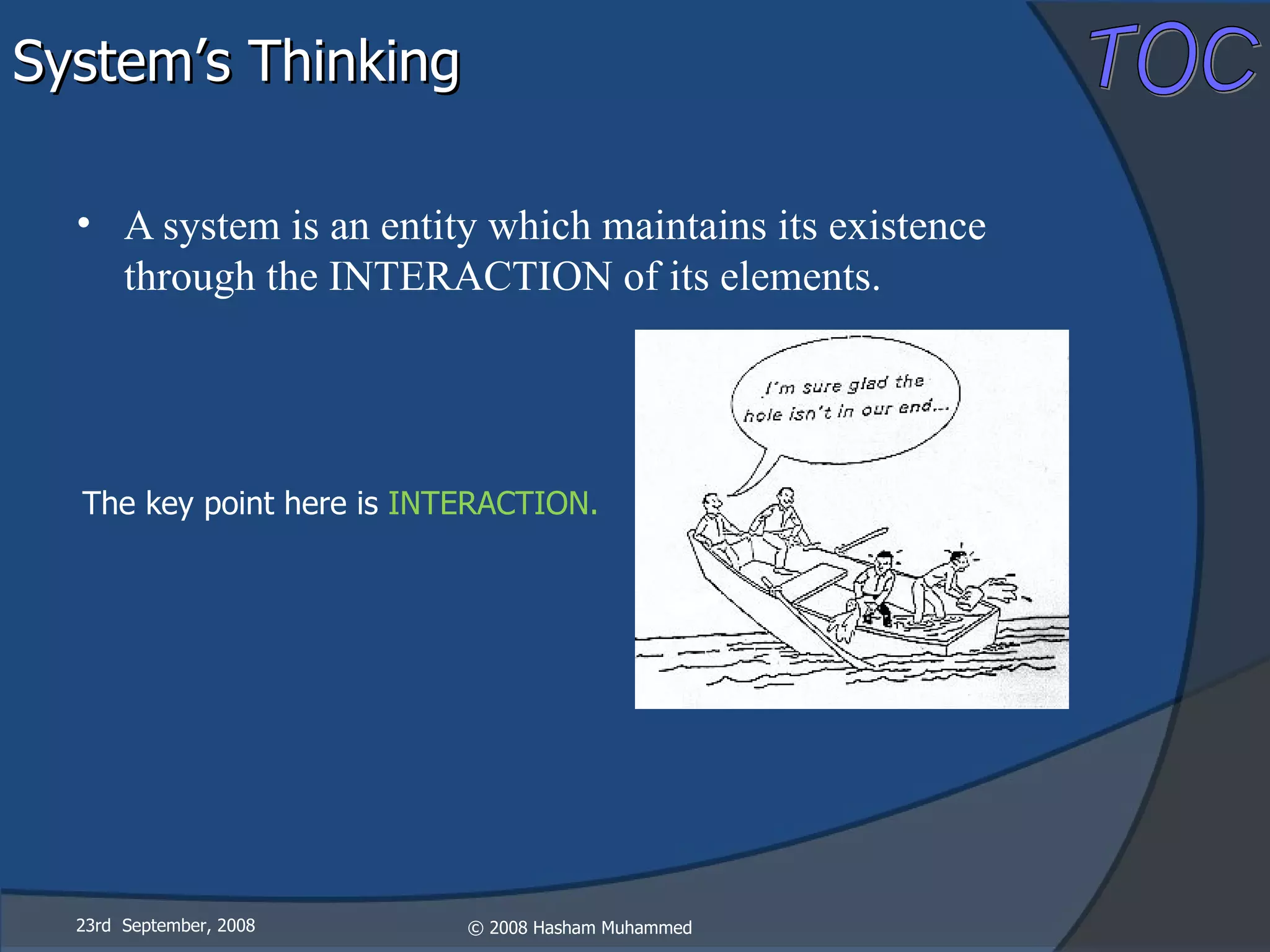
A system is an entity which maintains its existence through the INTERACTION of its elements.  23rd  September, 2008 The key point here is  INTERACTION. System’s Thinking
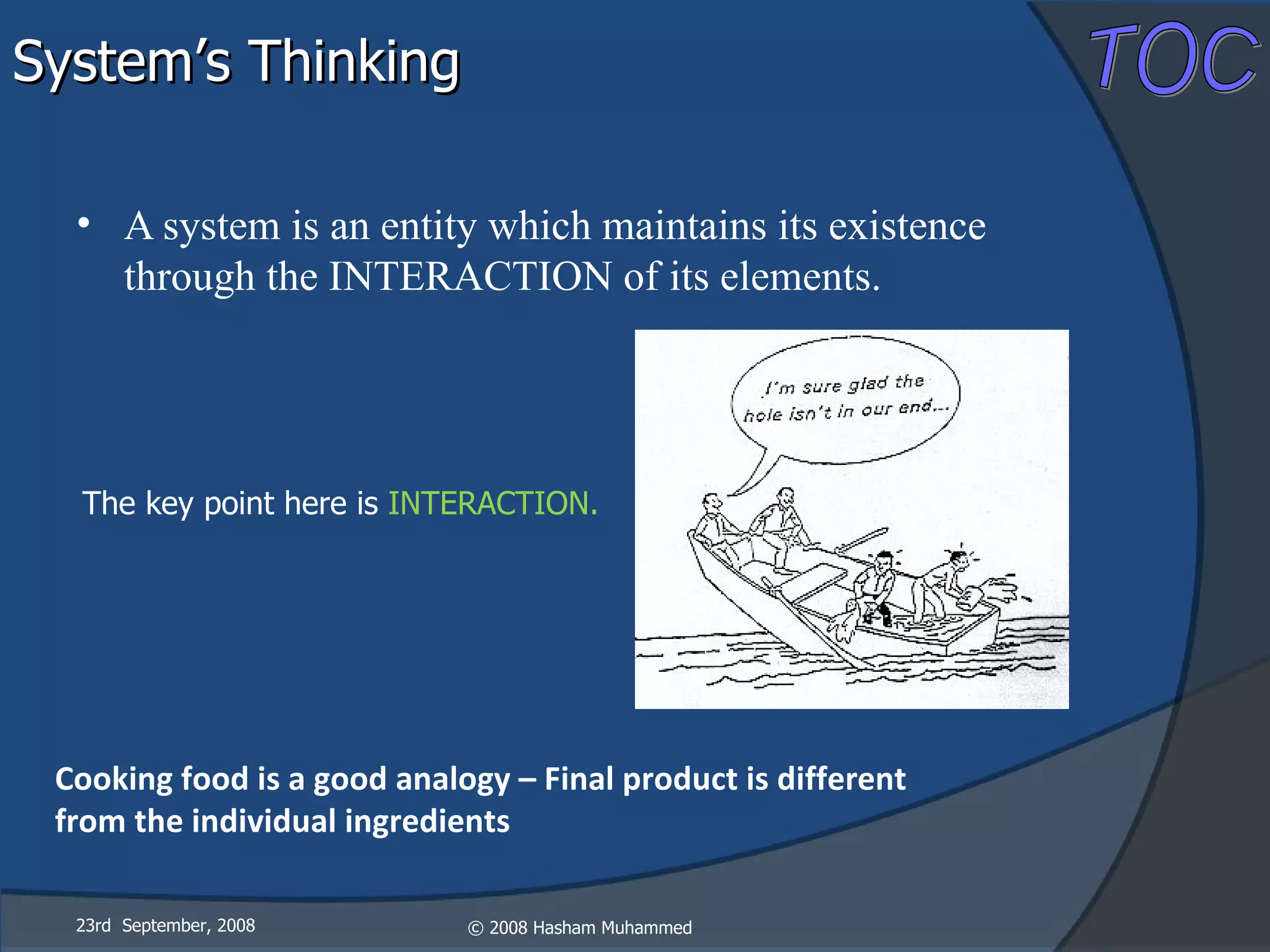
A system is an entity which maintains its existence through the INTERACTION of its elements.  23rd  September, 2008 Cooking food is a good analogy – Final product is different  from the individual ingredients The key point here is  INTERACTION. System’s Thinking
The System’s Goal Why do Systems exist? 23rd  September, 2008
The System’s Goal 23rd  September, 2008 Why do Systems exist? To achieve a “Goal”
The System’s Goal 23rd  September, 2008 Why do Systems exist? To achieve a “Goal” A result or achievement toward which effort is directed.
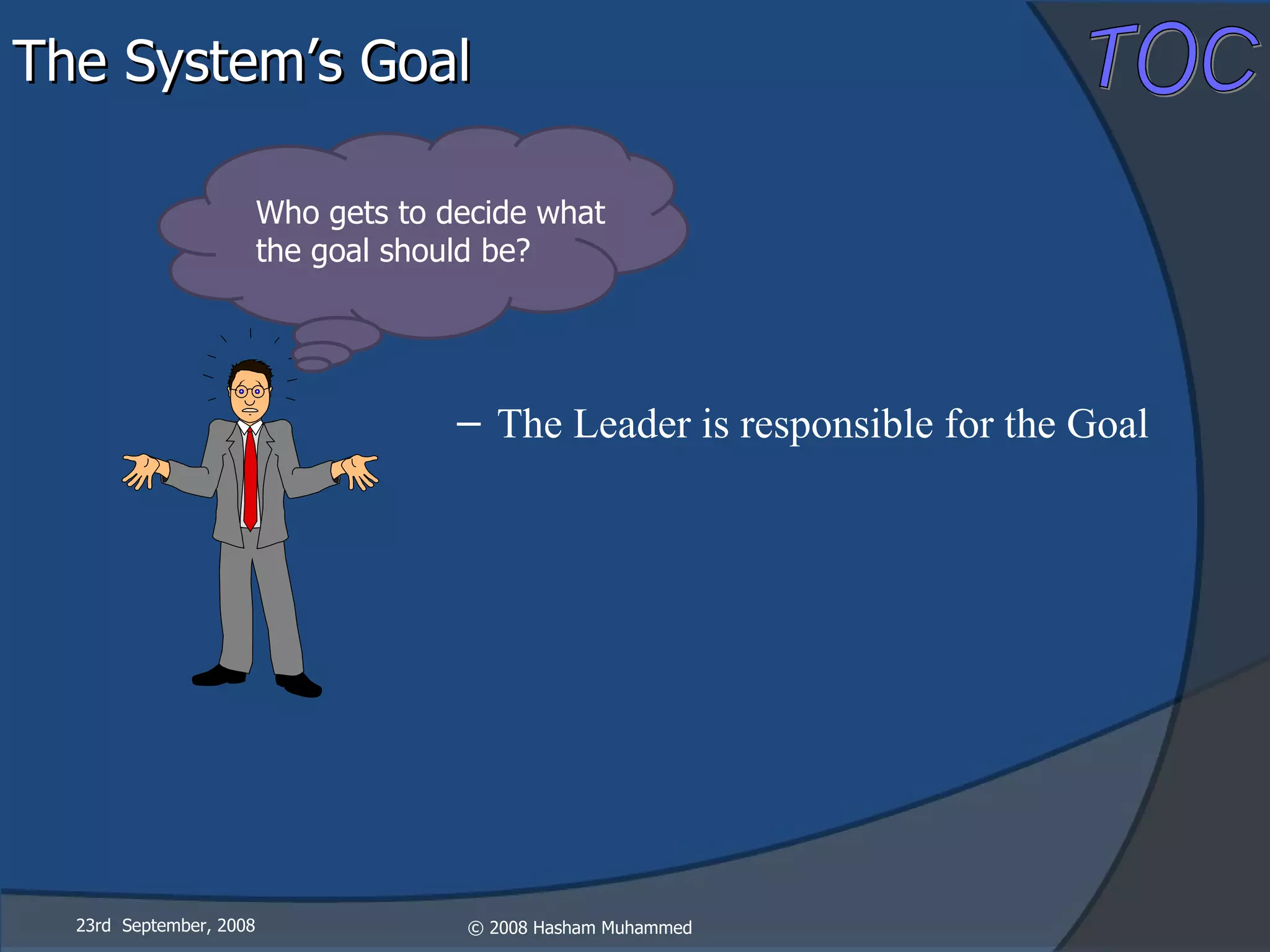
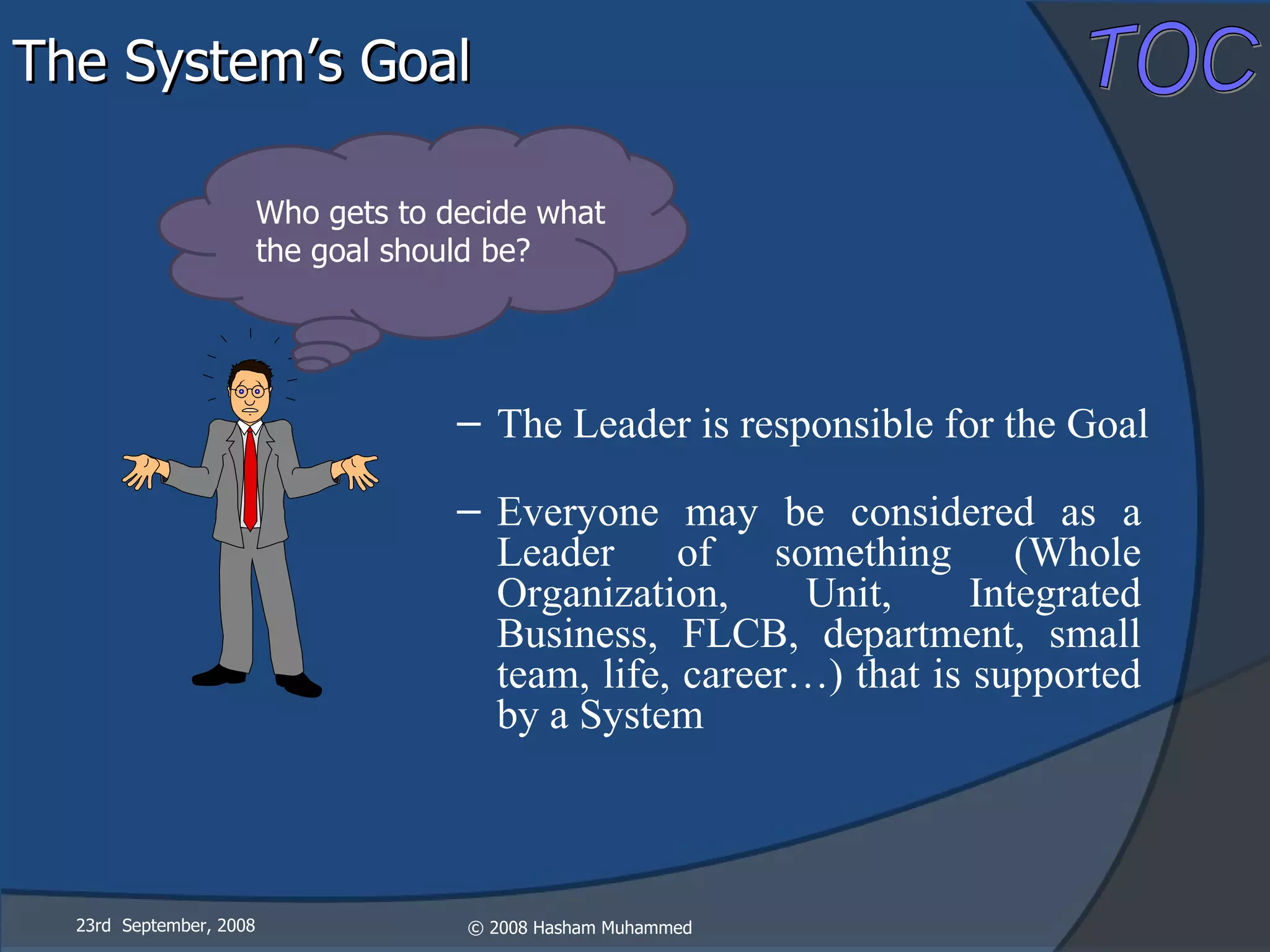
Who gets to decide what the goal should be? The System’s Goal 23rd  September, 2008
23rd  September, 2008 Who gets to decide what the goal should be? The System’s Goal The Leader is responsible for the Goal
23rd  September, 2008 Who gets to decide what the goal should be? The Leader is responsible for the Goal The System’s Goal Everyone may be considered as a Leader of something (Whole Organization, Unit, Integrated Business, FLCB, department, small team, life, career…) that is supported by a System
Theory of Constraints is about Management 23rd  September, 2008
The  three important questions for a manager What is the Ultimate goal? Where does he or she stand in relation to the goal? The magnitude and direction of the change needed to move from the status quo to where he or she wants to be (the goal). 23rd  September, 2008 Theory of Constraints is about Management
“ Average managers are concerned with methods, opinions, and precedents.  Good Managers are concerned with solving problems ” - William Dettmer 23rd  September, 2008
Concept of System Constraints 23rd  September, 2008
Concept of System Constraints 23rd  September, 2008 What keeps your system from doing better?
Concept of System Constraints 23rd  September, 2008 What keeps your system from doing better? Is there something that is constraining your system from reaching its GOAL?
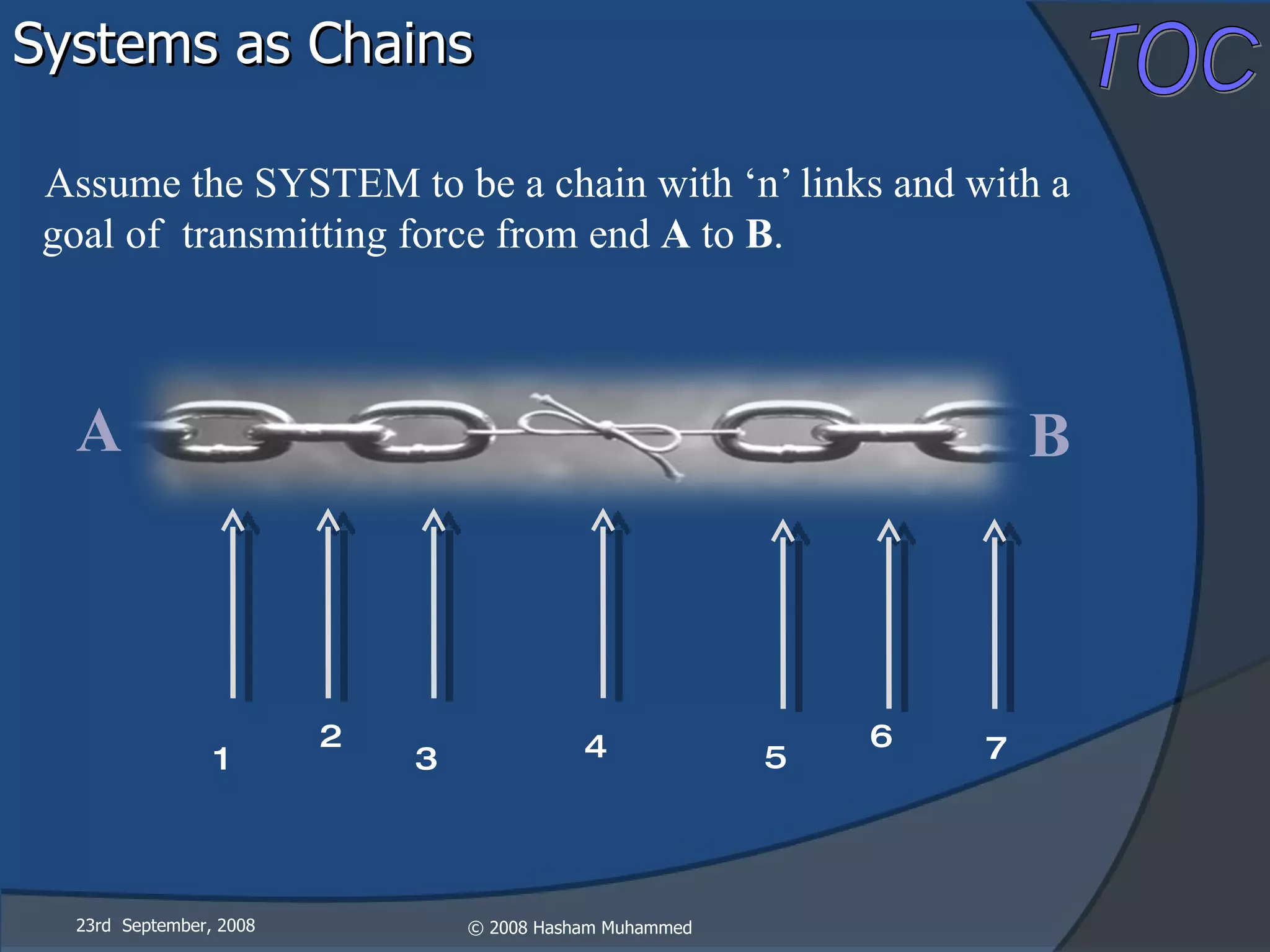
Systems as Chains Assume the SYSTEM to be a chain with ‘n’ links and with a goal of  transmitting force from end  A  to  B . 23rd  September, 2008 A B 1 2 3 6 5 7 4
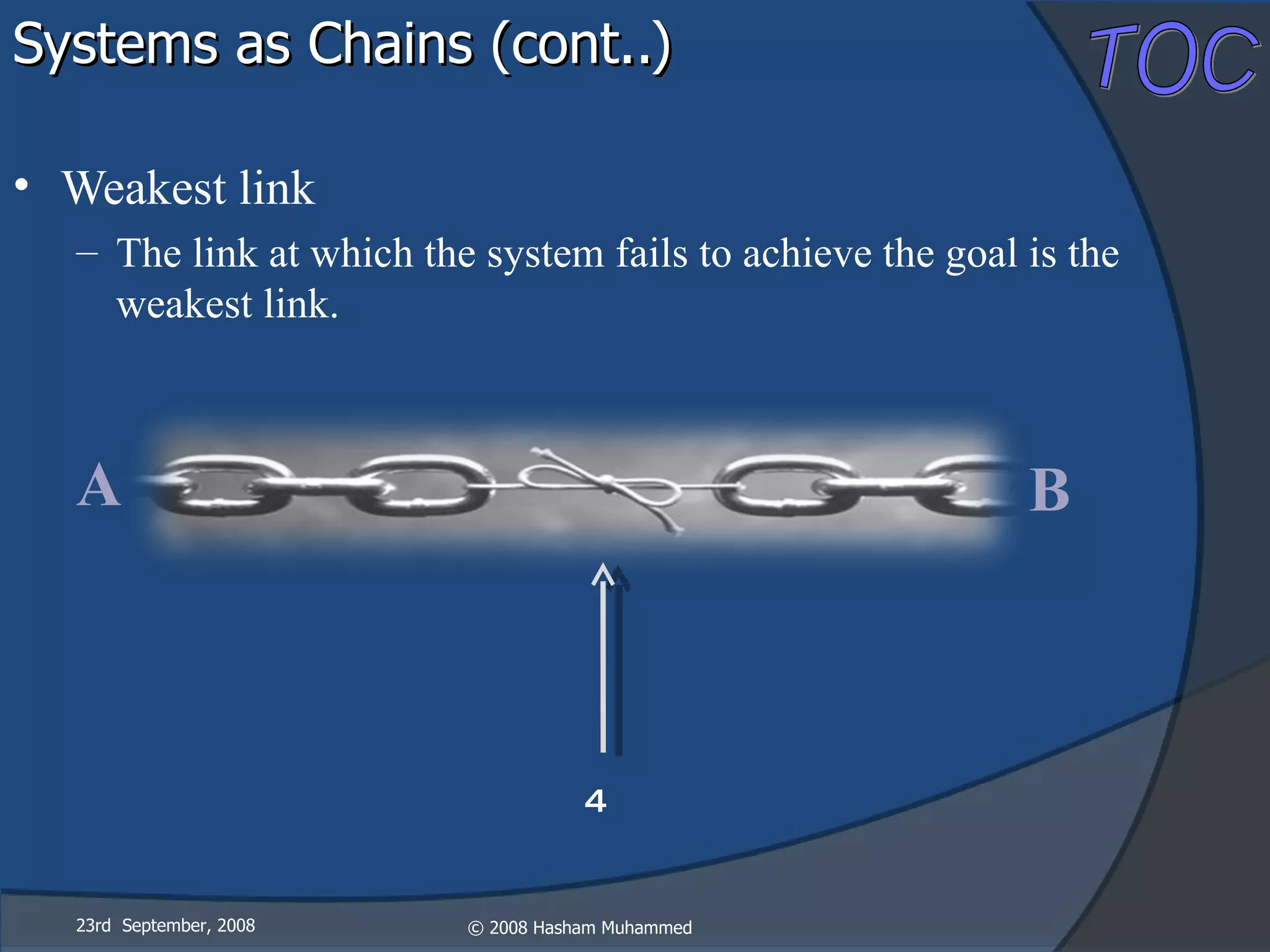
Systems as Chains (cont..) Weakest link The link at which the system fails to achieve the goal is the weakest link. 23rd  September, 2008 A B 4
Constraints and Non-Constraints 23rd  September, 2008
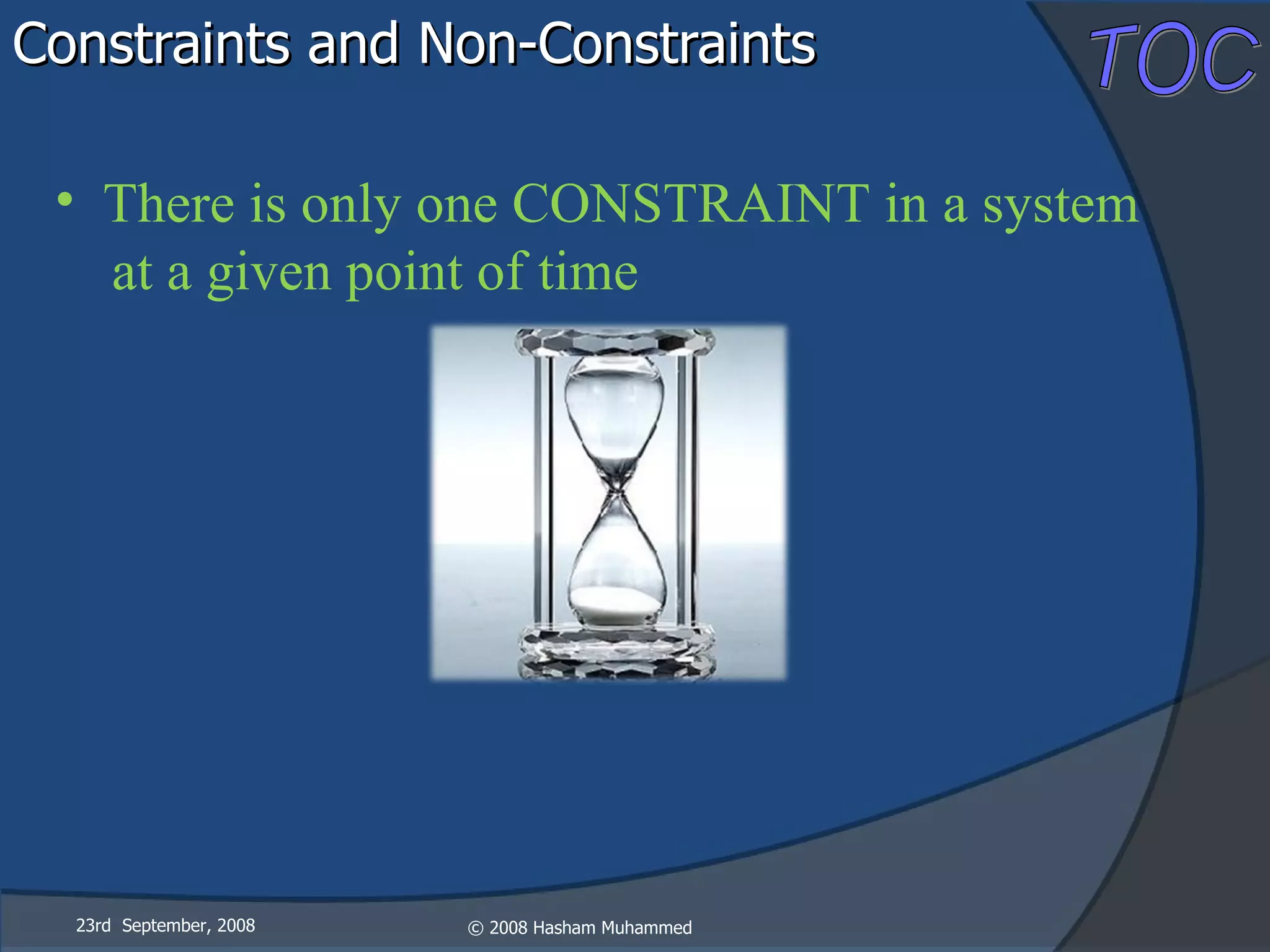
Constraints and Non-Constraints 23rd  September, 2008 There is only one CONSTRAINT in a system at a given point of time
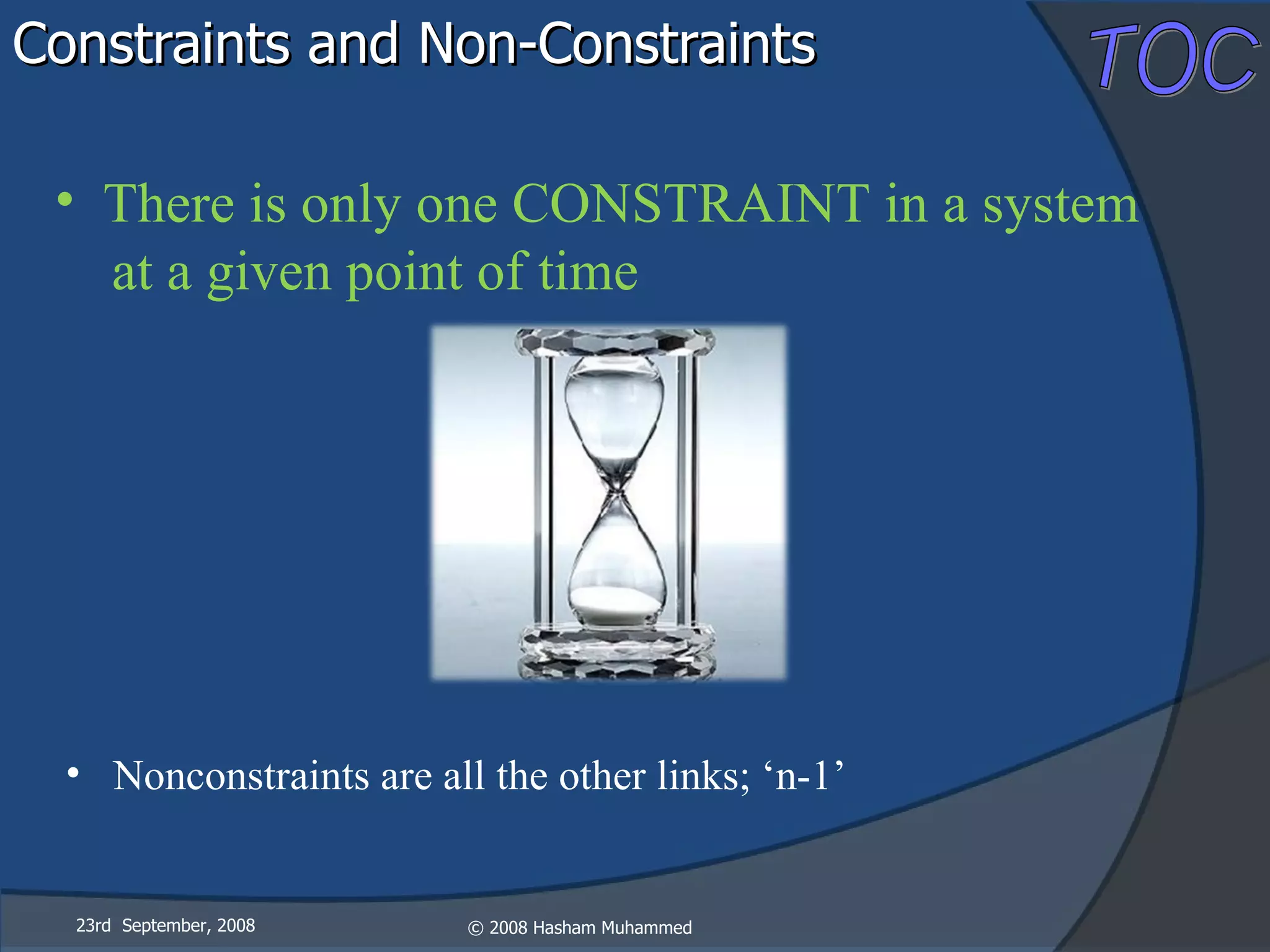
Constraints and Non-Constraints Nonconstraints are all the other links; ‘n-1’  23rd  September, 2008 There is only one CONSTRAINT in a system at a given point of time
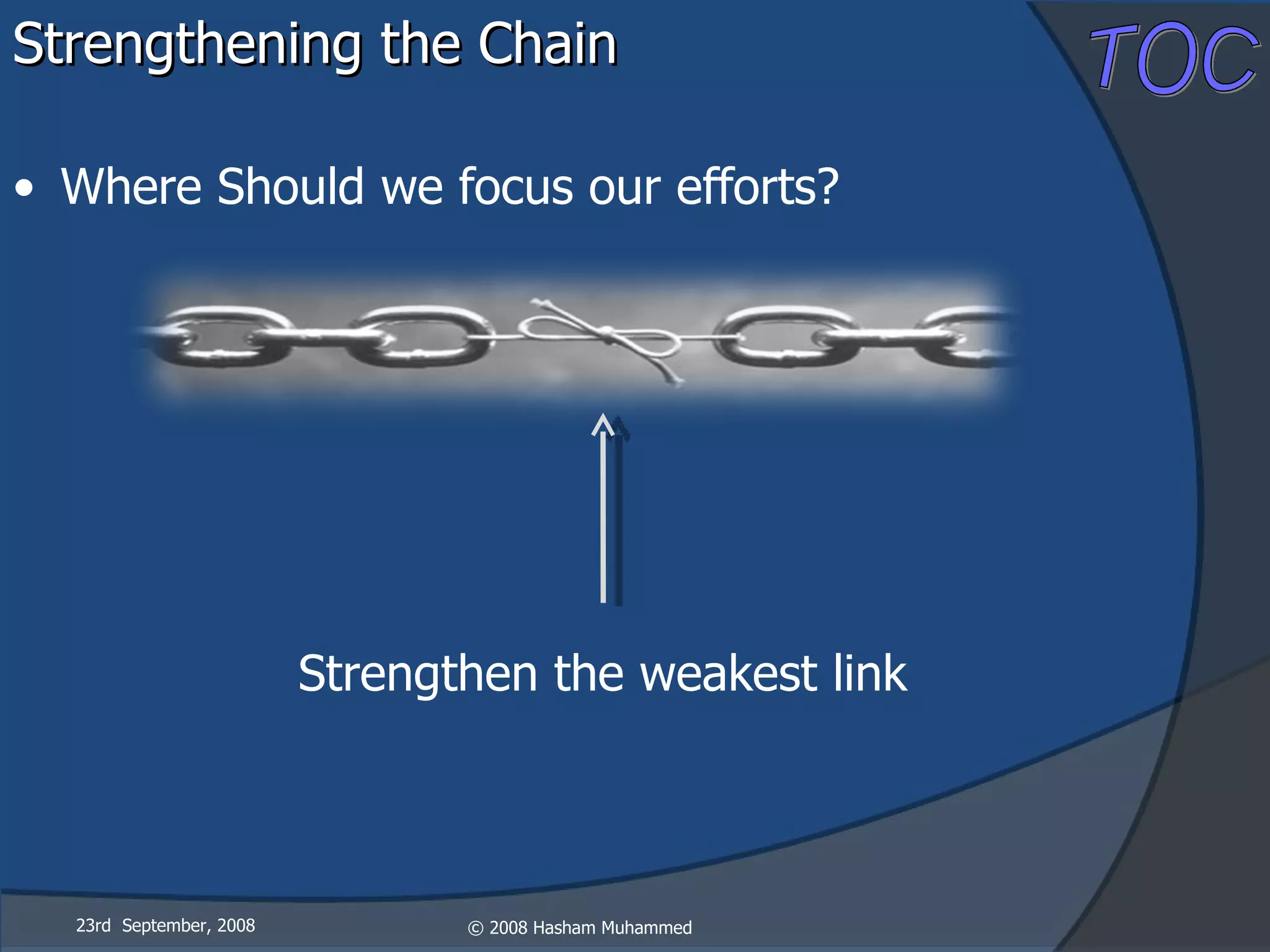
Strengthening the Chain 23rd  September, 2008
Strengthening the Chain Where Should we focus our efforts? 23rd  September, 2008
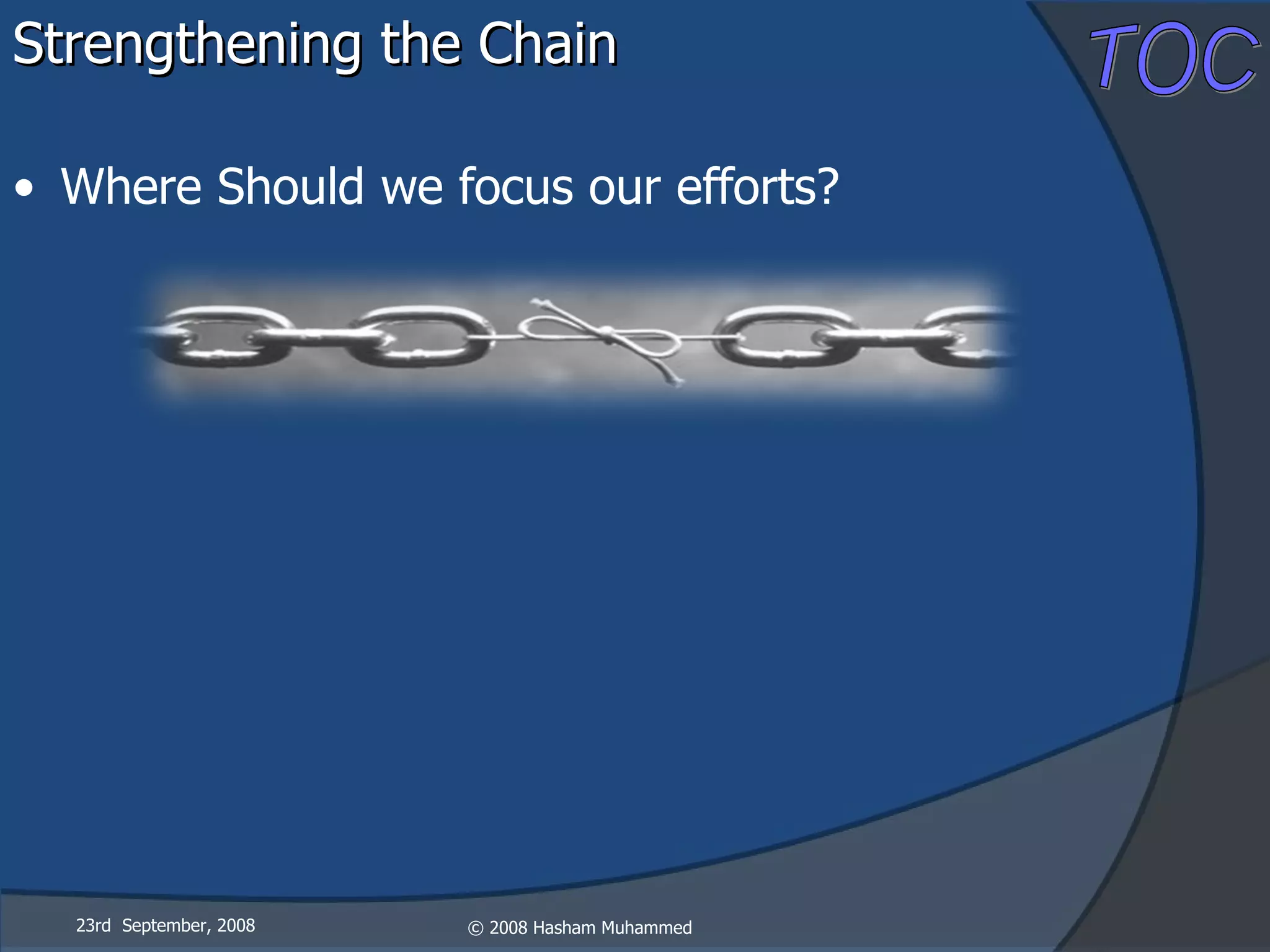
Strengthening the Chain Where Should we focus our efforts? 23rd  September, 2008 Strengthen the weakest link
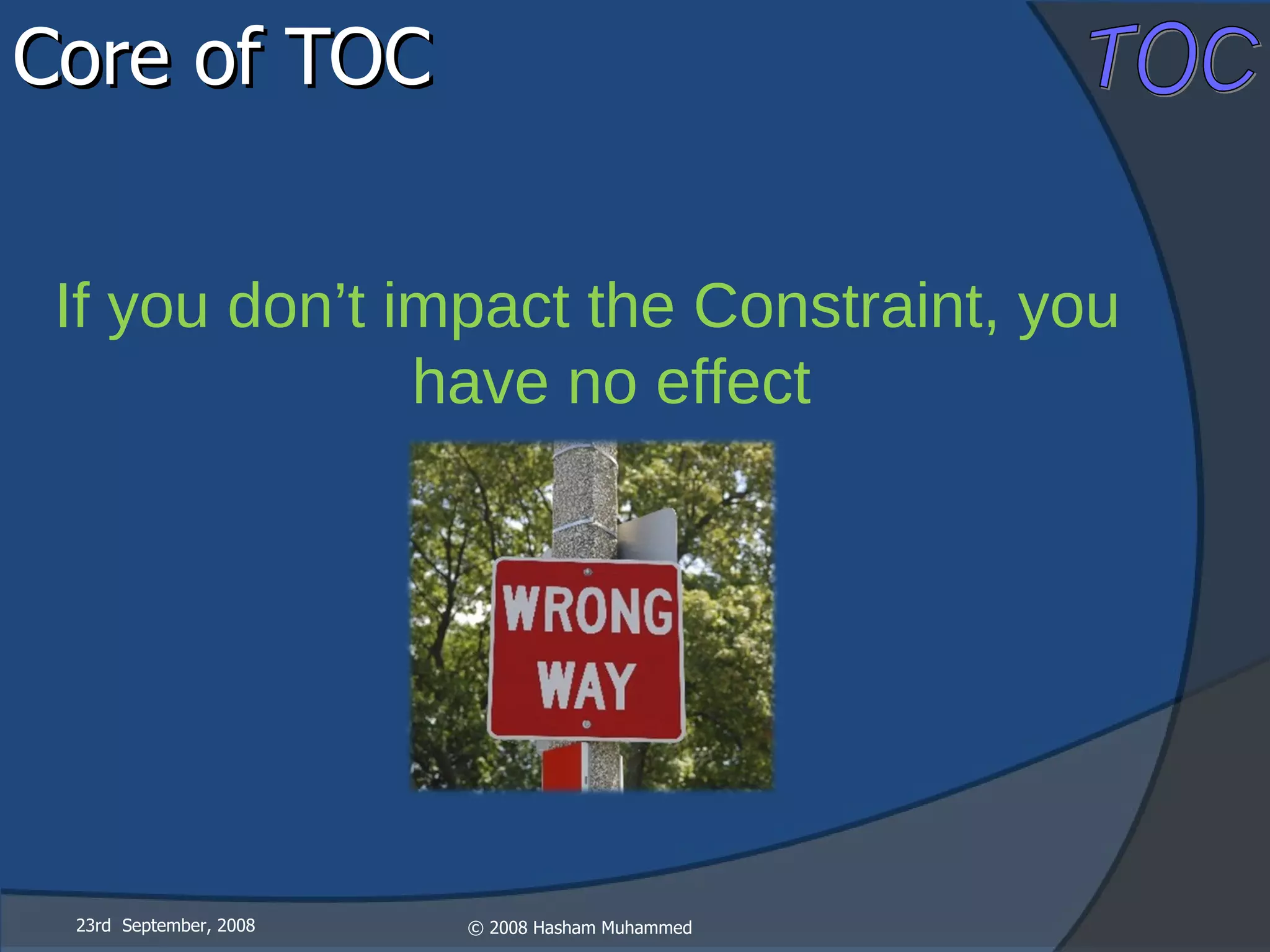
Core of TOC  23rd  September, 2008
Core of TOC  23rd  September, 2008 If you don’t impact the Constraint, you have no effect
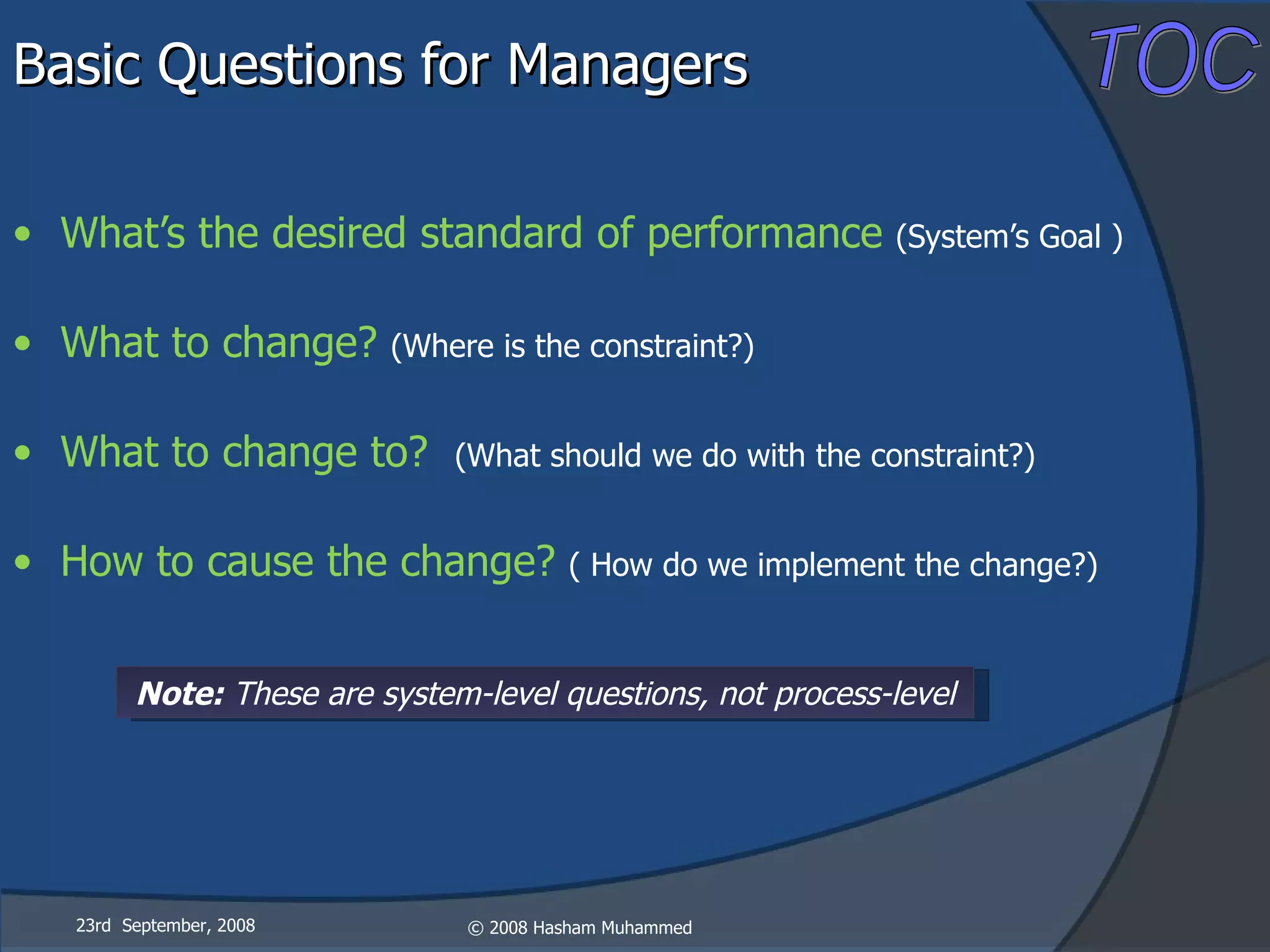
Basic Questions for Managers What’s the desired standard of performance  (System’s Goal ) What to change?  (Where is the constraint?) What to change to?  (What should we do with the constraint?) How to cause the change?  ( How do we implement the change?) 23rd  September, 2008 Note:  These are system-level questions, not process-level
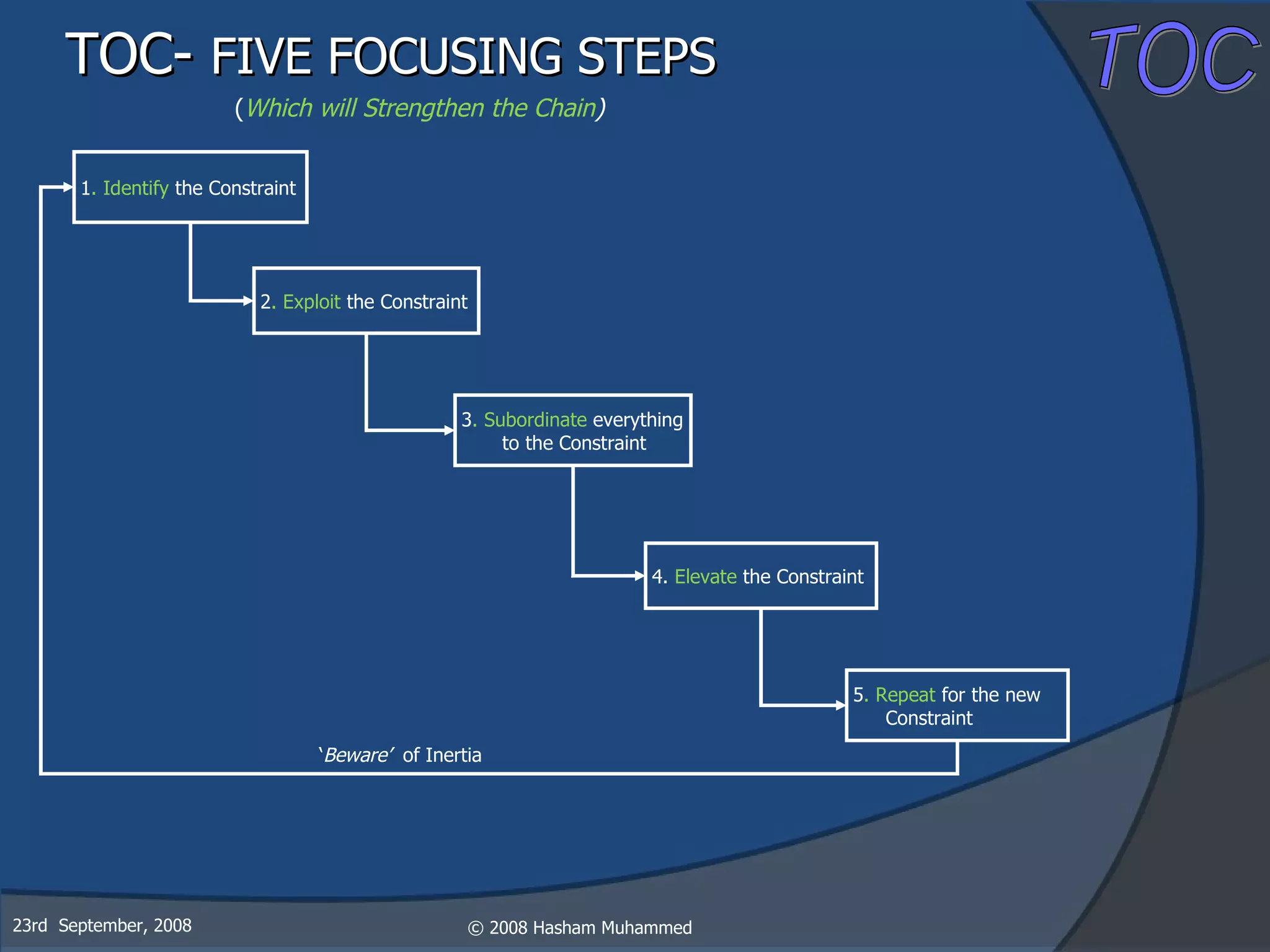
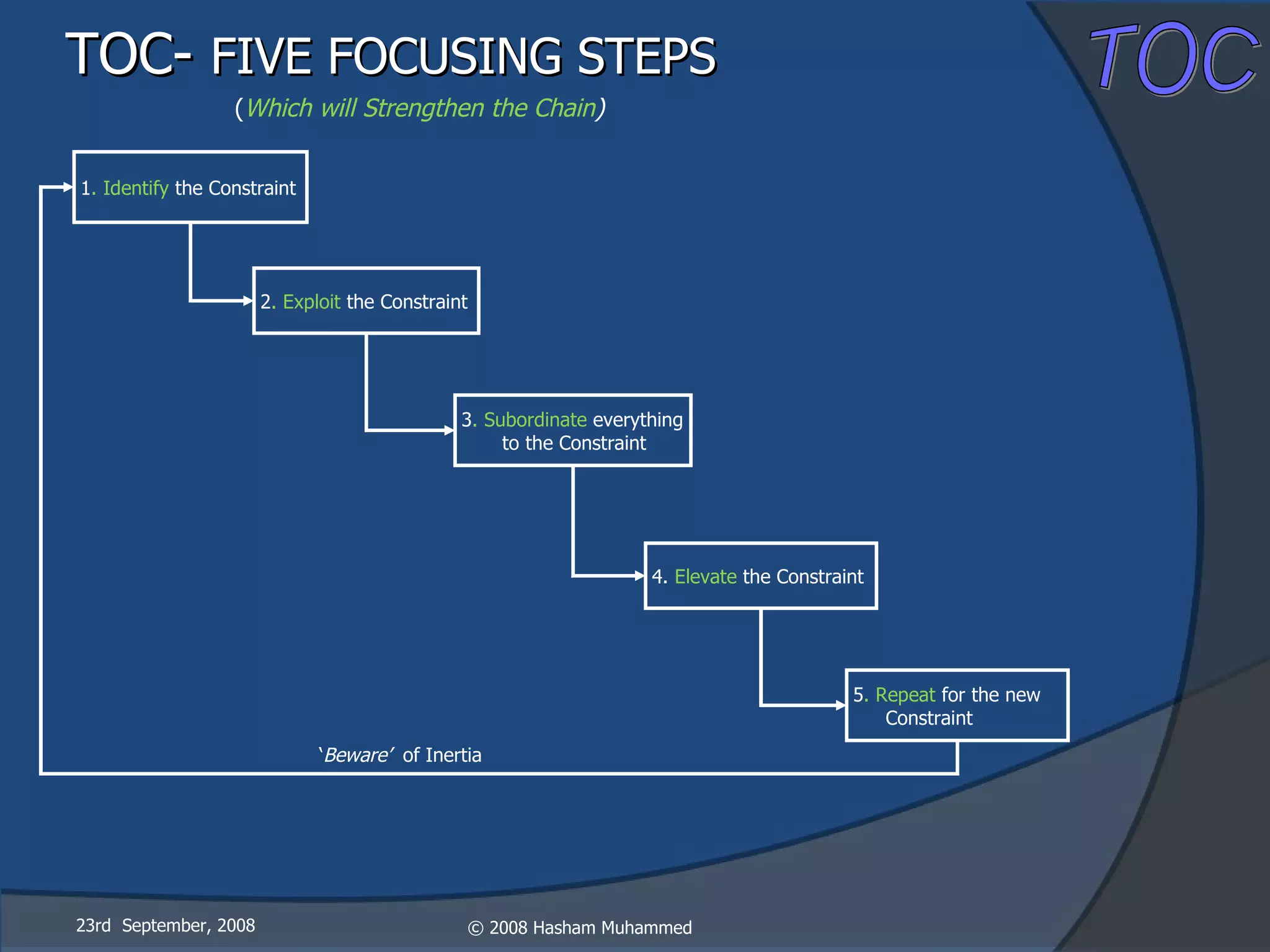
23rd  September, 2008 TOC-  FIVE FOCUSING STEPS   ( Which will Strengthen the Chain )
23rd  September, 2008 1 . Identify  the Constraint 2 . Exploit  the Constraint 3 . Subordinate  everything to the Constraint 4.  Elevate  the Constraint 5 . Repeat  for the new  Constraint ‘ Beware’  of Inertia TOC-  FIVE FOCUSING STEPS   ( Which will Strengthen the Chain )
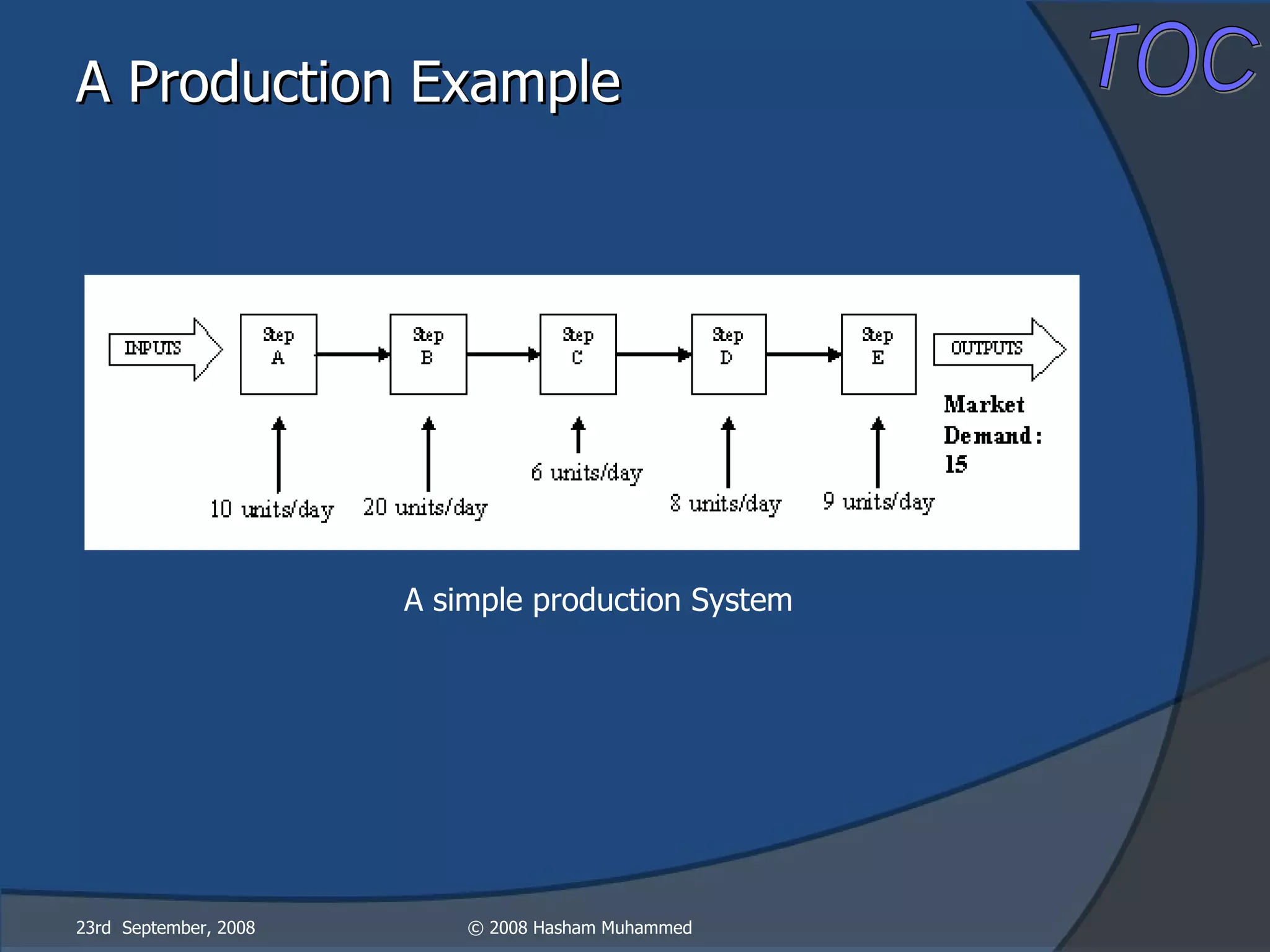
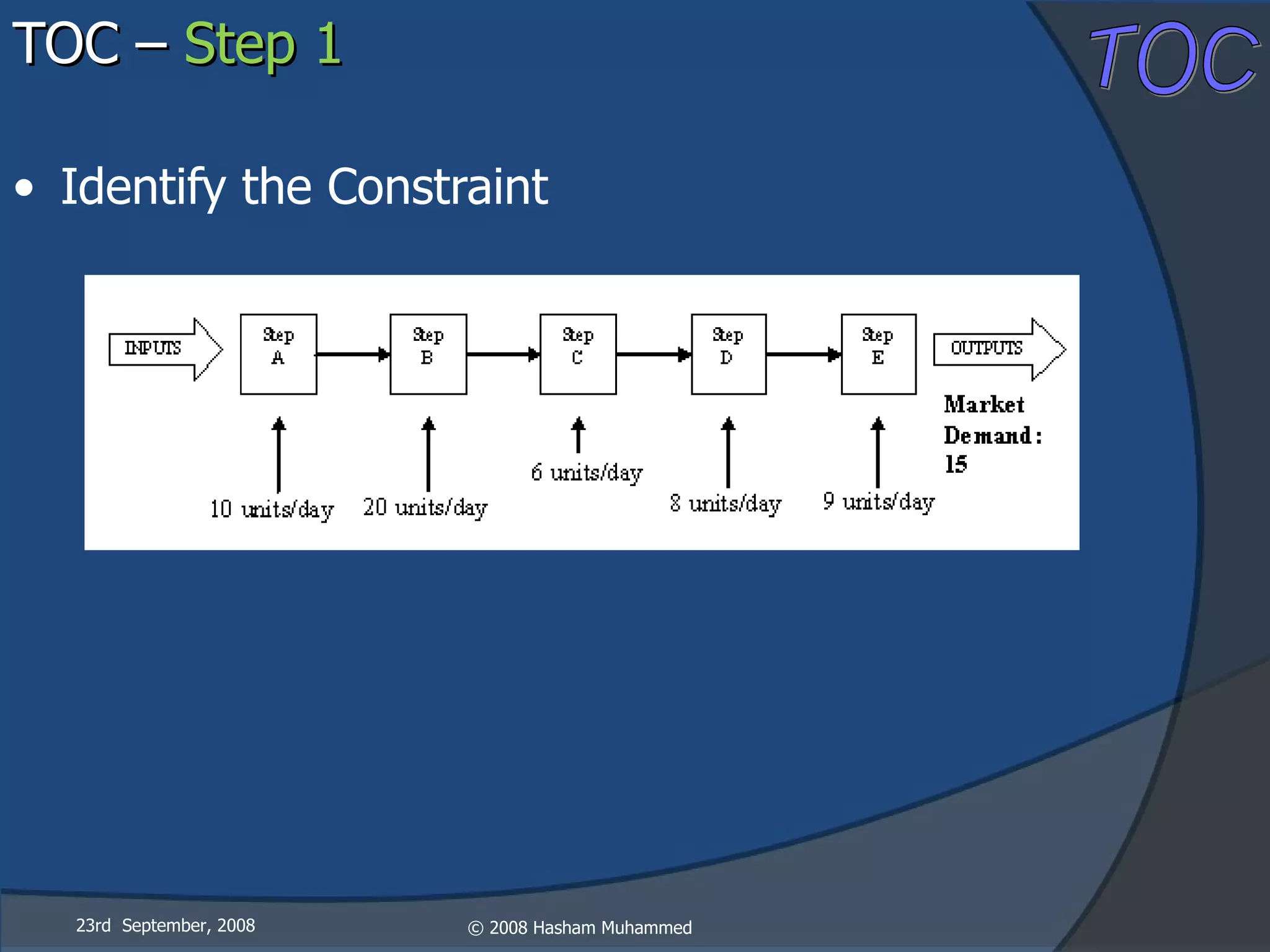
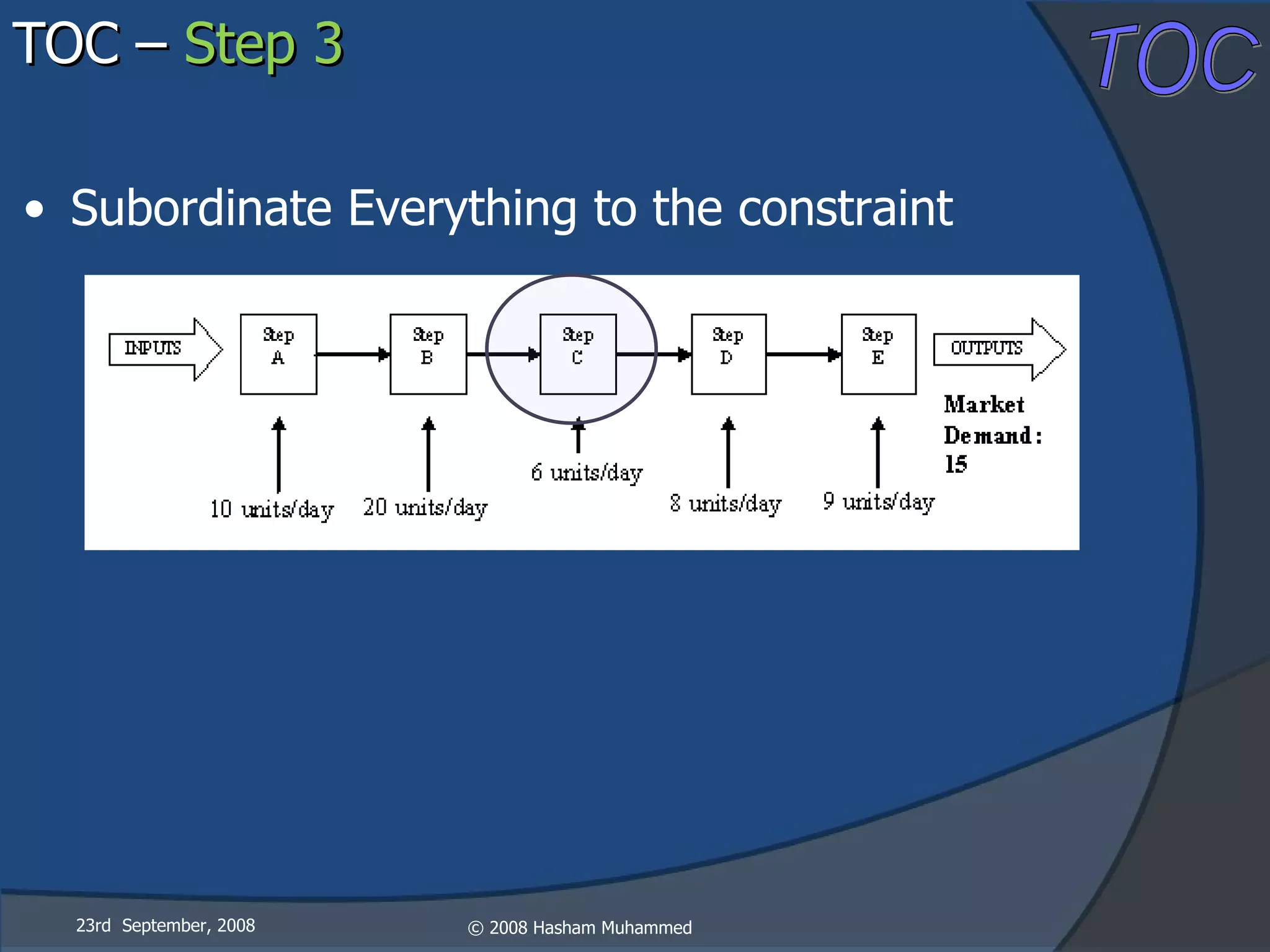
A Production Example 23rd  September, 2008 A simple production System
TOC –  Step 1 23rd  September, 2008
Identify the Constraint TOC –  Step 1 23rd  September, 2008
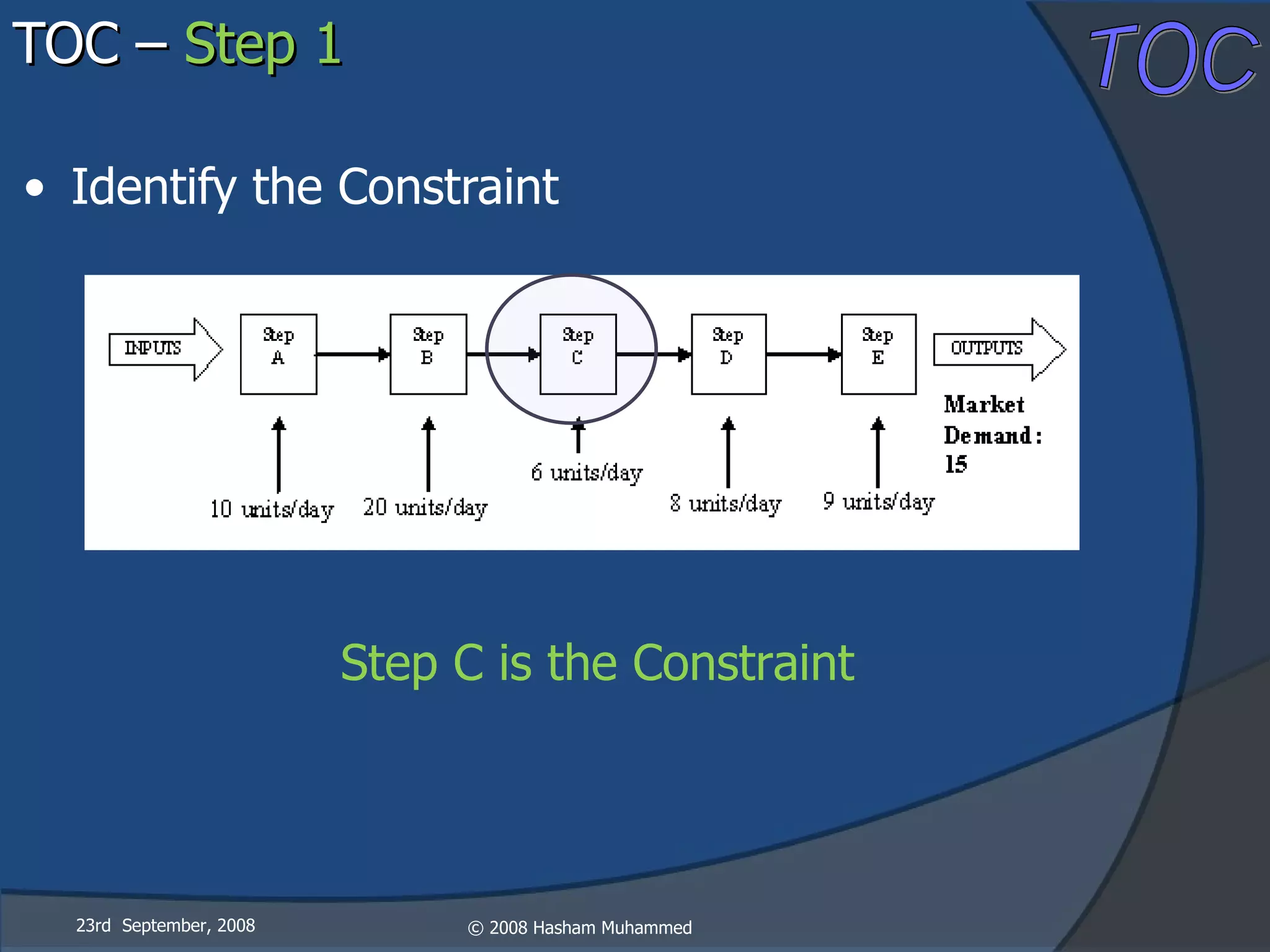
TOC –  Step 1 Identify the Constraint 23rd  September, 2008 Step C is the Constraint
TOC –  Step 2 23rd  September, 2008
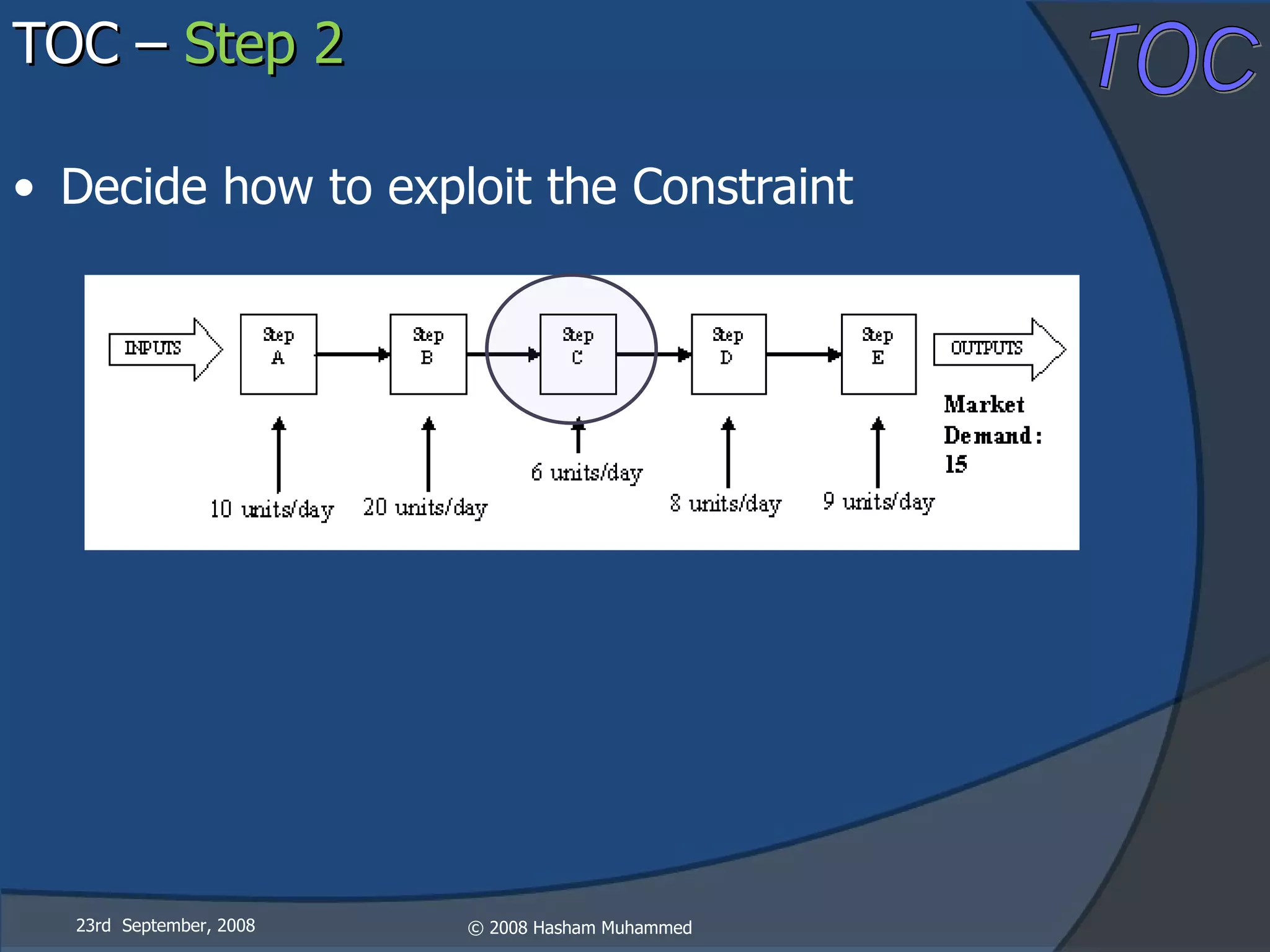
Decide how to exploit the Constraint TOC –  Step 2 23rd  September, 2008
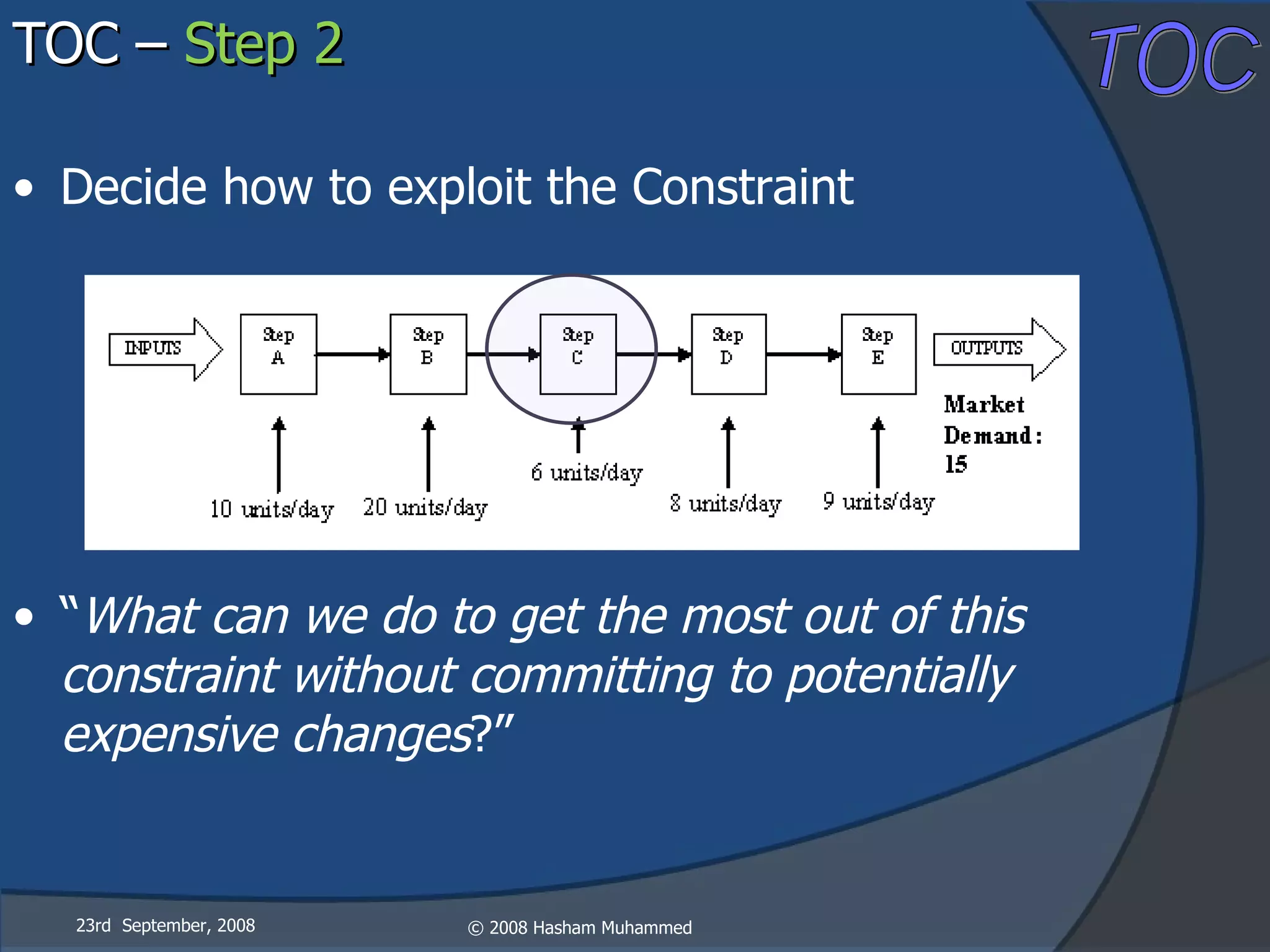
“ What can we do to get the most out of this constraint without committing to potentially expensive changes ?” TOC –  Step 2 23rd  September, 2008 Decide how to exploit the Constraint
TOC –  Step 3 23rd  September, 2008
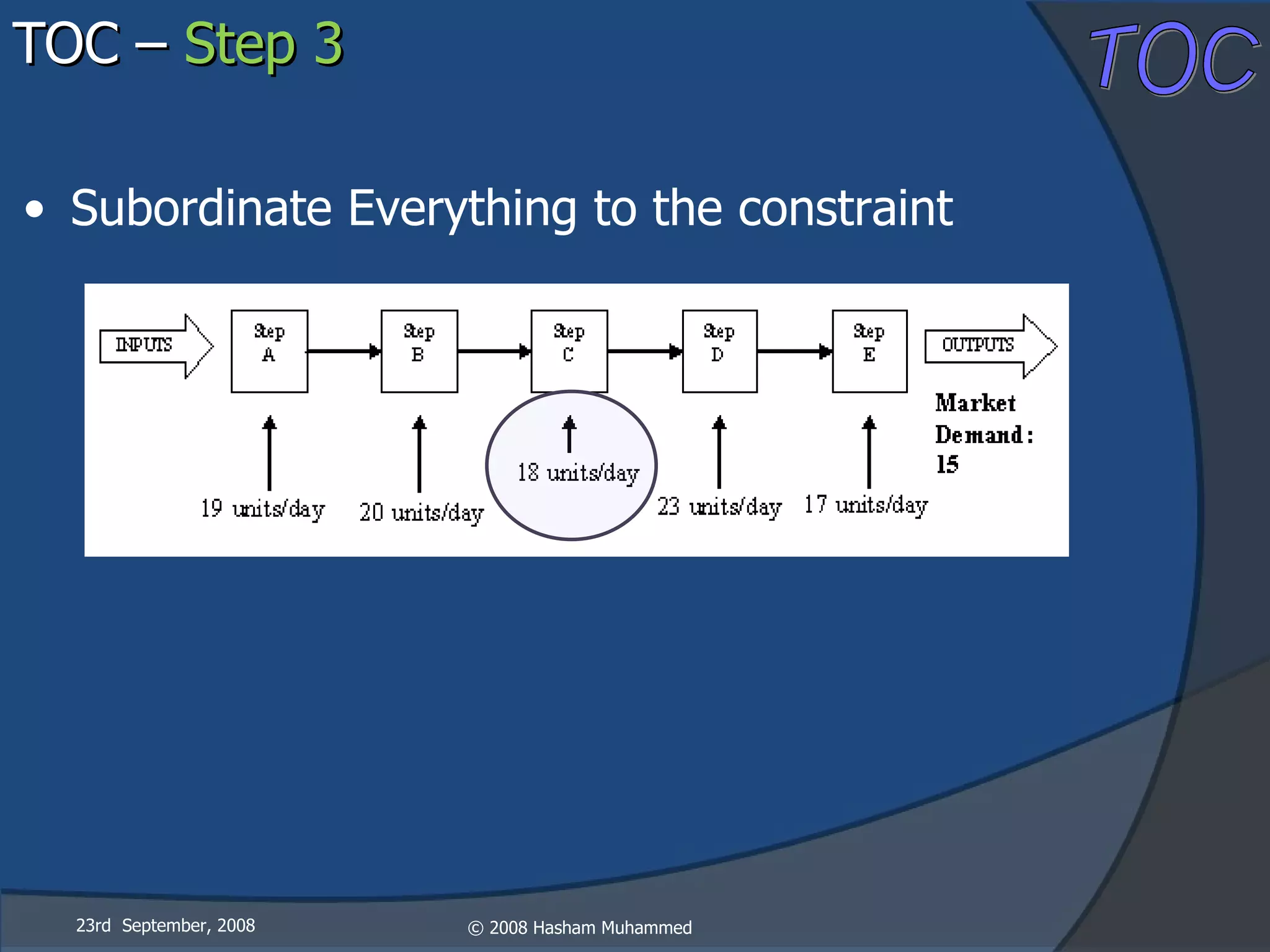
TOC –  Step 3 23rd  September, 2008 Subordinate Everything to the constraint
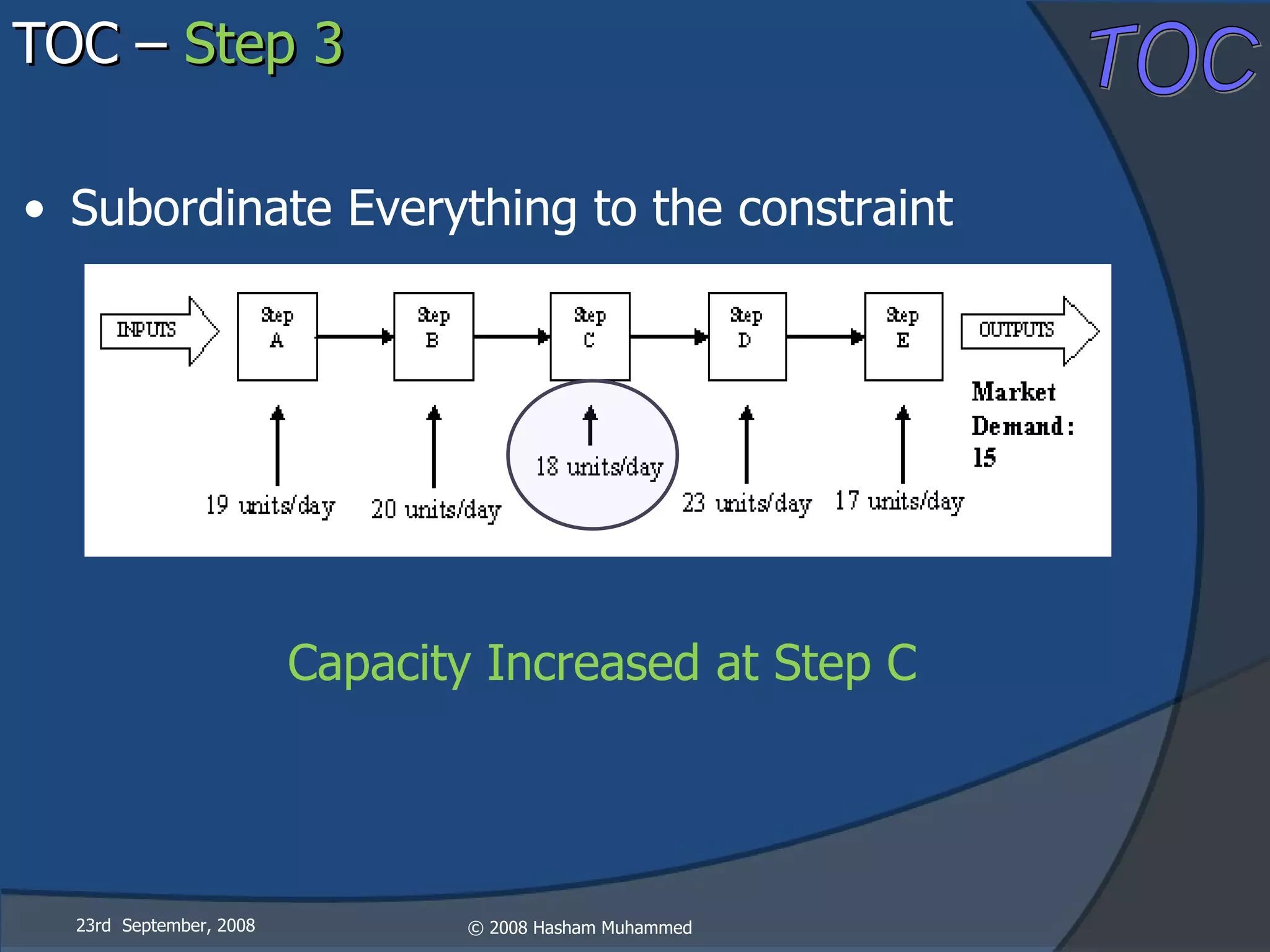
TOC –  Step 3 23rd  September, 2008 Subordinate Everything to the constraint Capacity Increased at Step C
23rd  September, 2008 TOC –  Step 4
23rd  September, 2008 TOC –  Step 4 Elevate the Constraint
23rd  September, 2008 Elevate the Constraint If we are doing Step 4, it means that Steps 2 & 3 weren’t sufficient to eliminate the constraint. TOC –  Step 4
23rd  September, 2008 Elevate the Constraint If we are doing Step 4, it means that Steps 2 & 3 weren’t sufficient to eliminate the constraint. ‘ Elevating’  the constraint means we take whatever action is required to eliminate the constraint. TOC –  Step 4
23rd  September, 2008 TOC –  Step 5
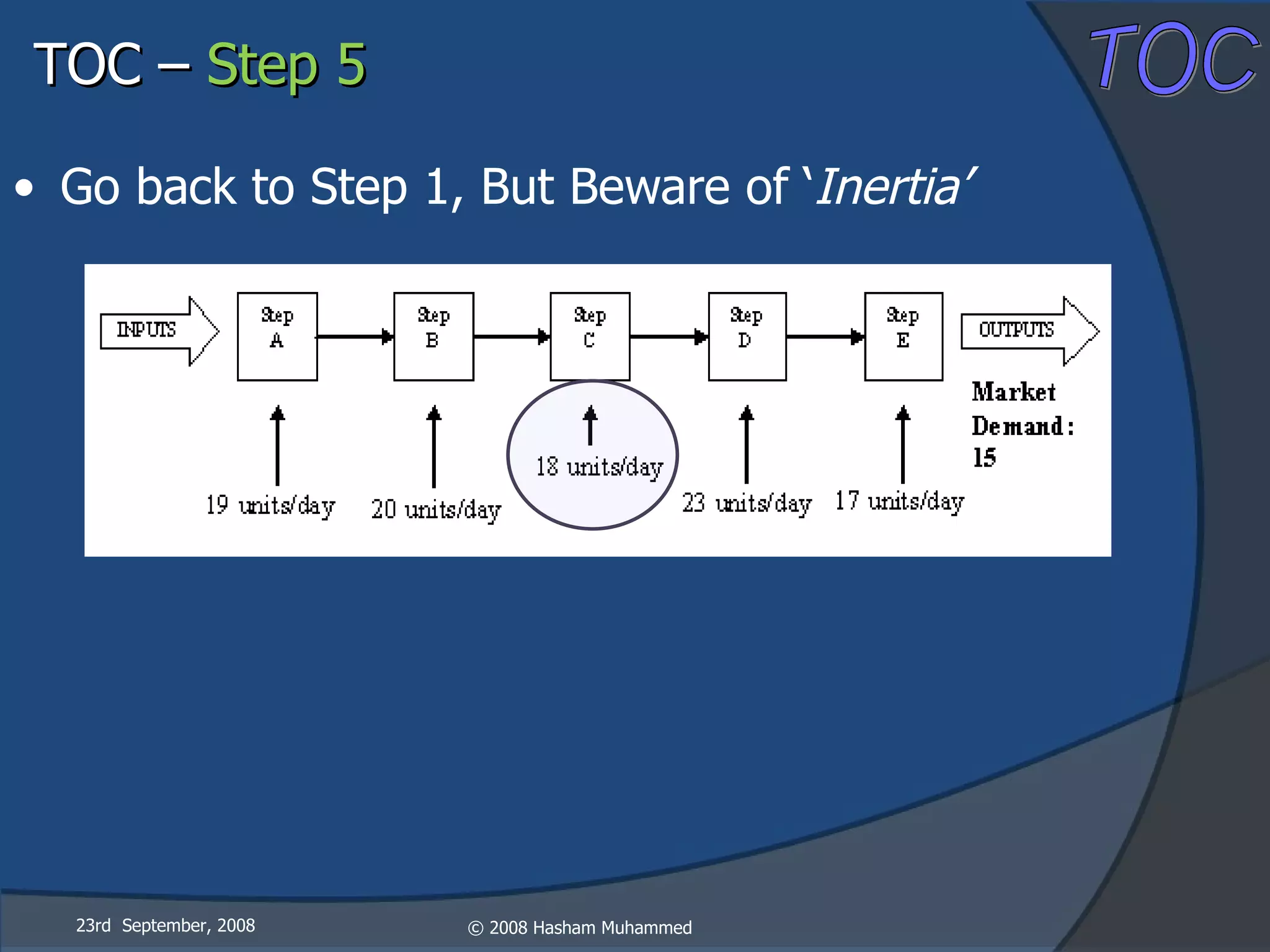
Go back to Step 1, But Beware of ‘ Inertia’ 23rd  September, 2008 TOC –  Step 5
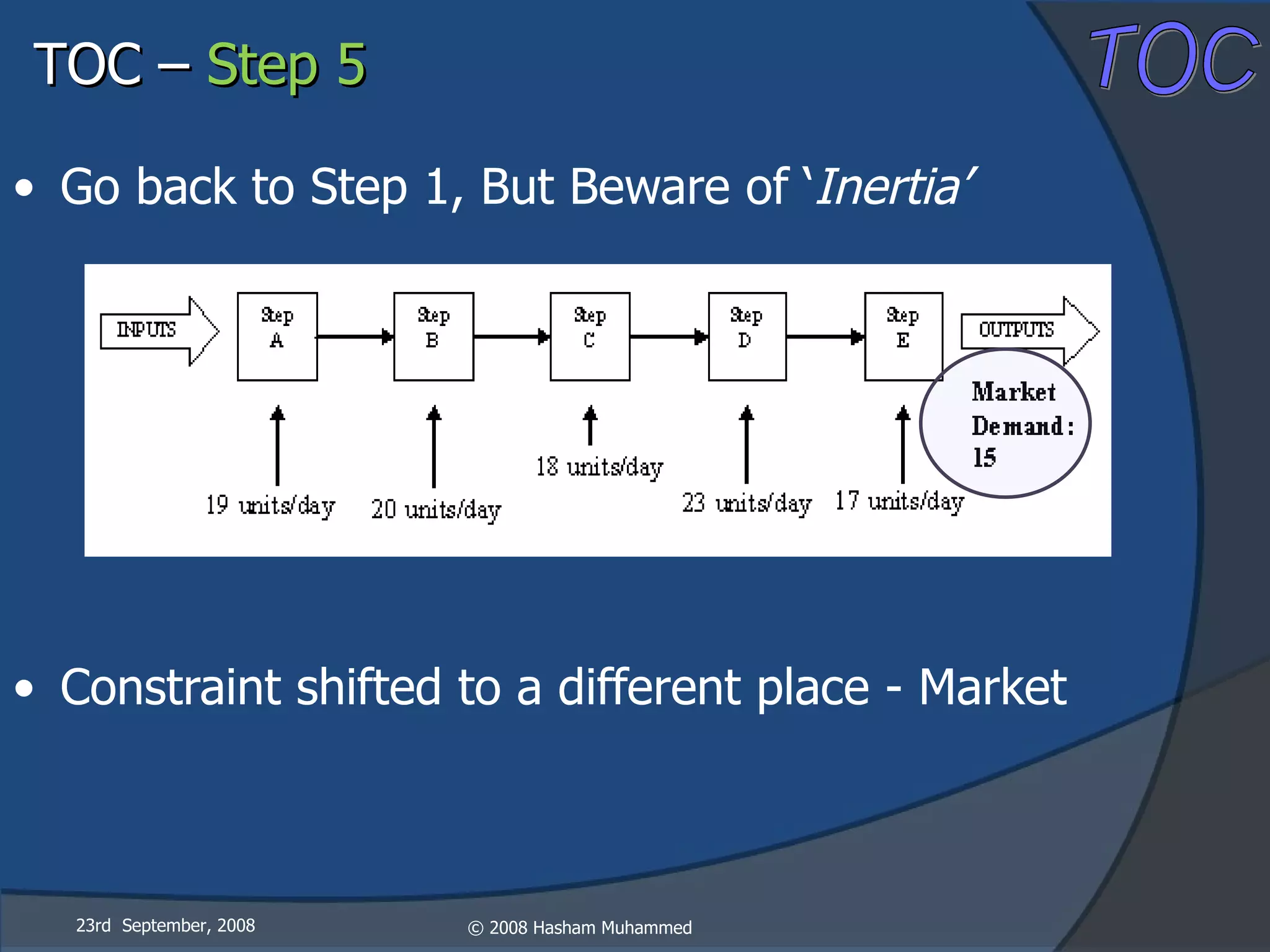
Go back to Step 1, But Beware of ‘ Inertia’ Constraint shifted to a different place - Market 23rd  September, 2008 TOC –  Step 5
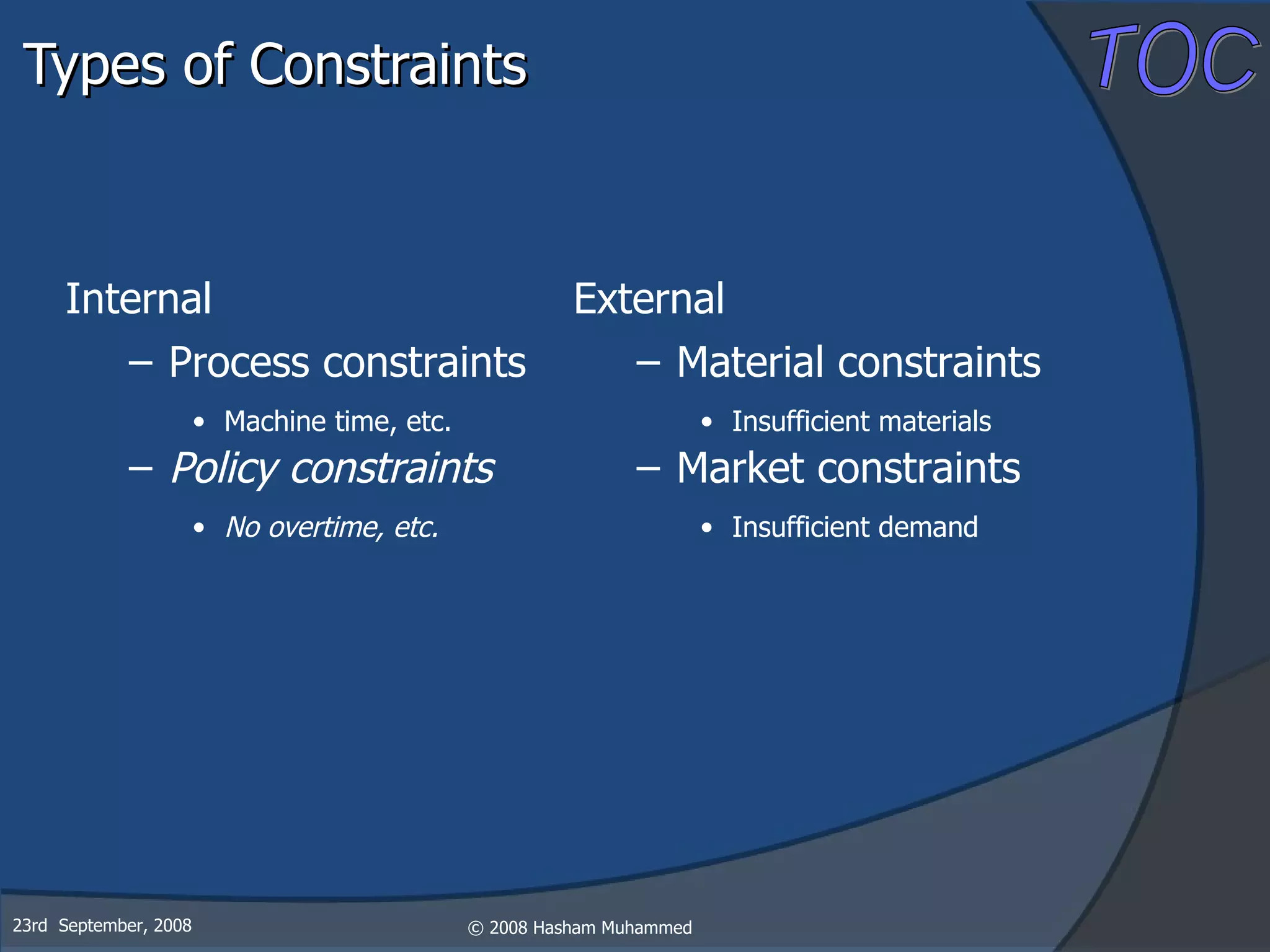
Types of Constraints Internal External Process constraints Machine time, etc. Policy constraints No overtime, etc. Material constraints Insufficient materials Market constraints Insufficient demand 23rd  September, 2008
23rd  September, 2008 1 . Identify  the Constraint 2 . Exploit  the Constraint 3 . Subordinate  everything to the Constraint 4.  Elevate  the Constraint 5 . Repeat  for the new  Constraint ‘ Beware’  of Inertia TOC-  FIVE FOCUSING STEPS   ( Which will Strengthen the Chain )
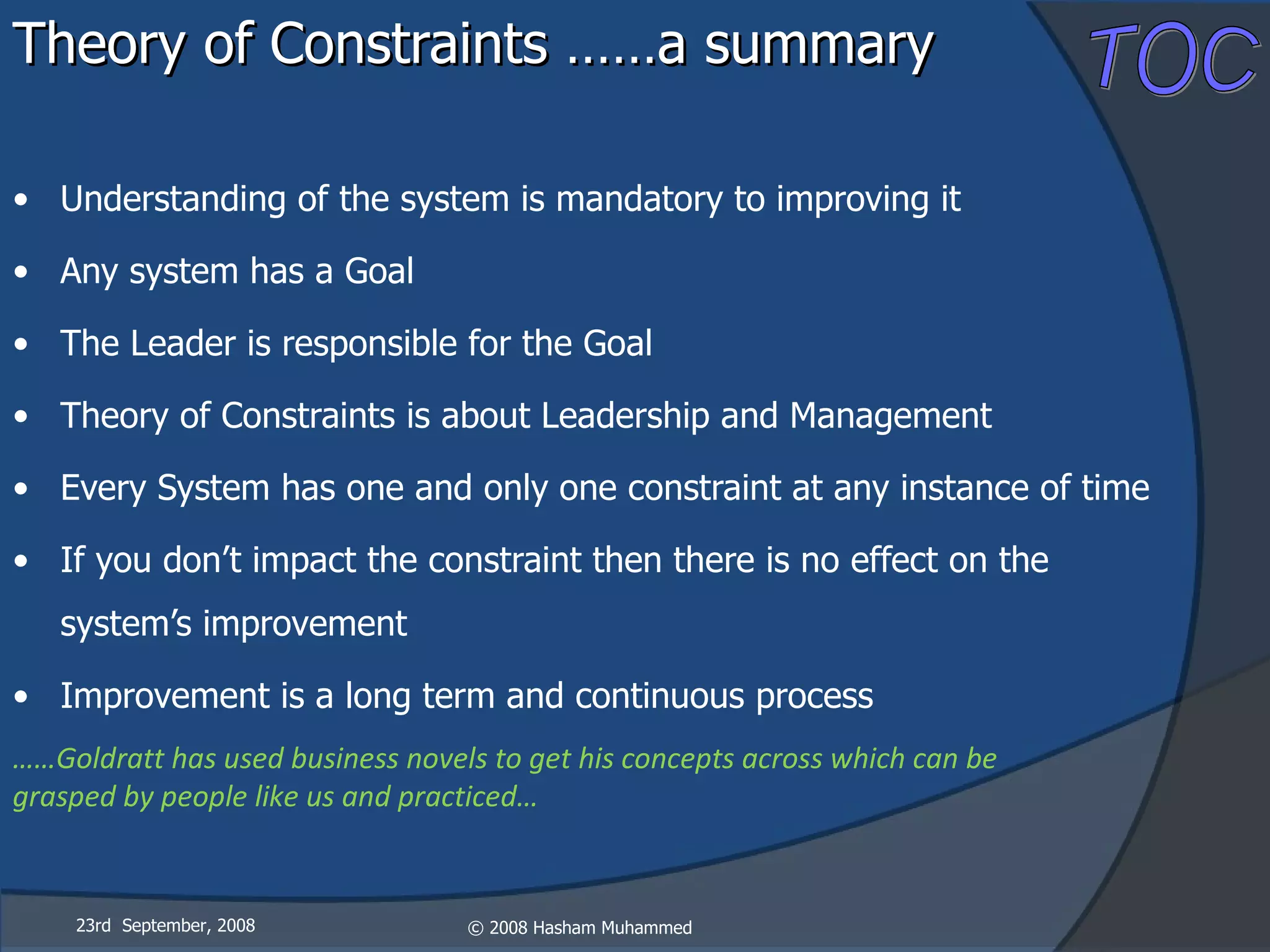
Theory of Constraints ……a summary Understanding of the system is mandatory to improving it Any system has a Goal The Leader is responsible for the Goal Theory of Constraints is about Leadership and Management Every System has one and only one constraint at any instance of time If you don’t impact the constraint then there is no effect on the system’s improvement Improvement is a long term and continuous process …… Goldratt has used business novels to get his concepts across which can be grasped by people like us and practiced… 23rd  September, 2008
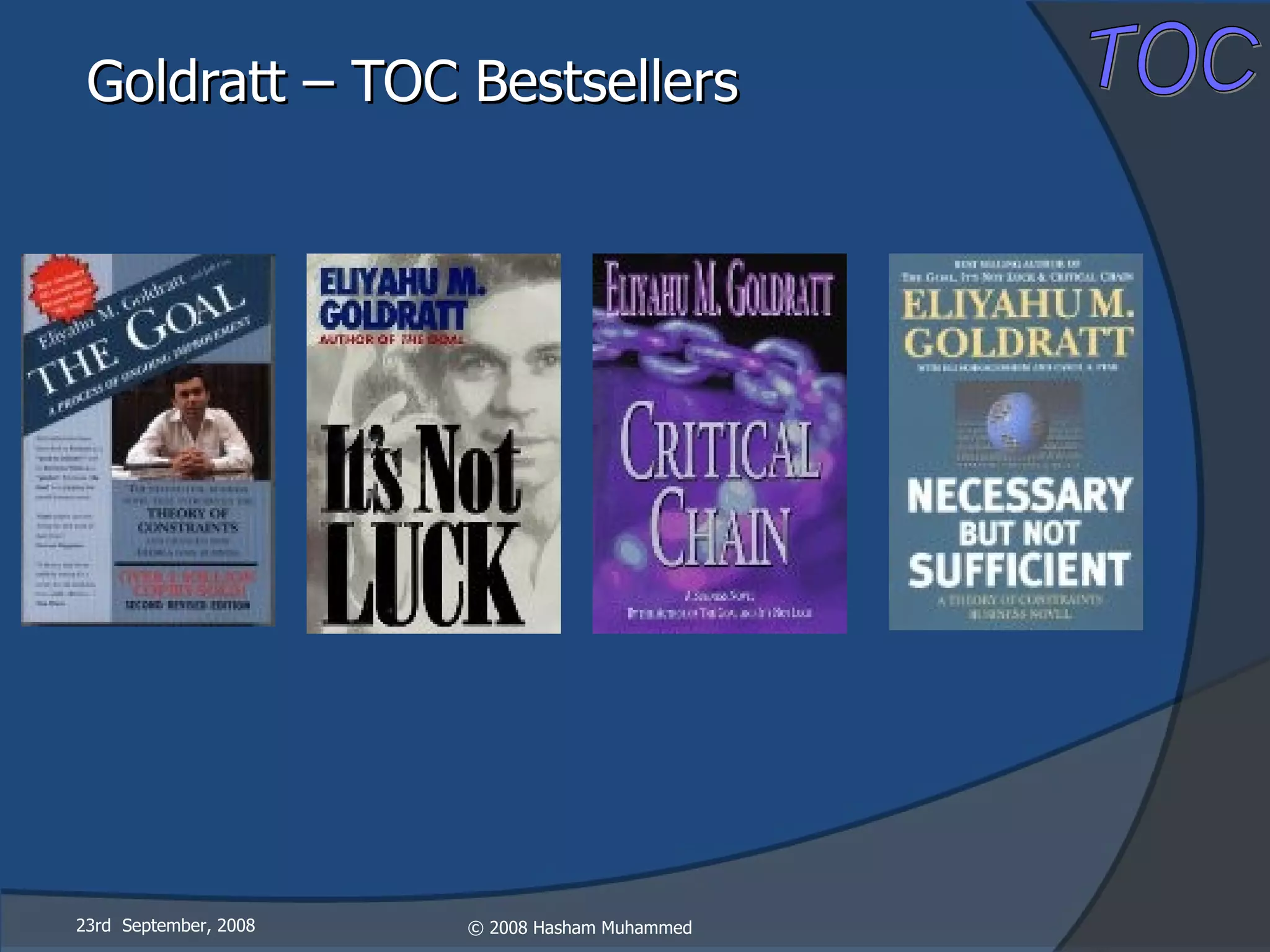
Goldratt – TOC Bestsellers 23rd  September, 2008
23rd  September, 2008 There is no such thing as staying the same. You are either striving to make yourself better or allowing yourself to get worse. -  Source Unknown
23rd  September, 2008 The Logical Thinking Process  – A systems approach to complex problem solving -  H. William Dettmer References

Introduction To Theory of Constraints

  • 1.
    Introduction to Theoryof Constraints Presented by Hasham Muhammed [email_address] 23rd September, 2008
  • 2.
    Contents Introduction – The Philosophy Thinking Process System’s Thinking Goal Concept of System Constraints TOC intro Steps in TOC Example Conclusion 23rd September, 2008
  • 3.
    Do we reallywant or need another New Theory? 23rd September, 2008
  • 4.
    Do we reallywant or need another New Theory? 23rd September, 2008 “ The significant problems we face today can not be resolved at the same level of thinking we were at when we created them.” - Albert Einstein
  • 5.
    Thinking Process Theprocess of how an entity learns to gain understanding of the environment or System 23rd September, 2008
  • 6.
    Thinking Processes 23rd September, 2008 The process of how an entity learns to gain understanding of the environment or System The KEY focus being Thinking from a SYSTEM’s point of view
  • 7.
    A system isan entity which maintains its existence through the INTERACTION of its elements. System’s Thinking 23rd September, 2008
  • 8.
    A system isan entity which maintains its existence through the INTERACTION of its elements. 23rd September, 2008 The key point here is INTERACTION. System’s Thinking
  • 9.
    A system isan entity which maintains its existence through the INTERACTION of its elements. 23rd September, 2008 Cooking food is a good analogy – Final product is different from the individual ingredients The key point here is INTERACTION. System’s Thinking
  • 10.
    The System’s GoalWhy do Systems exist? 23rd September, 2008
  • 11.
    The System’s Goal23rd September, 2008 Why do Systems exist? To achieve a “Goal”
  • 12.
    The System’s Goal23rd September, 2008 Why do Systems exist? To achieve a “Goal” A result or achievement toward which effort is directed.
  • 13.
    Who gets todecide what the goal should be? The System’s Goal 23rd September, 2008
  • 14.
    23rd September,2008 Who gets to decide what the goal should be? The System’s Goal The Leader is responsible for the Goal
  • 15.
    23rd September,2008 Who gets to decide what the goal should be? The Leader is responsible for the Goal The System’s Goal Everyone may be considered as a Leader of something (Whole Organization, Unit, Integrated Business, FLCB, department, small team, life, career…) that is supported by a System
  • 16.
    Theory of Constraintsis about Management 23rd September, 2008
  • 17.
    The threeimportant questions for a manager What is the Ultimate goal? Where does he or she stand in relation to the goal? The magnitude and direction of the change needed to move from the status quo to where he or she wants to be (the goal). 23rd September, 2008 Theory of Constraints is about Management
  • 18.
    “ Average managersare concerned with methods, opinions, and precedents. Good Managers are concerned with solving problems ” - William Dettmer 23rd September, 2008
  • 19.
    Concept of SystemConstraints 23rd September, 2008
  • 20.
    Concept of SystemConstraints 23rd September, 2008 What keeps your system from doing better?
  • 21.
    Concept of SystemConstraints 23rd September, 2008 What keeps your system from doing better? Is there something that is constraining your system from reaching its GOAL?
  • 22.
    Systems as ChainsAssume the SYSTEM to be a chain with ‘n’ links and with a goal of transmitting force from end A to B . 23rd September, 2008 A B 1 2 3 6 5 7 4
  • 23.
    Systems as Chains(cont..) Weakest link The link at which the system fails to achieve the goal is the weakest link. 23rd September, 2008 A B 4
  • 24.
    Constraints and Non-Constraints23rd September, 2008
  • 25.
    Constraints and Non-Constraints23rd September, 2008 There is only one CONSTRAINT in a system at a given point of time
  • 26.
    Constraints and Non-Constraints23rd September, 2008 There is only one CONSTRAINT in a system at a given point of time
  • 27.
    Constraints and Non-ConstraintsNonconstraints are all the other links; ‘n-1’ 23rd September, 2008 There is only one CONSTRAINT in a system at a given point of time
  • 28.
    Strengthening the Chain23rd September, 2008
  • 29.
    Strengthening the ChainWhere Should we focus our efforts? 23rd September, 2008
  • 30.
    Strengthening the ChainWhere Should we focus our efforts? 23rd September, 2008 Strengthen the weakest link
  • 31.
    Core of TOC 23rd September, 2008
  • 32.
    Core of TOC 23rd September, 2008 If you don’t impact the Constraint, you have no effect
  • 33.
    Basic Questions forManagers What’s the desired standard of performance (System’s Goal ) What to change? (Where is the constraint?) What to change to? (What should we do with the constraint?) How to cause the change? ( How do we implement the change?) 23rd September, 2008 Note: These are system-level questions, not process-level
  • 34.
    23rd September,2008 TOC- FIVE FOCUSING STEPS ( Which will Strengthen the Chain )
  • 35.
    23rd September,2008 1 . Identify the Constraint 2 . Exploit the Constraint 3 . Subordinate everything to the Constraint 4. Elevate the Constraint 5 . Repeat for the new Constraint ‘ Beware’ of Inertia TOC- FIVE FOCUSING STEPS ( Which will Strengthen the Chain )
  • 36.
    A Production Example23rd September, 2008 A simple production System
  • 37.
    TOC – Step 1 23rd September, 2008
  • 38.
    Identify the ConstraintTOC – Step 1 23rd September, 2008
  • 39.
    TOC – Step 1 Identify the Constraint 23rd September, 2008 Step C is the Constraint
  • 40.
    TOC – Step 2 23rd September, 2008
  • 41.
    Decide how toexploit the Constraint TOC – Step 2 23rd September, 2008
  • 42.
    “ What canwe do to get the most out of this constraint without committing to potentially expensive changes ?” TOC – Step 2 23rd September, 2008 Decide how to exploit the Constraint
  • 43.
    TOC – Step 3 23rd September, 2008
  • 44.
    TOC – Step 3 23rd September, 2008 Subordinate Everything to the constraint
  • 45.
    TOC – Step 3 23rd September, 2008 Subordinate Everything to the constraint
  • 46.
    TOC – Step 3 23rd September, 2008 Subordinate Everything to the constraint Capacity Increased at Step C
  • 47.
    23rd September,2008 TOC – Step 4
  • 48.
    23rd September,2008 TOC – Step 4 Elevate the Constraint
  • 49.
    23rd September,2008 Elevate the Constraint If we are doing Step 4, it means that Steps 2 & 3 weren’t sufficient to eliminate the constraint. TOC – Step 4
  • 50.
    23rd September,2008 Elevate the Constraint If we are doing Step 4, it means that Steps 2 & 3 weren’t sufficient to eliminate the constraint. ‘ Elevating’ the constraint means we take whatever action is required to eliminate the constraint. TOC – Step 4
  • 51.
    23rd September,2008 TOC – Step 5
  • 52.
    Go back toStep 1, But Beware of ‘ Inertia’ 23rd September, 2008 TOC – Step 5
  • 53.
    Go back toStep 1, But Beware of ‘ Inertia’ Constraint shifted to a different place - Market 23rd September, 2008 TOC – Step 5
  • 54.
    Types of ConstraintsInternal External Process constraints Machine time, etc. Policy constraints No overtime, etc. Material constraints Insufficient materials Market constraints Insufficient demand 23rd September, 2008
  • 55.
    23rd September,2008 1 . Identify the Constraint 2 . Exploit the Constraint 3 . Subordinate everything to the Constraint 4. Elevate the Constraint 5 . Repeat for the new Constraint ‘ Beware’ of Inertia TOC- FIVE FOCUSING STEPS ( Which will Strengthen the Chain )
  • 56.
    Theory of Constraints……a summary Understanding of the system is mandatory to improving it Any system has a Goal The Leader is responsible for the Goal Theory of Constraints is about Leadership and Management Every System has one and only one constraint at any instance of time If you don’t impact the constraint then there is no effect on the system’s improvement Improvement is a long term and continuous process …… Goldratt has used business novels to get his concepts across which can be grasped by people like us and practiced… 23rd September, 2008
  • 57.
    Goldratt – TOCBestsellers 23rd September, 2008
  • 58.
    23rd September,2008 There is no such thing as staying the same. You are either striving to make yourself better or allowing yourself to get worse. - Source Unknown
  • 59.
    23rd September,2008 The Logical Thinking Process – A systems approach to complex problem solving - H. William Dettmer References