


KURSUS KOMUNIKASI KORPORAT
    UNTUK AJK PESTA KONVOKESYEN UKM 2009


INTRODUCTION TO EFFECTIVE
 BUSINESS COMMUNICATION
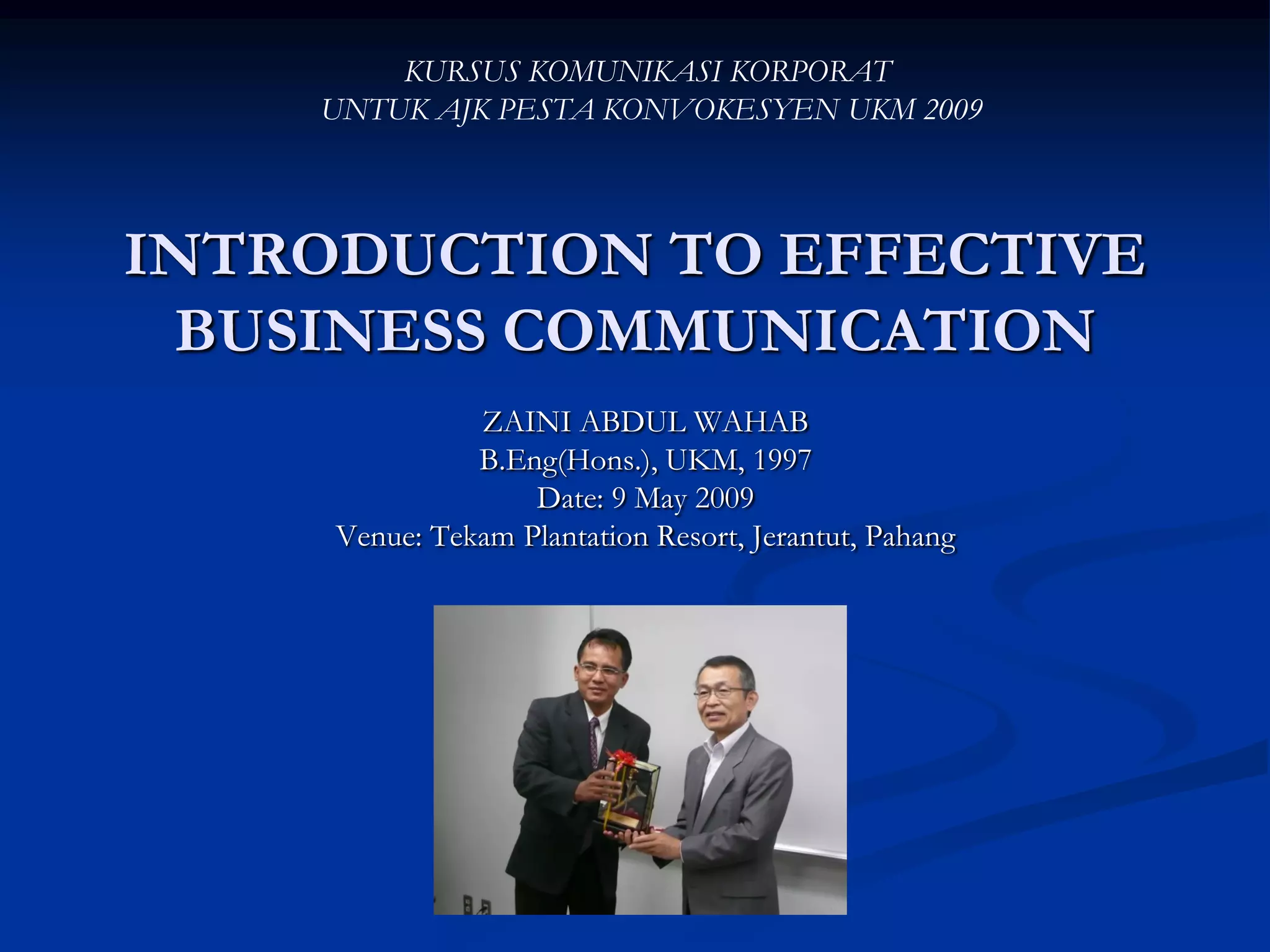
               ZAINI ABDUL WAHAB
               B.Eng(Hons.), UKM, 1997
                   Date: 9 May 2009
     Venue: Tekam Plantation Resort, Jerantut, Pahang
What Is Communication?

   Communication is often mistaken as being a means of
    transferring information.

   For human beings communication is much more than an
    information transfer, it is more clearly described as an exchange
    of meaning. Note the two words ‘exchange’ and ‘meaning’.

   Exchange means that there is always more than one person
    actively involved, communication with an active speaker and a
    passive listener, for example writing an article in a company
    newsletter, is not an exchange of meaning.
    Meaning is more than words, it involves all that is behind the
    words, the context in which they are used, the persons involved
    in the communication, the non verbal elements such a tone and
    body language. It involves both the creator of the message and
    the recipient.
The Meaning Of Words

   If I told you I was driving the latest model Rolls Royce
    you may wonder what such an important person would
    be doing here spending time in a class room. So you
    can see what the use of a familiar word can do and how
    the image can be simply enhanced, or changed by the
    addition of another simple word. Language is very
    powerful.
Our Understanding of Words

   If words can convey powerful images, words we don’t know or
    haven’t experienced before do nothing for us. We constantly
    confronted with words we don’t understand.

   Technical jargon (words we know but no one else understands)
    are wasted if our communication is not with an other person
    familiar with exactly the same technology.

   Beware of jargon!
Non Verbal Communication

   We are all familiar with verbal communication but we tend to
    overlook the non verbal aspects of communication. We seem
    to accept non verbal communication without a lot of thought.
    We do it naturally and we respond to it naturally.

   The two most powerful non verbal messages that can enhance
    your presentations are sincerity and determination.

   The slickness of the presentation and the degree of nervousness
    you are experiencing have little effect but if you are really sincere
    and determined to achieve the outcomes you believe are best for
    the business you will impress.
Our Preferences For Taking In
             And Processing Information

   People have certain ways of taking in information and in
    processing that information. We can’t tell what the preferences
    of our audience are so it is important to cover all possibilities.

   To illustrate what I mean by preference please write your name.
   Now write your name again using your other hand.

   Now you know what I mean by preference. You prefer using
    one hand rather than the other for writing and clearly one does a
    better job more easily than the other. In the same way we have
    preferences for gathering and processing information.
PROFESSIONAL APPEARANCE
      FOR BUSINESS
Introduction
   First impressions count. This professional dress code
    is codified because many professionals have never
    been taught appropriate professional appearance and
    demeanor.

   Professional dress code standards are alive and well in
    major financial and executive management. Anyone
    who aspires to top management knows that personal
    appearance counts.

   If you look and behave like a highly trained and well-
    groomed professional, you will win the respect and
    honor of our valued clients.
First Things First

   Some of the perceptions people can form solely from
    your appearance are:
   Your professionalism.
   Your level of sophistication.
   Your intelligence.
   Your credibility.
The Basics

   So what's right and what's wrong?

   First, there is no single set of rules that will work for
    everyone; sometimes the only written rules are
    expressed in your organization's dress code, if it has
    one. But there are a handful of characteristics that most
    successful business communicators share when it
    comes to dress and grooming.
Fashionable Of Foolish
   The corporate culture and the role you play in it should guide
    your choice of business attire.

   More businesses are moving to full-time business casual at every
    level in the organization. Some just have one or two days each
    week that are casual. And the definition of business casual varies,
    ranging from jeans to blazers.

   Just as in business communication, business dress requires you
    to know your audience. You need to gauge what attire will be
    right for the audience and the circumstance. This all hinges on
    the norms of the culture of the industry, region, company,
    division, department, and function.

   While your attire can be a vehicle for personal expression, you
    can pay a price for violating the written and unwritten codes of
    your culture. Always know the price before you pay.
Dress To Fit Your Audience

   When you're in front of a group giving a presentation, making a speech or just
    plain talking, you need to choose your attire to match the event.

   Regardless of what you're wearing, make sure it works. Make a thorough
    assessment of how you look in front of a full-length mirror. And don't
    hesitate to get a second opinion.
   Hands speak worlds about capability. They also reinforce your words. Hiding
    them can send a subtle message of incompetence.

   If you are not wearing a long-sleeved blouse under a jacket, the jacket sleeve
    should extend to the end of the wrist bone. This will preserve the visibility of
    your hands without calling attention to the bareness of your forearms.
Dress For Business, Not Pleasure

   Business attire is different from social attire and tends to be
    more formal. The parameters that cover business attire are
    narrower than they are for social attire. For example, social attire
    can be more suggestive or flashier or make more of a statement,
    while business attire should be tuned to the needs of the
    business circumstance.

   Your clothing and grooming should not distract. Rather, they
    should direct attention to your face and particularly your eyes.
    When you connect with someone else's eyes, they tend to listen.
    But who can stay focused on eyes when your purchasing agent
    has a copper ring pierced through his nose?

   Typical formal business attire has an advantage because it can
    easily direct listeners to your eyes.
Look Down

   The great American dancer, Fred Astaire, who wrote
    the book on popular dance, said this about footwear:
    “If you want to know if a fellow is well dressed, look
    down.”

   Couturier Diana Vreeland, renowned in women's
    fashion for wardrobe development, said: “First, I'd put
    money into shoes. No variety, just something I could
    wear with everything. ... Whatever it is you wear, I think
    shoes are terribly important.”
Speak Tight, Dress Right

   Business presenters need more than a professional look. They
    need to be able to move in their clothes. Narrow skirts, tight
    pants, or confining jackets restrict movement.

   To capitalize on large body gestures, be sure your clothes fit so
    you can move. And make sure they really fit.There is no excuse
    for ill-fitting business attire. If it doesn't fit, you must adjust it.
Testing, Testing. One, Two Three!

   Here's a simple test you can take before choosing attire
    for an event that puts you in the spotlight. Ask yourself:
   What's appropriate for this audience? This event?
   What image do I want to project?
   For my company?
   For my department?
   For myself?
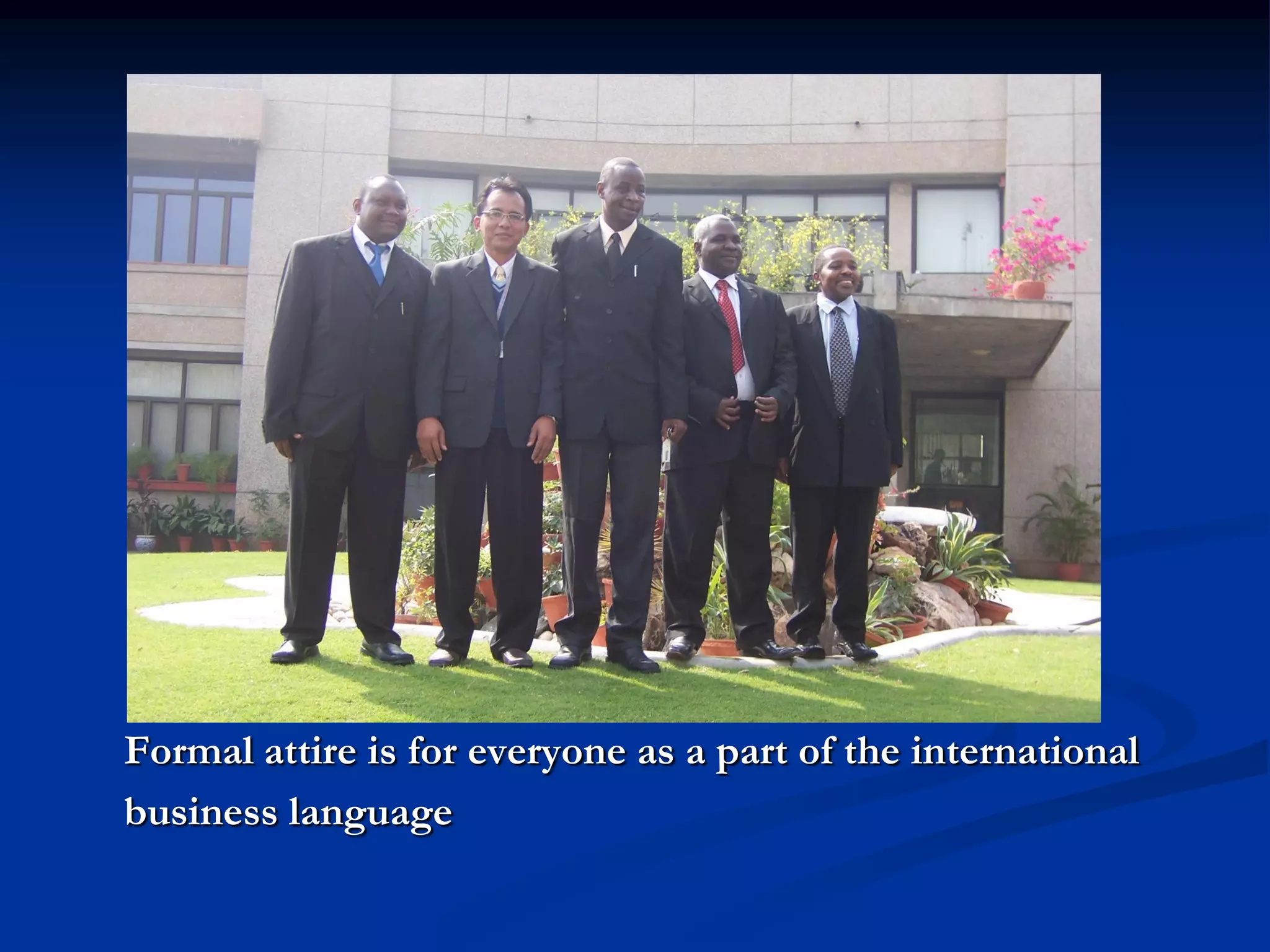
Formal attire is for everyone as a part of the international
business language
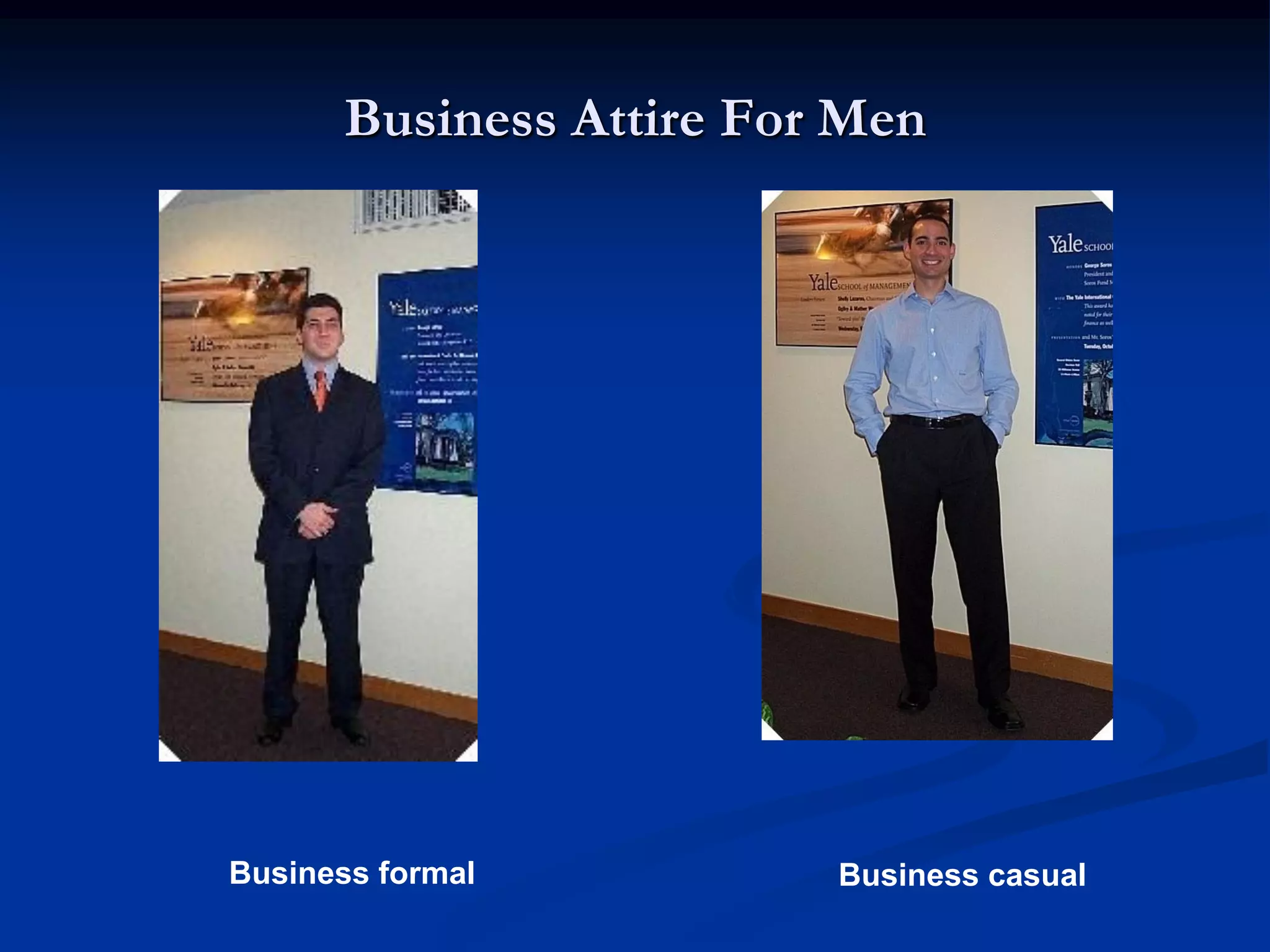
Business Attire For Men
   Traditional two-piece suit, or sport jacket with dress trousers in a dark color (NO
    KHAKIS).

   White freshly-pressed shirt.

   Conservative print or solid tie. No theme ties.

   Jewelry should be kept to a minimum, and can include a wedding band, class or other
    signet ring, and watch.

   All body piercings, including earrings, should be removed.

   Do not wear cologne or aftershave. Some people may be allergic! Your personal
    hygiene products will provide enough fragrance.

   Hair and facial hair should be neatly groomed and trimmed. Long hair should be worn
    in a low, neat ponytail. However, being clean shaven and having a short haircut is
    generally preferred.

   Limit the size of bags/briefcases and avoid over-stuffing them. No backpacks. A
    simple leather-like portfolio and planner will suffice.
Business Attire For Men


Business formal           Business casual
Business Attire For Men

   Shoes should be polished, and with a hard bottom, no rubber
    soles, worn with dark socks.

   A pair of top-quality shoes is a good investment because they
    can be resoled as needed and last for decades
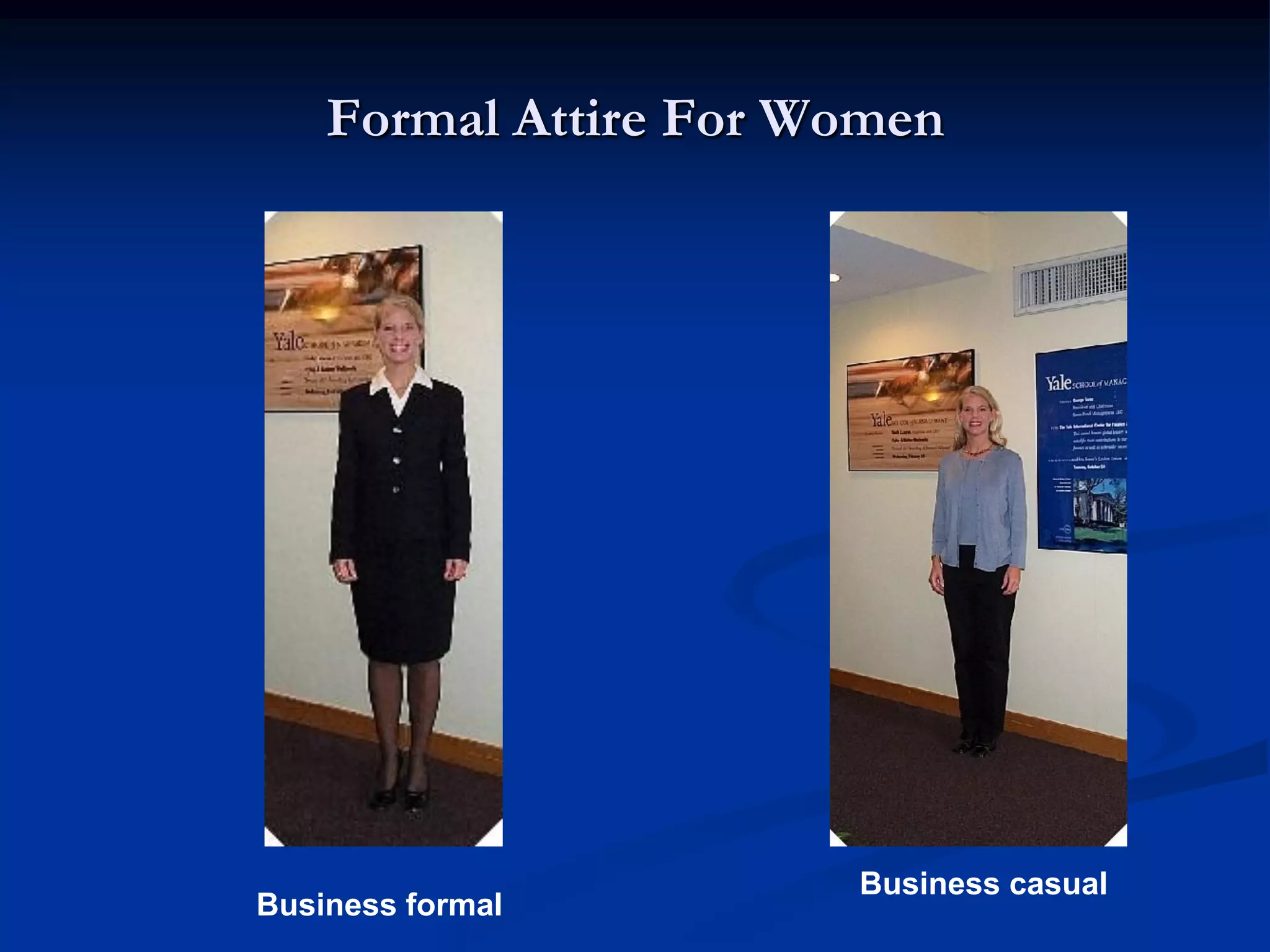
Business Attire For Women
   Traditional two-piece suit with a blazer and skirt or pants in a dark color or small pattern. Skirts
    must be knee length or below (when seated). Blouse should be buttoned up, or a crew neck shell
    may be worn in a conservative color (no prints).

   Shoes should be polished, and with a hard bottom, no rubber soles, and with a closed toe. No toe
    cleavage. Heel should be 1-2 inches.

   Neutral hose should always be worn. Avoid patterned tights or wild colors.

   Accessories such as scarves should be in a conservative print.

   Limit your jewelry to one set of earrings, a wedding set, and a watch. Avoid multiple rings or
    noisy bracelets.

   Bags should be limited to one briefcase. Leave purses behind to avoid fumbling with them. Or,
    forego the bag completely, and use a simple leather-like portfolio and planner.

   Clothing should fit well and not be too tight, too short, too low-cut, or show bare arms.

   Makeup should enhance your features, not draw attention to them!

   Nails should be trimmed and polished with clear or neutral tones.
Formal Attire For Women


                       Business casual
Business formal
BUSINESS
PRESENTATION
Define The Situation

Why are you giving the presentation?
 Know your purpose
 Specify your objective


Who is your audience?
 Analyse your audience (needs, attitude, what at stake, interest)


How much time do you have?
 Define the scope
 Allocate the time
 Time of the day/day of the week (impact on audience and organization)


What delivery medium should you use?
 You!
 Low tech (handouts, flipcharts,OHP)
 High tech (LCD Projectors, Presentation Softwares, multimedia)
Presentation Format
1.   Introduction: Set the tone and the theme

2.   Motivation opening: Tell them why to listen; lift your visor

3.   Outline of agenda: Help them to understand and picture the
     structure of your material

4.   Present your basic idea: Explain the whole idea first so
     whatever further explanation comes next can be hung from
     the framework you create right at the beginning

5.   Content – section by section: Begin to break into segments;
     present each segment with its details
Presentation Format

6.   Recap each section: Build in a recap at the end of each
     section before you finish and go on, for reinforcement and
     additional clarification

7.   Make transitions to next section: Let everyone know you're
     about to go to a new topic; this makes your outline structure
     continuously clear

8.   Wrap-up: At the end of all the components, wrap up by
     restating the whole idea, hitting the major points

9.   Conclusion: Finish memorably with a grand finale – bringing
     together all the elements of your presentation by reviewing the
     highlights and restating your major argument.
Preparing A Presentation
Steps:
1.       Decide the outcome you want

2.       Decide the core message you want your audience to accept

3.       Write the core message

4.       Write the supporting evidence around the core message to meet the needs of the
         different preferences for gathering and processing information that your audience
         may have

5.       Check through the supporting information to make sure you limit it to the bare
         minimum

6.       Arrange the presentation in a logical flowing order

7.       Prepare supporting graphs and diagrams

8.       Make a time for the presentation and invite your audience to attend

9.       Practice what you want to say as often as you can manage
DELIVER THE PRESENTATION
Deliver The Presentation

   Creating impressions
    When we talk, giving speech or presenting, we create an impression on the
    people/audience

   Physical presence
    How we say and what we look like when we say it is much more important
    than what we say. Your credibility will be assessed by the people/audience
    based on how you look and move.

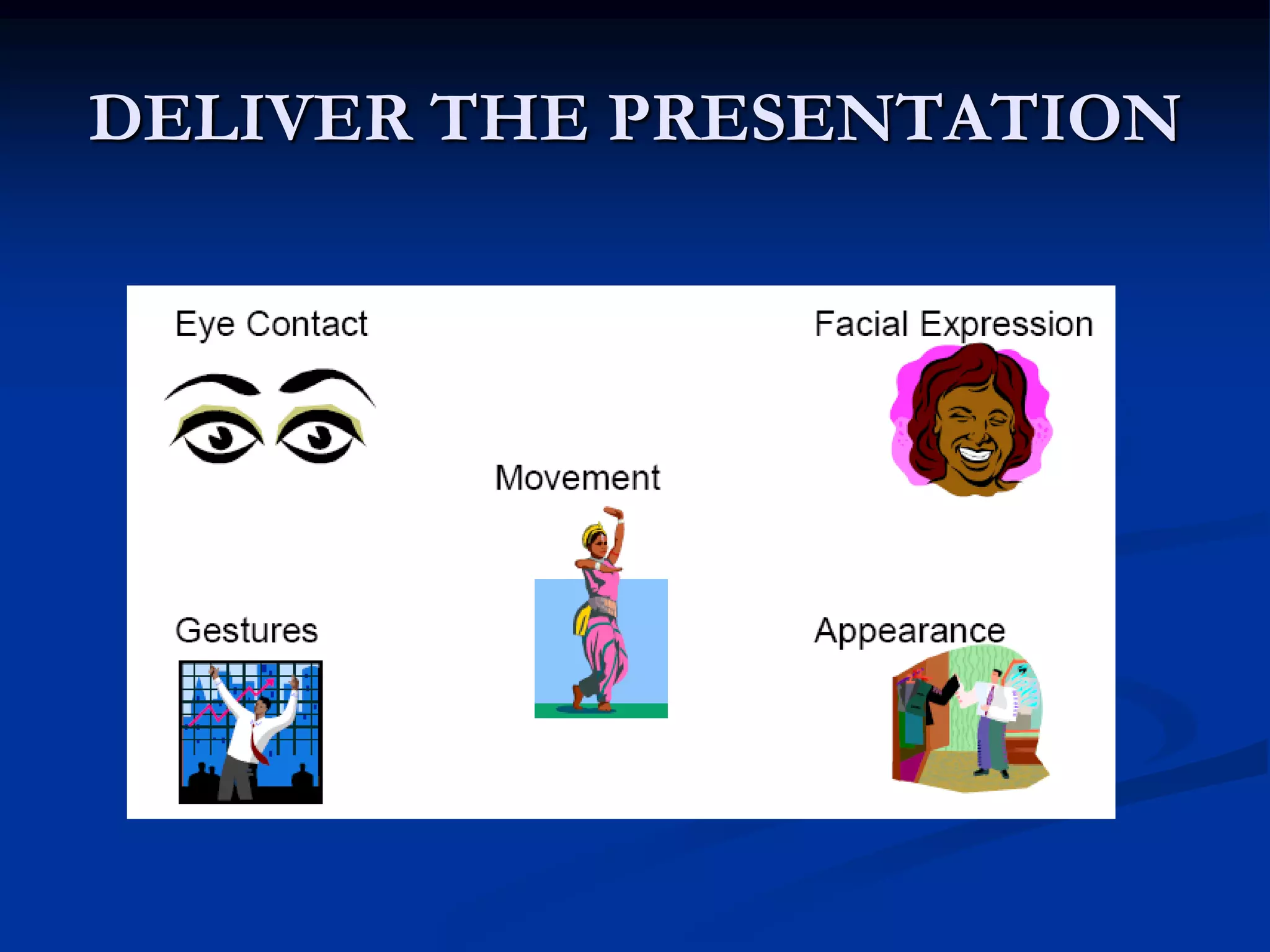
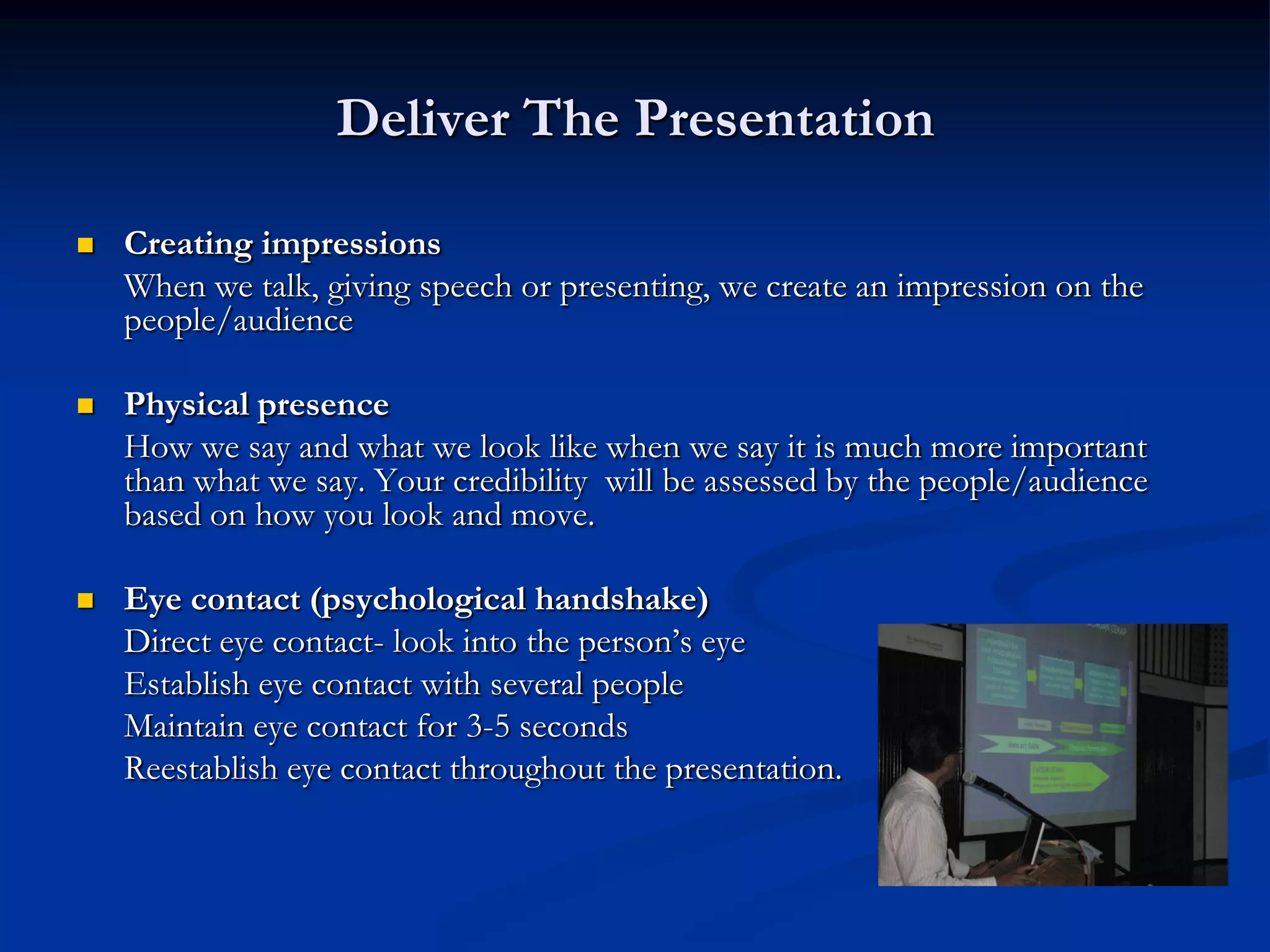
   Eye contact (psychological handshake)
    Direct eye contact- look into the person’s eye
    Establish eye contact with several people
    Maintain eye contact for 3-5 seconds
    Reestablish eye contact throughout the presentation.
Deliver The Presentation

   Facial expression
    Congruent with the intended message
    Show interest in the subject matter with the participants

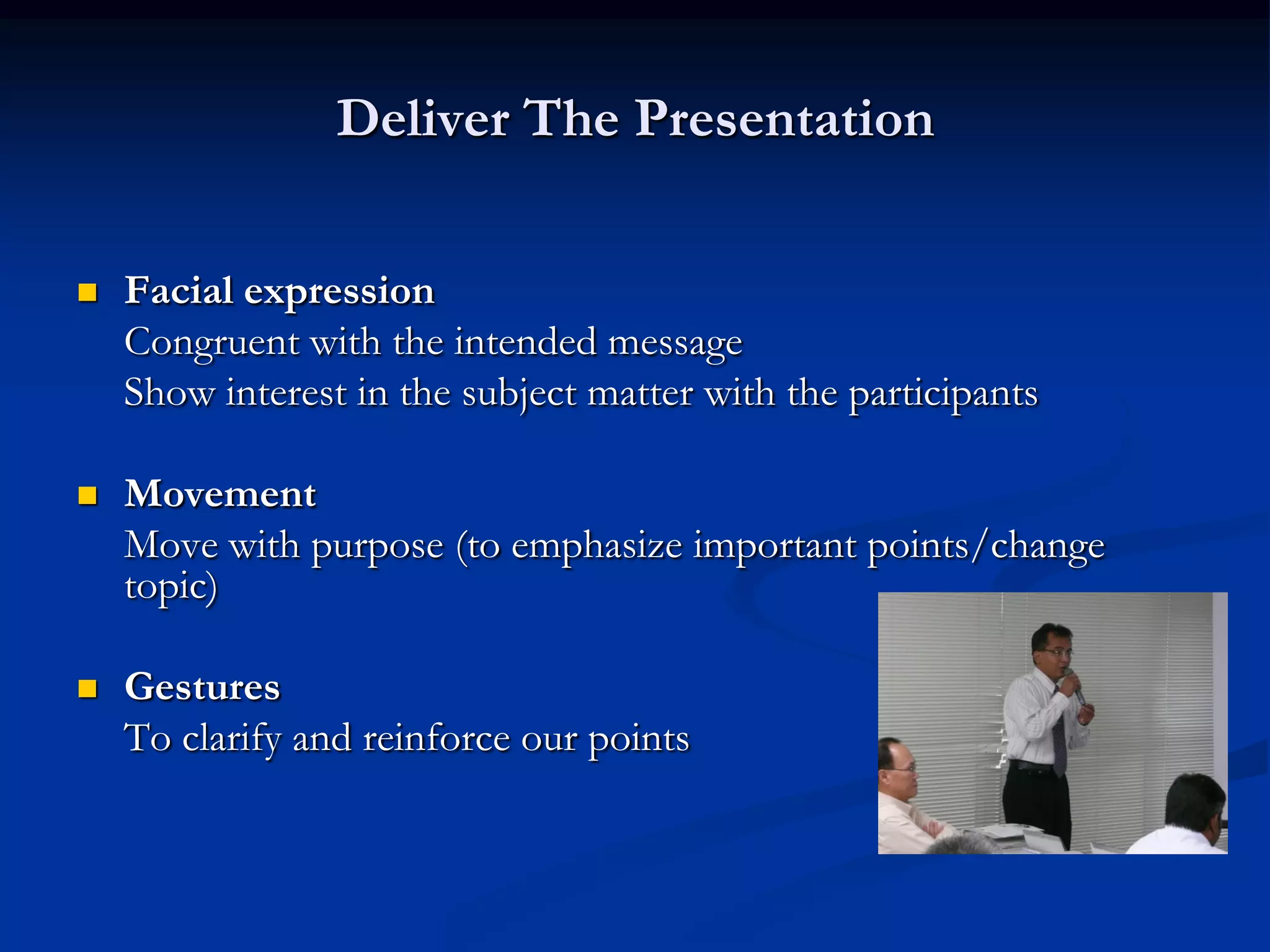
   Movement
    Move with purpose (to emphasize important points/change
    topic)

   Gestures
    To clarify and reinforce our points
Deliver The Presentation

   Appearance
    Dress, grooming, posture


   Your voice
    Projection – loud, clear and matching the context
    Tone – high and low
    Enunciation-Pronounce correctly and clearly, avoid filler words
    (uh’s, um’s), complete each words, emphasize important words
    Pace – speak fluently with varying speed
Deliver The Presentation
   Appropriate word choice
    Not lose participants with unfamiliar words
    Not insult participants with too simple words

   Stick with the script
    Don’t rely on memory and unless you are very experienced in
    giving presentations don’t make it up as you go. Remember you
    have put a lot of effort into the preparation so don’t waste it.
    Allow the audience to seek further clarification either during the
    presentation or at the end. You need to tell them which would
    suit you.
    Be as nervous as you like. Audiences are generally very
    sympathetic with nervousness, they have probably all been there
    too.
UNDERSTANDING
THE DECISION MAKING PROCESS
    AND DECISION MAKERS
Decision Making Process
   Making decisions based on logic or values

Logic
 People who prefer using logic may be said to construct formulae
  in their minds, they enter the data, process the data and out
  comes the result on which a decision is made. Using this
  method ensures consistency in results as long as the formula
  doesn’t change. Decisions made this way tend to be based on
  impersonal, objective logic.
 People who prefer to make decisions using logic are likely to:
 focus on facts and principles
 ignore their own and other people’s emotions
 be good at analysing a situation
 concentrate on people’s thoughts rather than their feelings
Decision Making Process
   Making decisions based on logic or values

Values
 People who prefer to use values for their decision making see values as
  guideposts which cannot be violated. So their decisions are directed
  towards ensuring they remain true to their values. The questions they
  would ask when having to come to a decision are such as; how would
  the other person feel if I did this? or is this an honourable thing to do?

   People who prefer to make decisions according to their values are
    likely to:
   decide things according to their own personal values
   focus on the values of other people and organisations
   ignore impersonal principles
   be good at understanding people and their principles
   concentrate on people’s feelings and thoughts
Decision Making Process
   Some key words which show the difference in logic and values
    intuition

 LOGIC
Head, distant, things, objective, criticise, analyse, firm but fair

 VALUES
Heart,personal,people, subjective, praise, understand, merciful

   Which do you think your preference is?

   These differences in the way we take in information and process
    it have a profound effect on how we communicate.
Decision Making Process
   You won’t know the preferences of the people to whom you
    make presentations so it is wise to cater for all possibilities.

   For the people who prefer:

  LOGIC
Show the logic of your argument in clear and precise terms and
show the cost saving that will resultfrom your proposal.
Also show in logical form how you will go about achieving the
outcomes you intend to deliver.

  VALUES
Show what the people in the business think about this, how it will
affect them and make the company a better place
to work, more productive, and a better corporate citizen.
Types Of Decision Makers
   Based on nearly year study carried out in United States
    of America, decision makers can be classified into the
    following types:

i) Charismatic (25%)
 Description: Looking for next big things ideas. Easily
   enthralled with bold and innovative approaches
 Prominent Examples: Richard Branson, Oprah
   Winfrey
 Characteristics: Enthusiastic imaginers, innovative
   risk seekers,Proactive and decisive,Responsible and
   accountable, bottom liners, interactive
Types Of Decision Makers

ii) Thinkers (11%)
 Description: Need to cautiously and methodically work
   through each pro and con of every conceivable option
   before rendering a decision.
 Prominent Examples: Bill Gates, Warren Buffet,
   Michael Dell,Alan Greenspan
 Characteristics: Methodical and process oriented,
   information driven,Quantitative and precise,Relentlessly
   thorough,Guarded and cautious, balanced, intellectually
   fluid
Types Of Decision Makers

iii) Sceptics(19%)
 Description: Inherent suspicious of any information
   that doesn’t fit their worldview. Need to hear things
   from very credible sources
 Prominent Examples: Larry Ellison

 Characteristics: Brazenly outspoken, fearlessly
   confident, assertive and demanding, determined and
   driven, visionary
Types Of Decision Makers
iv) Followers(36%)
 Description : Make decisions based on how other
   trusted executives (including themselves) have made in
   the past


   Prominent Examples: Carly Florina
   Characteristics: Devoted to the tried and the true,
    averse the new, conscientious corporate citizens, deft
    people handlers, emphatic, difficult to identify
Types Of Decision Makers
v) Controllers(9%)
 Description: Must be in charge of every aspect of
   decision making process. Need to have some
   ownership of an idea before proceeding with it
 Prominent Examples: Martha Stewart
 Characteristics: Driven by fear, proactive, fiercely self
   reliant, absolute and resolute, meticulous, unyielding
   perfectionists
Ways Of Persuasion
Charismatic
 Give the headline first
 Stay grounded no matter what
 Address risks upfront
 Follow through, follow through and follow through


Thinkers
 Tell your story chronologically
 Involve the thinker in your process’
 Be exhaustive but patient
 Allow (and encourage) others to join the thinking


Sceptics
 Above all, establish your credibility
 Hold your ground but find middle ground
 Keep your emotions and your ego in check
 Go to the source of credibility
Ways Of Persuasion

Followers
 When in doubt, assume
 Supply proof, proof and more proof
 Keep it simple
 Link the new to the old


Controllers
 Enable action but don’t force it
 Fly below the radar
 Build alliances
 Draw your line and hold on it
Common Mistakes
            In Dealing With Decision Makers
   Word versus action
    Pay attention to the person’s actions

   Personality versus decision making style
    Don’t confuse the two. Can be dramatically different

   A specific instance versus general behaviour
    Don’t classify the decision making style based on one case

   Sceptics versus controllers
    Share same characteristics but different way of deciding

   Thinkers versus controllers
    Both need copious data but using the info differently

   Followers versus everybody else
    Often to be something else mainly because they way they tend to project themselves
Common Barriers And Weaknesses In
            Business Communication
   Language proficiency
   Written: conventional (letter, fax) and electronic
    correspondences (e-mail)
   Oral: presentation, tele-conversation, meeting,
    discussion, negotiation and etc.
   Lacking of knowledge and information on the
    following:
        Prospective people and organization
        Own products/services and organization
        Failure to address the needs and restrictions of the
         prospective clients
        Unattractive packaging of products/services offered
        Business/official appearances
CONCLUSION

   Communication in a business organization provides
    the critical link between core functions due to:
   The changing environment and increasing complexity
    of the 21st century workplace make communication
    even more important.
   The world’s economy is becoming increasingly global

   Communication is crucial to business. Specialized
    business knowledge is important, but not enough to
    guarantee success. Communication skills are vital.
CONCLUSION

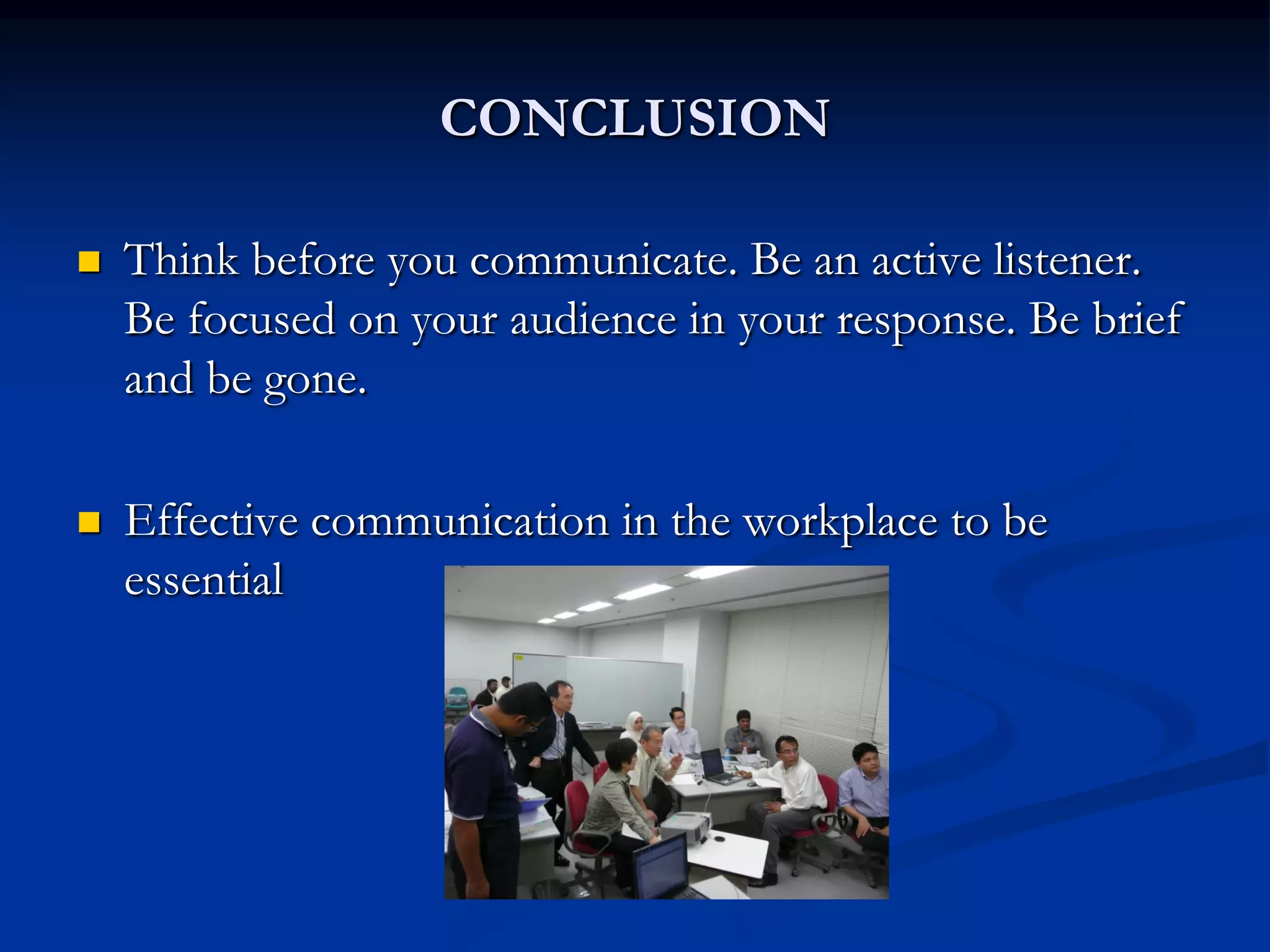
   Think before you communicate. Be an active listener.
    Be focused on your audience in your response. Be brief
    and be gone.

   Effective communication in the workplace to be
    essential
Thank you!
  Q&A

Introduction to effective communication

  • 1.
    KURSUS KOMUNIKASI KORPORAT UNTUK AJK PESTA KONVOKESYEN UKM 2009 INTRODUCTION TO EFFECTIVE BUSINESS COMMUNICATION ZAINI ABDUL WAHAB B.Eng(Hons.), UKM, 1997 Date: 9 May 2009 Venue: Tekam Plantation Resort, Jerantut, Pahang
  • 2.
    What Is Communication?  Communication is often mistaken as being a means of transferring information.  For human beings communication is much more than an information transfer, it is more clearly described as an exchange of meaning. Note the two words ‘exchange’ and ‘meaning’.  Exchange means that there is always more than one person actively involved, communication with an active speaker and a passive listener, for example writing an article in a company newsletter, is not an exchange of meaning.  Meaning is more than words, it involves all that is behind the words, the context in which they are used, the persons involved in the communication, the non verbal elements such a tone and body language. It involves both the creator of the message and the recipient.
  • 3.
    The Meaning OfWords  If I told you I was driving the latest model Rolls Royce you may wonder what such an important person would be doing here spending time in a class room. So you can see what the use of a familiar word can do and how the image can be simply enhanced, or changed by the addition of another simple word. Language is very powerful.
  • 4.
    Our Understanding ofWords  If words can convey powerful images, words we don’t know or haven’t experienced before do nothing for us. We constantly confronted with words we don’t understand.  Technical jargon (words we know but no one else understands) are wasted if our communication is not with an other person familiar with exactly the same technology.  Beware of jargon!
  • 5.
    Non Verbal Communication  We are all familiar with verbal communication but we tend to overlook the non verbal aspects of communication. We seem to accept non verbal communication without a lot of thought. We do it naturally and we respond to it naturally.  The two most powerful non verbal messages that can enhance your presentations are sincerity and determination.  The slickness of the presentation and the degree of nervousness you are experiencing have little effect but if you are really sincere and determined to achieve the outcomes you believe are best for the business you will impress.
  • 6.
    Our Preferences ForTaking In And Processing Information  People have certain ways of taking in information and in processing that information. We can’t tell what the preferences of our audience are so it is important to cover all possibilities.  To illustrate what I mean by preference please write your name.  Now write your name again using your other hand.  Now you know what I mean by preference. You prefer using one hand rather than the other for writing and clearly one does a better job more easily than the other. In the same way we have preferences for gathering and processing information.
  • 7.
  • 8.
    Introduction  First impressions count. This professional dress code is codified because many professionals have never been taught appropriate professional appearance and demeanor.  Professional dress code standards are alive and well in major financial and executive management. Anyone who aspires to top management knows that personal appearance counts.  If you look and behave like a highly trained and well- groomed professional, you will win the respect and honor of our valued clients.
  • 9.
    First Things First  Some of the perceptions people can form solely from your appearance are:  Your professionalism.  Your level of sophistication.  Your intelligence.  Your credibility.
  • 10.
    The Basics  So what's right and what's wrong?  First, there is no single set of rules that will work for everyone; sometimes the only written rules are expressed in your organization's dress code, if it has one. But there are a handful of characteristics that most successful business communicators share when it comes to dress and grooming.
  • 11.
    Fashionable Of Foolish  The corporate culture and the role you play in it should guide your choice of business attire.  More businesses are moving to full-time business casual at every level in the organization. Some just have one or two days each week that are casual. And the definition of business casual varies, ranging from jeans to blazers.  Just as in business communication, business dress requires you to know your audience. You need to gauge what attire will be right for the audience and the circumstance. This all hinges on the norms of the culture of the industry, region, company, division, department, and function.  While your attire can be a vehicle for personal expression, you can pay a price for violating the written and unwritten codes of your culture. Always know the price before you pay.
  • 12.
    Dress To FitYour Audience  When you're in front of a group giving a presentation, making a speech or just plain talking, you need to choose your attire to match the event.  Regardless of what you're wearing, make sure it works. Make a thorough assessment of how you look in front of a full-length mirror. And don't hesitate to get a second opinion.  Hands speak worlds about capability. They also reinforce your words. Hiding them can send a subtle message of incompetence.  If you are not wearing a long-sleeved blouse under a jacket, the jacket sleeve should extend to the end of the wrist bone. This will preserve the visibility of your hands without calling attention to the bareness of your forearms.
  • 13.
    Dress For Business,Not Pleasure  Business attire is different from social attire and tends to be more formal. The parameters that cover business attire are narrower than they are for social attire. For example, social attire can be more suggestive or flashier or make more of a statement, while business attire should be tuned to the needs of the business circumstance.  Your clothing and grooming should not distract. Rather, they should direct attention to your face and particularly your eyes. When you connect with someone else's eyes, they tend to listen. But who can stay focused on eyes when your purchasing agent has a copper ring pierced through his nose?  Typical formal business attire has an advantage because it can easily direct listeners to your eyes.
  • 14.
    Look Down  The great American dancer, Fred Astaire, who wrote the book on popular dance, said this about footwear: “If you want to know if a fellow is well dressed, look down.”  Couturier Diana Vreeland, renowned in women's fashion for wardrobe development, said: “First, I'd put money into shoes. No variety, just something I could wear with everything. ... Whatever it is you wear, I think shoes are terribly important.”
  • 15.
    Speak Tight, DressRight  Business presenters need more than a professional look. They need to be able to move in their clothes. Narrow skirts, tight pants, or confining jackets restrict movement.  To capitalize on large body gestures, be sure your clothes fit so you can move. And make sure they really fit.There is no excuse for ill-fitting business attire. If it doesn't fit, you must adjust it.
  • 16.
    Testing, Testing. One,Two Three!  Here's a simple test you can take before choosing attire for an event that puts you in the spotlight. Ask yourself:  What's appropriate for this audience? This event?  What image do I want to project?  For my company?  For my department?  For myself?
  • 17.
    Formal attire isfor everyone as a part of the international business language
  • 18.
    Business Attire ForMen  Traditional two-piece suit, or sport jacket with dress trousers in a dark color (NO KHAKIS).  White freshly-pressed shirt.  Conservative print or solid tie. No theme ties.  Jewelry should be kept to a minimum, and can include a wedding band, class or other signet ring, and watch.  All body piercings, including earrings, should be removed.  Do not wear cologne or aftershave. Some people may be allergic! Your personal hygiene products will provide enough fragrance.  Hair and facial hair should be neatly groomed and trimmed. Long hair should be worn in a low, neat ponytail. However, being clean shaven and having a short haircut is generally preferred.  Limit the size of bags/briefcases and avoid over-stuffing them. No backpacks. A simple leather-like portfolio and planner will suffice.
  • 19.
    Business Attire ForMen Business formal Business casual
  • 20.
    Business Attire ForMen  Shoes should be polished, and with a hard bottom, no rubber soles, worn with dark socks.  A pair of top-quality shoes is a good investment because they can be resoled as needed and last for decades
  • 21.
    Business Attire ForWomen  Traditional two-piece suit with a blazer and skirt or pants in a dark color or small pattern. Skirts must be knee length or below (when seated). Blouse should be buttoned up, or a crew neck shell may be worn in a conservative color (no prints).  Shoes should be polished, and with a hard bottom, no rubber soles, and with a closed toe. No toe cleavage. Heel should be 1-2 inches.  Neutral hose should always be worn. Avoid patterned tights or wild colors.  Accessories such as scarves should be in a conservative print.  Limit your jewelry to one set of earrings, a wedding set, and a watch. Avoid multiple rings or noisy bracelets.  Bags should be limited to one briefcase. Leave purses behind to avoid fumbling with them. Or, forego the bag completely, and use a simple leather-like portfolio and planner.  Clothing should fit well and not be too tight, too short, too low-cut, or show bare arms.  Makeup should enhance your features, not draw attention to them!  Nails should be trimmed and polished with clear or neutral tones.
  • 22.
    Formal Attire ForWomen Business casual Business formal
  • 23.
  • 24.
    Define The Situation Whyare you giving the presentation?  Know your purpose  Specify your objective Who is your audience?  Analyse your audience (needs, attitude, what at stake, interest) How much time do you have?  Define the scope  Allocate the time  Time of the day/day of the week (impact on audience and organization) What delivery medium should you use?  You!  Low tech (handouts, flipcharts,OHP)  High tech (LCD Projectors, Presentation Softwares, multimedia)
  • 25.
    Presentation Format 1. Introduction: Set the tone and the theme 2. Motivation opening: Tell them why to listen; lift your visor 3. Outline of agenda: Help them to understand and picture the structure of your material 4. Present your basic idea: Explain the whole idea first so whatever further explanation comes next can be hung from the framework you create right at the beginning 5. Content – section by section: Begin to break into segments; present each segment with its details
  • 26.
    Presentation Format 6. Recap each section: Build in a recap at the end of each section before you finish and go on, for reinforcement and additional clarification 7. Make transitions to next section: Let everyone know you're about to go to a new topic; this makes your outline structure continuously clear 8. Wrap-up: At the end of all the components, wrap up by restating the whole idea, hitting the major points 9. Conclusion: Finish memorably with a grand finale – bringing together all the elements of your presentation by reviewing the highlights and restating your major argument.
  • 27.
    Preparing A Presentation Steps: 1. Decide the outcome you want 2. Decide the core message you want your audience to accept 3. Write the core message 4. Write the supporting evidence around the core message to meet the needs of the different preferences for gathering and processing information that your audience may have 5. Check through the supporting information to make sure you limit it to the bare minimum 6. Arrange the presentation in a logical flowing order 7. Prepare supporting graphs and diagrams 8. Make a time for the presentation and invite your audience to attend 9. Practice what you want to say as often as you can manage
  • 28.
  • 29.
    Deliver The Presentation  Creating impressions When we talk, giving speech or presenting, we create an impression on the people/audience  Physical presence How we say and what we look like when we say it is much more important than what we say. Your credibility will be assessed by the people/audience based on how you look and move.  Eye contact (psychological handshake) Direct eye contact- look into the person’s eye Establish eye contact with several people Maintain eye contact for 3-5 seconds Reestablish eye contact throughout the presentation.
  • 30.
    Deliver The Presentation  Facial expression Congruent with the intended message Show interest in the subject matter with the participants  Movement Move with purpose (to emphasize important points/change topic)  Gestures To clarify and reinforce our points
  • 31.
    Deliver The Presentation  Appearance Dress, grooming, posture  Your voice Projection – loud, clear and matching the context Tone – high and low Enunciation-Pronounce correctly and clearly, avoid filler words (uh’s, um’s), complete each words, emphasize important words Pace – speak fluently with varying speed
  • 32.
    Deliver The Presentation  Appropriate word choice Not lose participants with unfamiliar words Not insult participants with too simple words  Stick with the script Don’t rely on memory and unless you are very experienced in giving presentations don’t make it up as you go. Remember you have put a lot of effort into the preparation so don’t waste it. Allow the audience to seek further clarification either during the presentation or at the end. You need to tell them which would suit you. Be as nervous as you like. Audiences are generally very sympathetic with nervousness, they have probably all been there too.
  • 33.
    UNDERSTANDING THE DECISION MAKINGPROCESS AND DECISION MAKERS
  • 34.
    Decision Making Process  Making decisions based on logic or values Logic  People who prefer using logic may be said to construct formulae in their minds, they enter the data, process the data and out comes the result on which a decision is made. Using this method ensures consistency in results as long as the formula doesn’t change. Decisions made this way tend to be based on impersonal, objective logic.  People who prefer to make decisions using logic are likely to:  focus on facts and principles  ignore their own and other people’s emotions  be good at analysing a situation  concentrate on people’s thoughts rather than their feelings
  • 35.
    Decision Making Process  Making decisions based on logic or values Values  People who prefer to use values for their decision making see values as guideposts which cannot be violated. So their decisions are directed towards ensuring they remain true to their values. The questions they would ask when having to come to a decision are such as; how would the other person feel if I did this? or is this an honourable thing to do?  People who prefer to make decisions according to their values are likely to:  decide things according to their own personal values  focus on the values of other people and organisations  ignore impersonal principles  be good at understanding people and their principles  concentrate on people’s feelings and thoughts
  • 36.
    Decision Making Process  Some key words which show the difference in logic and values intuition  LOGIC Head, distant, things, objective, criticise, analyse, firm but fair  VALUES Heart,personal,people, subjective, praise, understand, merciful  Which do you think your preference is?  These differences in the way we take in information and process it have a profound effect on how we communicate.
  • 37.
    Decision Making Process  You won’t know the preferences of the people to whom you make presentations so it is wise to cater for all possibilities.  For the people who prefer:  LOGIC Show the logic of your argument in clear and precise terms and show the cost saving that will resultfrom your proposal. Also show in logical form how you will go about achieving the outcomes you intend to deliver.  VALUES Show what the people in the business think about this, how it will affect them and make the company a better place to work, more productive, and a better corporate citizen.
  • 38.
    Types Of DecisionMakers  Based on nearly year study carried out in United States of America, decision makers can be classified into the following types: i) Charismatic (25%)  Description: Looking for next big things ideas. Easily enthralled with bold and innovative approaches  Prominent Examples: Richard Branson, Oprah Winfrey  Characteristics: Enthusiastic imaginers, innovative risk seekers,Proactive and decisive,Responsible and accountable, bottom liners, interactive
  • 39.
    Types Of DecisionMakers ii) Thinkers (11%)  Description: Need to cautiously and methodically work through each pro and con of every conceivable option before rendering a decision.  Prominent Examples: Bill Gates, Warren Buffet, Michael Dell,Alan Greenspan  Characteristics: Methodical and process oriented, information driven,Quantitative and precise,Relentlessly thorough,Guarded and cautious, balanced, intellectually fluid
  • 40.
    Types Of DecisionMakers iii) Sceptics(19%)  Description: Inherent suspicious of any information that doesn’t fit their worldview. Need to hear things from very credible sources  Prominent Examples: Larry Ellison  Characteristics: Brazenly outspoken, fearlessly confident, assertive and demanding, determined and driven, visionary
  • 41.
    Types Of DecisionMakers iv) Followers(36%)  Description : Make decisions based on how other trusted executives (including themselves) have made in the past  Prominent Examples: Carly Florina  Characteristics: Devoted to the tried and the true, averse the new, conscientious corporate citizens, deft people handlers, emphatic, difficult to identify
  • 42.
    Types Of DecisionMakers v) Controllers(9%)  Description: Must be in charge of every aspect of decision making process. Need to have some ownership of an idea before proceeding with it  Prominent Examples: Martha Stewart  Characteristics: Driven by fear, proactive, fiercely self reliant, absolute and resolute, meticulous, unyielding perfectionists
  • 43.
    Ways Of Persuasion Charismatic Give the headline first  Stay grounded no matter what  Address risks upfront  Follow through, follow through and follow through Thinkers  Tell your story chronologically  Involve the thinker in your process’  Be exhaustive but patient  Allow (and encourage) others to join the thinking Sceptics  Above all, establish your credibility  Hold your ground but find middle ground  Keep your emotions and your ego in check  Go to the source of credibility
  • 44.
    Ways Of Persuasion Followers When in doubt, assume  Supply proof, proof and more proof  Keep it simple  Link the new to the old Controllers  Enable action but don’t force it  Fly below the radar  Build alliances  Draw your line and hold on it
  • 45.
    Common Mistakes In Dealing With Decision Makers  Word versus action Pay attention to the person’s actions  Personality versus decision making style Don’t confuse the two. Can be dramatically different  A specific instance versus general behaviour Don’t classify the decision making style based on one case  Sceptics versus controllers Share same characteristics but different way of deciding  Thinkers versus controllers Both need copious data but using the info differently  Followers versus everybody else Often to be something else mainly because they way they tend to project themselves
  • 46.
    Common Barriers AndWeaknesses In Business Communication  Language proficiency  Written: conventional (letter, fax) and electronic correspondences (e-mail)  Oral: presentation, tele-conversation, meeting, discussion, negotiation and etc.  Lacking of knowledge and information on the following:  Prospective people and organization  Own products/services and organization  Failure to address the needs and restrictions of the prospective clients  Unattractive packaging of products/services offered  Business/official appearances
  • 47.
    CONCLUSION  Communication in a business organization provides the critical link between core functions due to:  The changing environment and increasing complexity of the 21st century workplace make communication even more important.  The world’s economy is becoming increasingly global  Communication is crucial to business. Specialized business knowledge is important, but not enough to guarantee success. Communication skills are vital.
  • 48.
    CONCLUSION  Think before you communicate. Be an active listener. Be focused on your audience in your response. Be brief and be gone.  Effective communication in the workplace to be essential
  • 49.