CHAPTER 8 COMMUNICATION METHODS
LESSON OBJECTIVES Use appropriate communication methods for different  occasions. Demonstrate skills in answering incoming telephone calls  effectively. Demonstrate skills in taking telephone messages. Demonstrate skills in making and receiving telephone calls  effectively. Explain importance of personal grooming in customer  service.
Communication Methods Face-To-Face Written Telephone
Face-To-Face 3 aspects of communication skills verbal non-verbal listening
Face-To-Face Examples of communication skills Sales assistant sells merchandise to customer. Bellboy receives hotel guests. Tour guide leads tourists on a tour.
Written 3 aspects of communication skills In helping us remember what has been said like notices. As follow-up on meetings & discussions like emails. As proofs & records of business deals like letters & memoranda.
Effective Written Communication   A piece of written communication contains: Introduction that gives background info. A body which contains main message details. Conclusion that either summarises message or states clearly what reader needs to do. Please refer to EBS Textbook from Page 229 to 231.
95% of daily business contact come through telephone. Useful for enquiries, requests & complaints. Telephone calls are to be  handle effectively to convey confidence & professionalism through: Right content Right attitude Correct tone of voice Telephone  Communication
TIPS FOR MAKING TELEPHPONE CALLS
Know purpose of our call
Being ready with questions to be asked
Being courteous to caller
Speaking with a smile
If the person whom we wish to speak to is not in, we can choose to leave a CLEAR & COMPLETE MESSAGE…..
Leave simple message by saying our name, contact no & the call purpose
Avoid leaving message in a noisy environment
What Are Procedures for Handling Telephone Calls Effectively?
A Call for Mr Charlie Sales Manager - Mr Charlie Customer – Ms Lucy Receptionist – Ms Sally
Transferring an Incoming Call Ms Lucy calls in to look for Mr Charlie. Her call is being transferred by Sally, the receptionist
Answer the call by the second ring. Greet the caller : ‘Good morning.’  Identify yourself to let the caller know the organisation he/she has reached:  ‘ Peanutzy Pte Ltd, Sally speaking.’ Ask for the caller’s name so that you can use it during the conversation to speak to him / her on a more personal basis: ‘  Who may I speaking to, please?’ Transfer the call: ‘Please hold on Ms Lucy while I transfer your call to Mr Charlie.” Transfer the call to Mr Charlie.
Putting an Incoming Call on Hold Ms Lucy calls in to look for Mr Charlie. Her call is being transferred by Sally, the receptionist
Answer the call by the second ring. Greet the caller : ‘Good morning.’  Identify yourself to let the caller know the organisation he/she has reached:  ‘ Peanutzy Pte Ltd, Sally speaking.’ Ask for the caller’s name so that you can use it during the conversation to speak to him / her on a more personal basis: ‘  Who may I speaking to, please?’ Transfer the call: ‘Please hold on Ms Lucy while I find out if Mr Charlie is in.’ Get back to caller every now and then to let her know that the line is not cut off:  ‘ Hi Ms Lucy, I’m afraid Mr Charlie is still on the line right now. Would you like to hold on or can I get him to return your call?’
Making Outgoing Local Calls Sally, the receptionist, is making an outgoing  local call to Mr Brown who is out of office
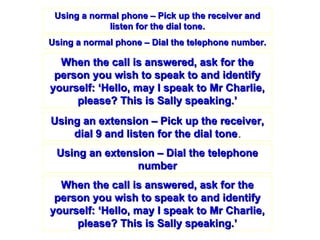
Using a normal phone – Pick up the receiver and listen for the dial tone. Using a normal phone – Dial the telephone number. Using an extension – Dial the telephone number Using an extension – Pick up the receiver, dial 9 and listen for the dial tone . When the call is answered, ask for the person you wish to speak to and identify yourself: ‘Hello, may I speak to Mr Charlie, please? This is Sally speaking.’ When the call is answered, ask for the person you wish to speak to and identify yourself: ‘Hello, may I speak to Mr Charlie, please? This is Sally speaking.’
Handling Incoming call from a nuisance caller Sally, the receptionist, receives a nuisance call.
Answer the call by the second ring. Greet the caller : ‘Good morning.’   Identify yourself to let the caller know the organisation he/she has reached:  ‘ Peanutzy Pte Ltd, Sally speaking.’ Ask for the caller’s name so that you can use it during the conversation to speak to him / her on a more personal basis: ‘  Who may I speaking to, please?’ Unfriendly Customer made complaints. But you should be polite and not get upset even if the customer is rude : “I’m sorry, Ms Lucy. We’ll look into this matter.” Thank the caller at the end of the call: ‘Thank you for letting us know about the matter.’
Write & Complete Telephone Message Form To:___________________________________________ Date:_______________ Time:_____________________ While you were out Mr / Miss / Mrs  Of  Phone     Telephoned you     Please call   Returned your call  Will call again   Wants to see you Urgent Message: _______________________________________  _______________________________________________  _______________________________________________  _______________________________________________  _______________________________________________ Call taken by: ______________  Date: ______________________ Time: ______________________ Name of person taking down the message Date and time of call Message Caller’s name Name of person caller wishes to speak to Caller’s company name & contact no.
What are 8 Principles in Handling Difficult Callers?
8  Principles in Handling Difficult Callers  1. Be Polite & Patient 2. Listen  –  Do Not Interrupt
8  Principles in Handling Difficult Callers   3. Show Interest & Concern 4. Ask Questions
8  Principles in Handling Difficult Callers  5. Show Understanding 6. Try to Help
8  Principles in Handling Difficult Callers  7. Assure the Caller of Assistance 8. Explain to the  Caller what You are  Going to Do
Are there any unpleasant circumstances  when you meet rude customer service  officers or assistants?  How do you feel when someone is rude to  you? What kind of impression does he /  she give you? Are there any pleasant circumstances  when you meet polite and friendly  customer service officers or assistants? How do you feel when someone is friendly  and polite to you? What kind of impression  does he / she give you? Think-Pair-Share
LESSON OBJECTIVES Importance of managing oneself well Ways to be well-groomed and leave  a good impression on others   PERSONAL MANAGEMENT SKILLS
Compare the 2 pictures… Who is well-groomed?  Who leaves a good impression  in others?
Important aspect in customer service is  personal grooming. Depends on communicating face-to-face,  appearance, work attire (smart & professional),  behaviours and non-verbal feedback. In front line customer service, our physical  appearance is important as people respond to us  according to how we look. Importance of Personal Grooming
Ways To Be Well-Groomed Take a shower to be fresh at workplace Keep hair neat and clean  Do not fiddle with the hair Brush and floss the teeth daily  Keep the fingernails clean Dress appropriately for occasion Maintain good standing, walking or sitting posture
Good personal grooming means being appropriately dressed, and having a neat and smart, well-groomed appearance
CONCLUSION Use appropriate communication methods for different  occasions. Demonstrate skills in answering incoming telephone calls  effectively. Demonstrate skills in taking telephone messages. Demonstrate skills in making and receiving telephone calls  effectively. Explain importance of personal grooming in customer  service.
Communicate effectively and be well-groomed… THANK YOU CLASS

Chapter 8 communication methods draft 2

  • 1.
  • 2.
    LESSON OBJECTIVES Useappropriate communication methods for different occasions. Demonstrate skills in answering incoming telephone calls effectively. Demonstrate skills in taking telephone messages. Demonstrate skills in making and receiving telephone calls effectively. Explain importance of personal grooming in customer service.
  • 3.
  • 4.
    Face-To-Face 3 aspectsof communication skills verbal non-verbal listening
  • 5.
    Face-To-Face Examples ofcommunication skills Sales assistant sells merchandise to customer. Bellboy receives hotel guests. Tour guide leads tourists on a tour.
  • 6.
    Written 3 aspectsof communication skills In helping us remember what has been said like notices. As follow-up on meetings & discussions like emails. As proofs & records of business deals like letters & memoranda.
  • 7.
    Effective Written Communication A piece of written communication contains: Introduction that gives background info. A body which contains main message details. Conclusion that either summarises message or states clearly what reader needs to do. Please refer to EBS Textbook from Page 229 to 231.
  • 8.
    95% of dailybusiness contact come through telephone. Useful for enquiries, requests & complaints. Telephone calls are to be handle effectively to convey confidence & professionalism through: Right content Right attitude Correct tone of voice Telephone Communication
  • 9.
    TIPS FOR MAKINGTELEPHPONE CALLS
  • 10.
  • 11.
    Being ready withquestions to be asked
  • 12.
  • 13.
  • 14.
    If the personwhom we wish to speak to is not in, we can choose to leave a CLEAR & COMPLETE MESSAGE…..
  • 15.
    Leave simple messageby saying our name, contact no & the call purpose
  • 16.
    Avoid leaving messagein a noisy environment
  • 17.
    What Are Proceduresfor Handling Telephone Calls Effectively?
  • 18.
    A Call forMr Charlie Sales Manager - Mr Charlie Customer – Ms Lucy Receptionist – Ms Sally
  • 19.
    Transferring an IncomingCall Ms Lucy calls in to look for Mr Charlie. Her call is being transferred by Sally, the receptionist
  • 20.
    Answer the callby the second ring. Greet the caller : ‘Good morning.’ Identify yourself to let the caller know the organisation he/she has reached: ‘ Peanutzy Pte Ltd, Sally speaking.’ Ask for the caller’s name so that you can use it during the conversation to speak to him / her on a more personal basis: ‘ Who may I speaking to, please?’ Transfer the call: ‘Please hold on Ms Lucy while I transfer your call to Mr Charlie.” Transfer the call to Mr Charlie.
  • 21.
    Putting an IncomingCall on Hold Ms Lucy calls in to look for Mr Charlie. Her call is being transferred by Sally, the receptionist
  • 22.
    Answer the callby the second ring. Greet the caller : ‘Good morning.’ Identify yourself to let the caller know the organisation he/she has reached: ‘ Peanutzy Pte Ltd, Sally speaking.’ Ask for the caller’s name so that you can use it during the conversation to speak to him / her on a more personal basis: ‘ Who may I speaking to, please?’ Transfer the call: ‘Please hold on Ms Lucy while I find out if Mr Charlie is in.’ Get back to caller every now and then to let her know that the line is not cut off: ‘ Hi Ms Lucy, I’m afraid Mr Charlie is still on the line right now. Would you like to hold on or can I get him to return your call?’
  • 23.
    Making Outgoing LocalCalls Sally, the receptionist, is making an outgoing local call to Mr Brown who is out of office
  • 24.
    Using a normalphone – Pick up the receiver and listen for the dial tone. Using a normal phone – Dial the telephone number. Using an extension – Dial the telephone number Using an extension – Pick up the receiver, dial 9 and listen for the dial tone . When the call is answered, ask for the person you wish to speak to and identify yourself: ‘Hello, may I speak to Mr Charlie, please? This is Sally speaking.’ When the call is answered, ask for the person you wish to speak to and identify yourself: ‘Hello, may I speak to Mr Charlie, please? This is Sally speaking.’
  • 25.
    Handling Incoming callfrom a nuisance caller Sally, the receptionist, receives a nuisance call.
  • 26.
    Answer the callby the second ring. Greet the caller : ‘Good morning.’ Identify yourself to let the caller know the organisation he/she has reached: ‘ Peanutzy Pte Ltd, Sally speaking.’ Ask for the caller’s name so that you can use it during the conversation to speak to him / her on a more personal basis: ‘ Who may I speaking to, please?’ Unfriendly Customer made complaints. But you should be polite and not get upset even if the customer is rude : “I’m sorry, Ms Lucy. We’ll look into this matter.” Thank the caller at the end of the call: ‘Thank you for letting us know about the matter.’
  • 27.
    Write & CompleteTelephone Message Form To:___________________________________________ Date:_______________ Time:_____________________ While you were out Mr / Miss / Mrs Of Phone   Telephoned you   Please call  Returned your call  Will call again  Wants to see you Urgent Message: _______________________________________ _______________________________________________ _______________________________________________ _______________________________________________ _______________________________________________ Call taken by: ______________ Date: ______________________ Time: ______________________ Name of person taking down the message Date and time of call Message Caller’s name Name of person caller wishes to speak to Caller’s company name & contact no.
  • 28.
    What are 8Principles in Handling Difficult Callers?
  • 29.
    8 Principlesin Handling Difficult Callers 1. Be Polite & Patient 2. Listen – Do Not Interrupt
  • 30.
    8 Principlesin Handling Difficult Callers 3. Show Interest & Concern 4. Ask Questions
  • 31.
    8 Principlesin Handling Difficult Callers 5. Show Understanding 6. Try to Help
  • 32.
    8 Principlesin Handling Difficult Callers 7. Assure the Caller of Assistance 8. Explain to the Caller what You are Going to Do
  • 33.
    Are there anyunpleasant circumstances when you meet rude customer service officers or assistants? How do you feel when someone is rude to you? What kind of impression does he / she give you? Are there any pleasant circumstances when you meet polite and friendly customer service officers or assistants? How do you feel when someone is friendly and polite to you? What kind of impression does he / she give you? Think-Pair-Share
  • 34.
    LESSON OBJECTIVES Importanceof managing oneself well Ways to be well-groomed and leave a good impression on others PERSONAL MANAGEMENT SKILLS
  • 35.
    Compare the 2pictures… Who is well-groomed? Who leaves a good impression in others?
  • 36.
    Important aspect incustomer service is personal grooming. Depends on communicating face-to-face, appearance, work attire (smart & professional), behaviours and non-verbal feedback. In front line customer service, our physical appearance is important as people respond to us according to how we look. Importance of Personal Grooming
  • 37.
    Ways To BeWell-Groomed Take a shower to be fresh at workplace Keep hair neat and clean Do not fiddle with the hair Brush and floss the teeth daily Keep the fingernails clean Dress appropriately for occasion Maintain good standing, walking or sitting posture
  • 38.
    Good personal groomingmeans being appropriately dressed, and having a neat and smart, well-groomed appearance
  • 39.
    CONCLUSION Use appropriatecommunication methods for different occasions. Demonstrate skills in answering incoming telephone calls effectively. Demonstrate skills in taking telephone messages. Demonstrate skills in making and receiving telephone calls effectively. Explain importance of personal grooming in customer service.
  • 40.
    Communicate effectively andbe well-groomed… THANK YOU CLASS