






National Institute of Fashion Technology,
Chennai
Presented By:
Abhishek Raj
Sarthak Sagar
Shriya Arora
Pammi Kumari
DFT-VII
Plant Layout
Plan for T-Shirt Manufacturing Unit
Department of Fashion Technology
 Product Description
 Required Raw Materials
 Location Analysis
 Proposed Factory Layout
 Area Description
 Material Flow
 Machines and Equipment
 Man Power
Contents
Product Description
 The product will manufacture is T-Shirts.
 Round Neck T-Shirt
 Crew Neck T-Shirt
 V Neck T-Shirt
Product Description
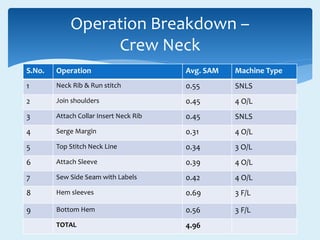
S.No. Operation Avg. SAM Machine Type
1 Neck Rib & Run stitch 0.55 SNLS
2 Join shoulders 0.45 4 O/L
3 Attach Collar Insert Neck Rib 0.45 SNLS
4 Serge Margin 0.31 4 O/L
5 Top Stitch Neck Line 0.34 3 O/L
6 Attach Sleeve 0.39 4 O/L
7 Sew Side Seam with Labels 0.42 4 O/L
8 Hem sleeves 0.69 3 F/L
9 Bottom Hem 0.56 3 F/L
TOTAL 4.96
Operation Breakdown –
Crew Neck
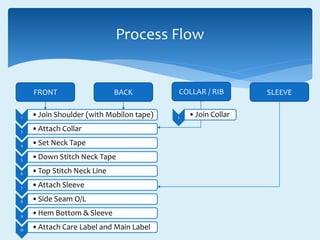
Process Flow
1 •Join Shoulder (with Mobilon tape)
3 •Attach Collar
4 •Set Neck Tape
5 •Down Stitch Neck Tape
6 •Top Stitch Neck Line
7 •Attach Sleeve
8 •Side Seam O/L
9 •Hem Bottom & Sleeve
10 •Attach Care Label and Main Label
FRONT BACK COLLAR / RIB SLEEVE
2 •Join Collar
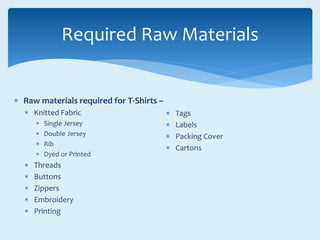
 Raw materials required for T-Shirts –
 Knitted Fabric
 Single Jersey
 Double Jersey
 Rib
 Dyed or Printed
 Threads
 Buttons
 Zippers
 Embroidery
 Printing
Required Raw Materials
 Tags
 Labels
 Packing Cover
 Cartons
Location Analysis
Brandix India Apparel City
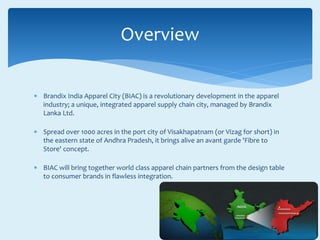
 Brandix India Apparel City (BIAC) is a revolutionary development in the apparel
industry; a unique, integrated apparel supply chain city, managed by Brandix
Lanka Ltd.
 Spread over 1000 acres in the port city of Visakhapatnam (or Vizag for short) in
the eastern state of Andhra Pradesh, it brings alive an avant garde 'Fibre to
Store' concept.
 BIAC will bring together world class apparel chain partners from the design table
to consumer brands in flawless integration.
Overview
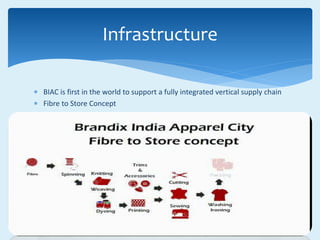
 BIAC is first in the world to support a fully integrated vertical supply chain
 Fibre to Store Concept
Infrastructure
 Special Economic Zone
 Land Area Covers 1000 acers
 Received ISO 14001:2004 EMS certification in 2011
 Environment friendly and sustainable campus
 Follow CTPAT – Customs-Trade Partnership Against Terrorism
Infrastructure
Infrastructure
Selected
Land Area
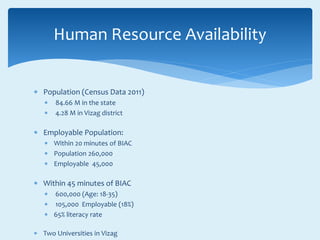
 Population (Census Data 2011)
 84.66 M in the state
 4.28 M in Vizag district
 Employable Population:
 Within 20 minutes of BIAC
 Population 260,000
 Employable 45,000
 Within 45 minutes of BIAC
 600,000 (Age: 18-35)
 105,000 Employable (18%)
 65% literacy rate
 Two Universities in Vizag
Human Resource Availability
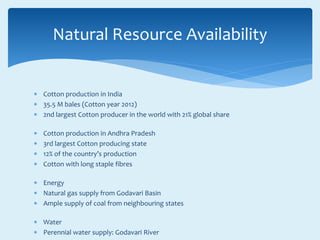
 Cotton production in India
 35.5 M bales (Cotton year 2012)
 2nd largest Cotton producer in the world with 21% global share
 Cotton production in Andhra Pradesh
 3rd largest Cotton producing state
 12% of the country’s production
 Cotton with long staple fibres
 Energy
 Natural gas supply from Godavari Basin
 Ample supply of coal from neighbouring states
 Water
 Perennial water supply: Godavari River
Natural Resource Availability
 Visakhapatnam City : 40km
 Airport : 42km
 Port : 35km
 Railway : 10km
 Highway : 5km
Connectivity
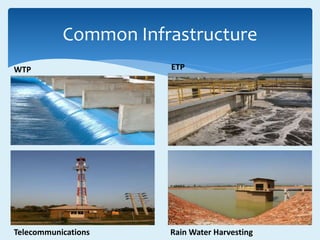
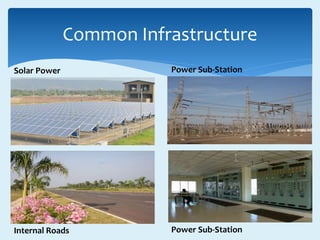
Common Infrastructure
Telecommunications
WTP ETP
Rain Water Harvesting
Common Infrastructure
Internal Roads
Power Sub-Station
Power Sub-Station
Solar Power
 Presently running Companies in BIAC campus:
 Ocean India - fabric mill for knitting, dyeing and printing
 Screenline Printing - printing services
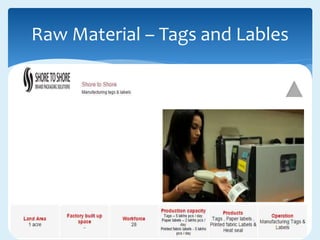
 Shore to Shore- Manufacturing tags and labels
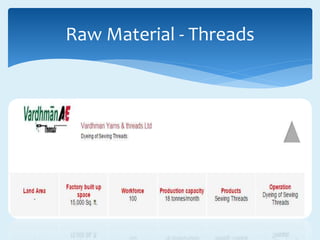
 Vardhman – Threads Suppliers
 Brandix Apparel India- ladies innerwear
 Seeds Intimate Apparel- Bras and Brallets
 Quantum Clothing - ladies innerwear and men’s shirts
 S & S- manufacturing underwires for bras
 Pioneer Elastics - China based company manufacturing and dyeing
narrow elastic
 Thermax- Providing energy solutions for other manufacturing units
Operational Units
 Presently running Companies in BIAC campus:
 Ocean India - fabric mill for knitting, dyeing and printing
 Screenline Printing - printing services
 Shore to Shore- Manufacturing tags and labels
 Vardhman – Threads Suppliers
Internal Suppliers
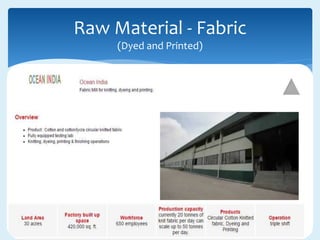
Raw Material - Fabric
(Dyed and Printed)
Raw Material – Tags and Lables
Raw Material - Threads
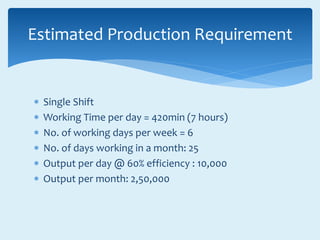
 Single Shift
 Working Time per day = 420min (7 hours)
 No. of working days per week = 6
 No. of days working in a month: 25
 Output per day @ 60% efficiency : 10,000
 Output per month: 2,50,000
Estimated Production Requirement
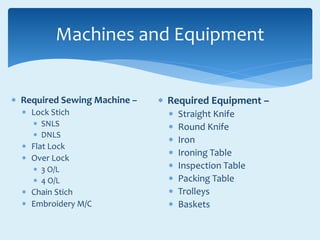
Machines and Equipment
 Required Sewing Machine –
 Lock Stich
 SNLS
 DNLS
 Flat Lock
 Over Lock
 3 O/L
 4 O/L
 Chain Stich
 Embroidery M/C
Machines and Equipment
 Required Equipment –
 Straight Knife
 Round Knife
 Iron
 Ironing Table
 Inspection Table
 Packing Table
 Trolleys
 Baskets
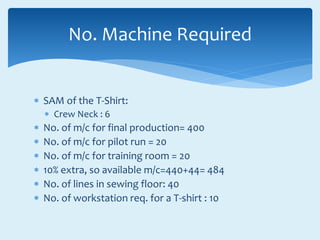
 SAM of the T-Shirt:
 Crew Neck : 6
 No. of m/c for final production= 400
 No. of m/c for pilot run = 20
 No. of m/c for training room = 20
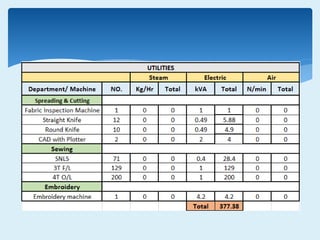
 10% extra, so available m/c=440+44= 484
 No. of lines in sewing floor: 40
 No. of workstation req. for a T-shirt : 10
No. Machine Required
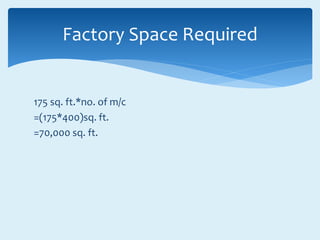
175 sq. ft.*no. of m/c
=(175*400)sq. ft.
=70,000 sq. ft.
Factory Space Required
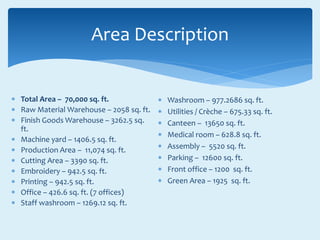
 Total Area – 70,000 sq. ft.
 Raw Material Warehouse – 2058 sq. ft.
 Finish Goods Warehouse – 3262.5 sq.
ft.
 Machine yard – 1406.5 sq. ft.
 Production Area – 11,074 sq. ft.
 Cutting Area – 3390 sq. ft.
 Embroidery – 942.5 sq. ft.
 Printing – 942.5 sq. ft.
 Office – 426.6 sq. ft. (7 offices)
 Staff washroom – 1269.12 sq. ft.
Area Description
 Washroom – 977.2686 sq. ft.
 Utilities / Crèche – 675.33 sq. ft.
 Canteen – 13650 sq. ft.
 Medical room – 628.8 sq. ft.
 Assembly – 5520 sq. ft.
 Parking – 12600 sq. ft.
 Front office – 1200 sq. ft.
 Green Area – 1925 sq. ft.
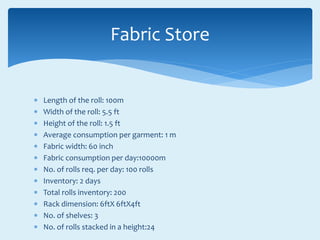
 Length of the roll: 100m
 Width of the roll: 5.5 ft
 Height of the roll: 1.5 ft
 Average consumption per garment: 1 m
 Fabric width: 60 inch
 Fabric consumption per day:10000m
 No. of rolls req. per day: 100 rolls
 Inventory: 2 days
 Total rolls inventory: 200
 Rack dimension: 6ftX 6ftX4ft
 No. of shelves: 3
 No. of rolls stacked in a height:24
Fabric Store
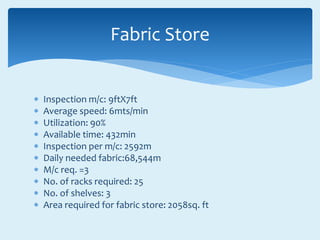
 Inspection m/c: 9ftX7ft
 Average speed: 6mts/min
 Utilization: 90%
 Available time: 432min
 Inspection per m/c: 2592m
 Daily needed fabric:68,544m
 M/c req. =3
 No. of racks required: 25
 No. of shelves: 3
 Area required for fabric store: 2058sq. ft
Fabric Store
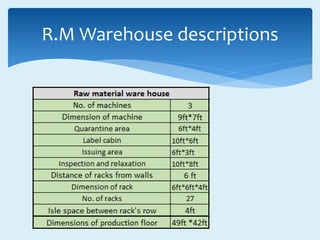
R.M Warehouse descriptions
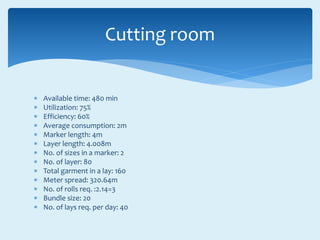
 Available time: 480 min
 Utilization: 75%
 Efficiency: 60%
 Average consumption: 2m
 Marker length: 4m
 Layer length: 4.008m
 No. of sizes in a marker: 2
 No. of layer: 80
 Total garment in a lay: 160
 Meter spread: 320.64m
 No. of rolls req. :2.14=3
 Bundle size: 20
 No. of lays req. per day: 40
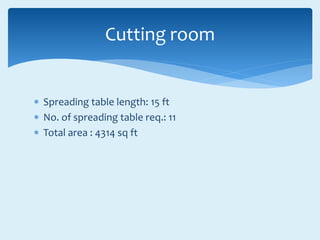
Cutting room
 Spreading table length: 15 ft
 No. of spreading table req.: 11
 Total area : 4314 sq ft
Cutting room
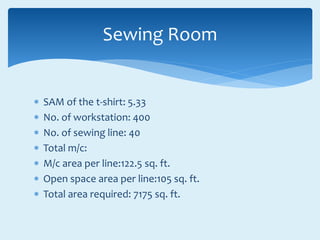
 SAM of the t-shirt: 5.33
 No. of workstation: 400
 No. of sewing line: 40
 Total m/c:
 M/c area per line:122.5 sq. ft.
 Open space area per line:105 sq. ft.
 Total area required: 7175 sq. ft.
Sewing Room
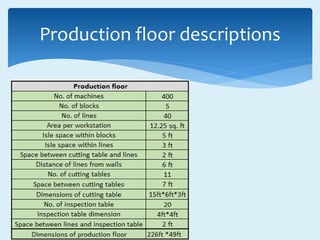
Production floor descriptions
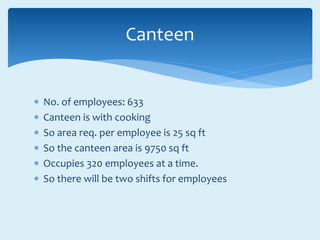
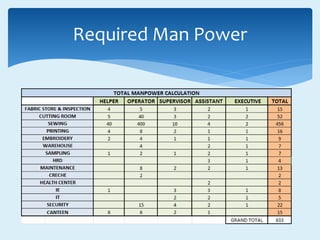
 No. of employees: 633
 Canteen is with cooking
 So area req. per employee is 25 sq ft
 So the canteen area is 9750 sq ft
 Occupies 320 employees at a time.
 So there will be two shifts for employees
Canteen
Man Power
Required Man Power
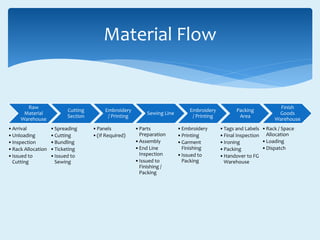
Material Flow
Raw
Material
Warehouse
•Arrival
•Unloading
•Inspection
•Rack Allocation
•Issued to
Cutting
Cutting
Section
•Spreading
•Cutting
•Bundling
•Ticketing
•Issued to
Sewing
Embroidery
/ Printing
•Panels
•(If Required)
Sewing Line
•Parts
Preparation
•Assembly
•End Line
Inspection
•Issued to
Finishing /
Packing
Embroidery
/ Printing
•Embroidery
•Printing
•Garment
Finishing
•Issued to
Packing
Packing
Area
•Tags and Labels
•Final Inspection
•Ironing
•Packing
•Handover to FG
Warehouse
Finish
Goods
Warehouse
•Rack / Space
Allocation
•Loading
•Dispatch
Material Flow
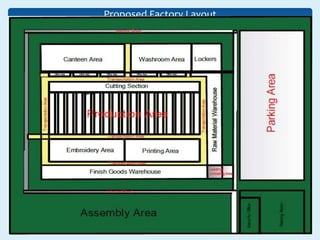
Proposed Factory Layout
 2D Layout
 3D Layout
Proposed Factory Layout
Thank You

T-Shirt Manufacturing - Plant Layout

  • 1.
    National Institute ofFashion Technology, Chennai Presented By: Abhishek Raj Sarthak Sagar Shriya Arora Pammi Kumari DFT-VII Plant Layout Plan for T-Shirt Manufacturing Unit Department of Fashion Technology
  • 2.
     Product Description Required Raw Materials  Location Analysis  Proposed Factory Layout  Area Description  Material Flow  Machines and Equipment  Man Power Contents
  • 3.
  • 4.
     The productwill manufacture is T-Shirts.  Round Neck T-Shirt  Crew Neck T-Shirt  V Neck T-Shirt Product Description
  • 5.
    S.No. Operation Avg.SAM Machine Type 1 Neck Rib & Run stitch 0.55 SNLS 2 Join shoulders 0.45 4 O/L 3 Attach Collar Insert Neck Rib 0.45 SNLS 4 Serge Margin 0.31 4 O/L 5 Top Stitch Neck Line 0.34 3 O/L 6 Attach Sleeve 0.39 4 O/L 7 Sew Side Seam with Labels 0.42 4 O/L 8 Hem sleeves 0.69 3 F/L 9 Bottom Hem 0.56 3 F/L TOTAL 4.96 Operation Breakdown – Crew Neck
  • 6.
    Process Flow 1 •JoinShoulder (with Mobilon tape) 3 •Attach Collar 4 •Set Neck Tape 5 •Down Stitch Neck Tape 6 •Top Stitch Neck Line 7 •Attach Sleeve 8 •Side Seam O/L 9 •Hem Bottom & Sleeve 10 •Attach Care Label and Main Label FRONT BACK COLLAR / RIB SLEEVE 2 •Join Collar
  • 7.
     Raw materialsrequired for T-Shirts –  Knitted Fabric  Single Jersey  Double Jersey  Rib  Dyed or Printed  Threads  Buttons  Zippers  Embroidery  Printing Required Raw Materials  Tags  Labels  Packing Cover  Cartons
  • 8.
  • 9.
  • 10.
     Brandix IndiaApparel City (BIAC) is a revolutionary development in the apparel industry; a unique, integrated apparel supply chain city, managed by Brandix Lanka Ltd.  Spread over 1000 acres in the port city of Visakhapatnam (or Vizag for short) in the eastern state of Andhra Pradesh, it brings alive an avant garde 'Fibre to Store' concept.  BIAC will bring together world class apparel chain partners from the design table to consumer brands in flawless integration. Overview
  • 11.
     BIAC isfirst in the world to support a fully integrated vertical supply chain  Fibre to Store Concept Infrastructure
  • 12.
     Special EconomicZone  Land Area Covers 1000 acers  Received ISO 14001:2004 EMS certification in 2011  Environment friendly and sustainable campus  Follow CTPAT – Customs-Trade Partnership Against Terrorism Infrastructure
  • 13.
  • 14.
     Population (CensusData 2011)  84.66 M in the state  4.28 M in Vizag district  Employable Population:  Within 20 minutes of BIAC  Population 260,000  Employable 45,000  Within 45 minutes of BIAC  600,000 (Age: 18-35)  105,000 Employable (18%)  65% literacy rate  Two Universities in Vizag Human Resource Availability
  • 15.
     Cotton productionin India  35.5 M bales (Cotton year 2012)  2nd largest Cotton producer in the world with 21% global share  Cotton production in Andhra Pradesh  3rd largest Cotton producing state  12% of the country’s production  Cotton with long staple fibres  Energy  Natural gas supply from Godavari Basin  Ample supply of coal from neighbouring states  Water  Perennial water supply: Godavari River Natural Resource Availability
  • 16.
     Visakhapatnam City: 40km  Airport : 42km  Port : 35km  Railway : 10km  Highway : 5km Connectivity
  • 17.
  • 18.
    Common Infrastructure Internal Roads PowerSub-Station Power Sub-Station Solar Power
  • 19.
     Presently runningCompanies in BIAC campus:  Ocean India - fabric mill for knitting, dyeing and printing  Screenline Printing - printing services  Shore to Shore- Manufacturing tags and labels  Vardhman – Threads Suppliers  Brandix Apparel India- ladies innerwear  Seeds Intimate Apparel- Bras and Brallets  Quantum Clothing - ladies innerwear and men’s shirts  S & S- manufacturing underwires for bras  Pioneer Elastics - China based company manufacturing and dyeing narrow elastic  Thermax- Providing energy solutions for other manufacturing units Operational Units
  • 20.
     Presently runningCompanies in BIAC campus:  Ocean India - fabric mill for knitting, dyeing and printing  Screenline Printing - printing services  Shore to Shore- Manufacturing tags and labels  Vardhman – Threads Suppliers Internal Suppliers
  • 21.
    Raw Material -Fabric (Dyed and Printed)
  • 22.
    Raw Material –Tags and Lables
  • 23.
  • 24.
     Single Shift Working Time per day = 420min (7 hours)  No. of working days per week = 6  No. of days working in a month: 25  Output per day @ 60% efficiency : 10,000  Output per month: 2,50,000 Estimated Production Requirement
  • 25.
  • 26.
     Required SewingMachine –  Lock Stich  SNLS  DNLS  Flat Lock  Over Lock  3 O/L  4 O/L  Chain Stich  Embroidery M/C Machines and Equipment  Required Equipment –  Straight Knife  Round Knife  Iron  Ironing Table  Inspection Table  Packing Table  Trolleys  Baskets
  • 28.
     SAM ofthe T-Shirt:  Crew Neck : 6  No. of m/c for final production= 400  No. of m/c for pilot run = 20  No. of m/c for training room = 20  10% extra, so available m/c=440+44= 484  No. of lines in sewing floor: 40  No. of workstation req. for a T-shirt : 10 No. Machine Required
  • 29.
    175 sq. ft.*no.of m/c =(175*400)sq. ft. =70,000 sq. ft. Factory Space Required
  • 30.
     Total Area– 70,000 sq. ft.  Raw Material Warehouse – 2058 sq. ft.  Finish Goods Warehouse – 3262.5 sq. ft.  Machine yard – 1406.5 sq. ft.  Production Area – 11,074 sq. ft.  Cutting Area – 3390 sq. ft.  Embroidery – 942.5 sq. ft.  Printing – 942.5 sq. ft.  Office – 426.6 sq. ft. (7 offices)  Staff washroom – 1269.12 sq. ft. Area Description  Washroom – 977.2686 sq. ft.  Utilities / Crèche – 675.33 sq. ft.  Canteen – 13650 sq. ft.  Medical room – 628.8 sq. ft.  Assembly – 5520 sq. ft.  Parking – 12600 sq. ft.  Front office – 1200 sq. ft.  Green Area – 1925 sq. ft.
  • 31.
     Length ofthe roll: 100m  Width of the roll: 5.5 ft  Height of the roll: 1.5 ft  Average consumption per garment: 1 m  Fabric width: 60 inch  Fabric consumption per day:10000m  No. of rolls req. per day: 100 rolls  Inventory: 2 days  Total rolls inventory: 200  Rack dimension: 6ftX 6ftX4ft  No. of shelves: 3  No. of rolls stacked in a height:24 Fabric Store
  • 32.
     Inspection m/c:9ftX7ft  Average speed: 6mts/min  Utilization: 90%  Available time: 432min  Inspection per m/c: 2592m  Daily needed fabric:68,544m  M/c req. =3  No. of racks required: 25  No. of shelves: 3  Area required for fabric store: 2058sq. ft Fabric Store
  • 33.
  • 34.
     Available time:480 min  Utilization: 75%  Efficiency: 60%  Average consumption: 2m  Marker length: 4m  Layer length: 4.008m  No. of sizes in a marker: 2  No. of layer: 80  Total garment in a lay: 160  Meter spread: 320.64m  No. of rolls req. :2.14=3  Bundle size: 20  No. of lays req. per day: 40 Cutting room
  • 35.
     Spreading tablelength: 15 ft  No. of spreading table req.: 11  Total area : 4314 sq ft Cutting room
  • 36.
     SAM ofthe t-shirt: 5.33  No. of workstation: 400  No. of sewing line: 40  Total m/c:  M/c area per line:122.5 sq. ft.  Open space area per line:105 sq. ft.  Total area required: 7175 sq. ft. Sewing Room
  • 37.
  • 38.
     No. ofemployees: 633  Canteen is with cooking  So area req. per employee is 25 sq ft  So the canteen area is 9750 sq ft  Occupies 320 employees at a time.  So there will be two shifts for employees Canteen
  • 39.
  • 40.
  • 41.
  • 42.
    Raw Material Warehouse •Arrival •Unloading •Inspection •Rack Allocation •Issued to Cutting Cutting Section •Spreading •Cutting •Bundling •Ticketing •Issuedto Sewing Embroidery / Printing •Panels •(If Required) Sewing Line •Parts Preparation •Assembly •End Line Inspection •Issued to Finishing / Packing Embroidery / Printing •Embroidery •Printing •Garment Finishing •Issued to Packing Packing Area •Tags and Labels •Final Inspection •Ironing •Packing •Handover to FG Warehouse Finish Goods Warehouse •Rack / Space Allocation •Loading •Dispatch Material Flow
  • 43.
  • 44.
  • 45.
     2D Layout 3D Layout Proposed Factory Layout
  • 46.