Lecture 6

MEDIEVAL
INTRO TO WESTERN HUMANITIES
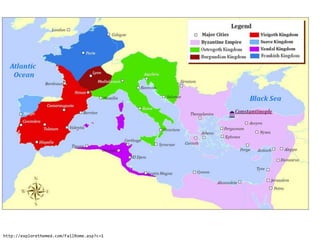
http://explorethemed.com/FallRome.asp?c=1
Confessions
Augustine

On blackboard in class
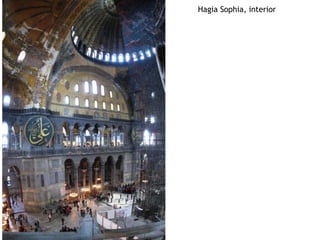
Hagia Sophia, Constantinople (Istanbul) [532 CE]
Hagia Sophia, interior
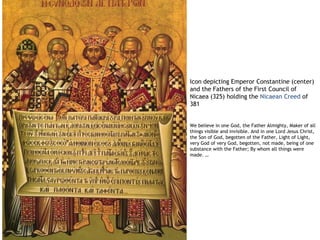
Icon depicting Emperor Constantine (center)
and the Fathers of the First Council of
Nicaea (325) holding the Nicaean Creed of
381


We believe in one God, the Father Almighty, Maker of all
things visible and invisible. And in one Lord Jesus Christ,
the Son of God, begotten of the Father, Light of Light,
very God of very God, begotten, not made, being of one
substance with the Father; By whom all things were
made. …
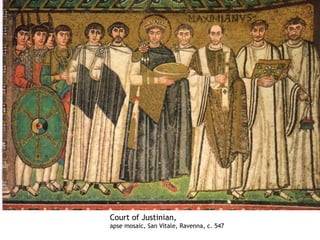
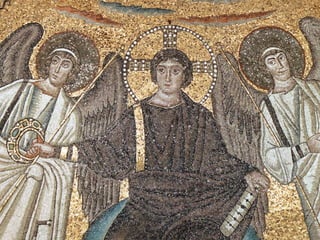
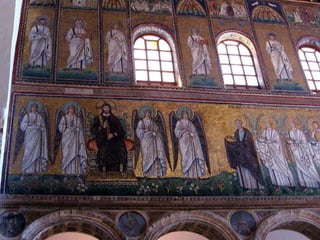
Court of Justinian,
apse mosaic, San Vitale, Ravenna, c. 547
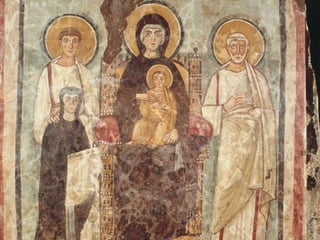
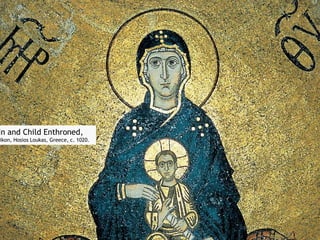
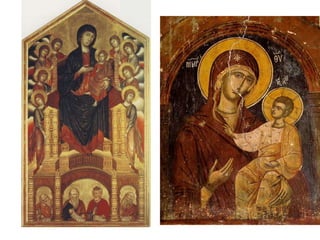
in and Child Enthroned,
ikon, Hosios Loukas, Greece, c. 1020.
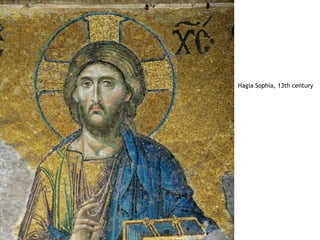
Hagia Sophia, 13th century
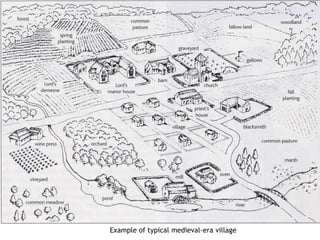
Example of typical medieval-era village
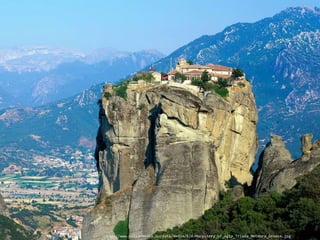
http://www.pulsarmedia.eu/data/media/920/Monastery_of_Agia_Triada_Meteora_Greece.jpg
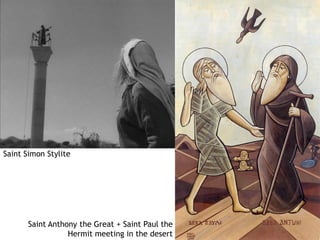
Saint Simon Stylite


       Saint Anthony the Great + Saint Paul the
                  Hermit meeting in the desert
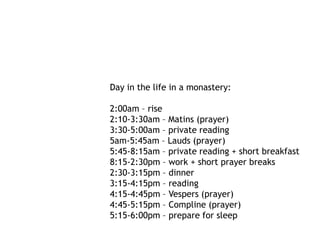
Day in the life in a monastery:

2:00am – rise
2:10-3:30am – Matins (prayer)
3:30-5:00am – private reading
5am-5:45am – Lauds (prayer)
5:45-8:15am – private reading + short breakfast
8:15-2:30pm – work + short prayer breaks
2:30-3:15pm – dinner
3:15-4:15pm – reading
4:15-4:45pm – Vespers (prayer)
4:45-5:15pm – Compline (prayer)
5:15-6:00pm – prepare for sleep
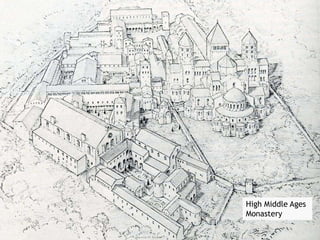
High Middle Ages
Monastery
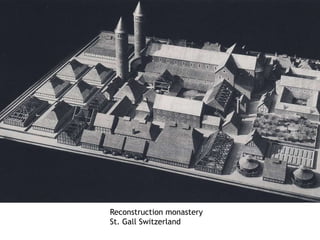
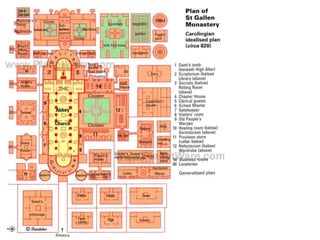
Reconstruction monastery
St. Gall Switzerland
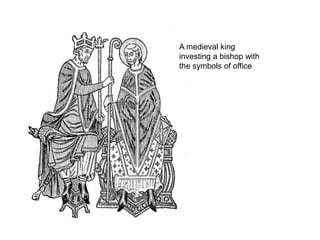
A medieval king
investing a bishop with
the symbols of office
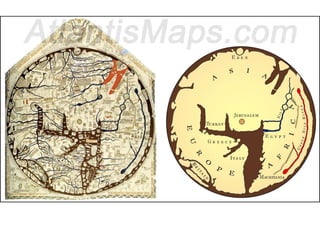
Medieval World View
At the center of medieval belief was the image of a perfect God and a
wretched and sinful human being.

God had given Adam and Eve freedom to choose; rebellious and
presumptuous, they had used their freedom to disobey God. In
doing so, they made evil an intrinsic part of the human personality.

With God’s grace they could overthrow their sinful nature and gain
salvation; without grace they were utterly damned.
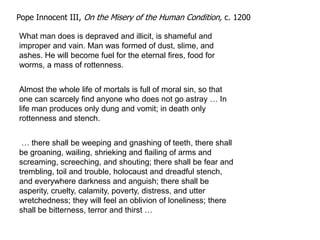
Pope Innocent III, On the Misery of the Human Condition, c. 1200

What man does is depraved and illicit, is shameful and
improper and vain. Man was formed of dust, slime, and
ashes. He will become fuel for the eternal fires, food for
worms, a mass of rottenness.


Almost the whole life of mortals is full of moral sin, so that
one can scarcely find anyone who does not go astray … In
life man produces only dung and vomit; in death only
rottenness and stench.


 … there shall be weeping and gnashing of teeth, there shall
be groaning, wailing, shrieking and flailing of arms and
screaming, screeching, and shouting; there shall be fear and
trembling, toil and trouble, holocaust and dreadful stench,
and everywhere darkness and anguish; there shall be
asperity, cruelty, calamity, poverty, distress, and utter
wretchedness; they will feel an oblivion of loneliness; there
shall be bitterness, terror and thirst …
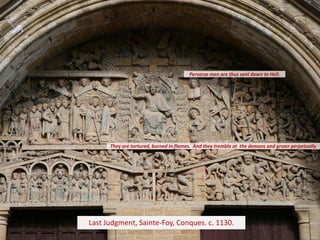
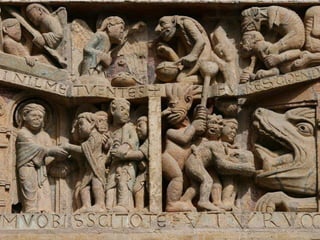
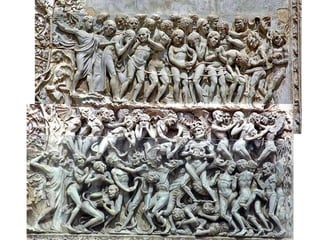
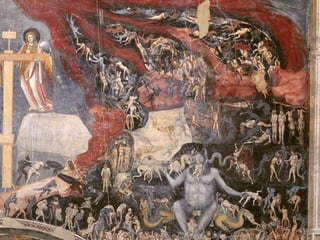
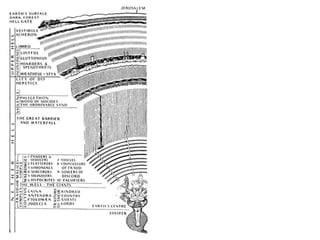
Perverse men are thus sent down to Hell.


      They are tortured, burned in flames. And they tremble at the demons and groan perpetually


Last Judgment, Sainte-Foy, Conques. c. 1130.
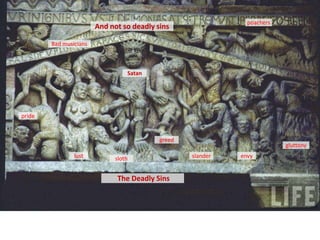
poachers
                        And not so deadly sins

        Bad musicians


                                 Satan


pride


                                           greed
                                                                          gluttony
                lust         sloth                 slander   envy


                              The Deadly Sins
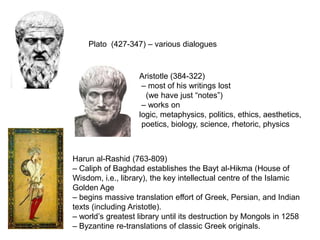
Plato (427-347) – various dialogues


                   Aristotle (384-322)
                    – most of his writings lost
                     (we have just “notes”)
                    – works on
                   logic, metaphysics, politics, ethics, aesthetics,
                    poetics, biology, science, rhetoric, physics


Harun al-Rashid (763-809)
– Caliph of Baghdad establishes the Bayt al-Hikma (House of
Wisdom, i.e., library), the key intellectual centre of the Islamic
Golden Age
– begins massive translation effort of Greek, Persian, and Indian
texts (including Aristotle).
– world’s greatest library until its destruction by Mongols in 1258
– Byzantine re-translations of classic Greek originals.
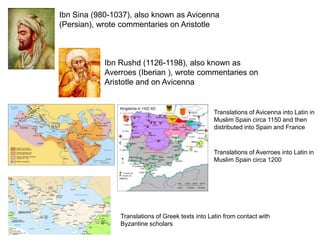
Ibn Sina (980-1037), also known as Avicenna
(Persian), wrote commentaries on Aristotle


            Ibn Rushd (1126-1198), also known as
            Averroes (Iberian ), wrote commentaries on
            Aristotle and on Avicenna


                                                   Translations of Avicenna into Latin in
                                                   Muslim Spain circa 1150 and then
                                                   distributed into Spain and France


                                                   Translations of Averroes into Latin in
                                                   Muslim Spain circa 1200


                Translations of Greek texts into Latin from contact with
                Byzantine scholars
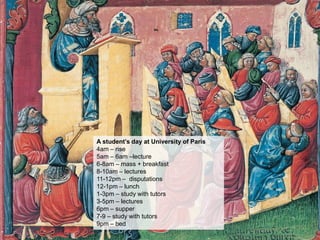
A student’s day at University of Paris
4am – rise
5am – 6am –lecture
6-8am – mass + breakfast
8-10am – lectures
11-12pm – disputations
12-1pm – lunch
1-3pm – study with tutors
3-5pm – lectures
6pm – supper
7-9 – study with tutors
9pm – bed
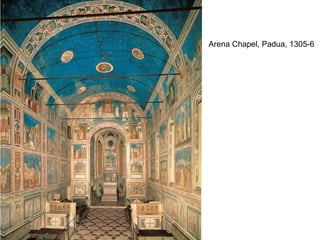
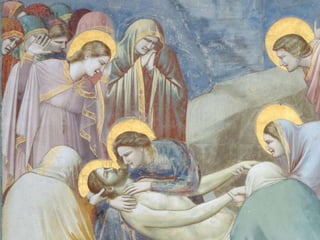
Arena Chapel, Padua, 1305-6
Leafless tree is
                                                                                                      traditional symbol of
                                                                                                      death; it sits on barren
                                                                                                      ridge that plunges
                                                                                                      towards dead Christ


                                                                         John the Evangelist
                                          Mary is also along the         arms echoes that of
                                          diagonal, reinforcing          angels; his sight is
                                          the emptiness of the           down the diagonal
                                          landscape


                                          Christ is at the bottom
                                          of a stark diagonal


                                                                    First artist since antiquity to
                                                                    show figures from behind; makes
                                                                    scene more realistic

Giotto, The Lamentation [1305-6, Arena Chapel, Padua], about 8’ x 8’
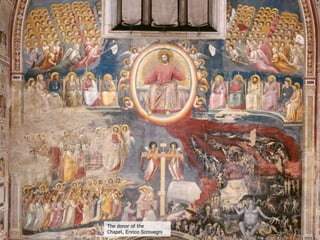
The donor of the
Chapel, Enrico Scrovegni
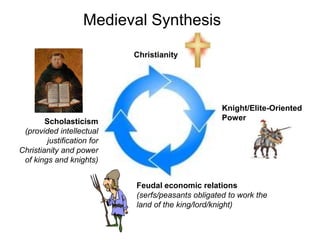
Medieval Synthesis

                             Christianity


                                                     Knight/Elite-Oriented
        Scholasticism                                Power
 (provided intellectual
         justification for
Christianity and power
 of kings and knights)


                             Feudal economic relations
                             (serfs/peasants obligated to work the
                             land of the king/lord/knight)
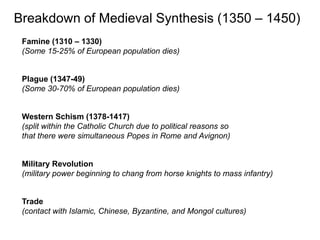
Breakdown of Medieval Synthesis (1350 – 1450)
 Famine (1310 – 1330)
 (Some 15-25% of European population dies)


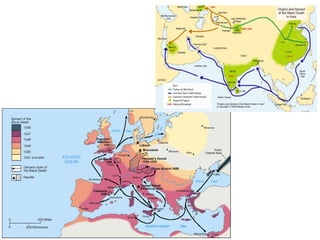
 Plague (1347-49)
 (Some 30-70% of European population dies)


 Western Schism (1378-1417)
 (split within the Catholic Church due to political reasons so
 that there were simultaneous Popes in Rome and Avignon)


 Military Revolution
 (military power beginning to chang from horse knights to mass infantry)


 Trade
 (contact with Islamic, Chinese, Byzantine, and Mongol cultures)
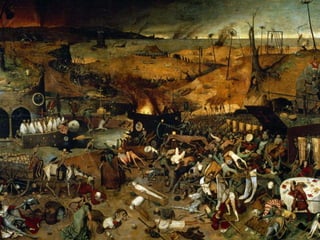
In the year of the Lord 1348 there was a very great pestilence in the
city and district of Florence. It was of such a fury and so tempestuous
that in houses in which it took hold previously healthy servants who
took care of the ill died of the same illness. Almost non of the ill
survived past the fourth day. Neither physicians nor medicines were
effective. Whether because these illnesses were previously unknown
or because physicians had not previously studied them, there seemed
to be no cure. There was such a fear that no one seemed to know
what to do. When it took hold in a house it often happened that no one
remained who had not died. And it was not just that men and women
died, but even sentient animals died. Dogs, cats, chickens, oxen,
donkeys, sheep showed the same symptoms and died of the same
disease. And almost none, or very few, who showed these symptoms,
were cured. … This pestilence began in March and ended in
September 1348.
                      Marchione di Coppo Stefani , Florentine Chronicle
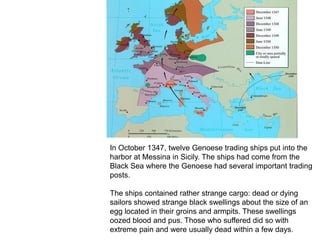
In October 1347, twelve Genoese trading ships put into the
harbor at Messina in Sicily. The ships had come from the
Black Sea where the Genoese had several important trading
posts.

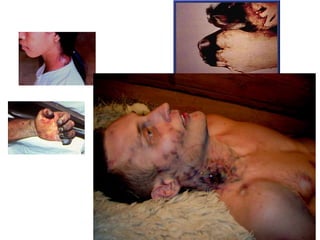
The ships contained rather strange cargo: dead or dying
sailors showed strange black swellings about the size of an
egg located in their groins and armpits. These swellings
oozed blood and pus. Those who suffered did so with
extreme pain and were usually dead within a few days.
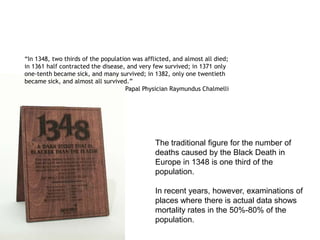
“In 1348, two thirds of the population was afflicted, and almost all died;
in 1361 half contracted the disease, and very few survived; in 1371 only
one-tenth became sick, and many survived; in 1382, only one twentieth
became sick, and almost all survived.”
                                    Papal Physician Raymundus Chalmelli


                                               The traditional figure for the number of
                                               deaths caused by the Black Death in
                                               Europe in 1348 is one third of the
                                               population.

                                               In recent years, however, examinations of
                                               places where there is actual data shows
                                               mortality rates in the 50%-80% of the
                                               population.
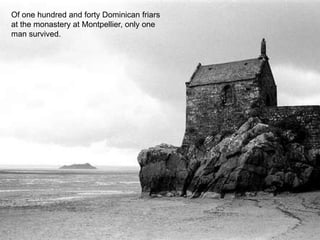
Of one hundred and forty Dominican friars
at the monastery at Montpellier, only one
man survived.
“By the year ad 1348, human iniquity and every manner
of sin so expanded over the earth that its fetor and noise
reached the just ears of the Almighty. Then His just wrath
fell …”.


Dies Irae
Day of wrath! O day of mourning!
See fulfilled the prophets' warning,
Heaven and earth in ashes burning!

Oh, what fear man's bosom rendeth,
when from heaven the Judge descendeth,
on whose sentence all dependeth.

Ah! that day of tears and mourning!
From the dust of earth returning
man for judgment must prepare him;
Spare, O God, in mercy spare him!
“I do not deny that we deserve these things and even
worse; but our ancestors also deserved them … why is
it that the violence of [God's] vengeance lies so
extraordinarily upon our times? … We have sinned as
much as anyone, but we alone are being punished.”


Nor, for all their number, were their obsequies honored by either tears
or lights or crowds of mourners rather, it was come to this, that a dead
man was then of no more account than a dead goat would be to-day.
                                             Boccaccio, The Decameron
Europe didn’t regain its
year 1300 population
level until about 1800.
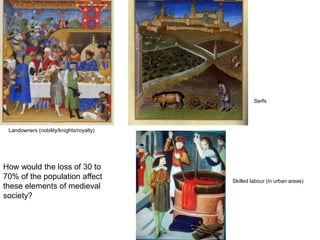
Serfs


 Landowners (nobility/knights/royalty)


How would the loss of 30 to
70% of the population affect             Skilled labour (in urban areas)
these elements of medieval
society?
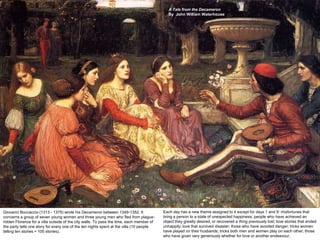
A Tale from the Decameron
                                                                                             By John William Waterhouse


Giovanni Boccaccio (1313 - 1375) wrote his Decameron between 1349-1352. It                Each day has a new theme assigned to it except for days 1 and 9: misfortunes that
concerns a group of seven young women and three young men who fled from plague-           bring a person to a state of unexpected happiness; people who have achieved an
ridden Florence for a villa outside of the city walls. To pass the time, each member of   object they greatly desired, or recovered a thing previously lost; love stories that ended
the party tells one story for every one of the ten nights spent at the villa (10 people   unhappily; love that survived disaster; those who have avoided danger; tricks women
telling ten stories = 100 stories).                                                       have played on their husbands; tricks both men and women play on each other; those
                                                                                          who have given very generously whether for love or another endeavour.

Introduction to Western Humanities - 6 - Medieval

  • 1.
    Lecture 6 MEDIEVAL INTRO TOWESTERN HUMANITIES
  • 2.
  • 3.
  • 4.
    Hagia Sophia, Constantinople(Istanbul) [532 CE]
  • 5.
  • 6.
    Icon depicting EmperorConstantine (center) and the Fathers of the First Council of Nicaea (325) holding the Nicaean Creed of 381 We believe in one God, the Father Almighty, Maker of all things visible and invisible. And in one Lord Jesus Christ, the Son of God, begotten of the Father, Light of Light, very God of very God, begotten, not made, being of one substance with the Father; By whom all things were made. …
  • 7.
    Court of Justinian, apsemosaic, San Vitale, Ravenna, c. 547
  • 11.
    in and ChildEnthroned, ikon, Hosios Loukas, Greece, c. 1020.
  • 12.
  • 15.
    Example of typicalmedieval-era village
  • 16.
  • 17.
    Saint Simon Stylite Saint Anthony the Great + Saint Paul the Hermit meeting in the desert
  • 18.
    Day in thelife in a monastery: 2:00am – rise 2:10-3:30am – Matins (prayer) 3:30-5:00am – private reading 5am-5:45am – Lauds (prayer) 5:45-8:15am – private reading + short breakfast 8:15-2:30pm – work + short prayer breaks 2:30-3:15pm – dinner 3:15-4:15pm – reading 4:15-4:45pm – Vespers (prayer) 4:45-5:15pm – Compline (prayer) 5:15-6:00pm – prepare for sleep
  • 19.
  • 20.
  • 32.
    A medieval king investinga bishop with the symbols of office
  • 36.
    Medieval World View Atthe center of medieval belief was the image of a perfect God and a wretched and sinful human being. God had given Adam and Eve freedom to choose; rebellious and presumptuous, they had used their freedom to disobey God. In doing so, they made evil an intrinsic part of the human personality. With God’s grace they could overthrow their sinful nature and gain salvation; without grace they were utterly damned.
  • 37.
    Pope Innocent III,On the Misery of the Human Condition, c. 1200 What man does is depraved and illicit, is shameful and improper and vain. Man was formed of dust, slime, and ashes. He will become fuel for the eternal fires, food for worms, a mass of rottenness. Almost the whole life of mortals is full of moral sin, so that one can scarcely find anyone who does not go astray … In life man produces only dung and vomit; in death only rottenness and stench. … there shall be weeping and gnashing of teeth, there shall be groaning, wailing, shrieking and flailing of arms and screaming, screeching, and shouting; there shall be fear and trembling, toil and trouble, holocaust and dreadful stench, and everywhere darkness and anguish; there shall be asperity, cruelty, calamity, poverty, distress, and utter wretchedness; they will feel an oblivion of loneliness; there shall be bitterness, terror and thirst …
  • 38.
    Perverse men arethus sent down to Hell. They are tortured, burned in flames. And they tremble at the demons and groan perpetually Last Judgment, Sainte-Foy, Conques. c. 1130.
  • 40.
    poachers And not so deadly sins Bad musicians Satan pride greed gluttony lust sloth slander envy The Deadly Sins
  • 45.
    Plato (427-347) –various dialogues Aristotle (384-322) – most of his writings lost (we have just “notes”) – works on logic, metaphysics, politics, ethics, aesthetics, poetics, biology, science, rhetoric, physics Harun al-Rashid (763-809) – Caliph of Baghdad establishes the Bayt al-Hikma (House of Wisdom, i.e., library), the key intellectual centre of the Islamic Golden Age – begins massive translation effort of Greek, Persian, and Indian texts (including Aristotle). – world’s greatest library until its destruction by Mongols in 1258 – Byzantine re-translations of classic Greek originals.
  • 46.
    Ibn Sina (980-1037),also known as Avicenna (Persian), wrote commentaries on Aristotle Ibn Rushd (1126-1198), also known as Averroes (Iberian ), wrote commentaries on Aristotle and on Avicenna Translations of Avicenna into Latin in Muslim Spain circa 1150 and then distributed into Spain and France Translations of Averroes into Latin in Muslim Spain circa 1200 Translations of Greek texts into Latin from contact with Byzantine scholars
  • 48.
    A student’s dayat University of Paris 4am – rise 5am – 6am –lecture 6-8am – mass + breakfast 8-10am – lectures 11-12pm – disputations 12-1pm – lunch 1-3pm – study with tutors 3-5pm – lectures 6pm – supper 7-9 – study with tutors 9pm – bed
  • 60.
  • 61.
    Leafless tree is traditional symbol of death; it sits on barren ridge that plunges towards dead Christ John the Evangelist Mary is also along the arms echoes that of diagonal, reinforcing angels; his sight is the emptiness of the down the diagonal landscape Christ is at the bottom of a stark diagonal First artist since antiquity to show figures from behind; makes scene more realistic Giotto, The Lamentation [1305-6, Arena Chapel, Padua], about 8’ x 8’
  • 64.
    The donor ofthe Chapel, Enrico Scrovegni
  • 67.
    Medieval Synthesis Christianity Knight/Elite-Oriented Scholasticism Power (provided intellectual justification for Christianity and power of kings and knights) Feudal economic relations (serfs/peasants obligated to work the land of the king/lord/knight)
  • 68.
    Breakdown of MedievalSynthesis (1350 – 1450) Famine (1310 – 1330) (Some 15-25% of European population dies) Plague (1347-49) (Some 30-70% of European population dies) Western Schism (1378-1417) (split within the Catholic Church due to political reasons so that there were simultaneous Popes in Rome and Avignon) Military Revolution (military power beginning to chang from horse knights to mass infantry) Trade (contact with Islamic, Chinese, Byzantine, and Mongol cultures)
  • 69.
    In the yearof the Lord 1348 there was a very great pestilence in the city and district of Florence. It was of such a fury and so tempestuous that in houses in which it took hold previously healthy servants who took care of the ill died of the same illness. Almost non of the ill survived past the fourth day. Neither physicians nor medicines were effective. Whether because these illnesses were previously unknown or because physicians had not previously studied them, there seemed to be no cure. There was such a fear that no one seemed to know what to do. When it took hold in a house it often happened that no one remained who had not died. And it was not just that men and women died, but even sentient animals died. Dogs, cats, chickens, oxen, donkeys, sheep showed the same symptoms and died of the same disease. And almost none, or very few, who showed these symptoms, were cured. … This pestilence began in March and ended in September 1348. Marchione di Coppo Stefani , Florentine Chronicle
  • 70.
    In October 1347,twelve Genoese trading ships put into the harbor at Messina in Sicily. The ships had come from the Black Sea where the Genoese had several important trading posts. The ships contained rather strange cargo: dead or dying sailors showed strange black swellings about the size of an egg located in their groins and armpits. These swellings oozed blood and pus. Those who suffered did so with extreme pain and were usually dead within a few days.
  • 72.
    “In 1348, twothirds of the population was afflicted, and almost all died; in 1361 half contracted the disease, and very few survived; in 1371 only one-tenth became sick, and many survived; in 1382, only one twentieth became sick, and almost all survived.” Papal Physician Raymundus Chalmelli The traditional figure for the number of deaths caused by the Black Death in Europe in 1348 is one third of the population. In recent years, however, examinations of places where there is actual data shows mortality rates in the 50%-80% of the population.
  • 74.
    Of one hundredand forty Dominican friars at the monastery at Montpellier, only one man survived.
  • 77.
    “By the yearad 1348, human iniquity and every manner of sin so expanded over the earth that its fetor and noise reached the just ears of the Almighty. Then His just wrath fell …”. Dies Irae Day of wrath! O day of mourning! See fulfilled the prophets' warning, Heaven and earth in ashes burning! Oh, what fear man's bosom rendeth, when from heaven the Judge descendeth, on whose sentence all dependeth. Ah! that day of tears and mourning! From the dust of earth returning man for judgment must prepare him; Spare, O God, in mercy spare him!
  • 80.
    “I do notdeny that we deserve these things and even worse; but our ancestors also deserved them … why is it that the violence of [God's] vengeance lies so extraordinarily upon our times? … We have sinned as much as anyone, but we alone are being punished.” Nor, for all their number, were their obsequies honored by either tears or lights or crowds of mourners rather, it was come to this, that a dead man was then of no more account than a dead goat would be to-day. Boccaccio, The Decameron
  • 81.
    Europe didn’t regainits year 1300 population level until about 1800.
  • 82.
    Serfs Landowners (nobility/knights/royalty) Howwould the loss of 30 to 70% of the population affect Skilled labour (in urban areas) these elements of medieval society?
  • 83.
    A Tale fromthe Decameron By John William Waterhouse Giovanni Boccaccio (1313 - 1375) wrote his Decameron between 1349-1352. It Each day has a new theme assigned to it except for days 1 and 9: misfortunes that concerns a group of seven young women and three young men who fled from plague- bring a person to a state of unexpected happiness; people who have achieved an ridden Florence for a villa outside of the city walls. To pass the time, each member of object they greatly desired, or recovered a thing previously lost; love stories that ended the party tells one story for every one of the ten nights spent at the villa (10 people unhappily; love that survived disaster; those who have avoided danger; tricks women telling ten stories = 100 stories). have played on their husbands; tricks both men and women play on each other; those who have given very generously whether for love or another endeavour.