ABOUT
THE PAPER
This paper updates the findings of a multi-
year study that is surveying major and non-
major students’ understanding of the different
computing disciplines.
GET STARTED
MOTIVATION
Do computing students have
an understanding of the
ACM computing disciplinary
identities and boundaries
and to what degree does
student understanding mirror
the official ones defined by
the ACM.
Courte, J. and Bishop-Clark, C. 2009. Do students
differentiate between computing disciplines?. In
Proceedings of SIGCSE '09.
2009
Uzoka, F-M., Connolly, R., Schroeder, M, Khemka, N,
and Miller, J. (2013). Computing is not a rock
band: student understanding of the computing
disciplines. In Proceedings of SIGITE '13.
2013
BACKGROUND
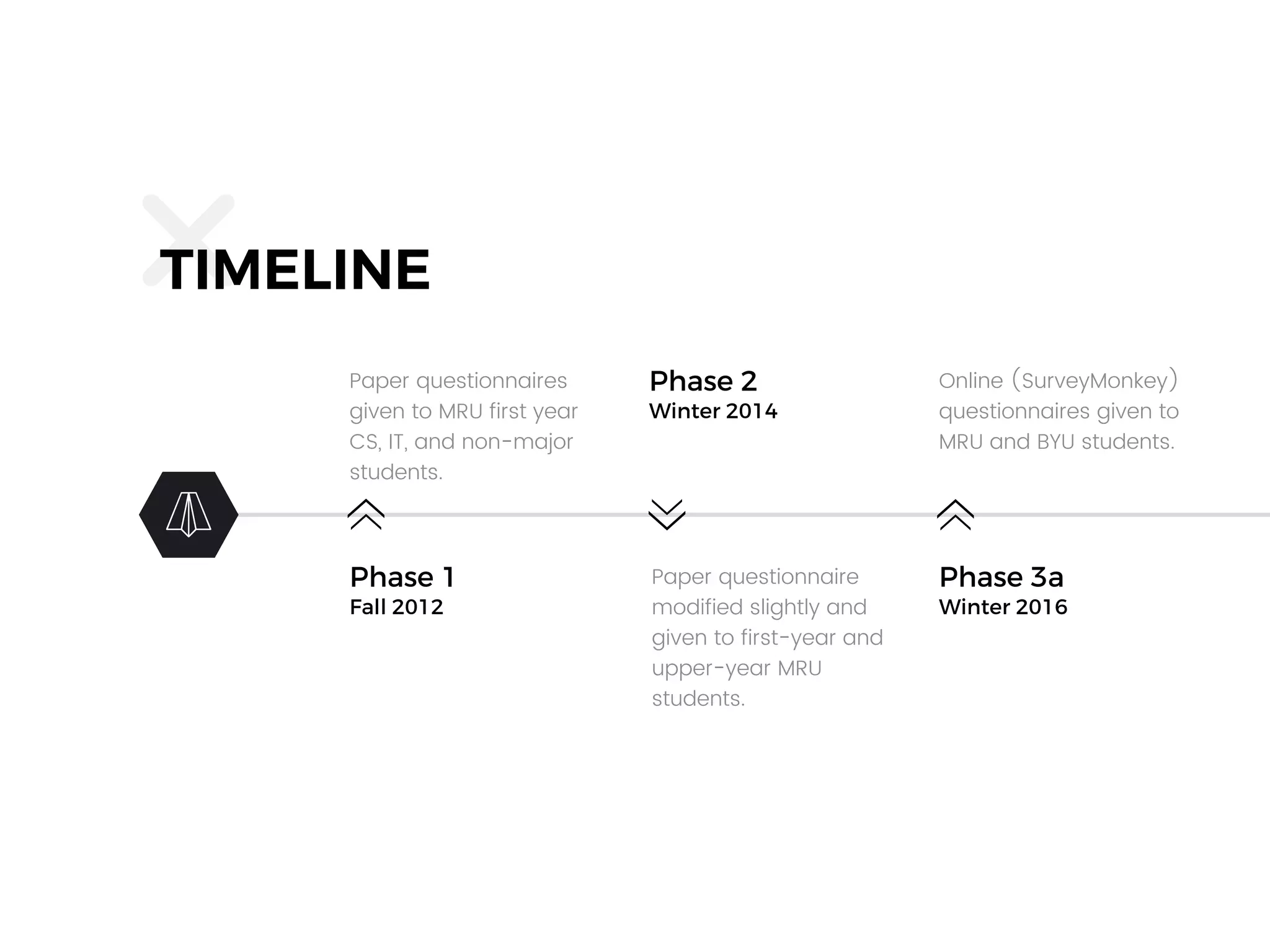
Phase 1
Fall 2012
Paper questionnaires
given to MRU first year
CS, IT, and non-major
students.
Phase 3a
Winter 2016
Online (SurveyMonkey)
questionnaires given to
MRU and BYU students.
Phase 2
Winter 2014
Paper questionnaire
modified slightly and
given to first-year and
upper-year MRU
students.
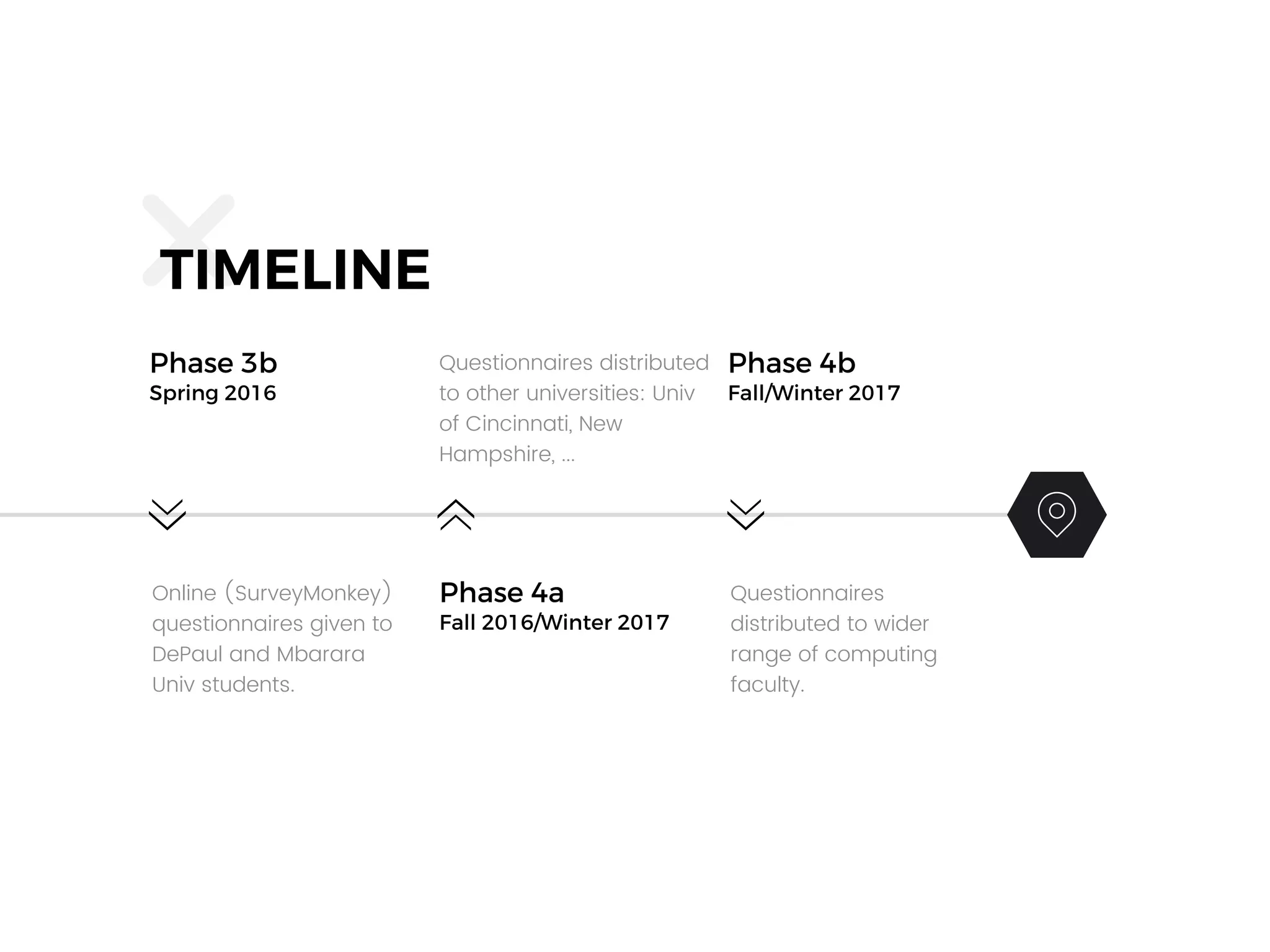
TIMELINE
Phase 4a
Fall 2016/Winter 2017
Questionnaires distributed
to other universities: Univ
of Cincinnati, New
Hampshire, ...
Phase 3b
Spring 2016
Online (SurveyMonkey)
questionnaires given to
DePaul and Mbarara
Univ students.
Phase 4b
Fall/Winter 2017
Questionnaires
distributed to wider
range of computing
faculty.
TIMELINE
RANDY CONNOLLY
Mount Royal University
Mathematics & Computing
OUR TEAM
JANET MILLER
Mount Royal University
Counselling
MICHAEL UZOKA
Mount Royal University
Mathematics & Computing
MARC SCHROEDER
Mount Royal University
Mathematics & Computing
BARRY LUNT
Brigham Young
University
CRAIG MILLER
DePaul University
ANABELLA
HABINKA
Mbarara University
????
Anywhere
DEGREE OF FIT OLD AND NEW QUESTIONS FACULTY RESPONSES
METHODOLOGY
ORIGINAL STUDY [2009]
In the original C&BC study, students
were given 15 task descriptions and
for each task they had to indicate
which of the five disciplines was the
best fit for that task.
OUR STUDY
To address that drawback, our study
allowed the participants to choose
how much each task fit with each of
the five disciplines.
X
X
X
XX
DEGREE OF FIT
Our questionnaire had
demographic-related questions
and then 31 discipline/task
questions.
SO WE DID
FACULTY
RESPONSES
We determined best fit by having
faculty (n=13) from four universities
(and four different computing
disciplines) fill in the same survey as
the students.
We then used their responses to
construct the disciplinary best fits.
RESULTS
After filtering out uncompleted
surveys, our analysis was able
to use 668 completed North
American surveys.
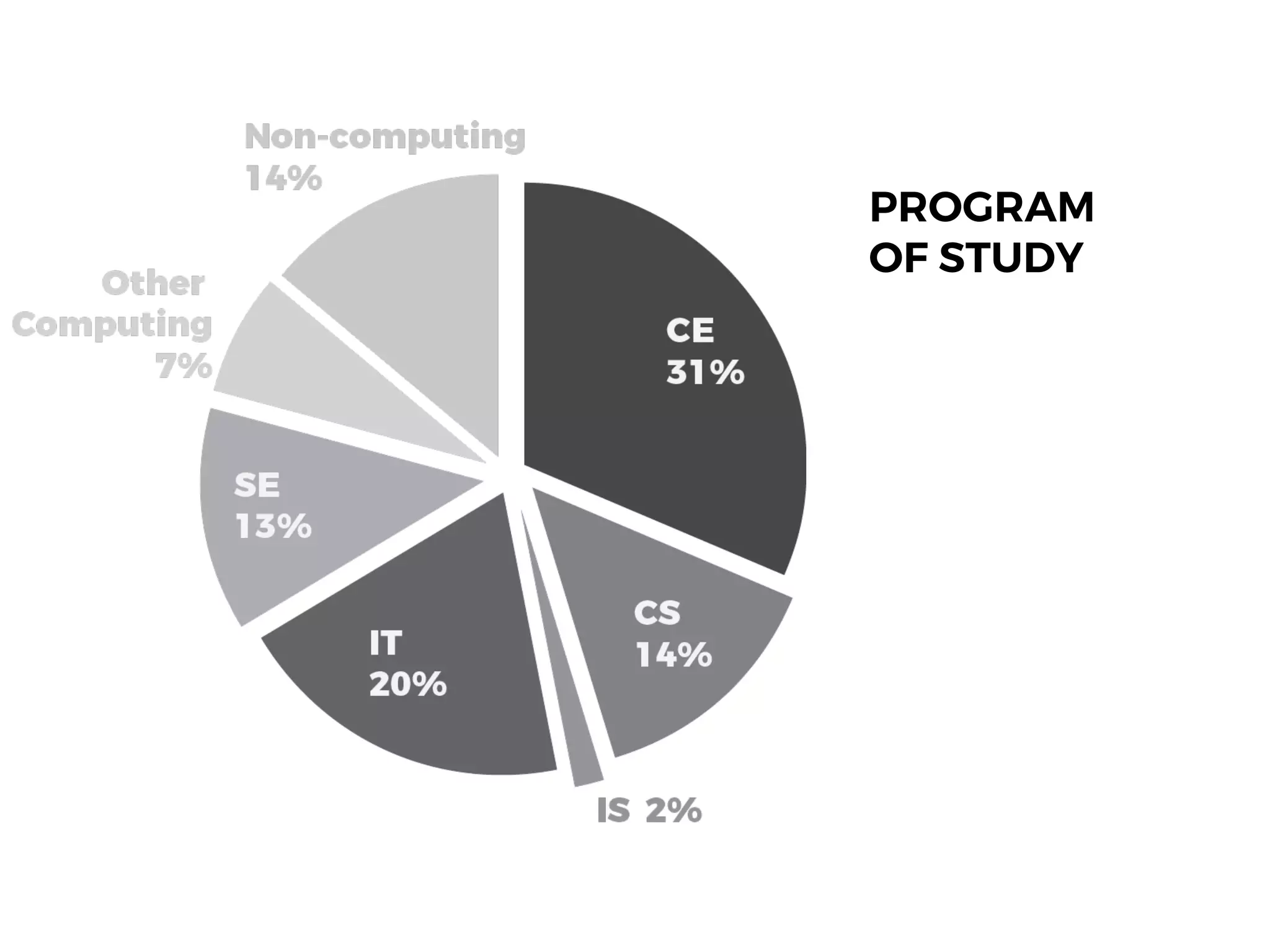
PROGRAM
OF STUDY
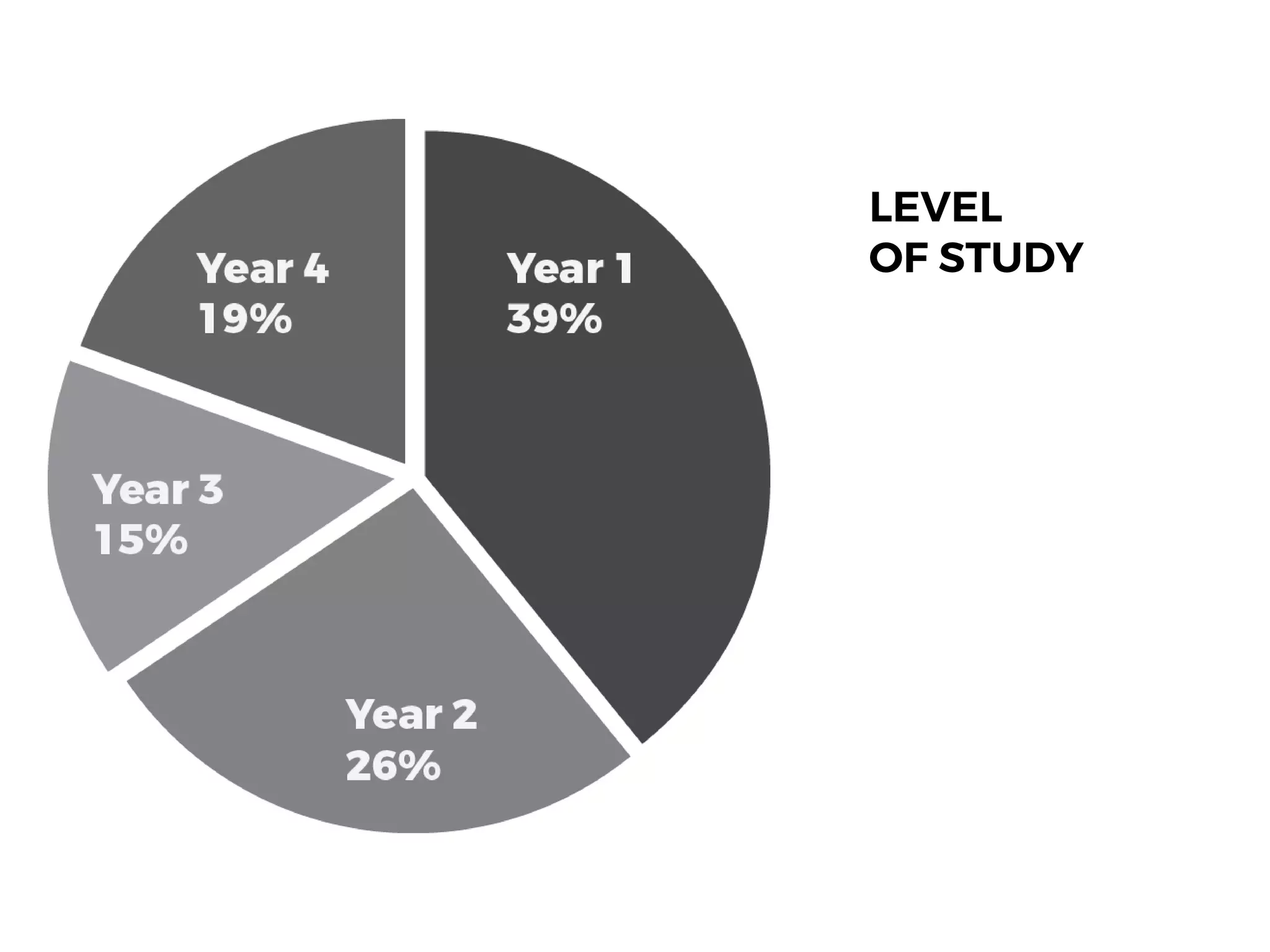
LEVEL
OF STUDY
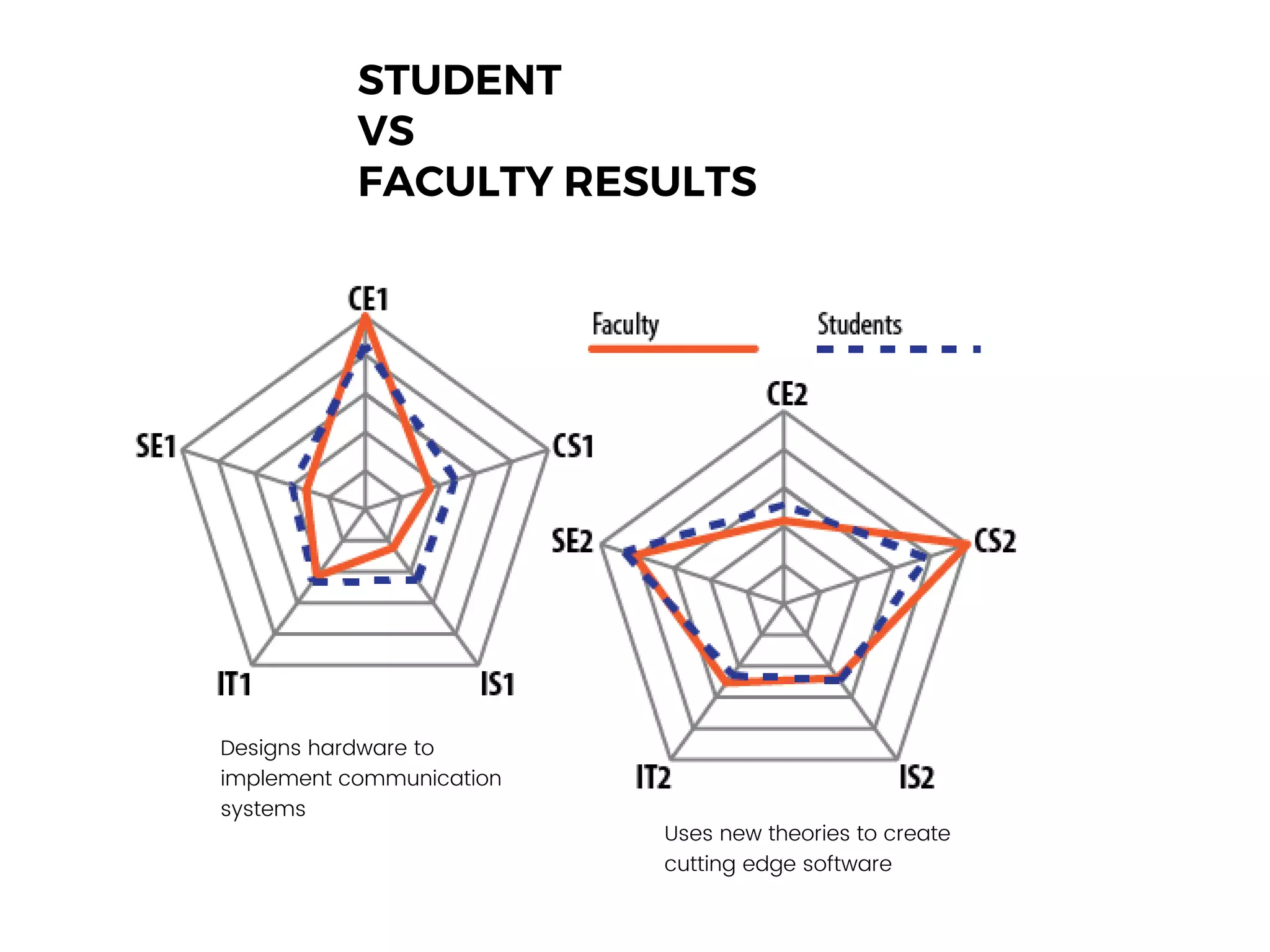
STUDENT
VS
FACULTY RESULTS
Designs hardware to
implement communication
systems
Uses new theories to create
cutting edge software
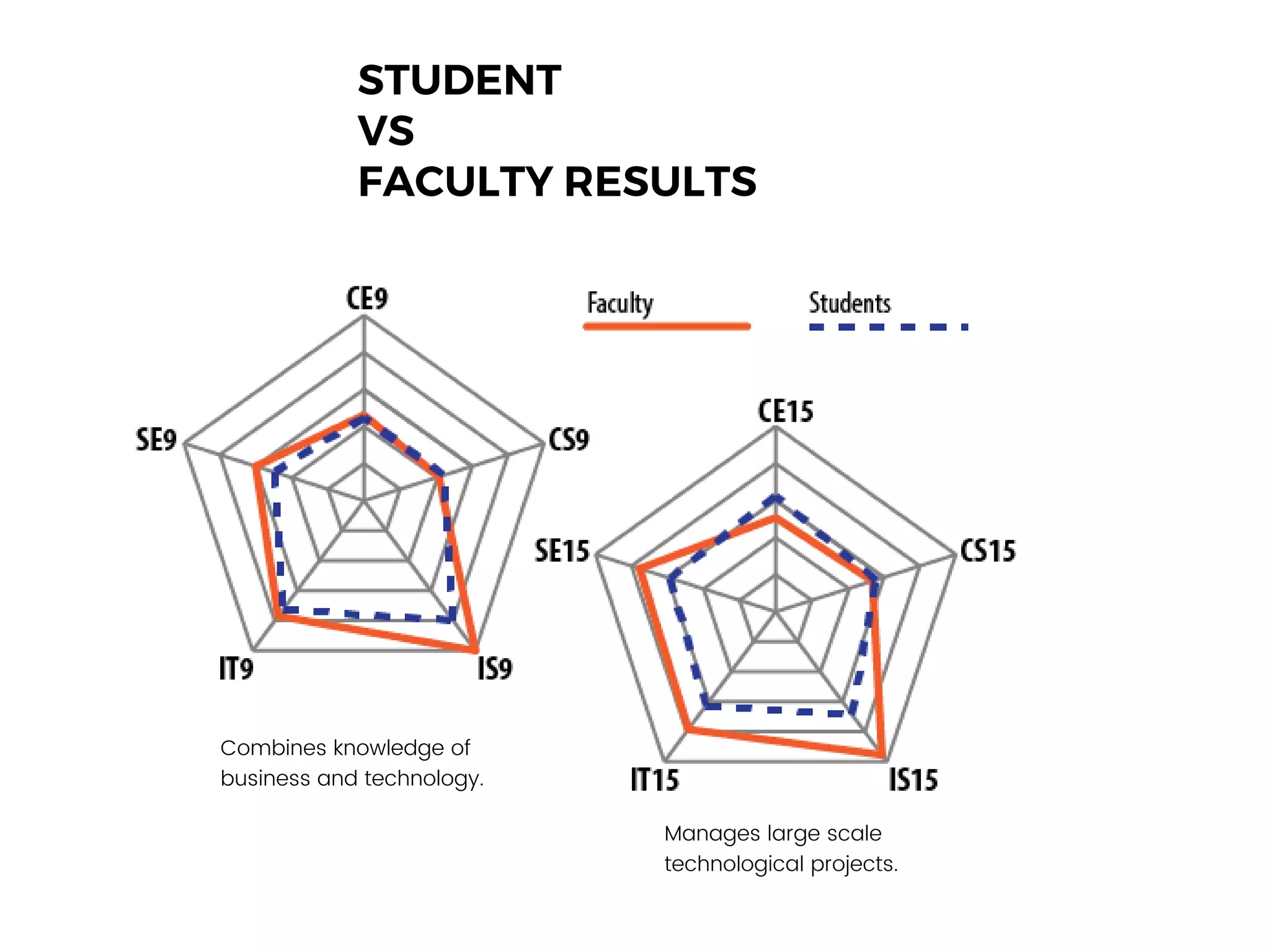
STUDENT
VS
FACULTY RESULTS
Combines knowledge of
business and technology.
Manages large scale
technological projects.
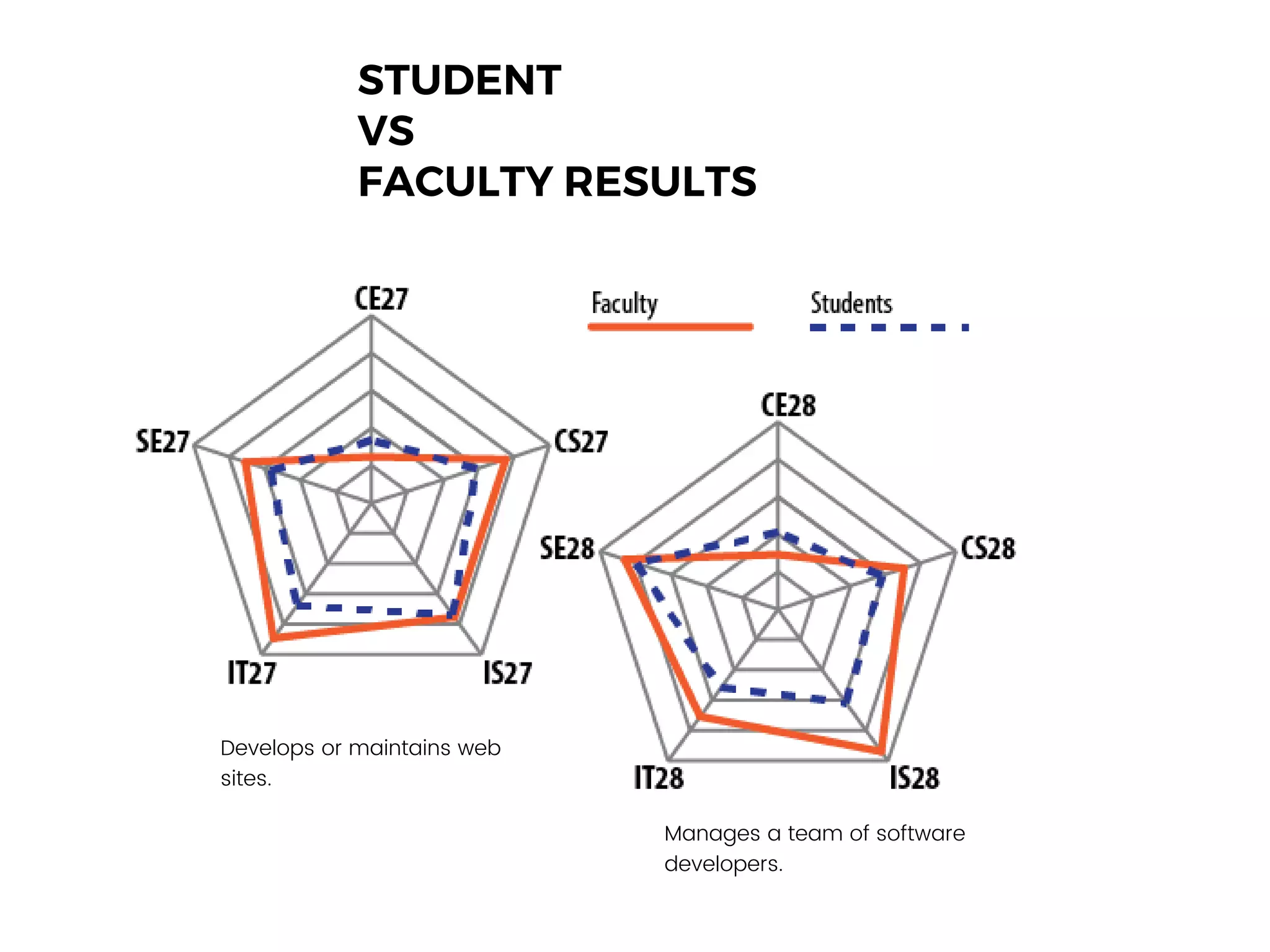
STUDENT
VS
FACULTY RESULTS
Develops or maintains web
sites.
Manages a team of software
developers.
RANK ORDER
ANALYSIS
This analysis method is
especially well suited for
interval data lacking
objective measures of
correctness.
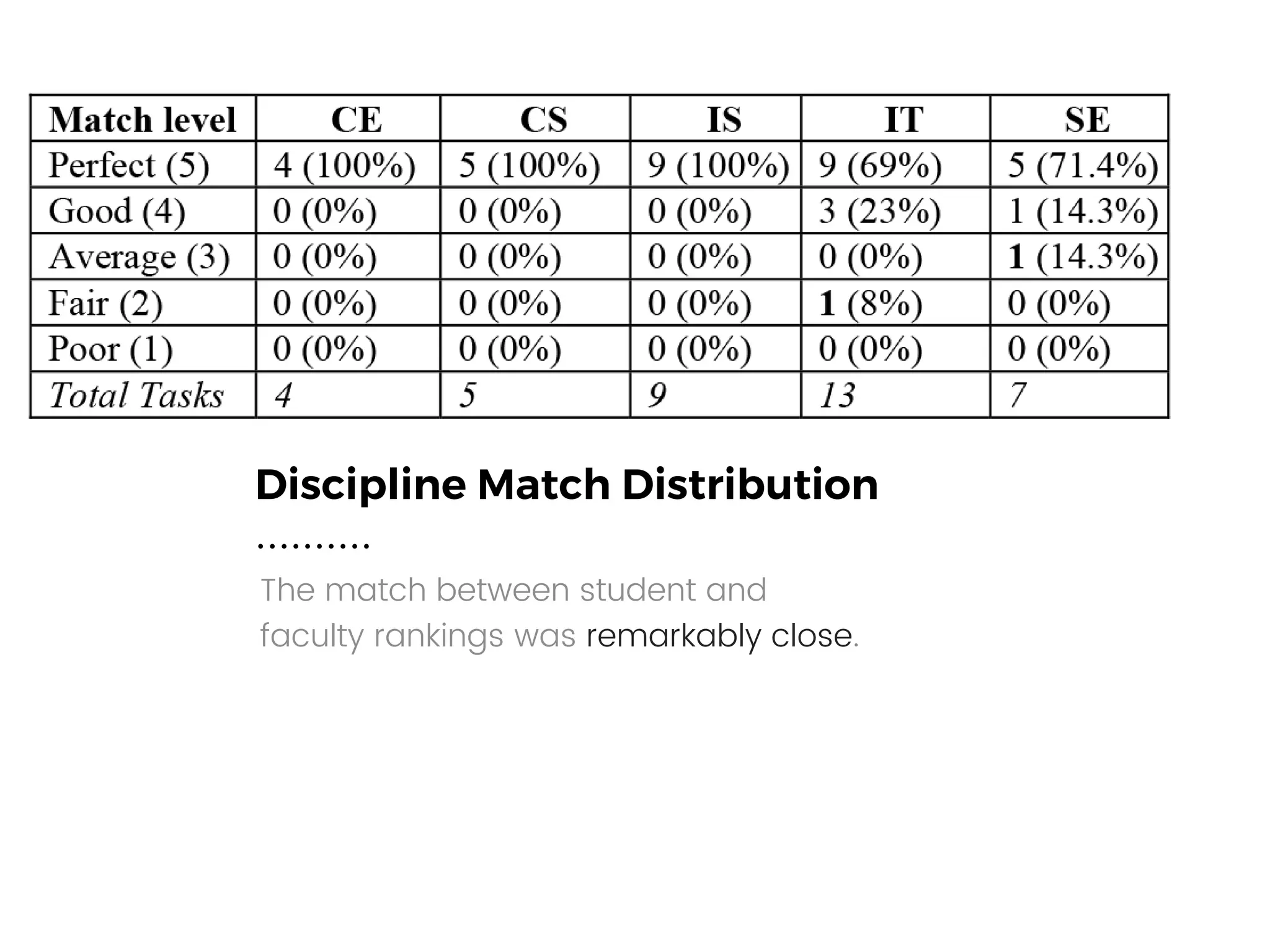
Discipline Match Distribution
The match between student and
faculty rankings was remarkably close.
PROGRAM
AND
DISCIPLINE
DIFFERENCES
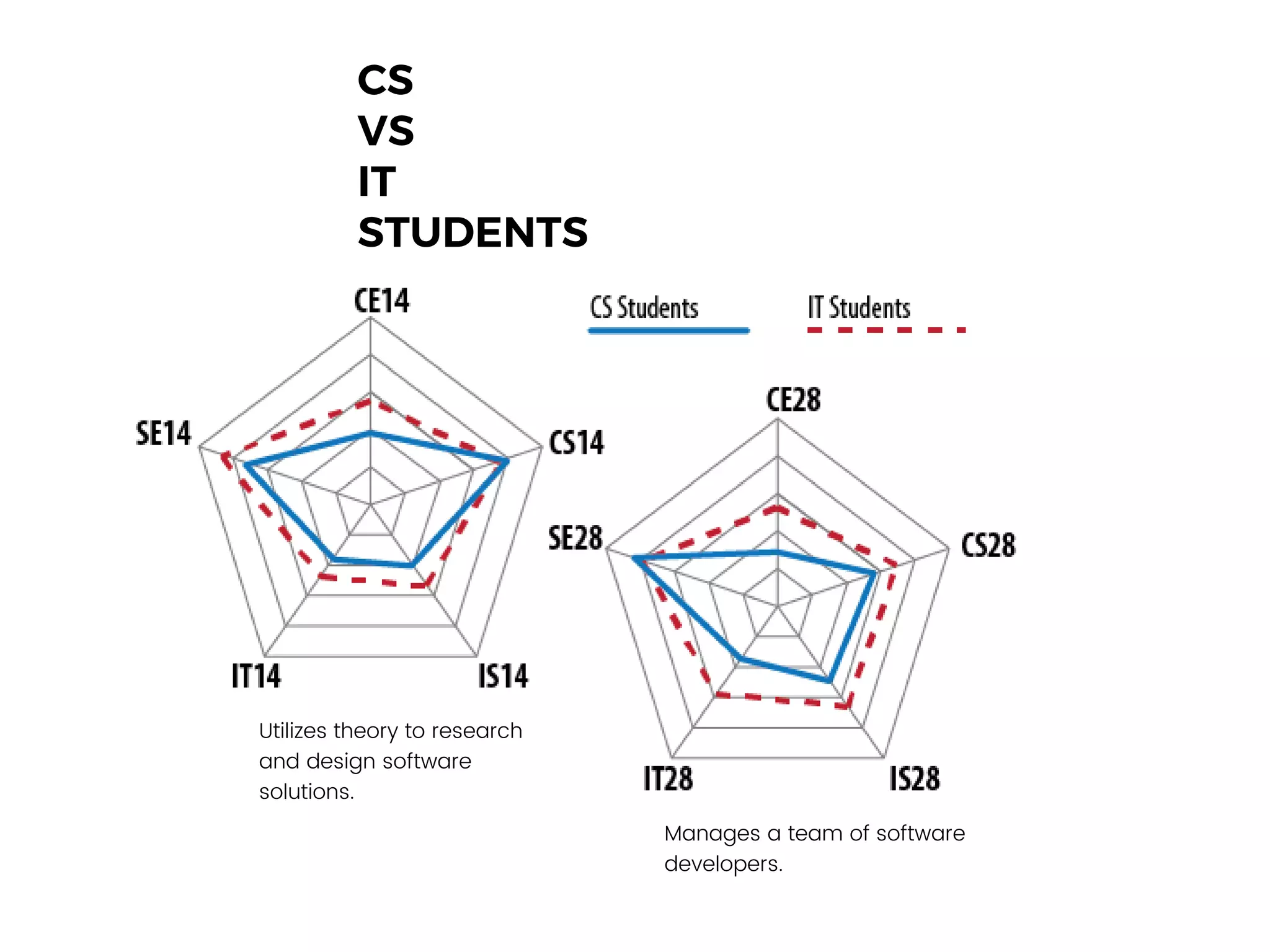
CS vs IT STUDENTS
Examining our one-way ANOVA analyses of the role
that the students’ program of study had on their
task scores, we discovered that one of the biggest
differences was that between CS and IT students.
CS
VS
IT
STUDENTS
Utilizes theory to research
and design software
solutions.
Manages a team of software
developers.
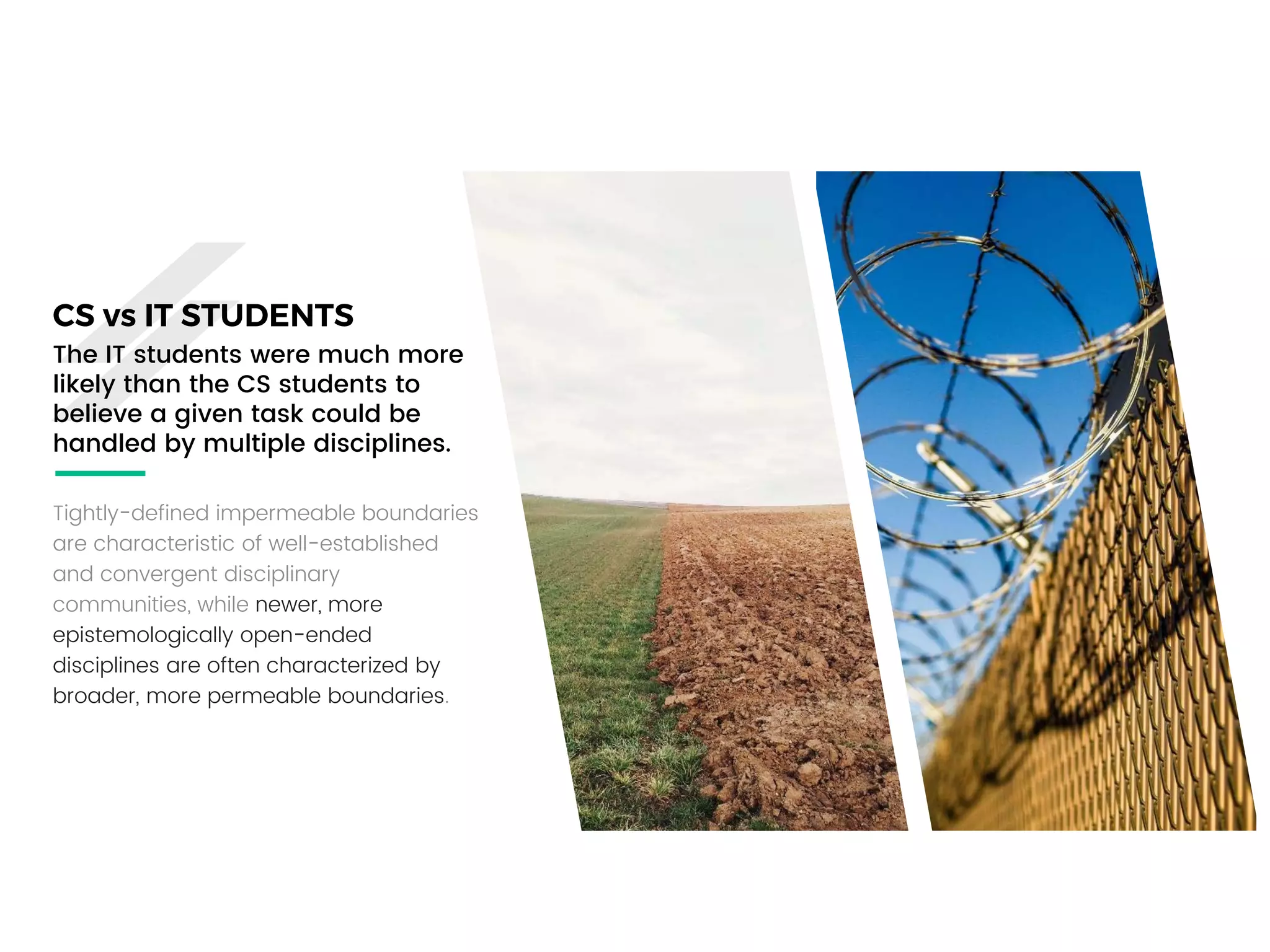
CS vs IT STUDENTS
Tightly-defined impermeable boundaries
are characteristic of well-established
and convergent disciplinary
communities, while newer, more
epistemologically open-ended
disciplines are often characterized by
broader, more permeable boundaries.
The IT students were much more
likely than the CS students to
believe a given task could be
handled by multiple disciplines.
DISCIPLINARY
CLUSTERS
The 31 questions were grouped into five
categories representing best-fits with
each of the computing disciplines.
Cluster scores were then calculated for
each student participant by adding
together the target discipline rating for
each question assigned to this cluster.
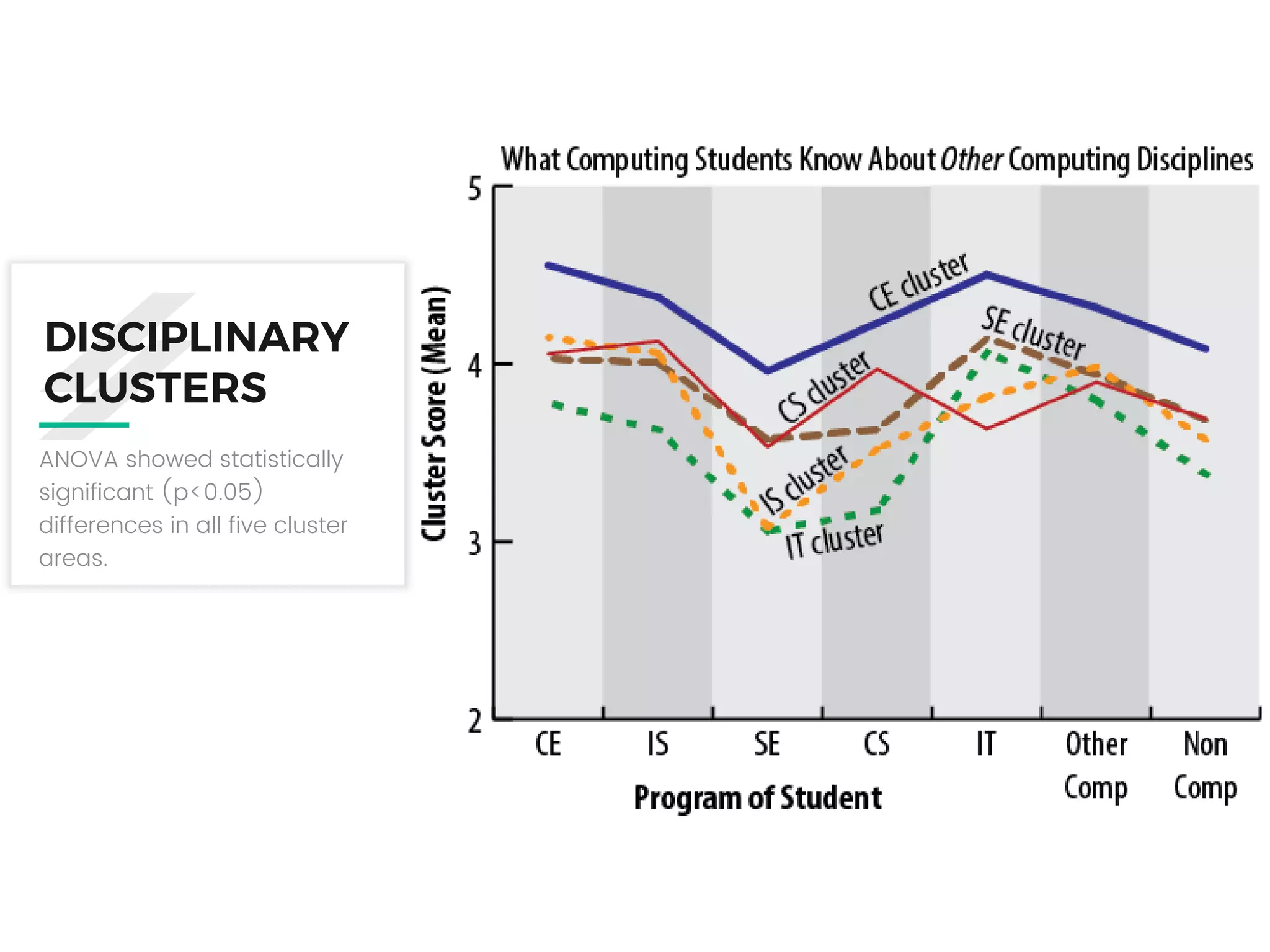
DISCIPLINARY
CLUSTERS
ANOVA showed statistically
significant (p<0.05)
differences in all five cluster
areas.
CLUSTER
ACCURACY
An average of all discipline cluster scores
yielded a total accuracy score, and again
significant differences among students
from the various programs was found,
F (6, 350) = 6.178, p = 0.00.
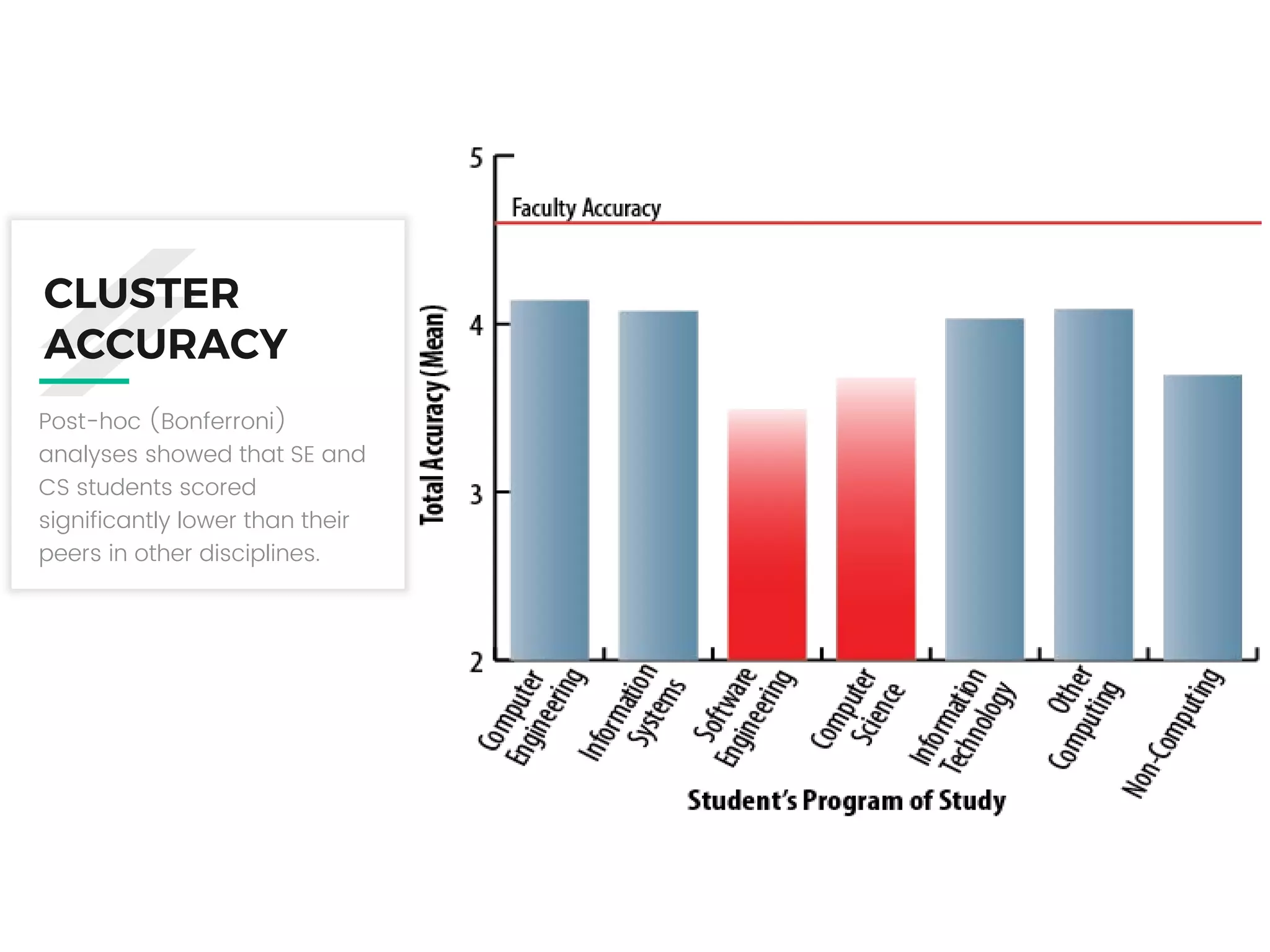
CLUSTER
ACCURACY
Post-hoc (Bonferroni)
analyses showed that SE and
CS students scored
significantly lower than their
peers in other disciplines.
DISCIPLINARITY ACM FRAMEWORK COUNSELLING
DISCUSSION
DISCIPLINARY FIT
By allowing students to specify a
degree of disciplinary fit, our study
showed that by and large
students are able to get their
discipline matches surprisingly
close.
DISCIPLINARY FIT
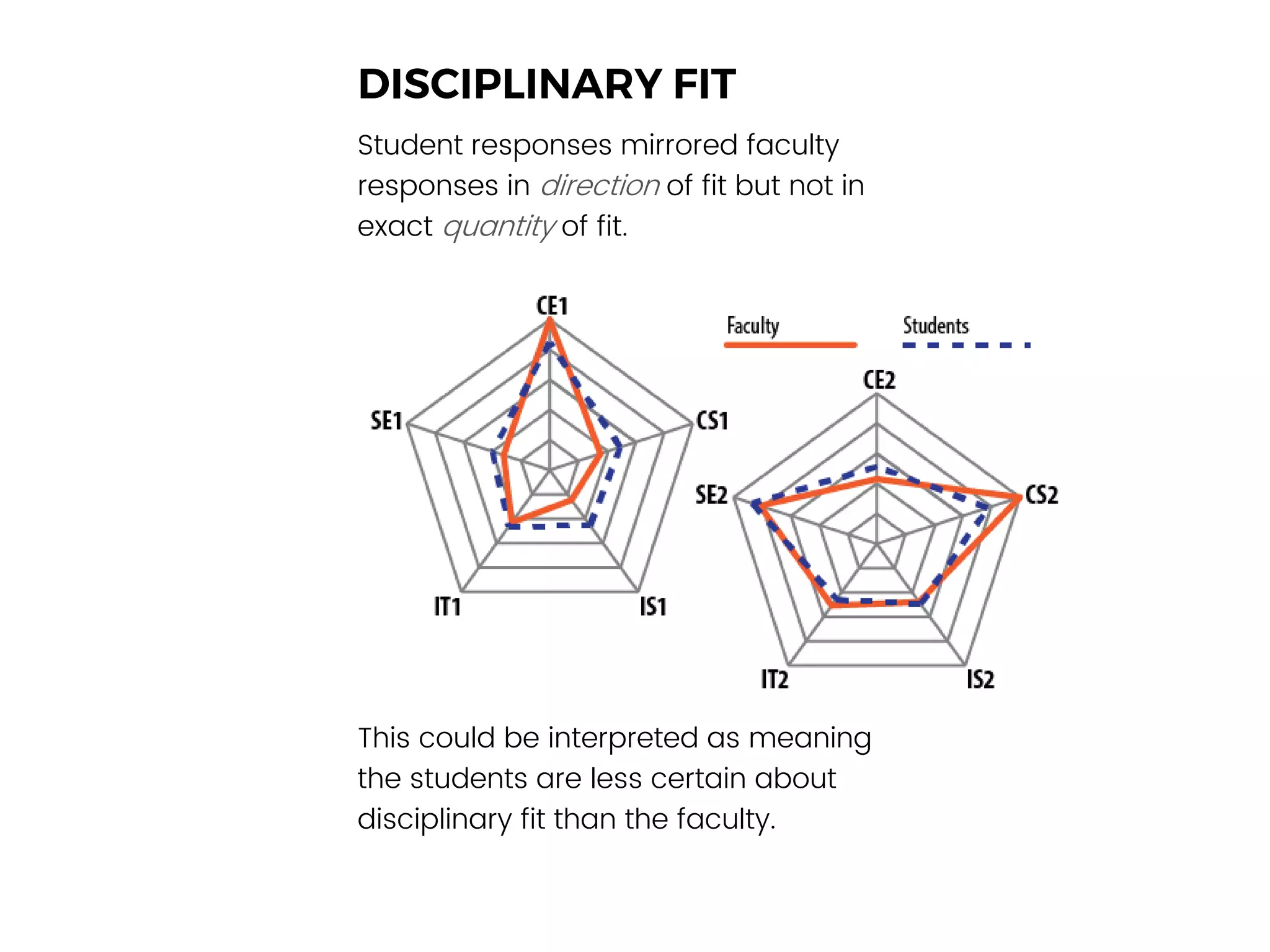
Student responses mirrored faculty
responses in direction of fit but not in
exact quantity of fit.
This could be interpreted as meaning
the students are less certain about
disciplinary fit than the faculty.
Perhaps students are actually
more cognizant than faculty of
the uncertain fit between the
different computing disciplines
and real-world computing tasks
and thus see disciplinary
boundaries as being permeable.
STUDENTS
University faculty live and
breathe disciplinary silos, so it is
natural that they would see
disciplinary fit in a more extreme
manner than students.
FACULTY
Some [academic] borders are so strongly defended
as to be virtually impenetrable; others are weakly
guarded and open to incoming and outgoing traffic:
but in general a considerable amount of poaching
goes on across all disciplines
Becher, T. and Trowler, P. R. (2001). Academic tribes and territories, Second Edition.
ACM FRAMEWORK
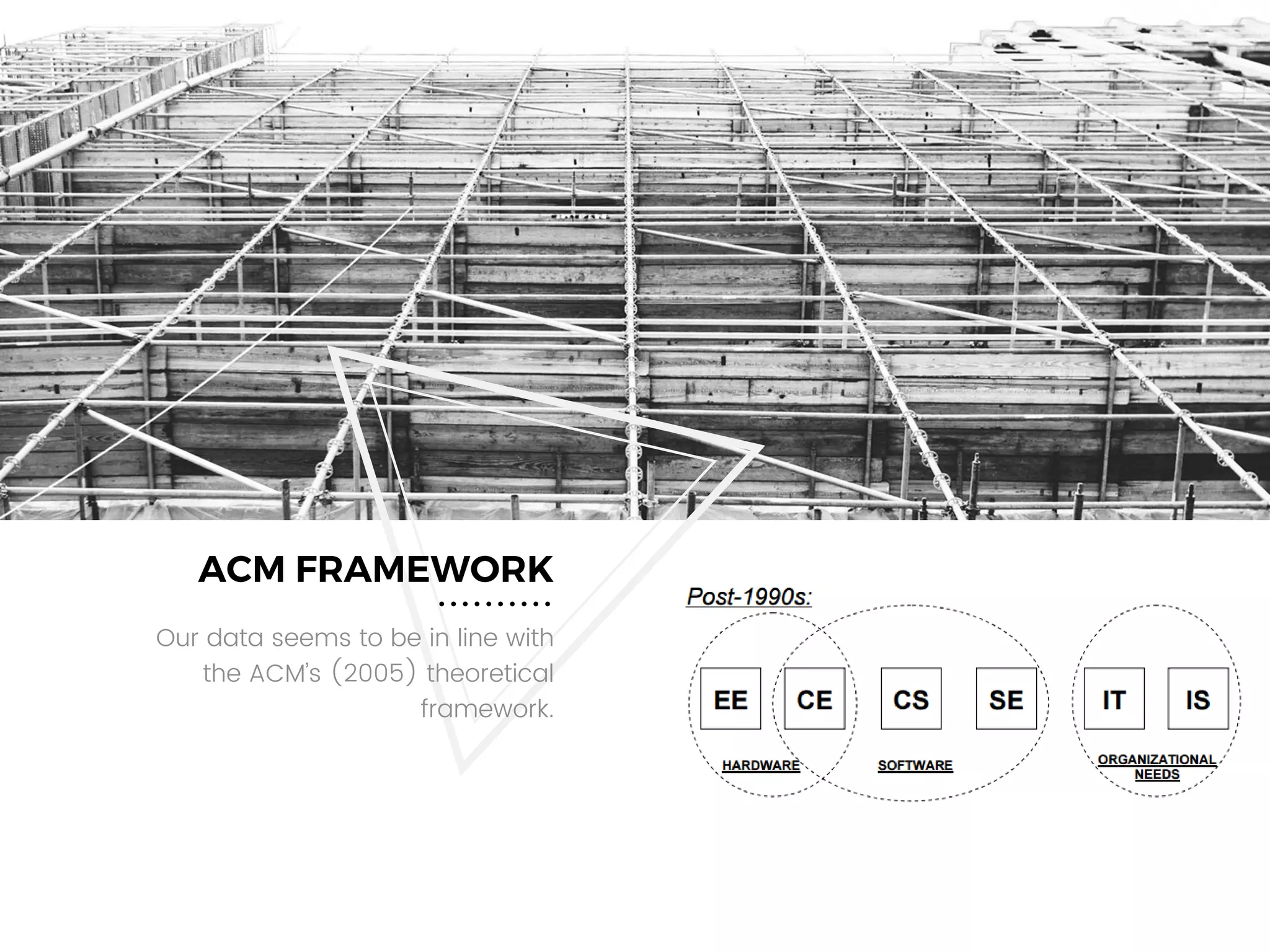
Our data seems to be in line with
the ACM’s (2005) theoretical
framework.
ACM FRAMEWORK
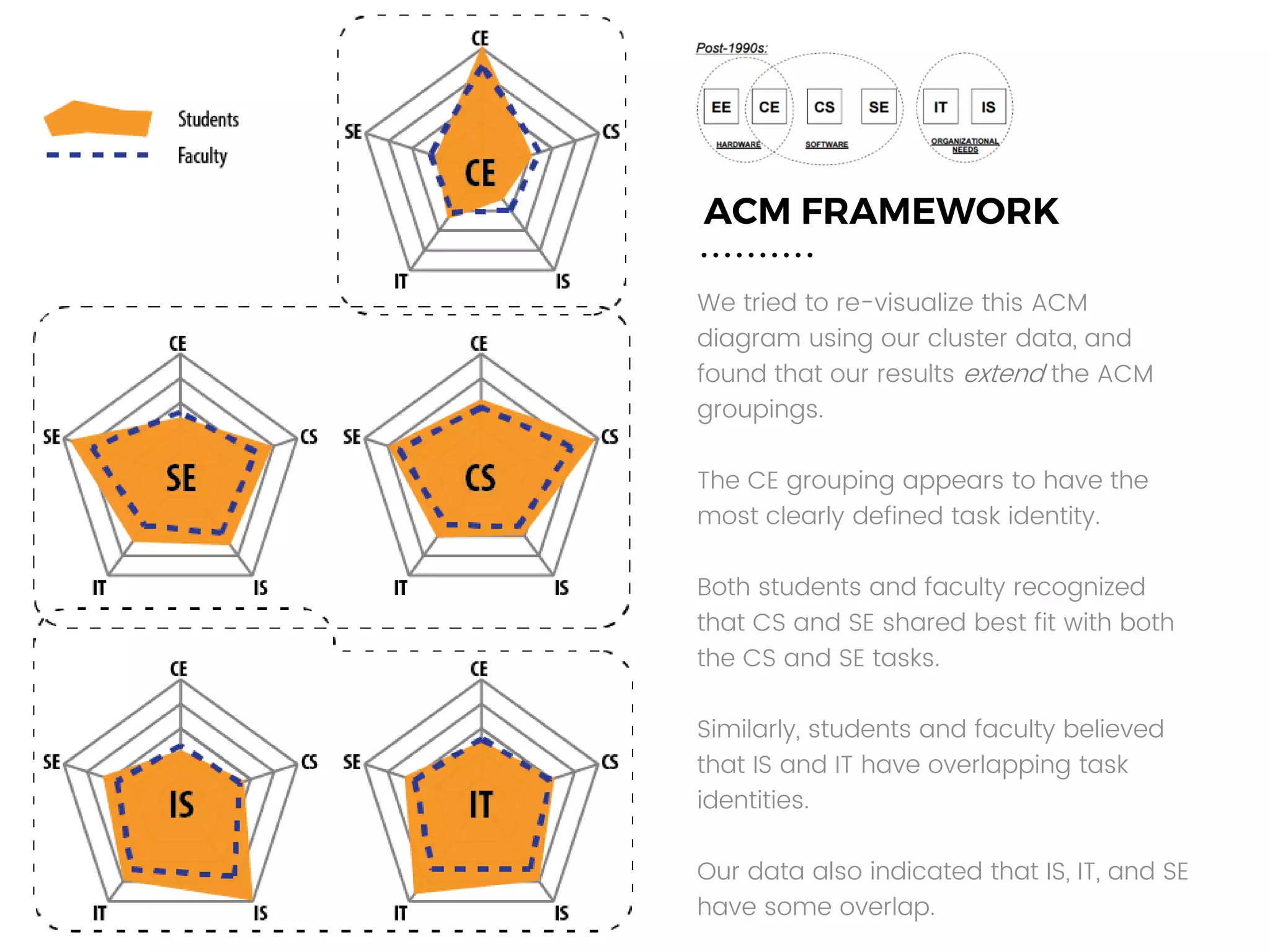
We tried to re-visualize this ACM
diagram using our cluster data, and
found that our results extend the ACM
groupings.
The CE grouping appears to have the
most clearly defined task identity.
Both students and faculty recognized
that CS and SE shared best fit with both
the CS and SE tasks.
Similarly, students and faculty believed
that IS and IT have overlapping task
identities.
Our data also indicated that IS, IT, and SE
have some overlap.
COUNSELLING
Our study results also provides
guidance for counsellors and
advisors.
TWO-STEP
INTERVENTION
PROCESS
In the first step, we should help
students to identify the general
computing area that is of most
interest (CE, CS/SE or IT/IS).
In the second step, further
define interests and clarify
understanding within each of
those areas.
LIMITATIONS
LIMITATIONS
OBVIOUS QUESTIONS? NOT ENOUGH “IS” STUDENTS MORE FACULTY RESPONSES
SURVEY FATIGUE
CONCLUSION
KNOWLEDGE OF DISCIPLINES
Students and faculty share a general
understanding of the computing
disciplines, and for students, discipline
understanding becomes more refined
as they proceed through their
undergraduate experience.
DISTINGUISH SE/CE + IT/IS
To support incoming students and
prospective students in their career
choice, our data shows that guidance
practitioners will need to provide
more specific information about the
CS/SE distinction and the IT/IS
distinction.
Examining the ACM Curricula Reports
for each discipline, we could not help
noticing that the ACM IT, IS, and CE
model curriculum reports each have a
section right at the start reflecting on
their discipline’s relationship to the other
five disciplines. The CS and SE reports
do not!
STARTING WITH
CURRICULM REPORTS
Within the computing disciplines, it
appears that the SE and CS students
could benefit especially from having
more knowledge about the other
computing disciplines.
SE + CS NEED MORE
FINAL THOUGHTS
Disciplinary boundaries are
not immutable but are
socially constructed (and
thus can change over time)
Nonetheless, we believe that
if computing students have
a realistic understanding of
the identity and boundary of
not only their own discipline
but also that of neighboring
disciplines, it is likely to
improve their ultimate
satisfaction with their
discipline.
Randy Connolly
Janet Miller
Mount Royal University, Calgary, Canada
Faith-Michael Uzoka
Marc Schroeder
Barry Lunt
Annabella Habinka
Craig Miller
Brigham Young University
DePaul University
Mbarara University, Uganda

Red Fish Blue Fish: Reexamining Student Understanding of the Computing Disciplines

  • 2.
    ABOUT THE PAPER This paperupdates the findings of a multi- year study that is surveying major and non- major students’ understanding of the different computing disciplines. GET STARTED
  • 3.
    MOTIVATION Do computing studentshave an understanding of the ACM computing disciplinary identities and boundaries and to what degree does student understanding mirror the official ones defined by the ACM.
  • 4.
    Courte, J. andBishop-Clark, C. 2009. Do students differentiate between computing disciplines?. In Proceedings of SIGCSE '09. 2009 Uzoka, F-M., Connolly, R., Schroeder, M, Khemka, N, and Miller, J. (2013). Computing is not a rock band: student understanding of the computing disciplines. In Proceedings of SIGITE '13. 2013 BACKGROUND
  • 5.
    Phase 1 Fall 2012 Paperquestionnaires given to MRU first year CS, IT, and non-major students. Phase 3a Winter 2016 Online (SurveyMonkey) questionnaires given to MRU and BYU students. Phase 2 Winter 2014 Paper questionnaire modified slightly and given to first-year and upper-year MRU students. TIMELINE
  • 6.
    Phase 4a Fall 2016/Winter2017 Questionnaires distributed to other universities: Univ of Cincinnati, New Hampshire, ... Phase 3b Spring 2016 Online (SurveyMonkey) questionnaires given to DePaul and Mbarara Univ students. Phase 4b Fall/Winter 2017 Questionnaires distributed to wider range of computing faculty. TIMELINE
  • 7.
    RANDY CONNOLLY Mount RoyalUniversity Mathematics & Computing OUR TEAM JANET MILLER Mount Royal University Counselling MICHAEL UZOKA Mount Royal University Mathematics & Computing MARC SCHROEDER Mount Royal University Mathematics & Computing
  • 8.
    BARRY LUNT Brigham Young University CRAIGMILLER DePaul University ANABELLA HABINKA Mbarara University ???? Anywhere
  • 9.
    DEGREE OF FITOLD AND NEW QUESTIONS FACULTY RESPONSES METHODOLOGY
  • 10.
    ORIGINAL STUDY [2009] Inthe original C&BC study, students were given 15 task descriptions and for each task they had to indicate which of the five disciplines was the best fit for that task. OUR STUDY To address that drawback, our study allowed the participants to choose how much each task fit with each of the five disciplines. X X X XX DEGREE OF FIT
  • 11.
    Our questionnaire had demographic-relatedquestions and then 31 discipline/task questions. SO WE DID
  • 12.
    FACULTY RESPONSES We determined bestfit by having faculty (n=13) from four universities (and four different computing disciplines) fill in the same survey as the students. We then used their responses to construct the disciplinary best fits.
  • 13.
    RESULTS After filtering outuncompleted surveys, our analysis was able to use 668 completed North American surveys.
  • 14.
  • 15.
  • 16.
    STUDENT VS FACULTY RESULTS Designs hardwareto implement communication systems Uses new theories to create cutting edge software
  • 17.
    STUDENT VS FACULTY RESULTS Combines knowledgeof business and technology. Manages large scale technological projects.
  • 18.
    STUDENT VS FACULTY RESULTS Develops ormaintains web sites. Manages a team of software developers.
  • 19.
    RANK ORDER ANALYSIS This analysismethod is especially well suited for interval data lacking objective measures of correctness.
  • 20.
    Discipline Match Distribution Thematch between student and faculty rankings was remarkably close.
  • 21.
  • 22.
    CS vs ITSTUDENTS Examining our one-way ANOVA analyses of the role that the students’ program of study had on their task scores, we discovered that one of the biggest differences was that between CS and IT students.
  • 23.
    CS VS IT STUDENTS Utilizes theory toresearch and design software solutions. Manages a team of software developers.
  • 24.
    CS vs ITSTUDENTS Tightly-defined impermeable boundaries are characteristic of well-established and convergent disciplinary communities, while newer, more epistemologically open-ended disciplines are often characterized by broader, more permeable boundaries. The IT students were much more likely than the CS students to believe a given task could be handled by multiple disciplines.
  • 25.
    DISCIPLINARY CLUSTERS The 31 questionswere grouped into five categories representing best-fits with each of the computing disciplines. Cluster scores were then calculated for each student participant by adding together the target discipline rating for each question assigned to this cluster.
  • 26.
    DISCIPLINARY CLUSTERS ANOVA showed statistically significant(p<0.05) differences in all five cluster areas.
  • 27.
    CLUSTER ACCURACY An average ofall discipline cluster scores yielded a total accuracy score, and again significant differences among students from the various programs was found, F (6, 350) = 6.178, p = 0.00.
  • 28.
    CLUSTER ACCURACY Post-hoc (Bonferroni) analyses showedthat SE and CS students scored significantly lower than their peers in other disciplines.
  • 29.
    DISCIPLINARITY ACM FRAMEWORKCOUNSELLING DISCUSSION
  • 30.
    DISCIPLINARY FIT By allowingstudents to specify a degree of disciplinary fit, our study showed that by and large students are able to get their discipline matches surprisingly close.
  • 31.
    DISCIPLINARY FIT Student responsesmirrored faculty responses in direction of fit but not in exact quantity of fit. This could be interpreted as meaning the students are less certain about disciplinary fit than the faculty.
  • 32.
    Perhaps students areactually more cognizant than faculty of the uncertain fit between the different computing disciplines and real-world computing tasks and thus see disciplinary boundaries as being permeable. STUDENTS University faculty live and breathe disciplinary silos, so it is natural that they would see disciplinary fit in a more extreme manner than students. FACULTY
  • 33.
    Some [academic] bordersare so strongly defended as to be virtually impenetrable; others are weakly guarded and open to incoming and outgoing traffic: but in general a considerable amount of poaching goes on across all disciplines Becher, T. and Trowler, P. R. (2001). Academic tribes and territories, Second Edition.
  • 34.
    ACM FRAMEWORK Our dataseems to be in line with the ACM’s (2005) theoretical framework.
  • 35.
    ACM FRAMEWORK We triedto re-visualize this ACM diagram using our cluster data, and found that our results extend the ACM groupings. The CE grouping appears to have the most clearly defined task identity. Both students and faculty recognized that CS and SE shared best fit with both the CS and SE tasks. Similarly, students and faculty believed that IS and IT have overlapping task identities. Our data also indicated that IS, IT, and SE have some overlap.
  • 36.
    COUNSELLING Our study resultsalso provides guidance for counsellors and advisors.
  • 37.
    TWO-STEP INTERVENTION PROCESS In the firststep, we should help students to identify the general computing area that is of most interest (CE, CS/SE or IT/IS). In the second step, further define interests and clarify understanding within each of those areas.
  • 38.
  • 39.
    LIMITATIONS OBVIOUS QUESTIONS? NOTENOUGH “IS” STUDENTS MORE FACULTY RESPONSES SURVEY FATIGUE
  • 40.
  • 41.
    KNOWLEDGE OF DISCIPLINES Studentsand faculty share a general understanding of the computing disciplines, and for students, discipline understanding becomes more refined as they proceed through their undergraduate experience. DISTINGUISH SE/CE + IT/IS To support incoming students and prospective students in their career choice, our data shows that guidance practitioners will need to provide more specific information about the CS/SE distinction and the IT/IS distinction.
  • 42.
    Examining the ACMCurricula Reports for each discipline, we could not help noticing that the ACM IT, IS, and CE model curriculum reports each have a section right at the start reflecting on their discipline’s relationship to the other five disciplines. The CS and SE reports do not! STARTING WITH CURRICULM REPORTS Within the computing disciplines, it appears that the SE and CS students could benefit especially from having more knowledge about the other computing disciplines. SE + CS NEED MORE
  • 43.
    FINAL THOUGHTS Disciplinary boundariesare not immutable but are socially constructed (and thus can change over time) Nonetheless, we believe that if computing students have a realistic understanding of the identity and boundary of not only their own discipline but also that of neighboring disciplines, it is likely to improve their ultimate satisfaction with their discipline.
  • 45.
    Randy Connolly Janet Miller MountRoyal University, Calgary, Canada Faith-Michael Uzoka Marc Schroeder Barry Lunt Annabella Habinka Craig Miller Brigham Young University DePaul University Mbarara University, Uganda