Egyptian Mythology
Tyson, Velasquez,and
Castillo
Egyptian mythology is the
collection of myths from
ancient Egypt, which
describe the actions of the
Egyptian gods as a means of
Ancient Egyptian Deities
Ancient Egyptian deities are the gods and
goddesses who were worshiped in
ancient Egypt. The beliefs and rituals
surrounding these gods formed the core
of ancient Egyptian religion, which
emerged along with them sometime in
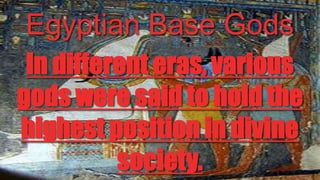
Egyptian Base Gods
In different eras, various
gods were said to hold the
highest position in divine
society.
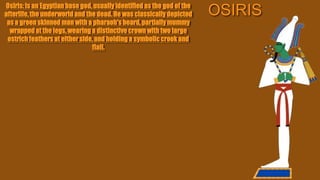
Osiris: is an Egyptian base god, usually identified as the god of the
afterlife, the underworld and the dead. He was classically depicted
as a green skinned man with a pharaoh's beard, partially mummy
wrapped at the legs, wearing a distinctive crown with two large
ostrich feathers at either side, and holding a symbolic crook and
flail.

OSIRIS
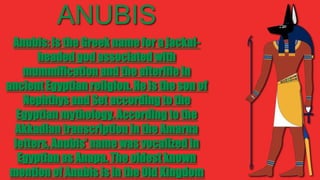
ANUBIS
Anubis: is the Greek name for a jackalheaded god associated with
mummification and the afterlife in
ancient Egyptian religion. He is the son of
Nephthys and Set according to the
Egyptian mythology. According to the
Akkadian transcription in the Amarna
letters, Anubis' name was vocalized in
Egyptian as Anapa. The oldest known
mention of Anubis is in the Old Kingdom
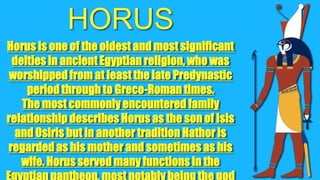
HORUS
Horus is one of the oldest and most significant
deities in ancient Egyptian religion, who was
worshipped from at least the late Predynastic
period through to Greco-Roman times.
The most commonly encountered family
relationship describes Horus as the son of Isis
and Osiris but in another tradition Hathor is
regarded as his mother and sometimes as his
wife. Horus served many functions in the
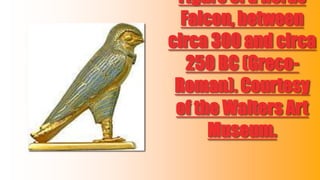
Figure of a Horus
Falcon, between
circa 300 and circa
250 BC (GrecoRoman). Courtesy
of the Walters Art
Museum.
Praised for controlling vermin and killing
dangerous snakes such as cobras, the cat
became a symbol of grace and poise.
As a revered animal and one important to
Egyptian society and religion, some cats
received the same mummification after death
as humans. Mummified cats were given in
offering to Bastet, who is the Goddess of
cats, Lower Egypt, the sun and the moon. In
1888, an Egyptian farmer uncovered a large
tomb with mummified cats and kittens. This
discovery outside the town of Beni Hasan had

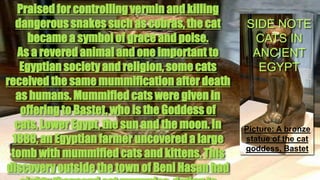
SIDE NOTE
CATS IN
ANCIENT
EGYPT

Picture: A bronze
statue of the cat
goddess, Bastet
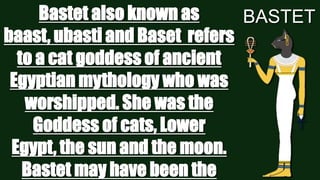
Bastet also known as
BASTET
baast, ubasti and Baset refers
to a cat goddess of ancient
Egyptian mythology who was
worshipped. She was the
Goddess of cats, Lower
Egypt, the sun and the moon.
Bastet may have been the
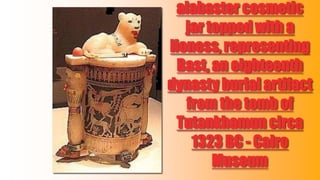
alabaster cosmetic
jar topped with a
lioness, representing
Bast, an eighteenth
dynasty burial artifact
from the tomb of
Tutankhamun circa
1323 BC - Cairo
Museum
Egyptian Heros?
The Egyptians didn't have the same
cosmology as the Greeks and Romans. There
are tales of great deeds done by the Egyptian
gods and goddesses, but they aren't the
same as the Heroes and demigods of Greek
and Roman mythology.
Most of the Egyptian 'heroes' would have
been pharaohs who won great battles or did
great things for their country. However there
are many myths.
Creation Myths
Among the most important myths were those describing
the creation of the world. The Egyptian developed many
accounts of the creation, which differ greatly in the events
they describe. In particular, the deities credited with
creating the world vary in each account. This difference
partly reflects the desire of Egypt's cities and priesthoods
to exalt their own patron gods by attributing creation to
them. Yet the differing accounts were not regarded as
contradictory; instead, the Egyptians saw the creation
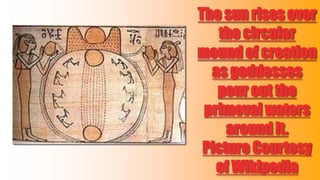
The sun rises over
the circular
mound of creation
as goddesses
pour out the
primeval waters
around it.
Picture Courtesy
of Wikipedia
Hermopolis Creation Myth
The creation myth formed in the city of Hermopolis focused on the nature of the
universe before the creation of the world. The qualities of the primeval waters
were represented by a set of eight gods, called the Ogdoad. The god Nu and his
female counterpart Naunet represented the inert primeval water itself; Huh and
his counterpart Hauhet represented the water's infinite extent; Kuk and Kauket
personified the darkness present within it.
and Amun and Amaunet represented its hidden and unknowable nature, in
contrast to the tangible world of the living. The primeval waters were themselves
part of the creation process, therefore, the deities representing them could be
seen as creator gods.
According to the myth, the eight gods were originally divided into male and
female groups. They were symbolically depicted as aquatic creatures because
they dwelt within the water: the males were represented as frogs, and the
females were represented as snakes. These two groups eventually converged,
resulting in a great upheaval, which produced the pyramidal mound. From it
Questions?

Egyptian mythology

  • 1.
  • 2.
    Egyptian mythology isthe collection of myths from ancient Egypt, which describe the actions of the Egyptian gods as a means of
  • 3.
    Ancient Egyptian Deities AncientEgyptian deities are the gods and goddesses who were worshiped in ancient Egypt. The beliefs and rituals surrounding these gods formed the core of ancient Egyptian religion, which emerged along with them sometime in
  • 4.
    Egyptian Base Gods Indifferent eras, various gods were said to hold the highest position in divine society.
  • 5.
    Osiris: is anEgyptian base god, usually identified as the god of the afterlife, the underworld and the dead. He was classically depicted as a green skinned man with a pharaoh's beard, partially mummy wrapped at the legs, wearing a distinctive crown with two large ostrich feathers at either side, and holding a symbolic crook and flail. OSIRIS
  • 6.
    ANUBIS Anubis: is theGreek name for a jackalheaded god associated with mummification and the afterlife in ancient Egyptian religion. He is the son of Nephthys and Set according to the Egyptian mythology. According to the Akkadian transcription in the Amarna letters, Anubis' name was vocalized in Egyptian as Anapa. The oldest known mention of Anubis is in the Old Kingdom
  • 7.
    HORUS Horus is oneof the oldest and most significant deities in ancient Egyptian religion, who was worshipped from at least the late Predynastic period through to Greco-Roman times. The most commonly encountered family relationship describes Horus as the son of Isis and Osiris but in another tradition Hathor is regarded as his mother and sometimes as his wife. Horus served many functions in the
  • 8.
    Figure of aHorus Falcon, between circa 300 and circa 250 BC (GrecoRoman). Courtesy of the Walters Art Museum.
  • 9.
    Praised for controllingvermin and killing dangerous snakes such as cobras, the cat became a symbol of grace and poise. As a revered animal and one important to Egyptian society and religion, some cats received the same mummification after death as humans. Mummified cats were given in offering to Bastet, who is the Goddess of cats, Lower Egypt, the sun and the moon. In 1888, an Egyptian farmer uncovered a large tomb with mummified cats and kittens. This discovery outside the town of Beni Hasan had SIDE NOTE CATS IN ANCIENT EGYPT Picture: A bronze statue of the cat goddess, Bastet
  • 10.
    Bastet also knownas BASTET baast, ubasti and Baset refers to a cat goddess of ancient Egyptian mythology who was worshipped. She was the Goddess of cats, Lower Egypt, the sun and the moon. Bastet may have been the
  • 11.
    alabaster cosmetic jar toppedwith a lioness, representing Bast, an eighteenth dynasty burial artifact from the tomb of Tutankhamun circa 1323 BC - Cairo Museum
  • 12.
    Egyptian Heros? The Egyptiansdidn't have the same cosmology as the Greeks and Romans. There are tales of great deeds done by the Egyptian gods and goddesses, but they aren't the same as the Heroes and demigods of Greek and Roman mythology. Most of the Egyptian 'heroes' would have been pharaohs who won great battles or did great things for their country. However there are many myths.
  • 13.
    Creation Myths Among themost important myths were those describing the creation of the world. The Egyptian developed many accounts of the creation, which differ greatly in the events they describe. In particular, the deities credited with creating the world vary in each account. This difference partly reflects the desire of Egypt's cities and priesthoods to exalt their own patron gods by attributing creation to them. Yet the differing accounts were not regarded as contradictory; instead, the Egyptians saw the creation
  • 14.
    The sun risesover the circular mound of creation as goddesses pour out the primeval waters around it. Picture Courtesy of Wikipedia
  • 15.
    Hermopolis Creation Myth Thecreation myth formed in the city of Hermopolis focused on the nature of the universe before the creation of the world. The qualities of the primeval waters were represented by a set of eight gods, called the Ogdoad. The god Nu and his female counterpart Naunet represented the inert primeval water itself; Huh and his counterpart Hauhet represented the water's infinite extent; Kuk and Kauket personified the darkness present within it. and Amun and Amaunet represented its hidden and unknowable nature, in contrast to the tangible world of the living. The primeval waters were themselves part of the creation process, therefore, the deities representing them could be seen as creator gods. According to the myth, the eight gods were originally divided into male and female groups. They were symbolically depicted as aquatic creatures because they dwelt within the water: the males were represented as frogs, and the females were represented as snakes. These two groups eventually converged, resulting in a great upheaval, which produced the pyramidal mound. From it
  • 16.