


Greece
Part 3
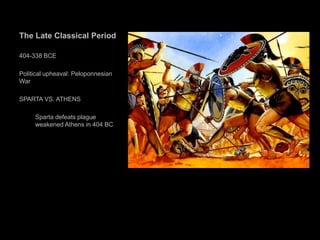
The Late Classical Period
404-338 BCE
Political upheaval: Peloponnesian
War
SPARTA VS. ATHENS
Sparta defeats plague
weakened Athens in 404 BC
Chaos and Disorder
Greece is much weaker after War
But good for philosophy and art
3
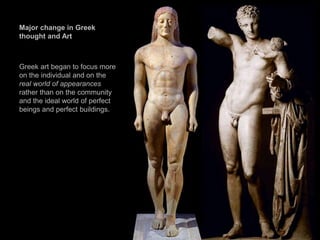
Major change in Greek
thought and Art
Greek art began to focus more
on the individual and on the
real world of appearances
rather than on the community
and the ideal world of perfect
beings and perfect buildings.
5
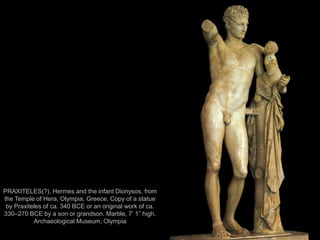
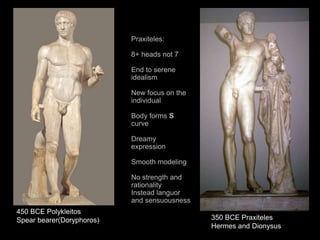
PRAXITELES(?), Hermes and the infant Dionysos, from
the Temple of Hera, Olympia, Greece. Copy of a statue
by Praxiteles of ca. 340 BCE or an original work of ca.
330–270 BCE by a son or grandson. Marble, 7’ 1” high.
Archaeological Museum, Olympia
6
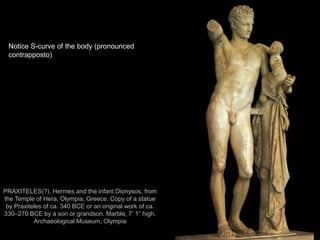
PRAXITELES(?), Hermes and the infant Dionysos, from
the Temple of Hera, Olympia, Greece. Copy of a statue
by Praxiteles of ca. 340 BCE or an original work of ca.
330–270 BCE by a son or grandson. Marble, 7’ 1” high.
Archaeological Museum, Olympia
Notice S-curve of the body (pronounced
contrapposto)
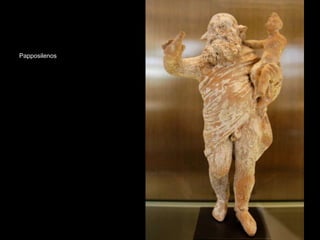
Papposilenos
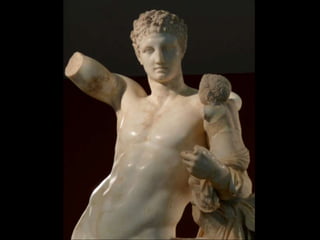
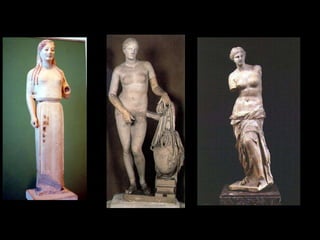
Praxiteles:
8+ heads not 7
End to serene
idealism
New focus on the
individual
Body forms S
curve
Dreamy
expression
Smooth modeling
No strength and
rationality
Instead languor
and sensuousness
350 BCE Praxiteles
Hermes and Dionysus
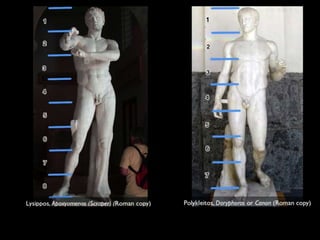
450 BCE Polykleitos
Spear bearer(Doryphoros)
10
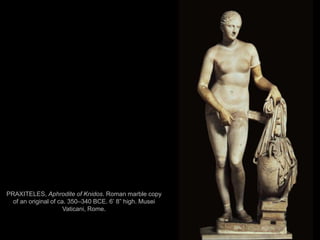
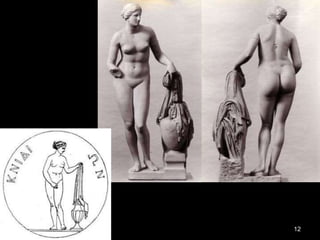
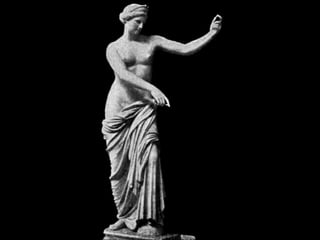
PRAXITELES, Aphrodite of Knidos. Roman marble copy
of an original of ca. 350–340 BCE. 6’ 8” high. Musei
Vaticani, Rome.
11
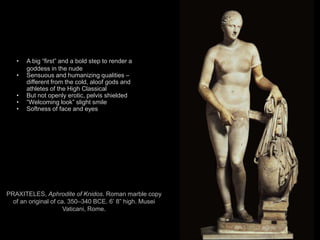
PRAXITELES, Aphrodite of Knidos. Roman marble copy
of an original of ca. 350–340 BCE. 6’ 8” high. Musei
Vaticani, Rome.
• A big “first” and a bold step to render a
goddess in the nude
• Sensuous and humanizing qualities –
different from the cold, aloof gods and
athletes of the High Classical
• But not openly erotic, pelvis shielded
• “Welcoming look” slight smile
• Softness of face and eyes
12
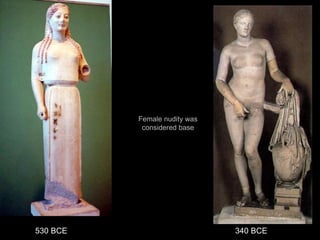
Female nudity was
considered base
340 BCE530 BCE
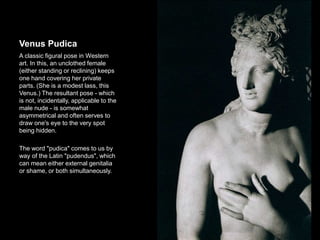
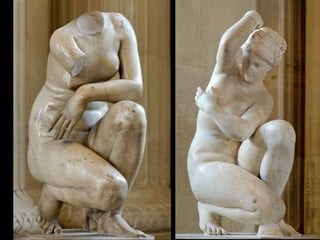
Venus Pudica
A classic figural pose in Western
art. In this, an unclothed female
(either standing or reclining) keeps
one hand covering her private
parts. (She is a modest lass, this
Venus.) The resultant pose - which
is not, incidentally, applicable to the
male nude - is somewhat
asymmetrical and often serves to
draw one's eye to the very spot
being hidden.
The word "pudica" comes to us by
way of the Latin "pudendus", which
can mean either external genitalia
or shame, or both simultaneously.
14
15
16
17
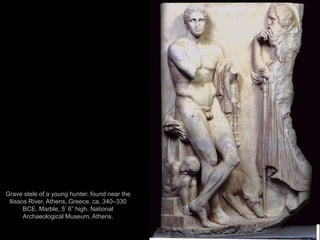
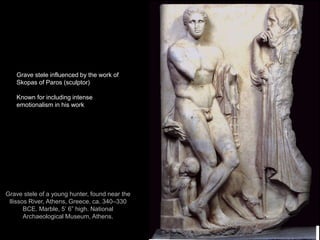
Grave stele of a young hunter, found near the
Ilissos River, Athens, Greece, ca. 340–330
BCE. Marble, 5’ 6” high. National
Archaeological Museum, Athens.
18
Grave stele of a young hunter, found near the
Ilissos River, Athens, Greece, ca. 340–330
BCE. Marble, 5’ 6” high. National
Archaeological Museum, Athens.
Grave stele influenced by the work of
Skopas of Paros (sculptor)
Known for including intense
emotionalism in his work
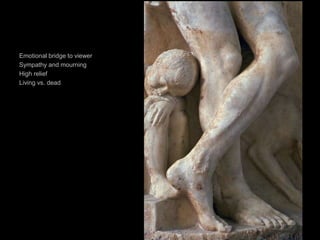
Emotional bridge to viewer
Sympathy and mourning
High relief
Living vs. dead
20
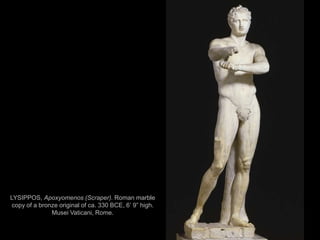
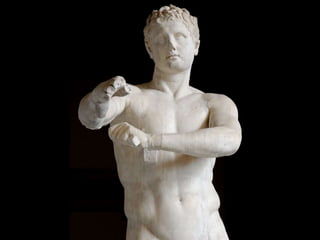
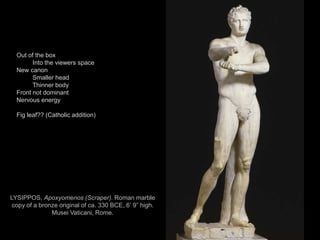
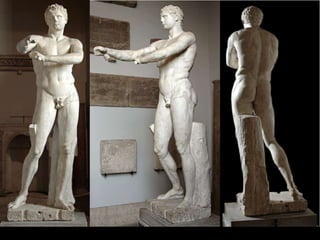
LYSIPPOS, Apoxyomenos (Scraper). Roman marble
copy of a bronze original of ca. 330 BCE, 6’ 9” high.
Musei Vaticani, Rome.
23
LYSIPPOS, Apoxyomenos (Scraper). Roman marble
copy of a bronze original of ca. 330 BCE, 6’ 9” high.
Musei Vaticani, Rome.
Out of the box
Into the viewers space
New canon
Smaller head
Thinner body
Front not dominant
Nervous energy
Fig leaf?? (Catholic addition)
26
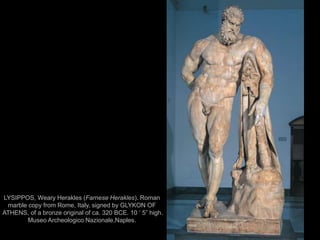
LYSIPPOS, Weary Herakles (Farnese Herakles). Roman
marble copy from Rome, Italy, signed by GLYKON OF
ATHENS, of a bronze original of ca. 320 BCE. 10 ‘ 5” high.
Museo Archeologico Nazionale,Naples.
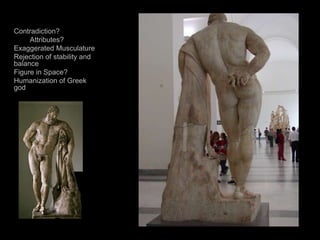
Contradiction?
Attributes?
Exaggerated Musculature
Rejection of stability and
balance
Figure in Space?
Humanization of Greek
god
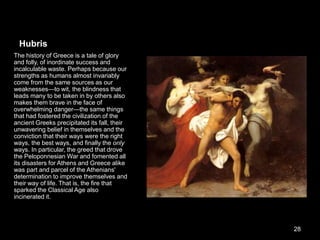
Hubris
The history of Greece is a tale of glory
and folly, of inordinate success and
incalculable waste. Perhaps because our
strengths as humans almost invariably
come from the same sources as our
weaknesses—to wit, the blindness that
leads many to be taken in by others also
makes them brave in the face of
overwhelming danger—the same things
that had fostered the civilization of the
ancient Greeks precipitated its fall, their
unwavering belief in themselves and the
conviction that their ways were the right
ways, the best ways, and finally the only
ways. In particular, the greed that drove
the Peloponnesian War and fomented all
its disasters for Athens and Greece alike
was part and parcel of the Athenians'
determination to improve themselves and
their way of life. That is, the fire that
sparked the Classical Age also
incinerated it.
28
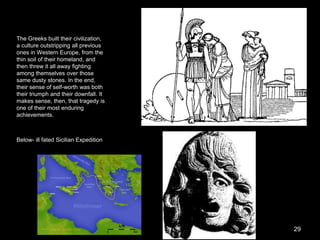
The Greeks built their civilization,
a culture outstripping all previous
ones in Western Europe, from the
thin soil of their homeland, and
then threw it all away fighting
among themselves over those
same dusty stones. In the end,
their sense of self-worth was both
their triumph and their downfall. It
makes sense, then, that tragedy is
one of their most enduring
achievements.
Below- ill fated Sicilian Expedition
29
30
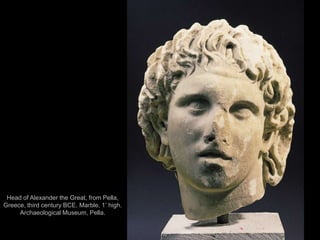
Head of Alexander the Great, from Pella,
Greece, third century BCE. Marble, 1’ high.
Archaeological Museum, Pella.
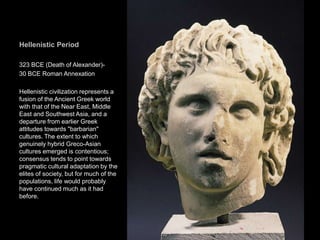
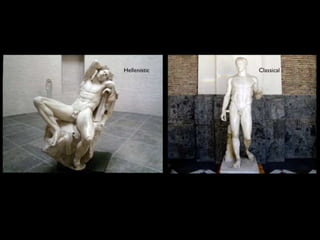
Hellenistic Period
323 BCE (Death of Alexander)-
30 BCE Roman Annexation
Hellenistic civilization represents a
fusion of the Ancient Greek world
with that of the Near East, Middle
East and Southwest Asia, and a
departure from earlier Greek
attitudes towards "barbarian"
cultures. The extent to which
genuinely hybrid Greco-Asian
cultures emerged is contentious;
consensus tends to point towards
pragmatic cultural adaptation by the
elites of society, but for much of the
populations, life would probably
have continued much as it had
before.
31
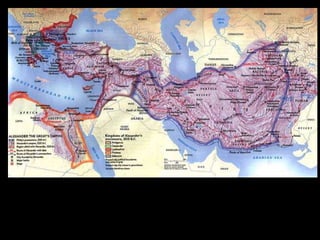
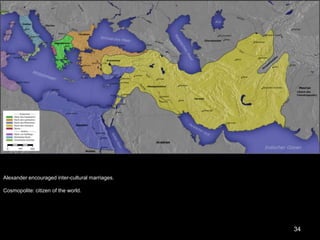
Alexander the Great’s Empire
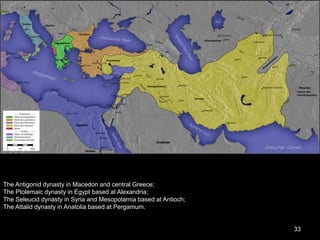
The Antigonid dynasty in Macedon and central Greece;
The Ptolemaic dynasty in Egypt based at Alexandria;
The Seleucid dynasty in Syria and Mesopotamia based at Antioch;
The Attalid dynasty in Anatolia based at Pergamum.
33
Alexander encouraged inter-cultural marriages.
Cosmopolite: citizen of the world.
34
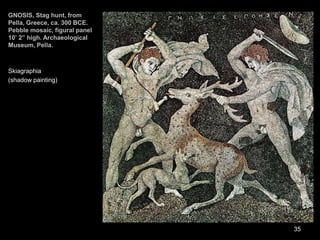
GNOSIS, Stag hunt, from
Pella, Greece, ca. 300 BCE.
Pebble mosaic, figural panel
10’ 2” high. Archaeological
Museum, Pella.
Skiagraphia
(shadow painting)
35
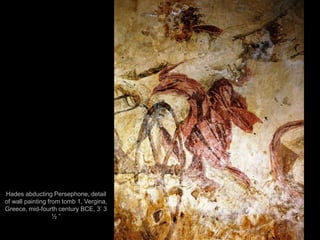
Hades abducting Persephone, detail
of wall painting from tomb 1, Vergina,
Greece, mid-fourth century BCE, 3’ 3
½ ”
36
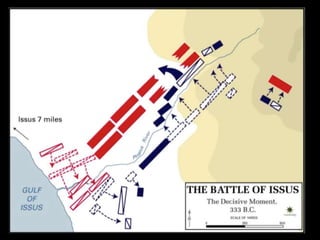
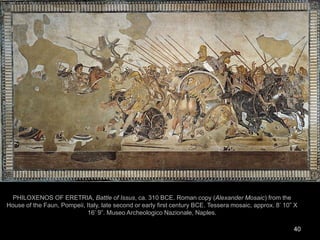
The “turning point” of the game
Battle of Issus
40
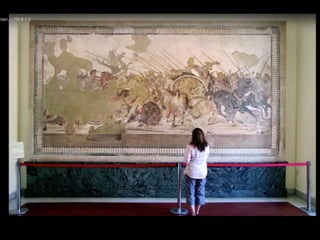
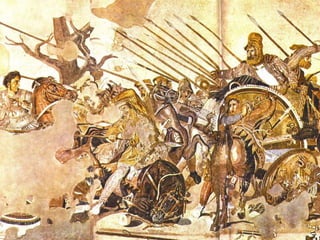
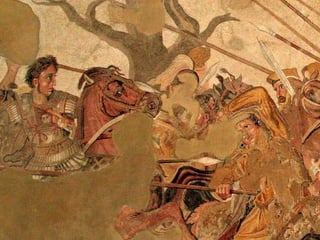
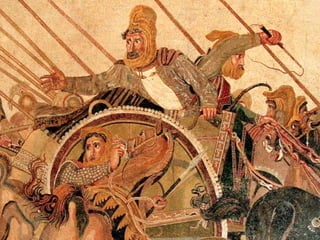
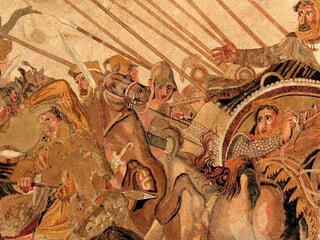
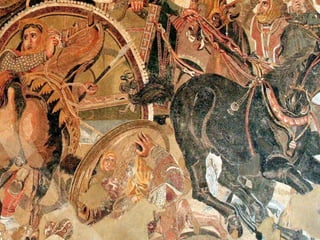
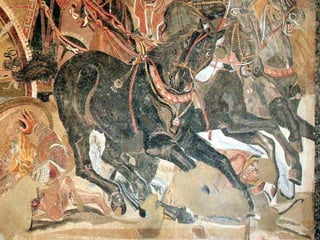
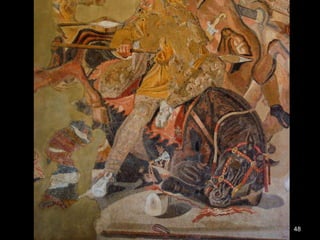
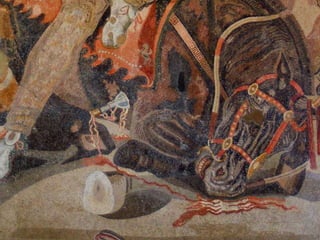
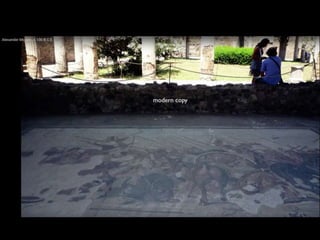
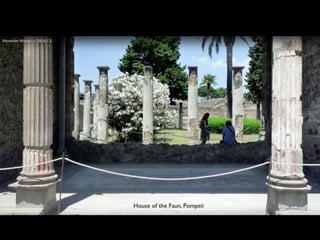
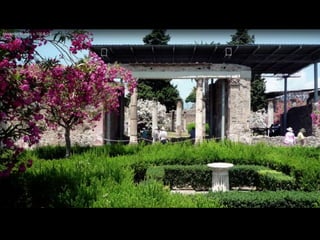
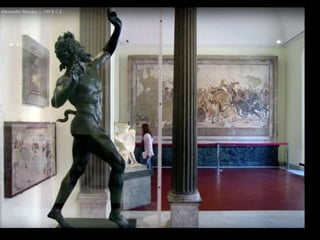
PHILOXENOS OF ERETRIA, Battle of Issus, ca. 310 BCE. Roman copy (Alexander Mosaic) from the
House of the Faun, Pompeii, Italy, late second or early first century BCE. Tessera mosaic, approx. 8’ 10” X
16’ 9”. Museo Archeologico Nazionale, Naples.
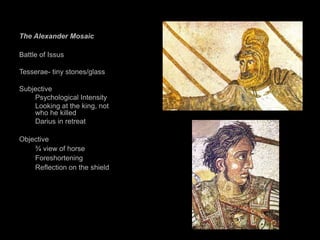
The Alexander Mosaic
Battle of Issus
Tesserae- tiny stones/glass
Subjective
Psychological Intensity
Looking at the king, not
who he killed
Darius in retreat
Objective
¾ view of horse
Foreshortening
Reflection on the shield
48
49
54
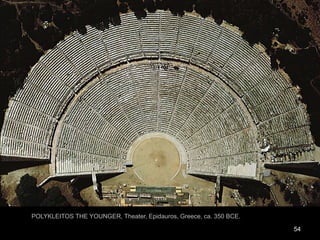
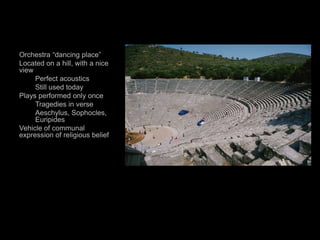
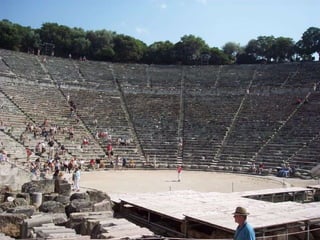
POLYKLEITOS THE YOUNGER, Theater, Epidauros, Greece, ca. 350 BCE.
Orchestra “dancing place”
Located on a hill, with a nice
view
Perfect acoustics
Still used today
Plays performed only once
Tragedies in verse
Aeschylus, Sophocles,
Euripides
Vehicle of communal
expression of religious belief
59
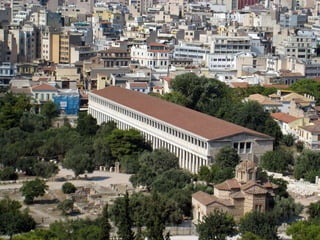
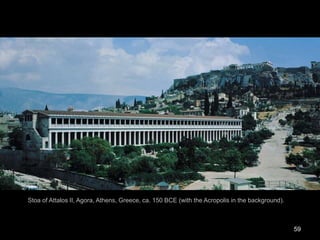
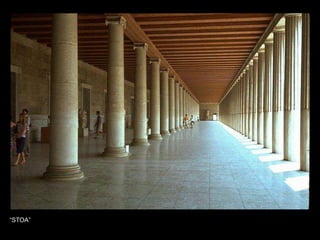
Stoa of Attalos II, Agora, Athens, Greece, ca. 150 BCE (with the Acropolis in the background).
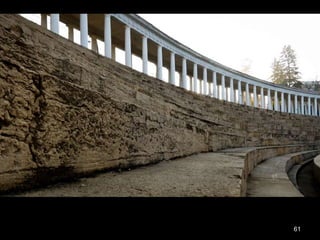
“STOA”
61
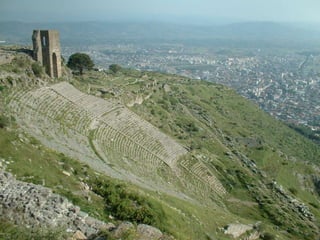
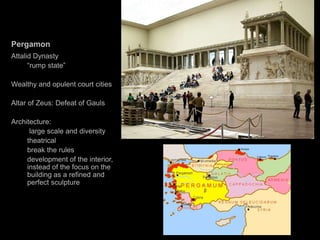
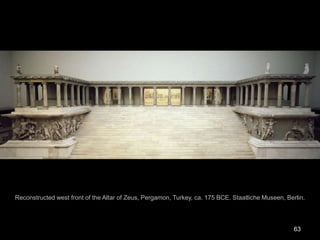
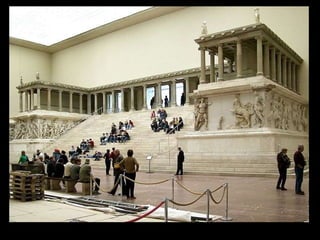
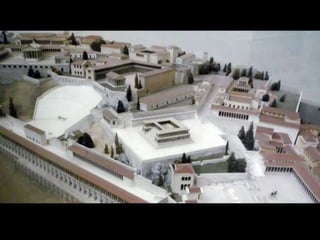
Pergamon
Attalid Dynasty
“rump state”
Wealthy and opulent court cities
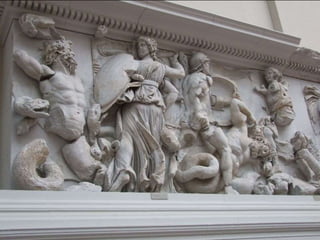
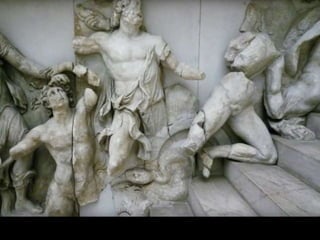
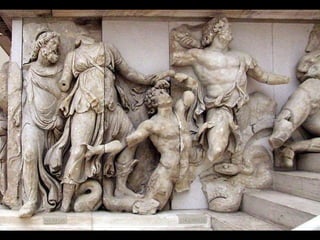
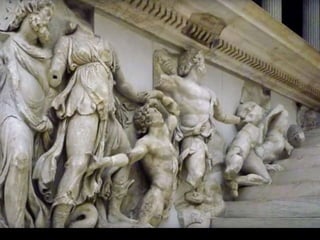
Altar of Zeus: Defeat of Gauls
Architecture:
large scale and diversity
theatrical
break the rules
development of the interior,
instead of the focus on the
building as a refined and
perfect sculpture
63
Reconstructed west front of the Altar of Zeus, Pergamon, Turkey, ca. 175 BCE. Staatliche Museen, Berlin.
68
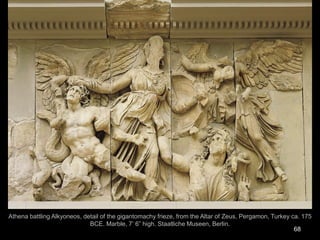
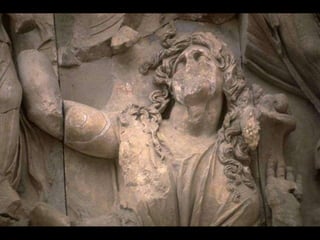
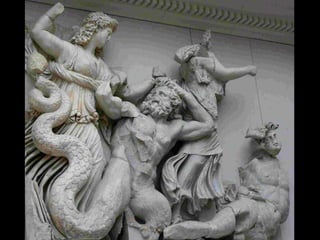
Athena battling Alkyoneos, detail of the gigantomachy frieze, from the Altar of Zeus, Pergamon, Turkey ca. 175
BCE. Marble, 7’ 6” high. Staatliche Museen, Berlin.
75
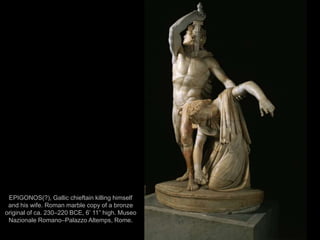
EPIGONOS(?), Gallic chieftain killing himself
and his wife. Roman marble copy of a bronze
original of ca. 230–220 BCE, 6’ 11” high. Museo
Nazionale Romano–Palazzo Altemps, Rome.
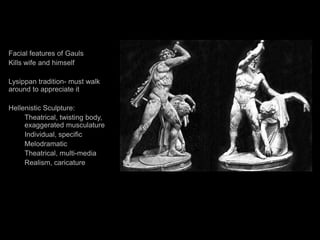
Facial features of Gauls
Kills wife and himself
Lysippan tradition- must walk
around to appreciate it
Hellenistic Sculpture:
Theatrical, twisting body,
exaggerated musculature
Individual, specific
Melodramatic
Theatrical, multi-media
Realism, caricature
77
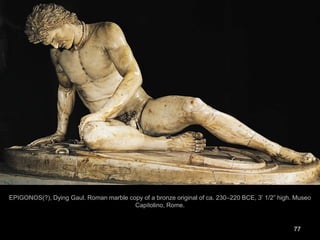
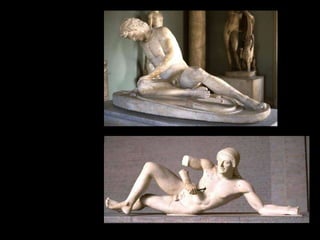
EPIGONOS(?), Dying Gaul. Roman marble copy of a bronze original of ca. 230–220 BCE, 3’ 1/2” high. Museo
Capitolino, Rome.
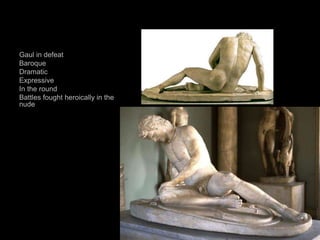
Gaul in defeat
Baroque
Dramatic
Expressive
In the round
Battles fought heroically in the
nude
80
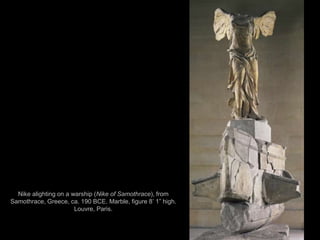
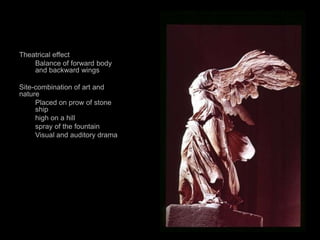
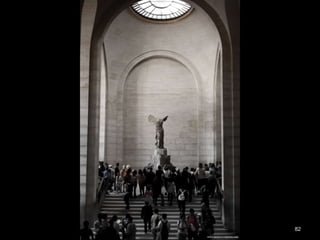
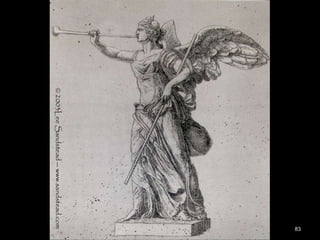
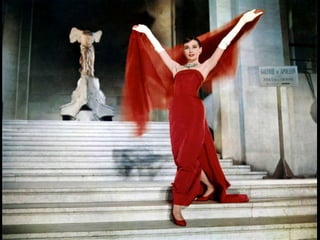
Nike alighting on a warship (Nike of Samothrace), from
Samothrace, Greece, ca. 190 BCE. Marble, figure 8’ 1” high.
Louvre, Paris.
Theatrical effect
Balance of forward body
and backward wings
Site-combination of art and
nature
Placed on prow of stone
ship
high on a hill
spray of the fountain
Visual and auditory drama
82
83
85
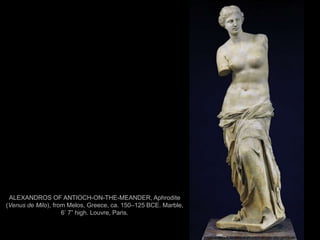
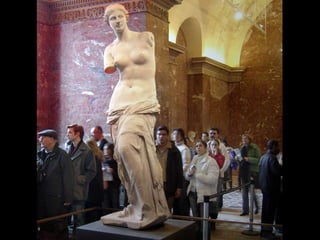
ALEXANDROS OF ANTIOCH-ON-THE-MEANDER, Aphrodite
(Venus de Milo), from Melos, Greece, ca. 150–125 BCE. Marble,
6’ 7” high. Louvre, Paris.
89
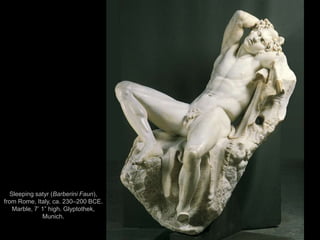
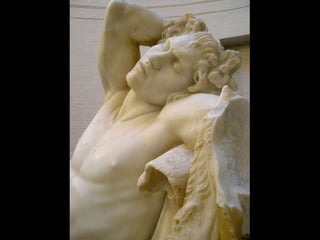
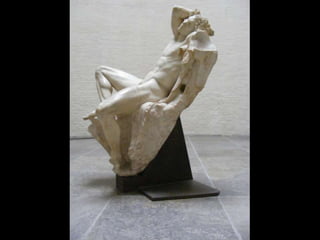
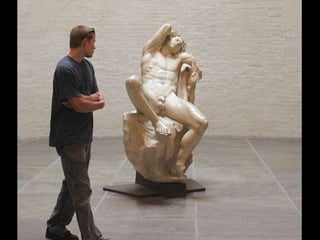
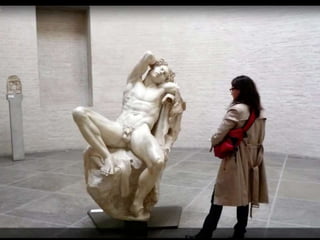
Sleeping satyr (Barberini Faun),
from Rome, Italy, ca. 230–200 BCE.
Marble, 7’ 1” high. Glyptothek,
Munich.
96
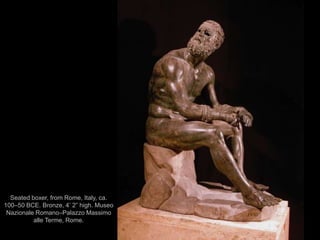
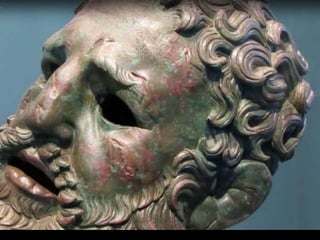
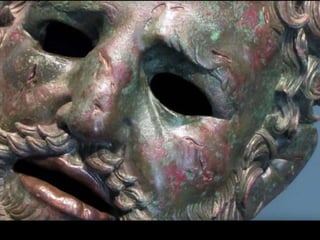
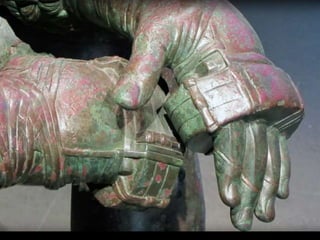
Seated boxer, from Rome, Italy, ca.
100–50 BCE. Bronze, 4’ 2” high. Museo
Nazionale Romano–Palazzo Massimo
alle Terme, Rome.
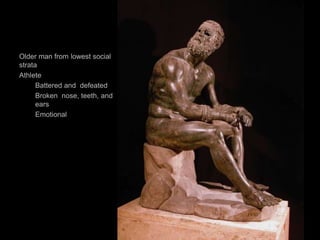
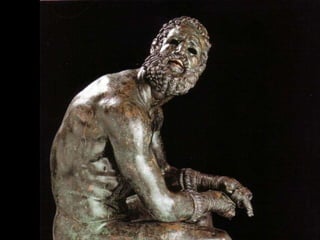
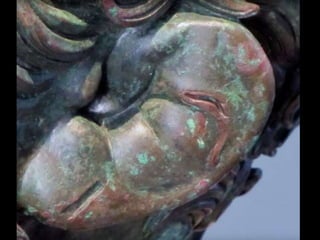
Older man from lowest social
strata
Athlete
Battered and defeated
Broken nose, teeth, and
ears
Emotional
97
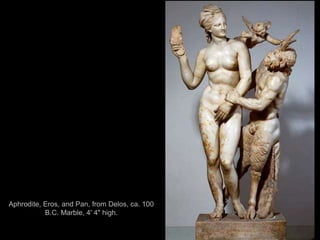
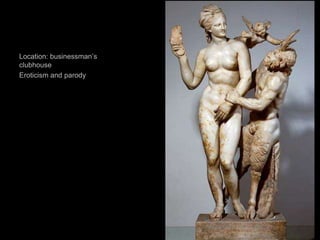
Aphrodite, Eros, and Pan, from Delos, ca. 100
B.C. Marble, 4' 4" high.
Location: businessman’s
clubhouse
Eroticism and parody
105
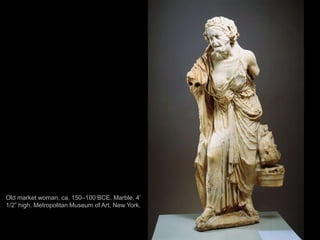
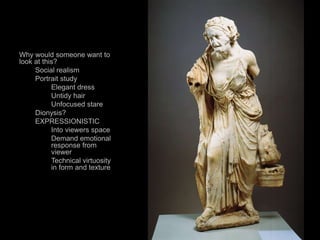
Old market woman, ca. 150–100 BCE. Marble, 4’
1/2” high. Metropolitan Museum of Art, New York.
Why would someone want to
look at this?
Social realism
Portrait study
Elegant dress
Untidy hair
Unfocused stare
Dionysis?
EXPRESSIONISTIC
Into viewers space
Demand emotional
response from
viewer
Technical virtuosity
in form and texture
106
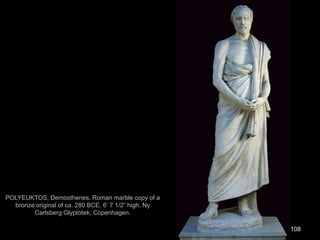
108
POLYEUKTOS, Demosthenes. Roman marble copy of a
bronze original of ca. 280 BCE. 6’ 7 1/2” high. Ny
Carlsberg Glyptotek, Copenhagen.
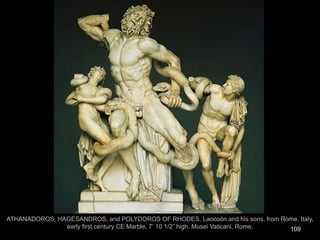
109
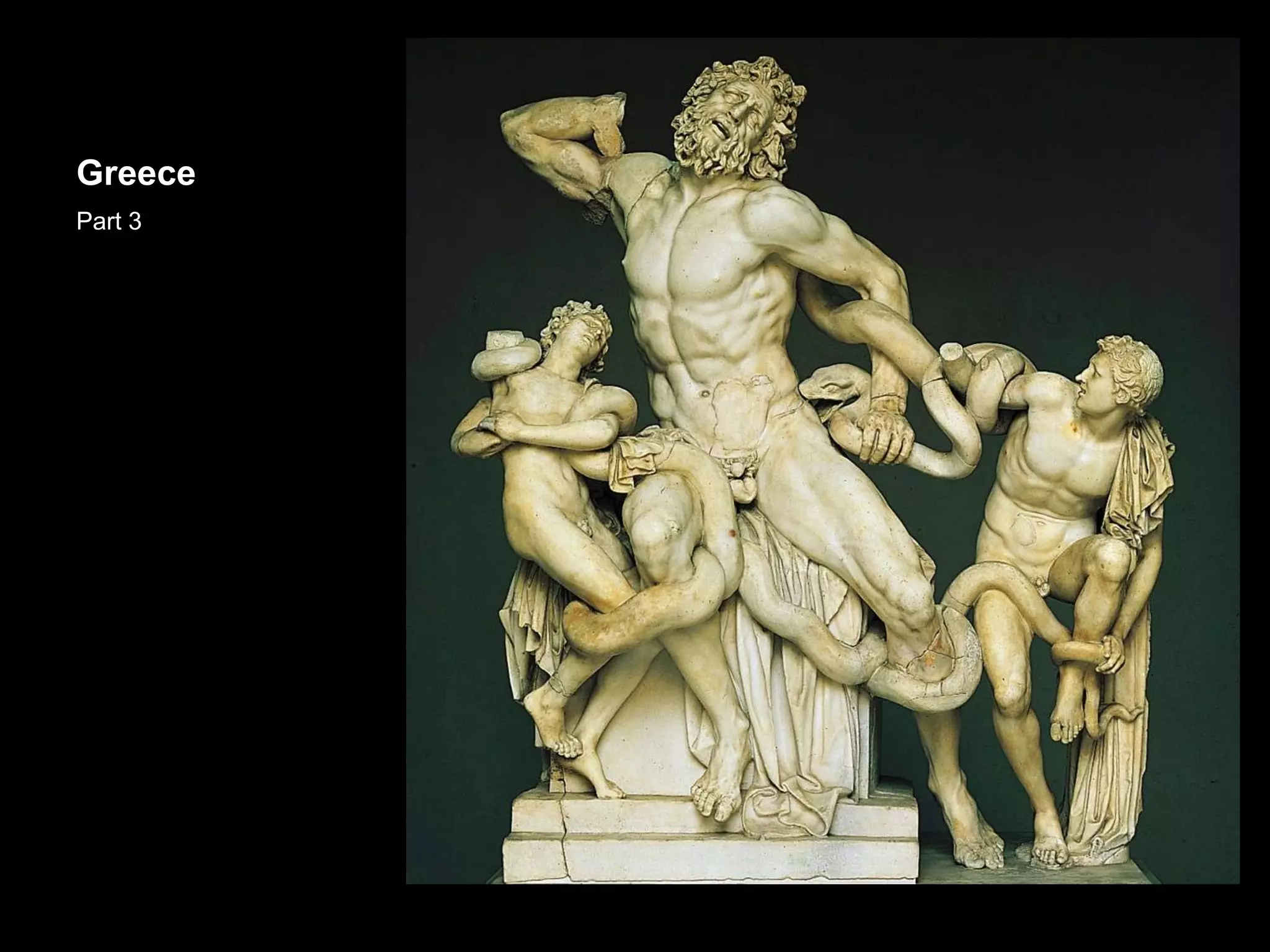
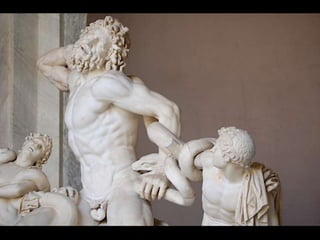
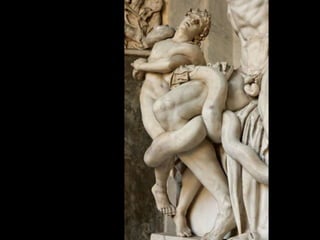
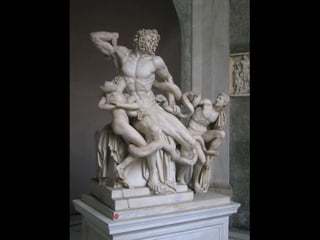
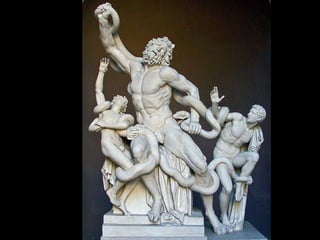
ATHANADOROS, HAGESANDROS, and POLYDOROS OF RHODES, Laocoön and his sons, from Rome, Italy,
early first century CE Marble, 7’ 10 1/2” high. Musei Vaticani, Rome.
GREECE part 3 de Beaufort

GREECE part 3 de Beaufort

  • 1.
  • 2.
    The Late ClassicalPeriod 404-338 BCE Political upheaval: Peloponnesian War SPARTA VS. ATHENS Sparta defeats plague weakened Athens in 404 BC
  • 3.
    Chaos and Disorder Greeceis much weaker after War But good for philosophy and art 3
  • 4.
    Major change inGreek thought and Art Greek art began to focus more on the individual and on the real world of appearances rather than on the community and the ideal world of perfect beings and perfect buildings.
  • 5.
    5 PRAXITELES(?), Hermes andthe infant Dionysos, from the Temple of Hera, Olympia, Greece. Copy of a statue by Praxiteles of ca. 340 BCE or an original work of ca. 330–270 BCE by a son or grandson. Marble, 7’ 1” high. Archaeological Museum, Olympia
  • 6.
    6 PRAXITELES(?), Hermes andthe infant Dionysos, from the Temple of Hera, Olympia, Greece. Copy of a statue by Praxiteles of ca. 340 BCE or an original work of ca. 330–270 BCE by a son or grandson. Marble, 7’ 1” high. Archaeological Museum, Olympia Notice S-curve of the body (pronounced contrapposto)
  • 8.
  • 9.
    Praxiteles: 8+ heads not7 End to serene idealism New focus on the individual Body forms S curve Dreamy expression Smooth modeling No strength and rationality Instead languor and sensuousness 350 BCE Praxiteles Hermes and Dionysus 450 BCE Polykleitos Spear bearer(Doryphoros)
  • 10.
    10 PRAXITELES, Aphrodite ofKnidos. Roman marble copy of an original of ca. 350–340 BCE. 6’ 8” high. Musei Vaticani, Rome.
  • 11.
    11 PRAXITELES, Aphrodite ofKnidos. Roman marble copy of an original of ca. 350–340 BCE. 6’ 8” high. Musei Vaticani, Rome. • A big “first” and a bold step to render a goddess in the nude • Sensuous and humanizing qualities – different from the cold, aloof gods and athletes of the High Classical • But not openly erotic, pelvis shielded • “Welcoming look” slight smile • Softness of face and eyes
  • 12.
  • 13.
    Female nudity was consideredbase 340 BCE530 BCE
  • 14.
    Venus Pudica A classicfigural pose in Western art. In this, an unclothed female (either standing or reclining) keeps one hand covering her private parts. (She is a modest lass, this Venus.) The resultant pose - which is not, incidentally, applicable to the male nude - is somewhat asymmetrical and often serves to draw one's eye to the very spot being hidden. The word "pudica" comes to us by way of the Latin "pudendus", which can mean either external genitalia or shame, or both simultaneously. 14
  • 15.
  • 16.
  • 17.
    17 Grave stele ofa young hunter, found near the Ilissos River, Athens, Greece, ca. 340–330 BCE. Marble, 5’ 6” high. National Archaeological Museum, Athens.
  • 18.
    18 Grave stele ofa young hunter, found near the Ilissos River, Athens, Greece, ca. 340–330 BCE. Marble, 5’ 6” high. National Archaeological Museum, Athens. Grave stele influenced by the work of Skopas of Paros (sculptor) Known for including intense emotionalism in his work
  • 19.
    Emotional bridge toviewer Sympathy and mourning High relief Living vs. dead
  • 20.
    20 LYSIPPOS, Apoxyomenos (Scraper).Roman marble copy of a bronze original of ca. 330 BCE, 6’ 9” high. Musei Vaticani, Rome.
  • 23.
    23 LYSIPPOS, Apoxyomenos (Scraper).Roman marble copy of a bronze original of ca. 330 BCE, 6’ 9” high. Musei Vaticani, Rome. Out of the box Into the viewers space New canon Smaller head Thinner body Front not dominant Nervous energy Fig leaf?? (Catholic addition)
  • 26.
    26 LYSIPPOS, Weary Herakles(Farnese Herakles). Roman marble copy from Rome, Italy, signed by GLYKON OF ATHENS, of a bronze original of ca. 320 BCE. 10 ‘ 5” high. Museo Archeologico Nazionale,Naples.
  • 27.
    Contradiction? Attributes? Exaggerated Musculature Rejection ofstability and balance Figure in Space? Humanization of Greek god
  • 28.
    Hubris The history ofGreece is a tale of glory and folly, of inordinate success and incalculable waste. Perhaps because our strengths as humans almost invariably come from the same sources as our weaknesses—to wit, the blindness that leads many to be taken in by others also makes them brave in the face of overwhelming danger—the same things that had fostered the civilization of the ancient Greeks precipitated its fall, their unwavering belief in themselves and the conviction that their ways were the right ways, the best ways, and finally the only ways. In particular, the greed that drove the Peloponnesian War and fomented all its disasters for Athens and Greece alike was part and parcel of the Athenians' determination to improve themselves and their way of life. That is, the fire that sparked the Classical Age also incinerated it. 28
  • 29.
    The Greeks builttheir civilization, a culture outstripping all previous ones in Western Europe, from the thin soil of their homeland, and then threw it all away fighting among themselves over those same dusty stones. In the end, their sense of self-worth was both their triumph and their downfall. It makes sense, then, that tragedy is one of their most enduring achievements. Below- ill fated Sicilian Expedition 29
  • 30.
    30 Head of Alexanderthe Great, from Pella, Greece, third century BCE. Marble, 1’ high. Archaeological Museum, Pella.
  • 31.
    Hellenistic Period 323 BCE(Death of Alexander)- 30 BCE Roman Annexation Hellenistic civilization represents a fusion of the Ancient Greek world with that of the Near East, Middle East and Southwest Asia, and a departure from earlier Greek attitudes towards "barbarian" cultures. The extent to which genuinely hybrid Greco-Asian cultures emerged is contentious; consensus tends to point towards pragmatic cultural adaptation by the elites of society, but for much of the populations, life would probably have continued much as it had before. 31
  • 32.
  • 33.
    The Antigonid dynastyin Macedon and central Greece; The Ptolemaic dynasty in Egypt based at Alexandria; The Seleucid dynasty in Syria and Mesopotamia based at Antioch; The Attalid dynasty in Anatolia based at Pergamum. 33
  • 34.
    Alexander encouraged inter-culturalmarriages. Cosmopolite: citizen of the world. 34
  • 35.
    GNOSIS, Stag hunt,from Pella, Greece, ca. 300 BCE. Pebble mosaic, figural panel 10’ 2” high. Archaeological Museum, Pella. Skiagraphia (shadow painting) 35
  • 36.
    Hades abducting Persephone,detail of wall painting from tomb 1, Vergina, Greece, mid-fourth century BCE, 3’ 3 ½ ” 36
  • 37.
    The “turning point”of the game Battle of Issus
  • 40.
    40 PHILOXENOS OF ERETRIA,Battle of Issus, ca. 310 BCE. Roman copy (Alexander Mosaic) from the House of the Faun, Pompeii, Italy, late second or early first century BCE. Tessera mosaic, approx. 8’ 10” X 16’ 9”. Museo Archeologico Nazionale, Naples.
  • 42.
    The Alexander Mosaic Battleof Issus Tesserae- tiny stones/glass Subjective Psychological Intensity Looking at the king, not who he killed Darius in retreat Objective ¾ view of horse Foreshortening Reflection on the shield
  • 48.
  • 49.
  • 54.
    54 POLYKLEITOS THE YOUNGER,Theater, Epidauros, Greece, ca. 350 BCE.
  • 55.
    Orchestra “dancing place” Locatedon a hill, with a nice view Perfect acoustics Still used today Plays performed only once Tragedies in verse Aeschylus, Sophocles, Euripides Vehicle of communal expression of religious belief
  • 59.
    59 Stoa of AttalosII, Agora, Athens, Greece, ca. 150 BCE (with the Acropolis in the background).
  • 60.
  • 61.
  • 62.
    Pergamon Attalid Dynasty “rump state” Wealthyand opulent court cities Altar of Zeus: Defeat of Gauls Architecture: large scale and diversity theatrical break the rules development of the interior, instead of the focus on the building as a refined and perfect sculpture
  • 63.
    63 Reconstructed west frontof the Altar of Zeus, Pergamon, Turkey, ca. 175 BCE. Staatliche Museen, Berlin.
  • 68.
    68 Athena battling Alkyoneos,detail of the gigantomachy frieze, from the Altar of Zeus, Pergamon, Turkey ca. 175 BCE. Marble, 7’ 6” high. Staatliche Museen, Berlin.
  • 75.
    75 EPIGONOS(?), Gallic chieftainkilling himself and his wife. Roman marble copy of a bronze original of ca. 230–220 BCE, 6’ 11” high. Museo Nazionale Romano–Palazzo Altemps, Rome.
  • 76.
    Facial features ofGauls Kills wife and himself Lysippan tradition- must walk around to appreciate it Hellenistic Sculpture: Theatrical, twisting body, exaggerated musculature Individual, specific Melodramatic Theatrical, multi-media Realism, caricature
  • 77.
    77 EPIGONOS(?), Dying Gaul.Roman marble copy of a bronze original of ca. 230–220 BCE, 3’ 1/2” high. Museo Capitolino, Rome.
  • 78.
    Gaul in defeat Baroque Dramatic Expressive Inthe round Battles fought heroically in the nude
  • 80.
    80 Nike alighting ona warship (Nike of Samothrace), from Samothrace, Greece, ca. 190 BCE. Marble, figure 8’ 1” high. Louvre, Paris.
  • 81.
    Theatrical effect Balance offorward body and backward wings Site-combination of art and nature Placed on prow of stone ship high on a hill spray of the fountain Visual and auditory drama
  • 82.
  • 83.
  • 85.
    85 ALEXANDROS OF ANTIOCH-ON-THE-MEANDER,Aphrodite (Venus de Milo), from Melos, Greece, ca. 150–125 BCE. Marble, 6’ 7” high. Louvre, Paris.
  • 89.
    89 Sleeping satyr (BarberiniFaun), from Rome, Italy, ca. 230–200 BCE. Marble, 7’ 1” high. Glyptothek, Munich.
  • 96.
    96 Seated boxer, fromRome, Italy, ca. 100–50 BCE. Bronze, 4’ 2” high. Museo Nazionale Romano–Palazzo Massimo alle Terme, Rome.
  • 97.
    Older man fromlowest social strata Athlete Battered and defeated Broken nose, teeth, and ears Emotional 97
  • 103.
    Aphrodite, Eros, andPan, from Delos, ca. 100 B.C. Marble, 4' 4" high.
  • 104.
  • 105.
    105 Old market woman,ca. 150–100 BCE. Marble, 4’ 1/2” high. Metropolitan Museum of Art, New York.
  • 106.
    Why would someonewant to look at this? Social realism Portrait study Elegant dress Untidy hair Unfocused stare Dionysis? EXPRESSIONISTIC Into viewers space Demand emotional response from viewer Technical virtuosity in form and texture 106
  • 108.
    108 POLYEUKTOS, Demosthenes. Romanmarble copy of a bronze original of ca. 280 BCE. 6’ 7 1/2” high. Ny Carlsberg Glyptotek, Copenhagen.
  • 109.
    109 ATHANADOROS, HAGESANDROS, andPOLYDOROS OF RHODES, Laocoön and his sons, from Rome, Italy, early first century CE Marble, 7’ 10 1/2” high. Musei Vaticani, Rome.