1
GROUP MEMBERS
 RIAZ ALI SOOMRO:2K22/MLT/95
 ABDUL GHAFFAR HALEPOTO:2K22/MLT/03
 ABDUL MUNAIM KHOSO:2K22/MLT/05
 OSHAQUE AHMED KANDHRO:2K22/MLT/88
 RAMEEZ ALI BURIRO:2K22/MLT/93
 ZOHAIB ALI UMRANI:2K22/MLT/127
 ARSLAN ALI :2K22/MLT/18
 DILDAR REBARI:2K22/MLT/29
 YASIR MANSOOR:2K22/MLT/124
 MUKESH KUMAR :2K22/MLT/79
 NOOR MUHAMMAD KHOSO :2K22/MLT/87 2
VIROLOGY
3
INTRODUCTION TO VIROLOGY
 Virology is the study of viruses and virus-like agents, including, but not
limited to, their taxonomy, disease-producing properties, cultivation, and
genetics.
 Virus are unique unlike cells.
 ALSO Viruses cannot make proteins and produce energy.
 They are small to a extent that we need electron microscope to see them.
 So we can say that they are not living organisms.
4
DISCOVERY OF VIRUSES
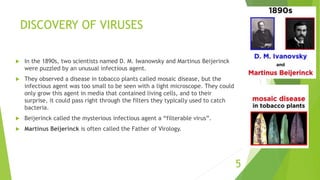
 In the 1890s, two scientists named D. M. Iwanowsky and Martinus Beijerinck
were puzzled by an unusual infectious agent.
 They observed a disease in tobacco plants called mosaic disease, but the
infectious agent was too small to be seen with a light microscope. They could
only grow this agent in media that contained living cells, and to their
surprise, it could pass right through the filters they typically used to catch
bacteria.
 Beijerinck called the mysterious infectious agent a “filterable virus”.
 Martinus Beijerinck is often called the Father of Virology.
5
DISCOVERY OF VIRUSES
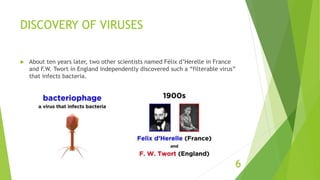
 About ten years later, two other scientists named Félix d’Herelle in France
and F.W. Twort in England independently discovered such a “filterable virus”
that infects bacteria.
6
INTRODUCTION TO VIRUS
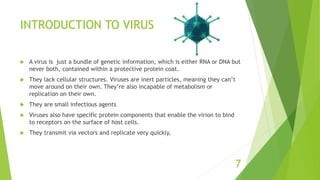
 A virus is just a bundle of genetic information, which is either RNA or DNA but
never both, contained within a protective protein coat.
 They lack cellular structures. Viruses are inert particles, meaning they can’t
move around on their own. They’re also incapable of metabolism or
replication on their own.
 They are small infectious agents
 Viruses also have specific protein components that enable the virion to bind
to receptors on the surface of host cells.
 They transmit via vectors and replicate very quickly,
7
VIRUSES
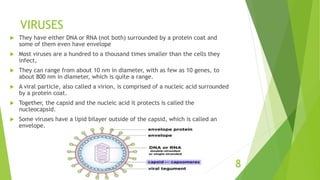
 They have either DNA or RNA (not both) surrounded by a protein coat and
some of them even have envelope
 Most viruses are a hundred to a thousand times smaller than the cells they
infect,
 They can range from about 10 nm in diameter, with as few as 10 genes, to
about 800 nm in diameter, which is quite a range.
 A viral particle, also called a virion, is comprised of a nucleic acid surrounded
by a protein coat.
 Together, the capsid and the nucleic acid it protects is called the
nucleocapsid.
 Some viruses have a lipid bilayer outside of the capsid, which is called an
envelope.
8
SINCE AND THEREFORE
 Since viruses cannot produce energy or make proteins.
 Therefore they cannot replicate outside the cell
 They have to be inside the host in order to replicate
 Therefore viruses are obligate intracellular parasites most scientists agree
that viruses are not alive, as they don’t fit the criteria we use to define life.
9
MODES OF VIRAL CATEGORIZATION
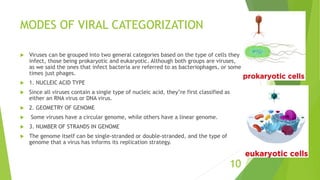
 Viruses can be grouped into two general categories based on the type of cells they
infect, those being prokaryotic and eukaryotic. Although both groups are viruses,
as we said the ones that infect bacteria are referred to as bacteriophages, or some
times just phages.
 1. NUCLEIC ACID TYPE
 Since all viruses contain a single type of nucleic acid, they’re first classified as
either an RNA virus or DNA virus.
 2. GEOMETRY OF GENOME
 Some viruses have a circular genome, while others have a linear genome.
 3. NUMBER OF STRANDS IN GENOME
 The genome itself can be single-stranded or double-stranded, and the type of
genome that a virus has informs its replication strategy.
10
VIRUS SHAPES
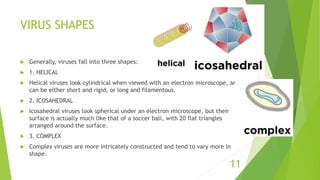
 Generally, viruses fall into three shapes:
 1. HELICAL
 Helical viruses look cylindrical when viewed with an electron microscope, and
can be either short and rigid, or long and filamentous.
 2. ICOSAHEDRAL
 Icosahedral viruses look spherical under an electron microscope, but their
surface is actually much like that of a soccer ball, with 20 flat triangles
arranged around the surface.
 3. COMPLEX
 Complex viruses are more intricately constructed and tend to vary more in
shape.
11
VIRAL CLASSIFICATION/NOMENCLATURE
 When it comes to viral classification and nomenclature, it can get pretty
messy. The good news is that there’s an entire international committee
dedicated to classifying viruses, called the International Committee on
Taxonomy of Viruses, or ICTV. According to this system,
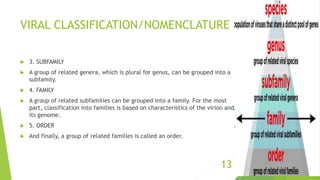
 1. SPECIES
 A species of virus is defined as a population of viruses that share a pool of
genes distinct from the gene pools of other viruses.
 2. GENUS
 Species of viruses can be grouped into a genus.
12
VIRAL CLASSIFICATION/NOMENCLATURE
 3. SUBFAMILY
 A group of related genera, which is plural for genus, can be grouped into a
subfamily.
 4. FAMILY
 A group of related subfamilies can be grouped into a family. For the most
part, classification into families is based on characteristics of the virion and
its genome.
 5. ORDER
 And finally, a group of related families is called an order.
13
SOME COMMON VIRUSES
 1. COVID-19
 Coronavirus disease (COVID-19) is an infectious disease caused by the SARS-CoV-2 virus.
 Most people who fall sick with COVID-19 will experience mild to moderate symptoms and
recover without special treatment. However, some will become seriously ill and require
medical attention.
 HOW IT SPREADS
 The virus can spread from an infected person’s mouth or nose in small liquid particles when
they cough, sneeze, speak, sing or breathe. These particles range from larger respiratory
droplets to smaller aerosols.
 Treatment
 Supportive care includes oxygen for severely ill patients and more advanced support such as
ventilation for critically ill patients.
 Dexamethasone is corticostereoid that can reduce the length of time on a ventilator.
14
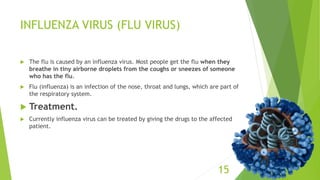
INFLUENZA VIRUS (FLU VIRUS)
 The flu is caused by an influenza virus. Most people get the flu when they
breathe in tiny airborne droplets from the coughs or sneezes of someone
who has the flu.
 Flu (influenza) is an infection of the nose, throat and lungs, which are part of
the respiratory system.
 Treatment.
 Currently influenza virus can be treated by giving the drugs to the affected
patient.
15
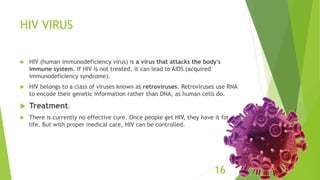
HIV VIRUS
 HIV (human immunodeficiency virus) is a virus that attacks the body's
immune system. If HIV is not treated, it can lead to AIDS (acquired
immunodeficiency syndrome).
 HIV belongs to a class of viruses known as retroviruses. Retroviruses use RNA
to encode their genetic information rather than DNA, as human cells do.
 Treatment.
 There is currently no effective cure. Once people get HIV, they have it for
life. But with proper medical care, HIV can be controlled.
16
17

VIROLOGY Presentation.pptx

  • 1.
  • 2.
    GROUP MEMBERS  RIAZALI SOOMRO:2K22/MLT/95  ABDUL GHAFFAR HALEPOTO:2K22/MLT/03  ABDUL MUNAIM KHOSO:2K22/MLT/05  OSHAQUE AHMED KANDHRO:2K22/MLT/88  RAMEEZ ALI BURIRO:2K22/MLT/93  ZOHAIB ALI UMRANI:2K22/MLT/127  ARSLAN ALI :2K22/MLT/18  DILDAR REBARI:2K22/MLT/29  YASIR MANSOOR:2K22/MLT/124  MUKESH KUMAR :2K22/MLT/79  NOOR MUHAMMAD KHOSO :2K22/MLT/87 2
  • 3.
  • 4.
    INTRODUCTION TO VIROLOGY Virology is the study of viruses and virus-like agents, including, but not limited to, their taxonomy, disease-producing properties, cultivation, and genetics.  Virus are unique unlike cells.  ALSO Viruses cannot make proteins and produce energy.  They are small to a extent that we need electron microscope to see them.  So we can say that they are not living organisms. 4
  • 5.
    DISCOVERY OF VIRUSES In the 1890s, two scientists named D. M. Iwanowsky and Martinus Beijerinck were puzzled by an unusual infectious agent.  They observed a disease in tobacco plants called mosaic disease, but the infectious agent was too small to be seen with a light microscope. They could only grow this agent in media that contained living cells, and to their surprise, it could pass right through the filters they typically used to catch bacteria.  Beijerinck called the mysterious infectious agent a “filterable virus”.  Martinus Beijerinck is often called the Father of Virology. 5
  • 6.
    DISCOVERY OF VIRUSES About ten years later, two other scientists named Félix d’Herelle in France and F.W. Twort in England independently discovered such a “filterable virus” that infects bacteria. 6
  • 7.
    INTRODUCTION TO VIRUS A virus is just a bundle of genetic information, which is either RNA or DNA but never both, contained within a protective protein coat.  They lack cellular structures. Viruses are inert particles, meaning they can’t move around on their own. They’re also incapable of metabolism or replication on their own.  They are small infectious agents  Viruses also have specific protein components that enable the virion to bind to receptors on the surface of host cells.  They transmit via vectors and replicate very quickly, 7
  • 8.
    VIRUSES  They haveeither DNA or RNA (not both) surrounded by a protein coat and some of them even have envelope  Most viruses are a hundred to a thousand times smaller than the cells they infect,  They can range from about 10 nm in diameter, with as few as 10 genes, to about 800 nm in diameter, which is quite a range.  A viral particle, also called a virion, is comprised of a nucleic acid surrounded by a protein coat.  Together, the capsid and the nucleic acid it protects is called the nucleocapsid.  Some viruses have a lipid bilayer outside of the capsid, which is called an envelope. 8
  • 9.
    SINCE AND THEREFORE Since viruses cannot produce energy or make proteins.  Therefore they cannot replicate outside the cell  They have to be inside the host in order to replicate  Therefore viruses are obligate intracellular parasites most scientists agree that viruses are not alive, as they don’t fit the criteria we use to define life. 9
  • 10.
    MODES OF VIRALCATEGORIZATION  Viruses can be grouped into two general categories based on the type of cells they infect, those being prokaryotic and eukaryotic. Although both groups are viruses, as we said the ones that infect bacteria are referred to as bacteriophages, or some times just phages.  1. NUCLEIC ACID TYPE  Since all viruses contain a single type of nucleic acid, they’re first classified as either an RNA virus or DNA virus.  2. GEOMETRY OF GENOME  Some viruses have a circular genome, while others have a linear genome.  3. NUMBER OF STRANDS IN GENOME  The genome itself can be single-stranded or double-stranded, and the type of genome that a virus has informs its replication strategy. 10
  • 11.
    VIRUS SHAPES  Generally,viruses fall into three shapes:  1. HELICAL  Helical viruses look cylindrical when viewed with an electron microscope, and can be either short and rigid, or long and filamentous.  2. ICOSAHEDRAL  Icosahedral viruses look spherical under an electron microscope, but their surface is actually much like that of a soccer ball, with 20 flat triangles arranged around the surface.  3. COMPLEX  Complex viruses are more intricately constructed and tend to vary more in shape. 11
  • 12.
    VIRAL CLASSIFICATION/NOMENCLATURE  Whenit comes to viral classification and nomenclature, it can get pretty messy. The good news is that there’s an entire international committee dedicated to classifying viruses, called the International Committee on Taxonomy of Viruses, or ICTV. According to this system,  1. SPECIES  A species of virus is defined as a population of viruses that share a pool of genes distinct from the gene pools of other viruses.  2. GENUS  Species of viruses can be grouped into a genus. 12
  • 13.
    VIRAL CLASSIFICATION/NOMENCLATURE  3.SUBFAMILY  A group of related genera, which is plural for genus, can be grouped into a subfamily.  4. FAMILY  A group of related subfamilies can be grouped into a family. For the most part, classification into families is based on characteristics of the virion and its genome.  5. ORDER  And finally, a group of related families is called an order. 13
  • 14.
    SOME COMMON VIRUSES 1. COVID-19  Coronavirus disease (COVID-19) is an infectious disease caused by the SARS-CoV-2 virus.  Most people who fall sick with COVID-19 will experience mild to moderate symptoms and recover without special treatment. However, some will become seriously ill and require medical attention.  HOW IT SPREADS  The virus can spread from an infected person’s mouth or nose in small liquid particles when they cough, sneeze, speak, sing or breathe. These particles range from larger respiratory droplets to smaller aerosols.  Treatment  Supportive care includes oxygen for severely ill patients and more advanced support such as ventilation for critically ill patients.  Dexamethasone is corticostereoid that can reduce the length of time on a ventilator. 14
  • 15.
    INFLUENZA VIRUS (FLUVIRUS)  The flu is caused by an influenza virus. Most people get the flu when they breathe in tiny airborne droplets from the coughs or sneezes of someone who has the flu.  Flu (influenza) is an infection of the nose, throat and lungs, which are part of the respiratory system.  Treatment.  Currently influenza virus can be treated by giving the drugs to the affected patient. 15
  • 16.
    HIV VIRUS  HIV(human immunodeficiency virus) is a virus that attacks the body's immune system. If HIV is not treated, it can lead to AIDS (acquired immunodeficiency syndrome).  HIV belongs to a class of viruses known as retroviruses. Retroviruses use RNA to encode their genetic information rather than DNA, as human cells do.  Treatment.  There is currently no effective cure. Once people get HIV, they have it for life. But with proper medical care, HIV can be controlled. 16
  • 17.