PRESENTED BY:
DEEPTANU DATTA
ROLL NO. 1811EE05
A
PRESENTATION
on
5G Smart Diabetes System
Guided by :
Dr. Preetam Kumar
Associate Professor
Department of Electrical
Engineering
IIT Patna
Indian Institute of Technology Patna
6 April 2019
1
Outlines
 Introduction
 What is smart healthcare ?
 5G in Healthcare
 Diabetes
 Drawbacks with the present diagnosis system
 5G Smart Diabetes System
 Advantages of 5G Smart Diabetes System
 5G Smart Diabetes System Architecture
 Three Layers of 5G Smart Diabetes System
 Effective Data Sharing Mechanism
 Conclusions
 References
6 April 2019
2
Smart Healthcare
 Smart Healthcare refers to use of smart devices and
smart healthcare sensors for better diagnosis and
improved treatment of patients
 With the rise in population, chronic diseases like
diabetes, asthma, obesity, arthritis etc. are more
spreading now a days
 So, there is a need for effective smart healthcare
monitoring system
6 April 2019
3
Smart Healthcare System
6 April 2019
4
5G in Healthcare
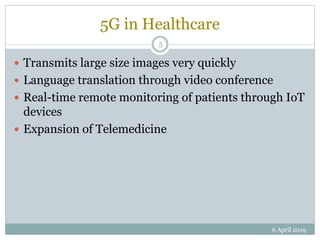
 Transmits large size images very quickly
 Language translation through video conference
 Real-time remote monitoring of patients through IoT
devices
 Expansion of Telemedicine
6 April 2019
5
Diabetes – a chronic disease
 Diabetes is a very common chronic disease that
affects 8.5 % of world’s population.
 Statistics shows that nearly 422 million people
suffers from diabetes per year
 It arises when the level of blood glucose in the body
increases
6 April 2019
6
Drawbacks with present diagnosis system
 System is not reliable
 Real-time data collection is difficult
 Lacks in continuous monitoring of patients
 Lacks in data sharing mechanism and personalized
data analysis
 There are no continuous suggestions for the
prevention and treatment of diabetes
6 April 2019
7
IDEA : INTEGRATION OF MODERN
TECHNOLOGIES, LIKE 5G MOBILE
NETWORKS, BIG DATA NETWORK,
MACHINE LEARNING, SMART
CLOTHING, MONITORING DEVICES
Solution : 5G-Smart Diabetes
System
6 April 2019
8
Advantages of 5G Smart diabetes system
 Low cost : Facilitates out of hospital treatment so
cost of treatment is reduced
 Comfort : It ensures that daily activities of the
patients’ is not disturbed
 Personalization : By collecting blood glucose data
through machine learning algorithm, it personalized
treatment for patients
 Smartness : Early detection of the disease is possible
with this system
6 April 2019
9
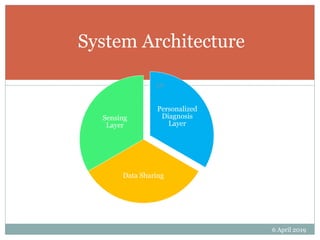
System Architecture
Personalized
Diagnosis
Layer
Data Sharing
Sensing
Layer
6 April 2019
10
Sensing Layer
 It senses physical information of the patient by
sensors
 Blood sugar is collected by blood glucose monitoring
device
 Body signals, like temperature and blood oxygen are
collected on real-time basis by smart clothing
 Data about physical activity of the patients, kcal
burned in exercise is collected by smart phone.
 All the data are uploaded to healthcare big data
cloud by 5G Network
6 April 2019
11
EFFICIENT MODELS ARE BUILD TO
ANALYSE AND PREDICT DIABETES BY
MACHINE LEARNING ALGORITHMS
Personalized Diagnosis Layer
6 April 2019
12
Data Sharing Layer
 It consists of social space and data space
 Social space is derived from social relationships
among patients, friends, personal health advisors,
and doctors
 Data space is constructed on the basis of different
patients’ data stored in different clouds
 Motive is to share data in these spaces efficiently in
terms of cost
 Patients living in nearby areas share data in same
cloud so cost of communication is less and vice-versa
6 April 2019
13
System Architecture of 5G Smart Diabetes
6 April 2019
14
Effective Data Sharing Mechanism
 Let D = (dij)n x n denotes data distances
between patient i’s data & patient j’s data in
cloud
 ‘n’ is the number of diabetes patients
 ‘D’ determines data sharing cost
 More is the distance between clouds in which
patient i and patient j store data, more is the
value of dij
 If both patients store data in same cloud, dij = O
6 April 2019
15
Effective Data Sharing Mechanism (Contd…)
 Let W = (wij)n x n denotes social relationship between
patient ‘i’ and patient ‘j’
 If patient ‘i’ and patient ‘j’ knows each other very
closely, ‘wij’ is large.
 If two patients do not know each other, wij = O
 Two patients share data if they knows each other
very well (Large wij)
 So, main objective is to maximise data sharing (high
W) with minimum communication cost (low D)
6 April 2019
16
Data Sharing and Personalized Analysis Model
6 April 2019
17
Results of Case Study
6 April 2019
18
Conclusions
 There is a high demand of 5G Network in healthcare
monitoring system
 5G Smart Diabetes System almost eliminates the
drawbacks with the present diagnosis system
 Patients can be continuously monitored as doctors
can access his data from big data cloud
 All these are achieved with very less suffering and
pains unlike in the case of hospital
6 April 2019
19
References
[1] Min Chen, Jun Yang, Jiehan Zhou, Yixue Hao, Jing Zhang, Chan-
Hyun Youn, “5G-Smart Diabetes : Toward Personalized Diabetes
Diagnosis with Healthcare Big Data Clouds” IEEE Communications
Magazine, April 2018
[2] https://www.technavio.com/blog/top-5-healthcare-technologies-
changing-global-smart-healthcare-market
[3] Min Chen, Yujun Ma, Yong Li, Di Wu, Yin Zhang, and Chan-Hyun
Youn, “Wearable 2.0: Enabling Human-Cloud Integration in Next
Generation Healthcare Systems” IEEE Communications Magazine,
January 2017
[4] Kazem Sohraby, Daniel Minoli, and Taieb Znati, “Wireless Sensor
Networks - Technology, Protocols, and Applications” WILEY Publishers
[5] https://www.business.att.com/learn/updates/how-5g-will-transform-
the-healthcare-industry.html
6 April 2019
20
THANK YOU
6 April 2019

5G for Healthcare

  • 1.
    PRESENTED BY: DEEPTANU DATTA ROLLNO. 1811EE05 A PRESENTATION on 5G Smart Diabetes System Guided by : Dr. Preetam Kumar Associate Professor Department of Electrical Engineering IIT Patna Indian Institute of Technology Patna 6 April 2019 1
  • 2.
    Outlines  Introduction  Whatis smart healthcare ?  5G in Healthcare  Diabetes  Drawbacks with the present diagnosis system  5G Smart Diabetes System  Advantages of 5G Smart Diabetes System  5G Smart Diabetes System Architecture  Three Layers of 5G Smart Diabetes System  Effective Data Sharing Mechanism  Conclusions  References 6 April 2019 2
  • 3.
    Smart Healthcare  SmartHealthcare refers to use of smart devices and smart healthcare sensors for better diagnosis and improved treatment of patients  With the rise in population, chronic diseases like diabetes, asthma, obesity, arthritis etc. are more spreading now a days  So, there is a need for effective smart healthcare monitoring system 6 April 2019 3
  • 4.
  • 5.
    5G in Healthcare Transmits large size images very quickly  Language translation through video conference  Real-time remote monitoring of patients through IoT devices  Expansion of Telemedicine 6 April 2019 5
  • 6.
    Diabetes – achronic disease  Diabetes is a very common chronic disease that affects 8.5 % of world’s population.  Statistics shows that nearly 422 million people suffers from diabetes per year  It arises when the level of blood glucose in the body increases 6 April 2019 6
  • 7.
    Drawbacks with presentdiagnosis system  System is not reliable  Real-time data collection is difficult  Lacks in continuous monitoring of patients  Lacks in data sharing mechanism and personalized data analysis  There are no continuous suggestions for the prevention and treatment of diabetes 6 April 2019 7
  • 8.
    IDEA : INTEGRATIONOF MODERN TECHNOLOGIES, LIKE 5G MOBILE NETWORKS, BIG DATA NETWORK, MACHINE LEARNING, SMART CLOTHING, MONITORING DEVICES Solution : 5G-Smart Diabetes System 6 April 2019 8
  • 9.
    Advantages of 5GSmart diabetes system  Low cost : Facilitates out of hospital treatment so cost of treatment is reduced  Comfort : It ensures that daily activities of the patients’ is not disturbed  Personalization : By collecting blood glucose data through machine learning algorithm, it personalized treatment for patients  Smartness : Early detection of the disease is possible with this system 6 April 2019 9
  • 10.
  • 11.
    Sensing Layer  Itsenses physical information of the patient by sensors  Blood sugar is collected by blood glucose monitoring device  Body signals, like temperature and blood oxygen are collected on real-time basis by smart clothing  Data about physical activity of the patients, kcal burned in exercise is collected by smart phone.  All the data are uploaded to healthcare big data cloud by 5G Network 6 April 2019 11
  • 12.
    EFFICIENT MODELS AREBUILD TO ANALYSE AND PREDICT DIABETES BY MACHINE LEARNING ALGORITHMS Personalized Diagnosis Layer 6 April 2019 12
  • 13.
    Data Sharing Layer It consists of social space and data space  Social space is derived from social relationships among patients, friends, personal health advisors, and doctors  Data space is constructed on the basis of different patients’ data stored in different clouds  Motive is to share data in these spaces efficiently in terms of cost  Patients living in nearby areas share data in same cloud so cost of communication is less and vice-versa 6 April 2019 13
  • 14.
    System Architecture of5G Smart Diabetes 6 April 2019 14
  • 15.
    Effective Data SharingMechanism  Let D = (dij)n x n denotes data distances between patient i’s data & patient j’s data in cloud  ‘n’ is the number of diabetes patients  ‘D’ determines data sharing cost  More is the distance between clouds in which patient i and patient j store data, more is the value of dij  If both patients store data in same cloud, dij = O 6 April 2019 15
  • 16.
    Effective Data SharingMechanism (Contd…)  Let W = (wij)n x n denotes social relationship between patient ‘i’ and patient ‘j’  If patient ‘i’ and patient ‘j’ knows each other very closely, ‘wij’ is large.  If two patients do not know each other, wij = O  Two patients share data if they knows each other very well (Large wij)  So, main objective is to maximise data sharing (high W) with minimum communication cost (low D) 6 April 2019 16
  • 17.
    Data Sharing andPersonalized Analysis Model 6 April 2019 17
  • 18.
    Results of CaseStudy 6 April 2019 18
  • 19.
    Conclusions  There isa high demand of 5G Network in healthcare monitoring system  5G Smart Diabetes System almost eliminates the drawbacks with the present diagnosis system  Patients can be continuously monitored as doctors can access his data from big data cloud  All these are achieved with very less suffering and pains unlike in the case of hospital 6 April 2019 19
  • 20.
    References [1] Min Chen,Jun Yang, Jiehan Zhou, Yixue Hao, Jing Zhang, Chan- Hyun Youn, “5G-Smart Diabetes : Toward Personalized Diabetes Diagnosis with Healthcare Big Data Clouds” IEEE Communications Magazine, April 2018 [2] https://www.technavio.com/blog/top-5-healthcare-technologies- changing-global-smart-healthcare-market [3] Min Chen, Yujun Ma, Yong Li, Di Wu, Yin Zhang, and Chan-Hyun Youn, “Wearable 2.0: Enabling Human-Cloud Integration in Next Generation Healthcare Systems” IEEE Communications Magazine, January 2017 [4] Kazem Sohraby, Daniel Minoli, and Taieb Znati, “Wireless Sensor Networks - Technology, Protocols, and Applications” WILEY Publishers [5] https://www.business.att.com/learn/updates/how-5g-will-transform- the-healthcare-industry.html 6 April 2019 20
  • 21.