Recognition in the EHEA
   An overview of HE reform in Europe
   Dr Justin Fenech       FAIRE
   Anthony F. Camilleri
www.KIC-malta.com         Coimbra – Portugal
What is the
Bologna Process?


www.KIC-malta.com
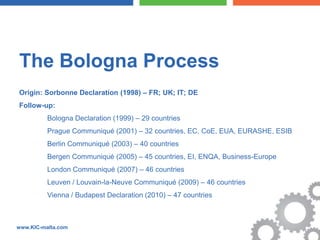
The Bologna Process
Origin: Sorbonne Declaration (1998) – FR; UK; IT; DE
Follow-up:
        Bologna Declaration (1999) – 29 countries
        Prague Communiqué (2001) – 32 countries, EC, CoE, EUA, EURASHE, ESIB
        Berlin Communiqué (2003) – 40 countries
        Bergen Communiqué (2005) – 45 countries, EI, ENQA, Business-Europe
        London Communiqué (2007) – 46 countries
        Leuven / Louvain-la-Neuve Communiqué (2009) – 46 countries
        Vienna / Budapest Declaration (2010) – 47 countries


www.KIC-malta.com
The Bologna Process
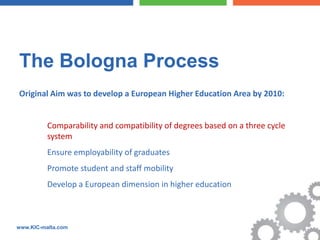
Original Aim was to develop a European Higher Education Area by 2010:


        Comparability and compatibility of degrees based on a three cycle
         system
        Ensure employability of graduates
        Promote student and staff mobility
        Develop a European dimension in higher education


www.KIC-malta.com
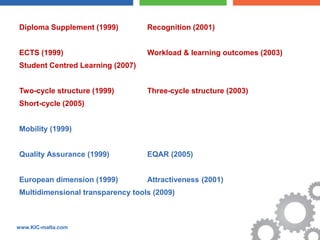
Diploma Supplement (1999)         Recognition (2001)


ECTS (1999)                       Workload & learning outcomes (2003)
Student Centred Learning (2007)


Two-cycle structure (1999)        Three-cycle structure (2003)
Short-cycle (2005)


Mobility (1999)


Quality Assurance (1999)          EQAR (2005)


European dimension (1999)         Attractiveness (2001)
Multidimensional transparency tools (2009)


www.KIC-malta.com
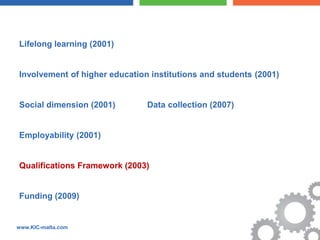
Lifelong learning (2001)


Involvement of higher education institutions and students (2001)


Social dimension (2001)        Data collection (2007)


Employability (2001)


Qualifications Framework (2003)


Funding (2009)


www.KIC-malta.com
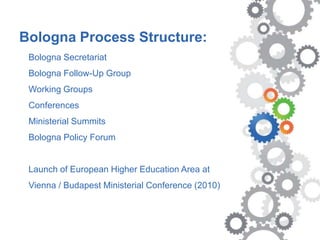
Bologna Process Structure:
   Bologna Secretariat
   Bologna Follow-Up Group
   Working Groups
   Conferences
   Ministerial Summits
   Bologna Policy Forum


   Launch of European Higher Education Area at
   Vienna / Budapest Ministerial Conference (2010)


www.KIC-malta.com
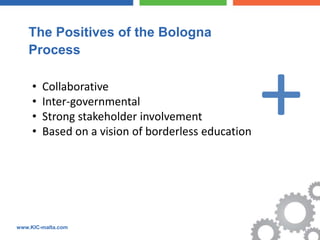
 The Positives of the Bologna
  Process

     •
     •
     •
     •
         Collaborative
         Inter-governmental
         Strong stakeholder involvement
         Based on a vision of borderless education
                                                     +
www.KIC-malta.com
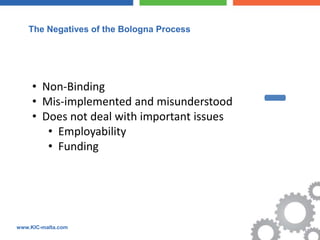
 The Negatives of the Bologna Process


     • Non-Binding
     • Mis-implemented and misunderstood
     • Does not deal with important issues
        • Employability
        • Funding
                                             -
www.KIC-malta.com
Bologna Process
Concepts


www.KIC-malta.com
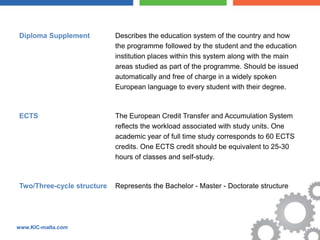
Diploma Supplement          Describes the education system of the country and how
                            the programme followed by the student and the education
                            institution places within this system along with the main
                            areas studied as part of the programme. Should be issued
                            automatically and free of charge in a widely spoken
                            European language to every student with their degree.


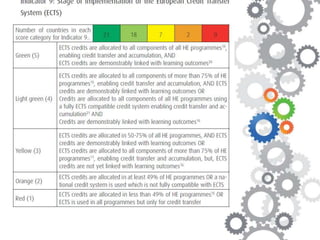
ECTS                        The European Credit Transfer and Accumulation System
                            reflects the workload associated with study units. One
                            academic year of full time study corresponds to 60 ECTS
                            credits. One ECTS credit should be equivalent to 25-30
                            hours of classes and self-study.


Two/Three-cycle structure   Represents the Bachelor - Master - Doctorate structure


www.KIC-malta.com
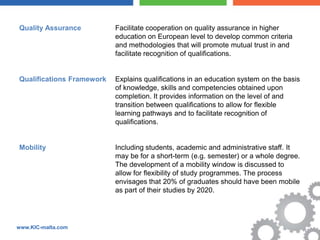
Quality Assurance          Facilitate cooperation on quality assurance in higher
                           education on European level to develop common criteria
                           and methodologies that will promote mutual trust in and
                           facilitate recognition of qualifications.


Qualifications Framework   Explains qualifications in an education system on the basis
                           of knowledge, skills and competencies obtained upon
                           completion. It provides information on the level of and
                           transition between qualifications to allow for flexible
                           learning pathways and to facilitate recognition of
                           qualifications.


Mobility                   Including students, academic and administrative staff. It
                           may be for a short-term (e.g. semester) or a whole degree.
                           The development of a mobility window is discussed to
                           allow for flexibility of study programmes. The process
                           envisages that 20% of graduates should have been mobile
                           as part of their studies by 2020.


www.KIC-malta.com
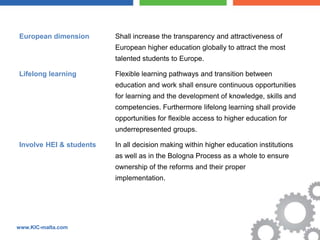
European dimension       Shall increase the transparency and attractiveness of
                         European higher education globally to attract the most
                         talented students to Europe.

Lifelong learning        Flexible learning pathways and transition between
                         education and work shall ensure continuous opportunities
                         for learning and the development of knowledge, skills and
                         competencies. Furthermore lifelong learning shall provide
                         opportunities for flexible access to higher education for
                         underrepresented groups.

Involve HEI & students   In all decision making within higher education institutions
                         as well as in the Bologna Process as a whole to ensure
                         ownership of the reforms and their proper
                         implementation.


www.KIC-malta.com
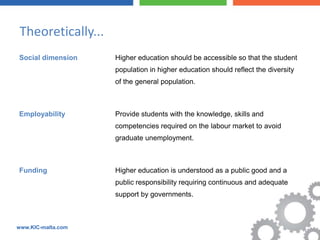
Theoretically...
Social dimension    Higher education should be accessible so that the student
                    population in higher education should reflect the diversity
                    of the general population.


Employability       Provide students with the knowledge, skills and
                    competencies required on the labour market to avoid
                    graduate unemployment.


Funding             Higher education is understood as a public good and a
                    public responsibility requiring continuous and adequate
                    support by governments.


www.KIC-malta.com
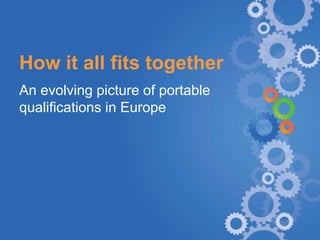
How it all fits together
An evolving picture of portable
qualifications in Europe


www.KIC-malta.com
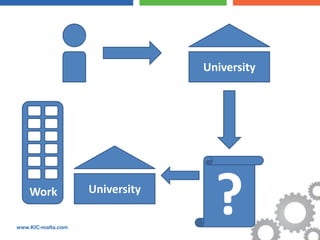
University


    Work

www.KIC-malta.com
                    University
                                   ?
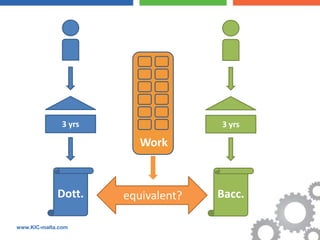
3 yrs                 3 yrs

                          Work


             Dott.     equivalent?   Bacc.

www.KIC-malta.com
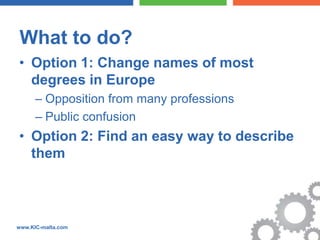
What to do?
• Option 1: Change names of most
  degrees in Europe
      – Opposition from many professions
      – Public confusion
• Option 2: Find an easy way to describe
  them


www.KIC-malta.com
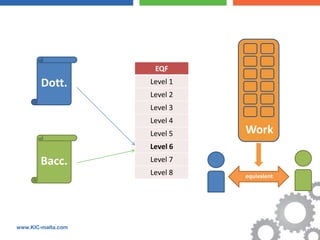
EQF
        Dott.       Level 1
                    Level 2
                    Level 3
                    Level 4
                    Level 5   Work
                    Level 6
        Bacc.       Level 7
                    Level 8   equivalent


www.KIC-malta.com
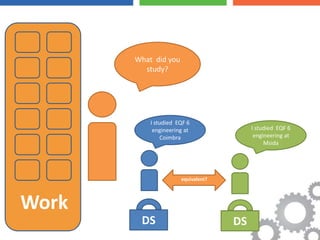
What did you
                      study?


                        I studied EQF 6
                         engineering at               I studied EQF 6
                            Coimbra                    engineering at
                                                           Msida


                                   equivalent?


 Work
www.KIC-malta.com
                     DS                          DS
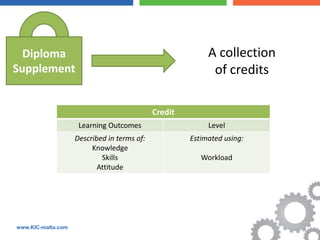
Diploma                                                  A collection
Supplement                                                  of credits

                                             Credit
                     Learning Outcomes                     Level
                    Described in terms of:            Estimated using:
                         Knowledge
                            Skills                       Workload
                           Attitude


www.KIC-malta.com
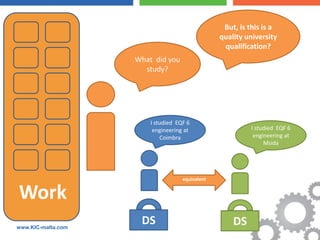
But, is this is a
                                                 quality university
                                                  qualification?
                    What did you
                      study?


                        I studied EQF 6
                         engineering at                   I studied EQF 6
                            Coimbra                        engineering at
                                                               Msida


                                    equivalent


Work
www.KIC-malta.com
                     DS                              DS
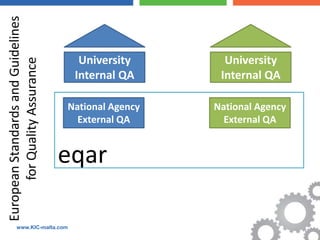
European Standards and Guidelines


                                      University        University
      for Quality Assurance


                                     Internal QA       Internal QA

                                    National Agency   National Agency
                                      External QA       External QA


                                    eqar

        www.KIC-malta.com
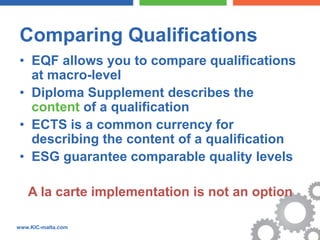
Comparing Qualifications
 • EQF allows you to compare qualifications
   at macro-level
 • Diploma Supplement describes the
   content of a qualification
 • ECTS is a common currency for
   describing the content of a qualification
 • ESG guarantee comparable quality levels

   A la carte implementation is not an option

www.KIC-malta.com
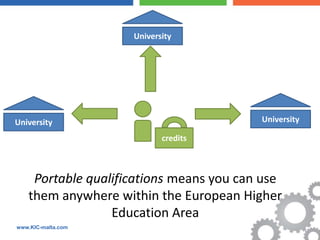
University


University                               University

                           credits


    Portable qualifications means you can use
   them anywhere within the European Higher
                 Education Area
www.KIC-malta.com
Bologna Process
Implementation

Reform of
Degree Structure


www.KIC-malta.com
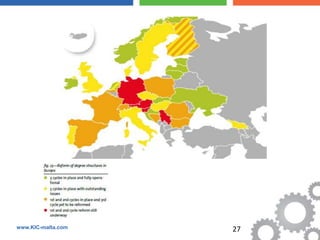
www.KIC-malta.com   27
Bologna Process
Implementation

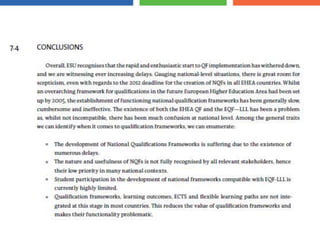
Qualification
Framework


www.KIC-malta.com
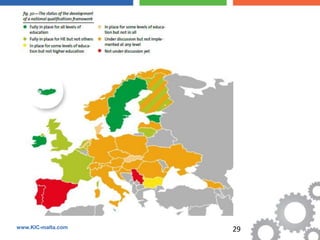
www.KIC-malta.com   29
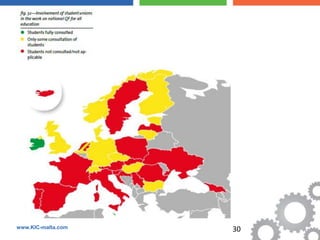
www.KIC-malta.com   30
Bologna Process
Implementation

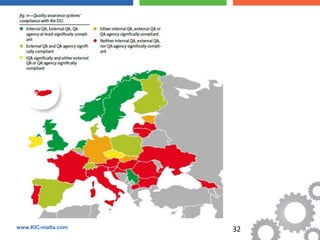
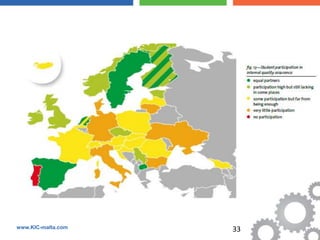
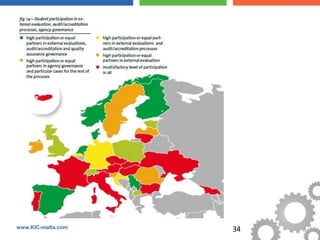
Quality Assurance


www.KIC-malta.com
www.KIC-malta.com   32
www.KIC-malta.com   33
www.KIC-malta.com   34
Bologna Process
Implementation

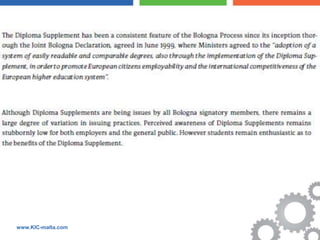
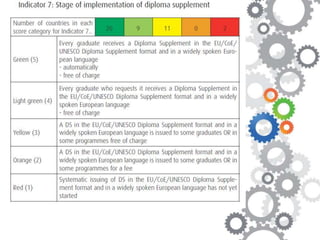
Diploma Supplement


www.KIC-malta.com
www.KIC-malta.com
www.KIC-malta.com
Bologna Process
Implementation

ECTS


www.KIC-malta.com
www.KIC-malta.com
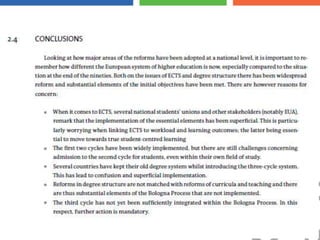
The Bologna Process
European Student Position


www.KIC-malta.com
www.KIC-malta.com
www.KIC-malta.com
Obrigado!
           Thank-you for your attention

                                Questions?


                      Dr Justin Fenech (justin@kic-malta.com)
                    Anthony F. Camilleri (anthony@kic-malta.com)


www.KIC-malta.com

Introduction to the Bologna Process

  • 1.
    Recognition in theEHEA An overview of HE reform in Europe Dr Justin Fenech FAIRE Anthony F. Camilleri www.KIC-malta.com Coimbra – Portugal
  • 2.
    What is the BolognaProcess? www.KIC-malta.com
  • 3.
    The Bologna Process Origin:Sorbonne Declaration (1998) – FR; UK; IT; DE Follow-up:  Bologna Declaration (1999) – 29 countries  Prague Communiqué (2001) – 32 countries, EC, CoE, EUA, EURASHE, ESIB  Berlin Communiqué (2003) – 40 countries  Bergen Communiqué (2005) – 45 countries, EI, ENQA, Business-Europe  London Communiqué (2007) – 46 countries  Leuven / Louvain-la-Neuve Communiqué (2009) – 46 countries  Vienna / Budapest Declaration (2010) – 47 countries www.KIC-malta.com
  • 4.
    The Bologna Process OriginalAim was to develop a European Higher Education Area by 2010:  Comparability and compatibility of degrees based on a three cycle system  Ensure employability of graduates  Promote student and staff mobility  Develop a European dimension in higher education www.KIC-malta.com
  • 5.
    Diploma Supplement (1999) Recognition (2001) ECTS (1999) Workload & learning outcomes (2003) Student Centred Learning (2007) Two-cycle structure (1999) Three-cycle structure (2003) Short-cycle (2005) Mobility (1999) Quality Assurance (1999) EQAR (2005) European dimension (1999) Attractiveness (2001) Multidimensional transparency tools (2009) www.KIC-malta.com
  • 6.
    Lifelong learning (2001) Involvementof higher education institutions and students (2001) Social dimension (2001) Data collection (2007) Employability (2001) Qualifications Framework (2003) Funding (2009) www.KIC-malta.com
  • 7.
    Bologna Process Structure: Bologna Secretariat Bologna Follow-Up Group Working Groups Conferences Ministerial Summits Bologna Policy Forum Launch of European Higher Education Area at Vienna / Budapest Ministerial Conference (2010) www.KIC-malta.com
  • 8.
     The Positivesof the Bologna Process • • • • Collaborative Inter-governmental Strong stakeholder involvement Based on a vision of borderless education + www.KIC-malta.com
  • 9.
     The Negativesof the Bologna Process • Non-Binding • Mis-implemented and misunderstood • Does not deal with important issues • Employability • Funding - www.KIC-malta.com
  • 10.
  • 11.
    Diploma Supplement Describes the education system of the country and how the programme followed by the student and the education institution places within this system along with the main areas studied as part of the programme. Should be issued automatically and free of charge in a widely spoken European language to every student with their degree. ECTS The European Credit Transfer and Accumulation System reflects the workload associated with study units. One academic year of full time study corresponds to 60 ECTS credits. One ECTS credit should be equivalent to 25-30 hours of classes and self-study. Two/Three-cycle structure Represents the Bachelor - Master - Doctorate structure www.KIC-malta.com
  • 12.
    Quality Assurance Facilitate cooperation on quality assurance in higher education on European level to develop common criteria and methodologies that will promote mutual trust in and facilitate recognition of qualifications. Qualifications Framework Explains qualifications in an education system on the basis of knowledge, skills and competencies obtained upon completion. It provides information on the level of and transition between qualifications to allow for flexible learning pathways and to facilitate recognition of qualifications. Mobility Including students, academic and administrative staff. It may be for a short-term (e.g. semester) or a whole degree. The development of a mobility window is discussed to allow for flexibility of study programmes. The process envisages that 20% of graduates should have been mobile as part of their studies by 2020. www.KIC-malta.com
  • 13.
    European dimension Shall increase the transparency and attractiveness of European higher education globally to attract the most talented students to Europe. Lifelong learning Flexible learning pathways and transition between education and work shall ensure continuous opportunities for learning and the development of knowledge, skills and competencies. Furthermore lifelong learning shall provide opportunities for flexible access to higher education for underrepresented groups. Involve HEI & students In all decision making within higher education institutions as well as in the Bologna Process as a whole to ensure ownership of the reforms and their proper implementation. www.KIC-malta.com
  • 14.
    Theoretically... Social dimension Higher education should be accessible so that the student population in higher education should reflect the diversity of the general population. Employability Provide students with the knowledge, skills and competencies required on the labour market to avoid graduate unemployment. Funding Higher education is understood as a public good and a public responsibility requiring continuous and adequate support by governments. www.KIC-malta.com
  • 15.
    How it allfits together An evolving picture of portable qualifications in Europe www.KIC-malta.com
  • 16.
    University Work www.KIC-malta.com University ?
  • 17.
    3 yrs 3 yrs Work Dott. equivalent? Bacc. www.KIC-malta.com
  • 18.
    What to do? •Option 1: Change names of most degrees in Europe – Opposition from many professions – Public confusion • Option 2: Find an easy way to describe them www.KIC-malta.com
  • 19.
    EQF Dott. Level 1 Level 2 Level 3 Level 4 Level 5 Work Level 6 Bacc. Level 7 Level 8 equivalent www.KIC-malta.com
  • 20.
    What did you study? I studied EQF 6 engineering at I studied EQF 6 Coimbra engineering at Msida equivalent? Work www.KIC-malta.com DS DS
  • 21.
    Diploma A collection Supplement of credits Credit Learning Outcomes Level Described in terms of: Estimated using: Knowledge Skills Workload Attitude www.KIC-malta.com
  • 22.
    But, is thisis a quality university qualification? What did you study? I studied EQF 6 engineering at I studied EQF 6 Coimbra engineering at Msida equivalent Work www.KIC-malta.com DS DS
  • 23.
    European Standards andGuidelines University University for Quality Assurance Internal QA Internal QA National Agency National Agency External QA External QA eqar www.KIC-malta.com
  • 24.
    Comparing Qualifications •EQF allows you to compare qualifications at macro-level • Diploma Supplement describes the content of a qualification • ECTS is a common currency for describing the content of a qualification • ESG guarantee comparable quality levels A la carte implementation is not an option www.KIC-malta.com
  • 25.
    University University University credits Portable qualifications means you can use them anywhere within the European Higher Education Area www.KIC-malta.com
  • 26.
  • 27.
  • 28.
  • 29.
  • 30.
  • 31.
  • 32.
  • 33.
  • 34.
  • 35.
  • 36.
  • 37.
  • 38.
  • 39.
  • 40.
    The Bologna Process EuropeanStudent Position www.KIC-malta.com
  • 41.
  • 42.
  • 43.
    Obrigado! Thank-you for your attention Questions? Dr Justin Fenech (justin@kic-malta.com) Anthony F. Camilleri (anthony@kic-malta.com) www.KIC-malta.com