Blockchain in Education
USAGE SCENARIOS IN THE EUROPEAN EDUCATION AREA
8 FEBRUARY 2018
EUROPEAN COMMISSION, BRUSSELS
Alex Grech & Anthony F. Camilleri
ASK QUESTIONS
ANSWER QUESTIONS
WWW.SLIDO.COM/BLC
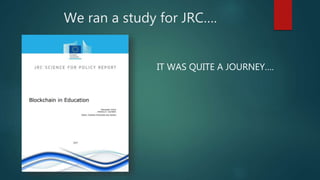
We ran a study for JRC….
IT WAS QUITE A JOURNEY….
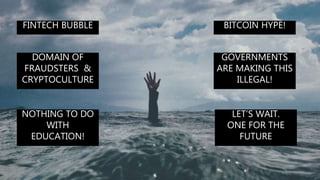
DOMAIN OF
FRAUDSTERS &
CRYPTOCULTURE
BITCOIN HYPE!FINTECH BUBBLE
LET’S WAIT.
ONE FOR THE
FUTURE
GOVERNMENTS
ARE MAKING THIS
ILLEGAL!
NOTHING TO DO
WITH
EDUCATION!
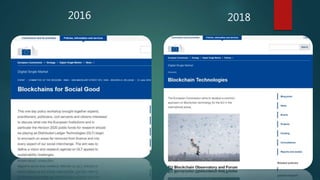
2016 2018
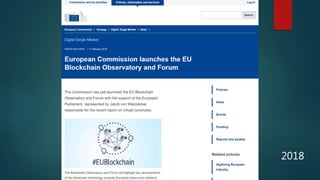
2018
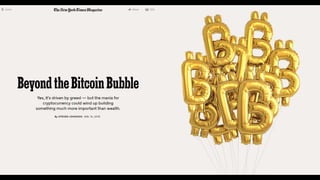
"If there's one thing we've learned from the
recent history of the internet, it's that
seemingly esoteric decisions about software
architecture can unleash profound global
forces once the technology moves into wider
circulation".
Steven Johnson
New York Times, January 16 2018
WHAT IS BLOCKCHAIN?
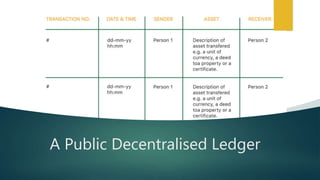
A Public Decentralised Ledger
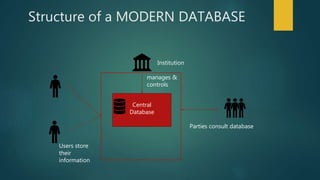
Central
Database
Structure of a MODERN DATABASE
Users store
their
information
Institution
manages &
controls
Parties consult database
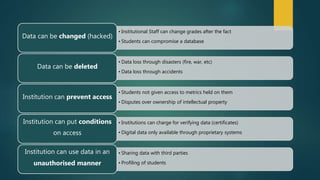
WHAT CAN GO WRONG?
• Institutional Staff can change grades after the fact
• Students can compromise a database
Data can be changed (hacked)
• Data loss through disasters (fire, war, etc)
• Data loss through accidents
Data can be deleted
• Students not given access to metrics held on them
• Disputes over ownership of intellectual property
Institution can prevent access
• Institutions can charge for verifying data (certificates)
• Digital data only available through proprietary systems
Institution can put conditions
on access
• Sharing data with third parties
• Profiling of students
Institution can use data in an
unauthorised manner
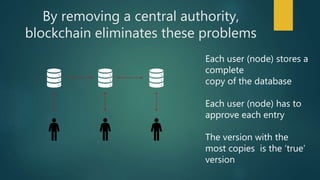
By removing a central authority,
blockchain eliminates these problems
Each user (node) stores a
complete
copy of the database
Each user (node) has to
approve each entry
The version with the
most copies is the ‘true’
version
THE
SOCIAL VALUE
PROPOSITION
OF BLOCKHAIN
SELF-
SOVEREIGNTY
& IDENTITY
TRUST
TRANSPARENCY
& PROVENANCE
IMMUTABILITY
DISINTERMEDIATION
HOW BLOCKCHAIN IS
STARTING TO IMPACT
EDUCATION
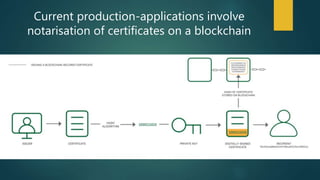
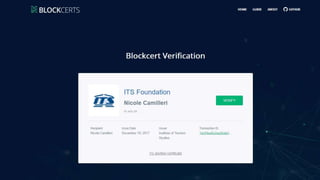
Current production-applications involve
notarisation of certificates on a blockchain
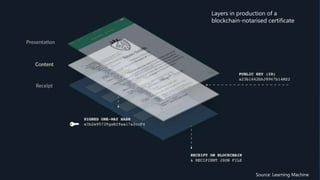
Layers in production of a
blockchain-notarised certificate
Source: Learning Machine
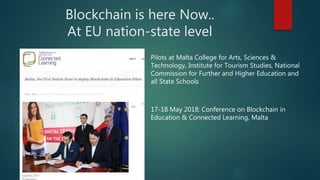
Blockchain is here Now..
At EU nation-state level
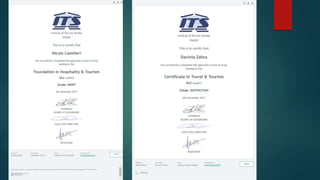
Pilots at Malta College for Arts, Sciences &
Technology, Institute for Tourism Studies, National
Commission for Further and Higher Education and
all State Schools
17-18 May 2018: Conference on Blockchain in
Education & Connected Learning, Malta
HOW MIGHT BLOCKCHAIN
‘DISRUPT’ EDUCATION
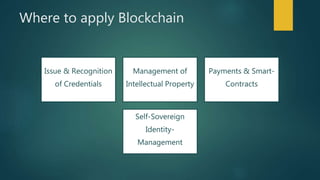
Where to apply Blockchain
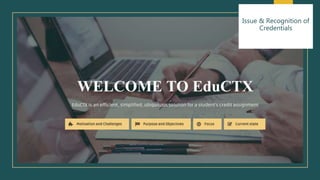
Issue & Recognition
of Credentials
Management of
Intellectual Property
Payments & Smart-
Contracts
Self-Sovereign
Identity-
Management
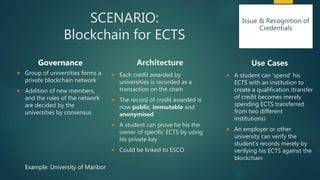
SCENARIO:
Blockchain for ECTS
Governance
 Group of universities forms a
private blockchain network
 Addition of new members,
and the rules of the network
are decided by the
universities by consensus
Architecture
 Each credit awarded by
universities is recorded as a
transaction on the chain
 The record of credit awarded is
now public, immutable and
anonymised
 A student can prove he his the
owner of specific ECTS by using
his private key
 Could be linked to ESCO
Use Cases
 A student can ‘spend’ his
ECTS with an institution to
create a qualification (transfer
of credit becomes merely
spending ECTS transferred
from two different
institutions)
 An employer or other
university can verify the
student’s records merely by
verifying his ECTS against the
blockchain
Example: University of Maribor
Issue & Recognition of
Credentials
Issue & Recognition of
Credentials
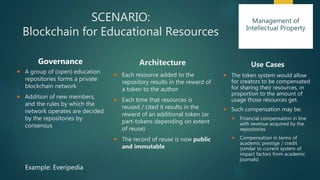
SCENARIO:
Blockchain for Educational Resources

Governance
 A group of (open) education
repositories forms a private
blockchain network
 Addition of new members,
and the rules by which the
network operates are decided
by the repositories by
consensus
Architecture
 Each resource added to the
repository results in the reward of
a token to the author
 Each time that resources is
reused / cited it results in the
reward of an additional token (or
part-tokens depending on extent
of reuse)
 The record of reuse is now public
and immutable
Use Cases
 The token system would allow
for creators to be compensated
for sharing their resources, in
proportion to the amount of
usage those resources get.
 Such compensation may be:
 Financial compensation in line
with revenue acquired by the
repositories
 Compensation in terms of
academic prestige / credit
(similar to current system of
impact factors from academic
journals)
Example: Everipedia
Management of
Intellectual Property
Management of
Intellectual Property
SCENARIO:
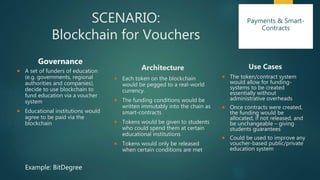
Blockchain for Vouchers
Governance
 A set of funders of education
(e.g. governments, regional
authorities and companies),
decide to use blockchain to
fund education via a voucher
system
 Educational institutions would
agree to be paid via the
blockchain
Architecture
 Each token on the blockchain
would be pegged to a real-world
currency.
 The funding conditions would be
written immutably into the chain as
smart-contracts
 Tokens would be given to students
who could spend them at certain
educational institutions
 Tokens would only be released
when certain conditions are met
Use Cases
 The token/contract system
would allow for funding-
systems to be created
essentially without
administrative overheads
 Once contracts were created,
the funding would be
allocated, if not released, and
be unchangeable – giving
students guarantees
 Could be used to improve any
voucher-based public/private
education system
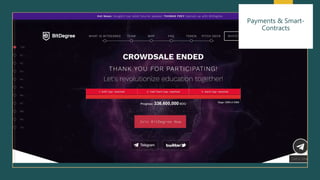
Example: BitDegree
Payments & Smart-
Contracts
Payments & Smart-
Contracts
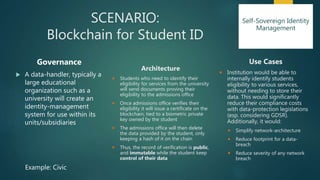
SCENARIO:
Blockchain for Student ID
Governance
 A data-handler, typically a
large educational
organization such as a
university will create an
identity-management
system for use within its
units/subsidiaries
Architecture
 Students who need to identify their
eligibility for services from the university
will send documents proving their
eligibility to the admissions office
 Once admissions office verifies their
eligibility it will issue a certificate on the
blockchain, tied to a biometric private
key owned by the student
 The admissions office will then delete
the data provided by the student, only
keeping a hash of it on the chain
 Thus, the record of verification is public,
and immutable while the student keep
control of their data
Use Cases
 Institution would be able to
internally identify students
eligibility to various services,
without needing to store their
data. This would significantly
reduce their compliance costs
with data-protection legislations
(esp. considering GDSR).
Additionally, it would:
 Simplify network-architecture
 Reduce footprint for a data-
breach
 Reduce severity of any network
breach
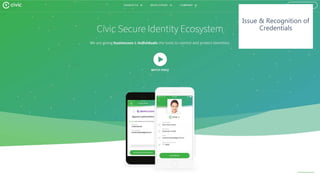
Example: Civic
Self-Sovereign Identity
Management
Issue & Recognition of
Credentials
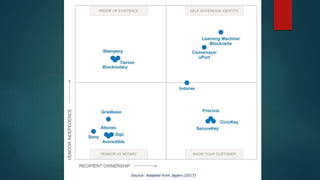
THE OPENNESS DILEMMA
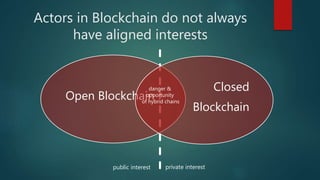
Open Blockchain
Closed
Blockchain
danger &
opportunity
of hybrid chains
Actors in Blockchain do not always
have aligned interests
public interest private interest
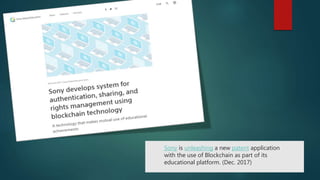
Sony is unleashing a new patent application
with the use of Blockchain as part of its
educational platform. (Dec. 2017)
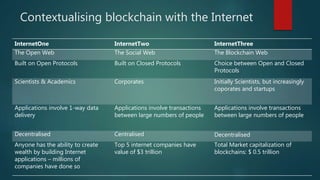
Contextualising blockchain with the Internet
InternetOne InternetTwo InternetThree
The Open Web The Social Web The Blockchain Web
Built on Open Protocols Built on Closed Protocols Choice between Open and Closed
Protocols
Scientists & Academics Corporates Initially Scientists, but increasingly
coporates and startups
Applications involve 1-way data
delivery
Applications involve transactions
between large numbers of people
Applications involve transactions
between large numbers of people
Decentralised Centralised Decentralised
Anyone has the ability to create
wealth by building Internet
applications – millions of
companies have done so
Top 5 internet companies have
value of $3 trillion
Total Market capitalization of
blockchains: $ 0.5 trillion
THE STANDARDS DILEMMA
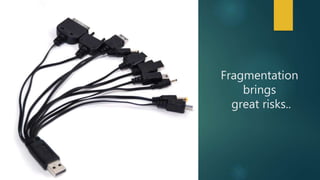
Fragmentation
brings
great risks..
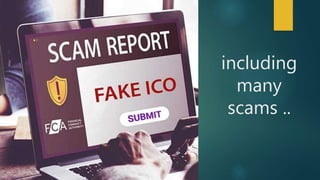
including
many
scams ..
but standards& regulation can
hinder innovation when we
still discovering the potential of
the technology
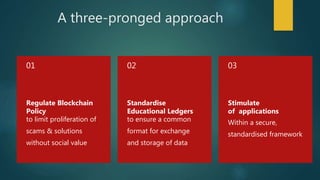
A three-pronged approach
Regulate Blockchain
Policy
to limit proliferation of
scams & solutions
without social value
01
Standardise
Educational Ledgers
to ensure a common
format for exchange
and storage of data
02
Stimulate
of applications
Within a secure,
standardised framework
03
KEY CONCLUSIONS &
RECOMMENDATIONS
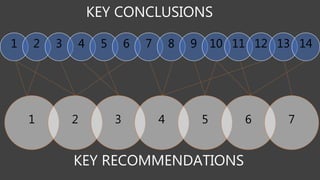
1 2 3 4 5 6 7 8 9 10 11 12 13 14
1 2 3 4 5 6 7
KEY RECOMMENDATIONS
KEY CONCLUSIONS
If we are going to achieve the Social
Value Proposition of blockchain we
need …
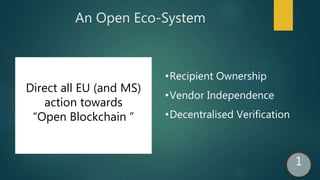
An Open Eco-System
Direct all EU (and MS)
action towards
“Open Blockchain ”
•Recipient Ownership
•Vendor Independence
•Decentralised Verification
1
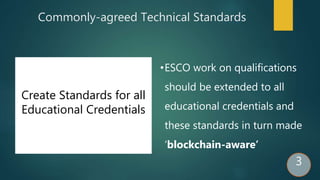
Commonly-agreed Technical Standards
Create Standards for all
Educational Credentials
•ESCO work on qualifications
should be extended to all
educational credentials and
these standards in turn made
‘blockchain-aware’
3
A Stakeholder-led Approach
Empower Stakeholders
• Funding for stakeholder-led
blockchain pilots within Erasmus+
• Mainstreaming open standards
• Enabling desirable futures
(not solely market-based)
42
Coordination of ‘Actors’
Set up a Coordination /
Advisory Body for
Blockchain in Education
• Composed of representatives of
national governments, educational
stakeholders and advisors
• Complements the work of the EU
Blockchain Advisory Group &
Forum
• Focuses on Coordination of Efforts
vs ‘Information Outpost’
5
An ‘informed’ Public
Fund an online
curriculum on
blockchain
Should allow for users to:
• Understand the differences between
cryptocurrencies and blockchains
• Understand risks associated with
cryptocurrencies
• Evaluate blockchain implications in
terms of social good
• Understand the principle of self-
sovereignty and how to apply in
practice on the web
6
Blockchain might be the
last best chance
to save the Open Web
WWW.SLIDO.COM/BLC
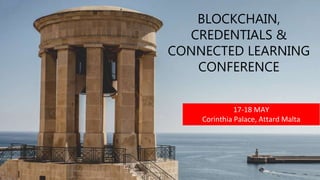
BLOCKCHAIN,
CREDENTIALS &
CONNECTED LEARNING
CONFERENCE
17-18 MAY
Corinthia Palace, Attard Malta

Blockchain in Education

  • 1.
    Blockchain in Education USAGESCENARIOS IN THE EUROPEAN EDUCATION AREA 8 FEBRUARY 2018 EUROPEAN COMMISSION, BRUSSELS Alex Grech & Anthony F. Camilleri
  • 3.
  • 4.
    We ran astudy for JRC…. IT WAS QUITE A JOURNEY….
  • 5.
    DOMAIN OF FRAUDSTERS & CRYPTOCULTURE BITCOINHYPE!FINTECH BUBBLE LET’S WAIT. ONE FOR THE FUTURE GOVERNMENTS ARE MAKING THIS ILLEGAL! NOTHING TO DO WITH EDUCATION!
  • 6.
  • 7.
  • 11.
    "If there's onething we've learned from the recent history of the internet, it's that seemingly esoteric decisions about software architecture can unleash profound global forces once the technology moves into wider circulation". Steven Johnson New York Times, January 16 2018
  • 12.
  • 13.
  • 14.
    Central Database Structure of aMODERN DATABASE Users store their information Institution manages & controls Parties consult database
  • 15.
  • 16.
    • Institutional Staffcan change grades after the fact • Students can compromise a database Data can be changed (hacked) • Data loss through disasters (fire, war, etc) • Data loss through accidents Data can be deleted • Students not given access to metrics held on them • Disputes over ownership of intellectual property Institution can prevent access • Institutions can charge for verifying data (certificates) • Digital data only available through proprietary systems Institution can put conditions on access • Sharing data with third parties • Profiling of students Institution can use data in an unauthorised manner
  • 17.
    By removing acentral authority, blockchain eliminates these problems Each user (node) stores a complete copy of the database Each user (node) has to approve each entry The version with the most copies is the ‘true’ version
  • 18.
  • 19.
  • 20.
  • 21.
  • 22.
  • 23.
  • 24.
    HOW BLOCKCHAIN IS STARTINGTO IMPACT EDUCATION
  • 25.
  • 26.
    Layers in productionof a blockchain-notarised certificate Source: Learning Machine
  • 30.
    Blockchain is hereNow.. At EU nation-state level Pilots at Malta College for Arts, Sciences & Technology, Institute for Tourism Studies, National Commission for Further and Higher Education and all State Schools 17-18 May 2018: Conference on Blockchain in Education & Connected Learning, Malta
  • 33.
  • 34.
    Where to applyBlockchain Issue & Recognition of Credentials Management of Intellectual Property Payments & Smart- Contracts Self-Sovereign Identity- Management
  • 35.
    SCENARIO: Blockchain for ECTS Governance Group of universities forms a private blockchain network  Addition of new members, and the rules of the network are decided by the universities by consensus Architecture  Each credit awarded by universities is recorded as a transaction on the chain  The record of credit awarded is now public, immutable and anonymised  A student can prove he his the owner of specific ECTS by using his private key  Could be linked to ESCO Use Cases  A student can ‘spend’ his ECTS with an institution to create a qualification (transfer of credit becomes merely spending ECTS transferred from two different institutions)  An employer or other university can verify the student’s records merely by verifying his ECTS against the blockchain Example: University of Maribor Issue & Recognition of Credentials
  • 36.
    Issue & Recognitionof Credentials
  • 37.
    SCENARIO: Blockchain for EducationalResources Governance  A group of (open) education repositories forms a private blockchain network  Addition of new members, and the rules by which the network operates are decided by the repositories by consensus Architecture  Each resource added to the repository results in the reward of a token to the author  Each time that resources is reused / cited it results in the reward of an additional token (or part-tokens depending on extent of reuse)  The record of reuse is now public and immutable Use Cases  The token system would allow for creators to be compensated for sharing their resources, in proportion to the amount of usage those resources get.  Such compensation may be:  Financial compensation in line with revenue acquired by the repositories  Compensation in terms of academic prestige / credit (similar to current system of impact factors from academic journals) Example: Everipedia Management of Intellectual Property
  • 38.
  • 39.
    SCENARIO: Blockchain for Vouchers Governance A set of funders of education (e.g. governments, regional authorities and companies), decide to use blockchain to fund education via a voucher system  Educational institutions would agree to be paid via the blockchain Architecture  Each token on the blockchain would be pegged to a real-world currency.  The funding conditions would be written immutably into the chain as smart-contracts  Tokens would be given to students who could spend them at certain educational institutions  Tokens would only be released when certain conditions are met Use Cases  The token/contract system would allow for funding- systems to be created essentially without administrative overheads  Once contracts were created, the funding would be allocated, if not released, and be unchangeable – giving students guarantees  Could be used to improve any voucher-based public/private education system Example: BitDegree Payments & Smart- Contracts
  • 40.
  • 41.
    SCENARIO: Blockchain for StudentID Governance  A data-handler, typically a large educational organization such as a university will create an identity-management system for use within its units/subsidiaries Architecture  Students who need to identify their eligibility for services from the university will send documents proving their eligibility to the admissions office  Once admissions office verifies their eligibility it will issue a certificate on the blockchain, tied to a biometric private key owned by the student  The admissions office will then delete the data provided by the student, only keeping a hash of it on the chain  Thus, the record of verification is public, and immutable while the student keep control of their data Use Cases  Institution would be able to internally identify students eligibility to various services, without needing to store their data. This would significantly reduce their compliance costs with data-protection legislations (esp. considering GDSR). Additionally, it would:  Simplify network-architecture  Reduce footprint for a data- breach  Reduce severity of any network breach Example: Civic Self-Sovereign Identity Management
  • 42.
    Issue & Recognitionof Credentials
  • 43.
  • 44.
    Open Blockchain Closed Blockchain danger & opportunity ofhybrid chains Actors in Blockchain do not always have aligned interests public interest private interest
  • 45.
    Sony is unleashinga new patent application with the use of Blockchain as part of its educational platform. (Dec. 2017)
  • 47.
    Contextualising blockchain withthe Internet InternetOne InternetTwo InternetThree The Open Web The Social Web The Blockchain Web Built on Open Protocols Built on Closed Protocols Choice between Open and Closed Protocols Scientists & Academics Corporates Initially Scientists, but increasingly coporates and startups Applications involve 1-way data delivery Applications involve transactions between large numbers of people Applications involve transactions between large numbers of people Decentralised Centralised Decentralised Anyone has the ability to create wealth by building Internet applications – millions of companies have done so Top 5 internet companies have value of $3 trillion Total Market capitalization of blockchains: $ 0.5 trillion
  • 48.
  • 49.
  • 50.
  • 51.
    but standards& regulationcan hinder innovation when we still discovering the potential of the technology
  • 52.
    A three-pronged approach RegulateBlockchain Policy to limit proliferation of scams & solutions without social value 01 Standardise Educational Ledgers to ensure a common format for exchange and storage of data 02 Stimulate of applications Within a secure, standardised framework 03
  • 54.
  • 55.
    1 2 34 5 6 7 8 9 10 11 12 13 14 1 2 3 4 5 6 7 KEY RECOMMENDATIONS KEY CONCLUSIONS
  • 56.
    If we aregoing to achieve the Social Value Proposition of blockchain we need …
  • 57.
    An Open Eco-System Directall EU (and MS) action towards “Open Blockchain ” •Recipient Ownership •Vendor Independence •Decentralised Verification 1
  • 58.
    Commonly-agreed Technical Standards CreateStandards for all Educational Credentials •ESCO work on qualifications should be extended to all educational credentials and these standards in turn made ‘blockchain-aware’ 3
  • 59.
    A Stakeholder-led Approach EmpowerStakeholders • Funding for stakeholder-led blockchain pilots within Erasmus+ • Mainstreaming open standards • Enabling desirable futures (not solely market-based) 42
  • 60.
    Coordination of ‘Actors’ Setup a Coordination / Advisory Body for Blockchain in Education • Composed of representatives of national governments, educational stakeholders and advisors • Complements the work of the EU Blockchain Advisory Group & Forum • Focuses on Coordination of Efforts vs ‘Information Outpost’ 5
  • 61.
    An ‘informed’ Public Fundan online curriculum on blockchain Should allow for users to: • Understand the differences between cryptocurrencies and blockchains • Understand risks associated with cryptocurrencies • Evaluate blockchain implications in terms of social good • Understand the principle of self- sovereignty and how to apply in practice on the web 6
  • 63.
    Blockchain might bethe last best chance to save the Open Web
  • 64.
  • 65.

Editor's Notes