Diplomas Track
Deep Dive: Ensuring Interoperability
Anthony F. CAmilleri
EBSI Diplomas use case group
22th & 23rd October 2019
EBSI use case groups Joint workshop
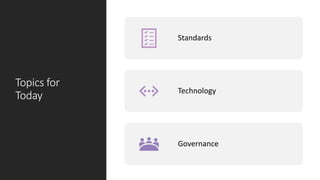
Topics for
Today
Standards
Technology
Governance
Standards
ENSURING WE SPEAK
THE SAME LANGUAGE
Design Brief
for an
Effective Learning
Standard
Addresses all Levels of Education
Aligned with European
Recognition Instruments
Captures
Formal, Non-
Formal &
Informal
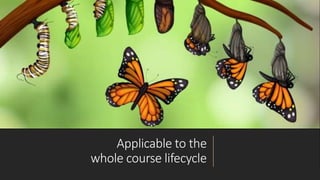
Applicable to the
whole course lifecycle
Interoperable
Free & Open Source
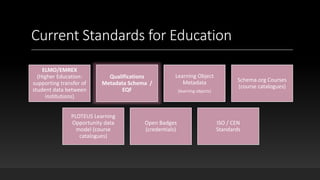
Current Standards for Education
ELMO/EMREX
(Higher Education:
supporting transfer of
student data between
institutions)
Qualifications
Metadata Schema /
EQF
Learning Object
Metadata
(learning objects)
Schema.org Courses
(course catalogues)
PLOTEUS Learning
Opportunity data
model (course
catalogues)
Open Badges
(credentials)
ISO / CEN
Standards
No Existing
Standard
fully reflects
lifelong learning
A new Meta-Model for
Interoperability
Extend the scope, purpose and use
Qualifications Metadata Schema
(legislative basis)
Europass Learning
Data Model
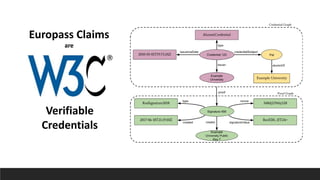
Europass Claims
are
Verifiable
Credentials
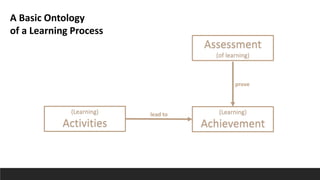
(Learning)
Achievement
(Learning)
Activities
lead to
Assessment
(of learning)
prove
A Basic Ontology
of a Learning Process
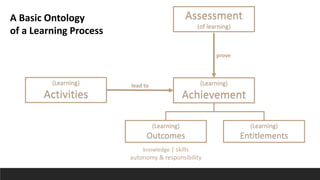
(Learning)
Achievement
(Learning)
Activities
lead to
Assessment
(of learning)
prove
A Basic Ontology
of a Learning Process
(Learning)
Outcomes
(Learning)
Entitlements
knowledge | skills
autonomy & responsibility
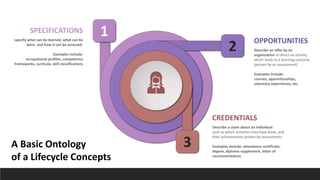
OPPORTUNITIES
Describe an offer by an
organization to direct an activity
which leads to a learning outcome
(proven by an assessment)
Examples include:
courses, apprenticeships,
voluntary experiences, etc.
SPECIFICATIONS
specify what can be learned, what can be
done and how it can be assessed.


Examples include:
occupational profiles, competence
frameworks, curricula, skill classifications
CREDENTIALS
Describe a claim about an individual
such as which activities they have done, and
their achievements proven by assessments.
Examples include: attendance certificate,
degree, diploma supplement, letter of
recommendation
1
2
3
A Basic Ontology
of a Lifecycle Concepts
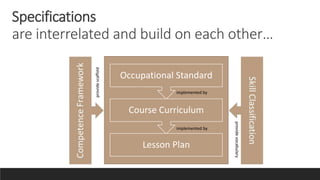
Specifications
are interrelated and build on each other…
Lesson Plan
Course Curriculum
Occupational Standard
provide
vocabulary
provide
scaffold
implemented by
implemented by
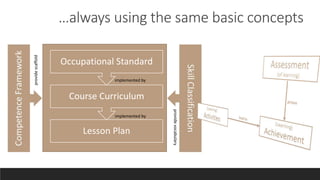
…always using the same basic concepts
Lesson Plan
Course Curriculum
Occupational Standard
provide
vocabulary
provide
scaffold
implemented by
implemented by
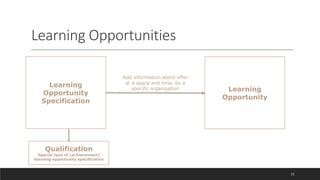
Learning Opportunities
21
Learning
Opportunity
Specification
Learning
Opportunity
Add information about offer
at a space and time, by a
specific organisation
Qualification
Special type of (achievement)
learning opportunity specification
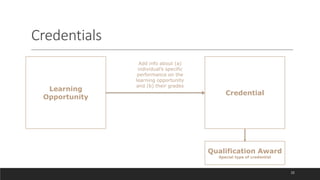
Credentials
22
Learning
Opportunity
Credential
Add info about (a)
individual’s specific
performance on the
learning opportunity
and (b) their grades
Qualification Award
Special type of credential
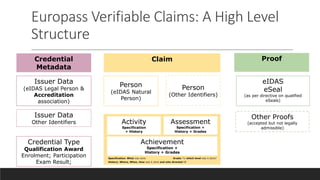
Europass Verifiable Claims: A High Level
Structure
Credential
Metadata
Claim Proof
Issuer Data
(eIDAS Legal Person &
Accreditation
association)
Issuer Data
Other Identifiers
Credential Type
Qualification Award
Enrolment; Participation
Exam Result;
Activity
Specification
+ History
Assessment
Specification +
History + Grades
Achievement
Specification +
History + Grades
eIDAS
eSeal
(as per directive on qualified
eSeals)
Other Proofs
(accepted but not legally
admissible)
Person
(eIDAS Natural
Person)
Person
(Other Identifiers)
Specification: What was done Grade: To which level was it done?
History: Where, When, How was it done and who directed it?
Technology
CREATING A RELIABLE TRUST
INFRASTRUCTURE
Europass Verifiable Claims: A High Level
Structure
Credential
Metadata
Claim Proof
Issuer Data
(eIDAS Legal Person &
Accreditation
association)
Issuer Data
Other Identifiers
Credential Type
Qualification Award
Enrolment; Participation
Exam Result;
Activity
Specification
+ History
Assessment
Specification +
History + Grades
Achievement
Specification +
History + Grades
eIDAS
eSeal
(as per directive on qualified
eSeals)
Other Proofs
(accepted but not legally
admissible)
Person
(eIDAS Natural
Person)
Person
(Other Identifiers)
Specification: What was done Grade: To which level was it done?
History: Where, When, How was it done and who directed it?
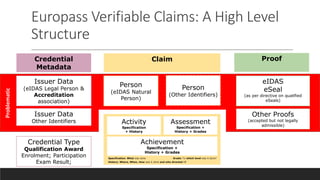
Problematic
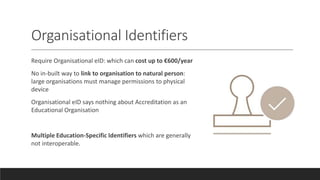
Organisational Identifiers
Require Organisational eID: which can cost up to €600/year
No in-built way to link to organisation to natural person:
large organisations must manage permissions to physical
device
Organisational eID says nothing about Accreditation as an
Educational Organisation
Multiple Education-Specific Identifiers which are generally
not interoperable.
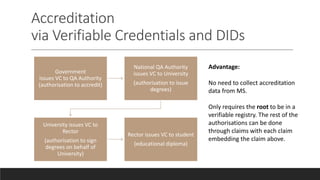
Accreditation
via Verifiable Credentials and DIDs
Government
issues VC to QA Authority
(authorisation to accredit)
National QA Authority
issues VC to University
(authorisation to issue
degrees)
University issues VC to
Rector
(authorisation to sign
degrees on behalf of
University)
Rector issues VC to student
(educational diploma)
Advantage:
No need to collect accreditation
data from MS.
Only requires the root to be in a
verifiable registry. The rest of the
authorisations can be done
through claims with each claim
embedding the claim above.
Personal Identifiers
Not Feasible to issue diplomas to verified national eIDs.
Use of only default metadata fields from eIDAS produces
multiple identification exceptions (name changes etc).
Decentralised Identifiers linked to eIDs may provide a more
automatable, easier to use, and persistent workflow.
PKI-based Proofs
Diplomas signed via PKI need to be resigned approx. every
5-7 years.
For user-convenience this requires use of cloud-based
resigning services.
Cloud-dependency makes self-sovereignty impractical
EBSI-
Notarisation
obviates the need for e-signing
NOTARISATION
ALLOWS AN
IMMUTABLE
GUARANTEE OF
AUTHENTICITY.
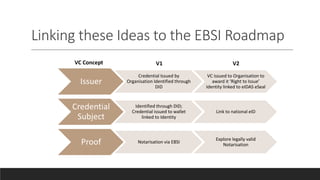
Linking these Ideas to the EBSI Roadmap
Issuer
Credential Issued by
Organisation Identified through
DID
VC issued to Organisation to
award it ‘Right to Issue’
Identity linked to eIDAS eSeal
Credential
Subject
Identified through DID;
Credential issued to wallet
linked to Identity
Link to national eID
Proof Notarisation via EBSI
Explore legally valid
Notarisation
V1 V2
VC Concept
Governance
CREATING A RELIABLE TRUST
INFRASTRUCTURE
Efforts for Self-
Sovereign Identity and
Verifiable Credentials
need to be connected
through Educational
Standards
CONNECTING EDUCATIONAL
DATABASES IS ABOUT MUCH
MORE THAN IDENTITY
“Who do I Call to decide on
Educational Standards?”
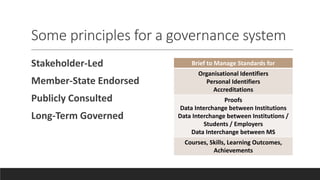
Some principles for a governance system
Stakeholder-Led
Member-State Endorsed
Publicly Consulted
Long-Term Governed
Brief to Manage Standards for
Organisational Identifiers
Personal Identifiers
Accreditations
Proofs
Data Interchange between Institutions
Data Interchange between Institutions /
Students / Employers
Data Interchange between MS
Courses, Skills, Learning Outcomes,
Achievements
“Lock ‘em Up”
(until a standard is
agreed)
Need for a
Cross-
Sectoral
Approach
Identity, Technology, Education,
Employment stakeholders and
regulators need to come together
for real impact
Thank You
QUESTIONS?

Interoperability of Digital Credentials

  • 1.
    Diplomas Track Deep Dive:Ensuring Interoperability Anthony F. CAmilleri EBSI Diplomas use case group 22th & 23rd October 2019 EBSI use case groups Joint workshop
  • 2.
  • 3.
  • 4.
  • 5.
  • 6.
  • 7.
  • 8.
    Applicable to the wholecourse lifecycle
  • 9.
  • 10.
  • 11.
    Current Standards forEducation ELMO/EMREX (Higher Education: supporting transfer of student data between institutions) Qualifications Metadata Schema / EQF Learning Object Metadata (learning objects) Schema.org Courses (course catalogues) PLOTEUS Learning Opportunity data model (course catalogues) Open Badges (credentials) ISO / CEN Standards
  • 12.
  • 13.
    A new Meta-Modelfor Interoperability Extend the scope, purpose and use Qualifications Metadata Schema (legislative basis)
  • 14.
  • 15.
  • 16.
  • 17.
    (Learning) Achievement (Learning) Activities lead to Assessment (of learning) prove ABasic Ontology of a Learning Process (Learning) Outcomes (Learning) Entitlements knowledge | skills autonomy & responsibility
  • 18.
    OPPORTUNITIES Describe an offerby an organization to direct an activity which leads to a learning outcome (proven by an assessment) Examples include: courses, apprenticeships, voluntary experiences, etc. SPECIFICATIONS specify what can be learned, what can be done and how it can be assessed. Examples include: occupational profiles, competence frameworks, curricula, skill classifications CREDENTIALS Describe a claim about an individual such as which activities they have done, and their achievements proven by assessments. Examples include: attendance certificate, degree, diploma supplement, letter of recommendation 1 2 3 A Basic Ontology of a Lifecycle Concepts
  • 19.
    Specifications are interrelated andbuild on each other… Lesson Plan Course Curriculum Occupational Standard provide vocabulary provide scaffold implemented by implemented by
  • 20.
    …always using thesame basic concepts Lesson Plan Course Curriculum Occupational Standard provide vocabulary provide scaffold implemented by implemented by
  • 21.
    Learning Opportunities 21 Learning Opportunity Specification Learning Opportunity Add informationabout offer at a space and time, by a specific organisation Qualification Special type of (achievement) learning opportunity specification
  • 22.
    Credentials 22 Learning Opportunity Credential Add info about(a) individual’s specific performance on the learning opportunity and (b) their grades Qualification Award Special type of credential
  • 23.
    Europass Verifiable Claims:A High Level Structure Credential Metadata Claim Proof Issuer Data (eIDAS Legal Person & Accreditation association) Issuer Data Other Identifiers Credential Type Qualification Award Enrolment; Participation Exam Result; Activity Specification + History Assessment Specification + History + Grades Achievement Specification + History + Grades eIDAS eSeal (as per directive on qualified eSeals) Other Proofs (accepted but not legally admissible) Person (eIDAS Natural Person) Person (Other Identifiers) Specification: What was done Grade: To which level was it done? History: Where, When, How was it done and who directed it?
  • 24.
    Technology CREATING A RELIABLETRUST INFRASTRUCTURE
  • 25.
    Europass Verifiable Claims:A High Level Structure Credential Metadata Claim Proof Issuer Data (eIDAS Legal Person & Accreditation association) Issuer Data Other Identifiers Credential Type Qualification Award Enrolment; Participation Exam Result; Activity Specification + History Assessment Specification + History + Grades Achievement Specification + History + Grades eIDAS eSeal (as per directive on qualified eSeals) Other Proofs (accepted but not legally admissible) Person (eIDAS Natural Person) Person (Other Identifiers) Specification: What was done Grade: To which level was it done? History: Where, When, How was it done and who directed it? Problematic
  • 26.
    Organisational Identifiers Require OrganisationaleID: which can cost up to €600/year No in-built way to link to organisation to natural person: large organisations must manage permissions to physical device Organisational eID says nothing about Accreditation as an Educational Organisation Multiple Education-Specific Identifiers which are generally not interoperable.
  • 27.
    Accreditation via Verifiable Credentialsand DIDs Government issues VC to QA Authority (authorisation to accredit) National QA Authority issues VC to University (authorisation to issue degrees) University issues VC to Rector (authorisation to sign degrees on behalf of University) Rector issues VC to student (educational diploma) Advantage: No need to collect accreditation data from MS. Only requires the root to be in a verifiable registry. The rest of the authorisations can be done through claims with each claim embedding the claim above.
  • 28.
    Personal Identifiers Not Feasibleto issue diplomas to verified national eIDs. Use of only default metadata fields from eIDAS produces multiple identification exceptions (name changes etc). Decentralised Identifiers linked to eIDs may provide a more automatable, easier to use, and persistent workflow.
  • 29.
    PKI-based Proofs Diplomas signedvia PKI need to be resigned approx. every 5-7 years. For user-convenience this requires use of cloud-based resigning services. Cloud-dependency makes self-sovereignty impractical
  • 30.
    EBSI- Notarisation obviates the needfor e-signing NOTARISATION ALLOWS AN IMMUTABLE GUARANTEE OF AUTHENTICITY.
  • 31.
    Linking these Ideasto the EBSI Roadmap Issuer Credential Issued by Organisation Identified through DID VC issued to Organisation to award it ‘Right to Issue’ Identity linked to eIDAS eSeal Credential Subject Identified through DID; Credential issued to wallet linked to Identity Link to national eID Proof Notarisation via EBSI Explore legally valid Notarisation V1 V2 VC Concept
  • 32.
    Governance CREATING A RELIABLETRUST INFRASTRUCTURE
  • 33.
    Efforts for Self- SovereignIdentity and Verifiable Credentials need to be connected through Educational Standards CONNECTING EDUCATIONAL DATABASES IS ABOUT MUCH MORE THAN IDENTITY
  • 34.
    “Who do ICall to decide on Educational Standards?”
  • 35.
    Some principles fora governance system Stakeholder-Led Member-State Endorsed Publicly Consulted Long-Term Governed Brief to Manage Standards for Organisational Identifiers Personal Identifiers Accreditations Proofs Data Interchange between Institutions Data Interchange between Institutions / Students / Employers Data Interchange between MS Courses, Skills, Learning Outcomes, Achievements
  • 36.
    “Lock ‘em Up” (untila standard is agreed)
  • 37.
    Need for a Cross- Sectoral Approach Identity,Technology, Education, Employment stakeholders and regulators need to come together for real impact
  • 38.