
OpenCredentials for
Open Education
Moving the Needle Forward
Anthony F. Camilleri
Knowledge InnovationCentre
Course inOpen Education Design –Vipava, 6th July 2018
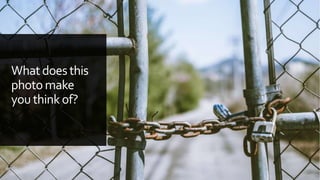
Whatdoesthis
photomake
youthinkof?
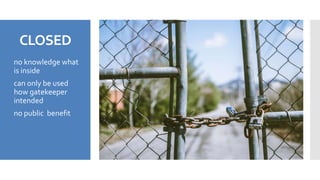
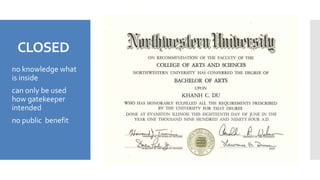
CLOSED
 no knowledge what
is inside
 can only be used
how gatekeeper
intended
 no public benefit
Education is a PublicGood
This means
OpenAccess to EducationalOpportunities
Use of Open Educational Resources
Empowerement of Students through Open
Educational Practices
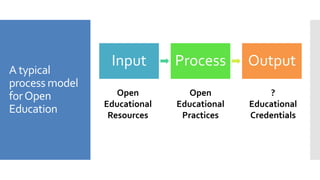
A typical
process model
forOpen
Education
Input Process Output
Open
Educational
Resources
Open
Educational
Practices
?
Educational
Credentials
CLOSED
 no knowledge what
is inside
 can only be used
how gatekeeper
intended
 no public benefit
(Digital)
Credentials
areBroken
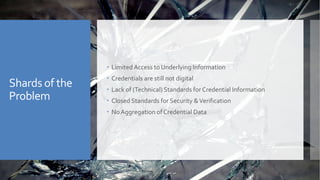
Shards of the
Problem
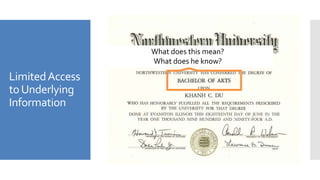
 Limited Access to Underlying Information
 Credentials are still not digital
 Lack of (Technical) Standards for Credential Information
 Closed Standards for Security &Verification
 NoAggregation of Credential Data
LimitedAccess
toUnderlying
Information
What does this mean?
What does he know?
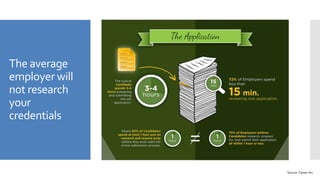
The average
employer will
not research
your
credentials
Source: Career Arc
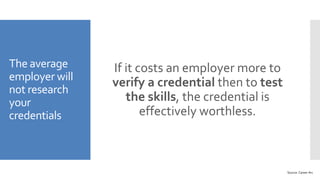
The average
employer will
not research
your
credentials
If it costs an employer more to
verify a credential then to test
the skills, the credential is
effectively worthless.
Source: Career Arc
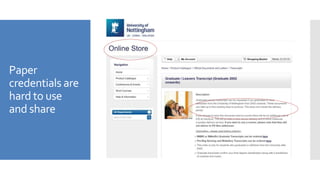
Paper
credentials are
hard to use
and share
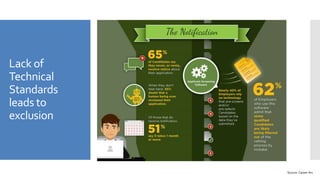
Lack of
Technical
Standards
leads to
exclusion
Source: Career Arc
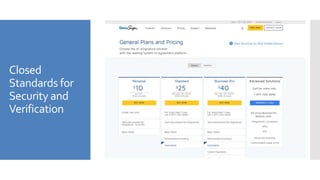
Closed
Standards for
Security and
Verification
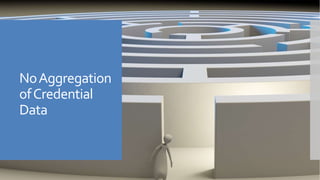
NoAggregation
ofCredential
Data
Closed
Credentials
 expensive
 hard to use and share
 hinder Open Education by failing to evidence
flexible learning pathways in a transparent manner
 exclude the people who need them most
 can be abused by networks of intermediaries
 do not inform policy
The Road toOpen
Disrupting Credentials for the Public Good
Wehaveallthe
piecesfor an
opencredential
system
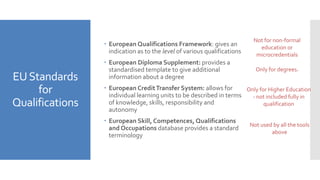
EUStandards
for
Qualifications
 European Qualifications Framework: gives an
indication as to the level of various qualifications
 European Diploma Supplement: provides a
standardised template to give additional
information about a degree
 European CreditTransfer System: allows for
individual learning units to be described in terms
of knowledge, skills, responsibility and
autonomy
 European Skill, Competences, Qualifications
and Occupations database provides a standard
terminology
Not for non-formal
education or
microcredentials
Only for degrees.
Only for Higher Education
- not included fully in
qualification
Not used by all the tools
above
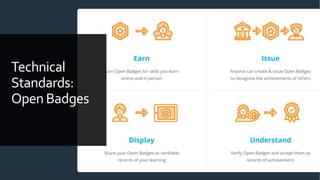
Technical
Standards:
OpenBadges
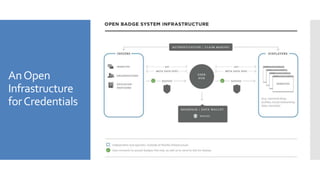
AnOpen
Infrastructure
forCredentials
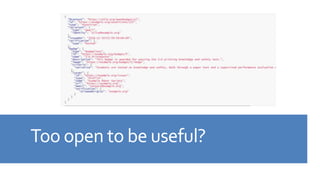
Too open to be useful?
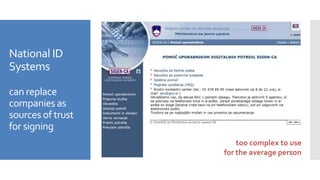
National ID
Systems
can replace
companies as
sources of trust
for signing
too complex to use
for the average person
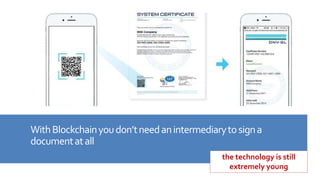
WithBlockchainyoudon’tneedanintermediarytosigna
documentatall
the technology is still
extremely young
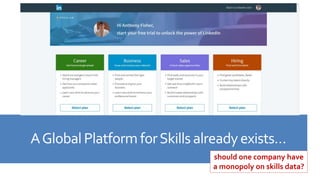
AGlobal Platform forSkills alreadyexists…
should one company have
a monopoly on skills data?
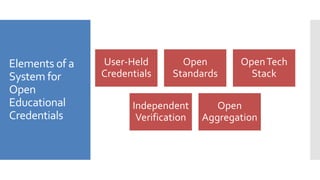
Elements of a
System for
Open
Educational
Credentials
User-Held
Credentials
Open
Standards
OpenTech
Stack
Independent
Verification
Open
Aggregation
Shameless
self-
promotion
TwoOngoing
Initiatives
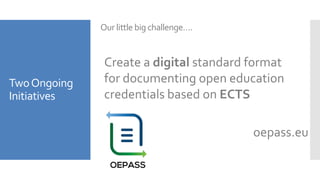
Our little big challenge….
Create a digital standard format
for documenting open education
credentials based on ECTS
oepass.eu
TwoOngoing
Initiatives
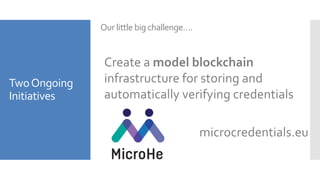
Our little big challenge….
Create a model blockchain
infrastructure for storing and
automatically verifying credentials
microcredentials.eu
www.microcredentials.eu
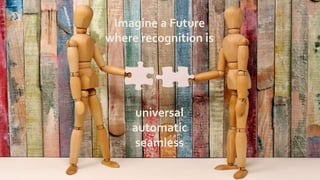
Imagine a Future
where recognition is
universal
automatic
seamless
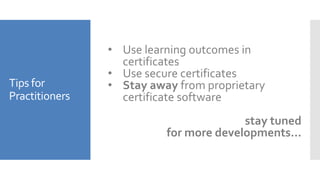
Tips for
Practitioners
• Use learning outcomes in
certificates
• Use secure certificates
• Stay away from proprietary
certificate software
stay tuned
for more developments…
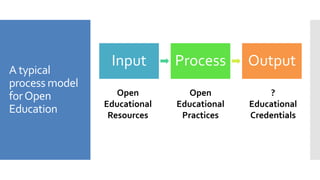
A typical
process model
forOpen
Education
Input Process Output
Open
Educational
Resources
Open
Educational
Practices
?
Educational
Credentials
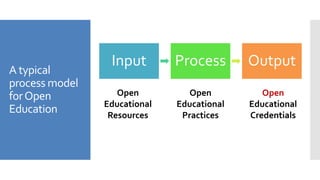
A typical
process model
forOpen
Education
Input Process Output
Open
Educational
Resources
Open
Educational
Practices
Open
Educational
Credentials
THANK YOU FOR
YOUR ATTENTION
You can download this presentation at:
The European Commission support for the production of this publication does not constitute an endorsement of the
contents which reflects the views only of the authors, and the Commission cannot be held responsible for any use
which may be made of the information contained therein.
This work is licensed under a Creative Commons Attribution ShareAlike 4.0 International License.
You are free to:
Share — copy and redistribute the material in any medium or format
Adapt — remix, transform, and build upon the material
for any purpose, even commercially.
The licensor cannot revoke these freedoms as long as you follow the license terms.
Under the following conditions:
Attribution — You must give appropriate credit, provide a link to the license, and indicate if changes were made.
You may do so in any reasonable manner, but not in any way that suggests the licensor endorses you or your use.
ShareAlike — If you remix, transform, or build upon the material, you must distribute your contributions under
the same license as the original.
No additional restrictions — You may not apply legal terms or technological

Open Credentials for Open Education: Moving the Needle Forward