Collaboration
around HVET &
PHE in Europe
Initial Findings from
Research
Anthony F. Camilleri
Beehives Expert Meeting
Brussels 02 Feb 2017
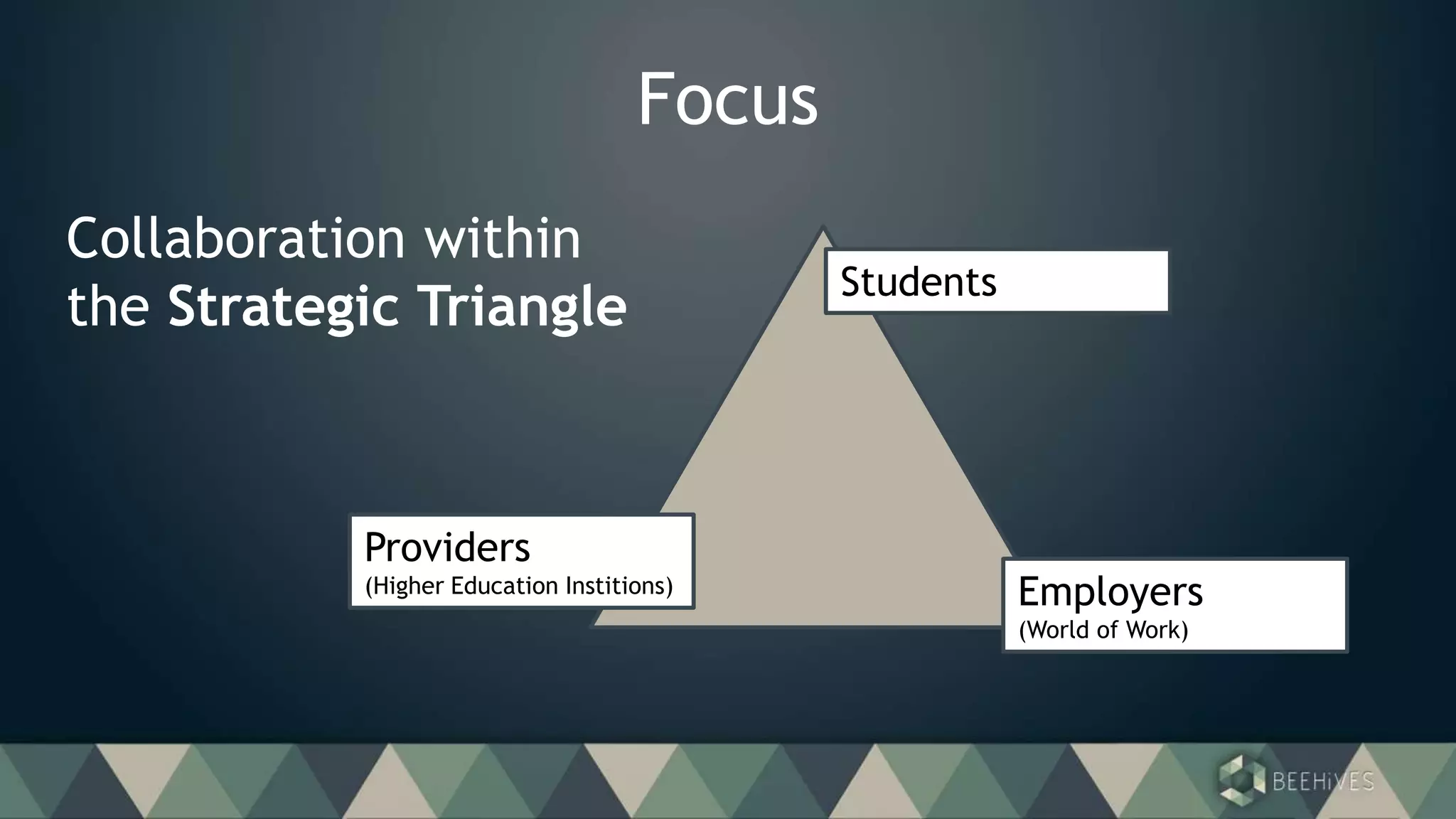
Focus
Students
Employers
(World of Work)
Providers
(Higher Education Institions)
Collaboration within
the Strategic Triangle
Activities & Outputs
• Desk Research on Context of Collaboration
in 6 Countries
• Survey of Students, Employers and
Institutions
• Toolbox to Success Factors for Collaboration
• Policy Recommendations to aid collaboration
Partnership & Countries
• Duale Hochschule Baden-
Württemberg Heilbronn (DE),
lead partner
• Artesis Plantijn Hogeschool
Antwerpen, Antwerpen (BE)
• Association Of Colleges,
London (UK)
• Tknika, Errenteria (ES)
• EURASHE; Brussels (BE);
research undertaken in
Denmark (DE)
• Knowledge Innovation Centre
Ltd, Swieqi (MT)
• Sdruzeni Profesniho
Terciarniho Vzdelavani, Prag
(CZ)
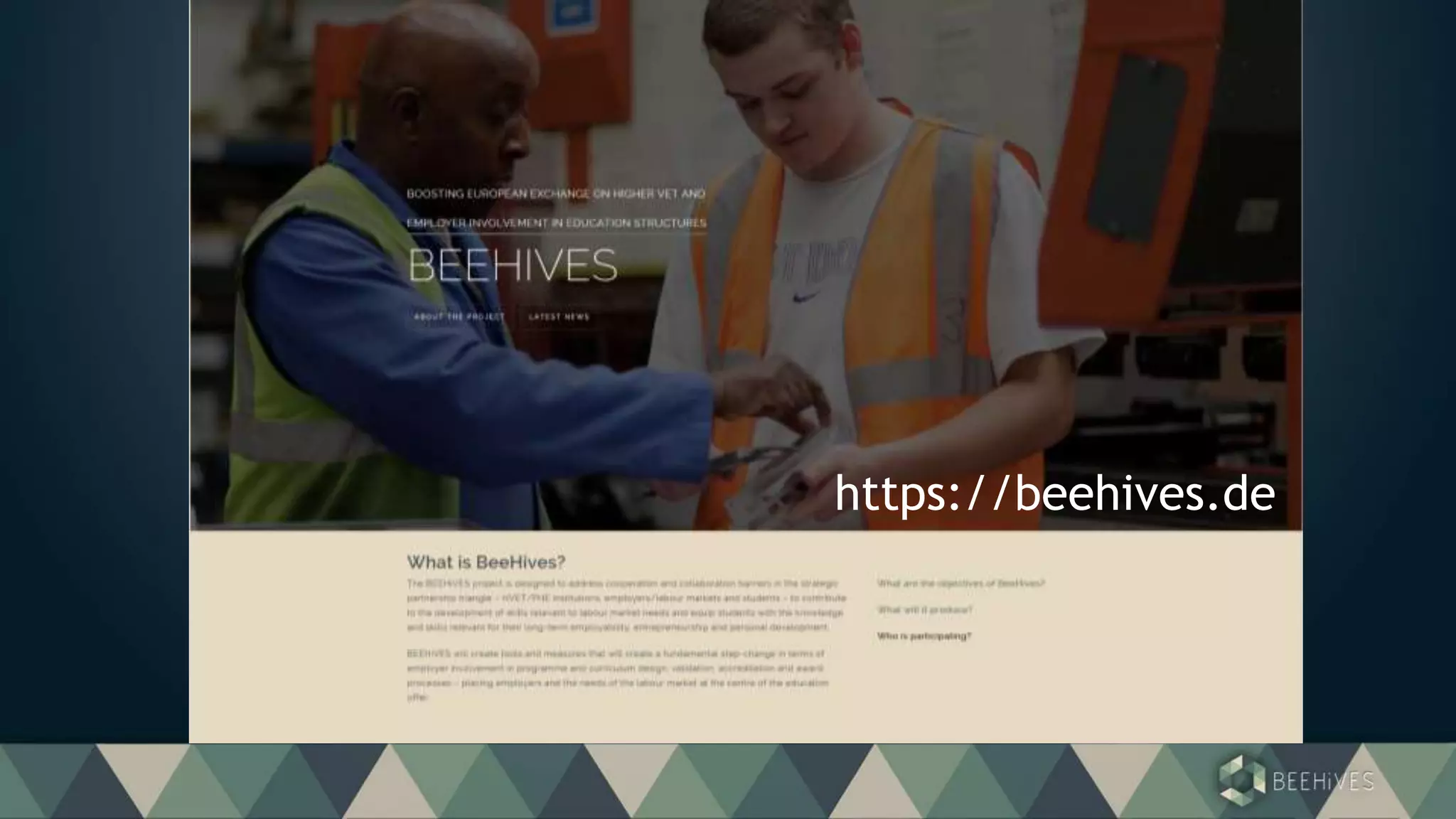
https://beehives.de
Research Questions
1. How is HVET and PHE organized in Flanders, the Czech Republic,
Denmark, Germany, Spain and the UK?
2. Why should providers of HVET and PHE, employers/the world of
work and students (the stakeholders of the strategic triangle)
collaborate?
3. In which areas should the stakeholders of the strategic triangle
collaborate?
Research Questions
4. What are the barriers in the collaboration of the stakeholders of the
strategic triangle?
5. What are the success factors for collaboration for each member of
the strategic triangle
Research Questions
6. What are key performance indicators (KPI’s) to improve
coordination and collaboration amongst all HVET/PHE actors?
7. How can curricula adapt to current and emerging labour market
needs?
Structure of HVET
• a ‘confused policy area’ in many member
countries – with HVET offered in several
structurally separate sectors (HE, PHE, VET,
CVET) with limited permeability (vertical and
horizontal) and in many countries limited
progression opportunities
• limited attempts have been made to develop
innovative and transferable employer
engagement HVET practices and tools.
Structure of HVETs
• mapped to EQF level 5 or higher;
• are oriented towards providing students with
specific skills for practicing in a named
profession;
• involve apprenticeships or other types of work-
based learning as part of their curricula; and
• involve the world of work closely in their
activities, in particular course design and
teaching.
Key Finding
All countries are enacting reforms
which strengthen HVET/PHE
Methods of Forwarding Collaboration
• surveying techniques
such as graduate tracer studies, market-research surveys, skills-gap identification etc., mainly
deployed by educational institutions to understand the requirements of the other stakeholders
within the knowledge triangle
• consultative techniques
either in the form of employer or student participation in governing boards of institutions; or
through institutional participation in bodies of chambers of commerce or regional development
boards; or through independent consultative bodies such as national skills councils
Methods of Forwarding Collaboration
• knowledge transfer techniques
such as dissertation topics set by employers, jointly set topics for internships and placements,
involvement of alumni in outreach activities and rotating staff between industry and
educational institutions
• fully joint projects
such as definition of occupational standards, jointly taught courses by industry and
academia together, and joint research & development initiatives.
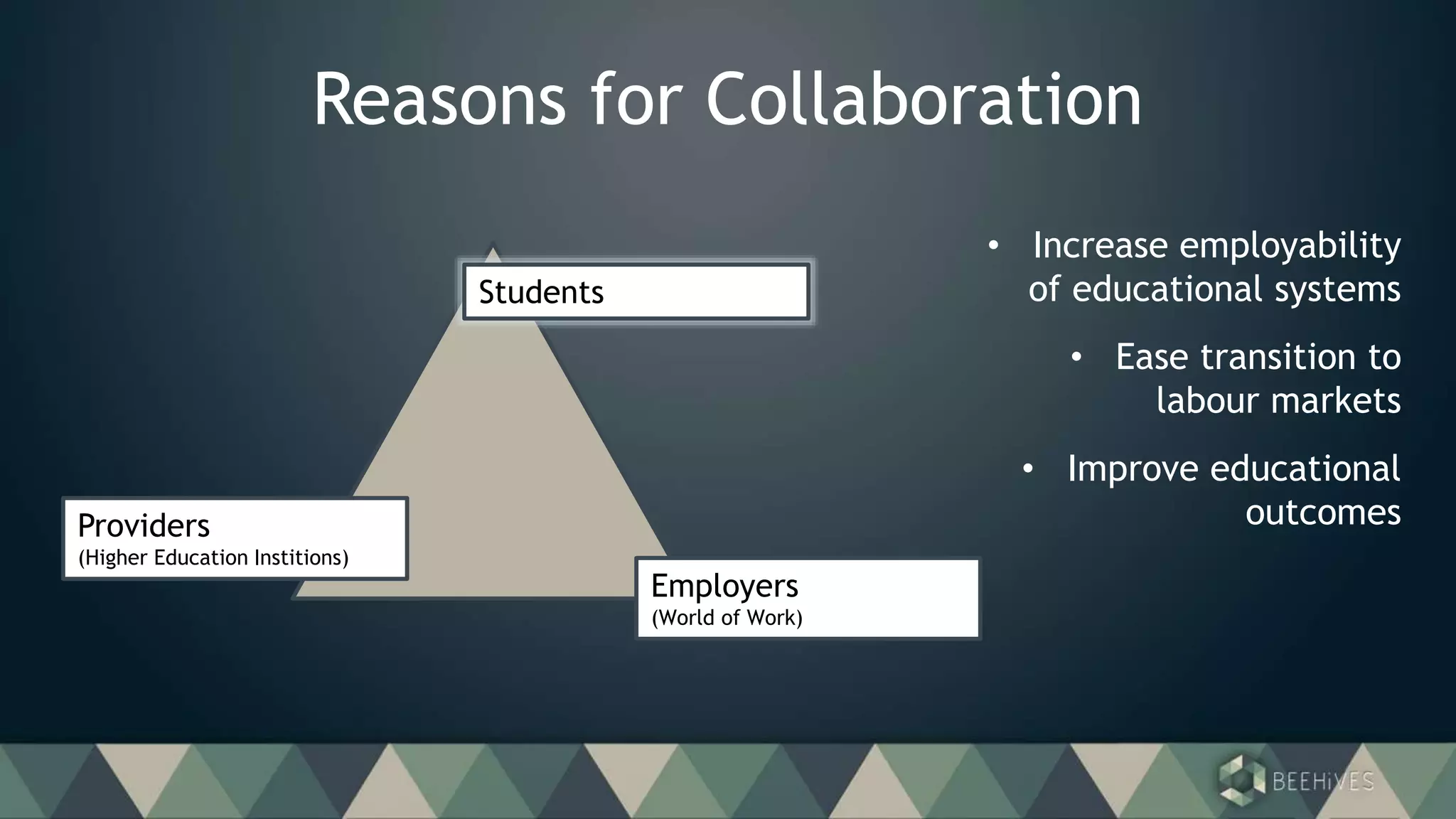
Reasons for Collaboration
Students
Employers
(World of Work)
Providers
(Higher Education Institions)
• Increase employability
of educational systems
• Ease transition to
labour markets
• Improve educational
outcomes
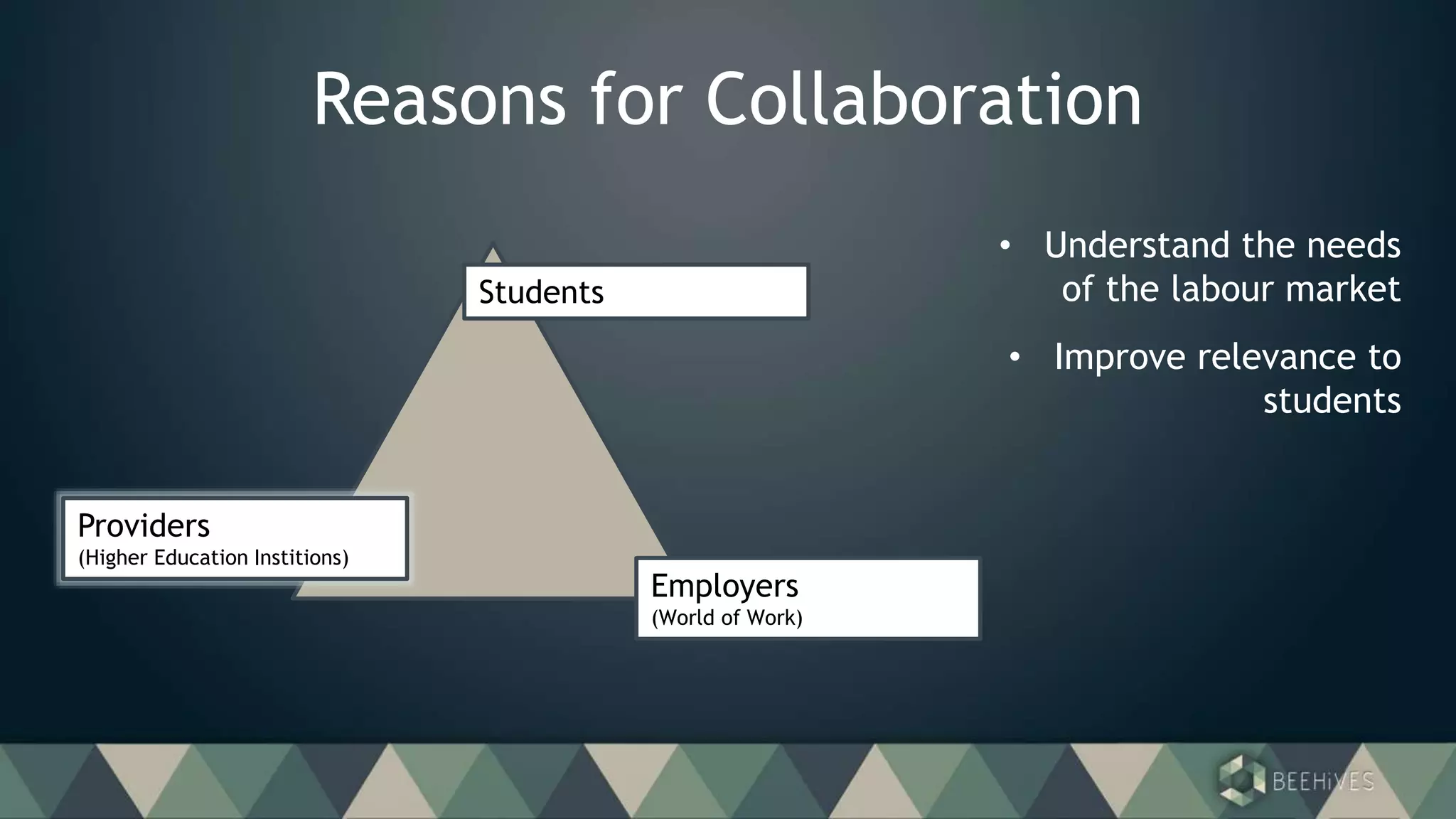
Reasons for Collaboration
Students
Employers
(World of Work)
Providers
(Higher Education Institions)
• Understand the needs
of the labour market
• Improve relevance to
students
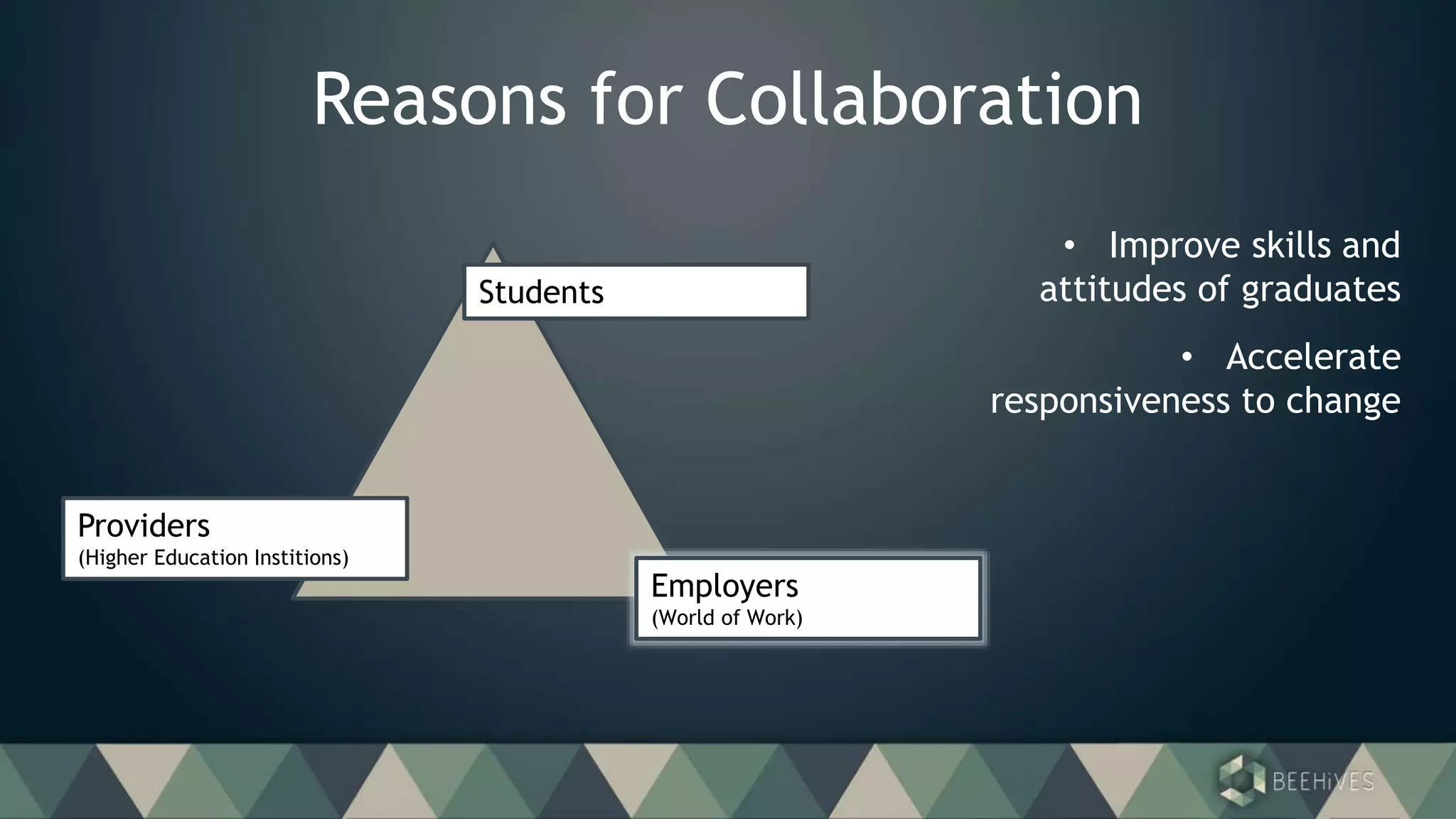
Reasons for Collaboration
Students
Employers
(World of Work)
Providers
(Higher Education Institions)
• Improve skills and
attitudes of graduates
• Accelerate
responsiveness to change
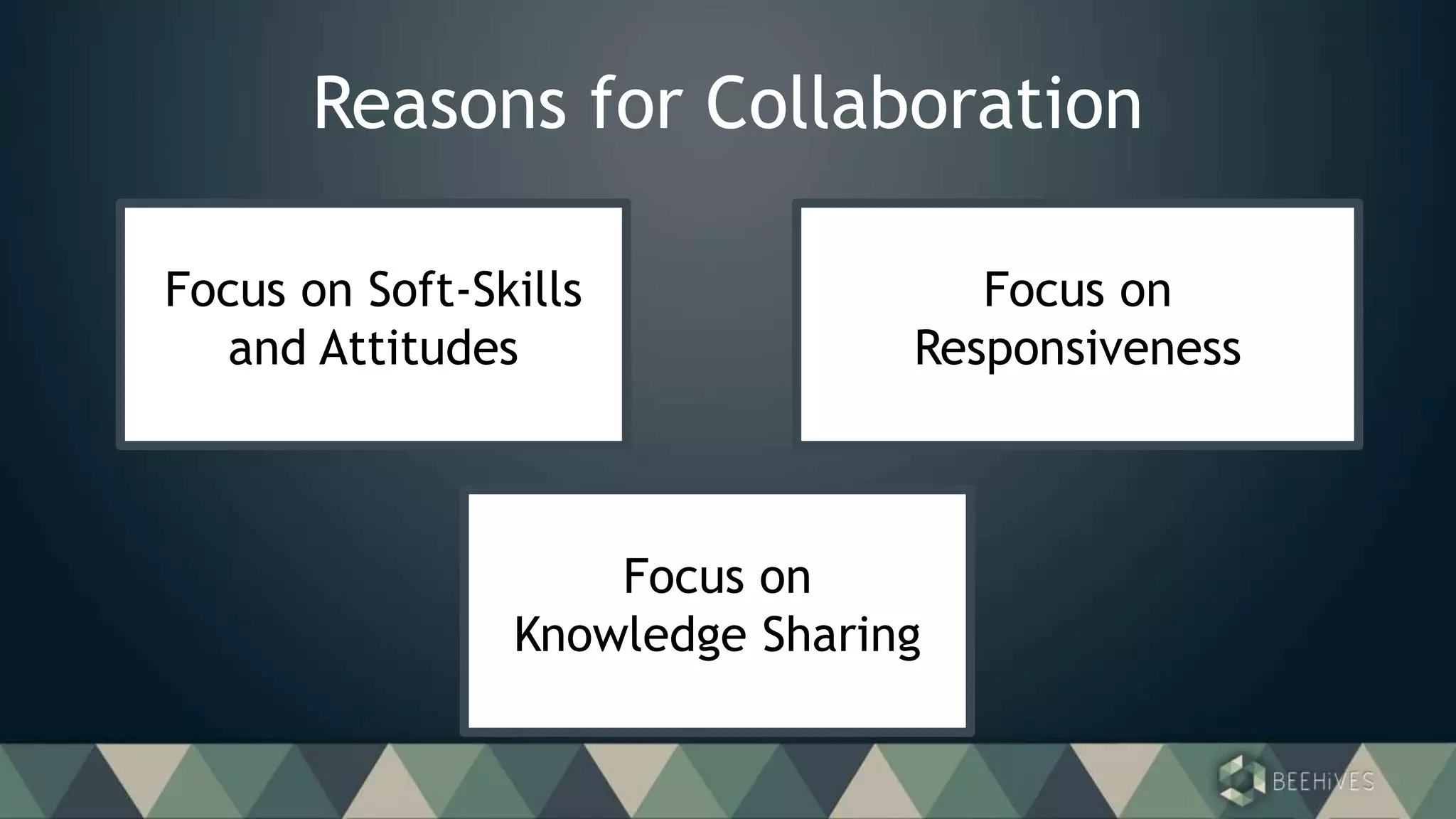
Reasons for Collaboration
Focus on Soft-Skills
and Attitudes
Focus on
Responsiveness
Focus on
Knowledge Sharing
Where does Collaboration Happen?
– Definition of
occupational skills
– Course design
– Assessment
– Teaching
– Work Based Learning
– Guidance
– Quality assurance
Quantity & Quality differ between institutions
Across all processes in the institution
Success Factors
• establishing regional forums for collaboration, so as to
contextualization the collaboration within a wider
societal context;
• providing space within collaboration for a to triangulate
the requirements and expectations of each stakeholder,
and for them to balance these amongst themselves;
• ensuring that any fora for collaboration meet regularly,
and have specific objectives and targets;
Success Factors
• ensuring specific persons and/or associations are assigned
the role to manage and strengthen collaboration, rather than
allowing it to develop purely organically;
• supporting both top-down and bottom-up collaboration
methodologies simultaneously;
• integrating criteria on the quality of collaboration into the
overall quality management systems of both businesses and
educational institutions
• providing individualized pathways for collaboration, both for
individual students as well as for specific businesses,
including SMEs
Under the following conditions:
Attribution — You must give appropriate credit, provide a link to the
license, and indicate if changes were made. You may do so in any
reasonable manner, but not in any way that suggests the licensor
endorses you or your use.
ShareAlike — If you remix, transform, or build upon the material,
you must distribute your contributions under the same license as the
original.
No additional restrictions — You may not apply legal terms
or technological measures that legally restrict others from doing
anything the license permits.
This work is licensed under a Creative Commons Attribution
ShareAlike 4.0 International License.
You are free to:
Share — copy and redistribute the material in any medium or format
Adapt — remix, transform, and build upon the material
for any purpose, even commercially.
The licensor cannot revoke these freedoms as long as you follow the
license terms.
The European Commission support for the production of this
publication does not constitute an endorsement of the contents which
reflects the views only of the authors, and the Commission cannot be
held responsible for any use which may be made of the information
contained therein.

Collaboration around HVET & PHE in Europe: Initial Findings from Research

  • 1.
    Collaboration around HVET & PHEin Europe Initial Findings from Research Anthony F. Camilleri Beehives Expert Meeting Brussels 02 Feb 2017
  • 2.
    Focus Students Employers (World of Work) Providers (HigherEducation Institions) Collaboration within the Strategic Triangle
  • 3.
    Activities & Outputs •Desk Research on Context of Collaboration in 6 Countries • Survey of Students, Employers and Institutions • Toolbox to Success Factors for Collaboration • Policy Recommendations to aid collaboration
  • 4.
    Partnership & Countries •Duale Hochschule Baden- Württemberg Heilbronn (DE), lead partner • Artesis Plantijn Hogeschool Antwerpen, Antwerpen (BE) • Association Of Colleges, London (UK) • Tknika, Errenteria (ES) • EURASHE; Brussels (BE); research undertaken in Denmark (DE) • Knowledge Innovation Centre Ltd, Swieqi (MT) • Sdruzeni Profesniho Terciarniho Vzdelavani, Prag (CZ)
  • 5.
  • 6.
    Research Questions 1. Howis HVET and PHE organized in Flanders, the Czech Republic, Denmark, Germany, Spain and the UK? 2. Why should providers of HVET and PHE, employers/the world of work and students (the stakeholders of the strategic triangle) collaborate? 3. In which areas should the stakeholders of the strategic triangle collaborate?
  • 7.
    Research Questions 4. Whatare the barriers in the collaboration of the stakeholders of the strategic triangle? 5. What are the success factors for collaboration for each member of the strategic triangle
  • 8.
    Research Questions 6. Whatare key performance indicators (KPI’s) to improve coordination and collaboration amongst all HVET/PHE actors? 7. How can curricula adapt to current and emerging labour market needs?
  • 9.
    Structure of HVET •a ‘confused policy area’ in many member countries – with HVET offered in several structurally separate sectors (HE, PHE, VET, CVET) with limited permeability (vertical and horizontal) and in many countries limited progression opportunities • limited attempts have been made to develop innovative and transferable employer engagement HVET practices and tools.
  • 10.
    Structure of HVETs •mapped to EQF level 5 or higher; • are oriented towards providing students with specific skills for practicing in a named profession; • involve apprenticeships or other types of work- based learning as part of their curricula; and • involve the world of work closely in their activities, in particular course design and teaching.
  • 11.
    Key Finding All countriesare enacting reforms which strengthen HVET/PHE
  • 12.
    Methods of ForwardingCollaboration • surveying techniques such as graduate tracer studies, market-research surveys, skills-gap identification etc., mainly deployed by educational institutions to understand the requirements of the other stakeholders within the knowledge triangle • consultative techniques either in the form of employer or student participation in governing boards of institutions; or through institutional participation in bodies of chambers of commerce or regional development boards; or through independent consultative bodies such as national skills councils
  • 13.
    Methods of ForwardingCollaboration • knowledge transfer techniques such as dissertation topics set by employers, jointly set topics for internships and placements, involvement of alumni in outreach activities and rotating staff between industry and educational institutions • fully joint projects such as definition of occupational standards, jointly taught courses by industry and academia together, and joint research & development initiatives.
  • 14.
    Reasons for Collaboration Students Employers (Worldof Work) Providers (Higher Education Institions) • Increase employability of educational systems • Ease transition to labour markets • Improve educational outcomes
  • 15.
    Reasons for Collaboration Students Employers (Worldof Work) Providers (Higher Education Institions) • Understand the needs of the labour market • Improve relevance to students
  • 16.
    Reasons for Collaboration Students Employers (Worldof Work) Providers (Higher Education Institions) • Improve skills and attitudes of graduates • Accelerate responsiveness to change
  • 17.
    Reasons for Collaboration Focuson Soft-Skills and Attitudes Focus on Responsiveness Focus on Knowledge Sharing
  • 18.
    Where does CollaborationHappen? – Definition of occupational skills – Course design – Assessment – Teaching – Work Based Learning – Guidance – Quality assurance Quantity & Quality differ between institutions Across all processes in the institution
  • 19.
    Success Factors • establishingregional forums for collaboration, so as to contextualization the collaboration within a wider societal context; • providing space within collaboration for a to triangulate the requirements and expectations of each stakeholder, and for them to balance these amongst themselves; • ensuring that any fora for collaboration meet regularly, and have specific objectives and targets;
  • 20.
    Success Factors • ensuringspecific persons and/or associations are assigned the role to manage and strengthen collaboration, rather than allowing it to develop purely organically; • supporting both top-down and bottom-up collaboration methodologies simultaneously; • integrating criteria on the quality of collaboration into the overall quality management systems of both businesses and educational institutions • providing individualized pathways for collaboration, both for individual students as well as for specific businesses, including SMEs
  • 21.
    Under the followingconditions: Attribution — You must give appropriate credit, provide a link to the license, and indicate if changes were made. You may do so in any reasonable manner, but not in any way that suggests the licensor endorses you or your use. ShareAlike — If you remix, transform, or build upon the material, you must distribute your contributions under the same license as the original. No additional restrictions — You may not apply legal terms or technological measures that legally restrict others from doing anything the license permits. This work is licensed under a Creative Commons Attribution ShareAlike 4.0 International License. You are free to: Share — copy and redistribute the material in any medium or format Adapt — remix, transform, and build upon the material for any purpose, even commercially. The licensor cannot revoke these freedoms as long as you follow the license terms. The European Commission support for the production of this publication does not constitute an endorsement of the contents which reflects the views only of the authors, and the Commission cannot be held responsible for any use which may be made of the information contained therein.