


Overview of the
BOLOGNA PROCESS
EUROPEAN HIGHER EDUCATION AREA - 2015
PROFESSOR TANYA SAMMUT-BONNICI
Bologna Process
 First meeting held at the University of Bologna 1999, 24
European countries.
 Ministerial meetings (every 3 years) and agreements
between European countries
 Objectives: to ensure more
comparable, compatible
and coherent systems of
higher education in Europe
Prof Tanya Sammut-BonniciProfessor Tanya Sammut-Bonnici
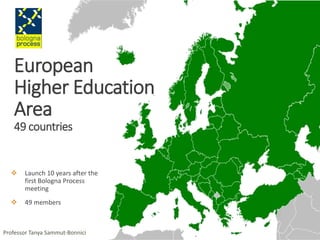
European
Higher Education
Area
49 countries
 Launch 10 years after the
first Bologna Process
meeting
 49 members
Professor Tanya Sammut-Bonnici
European Higher Education Area
ACHIEVEMENTS
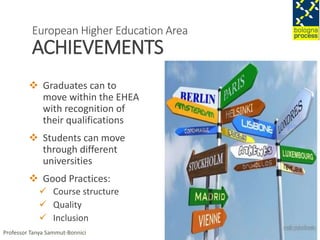
 Graduates can to
move within the EHEA
with recognition of
their qualifications
 Students can move
through different
universities
 Good Practices:
 Course structure
 Quality
 Inclusion
Prof Tanya Sammut-BonniciProfessor Tanya Sammut-Bonnici
1. Enhancing the quality and
relevance of learning and teaching
2. Fostering the employability of
graduates throughout their
working
3. Making higher education systems
more inclusive as populations
become more diverse
4. Common degree structure and
credit system
5. Common quality assurance
standards and guidelines
EuropeanHigherEducationArea
Ministerial Communique May 2015
Members’ Commitments
Professor Tanya Sammut-Bonnici
EuropeanHigherEducationArea
Ministerial Communique May 2015
Members’ Commitments
5. Cooperation for mobility
6. Joint programmes and degrees
7. Recognition of credits gained abroad
8. Recognition of qualifications for academic and professional purposes
9. Recognition of prior learning
Prof Tanya Sammut-BonniciProfessor Tanya Sammut-Bonnici
EuropeanHigherEducationArea
Ministerial Communique May 2015
Members' Commitments
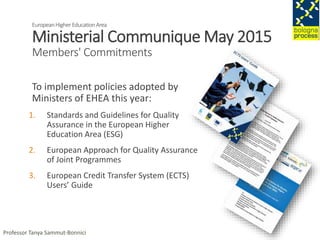
To implement policies adopted by
Ministers of EHEA this year:
1. Standards and Guidelines for Quality
Assurance in the European Higher
Education Area (ESG)
2. European Approach for Quality Assurance
of Joint Programmes
3. European Credit Transfer System (ECTS)
Users’ Guide
Professor Tanya Sammut-Bonnici
EuropeanHigherEducationArea
Ministerial Communique May 2015
Members' Commitments
1. Short Cycle courses (2 years, 120 ECTS)
2. Competence Requirements for Public Employment
3. Information on Graduates’ Career Patterns
4. Review National Legislations
5. Recognition of Prior Learning
6. National Qualifications Frameworks
7. Professional Recognition
8. Staff Mobility
9. Portability of Grants and Loans
10. Socially Inclusive
11. Automatically Recognized
12. EQAR Registered Agencies for Quality Processes
Prof Tanya Sammut-Bonniciordinator Bologna ProcessProfessor Tanya Sammut-Bonnici

Bologna process 2015 overview

  • 1.
    Overview of the BOLOGNAPROCESS EUROPEAN HIGHER EDUCATION AREA - 2015 PROFESSOR TANYA SAMMUT-BONNICI
  • 3.
    Bologna Process  Firstmeeting held at the University of Bologna 1999, 24 European countries.  Ministerial meetings (every 3 years) and agreements between European countries  Objectives: to ensure more comparable, compatible and coherent systems of higher education in Europe Prof Tanya Sammut-BonniciProfessor Tanya Sammut-Bonnici
  • 4.
    European Higher Education Area 49 countries Launch 10 years after the first Bologna Process meeting  49 members Professor Tanya Sammut-Bonnici
  • 5.
    European Higher EducationArea ACHIEVEMENTS  Graduates can to move within the EHEA with recognition of their qualifications  Students can move through different universities  Good Practices:  Course structure  Quality  Inclusion Prof Tanya Sammut-BonniciProfessor Tanya Sammut-Bonnici
  • 6.
    1. Enhancing thequality and relevance of learning and teaching 2. Fostering the employability of graduates throughout their working 3. Making higher education systems more inclusive as populations become more diverse 4. Common degree structure and credit system 5. Common quality assurance standards and guidelines EuropeanHigherEducationArea Ministerial Communique May 2015 Members’ Commitments Professor Tanya Sammut-Bonnici
  • 7.
    EuropeanHigherEducationArea Ministerial Communique May2015 Members’ Commitments 5. Cooperation for mobility 6. Joint programmes and degrees 7. Recognition of credits gained abroad 8. Recognition of qualifications for academic and professional purposes 9. Recognition of prior learning Prof Tanya Sammut-BonniciProfessor Tanya Sammut-Bonnici
  • 8.
    EuropeanHigherEducationArea Ministerial Communique May2015 Members' Commitments To implement policies adopted by Ministers of EHEA this year: 1. Standards and Guidelines for Quality Assurance in the European Higher Education Area (ESG) 2. European Approach for Quality Assurance of Joint Programmes 3. European Credit Transfer System (ECTS) Users’ Guide Professor Tanya Sammut-Bonnici
  • 9.
    EuropeanHigherEducationArea Ministerial Communique May2015 Members' Commitments 1. Short Cycle courses (2 years, 120 ECTS) 2. Competence Requirements for Public Employment 3. Information on Graduates’ Career Patterns 4. Review National Legislations 5. Recognition of Prior Learning 6. National Qualifications Frameworks 7. Professional Recognition 8. Staff Mobility 9. Portability of Grants and Loans 10. Socially Inclusive 11. Automatically Recognized 12. EQAR Registered Agencies for Quality Processes Prof Tanya Sammut-Bonniciordinator Bologna ProcessProfessor Tanya Sammut-Bonnici