The Project Management Course:
Beginner to PROject Manager
Course Notes
Clear your mind
PM principles, tools and techniques are
very much based on common sense.
This does not mean it is easy, and you do
not need good preparation to handle a
project yourself.
Consider most of the things as guidelines and practical
lessons for you – there is no formula on how best to
prepare a project plan.
Try not to think in absolute terms – rarely, there
are black and white options. There are often many
shades of grey in between.
3
Definition of a Project
“A project is a temporary endeavor undertaken
to create a unique product, service or result.”
- Project Management Body of Knowledge PMBOK Guide 5th Ed
What is a Project?
4
Characteristics of a Project
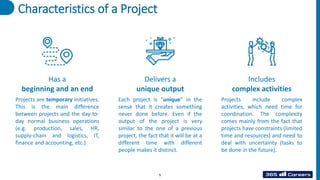
Has a
beginning and an end
Delivers a
unique output
Includes
complex activities
Projects include complex
activities, which need time for
coordination. The complexity
comes mainly from the fact that
projects have constraints (limited
time and resources) and need to
deal with uncertainty (tasks to
be done in the future).
Each project is “unique” in the
sense that it creates something
never done before. Even if the
output of the project is very
similar to the one of a previous
project, the fact that it will be at a
different time with different
people makes it distinct.
Projects are temporary initiatives.
This is the main difference
between projects and the day-to-
day normal business operations
(e.g. production, sales, HR,
supply-chain and logistics, IT,
finance and accounting, etc.).
5
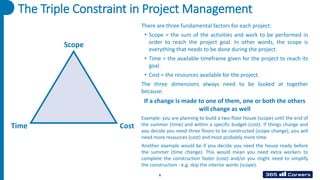
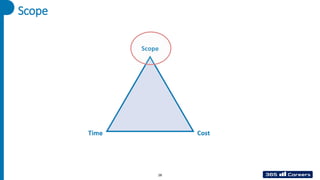
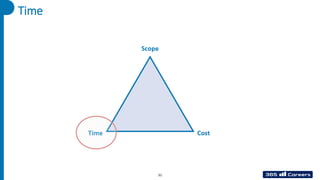
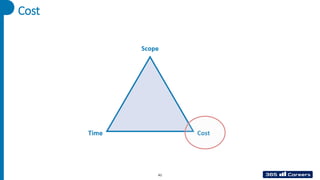
The Triple Constraint in Project Management
Scope
Time Cost
There are three fundamental factors for each project:
• Scope = the sum of the activities and work to be performed in
order to reach the project goal. In other words, the scope is
everything that needs to be done during the project.
• Time = the available timeframe given for the project to reach its
goal.
• Cost = the resources available for the project.
The three dimensions always need to be looked at together
because:
If a change is made to one of them, one or both the others
will change as well
Example: you are planning to build a two-floor house (scope) until the end of
the summer (time) and within a specific budget (cost). If things change and
you decide you need three floors to be constructed (scope change), you will
need more resources (cost) and most probably more time.
Another example would be if you decide you need the house ready before
the summer (time change). This would mean you need extra workers to
complete the construction faster (cost) and/or you might need to simplify
the construction - e.g. skip the interior works (scope).
6
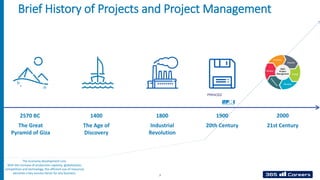
Brief History of Projects and Project Management
The Great
Pyramid of Giza
2570 BC
The Age of
Discovery
1400
Industrial
Revolution
1800
20th Century
1900
21st Century
2000
The Economy development Line.
With the increase of production capacity, globalization,
competition and technology, the efficient use of resources
becomes a key success factor for any business.
7
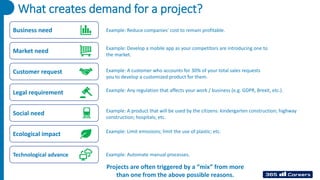
What creates demand for a project?
Example: Reduce companies’ cost to remain profitable.
Example: Develop a mobile app as your competitors are introducing one to
the market.
Example: A customer who accounts for 30% of your total sales requests
you to develop a customized product for them.
Example: Any regulation that affects your work / business (e.g. GDPR, Brexit, etc.).
Example: A product that will be used by the citizens: kindergarten construction; highway
construction; hospitals; etc.
Example: Limit emissions; limit the use of plastic; etc.
Example: Automate manual processes.
Projects are often triggered by a “mix” from more
than one from the above possible reasons.
Business need
Market need
Customer request
Legal requirement
Social need
Ecological impact
Technological advance
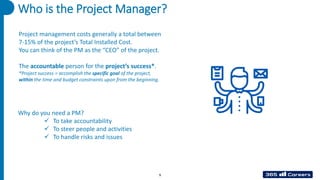
Who is the Project Manager?
Project management costs generally a total between
7-15% of the project’s Total Installed Cost.
You can think of the PM as the “CEO” of the project.
The accountable person for the project’s success*.
*Project success = accomplish the specific goal of the project,
within the time and budget constraints upon from the beginning.
Why do you need a PM?
✓ To take accountability
✓ To steer people and activities
✓ To handle risks and issues
9
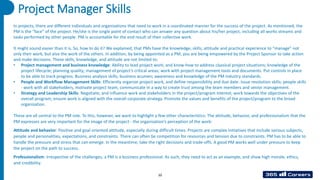
Project Manager Skills
In projects, there are different individuals and organizations that need to work in a coordinated manner for the success of the project. As mentioned, the
PM is the “face” of the project. He/she is the single point of contact who can answer any question about his/her project, including all works streams and
tasks performed by other people. PM is accountable for the end result of their collective work.
It might sound easier than it is. So, how to do it? We explained, that PMs have the knowledge, skills, attitude and practical experience to “manage” not
only their work, but also the work of the others. In addition, by being appointed as a PM, you are being empowered by the Project Sponsor to take action
and make decisions. These skills, knowledge, and attitude are not limited to:
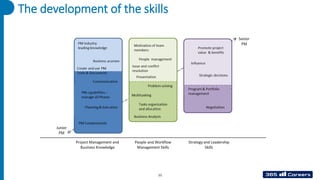
• Project management and business knowledge: Ability to lead project work, and know-how to address classical project situations; knowledge of the
project lifecycle; planning quality; management of project’s critical areas; work with project management tools and documents. Put controls in place
to be able to track progress. Business analysis skills; business acumen; awareness and knowledge of the PM industry standards.
• People and Workflow Management Skills: Efficiently organize project work, and define responsibility and due date. Issue resolution skills; people skills
- work with all stakeholders, motivate project team, communicate in a way to create trust among the team members and senior management.
• Strategy and Leadership Skills: Negotiate, and influence work and stakeholders in the project/program interest; work towards the objectives of the
overall program; ensure work is aligned with the overall corporate strategy. Promote the values and benefits of the project/program to the broad
organization.
These are all central to the PM role. To this, however, we want to highlight a few other characteristics: The attitude, behavior, and professionalism that the
PM expresses are very important for the image of the project - the organization’s perception of the work:
Attitude and behavior: Positive and goal-oriented attitude, especially during difficult times. Projects are complex initiatives that include various subjects,
people and personalities, expectations, and constraints. There can often be competition for resources and tension due to constraints. PM has to be able to
handle the pressure and stress that can emerge. In the meantime, take the right decisions and trade-offs. A good PM works well under pressure to keep
the project on the path to success.
Professionalism: Irrespective of the challenges, a PM is a business professional. As such, they need to act as an example, and show high morale, ethics,
and credibility.
10
The development of the skills
11
Project, Program and Portfolio
Portfolio Project
Program
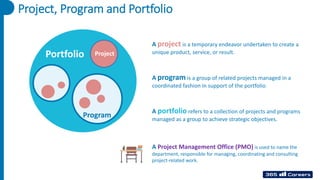
A project is a temporary endeavor undertaken to create a
unique product, service, or result.
A program is a group of related projects managed in a
coordinated fashion in support of the portfolio.
A portfolio refers to a collection of projects and programs
managed as a group to achieve strategic objectives.
А Project Management Office (PMO) is used to name the
department, responsible for managing, coordinating and consulting
project-related work.
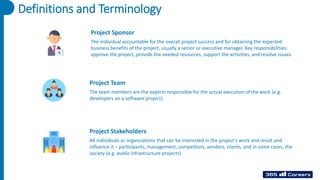
Definitions and Terminology
Project Sponsor
The individual accountable for the overall project success and for obtaining the expected
business benefits of the project, usually a senior or executive manager. Key responsibilities:
approve the project, provide the needed resources, support the activities, and resolve issues.
Project Team
The team members are the experts responsible for the actual execution of the work (e.g.
developers on a software project).
Project Stakeholders
All individuals or organizations that can be interested in the project’s work and result and
influence it – participants, management, competitors, vendors, clients, and in some cases, the
society (e.g. public infrastructure projects).
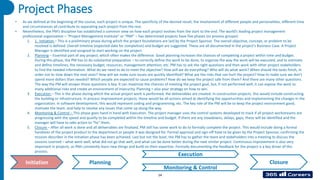
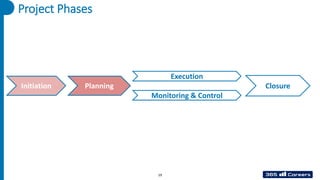
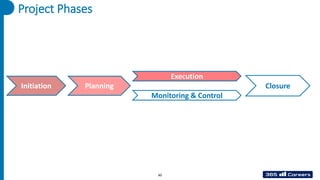
Project Phases
Initiation
Monitoring & Control
Execution
Closure
Planning
14
• As we defined at the beginning of the course, each project is unique. The specificity of the desired result, the involvement of different people and personalities, different time
and circumstances all contribute to separating each project from the rest.
• Nevertheless, the PM’s discipline has established a common view on how each project evolves from the start to the end. The world’s leading project management
professional organization – “Project Management Institute” or “PMI” – has determined projects have five phases (or process groups):
1. 1. Initiation – This is a preliminary phase during which the project foundations are laid by the Project Sponsor. The overall objective, concept, or problem to be
resolved is defined. Overall timeline (expected date for completion) and budget are suggested. These are all documented in the project’s Business Case. A Project
Manager is identified and assigned to start working on the project.
2. Planning – Essential part of any project, which often makes the difference. Good planning increases the chances of completing a project within time and budget.
During this phase, the PM has to do substantial preparation – to correctly define the work to be done, to organize the way the work will be executed, and to estimate
and define timelines, the necessary budget, resources, management attention, etc. PM has to ask the right questions and then work with other project stakeholders
to find the needed information. What do we need to do to meet the objective? How will we do everything? Who will do what work? When should the tasks finish, in
order not to slow down the next ones? How will we make sure issues are quickly identified? What are the risks that can hurt the project? How to make sure we don’t
spend more dollars than needed? Which people are expected to cause problems? How do we keep the project safe from them? And there are many other questions.
The way the PM will answer those questions is key. It can maximize the chances of meeting the project goal, but, if not performed well, it can expose the work to
many additional risks and create an environment of insecurity. Planning = also your strategy on how to win.
3. Execution – This is the phase during which the actual project work is performed, the deliverables are created. In construction projects, this would include constructing
the building or infrastructure. In process improvement projects, these would be all actions aimed at identifying the opportunities and implementing the changes in the
organization. In software development, this would represent coding and programming, etc. The key role of the PM will be to keep the project environment good,
motivate the team, and help to resolve any issues that come up along the way.
4. Monitoring & Control – This phase goes hand in hand with Execution. The project manager uses the control systems developed to track if all project workstreams are
progressing with the speed and quality to be completed within the timeline and budget. If there are any slowdowns, delays, gaps, these will be identified and the
manager will have to take action to “fix” them.
5. Closure – After all work is done and all deliverables are finalized, PM still has some work to do to formally complete the project. This would include doing a formal
handover of the project product to the department or people it was designed for. Formal approval and sign-off have to be given by the Project Sponsor, confirming the
mission describer in the initiation phase has been achieved. Last but not the least, the PM has to gather the team and stakeholders into a meeting to discuss the
Lessons Learned – what went well, what did not go that well, and what can be done better during the next similar project. Continuous improvement is also very
important in projects, as PMs constantly learn new things and build on their expertise. Formally documenting the feedback for the project is a key driver of this
process.
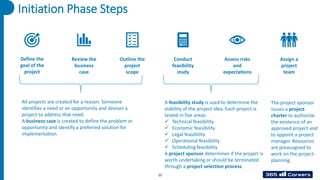
Define the
goal of the
project
Review the
business
case
Outline the
project
scope
Conduct
feasibility
study
Assign a
project
team
Assess risks
and
expectations
Initiation Phase Steps
A feasibility study is used to determine the
viability of the project idea. Each project is
tested in five areas:
✓ Technical feasibility
✓ Economic feasibility
✓ Legal feasibility
✓ Operational feasibility
✓ Scheduling feasibility
A project sponsor determines if the project is
worth undertaking or should be terminated
through a project selection process.
All projects are created for a reason. Someone
identifies a need or an opportunity and devises a
project to address that need.
A business case is created to define the problem or
opportunity and identify a preferred solution for
implementation.
The project sponsor
issues a project
charter to authorize
the existence of an
approved project and
to appoint a project
manager. Resources
are preassigned to
work on the project
planning.
15
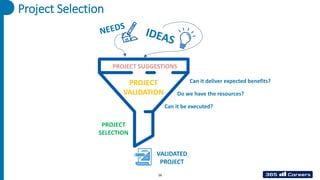
Project Selection
Can it be executed?
Can it deliver expected benefits?
Do we have the resources?
PROJECT
VALIDATION
PROJECT
SELECTION
PROJECT SUGGESTIONS
VALIDATED
PROJECT
16
Project Charter
The project charter is “a document issued by the project
sponsor that formally authorizes the existence of a
project, and provides the project manager with the
authority to apply organizational resources to project
activities.”
- Project Management Body of Knowledge PMBOK Guide 5th Ed
17
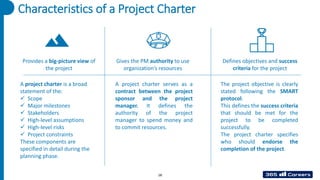
Characteristics of a Project Charter
Provides a big-picture view of
the project
Gives the PM authority to use
organization’s resources
Defines objectives and success
criteria for the project
A project charter is a broad
statement of the:
✓ Scope
✓ Major milestones
✓ Stakeholders
✓ High-level assumptions
✓ High-level risks
✓ Project constraints
These components are
specified in detail during the
planning phase.
A project charter serves as a
contract between the project
sponsor and the project
manager. It defines the
authority of the project
manager to spend money and
to commit resources.
The project objective is clearly
stated following the SMART
protocol.
This defines the success criteria
that should be met for the
project to be completed
successfully.
The project charter specifies
who should endorse the
completion of the project.
18
Project Phases
Initiation
Monitoring & Control
Execution
Closure
Planning
19
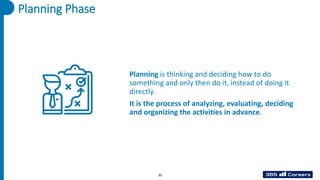
Planning is thinking and deciding how to do
something and only then do it, instead of doing it
directly.
It is the process of analyzing, evaluating, deciding
and organizing the activities in advance.
Planning Phase
20
Planning Phase
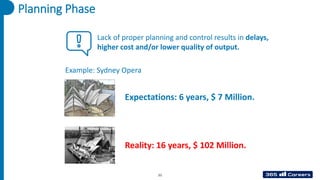
Lack of proper planning and control results in delays,
higher cost and/or lower quality of output.
Expectations: 6 years, $ 7 Million.
Reality: 16 years, $ 102 Million.
Example: Sydney Opera
21
22
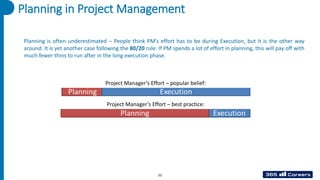
Planning in Project Management
Planning is often underestimated – People think PM’s effort has to be during Execution, but it is the other way
around. It is yet another case following the 80/20 rule: If PM spends a lot of effort in planning, this will pay off with
much fewer thins to run after in the long execution phase.
Project Manager’s Effort – popular belief:
Project Manager’s Effort – best practice:
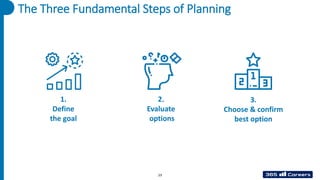
The Three Fundamental Steps of Planning
2.
Evaluate
options
3.
Choose & confirm
best option
1.
Define
the goal
23
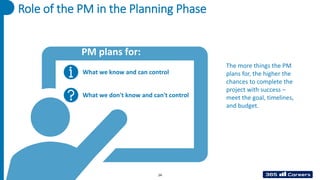
Role of the PM in the Planning Phase
PM plans for:
What we know and can control
What we don't know and can't control
The more things the PM
plans for, the higher the
chances to complete the
project with success –
meet the goal, timelines,
and budget.
24
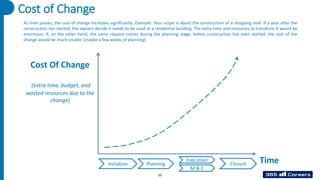
Cost of Change
Cost Of Change
(extra time, budget, and
wasted resources due to the
change)
Time
Initiation
M & C
Execution
Closure
Planning
As time passes, the cost of change increases significantly. Example: Your scope is about the construction of a shopping mall. If a year after the
construction has started, the owners decide it needs to be used as a residential building. The extra time and resources to transform it would be
enormous. If, on the other hand, the same request comes during the planning stage, before construction has even started, the cost of the
change would be much smaller (maybe a few weeks of planning).
25
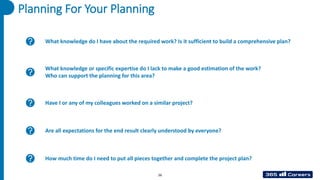
Planning For Your Planning
What knowledge do I have about the required work? Is it sufficient to build a comprehensive plan?
What knowledge or specific expertise do I lack to make a good estimation of the work?
Who can support the planning for this area?
Have I or any of my colleagues worked on a similar project?
Are all expectations for the end result clearly understood by everyone?
How much time do I need to put all pieces together and complete the project plan?
26
27
How to “extract” the needed information from a stakeholder, expert, etc.? This can be a difficult process,
as the information the PM is looking for cannot be directly understood (in some cases).
We can call this a non-straightforward process.
Tips: When organizing a meeting/interview/workshop to start planning, make sure you create a good
agenda, including the goal of the meeting, and a list of all topics that need to be covered and questions to
be answered. Then, follow the list during the meeting to ensure you exit the room with the needed
answers, or in case the answers could not be given, with a view on who can provide the needed answers.
Although PM does not need to be a real “expert” in all fields, they must be able to understand how things
operate in each field, in order to correctly manage the project work. Along with the fact that in each
project, there are many parts to be planned and executed (as we will see now in the following lectures). It
is the PM’s core responsibility to perform integration management (PMI quote) or, in other words, be
successful in managing simultaneously all different aspects of the project and factoring all
interdependencies.
Non-straightforward Process
Scope
28
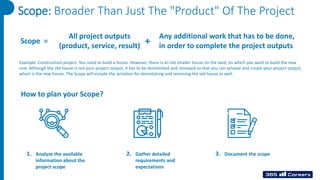
Scope: Broader Than Just The "Product" Of The Project
2. Gather detailed
requirements and
expectations
1. Analyze the available
information about the
project scope
3. Document the scope
All project outputs
(product, service, result)
Any additional work that has to be done,
in order to complete the project outputs
+
Scope =
Example: Construction project. You need to build a house. However, there is an old smaller house on the land, on which you want to build the new
one. Although the old house is not your project output, it has to be demolished and removed so that you can achieve and create your project output,
which is the new house. The Scope will include the activities for demolishing and removing the old house as well.
How to plan your Scope?
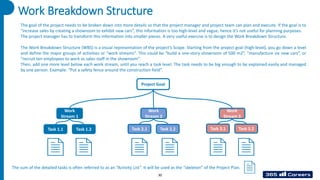
Work Breakdown Structure
The goal of the project needs to be broken down into more details so that the project manager and project team can plan and execute. If the goal is to
“increase sales by creating a showroom to exhibit new cars”, this information is too high-level and vague, hence it’s not useful for planning purposes.
The project manager has to transform this information into smaller pieces. A very useful exercise is to design the Work Breakdown Structure.
The Work Breakdown Structure (WBS) is a visual representation of the project’s Scope. Starting from the project goal (high-level), you go down a level
and define the major groups of activities or “work streams”. This could be “build a one-story showroom of 500 m2”, “manufacture six new cars”, or
“recruit ten employees to work as sales staff in the showroom”.
Then, add one more level below each work stream, until you reach a task level. The task needs to be big enough to be explained easily and managed
by one person. Example: “Put a safety fence around the construction field”.
Project Goal
Work
Stream 1
Task 1.1 Task 1.2
Work
Stream 2
Task 2.1 Task 2.2
Work
Stream 3
Task 3.1 Task 3.2
The sum of the detailed tasks is often referred to as an “Activity List”. It will be used as the “skeleton” of the Project Plan.
30
Time
31
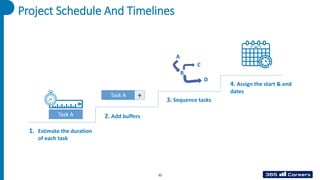
Project Schedule And Timelines
1. Estimate the duration
of each task
2. Add buffers
3. Sequence tasks
4. Assign the start & end
dates
Task A +
A
B
C
D
Task A
32
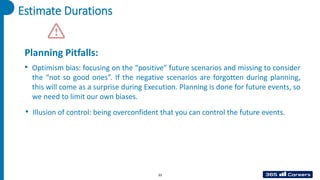
Estimate Durations
Planning Pitfalls:
• Optimism bias: focusing on the “positive” future scenarios and missing to consider
the “not so good ones”. If the negative scenarios are forgotten during planning,
this will come as a surprise during Execution. Planning is done for future events, so
we need to limit our own biases.
• Illusion of control: being overconfident that you can control the future events.
33
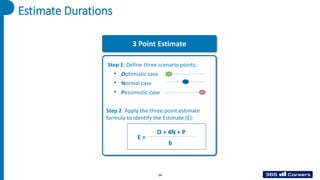
Estimate Durations
E =
O + 4N + P
6
3 Point Estimate
Step 1: Define three scenario points:
• Optimistic case
• Normal case
• Pessimistic case
Step 2: Apply the three-point estimate
formula to identify the Estimate (E):
34
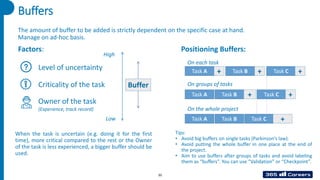
Buffers
The amount of buffer to be added is strictly dependent on the specific case at hand.
Manage on ad-hoc basis.
Level of uncertainty
Criticality of the task
Owner of the task
(Experience, track record)
High
Low
Buffer
Positioning Buffers:
Factors:
Task A + Task B + Task C +
Task A Task B + Task C +
Task A Task B Task C +
On each task
On groups of tasks
On the whole project
When the task is uncertain (e.g. doing it for the first
time), more critical compared to the rest or the Owner
of the task is less experienced, a bigger buffer should be
used.
Tips:
• Avoid big buffers on single tasks (Parkinson’s law).
• Avoid putting the whole buffer in one place at the end of
the project.
• Aim to use buffers after groups of tasks and avoid labeling
them as “buffers”. You can use “Validation” or “Checkpoint”.
35
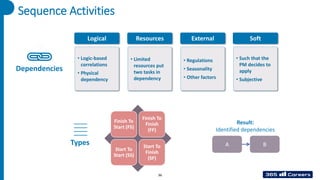
Sequence Activities
Finish To
Start (FS)
Finish To
Finish
(FF)
Start To
Start (SS)
Start To
Finish
(SF)
Dependencies
• Logic-based
correlations
• Physical
dependency
Logical
• Limited
resources put
two tasks in
dependency
Resources
• Regulations
• Seasonality
• Other factors
External
• Such that the
PM decides to
apply
• Subjective
Soft
Types A B
Result:
Identified dependencies
36
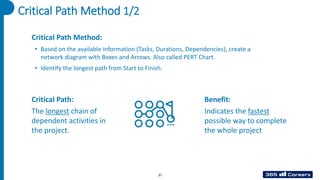
Critical Path Method 1/2
Critical Path:
The longest chain of
dependent activities in
the project.
Benefit:
Indicates the fastest
possible way to complete
the whole project
Critical Path Method:
• Based on the available information (Tasks, Durations, Dependencies), create a
network diagram with Boxes and Arrows. Also called PERT Chart.
• Identify the longest path from Start to Finish.
37
A
1 week
B
2 weeks
C
4 weeks
F
3 weeks
J
2 weeks
D
4 weeks
H
2 weeks
K
1 week
E
1 week
I
3 weeks
L
Critical Path Method 2/2
How to perform the Critical Path Method:
1. Use the information available:
• Activity List; Durations; Dependencies
2. Build the network diagram, by drawing Boxes with Task Name and Duration
and Arrows to indicate dependencies:
3. Calculate the Longest chain of dependent tasks (the Critical Path).
38
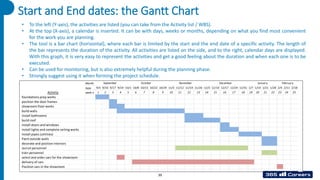
Start and End dates: the Gantt Chart
• To the left (Y-axis), the activities are listed (you can take from the Activity list / WBS).
• At the top (X-axis), a calendar is inserted. It can be with days, weeks or months, depending on what you find most convenient
for the work you are planning.
• The tool is a bar chart (horizontal), where each bar is limited by the start and the end date of a specific activity. The length of
the bar represents the duration of the activity. All activities are listed on the side, and to the right, calendar days are displayed.
With this graph, it is very easy to represent the activities and get a good feeling about the duration and when each one is to be
executed.
• Can be used for monitoring, but is also extremely helpful during the planning phase.
• Strongly suggest using it when forming the project schedule.
39
Month
Date 9/3 9/10 9/17 9/24 10/1 10/8 10/15 10/22 10/29 11/5 11/12 11/19 11/26 12/3 12/10 12/17 12/24 12/31 1/7 1/14 1/21 1/28 2/4 2/11 2/18
Activity week n 1 2 3 4 5 6 7 8 9 10 11 12 13 14 15 16 17 18 19 20 21 22 23 24 25
foundations prep works
position the door frames
showroom floor works
build walls
install bathrooms
build roof
install doors and windows
install lights and complete ceiling works
Install pipes (utilities)
Paint outside walls
decorate and position interiors
recruit personnel
train personnel
select and order cars for the showroom
delivery of cars
Position cars in the showroom
September October November December January February
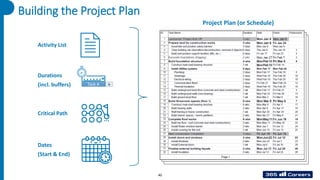
Building the Project Plan
Task A +
Critical Path
Activity List
Durations
(incl. buffers)
Dates
(Start & End)
Project Plan (or Schedule)
40
Cost
41
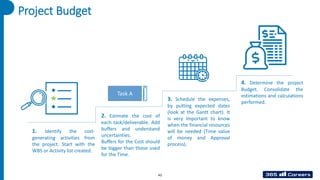
Project Budget
1. Identify the cost-
generating activities from
the project. Start with the
WBS or Activity list created.
2. Estimate the cost of
each task/deliverable. Add
buffers and understand
uncertainties.
Buffers for the Cost should
be bigger than those used
for the Time.
3. Schedule the expenses,
by putting expected dates
(look at the Gantt chart). It
is very important to know
when the financial resources
will be needed (Time value
of money and Approval
process).
4. Determine the project
Budget. Consolidate the
estimations and calculations
performed.
Task A
42
Project Budget 1/2
Budget Estimations:
• Gather information (price is available; alternatives; gathering information
through quotations [RFQ, RFP]).
• Calculations (lump sum; time and materials; units)
• Buffers – Usually, bigger than the Time buffers, because it is easier to allocate
additional time and harder to get some more money
Timing the Budget – plan and indicate WHEN an expense is expected
to take place (Time value of money; Financial processes)
43
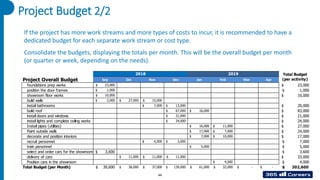
Project Budget 2/2
If the project has more work streams and more types of costs to incur, it is recommended to have a
dedicated budget for each separate work stream or cost type.
Consolidate the budgets, displaying the totals per month. This will be the overall budget per month
(or quarter or week, depending on the needs).
Project Overall Budget Sep Oct Nov Dec Jan Feb Mar Apr
foundations prep works 23,000
$ 23,000
$
position the door frames 1,000
$ 1,000
$
showroom floor works 10,000
$ 10,000
$
build walls 2,000
$ 27,000
$ 15,000
$
install bathrooms 7,000
$ 13,000
$ 20,000
$
build roof 67,000
$ 16,000
$ 83,000
$
install doors and windows 21,000
$ 21,000
$
install lights and complete ceiling works 24,000
$ 24,000
$
Install pipes (utilities) 16,000
$ 11,000
$ 27,000
$
Paint outside walls 17,000
$ 7,000
$ 24,000
$
decorate and position interiors 7,000
$ 10,000
$ 17,000
$
recruit personnel 4,000
$ 3,000
$ 7,000
$
train personnel 5,000
$ 5,000
$
select and order cars for the showroom 3,600
$ 3,600
$
delivery of cars 11,000
$ 11,000
$ 11,000
$ 33,000
$
Position cars in the showroom 4,000
$ 4,000
$
Total Budget (per Month) 39,600
$ 38,000
$ 37,000
$ 139,000
$ 61,000
$ 32,000
$ -
$ -
$ 302,600
$
2018 2019 Total Budget
(per activity)
44
45
Planning - Resources: Procurement 1/2
It is often the case that an organization will not have the required resources that a project needs. Therefore,
the PM here has the responsibility to procure what they need externally. By this point, they should be very
familiar with the details of the contract in order to properly assess the costs and the risks of any transaction.
They must be aware of timelines, due dates, and quality levels of all resources they are procuring.
There are three main types of contracts that we will run through now. It is up to the PM to find the best
contract because it is their main tool for keeping track of vendor work and behavior.
So, the first one is called fixed price and it is the simplest type of contract. The vendor commits to doing the
work for a set amount within a certain timeframe.
The pros of this is that any additional spending will be taken on by the vendor – no risk for you. Perfect!
Or is it?
You see that they are aware that with this kind of contract, if the costs are higher than expected, then they
will incur losses. Therefore, there is a chance they will put a big buffer on the initial price.
46
Planning - Resources: Procurement 2/2
Or if they find that costs are getting too high, they may try to decrease the scope or the quality in order to compensate.
So, know that this is beneficial to use when the scope is clear to all parties, but a good analysis is important prior to make
agreements.
The second type is called Cost Plus – This is where the buyer agrees to pay any cost incurred by the vendor performing the work. This
can be a fixed additional fee, a variable fee, or a mix of the two. Either way, it gives the buyer the flexibility to adapt the spending in
accordance with the work being done.
But with that comes the risk of covering all extra costs, along with the chance that the vendor may keep the work going longer than
needed or add extra items to the ‘to-do list’.
This contract makes more sense if the scope is not easy to define. But proper controls need to be put in place to ensure money is only
spent on things essential for the project. A fancy new haircut for the vendor doesn’t fall into this category.
The third type of contract is called time and materials and it’s a mixture of fixed price and cost-plus. It’s where the vendor charges the
buyer an hourly or daily rate. For example, when consultants or technicians charge per day of their services. It’s another good
contract to jump into when the scope is not clear, and the work is more labor-based than material-based. It runs a similar risk to the
cost-plus contract, but that just means the same countermeasures can be taken.
Well, there we have it – the three types of contract, but there can be many variations and, of course, they can all be tailor-made. The
PM could add incentives for the vendor to complete work faster or to better the quality. The contract can even include inflation if the
project spans a long time.
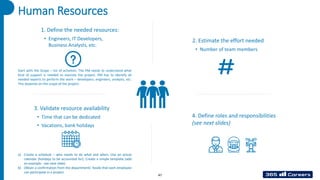
Human Resources
1. Define the needed resources:
• Engineers, IT Developers,
Business Analysts, etc.
2. Estimate the effort needed
• Number of team members
4. Define roles and responsibilities
(see next slides)
3. Validate resource availability
• Time that can be dedicated
• Vacations, bank holidays
47
Start with the Scope – list of activities. The PM needs to understand what
kind of support is needed to execute the project. PM has to identify all
needed experts to perform the work – developers, engineers, analysts, etc.
This depends on the scope of the project.
a) Create a schedule – who needs to do what and when. Use an actual
calendar (holidays to be accounted for). Create a simple template (add
an example - see next slide).
b) Obtain a confirmation from the departments’ heads that each employee
can participate in a project.
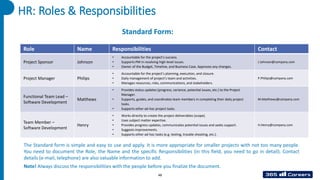
HR: Roles & Responsibilities
Role Name Responsibilities Contact
Project Sponsor Johnson
• Accountable for the project’s success.
• Supports PM in resolving high-level issues.
• Owner of the Budget, Timeline, and Business Case. Approves any changes.
J.Johnson@company.com
Project Manager Philips
• Accountable for the project’s planning, execution, and closure.
• Daily management of project’s team and activities.
• Manages resources, risks, communications, and stakeholders.
P.Philips@company.com
Functional Team Lead –
Software Development
Matthews
• Provides status updates (progress, variance, potential issues, etc.) to the Project
Manager.
• Supports, guides, and coordinates team members in completing their daily project
tasks.
• Supports other ad-hoc project tasks.
M.Matthews@company.com
Team Member –
Software Development
Henry
• Works directly to create the project deliverables (scope).
• Uses subject matter expertise.
• Provides progress updates, communicates potential issues and seeks support.
• Suggests improvements.
• Supports other ad-hoc tasks (e.g. testing, trouble shooting, etc.).
H.Henry@company.com
Standard Form:
The Standard form is simple and easy to use and apply. It is more appropriate for smaller projects with not too many people.
You need to document the Role, the Name and the specific Responsibilities (in this field, you need to go in detail). Contact
details (e-mail, telephone) are also valuable information to add.
Note! Always discuss the responsibilities with the people before you finalize the document.
48
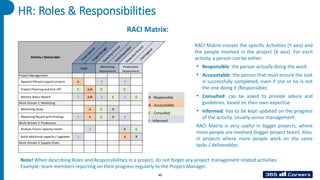
HR: Roles & Responsibilities
RACI Matrix:
ProjectSponsor
ProjectM
anager
M
arketingDirector
M
arketinganalyst
ProductionDirector
Chiefengineer
PMO
Marketing
Department
Production
Department
Activity / Deliverable
Project Management
Appoint PMand support project A I I
Project Planning and Kick-Off C A/R C C
Weekly Status Report I A/R I C I C
Work-Stream 1: Marketing
Marketing Study A C R
Marketing Report with findings I A C R I
Work-Stream 2: Production
Analyze future capacity needs I R C
Build additional capacity / upgrades I A R
Work-Stream 3: Supply-Chain
…
PMO
Marketing
Department
Production
Department
Activity / Deliverable
R - Responsible
A - Accountable
C - Consulted
I - Informed
RACI Matrix crosses the specific Activities (Y axis) and
the people involved in the project (X axis). For each
activity, a person can be either:
• Responsible: the person actually doing the work
• Accountable: the person that must ensure the task
is successfully completed, even if she or he is not
the one doing it (Responsible)
• Consulted: can be asked to provide advice and
guidelines, based on their own expertise
• Informed: has to be kept updated on the progress
of the activity. Usually senior management.
RACI Matrix is very useful in bigger projects, where
more people are involved (bigger project team). Also,
in projects where more people work on the same
tasks / deliverables.
Note! When describing Roles and Responsibilities in a project, do not forget any project management related activities.
Example: team members reporting on their progress regularly to the Project Manager.
49
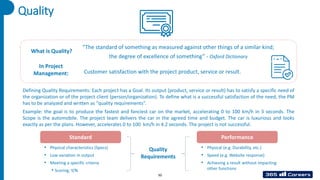
Defining Quality Requirements: Each project has a Goal. Its output (product, service or result) has to satisfy a specific need of
the organization or of the project client (person/organization). To define what is a successful satisfaction of the need, the PM
has to be analyzed and written as “quality requirements”.
Example: the goal is to produce the fastest and fanciest car on the market, accelerating 0 to 100 km/h in 3 seconds. The
Scope is the automobile. The project team delivers the car in the agreed time and budget. The car is luxurious and looks
exactly as per the plans. However, accelerates 0 to 100 km/h in 4.2 seconds. The project is not successful.
Quality
“The standard of something as measured against other things of a similar kind;
the degree of excellence of something” - Oxford Dictionary
Standard Performance
What is Quality?
In Project
Management: Customer satisfaction with the project product, service or result.
Quality
Requirements
• Physical characteristics (Specs)
• Low variation in output
• Meeting a specific criteria
• Scoring; Y/N
• Physical (e.g. Durability, etc.)
• Speed (e.g. Website response)
• Achieving a result without impacting
other functions
50
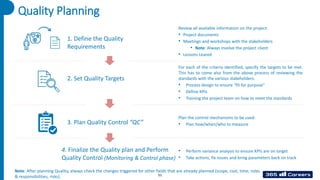
Quality Planning
1. Define the Quality
Requirements
2. Set Quality Targets
3. Plan Quality Control “QC”
4. Finalize the Quality plan and Perform
Quality Control (Monitoring & Control phase)
Review all available information on the project:
• Project documents
• Meetings and workshops with the stakeholders
• Note: Always involve the project client
• Lessons Leared
For each of the criteria identified, specify the targets to be met.
This has to come also from the above process of reviewing the
standards with the various stakeholders:
• Process design to ensure “fit for purpose”
• Define KPIs
• Training the project team on how to meet the standards
Plan the control mechanisms to be used:
• Plan how/when/who to measure
• Perform variance analysis to ensure KPIs are on target
• Take actions, fix issues and bring parameters back on track
Note: After planning Quality, always check the changes triggered for other fields that are already planned (scope, cost, time, roles
& responsibilities, risks). 51
52
Expectations 1/2
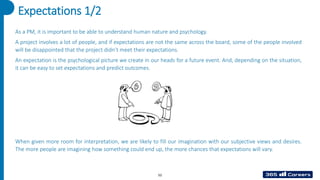
As a PM, it is important to be able to understand human nature and psychology.
A project involves a lot of people, and if expectations are not the same across the board, some of the people involved
will be disappointed that the project didn’t meet their expectations.
An expectation is the psychological picture we create in our heads for a future event. And, depending on the situation,
it can be easy to set expectations and predict outcomes.
When given more room for interpretation, we are likely to fill our imagination with our subjective views and desires.
The more people are imagining how something could end up, the more chances that expectations will vary.
53
Expectations 2/2
The process of getting everyone on the same page is done mostly when defining the scope, during workshops, and
when meeting with stakeholders. The PM must be able to clearly communicate their expectations and hold sessions
in a way that encourages stakeholders to share their expectations in order to identify any gaps.
Some example questions the PM could ask are: How do you think the final product of the project will be useful to the
organization? Do you believe something can be added to significantly improve the result? Do you agree with the way
the scope is described in the project documents? There are many other questions because the more thorough, the
better.
The PM’s job of leveling everyone’s expectations does not stop there. Not only must the project manager keep all
stakeholders up to date during the various meetings carried out through the scoping phase, but they must also keep
in constant communication for the whole project as any changes occur. The whole idea behind keeping everyone in
the loop, constantly, is to eliminate any opportunities for the stakeholders’ imagination to run wild.
54
An assumption is when something is believed to be true when there is no definite proof. While the planning
process aims to clarify all areas of a project, we must assume that there are areas that we cannot be certain of. For
example, we cannot be 100% sure that all team members will be as productive as they usually are, but we have to
assume they will.
Of course, a PM will be more certain of their assumption if they have worked with the team before, but it is still an
assumption.
When a PM has more past data, the safer their assumptions will be. Imagine Lamborrari needs to hire a certain
number of mechanics to deal with any problems the show cars may have. You, as the PM, could look at previous
data where a similarly trained mechanic from a previous showroom project was able to properly care for five cars.
You plan to have 20 cars in your showroom, therefore you can assume you will need to hire four mechanics. While
there is still a level of uncertainty, it is a lot less than if you had no previous data.
Assumptions
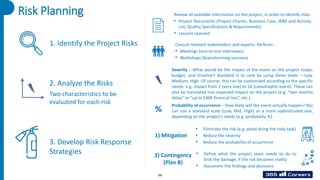
Risk Planning
What is a
Risk?
Exposure to the possibility of loss, injury, or other adverse or
unwelcome circumstance; a chance or situation involving
such a possibility. Oxford English Dictionary
Risk Management – What to do:
1. Identify the project risks
2. Analyze the risks
3. Develop risk response strategies
55
More difficult to plan than the cost, time, or scope. You
don’t see them. They are the result of the uncertainties
that expect us in the future.
PM Context:
Severity – What would be the impact of the event on the project scope,
budget, and timeline? Standard is to rank by using three levels – Low,
Medium, High. Of course, this can be customized according to the specific
needs: e.g. impact from 1 (very low) to 10 (catastrophic event). These can
also be translated into expected impact on the project (e.g. “two months
delay” or “up to $40K financial loss”, etc.).
Probability of occurrence – How likely will the event actually happen? You
can use a standard scale (Low, Mid, High) or a more sophisticated one,
depending on the project’s needs (e.g. probability %).
Risk Planning
1. Identify the Project Risks
2. Analyze the Risks
Two characteristics to be
evaluated for each risk
Review all available information on the project, in order to identify risks:
• Project Documents (Project Charter, Business Case, WBS and Activity
List, Quality Specifications & Requirements)
• Lessons Learned
3. Develop Risk Response
Strategies
%
• Eliminate the risk (e.g. avoid doing the risky task)
• Reduce the severity
• Reduce the probability of occurrence
2) Contingency
(Plan B)
1) Mitigation
Consult relevant stakeholders and experts. Perform:
• Meetings (one-to-one interviews)
• Workshops (brainstorming sessions)
• Define what the project team needs to do to
limit the damage, if the risk becomes reality
• Document the findings and decisions
56
57
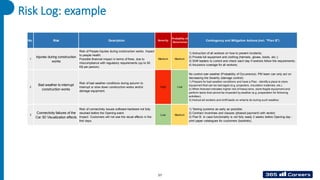
No. Risk Description Severity
Probabilty of
Occurrence
Contingency and Mitigation Actions (incl. "Plan B")
1
Injuries during construction
works
Risk of People Injuries during construction works. Impact
to people health.
Possible financial impact in terms of fines, due to
miscompliance with regulatory requirements (up to 50
K$ per person).
Medium Medium
1) Instruction of all workers on how to prevent incidents;
2) Provide full equipment and clothing (helmets, gloves, boots, etc.);
3) Shift leaders to control and check each day if workers follow the requirements;
4) Insurance coverage for all workers;
2
Bad weather to interrupt
construction works
Risk of bad weather conditions during autumn to
interrupt or slow down construction works and/or
damage equipment.
High Low
No control over weather (Probability of Occurrence). PM team can only act on
decreasing the Severity (damage control):
1) Prepare for bad weather conditions and have a Plan - identify a place to store
equipment that can be damaged (e.g. projectors, insulation materials, etc.).
2) When forecast indicates higher risk of heavy rains, store fragile equipment and
perform tasks that cannot be impacted by weather (e.g. preparation for follwoing
activities).
3) Instruct all workers and shift leads on what to do during such weather;
3
Connectivity failures of the
Car 3D Visualization effects
Risk of connectivity issues software-hardware not fully
resolved before the Opening event.
Impact: Customers will not see the visual effects in the
first days.
Low Medium
1) Testing systems as early as possible;
2) Contract incentives and clauses (phased payment) with vendor;
3) Plan B: In case functionality is not fully ready 2 weeks before Opening day -
print paper catalogues for customers (booklets).
Risk Log: example
58
Change process 1/2
In a project, frequent changes will incur excessive costs, for budget, scope, quality or time. And the PM tries to eliminate
as much of this cost as possible with a detailed plan. But a good PM is also not stubborn and will adapt to change.
Basically, it is the PM’s job to limit the need for changes on one hand and on the other to manage the changes efficiently in
a way that the project could benefit from it.
First is what we’ve been doing in the course so far, limiting the potential for change through comprehensive planning. By
using the methods that we have been discussing, any PM will miss fewer details in the execution phase and, therefore,
will not need to make many changes.
If they do need to make changes, a PM should implement a change control process. Before moving to execution, how to
manage changes must be agreed upon, and as with most parts of the planning, a process needs to be established.
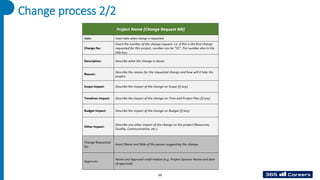
The thing that will start the process is a change being requested and that request needs to be analyzed. What are the
benefits of the change? What is needed in order to implement the change and what is its impact on the project? Of
course, a formal document must be created to collect this data – a change request form. The PM must understand the
proposal, fill in the form, and then send it for approval.
Who will the PM send the change request form to? The project sponsor, of course; since they have provided the needed
resources, they should also determine if the additional needs are worth it. If the PM has concluded that the change will
benefit the project, they must then convince the project sponsor.
59
Change process 2/2
Project Phases
Initiation
Monitoring & Control
Execution
Closure
Planning
60
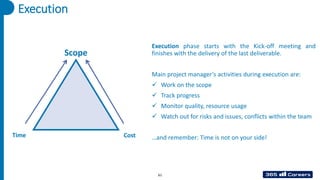
Execution
Execution phase starts with the Kick-off meeting and
finishes with the delivery of the last deliverable.
Main project manager’s activities during execution are:
✓ Work on the scope
✓ Track progress
✓ Monitor quality, resource usage
✓ Watch out for risks and issues, conflicts within the team
…and remember: Time is not on your side!
Scope
Time Cost
61
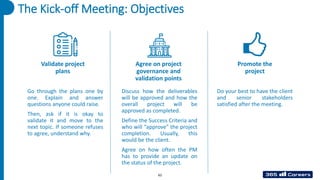
The Kick-off Meeting: Objectives
Validate project
plans
Agree on project
governance and
validation points
Promote the
project
Go through the plans one by
one. Explain and answer
questions anyone could raise.
Then, ask if it is okay to
validate it and move to the
next topic. If someone refuses
to agree, understand why.
Discuss how the deliverables
will be approved and how the
overall project will be
approved as completed.
Define the Success Criteria and
who will “approve” the project
completion. Usually, this
would be the client.
Agree on how often the PM
has to provide an update on
the status of the project.
Do your best to have the client
and senior stakeholders
satisfied after the meeting.
62
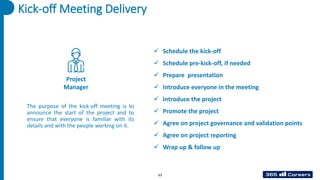
Kick-off Meeting Delivery
Project
Manager
✓ Schedule the kick-off
✓ Schedule pre-kick-off, if needed
✓ Prepare presentation
✓ Introduce everyone in the meeting
✓ Introduce the project
✓ Promote the project
✓ Agree on project governance and validation points
✓ Agree on project reporting
✓ Wrap up & follow up
The purpose of the kick-off meeting is to
announce the start of the project and to
ensure that everyone is familiar with its
details and with the people working on it.
63
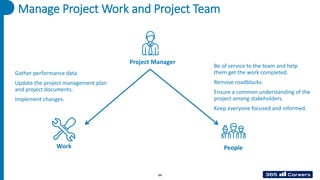
Manage Project Work and Project Team
Project Manager
People
Work
Be of service to the team and help
them get the work completed.
Remove roadblocks.
Ensure a common understanding of the
project among stakeholders.
Keep everyone focused and informed.
Gather performance data.
Update the project management plan
and project documents.
Implement changes.
64
65
The most important things the PM should do:
• Supervise critical path activities – PM needs to ensure high productivity on these activities. If you get delayed on any of them, you delay the
overall project, remember? PM needs to put extra care on:
• Productivity of the ongoing activity: the work needs to progress at a good rate in order not to get delayed. Productivity needs to be high
enough to complete the work on time. But what is Productivity? It essentially is the output you get out of a given input or the ratio
between the two (output/input). In a project world, the output are pieces of the scope and the input is essentially time and resources –
see, this is again our triangle, but this time put in motion. Available Time and resources will be decreasing and the Scope will become real
(see graph). So the PM will need to maintain the productivity high, especially on the critical path. How to measure productivity in projects?
Again, it will be different for the different projects (the scope is unique). In construction, the productivity could be measured in constructed
stories per month (e.g. two stories per month built). In software development, this can be a number of new functionalities programmed.
Whatever it is, PM needs to ensure the rate is good.
• Readiness of the following activities to start: keeping the best productivity on activity. A high is good, but you can still fail in case the next
activity for any reason is not ready to start on time. The upcoming activities in the chain need to start on time (B, C, etc.). PM needs to ask
the question – is everything ready to start on time? Example: In the showroom case, for example, let’s say the construction works are
progressing on track to be entirely completed (including pipelines, etc.) in the remaining two weeks. However, it turns out there have been
some additional discussions on the design of the interiors, and more specifically, the effects around the car podiums and the next activity
may not be ready to start as planned (“decorate and position interiors).
• Look for opportunities to optimize the workflow using your business knowledge, project management experience, and common sense (it
can be stronger than you think ☺ ). As the project progresses, the PM and project team become more knowledgeable of the work at hand.
Hence, often there are ideas of how to make it better, faster, or both. Is this activity valuable? Are there better ways of sequencing the
work – starting more activities in parallel to save some time? Keep asking these questions.
• Don’t forget other project activities (e.g. legal documents, etc.), the ones that are not on the critical path. Forget? You cannot forget – you
have the recipe! If not supervised or underestimated, activities outside the critical path may become part of the critical path (if delayed
significantly).
Manage Project Work
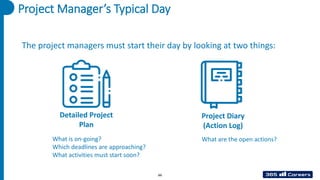
Project Manager’s Typical Day
Detailed Project
Plan
The project managers must start their day by looking at two things:
Project Diary
(Action Log)
What is on-going?
Which deadlines are approaching?
What activities must start soon?
What are the open actions?
66
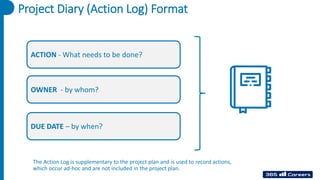
Project Diary (Action Log) Format
ACTION - What needs to be done?
OWNER - by whom?
DUE DATE – by when?
The Action Log is supplementary to the project plan and is used to record actions,
which occur ad-hoc and are not included in the project plan.
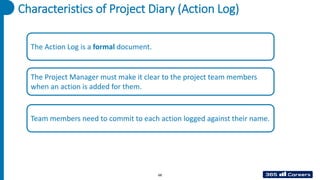
Characteristics of Project Diary (Action Log)
The Action Log is a formal document.
The Project Manager must make it clear to the project team members
when an action is added for them.
Team members need to commit to each action logged against their name.
68
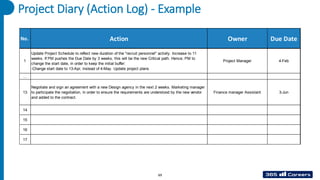
Project Diary (Action Log) - Example
69
No. Action Owner Due Date
1
Update Project Schedule to reflect new duration of the "recruit personnel" activity. Increase to 11
weeks. If PM pushes the Due Date by 3 weeks, this will be the new Critical path. Hence, PM to
change the start date, in order to keep the initial buffer:
-Change start date to 13-Apr, instead of 4-May. Update project plans
Project Manager 4-Feb
…
13
Negotiate and sign an agreement with a new Design agency in the next 2 weeks. Marketing manager
to participate the negotiation, in order to ensure the requirements are understood by the new vendor
and added to the contract.
Finance manager Assistant 3-Jun
14
15
16
17
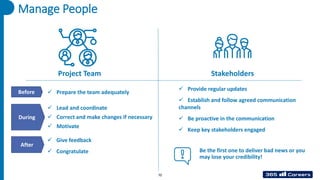
Manage People
Stakeholders
Project Team
✓ Provide regular updates
✓ Establish and follow agreed communication
channels
✓ Be proactive in the communication
✓ Keep key stakeholders engaged
Be the first one to deliver bad news or you
may lose your credibility!
✓ Prepare the team adequately
Before
During
After
✓ Lead and coordinate
✓ Correct and make changes if necessary
✓ Motivate
✓ Give feedback
✓ Congratulate
70
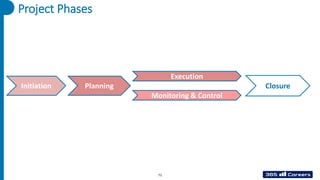
Project Phases
Initiation
Monitoring & Control
Execution
Closure
Planning
71
Monitoring and Control
In Project Management, the Monitoring and Control phase is
basically about analyzing the Actual against the target and
understanding early on, through numbers, if something is not
working “fast enough” or “well enough”. In other words,
measuring project performance against the project plan.
The monitoring and control phase consists of 3 key activities:
➢Define Metrics & Targets
➢Collect Actuals
➢Identify any areas in which changes are required
➢Initiate changes where needed
72
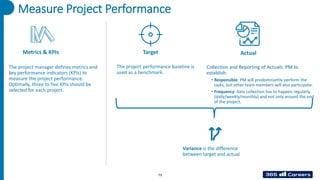
Measure Project Performance
Target Actual
Variance is the difference
between target and actual
Metrics & KPIs
The project performance baseline is
used as a benchmark.
Collection and Reporting of Actuals. PM to
establish:
• Responsible: PM will predominantly perform the
tasks, but other team members will also participate.
• Frequency: data collection has to happen regularly
(daily/weekly/monthly) and not only around the end
of the project.
The project manager defines metrics and
key performance indicators (KPIs) to
measure the project performance.
Optimally, three to five KPIs should be
selected for each project.
73
Measure Project Performance
Target Actual
Metrics & KPIs
74
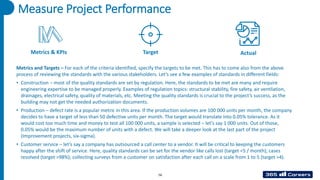
Metrics and Targets – For each of the criteria identified, specify the targets to be met. This has to come also from the above
process of reviewing the standards with the various stakeholders. Let’s see a few examples of standards in different fields:
• Construction – most of the quality standards are set by regulation. Here, the standards to be met are many and require
engineering expertise to be managed properly. Examples of regulation topics: structural stability, fire safety, air ventilation,
drainages, electrical safety, quality of materials, etc. Meeting the quality standards is crucial to the project’s success, as the
building may not get the needed authorization documents.
• Production – defect rate is a popular metric in this area. If the production volumes are 100 000 units per month, the company
decides to have a target of less than 50 defective units per month. The target would translate into 0.05% tolerance. As it
would cost too much time and money to test all 100 000 units, a sample is selected – let’s say 1 000 units. Out of those,
0.05% would be the maximum number of units with a defect. We will take a deeper look at the last part of the project
(Improvement projects, six-sigma).
• Customer service – let’s say a company has outsourced a call center to a vendor. It will be critical to keeping the customers
happy after the shift of service. Here, quality standards can be set for the vendor like calls lost (target <5 / month); cases
resolved (target >98%); collecting surveys from a customer on satisfaction after each call on a scale from 1 to 5 (target >4).
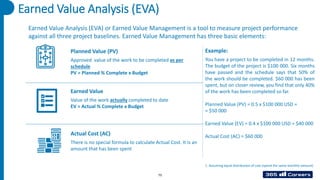
Earned Value Analysis (EVA)
Planned Value (PV)
Approved value of the work to be completed as per
schedule
PV = Planned % Complete x Budget
Earned Value
Value of the work actually completed to date
EV = Actual % Complete x Budget
Actual Cost (AC)
There is no special formula to calculate Actual Cost. It is an
amount that has been spent
Example:
You have a project to be completed in 12 months.
The budget of the project is $100 000. Six months
have passed and the schedule says that 50% of
the work should be completed. $60 000 has been
spent, but on closer review, you find that only 40%
of the work has been completed so far.
Planned Value (PV) = 0.5 x $100 000 USD =
= $50 000
Earned Value (EV) = 0.4 x $100 000 USD = $40 000
Actual Cost (AC) = $60 000
Earned Value Analysis (EVA) or Earned Value Management is a tool to measure project performance
against all three project baselines. Earned Value Management has three basic elements:
75
1. Assuming equal distribution of cost (spend the same monthly amount)
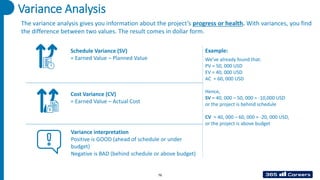
Variance Analysis
Schedule Variance (SV)
= Earned Value – Planned Value
Cost Variance (CV)
= Earned Value – Actual Cost
Variance interpretation
Positive is GOOD (ahead of schedule or under
budget)
Negative is BAD (behind schedule or above budget)
The variance analysis gives you information about the project’s progress or health. With variances, you find
the difference between two values. The result comes in dollar form.
Example:
We’ve already found that:
PV = 50, 000 USD
EV = 40, 000 USD
AC = 60, 000 USD
Hence,
SV = 40, 000 – 50, 000 = -10,000 USD
or the project is behind schedule
CV = 40, 000 – 60, 000 = -20, 000 USD,
or the project is above budget
76
Performance Index Analysis
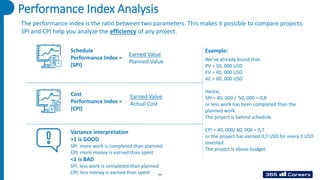
Schedule
Performance Index =
(SPI)
Cost
Performance Index =
(CPI)
Variance interpretation
>1 is GOOD
SPI: more work is completed than planned
CPI: more money is earned than spent
<1 is BAD
SPI: less work is completed than planned
CPI: less money is earned than spent
Earned Value
Planned Value
Earned Value
Actual Cost
Example:
We’ve already found that:
PV = 50, 000 USD
EV = 40, 000 USD
AC = 60, 000 USD
Hence,
SPI = 40, 000 / 50, 000 = 0,8
or less work has been completed than the
planned work.
The project is behind schedule.
CPI = 40, 000/ 60, 000 = 0,7
or the project has earned 0,7 USD for every 1 USD
invested.
The project is above budget.
The performance index is the ratio between two parameters. This makes it possible to compare projects.
SPI and CPI help you analyze the efficiency of any project.
77
78
Quality Control
Remember what Quality is in projects – the characteristics of the project’s final deliverable.
Project work needs to be executed in a way to guarantee that the final product possesses the desired characteristics and
capabilities.
During planning the Quality piece, the PM has collected all requirements, set quality targets, and prepared a plan of
quality control (measurement of actuals vs targets). The quality standards, targets, and how they are controlled will be
very different from one project to another, as is the scope, but we will highlight common things that need to be done in
the Control Quality activities. The Actuals are collected through quality audits, checks, and inspections (this corresponds
to the registration of Actual values – which we reviewed for Timelines and Cost (again – data, data, data ). Our Quality
control efforts are aimed at answering one general question: Are the quality targets being met?
In order to answer the question, the quality may be analyzed on three points: Input-Process-Output.
79
Quality Control
Let’s see a couple of different quality checkpoints that can be controlled, just in our Lamborrari project:
• Input: Here, the PM must be sure the works start with the right foot. Are all the needed inputs okay for us to reach the goal? If we need
to start with resources that cannot be transformed in the desired scope, why start at all? In our case, these would be the construction
materials – verify if they meet all standards. A logical step would be for the one responsible for the construction workstream to do an
initial validation of the construction materials procured. They will be the appropriate team member, as this is a specific field, which
needs to be validated by an expert (engineer). A checklist would be an appropriate tool to go through all these.
Same verification can be done for the car production – are all materials procured meeting the established standards (by regulation
and/or internally set)? Examples: Car body, doors, windows, electronics, interior, etc.
• Process: Here, the PM needs to check if all steps required in an activity are being completed. For example, in the preparation of the
newly hired staff, to engage with customers, there is a program which each one needs to take. Each salesperson needs to know specific
details about each model. Although that would be the most important piece of the training, the management decides they all need to
do a two-day customer service training – learning the important soft skills and customer satisfaction. If that step (training) is skipped,
Lamborrari may have great technical consultants there, but the lack of customer care and appropriate behavior may be sufficient to
push away clients. Not what we want! Here, the control can be assigned to a sales or marketing employee who would deliver the
training to put a checklist and mark each time someone passes this training.
• Output: These will be the quality checks at the completion point of the various deliverables (or sub-deliverables). Note, that this is
before the final validation of the project with all its parts. Here, PM needs to understand, as deliverables are being completed, if
everything is meeting the standards. For example, the augmented reality effects on the displayed cars that are being prepared. Is the
connectivity speed sufficient – i.e. when a customer selects on a monitor to see the car in a different color? A projector needs to light
the car in the selected color. The target is below three seconds. Nine out of ten, it has to be under three seconds. Is that criterion met?
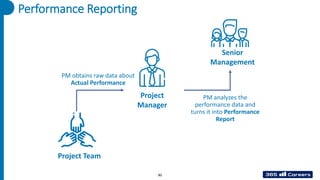
Performance Reporting
Project Team
Project
Manager
Senior
Management
PM obtains raw data about
Actual Performance
PM analyzes the
performance data and
turns it into Performance
Report
80
Project Status Indicator (RAG)
➢ Issues that put the
completion of the project
At-Risk
➢ Project is seriously getting
delayed, project scope is
not being met and/or
resources are becoming
exhausted
➢ Sponsor’s attention and
support is needed
Amber = At Risk Red = Off Track
➢ Progress according to the
plan
Green = On Track
81
Issues Management – 4Rs
REACT – assess the damage and perform damage control.
READ – understand the reason and the root cause of the problem.
RESPOND – create an action plan and take steps to correct the issue.
RESOLVE OR REPEAT – confirm the issue is resolved from your response
through monitoring. If so, carry on with the execution. If not, go back a
step or two. Change something until step four is resolved.
82
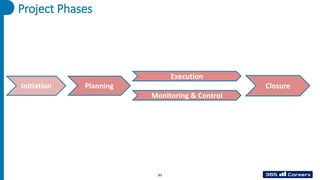
Project Phases
Initiation
Monitoring & Control
Execution
Closure
Planning
83
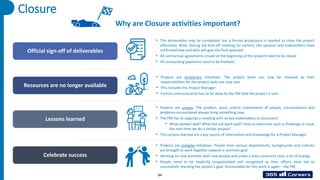
Closure
Official sign-off of deliverables
Resources are no longer available
Lessons learned
Celebrate success
Why are Closure activities important?
• The deliverables may be completed, but a formal acceptance is needed to close the project
effectively. Note: During the kick-off meeting (or earlier), the sponsor and stakeholders have
confirmed how and who will give the final approval
• All contractual agreements (made at the beginning of the project) need to be closed
• All outstanding payments need to be finalized
• Projects are temporary initiatives. The project team can now be released as their
responsibilities for the project tasks are now over
• This includes the Project Manager
• Formal communication has to be done by the PM that the project is over
• Projects are unique. The product, work, and/or combination of people, circumstances and
problems encountered always bring something new
• The PM has to organize a meeting with all key stakeholders to document:
• What worked well? What did not work well? How to overcome such a challenge or issue
the next time we do a similar project?
• The Lessons learned are a key source of information and knowledge for a Project Manager
• Projects are complex initiatives. People from various departments, backgrounds and cultures
are brought to work together towards a common goal
• Working on new activities with new people and under a time constraint costs a lot of energy
• People need to be explicitly congratulated and recognized as their efforts have led to
successfully reaching the project’s goal. Accountable for this work is again – the PM
84
Project Management Methodologies
Year 2020
1/6 1/13 1/20 1/27 2/3 2/10 2/17 2/24 3/2 3/9 3/16 3/23 4/20 4/27 5/4 5/11 5/18
Ind Activity 1 2 3 4 5 6 7 8 9 10 11 12 16 17 18 19 20
A Prepare land for construction works
B Excavate foundations (Digging)
C Build foundation structure
D Build Showroom spaces (floor 1)
E Complete Roof works
February March April May
January
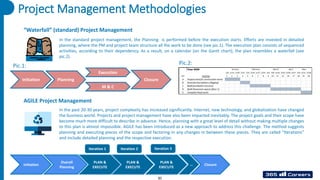
“Waterfall” (standard) Project Management
AGILE Project Management
Initiation
M & C
Execution
Closure
Planning
Initiation
Overall
Planning
PLAN &
EXECUTE
PLAN &
EXECUTE
PLAN &
EXECUTE
… Closure
Iteration 1 Iteration 2 Iteration 3
In the standard project management, the Planning is performed before the execution starts. Efforts are invested in detailed
planning, where the PM and project team structure all the work to be done (see pic.1). The execution plan consists of sequenced
activities, according to their dependency. As a result, on a calendar (on the Gantt chart), the plan resembles a waterfall (see
pic.2).
Pic.1: Pic.2:
In the past 20-30 years, project complexity has increased significantly. Internet, new technology, and globalization have changed
the business world. Projects and project management have also been impacted inevitably. The project goals and their scope have
become much more difficult to describe in advance. Hence, planning with a great level of detail without making multiple changes
to this plan is almost impossible. AGILE has been introduced as a new approach to address this challenge. The method suggests
planning and executing pieces of the scope and factoring in any changes in between these pieces. They are called “Iterations”
and include detailed planning and the respective execution.
85
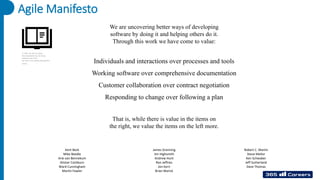
Agile Manifesto
We are uncovering better ways of developing
software by doing it and helping others do it.
Through this work we have come to value:
Individuals and interactions over processes and tools
Working software over comprehensive documentation
Customer collaboration over contract negotiation
Responding to change over following a plan
That is, while there is value in the items on
the right, we value the items on the left more.
Kent Beck
Mike Beedle
Arie van Bennekum
Alistair Cockburn
Ward Cunningham
Martin Fowler
James Grenning
Jim Highsmith
Andrew Hunt
Ron Jeffries
Jon Kern
Brian Marick
Robert C. Martin
Steve Mellor
Ken Schwaber
Jeff Sutherland
Dave Thomas
© 2001, the above authors
this declaration may be freely
copied in any form,
but only in its entirety through this
notice.
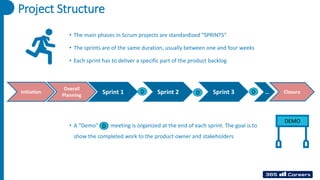
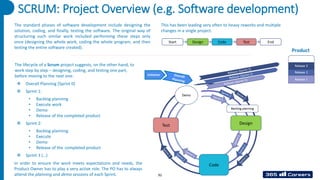
Project Structure
• The main phases in Scrum projects are standardized “SPRINTS”
• The sprints are of the same duration, usually between one and four weeks
• Each sprint has to deliver a specific part of the product backlog
• A “Demo” meeting is organized at the end of each sprint. The goal is to
show the completed work to the product owner and stakeholders
Initiation
Overall
Planning
Sprint 1 Sprint 2 Sprint 3 … Closure
D D D
DEMO
D
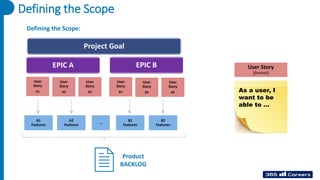
Defining the Scope
Defining the Scope:
Project Goal
EPIC A EPIC B
User
Story
A1
User
Story
A2
User
Story
A2
User
Story
B1
User
Story
B2
User
Story
B2
A1
Features
A2
Features
…
B1
Features
B2
Features
Product
BACKLOG
As a user, I
want to be
able to …
User Story
(format)
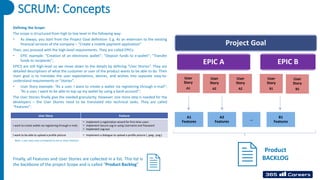
SCRUM: Concepts
Defining the Scope:
The scope is structured from high to low level in the following way:
• As always, you start from the Project Goal definition: E.g. As an extension to the existing
financial services of the company – “Create a mobile payment application”
Then, you proceed with the high-level requirements. They are called EPICs:
• EPIC example: “Creation of an electronic wallet”; “Deposit funds to e-wallet”; “Transfer
funds to recipients”;
EPICS are still high-level so we move down to the details by defining “User Stories”. They are
detailed descriptions of what the customer or user of the product wants to be able to do. Their
main goal is to translate the user expectations, desires, and wishes into separate easy-to-
understand requirements or “stories”.
• User Story example: “As a user, I want to create a wallet via registering through e-mail”;
“As a user, I want to be able to top-up my wallet by using a bank account”;
The User Stories finally give the needed granularity. However, one more step is needed for the
developers – the User Stories need to be translated into technical tasks. They are called
“Features”:
User Story Feature
I want to create wallet via registering through e-mail;
• Implement a registration wizard for first-time users
• Implement Secure Log-in using Username and Password
• Implement Log-out
I want to be able to upload a profile picture • Implement a dialogue to upload a profile picture (. jpeg; .png;)
Note: 1 user story may correspond to one or more Features
Finally, all Features and User Stories are collected in a list. This list is
the backbone of the project Scope and is called “Product Backlog”
Project Goal
EPIC A EPIC B
User
Story
A1
User
Story
A2
User
Story
A2
User
Story
B1
User
Story
B2
A1
Features
A2
Features
…
B1
Features
Product
BACKLOG
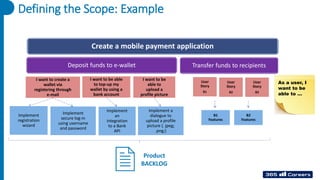
Defining the Scope: Example
Create a mobile payment application
Deposit funds to e-wallet Transfer funds to recipients
I want to create a
wallet via
registering through
e-mail
Implement
registration
wizard
Product
BACKLOG
As a user, I
want to be
able to …
I want to be able
to top-up my
wallet by using a
bank account
Implement
secure log-in
using username
and password
Implement
an
integration
to a Bank
API
I want to be
able to
upload a
profile picture
Implement a
dialogue to
upload a profile
picture (. jpeg;
.png;)
User
Story
B1
User
Story
B2
User
Story
B2
B1
Features
B2
Features
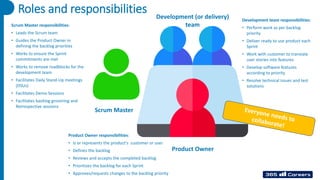
Roles and responsibilities Development (or delivery)
team
Product Owner
Scrum Master
Scrum Master responsibilities:
• Leads the Scrum team
• Guides the Product Owner in
defining the backlog priorities
• Works to ensure the Sprint
commitments are met
• Works to remove roadblocks for the
development team
• Facilitates Daily Stand-Up meetings
(DSUs)
• Facilitates Demo Sessions
• Facilitates backlog grooming and
Retrospective sessions
Product Owner responsibilities:
• Is or represents the product's customer or user
• Defines the backlog
• Reviews and accepts the completed backlog
• Prioritizes the backlog for each Sprint
• Approves/requests changes to the backlog priority
Development team responsibilities:
• Perform work as per backlog
priority
• Deliver ready to use product each
Sprint
• Work with customer to translate
user stories into features
• Develop software features
according to priority
• Resolve technical issues and test
solutions
SCRUM: Project Overview (e.g. Software development)
❖ Overall Planning (Sprint 0)
❖ Sprint 1:
• Backlog planning
• Execute work
• Demo
• Release of the completed product
❖ Sprint 2:
• Backlog planning
• Execute
• Demo
• Release of the completed product
❖ Sprint 3 (…)
The lifecycle of a Scrum project suggests, on the other hand, to
work step by step – designing, coding, and testing one part,
before moving to the next one:
In order to ensure the work meets expectations and needs, the
Product Owner has to play a very active role. The PO has to always
attend the planning and demo sessions of each Sprint.
Design Code Test
Start End
The standard phases of software development include designing the
solution, coding, and finally, testing the software. The original way of
structuring such similar work included performing these steps only
once (designing the whole work, coding the whole program, and then
testing the entire software created).
This has been leading very often to heavy reworks and multiple
changes in a single project.
92
Project Managment Project Managment Project Managment

Project Managment Project Managment Project Managment

  • 1.
    The Project ManagementCourse: Beginner to PROject Manager Course Notes
  • 3.
    Clear your mind PMprinciples, tools and techniques are very much based on common sense. This does not mean it is easy, and you do not need good preparation to handle a project yourself. Consider most of the things as guidelines and practical lessons for you – there is no formula on how best to prepare a project plan. Try not to think in absolute terms – rarely, there are black and white options. There are often many shades of grey in between. 3
  • 4.
    Definition of aProject “A project is a temporary endeavor undertaken to create a unique product, service or result.” - Project Management Body of Knowledge PMBOK Guide 5th Ed What is a Project? 4
  • 5.
    Characteristics of aProject Has a beginning and an end Delivers a unique output Includes complex activities Projects include complex activities, which need time for coordination. The complexity comes mainly from the fact that projects have constraints (limited time and resources) and need to deal with uncertainty (tasks to be done in the future). Each project is “unique” in the sense that it creates something never done before. Even if the output of the project is very similar to the one of a previous project, the fact that it will be at a different time with different people makes it distinct. Projects are temporary initiatives. This is the main difference between projects and the day-to- day normal business operations (e.g. production, sales, HR, supply-chain and logistics, IT, finance and accounting, etc.). 5
  • 6.
    The Triple Constraintin Project Management Scope Time Cost There are three fundamental factors for each project: • Scope = the sum of the activities and work to be performed in order to reach the project goal. In other words, the scope is everything that needs to be done during the project. • Time = the available timeframe given for the project to reach its goal. • Cost = the resources available for the project. The three dimensions always need to be looked at together because: If a change is made to one of them, one or both the others will change as well Example: you are planning to build a two-floor house (scope) until the end of the summer (time) and within a specific budget (cost). If things change and you decide you need three floors to be constructed (scope change), you will need more resources (cost) and most probably more time. Another example would be if you decide you need the house ready before the summer (time change). This would mean you need extra workers to complete the construction faster (cost) and/or you might need to simplify the construction - e.g. skip the interior works (scope). 6
  • 7.
    Brief History ofProjects and Project Management The Great Pyramid of Giza 2570 BC The Age of Discovery 1400 Industrial Revolution 1800 20th Century 1900 21st Century 2000 The Economy development Line. With the increase of production capacity, globalization, competition and technology, the efficient use of resources becomes a key success factor for any business. 7
  • 8.
    What creates demandfor a project? Example: Reduce companies’ cost to remain profitable. Example: Develop a mobile app as your competitors are introducing one to the market. Example: A customer who accounts for 30% of your total sales requests you to develop a customized product for them. Example: Any regulation that affects your work / business (e.g. GDPR, Brexit, etc.). Example: A product that will be used by the citizens: kindergarten construction; highway construction; hospitals; etc. Example: Limit emissions; limit the use of plastic; etc. Example: Automate manual processes. Projects are often triggered by a “mix” from more than one from the above possible reasons. Business need Market need Customer request Legal requirement Social need Ecological impact Technological advance
  • 9.
    Who is theProject Manager? Project management costs generally a total between 7-15% of the project’s Total Installed Cost. You can think of the PM as the “CEO” of the project. The accountable person for the project’s success*. *Project success = accomplish the specific goal of the project, within the time and budget constraints upon from the beginning. Why do you need a PM? ✓ To take accountability ✓ To steer people and activities ✓ To handle risks and issues 9
  • 10.
    Project Manager Skills Inprojects, there are different individuals and organizations that need to work in a coordinated manner for the success of the project. As mentioned, the PM is the “face” of the project. He/she is the single point of contact who can answer any question about his/her project, including all works streams and tasks performed by other people. PM is accountable for the end result of their collective work. It might sound easier than it is. So, how to do it? We explained, that PMs have the knowledge, skills, attitude and practical experience to “manage” not only their work, but also the work of the others. In addition, by being appointed as a PM, you are being empowered by the Project Sponsor to take action and make decisions. These skills, knowledge, and attitude are not limited to: • Project management and business knowledge: Ability to lead project work, and know-how to address classical project situations; knowledge of the project lifecycle; planning quality; management of project’s critical areas; work with project management tools and documents. Put controls in place to be able to track progress. Business analysis skills; business acumen; awareness and knowledge of the PM industry standards. • People and Workflow Management Skills: Efficiently organize project work, and define responsibility and due date. Issue resolution skills; people skills - work with all stakeholders, motivate project team, communicate in a way to create trust among the team members and senior management. • Strategy and Leadership Skills: Negotiate, and influence work and stakeholders in the project/program interest; work towards the objectives of the overall program; ensure work is aligned with the overall corporate strategy. Promote the values and benefits of the project/program to the broad organization. These are all central to the PM role. To this, however, we want to highlight a few other characteristics: The attitude, behavior, and professionalism that the PM expresses are very important for the image of the project - the organization’s perception of the work: Attitude and behavior: Positive and goal-oriented attitude, especially during difficult times. Projects are complex initiatives that include various subjects, people and personalities, expectations, and constraints. There can often be competition for resources and tension due to constraints. PM has to be able to handle the pressure and stress that can emerge. In the meantime, take the right decisions and trade-offs. A good PM works well under pressure to keep the project on the path to success. Professionalism: Irrespective of the challenges, a PM is a business professional. As such, they need to act as an example, and show high morale, ethics, and credibility. 10
  • 11.
    The development ofthe skills 11
  • 12.
    Project, Program andPortfolio Portfolio Project Program A project is a temporary endeavor undertaken to create a unique product, service, or result. A program is a group of related projects managed in a coordinated fashion in support of the portfolio. A portfolio refers to a collection of projects and programs managed as a group to achieve strategic objectives. А Project Management Office (PMO) is used to name the department, responsible for managing, coordinating and consulting project-related work.
  • 13.
    Definitions and Terminology ProjectSponsor The individual accountable for the overall project success and for obtaining the expected business benefits of the project, usually a senior or executive manager. Key responsibilities: approve the project, provide the needed resources, support the activities, and resolve issues. Project Team The team members are the experts responsible for the actual execution of the work (e.g. developers on a software project). Project Stakeholders All individuals or organizations that can be interested in the project’s work and result and influence it – participants, management, competitors, vendors, clients, and in some cases, the society (e.g. public infrastructure projects).
  • 14.
    Project Phases Initiation Monitoring &Control Execution Closure Planning 14 • As we defined at the beginning of the course, each project is unique. The specificity of the desired result, the involvement of different people and personalities, different time and circumstances all contribute to separating each project from the rest. • Nevertheless, the PM’s discipline has established a common view on how each project evolves from the start to the end. The world’s leading project management professional organization – “Project Management Institute” or “PMI” – has determined projects have five phases (or process groups): 1. 1. Initiation – This is a preliminary phase during which the project foundations are laid by the Project Sponsor. The overall objective, concept, or problem to be resolved is defined. Overall timeline (expected date for completion) and budget are suggested. These are all documented in the project’s Business Case. A Project Manager is identified and assigned to start working on the project. 2. Planning – Essential part of any project, which often makes the difference. Good planning increases the chances of completing a project within time and budget. During this phase, the PM has to do substantial preparation – to correctly define the work to be done, to organize the way the work will be executed, and to estimate and define timelines, the necessary budget, resources, management attention, etc. PM has to ask the right questions and then work with other project stakeholders to find the needed information. What do we need to do to meet the objective? How will we do everything? Who will do what work? When should the tasks finish, in order not to slow down the next ones? How will we make sure issues are quickly identified? What are the risks that can hurt the project? How to make sure we don’t spend more dollars than needed? Which people are expected to cause problems? How do we keep the project safe from them? And there are many other questions. The way the PM will answer those questions is key. It can maximize the chances of meeting the project goal, but, if not performed well, it can expose the work to many additional risks and create an environment of insecurity. Planning = also your strategy on how to win. 3. Execution – This is the phase during which the actual project work is performed, the deliverables are created. In construction projects, this would include constructing the building or infrastructure. In process improvement projects, these would be all actions aimed at identifying the opportunities and implementing the changes in the organization. In software development, this would represent coding and programming, etc. The key role of the PM will be to keep the project environment good, motivate the team, and help to resolve any issues that come up along the way. 4. Monitoring & Control – This phase goes hand in hand with Execution. The project manager uses the control systems developed to track if all project workstreams are progressing with the speed and quality to be completed within the timeline and budget. If there are any slowdowns, delays, gaps, these will be identified and the manager will have to take action to “fix” them. 5. Closure – After all work is done and all deliverables are finalized, PM still has some work to do to formally complete the project. This would include doing a formal handover of the project product to the department or people it was designed for. Formal approval and sign-off have to be given by the Project Sponsor, confirming the mission describer in the initiation phase has been achieved. Last but not the least, the PM has to gather the team and stakeholders into a meeting to discuss the Lessons Learned – what went well, what did not go that well, and what can be done better during the next similar project. Continuous improvement is also very important in projects, as PMs constantly learn new things and build on their expertise. Formally documenting the feedback for the project is a key driver of this process.
  • 15.
    Define the goal ofthe project Review the business case Outline the project scope Conduct feasibility study Assign a project team Assess risks and expectations Initiation Phase Steps A feasibility study is used to determine the viability of the project idea. Each project is tested in five areas: ✓ Technical feasibility ✓ Economic feasibility ✓ Legal feasibility ✓ Operational feasibility ✓ Scheduling feasibility A project sponsor determines if the project is worth undertaking or should be terminated through a project selection process. All projects are created for a reason. Someone identifies a need or an opportunity and devises a project to address that need. A business case is created to define the problem or opportunity and identify a preferred solution for implementation. The project sponsor issues a project charter to authorize the existence of an approved project and to appoint a project manager. Resources are preassigned to work on the project planning. 15
  • 16.
    Project Selection Can itbe executed? Can it deliver expected benefits? Do we have the resources? PROJECT VALIDATION PROJECT SELECTION PROJECT SUGGESTIONS VALIDATED PROJECT 16
  • 17.
    Project Charter The projectcharter is “a document issued by the project sponsor that formally authorizes the existence of a project, and provides the project manager with the authority to apply organizational resources to project activities.” - Project Management Body of Knowledge PMBOK Guide 5th Ed 17
  • 18.
    Characteristics of aProject Charter Provides a big-picture view of the project Gives the PM authority to use organization’s resources Defines objectives and success criteria for the project A project charter is a broad statement of the: ✓ Scope ✓ Major milestones ✓ Stakeholders ✓ High-level assumptions ✓ High-level risks ✓ Project constraints These components are specified in detail during the planning phase. A project charter serves as a contract between the project sponsor and the project manager. It defines the authority of the project manager to spend money and to commit resources. The project objective is clearly stated following the SMART protocol. This defines the success criteria that should be met for the project to be completed successfully. The project charter specifies who should endorse the completion of the project. 18
  • 19.
    Project Phases Initiation Monitoring &Control Execution Closure Planning 19
  • 20.
    Planning is thinkingand deciding how to do something and only then do it, instead of doing it directly. It is the process of analyzing, evaluating, deciding and organizing the activities in advance. Planning Phase 20
  • 21.
    Planning Phase Lack ofproper planning and control results in delays, higher cost and/or lower quality of output. Expectations: 6 years, $ 7 Million. Reality: 16 years, $ 102 Million. Example: Sydney Opera 21
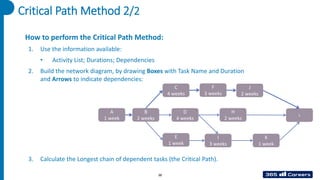
  • 22.
    22 Planning in ProjectManagement Planning is often underestimated – People think PM’s effort has to be during Execution, but it is the other way around. It is yet another case following the 80/20 rule: If PM spends a lot of effort in planning, this will pay off with much fewer thins to run after in the long execution phase. Project Manager’s Effort – popular belief: Project Manager’s Effort – best practice:
  • 23.
    The Three FundamentalSteps of Planning 2. Evaluate options 3. Choose & confirm best option 1. Define the goal 23
  • 24.
    Role of thePM in the Planning Phase PM plans for: What we know and can control What we don't know and can't control The more things the PM plans for, the higher the chances to complete the project with success – meet the goal, timelines, and budget. 24
  • 25.
    Cost of Change CostOf Change (extra time, budget, and wasted resources due to the change) Time Initiation M & C Execution Closure Planning As time passes, the cost of change increases significantly. Example: Your scope is about the construction of a shopping mall. If a year after the construction has started, the owners decide it needs to be used as a residential building. The extra time and resources to transform it would be enormous. If, on the other hand, the same request comes during the planning stage, before construction has even started, the cost of the change would be much smaller (maybe a few weeks of planning). 25
  • 26.
    Planning For YourPlanning What knowledge do I have about the required work? Is it sufficient to build a comprehensive plan? What knowledge or specific expertise do I lack to make a good estimation of the work? Who can support the planning for this area? Have I or any of my colleagues worked on a similar project? Are all expectations for the end result clearly understood by everyone? How much time do I need to put all pieces together and complete the project plan? 26
  • 27.
    27 How to “extract”the needed information from a stakeholder, expert, etc.? This can be a difficult process, as the information the PM is looking for cannot be directly understood (in some cases). We can call this a non-straightforward process. Tips: When organizing a meeting/interview/workshop to start planning, make sure you create a good agenda, including the goal of the meeting, and a list of all topics that need to be covered and questions to be answered. Then, follow the list during the meeting to ensure you exit the room with the needed answers, or in case the answers could not be given, with a view on who can provide the needed answers. Although PM does not need to be a real “expert” in all fields, they must be able to understand how things operate in each field, in order to correctly manage the project work. Along with the fact that in each project, there are many parts to be planned and executed (as we will see now in the following lectures). It is the PM’s core responsibility to perform integration management (PMI quote) or, in other words, be successful in managing simultaneously all different aspects of the project and factoring all interdependencies. Non-straightforward Process
  • 28.
  • 29.
    Scope: Broader ThanJust The "Product" Of The Project 2. Gather detailed requirements and expectations 1. Analyze the available information about the project scope 3. Document the scope All project outputs (product, service, result) Any additional work that has to be done, in order to complete the project outputs + Scope = Example: Construction project. You need to build a house. However, there is an old smaller house on the land, on which you want to build the new one. Although the old house is not your project output, it has to be demolished and removed so that you can achieve and create your project output, which is the new house. The Scope will include the activities for demolishing and removing the old house as well. How to plan your Scope?
  • 30.
    Work Breakdown Structure Thegoal of the project needs to be broken down into more details so that the project manager and project team can plan and execute. If the goal is to “increase sales by creating a showroom to exhibit new cars”, this information is too high-level and vague, hence it’s not useful for planning purposes. The project manager has to transform this information into smaller pieces. A very useful exercise is to design the Work Breakdown Structure. The Work Breakdown Structure (WBS) is a visual representation of the project’s Scope. Starting from the project goal (high-level), you go down a level and define the major groups of activities or “work streams”. This could be “build a one-story showroom of 500 m2”, “manufacture six new cars”, or “recruit ten employees to work as sales staff in the showroom”. Then, add one more level below each work stream, until you reach a task level. The task needs to be big enough to be explained easily and managed by one person. Example: “Put a safety fence around the construction field”. Project Goal Work Stream 1 Task 1.1 Task 1.2 Work Stream 2 Task 2.1 Task 2.2 Work Stream 3 Task 3.1 Task 3.2 The sum of the detailed tasks is often referred to as an “Activity List”. It will be used as the “skeleton” of the Project Plan. 30
  • 31.
  • 32.
    Project Schedule AndTimelines 1. Estimate the duration of each task 2. Add buffers 3. Sequence tasks 4. Assign the start & end dates Task A + A B C D Task A 32
  • 33.
    Estimate Durations Planning Pitfalls: •Optimism bias: focusing on the “positive” future scenarios and missing to consider the “not so good ones”. If the negative scenarios are forgotten during planning, this will come as a surprise during Execution. Planning is done for future events, so we need to limit our own biases. • Illusion of control: being overconfident that you can control the future events. 33
  • 34.
    Estimate Durations E = O+ 4N + P 6 3 Point Estimate Step 1: Define three scenario points: • Optimistic case • Normal case • Pessimistic case Step 2: Apply the three-point estimate formula to identify the Estimate (E): 34
  • 35.
    Buffers The amount ofbuffer to be added is strictly dependent on the specific case at hand. Manage on ad-hoc basis. Level of uncertainty Criticality of the task Owner of the task (Experience, track record) High Low Buffer Positioning Buffers: Factors: Task A + Task B + Task C + Task A Task B + Task C + Task A Task B Task C + On each task On groups of tasks On the whole project When the task is uncertain (e.g. doing it for the first time), more critical compared to the rest or the Owner of the task is less experienced, a bigger buffer should be used. Tips: • Avoid big buffers on single tasks (Parkinson’s law). • Avoid putting the whole buffer in one place at the end of the project. • Aim to use buffers after groups of tasks and avoid labeling them as “buffers”. You can use “Validation” or “Checkpoint”. 35
  • 36.
    Sequence Activities Finish To Start(FS) Finish To Finish (FF) Start To Start (SS) Start To Finish (SF) Dependencies • Logic-based correlations • Physical dependency Logical • Limited resources put two tasks in dependency Resources • Regulations • Seasonality • Other factors External • Such that the PM decides to apply • Subjective Soft Types A B Result: Identified dependencies 36
  • 37.
    Critical Path Method1/2 Critical Path: The longest chain of dependent activities in the project. Benefit: Indicates the fastest possible way to complete the whole project Critical Path Method: • Based on the available information (Tasks, Durations, Dependencies), create a network diagram with Boxes and Arrows. Also called PERT Chart. • Identify the longest path from Start to Finish. 37
  • 38.
    A 1 week B 2 weeks C 4weeks F 3 weeks J 2 weeks D 4 weeks H 2 weeks K 1 week E 1 week I 3 weeks L Critical Path Method 2/2 How to perform the Critical Path Method: 1. Use the information available: • Activity List; Durations; Dependencies 2. Build the network diagram, by drawing Boxes with Task Name and Duration and Arrows to indicate dependencies: 3. Calculate the Longest chain of dependent tasks (the Critical Path). 38
  • 39.
    Start and Enddates: the Gantt Chart • To the left (Y-axis), the activities are listed (you can take from the Activity list / WBS). • At the top (X-axis), a calendar is inserted. It can be with days, weeks or months, depending on what you find most convenient for the work you are planning. • The tool is a bar chart (horizontal), where each bar is limited by the start and the end date of a specific activity. The length of the bar represents the duration of the activity. All activities are listed on the side, and to the right, calendar days are displayed. With this graph, it is very easy to represent the activities and get a good feeling about the duration and when each one is to be executed. • Can be used for monitoring, but is also extremely helpful during the planning phase. • Strongly suggest using it when forming the project schedule. 39 Month Date 9/3 9/10 9/17 9/24 10/1 10/8 10/15 10/22 10/29 11/5 11/12 11/19 11/26 12/3 12/10 12/17 12/24 12/31 1/7 1/14 1/21 1/28 2/4 2/11 2/18 Activity week n 1 2 3 4 5 6 7 8 9 10 11 12 13 14 15 16 17 18 19 20 21 22 23 24 25 foundations prep works position the door frames showroom floor works build walls install bathrooms build roof install doors and windows install lights and complete ceiling works Install pipes (utilities) Paint outside walls decorate and position interiors recruit personnel train personnel select and order cars for the showroom delivery of cars Position cars in the showroom September October November December January February
  • 40.
    Building the ProjectPlan Task A + Critical Path Activity List Durations (incl. buffers) Dates (Start & End) Project Plan (or Schedule) 40
  • 41.
  • 42.
    Project Budget 1. Identifythe cost- generating activities from the project. Start with the WBS or Activity list created. 2. Estimate the cost of each task/deliverable. Add buffers and understand uncertainties. Buffers for the Cost should be bigger than those used for the Time. 3. Schedule the expenses, by putting expected dates (look at the Gantt chart). It is very important to know when the financial resources will be needed (Time value of money and Approval process). 4. Determine the project Budget. Consolidate the estimations and calculations performed. Task A 42
  • 43.
    Project Budget 1/2 BudgetEstimations: • Gather information (price is available; alternatives; gathering information through quotations [RFQ, RFP]). • Calculations (lump sum; time and materials; units) • Buffers – Usually, bigger than the Time buffers, because it is easier to allocate additional time and harder to get some more money Timing the Budget – plan and indicate WHEN an expense is expected to take place (Time value of money; Financial processes) 43
  • 44.
    Project Budget 2/2 Ifthe project has more work streams and more types of costs to incur, it is recommended to have a dedicated budget for each separate work stream or cost type. Consolidate the budgets, displaying the totals per month. This will be the overall budget per month (or quarter or week, depending on the needs). Project Overall Budget Sep Oct Nov Dec Jan Feb Mar Apr foundations prep works 23,000 $ 23,000 $ position the door frames 1,000 $ 1,000 $ showroom floor works 10,000 $ 10,000 $ build walls 2,000 $ 27,000 $ 15,000 $ install bathrooms 7,000 $ 13,000 $ 20,000 $ build roof 67,000 $ 16,000 $ 83,000 $ install doors and windows 21,000 $ 21,000 $ install lights and complete ceiling works 24,000 $ 24,000 $ Install pipes (utilities) 16,000 $ 11,000 $ 27,000 $ Paint outside walls 17,000 $ 7,000 $ 24,000 $ decorate and position interiors 7,000 $ 10,000 $ 17,000 $ recruit personnel 4,000 $ 3,000 $ 7,000 $ train personnel 5,000 $ 5,000 $ select and order cars for the showroom 3,600 $ 3,600 $ delivery of cars 11,000 $ 11,000 $ 11,000 $ 33,000 $ Position cars in the showroom 4,000 $ 4,000 $ Total Budget (per Month) 39,600 $ 38,000 $ 37,000 $ 139,000 $ 61,000 $ 32,000 $ - $ - $ 302,600 $ 2018 2019 Total Budget (per activity) 44
  • 45.
    45 Planning - Resources:Procurement 1/2 It is often the case that an organization will not have the required resources that a project needs. Therefore, the PM here has the responsibility to procure what they need externally. By this point, they should be very familiar with the details of the contract in order to properly assess the costs and the risks of any transaction. They must be aware of timelines, due dates, and quality levels of all resources they are procuring. There are three main types of contracts that we will run through now. It is up to the PM to find the best contract because it is their main tool for keeping track of vendor work and behavior. So, the first one is called fixed price and it is the simplest type of contract. The vendor commits to doing the work for a set amount within a certain timeframe. The pros of this is that any additional spending will be taken on by the vendor – no risk for you. Perfect! Or is it? You see that they are aware that with this kind of contract, if the costs are higher than expected, then they will incur losses. Therefore, there is a chance they will put a big buffer on the initial price.
  • 46.
    46 Planning - Resources:Procurement 2/2 Or if they find that costs are getting too high, they may try to decrease the scope or the quality in order to compensate. So, know that this is beneficial to use when the scope is clear to all parties, but a good analysis is important prior to make agreements. The second type is called Cost Plus – This is where the buyer agrees to pay any cost incurred by the vendor performing the work. This can be a fixed additional fee, a variable fee, or a mix of the two. Either way, it gives the buyer the flexibility to adapt the spending in accordance with the work being done. But with that comes the risk of covering all extra costs, along with the chance that the vendor may keep the work going longer than needed or add extra items to the ‘to-do list’. This contract makes more sense if the scope is not easy to define. But proper controls need to be put in place to ensure money is only spent on things essential for the project. A fancy new haircut for the vendor doesn’t fall into this category. The third type of contract is called time and materials and it’s a mixture of fixed price and cost-plus. It’s where the vendor charges the buyer an hourly or daily rate. For example, when consultants or technicians charge per day of their services. It’s another good contract to jump into when the scope is not clear, and the work is more labor-based than material-based. It runs a similar risk to the cost-plus contract, but that just means the same countermeasures can be taken. Well, there we have it – the three types of contract, but there can be many variations and, of course, they can all be tailor-made. The PM could add incentives for the vendor to complete work faster or to better the quality. The contract can even include inflation if the project spans a long time.
  • 47.
    Human Resources 1. Definethe needed resources: • Engineers, IT Developers, Business Analysts, etc. 2. Estimate the effort needed • Number of team members 4. Define roles and responsibilities (see next slides) 3. Validate resource availability • Time that can be dedicated • Vacations, bank holidays 47 Start with the Scope – list of activities. The PM needs to understand what kind of support is needed to execute the project. PM has to identify all needed experts to perform the work – developers, engineers, analysts, etc. This depends on the scope of the project. a) Create a schedule – who needs to do what and when. Use an actual calendar (holidays to be accounted for). Create a simple template (add an example - see next slide). b) Obtain a confirmation from the departments’ heads that each employee can participate in a project.
  • 48.
    HR: Roles &Responsibilities Role Name Responsibilities Contact Project Sponsor Johnson • Accountable for the project’s success. • Supports PM in resolving high-level issues. • Owner of the Budget, Timeline, and Business Case. Approves any changes. J.Johnson@company.com Project Manager Philips • Accountable for the project’s planning, execution, and closure. • Daily management of project’s team and activities. • Manages resources, risks, communications, and stakeholders. P.Philips@company.com Functional Team Lead – Software Development Matthews • Provides status updates (progress, variance, potential issues, etc.) to the Project Manager. • Supports, guides, and coordinates team members in completing their daily project tasks. • Supports other ad-hoc project tasks. M.Matthews@company.com Team Member – Software Development Henry • Works directly to create the project deliverables (scope). • Uses subject matter expertise. • Provides progress updates, communicates potential issues and seeks support. • Suggests improvements. • Supports other ad-hoc tasks (e.g. testing, trouble shooting, etc.). H.Henry@company.com Standard Form: The Standard form is simple and easy to use and apply. It is more appropriate for smaller projects with not too many people. You need to document the Role, the Name and the specific Responsibilities (in this field, you need to go in detail). Contact details (e-mail, telephone) are also valuable information to add. Note! Always discuss the responsibilities with the people before you finalize the document. 48
  • 49.
    HR: Roles &Responsibilities RACI Matrix: ProjectSponsor ProjectM anager M arketingDirector M arketinganalyst ProductionDirector Chiefengineer PMO Marketing Department Production Department Activity / Deliverable Project Management Appoint PMand support project A I I Project Planning and Kick-Off C A/R C C Weekly Status Report I A/R I C I C Work-Stream 1: Marketing Marketing Study A C R Marketing Report with findings I A C R I Work-Stream 2: Production Analyze future capacity needs I R C Build additional capacity / upgrades I A R Work-Stream 3: Supply-Chain … PMO Marketing Department Production Department Activity / Deliverable R - Responsible A - Accountable C - Consulted I - Informed RACI Matrix crosses the specific Activities (Y axis) and the people involved in the project (X axis). For each activity, a person can be either: • Responsible: the person actually doing the work • Accountable: the person that must ensure the task is successfully completed, even if she or he is not the one doing it (Responsible) • Consulted: can be asked to provide advice and guidelines, based on their own expertise • Informed: has to be kept updated on the progress of the activity. Usually senior management. RACI Matrix is very useful in bigger projects, where more people are involved (bigger project team). Also, in projects where more people work on the same tasks / deliverables. Note! When describing Roles and Responsibilities in a project, do not forget any project management related activities. Example: team members reporting on their progress regularly to the Project Manager. 49
  • 50.
    Defining Quality Requirements:Each project has a Goal. Its output (product, service or result) has to satisfy a specific need of the organization or of the project client (person/organization). To define what is a successful satisfaction of the need, the PM has to be analyzed and written as “quality requirements”. Example: the goal is to produce the fastest and fanciest car on the market, accelerating 0 to 100 km/h in 3 seconds. The Scope is the automobile. The project team delivers the car in the agreed time and budget. The car is luxurious and looks exactly as per the plans. However, accelerates 0 to 100 km/h in 4.2 seconds. The project is not successful. Quality “The standard of something as measured against other things of a similar kind; the degree of excellence of something” - Oxford Dictionary Standard Performance What is Quality? In Project Management: Customer satisfaction with the project product, service or result. Quality Requirements • Physical characteristics (Specs) • Low variation in output • Meeting a specific criteria • Scoring; Y/N • Physical (e.g. Durability, etc.) • Speed (e.g. Website response) • Achieving a result without impacting other functions 50
  • 51.
    Quality Planning 1. Definethe Quality Requirements 2. Set Quality Targets 3. Plan Quality Control “QC” 4. Finalize the Quality plan and Perform Quality Control (Monitoring & Control phase) Review all available information on the project: • Project documents • Meetings and workshops with the stakeholders • Note: Always involve the project client • Lessons Leared For each of the criteria identified, specify the targets to be met. This has to come also from the above process of reviewing the standards with the various stakeholders: • Process design to ensure “fit for purpose” • Define KPIs • Training the project team on how to meet the standards Plan the control mechanisms to be used: • Plan how/when/who to measure • Perform variance analysis to ensure KPIs are on target • Take actions, fix issues and bring parameters back on track Note: After planning Quality, always check the changes triggered for other fields that are already planned (scope, cost, time, roles & responsibilities, risks). 51
  • 52.
    52 Expectations 1/2 As aPM, it is important to be able to understand human nature and psychology. A project involves a lot of people, and if expectations are not the same across the board, some of the people involved will be disappointed that the project didn’t meet their expectations. An expectation is the psychological picture we create in our heads for a future event. And, depending on the situation, it can be easy to set expectations and predict outcomes. When given more room for interpretation, we are likely to fill our imagination with our subjective views and desires. The more people are imagining how something could end up, the more chances that expectations will vary.
  • 53.
    53 Expectations 2/2 The processof getting everyone on the same page is done mostly when defining the scope, during workshops, and when meeting with stakeholders. The PM must be able to clearly communicate their expectations and hold sessions in a way that encourages stakeholders to share their expectations in order to identify any gaps. Some example questions the PM could ask are: How do you think the final product of the project will be useful to the organization? Do you believe something can be added to significantly improve the result? Do you agree with the way the scope is described in the project documents? There are many other questions because the more thorough, the better. The PM’s job of leveling everyone’s expectations does not stop there. Not only must the project manager keep all stakeholders up to date during the various meetings carried out through the scoping phase, but they must also keep in constant communication for the whole project as any changes occur. The whole idea behind keeping everyone in the loop, constantly, is to eliminate any opportunities for the stakeholders’ imagination to run wild.
  • 54.
    54 An assumption iswhen something is believed to be true when there is no definite proof. While the planning process aims to clarify all areas of a project, we must assume that there are areas that we cannot be certain of. For example, we cannot be 100% sure that all team members will be as productive as they usually are, but we have to assume they will. Of course, a PM will be more certain of their assumption if they have worked with the team before, but it is still an assumption. When a PM has more past data, the safer their assumptions will be. Imagine Lamborrari needs to hire a certain number of mechanics to deal with any problems the show cars may have. You, as the PM, could look at previous data where a similarly trained mechanic from a previous showroom project was able to properly care for five cars. You plan to have 20 cars in your showroom, therefore you can assume you will need to hire four mechanics. While there is still a level of uncertainty, it is a lot less than if you had no previous data. Assumptions
  • 55.
    Risk Planning What isa Risk? Exposure to the possibility of loss, injury, or other adverse or unwelcome circumstance; a chance or situation involving such a possibility. Oxford English Dictionary Risk Management – What to do: 1. Identify the project risks 2. Analyze the risks 3. Develop risk response strategies 55 More difficult to plan than the cost, time, or scope. You don’t see them. They are the result of the uncertainties that expect us in the future. PM Context:
  • 56.
    Severity – Whatwould be the impact of the event on the project scope, budget, and timeline? Standard is to rank by using three levels – Low, Medium, High. Of course, this can be customized according to the specific needs: e.g. impact from 1 (very low) to 10 (catastrophic event). These can also be translated into expected impact on the project (e.g. “two months delay” or “up to $40K financial loss”, etc.). Probability of occurrence – How likely will the event actually happen? You can use a standard scale (Low, Mid, High) or a more sophisticated one, depending on the project’s needs (e.g. probability %). Risk Planning 1. Identify the Project Risks 2. Analyze the Risks Two characteristics to be evaluated for each risk Review all available information on the project, in order to identify risks: • Project Documents (Project Charter, Business Case, WBS and Activity List, Quality Specifications & Requirements) • Lessons Learned 3. Develop Risk Response Strategies % • Eliminate the risk (e.g. avoid doing the risky task) • Reduce the severity • Reduce the probability of occurrence 2) Contingency (Plan B) 1) Mitigation Consult relevant stakeholders and experts. Perform: • Meetings (one-to-one interviews) • Workshops (brainstorming sessions) • Define what the project team needs to do to limit the damage, if the risk becomes reality • Document the findings and decisions 56
  • 57.
    57 No. Risk DescriptionSeverity Probabilty of Occurrence Contingency and Mitigation Actions (incl. "Plan B") 1 Injuries during construction works Risk of People Injuries during construction works. Impact to people health. Possible financial impact in terms of fines, due to miscompliance with regulatory requirements (up to 50 K$ per person). Medium Medium 1) Instruction of all workers on how to prevent incidents; 2) Provide full equipment and clothing (helmets, gloves, boots, etc.); 3) Shift leaders to control and check each day if workers follow the requirements; 4) Insurance coverage for all workers; 2 Bad weather to interrupt construction works Risk of bad weather conditions during autumn to interrupt or slow down construction works and/or damage equipment. High Low No control over weather (Probability of Occurrence). PM team can only act on decreasing the Severity (damage control): 1) Prepare for bad weather conditions and have a Plan - identify a place to store equipment that can be damaged (e.g. projectors, insulation materials, etc.). 2) When forecast indicates higher risk of heavy rains, store fragile equipment and perform tasks that cannot be impacted by weather (e.g. preparation for follwoing activities). 3) Instruct all workers and shift leads on what to do during such weather; 3 Connectivity failures of the Car 3D Visualization effects Risk of connectivity issues software-hardware not fully resolved before the Opening event. Impact: Customers will not see the visual effects in the first days. Low Medium 1) Testing systems as early as possible; 2) Contract incentives and clauses (phased payment) with vendor; 3) Plan B: In case functionality is not fully ready 2 weeks before Opening day - print paper catalogues for customers (booklets). Risk Log: example
  • 58.
    58 Change process 1/2 Ina project, frequent changes will incur excessive costs, for budget, scope, quality or time. And the PM tries to eliminate as much of this cost as possible with a detailed plan. But a good PM is also not stubborn and will adapt to change. Basically, it is the PM’s job to limit the need for changes on one hand and on the other to manage the changes efficiently in a way that the project could benefit from it. First is what we’ve been doing in the course so far, limiting the potential for change through comprehensive planning. By using the methods that we have been discussing, any PM will miss fewer details in the execution phase and, therefore, will not need to make many changes. If they do need to make changes, a PM should implement a change control process. Before moving to execution, how to manage changes must be agreed upon, and as with most parts of the planning, a process needs to be established. The thing that will start the process is a change being requested and that request needs to be analyzed. What are the benefits of the change? What is needed in order to implement the change and what is its impact on the project? Of course, a formal document must be created to collect this data – a change request form. The PM must understand the proposal, fill in the form, and then send it for approval. Who will the PM send the change request form to? The project sponsor, of course; since they have provided the needed resources, they should also determine if the additional needs are worth it. If the PM has concluded that the change will benefit the project, they must then convince the project sponsor.
  • 59.
  • 60.
    Project Phases Initiation Monitoring &Control Execution Closure Planning 60
  • 61.
    Execution Execution phase startswith the Kick-off meeting and finishes with the delivery of the last deliverable. Main project manager’s activities during execution are: ✓ Work on the scope ✓ Track progress ✓ Monitor quality, resource usage ✓ Watch out for risks and issues, conflicts within the team …and remember: Time is not on your side! Scope Time Cost 61
  • 62.
    The Kick-off Meeting:Objectives Validate project plans Agree on project governance and validation points Promote the project Go through the plans one by one. Explain and answer questions anyone could raise. Then, ask if it is okay to validate it and move to the next topic. If someone refuses to agree, understand why. Discuss how the deliverables will be approved and how the overall project will be approved as completed. Define the Success Criteria and who will “approve” the project completion. Usually, this would be the client. Agree on how often the PM has to provide an update on the status of the project. Do your best to have the client and senior stakeholders satisfied after the meeting. 62
  • 63.
    Kick-off Meeting Delivery Project Manager ✓Schedule the kick-off ✓ Schedule pre-kick-off, if needed ✓ Prepare presentation ✓ Introduce everyone in the meeting ✓ Introduce the project ✓ Promote the project ✓ Agree on project governance and validation points ✓ Agree on project reporting ✓ Wrap up & follow up The purpose of the kick-off meeting is to announce the start of the project and to ensure that everyone is familiar with its details and with the people working on it. 63
  • 64.
    Manage Project Workand Project Team Project Manager People Work Be of service to the team and help them get the work completed. Remove roadblocks. Ensure a common understanding of the project among stakeholders. Keep everyone focused and informed. Gather performance data. Update the project management plan and project documents. Implement changes. 64
  • 65.
    65 The most importantthings the PM should do: • Supervise critical path activities – PM needs to ensure high productivity on these activities. If you get delayed on any of them, you delay the overall project, remember? PM needs to put extra care on: • Productivity of the ongoing activity: the work needs to progress at a good rate in order not to get delayed. Productivity needs to be high enough to complete the work on time. But what is Productivity? It essentially is the output you get out of a given input or the ratio between the two (output/input). In a project world, the output are pieces of the scope and the input is essentially time and resources – see, this is again our triangle, but this time put in motion. Available Time and resources will be decreasing and the Scope will become real (see graph). So the PM will need to maintain the productivity high, especially on the critical path. How to measure productivity in projects? Again, it will be different for the different projects (the scope is unique). In construction, the productivity could be measured in constructed stories per month (e.g. two stories per month built). In software development, this can be a number of new functionalities programmed. Whatever it is, PM needs to ensure the rate is good. • Readiness of the following activities to start: keeping the best productivity on activity. A high is good, but you can still fail in case the next activity for any reason is not ready to start on time. The upcoming activities in the chain need to start on time (B, C, etc.). PM needs to ask the question – is everything ready to start on time? Example: In the showroom case, for example, let’s say the construction works are progressing on track to be entirely completed (including pipelines, etc.) in the remaining two weeks. However, it turns out there have been some additional discussions on the design of the interiors, and more specifically, the effects around the car podiums and the next activity may not be ready to start as planned (“decorate and position interiors). • Look for opportunities to optimize the workflow using your business knowledge, project management experience, and common sense (it can be stronger than you think ☺ ). As the project progresses, the PM and project team become more knowledgeable of the work at hand. Hence, often there are ideas of how to make it better, faster, or both. Is this activity valuable? Are there better ways of sequencing the work – starting more activities in parallel to save some time? Keep asking these questions. • Don’t forget other project activities (e.g. legal documents, etc.), the ones that are not on the critical path. Forget? You cannot forget – you have the recipe! If not supervised or underestimated, activities outside the critical path may become part of the critical path (if delayed significantly). Manage Project Work
  • 66.
    Project Manager’s TypicalDay Detailed Project Plan The project managers must start their day by looking at two things: Project Diary (Action Log) What is on-going? Which deadlines are approaching? What activities must start soon? What are the open actions? 66
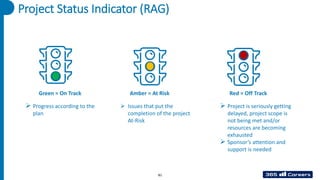
  • 67.
    Project Diary (ActionLog) Format ACTION - What needs to be done? OWNER - by whom? DUE DATE – by when? The Action Log is supplementary to the project plan and is used to record actions, which occur ad-hoc and are not included in the project plan.
  • 68.
    Characteristics of ProjectDiary (Action Log) The Action Log is a formal document. The Project Manager must make it clear to the project team members when an action is added for them. Team members need to commit to each action logged against their name. 68
  • 69.
    Project Diary (ActionLog) - Example 69 No. Action Owner Due Date 1 Update Project Schedule to reflect new duration of the "recruit personnel" activity. Increase to 11 weeks. If PM pushes the Due Date by 3 weeks, this will be the new Critical path. Hence, PM to change the start date, in order to keep the initial buffer: -Change start date to 13-Apr, instead of 4-May. Update project plans Project Manager 4-Feb … 13 Negotiate and sign an agreement with a new Design agency in the next 2 weeks. Marketing manager to participate the negotiation, in order to ensure the requirements are understood by the new vendor and added to the contract. Finance manager Assistant 3-Jun 14 15 16 17
  • 70.
    Manage People Stakeholders Project Team ✓Provide regular updates ✓ Establish and follow agreed communication channels ✓ Be proactive in the communication ✓ Keep key stakeholders engaged Be the first one to deliver bad news or you may lose your credibility! ✓ Prepare the team adequately Before During After ✓ Lead and coordinate ✓ Correct and make changes if necessary ✓ Motivate ✓ Give feedback ✓ Congratulate 70
  • 71.
    Project Phases Initiation Monitoring &Control Execution Closure Planning 71
  • 72.
    Monitoring and Control InProject Management, the Monitoring and Control phase is basically about analyzing the Actual against the target and understanding early on, through numbers, if something is not working “fast enough” or “well enough”. In other words, measuring project performance against the project plan. The monitoring and control phase consists of 3 key activities: ➢Define Metrics & Targets ➢Collect Actuals ➢Identify any areas in which changes are required ➢Initiate changes where needed 72
  • 73.
    Measure Project Performance TargetActual Variance is the difference between target and actual Metrics & KPIs The project performance baseline is used as a benchmark. Collection and Reporting of Actuals. PM to establish: • Responsible: PM will predominantly perform the tasks, but other team members will also participate. • Frequency: data collection has to happen regularly (daily/weekly/monthly) and not only around the end of the project. The project manager defines metrics and key performance indicators (KPIs) to measure the project performance. Optimally, three to five KPIs should be selected for each project. 73
  • 74.
    Measure Project Performance TargetActual Metrics & KPIs 74 Metrics and Targets – For each of the criteria identified, specify the targets to be met. This has to come also from the above process of reviewing the standards with the various stakeholders. Let’s see a few examples of standards in different fields: • Construction – most of the quality standards are set by regulation. Here, the standards to be met are many and require engineering expertise to be managed properly. Examples of regulation topics: structural stability, fire safety, air ventilation, drainages, electrical safety, quality of materials, etc. Meeting the quality standards is crucial to the project’s success, as the building may not get the needed authorization documents. • Production – defect rate is a popular metric in this area. If the production volumes are 100 000 units per month, the company decides to have a target of less than 50 defective units per month. The target would translate into 0.05% tolerance. As it would cost too much time and money to test all 100 000 units, a sample is selected – let’s say 1 000 units. Out of those, 0.05% would be the maximum number of units with a defect. We will take a deeper look at the last part of the project (Improvement projects, six-sigma). • Customer service – let’s say a company has outsourced a call center to a vendor. It will be critical to keeping the customers happy after the shift of service. Here, quality standards can be set for the vendor like calls lost (target <5 / month); cases resolved (target >98%); collecting surveys from a customer on satisfaction after each call on a scale from 1 to 5 (target >4).
  • 75.
    Earned Value Analysis(EVA) Planned Value (PV) Approved value of the work to be completed as per schedule PV = Planned % Complete x Budget Earned Value Value of the work actually completed to date EV = Actual % Complete x Budget Actual Cost (AC) There is no special formula to calculate Actual Cost. It is an amount that has been spent Example: You have a project to be completed in 12 months. The budget of the project is $100 000. Six months have passed and the schedule says that 50% of the work should be completed. $60 000 has been spent, but on closer review, you find that only 40% of the work has been completed so far. Planned Value (PV) = 0.5 x $100 000 USD = = $50 000 Earned Value (EV) = 0.4 x $100 000 USD = $40 000 Actual Cost (AC) = $60 000 Earned Value Analysis (EVA) or Earned Value Management is a tool to measure project performance against all three project baselines. Earned Value Management has three basic elements: 75 1. Assuming equal distribution of cost (spend the same monthly amount)
  • 76.
    Variance Analysis Schedule Variance(SV) = Earned Value – Planned Value Cost Variance (CV) = Earned Value – Actual Cost Variance interpretation Positive is GOOD (ahead of schedule or under budget) Negative is BAD (behind schedule or above budget) The variance analysis gives you information about the project’s progress or health. With variances, you find the difference between two values. The result comes in dollar form. Example: We’ve already found that: PV = 50, 000 USD EV = 40, 000 USD AC = 60, 000 USD Hence, SV = 40, 000 – 50, 000 = -10,000 USD or the project is behind schedule CV = 40, 000 – 60, 000 = -20, 000 USD, or the project is above budget 76
  • 77.
    Performance Index Analysis Schedule PerformanceIndex = (SPI) Cost Performance Index = (CPI) Variance interpretation >1 is GOOD SPI: more work is completed than planned CPI: more money is earned than spent <1 is BAD SPI: less work is completed than planned CPI: less money is earned than spent Earned Value Planned Value Earned Value Actual Cost Example: We’ve already found that: PV = 50, 000 USD EV = 40, 000 USD AC = 60, 000 USD Hence, SPI = 40, 000 / 50, 000 = 0,8 or less work has been completed than the planned work. The project is behind schedule. CPI = 40, 000/ 60, 000 = 0,7 or the project has earned 0,7 USD for every 1 USD invested. The project is above budget. The performance index is the ratio between two parameters. This makes it possible to compare projects. SPI and CPI help you analyze the efficiency of any project. 77
  • 78.
    78 Quality Control Remember whatQuality is in projects – the characteristics of the project’s final deliverable. Project work needs to be executed in a way to guarantee that the final product possesses the desired characteristics and capabilities. During planning the Quality piece, the PM has collected all requirements, set quality targets, and prepared a plan of quality control (measurement of actuals vs targets). The quality standards, targets, and how they are controlled will be very different from one project to another, as is the scope, but we will highlight common things that need to be done in the Control Quality activities. The Actuals are collected through quality audits, checks, and inspections (this corresponds to the registration of Actual values – which we reviewed for Timelines and Cost (again – data, data, data ). Our Quality control efforts are aimed at answering one general question: Are the quality targets being met? In order to answer the question, the quality may be analyzed on three points: Input-Process-Output.
  • 79.
    79 Quality Control Let’s seea couple of different quality checkpoints that can be controlled, just in our Lamborrari project: • Input: Here, the PM must be sure the works start with the right foot. Are all the needed inputs okay for us to reach the goal? If we need to start with resources that cannot be transformed in the desired scope, why start at all? In our case, these would be the construction materials – verify if they meet all standards. A logical step would be for the one responsible for the construction workstream to do an initial validation of the construction materials procured. They will be the appropriate team member, as this is a specific field, which needs to be validated by an expert (engineer). A checklist would be an appropriate tool to go through all these. Same verification can be done for the car production – are all materials procured meeting the established standards (by regulation and/or internally set)? Examples: Car body, doors, windows, electronics, interior, etc. • Process: Here, the PM needs to check if all steps required in an activity are being completed. For example, in the preparation of the newly hired staff, to engage with customers, there is a program which each one needs to take. Each salesperson needs to know specific details about each model. Although that would be the most important piece of the training, the management decides they all need to do a two-day customer service training – learning the important soft skills and customer satisfaction. If that step (training) is skipped, Lamborrari may have great technical consultants there, but the lack of customer care and appropriate behavior may be sufficient to push away clients. Not what we want! Here, the control can be assigned to a sales or marketing employee who would deliver the training to put a checklist and mark each time someone passes this training. • Output: These will be the quality checks at the completion point of the various deliverables (or sub-deliverables). Note, that this is before the final validation of the project with all its parts. Here, PM needs to understand, as deliverables are being completed, if everything is meeting the standards. For example, the augmented reality effects on the displayed cars that are being prepared. Is the connectivity speed sufficient – i.e. when a customer selects on a monitor to see the car in a different color? A projector needs to light the car in the selected color. The target is below three seconds. Nine out of ten, it has to be under three seconds. Is that criterion met?
  • 80.
    Performance Reporting Project Team Project Manager Senior Management PMobtains raw data about Actual Performance PM analyzes the performance data and turns it into Performance Report 80
  • 81.
    Project Status Indicator(RAG) ➢ Issues that put the completion of the project At-Risk ➢ Project is seriously getting delayed, project scope is not being met and/or resources are becoming exhausted ➢ Sponsor’s attention and support is needed Amber = At Risk Red = Off Track ➢ Progress according to the plan Green = On Track 81
  • 82.
    Issues Management –4Rs REACT – assess the damage and perform damage control. READ – understand the reason and the root cause of the problem. RESPOND – create an action plan and take steps to correct the issue. RESOLVE OR REPEAT – confirm the issue is resolved from your response through monitoring. If so, carry on with the execution. If not, go back a step or two. Change something until step four is resolved. 82
  • 83.
    Project Phases Initiation Monitoring &Control Execution Closure Planning 83
  • 84.
    Closure Official sign-off ofdeliverables Resources are no longer available Lessons learned Celebrate success Why are Closure activities important? • The deliverables may be completed, but a formal acceptance is needed to close the project effectively. Note: During the kick-off meeting (or earlier), the sponsor and stakeholders have confirmed how and who will give the final approval • All contractual agreements (made at the beginning of the project) need to be closed • All outstanding payments need to be finalized • Projects are temporary initiatives. The project team can now be released as their responsibilities for the project tasks are now over • This includes the Project Manager • Formal communication has to be done by the PM that the project is over • Projects are unique. The product, work, and/or combination of people, circumstances and problems encountered always bring something new • The PM has to organize a meeting with all key stakeholders to document: • What worked well? What did not work well? How to overcome such a challenge or issue the next time we do a similar project? • The Lessons learned are a key source of information and knowledge for a Project Manager • Projects are complex initiatives. People from various departments, backgrounds and cultures are brought to work together towards a common goal • Working on new activities with new people and under a time constraint costs a lot of energy • People need to be explicitly congratulated and recognized as their efforts have led to successfully reaching the project’s goal. Accountable for this work is again – the PM 84
  • 85.
    Project Management Methodologies Year2020 1/6 1/13 1/20 1/27 2/3 2/10 2/17 2/24 3/2 3/9 3/16 3/23 4/20 4/27 5/4 5/11 5/18 Ind Activity 1 2 3 4 5 6 7 8 9 10 11 12 16 17 18 19 20 A Prepare land for construction works B Excavate foundations (Digging) C Build foundation structure D Build Showroom spaces (floor 1) E Complete Roof works February March April May January “Waterfall” (standard) Project Management AGILE Project Management Initiation M & C Execution Closure Planning Initiation Overall Planning PLAN & EXECUTE PLAN & EXECUTE PLAN & EXECUTE … Closure Iteration 1 Iteration 2 Iteration 3 In the standard project management, the Planning is performed before the execution starts. Efforts are invested in detailed planning, where the PM and project team structure all the work to be done (see pic.1). The execution plan consists of sequenced activities, according to their dependency. As a result, on a calendar (on the Gantt chart), the plan resembles a waterfall (see pic.2). Pic.1: Pic.2: In the past 20-30 years, project complexity has increased significantly. Internet, new technology, and globalization have changed the business world. Projects and project management have also been impacted inevitably. The project goals and their scope have become much more difficult to describe in advance. Hence, planning with a great level of detail without making multiple changes to this plan is almost impossible. AGILE has been introduced as a new approach to address this challenge. The method suggests planning and executing pieces of the scope and factoring in any changes in between these pieces. They are called “Iterations” and include detailed planning and the respective execution. 85
  • 86.
    Agile Manifesto We areuncovering better ways of developing software by doing it and helping others do it. Through this work we have come to value: Individuals and interactions over processes and tools Working software over comprehensive documentation Customer collaboration over contract negotiation Responding to change over following a plan That is, while there is value in the items on the right, we value the items on the left more. Kent Beck Mike Beedle Arie van Bennekum Alistair Cockburn Ward Cunningham Martin Fowler James Grenning Jim Highsmith Andrew Hunt Ron Jeffries Jon Kern Brian Marick Robert C. Martin Steve Mellor Ken Schwaber Jeff Sutherland Dave Thomas © 2001, the above authors this declaration may be freely copied in any form, but only in its entirety through this notice.
  • 87.
    Project Structure • Themain phases in Scrum projects are standardized “SPRINTS” • The sprints are of the same duration, usually between one and four weeks • Each sprint has to deliver a specific part of the product backlog • A “Demo” meeting is organized at the end of each sprint. The goal is to show the completed work to the product owner and stakeholders Initiation Overall Planning Sprint 1 Sprint 2 Sprint 3 … Closure D D D DEMO D
  • 88.
    Defining the Scope Definingthe Scope: Project Goal EPIC A EPIC B User Story A1 User Story A2 User Story A2 User Story B1 User Story B2 User Story B2 A1 Features A2 Features … B1 Features B2 Features Product BACKLOG As a user, I want to be able to … User Story (format)
  • 89.
    SCRUM: Concepts Defining theScope: The scope is structured from high to low level in the following way: • As always, you start from the Project Goal definition: E.g. As an extension to the existing financial services of the company – “Create a mobile payment application” Then, you proceed with the high-level requirements. They are called EPICs: • EPIC example: “Creation of an electronic wallet”; “Deposit funds to e-wallet”; “Transfer funds to recipients”; EPICS are still high-level so we move down to the details by defining “User Stories”. They are detailed descriptions of what the customer or user of the product wants to be able to do. Their main goal is to translate the user expectations, desires, and wishes into separate easy-to- understand requirements or “stories”. • User Story example: “As a user, I want to create a wallet via registering through e-mail”; “As a user, I want to be able to top-up my wallet by using a bank account”; The User Stories finally give the needed granularity. However, one more step is needed for the developers – the User Stories need to be translated into technical tasks. They are called “Features”: User Story Feature I want to create wallet via registering through e-mail; • Implement a registration wizard for first-time users • Implement Secure Log-in using Username and Password • Implement Log-out I want to be able to upload a profile picture • Implement a dialogue to upload a profile picture (. jpeg; .png;) Note: 1 user story may correspond to one or more Features Finally, all Features and User Stories are collected in a list. This list is the backbone of the project Scope and is called “Product Backlog” Project Goal EPIC A EPIC B User Story A1 User Story A2 User Story A2 User Story B1 User Story B2 A1 Features A2 Features … B1 Features Product BACKLOG
  • 90.
    Defining the Scope:Example Create a mobile payment application Deposit funds to e-wallet Transfer funds to recipients I want to create a wallet via registering through e-mail Implement registration wizard Product BACKLOG As a user, I want to be able to … I want to be able to top-up my wallet by using a bank account Implement secure log-in using username and password Implement an integration to a Bank API I want to be able to upload a profile picture Implement a dialogue to upload a profile picture (. jpeg; .png;) User Story B1 User Story B2 User Story B2 B1 Features B2 Features
  • 91.
    Roles and responsibilitiesDevelopment (or delivery) team Product Owner Scrum Master Scrum Master responsibilities: • Leads the Scrum team • Guides the Product Owner in defining the backlog priorities • Works to ensure the Sprint commitments are met • Works to remove roadblocks for the development team • Facilitates Daily Stand-Up meetings (DSUs) • Facilitates Demo Sessions • Facilitates backlog grooming and Retrospective sessions Product Owner responsibilities: • Is or represents the product's customer or user • Defines the backlog • Reviews and accepts the completed backlog • Prioritizes the backlog for each Sprint • Approves/requests changes to the backlog priority Development team responsibilities: • Perform work as per backlog priority • Deliver ready to use product each Sprint • Work with customer to translate user stories into features • Develop software features according to priority • Resolve technical issues and test solutions
  • 92.
    SCRUM: Project Overview(e.g. Software development) ❖ Overall Planning (Sprint 0) ❖ Sprint 1: • Backlog planning • Execute work • Demo • Release of the completed product ❖ Sprint 2: • Backlog planning • Execute • Demo • Release of the completed product ❖ Sprint 3 (…) The lifecycle of a Scrum project suggests, on the other hand, to work step by step – designing, coding, and testing one part, before moving to the next one: In order to ensure the work meets expectations and needs, the Product Owner has to play a very active role. The PO has to always attend the planning and demo sessions of each Sprint. Design Code Test Start End The standard phases of software development include designing the solution, coding, and finally, testing the software. The original way of structuring such similar work included performing these steps only once (designing the whole work, coding the whole program, and then testing the entire software created). This has been leading very often to heavy reworks and multiple changes in a single project. 92