Wasim Akram Ansari
Medical Services Associate
Accenture Solutions
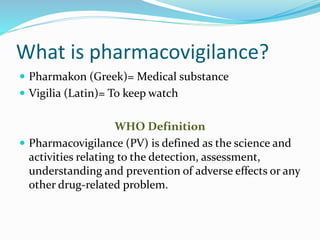
What is pharmacovigilance?
 Pharmakon (Greek)= Medical substance
 Vigilia (Latin)= To keep watch
WHO Definition
 Pharmacovigilance (PV) is defined as the science and
activities relating to the detection, assessment,
understanding and prevention of adverse effects or any
other drug-related problem.
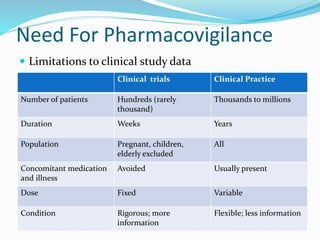
Need For Pharmacovigilance
 Limitations to clinical study data
Clinical trials Clinical Practice
Number of patients Hundreds (rarely
thousand)
Thousands to millions
Duration Weeks Years
Population Pregnant, children,
elderly excluded
All
Concomitant medication
and illness
Avoided Usually present
Dose Fixed Variable
Condition Rigorous; more
information
Flexible; less information
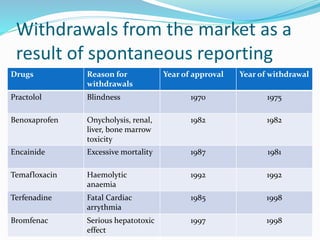
Withdrawals from the market as a
result of spontaneous reporting
Drugs Reason for
withdrawals
Year of approval Year of withdrawal
Practolol Blindness 1970 1975
Benoxaprofen Onycholysis, renal,
liver, bone marrow
toxicity
1982 1982
Encainide Excessive mortality 1987 1981
Temafloxacin Haemolytic
anaemia
1992 1992
Terfenadine Fatal Cardiac
arrythmia
1985 1998
Bromfenac Serious hepatotoxic
effect
1997 1998
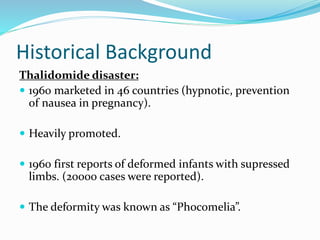
Historical Background
Thalidomide disaster:
 1960 marketed in 46 countries (hypnotic, prevention
of nausea in pregnancy).
 Heavily promoted.
 1960 first reports of deformed infants with supressed
limbs. (20000 cases were reported).
 The deformity was known as “Phocomelia”.
What is Phocomelia.
 A rare congenital deformity in which the hands or feet
are attached close to the trunk, the limbs being grossly
underdeveloped or absent. This condition was a side
effect of the drug thalidomide taken during early
pregnancy.
Aim
 To improve patient care and safety in relation to the
use of medicines, and all medical and paramedical
interventions.
 To improve public health and safety in relation to the
use of medicines.
Contd...
 To contribute to the assessment of benefit, harm,
effectiveness and risk of medicines, encouraging their
safe, rational and more effective use.
 To promote understanding, education and clinical
training in pharmacovigilance and its effective
communication to health professionals and the public.
Pharmacovigilance process
 Detecting and Reporting ADR,
1. Spontaneous reporting
2. Mandatory reporting
Spontaneous reporting
 HCP identify and reports any ADR related to the drug
to their national regulatory bodies.
 Most common ADR form.
Mandatory reporting
 Manufacture needs to submit the ADR reports to the
their respective national regulatory bodies in the form
of PSUR (Periodic safety update report).
 Includes information of all types of ADR collected
irrespective of the reporting country.
 Includes scientific evaluation of risk benefit balance.
Pharmacovigilance In India
 CDSCO (Central drug standard control organisation)-
DGHS (Ministry of health).
 Legislative requirement of PV in India was done under
schedule Y drug. (drugs under clinical trials).
 PVPI (Pharmacovigilance programe of india).
Timelines For ADR Reporting
 Serious ICSR
-Fatal and Life threatening outcome should be reported
in 7 calendar days.
-Hospitalization and IME (15 calendar days).
 No serious ICSR- 30 calendar days (for USA) and 90
days for European country.
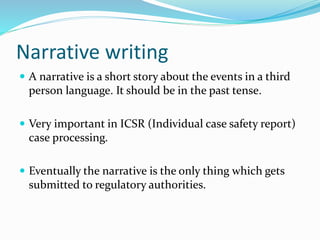
Narrative writing
 A narrative is a short story about the events in a third
person language. It should be in the past tense.
 Very important in ICSR (Individual case safety report)
case processing.
 Eventually the narrative is the only thing which gets
submitted to regulatory authorities.
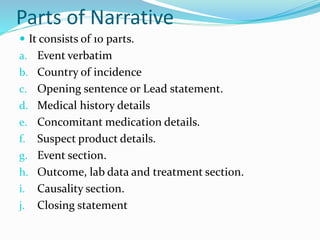
Parts of Narrative
 It consists of 10 parts.
a. Event verbatim
b. Country of incidence
c. Opening sentence or Lead statement.
d. Medical history details
e. Concomitant medication details.
f. Suspect product details.
g. Event section.
h. Outcome, lab data and treatment section.
i. Causality section.
j. Closing statement
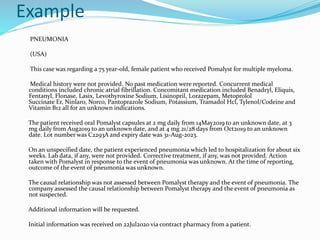
Example
PNEUMONIA
(USA)
This case was regarding a 75 year-old, female patient who received Pomalyst for multiple myeloma.
Medical history were not provided. No past medication were reported. Concurrent medical
conditions included chronic atrial fibrillation. Concomitant medication included Benadryl, Eliquis,
Fentanyl, Flonase, Lasix, Levothyroxine Sodium, Lisinopril, Lorazepam, Metoprolol
Succinate Er, Ninlaro, Norco, Pantoprazole Sodium, Potassium, Tramadol Hcl, Tylenol/Codeine and
Vitamin B12 all for an unknown indications.
The patient received oral Pomalyst capsules at 2 mg daily from 14May2019 to an unknown date, at 3
mg daily from Aug2019 to an unknown date, and at 4 mg 21/28 days from Oct2019 to an unknown
date. Lot number was C2293A and expiry date was 31-Aug-2023.
On an unspecified date, the patient experienced pneumonia which led to hospitalization for about six
weeks. Lab data, if any, were not provided. Corrective treatment, if any, was not provided. Action
taken with Pomalyst in response to the event of pneumonia was unknown. At the time of reporting,
outcome of the event of pneumonia was unknown.
The causal relationship was not assessed between Pomalyst therapy and the event of pneumonia. The
company assessed the causal relationship between Pomalyst therapy and the event of pneumonia as
not suspected.
Additional information will be requested.
Initial information was received on 22Jul2020 via contract pharmacy from a patient.
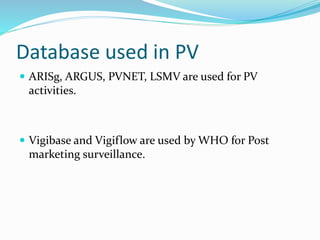
Database used in PV
 ARISg, ARGUS, PVNET, LSMV are used for PV
activities.
 Vigibase and Vigiflow are used by WHO for Post
marketing surveillance.
Types of reporting forms
 CIOMS- Europe
 Medwatch- USA
 E2B- World
Online course - Free of cost
 Uppsala monitoring center website.
 https://www.who-umc.org/
THANK YOU

Introduction to Pharmacovigilance.pptx

  • 1.
    Wasim Akram Ansari MedicalServices Associate Accenture Solutions
  • 2.
    What is pharmacovigilance? Pharmakon (Greek)= Medical substance  Vigilia (Latin)= To keep watch WHO Definition  Pharmacovigilance (PV) is defined as the science and activities relating to the detection, assessment, understanding and prevention of adverse effects or any other drug-related problem.
  • 3.
    Need For Pharmacovigilance Limitations to clinical study data Clinical trials Clinical Practice Number of patients Hundreds (rarely thousand) Thousands to millions Duration Weeks Years Population Pregnant, children, elderly excluded All Concomitant medication and illness Avoided Usually present Dose Fixed Variable Condition Rigorous; more information Flexible; less information
  • 4.
    Withdrawals from themarket as a result of spontaneous reporting Drugs Reason for withdrawals Year of approval Year of withdrawal Practolol Blindness 1970 1975 Benoxaprofen Onycholysis, renal, liver, bone marrow toxicity 1982 1982 Encainide Excessive mortality 1987 1981 Temafloxacin Haemolytic anaemia 1992 1992 Terfenadine Fatal Cardiac arrythmia 1985 1998 Bromfenac Serious hepatotoxic effect 1997 1998
  • 5.
    Historical Background Thalidomide disaster: 1960 marketed in 46 countries (hypnotic, prevention of nausea in pregnancy).  Heavily promoted.  1960 first reports of deformed infants with supressed limbs. (20000 cases were reported).  The deformity was known as “Phocomelia”.
  • 6.
    What is Phocomelia. A rare congenital deformity in which the hands or feet are attached close to the trunk, the limbs being grossly underdeveloped or absent. This condition was a side effect of the drug thalidomide taken during early pregnancy.
  • 7.
    Aim  To improvepatient care and safety in relation to the use of medicines, and all medical and paramedical interventions.  To improve public health and safety in relation to the use of medicines.
  • 8.
    Contd...  To contributeto the assessment of benefit, harm, effectiveness and risk of medicines, encouraging their safe, rational and more effective use.  To promote understanding, education and clinical training in pharmacovigilance and its effective communication to health professionals and the public.
  • 9.
    Pharmacovigilance process  Detectingand Reporting ADR, 1. Spontaneous reporting 2. Mandatory reporting
  • 10.
    Spontaneous reporting  HCPidentify and reports any ADR related to the drug to their national regulatory bodies.  Most common ADR form.
  • 11.
    Mandatory reporting  Manufactureneeds to submit the ADR reports to the their respective national regulatory bodies in the form of PSUR (Periodic safety update report).  Includes information of all types of ADR collected irrespective of the reporting country.  Includes scientific evaluation of risk benefit balance.
  • 12.
    Pharmacovigilance In India CDSCO (Central drug standard control organisation)- DGHS (Ministry of health).  Legislative requirement of PV in India was done under schedule Y drug. (drugs under clinical trials).  PVPI (Pharmacovigilance programe of india).
  • 13.
    Timelines For ADRReporting  Serious ICSR -Fatal and Life threatening outcome should be reported in 7 calendar days. -Hospitalization and IME (15 calendar days).  No serious ICSR- 30 calendar days (for USA) and 90 days for European country.
  • 14.
    Narrative writing  Anarrative is a short story about the events in a third person language. It should be in the past tense.  Very important in ICSR (Individual case safety report) case processing.  Eventually the narrative is the only thing which gets submitted to regulatory authorities.
  • 15.
    Parts of Narrative It consists of 10 parts. a. Event verbatim b. Country of incidence c. Opening sentence or Lead statement. d. Medical history details e. Concomitant medication details. f. Suspect product details. g. Event section. h. Outcome, lab data and treatment section. i. Causality section. j. Closing statement
  • 16.
    Example PNEUMONIA (USA) This case wasregarding a 75 year-old, female patient who received Pomalyst for multiple myeloma. Medical history were not provided. No past medication were reported. Concurrent medical conditions included chronic atrial fibrillation. Concomitant medication included Benadryl, Eliquis, Fentanyl, Flonase, Lasix, Levothyroxine Sodium, Lisinopril, Lorazepam, Metoprolol Succinate Er, Ninlaro, Norco, Pantoprazole Sodium, Potassium, Tramadol Hcl, Tylenol/Codeine and Vitamin B12 all for an unknown indications. The patient received oral Pomalyst capsules at 2 mg daily from 14May2019 to an unknown date, at 3 mg daily from Aug2019 to an unknown date, and at 4 mg 21/28 days from Oct2019 to an unknown date. Lot number was C2293A and expiry date was 31-Aug-2023. On an unspecified date, the patient experienced pneumonia which led to hospitalization for about six weeks. Lab data, if any, were not provided. Corrective treatment, if any, was not provided. Action taken with Pomalyst in response to the event of pneumonia was unknown. At the time of reporting, outcome of the event of pneumonia was unknown. The causal relationship was not assessed between Pomalyst therapy and the event of pneumonia. The company assessed the causal relationship between Pomalyst therapy and the event of pneumonia as not suspected. Additional information will be requested. Initial information was received on 22Jul2020 via contract pharmacy from a patient.
  • 17.
    Database used inPV  ARISg, ARGUS, PVNET, LSMV are used for PV activities.  Vigibase and Vigiflow are used by WHO for Post marketing surveillance.
  • 18.
    Types of reportingforms  CIOMS- Europe  Medwatch- USA  E2B- World
  • 19.
    Online course -Free of cost  Uppsala monitoring center website.  https://www.who-umc.org/
  • 20.