WELCOMES YOU 
PHARMACOVIGILANCE
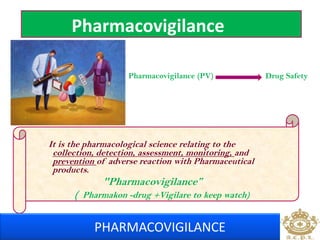
Pharmacovigilance 
Pharmacovigilance (PV) Drug Safety 
It is the pharmacological science relating to the 
collection, detection, assessment, monitoring, and 
prevention of adverse reaction with Pharmaceutical 
products. 
"Pharmacovigilance” 
( Pharmakon -drug +Vigilare to keep watch) 
PHARMACOVIGILANCE
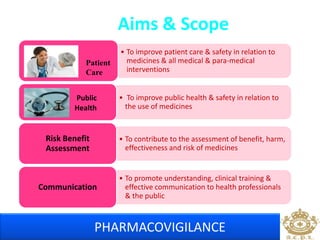
Aims & Scope 
• To improve patient care & safety in relation to 
medicines & all medical & para-medical 
interventions 
• To improve public health & safety in relation to 
the use of medicines 
Patient 
Care 
Public 
Health 
• To contribute to the assessment of benefit, harm, 
effectiveness and risk of medicines 
Risk Benefit 
Assessment 
• To promote understanding, clinical training & 
effective communication to health professionals 
& the public 
Communication 
PHARMACOVIGILANCE
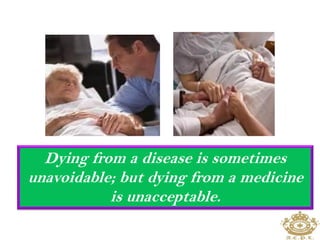
Dying from a disease is sometimes 
unavoidable; but dying from a medicine 
is unacceptable.
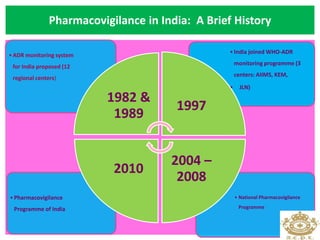
Pharmacovigilance in India: A Brief History 
• 
• National Pharmacovigilance 
Programme 
• Pharmacovigilance 
Programme of India 
• India joined WHO-ADR 
monitoring programme (3 
centers: AIIMS, KEM, 
• JLN) 
•ADR monitoring system 
for India proposed (12 
regional centers) 
1982 & 
1989 
1997 
2004 – 
2008 
2010
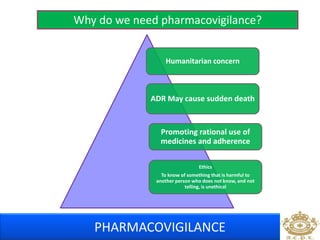
Why do we need pharmacovigilance? 
Humanitarian concern 
ADR May cause sudden death 
Promoting rational use of 
medicines and adherence 
Ethics 
To know of something that is harmful to 
another person who does not know, and not 
telling, is unethical 
PHARMACOVIGILANCE
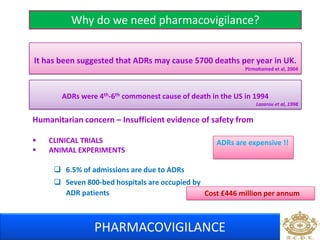
Why do we need pharmacovigilance? 
It has been suggested that ADRs may cause 5700 deaths per year in UK. 
Humanitarian concern – Insufficient evidence of safety from 
 CLINICAL TRIALS 
 ANIMAL EXPERIMENTS 
Pirmohamed et al, 2004 
ADRs were 4th-6th commonest cause of death in the US in 1994 
Lazarou et al, 1998 
ADRs are expensive !! 
 6.5% of admissions are due to ADRs 
 Seven 800-bed hospitals are occupied by 
ADR patients Cost £446 million per annum 
PHARMACOVIGILANCE
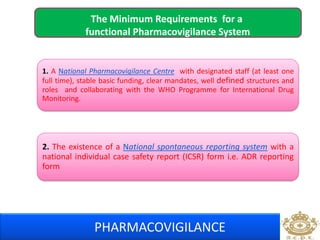
The Minimum Requirements for a 
functional Pharmacovigilance System 
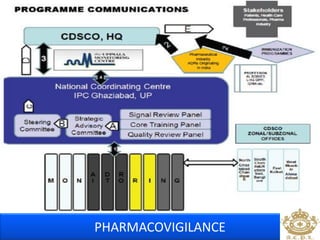
1. A National Pharmacovigilance Centre with designated staff (at least one 
full time), stable basic funding, clear mandates, well defined structures and 
roles and collaborating with the WHO Programme for International Drug 
Monitoring. 
2. The existence of a National spontaneous reporting system with a 
national individual case safety report (ICSR) form i.e. ADR reporting 
form 
PHARMACOVIGILANCE
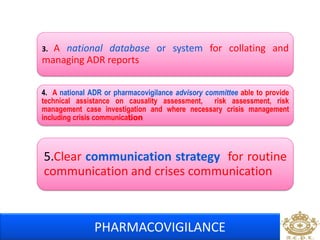
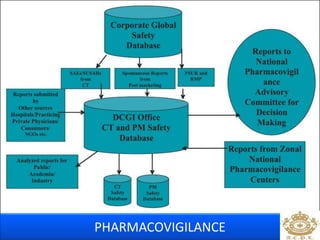
3. A national database or system for collating and 
managing ADR reports 
4. A national ADR or pharmacovigilance advisory committee able to provide 
technical assistance on causality assessment, risk assessment, risk 
management case investigation and where necessary crisis management 
including crisis communication 
5.Clear communication strategy for routine 
communication and crises communication 
PHARMACOVIGILANCE
What information should be reported ? 
PHARMACOVIGILANCE
ANY INFORMATION 
on an ADR or lack of efficacy connected with 
the use of a Bayer product. 
 on ADRs occurring 
in the course of the use of a drug 
from drug overdose whether accidental or intentional 
from drug abuse / misuse / non-approved use 
from drug withdrawal 
in the infant of a nursing mother 
possibly as a result of exposure of the mother or the fetus during 
pregnancy. 
even if no ADR has been observed, 
 From drug overdose whether accidental or intentional 
 From drug abuse / misuse / non-approved use 
 From drug administration during pregnancy. 
PHARMACOVIGILANCE
PHARMACOVIGILANCE
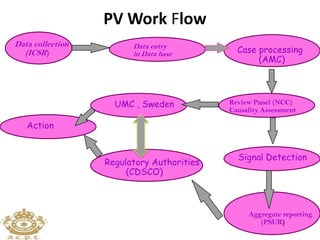
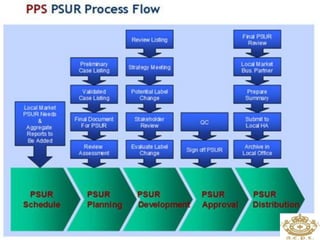
PV Work Flow 
Data collection 
(ICSR) 
Data entry 
in Data base Case processing 
(AMC) 
Review Panel (NCC) 
Causality Assessment 
Signal Detection 
Aggregate reporting 
(PSUR) 
Regulatory Authorities 
(CDSCO) 
Action 
UMC , Sweden
PHARMACOVIGILANCE
PHARMACOVIGILANCE
ADR Reporting through vigiflow. 
VigiFlow is a web-based Individual Case Safety Report 
(ICSR) management system that is specially designed for 
use by national centres in the WHO Programme for 
International Drug Monitoring. 
VigiFlow 5.1(Released on 14 June 2013) 
 Subscription for Vigiflow is free in India. 
 Other tools: 
ARISg (mainly used by Drug manufacturer in Europe) 
 Argus (mainly used by Drug manufacturer in USA) 
Vigibase 
PHARMACOVIGILANCE
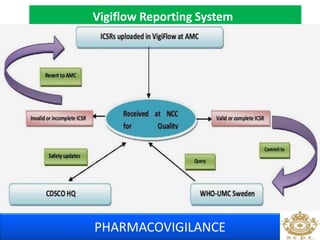
Vigiflow Reporting System. 
PHARMACOVIGILANCE
PHARMACOVIGILANCE
Overview Of PSUR 
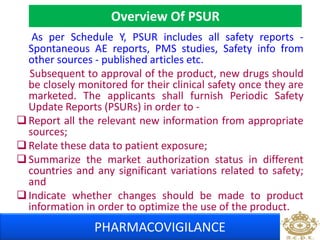
As per Schedule Y, PSUR includes all safety reports - 
Spontaneous AE reports, PMS studies, Safety info from 
other sources - published articles etc. 
Subsequent to approval of the product, new drugs should 
be closely monitored for their clinical safety once they are 
marketed. The applicants shall furnish Periodic Safety 
Update Reports (PSURs) in order to - 
 Report all the relevant new information from appropriate 
sources; 
 Relate these data to patient exposure; 
 Summarize the market authorization status in different 
countries and any significant variations related to safety; 
and 
 Indicate whether changes should be made to product 
information in order to optimize the use of the product. 
PHARMACOVIGILANCE
Aggregate Reporting (PSUR) 
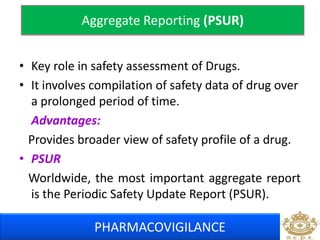
• Key role in safety assessment of Drugs. 
• It involves compilation of safety data of drug over 
a prolonged period of time. 
Advantages: 
Provides broader view of safety profile of a drug. 
• PSUR 
Worldwide, the most important aggregate report 
is the Periodic Safety Update Report (PSUR). 
PHARMACOVIGILANCE
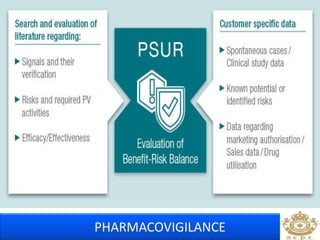
Periodic safety update reports (PSURs) 
• (PSURs) now called as PBRER (Periodic benefit 
risk evaluation report, 21Jul2012) are 
Pharmacovigilance documents intended to 
provide an evaluation of the risk-benefit 
balance of a medicinal product for submission 
at defined time points during the post-authorisation 
phase. 
• The PSUR should focus on summary 
information, scientific safety assessment and 
integrated benefit-risk evaluation. 
PHARMACOVIGILANCE
PHARMACOVIGILANCE
Submission frequency for PSURs 
• First 2 yrs: every 6 month 
• Next 2 yrs: every year 
• After that every 3 years. 
On the basis of PSURs: Regulatory Authorities take 
the appropriate decision for marketing of 
particular medicinal product. 
PHARMACOVIGILANCE
PHARMACOVIGILANCE
What We Do….. 
Pharmacovigilance / Safety / Medical Writing Services 
ACPL provide services entails the generation of 
well‐structured individual reports supporting extensive 
medical writing programs, including: 
Aggregate report writing/ Medical and technical 
writing for PSURs 
Product Feasibility Reports for Medical Devices/Drugs 
Medical and technical writing for clinical study reports 
and annual reports 
Clinical Summaries. 
SAE Narratives for Clinical Study Reports 
RMP, SOP writing 
PHARMACOVIGILANCE
Recently banned drugs in India 
• Serodiagnostic test kits for diagnosis of tuberculosis (with 
effect from 7Jun2013). 
• Dextropropoxyphene (with effect from 23May2013) . 
• Fixed dose combination of Flupentixol+Melitracen (with effect 
from 18Jun2013). 
• Analgin (with effect from 18Jun2013) 
• Pioglitazone (with effect from 18Jun2013) 
PHARMACOVIGILANCE
THANK YOU 
ACCREDITED CONSULTANTS PVT. LTD. 
(Email: bhatbio@gmail.com, info@acplgroupindia.co.in, Website: acplgroupindia.co.in) 
(Contact: +91 22758204, 9350040434, 9310040434, Fax: 22758994) 
D-29, 1ST FLOOR, ACHARYA NIKETAN, MAYUR VIHAR 
PHASE-I, NEW DELHI-110091 
PHARMACOVIGILANCE

pharmacovigilance pdf (1)

  • 1.
  • 2.
    Pharmacovigilance Pharmacovigilance (PV)Drug Safety It is the pharmacological science relating to the collection, detection, assessment, monitoring, and prevention of adverse reaction with Pharmaceutical products. "Pharmacovigilance” ( Pharmakon -drug +Vigilare to keep watch) PHARMACOVIGILANCE
  • 3.
    Aims & Scope • To improve patient care & safety in relation to medicines & all medical & para-medical interventions • To improve public health & safety in relation to the use of medicines Patient Care Public Health • To contribute to the assessment of benefit, harm, effectiveness and risk of medicines Risk Benefit Assessment • To promote understanding, clinical training & effective communication to health professionals & the public Communication PHARMACOVIGILANCE
  • 4.
    Dying from adisease is sometimes unavoidable; but dying from a medicine is unacceptable.
  • 5.
    Pharmacovigilance in India:A Brief History • • National Pharmacovigilance Programme • Pharmacovigilance Programme of India • India joined WHO-ADR monitoring programme (3 centers: AIIMS, KEM, • JLN) •ADR monitoring system for India proposed (12 regional centers) 1982 & 1989 1997 2004 – 2008 2010
  • 6.
    Why do weneed pharmacovigilance? Humanitarian concern ADR May cause sudden death Promoting rational use of medicines and adherence Ethics To know of something that is harmful to another person who does not know, and not telling, is unethical PHARMACOVIGILANCE
  • 7.
    Why do weneed pharmacovigilance? It has been suggested that ADRs may cause 5700 deaths per year in UK. Humanitarian concern – Insufficient evidence of safety from  CLINICAL TRIALS  ANIMAL EXPERIMENTS Pirmohamed et al, 2004 ADRs were 4th-6th commonest cause of death in the US in 1994 Lazarou et al, 1998 ADRs are expensive !!  6.5% of admissions are due to ADRs  Seven 800-bed hospitals are occupied by ADR patients Cost £446 million per annum PHARMACOVIGILANCE
  • 8.
    The Minimum Requirementsfor a functional Pharmacovigilance System 1. A National Pharmacovigilance Centre with designated staff (at least one full time), stable basic funding, clear mandates, well defined structures and roles and collaborating with the WHO Programme for International Drug Monitoring. 2. The existence of a National spontaneous reporting system with a national individual case safety report (ICSR) form i.e. ADR reporting form PHARMACOVIGILANCE
  • 9.
    3. A nationaldatabase or system for collating and managing ADR reports 4. A national ADR or pharmacovigilance advisory committee able to provide technical assistance on causality assessment, risk assessment, risk management case investigation and where necessary crisis management including crisis communication 5.Clear communication strategy for routine communication and crises communication PHARMACOVIGILANCE
  • 10.
    What information shouldbe reported ? PHARMACOVIGILANCE
  • 11.
    ANY INFORMATION onan ADR or lack of efficacy connected with the use of a Bayer product.  on ADRs occurring in the course of the use of a drug from drug overdose whether accidental or intentional from drug abuse / misuse / non-approved use from drug withdrawal in the infant of a nursing mother possibly as a result of exposure of the mother or the fetus during pregnancy. even if no ADR has been observed,  From drug overdose whether accidental or intentional  From drug abuse / misuse / non-approved use  From drug administration during pregnancy. PHARMACOVIGILANCE
  • 12.
  • 13.
    PV Work Flow Data collection (ICSR) Data entry in Data base Case processing (AMC) Review Panel (NCC) Causality Assessment Signal Detection Aggregate reporting (PSUR) Regulatory Authorities (CDSCO) Action UMC , Sweden
  • 14.
  • 15.
  • 16.
    ADR Reporting throughvigiflow. VigiFlow is a web-based Individual Case Safety Report (ICSR) management system that is specially designed for use by national centres in the WHO Programme for International Drug Monitoring. VigiFlow 5.1(Released on 14 June 2013)  Subscription for Vigiflow is free in India.  Other tools: ARISg (mainly used by Drug manufacturer in Europe)  Argus (mainly used by Drug manufacturer in USA) Vigibase PHARMACOVIGILANCE
  • 17.
    Vigiflow Reporting System. PHARMACOVIGILANCE
  • 18.
  • 19.
    Overview Of PSUR As per Schedule Y, PSUR includes all safety reports - Spontaneous AE reports, PMS studies, Safety info from other sources - published articles etc. Subsequent to approval of the product, new drugs should be closely monitored for their clinical safety once they are marketed. The applicants shall furnish Periodic Safety Update Reports (PSURs) in order to -  Report all the relevant new information from appropriate sources;  Relate these data to patient exposure;  Summarize the market authorization status in different countries and any significant variations related to safety; and  Indicate whether changes should be made to product information in order to optimize the use of the product. PHARMACOVIGILANCE
  • 20.
    Aggregate Reporting (PSUR) • Key role in safety assessment of Drugs. • It involves compilation of safety data of drug over a prolonged period of time. Advantages: Provides broader view of safety profile of a drug. • PSUR Worldwide, the most important aggregate report is the Periodic Safety Update Report (PSUR). PHARMACOVIGILANCE
  • 22.
    Periodic safety updatereports (PSURs) • (PSURs) now called as PBRER (Periodic benefit risk evaluation report, 21Jul2012) are Pharmacovigilance documents intended to provide an evaluation of the risk-benefit balance of a medicinal product for submission at defined time points during the post-authorisation phase. • The PSUR should focus on summary information, scientific safety assessment and integrated benefit-risk evaluation. PHARMACOVIGILANCE
  • 23.
  • 24.
    Submission frequency forPSURs • First 2 yrs: every 6 month • Next 2 yrs: every year • After that every 3 years. On the basis of PSURs: Regulatory Authorities take the appropriate decision for marketing of particular medicinal product. PHARMACOVIGILANCE
  • 25.
  • 26.
    What We Do….. Pharmacovigilance / Safety / Medical Writing Services ACPL provide services entails the generation of well‐structured individual reports supporting extensive medical writing programs, including: Aggregate report writing/ Medical and technical writing for PSURs Product Feasibility Reports for Medical Devices/Drugs Medical and technical writing for clinical study reports and annual reports Clinical Summaries. SAE Narratives for Clinical Study Reports RMP, SOP writing PHARMACOVIGILANCE
  • 27.
    Recently banned drugsin India • Serodiagnostic test kits for diagnosis of tuberculosis (with effect from 7Jun2013). • Dextropropoxyphene (with effect from 23May2013) . • Fixed dose combination of Flupentixol+Melitracen (with effect from 18Jun2013). • Analgin (with effect from 18Jun2013) • Pioglitazone (with effect from 18Jun2013) PHARMACOVIGILANCE
  • 28.
    THANK YOU ACCREDITEDCONSULTANTS PVT. LTD. (Email: bhatbio@gmail.com, info@acplgroupindia.co.in, Website: acplgroupindia.co.in) (Contact: +91 22758204, 9350040434, 9310040434, Fax: 22758994) D-29, 1ST FLOOR, ACHARYA NIKETAN, MAYUR VIHAR PHASE-I, NEW DELHI-110091 PHARMACOVIGILANCE