UNIVERSITY OF SOUTHERN MINDANAO
Chapter 1:
Holistic Understanding of Peace and Violence
SocSci 2 – Peace and Development
Prepared by: Group 3
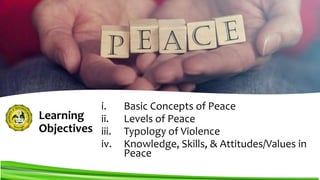
Learning
Objectives
i. Basic Concepts of Peace
ii. Levels of Peace
iii. Typology of Violence
iv. Knowledge, Skills, & Attitudes/Values in
Peace
What is Peace?
“Relation between two or more parties”
“Peace is not a property of one party
alone, but a property of the relationship
between parties”
- Johan Galtung (Father of Peace Studies)
Levels of Peace
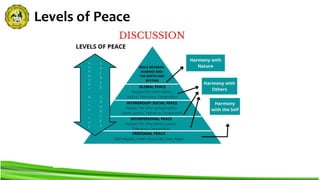
A. Personal Peace
•Intrapersonal peace or inner peace
•Harmony with the self, self-respect and self-
love
Levels of Peace
B. Interpersonal Peace
•Respect for another person, justice, tolerance,
and cooperation
•Requires a balance between care for myself
and care for others; a balance between
intellectual pursuits and physical pursuits; and a
balance between local care and global care.
Levels of Peace
C. Intergroup/ Social Peace
•Respect for other groups/ tribes in nations,
justice, tolerance, and cooperation
Levels of Peace
D. Global Peace
•Respect between nations
•Peace between humans and the earth and
beyond (Harmony with nature) Respect for the
ecological (nature, environment, and the
natural world) system
Levels of Peace
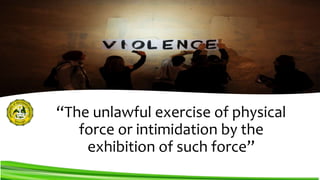
“The unlawful exercise of physical
force or intimidation by the
exhibition of such force”
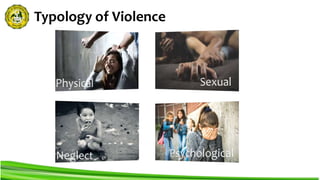
Typology of Violence
A. Physical Violence
• Scratching, pushing, shoving, grabbing, biting,
choking, shaking, slapping, punching, hitting,
burning, and use of a weapon.
Typology of Violence
B. Sexual Violence
• This includes, but is not limited to, forced,
facilitated by alcohol/drugs, or unwanted
penetration, sexual touching, or non-contact
sexual acts.
Typology of Violence
C. Psychological Violence
• emotional abuse, is a form of abuse characterized
by a person subjecting or exposing another person
to a behavior that may result in psychological
trauma
• Coercion, Defamation, Verbal insult, or harassment.
Typology of Violence
D. Neglect
• include failing to provide adequate supervision, nourishment, or
medical care, as well as failing to meet other needs.
-Can result in a variety of long-term consequences including;
 Physical injuries
 Low self-esteem and,
 Death.
Typology of Violence
Peace studies equips students with the
knowledge to understand the causes of violent
conflict, develop nonviolent ways of addressing
violence, and build peaceful, just societies.
Education for Peace (Knowledge Areas)
Holistic concept of peace-
peace is not only the absence of
direct or physical violence but
also the presence of Well-being,
Cooperation, and Relationships
in Human, Ecological spheres
• What are the knowledge areas integral to peace education?
Conflict and violence- has
personal to global violence
 Direct
 Structural
 Socio-cultural
 Ecological violence
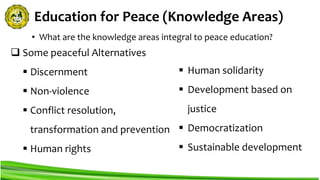
Education for Peace (Knowledge Areas)
 Some peaceful Alternatives
 Discernment
 Non-violence
 Conflict resolution,
transformation and prevention
 Human rights
• What are the knowledge areas integral to peace education?
 Human solidarity
 Development based on
justice
 Democratization
 Sustainable development
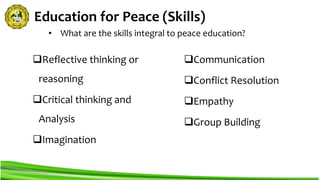
Education for Peace (Skills)
Reflective thinking or
reasoning
Critical thinking and
Analysis
Imagination
Communication
Conflict Resolution
Empathy
Group Building
• What are the skills integral to peace education?
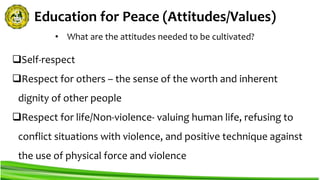
Education for Peace (Attitudes/Values)
Self-respect
Respect for others – the sense of the worth and inherent
dignity of other people
Respect for life/Non-violence- valuing human life, refusing to
conflict situations with violence, and positive technique against
the use of physical force and violence
• What are the attitudes needed to be cultivated?
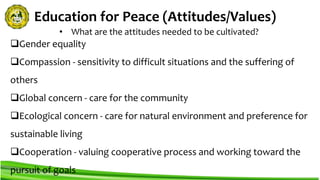
Education for Peace (Attitudes/Values)
Gender equality
Compassion - sensitivity to difficult situations and the suffering of
others
Global concern - care for the community
Ecological concern - care for natural environment and preference for
sustainable living
Cooperation - valuing cooperative process and working toward the
pursuit of goals
• What are the attitudes needed to be cultivated?
Education for Peace (Attitudes/Values)
Openness/Tolerance - receive other ideas and beliefs, respect
rich diversity traditions and culture
Justice - fairness towards others, upholding the principle of
equality, and rejection of exploitation and oppression
Social Responsibility - willingness to take actions
Positive vision -imaging the future with a sense of hope and
pursuing the realization
• What are the attitudes needed to be cultivated?
Group 3

Chapter-1-Holistic-Understanding-of-Peace-and-Violence-Group-3.pptx

  • 1.
    UNIVERSITY OF SOUTHERNMINDANAO Chapter 1: Holistic Understanding of Peace and Violence SocSci 2 – Peace and Development Prepared by: Group 3
  • 2.
    Learning Objectives i. Basic Conceptsof Peace ii. Levels of Peace iii. Typology of Violence iv. Knowledge, Skills, & Attitudes/Values in Peace
  • 3.
    What is Peace? “Relationbetween two or more parties” “Peace is not a property of one party alone, but a property of the relationship between parties” - Johan Galtung (Father of Peace Studies)
  • 4.
    Levels of Peace A.Personal Peace •Intrapersonal peace or inner peace •Harmony with the self, self-respect and self- love
  • 5.
    Levels of Peace B.Interpersonal Peace •Respect for another person, justice, tolerance, and cooperation •Requires a balance between care for myself and care for others; a balance between intellectual pursuits and physical pursuits; and a balance between local care and global care.
  • 6.
    Levels of Peace C.Intergroup/ Social Peace •Respect for other groups/ tribes in nations, justice, tolerance, and cooperation
  • 7.
    Levels of Peace D.Global Peace •Respect between nations •Peace between humans and the earth and beyond (Harmony with nature) Respect for the ecological (nature, environment, and the natural world) system
  • 8.
  • 9.
    “The unlawful exerciseof physical force or intimidation by the exhibition of such force”
  • 10.
    Typology of Violence A.Physical Violence • Scratching, pushing, shoving, grabbing, biting, choking, shaking, slapping, punching, hitting, burning, and use of a weapon.
  • 11.
    Typology of Violence B.Sexual Violence • This includes, but is not limited to, forced, facilitated by alcohol/drugs, or unwanted penetration, sexual touching, or non-contact sexual acts.
  • 12.
    Typology of Violence C.Psychological Violence • emotional abuse, is a form of abuse characterized by a person subjecting or exposing another person to a behavior that may result in psychological trauma • Coercion, Defamation, Verbal insult, or harassment.
  • 13.
    Typology of Violence D.Neglect • include failing to provide adequate supervision, nourishment, or medical care, as well as failing to meet other needs. -Can result in a variety of long-term consequences including;  Physical injuries  Low self-esteem and,  Death.
  • 14.
  • 15.
    Peace studies equipsstudents with the knowledge to understand the causes of violent conflict, develop nonviolent ways of addressing violence, and build peaceful, just societies.
  • 16.
    Education for Peace(Knowledge Areas) Holistic concept of peace- peace is not only the absence of direct or physical violence but also the presence of Well-being, Cooperation, and Relationships in Human, Ecological spheres • What are the knowledge areas integral to peace education? Conflict and violence- has personal to global violence  Direct  Structural  Socio-cultural  Ecological violence
  • 17.
    Education for Peace(Knowledge Areas)  Some peaceful Alternatives  Discernment  Non-violence  Conflict resolution, transformation and prevention  Human rights • What are the knowledge areas integral to peace education?  Human solidarity  Development based on justice  Democratization  Sustainable development
  • 18.
    Education for Peace(Skills) Reflective thinking or reasoning Critical thinking and Analysis Imagination Communication Conflict Resolution Empathy Group Building • What are the skills integral to peace education?
  • 19.
    Education for Peace(Attitudes/Values) Self-respect Respect for others – the sense of the worth and inherent dignity of other people Respect for life/Non-violence- valuing human life, refusing to conflict situations with violence, and positive technique against the use of physical force and violence • What are the attitudes needed to be cultivated?
  • 20.
    Education for Peace(Attitudes/Values) Gender equality Compassion - sensitivity to difficult situations and the suffering of others Global concern - care for the community Ecological concern - care for natural environment and preference for sustainable living Cooperation - valuing cooperative process and working toward the pursuit of goals • What are the attitudes needed to be cultivated?
  • 21.
    Education for Peace(Attitudes/Values) Openness/Tolerance - receive other ideas and beliefs, respect rich diversity traditions and culture Justice - fairness towards others, upholding the principle of equality, and rejection of exploitation and oppression Social Responsibility - willingness to take actions Positive vision -imaging the future with a sense of hope and pursuing the realization • What are the attitudes needed to be cultivated?
  • 23.