Introduction to
pathology
1
‫د‬
.
‫عبيرالشيخي‬
Intended Learning Outcomes:
By the end of this lecture , you will be able to:
1. Define pathology and disease
2. Enumerate the pathology subspecialties
3. Understand the nomenclature of disease
4. Apply the prefixes, root and suffixes
5. Explain the four aspects of disease progression
:eitiology, pathogenesis, morphologic changes and
clinical manifestations
2
Introduction to pathology
• The word ‘Pathology’ is derived from two Greek words
– Pathos (meaning suffering/disease)
– logos (meaning study)
• Pathology is scientific study of changes in the structure
and function of the body in disease
• Study of diseases
3
Definition of pathology/disease
Introduction to pathology
“your practice of medicine will be as good as is
your understanding of pathology” Sir William Osler
‘Father of Modern Medicine’
• What is disease? In simple language, dis-ease is opposite
of health (what is not healthy is disease)
• Disease or an illness means a condition marked by
pronounced deviation from the normal healthy state
4
Introduction to pathology
Traditionally the study of pathology is divided into
• General Pathology: dealing with general principles of
disease
• Systemic Pathology: that includes study of diseases
relating to the specific organs and body systems
5
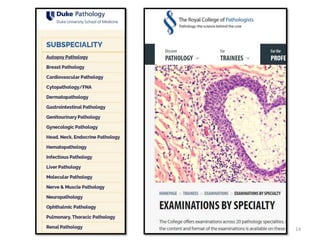
The pathology subspecialties
Introduction to pathology
Subspecialties of pathology:
• Histopathology: used synonymously with Anatomic
pathology
– Gross or macroscopic changes
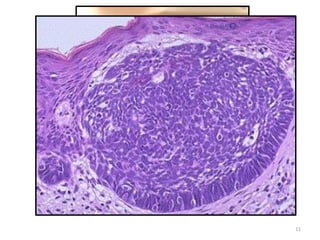
– Microscopic changes
6
The pathology subspecialties
Introduction to pathology
Morphology
7
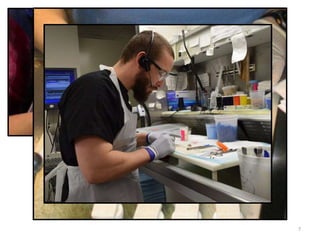
• Anatomic pathology includes 3 main subdivisions:
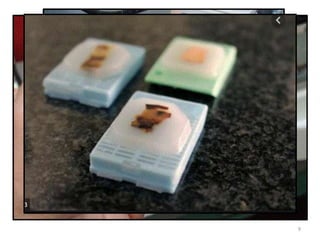
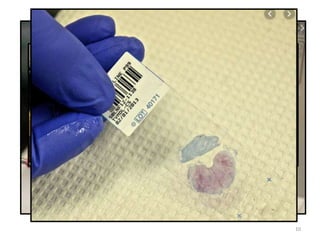
– Surgical pathology : the study of tissues removed from the
living body
• Paraffin embedding techniques
• Frozen section
– Forensic pathology : study of organs and tissues removed at
postmortem
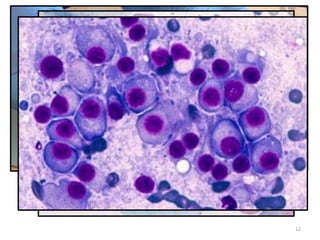
– Cytopathology : the study of individual cells
• Exfoliative cytology: study of cells shed off from the
lesions
• Fine-Needle Aspiration Cytology (FNAC) of superficial and
deep-seated lesions for diagnosis
8
The pathology subspecialties
Introduction to pathology
9
10
11
12
• Molecular pathology:
– To clarify the mechanisms of disease by identifying molecular
and pathway alterations
– Now, the availability of molecular techniques is not only for
research purposes but also as a tool in diagnostic pathology
• Medical genetics: deals with the relationship between
heredity and disease
• Chemical pathology
13
The pathology subspecialties
Introduction to pathology
14
• Although medical terms have been drawn from many
languages, a large majority are from Greek and Latin
• Prefix: is a group of letters attached to the beginning of
a word to partly demonstrate its definition (Pre means
before)
• Root: is a base or stem of a word that conveys
meaning
• Suffix: is a group of letters added to the end of a word
to adjust its meaning
15
The nomenclature of disease
Prefixes, root and suffixes
Introduction to pathology
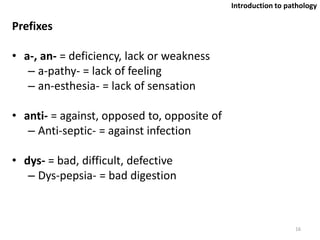
Prefixes
• a-, an- = deficiency, lack or weakness
– a-pathy- = lack of feeling
– an-esthesia- = lack of sensation
• anti- = against, opposed to, opposite of
– Anti-septic- = against infection
• dys- = bad, difficult, defective
– Dys-pepsia- = bad digestion
16
Introduction to pathology
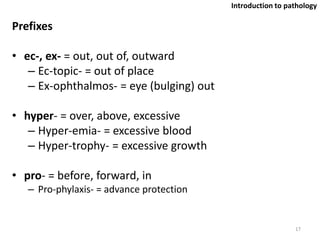
Prefixes
• ec-, ex- = out, out of, outward
– Ec-topic- = out of place
– Ex-ophthalmos- = eye (bulging) out
• hyper- = over, above, excessive
– Hyper-emia- = excessive blood
– Hyper-trophy- = excessive growth
• pro- = before, forward, in
– Pro-phylaxis- = advance protection
17
Introduction to pathology
Suffix
• -itis = inflammatory disease
– Appendic-itis
– Arthr-itis
– Bronch-itis
• -oid = a resemblance to the object designated in the
main word
– Typh-oid-like typhus fever
– Thy-oid-the shield like gland (thyreos-shield)
18
Introduction to pathology
• Etiology: is the initiating cause of a disease
• Pathogenesis: the sequence of molecular, biochemical,
and cellular events that lead to the development of
disease
• Morphologic changes: the structural alterations in cells
or tissues that are characteristic of a disease and hence
diagnostic of an etiologic process
• Clinical features/manifestations: signs and symptoms
of disease, (the functional features of a disease),
example: pain and fever
19
Aspects of disease progression
Introduction to pathology
• Robbins basic pathology, 10th edition,2018
• Robbins and Cotran Pathologic Basis of Disease. Copyright © 2020 by Saunders,
an imprint of Elsevier Inc.
• Textbook of Pathology, Seventh Edition. Copyright © 2015, Harsh Mohan
References
20
Thank you
21

Introduction to pathology (2).pptx

  • 1.
  • 2.
    Intended Learning Outcomes: Bythe end of this lecture , you will be able to: 1. Define pathology and disease 2. Enumerate the pathology subspecialties 3. Understand the nomenclature of disease 4. Apply the prefixes, root and suffixes 5. Explain the four aspects of disease progression :eitiology, pathogenesis, morphologic changes and clinical manifestations 2 Introduction to pathology
  • 3.
    • The word‘Pathology’ is derived from two Greek words – Pathos (meaning suffering/disease) – logos (meaning study) • Pathology is scientific study of changes in the structure and function of the body in disease • Study of diseases 3 Definition of pathology/disease Introduction to pathology
  • 4.
    “your practice ofmedicine will be as good as is your understanding of pathology” Sir William Osler ‘Father of Modern Medicine’ • What is disease? In simple language, dis-ease is opposite of health (what is not healthy is disease) • Disease or an illness means a condition marked by pronounced deviation from the normal healthy state 4 Introduction to pathology
  • 5.
    Traditionally the studyof pathology is divided into • General Pathology: dealing with general principles of disease • Systemic Pathology: that includes study of diseases relating to the specific organs and body systems 5 The pathology subspecialties Introduction to pathology
  • 6.
    Subspecialties of pathology: •Histopathology: used synonymously with Anatomic pathology – Gross or macroscopic changes – Microscopic changes 6 The pathology subspecialties Introduction to pathology Morphology
  • 7.
  • 8.
    • Anatomic pathologyincludes 3 main subdivisions: – Surgical pathology : the study of tissues removed from the living body • Paraffin embedding techniques • Frozen section – Forensic pathology : study of organs and tissues removed at postmortem – Cytopathology : the study of individual cells • Exfoliative cytology: study of cells shed off from the lesions • Fine-Needle Aspiration Cytology (FNAC) of superficial and deep-seated lesions for diagnosis 8 The pathology subspecialties Introduction to pathology
  • 9.
  • 10.
  • 11.
  • 12.
  • 13.
    • Molecular pathology: –To clarify the mechanisms of disease by identifying molecular and pathway alterations – Now, the availability of molecular techniques is not only for research purposes but also as a tool in diagnostic pathology • Medical genetics: deals with the relationship between heredity and disease • Chemical pathology 13 The pathology subspecialties Introduction to pathology
  • 14.
  • 15.
    • Although medicalterms have been drawn from many languages, a large majority are from Greek and Latin • Prefix: is a group of letters attached to the beginning of a word to partly demonstrate its definition (Pre means before) • Root: is a base or stem of a word that conveys meaning • Suffix: is a group of letters added to the end of a word to adjust its meaning 15 The nomenclature of disease Prefixes, root and suffixes Introduction to pathology
  • 16.
    Prefixes • a-, an-= deficiency, lack or weakness – a-pathy- = lack of feeling – an-esthesia- = lack of sensation • anti- = against, opposed to, opposite of – Anti-septic- = against infection • dys- = bad, difficult, defective – Dys-pepsia- = bad digestion 16 Introduction to pathology
  • 17.
    Prefixes • ec-, ex-= out, out of, outward – Ec-topic- = out of place – Ex-ophthalmos- = eye (bulging) out • hyper- = over, above, excessive – Hyper-emia- = excessive blood – Hyper-trophy- = excessive growth • pro- = before, forward, in – Pro-phylaxis- = advance protection 17 Introduction to pathology
  • 18.
    Suffix • -itis =inflammatory disease – Appendic-itis – Arthr-itis – Bronch-itis • -oid = a resemblance to the object designated in the main word – Typh-oid-like typhus fever – Thy-oid-the shield like gland (thyreos-shield) 18 Introduction to pathology
  • 19.
    • Etiology: isthe initiating cause of a disease • Pathogenesis: the sequence of molecular, biochemical, and cellular events that lead to the development of disease • Morphologic changes: the structural alterations in cells or tissues that are characteristic of a disease and hence diagnostic of an etiologic process • Clinical features/manifestations: signs and symptoms of disease, (the functional features of a disease), example: pain and fever 19 Aspects of disease progression Introduction to pathology
  • 20.
    • Robbins basicpathology, 10th edition,2018 • Robbins and Cotran Pathologic Basis of Disease. Copyright © 2020 by Saunders, an imprint of Elsevier Inc. • Textbook of Pathology, Seventh Edition. Copyright © 2015, Harsh Mohan References 20
  • 21.