Introduction to Pathology
MD. SAKHAWAT HOSSAIN
SENIOR LECTURER
DEPARTMENT OF PHARMACY
DAFFODIL INTERNATIONAL UNIVERSITY
Pathology
The word “pathology” is derived from two Greek words “Pathos” meaning “suffering”
and “logos” meaning “study” or “knowledge”. So simply, pathology can be defined as the
study of suffering.
Pathology is Scientific study of disease.
Pathology may be defined as the branch of medical science dedicated to the study of
essential nature of disease specially the changes that cause disease or are caused by disease.
More specifically, pathology may be defined as the "scientific study of the molecular,
cellular, tissue, or organ system in response to injurious agents or adverse influences."
Disease
Disease is defined as any disturbance of the structure and/or
function of the body or any of its constituent parts outside the
normal range, especially one that produces specific clinical signs.
Disease occurs when:
• Enough cells become dysfunctional
• Enough cells die and organ loses function
Causes of Disease
Diseases can be due to:
• Autoimmunity
• Prokaryotic cell infection: bacteria (cause disease primarily by
toxin released, not by direct invasion into cells and killing of cells)
• Viral infection: virus cause disease primarily by lyses of infected
cells
• Chemicals- environment, pollution
• Drugs- medicinal or otherwise
Branches of Clinical Pathology
We can divide clinical pathology into two sections –
1. General pathology: It discusses the changes in the cells or tissue when
pathologic/abnormal stimuli are applied or due to inherited defects. So
inflammation, cell injury etc. fall under general pathology.
2. Systemic/special pathology: It discusses pathology of different organs i.e.
alterations in different organs responsible for disorders. So lung cancer, breast
cancer, myocardial infarction etc. fall under systemic pathology.
Subdivisions of Pathology
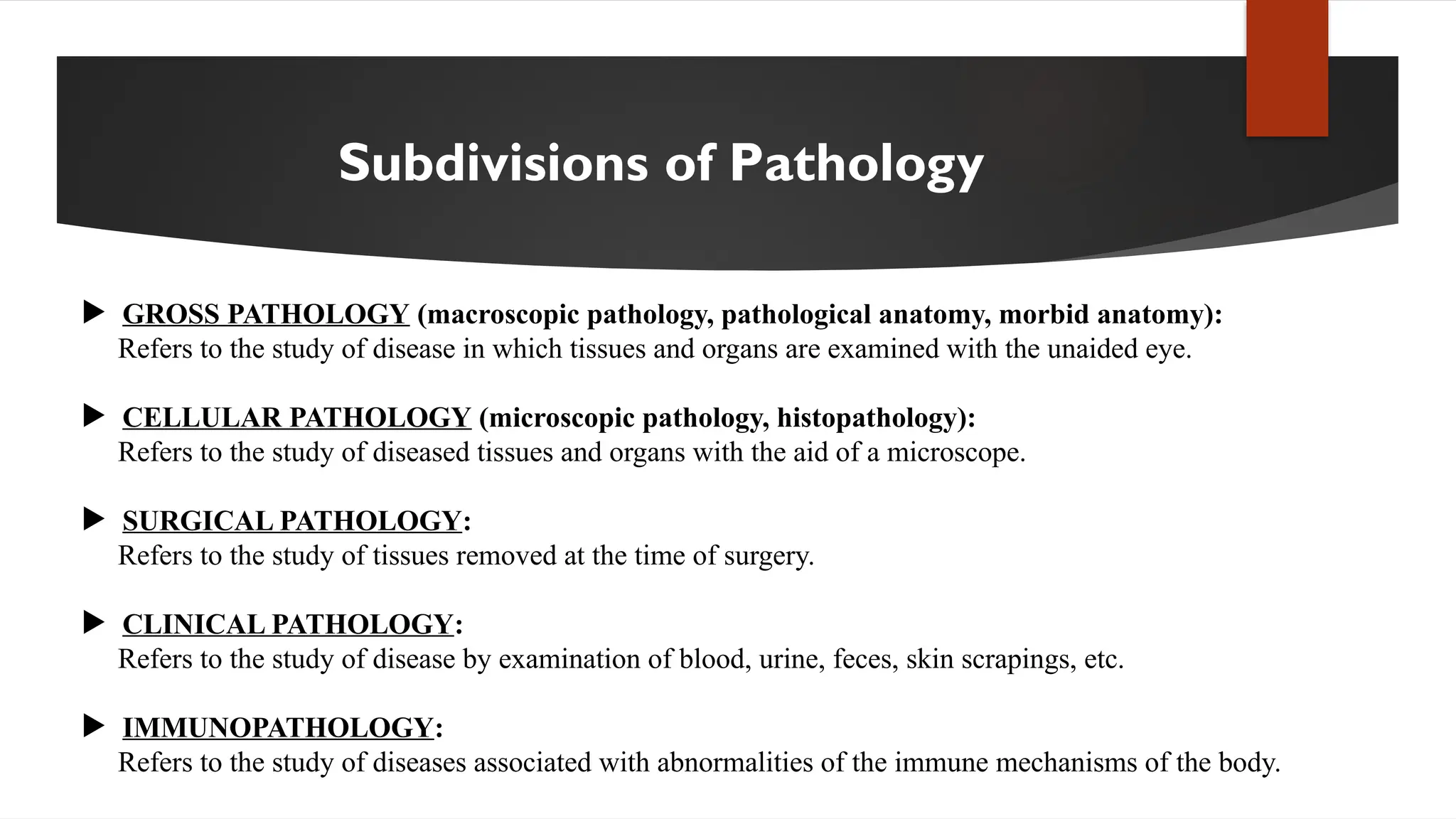
 GROSS PATHOLOGY (macroscopic pathology, pathological anatomy, morbid anatomy):
Refers to the study of disease in which tissues and organs are examined with the unaided eye.
 CELLULAR PATHOLOGY (microscopic pathology, histopathology):
Refers to the study of diseased tissues and organs with the aid of a microscope.
 SURGICAL PATHOLOGY:
Refers to the study of tissues removed at the time of surgery.
 CLINICAL PATHOLOGY:
Refers to the study of disease by examination of blood, urine, feces, skin scrapings, etc.
 IMMUNOPATHOLOGY:
Refers to the study of diseases associated with abnormalities of the immune mechanisms of the body.
Scope of pathology / Characteristics of disease /
Concerned areas of Pathology
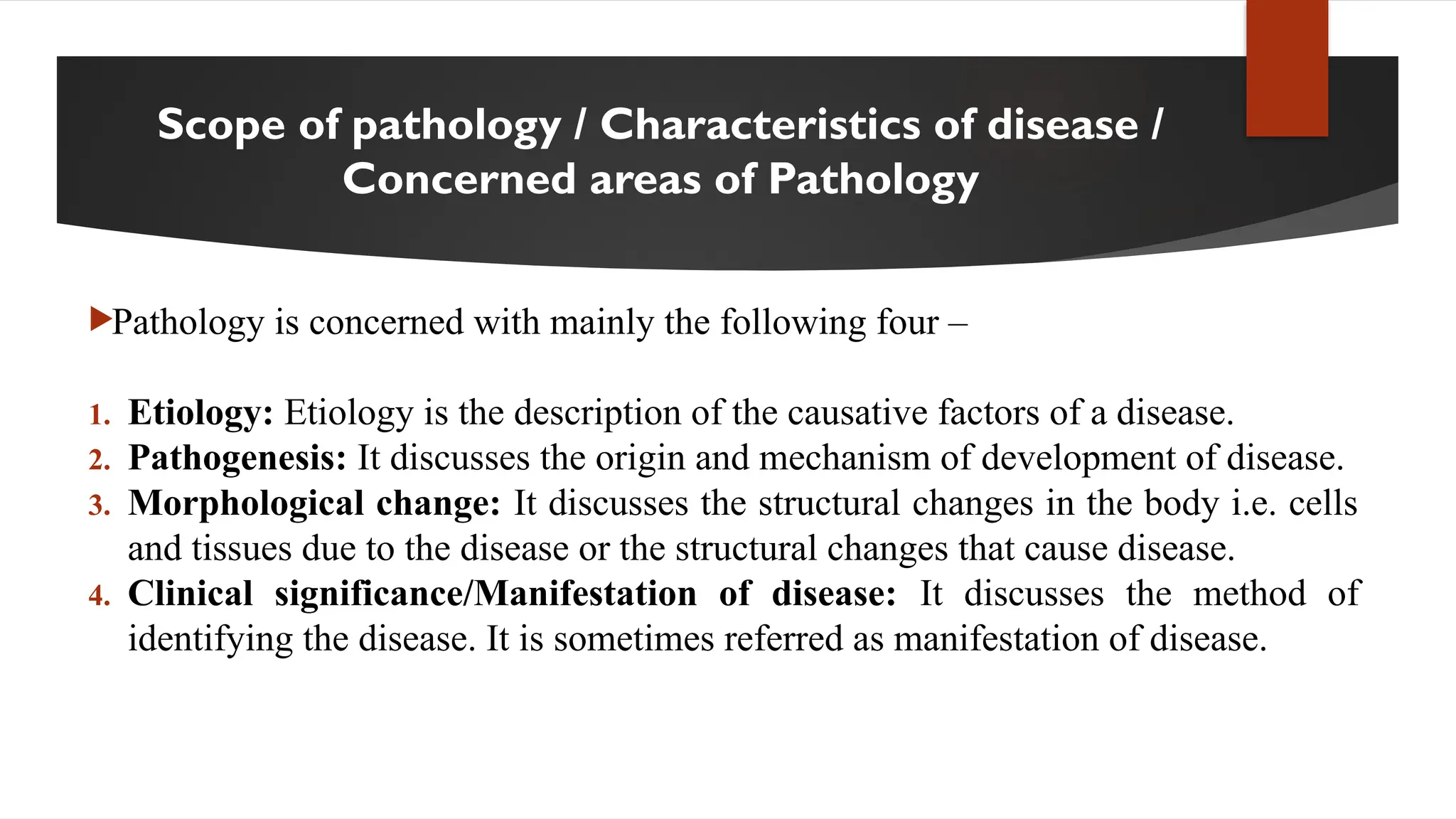
Pathology is concerned with mainly the following four –
1. Etiology: Etiology is the description of the causative factors of a disease.
2. Pathogenesis: It discusses the origin and mechanism of development of disease.
3. Morphological change: It discusses the structural changes in the body i.e. cells
and tissues due to the disease or the structural changes that cause disease.
4. Clinical significance/Manifestation of disease: It discusses the method of
identifying the disease. It is sometimes referred as manifestation of disease.
ETIOLOGY
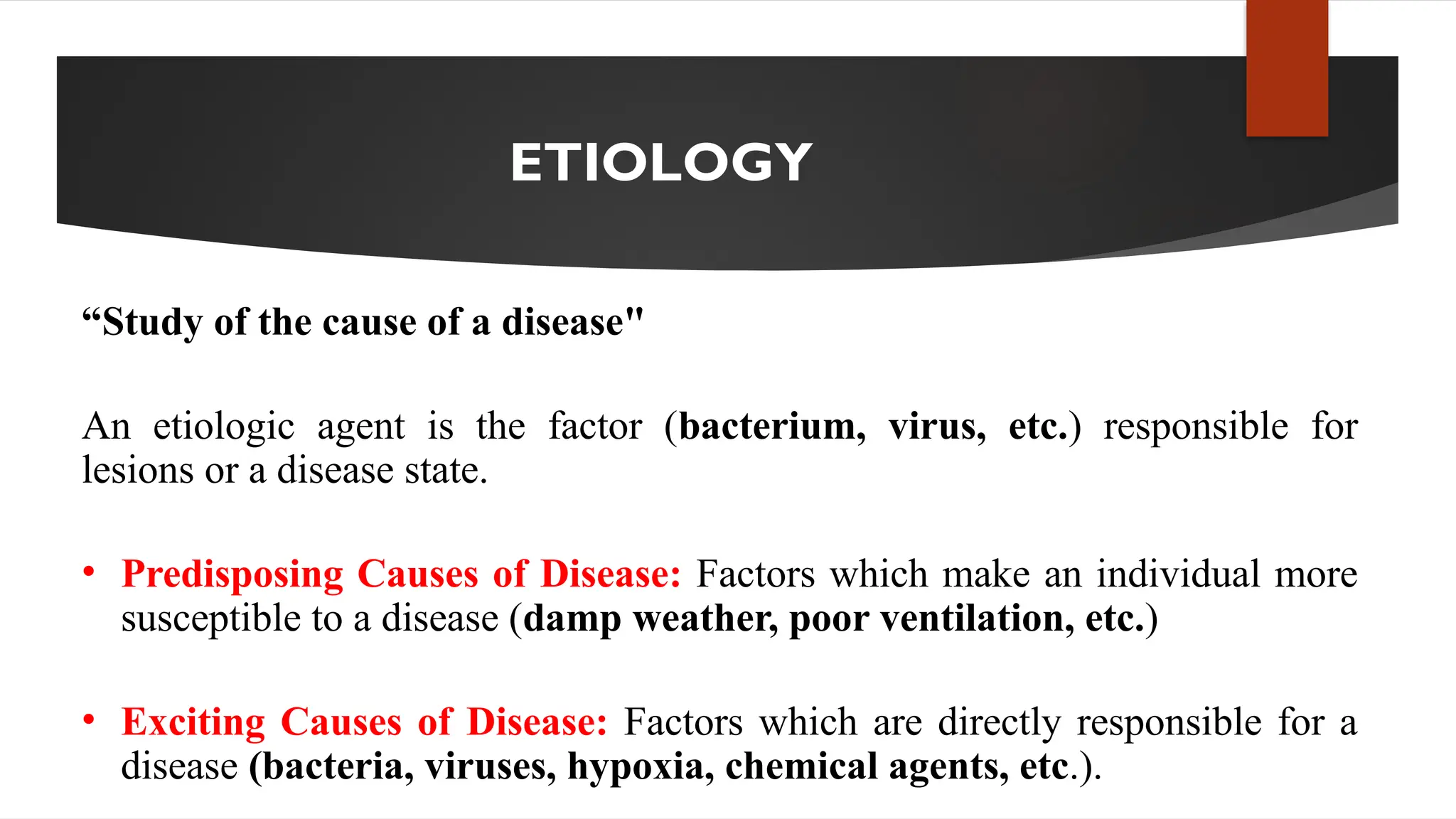
“Study of the cause of a disease"
An etiologic agent is the factor (bacterium, virus, etc.) responsible for
lesions or a disease state.
• Predisposing Causes of Disease: Factors which make an individual more
susceptible to a disease (damp weather, poor ventilation, etc.)
• Exciting Causes of Disease: Factors which are directly responsible for a
disease (bacteria, viruses, hypoxia, chemical agents, etc.).
MORPHOLOGICAL CHANGES
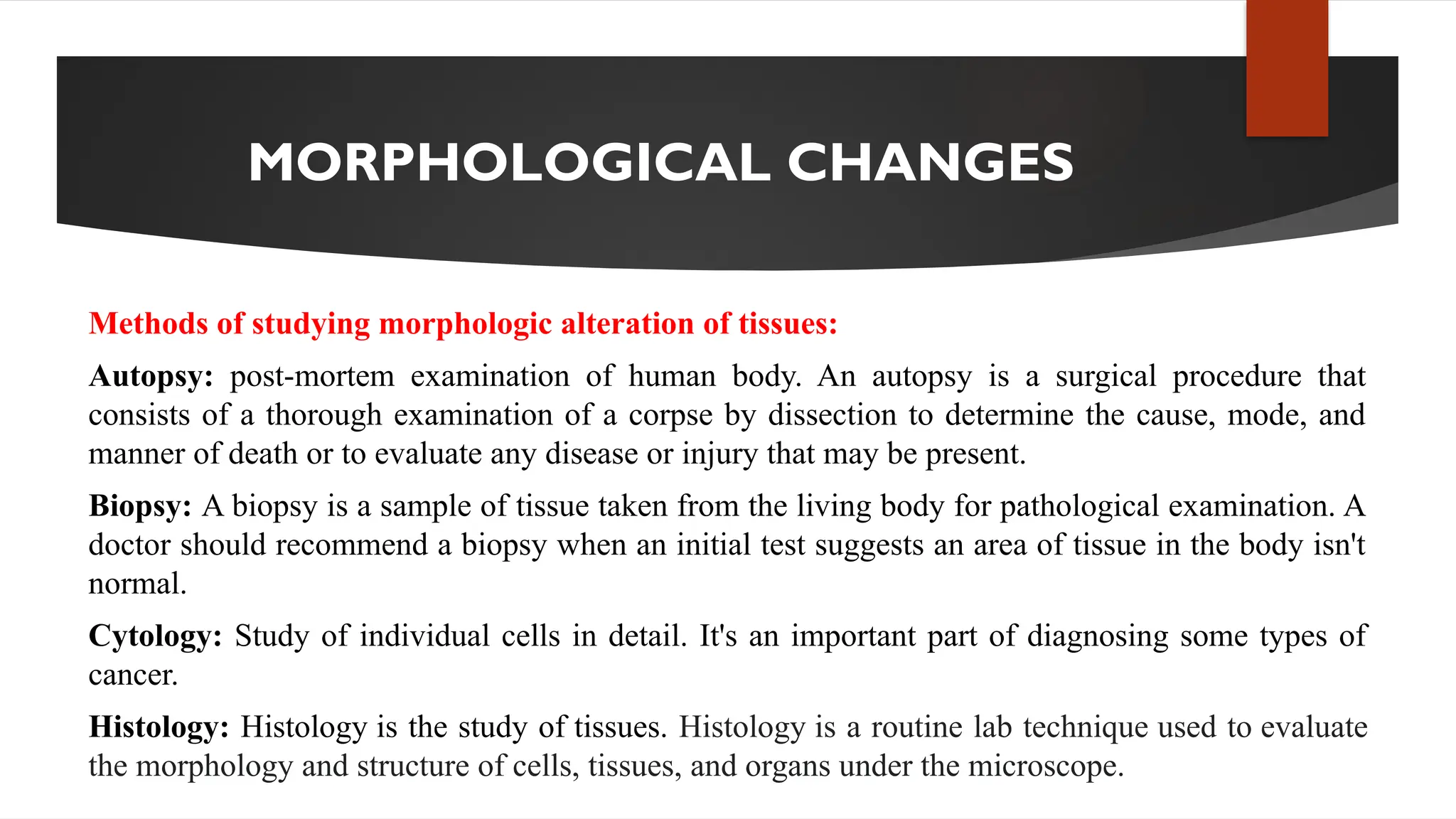
Methods of studying morphologic alteration of tissues:
Autopsy: post-mortem examination of human body. An autopsy is a surgical procedure that
consists of a thorough examination of a corpse by dissection to determine the cause, mode, and
manner of death or to evaluate any disease or injury that may be present.
Biopsy: A biopsy is a sample of tissue taken from the living body for pathological examination. A
doctor should recommend a biopsy when an initial test suggests an area of tissue in the body isn't
normal.
Cytology: Study of individual cells in detail. It's an important part of diagnosing some types of
cancer.
Histology: Histology is the study of tissues. Histology is a routine lab technique used to evaluate
the morphology and structure of cells, tissues, and organs under the microscope.
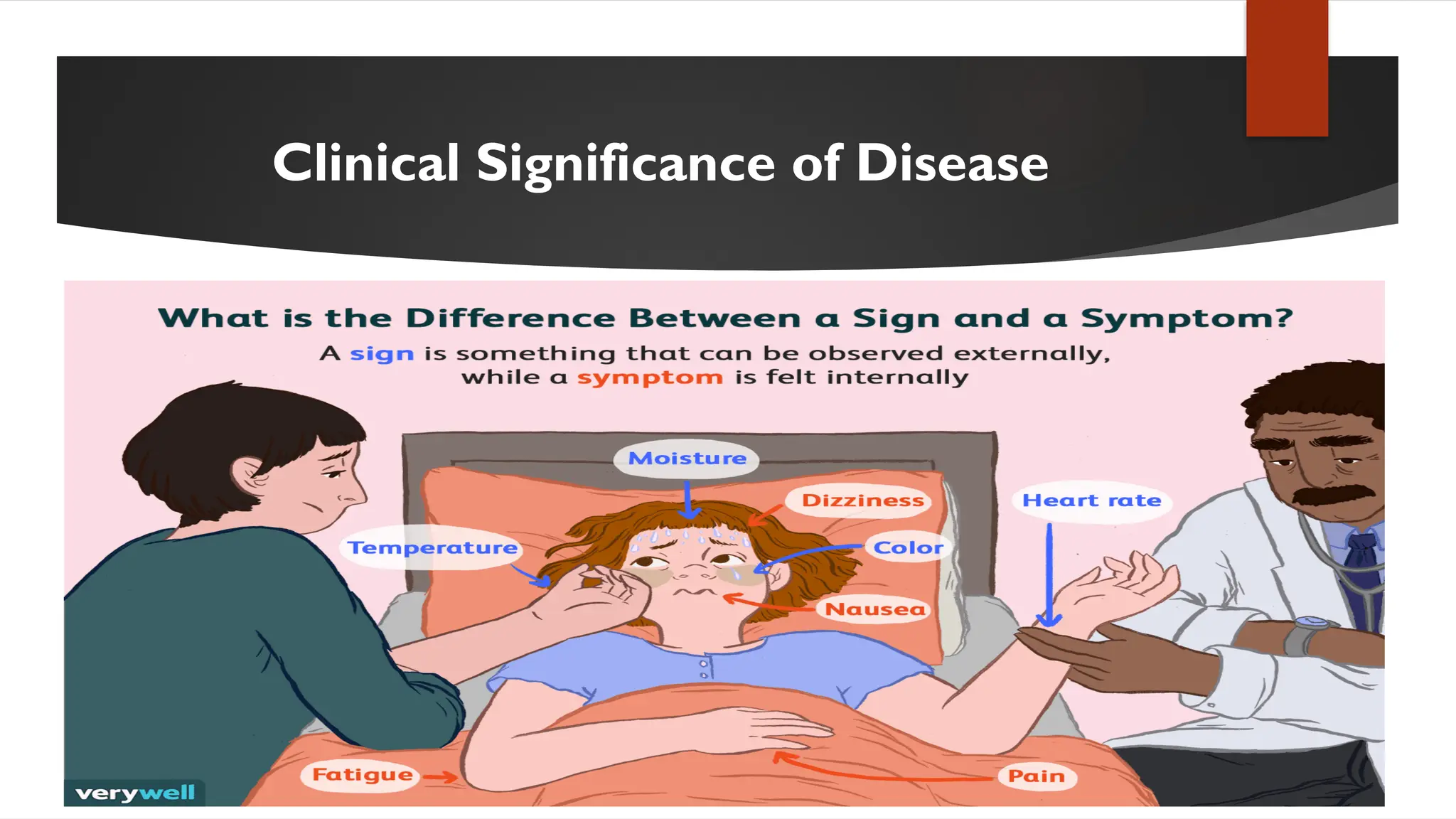
Clinical Significance of Disease
DiagnosisVs Prognosis
Diagnosis is used to identify a present disease, illness, problem, etc., by examination
and observation (of signs and symptoms).
Prognosis refers to predicting the course of the diagnosed disease, illness, problem,
etc., and determining treatment and outcome.
Fate: Outcome of the disease.
Onset: Start of the disease; might be sudden (Acute) or gradual (Chronic).
Primary and Secondary Disease
They may be used to describe the causation of a disease.
Primary means that the disease is without evident cause. Example, primary hypertension is
defined as abnormally high BP without apparent cause.
Secondary means that the disease represents a complication of some underlying lesion.
Example, secondary hypertension is defined as abnormally high BP as a consequence of
some other lesion (e.g. renal artery stenosis).
The words primary and secondary may be used to distinguish between the initial and
subsequent stages of a disease, most commonly in cancer.
Acute and Chronic Desease
Acute and chronic are terms used to describe the dynamics of a disease.
Acute conditions have a rapid onset, often but not always followed by a rapid
resolution.
Chronic conditions may follow an acute initial episode, but often are of
deceptive onset, and have a prolonged course lasting months or years.
Subacute, a term not often used now, is intermediate between acute and chronic.
Benign and Malignant Disease
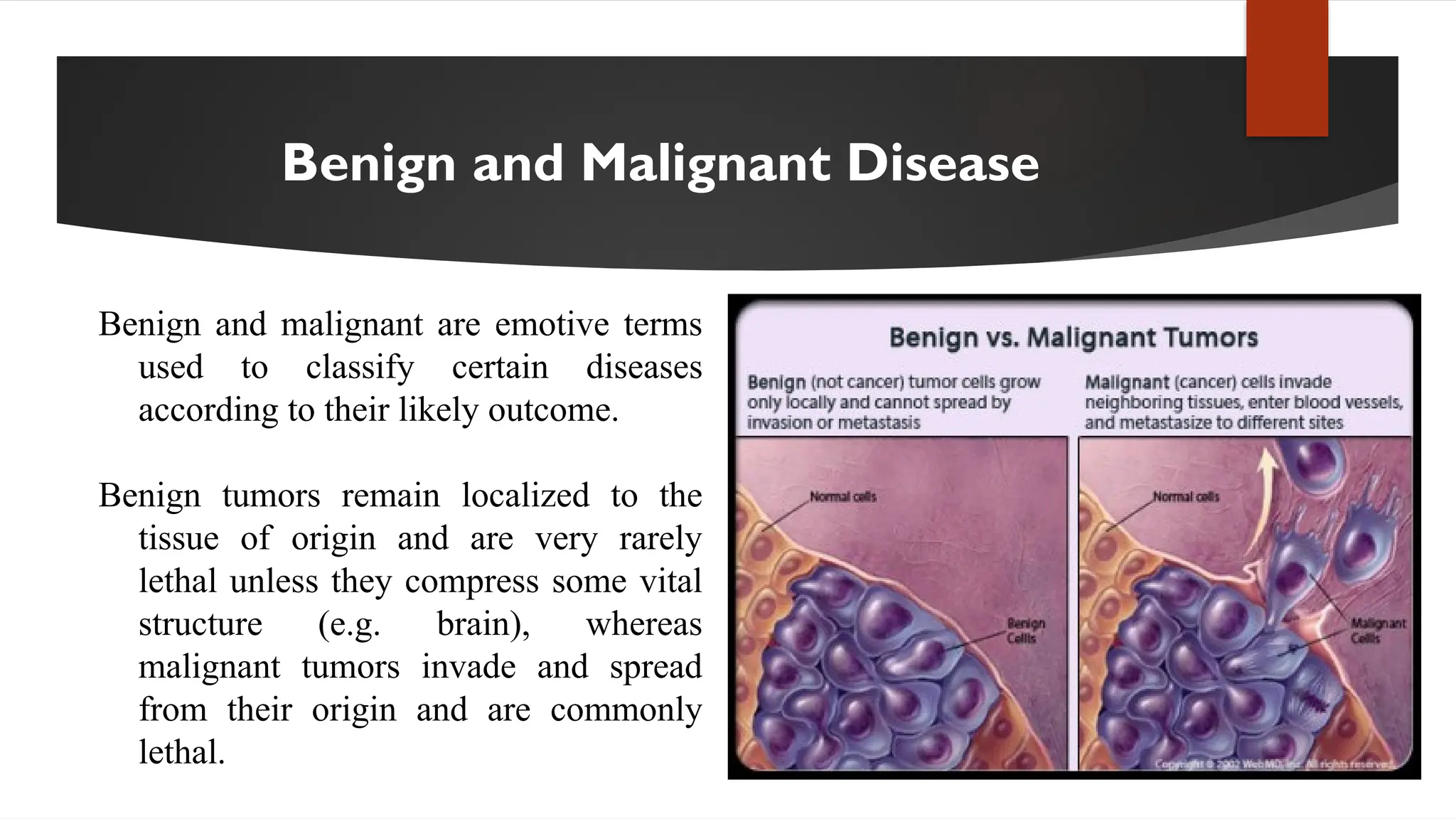
Benign and malignant are emotive terms
used to classify certain diseases
according to their likely outcome.
Benign tumors remain localized to the
tissue of origin and are very rarely
lethal unless they compress some vital
structure (e.g. brain), whereas
malignant tumors invade and spread
from their origin and are commonly
lethal.
Eponymous Disease
An eponymous disease or lesion is named after a person who first described the condition. Examples
include:
i. Graves' disease: Primary thyrotoxicosis
ii. Paget's disease of the nipple: Infiltration of the skin of the nipple by cells from a cancer in the
underlying breast tissue
iii. Crohn's disease: A chronic inflammatory disease of the gut affecting most commonly the terminal
ileum and causing narrowing of the lumen
iv. Hodgkin's disease: A neoplasm of lymph nodes characterized by the presence of Reed-Sternberg
cells
v. Reed-Sternberg cells: Large cells with bilobed nuclei and prominent nucleoli which are virtually
diagnostic of Hodgkin's disease.
DiseaseVs Syndrome
A disease can be defined as a health condition that has a clearly defined reason behind it. A syndrome (from the Greek
word meaning 'run together') however, may produce a number of symptoms without an identifiable cause.
A syndrome refers to a group of symptoms, while a disease refers to an established condition.
Nephrotic syndrome: Albuminuria, hypoalbuminemia and oedema; this syndrome can result from a variety of
glomerular and other renal disorders.
Hepatorenal Syndrome (HRS): HRS is a life-threatening condition that affects kidney function in people with
advanced liver disease.
Cushing's syndrome: hyperactivity of the adrenal cortex resulting in obesity, hirsutism, hypertension, etc.
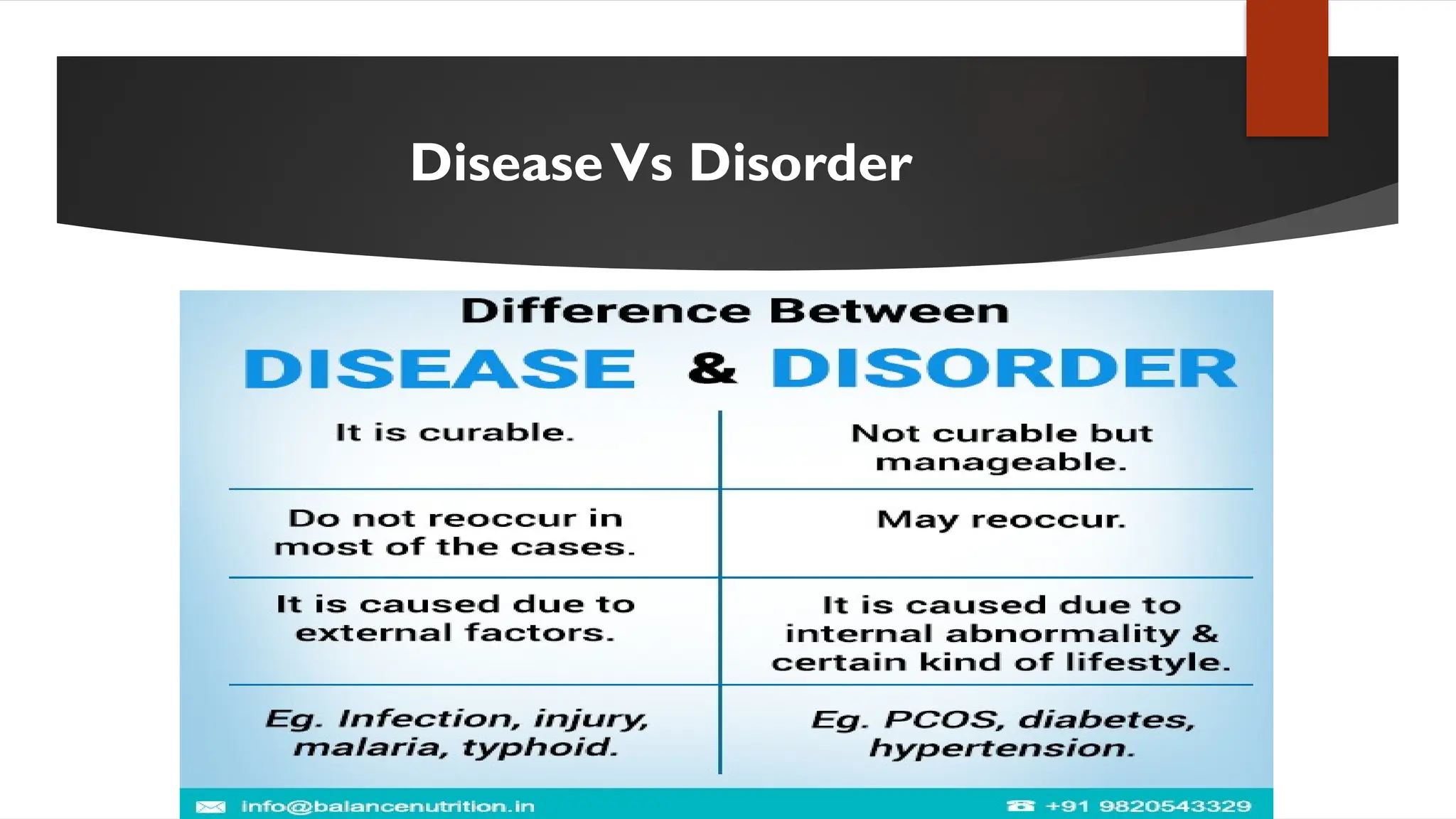
DiseaseVs Disorder
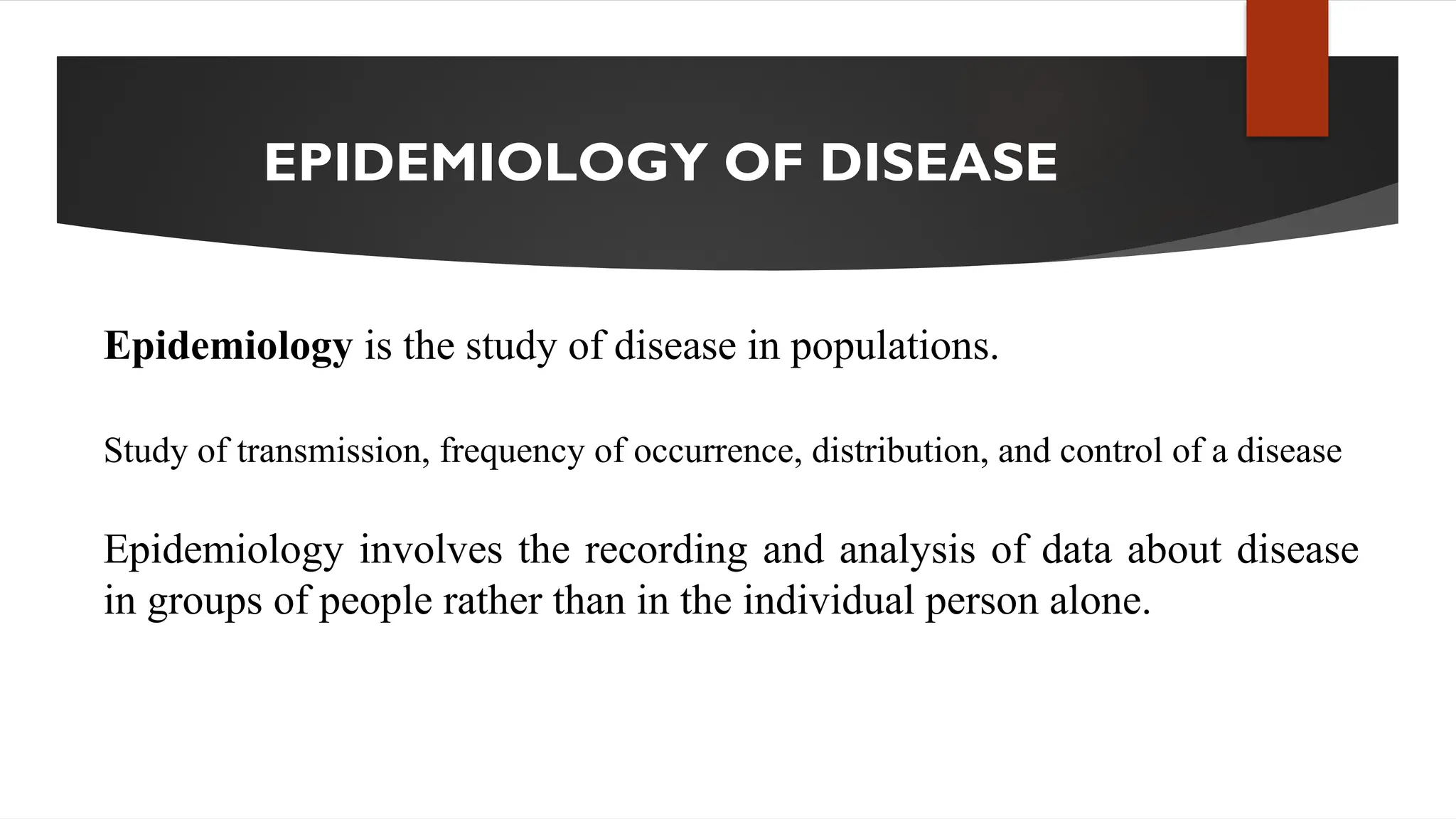
EPIDEMIOLOGY OF DISEASE
Epidemiology is the study of disease in populations.
Study of transmission, frequency of occurrence, distribution, and control of a disease
Epidemiology involves the recording and analysis of data about disease
in groups of people rather than in the individual person alone.
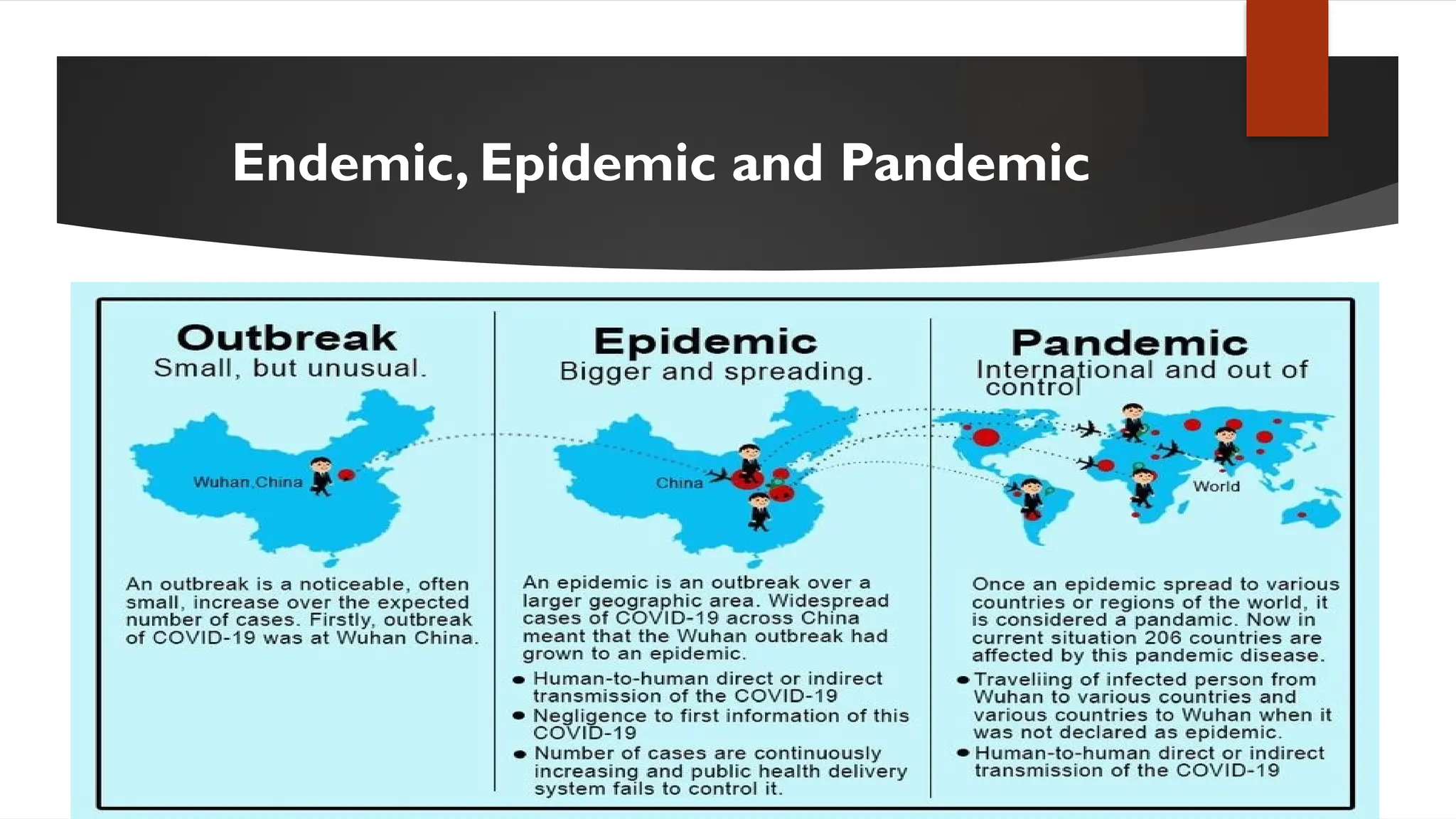
Endemic, Epidemic and Pandemic
ThankYou

Introduction to general Pathology and Ethology

  • 1.
    Introduction to Pathology MD.SAKHAWAT HOSSAIN SENIOR LECTURER DEPARTMENT OF PHARMACY DAFFODIL INTERNATIONAL UNIVERSITY
  • 2.
    Pathology The word “pathology”is derived from two Greek words “Pathos” meaning “suffering” and “logos” meaning “study” or “knowledge”. So simply, pathology can be defined as the study of suffering. Pathology is Scientific study of disease. Pathology may be defined as the branch of medical science dedicated to the study of essential nature of disease specially the changes that cause disease or are caused by disease. More specifically, pathology may be defined as the "scientific study of the molecular, cellular, tissue, or organ system in response to injurious agents or adverse influences."
  • 3.
    Disease Disease is definedas any disturbance of the structure and/or function of the body or any of its constituent parts outside the normal range, especially one that produces specific clinical signs. Disease occurs when: • Enough cells become dysfunctional • Enough cells die and organ loses function
  • 4.
    Causes of Disease Diseasescan be due to: • Autoimmunity • Prokaryotic cell infection: bacteria (cause disease primarily by toxin released, not by direct invasion into cells and killing of cells) • Viral infection: virus cause disease primarily by lyses of infected cells • Chemicals- environment, pollution • Drugs- medicinal or otherwise
  • 5.
    Branches of ClinicalPathology We can divide clinical pathology into two sections – 1. General pathology: It discusses the changes in the cells or tissue when pathologic/abnormal stimuli are applied or due to inherited defects. So inflammation, cell injury etc. fall under general pathology. 2. Systemic/special pathology: It discusses pathology of different organs i.e. alterations in different organs responsible for disorders. So lung cancer, breast cancer, myocardial infarction etc. fall under systemic pathology.
  • 6.
    Subdivisions of Pathology GROSS PATHOLOGY (macroscopic pathology, pathological anatomy, morbid anatomy): Refers to the study of disease in which tissues and organs are examined with the unaided eye.  CELLULAR PATHOLOGY (microscopic pathology, histopathology): Refers to the study of diseased tissues and organs with the aid of a microscope.  SURGICAL PATHOLOGY: Refers to the study of tissues removed at the time of surgery.  CLINICAL PATHOLOGY: Refers to the study of disease by examination of blood, urine, feces, skin scrapings, etc.  IMMUNOPATHOLOGY: Refers to the study of diseases associated with abnormalities of the immune mechanisms of the body.
  • 7.
    Scope of pathology/ Characteristics of disease / Concerned areas of Pathology Pathology is concerned with mainly the following four – 1. Etiology: Etiology is the description of the causative factors of a disease. 2. Pathogenesis: It discusses the origin and mechanism of development of disease. 3. Morphological change: It discusses the structural changes in the body i.e. cells and tissues due to the disease or the structural changes that cause disease. 4. Clinical significance/Manifestation of disease: It discusses the method of identifying the disease. It is sometimes referred as manifestation of disease.
  • 8.
    ETIOLOGY “Study of thecause of a disease" An etiologic agent is the factor (bacterium, virus, etc.) responsible for lesions or a disease state. • Predisposing Causes of Disease: Factors which make an individual more susceptible to a disease (damp weather, poor ventilation, etc.) • Exciting Causes of Disease: Factors which are directly responsible for a disease (bacteria, viruses, hypoxia, chemical agents, etc.).
  • 9.
    MORPHOLOGICAL CHANGES Methods ofstudying morphologic alteration of tissues: Autopsy: post-mortem examination of human body. An autopsy is a surgical procedure that consists of a thorough examination of a corpse by dissection to determine the cause, mode, and manner of death or to evaluate any disease or injury that may be present. Biopsy: A biopsy is a sample of tissue taken from the living body for pathological examination. A doctor should recommend a biopsy when an initial test suggests an area of tissue in the body isn't normal. Cytology: Study of individual cells in detail. It's an important part of diagnosing some types of cancer. Histology: Histology is the study of tissues. Histology is a routine lab technique used to evaluate the morphology and structure of cells, tissues, and organs under the microscope.
  • 10.
  • 11.
    DiagnosisVs Prognosis Diagnosis isused to identify a present disease, illness, problem, etc., by examination and observation (of signs and symptoms). Prognosis refers to predicting the course of the diagnosed disease, illness, problem, etc., and determining treatment and outcome. Fate: Outcome of the disease. Onset: Start of the disease; might be sudden (Acute) or gradual (Chronic).
  • 12.
    Primary and SecondaryDisease They may be used to describe the causation of a disease. Primary means that the disease is without evident cause. Example, primary hypertension is defined as abnormally high BP without apparent cause. Secondary means that the disease represents a complication of some underlying lesion. Example, secondary hypertension is defined as abnormally high BP as a consequence of some other lesion (e.g. renal artery stenosis). The words primary and secondary may be used to distinguish between the initial and subsequent stages of a disease, most commonly in cancer.
  • 13.
    Acute and ChronicDesease Acute and chronic are terms used to describe the dynamics of a disease. Acute conditions have a rapid onset, often but not always followed by a rapid resolution. Chronic conditions may follow an acute initial episode, but often are of deceptive onset, and have a prolonged course lasting months or years. Subacute, a term not often used now, is intermediate between acute and chronic.
  • 14.
    Benign and MalignantDisease Benign and malignant are emotive terms used to classify certain diseases according to their likely outcome. Benign tumors remain localized to the tissue of origin and are very rarely lethal unless they compress some vital structure (e.g. brain), whereas malignant tumors invade and spread from their origin and are commonly lethal.
  • 15.
    Eponymous Disease An eponymousdisease or lesion is named after a person who first described the condition. Examples include: i. Graves' disease: Primary thyrotoxicosis ii. Paget's disease of the nipple: Infiltration of the skin of the nipple by cells from a cancer in the underlying breast tissue iii. Crohn's disease: A chronic inflammatory disease of the gut affecting most commonly the terminal ileum and causing narrowing of the lumen iv. Hodgkin's disease: A neoplasm of lymph nodes characterized by the presence of Reed-Sternberg cells v. Reed-Sternberg cells: Large cells with bilobed nuclei and prominent nucleoli which are virtually diagnostic of Hodgkin's disease.
  • 16.
    DiseaseVs Syndrome A diseasecan be defined as a health condition that has a clearly defined reason behind it. A syndrome (from the Greek word meaning 'run together') however, may produce a number of symptoms without an identifiable cause. A syndrome refers to a group of symptoms, while a disease refers to an established condition. Nephrotic syndrome: Albuminuria, hypoalbuminemia and oedema; this syndrome can result from a variety of glomerular and other renal disorders. Hepatorenal Syndrome (HRS): HRS is a life-threatening condition that affects kidney function in people with advanced liver disease. Cushing's syndrome: hyperactivity of the adrenal cortex resulting in obesity, hirsutism, hypertension, etc.
  • 17.
  • 18.
    EPIDEMIOLOGY OF DISEASE Epidemiologyis the study of disease in populations. Study of transmission, frequency of occurrence, distribution, and control of a disease Epidemiology involves the recording and analysis of data about disease in groups of people rather than in the individual person alone.
  • 19.
  • 20.