Cellular
Adaptations
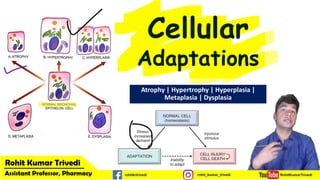
Atrophy | Hypertrophy | Hyperplasia |
Metaplasia | Dysplasia
Video Lecture Link
Click or Paste above given link to your internet browser
https://youtu.be/wnjuuwDl3zE
▪ Adjustments which the cells make in response
to stresses.
▪ Adjustments may be for physiologic need or
response to non-lethal pathogenic injury
(Pathologic adaptation).
Pathophysiology
(BP204T)
UNIT-I
B. Pharm
2nd Semester
Cellular Adaptations
▪ Adaptive responses are reversible on withdrawal of stimulus.
▪ If the irritant stimulus persists for longer duration or is more lethal,
the cell may not be able to survive.
“Survival of the Adaptable”
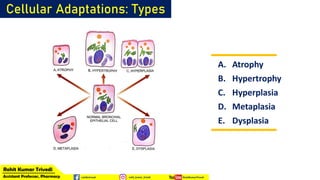
Cellular Adaptations: Types
A. Atrophy
B. Hypertrophy
C. Hyperplasia
D. Metaplasia
E. Dysplasia
▪ Decrease in size of a cell or tissue
▪ Decreased size results in decreased oxygen consumption
and metabolic needs of the cell and may increase the overall
efficiency of the cell function.
▪ Atrophy is generally a reversible process except Atrophy
caused by loss of nervous innervation to a tissue.
▪ Causes of Atrophy:
✓ Prolonged bed rest
✓ Disuse of limbs or tissue
✓ Poor tissue nutrition
✓ Ischemia (restriction in blood supply to tissues,)
▪ Atrophy
Cellular Adaptations
▪ Increase in size of a cell and tissue mass
▪ Occurs when a cell or tissue is exposed to an
increased workout.
▪ Occurs in tissue that can not increase cell numbers
as an adaptive response.
▪ Hypertrophy may be a normal physiologic response.
Example: Increase in the muscle mass that is seen
with exercise
▪ Hypertrophy
Cellular Adaptations
It may be pathologic
▪ As in the case of cardiac hypertrophy that is seen
with prolonged hypertension.
▪ When one Kidney is removed, the remaining Kidney
Hypertrophies to increase its functional capacity.
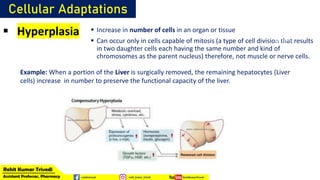
▪ Increase in number of cells in an organ or tissue
▪ Can occur only in cells capable of mitosis (a type of cell division that results
in two daughter cells each having the same number and kind of
chromosomes as the parent nucleus) therefore, not muscle or nerve cells.
Example: When a portion of the Liver is surgically removed, the remaining hepatocytes (Liver
cells) increase in number to preserve the functional capacity of the liver.
Pathophysiology
(BP204T)
UNIT-I
B. Pharm
2nd Semester
▪ Hyperplasia
Cellular Adaptations
▪ The conversion of one type of cell to another type of cell that might
have a better chance of survival under certain circumstances.
▪ Metaplasia generally occurs in response to chronic irritation or
inflammation.
▪ Example: Exposure to irritating cigarette smoke, the ciliated columnar epithelial
lining gradually converted to stratified squamous epithelial.
▪ Metaplasia
Cellular Adaptations
▪ Derangement of cell growth that leads to tissue with cells of varying
size, shape, and appearance.
▪ Generally occurs in response to chronic irritation and inflammation.
▪ Dysplasia may be a strong precursor to cancer. Such as in the cervix or respiratory tract
▪ Dysplasia
Cellular Adaptations
PRACTICE QUESTION:
1. Elaborate the phrase: “Survival of the Adaptable”
2. What is the relationship between Homeostasis, Adaptation and cell Injury? Discuss.
3. What do you understand by Cellular Adaptation? What role does Cellular Adaptation play
in the maintenance of free life?
4. Describe the types of Cellular Adaptations.
5. What is the difference between Atrophy and Hypertrophy?
6. Distinguish Metaplasia and Dysplasia.
Rohit Kumar Trivedi
Assistant Professor, Pharmacy

Cellular adaptations

  • 1.
    Cellular Adaptations Atrophy | Hypertrophy| Hyperplasia | Metaplasia | Dysplasia
  • 2.
    Video Lecture Link Clickor Paste above given link to your internet browser https://youtu.be/wnjuuwDl3zE
  • 3.
    ▪ Adjustments whichthe cells make in response to stresses. ▪ Adjustments may be for physiologic need or response to non-lethal pathogenic injury (Pathologic adaptation). Pathophysiology (BP204T) UNIT-I B. Pharm 2nd Semester Cellular Adaptations ▪ Adaptive responses are reversible on withdrawal of stimulus. ▪ If the irritant stimulus persists for longer duration or is more lethal, the cell may not be able to survive. “Survival of the Adaptable”
  • 4.
    Cellular Adaptations: Types A.Atrophy B. Hypertrophy C. Hyperplasia D. Metaplasia E. Dysplasia
  • 5.
    ▪ Decrease insize of a cell or tissue ▪ Decreased size results in decreased oxygen consumption and metabolic needs of the cell and may increase the overall efficiency of the cell function. ▪ Atrophy is generally a reversible process except Atrophy caused by loss of nervous innervation to a tissue. ▪ Causes of Atrophy: ✓ Prolonged bed rest ✓ Disuse of limbs or tissue ✓ Poor tissue nutrition ✓ Ischemia (restriction in blood supply to tissues,) ▪ Atrophy Cellular Adaptations
  • 6.
    ▪ Increase insize of a cell and tissue mass ▪ Occurs when a cell or tissue is exposed to an increased workout. ▪ Occurs in tissue that can not increase cell numbers as an adaptive response. ▪ Hypertrophy may be a normal physiologic response. Example: Increase in the muscle mass that is seen with exercise ▪ Hypertrophy Cellular Adaptations It may be pathologic ▪ As in the case of cardiac hypertrophy that is seen with prolonged hypertension. ▪ When one Kidney is removed, the remaining Kidney Hypertrophies to increase its functional capacity.
  • 7.
    ▪ Increase innumber of cells in an organ or tissue ▪ Can occur only in cells capable of mitosis (a type of cell division that results in two daughter cells each having the same number and kind of chromosomes as the parent nucleus) therefore, not muscle or nerve cells. Example: When a portion of the Liver is surgically removed, the remaining hepatocytes (Liver cells) increase in number to preserve the functional capacity of the liver. Pathophysiology (BP204T) UNIT-I B. Pharm 2nd Semester ▪ Hyperplasia Cellular Adaptations
  • 8.
    ▪ The conversionof one type of cell to another type of cell that might have a better chance of survival under certain circumstances. ▪ Metaplasia generally occurs in response to chronic irritation or inflammation. ▪ Example: Exposure to irritating cigarette smoke, the ciliated columnar epithelial lining gradually converted to stratified squamous epithelial. ▪ Metaplasia Cellular Adaptations
  • 9.
    ▪ Derangement ofcell growth that leads to tissue with cells of varying size, shape, and appearance. ▪ Generally occurs in response to chronic irritation and inflammation. ▪ Dysplasia may be a strong precursor to cancer. Such as in the cervix or respiratory tract ▪ Dysplasia Cellular Adaptations
  • 10.
    PRACTICE QUESTION: 1. Elaboratethe phrase: “Survival of the Adaptable” 2. What is the relationship between Homeostasis, Adaptation and cell Injury? Discuss. 3. What do you understand by Cellular Adaptation? What role does Cellular Adaptation play in the maintenance of free life? 4. Describe the types of Cellular Adaptations. 5. What is the difference between Atrophy and Hypertrophy? 6. Distinguish Metaplasia and Dysplasia.
  • 11.
    Rohit Kumar Trivedi AssistantProfessor, Pharmacy