Pathology
Pathology
 surgical pathology report-diagnosis based on
microscopic and gross examination of surgicals
 autopsy report-diagnosis of disease and cause of
death, describes morphologic changes, studies
pathogenetic consequencies
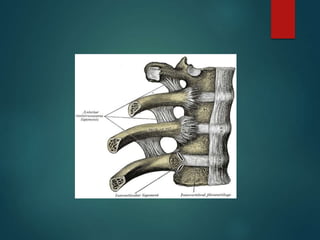
There are 3 types of joints present in the thoracic spine:
Between vertebral bodies – adjacent vertebral bodies are joined by intervertebral
discs, made of fibrocartilage. This is a type of cartilaginous joint, known as a
symphysis.
Between vertebral arches ie facet joints – formed by the articulation of superior
and inferior articular processes from adjacent vertebrae. It is a synovial type joint. In
the thoracic spine facet joints angled at:
•60° to the transverse plane
•20° to the frontal plane, with the superior facets facing posterior and a little up and
laterally and the inferior facets facing anteriorly, down, and medially.
•motion: lateral flexion and rotation; no flexion/extension
Costovertebral joints, unique to the thoracic spine - consists of the head of the rib
articulating with:
•Superior costal facet of the corresponding vertebra
•Inferior costal facet of the superior vertebra
•Intervertebral disc separating the two vertebrae
Within this joint, the intra-articular ligament of head of rib attaches the rib head to the
intervertebral disc. Only slight gliding movements can occur at these joints, due to
the close articulation of their components
Pathology
 The study of pathology is divided into:
 general pathology- concerns with basic
reactions of cells and tissues to abnormal
stimuli that are common for a group of
diseases or that underlie all diseases or
groups of diseases
 special pathology- examines specific
responses of specialized tissues and
organs to pathologic stimuli
 oncologic pathology- deals with
neoplastic processes (tumours)
DEFINITIONS OF BASIC ASPECTS OF
DISEASE PROCESS
 Pathology
 medical discipline which provides the link
between basic biological sciences and the
practice of medicine. Pathology is a
logical, scientific basis of medicine
 is the study of changes which occur in
cells and tissues as a result of either
genetic inborn or environmental damage,
is a study of diseases
 the study provides understanding of the
processes (their causes, clinical effects
etc)..
Pathology
 -as a science-
 focuses on mechanisms by which cells and tissues are
injured, on structural and functional consequences of
injurious stimuli on cells, tissues, and organs, finally on
the entire organism
 - it is a morphologic discipline- describes pathological
morphologic findings in tissues and cells
Pathology
 -as a medical discipline-
 deals with a performance and an
interpretation of laboratory procedures,
leading to diagnosis
 -these include many diagnostic and
investigative techniques and concern with
interpretation of laboratory procedures-
examples: histologic examination of
surgical biopsies, cytological examination
of smears and FNA (fine needle aspirates),
bone marrow smears, etc.
Pathology
 Two main fields of pathology as medical
discipline:
 (1) surgical pathology -deals with
interpretation of histological examination
of tissues and organs removed in surgery
from living patients
 (2) autopsy pathology -is concerned with
examination of gross, macroscopic and
histological changes in diseases studied in
dead persons
Pathology
 Forensic pathology - is performed and practised
separately from pathology- in faculty hospitals, both
disciplines are closely related in small and district
hospitals
 - main task is to determine whether death was due to
natural or unnatural causes, such as caused by accident,
other person, murders etc.
 -in large medical centers and faculty hospitals-
pathologists usually subspecialize in a distinctive
discipline, i.e. cytology, hematopathology, surgical
pathology, gynecological pathology
WHAT IS PATHOLOGY
 Pathology is a study of diseases.
 The study provides understanding of the processes
(their causes, clinical effects etc).
Pathology
 -in broader terms, pathology means also study of the
diseases, their causes, prevention and classification
Disease
 Disease- is defined as a physiological or psychological
dysfunction.
 -it can be caused by obvious structural abnormalities,
or may be less well defined-without obvious
morphological damage, such as in anorhexia nervosa-
mental anorhexia
Diseases
 All diseases have certain aspects which can form
the basis for classification- these include
 -pathology focuses on the following different
aspects of disease
 -epidemiology (occurrence and incidence of d.)
 -etiology (causes of disease)
 -pathogenesis (mechanisms of disease)
 -morphology of the tissue changes
 - clinical significance and consequencies
Disease
 1.epidemiology-provides a wider context for the study,
classification, and diagnosis of diseases
 -epidemiological data are important
 -for providing informations about causes of
diseases.
 -for identifying risk factors
 -for providing adequate health care, and planning
disease prevention, epidemiology records data
about
 .incidence-number of new cases occurring in a defined
population over a defined time period
Disease
 prevalence-number of cases found in a defined
population at a stated time
 morbidity-number of diseased persons in a given
locality, nation etc. and mortality-number of deaths to
the population
Disease
 2.etiology studies causes of disease
 diseases result from the interaction between individuals and their
environment
 -the other diseases result from an environmental factors acting in
conjunction with a genetic predisposition
 -in some instances the underlying cause of a disease is obscure-
idiopathic, spontaneous, essential
classification of diseases
 classification of diseases - based on the etiologic
factors, diseases can be classified to two categories
 -congenital- present at birth, even though they are
sometimes recognized later
 -acquired- occur only later after births (infectious,
nutritional, chemical, physical, radiation injury etc.)
Disease
 3.pathogenesis- etiopathogenesis
 -refers to the sequence of events in the response of
the cells, tissues, organs to the injurious stimuli that
may lead to a disease
 -describes mechanisms of development of disease
 -study of pathogenesis remains a main domain of the
scientific pathology
Disease
 4.morphological changes
 -structural alterations induced in cells and tissues
 -refers to the structural alterations of cells or tissues
that are either characteristic or diagnostic of a disease
 -there are gross/ macroscopic findings and histological
microscopic findings
Disease
 5.clinical significance
 -functional consequencies of morphologic changes, as observed
clinically
 -morphologic structural changes of cells, tissues and organs are related
to functional disorders, morphologically altered tissues do not provide
normal functions, and these consequent pathologic functions are
studied in details in many clinical disciplines- pathology provides basic
information with respect to clinical outcome, prognosis, etc.
Disease
 -symptoms- features of illness that are noticed by
patients
 -signs- clinical manifestation of the disease which are
recognized by clinicians
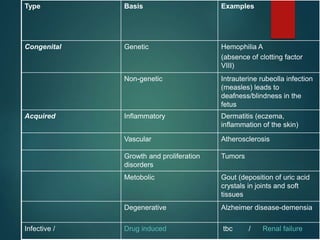
Type Basis Examples
Congenital Genetic Hemophilia A
(absence of clotting factor
VIII)
Non-genetic Intrauterine rubeolla infection
(measles) leads to
deafness/blindness in the
fetus
Acquired Inflammatory Dermatitis (eczema,
inflammation of the skin)
Vascular Atherosclerosis
Growth and proliferation
disorders
Tumors
Metobolic Gout (deposition of uric acid
crystals in joints and soft
tissues
Degenerative Alzheimer disease-demensia
Infective / Drug induced tbc / Renal failure
THE ROLE OF PATHOLOGY IN DIAGNOSTIC
PROCESS: FROM CLINICAL REASONING TO
MOLECULAR BIOLOGY.
 patients present with symptoms and
clinical examination reveals signs which
suggest a diagnosis
 -examination of various specimens in
pathology laboratories helps to establish
and confirm diagnosis, and monitor the
treatment
 Diagnosis is the act of identifying a
disease in an individual patient and is
based on clinical history, physical
examination and pathology investigation
Diagnosis
 Diagnosis involves skills and laboratory tests
 Special pathology techniques are used
 Special stains, immunohistochemistry and molecular
biology techniques are routinely used
The role of pathologist:
 Looking at samples of tissues (biopsies)
 Using the range of special laboratory
techniques
 Histology
 Autopsy
 Special stains
 Immunohistochemistry
 Electron microscopy
 Molecular biology techniques
METHODS IN PATHOLOGY
Diagnostic and investigative techniques used in pathology
 routine histological techniques –fundamental for
histopathologic diagnosis – these techniques use
different coloration of cells and tissues and cell
components using different staining methods
most commonly used staining
methods-
 hematoxylin and eosin stain- combination of
haematoxylin and eosin remains the gold standard,
method used for majority of histopathologic
diagnoses- method is now over 100 years old
 haematoxylin- is natural product of blue colour, is
used mostly for staining the nuclei- shows general
morphology of a tissue
 -eosin- the most frequently used partner stain
because it is easy to stain, and its red colour
contrasts well with blue colour of haematoxylin-
eosin stains cytoplasm
 special stains- HE is important as a general staining
procedure but it is sometimes necessary to use other
staining procedures in order to demonstrate more
selectively the particular tissue components
 -connective tissue components, such as collagens,
muscle fibers can be demonstrated by Van Gieson
stain or trichrome stains
 reticulin (type III collagen) can be shown by silver
impregnation technique
 -basement membrane components (such as type IV
collagen, laminin) are well demonstrated with the
periodic acid-Schiff (PAS) method, silver
according to Gomory, etc.
Recommended Reading
Material
 1. Cotran RS, Kumar V and Collins T. Robbin: Pathologic basis of
Diseases, WB Saunders, Philadelphia.
 2. Klatt EC and KumarV: Robbins Review of Pathology. W. B.
Saunders, Missouri.
 3. Harsh Mohan: Textbook of Pathology

Pathology.ppt

  • 1.
  • 2.
    Pathology  surgical pathologyreport-diagnosis based on microscopic and gross examination of surgicals  autopsy report-diagnosis of disease and cause of death, describes morphologic changes, studies pathogenetic consequencies
  • 3.
    There are 3types of joints present in the thoracic spine: Between vertebral bodies – adjacent vertebral bodies are joined by intervertebral discs, made of fibrocartilage. This is a type of cartilaginous joint, known as a symphysis. Between vertebral arches ie facet joints – formed by the articulation of superior and inferior articular processes from adjacent vertebrae. It is a synovial type joint. In the thoracic spine facet joints angled at: •60° to the transverse plane •20° to the frontal plane, with the superior facets facing posterior and a little up and laterally and the inferior facets facing anteriorly, down, and medially. •motion: lateral flexion and rotation; no flexion/extension Costovertebral joints, unique to the thoracic spine - consists of the head of the rib articulating with: •Superior costal facet of the corresponding vertebra •Inferior costal facet of the superior vertebra •Intervertebral disc separating the two vertebrae Within this joint, the intra-articular ligament of head of rib attaches the rib head to the intervertebral disc. Only slight gliding movements can occur at these joints, due to the close articulation of their components
  • 5.
    Pathology  The studyof pathology is divided into:  general pathology- concerns with basic reactions of cells and tissues to abnormal stimuli that are common for a group of diseases or that underlie all diseases or groups of diseases  special pathology- examines specific responses of specialized tissues and organs to pathologic stimuli  oncologic pathology- deals with neoplastic processes (tumours)
  • 6.
    DEFINITIONS OF BASICASPECTS OF DISEASE PROCESS  Pathology  medical discipline which provides the link between basic biological sciences and the practice of medicine. Pathology is a logical, scientific basis of medicine  is the study of changes which occur in cells and tissues as a result of either genetic inborn or environmental damage, is a study of diseases  the study provides understanding of the processes (their causes, clinical effects etc)..
  • 7.
    Pathology  -as ascience-  focuses on mechanisms by which cells and tissues are injured, on structural and functional consequences of injurious stimuli on cells, tissues, and organs, finally on the entire organism  - it is a morphologic discipline- describes pathological morphologic findings in tissues and cells
  • 8.
    Pathology  -as amedical discipline-  deals with a performance and an interpretation of laboratory procedures, leading to diagnosis  -these include many diagnostic and investigative techniques and concern with interpretation of laboratory procedures- examples: histologic examination of surgical biopsies, cytological examination of smears and FNA (fine needle aspirates), bone marrow smears, etc.
  • 9.
    Pathology  Two mainfields of pathology as medical discipline:  (1) surgical pathology -deals with interpretation of histological examination of tissues and organs removed in surgery from living patients  (2) autopsy pathology -is concerned with examination of gross, macroscopic and histological changes in diseases studied in dead persons
  • 10.
    Pathology  Forensic pathology- is performed and practised separately from pathology- in faculty hospitals, both disciplines are closely related in small and district hospitals  - main task is to determine whether death was due to natural or unnatural causes, such as caused by accident, other person, murders etc.  -in large medical centers and faculty hospitals- pathologists usually subspecialize in a distinctive discipline, i.e. cytology, hematopathology, surgical pathology, gynecological pathology
  • 11.
    WHAT IS PATHOLOGY Pathology is a study of diseases.  The study provides understanding of the processes (their causes, clinical effects etc).
  • 12.
    Pathology  -in broaderterms, pathology means also study of the diseases, their causes, prevention and classification
  • 13.
    Disease  Disease- isdefined as a physiological or psychological dysfunction.  -it can be caused by obvious structural abnormalities, or may be less well defined-without obvious morphological damage, such as in anorhexia nervosa- mental anorhexia
  • 14.
    Diseases  All diseaseshave certain aspects which can form the basis for classification- these include  -pathology focuses on the following different aspects of disease  -epidemiology (occurrence and incidence of d.)  -etiology (causes of disease)  -pathogenesis (mechanisms of disease)  -morphology of the tissue changes  - clinical significance and consequencies
  • 15.
    Disease  1.epidemiology-provides awider context for the study, classification, and diagnosis of diseases  -epidemiological data are important  -for providing informations about causes of diseases.  -for identifying risk factors  -for providing adequate health care, and planning disease prevention, epidemiology records data about  .incidence-number of new cases occurring in a defined population over a defined time period
  • 16.
    Disease  prevalence-number ofcases found in a defined population at a stated time  morbidity-number of diseased persons in a given locality, nation etc. and mortality-number of deaths to the population
  • 17.
    Disease  2.etiology studiescauses of disease  diseases result from the interaction between individuals and their environment  -the other diseases result from an environmental factors acting in conjunction with a genetic predisposition  -in some instances the underlying cause of a disease is obscure- idiopathic, spontaneous, essential
  • 18.
    classification of diseases classification of diseases - based on the etiologic factors, diseases can be classified to two categories  -congenital- present at birth, even though they are sometimes recognized later  -acquired- occur only later after births (infectious, nutritional, chemical, physical, radiation injury etc.)
  • 19.
    Disease  3.pathogenesis- etiopathogenesis -refers to the sequence of events in the response of the cells, tissues, organs to the injurious stimuli that may lead to a disease  -describes mechanisms of development of disease  -study of pathogenesis remains a main domain of the scientific pathology
  • 20.
    Disease  4.morphological changes -structural alterations induced in cells and tissues  -refers to the structural alterations of cells or tissues that are either characteristic or diagnostic of a disease  -there are gross/ macroscopic findings and histological microscopic findings
  • 21.
    Disease  5.clinical significance -functional consequencies of morphologic changes, as observed clinically  -morphologic structural changes of cells, tissues and organs are related to functional disorders, morphologically altered tissues do not provide normal functions, and these consequent pathologic functions are studied in details in many clinical disciplines- pathology provides basic information with respect to clinical outcome, prognosis, etc.
  • 22.
    Disease  -symptoms- featuresof illness that are noticed by patients  -signs- clinical manifestation of the disease which are recognized by clinicians
  • 23.
    Type Basis Examples CongenitalGenetic Hemophilia A (absence of clotting factor VIII) Non-genetic Intrauterine rubeolla infection (measles) leads to deafness/blindness in the fetus Acquired Inflammatory Dermatitis (eczema, inflammation of the skin) Vascular Atherosclerosis Growth and proliferation disorders Tumors Metobolic Gout (deposition of uric acid crystals in joints and soft tissues Degenerative Alzheimer disease-demensia Infective / Drug induced tbc / Renal failure
  • 24.
    THE ROLE OFPATHOLOGY IN DIAGNOSTIC PROCESS: FROM CLINICAL REASONING TO MOLECULAR BIOLOGY.  patients present with symptoms and clinical examination reveals signs which suggest a diagnosis  -examination of various specimens in pathology laboratories helps to establish and confirm diagnosis, and monitor the treatment  Diagnosis is the act of identifying a disease in an individual patient and is based on clinical history, physical examination and pathology investigation
  • 25.
    Diagnosis  Diagnosis involvesskills and laboratory tests  Special pathology techniques are used  Special stains, immunohistochemistry and molecular biology techniques are routinely used
  • 26.
    The role ofpathologist:  Looking at samples of tissues (biopsies)  Using the range of special laboratory techniques  Histology  Autopsy  Special stains  Immunohistochemistry  Electron microscopy  Molecular biology techniques
  • 27.
    METHODS IN PATHOLOGY Diagnosticand investigative techniques used in pathology  routine histological techniques –fundamental for histopathologic diagnosis – these techniques use different coloration of cells and tissues and cell components using different staining methods
  • 28.
    most commonly usedstaining methods-  hematoxylin and eosin stain- combination of haematoxylin and eosin remains the gold standard, method used for majority of histopathologic diagnoses- method is now over 100 years old  haematoxylin- is natural product of blue colour, is used mostly for staining the nuclei- shows general morphology of a tissue  -eosin- the most frequently used partner stain because it is easy to stain, and its red colour contrasts well with blue colour of haematoxylin- eosin stains cytoplasm
  • 29.
     special stains-HE is important as a general staining procedure but it is sometimes necessary to use other staining procedures in order to demonstrate more selectively the particular tissue components  -connective tissue components, such as collagens, muscle fibers can be demonstrated by Van Gieson stain or trichrome stains  reticulin (type III collagen) can be shown by silver impregnation technique
  • 30.
     -basement membranecomponents (such as type IV collagen, laminin) are well demonstrated with the periodic acid-Schiff (PAS) method, silver according to Gomory, etc.
  • 31.
    Recommended Reading Material  1.Cotran RS, Kumar V and Collins T. Robbin: Pathologic basis of Diseases, WB Saunders, Philadelphia.  2. Klatt EC and KumarV: Robbins Review of Pathology. W. B. Saunders, Missouri.  3. Harsh Mohan: Textbook of Pathology