OSHAX.org - The Unofficial Guide to the OSHA   1
Introduction
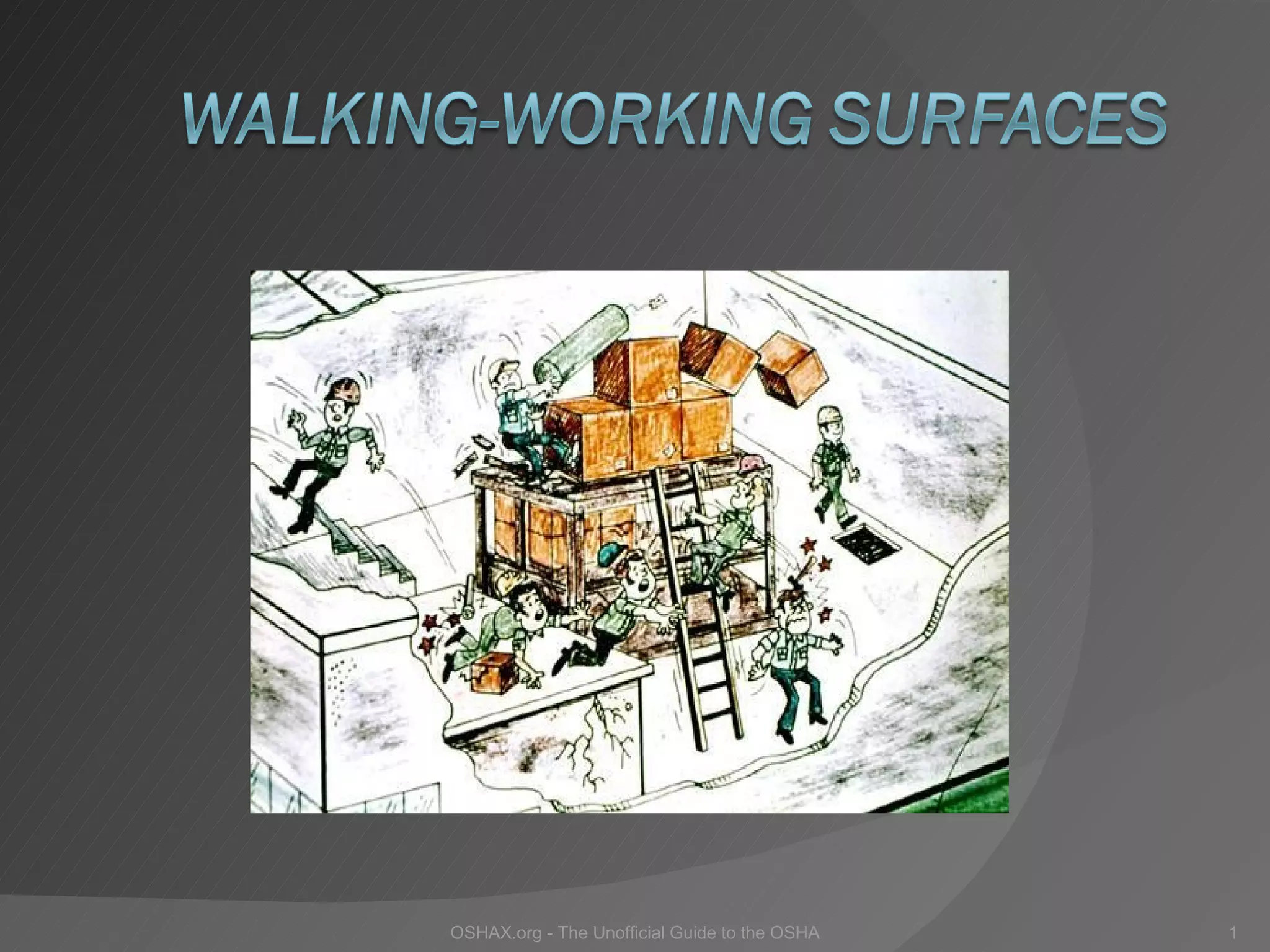
 Slips, trips and falls cause:
   the majority of general industry accidents
   15 percent of all accidental deaths
   more fatalities than all other causes but motor
    vehicles
 OSHA’s standards for walking and working
  surfaces apply to all permanent places of
  employment, except where only domestic,
  mining, or agricultural work is performed


                 OSHAX.org - The Unofficial Guide to the OSHA   2
General Requirements
Housekeeping

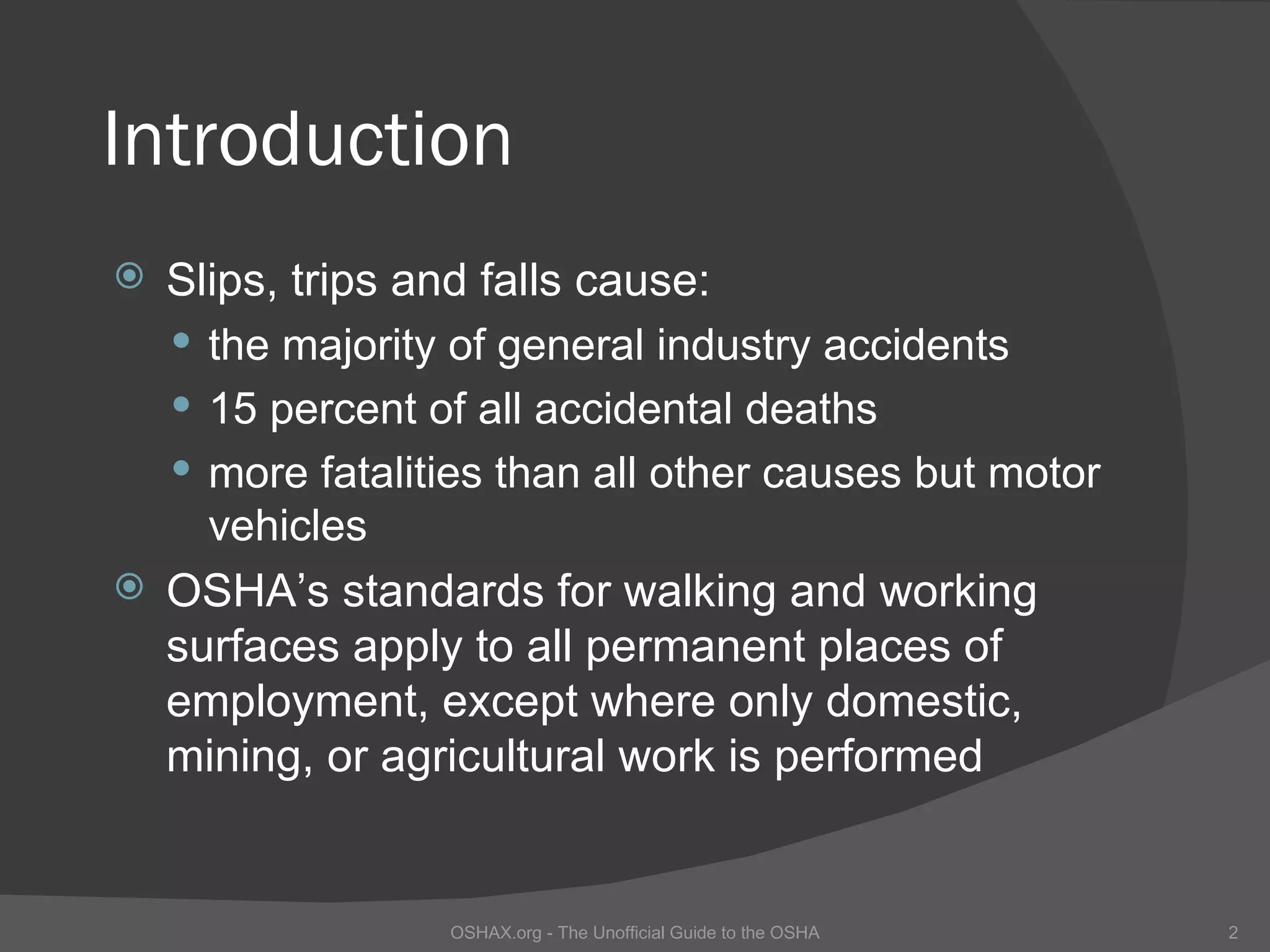
  Workplaces must be kept
   clean, orderly, and sanitary
  Workroom floors must be
   maintained as clean and
   dry as possible


                  OSHAX.org - The Unofficial Guide to the OSHA   3
General Requirements
Aisles and Passageways
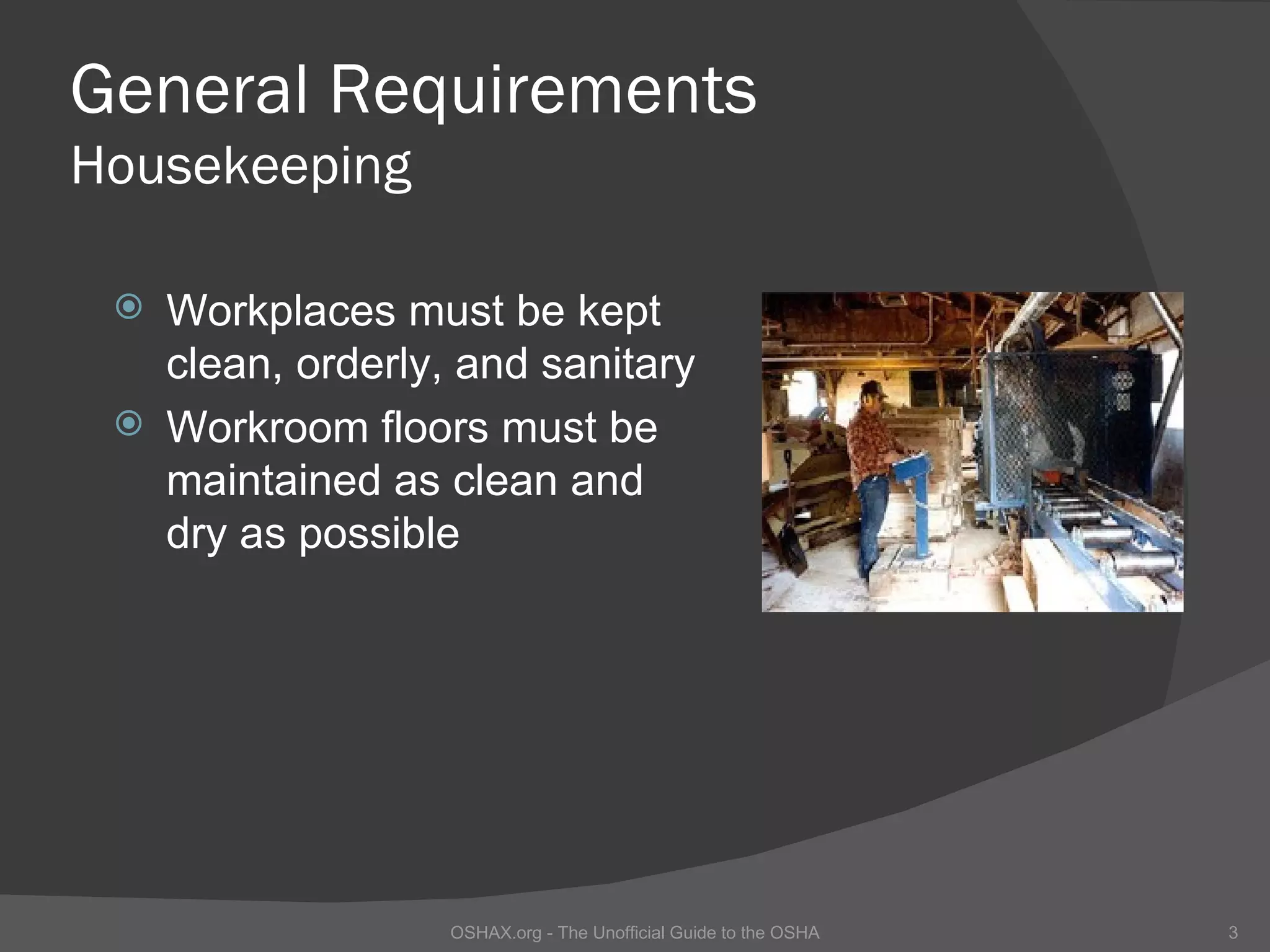
   Keep clear and move
    obstructions that could
    create a hazard
   Mark permanent aisles
    and passageways
   Aisles must be
    sufficiently wide where
    mechanical handling
    equipment is used


                 OSHAX.org - The Unofficial Guide to the OSHA   4
General Requirements
Covers and Guardrails

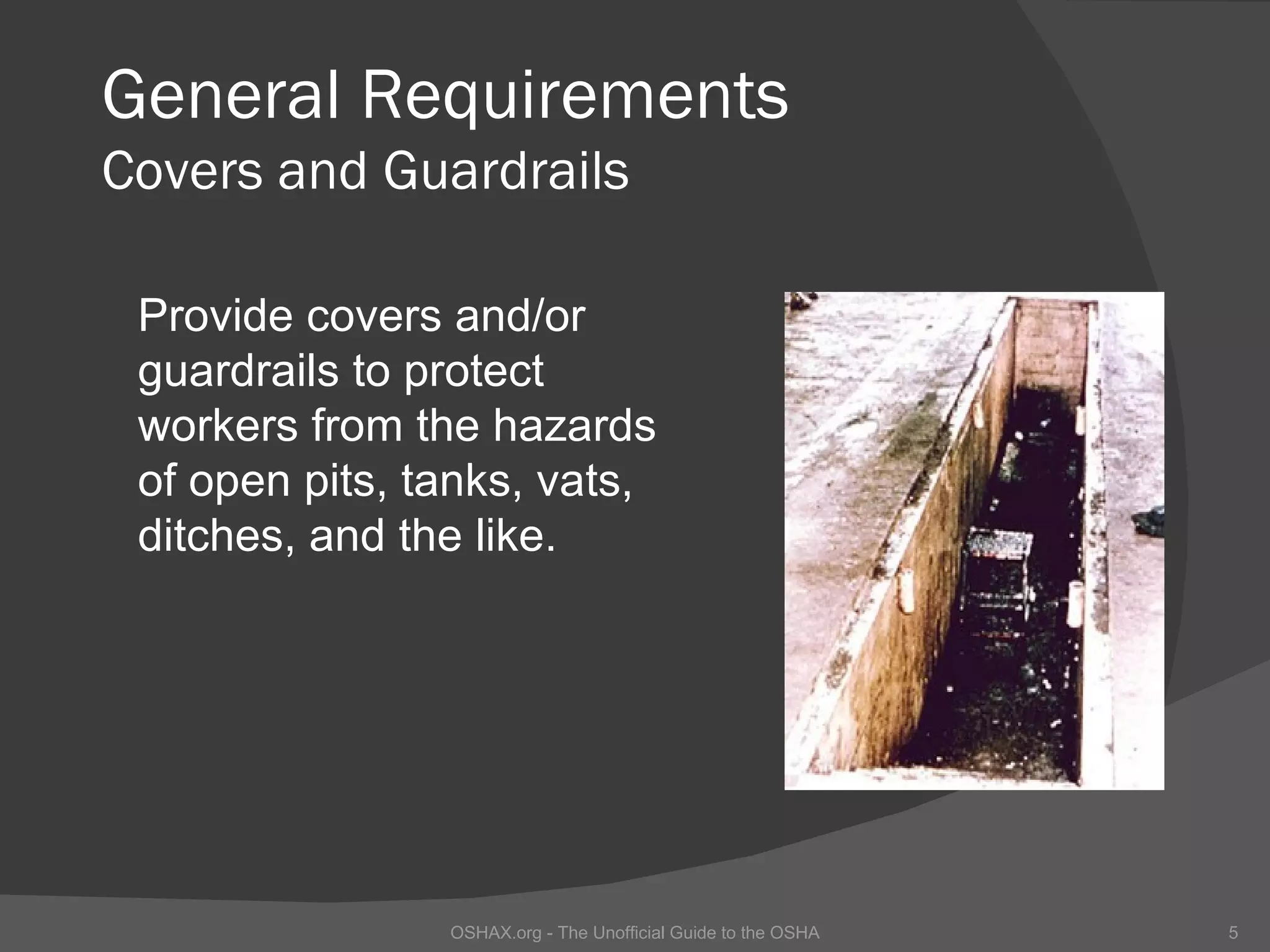
 Provide covers and/or
 guardrails to protect
 workers from the hazards
 of open pits, tanks, vats,
 ditches, and the like.


                OSHAX.org - The Unofficial Guide to the OSHA   5
General Requirements
Floor Loading Protection

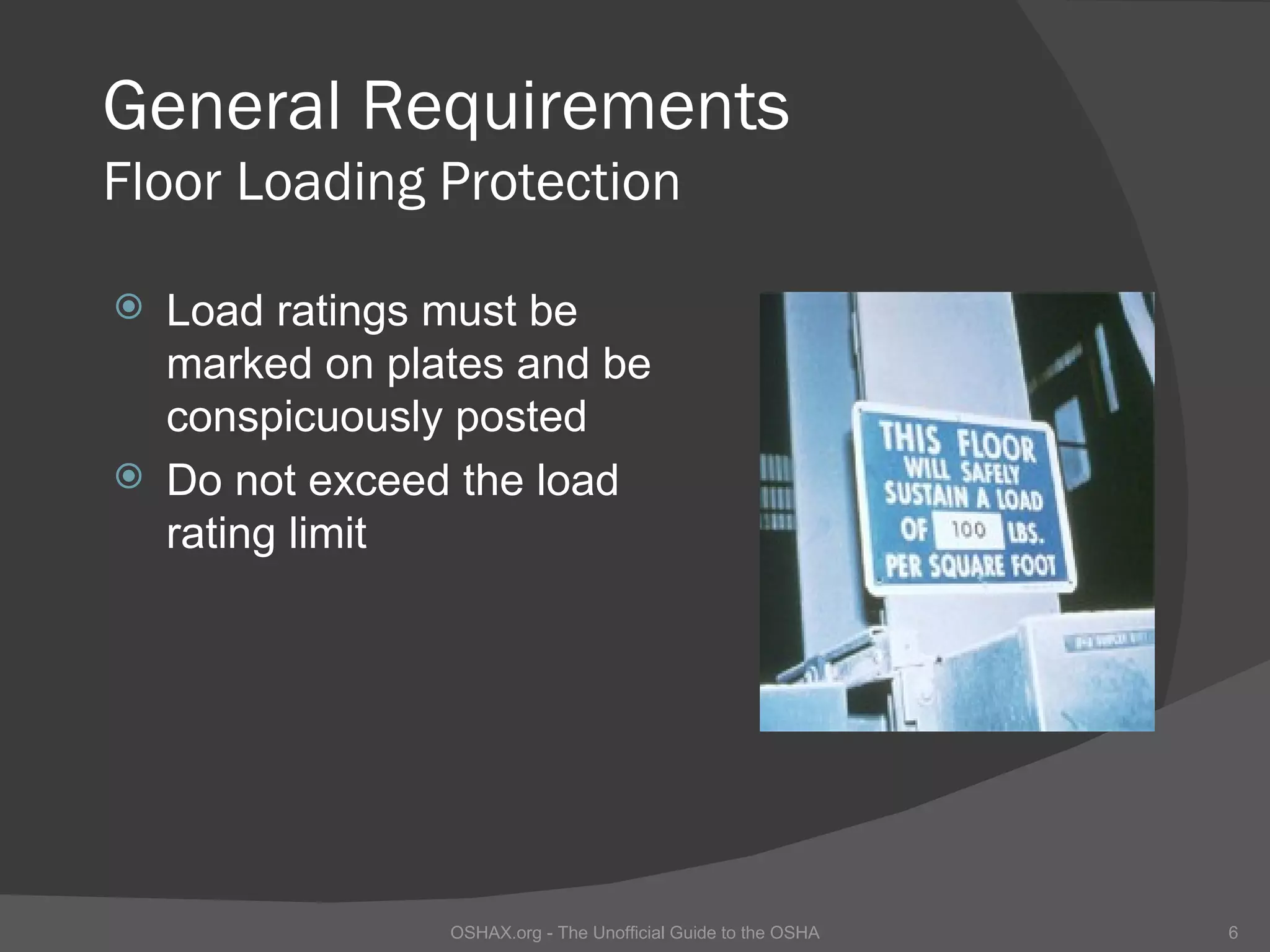
 Load ratings must be
  marked on plates and be
  conspicuously posted
 Do not exceed the load
  rating limit


               OSHAX.org - The Unofficial Guide to the OSHA   6
Floor Opening
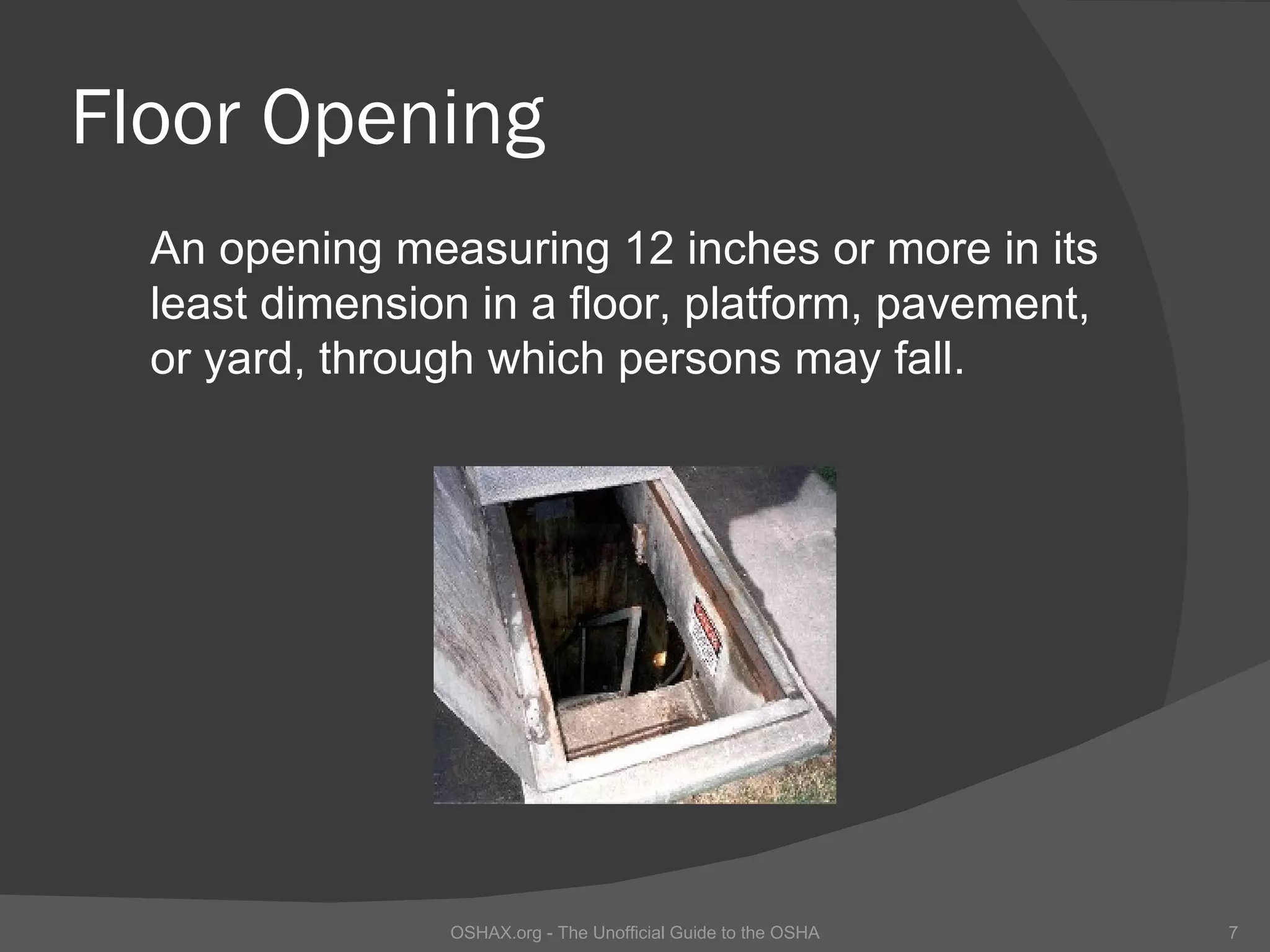
  An opening measuring 12 inches or more in its
  least dimension in a floor, platform, pavement,
  or yard, through which persons may fall.


                OSHAX.org - The Unofficial Guide to the OSHA   7
Guarding Floor Openings
Definitions
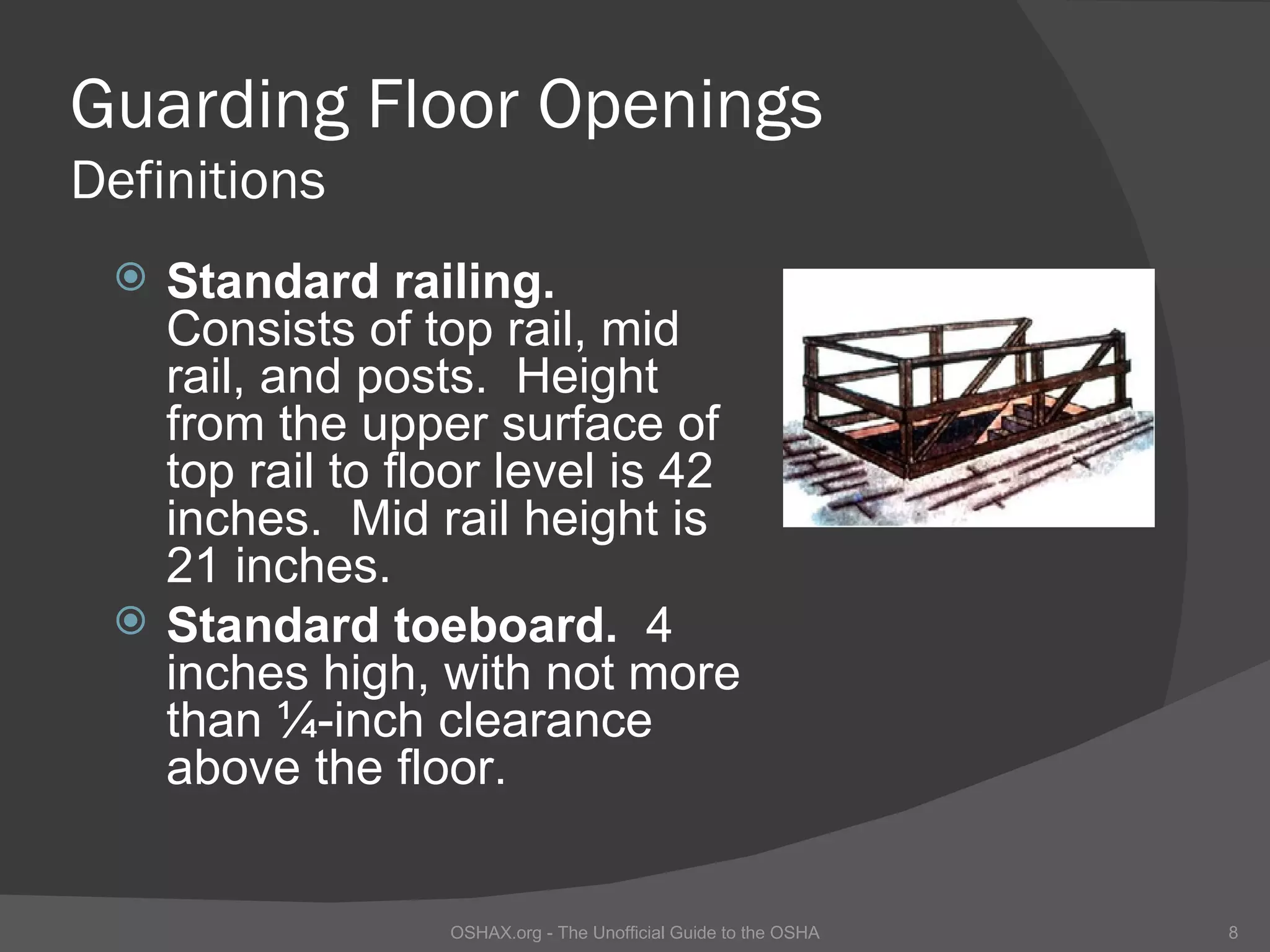
    Standard railing.
     Consists of top rail, mid
     rail, and posts. Height
     from the upper surface of
     top rail to floor level is 42
     inches. Mid rail height is
     21 inches.
    Standard toeboard. 4
     inches high, with not more
     than ¼-inch clearance
     above the floor.


                   OSHAX.org - The Unofficial Guide to the OSHA   8
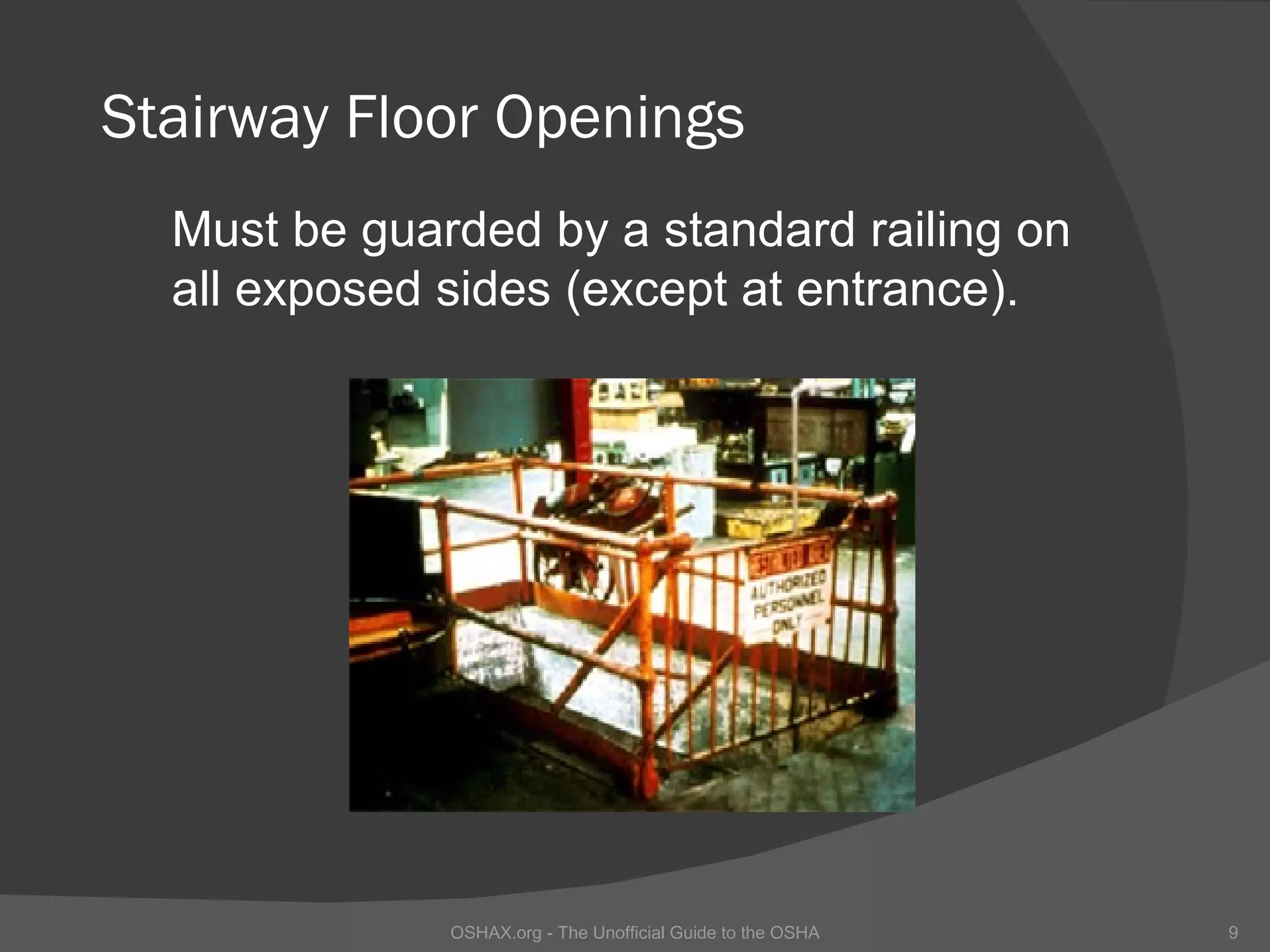
Stairway Floor Openings
  Must be guarded by a standard railing on
  all exposed sides (except at entrance).


              OSHAX.org - The Unofficial Guide to the OSHA   9
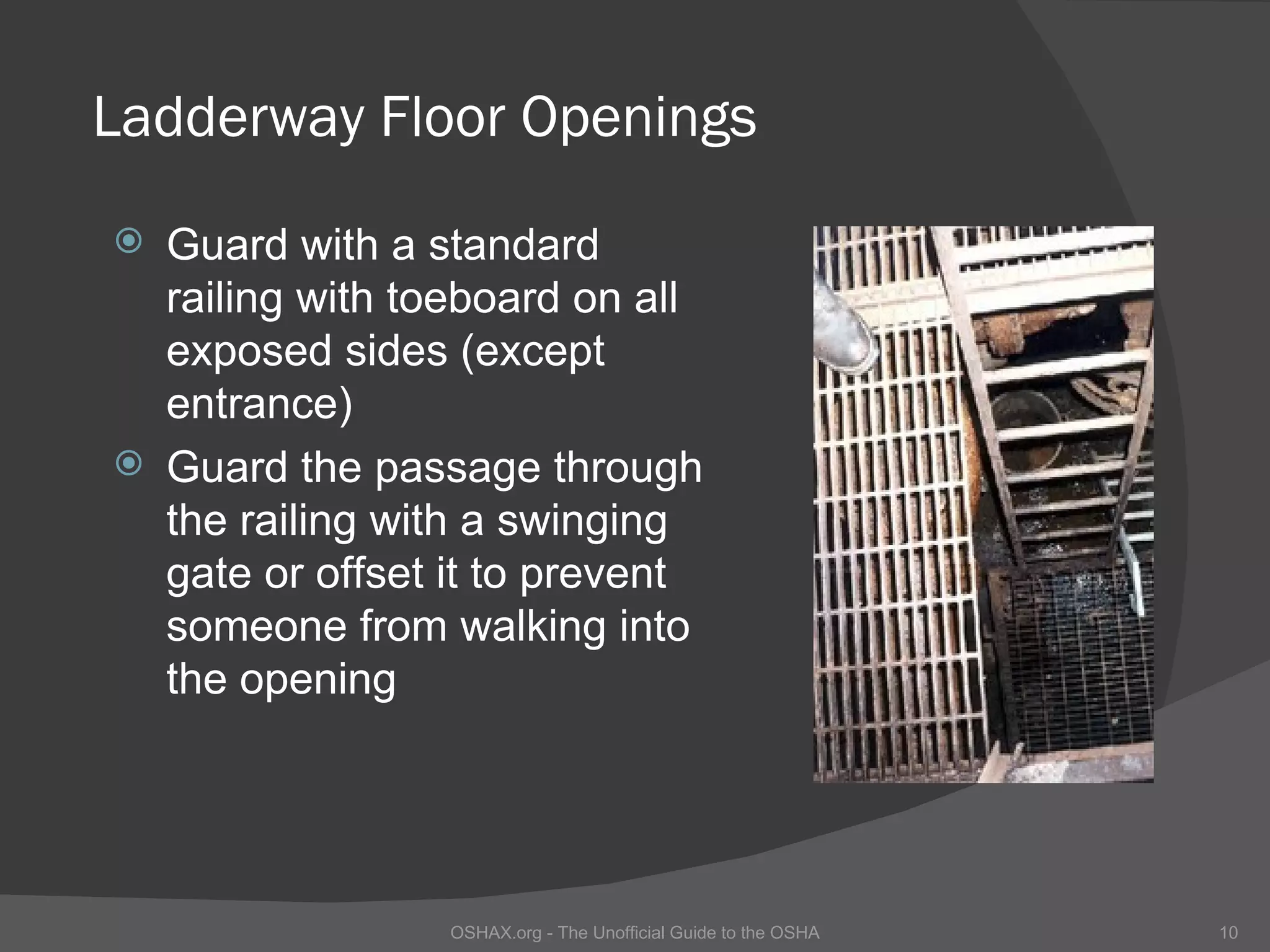
Ladderway Floor Openings
 Guard with a standard
  railing with toeboard on all
  exposed sides (except
  entrance)
 Guard the passage through
  the railing with a swinging
  gate or offset it to prevent
  someone from walking into
  the opening


                 OSHAX.org - The Unofficial Guide to the OSHA   10
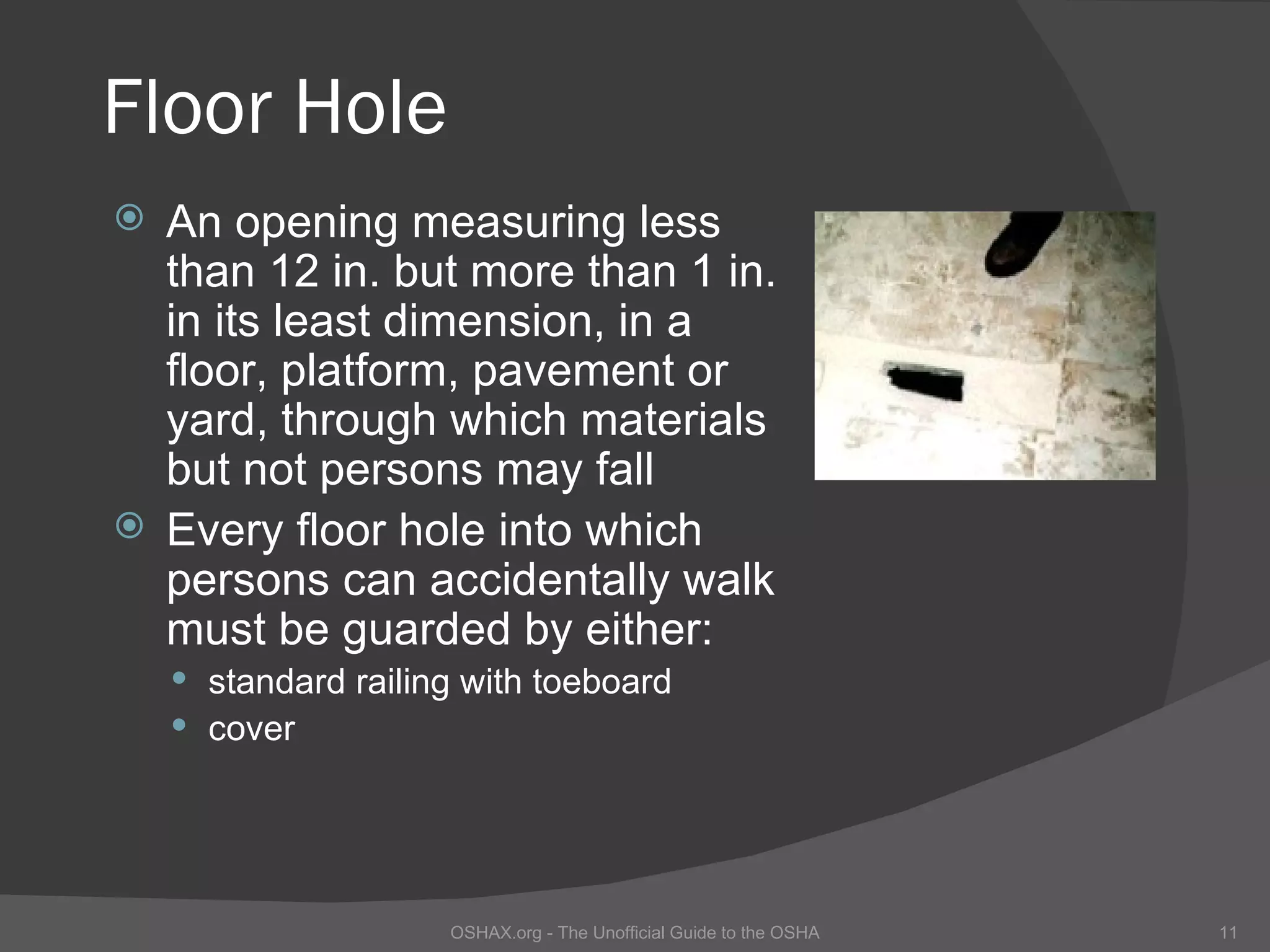
Floor Hole
 An opening measuring less
  than 12 in. but more than 1 in.
  in its least dimension, in a
  floor, platform, pavement or
  yard, through which materials
  but not persons may fall
 Every floor hole into which
  persons can accidentally walk
  must be guarded by either:
     standard railing with toeboard
     cover


                     OSHAX.org - The Unofficial Guide to the OSHA   11
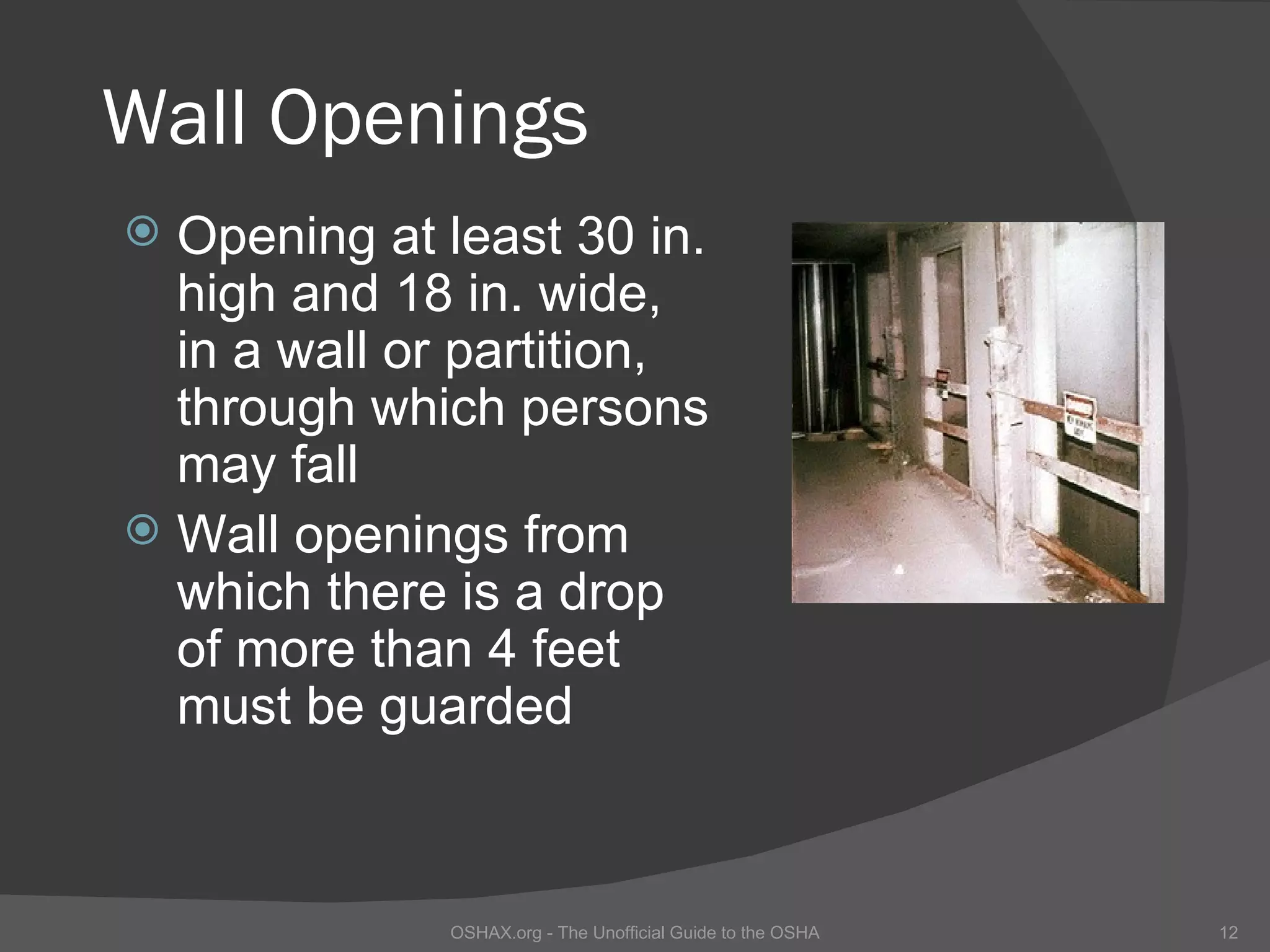
Wall Openings
 Opening at least 30 in.
  high and 18 in. wide,
  in a wall or partition,
  through which persons
  may fall
 Wall openings from
  which there is a drop
  of more than 4 feet
  must be guarded


             OSHAX.org - The Unofficial Guide to the OSHA   12
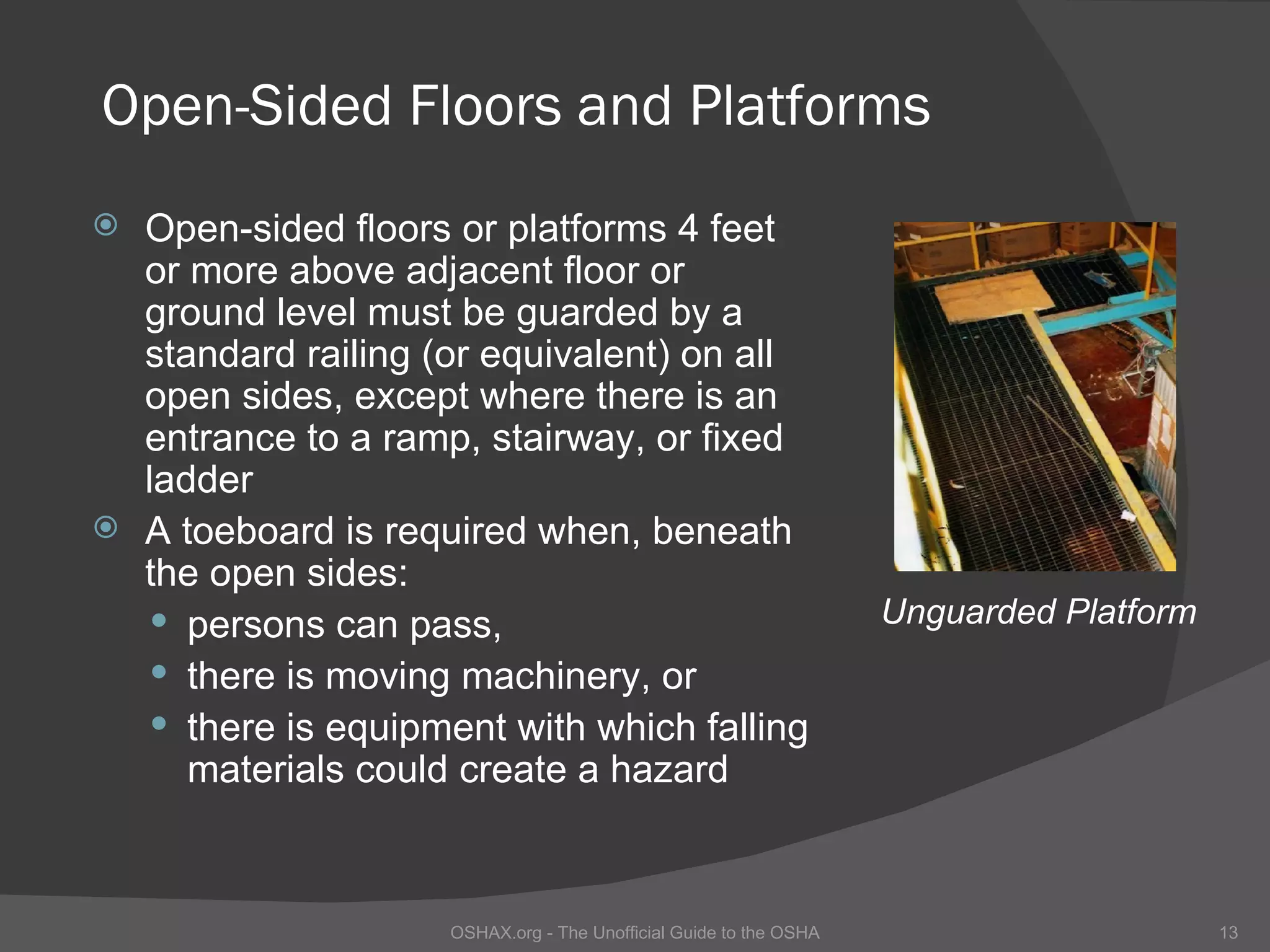
Open-Sided Floors and Platforms
 Open-sided floors or platforms 4 feet
  or more above adjacent floor or
  ground level must be guarded by a
  standard railing (or equivalent) on all
  open sides, except where there is an
  entrance to a ramp, stairway, or fixed
  ladder
 A toeboard is required when, beneath
  the open sides:
   persons can pass,                                              Unguarded Platform
   there is moving machinery, or
   there is equipment with which falling
     materials could create a hazard


                    OSHAX.org - The Unofficial Guide to the OSHA                        13
Open-Sided Floors, Walkways, Platforms,
and Runways

  Regardless of height, a standard railing and
  toeboard must be used to guard:
  - open-sided floors
  - walkways
  - platforms, or
  - runways
  above or adjacent to dangerous equipment,
  pickling or galvanizing tanks, degreasing
  units, and similar hazards.


                OSHAX.org - The Unofficial Guide to the OSHA   14
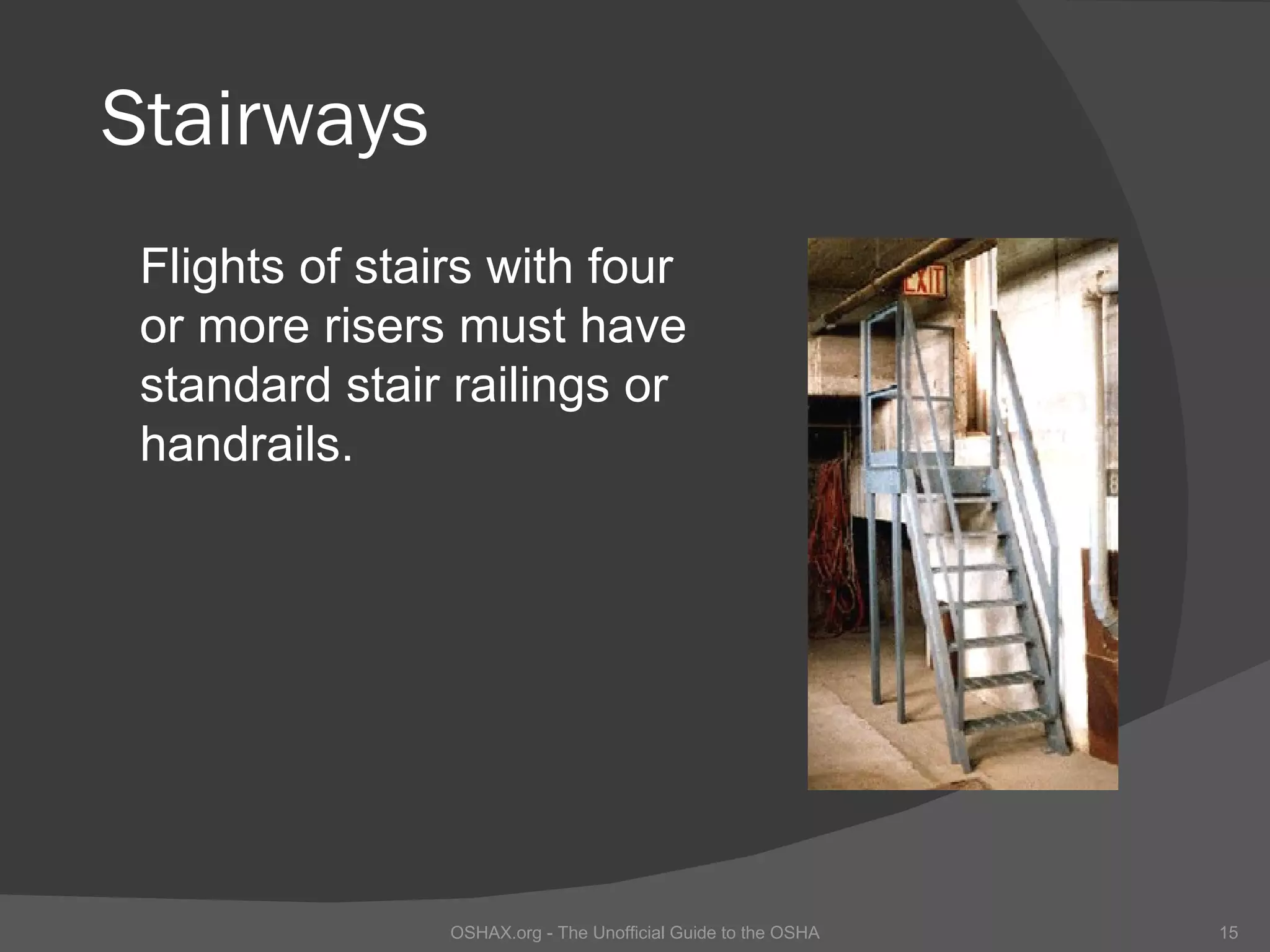
Stairways
 Flights of stairs with four
 or more risers must have
 standard stair railings or
 handrails.


                OSHAX.org - The Unofficial Guide to the OSHA   15
Fixed Industrial Stairs
   Treads must be slip
    resistant with uniform
    rise height and tread
    width
   Must be able to carry 5
    times expected load;
    minimum of 1000
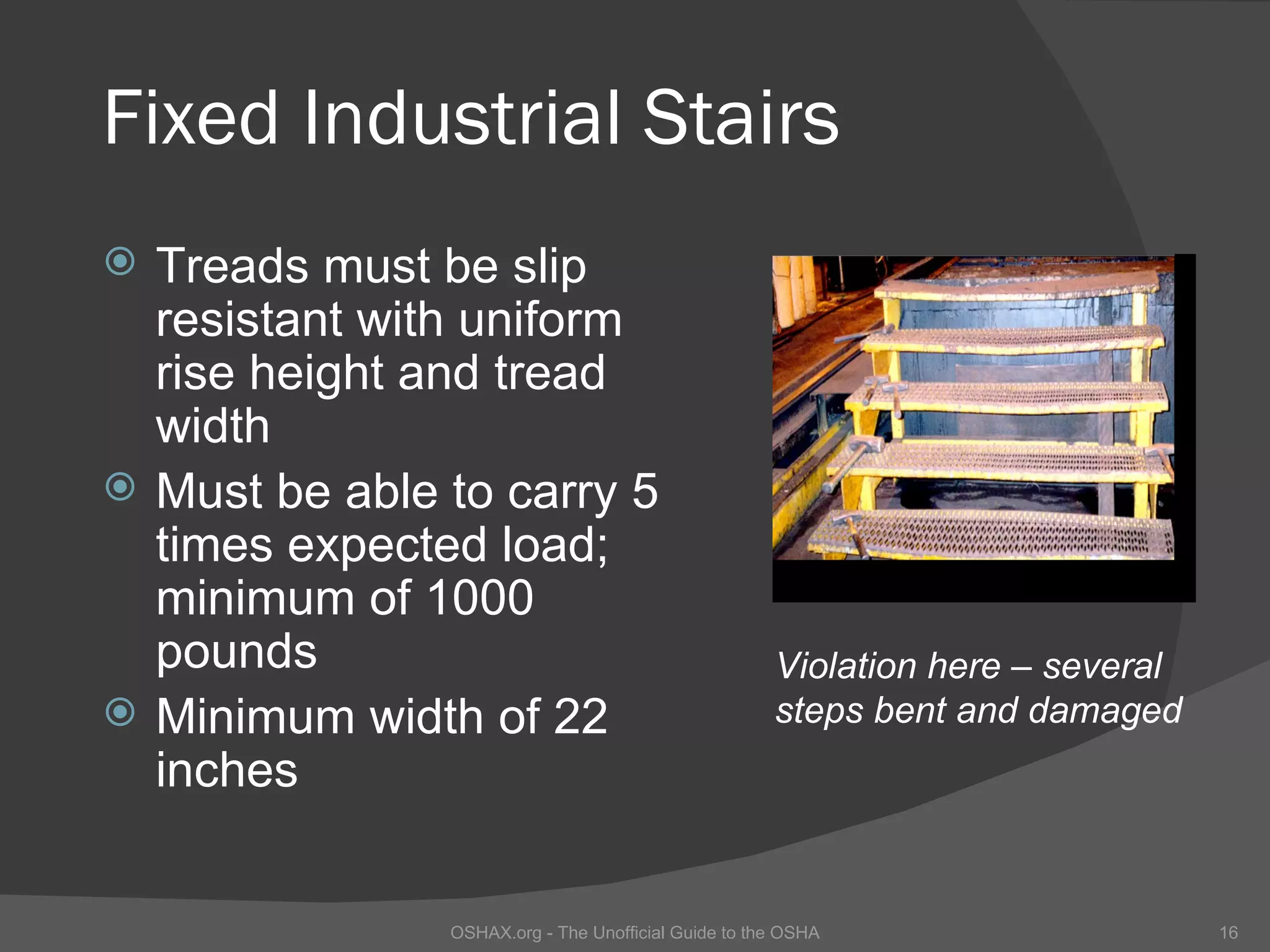
    pounds                                             Violation here – several
   Minimum width of 22                                steps bent and damaged
    inches


                 OSHAX.org - The Unofficial Guide to the OSHA                     16
Portable Ladders
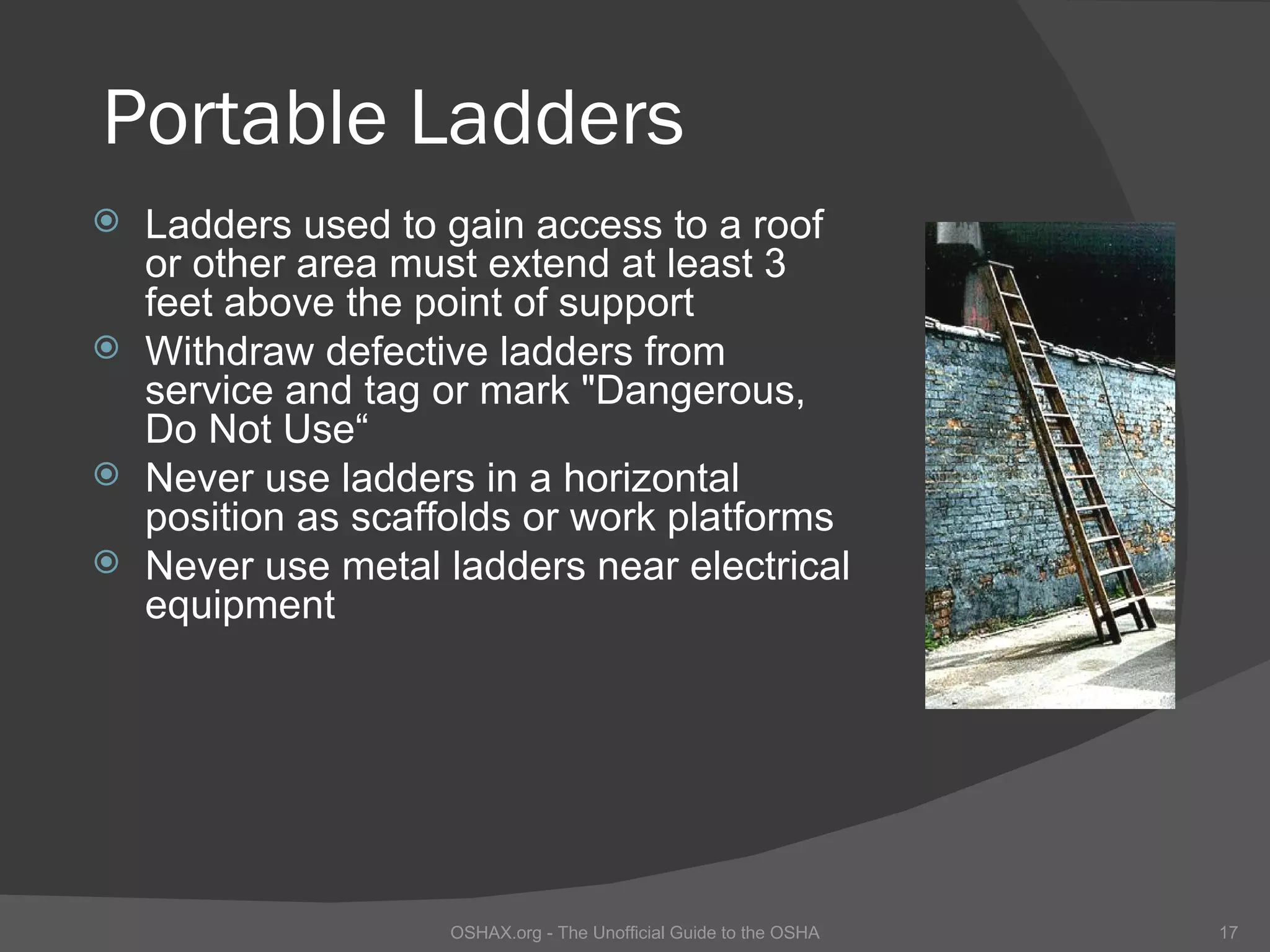
   Ladders used to gain access to a roof
    or other area must extend at least 3
    feet above the point of support
   Withdraw defective ladders from
    service and tag or mark "Dangerous,
    Do Not Use“
   Never use ladders in a horizontal
    position as scaffolds or work platforms
   Never use metal ladders near electrical
    equipment


                    OSHAX.org - The Unofficial Guide to the OSHA   17
Ladder Angle
Portable Rung and Cleat Ladders

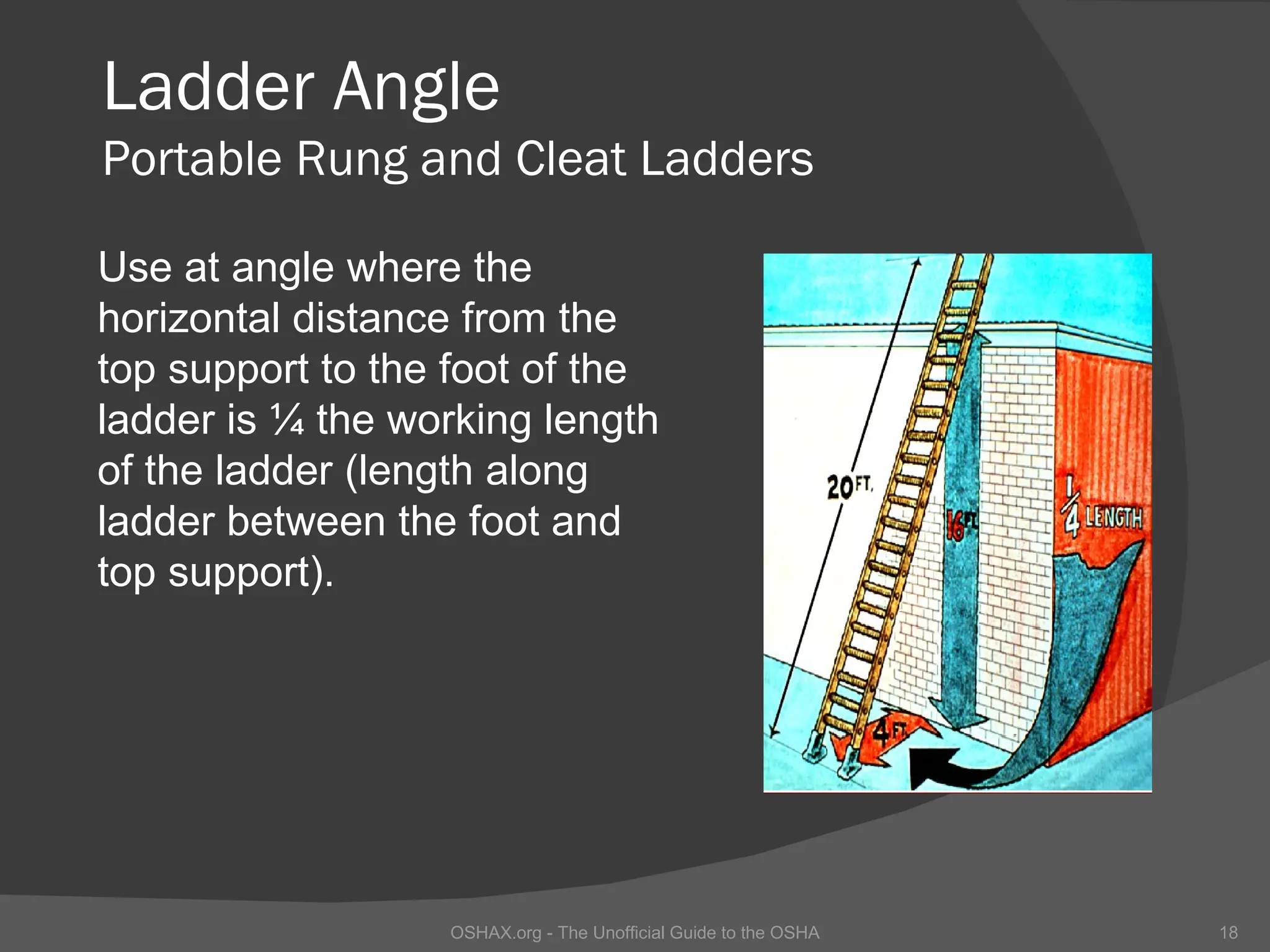
Use at angle where the
horizontal distance from the
top support to the foot of the
ladder is ¼ the working length
of the ladder (length along
ladder between the foot and
top support).


                  OSHAX.org - The Unofficial Guide to the OSHA   18
Fixed Ladders
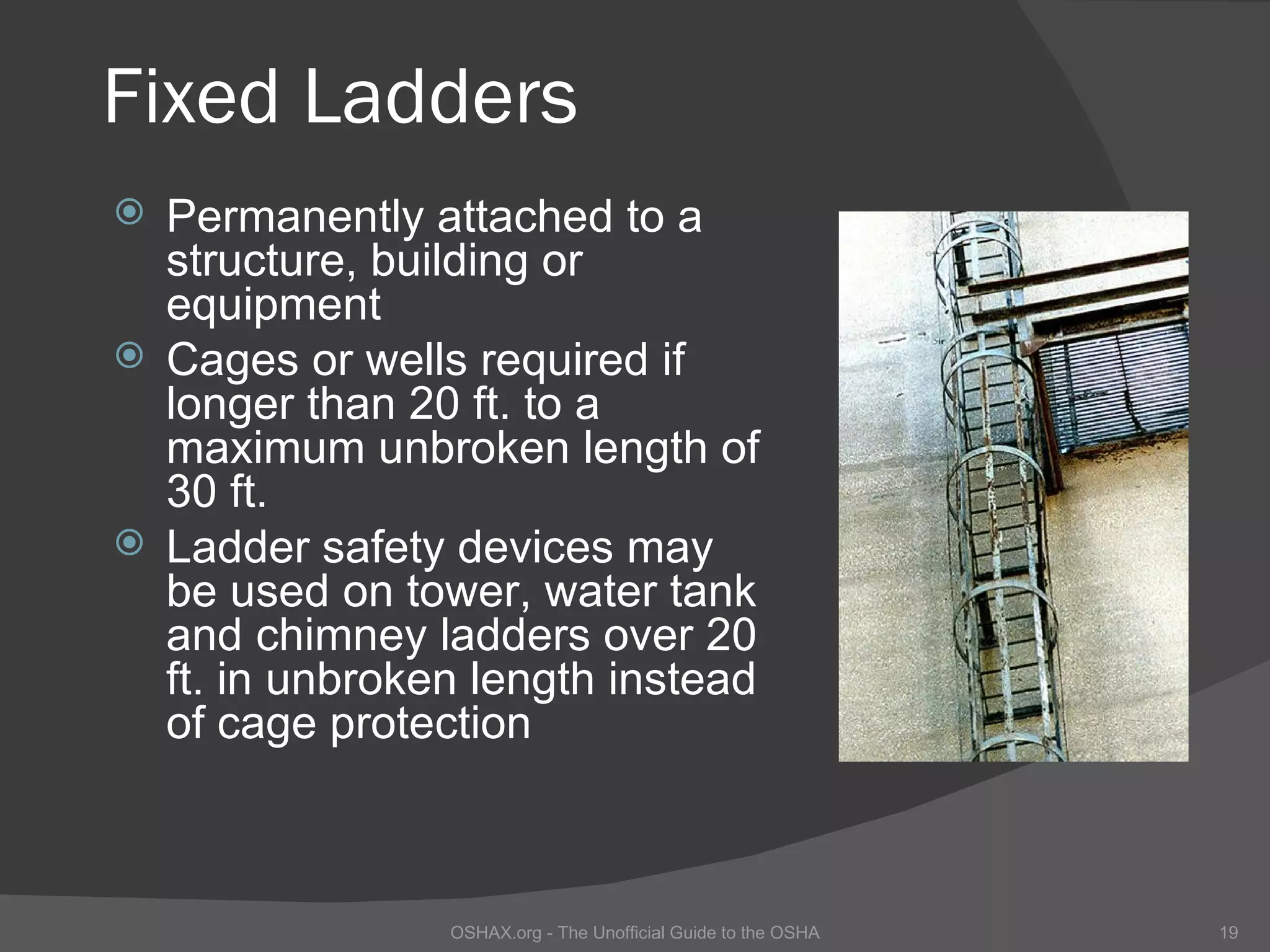
 Permanently attached to a
  structure, building or
  equipment
 Cages or wells required if
  longer than 20 ft. to a
  maximum unbroken length of
  30 ft.
 Ladder safety devices may
  be used on tower, water tank
  and chimney ladders over 20
  ft. in unbroken length instead
  of cage protection


                OSHAX.org - The Unofficial Guide to the OSHA   19
Scaffolding
General Requirements
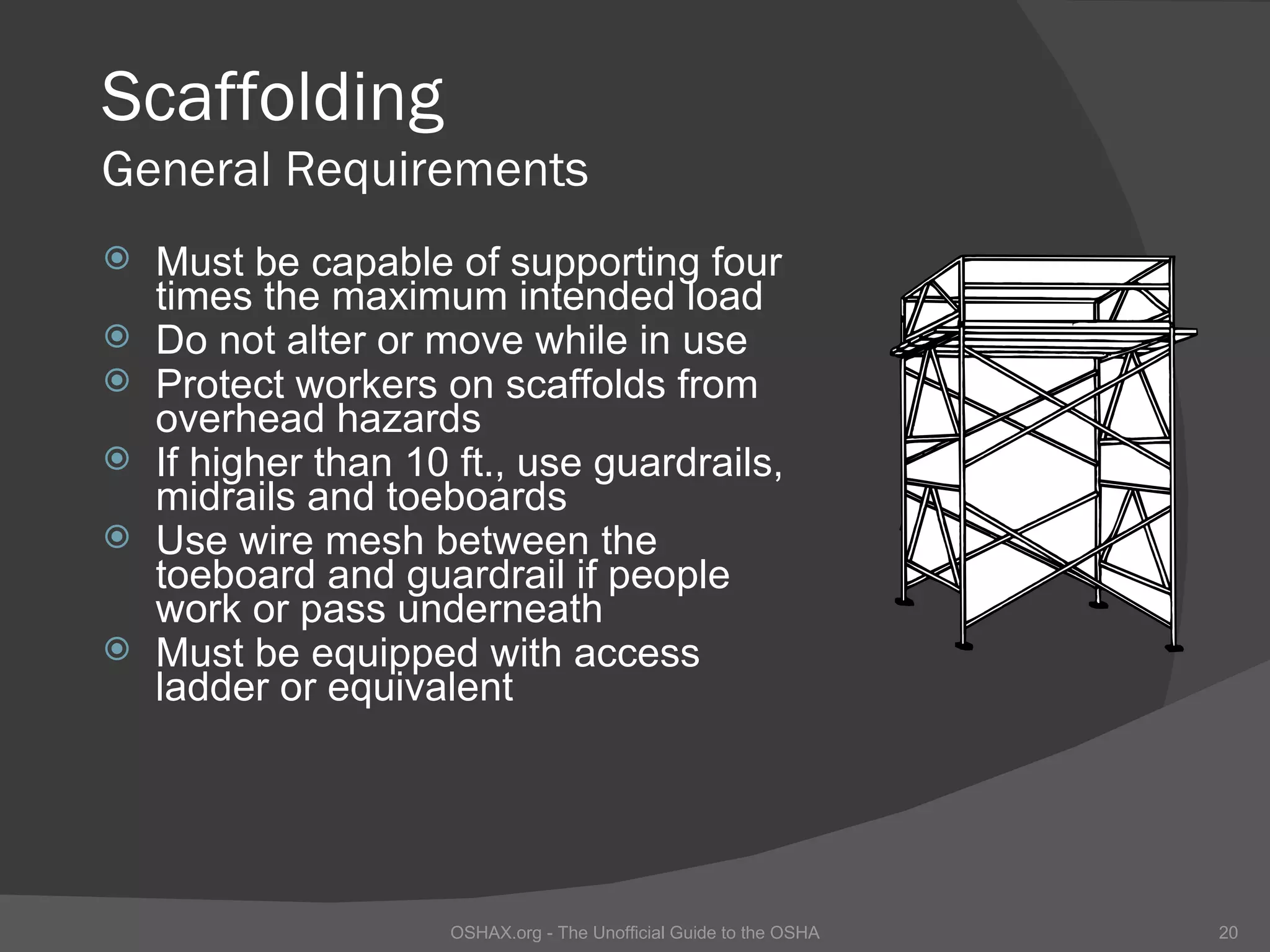
   Must be capable of supporting four
    times the maximum intended load
   Do not alter or move while in use
   Protect workers on scaffolds from
    overhead hazards
   If higher than 10 ft., use guardrails,
    midrails and toeboards
   Use wire mesh between the
    toeboard and guardrail if people
    work or pass underneath
   Must be equipped with access
    ladder or equivalent


                     OSHAX.org - The Unofficial Guide to the OSHA   20
Summary
 Slips, trips, and falls constitute the
  majority of general industry accidents
 OSHA’s standards for walking and
  working surfaces include requirements
  for housekeeping, guarding floor and
  wall openings and holes, industrial stairs
  and ladders
 Keeping working surfaces clean, dry,
  and uncluttered can prevent many
  workplace accidents

                OSHAX.org - The Unofficial Guide to the OSHA   21

Walk worksurfaces

  • 1.
    OSHAX.org - TheUnofficial Guide to the OSHA 1
  • 2.
    Introduction  Slips, tripsand falls cause:  the majority of general industry accidents  15 percent of all accidental deaths  more fatalities than all other causes but motor vehicles  OSHA’s standards for walking and working surfaces apply to all permanent places of employment, except where only domestic, mining, or agricultural work is performed OSHAX.org - The Unofficial Guide to the OSHA 2
  • 3.
    General Requirements Housekeeping Workplaces must be kept clean, orderly, and sanitary  Workroom floors must be maintained as clean and dry as possible OSHAX.org - The Unofficial Guide to the OSHA 3
  • 4.
    General Requirements Aisles andPassageways  Keep clear and move obstructions that could create a hazard  Mark permanent aisles and passageways  Aisles must be sufficiently wide where mechanical handling equipment is used OSHAX.org - The Unofficial Guide to the OSHA 4
  • 5.
    General Requirements Covers andGuardrails Provide covers and/or guardrails to protect workers from the hazards of open pits, tanks, vats, ditches, and the like. OSHAX.org - The Unofficial Guide to the OSHA 5
  • 6.
    General Requirements Floor LoadingProtection  Load ratings must be marked on plates and be conspicuously posted  Do not exceed the load rating limit OSHAX.org - The Unofficial Guide to the OSHA 6
  • 7.
    Floor Opening An opening measuring 12 inches or more in its least dimension in a floor, platform, pavement, or yard, through which persons may fall. OSHAX.org - The Unofficial Guide to the OSHA 7
  • 8.
    Guarding Floor Openings Definitions  Standard railing. Consists of top rail, mid rail, and posts. Height from the upper surface of top rail to floor level is 42 inches. Mid rail height is 21 inches.  Standard toeboard. 4 inches high, with not more than ¼-inch clearance above the floor. OSHAX.org - The Unofficial Guide to the OSHA 8
  • 9.
    Stairway Floor Openings Must be guarded by a standard railing on all exposed sides (except at entrance). OSHAX.org - The Unofficial Guide to the OSHA 9
  • 10.
    Ladderway Floor Openings Guard with a standard railing with toeboard on all exposed sides (except entrance)  Guard the passage through the railing with a swinging gate or offset it to prevent someone from walking into the opening OSHAX.org - The Unofficial Guide to the OSHA 10
  • 11.
    Floor Hole  Anopening measuring less than 12 in. but more than 1 in. in its least dimension, in a floor, platform, pavement or yard, through which materials but not persons may fall  Every floor hole into which persons can accidentally walk must be guarded by either:  standard railing with toeboard  cover OSHAX.org - The Unofficial Guide to the OSHA 11
  • 12.
    Wall Openings  Openingat least 30 in. high and 18 in. wide, in a wall or partition, through which persons may fall  Wall openings from which there is a drop of more than 4 feet must be guarded OSHAX.org - The Unofficial Guide to the OSHA 12
  • 13.
    Open-Sided Floors andPlatforms  Open-sided floors or platforms 4 feet or more above adjacent floor or ground level must be guarded by a standard railing (or equivalent) on all open sides, except where there is an entrance to a ramp, stairway, or fixed ladder  A toeboard is required when, beneath the open sides:  persons can pass, Unguarded Platform  there is moving machinery, or  there is equipment with which falling materials could create a hazard OSHAX.org - The Unofficial Guide to the OSHA 13
  • 14.
    Open-Sided Floors, Walkways,Platforms, and Runways Regardless of height, a standard railing and toeboard must be used to guard: - open-sided floors - walkways - platforms, or - runways above or adjacent to dangerous equipment, pickling or galvanizing tanks, degreasing units, and similar hazards. OSHAX.org - The Unofficial Guide to the OSHA 14
  • 15.
    Stairways Flights ofstairs with four or more risers must have standard stair railings or handrails. OSHAX.org - The Unofficial Guide to the OSHA 15
  • 16.
    Fixed Industrial Stairs  Treads must be slip resistant with uniform rise height and tread width  Must be able to carry 5 times expected load; minimum of 1000 pounds Violation here – several  Minimum width of 22 steps bent and damaged inches OSHAX.org - The Unofficial Guide to the OSHA 16
  • 17.
    Portable Ladders  Ladders used to gain access to a roof or other area must extend at least 3 feet above the point of support  Withdraw defective ladders from service and tag or mark "Dangerous, Do Not Use“  Never use ladders in a horizontal position as scaffolds or work platforms  Never use metal ladders near electrical equipment OSHAX.org - The Unofficial Guide to the OSHA 17
  • 18.
    Ladder Angle Portable Rungand Cleat Ladders Use at angle where the horizontal distance from the top support to the foot of the ladder is ¼ the working length of the ladder (length along ladder between the foot and top support). OSHAX.org - The Unofficial Guide to the OSHA 18
  • 19.
    Fixed Ladders  Permanentlyattached to a structure, building or equipment  Cages or wells required if longer than 20 ft. to a maximum unbroken length of 30 ft.  Ladder safety devices may be used on tower, water tank and chimney ladders over 20 ft. in unbroken length instead of cage protection OSHAX.org - The Unofficial Guide to the OSHA 19
  • 20.
    Scaffolding General Requirements  Must be capable of supporting four times the maximum intended load  Do not alter or move while in use  Protect workers on scaffolds from overhead hazards  If higher than 10 ft., use guardrails, midrails and toeboards  Use wire mesh between the toeboard and guardrail if people work or pass underneath  Must be equipped with access ladder or equivalent OSHAX.org - The Unofficial Guide to the OSHA 20
  • 21.
    Summary  Slips, trips,and falls constitute the majority of general industry accidents  OSHA’s standards for walking and working surfaces include requirements for housekeeping, guarding floor and wall openings and holes, industrial stairs and ladders  Keeping working surfaces clean, dry, and uncluttered can prevent many workplace accidents OSHAX.org - The Unofficial Guide to the OSHA 21

Editor's Notes

  • #2 This presentation is designed to assist trainers conducting OSHA 10-hour General Industry outreach training for workers. Since workers are the target audience, this presentation emphasizes hazard identification, avoidance, and control – not standards. No attempt has been made to treat the topic exhaustively. It is essential that trainers tailor their presentations to the needs and understanding of their audience. This presentation is not a substitute for any of the provisions of the Occupational Safety and Health Act of 1970 or for any standards issued by the U.S. Department of Labor. Mention of trade names, commercial products, or organizations does not imply endorsement by the U.S. Department of Labor.
  • #3 29 CFR Part 1910 Subpart D Walking-Working Surfaces ( §1910.21 to 1910.30)
  • #4 Some of the most frequently cited violations in Subpart D involve housekeeping [1910.22(a)]. Drainage must be maintained and gratings, mats or raised platforms must be provided where wet processes are used. Every floor, working place and passageway must be kept free from protruding nails, splinters, holes, or loose boards to facilitate cleaning.
  • #5 1910.22(b)
  • #6 1910.22(c)
  • #7 1910.22(d)
  • #8 1910.21(a)(2)
  • #9 1910.23(e)(1) and (4)
  • #10 1910.23(a)(1)
  • #11 1910.23(a)(2)
  • #12 1910.21(a)(1) 1910.23(a)(8) While the cover is not in place, the floor hole shall be constantly attended by someone or shall be protected by a standard railing with a standard toeboard. Every floor hole into which persons cannot accidentally walk (because of fixed machinery, equipment, or walls) shall be protected by a cover that leaves no openings more than 1 inch wide. The cover shall be securely held in place to prevent tools or materials from falling through.
  • #13 1910.23(b)(1) Guard using one of the following: rail, roller, picket fence, half door, or equivalent barrier. Where there is exposure below to falling materials, a removable toe board or the equivalent must also be provided.
  • #14 1910.23(c)(1)
  • #15 1910.23(c)(3)
  • #16 1910.23(d)(1) 1910.23(e)(2)
  • #17 1910.24 Applies to interior and exterior stairs around machinery, tanks and other equipment, and stairs leading to or from floors, platforms or pits. Does not apply to stairs used for fire exit purposes, to construction operations, to private residences, or to articulated stairs, such as those on floating roof tanks. Fixed industrial stairs are required for access to and from places of work where operations necessitate regular travel between levels.
  • #18 1910.25 1910.26 Maximum length : Stepladders – 20 ft, single-rung ladders – 30 ft., two-section rung ladders – 60 ft. Stepladders must be equipped with a metal spreader or locking device to securely hold the front and back sections in an open position. All ladders must be inspected periodically, kept in good condition at all times, and must be free from sharp edges, splinters, oil grease, or other defects which would affect their use. - Always place the ladder on secure footing and lock in place. - Short ladders shall not be spliced together to make long ladders. - The top of a regular stepladder shall not be used as a step. - Always face the ladder when climbing or descending.
  • #19 1910.25
  • #20 1910.27 All fixed ladders must be inspected regularly and be maintained in a safe condition. Preferred pitch in range of 75 to 90 degrees with horizontal.
  • #21 1910.28 Damaged or weakened scaffolds must not be used. A safe means must be provided to gain access to the working platform level through use of a ladder, ramp, etc. Never work on scaffolds during storms, high winds, ice, or snow. Always be aware of the hazards of overhead power lines when working on scaffolds .